
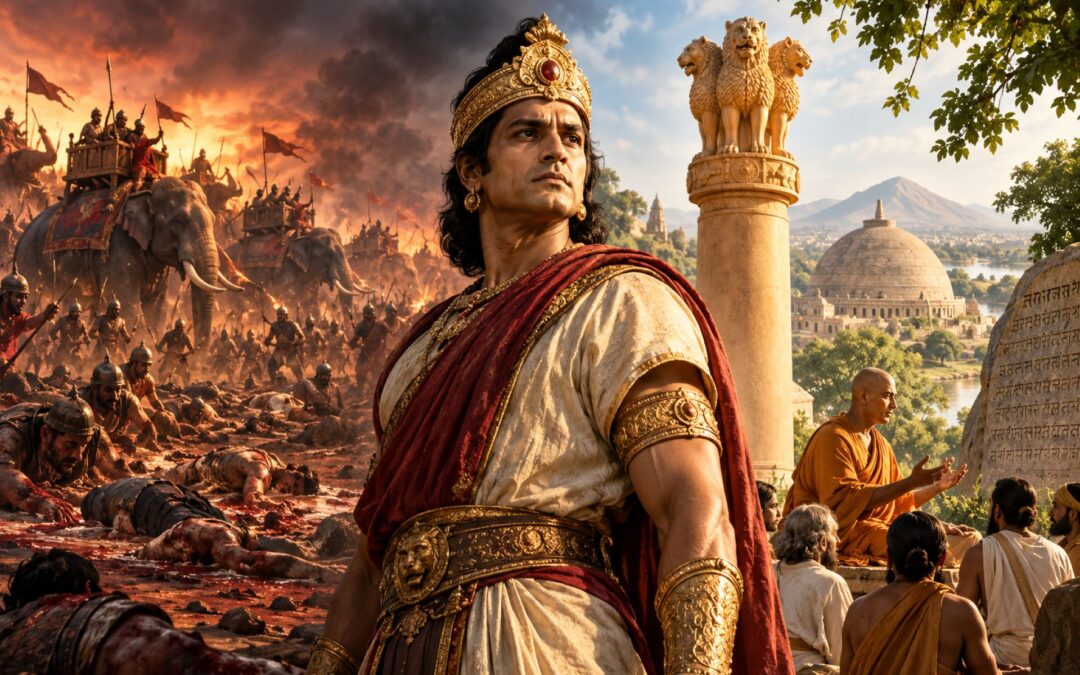
Few ancient rulers remain as visible in modern India as Emperor Ashoka. The Lion Capital from his pillar at Sarnath became the country’s State Emblem, while the 24-spoked Ashoka Chakra occupies the centre of its national flag. More than two thousand years after his death, these symbols continue to represent an emperor remembered for abandoning conquest, embracing Buddhism, and promoting a vision of government based on compassion and moral responsibility.
According to the familiar story, Ashoka began as a ruthless conqueror whose conscience awakened after witnessing the devastation of the Kalinga War. Horrified by the suffering he had caused, he supposedly renounced violence and transformed himself into an enlightened ruler. His conversion has become one of history’s most celebrated examples of personal redemption.
Yet the surviving evidence tells a more complicated story. Accounts of extraordinary cruelty come largely from Buddhist texts written long after his death, while his own inscriptions describe both compassion and the continuing authority to punish. His public works and religious patronage were significant, but their actual results are difficult to measure. Even the timing of his supposed conversion is less certain than popular accounts suggest.
Understanding Ashoka requires separating what his inscriptions establish, what later generations believed, and what modern historians can reasonably infer. Only then can we decide whether the emperor deserves his extraordinary reputation.
The Empire Ashoka Inherited
Ashoka belonged to the Mauryan dynasty, which established the first known empire to bring most of the Indian subcontinent under a single political authority. His grandfather, Chandragupta Maurya, founded the dynasty around 321 BCE after overthrowing the Nandas of Magadha. Through military expansion, diplomacy, and an agreement with the Seleucid ruler Seleucus I, Chandragupta established a powerful state centred on Pataliputra, near modern Patna.
The empire’s strength depended on more than territorial conquest. Its rulers inherited and developed systems of taxation, military organisation, provincial administration, and communication that allowed authority to extend across enormous distances. The Mauryan military also relied on resources such as cavalry and Indian war elephants, which provided battlefield capabilities and demonstrated royal power.
Chandragupta’s son Bindusara succeeded him and maintained the dynasty’s position. Ashoka, one of Bindusara’s sons, eventually inherited an empire that already possessed considerable military, economic, and administrative resources. His subsequent achievements must therefore be understood within the rise of the Mauryan Empire, rather than attributed entirely to his personal genius.
Unfortunately, reliable information about Ashoka’s childhood is scarce. Later Buddhist traditions identify his mother as Subhadrangi or Dharma and describe her as a Brahmin’s daughter who entered the royal household under circumstances involving a barber’s occupation. Different retellings complicate her social position, but there is no convincing contemporary evidence that her supposedly humble origins shaped Ashoka’s ambitions.
Stories about his appearance are similarly uncertain. Buddhist narratives sometimes describe him as physically unattractive or possessing rough skin, with his father consequently regarding him unfavourably. Such details may serve literary purposes, explaining how a supposedly undesirable prince became an extraordinary monarch. They cannot be treated as a reliable physical description or psychological explanation of his political career.
What can be established is that Ashoka emerged from a competitive royal dynasty and ultimately secured the throne of one of the ancient world’s largest empires.
The Violent Road to the Mauryan Throne
Ashoka’s accession is surrounded by stories of political rivalry, deception, and bloodshed. Buddhist traditions portray him as a capable but dangerous prince who overcame brothers with stronger claims to the throne. These narratives help explain the later image of Chandashoka, or Ashoka the Fierce, but they are not contemporary records of a documented succession struggle.
Some accounts associate Ashoka with administrative assignments at Taxila and Ujjain before he became emperor. Taxila was an important northwestern centre connected to trade routes, military activity, and cultural exchange, while Ujjain occupied a strategic position in central India. In later narratives, Ashoka’s involvement in suppressing unrest or governing these regions demonstrates his competence and political influence.
The surviving evidence does not establish the precise sequence of these appointments or the military operations supposedly involved. Nevertheless, the traditions suggest how later storytellers imagined Ashoka’s rise: a prince proving himself through provincial responsibility before challenging the established succession.
His principal rival is usually identified as his elder half-brother Susima. One famous account describes Susima being tricked into falling into a pit filled with burning charcoal. Other traditions claim that Ashoka killed numerous brothers, sometimes giving the extraordinary figure of ninety-nine.
These stories are striking, but their historical reliability is limited. Royal succession in ancient empires could certainly involve violence, and disputes within the Mauryan family are plausible. However, neither the charcoal-pit episode nor the precise number of murdered brothers is independently established.
There is also uncertainty surrounding Ashoka’s accession and coronation dates. Traditional reconstructions sometimes place a gap of several years between his acquisition of power and formal consecration, contributing to the suggestion of a prolonged struggle. That interval does not, by itself, prove a four-year civil war.
The customary chronology places Ashoka’s reign in the third century BCE, broadly from around 268 to 232 BCE, although different scholarly reconstructions vary. His inscriptions identify him through royal titles such as Devanampiya Piyadasi, commonly translated as Beloved of the Gods, He Who Looks with Affection. The exact relationship between these titles and the Ashoka of literary tradition became clearer through the modern decipherment and interpretation of inscriptions.
The safest conclusion is that Ashoka’s path to power may have been contentious, but the detailed portrait of a murderous usurper comes primarily from later storytelling. It is an important part of his remembered biography without being an independently verified account of his accession.
The Kalinga War and the Meaning of Remorse
The conquest of Kalinga is the decisive event in Ashoka’s historical reputation. Located along India’s eastern coast, broadly corresponding to parts of modern Odisha, Kalinga occupied a commercially and strategically important region outside Mauryan control. Its incorporation would strengthen imperial authority over the eastern seaboard.
Ashoka conquered Kalinga in the eighth year after his coronation, according to his own inscriptional chronology. The campaign was exceptionally destructive, at least as represented in the emperor’s subsequent proclamations.
In Ashoka’s own account of the Kalinga campaign, preserved in Major Rock Edict XIII, he reports that 150,000 people were carried away, 100,000 were killed, and many times that number died from other causes. These figures come from the victorious ruler himself. They demonstrate the scale of suffering he chose to acknowledge, although historians cannot independently verify their numerical precision.
The inscription’s significance goes beyond the battlefield casualties. Ashoka describes the suffering experienced by families, religious communities, and people who had survived the immediate violence. Deportation, separation, and the deaths of loved ones extended the consequences of conquest far beyond soldiers killed during combat.
This concern makes Edict XIII an unusual surviving statement of royal responsibility. Ancient monarchs frequently celebrated victories, territorial expansion, and the humiliation of their enemies. Ashoka instead publicly represented conquest as an activity whose human consequences should trouble the conqueror.
He also promoted dhamma-vijaya, commonly understood as conquest through dhamma or moral influence, as preferable to ordinary military conquest. This provided an alternative language of imperial achievement in which ethical conduct and persuasion could be presented as greater victories than battlefield success.
Yet Ashoka’s expression of remorse did not amount to an unconditional renunciation of coercion. The same edict addresses forest peoples under his authority and makes clear that the emperor retained the power to punish them. His message encouraged restraint while reminding potentially troublesome communities of the consequences of defiance.
This is one of the most important qualifications to the conventional conversion story. Ashoka did not dissolve his army, abandon political authority, or transform the Mauryan Empire into a pacifist society. He continued to govern an expansive monarchy in which punishment and military force remained available.
Nevertheless, the continued existence of coercive power does not establish that his regret was insincere. A ruler could become more conscious of suffering while believing that maintaining order sometimes required force. Whether that position was morally adequate is a separate question from whether his remorse was genuine.
The historical evidence therefore supports a change in Ashoka’s public presentation of conquest, particularly after Kalinga. It does not give historians direct access to his conscience or prove that every aspect of his subsequent government matched his proclaimed ideals.
When Did Ashoka Become a Buddhist?
The familiar account presents Ashoka’s conversion as an immediate consequence of the Kalinga War. After witnessing the battlefield’s destruction, the emperor supposedly embraced Buddhism and rejected his earlier violence. This creates a compelling narrative, but the chronology of his religious development is considerably more complicated.
One important piece of evidence is Minor Rock Edict I, in which Ashoka describes his experience of becoming a Buddhist lay follower. He distinguishes an initial period of relatively limited religious effort from a subsequent period of greater commitment associated with closer contact with the Buddhist community.
This suggests a process of religious development rather than a single instantaneous transformation. Ashoka could identify with Buddhism before becoming particularly devoted to its practice, and increasing religious commitment might have continued over several years.
Determining how this development relates to Kalinga is difficult. Scholars differ in reconstructing the relevant inscriptional dates and in interpreting expressions of lay adherence and participation in the Buddhist community. The edicts do not provide a simple account of a battlefield conversion at the moment traditionally imagined.
Equally, it would be misleading to assert with certainty that Ashoka was already a committed Buddhist several years before the war on the basis of an uncontested fourth-, fifth-, or seventh-regnal-year sequence. That precise reconstruction goes beyond what the available evidence securely establishes.
Another distinction concerns personal Buddhism and public dhamma. Ashoka’s inscriptions reveal strong Buddhist affiliations, and later Buddhist traditions remember him as a major supporter of the religion. His government, however, promoted ethical principles that were not identical to requiring every subject to accept Buddhist doctrine.
The movement from conquest toward moral governance and the development of Ashoka’s Buddhist commitment may have influenced each other. Kalinga could have intensified religious concerns that had already emerged, while Buddhism could have supplied an intellectual and moral language through which he interpreted the violence of imperial rule.
This more gradual possibility lacks the dramatic simplicity of the familiar conversion story, but it better respects the evidence. Ashoka’s religious transformation remains historically significant even when its precise starting point and psychological causes cannot be established.
What Ashoka’s Edicts Said—and What They Left Out
Much of what makes Ashoka historically distinctive is the extraordinary collection of inscriptions distributed across his empire. Written on rocks and pillars in different regions, scripts, and languages, they communicated royal instructions and ethical ideals to audiences far from Pataliputra.
These inscriptions provide an unusually direct opportunity to study how an ancient Indian emperor represented himself. The National Museum’s material on Ashoka’s edicts also highlights their importance for understanding the Mauryan world.
However, Ashoka’s inscriptions were royal communications, not neutral histories of his reign. They were composed under imperial authority and intended to influence how people understood the ruler’s responsibilities, policies, and legitimacy. Their value as contemporary evidence does not eliminate the need to interpret their political purposes.
The inscriptions found in Kalinga illustrate this problem particularly well. At sites such as Dhauli and Jaugada, certain general major rock edicts were replaced by separate administrative instructions directed toward the newly conquered territory.
The absence of Major Rock Edict XIII, with its famous statement of remorse, from these local sequences has attracted considerable attention. The emperor’s acknowledgment of Kalinga’s suffering survives elsewhere, while the inscriptions in the conquered region emphasize matters such as humane administration, official conduct, and relations with the population.
This difference invites questions about audience and intention. Was Ashoka more interested in demonstrating remorse to distant subjects than in apologizing to the people he had conquered? Did he consider administrative reassurance more useful in Kalinga than a public retelling of the war?
Such interpretations are possible, but the omission alone cannot settle them. The local edicts address the specific problems of governing a recently conquered population, and their practical emphasis does not necessarily mean that expressions of regret elsewhere were fraudulent.
Major Rock Edict XIV also acknowledges that the inscriptions differ in extent and presentation. It refers to variations in the material communicated and recognizes imperfections in transmission. This demonstrates that the surviving texts were not intended to be identical everywhere, but it should not be treated as a confession that the emperor deliberately falsified his political record.
At Dhauli, where the surviving Kalinga inscriptions form part of the historical landscape, the relationship between conquest and governance is especially visible. The inscriptions direct attention toward officials, justice, and the treatment of people living under imperial authority.
The broader lesson is that Ashoka’s proclamations reveal both political ideals and techniques of rulership. His use of inscriptions helped create a public image of an emperor personally concerned with ethical conduct across a culturally diverse realm. Whether that image fully reflected government practice remains a different and much harder historical question.
Chandashoka, the Torture Prison, and the Persecution Stories
If Ashoka’s inscriptions emphasize compassion, later Buddhist narratives preserve a ruler whose earlier conduct was extraordinarily cruel. The contrast between Chandashoka, Ashoka the Fierce, and Dharmashoka, Ashoka the Righteous, became central to the religious and literary memory of his life.
Among the most disturbing stories is the account of Ashoka’s Hell, a specially constructed prison or torture facility. In the narrative, an executioner named Girika administers brutal punishments within a building whose outward appearance conceals its horrifying purpose. Ashoka is associated with the facility before his moral transformation.
Other stories describe violent treatment of people in the royal household, including women who supposedly offended the emperor by criticizing his appearance. These episodes reinforce a portrait of uncontrolled royal cruelty, making his eventual commitment to Buddhist morality appear all the more remarkable.
The problem is that these accounts come from later Buddhist traditions about Ashoka’s cruelty, particularly the Ashokavadana, rather than contemporary administrative records. They belong to a literary world in which dramatic violence can establish the moral distance between a sinner’s previous conduct and his subsequent religious achievements.
Chinese Buddhist travellers such as Faxian and Xuanzang encountered and recorded traditions associated with Ashoka centuries after his death. References to places identified with his torture prison show how enduring these stories became. They do not independently establish that the legendary facility existed in the form described.
The distinction becomes especially important when considering accusations of religious persecution after Ashoka’s supposed transformation.
Later Buddhist narratives describe an episode in which the emperor ordered the killing of 18,000 Ajivikas in response to an offensive representation of the Buddha. Another story concerns the punishment of a Jain associated with an insulting image, followed by a bounty allegedly offered for Jain heads. In the narrative, the danger of indiscriminate violence eventually reaches Ashoka’s own family.
These accounts should not be suppressed merely because they conflict with an admired ruler’s reputation. They are part of the historical development of Ashoka’s image and show that Buddhist traditions themselves could portray a supposedly righteous king committing terrible acts.
Yet they cannot responsibly be repeated as independently established massacres. Their sources are late, the numbers are uncorroborated, and the episodes frequently serve religious or moral narrative purposes.
There is also significant evidence complicating the claim that Ashoka systematically persecuted Ajivikas. Inscriptions associated with the Barabar caves record his donations of cave shelters to the Ajivika community. These grants demonstrate that the emperor could extend patronage beyond Buddhism and make any simple picture of unrelenting anti-Ajivika hostility difficult to sustain.
This does not prove that every allegation of violence is false. It means that the historian must account for conflicting forms of evidence rather than accepting whichever account best supports admiration or condemnation.
A similar correction is necessary regarding Kharavela, the later ruler of Kalinga. His Hathigumpha inscription describes the recovery of a sacred Jain object previously taken from Kalinga and attributes its earlier removal to a Nanda ruler. The inscription cannot therefore be used as evidence that Kharavela personally avenged an object stolen by Ashoka.
What emerges is not a definitive acquittal or conviction of Ashoka on every allegation. It is a distinction between contemporary records, later religious memory, and claims that cannot presently be demonstrated. The violent legends deserve examination precisely because they reveal how deeply Ashoka’s moral reputation became intertwined with storytelling.
Dhamma as Government: Tolerance, Discipline, and Welfare
Ashoka’s most distinctive political project was the promotion of dhamma, an ethical framework presented as a guide for both personal conduct and imperial administration. Its principles included respect for parents and elders, generosity, restraint, concern for living beings, and proper behaviour toward different religious communities.
Dhamma was not simply Buddhism imposed on the population. Although the emperor identified strongly with Buddhist practice, his public proclamations addressed conduct that people from multiple traditions could recognize as morally important. This distinction mattered in an empire containing different languages, communities, customs, and religious institutions.
The policy nevertheless had an unmistakable political dimension. Ashoka was not merely encouraging private virtue; he was using imperial institutions to promote a particular understanding of proper conduct.
He appointed officials known as dhamma-mahamatras, whose responsibilities included attending to the welfare of different communities and helping implement the emperor’s ethical priorities. His inscriptions describe their activities among religious groups, householders, vulnerable people, and those affected by imprisonment or other administrative decisions.
Other officials were also expected to communicate policy, inspect conditions, and report matters requiring royal attention. Ashoka described his willingness to receive information about public affairs even while occupied with personal activities, presenting attentiveness to government as a fundamental royal responsibility.
Such measures could improve communication between the centre and distant communities, encourage humane treatment, and provide opportunities for grievances to reach imperial authorities. They could also extend the government’s involvement in moral and social life, making royal expectations relevant to matters beyond taxation and security.
The available inscriptions do not establish that the dhamma-mahamatras numbered 81,000 or consumed one-quarter of government revenue. There is no sufficiently reliable basis for using those precise figures to reconstruct an enormous, financially ruinous bureaucracy.
Ashoka’s religious policies are equally complex. Several inscriptions encourage restraint in praising one’s own tradition and criticizing others, emphasizing the importance of mutual respect. These proclamations are striking examples of an ancient ruler publicly supporting coexistence.
However, as Robert A. Yelle examines in his study of Ashoka’s policy of religious toleration, ancient dhamma should not be confused with modern secular government. Ashoka promoted a shared ethical order through state authority rather than establishing a strict separation between religion and political power.
His treatment of animals also reflected moral intervention. The edicts describe restrictions on slaughter and sacrifice, protections for particular species, and efforts to limit certain forms of killing. These policies show concern for living beings, although they should not be simplified into a universal prohibition on all animal killing or an independently verified system of modern wildlife reserves.
The same government continued to use punishment. One pillar edict describes a period of respite for people sentenced to death, offering time for appeals or religious preparation. This was a humane modification of an existing practice, not the abolition of capital punishment.
Ashoka’s dhamma therefore combined ethical aspiration, administrative supervision, religious accommodation, and continuing royal authority. Its historical importance lies partly in that combination: the emperor attempted to make moral responsibility an explicit language of government without surrendering the coercive powers on which an empire depended.
What Can We Really Credit Ashoka With Building?
Ashoka’s reputation as a reformer includes stories of hospitals, roads, irrigation systems, educational institutions, and public welfare projects. Some of these claims have foundations in his inscriptions, while others have grown far beyond what the evidence establishes.
Major Rock Edict II describes provisions for medical treatment for people and animals, including medicinal plants and other useful resources. Other proclamations refer to wells, shade trees, and improvements intended to make travel and everyday life easier.
These measures are noteworthy because they present public welfare as a responsibility of kingship. Instead of justifying authority exclusively through military success or dynastic inheritance, Ashoka emphasized the ruler’s obligation to reduce suffering and improve material conditions.
However, announcing a policy is not the same as demonstrating its successful implementation. The inscriptions do not provide comprehensive budgets, operational records, or independent assessments establishing how consistently these services functioned throughout the empire.
The frequently repeated claim that Ashoka founded a large network of hospitals illustrates this problem. In his examination of the evidence for hospitals in early India, historian Dominik Wujastyk challenges confident attributions of hospital foundations to Ashoka and examines the broader historical record for organized medical care.
Ashoka’s statements about medical treatment support a commitment to healthcare-related provisions. They do not automatically establish institutions equivalent to modern hospitals.
Similar caution applies to assertions that Ashoka founded universities or created scholarship programmes specifically for women. Educational traditions and institutions certainly existed in ancient India, but there is insufficient evidence for crediting these particular modern-style initiatives to his administration.
Archaeology offers a more grounded way to appreciate the built environment of his era. Pataliputra, for example, possessed substantial timber fortifications and monumental structures associated with the Mauryan period. These remains illuminate administration and public infrastructure in ancient Indian cities without requiring unsupported claims about every institution supposedly established by Ashoka.
There is also the problem of evaluating relative achievement. Powerful monarchs were expected to maintain infrastructure, support economic activity, and administer their territories. The existence of public projects does not, by itself, demonstrate that one ruler governed more effectively than every possible predecessor or successor.
Ashoka deserves credit for the policies his inscriptions document and for making welfare part of his public conception of kingship. His accomplishments become more convincing, rather than less impressive, when separated from achievements that cannot be reliably attributed to him.
How Far Did Ashoka Spread Buddhism?
One of Ashoka’s most enduring achievements was his role in the development and expansion of Buddhism. His support gave the religion greater political visibility, helped strengthen its institutions, and contributed to traditions that connected Buddhist communities across regions.
Ashoka’s inscriptions demonstrate personal religious affiliation and his concern with spreading ethical conduct beyond his immediate political centre. Major Rock Edict XIII refers to rulers and regions outside the Mauryan Empire, including territories associated with Hellenistic kingdoms.
These references demonstrate the geographical reach of Ashoka’s diplomatic imagination and his desire to portray dhamma as significant beyond his borders. They do not prove that the rulers he named converted to Buddhism or that Buddhist institutions were successfully established in each kingdom through his personal direction.
The most influential missionary traditions concern Sri Lanka. Buddhist chronicles associate the arrival and establishment of Buddhism there with missions connected to Ashoka’s family, particularly Mahinda and Sanghamitta. These traditions became foundational to Sri Lankan Buddhist historical memory, although their detailed chronology and individual episodes require critical interpretation.
Royal patronage also contributed to the development of religious monuments, monastic institutions, and pilgrimage traditions. Later Buddhist accounts magnified Ashoka’s achievements, sometimes crediting him with extraordinary numbers of monuments or idealizing his relationship with the monastic community.
Buddhism’s subsequent expansion into Central Asia, China, Korea, Japan, and Southeast Asia unfolded across many centuries. Merchants, monks, translators, local rulers, and established cultural networks all contributed to its development. The history of Buddhism’s later transmission from India into China illustrates how the religion evolved through sustained exchange rather than a single imperial mission.
Centuries after Ashoka, figures such as Bodhisena, the Indian monk who became influential in Japan, demonstrate the continued movement of Buddhist learning across Asia. Such later achievements reflect a much larger historical process, not an uninterrupted programme personally directed by the Mauryan emperor.
It would be impossible to prove that Buddhism could never have become a major world religion without Ashoka. Nevertheless, his patronage was a substantial intervention at an important stage of its history, and later Buddhist communities regarded him as a foundational example of righteous kingship.
His religious legacy is therefore significant without needing to be presented as the sole cause of Buddhism’s global expansion.
Did Ashoka’s Policies Weaken the Mauryan Empire?
Ashoka’s reign is generally reconstructed as lasting roughly thirty-seven years, during which the Mauryan Empire maintained authority over an exceptionally large and diverse territory. Sustaining such a political system required continuing military, administrative, and economic capacity.
That achievement deserves recognition. An empire containing distant provinces, different local elites, and varied social communities could not survive merely through the personal popularity of its ruler. It depended on institutions capable of collecting resources, communicating instructions, and responding to conflict.
Critics sometimes argue that Ashoka’s moral policies weakened the state by placing excessive resources into religious patronage and bureaucracy. According to this interpretation, administrative expansion, economic mismanagement, and reduced military aggressiveness undermined the foundations of Mauryan power.
The difficulty is that surviving evidence cannot sustain such a precise causal explanation. We lack comprehensive financial records establishing the cost of Ashoka’s ethical administration, reliable expenditure comparisons across reigns, or sufficient evidence to calculate the fiscal burden of individual official groups.
The decline of Mauryan power after Ashoka’s death is real, but its causes were probably multiple. Dynastic succession problems, the growing autonomy of provincial authorities, military pressures, resource demands, and the difficulties of maintaining central control across great distances could all have contributed.
The empire did not disappear immediately upon Ashoka’s death around 232 BCE. Mauryan rulers continued to govern parts of the former imperial territory until the dynasty’s final overthrow around 185 BCE, although its authority had weakened considerably.
The economic interpretation is equally complicated. Archaeological evidence suggests that some regions developed increasingly prosperous settlements, trade networks, and material cultures during the centuries following Mauryan fragmentation. Yet later prosperity does not establish that Ashoka’s government was economically unsuccessful.
Political decentralization could create new opportunities for regional powers and commercial communities, but those developments cannot be explained through a single judgment about Ashoka’s policies. Nor should evidence of later economic growth be transformed into proof that the Mauryan state systematically neglected commerce in favour of agriculture.
Historical scholarship, including Romila Thapar’s Aśoka and the Decline of the Mauryas, examines the relationship between imperial administration, social conditions, political institutions, and the dynasty’s eventual fragmentation. Such questions require analysis of the broader Mauryan system rather than a simplistic assumption that Buddhist ethics caused political weakness.
Ashoka may have strengthened aspects of imperial integration through shared political language and administrative communication. His government may also have faced structural burdens that became more difficult for weaker successors to sustain. Neither possibility can be reduced to an exact financial calculation or a definitive verdict on his personal economic competence.
The empire’s eventual collapse therefore limits claims that Ashoka created a permanently successful political system. It does not prove that his reforms were responsible for destroying it.
How Ashoka Became a Symbol of Modern India
Ashoka’s reputation has changed repeatedly since his death. Buddhist traditions preserved him as an exemplary patron and ruler, while the decline of the Mauryan Empire and the passage of centuries separated his historical reign from the political world of later India.
Modern scholarship transformed knowledge of Ashoka by deciphering inscriptions and connecting their royal titles to traditions preserved in Buddhist literature. James Prinsep’s work on Brahmi script in the nineteenth century was especially important, although the identification and reconstruction of Ashoka’s history depended on the combined efforts of several scholars and sources.
The recovered inscriptions made it possible to examine an ancient Indian emperor through contemporary proclamations rather than later narratives alone. They also encouraged a renewed interest in the Mauryan Empire’s extraordinary territorial reach and Ashoka’s unusual articulation of ethical kingship.
Scholarly interpretations continued to develop in the twentieth century. Romila Thapar’s doctoral research on Ashoka and the Mauryan world formed part of a broader reassessment that placed the emperor within the political, social, and economic structures of his time.
Ashoka’s modern symbolic importance is especially visible in independent India. The Lion Capital from his pillar at Sarnath became the State Emblem of India, while the Ashoka Chakra was incorporated into the national flag adopted by the Constituent Assembly in 1947.
The history of India’s national flag explains the adoption of the wheel at its centre. With twenty-four spokes, the Ashoka Chakra connects the modern national symbol to an ancient Indian tradition associated with dhamma and righteous conduct.
These choices gave independent India access to a powerful historical inheritance. Ashoka represented a ruler associated with extensive territorial authority, public ethical ideals, and concern for coexistence among different communities. Such associations offered meaningful symbolism for a country attempting to establish shared political institutions across extraordinary diversity.
However, it would be excessive to claim that India’s independence leaders deliberately invented a false Ashoka because they needed a convenient ancient monarch. Political symbolism is necessarily selective, but selectivity does not automatically establish dishonest intentions.
The same historical figure can possess genuine achievements and serious limitations while remaining useful as a public symbol. A national emblem need not function as an exhaustive moral evaluation of the person from whose monument it originated.
Ashoka’s modern reputation is best understood as the result of several overlapping processes: his own attempts to represent his rule, Buddhist traditions that developed after his death, the recovery and interpretation of his inscriptions, and independent India’s use of ancient historical symbols.
Each process contributed something different to the image of Ashoka that survives today.
The question of whether Ashoka deserves to be called great therefore depends on what greatness means. If it requires a ruler whose motives were always pure, whose government never resorted to violence, and whose achievements have all been independently verified, the historical Ashoka cannot satisfy that standard.
But if greatness includes governing an enormous empire, transforming the public language of kingship, acknowledging the suffering caused by conquest, encouraging ethical administration, and exercising a lasting influence on religious and political traditions, Ashoka has a substantial claim.
His inscriptions do not prove that he became a saint, just as later stories of brutality do not establish that his remorse was fraudulent. The records reveal an emperor who promoted compassion while retaining coercive power, advocated religious respect while exercising moral authority, and attempted reforms whose precise results remain uncertain.
Ashoka’s reputation deserves neither unquestioning celebration nor reflexive demolition. His enduring historical importance lies in the attempt to make ethical responsibility part of imperial government, together with the contradictions inherent in pursuing that ambition through the authority of an empire. Understanding those contradictions produces a more convincing account of his greatness than any legend of complete redemption or absolute tyranny.
Last Updated on October 25, 2026 by Aseem Gupta