
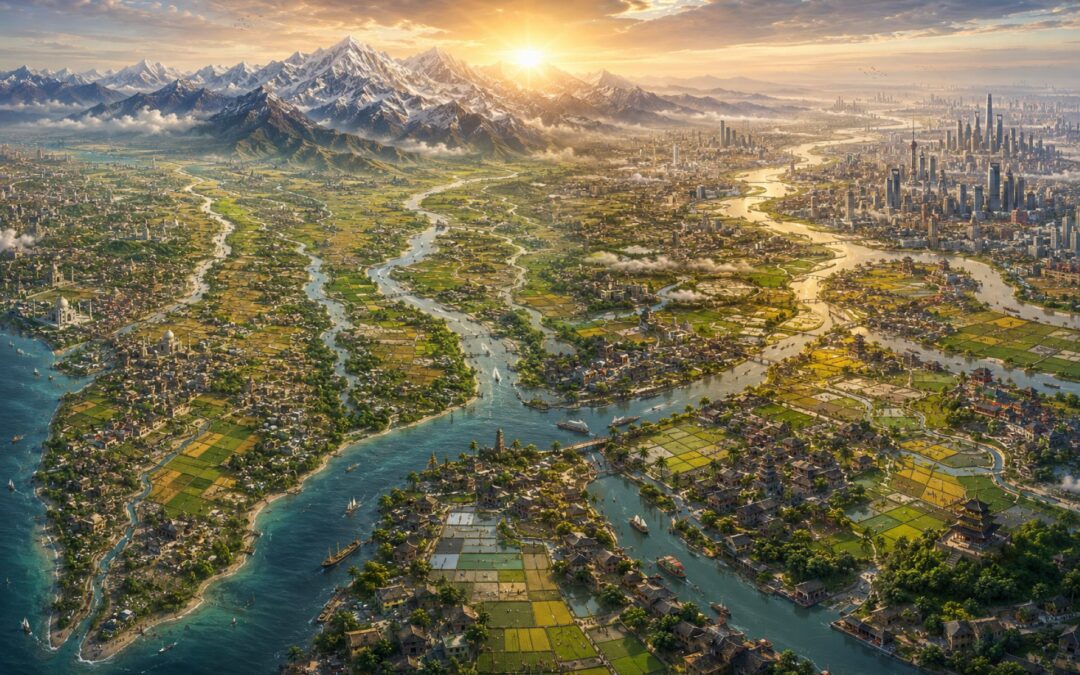
India and China are home to approximately 2.89 billion people. Together, they contain close to 35% of humanity, even though they occupy only a relatively small share of the planet’s land.
No other two countries come close.
The immediate temptation is to explain this through modern fertility: perhaps people in India and China simply had more children than people elsewhere. But that explanation begins far too late. Both regions were already among the world’s greatest concentrations of humanity centuries before modern medicine, industrialisation, or twentieth-century population policies.
The deeper answer lies in an advantage accumulated over thousands of years. Vast river-fed agricultural regions allowed unusually dense settlements to form early. Intensive farming systems extracted more food from limited land. States built canals, storage systems, roads, and administrative networks that helped sustain large populations. Then, during the modern demographic transition, death rates fell faster than birth rates, multiplying populations that were already enormous.
According to the United Nations’ latest population estimates, India is now the world’s most populous country, while China has entered a period of population decline. Their futures are beginning to diverge, but the historical forces that made them demographic giants were remarkably similar.
The Population Advantage Began Thousands of Years Ago
The modern population explosion did not begin from an equal starting line.
For most of human history, populations grew slowly. Families could have many children, but infant mortality was high, infectious disease was common, harvest failures caused famine, and childbirth remained dangerous. Periods of growth were frequently interrupted by war, epidemics, political collapse, or environmental disaster.
Within that harsh demographic world, the regions that would become India and China developed unusually large population bases.
Historical estimates must be treated carefully. Ancient and medieval societies did not conduct modern censuses, borders changed repeatedly, and surviving records are incomplete. Even so, long-run historical population estimates consistently show the territories of present-day India and China containing an exceptional share of humanity long before the twentieth century.
That early lead mattered enormously.
Imagine two regions growing at the same rate. One begins with ten million people and the other with one hundred million. Even if their fertility and mortality patterns are identical, the second region will add ten times as many people in absolute terms.
This is the principle of demographic path dependence. A large population creates the base from which future growth occurs.
India and China did not suddenly become populous after industrialisation. Industrialisation, public health, and modern medicine accelerated populations that had already been accumulating for millennia.
Their early scale was rooted first in geography.
Geography Created Two Vast Agricultural Heartlands
Rivers are often described as the birthplace of civilisation, but water alone does not explain population density. What matters is the wider system surrounding a river: the size of its floodplain, the quality of its soil, the reliability of rainfall, the length of the growing season, the availability of tributaries and groundwater, and the ease with which crops and goods can be transported.
India and China each possessed several enormous agricultural zones rather than depending on a single narrow river corridor. This gave them a scale and ecological diversity that many other early civilisations lacked.
India’s Indo-Gangetic Heartland
The northern part of the Indian subcontinent contains one of the largest continuous expanses of fertile land on Earth.
The Indus, Ganges, Brahmaputra, and their many tributaries carry water and sediment from the Himalayas across immense plains. Over long periods, flooding deposited layers of alluvial soil—fine, nutrient-rich material that could be cultivated repeatedly.
The resulting agricultural region stretches across modern India, Pakistan, Bangladesh, and Nepal. It should therefore be understood as a subcontinental population system rather than something that always existed within the borders of the modern Republic of India.
The western Indus region supported some of the earliest urban settlements in South Asia. Farther east, the Ganges plain eventually became another major centre of farming, cities, kingdoms, and imperial power.
Several environmental advantages reinforced one another.
Himalayan snowmelt fed rivers during warmer months. Monsoon rains supplied additional water, although their variability could also produce drought or devastating floods. Warm temperatures allowed long growing seasons, while regional differences supported rice, wheat, barley, millet, pulses, sugarcane, and other crops.
A large share of India’s territory remains cultivable even today. World Bank data on the proportion of Indian land classified as arable illustrates how unusual this is compared with countries dominated by deserts, tundra, mountains, or thin tropical soils.
This does not mean every part of India is equally fertile. The Thar Desert, the Deccan Plateau, forested regions, mountain ranges, and dry interior zones all presented different challenges. But the subcontinent’s major plains were large enough to sustain enormous populations while remaining connected to other productive regions.
Rivers also served as transport routes. Moving grain, timber, people, and manufactured goods by water was generally easier than carrying them overland. Agricultural surplus could therefore support towns, merchants, soldiers, administrators, craftspeople, and religious institutions far beyond the villages where the food was grown.
China’s River Basins and Agricultural Cores
China’s population has never been distributed evenly across its vast territory.
Much of western and northern China consists of deserts, high plateaus, mountains, or dry grasslands. The country’s great demographic centres emerged primarily in the east, where river valleys, plains, basins, and humid climates allowed intensive farming.
In northern China, the Yellow River and its tributaries supported early agricultural communities based largely on millet and, later, wheat. The North China Plain became one of the country’s most important zones of settlement and political power.
The Yellow River carried enormous quantities of silt, enriching farmland but also raising the riverbed and increasing the risk of catastrophic flooding. Its value could not be separated from its danger. Communities and governments repeatedly built embankments, redirected channels, and organised flood-control projects in an effort to manage it.
Farther south, the Yangtze River basin offered warmer and wetter conditions that favoured rice cultivation. Over centuries, migration, land clearance, irrigation, improved rice varieties, and multiple cropping helped southern China support increasingly dense populations.
The Sichuan Basin formed another highly productive centre. Surrounded by mountains but watered by rivers, it developed into a major agricultural and population zone capable of supporting large cities and states.
Modern figures show why China’s population geography must be described precisely. China’s arable-land data reveals that only a limited share of its enormous territory is classified as arable. Hundreds of millions of people became concentrated not across the whole country but within exceptionally productive eastern plains, valleys, and basins.
This concentration is visible even now. The densely settled eastern half of China contrasts sharply with the sparsely populated Tibetan Plateau, Gobi Desert, and far-western regions.
Geography created the physical capacity for dense settlement. It did not guarantee that such settlement would emerge. That required farming systems capable of turning water, soil, labour, and time into reliable food surpluses.
Intensive Farming Turned Fertile Land Into Dense Settlement
Good agricultural land can remain lightly populated when farming is extensive, labour is scarce, transport is poor, or water cannot be controlled. India and China became demographic centres because generations of farmers intensified production, extracting more food from each cultivated area.
This was not the result of one miracle crop. It came from varied combinations of rice, wheat, millet, pulses, vegetables, livestock, irrigation, crop rotation, and repeated harvesting.
Rice, Wheat, Millet, and Multiple Cropping
Rice deserves an important place in the explanation, particularly in southern China and the wetter regions of South and Southeast Asia.
Wet-rice cultivation can produce high yields from a relatively small area. In warm climates with sufficient water, farmers may also grow more than one crop in a year. This makes it possible to feed large numbers of people without expanding farmland at the same rate as the population.
But saying that rice alone produced the populations of India and China would be misleading.
Northern China’s early agricultural societies depended heavily on millet. Wheat later became increasingly important, especially in drier and cooler regions where flooded rice cultivation was impractical. Southern China relied more heavily on rice, but even there, farming systems varied according to elevation, rainfall, soil, and access to irrigation.
South Asia was similarly diverse. Rice became central in the eastern Gangetic plain, Bengal, coastal regions, and many parts of southern India. Wheat remained essential across northwestern and northern areas. Pulses supplied protein, while oilseeds, millet, barley, vegetables, and livestock helped sustain communities across very different ecological zones.
This diversity mattered. A civilisation relying entirely on one crop or one river system would be highly vulnerable to a single ecological shock. India and China contained several agricultural cores, allowing population and political power to shift when one region suffered drought, flooding, war, or declining productivity.
Long growing seasons also made multiple cropping possible in some areas. A farmer might harvest one crop and plant another within the same year, increasing the total food produced from the same land. Irrigation and careful water management could extend this capacity beyond what rainfall alone allowed.
Europe’s population history provides a useful comparison. Before the arrival and spread of American crops such as the potato, many European regions had fewer options for producing very high quantities of food on small plots. The potato later helped support substantial population growth because it delivered large yields under conditions unsuitable for some grains.
The broader principle is not that one crop inevitably creates large families. It is that societies capable of producing more calories from each unit of land can sustain denser settlement.
Labour, Irrigation, and Population Feedback
Traditional wet-rice cultivation was productive, but it was also demanding.
Fields had to be levelled and flooded. Seedlings were often raised separately and transplanted by hand. Water channels required construction and maintenance. Weeding, harvesting, threshing, and processing demanded coordinated labour during specific periods.
As Columbia University’s account of the labour-intensive nature of traditional wet-rice cultivation explains, dense populations and intensive agriculture could reinforce one another.
More household labour made it possible to cultivate fields more carefully. More careful cultivation increased output. Greater output supported more people, who in turn supplied additional labour.
This created a feedback loop.
It would be wrong, however, to reduce the relationship to the claim that rice farmers simply wanted more children. Agrarian family size was influenced by many forces. Children could contribute labour, but families also faced high infant mortality, limited access to contraception, few formal systems of old-age support, and strong economic dependence on kin.
When many children died before adulthood, parents often had more births partly to ensure that some survived. When land, work, and care for elderly parents were organised through the household, children could provide economic security that modern pensions, insurance, and labour markets now supply in other ways.
These incentives changed as societies urbanised. Children became less economically productive within the household and more expensive to educate and house. Female education expanded. Contraception became more accessible. People married later, and survival into old age became more predictable.
The old farming-population feedback weakened.
It had nevertheless operated for centuries, helping agricultural communities transform fertile river valleys into some of the most densely settled landscapes in human history.
States and Infrastructure Reinforced the Advantage
Farming created food, but sustaining millions of people required more than individual households.
River-based agriculture often demanded cooperation beyond the village. Canals had to be dug, embankments repaired, floodwaters diverted, reservoirs maintained, and grain transported from regions of surplus to regions facing shortages.
States could organise these activities on a larger scale. They collected taxes, recorded land, mobilised labour, built roads, maintained canals, stored grain, standardised weights and measures, and supported markets.
This capacity was never purely benevolent. The same administrative systems that constructed irrigation networks could impose forced labour, finance armies, extract heavy taxes, and deepen social inequality. State power helped populations survive and expand, but it also exposed them to conquest, exploitation, and political failure.
Even with those qualifications, administration made demographic scale easier to maintain.
The Mauryan Empire, founded by Chandragupta Maurya in the late fourth century BCE and later ruled by Ashoka, brought much of the Indian subcontinent under one political system. It did not permanently unify all of modern India, and it fragmented after a relatively short period. Yet it demonstrated that South Asia’s agricultural zones could support extensive administration, cities, armies, roads, and long-distance exchange.
In China, the Qin state unified rival kingdoms in 221 BCE. The Qin dynasty itself was brief, but the Han dynasty retained and expanded many of its administrative structures. Standardisation, roads, canals, taxation, grain transport, and imperial bureaucracy helped connect large farming regions under a recurring framework of central rule.
These developments formed part of the wider transition from farming communities to cities, states, and empires. Agricultural surplus allowed some people to become officials, soldiers, merchants, builders, craftspeople, and scholars rather than producing food directly. In turn, these specialists created institutions and infrastructure that could support still larger societies.
Trade strengthened the system further.
India connected the Middle East, Central Asia, Southeast Asia, and the Indian Ocean. China exchanged goods and ideas through routes later grouped under the name Silk Road, as well as through maritime networks. Crops, animals, manufacturing techniques, religions, technologies, and commercial practices crossed political borders.
India and China were therefore neither isolated nor protected from all outside influence. Their location within Eurasian exchange networks allowed them to absorb innovations while exporting valuable goods of their own.
Mountains, deserts, plateaus, jungles, and seas shaped the routes through which armies and migrants could move, but they did not prevent invasion or warfare. Both regions experienced repeated conquest, rebellion, fragmentation, famine, and dynastic collapse.
Their demographic importance survived not because history was peaceful, but because the agricultural systems beneath political change remained capable of supporting very large populations.
Political Scale Helped Create Two Giant Countries
There is another part of the puzzle that purely agricultural explanations miss.
Europe also developed productive farming regions and eventually supported hundreds of millions of people. Yet those people were divided among many countries. Why, then, did so much of the population of East Asia and South Asia come to be counted within China and India?
The answer lies partly in political geography.
China repeatedly fragmented into competing states, but successive dynasties restored large imperial structures across much of the same core territory. The idea of political reunification became deeply embedded in institutions, historical memory, administrative practice, and political legitimacy.
The borders changed, frontier regions moved in and out of imperial control, and many communities retained distinct identities. China was never a permanently unified or culturally uniform block. Even so, large-scale reunification occurred often enough to shape the territorial framework inherited by the modern state.
South Asia followed a different path.
The subcontinent experienced major empires—the Mauryan, Gupta, Mughal, and others—but also long periods of regional kingdoms and political fragmentation. Geography encouraged both connection and diversity. The northern plains could support large imperial centres, while mountains, plateaus, forests, river systems, and distant coastal regions strengthened regional powers.
British colonial rule eventually brought most of the subcontinent under a single administrative system, although princely states retained varying degrees of autonomy. Partition in 1947 then divided British India into India and Pakistan, while Bangladesh emerged from Pakistan in 1971.
The population historically associated with the Indian subcontinent is therefore spread across several modern countries. Even after partition, the Republic of India remained a continental-scale state containing an extraordinary range of densely settled regions.
Modern population rankings are consequently shaped not only by where people lived, but by how borders were drawn.
Had Europe unified into one enduring state, it too would appear near the top of national population tables. If China had remained divided into several large countries, or if the Indian subcontinent had fragmented further, the world might contain more medium-sized population powers and fewer billion-person states.
The existence of India and China as demographic giants is therefore partly a story of farms and families—and partly a story of maps.
Modern Medicine Multiplied an Already Large Population Base
By the nineteenth century, India and China were already home to hundreds of millions of people. Yet their most dramatic growth came later, when a fundamental demographic pattern began to change.
In traditional societies, birth rates and death rates were both high. Families had many children, but large numbers died in infancy or childhood. Adults faced repeated epidemics, dangerous childbirth, poor sanitation, malnutrition, and limited treatment for injury or infection.
Population growth remained slow because high fertility was continually offset by high mortality.
Modernisation disrupted that balance.
Clean-water systems reduced the spread of disease. Vaccination prevented deadly infections. Antibiotics made previously fatal illnesses treatable. Food could be transported more quickly into areas facing shortages. Public-health campaigns improved maternal and infant survival. Agricultural production and storage became more reliable.
Death rates began falling.
Birth rates, however, did not fall immediately. Families continued behaving according to economic expectations, social institutions, and survival patterns formed under the older high-mortality system.
The interval between declining death rates and declining birth rates created rapid population growth. Demographers call this the demographic transition.
The mechanism occurred in Europe earlier, although at different speeds in different countries. It later unfolded across Asia, Latin America, and other regions as modern medicine and public-health systems spread.
India and China experienced this transition from an unusually large starting point. Even a modest annual growth rate, applied to hundreds of millions of people, produced enormous absolute increases.
Industrialisation contributed, but it was not the sole cause. Factories do not automatically create population growth. The decisive change was that more people survived childhood, more women survived childbirth, and adults lived longer.
A population that once required many births merely to replace itself began retaining far more of those births.
This is why cultural explanations are inadequate. Large families were not uniquely Indian or Chinese. They were common across agrarian societies in which mortality was high, children contributed economically, and formal systems of social protection were weak.
As mortality fell, fertility eventually declined as well. The timing and speed of that decline differed between India and China, producing the contrasting population trajectories visible today.
India and China Are Now Moving in Opposite Directions
India surpassed China as the world’s most populous country in 2023. But this did not happen because Indian families suddenly began having more children. India’s national fertility rate has already fallen to around or below the replacement level—the average number of births needed for one generation to replace itself.
The country can continue growing because of population momentum.
India has a very large generation of young people entering adulthood. Even if each couple has fewer children than earlier generations did, the number of couples is so large that total births can remain higher than total deaths.
A train does not stop the moment the engine is switched off. In the same way, population growth does not stop the moment fertility reaches replacement level.
The UNFPA’s assessment of India’s falling fertility and continuing population growth stresses this distinction. India’s demographic future is now shaped less by uniformly large families than by its youthful age structure and substantial regional variation.
Some Indian states have fertility rates comparable to or below those of many European countries. Others remain higher. Education, urbanisation, healthcare, women’s employment, marriage age, income, and access to contraception all influence these differences.
China has moved further along the transition.
During the early decades of the People’s Republic, Mao Zedong’s government often treated a large population as a source of national strength and labour. Fertility remained high, although famine and political upheaval caused severe interruptions.
From around 1980, the Chinese state imposed the one-child policy, using administrative pressure, fines, workplace enforcement, contraception, sterilisation, and, in some cases, coercive abortions to restrict births.
The policy helped accelerate fertility decline, but it does not fully explain China’s present situation.
Restrictions were gradually relaxed, first to allow two children and later three. Yet fertility did not recover substantially. Many couples did not respond to permission to have more children because the social and economic environment had changed.
Urban housing is expensive. Education is highly competitive. Childcare can be difficult to obtain. People marry later, and fewer people marry at all. Women have greater educational and professional opportunities and often bear a disproportionate share of domestic labour. Raising several children can conflict with employment, income, personal freedom, and desired living standards.
These pressures are visible in other East Asian societies that never imposed China’s one-child policy but developed similarly low fertility.
China has now entered natural population decline. The country’s latest official population figures recorded substantially more deaths than births in 2025.
The consequences are significant. China is ageing rapidly. Its working-age population is shrinking, while the number of elderly people requiring pensions, healthcare, and family support is rising.
India remains younger and is still growing, although its rate of growth is slowing. China is older and shrinking. The two countries that followed similar historical routes to enormous population size are now moving in opposite directions.
That divergence reveals something important about their shared past.
Neither country became populous because of an unchanging cultural desire for large families. Fertility responds to mortality, economics, education, policy, urban life, gender relations, and expectations about the future. When those conditions change, reproductive behaviour changes with them.
India and China contain so many people because they accumulated demographic advantages over a very long period.
Their river basins and plains offered the water, soil, and climate needed to support extensive farming. Rice, wheat, millet, irrigation, multiple cropping, and intensive household labour increased the amount of food that could be produced from limited land. States built infrastructure, organised grain, administered territory, and connected agricultural regions through transport and trade.
These systems established enormous population bases long before industrialisation.
Modern medicine and public health then lowered mortality faster than fertility, multiplying populations that were already among the world’s largest. Political history placed much of those populations inside two continental-scale modern states, making their demographic weight even more visible.
Geography created the opportunity. Human organisation intensified it. History compounded it. Modern demography magnified it.
India and China’s populations will not follow the same path forever. But the reason both crossed the billion-person threshold is written into thousands of years of agriculture, institutions, survival, and accumulated human settlement.
Last Updated on July 27, 2026 by Aseem Gupta