
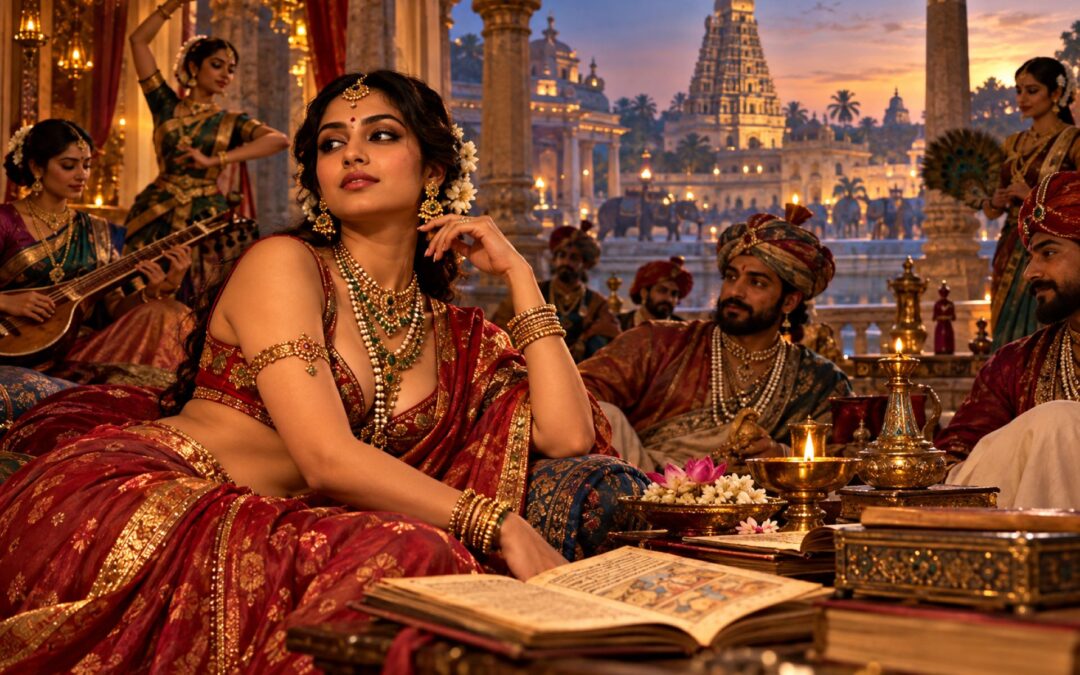
A woman trained in music, poetry, dance, and conversation could command the attention of India’s wealthiest merchants, nobles, and kings. She might own property, employ servants, entertain powerful guests, and contribute generously to religious institutions. Her artistic accomplishments could make her a celebrated figure in a society that otherwise placed considerable restrictions on women’s public lives.
Yet the same woman might remain vulnerable to exploitation, official supervision, financial dependence, and social stigma. Some courtesans enjoyed extraordinary privileges, while others entered their professions through poverty, inherited obligations, or coercion. Their position combined opportunities rarely available to other women with forms of control that could severely limit their independence.
Across ancient and medieval India, courtesans occupied a distinctive place in the worlds of entertainment, commerce, religion, and politics. Far from being a uniform class of prostitutes, they belonged to a range of professional and social traditions whose members could serve as performers, companions, court attendants, religious specialists, and influential cultural figures.
Their history reveals something important about Indian society: wealth and respectability did not always belong to the same people, and women excluded from conventional domestic ideals could sometimes become indispensable to the artistic and political life of their communities.
Who Were the Courtesans of Ancient India?
Courtesanship in India encompassed several occupations and social positions rather than one clearly defined profession. Ancient literary, legal, and political texts describe women who earned money through sexual relationships, provided entertainment, maintained exclusive arrangements with patrons, or served in royal establishments. Although these activities sometimes overlapped, their participants did not necessarily perform the same work or enjoy similar standing.
The Sanskrit term gaṇikā commonly referred to an accomplished courtesan associated with cultivated urban society or elite patronage. In classical literary ideals, a gaṇikā was valued not only for her appearance but also for her education, artistic accomplishments, conversation, and ability to entertain influential guests. Such women could occupy a considerably different position from those who depended principally on commercial sexual services for survival.
Other terminology distinguished women according to their occupations or circumstances. The term rūpājīvā, for example, referred to women whose livelihood was associated with their physical appearance, while the broader vocabulary of prostitution encompassed different kinds of commercial relationships. Royal concubines, household companions, performers, and women serving religious institutions could occupy related but distinct positions.
These categories were neither permanent nor universally applied. Their meanings varied across languages, regions, historical periods, and literary genres, making it misleading to imagine that ancient India maintained one standardized system of courtesanship.
The sources themselves also require interpretation. Early Buddhist narratives, classical Sanskrit literature, Jain writings, and political treatises all contain references to courtesans, but they describe different aspects of society. A moral story about a wealthy courtesan, an erotic manual outlining desirable accomplishments, and a political text prescribing state regulations cannot automatically be treated as equivalent records of everyday life.
Among the most important works is Vātsyāyana’s Kāmasūtra, particularly its sixth part dealing with courtesans. Although popularly associated with sexual techniques, the work also examines courtship, marriage, urban entertainment, relationships, social refinement, and the pursuit of pleasure. Its treatment of courtesans reveals how affection, professional skill, money, and social position could become closely intertwined.
The work primarily imagines a relatively prosperous urban environment. Its cultivated gentleman, or nāgaraka, possesses the resources and leisure to attend performances, entertain friends, pursue relationships, and appreciate artistic accomplishments. His world cannot stand for the experiences of every Indian man, just as the successful gaṇikā cannot represent every woman who sold sexual services.
Courtesans were therefore neither universally celebrated entertainers nor universally impoverished sex workers. Their circumstances depended on the kinds of work they performed, the patrons they served, the institutions to which they belonged, and the resources they could command.
How Women Entered Courtesanship
Women entered courtesanship through different routes, and their circumstances could strongly influence how much control they exercised over their lives. Some grew up in professional households where artistic knowledge, patron relationships, and occupational identities passed between generations. Others entered through economic necessity, dependence on powerful individuals, or arrangements over which they possessed little choice.
The existence of hereditary professional traditions is especially important. A girl raised in a household of performers might learn music, dancing, etiquette, and other accomplishments from relatives or professional instructors. Such training could provide access to an established network of patrons and performers, although inheritance of an occupation was not necessarily equivalent to freely choosing it.
Ancient political sources also recognized recruitment outside courtesan families. The Arthaśāstra, for example, describes the appointment of a qualified gaṇikā to royal service whether or not she was born into the profession. Its provisions concerning succession, employment, and professional supervision suggest that courtesanship could operate within administrative structures as well as family networks.
Other circumstances were considerably less favorable. Poverty, slavery, household dependence, and the transfer of women between powerful men could draw individuals into sexual or entertainment services. Literary and historical accounts also describe women treated as gifts, captives, or dependants, although such references must be evaluated in their particular contexts rather than generalized across all periods.
The distinction between an independently earning performer and a woman attached to a royal household could be substantial. One might negotiate with several patrons, while another depended on a single employer or institution. A third might participate in temple service under obligations that did not resemble either arrangement.
Nor did a respectable artistic title guarantee freedom. A woman might possess considerable professional knowledge while remaining dependent on a household head, matron, patron, or official. Her income could be valuable to others, and her ability to leave an arrangement might be more restricted than her public success suggested.
Understanding these different routes prevents courtesanship from becoming an idealized profession in which talented women simply exchanged conventional marriage for an independent career. For some, it offered genuine opportunities for income, education, and social mobility. For others, it was shaped by circumstances that made those opportunities difficult to exercise freely.
The Arts, Education, and Social World of Courtesans
One of the most distinctive features of elite courtesanship was the importance attached to artistic and intellectual accomplishment. A successful gaṇikā was expected to provide an experience extending beyond physical attraction, combining performance, conversation, refinement, and an understanding of the social world inhabited by her patrons.
The Kāmasūtra describes sixty-four arts or accomplishments associated with cultivated living. These include singing, instrumental music, dancing, drawing, poetry, games, riddles, decoration, flower arrangement, perfumery, and other skills that combined entertainment with personal refinement. Some traditions developed different enumerations of desirable accomplishments, but these lists should not be mistaken for a universal curriculum that every historical courtesan completed.
The ideal was nonetheless revealing. The company of an accomplished courtesan could be valued because she knew how to sustain conversation, interpret poetry, appreciate music, and participate in sophisticated entertainment. Education was therefore not merely ornamental; it could increase a woman’s professional standing and earning potential.
These expectations distinguished elite courtesans from the conventional domestic roles prescribed to many married women in certain literary and social traditions. A wife might be valued primarily through her household responsibilities, while a courtesan’s public reputation could depend on her artistic abilities and accomplishments in entertaining guests. This contrast reflected the assumptions of particular elite environments, not a universal absence of education among married women.
Courtesans were associated with festivals, musical gatherings, dramatic performances, garden excursions, and private entertainments. They could appear in the company of merchants, administrators, nobles, soldiers, and other prosperous men whose interests extended into literature and the arts.
The urban environment helped sustain such activities. Prosperous cities offered audiences, patrons, commercial networks, and spaces where people could gather for entertainment and intellectual exchange. The wider social life of ancient Indian cities included markets, gardens, festivals, religious establishments, and gathering places that supported different forms of public and private leisure.
A particularly revealing institution was the goṣṭhī, a gathering associated in classical literature with cultivated conversation and social interaction. Such occasions could involve discussions of poetry, music, and other artistic subjects alongside food, drink, and entertainment. Accomplished women might contribute to these gatherings as performers, conversationalists, or hosts.
The attraction of a courtesan’s household could therefore extend beyond an individual relationship. In certain elite literary settings, it represented a place where wealth, artistic expertise, and social connections came together. An established courtesan might maintain relationships with poets, musicians, wealthy patrons, and other people whose presence contributed to her reputation.
Professional success could also require organization. Entertainers sometimes worked with assistants, musicians, dancers, household servants, or intermediaries who helped manage performances and patrons. Some literary accounts describe impressive establishments with extensive retinues, although such portrayals should not be treated as evidence that every successful courtesan maintained a large household.
The association between courtesans and the performing arts extended into royal settings. Courtly festivals, ceremonies, and entertainments provided opportunities for professional musicians and dancers, while the enormous entourages accompanying some military campaigns could also include entertainers. Descriptions of these occasions illustrate the importance of performance to elite life, even when chroniclers’ impressive numerical claims cannot be independently confirmed.
Not every woman involved in these activities was a courtesan, and not every courtesan possessed the accomplishments celebrated in literature. Nevertheless, professional women helped sustain artistic traditions through training, performance, patronage, and the transmission of specialized knowledge.
Their significance cannot be measured only through the enjoyment they provided to wealthy men. The musical and literary practices associated with these women formed part of India’s wider cultural history, and some traditions continued long after the political institutions that originally supported them had changed.
How Courtesans Earned Money and Why States Regulated Them
Courtesans could earn money through different combinations of artistic performance, companionship, gifts, professional services, and relationships with patrons. The balance depended on their circumstances. Some served several paying clients, others maintained long-term arrangements, and certain accomplished performers were employed within royal establishments.
For an elite courtesan, attracting a wealthy patron could be economically significant. A relationship might involve gifts, jewelry, financial support, property, or payments for entertainment. Maintaining the patron’s interest therefore required professional judgment as well as personal charm.
The Kāmasūtra treats these relationships with considerable practical attention. It discusses how courtesans might assess a man’s resources, cultivate his attachment, evaluate his generosity, and decide whether continuing a relationship remained advantageous. It also considers how a courtesan might manage rival patrons or withdraw from an unprofitable arrangement.
Such advice reveals that courtesanship could involve a sophisticated understanding of human behavior and financial incentives. Affection was not necessarily absent, but it operated alongside material considerations that could determine a woman’s security.
These arrangements also belonged to the broader history of romance and patronage in ancient India. Personal attachment, sexual desire, wealth, and social expectations frequently overlapped, although a professional courtesan’s relationship with a patron differed from marriage or ordinary courtship.
Financial success could give certain courtesans opportunities unavailable to many other women. They might control earnings, commission goods, employ assistants, or negotiate with wealthy men. Yet those opportunities depended on maintaining access to patrons and could disappear when age, illness, changing fashions, or political circumstances undermined their position.
Courtesans were also economically significant to governments. Authorities had reasons to supervise occupations that generated revenue, operated within elite households, and connected individuals to powerful political networks.
One of the clearest descriptions appears in the Arthaśāstra’s chapter on the superintendent of prostitutes. The text, traditionally associated with Kauṭilya, outlines an elaborate system for appointing, employing, supervising, and regulating courtesans.
A qualified gaṇikā could receive an official appointment and salary for service at the royal court. Her beauty and accomplishments were among the qualities considered valuable, demonstrating that artistic and personal refinement could have recognized economic importance within the political system imagined by the text.
The superintendent was also expected to oversee aspects of courtesans’ income, expenses, and activities. These provisions show that professional relationships could become objects of administrative concern rather than remaining entirely private transactions.
The text describes punishments for certain forms of violence and mistreatment against courtesans. Such provisions acknowledged that these women could possess legally recognized interests requiring protection, even though their position differed from that of other members of society.
Training was another area of administrative involvement. The Arthaśāstra envisages state support for instructors teaching accomplishments such as music, dancing, acting, writing, and other skills relevant to professional entertainment. It also discusses the preparation of performers’ children for suitable occupations.
This system suggests that artistic labor could be regarded as something worth cultivating and organizing. Rather than merely tolerating courtesans, the state described in the treatise sought to obtain services, revenue, and other benefits from their work.
Courtesans and performers could also have intelligence functions. Political literature discusses the use of individuals with access to private gatherings, powerful households, and visiting dignitaries within wider networks of observation and espionage. Their ability to circulate through environments where confidential conversations occurred made them potentially useful to rulers.
However, these provisions should not be read as proof that every ancient Indian kingdom maintained an identical administrative system. The Arthaśāstra is a prescriptive political work whose surviving form reflects a complex history of composition. It tells us what its authors considered desirable or effective government, not necessarily what every ruler actually implemented.
Even within that framework, state involvement was not consistently benevolent. The same text that provides for remuneration and certain protections also imposes stringent controls, regulates conduct and property, and prescribes severe penalties for forms of disobedience.
A courtesan might be protected against unauthorized mistreatment while remaining subject to compulsory service or harsh administrative demands. Her professional value to the state did not guarantee that her wishes would determine how she was employed.
The text also discusses arrangements for women whose former professional roles had become difficult to sustain. These provisions should not be confused with a modern pension system guaranteeing independent financial security after retirement.
Similarly, while courtesans’ earnings could be subject to taxation or official claims, there is no justification for assigning one fixed tax percentage to all courtesans across ancient and medieval India. Rates, obligations, and administrative practices must be established for particular institutions and historical settings.
The resulting picture is more complicated than either exploitation or empowerment alone. Governments could provide employment, instruction, and legal recognition while simultaneously treating courtesans as economically valuable subjects whose labor and movements required supervision.
Their history demonstrates how economic importance could produce both privileges and restrictions.
Wealth, Property, Servants, and Philanthropy
Some courtesans accumulated remarkable wealth, particularly when they attracted prosperous patrons or occupied established positions in royal and urban society. Their earnings could support substantial households, including servants, attendants, professional assistants, and people responsible for arranging meetings or performances.
Successful courtesans sometimes relied on intermediaries to manage their relationships with patrons. A trusted attendant might accompany a woman, negotiate arrangements, provide security, or help procure goods. A senior woman or household manager could assist with professional decisions, financial matters, and the organization of entertainment.
Literary accounts occasionally portray courtesans surrounded by large retinues. Such descriptions convey the association between elite courtesanship and luxury, but exceptional or exaggerated establishments cannot be taken as representative of ordinary working conditions.
The possession of wealth could translate into a degree of independence. Property, jewelry, savings, and control over household expenditures might allow an accomplished courtesan to support dependants, sponsor activities, or make decisions that would otherwise require a husband’s or household head’s approval.
Yet possession and control were not always equivalent. Legal restrictions, administrative supervision, patron dependence, and family obligations could limit what a woman was able to do with resources attributed to her.
One of the most significant aspects of courtesan history is the evidence of charitable and religious patronage. Buddhist literature preserves accounts of wealthy courtesans making donations, while other textual traditions associate successful women with support for religious establishments and public works.
The best-known example is Āmrapālī, also called Ambapālī, a celebrated courtesan of Vaiśālī in Buddhist tradition. She is remembered for her relationship with the Buddha and for donating a mango grove to him and his community of disciples.
The story became sufficiently important to appear not only in Buddhist textual traditions but also in artistic representations. Research into Āmrapālī’s gift of a mango grove in Gandhāran art examines how different Buddhist sources informed portrayals of this act of generosity.
Her example is important because the donation presents a courtesan as a religious benefactor rather than merely an object of desire or moral judgment. She possesses something valuable and directs it toward an institution whose significance extends beyond her private household.
Other literary traditions describe courtesans providing food, supporting religious communities, or contributing to public facilities such as wells, gardens, and places of worship. These examples show that generosity and public reputation could be connected to professional wealth, although literary descriptions must be distinguished from independently documented transactions.
The larger implication is that successful courtesans could participate in the circulation of wealth through society. Their earnings might be spent on households, artistic production, religious offerings, and charitable activities.
This did not erase the inequalities within their professions. A wealthy patron’s favored companion and a financially vulnerable sex worker occupied very different positions. The existence of influential female donors demonstrates the possibilities available to some women without establishing that such prosperity or independence was widespread.
Temple Women, Devotional Poetry, and the Performing Arts
The relationship between courtesanship and religious performance becomes particularly important in medieval South India. Women associated with temples participated in traditions of service, patronage, ritual, music, and dance that cannot be adequately understood by categorizing them all as prostitutes.
The term devadāsī, often translated as servant of a deity, has acquired many different associations over time. Its meaning and the experiences of women identified with temple service varied considerably according to region, institution, and historical period.
Some temple women performed religious duties or participated in festivals and ceremonies. Others held rights, received gifts, maintained relationships with patrons, or contributed to the economic and cultural life of religious establishments.
The surviving evidence is especially significant because temple inscriptions can reveal activities that literary ideals alone cannot establish. Records of donations, services, property, and institutional relationships allow historians to examine women as participants in religious economies rather than relying exclusively on later stereotypes.
In Donors, Devotees, and Daughters of God: Temple Women in Medieval Tamilnadu, historian Leslie C. Orr examines evidence concerning temple women’s identities, religious roles, and economic activities. Her work demonstrates why the history of these women requires attention to actual institutions and documented transactions.
Temple affiliation could provide opportunities for income, recognition, and participation in religious life. At the same time, women’s obligations and personal autonomy remained shaped by the institutions and social relationships surrounding them.
It is therefore misleading to imagine one uninterrupted institution in which every temple woman performed the same duties or occupied the same position. The relationship between temple service, artistic performance, patronage, and sexuality changed across centuries.
Professional women also played important roles in transmitting artistic traditions. Their accomplishments could include music, dance, and the interpretation of poetry whose subjects ranged from romantic longing to religious devotion.
One especially revealing tradition is the Telugu padam, a relatively short lyrical composition associated with musical performance and dance. Some padams combine the emotional language of erotic relationships with devotion to a deity.
In these compositions, the divine figure may appear as a lover or customer who is expected to provide affection, attention, or material reward. The relationship can be playful, affectionate, demanding, jealous, or openly confrontational.
The imagery sometimes resembles the relationship between a courtesan and a patron. A woman questions her lover’s fidelity, complains that he has visited someone else, demands proper treatment, or reminds him of what he owes her.
The religious significance comes from the identity of the lover. A deity such as Krishna can be approached through the intimate emotional vocabulary of earthly relationships, transforming familiar situations involving desire and disappointment into expressions of devotion.
The scholarly collection When God Is a Customer: Telugu Courtesan Songs by Ksetrayya and Others, edited and translated by A. K. Ramanujan, Velcheru Narayana Rao, and David Shulman, explores this remarkable literary world.
An important distinction concerns authorship. Several of the poems in this tradition were composed by men who adopted a female courtesan’s voice. Their connection to women’s professional culture also depended on performance, interpretation, and the transmission of artistic knowledge.
Consequently, a poem spoken by a courtesan cannot automatically be attributed to a historical woman. The literary speaker, composer, and performer may be different people, each contributing to the tradition in a distinct way.
Women nevertheless participated as artists and authors in their own right. Muddupalani, an eighteenth-century Telugu poet associated with courtly performance culture, is a particularly important example of a woman whose literary accomplishments became part of the history of erotic and devotional expression.
The contributions of professional women should therefore be understood through several overlapping forms of cultural work. They could create compositions, interpret existing texts, develop performance techniques, train others, and preserve repertoires across generations.
This is part of the reason courtesan culture cannot be reduced to sexual commerce. The artistic traditions associated with professional women helped shape musical and literary expression, including works that continued to be performed after the social arrangements surrounding their creation had changed.
Yet celebrating those achievements should not obscure the vulnerabilities of the performers themselves. Cultural prestige did not automatically ensure economic security, freedom from exploitation, or control over personal relationships.
Courtesans, Kings, and Political Influence
Courtesans could acquire political significance because they sometimes had access to people whose decisions affected entire kingdoms. A woman connected to a powerful ruler might gain wealth, patronage, protection, or influence through a personal relationship, although the extent of that influence varied enormously.
Royal courts provided opportunities for performers, companions, and attendants whose occupations brought them into contact with influential individuals. Artistic expertise could create familiarity with elite households, while long-standing relationships might provide access to information and networks unavailable to outsiders.
The Vijayanagara Empire illustrates the scale of courtly culture in which such relationships developed. Its rulers supported literature, religious institutions, ceremonial performances, and elaborate royal establishments. Under Krishnadevaraya, the empire became especially renowned for military power and cultural patronage.
Accounts of Vijayanagara’s imperial court and Krishnadevaraya’s reign describe an environment sustained by extensive wealth and political resources. Court entertainers and other professional women formed part of the broader society surrounding these institutions.
Later narratives also associate Krishnadevaraya with women whose origins lay outside conventional royal marriage alliances, including accounts concerning his mother Nagamba and his relationship with Chinnadevi. However, the surviving traditions about their status and the circumstances of his succession are not sufficiently uniform to justify confident claims that his parentage legally disqualified him or that one particular romantic relationship explains his accession.
The more secure historical point is that royal households and courtly entertainment were connected, allowing some women to move between artistic and politically influential environments.
Another celebrated relationship emerged in eighteenth-century Kishangarh, where the ruler Savant Singh became associated with Bani Thani, a woman remembered in the artistic traditions of the court.
Their relationship acquired an enduring place in Rajput painting. A work preserved by the Los Angeles County Museum of Art depicts Savant Singh and Bani Thani in the guise of Krishna and Radha, presenting them through the imagery of divine romance.
The painting demonstrates how a ruler’s relationship with a woman associated with courtly culture could enter the visual language of devotion and aristocratic identity. It also illustrates the transformation of personal relationships into artistic subjects that outlasted the people involved.
The precise details of the couple’s private circumstances require more caution than the existence of their artistic association. Later romantic narratives should not be accepted uncritically as complete biographies.
Indian literature also imagined courtesans exercising influence through wealth, intelligence, and social connections. These stories reveal cultural assumptions about the unusual opportunities available to accomplished women, even when their events cannot be treated as recorded history.
One example appears in the eleventh-century Kashmiri writer Kṣemendra’s Kalāvilāsa, a satirical work concerned with deception, social behavior, and the misuse of various accomplishments.
A narrative involving the courtesan Vilāsavatī appears within the literary world of the Kalāvilāsa. Its dramatic treatment of powerful men and courtesans belongs to a work of satire, not to a securely documented account of a historical emperor’s marriage.
Such stories should not be discarded simply because they are fictional. They reveal how audiences understood courtesans as potentially resourceful, persuasive, and connected to powerful social networks.
The ability to influence a ruler did not necessarily translate into stable authority, however. A woman’s position might depend on the continuing favor of one man, and that favor could disappear through succession, political conflict, or changes within the royal household.
Courtesans could therefore possess considerable informal influence without holding recognized political office. Their position demonstrates how access, intimacy, wealth, and cultural prestige sometimes created channels of power outside the formal institutions of government.
Sex, Pregnancy, and the Limits of Ancient Birth Control
For women whose livelihoods or personal relationships involved sexual activity, pregnancy could have important consequences. It might affect their ability to work, financial arrangements, household responsibilities, and relationships with patrons. The desire to avoid or manage pregnancy is therefore a relevant part of understanding their lives.
Ancient and medieval societies possessed various beliefs about fertility, contraception, and reproductive medicine. Medical and erotic texts referred to botanical preparations, substances intended for bodily application, and physical methods thought to interfere with conception.
Some traditions described barriers or preparations used internally, while others referred to plants and combinations of substances believed to affect fertility. Their inclusion in historical texts demonstrates awareness of reproductive concerns, but it does not establish that these methods were safe or effective.
The distinction is particularly important when historical accounts are interpreted through modern scientific knowledge. A plant may contain biologically active compounds without functioning as a reliable contraceptive in the form, quantity, or circumstances described by an ancient author.
One frequently repeated claim concerns silphium, a valuable plant associated with the ancient Mediterranean world. Popular accounts describe it as an extraordinarily effective contraceptive whose disappearance deprived later societies of a powerful means of birth control.
The historical evidence is considerably more uncertain. A modern review, The enigmatic Silphion: A phytochemical perspective, examines problems surrounding the plant’s identification and its alleged contraceptive properties. The evidence does not establish the confident claims about its effectiveness that often appear in popular histories.
Nor does the existence of trade between Mediterranean societies and India prove that silphium was widely used by Indian courtesans. Trade connections demonstrate the possibility of exchanging goods, not the presence or particular medical use of every substance known elsewhere.
Other botanical preparations mentioned in historical sources face similar evidentiary problems. Claims about contraceptive effectiveness, especially those based on laboratory observations of plant compounds, cannot automatically be extended to traditional human use.
It is reasonable to conclude that people sought ways of influencing conception and that some women may have used methods described in contemporary traditions. It is not reasonable to assume that such practices gave courtesans reliable control over pregnancy.
The historical significance lies in the recognition of reproductive concerns and the attempts made to address them. The effectiveness and safety of individual preparations remain separate questions that cannot be settled by their presence in ancient literature.
How Courtesan Culture Changed Under Colonial Rule
Courtesan traditions continued to evolve beyond the periods described in classical Sanskrit literature. In later North India, professional women known as tawaifs became associated with sophisticated traditions of music, dance, poetry, conversation, and elite entertainment.
These women occupied social and artistic environments that differed significantly from those of ancient gaṇikās or medieval South Indian temple women. Their professional identities developed through particular regional cultures, courtly institutions, and networks of patronage.
Cities such as Lucknow became important centers of refined musical and literary culture. Accomplished performers contributed to the transmission of artistic knowledge, while their establishments could serve as places where elite men encountered music, poetry, etiquette, and other cultivated accomplishments.
British colonial expansion changed the circumstances in which many professional women worked. The weakening or disappearance of traditional courts disrupted established systems of patronage, while colonial moral judgments increasingly associated certain forms of female performance with sexual impropriety.
The anti-nautch campaigns of the late nineteenth century further challenged the standing of hereditary performers and traditions connected to temple and courtly institutions. These movements affected professional identity, public reputation, and opportunities for artistic employment, although their consequences varied between communities and regions.
Courtesan culture did not simply vanish. Some performers adapted to changing markets, new patrons, and emerging forms of public entertainment, while other traditions experienced decline or transformation.
The changes illustrate how closely professional women’s fortunes were tied to the institutions supporting their work. Their artistic knowledge could survive the loss of an old patronage system, but their position within society might be profoundly altered.
The history of Indian courtesans is therefore neither a story of universally privileged women nor one of uninterrupted exploitation. It reveals a varied professional world in which education, artistic skill, wealth, and personal relationships could create remarkable opportunities, while powerful social and political institutions continued to shape the limits of those opportunities.
Some courtesans became celebrated performers, influential companions, religious donors, and custodians of sophisticated artistic traditions. Others faced poverty, coercion, dependence, and stigma. Those experiences were not contradictions that can be resolved by choosing one image over the other; they belonged to the same unequal social landscape.
What makes courtesans historically significant is not simply their proximity to powerful men, but the cultural and economic roles they performed in societies that often restricted women’s access to public influence. Their lives demonstrate that a person could be admired for artistic accomplishment, valued for economic contributions, and constrained by social expectations at the same time.
To understand them fully is to recognize both the achievements they made possible and the institutions that governed their lives. Their legacy survives not only in stories of royal romance or extraordinary wealth, but also in the music, poetry, performance traditions, and historical records through which their contributions to Indian society can still be traced.
Last Updated on October 26, 2026 by Aseem Gupta