
Reading Time: 21 Minutes
For more than two decades, Hatshepsut occupied the highest levels of power in ancient Egypt. She commissioned enormous temples, erected towering obelisks, organised expeditions to distant lands, and presented herself as the earthly representative of the gods. She ruled not merely as a queen acting on behalf of a king but as a pharaoh in her own right, adopting the titles, regalia, and religious responsibilities associated with Egyptian kingship.
Yet long after her death, workers were sent to alter monuments bearing her name and image. Her royal titles were removed from inscriptions, her likeness was replaced by those of male predecessors, and later accounts of the Egyptian monarchy largely excluded her reign. A woman who had devoted extraordinary resources to establishing her place in history was deliberately pushed out of the official record.
The circumstances of her rise were as remarkable as the later treatment of her memory. Egyptian kingship was overwhelmingly associated with men, but Hatshepsut managed to transform her position as a royal wife and regent into a fully recognised kingship without displacing the young male ruler whose throne she initially protected.
How did she accomplish this transformation, what made her reign significant, and why did her successors eventually attempt to erase the evidence of her authority?
The Royal Family Hatshepsut Was Born Into
Hatshepsut was born into Egypt’s Eighteenth Dynasty, during the early New Kingdom, a period of growing military strength, economic prosperity, and royal ambition. The dynasty had emerged from the reunification of Egypt following the expulsion of the Hyksos, rulers who had controlled substantial parts of northern Egypt. The restored monarchy increasingly sought to secure Egypt by extending its influence beyond the Nile Valley, particularly into Nubia and the Levant.
Her father, Thutmose I, helped establish Egypt as an expanding imperial power. His military campaigns reached deep into Nubia and extended Egyptian operations into western Asia, bringing prestige and resources to the royal court. These developments formed part of the wider transformation explored in the history of Egypt’s New Kingdom, when military expansion, religious patronage, and centralised administration became closely connected.
Hatshepsut was the daughter of Thutmose I and his Great Royal Wife, Ahmose. Her parentage placed her among the highest-ranking members of the royal family, giving her a strong claim to dynastic legitimacy. Egyptian succession did not operate through an entirely rigid system of inheritance, however, and royal descent alone did not guarantee that a daughter would inherit the throne. Kingship was conventionally exercised by men, and a suitable male successor was generally preferred.
Hatshepsut’s early life also connected her to one of Egypt’s most influential religious institutions: the cult of Amun. Originally a major deity associated with Thebes, Amun had become increasingly important to the monarchy and would eventually be worshipped as Amun-Ra, combining attributes of the Theban god with those of the sun god Ra.
The temples of Amun were more than places of worship. They possessed agricultural estates, employed priests and workers, controlled valuable resources, and maintained relationships with the royal administration. Royal support for these institutions could strengthen the legitimacy of a ruler, while the priesthood’s religious authority helped present political decisions as expressions of divine approval.
Hatshepsut held the important religious title of God’s Wife of Amun. The office was associated with the performance of sacred rituals, offerings, and ceremonies connected to the deity. It also carried prestige within the religious establishment, although the precise responsibilities and influence of the position changed considerably across Egyptian history. A surviving scarab identifying Hatshepsut as God’s Wife provides material evidence of this significant part of her identity before she assumed full royal titles.
The title gave Hatshepsut a recognised position in the religious world of Thebes. It did not automatically provide a route to kingship, but it connected her to institutions that would later become central to the presentation of her authority.
Following Thutmose I’s death, the throne passed to Thutmose II, Hatshepsut’s half-brother. She married him and became his Great Royal Wife, the principal queen. Marriage between close relatives occurred within Egyptian royal families, where dynastic relationships carried political and religious significance, although such marriages were not universal or required for legitimate succession.
Hatshepsut and Thutmose II had a daughter, Neferure. The couple did not produce a surviving male heir together, but Thutmose II fathered a son with another royal wife, Isis. That child would become Thutmose III.
The exact ages of Hatshepsut and her relatives during these transitions are uncertain. Although it is sometimes possible to reconstruct approximate timelines from royal inscriptions and reign lengths, the surviving evidence does not justify treating detailed accounts of her childhood, marriage, or early political education as established biography.
What matters is the position she had acquired by the time Thutmose II died. Hatshepsut was the daughter of a powerful king, the widow of his successor, the mother of a royal princess, and a woman with an important religious title. These relationships would become decisive when the Egyptian court confronted another succession involving a very young heir.
From Great Royal Wife to Regent for Thutmose III
Thutmose II died while his son, Thutmose III, was still a child. The exact duration of Thutmose II’s reign remains debated, but his death created an immediate problem for the monarchy: the legitimate successor was too young to exercise the responsibilities expected of an Egyptian king.
The succession itself was not necessarily unusual. Egyptian history included several rulers who had inherited the throne as children, and established institutions could continue operating during their minority. The more important question was who would supervise government, maintain relationships with officials and religious authorities, and exercise practical power until the young king could rule independently.
Hatshepsut occupied an unusually strong position. As Thutmose II’s principal widow, Thutmose III’s stepmother, and a senior member of the royal family, she possessed dynastic standing that other potential regents might have lacked. She was also the young king’s aunt, since his father had been her half-brother.
She assumed the regency, governing on behalf of Thutmose III while recognising him as king. In this position, she could participate in the administration of the country, oversee royal activities, support temple institutions, and exercise authority that was normally associated with the monarchy.
Egyptian religious ideology helped legitimise the succession. A later royal account describes Amun identifying the young Thutmose III as the chosen ruler, associating his accession with divine will. Such narratives were politically important because they presented royal succession as more than a decision made by powerful families and officials.
They should not, however, be confused with independently documented descriptions of exactly what happened. The surviving evidence does not establish a public ceremony in which Hatshepsut arranged for a statue of Amun to select Thutmose III from a lineup of infant princes. The account expresses royal legitimacy through religious language, rather than providing enough information to reconstruct the event in that detail.
During the early regency, Hatshepsut increasingly appeared in contexts that communicated exceptional authority. Her position was strengthened through the familiar mechanisms of Egyptian government: connections with administrators, participation in religious ceremonies, patronage of temples, and the public representation of royal power.
Her relationship with the Amun establishment was particularly significant. Royal legitimacy depended partly on maintaining the proper relationship between the king and the gods, and temples provided both the ceremonial setting and institutional machinery through which that relationship was expressed.
Important officials also supported the functioning of her government. Among them was Senenmut, who became closely associated with Hatshepsut’s court and held positions involving royal administration, building projects, and the household of her daughter Neferure. His career illustrates how the influence of a ruler depended on capable and trusted personnel as well as inherited status.
The political transformation that followed was gradual rather than a clearly documented seizure of power. The evidence does not require us to imagine assassinations, a military coup, or a campaign of bribery and intimidation. Hatshepsut already occupied an established position from which authority could be exercised, and her subsequent actions increasingly placed her in the role of a ruling monarch.
As the Metropolitan Museum of Art’s account of her transformation from queen to pharaoh explains, her kingship developed within an existing dynastic framework. Thutmose III was not removed from the throne. Instead, Hatshepsut’s authority expanded until she adopted the full identity of a king while continuing to govern alongside him.
That distinction is essential to understanding her reign. Hatshepsut did not simply take the place of a male successor. She created an unusual arrangement in which two members of the dynasty occupied royal positions simultaneously, with Hatshepsut exercising senior authority for much of their shared rule.
How Hatshepsut Claimed the Title of King
Around the seventh year of Thutmose III’s reign, Hatshepsut adopted the full titles and ceremonial identity of an Egyptian king. The transition marked the decisive change in her political position. She was no longer represented only as the senior queen or regent supervising the affairs of a child monarch; she was now a pharaoh herself.
Among the titles she adopted was the throne name Maatkare, which connected her kingship to the divine concept of maat and the sun god Ra. Maat encompassed order, justice, balance, and the proper relationship between the human and divine worlds. A legitimate Egyptian ruler was expected to preserve this order through effective government, religious observance, and the protection of Egypt.
Egyptian kingship was therefore not simply an administrative office. The monarch occupied a sacred role within the country’s religious understanding of the universe. Royal inscriptions and ceremonies presented the king as the person through whom divine order was maintained on Earth.
For Hatshepsut, adopting royal titles required more than announcing a new political rank. She needed to demonstrate that her assumption of kingship was compatible with the religious traditions through which Egyptian authority was understood.
One of her most important strategies was to connect her position directly to Amun. In royal inscriptions and monumental scenes, Hatshepsut presented herself as the deity’s chosen ruler. Her mortuary temple would eventually include a divine-birth narrative portraying Amun as the source of her conception and royal destiny.
Such accounts should not be read as straightforward descriptions of historical events. They formed part of the religious language of kingship, in which the ruler’s authority was explained through divine favour and sacred ancestry. By placing herself within this tradition, Hatshepsut used established Egyptian ideas to justify an unusual political reality.
Her visual representation underwent an equally important transformation. Early images could show her with recognisably female features while wearing royal insignia. Later representations increasingly adopted the conventional male body, beard, crowns, and clothing associated with Egyptian kings.
These changes are sometimes interpreted as evidence that Hatshepsut attempted to disguise herself as a man. That explanation is misleading because Egyptian royal images were not intended to function as realistic portraits in the modern sense. They communicated the symbolic responsibilities and divine position of the ruler through established artistic conventions.
The pharaoh’s body was part of a visual language that had developed over centuries. By adopting that language, Hatshepsut presented herself as a legitimate participant in the institution of kingship, even when its conventional imagery was masculine.
This did not necessarily mean abandoning her identity as a woman. Some inscriptions continued to use feminine grammatical forms, and representations of Hatshepsut did not change uniformly or instantaneously. The Egypt Exploration Society’s discussion of Hatshepsut’s royal titles and imagery demonstrates how her presentation combined established conventions with the unusual circumstances of her reign.
The surviving statuary provides particularly revealing evidence. A sculpture of Hatshepsut as a female pharaoh shows how royal attributes could be combined with a representation of female identity. Other statues follow more conventionally masculine forms, reflecting the range of ways artists and patrons expressed her kingship.
The transformation extended beyond Hatshepsut herself. Her daughter Neferure became God’s Wife of Amun, taking over the important religious position previously held by her mother. This helped maintain the royal family’s connection with the cult of Amun while Hatshepsut exercised the responsibilities of kingship.
Neferure also appeared prominently in the surviving record of Hatshepsut’s reign, and her upbringing was entrusted to influential court officials, including Senenmut. These arrangements demonstrate the continuing importance of the royal household in maintaining political and religious relationships.
Hatshepsut’s rise was exceptional, but it was not entirely without precedent. Earlier women, including Sobekneferu of the Twelfth Dynasty, had exercised kingship in Egypt. Hatshepsut was therefore not the first female pharaoh, although the duration, visibility, and achievements of her rule made her one of the most consequential.
Her achievement lay in adapting the mechanisms of an overwhelmingly male institution to accommodate her own authority. She did not abolish the traditions of Egyptian kingship or establish a fundamentally new political system. Instead, she employed its titles, ceremonies, religious claims, and visual symbols to make her position intelligible within the existing order.
The result was a ruler who could be presented as both Hatshepsut, a woman of the royal family, and Maatkare, the king responsible for preserving Egypt’s relationship with the gods.
A Pharaoh’s Monuments: Karnak and Deir el-Bahri
Monumental construction was one of the most visible responsibilities of an Egyptian pharaoh. Temples, statues, obelisks, and ceremonial structures demonstrated a ruler’s devotion to the gods while displaying the resources and organisational capabilities of the monarchy.
Such projects also preserved royal names and achievements in durable materials. In a civilisation where kingship was closely connected to religious continuity, monuments offered a way for rulers to establish their place within both the sacred landscape and the historical record.
Hatshepsut pursued an ambitious programme of construction and restoration. Her works were particularly associated with Thebes, the religious centre where the cult of Amun exercised enormous influence, although her building activity extended beyond the city’s principal temples.
At Karnak, she sponsored imposing obelisks made from red granite. These tall, tapering monuments were associated with solar symbolism and royal devotion to the gods. Their construction required exceptional stoneworking, transport, engineering, and coordination.
Obelisks were carved from granite quarried far to the south, notably around Aswan, before being transported to their intended locations. Their erection demanded sophisticated planning, since the immense stone shafts had to be moved and raised without the machinery available to modern builders.
Some Egyptian obelisks were crowned or covered in precious materials, including electrum, an alloy of gold and silver. When sunlight struck these surfaces, the monuments could produce a striking visual expression of their connection to the sun and the divine order represented by the king.
Hatshepsut’s inscriptions emphasised the extraordinary resources devoted to these offerings. Nevertheless, individual obelisks must be understood within their actual construction histories. Some projects associated with her reign had connections to earlier commissions or were completed across successive reigns, and the surviving record does not justify attributing every object bearing her name entirely to her initiative.
The remarkable unfinished obelisk at Aswan illustrates the enormous technical ambition associated with Egyptian obelisk production. Often linked to Hatshepsut’s building programme, it remains attached to the bedrock after cracks interrupted its extraction. It offers an unusually direct view of the methods and challenges involved in producing such monuments.
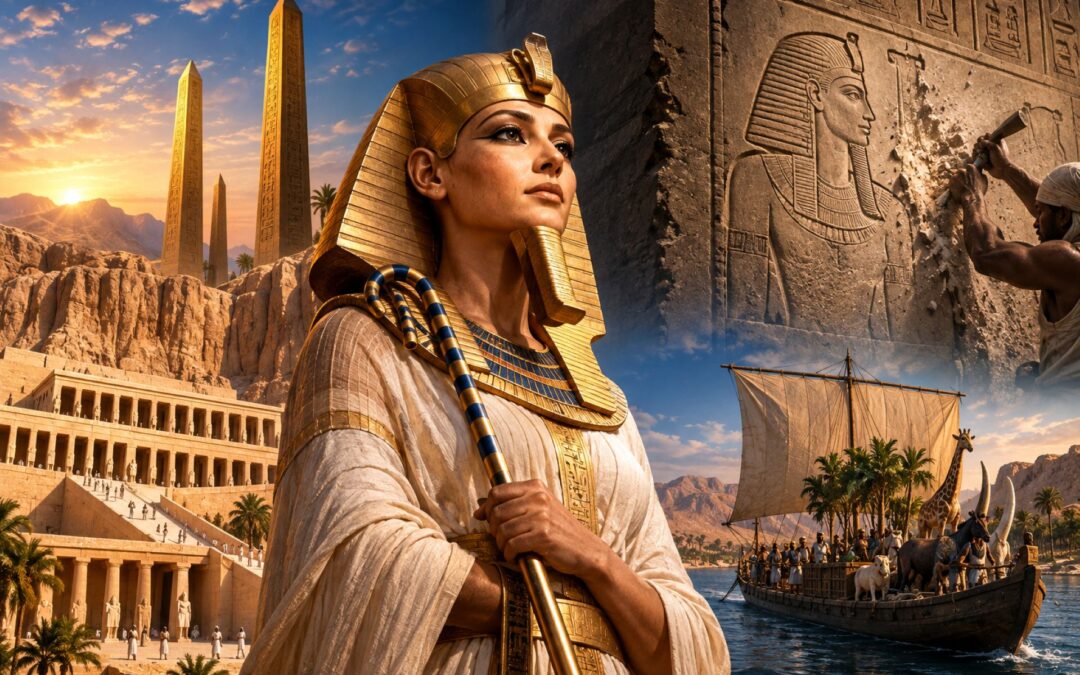
Her most celebrated architectural achievement, however, was her mortuary temple at Deir el-Bahri, on the west bank of the Nile opposite ancient Thebes.
Known as Djeser-Djeseru, commonly translated as the Holy of Holies, the temple was constructed against a dramatic backdrop of limestone cliffs. Its design incorporated a succession of broad terraces connected by ascending ramps, with long colonnades creating carefully ordered spaces along the approach.
The arrangement produced an unusual relationship between architecture and landscape. Rather than standing as an isolated building, the temple appeared to develop out of the cliffs behind it. Its terraces, open courts, columns, and ceremonial spaces created a processional setting that connected the royal monument with the surrounding sacred landscape.
Hatshepsut’s complex also belonged to an older tradition at Deir el-Bahri. Nearby stood the mortuary temple of Mentuhotep II, the Middle Kingdom ruler who had reunited Egypt after the First Intermediate Period. The relationship between these buildings reinforced the connection between Hatshepsut’s reign and the achievements of earlier kings.
The terraces and forecourts incorporated planting arrangements, and the temple’s decoration associated its sacred spaces with gardens and exotic trees. The extensive building programme required the labour of artisans, stonecutters, sculptors, administrators, and workers who supplied materials and maintained construction operations.
Senenmut was among the most important officials connected with this activity. His titles and surviving monuments demonstrate a close association with Hatshepsut’s administration and royal projects, although identifying him as the sole designer of the temple would go beyond what the evidence securely establishes.
The complex was not merely an impressive burial monument. Its reliefs presented Hatshepsut’s religious legitimacy, royal activities, divine birth, and foreign expedition to Punt. Architecture and imagery worked together to explain why she deserved to occupy the position of pharaoh.
As the Metropolitan Museum’s study of Hatshepsut’s temple at Deir el-Bahri makes clear, its design formed part of a developed Egyptian architectural tradition while producing a distinctive monumental setting for her kingship.
Hatshepsut’s construction programme therefore served several purposes simultaneously. It honoured the gods, mobilised the state’s economic and administrative resources, strengthened relationships with religious institutions, and created enduring representations of her royal authority.
The monuments also became central to the struggle over her memory after death. Their inscriptions and images made her reign visible across Egypt, giving later rulers numerous places where her identity could be removed, altered, or replaced.
The Voyage to Punt and the Politics of Prosperity
Among Hatshepsut’s most famous achievements was the expedition she organised to the land of Punt. The journey is recorded in detailed reliefs at her mortuary temple, where the preparation, activities, and return of the expedition became part of the official representation of her reign.
Punt was a region with which Egypt had maintained connections for centuries. Egyptian records from earlier dynasties describe expeditions seeking valuable goods, particularly aromatic substances used in religious ceremonies and elite consumption. Its exact location remains debated, although it is generally associated with regions around the southern Red Sea and the Horn of Africa.
The expedition associated with Hatshepsut took place during Year 9 of Thutmose III’s regnal count, when the two rulers shared kingship. Its importance did not lie in discovering a previously unknown civilisation. Rather, the voyage demonstrated Egypt’s capacity to organise long-distance maritime activity and obtain prestigious goods from established foreign networks.
The reliefs at Deir el-Bahri provide an unusually rich visual account. They depict Egyptian ships, the foreign landscape, inhabitants of Punt, exchanges of goods, and the transportation of valuable materials. These scenes are among the most important surviving representations of Egypt’s contact with the region.
The cargo included aromatic resins, myrrh trees, valuable woods, and other luxury materials. Such products were significant in a society where incense and fragrant substances featured prominently in religious offerings, royal ceremonies, and elite life.
The transportation of living trees was particularly striking. Their inclusion in the temple’s imagery associated the expedition with the possibility of bringing valuable and symbolically important plants into Egypt itself. The scenes presented the journey as an achievement involving both foreign exchange and religious provision.
The inscriptions also connected the expedition with divine favour. Hatshepsut portrayed the acquisition of these goods as part of her service to Amun, transforming a commercial and diplomatic undertaking into evidence that her kingship was fulfilling its religious responsibilities.
This relationship between trade and religious legitimacy helps explain why the expedition received such prominent treatment on her temple walls. Incense was not merely an exotic commodity; it was a material used in the rituals through which temples maintained their relationships with the gods.
The expedition also demonstrated the practical strength of the Egyptian state. Organising ships, crews, provisions, navigation, cargo transport, and the subsequent movement of goods inland required considerable administrative coordination. The journey could be celebrated as a royal achievement precisely because its success depended on institutions capable of operating beyond Egypt’s immediate territory.
The surviving scenes should nevertheless be interpreted carefully. Royal inscriptions were designed to glorify the monarch and demonstrate divine approval, not to provide disinterested accounts of foreign societies or commercial negotiations. They reveal what Egyptian officials chose to commemorate, while leaving many details about Punt and its people uncertain.
Archaeological work on the Punt portico, including research by the University of Warsaw’s Egyptian expedition, has helped scholars study the scenes and their historical context. Objects and reliefs preserved in Egyptian museum collections also provide evidence for the valuable goods and activities associated with the voyage.
For Hatshepsut, Punt became a particularly effective expression of legitimate kingship. The expedition strengthened the image of a ruler who could maintain foreign relationships, acquire prestigious resources, support religious institutions, and bring prosperity to Egypt.
Her achievement was not that she created Egyptian trade with Punt from nothing. It was that she sponsored a memorable expedition and had its success represented in extraordinary detail, leaving one of the most significant surviving records of Egypt’s connections with the region.
Governing Alongside Thutmose III
Hatshepsut’s reign is often described as though she displaced Thutmose III and ruled in his place. The surviving evidence supports a more complicated arrangement. Thutmose III remained a recognised king throughout the period, while Hatshepsut increasingly occupied the senior position and exercised the authority associated with full kingship.
Their relationship illustrates the unusual flexibility of Egyptian political institutions. The presence of two rulers did not necessarily mean that each exercised an identical share of practical authority. Hatshepsut’s prominence in royal inscriptions, monuments, and ceremonies demonstrates the extent to which she dominated the public representation of government.
Yet Thutmose III was not simply erased from political life during her reign. His royal identity continued to be acknowledged, and the dynasty’s future remained connected to his succession. The arrangement allowed Hatshepsut to exercise kingship while preserving the position of the male heir whose accession had originally brought her into the regency.
Both government and royal representation continued developing during their shared rule. Temple construction, religious patronage, administrative activity, and foreign expeditions demonstrate the monarchy’s capacity to mobilise resources and maintain relationships within and beyond Egypt.
Hatshepsut is sometimes characterised as a ruler who concentrated on peaceful trade and construction while leaving military affairs to others. That distinction is too absolute. Evidence of military activity survives from her period, and maintaining Egypt’s position in Nubia and neighbouring regions required more than ceremonial expressions of authority.
At the same time, detailed accounts of Thutmose III’s military training, assignments, and personal relationships during the co-rule cannot be confidently reconstructed. His later achievements as a commander should not be projected backwards into invented stories about how Hatshepsut prepared him for war.
Royal festivals and jubilees also contributed to the public expression of kingship. The Sed festival, traditionally associated with the renewal of royal power and often linked to a king’s thirtieth regnal year, carried important religious symbolism. However, the chronology and interpretation of Hatshepsut’s jubilee-related representations are complex, and the evidence does not establish that such a celebration was designed specifically to announce Thutmose III’s coming of age.
What can be established is that Hatshepsut occupied a royal position for a substantial period. Her authority began during the regency and developed into full kingship, producing a combined period of governing influence that lasted roughly two decades.
Her death is generally dated to around 1458 BCE, following a period traditionally associated with approximately twenty-two years of Thutmose III’s reign. The precise details of her final illness or circumstances of death cannot be established with the certainty sometimes suggested in popular biographies.
Hatshepsut had prepared for death through the funerary arrangements expected of an Egyptian monarch. Her association with the Valley of the Kings and royal burial practices reflected the position she claimed during life. The construction of her mortuary temple further connected her memory with the religious obligations and continuing cult of a king.
With her death, Thutmose III became the sole ruler. He subsequently conducted major campaigns that expanded and consolidated Egyptian power in western Asia, including the famous campaign against a coalition of Levantine rulers at Megiddo.
His military achievements became central to his historical reputation, but they should not overshadow the continuity between the institutions he inherited and those that had operated during Hatshepsut’s rule. Egypt’s administrative and religious foundations continued to support royal power as the character of the monarchy’s activities changed.
For a time, Hatshepsut remained visible in the monuments and inscriptions she had commissioned. Her name and image continued to occupy places within the monumental landscape of Egypt, apparently preserving her position among the country’s rulers.
That visibility would not last unchanged.
Why Thutmose III Erased Hatshepsut’s Name
Decades after Hatshepsut’s death, a campaign began to remove or alter representations of her kingship. Her names were erased from inscriptions, her figures were removed or replaced in temple reliefs, and some monuments were modified to attribute royal activities to other members of the dynasty.
The campaign was selective rather than a complete demolition of everything associated with her. The treatment of particular images and inscriptions varied, and numerous monuments retained evidence of the changes. In some places, the outlines of removed figures or altered inscriptions continued to reveal the presence of the ruler whom later authorities sought to exclude.
The most striking feature of the campaign is its timing. The attacks on her royal identity did not begin immediately after her death. They occurred substantially later in Thutmose III’s reign, a delay that complicates the familiar explanation that he acted out of immediate anger toward the woman who had exercised senior authority during his youth.
One interpretation connects the erasure with questions of dynastic succession. By removing Hatshepsut’s independent kingship from the official historical sequence, later royal representations could present a more straightforward line from Thutmose I through Thutmose II and Thutmose III, leading toward Thutmose III’s own successor, Amenhotep II.
Such a reconstruction would have political value within a system in which legitimate descent and royal precedent helped justify authority. Hatshepsut’s kingship was unusual, and its inclusion in the royal record complicated a succession narrative organised principally around male rulers.
The proposed connection with Amenhotep II is plausible, but it remains an interpretation. No surviving evidence establishes a definitive statement of Thutmose III’s private motives, and historians continue to debate the relationship between dynastic interests, political memory, and the decisions that produced the erasure.
Another explanation has emphasised resentment. According to this interpretation, Thutmose III sought to punish Hatshepsut because she had exercised authority that he might otherwise have held independently. The dramatic appeal of this story is understandable, particularly given the contrast between their earlier co-rule and the later destruction of her royal images.
The difficulty is that the evidence does not require personal hatred to explain the actions. Thutmose III ruled alongside Hatshepsut for many years and subsequently enjoyed a successful independent reign. The long delay before the campaign also makes a simple story of immediate revenge difficult to sustain.
Understanding the erasure requires distinguishing the official representation of kingship from the surviving physical treatment of monuments and statues.
Royal names and images were politically significant because they identified individuals as legitimate participants in Egypt’s sacred historical order. Removing Hatshepsut’s name from a royal sequence or replacing her figure with that of another king could alter how later generations encountered the history of the dynasty.
Damage to individual statues, however, could occur for several reasons. Egyptian sculpture possessed religious and ritual significance, and statues could be deliberately altered when their original sacred function ended. Objects could also be broken, reused, buried, or moved in ways that reflected later building activities rather than a single coordinated campaign of political hostility.
This distinction has become especially important through recent archaeological research. In a 2025 study examining the afterlife of Hatshepsut’s statuary, Egyptologist Jun Yi Wong re-examined evidence of damage to her sculptures and argued that some breakage reflected ritual deactivation rather than acts motivated solely by animosity.
The research does not establish that Hatshepsut’s political erasure was imaginary or that every damaged statue was treated for the same reason. Instead, it challenges the assumption that all surviving physical damage must be understood as evidence of a personal campaign of revenge.
The broader programme of removing her name and royal representation remains historically significant. What requires greater care is identifying the motives behind different interventions and distinguishing the evidence for deliberate political exclusion from evidence for other practices involving monuments and sculpture.
The campaign also had limits. Hatshepsut had commissioned too many monuments, inscriptions, and objects for every trace of her reign to disappear. Even when her name was removed, the surrounding scenes, altered surfaces, or surviving objects could preserve evidence that later scholars would use to reconstruct her position.
Her mortuary temple at Deir el-Bahri survived as one of Egypt’s most remarkable architectural monuments. Other sculptures and inscriptions eventually allowed Egyptologists to identify her achievements, investigate the chronology of her reign, and reconsider the nature of her relationship with Thutmose III.
The attempt to remove her from official memory therefore became part of the evidence through which modern scholars recovered her history. The alterations reveal that later rulers regarded her place in the royal record as politically consequential, even if their precise reasons remain uncertain.
Hatshepsut’s reign demonstrates how Egyptian kingship depended on more than military power or hereditary descent. She established her authority through dynastic relationships, religious legitimacy, institutional support, and a sophisticated use of the symbols that made a pharaoh recognisable to Egyptian society.
Her achievements were substantial in their own right. The monuments at Karnak and Deir el-Bahri, the expedition to Punt, and the artistic representations of her kingship reveal a ruler who exercised the resources and responsibilities of the Egyptian state on an exceptional scale.
Yet her story is also about the limits of a ruler’s control over historical memory. Hatshepsut could commission stone monuments intended to proclaim her legitimacy for generations, but she could not determine how her successors would interpret or preserve them.
What survived was not an untouched record of her reign. It was a complicated body of evidence shaped by her own royal propaganda, subsequent political intervention, the reuse of monuments, and thousands of years of physical change. By examining these traces together, historians have reconstructed the career of a woman whose kingship was both extraordinary and firmly rooted in Egyptian political and religious traditions.
Hatshepsut became pharaoh by working within the institutions that defined kingship, even as she expanded the possibilities of who could occupy that position. Her successors could alter the official record, but they could not entirely eliminate the evidence of what she had accomplished. Her historical significance rests not simply on having ruled as a woman, but on the authority she exercised, the achievements she left behind, and the revealing struggle over how that reign would be remembered.
Last Updated on October 29, 2026 by Aseem Gupta