
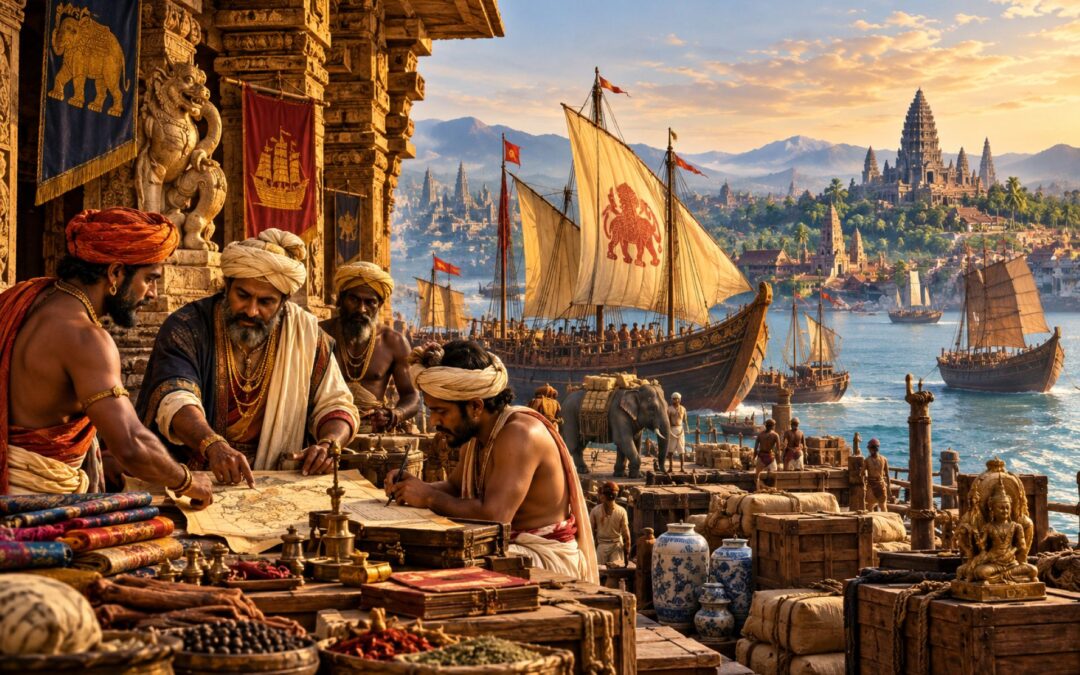
The history of India is often told through its emperors, dynasties, conquests, and battles. Chandragupta Maurya established an empire, the Guptas presided over a period of cultural and political influence, and the Cholas projected military power across the Bay of Bengal. Yet behind these familiar stories were merchants and commercial organisations whose activities helped connect kingdoms, finance institutions, and sustain economic networks that outlasted individual rulers.
Some of these merchants accumulated considerable wealth, negotiated privileges with kings, supported religious establishments, and organised protection for their commercial interests. Their associations connected distant producers and markets, handled financial endowments, and established communities in foreign ports. In certain circumstances, commercial success also brought social standing and influence within royal political systems.
Their power raises a fascinating question: how much influence did Indian merchants really possess? Were they simply wealthy participants in economies controlled by kings, or could they help shape the decisions of states and empires? The surviving evidence reveals institutions far more sophisticated than the traditional image of an isolated trader buying and selling goods, although it also places important limits on claims that merchants secretly controlled India’s rulers.
Before the Guilds: Trade from the Indus Valley to Mesopotamia
The foundations of India’s long-distance commercial history reach back to the Indus Valley Civilization, whose mature urban phase flourished from approximately 2600 to 1900 BCE. Across an enormous region encompassing parts of present-day Pakistan and northwestern India, Harappan settlements developed specialised industries, shared systems of measurement, and exchange networks connecting cities, agricultural communities, and distant sources of raw materials.
Cities such as Harappa and Mohenjo-daro depended on more than agricultural production. Skilled workers manufactured ornaments, textiles, pottery, metal objects, and carefully drilled stone beads, while traders and transporters connected workshops with markets. Materials including copper, lapis lazuli, shells, and precious stones moved across considerable distances, demonstrating that the economy integrated communities with different resources and specialisations.
One of the clearest indications of this integration is the widespread use of standardised stone weights. Their consistent numerical relationships suggest that people separated by substantial distances followed recognisable measurement conventions. Seals bearing animals and short inscriptions may also have helped identify goods, individuals, or institutions, although their precise administrative functions remain uncertain.
These networks extended beyond South Asia. Archaeological discoveries and Mesopotamian records reveal connections linking the Indus region with the Iranian plateau, the Persian Gulf, and southeastern Arabia. Mesopotamian texts mention trading regions called Dilmun, Magan, and Meluhha, with Meluhha commonly identified with the Harappan world. Goods could travel through intermediaries, while some merchants and sailors may have spent extended periods in foreign communities.
The commercial significance of these connections is explored more fully in the history of Harappan trade networks. What matters here is that long-distance exchange required coordination between producers, transporters, suppliers, and people operating in unfamiliar markets. The physical evidence demonstrates substantial commercial organisation even though the institutions responsible for managing it cannot be reconstructed with certainty.
This distinction becomes especially important when interpreting Indus seals. Some researchers have proposed that particular animal emblems, including bison imagery, identified merchant associations operating across trading sites. An academic interpretation of Indus inscriptions and commercial organisation illustrates the possibility of connecting recurring symbols with economic institutions, but such interpretations remain hypotheses.
Because the Indus script has not been deciphered to scholarly consensus, no particular seal can confidently be identified as the emblem of a named merchant guild. Nor can the existence of a Harappan commercial system establish direct institutional continuity with the guilds documented many centuries later.
The Harappans therefore provide an important starting point, not because they can be shown to have created the medieval guild system, but because they demonstrate how deeply organised production and exchange were embedded in South Asian society long before the rise of its best-known empires.
How Merchant Associations Emerged in Early India
By the middle of the first millennium BCE, northern India was experiencing another period of urban and commercial expansion. Agricultural development in the Ganges basin supported growing towns, markets, specialised occupations, and increasingly powerful territorial states. Merchants operated within a changing economy in which goods, money, and services circulated between communities that were becoming more economically interconnected.
Occupational and commercial associations emerged within this environment. One important term was śreṇi, often translated as guild, which could describe an organised body of people associated with a particular trade or occupation. Such groups might include artisans or producers as well as merchants, and their precise structures varied across regions and historical periods.
Membership in an association could provide practical advantages. Traders dealing repeatedly with the same partners benefited from established reputations, shared commercial practices, and mechanisms for addressing disagreements. Artisans could coordinate aspects of production and professional conduct, while associations could represent collective interests in their dealings with political authorities.
These organisations existed within states that also recognised the economic importance of commerce. The emergence of Magadha and the Mauryan Empire brought extensive territories into political systems capable of raising revenue, supporting armies, and maintaining administrative arrangements. Merchants and producers were valuable participants in those economies, although the extent to which they influenced particular political decisions is much harder to establish.
A particularly striking theory concerns Chandragupta Maurya’s overthrow of the Nanda dynasty in the late fourth century BCE. Later traditions associate his rise with the strategist Chanakya, who supposedly assembled substantial resources, cultivated allies, and helped organise the campaign against Magadha’s established rulers.
Some accounts describe Chanakya acquiring extraordinary wealth, occasionally through explanations involving magic or legendary achievements. Modern interpretations have suggested that merchant associations may have supplied loans or financial backing to Chandragupta’s cause. Given the expense of military operations, the involvement of wealthy commercial supporters would be understandable, but historical plausibility is not evidence that a particular transaction occurred.
The surviving traditions do not establish that merchant guilds financed the conquest, dictated Chandragupta’s political promises, or secured specific tax concessions in return. The distinction between the legendary financing of the Mauryan revolution and independently documented history is important when examining stories about Chanakya’s campaign financing.
Similar caution applies to claims that merchants encouraged the Mauryan conquest of Kalinga. Kalinga occupied an important coastal region, and access to maritime commerce could matter to expanding states. Nevertheless, the commercial importance of a territory does not demonstrate that merchant associations pressured Ashoka into conquering it.
Over the following centuries, commercial networks continued developing under changing political powers. The Kushan Empire connected northern India with Afghanistan and Central Asia, while merchants and religious communities participated in exchanges across the routes later grouped under the Silk Roads. Buddhist monasteries attracted donations from traders and other patrons, creating lasting connections between commercial activity and religious institutions.
During and after the Gupta period, trade, craft production, and urban institutions operated within increasingly varied political environments. Some wealthy commercial families acquired social prestige through patronage and relationships with local elites. However, claims that particular royal dynasties descended from organised merchant families must be evaluated individually. The Chinese pilgrim Xuanzang’s association of Harsha’s background with the Vaishya category, for example, cannot establish a detailed genealogy of merchant ancestors who acquired royal power.
What emerges from these centuries is not an uninterrupted rise toward merchant rule. It is the growing historical visibility of commercial and occupational associations that could accumulate resources, maintain relationships, and participate in society beyond individual transactions.
Banking, Collective Rules, and Armed Protection
The influence of Indian merchant guilds becomes easier to understand when we examine what these organisations actually did. Their importance did not depend exclusively on the wealth of individual members. It also arose from their ability to organise resources collectively, preserve obligations, and provide services that could remain useful across repeated transactions and changing political circumstances.
One of the most revealing examples comes from an inscription at Nasik associated with a religious endowment made during the early centuries of the Common Era. The record describes a substantial sum, commonly stated as 3,000 coins, deposited with two guilds of weavers. The funds were intended to generate income for the support of Buddhist monks, with specified interest arrangements governing the payments.
The significance of the transaction lies in its institutional structure. Money was entrusted to recognised occupational organisations under arrangements that provided continuing financial benefits to another institution. The guilds were not simply selling woven goods; they were participating in a financial relationship based on capital, obligations, and the expectation that income would be generated over time.
As examined in scholarship on religious endowments and financial obligations in ancient India, such records demonstrate that some guilds could perform functions resembling deposit-taking and investment. They also show why occupational associations could become important participants in local economic life even when their members specialised in manufacturing rather than long-distance trade.
It would nevertheless be misleading to describe every ancient Indian guild as a bank in the modern sense. There is no reason to assume that all associations accepted public savings, followed identical interest arrangements, or possessed the same financial capabilities. The records demonstrate particular transactions and institutional practices, not a single standardised banking system operating throughout the subcontinent.
The practical value of collective organisation extended beyond finance. Long-distance merchants needed dependable suppliers, access to transport, information about unfamiliar markets, and relationships with people who controlled commercial facilities. A trader travelling far from home could face uncertain prices, unreliable counterparties, unfamiliar laws, and the possibility of losing an entire cargo to an accident or attack.
Commercial associations could help reduce some of these difficulties. Membership might provide introductions to established partners, access to shared commercial knowledge, or support in negotiating with local authorities. A recognised corporate reputation could sometimes be valuable where personal relationships were insufficient, particularly when commerce crossed political and linguistic boundaries.
Guilds also possessed forms of internal organisation. Literary and legal traditions refer to customary rules governing occupational communities, while inscriptions document collective decisions and agreements. Some organisations operated through recognised officers or representatives who could act for the group, manage obligations, or participate in negotiations.
The important point is that collective authority could exist without every guild following one identical constitution. There is insufficient evidence to conclude that Indian merchant organisations universally elected presidents every few years, rejected hereditary influence, or operated according to a standard democratic model. Leadership, participation, and authority could vary depending on local circumstances, wealth, status, and the nature of the association.
An association’s ability to make recognised decisions was nevertheless an important resource. It allowed commercial groups to act beyond the scale of a single household or individual merchant. Funds could be committed to projects, obligations could be recorded, and relationships with other institutions could acquire a degree of continuity.
Collective organisation also mattered when economic interests required protection. Transporting valuable goods across land routes and dangerous waterways exposed merchants to theft, piracy, warfare, and changing political conditions. Commercial networks therefore had reasons to maintain relationships with soldiers, guards, and rulers capable of providing security.
Evidence from South India shows that some merchant associations became connected with armed personnel and militias. The Tamil Nadu Department of Archaeology’s account of guild inscriptions identifies important trading organisations and records that illuminate their collective activities, including their associations with military protection.
Armed protection gave merchants practical capabilities beyond those of ordinary traders. A commercial organisation able to defend goods, maintain secure routes, or mobilise armed supporters might negotiate from a stronger position than one entirely dependent on outside protection. Its resources could also become attractive to rulers seeking assistance.
However, merchant militias should not automatically be imagined as permanent private armies equivalent to those of territorial kingdoms. Nor do references to armed trading communities establish that guilds possessed immense independent navies, exercised unrestricted criminal jurisdiction, or enjoyed immunity when members attacked commercial rivals.
Guild customs and mechanisms for resolving disputes could coexist with royal law, local authority, and other institutions. The ability to enforce certain internal obligations did not mean that merchants had become sovereign rulers over themselves.
These distinctions make the historical achievement more interesting rather than less impressive. Indian guilds could coordinate commercial activity, handle valuable funds, establish rules, support religious endowments, and sometimes provide security without needing to resemble modern corporations or miniature independent states.
Their strength lay in the accumulation of relationships and capacities that merchants could use repeatedly. Once these organisations became important to the movement of goods and capital, political authorities had practical reasons to cultivate their cooperation.
When Commercial Wealth Entered Royal Politics
For Indian rulers, successful commerce offered more than luxury imports and prosperous marketplaces. Ports, commercial towns, and inland routes could generate revenue, attract skilled producers, and connect political centres with valuable resources. Merchants benefited from predictable trading arrangements and security, while rulers benefited from economic activity that could support their wider ambitions.
The relationship was therefore often cooperative, although it was never necessarily equal. Rulers could impose taxes, regulate ports, recognise commercial privileges, and offer protection. Merchants, particularly those operating through influential associations, could negotiate terms, provide resources, finance religious institutions, and establish relationships with competing political authorities.
The Rashtrakuta Empire illustrates the importance of commerce within a broader system of imperial power. During the eighth to tenth centuries, its rulers controlled extensive territories in the Deccan and exercised influence over regions connected with the western coast. Those connections brought the empire into commercial networks reaching the Persian Gulf and the wider Arab world.
Arab and Persian merchants participated in western Indian trade, exchanging goods through ports and inland markets connected with agricultural and manufacturing centres. Rulers had reasons to accommodate these commercial communities, whose economic activities could contribute to revenue and the prosperity of settlements under their influence.
Under Amoghavarsha I, who ruled for much of the ninth century, the Rashtrakutas maintained a major imperial presence despite periods of political and military difficulty. His comparatively conciliatory reputation should not be explained as the automatic consequence of trade wealth. The dynasty’s resources continued to depend heavily on agriculture, subordinate rulers, military organisation, and political alliances, alongside its participation in international commerce.
The relationship between these different foundations of power is important to understanding Rashtrakuta connections with Indian Ocean trade. Commercial income could strengthen a ruler’s position, but it did not replace the other structures required to maintain imperial authority across distant territories.
Merchant influence was also visible through religious and architectural patronage. Wealthy individuals could sponsor temples, support religious establishments, and participate in projects closely connected with royal prestige. Such activities established public recognition and linked commercial fortunes with institutions that held considerable social importance.
A notable example comes from the Hoysala kingdom in southern India. The twelfth-century Hoysaleshvara temple at Halebidu is associated with the patronage of Ketamalla, a wealthy merchant connected with the political world of King Vishnuvardhana. The history of Hoysaleshvara and its patrons illustrates how commercial wealth could help create monumental religious institutions within a royal setting.
This form of patronage was politically meaningful even when it did not amount to control over royal policy. A merchant capable of sponsoring an important temple possessed resources that could generate prestige, strengthen social relationships, and establish a durable public legacy. Such figures were not necessarily hereditary aristocrats, but their economic standing could bring them into close contact with elite political society.
Commercial considerations also shaped the importance of coastal territories. Ports such as Goa connected inland regions with Arabian Sea trading networks, making maritime security and access to commercial routes attractive concerns for regional powers. Merchant associations could support political interests that favoured stable or advantageous conditions, although claims that they directly engineered particular dynastic takeovers require specific evidence.
The broader pattern is one of overlapping interests. A king needed revenue, supplies, political allies, and access to commercial resources. Merchants needed protection, established privileges, functioning markets, and authorities with whom they could negotiate.
The resulting relationships could give wealthy commercial actors considerable influence, but influence should not be confused with the ability to command every royal decision. A merchant who financed an endowment, advised a ruler, or received official recognition had achieved something significant without necessarily becoming the hidden authority behind the throne.
The clearest demonstration of how commercial organisations could extend these relationships across an extraordinary geographic scale emerged in the maritime world of southern India.
The Ayyavole Five Hundred and the Chola–Srivijaya Clash
By the early medieval period, commercial networks connecting India with western Asia, Sri Lanka, Southeast Asia, and China had become increasingly important. Ships carried textiles, precious materials, spices, aromatic products, ceramics, and other commodities between regions whose economies were linked through intermediaries and established ports.
Among the most prominent South Indian merchant organisations was the Ayyavole Five Hundred, also known as the Ainnurruvar or the Five Hundred of Aihole. Associated with the commercial traditions of Aihole in present-day Karnataka, the organisation developed connections extending well beyond its original regional setting.
Its surviving inscriptions describe merchants operating across considerable distances and identify collective commercial activities. They reveal an organisation whose members and associates participated in networks connecting inland markets with maritime trading centres.
Other important names included Manigramam and Anjuvannam. These associations appeared in different regional and commercial contexts, and their relationships with the Five Hundred changed over time. Some operated alongside larger networks or became connected with them, but it would be inaccurate to imagine all these organisations as permanent subsidiaries of one centrally managed corporation.
Their importance rested on the ability to maintain commercial relationships across regions governed by different political authorities. Merchants needed information about local conditions, trusted associates, financial resources, and arrangements for handling cargo and obligations. Participation in recognised networks could help them negotiate the practical difficulties of conducting business far from their home communities.
These organisations expanded in an Asian commercial environment undergoing significant change. The Abbasid Caliphate and the wider Islamic commercial world helped sustain connections around the Persian Gulf and Indian Ocean, while the Tang and later Song dynasties played important roles in the economic history of East Asia. Demand, diplomacy, maritime activity, and changing technologies encouraged commerce across an increasingly interconnected region.
Indian ports occupied important positions within these routes, but they were not indispensable stopping points for every vessel. Merchants could use different itineraries, redistribute goods through several ports, or undertake longer voyages depending on navigational knowledge and commercial conditions. The fortunes of individual ports could therefore change as trading patterns evolved.
Political authorities benefited from attracting commercial activity. Harbours provided access to foreign goods, markets, customs revenue, and diplomatic contacts, while successful trading communities could help connect inland production with overseas demand. Merchants, in turn, sought secure routes and arrangements that allowed them to compete effectively.
The Chola Empire emerged as a formidable power within this environment. Beginning with its resurgence in the ninth century, the dynasty expanded from the Kaveri region into much of southern India. Under Rajaraja Chola I and his son Rajendra Chola I, military campaigns extended Chola influence across important territories, including parts of Sri Lanka and regions connected with India’s eastern coastline.
The empire’s power depended on productive agricultural lands, political organisation, and military resources, but its coastal position also gave it access to extensive commercial networks. Tamil merchant communities participated in exchanges across the Bay of Bengal, where the movement of goods intersected with diplomacy, religious patronage, and competition between states.
Farther east, Srivijaya had developed into an influential maritime political network centred on Sumatra and associated with ports around the Strait of Malacca. Its importance came partly from its position along routes connecting the Indian Ocean with the South China Sea. Political influence over ports, access to markets, and relationships with other maritime communities helped sustain its regional prominence.
Srivijaya was not a uniformly administered territorial empire controlling every island and coastline in the region. Its authority depended on relationships among ports, rulers, and communities whose interests could differ. This flexible political structure helps explain both its commercial importance and the difficulty of describing its fortunes simply in terms of conquest or collapse.
The Cholas and Srivijaya had maintained cooperative relationships before their famous confrontation. A Srivijayan ruler supported the establishment of a Buddhist monastery at Nagapattinam on the Tamil coast, with Chola royal patronage associated with the institution. These earlier ties demonstrate that commercial and diplomatic cooperation could connect rulers belonging to different religious traditions.
Yet in 1025 CE, Rajendra Chola launched a major military expedition against Srivijaya and associated maritime centres. Chola inscriptions celebrate victories over several places, the seizure of treasures, and the capture of a foreign ruler. The campaign represented an extraordinary projection of South Indian military power across the Bay of Bengal.
Why the Cholas undertook this expedition remains debated. Competition for commercial access and the desire to strengthen connections with Song China are important possibilities. Other explanations emphasise royal prestige, plunder, diplomatic rivalry, and the political circumstances of the maritime region.
Historian Hermann Kulke’s analysis of Srivijaya and its changing political relationships helps place the expedition within a complex international environment rather than a simple struggle between two fixed territorial empires. Commercial interests mattered within that environment, but they did not necessarily provide the only motive for military action.
The ambitions of South Indian merchant associations are especially relevant to this debate. Guilds such as the Five Hundred benefited from dependable maritime connections, and merchants familiar with distant ports possessed information that could have been valuable to the Chola state. It is reasonable to investigate whether shared commercial interests helped shape the political environment in which Rajendra made his decision.
What cannot be established is the stronger claim that the Five Hundred ordered the invasion, threatened to replace Rajendra with another king, or supplied the ships and soldiers that made the expedition possible. The detailed organisation of the Chola naval force remains difficult to reconstruct, as discussions of the evidence for the Chola navy make clear.
The existence of powerful merchant networks does not identify the owners of the expedition’s vessels or establish who financed particular operations. Nor can later evidence of South Indian merchants in Southeast Asia be treated as proof that those merchants orchestrated the earlier campaign.
The expedition itself was nevertheless a remarkable achievement. Rajendra’s forces attacked important maritime centres at a considerable distance from the Chola heartland, demonstrating the empire’s ability to mobilise resources beyond the Indian subcontinent. Its historical significance is examined in greater detail through Rajendra Chola’s expedition against Srivijaya.
The aftermath also requires care. Although the campaign inflicted a serious defeat on Srivijaya, it did not establish permanent Chola administration throughout Southeast Asia or immediately destroy the region’s existing political networks. Commercial activity continued, political relationships changed, and South Indian merchant associations remained important participants in maritime exchange.
The Chola–Srivijaya confrontation therefore reveals both the possibilities and the limits of merchant power. Commercial interests were deeply connected with imperial policy, but the surviving records do not allow the motives of merchants and kings to be treated as identical. Understanding that distinction is essential to appreciating how trade and political authority interacted.
The Merchant Networks That Crossed Empires and Oceans
One of the strongest indications of South Indian merchants’ international reach comes not from accounts of royal conquests but from inscriptions left by commercial communities overseas. These records demonstrate the presence of organised merchant groups in places far removed from their original centres, sometimes decades or centuries after the political events commonly associated with their expansion.
An especially important example comes from Barus on the western coast of Sumatra. A Tamil inscription dated to 1088 records activity associated with the Five Hundred, including an agreement involving commercial dues. The inscription provides tangible evidence that South Indian merchants participated collectively in the commercial affairs of a Southeast Asian port.
Research on South Indian involvement in northern Sumatra places such inscriptions within the wider archaeological history of the region. Their importance lies in what they directly document: merchants operating abroad through recognised associations and making arrangements relevant to their commercial activity.
The Barus inscription dates more than six decades after Rajendra Chola’s expedition. Its existence demonstrates overseas commercial organisation, but it does not establish that the Chola raid created the guild’s presence there or that the merchants exercised political control over Sumatra.
The commercial connections of South Indian communities extended even farther east. In the Chinese port of Quanzhou, surviving architectural remains and inscriptions reveal the presence of a Tamil-speaking community associated with a Hindu temple during the thirteenth century. An inscription dated to 1281 is particularly important for reconstructing this later phase of overseas settlement.
Quanzhou’s prosperity depended on maritime exchanges linking China with Southeast Asia, South Asia, and regions farther west. Foreign commercial communities participated in the city’s economic and religious life, sometimes establishing institutions that reflected their own traditions while operating within Chinese political and social arrangements.
The traces of Tamil merchants in Quanzhou demonstrate how commercial relationships could develop into more lasting forms of settlement. Merchants did not simply carry goods between distant markets; they also maintained religious practices, supported institutions, and established relationships within foreign communities. Their presence belongs to the wider history of Tamil merchant communities in Chinese ports.
These networks were not evidence that Indian merchants controlled every region they visited. Their activities depended on cooperation with local rulers, suppliers, port authorities, and other trading communities. Southeast Asian and Chinese participants were active economic and political actors, not passive recipients of Indian commercial influence.
The success of a guild operating across different political systems therefore depended on adaptability as much as accumulated wealth. Commercial associations needed to maintain relationships that could survive changes in rulers, routes, demand, and regional competition. Their geographic reach could provide resilience, but it did not guarantee permanent prosperity or uninterrupted authority.
The surviving inscriptions offer a view of Indian merchant power more convincing than stories of secret political domination. They document organisations capable of taking collective decisions, handling financial relationships, protecting commercial interests, and participating in international networks whose importance extended beyond any one dynasty.
Indian history cannot be fully understood through the actions of kings alone. Merchants, artisans, financiers, transporters, and commercial associations helped sustain the economic connections through which kingdoms obtained resources and distant societies exchanged goods and ideas. Their influence could be considerable because the institutions they maintained performed functions that neither individual traders nor rulers could always accomplish alone.
Yet economic importance did not automatically confer political control. A merchant guild could negotiate privileges without governing a kingdom, maintain armed protection without commanding an imperial navy, and benefit from conquest without having ordered it. Recognising these distinctions reveals a more substantial historical achievement: Indian merchants built commercial institutions capable of operating across political borders, preserving relationships, and sometimes influencing the rulers whose fortunes were tied to the wealth moving through their networks.
Last Updated on October 26, 2026 by Aseem Gupta