
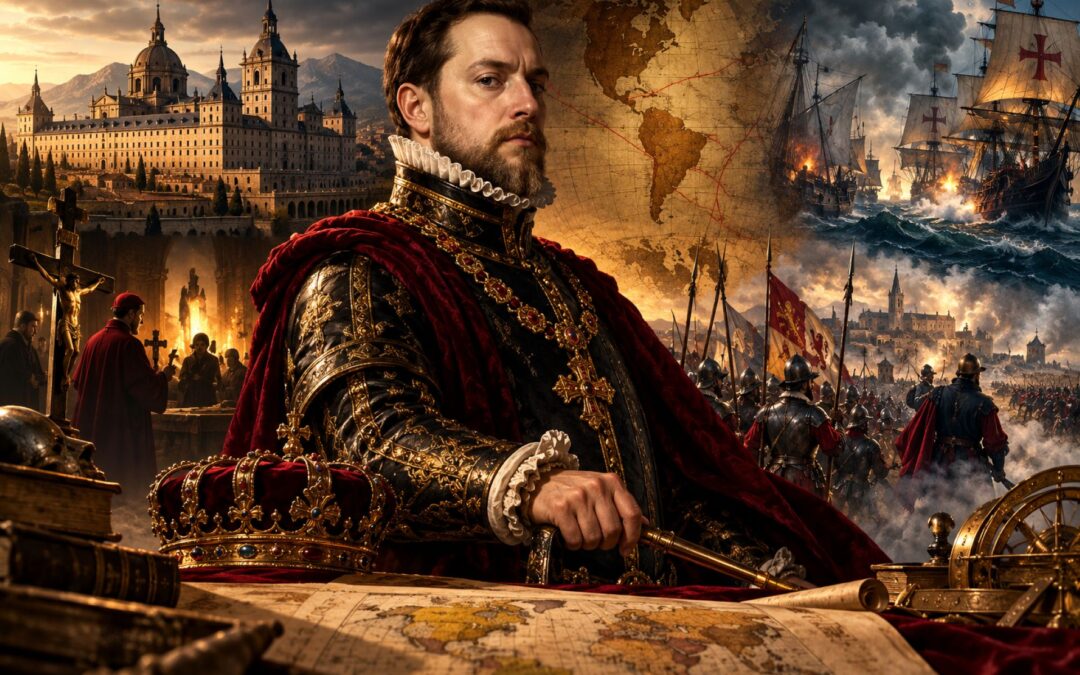
In the late sixteenth century, Philip II of Spain governed territories scattered across Europe, the Americas, Africa, and Asia. His possessions included the kingdoms of the Iberian Peninsula, territories in Italy and the Low Countries, vast American colonies, and the Philippines. After acquiring the Portuguese crown in 1580, his authority extended across an even larger collection of overseas territories. Few rulers in history had exercised power over such an extensive geographical area.
Yet the man at the center of this enormous monarchy spent much of his life surrounded by paperwork. Philip examined reports, studied financial accounts, reviewed military plans, and wrote detailed instructions to officials thousands of miles away. He believed that careful supervision was essential to responsible government, even when the decisions confronting him involved territories he had never visited and events that could change long before his orders arrived.
His reign, from 1556 to 1598, produced extraordinary achievements and devastating failures. Spanish forces defeated the Ottomans at Lepanto, acquired Portugal, and extended royal authority across the Pacific. At the same time, rebellion engulfed the Netherlands, religious persecution destabilized communities, successive wars strained royal finances, and the attempted invasion of England ended in humiliation.
Philip was neither an incapable ruler who simply inherited an empire nor an all-powerful monarch undone by a few unfortunate battles. He was an intelligent, industrious, deeply religious king whose greatest administrative strengths could also become political weaknesses. Understanding his life reveals how difficult it was to govern a global monarchy when almost every important decision ultimately depended on one man.
A Habsburg Prince Learns to Rule (1527–1556)
Philip was born in Valladolid on May 21, 1527, the eldest son of Charles V, Holy Roman Emperor and King Charles I of Spain, and Isabella of Portugal. His parents belonged to two powerful European dynasties whose marriages and inheritances had brought enormous territories under their control. From birth, Philip was expected to inherit responsibilities extending far beyond the Iberian Peninsula.
His father governed a sprawling collection of territories that included the Spanish kingdoms, the Low Countries, parts of Italy, and Habsburg lands in Central Europe. Charles also faced constant political and military challenges from France, the Ottoman Empire, rebellious German princes, and the religious divisions unleashed by the Protestant Reformation. These responsibilities frequently kept him away from Spain, leaving much of Philip’s childhood under the care of his mother and royal household.
Isabella played an important role in the young prince’s upbringing. Her death in 1539, when Philip was eleven, deprived him of a parent to whom he had been closely attached. His father remained an influential but frequently absent figure, communicating expectations and political guidance through letters and trusted advisers.
Philip received an extensive education intended to prepare him for kingship. His principal household governor, Juan de Zúñiga, oversaw his upbringing, while teachers including Juan Martínez Silíceo and Juan Ginés de Sepúlveda contributed to his intellectual formation. As the Spanish Royal Collections’ biography of Philip II explains, his education combined humanist learning with practical preparation for political responsibility.
The prince studied Latin, history, religion, literature, and the principles of government. He developed a lasting interest in books, manuscripts, art, and scholarly pursuits. Although he acquired knowledge of several languages, Castilian remained his principal language of administration, and his limited fluency in some of the languages spoken across his future territories would complicate his relationships with foreign subjects.
Catholicism occupied a central place in his education. Philip grew up during an age when religious belief was inseparable from political legitimacy, and European rulers were expected to defend the religious identity of their territories. The Protestant Reformation had already challenged the authority of the Catholic Church, while Charles V regarded religious division as a major threat to the political order he was struggling to preserve.
Philip’s training was not limited to theoretical instruction. In 1543, at the age of sixteen, he began exercising governmental responsibilities in Spain while his father attended to affairs elsewhere. Charles provided detailed advice concerning ministers, political factions, financial management, personal conduct, and the dangers of allowing powerful courtiers to dominate royal decisions.
These instructions reveal an important feature of Philip’s early development. He was taught to listen carefully to advisers but reserve final judgment for himself. He also learned that information was a source of political power and that rulers needed to scrutinize the interests of those who supplied it. Both principles would become defining characteristics of his reign.
The same year, Philip married Maria Manuela of Portugal, his first cousin. Their marriage strengthened connections between the Spanish and Portuguese royal families and reinforced the dynastic relationships through which European monarchies accumulated power. In 1545, Maria Manuela gave birth to their son, Don Carlos, but died shortly afterward from complications associated with childbirth.
The young prince was therefore a widower and father before reaching twenty. His personal life had already become entangled with the demands of succession, a pattern that would continue through three further marriages.
In 1548, Philip departed on an extended journey through Habsburg territories in Italy and Central Europe before reaching the Low Countries. The journey allowed him to meet nobles, administrators, and political representatives in lands he might eventually govern. Elaborate receptions celebrated the prince, but they also exposed him to the practical difficulties of ruling territories with different languages, political traditions, and expectations.
The Netherlands presented particular challenges. Its wealthy cities and provinces possessed important commercial networks and long-established privileges, and their political institutions did not simply accept unlimited interference from a distant sovereign. Philip encountered a society whose prosperity made it valuable to the Habsburg monarchy but whose traditions would later make centralized religious and political policies deeply contentious.
Meanwhile, Charles V was growing increasingly exhausted by decades of war and government. His attempts to preserve Catholic unity in the Holy Roman Empire had encountered determined resistance, and his European commitments continued to demand money and military manpower.
During 1555 and 1556, Charles gradually surrendered his responsibilities. Philip inherited the Netherlands in 1555 and the Spanish crowns in January 1556, together with the monarchy’s overseas possessions and many of its Italian territories. The Austrian Habsburg lands and imperial succession followed a different dynastic line, eventually passing to Charles’s brother Ferdinand.
Philip therefore did not inherit his father’s complete political position. He became ruler of an immense collection of territories, but he was not Holy Roman Emperor. Charles remained alive until September 1558, having deliberately transferred the principal responsibilities of government before his death.
When Philip assumed the Spanish crowns at twenty-eight, he possessed considerable experience as a regent and heir. What he had not yet experienced was the full burden of being the final authority over a monarchy whose military commitments, political disputes, and financial obligations extended across much of the known world.
A New King Between England, France, and Spain (1554–1561)
Philip’s accession occurred during a period of intense competition among Europe’s leading dynasties. France remained a powerful Habsburg rival, Protestantism was dividing Christian Europe, and England’s religious and political future was uncertain. Philip’s marriage to Mary I of England placed him directly inside these struggles even before he became king of Spain.
Mary had inherited the English throne in 1553 following the death of her half-brother Edward VI. A committed Catholic, she sought to restore England’s relationship with Rome after the Protestant reforms of the preceding reigns. Her marriage to Philip in July 1554 offered diplomatic support for that objective while strengthening England’s connections with the Habsburg monarchy.
The marriage was politically controversial. Many English subjects feared that a Spanish prince would dominate their country, subordinate its interests to Habsburg ambitions, or draw it into costly continental wars. The marriage settlement therefore restricted Philip’s powers, protecting English laws and attempting to prevent the transfer of national resources into foreign conflicts.
Philip possessed the title of king during Mary’s reign, but he was not an independent English sovereign. His authority depended on the marriage and the arrangements established by the English political system. He also spent substantial periods outside England, particularly as his responsibilities in the Netherlands and Spain increased.
Religious policy was one area in which their interests broadly aligned. Mary’s government restored papal authority and persecuted Protestants, with hundreds executed for heresy during her reign. Philip supported Catholic restoration, although the details of individual prosecutions and English policy cannot simply be attributed to him personally.
The marriage failed to produce a surviving child. That failure carried enormous political consequences because a Catholic heir might have changed the succession and England’s subsequent religious direction. Without one, the Habsburg alliance remained vulnerable to Mary’s death.
Relations with France soon became an immediate concern. The French monarchy had long challenged Habsburg influence in Italy and the Low Countries, and the conflict continued during Philip’s early reign. England entered the war against France in 1557, deepening domestic criticism of Mary’s marriage.
In August 1557, a Habsburg army commanded by Emmanuel Philibert, Duke of Savoy, defeated French forces at the Battle of Saint-Quentin. The victory strengthened Philip’s military position and enhanced his prestige, although the achievement depended on experienced commanders and multinational forces rather than his personal battlefield leadership.
The war nevertheless remained expensive and politically complicated. England suffered the loss of Calais in January 1558, ending its possession of a strategically important continental foothold that had survived since the fourteenth century.
Mary died in November 1558 and was succeeded by her Protestant half-sister Elizabeth I. Philip’s direct connection to the English crown ended, but he did not immediately become Elizabeth’s irreconcilable enemy. For years, Spanish policy had to balance religious hostility against the strategic advantages of preventing France from gaining excessive influence in England.
Peace with France followed through the Treaty of Cateau-Cambrésis in April 1559. The settlement brought an end to a long period of Habsburg-Valois warfare and strengthened Spain’s position in Italy. It also created the circumstances for Philip’s third marriage, this time to Elisabeth of Valois, daughter of Henry II of France and Catherine de’ Medici.
Elisabeth was a young bride entering a foreign court whose language and customs were initially unfamiliar to her. Over time, she developed a closer relationship with Philip, and their marriage produced two daughters. Her presence also helped symbolize the diplomatic reconciliation between the Spanish and French monarchies.
The death of Henry II in 1559 soon plunged France into a period of political instability that would develop into decades of religious warfare. Philip’s apparent diplomatic success had therefore not eliminated the difficulties on Spain’s northern frontier.
In 1559, Philip returned to Spain after spending much of the preceding years abroad. He would never again visit the Netherlands, even as its political problems became some of the most serious of his reign.
In 1561, he established Madrid as the permanent seat of the royal court. The decision helped make the city the administrative center of the monarchy, although its selection cannot be explained simply by its geographical position near the center of the Iberian Peninsula. Existing royal residences, communications, political considerations, and the practical needs of government also influenced the choice.
Philip had secured his throne, survived major wars, concluded an important peace, and established a central court. His next challenge was to turn those achievements into a functioning system of government across territories that could never be managed as one ordinary kingdom.
Governing by Paper: Madrid, Councils, and El Escorial
Philip II’s most distinctive characteristic as a ruler was his extraordinary attention to administrative detail. He did not regard government as something that could simply be delegated to generals, ministers, and provincial governors. He believed that responsible kingship required knowledge, supervision, and personal judgment, even when the number of decisions demanding his attention became overwhelming.
The monarchy he governed was not a unified state with identical laws across its territories. Castile, Aragon, the Italian possessions, the Netherlands, and the overseas colonies possessed different administrative arrangements, privileges, and fiscal obligations. Philip’s authority was extensive, but it operated through established institutions and frequently required negotiation with local political bodies.
Government depended heavily on councils. These included the Council of State, which advised on major diplomatic and strategic questions, and other bodies responsible for particular territories or functions. The Council of the Indies dealt with matters involving Spain’s American possessions, while financial institutions advised on taxation, borrowing, and expenditure.
Secretaries and officials received petitions, prepared memoranda, summarized correspondence, and carried instructions between the king and his advisers. Their work gave Philip access to an enormous quantity of information, but it also made him dependent on individuals who decided what information reached him, how it was presented, and which matters required immediate attention.
Philip frequently examined documents personally and added comments, corrections, or instructions. He could spend hours working through correspondence, sometimes returning to an issue repeatedly before making a decision. His diligence impressed contemporaries, but officials waiting for answers could find his methods frustrating.
The historian Geoffrey Parker, drawing on extensive archival documentation in Imprudent King: A New Life of Philip II, examines how the king’s personal habits influenced his decisions. Philip’s insistence on close supervision sometimes produced careful judgments, but it could also create delays when rapidly changing political or military circumstances required greater freedom for local commanders.
The difficulty was not merely that Philip worked too much. It was that his monarchy generated more information than any individual could consistently process. A ruler might possess impressive knowledge of an issue while still lacking the most recent facts needed to resolve it.
Communication made the problem worse. Messages from the Netherlands could take days or weeks to arrive, depending on conditions, while information from the Americas or Philippines required ocean voyages lasting months. By the time Philip received a report, considered possible responses, consulted advisers, and issued orders, events at the destination might already have changed.
The Spanish Road illustrates both the strengths and limitations of Habsburg communications. This network of military and logistical routes connected possessions in northern Italy with the Low Countries through territories in Central Europe. It helped Spain move soldiers and maintain strategic connections without depending entirely on vulnerable sea routes, but it was not simply a private information network belonging to Philip.
Madrid provided a more stable base for managing these responsibilities. Establishing the court there concentrated officials, secretaries, records, and advisers in one location. Yet the concentration of administrative authority did not eliminate the institutional differences separating the monarchy’s territories.
Philip also undertook one of the most ambitious architectural projects of his age: the royal complex of San Lorenzo de El Escorial, northwest of Madrid. Construction began in 1563, and the complex eventually incorporated a monastery, church, royal residence, library, and dynastic burial spaces.
El Escorial reflected several dimensions of Philip’s kingship. Its religious functions expressed his commitment to Catholicism, while its royal spaces represented dynastic authority and political continuity. Its design also demonstrated his interest in architecture, artistic patronage, and the relationship between intellectual culture and monarchy.
The library was particularly important. Philip collected books and manuscripts covering theology, history, classical learning, science, and other disciplines. He supported a scholarly environment in which the preservation and organization of knowledge served both religious and humanist purposes. His intellectual interests complicate the popular image of a monarch concerned exclusively with military conquest and religious persecution.
Philip’s government also operated through a vast overseas network. The monarchy inherited from his predecessors extensive American territories governed through viceroys, audiencias, governors, municipal councils, and other institutions. The Spanish Empire’s wider system of colonial administration, commerce, and territorial expansion depended on cooperation and negotiation among royal officials, settlers, Indigenous authorities, merchants, and religious organizations.
Spanish expansion continued during his reign. In 1565, Miguel López de Legazpi established a durable Spanish presence in the Philippines, and Manila became a colonial center in 1571. The islands were not uniformly conquered, and Spanish authority remained contested in several regions, particularly where powerful local communities and Muslim sultanates retained their independence.
The development of the Manila–Acapulco galleon trade gave the monarchy a crucial connection between the Americas and Asia. American silver crossed the Pacific and entered Asian commercial networks, while silk, porcelain, and other goods traveled toward markets in the Americas and Europe. This system linked territories separated by extraordinary distances, but the commercial exchange depended on merchants, sailors, local producers, and colonial institutions far beyond the king’s immediate control.
Philip’s achievement lay partly in maintaining a system capable of operating across those distances. His failure was not that he controlled every decision badly, because no ruler could have controlled all of them. Rather, his governing philosophy sometimes encouraged him to exercise personal authority over questions that might have been resolved more effectively by officials who understood local conditions.
The result was a monarchy that combined remarkable administrative sophistication with persistent delays, competing jurisdictions, and dependence on royal judgment. Philip could supervise details more closely than many earlier rulers, but greater access to information did not necessarily produce greater control over events.
Faith, Persecution, and the Morisco Rebellion
Religion was central to Philip II’s identity and understanding of kingship. He regarded Catholic orthodoxy as a responsibility inherited from his ancestors and reinforced by the religious conflicts of his lifetime. For Philip, the preservation of the Catholic faith was connected to the legitimacy of political authority and the stability of Christian society.
The Protestant Reformation had profoundly altered European politics before he became king. Lutheranism, Calvinism, and other reform movements challenged established religious institutions, while rulers and communities increasingly disagreed over the relationship between religious belief and political obedience. Philip inherited these disputes from his father, but his policies reflected a particularly determined commitment to maintaining Catholic uniformity.
Within Spain, the monarchy supported institutions that investigated suspected heresy and enforced religious conformity. The Spanish Inquisition had existed since the late fifteenth century, and it operated through its own judicial procedures and administrative structures. Although royal authority was closely connected to the institution, individual trials and policies were not simply personal actions carried out by Philip.
The Inquisition pursued alleged religious offenses, including suspected Protestant beliefs, while broader royal and ecclesiastical policies regulated religious practices, literature, and public conduct. Catholic orthodoxy was also associated with political loyalty, making religious dissent especially threatening to a monarchy concerned about foreign enemies and internal rebellion.
The consequences extended beyond Spain’s Protestant minorities. Moriscos, descendants of Muslims who had converted to Christianity or whose ancestors had been compelled to convert, faced extensive restrictions on their inherited cultural and religious practices.
In the former kingdom of Granada, many Morisco communities continued using Arabic, preserving traditional customs, and maintaining distinctive social relationships. Royal officials and church authorities increasingly viewed these practices with suspicion, interpreting cultural differences as evidence of incomplete religious conversion.
During the 1560s, restrictions intensified. Measures directed against Arabic language use, clothing, ceremonies, and other aspects of community life provoked growing resentment. Policies presented as efforts to enforce Christian religious unity threatened the cultural identity and everyday autonomy of large populations.
The crisis erupted into rebellion in the Alpujarras region in 1568. The uprising spread through mountainous areas of the former kingdom of Granada, where resistance to royal authority combined religious grievances, local political tensions, and fears of further persecution.
Suppressing the rebellion proved difficult. Royal forces encountered determined resistance, and the fighting involved severe violence against both combatants and civilians. Philip eventually entrusted major responsibilities to his half-brother Don John of Austria, whose military leadership contributed to the defeat of the rebels by 1571.
Victory did not produce reconciliation. The monarchy responded with forced population movements, dispersing many Granadan Moriscos into Castile and other parts of Iberia. Families and communities were uprooted, property and livelihoods were disrupted, and people were compelled to rebuild their lives under unfamiliar conditions.
Historian Max Deardorff’s research on Morisco identity, Spanish law, and the aftermath of the Alpujarras rebellion demonstrates how religious policy affected legal status, community rights, and the ability of displaced people to return home. The conflict was not merely a military rebellion but a struggle over the conditions under which religious converts could participate in society.
These dispersals must be distinguished from the general expulsion of the Moriscos ordered under Philip III beginning in 1609, after Philip II’s death. Combining the two episodes would obscure important differences in their causes, chronology, and consequences.
The Alpujarras rebellion exposed a contradiction within Philip’s religious government. Policies intended to reinforce unity and stability could instead generate armed resistance, impose enormous human costs, and require further military intervention. The king’s determination to defend Catholic orthodoxy was genuine, but its political effects were not always those he intended.
The same conflict between religious uniformity and political accommodation would become even more consequential in the Netherlands.
The Dutch Revolt: A War That Would Not End
The Low Countries were among Philip II’s most valuable European possessions. Their cities supported manufacturing, international commerce, banking, and maritime trade, while their location gave the Habsburg monarchy strategic influence between France, the German territories, and the North Sea. Yet the provinces also possessed established institutions and political privileges that made them resistant to interference from a distant ruler.
The conflict that became the Dutch Revolt did not begin as a straightforward war for national independence. Religious disputes, resentment of royal centralization, opposition to taxation, and resistance to political interference gradually combined into a crisis that the monarchy struggled to contain. Philip’s decisions shaped its development, but the conflict also reflected powerful local interests and wider European changes.
From Iconoclasm to the Duke of Alba
During the 1550s and 1560s, Protestantism gained supporters in parts of the Low Countries, particularly among communities influenced by Calvinism. Catholic authorities regarded these movements as heretical, while many local nobles objected to the severity of religious persecution and the increasing power of royal officials.
Philip governed through his half-sister Margaret of Parma, who served as regent in the Netherlands. She faced growing pressure from nobles demanding moderation of religious policy and from communities dissatisfied with the monarchy’s response to Protestant worship.
In 1566, a wave of iconoclastic violence spread through parts of the Low Countries. Groups attacked Catholic churches, destroyed religious images, and challenged symbols of ecclesiastical authority. The disturbances shocked supporters of the established Church and reinforced Philip’s belief that stronger measures were necessary.
The king responded by sending Fernando Álvarez de Toledo, Duke of Alba, with an army to restore order. Alba arrived in 1567 and pursued a harsh policy of repression intended to punish rebellion and discourage further resistance.
He established the Council of Troubles, a tribunal that prosecuted people accused of involvement in the disturbances or opposition to royal government. Its severity earned it a notorious reputation, while the execution of prominent nobles such as Counts Egmont and Horne in 1568 deepened political resentment.
The monarchy hoped that decisive punishment would intimidate opponents and restore obedience. Instead, repression strengthened the conviction among many critics that the king threatened their traditional liberties and could not be trusted to govern through established institutions.
William of Orange emerged as a central figure in the developing resistance. A nobleman who had previously served the Habsburg monarchy, he opposed Alba’s policies and became increasingly associated with the defense of provincial privileges and resistance to royal oppression.
Early rebel military operations achieved limited success, and Habsburg forces remained formidable. Yet the revolt gained momentum through developments that undermined Spain’s ability to maintain control over every province.
One decisive turning point occurred in 1572, when the Sea Beggars, a group of maritime rebels and privateers, captured the port of Brielle. Their success encouraged uprisings in several towns, particularly in Holland and Zeeland, allowing the rebels to establish more durable territorial positions.
Alba responded with military campaigns that included severe sieges, executions, and the destruction of towns. These actions demonstrated the strength of Spanish military power, but they also intensified hostility and complicated attempts to restore loyalty.
The proposed introduction of new taxation measures added another source of resentment. Taxes were not the sole cause of the rebellion, but they contributed to broader fears that royal officials intended to override local privileges and impose more direct control.
As the Royal House of the Netherlands’ history of the Dutch Revolt explains, resistance developed through several stages, with William of Orange becoming an increasingly important leader after 1572. The conflict was evolving from opposition to particular royal policies into a sustained challenge to Habsburg authority.
Mutiny, Compromise, and a Divided Netherlands
Philip eventually became dissatisfied with Alba’s inability to end the rebellion. Despite military successes, the war remained expensive, politically divisive, and increasingly difficult to manage from Madrid. In 1573, the king replaced Alba with Luis de Requesens, hoping that a different approach might restore stability.
Requesens combined continued military operations with attempts to reduce hostility, but he faced enormous financial and political difficulties. The Spanish army required regular payment, provisions, reinforcements, and logistical support, while the monarchy’s resources were already stretched by commitments elsewhere.
Military expenditure depended heavily on Castilian taxation and credit arrangements involving international bankers. When the Crown suspended certain payments in 1575, the resulting disruption complicated the financing of its forces in the Netherlands. Soldiers who had gone unpaid for long periods increasingly resorted to mutiny and violence.
The crisis became catastrophic in November 1576, when mutinous Spanish troops attacked and plundered Antwerp. The episode, remembered as the Spanish Fury, caused widespread destruction and civilian suffering in one of Europe’s great commercial cities.
The sack of Antwerp transformed political attitudes. Even people who had not initially supported outright rebellion became alarmed by the dangers posed by unpaid royal troops and the monarchy’s inability to guarantee security.
The Pacification of Ghent, concluded in November 1576, brought together representatives of several provinces in opposition to the presence of foreign soldiers. It represented an attempt to coordinate political resistance while postponing some of the deepest religious disagreements among the provinces.
Philip appointed his half-brother Don John of Austria as governor after Requesens’s death. Don John had already achieved fame through his victory at Lepanto, but success in naval warfare did not guarantee the diplomatic skills or political conditions necessary to resolve the Dutch crisis.
He initially accepted concessions intended to restore peace and secure the withdrawal of foreign troops. Yet distrust remained intense, and disagreements concerning religion, royal authority, and military security repeatedly undermined negotiations.
The conflict also exposed fundamental divisions within the Netherlands. Some provinces were primarily concerned with protecting traditional privileges and securing religious accommodation, while others increasingly embraced Protestant political leadership. Catholic and Protestant communities did not always share the same objectives, even when both opposed particular actions of the monarchy.
Don John resumed military operations and died in 1578. His successor, Alexander Farnese, Duke of Parma, proved to be an effective military commander and diplomat who exploited divisions among the provinces.
In 1579, several southern provinces moved toward reconciliation with the Habsburg monarchy through the Union of Arras. Northern provinces, meanwhile, developed a competing political alliance through the Union of Utrecht, which became an important foundation for the emerging Dutch Republic.
The political separation deepened in 1581, when representatives of several northern provinces issued the Act of Abjuration, rejecting Philip’s sovereignty. The decision marked a major transformation in the conflict: opposition to the king’s policies had become a formal rejection of his authority.
William of Orange remained a leading figure in the resistance until his assassination in 1584. The attack removed an important leader but did not end the rebellion or reverse the political developments that had produced it.
Farnese subsequently reconquered several important southern cities, including Antwerp in 1585. His successes restored Habsburg authority over substantial territory, but the northern provinces retained the capacity to resist and increasingly developed independent political institutions.
The war continued long after Philip’s death. Spain did not formally recognize Dutch independence until the Peace of Münster in 1648, demonstrating how far the conflict extended beyond the original disputes of the 1560s.
Philip’s Dutch policy reveals both the power and limitations of his approach to government. He possessed the resources to sustain large armies and recover important territories, but his insistence on religious conformity and royal authority narrowed the possibilities for compromise. The conflict became one of the greatest drains on his monarchy’s finances and political attention, while the rebellion helped create an enduring rival to Habsburg power.
Four Marriages and the Tragedy of Don Carlos
Philip II’s private life was inseparable from dynastic politics. Marriage determined alliances, succession prospects, territorial claims, and relationships among Europe’s ruling families. For a monarch whose power rested partly on inheritance, the production of legitimate heirs was a political responsibility as well as a personal concern.
His first marriage, to Maria Manuela of Portugal in 1543, produced Don Carlos but ended with her death in 1545. His second marriage, to Mary I of England in 1554, provided an important diplomatic alliance but no surviving children. The death of Mary in 1558 ended that relationship and reopened questions about Philip’s future dynastic arrangements.
His third wife, Elisabeth of Valois, entered the Spanish court following the peace with France in 1559. Although the marriage had been arranged for diplomatic reasons, the relationship developed into an important part of Philip’s personal life.
Elisabeth gave birth to two daughters, Isabella Clara Eugenia and Catherine Michaela. The girls survived childhood and became significant figures within Habsburg dynastic politics, but the absence of a surviving son from the marriage left the Spanish succession uncertain.
Elisabeth died in 1568, a year already marked by major political and family crises. Philip’s grief was compounded by the death of his son Don Carlos, whose troubled life had become an increasingly serious concern for the monarchy.
Don Carlos had experienced health problems from an early age, and contemporary accounts described physical difficulties and unpredictable behavior. His upbringing was complicated by the early death of his mother, the demands of his father’s government, and the expectations attached to his position as heir.
In 1562, while studying at Alcalá de Henares, Carlos suffered a serious head injury after a fall. His condition became life-threatening, and treatment was followed by a prolonged recovery. Later accounts have sometimes treated this accident as the explanation for all his subsequent behavior, but the relationship between the injury, his earlier health problems, and his later actions cannot be established with certainty.
Carlos increasingly clashed with his father and other members of the court. Reports describe violent outbursts, threats against officials, and resentment over restrictions imposed upon him. Some accounts may reflect genuine behavior, while others were shaped by court politics and the later development of dramatic stories about the prince.
The young heir also expressed frustration over his exclusion from major political responsibilities. He wanted opportunities to exercise authority and was particularly interested in the Netherlands, where the developing crisis appeared to offer a possible role.
Philip had reason to worry about placing an unstable heir in a territory already experiencing rebellion. The conflict between father and son intensified as Carlos sought greater independence and the king became increasingly concerned about his intentions.
In January 1568, Philip ordered Carlos confined within the royal palace. The decision was extraordinary because it publicly demonstrated that the heir to the monarchy had lost his father’s confidence. It also raised uncomfortable questions about the succession and the ability of the dynasty to provide stable government.
Carlos died in July 1568, while still confined. His death generated rumors that Philip had arranged his murder or deliberately allowed him to die, allegations that later became central to anti-Spanish propaganda, literature, and historical drama.
The evidence does not justify presenting those accusations as established facts. The historical treatment of Don Carlos preserved by the Instituto Cervantes and contemporary records reveal a complicated mixture of illness, confinement, political anxiety, and disputed interpretations. His final decline has been associated with erratic eating and deteriorating health, but reducing his death to a single sensational explanation would be misleading.
The tragedy also illustrates the limits of Philip’s authority within his own household. He could command armies and dismiss governors, yet he could not resolve the problems affecting his heir or prevent the resulting dynastic crisis.
In 1570, Philip married Anna of Austria, his niece and a member of the Austrian Habsburg dynasty. Such close dynastic marriages were intended to preserve alliances and succession claims, but they also reflected patterns of intermarriage that historians have examined in relation to hereditary health problems among the Habsburgs.
Anna gave birth to several children, although most died young. Her surviving son, the future Philip III, eventually secured the Spanish succession. Anna herself died in 1580, leaving Philip a widower for the fourth and final time.
Philip maintained relationships with his surviving daughters and took an active interest in their lives and marriages. His surviving correspondence demonstrates that the distant and formal public image of the king does not fully capture his personal relationships.
The repeated deaths within his family, the tragedy of Don Carlos, and the difficulty of securing a surviving male heir placed considerable pressure on Philip. They also reveal why dynastic concerns remained central to his diplomacy and territorial ambitions throughout his reign.
Lepanto and the Ottoman War in the Mediterranean
While rebellion destabilized the Netherlands, Philip II faced another major challenge in the Mediterranean. The Ottoman Empire remained one of the most powerful states of the sixteenth century, possessing extensive territories, formidable armies, and a navy capable of projecting force across the eastern and central Mediterranean.
Spanish and Ottoman rivalry had deep political and strategic roots. Both monarchies sought influence over maritime trade, coastal fortifications, islands, and territories in North Africa. Religious differences gave these conflicts additional significance, but competition for strategic positions and commercial routes was equally important.
The Mediterranean was not divided into two completely isolated religious worlds. Trade, diplomacy, intelligence gathering, and occasional negotiation continued across political and religious boundaries. Nevertheless, major military campaigns periodically brought the rival powers into direct confrontation.
Ottoman expansion into Cyprus, a Venetian possession, helped trigger the formation of a new coalition. Spain, Venice, and the papacy joined forces in the Holy League, an alliance intended to challenge Ottoman naval power.
Philip committed important military resources to the enterprise, although the coalition required cooperation among governments with different priorities. Venice was particularly concerned with its eastern Mediterranean possessions and commercial interests, while Spain had to consider its commitments in North Africa, Italy, and the wider Habsburg monarchy.
Command of the allied fleet was entrusted to Don John of Austria, Philip’s half-brother. The appointment reflected both Don John’s status within the Habsburg dynasty and his growing military reputation.
On October 7, 1571, the Holy League fleet encountered the Ottoman navy near Lepanto, in the Gulf of Patras off western Greece. The resulting battle became one of the most famous naval engagements of the early modern Mediterranean.
Both fleets relied heavily on galleys, warships propelled principally by oars and equipped for close-range combat. Artillery played an important role, but boarding actions and fighting between soldiers and sailors were also central to the battle.
The engagement was extraordinarily violent. Ottoman and allied ships were captured, damaged, or destroyed, while thousands of combatants were killed or wounded. The Holy League achieved a decisive tactical victory, capturing numerous Ottoman vessels and freeing many enslaved rowers.
The victory was celebrated across Catholic Europe as evidence that Ottoman maritime power could be defeated. Don John became a renowned commander, and Philip’s monarchy gained substantial prestige from its contribution to the coalition.
Yet the strategic consequences were more limited than the celebrations suggested. The Ottoman Empire retained extensive resources and rebuilt significant naval capacity, while the Holy League’s members disagreed about how to exploit their victory.
Venice eventually made a separate peace with the Ottomans, accepting the loss of Cyprus. Spain continued pursuing its own Mediterranean objectives, including renewed efforts in North Africa.
In 1573, Don John captured Tunis, but the Spanish position proved difficult to sustain. Ottoman forces recovered the city in 1574, demonstrating that victory in one campaign did not guarantee lasting control over strategically contested territory.
Over time, the two empires increasingly managed their rivalry through a mixture of military deterrence, negotiation, and changing strategic priorities. Philip needed resources for the Netherlands and other European conflicts, while the Ottomans faced challenges elsewhere.
Lepanto was therefore a genuine achievement without being a permanent solution to Spain’s Mediterranean problems. It demonstrated the military effectiveness of a coordinated Christian coalition, but it did not eliminate Ottoman power or establish uncontested Spanish dominance.
For Philip, the battle also revealed the importance of delegation. His half-brother and allied commanders achieved a major victory far from the royal court through decisions made at sea. The contrast with Philip’s more rigid supervision of certain other campaigns would become increasingly important as his military commitments expanded.
Portugal and the Making of a Global Monarchy
Philip II’s acquisition of Portugal was one of the most consequential achievements of his reign. Unlike many of his military campaigns, it produced a substantial and enduring enlargement of his authority, bringing two great overseas imperial networks under the same monarch.
The opportunity emerged from a succession crisis. In 1578, King Sebastian of Portugal led a military expedition into Morocco, where his army suffered a devastating defeat at the Battle of Alcácer Quibir. Sebastian was killed, and much of the Portuguese nobility was killed, captured, or otherwise affected by the disaster.
The young king left no direct heir. His elderly great-uncle, Cardinal Henry, succeeded him, but Henry’s own position could not resolve the longer-term question of who would inherit the Portuguese throne.
Philip possessed a strong dynastic claim through his mother, Isabella of Portugal, who had been a daughter of King Manuel I. Yet he was not the only claimant, and the succession involved competing interpretations of legitimacy as well as resistance to the possibility of rule by the Spanish Habsburg monarchy.
One important rival was António, Prior of Crato, who also claimed descent from Manuel I. Support for António reflected opposition to Philip’s accession among sections of Portuguese society, particularly groups fearful of losing political independence.
Cardinal Henry died in January 1580, leaving the succession unresolved. Philip pursued his claim through diplomacy, political negotiations, and preparations for military intervention.
He persuaded or secured the support of important Portuguese elites, but opposition remained significant. The Spanish army, commanded by the experienced Duke of Alba, entered Portugal during 1580 and defeated forces supporting António.
Philip’s supporters gained control of Lisbon and much of the kingdom, although resistance continued in some overseas and island territories. The struggle was therefore not merely a peaceful inheritance settled through legal arguments; military force was an important part of its outcome.
In 1581, Philip was formally recognized as king of Portugal at the Cortes of Tomar. The political settlement acknowledged his kingship while preserving important Portuguese laws, institutions, offices, and privileges.
Portugal did not simply disappear into a unified Spanish state. It retained its separate governmental traditions and colonial administration, even though it now shared a ruler with the Spanish crowns.
The accession dramatically enlarged the reach of Philip’s monarchy. Portuguese possessions and trading networks extended through Brazil, Atlantic Africa, the Indian Ocean, and parts of Asia. Combined with the Spanish territories in the Americas and the Pacific, the monarchy now possessed connections spanning an unprecedented geographical area.
As Geoffrey Parker explains in his study of Philip II and the global monarchy of the 1580s, the Portuguese succession transformed the geographical scale of Philip’s authority. His possessions and overseas relationships connected Europe with the Americas, Africa, India, Southeast Asia, and the western Pacific.
Yet this remarkable expansion also multiplied his obligations. Portuguese officials, merchants, colonies, and trading interests now became entangled with the wider diplomatic and military struggles of the Habsburg monarchy.
The Dutch Revolt was particularly important. Dutch merchants had long depended on trade involving Portuguese goods and Iberian ports, but the union of the crowns made the conflict with Spain increasingly relevant to their commercial interests. Over time, Dutch expansion into Asian trade would challenge Portuguese positions across the Indian Ocean and Southeast Asia.
The Portuguese union also exposed the limitations of Philip’s system of government. Acquiring sovereignty over a territory did not mean that its institutions, economic interests, and political traditions could be absorbed without difficulty.
Nevertheless, the acquisition represented an extraordinary success. Philip had used dynastic legitimacy, political negotiation, military force, and institutional compromise to extend his authority over another major European kingdom.
For a ruler frequently remembered through the failure of the Spanish Armada, Portugal demonstrates that his reign cannot be evaluated solely through military defeats. His monarchy reached a new level of geographical power, even as the responsibilities attached to that expansion created further strategic vulnerabilities.
The Spanish Armada and the Failed Invasion of England
Philip II’s relationship with England deteriorated gradually after Elizabeth I became queen in 1558. Religious differences were important, but strategic and commercial disputes increasingly made confrontation difficult to avoid. By the 1580s, England had become a major obstacle to Philip’s efforts to preserve Habsburg authority in the Netherlands.
Elizabeth’s government supported Protestant interests and increasingly provided assistance to the Dutch rebels. English maritime expeditions also attacked Spanish shipping and overseas possessions, challenging the monarchy’s ability to protect its commercial networks.
Francis Drake became particularly prominent through his voyages and attacks on Spanish interests. His circumnavigation between 1577 and 1580 included raids against Spanish possessions and vessels in the Pacific, demonstrating the vulnerability of an empire whose overseas commerce stretched across vast distances.
England’s support for the Dutch rebels became more direct through the Treaty of Nonsuch in 1585. Elizabeth agreed to provide military assistance to the Netherlands, bringing England into more open confrontation with Spain.
Philip increasingly viewed English intervention as a threat to his European strategy. As long as Elizabeth supported the Dutch rebellion and encouraged attacks against Spanish maritime interests, the monarchy would struggle to restore control in the Low Countries.
Religious considerations reinforced these concerns. Philip regarded the restoration of Catholicism in England as desirable, while Catholics opposed to Elizabeth’s government sought support from foreign powers. However, his decision to pursue invasion cannot be reduced to religion alone.
The execution of Mary, Queen of Scots, in 1587 further intensified Catholic hostility toward Elizabeth. Yet the plans for an expedition against England had already developed through strategic discussions involving Philip and his commanders.
The proposed invasion was intended to weaken or overthrow Elizabeth’s government, remove English support for the Dutch rebels, and transform the strategic balance in northern Europe. Its success would require an ambitious coordination of naval forces, troops, supplies, intelligence, and political expectations.
The Plan to Unite the Fleet and the Army of Flanders
The invasion depended on two major military elements. A large fleet would sail from Iberia toward the English Channel, while an army commanded by Alexander Farnese, Duke of Parma, prepared to cross from the Netherlands.
The Spanish fleet was expected to secure the Channel sufficiently for Parma’s troops to reach England. This demanded cooperation between commanders separated by considerable distances and operating under very different geographical conditions.
Álvaro de Bazán, Marquis of Santa Cruz, had been one of Spain’s most experienced naval commanders and played an important role in developing plans for the enterprise. His death in February 1588 deprived the monarchy of a leader whose experience and reputation might have strengthened preparations.
Philip appointed Alonso Pérez de Guzmán, Duke of Medina Sidonia, to command the Armada. Medina Sidonia lacked Bazán’s extensive naval combat experience and expressed doubts about his suitability, but he possessed significant organizational abilities and a reputation for disciplined administration.
His appointment was not evidence that Philip simply chose an incapable amateur. Medina Sidonia helped organize and prepare an enormous fleet under difficult conditions, although the responsibilities of command would test both his experience and the operation’s underlying assumptions.
The Armada consisted of approximately 130 vessels of different types, including warships, transports, and supply vessels. Its success required provisions, ammunition, equipment, sailors, soldiers, and reliable coordination across a complex organization.
The greatest strategic problem concerned the meeting with Parma’s army. The shallow coastal waters of Flanders, Dutch naval resistance, and the absence of a suitable deep-water harbor created serious obstacles to bringing the Armada close enough to protect the embarkation and crossing of troops.
Parma could not simply place his soldiers aboard large Spanish warships waiting conveniently offshore. His army depended on smaller vessels and access to waters that could be contested by Dutch forces.
The commanders also struggled with communication. Messages could be delayed, intercepted, or rendered obsolete by changing conditions, while Medina Sidonia and Parma were expected to coordinate an operation requiring close timing.
These difficulties reflected a fundamental weakness in the invasion plan. The Spanish monarchy possessed enormous military resources, but those resources could not be converted automatically into an effective combined operation.
Philip’s personal supervision added another layer of complexity. His instructions established strategic objectives, but commanders on the scene had to respond to circumstances that could not be fully anticipated in Madrid.
The operation therefore depended on a degree of flexibility and local cooperation that the planning process had not adequately secured.
Gravelines, Retreat, and the Storms
The Armada departed from Lisbon in May 1588, but adverse weather and logistical difficulties delayed its advance. After further preparations, the fleet moved toward the English Channel in the summer.
English forces under commanders including Charles Howard and Francis Drake engaged the Spanish fleet as it sailed eastward. The English generally sought to exploit their ships’ maneuverability and artillery rather than engage in the close combat that had characterized earlier naval warfare.
The Armada maintained a formidable defensive formation during much of its passage. English attacks caused difficulties but did not immediately destroy the fleet or prevent its movement toward the Netherlands.
The crucial moment came when the Spaniards anchored near Calais while attempting to establish contact with Parma. The fleet was close to its intended operational area, but the army it needed to transport was not ready to embark under the protection required for the invasion.
Dutch naval forces continued to obstruct access to the Flemish coast. Meanwhile, English ships remained nearby, threatening the Armada’s position.
During the night, the English launched fireships toward the anchored Spanish fleet. Although the fireships did not destroy the Armada, they forced Spanish captains to cut anchor cables and disperse to avoid the danger.
The resulting disorder weakened the fleet’s defensive formation. English ships attacked the Spaniards near Gravelines on August 8, inflicting damage and further disrupting the operation.
The Armada ultimately failed to establish the necessary connection with Parma’s troops. Without that coordination, the invasion could not proceed as planned.
The fleet then moved northward into the North Sea. Its commanders faced the difficult task of returning to Spain by sailing around Scotland and Ireland, a long and dangerous route for vessels already affected by combat, shortages, damage, and deteriorating conditions.
Severe storms struck the returning fleet, and numerous ships were wrecked along the coasts of Scotland and Ireland. Sailors and soldiers died through shipwreck, exposure, disease, and shortages, while some survivors reaching shore encountered hostile authorities.
The disaster became one of the most famous military failures of the sixteenth century. Yet the familiar suggestion that storms alone destroyed the Armada obscures the importance of the unsuccessful rendezvous, English naval operations, Dutch resistance, and the logistical weaknesses of the invasion plan.
The Royal Museums Greenwich account of the Spanish Armada emphasizes the combination of military action, operational difficulties, and adverse conditions that shaped the campaign. The defeat was not the result of one simple mistake or a single dramatic encounter.
The outcome was a serious strategic and symbolic blow to Philip. His monarchy had invested heavily in an enterprise intended to transform northern European politics, only to discover that the proposed combination of fleet and army could not be achieved.
The defeat also became central to England’s national memory. Elizabeth’s government celebrated its survival as a providential victory, while Protestant writers interpreted the result as evidence that divine favor had protected England against a Catholic invasion.
For Spain, however, 1588 did not mark the immediate destruction of naval power. The monarchy continued building ships, defending overseas trade, and conducting military operations. Its wider imperial system remained formidable despite the failed invasion.
England also suffered major failures. An English counter-expedition in 1589 attempted to exploit Spanish weakness but encountered severe military and logistical difficulties, producing heavy losses without achieving its principal objectives.
The Anglo-Spanish War continued beyond Philip’s death in 1598 and Elizabeth’s death in 1603. Peace was finally concluded in 1604 under their successors.
The Armada exposed the limits of Philip’s centralized approach to military strategy. The king could assemble ships, authorize extraordinary expenditure, and establish ambitious objectives, but he could not ensure that commanders, geography, weather, local resistance, and communications would conform to the assumptions underlying his plans.
Debt, Intrigue, and the Final Years of Philip II
Philip II governed an extraordinarily wealthy monarchy, but wealth did not eliminate financial difficulty. His territories generated revenue through taxation, mining, commerce, customs duties, and other sources, yet those resources were unevenly distributed and frequently tied to obligations that made them difficult to mobilize.
The monarchy’s military commitments were particularly expensive. Armies in the Netherlands required regular payment and supplies, Mediterranean operations consumed large amounts of money, naval expeditions demanded costly preparation, and conflicts involving France and England competed for available resources.
Castile bore a substantial share of these expenses. Its fiscal institutions provided major revenues to the Crown, but taxation involved negotiation with representative bodies and powerful interests. Philip could not simply command every territory to contribute equally to his wars.
The monarchy therefore depended heavily on credit. International bankers, particularly financiers associated with Genoese networks, advanced money against anticipated royal revenues and helped transfer funds across European financial markets.
These arrangements were essential to maintaining armies far from Spain. Money collected in Castile did not automatically appear in the Netherlands when soldiers needed payment, and moving funds across Europe involved exchange arrangements, financial intermediaries, and political risks.
Philip inherited significant debts from Charles V and encountered financial difficulties early in his reign. Payment suspensions and restructuring measures were associated with 1557, 1560, 1575, and 1596, although the details of each episode differed.
These events are frequently described as Spanish bankruptcies. The term can be useful when explaining interruptions to royal payments, but it becomes misleading if interpreted as proof that the monarchy had permanently exhausted its resources or refused all future obligations.
In many cases, the Crown sought to renegotiate short-term loans and convert obligations into longer-term debt. The resulting settlements affected creditors, military operations, and political negotiations, but they did not necessarily destroy the monarchy’s ability to borrow.
The financial crisis of 1575 was particularly damaging because it occurred during the Dutch conflict. Disruptions in credit and military payments contributed to the difficulties experienced by royal troops, including the mutinies that culminated in the sack of Antwerp in 1576.
The broader fiscal position remains a subject of historical debate. Economists Mauricio Drelichman and Hans-Joachim Voth, in their reconstruction of Philip II’s debts and Castile’s finances, argue that the Crown’s debt burdens were sustainable over the longer term despite repeated payment crises.
Their findings challenge the popular image of a monarch who simply spent all his treasure and permanently bankrupted his kingdom. Yet the sustainability of debt over decades did not remove the immediate political and military consequences of interrupted payments.
The problem was one of timing, access, institutional constraints, and competing demands. Philip’s monarchy could possess enormous resources while still struggling to deliver money to the right place at the right moment.
Financial pressure also intersected with political intrigue at court. One of the most consequential scandals of Philip’s reign involved his secretary Antonio Pérez and the assassination of Juan de Escobedo.
Pérez had become an influential official through his position in the royal secretariat and his access to sensitive information. His career demonstrated how the administrative system depended on trusted intermediaries who could shape the king’s understanding of distant events.
Escobedo served as secretary to Don John of Austria, whose position in the Netherlands made his correspondence politically sensitive. Relations among the king, Don John, Pérez, and rival court factions were complicated by disputes over policy, personal influence, and suspicions of disloyalty.
Pérez encouraged Philip to believe that Escobedo posed a danger to royal interests. Escobedo was murdered in Madrid in March 1578 after earlier attempts against his life.
The surviving evidence indicates that Philip authorized the killing, although the circumstances surrounding his decision and the extent of Pérez’s manipulation remain subjects requiring careful interpretation. The king’s involvement became a politically dangerous secret.
After Don John’s death later in 1578, Philip obtained information that undermined his confidence in Pérez. The secretary and Ana de Mendoza, Princess of Éboli, were arrested in July 1579.
The subsequent investigations continued for years. Pérez possessed documents and knowledge that could implicate the king, making the prosecution unusually sensitive. The monarchy faced the difficulty of punishing a former favorite without exposing damaging information about the conduct of royal government.
Pérez was held under various forms of confinement and eventually subjected to torture. In 1590, he escaped to Aragón, where he sought protection under the kingdom’s legal privileges.
The case developed into a constitutional confrontation. Aragonese institutions asserted their jurisdiction and legal traditions, while Philip attempted to secure Pérez’s return and punishment.
In 1591, efforts to transfer Pérez into inquisitorial custody helped provoke major disturbances in Zaragoza. The conflict revealed tensions between royal authority and the institutions of a kingdom whose political privileges had not disappeared merely because it shared a sovereign with Castile.
Philip responded with military intervention, restoring control but leaving deep political consequences. Pérez eventually escaped abroad and continued attacking the king’s reputation through his writings and allegations.
The Spanish State Archives’ account of Antonio Pérez and his surviving papers demonstrates the prolonged nature of the scandal and the sensitive relationship between political secrecy, royal authorization, and legal accountability.
The affair exposed a contradiction in Philip’s governing methods. His determination to supervise decisions personally could make him dependent on the interpretation of information supplied by trusted officials. When those officials manipulated or concealed facts, personal oversight did not necessarily protect him from serious errors.
The case also contributed to the hostile portrayal of Philip that developed in parts of Protestant Europe. Critics presented him as a secretive, oppressive, and ruthless ruler, an image that became closely associated with the wider anti-Spanish tradition often described as the Black Legend.
That tradition drew on genuine persecution and coercive policies, but its most sensational claims were not always reliable. The problem for historians is to distinguish documented abuses and decisions from propaganda, rumor, and retrospective storytelling.
Philip’s later years were further burdened by conflict in France. The French Wars of Religion had destabilized the country for decades, and the succession of Henry of Navarre, a Protestant who became Henry IV, raised serious concerns for Catholic powers.
Philip supported Catholic forces and intervened in the struggle for influence over the French monarchy. His objectives involved religion, dynastic interests, and the strategic balance between Spain and France.
The campaign consumed additional resources at a time when the monarchy was already fighting England and the Dutch rebels. Although Spanish forces achieved successes, they could not impose a lasting political settlement entirely on Philip’s terms.
Henry IV converted to Catholicism in 1593 and gradually consolidated his position. Spain eventually concluded the Peace of Vervins with France in May 1598, ending one of the major conflicts that had occupied Philip’s final decade.
By then, the king’s health had deteriorated substantially. He suffered from recurring illness, including severe gout and other painful conditions, while many of the advisers who had served him for decades had died or become elderly themselves.
The replacement of experienced officials presented further difficulties. Philip had spent much of his life developing relationships with particular secretaries, counselors, and commanders, but government required capable successors who understood increasingly complex institutions.
His declining strength made the burden of personal administration even more difficult. Yet the surviving records of his reign demonstrate that the machinery of government continued operating through its councils, secretaries, and territorial officials.
Philip died at El Escorial on September 13, 1598, aged seventy-one. He had ruled the Spanish crowns for more than forty-two years.
His surviving son succeeded him as Philip III, inheriting a monarchy with enormous territories, established institutions, substantial commercial networks, and formidable military resources. He also inherited unresolved conflicts, financial obligations, political rivalries, and the consequences of decades of religious and dynastic warfare.
The reign had enlarged the monarchy’s geographical reach without eliminating the limits of its political power. Philip’s successor received one of the world’s most impressive dynastic inheritances, but maintaining it would remain an immense challenge.
Philip II’s historical reputation has always been divided. Admirers emphasize his administrative dedication, patronage of scholarship and architecture, territorial expansion, dynastic achievements, and commitment to the responsibilities he believed kingship imposed. Critics point to his religious persecution, inflexible policies, costly wars, and decisions that intensified conflicts rather than resolving them.
Neither perspective is sufficient by itself. Philip did not govern through unlimited personal power, and his achievements depended on institutions, officials, commanders, merchants, and subjects whose actions were not simply extensions of his will. His failures likewise emerged from a combination of individual judgment, political structures, financial constraints, international competition, and events beyond his control.
His most enduring achievement may have been the consolidation of a monarchy whose authority and commercial networks connected distant continents. Under his rule, Spanish and Portuguese territories formed an unprecedented global system, while the administrative and cultural institutions associated with Habsburg government left lasting consequences across the world.
Yet the same geographical expansion intensified the demands placed upon the monarchy. Wars in Europe, rebellions in the Netherlands, disputes involving England, Mediterranean rivalry, and the administration of overseas possessions competed for the attention and resources of a ruler who believed that responsible government required his personal supervision.
Philip’s reign demonstrates that diligence and intelligence do not necessarily produce flexibility, and that extensive information does not guarantee effective decisions. His ability to examine details was valuable in administering a complex monarchy, but it could also delay action when distant commanders faced circumstances that changed faster than royal correspondence could travel.
He tried to govern a political world larger than any one person could fully comprehend or control. His achievements were substantial, his failures consequential, and his legacy inseparable from both. The story of Philip II is ultimately a study of the possibilities and limitations of personal monarchy at the moment European dynastic power became truly global.
Last Updated on October 30, 2026 by Aseem Gupta