
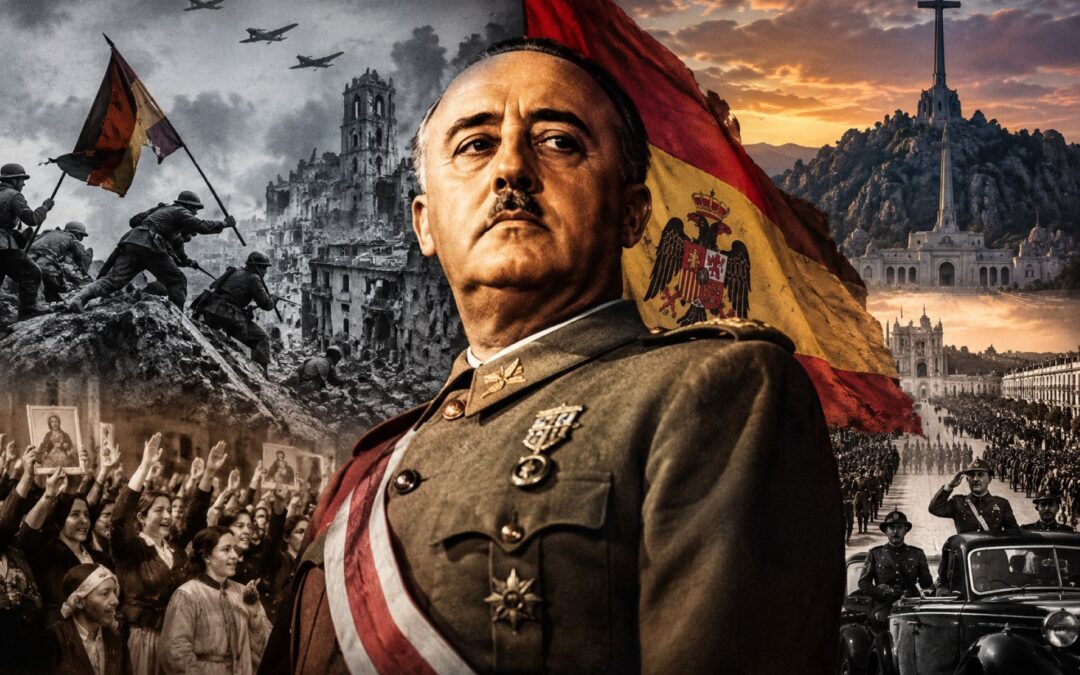
When Francisco Franco died on November 20, 1975, Spain stood at a historical crossroads. For nearly four decades, the country had been governed by a military dictator who had seized power during one of Europe’s bloodiest civil wars, dismantled democratic institutions, suppressed political opposition, and imposed a conservative vision of Spanish society. Yet the Spain Franco left behind was also considerably wealthier, more industrialized, and more connected to the international economy than the country he had conquered in 1939.
These contrasting developments have made Franco one of the most controversial political figures in modern European history. His government was responsible for executions, imprisonment, censorship, forced labor, and the persecution of communities and families associated with the defeated Republic. At the same time, the later years of his dictatorship witnessed an extraordinary period of economic expansion that helped transform Spain from a relatively poor, predominantly agricultural country into a major industrial and tourist economy.
Franco’s longevity was remarkable. Adolf Hitler and Benito Mussolini were destroyed alongside their regimes in 1945, but Franco survived the Second World War, international isolation, the emergence of the Cold War, and the gradual transformation of Western Europe into a community of predominantly democratic states. His ability to adapt to changing circumstances allowed him to remain in power long after the ideological environment that had helped bring him to prominence had disappeared.
Understanding Francisco Franco therefore requires more than examining the Spanish Civil War or deciding whether he should be classified as a fascist. His life reveals how military prestige can become political authority, how authoritarian governments preserve themselves through institutions and alliances, and how a country can undergo profound economic and social changes without acquiring political freedom.
From Ferrol to Morocco: The Making of a General
Francisco Franco Bahamonde was born on December 4, 1892, in Ferrol, a naval city in Galicia, northwestern Spain. His family belonged to an established military and administrative tradition, with generations of Franco men serving the Spanish Navy. His father, Nicolás Franco, worked in naval administration, while his mother, María del Pilar Bahamonde y Pardo de Andrade, came from a respectable Galician family and maintained a strongly Catholic household.
Franco’s parents represented contrasting influences. His father was unconventional, sociable, and frequently at odds with the religious and domestic expectations of his family. His mother was disciplined, devout, and devoted to her children. Franco developed a particularly close relationship with her, and his subsequent public image as a restrained, serious, deeply Catholic man resembled her values more closely than his father’s temperament. Nicolás eventually separated from the family, deepening an already difficult relationship with his son.
Like his ancestors, Franco initially expected to pursue a naval career. However, Spain’s naval establishment had been severely weakened by the Spanish-American War of 1898, when the country lost Cuba, Puerto Rico, Guam, and the Philippines. The defeat was a national humiliation that provoked widespread debate about Spain’s institutions, military capabilities, and international standing. It also reduced opportunities for young naval officers, helping redirect Franco toward the army.
The defeat belonged to a much longer story of imperial contraction. Spain had once governed an enormous overseas empire linking Europe, the Americas, Africa, and Asia, but the independence movements of the nineteenth century and the territorial losses of 1898 had transformed its global position. As the history of Spain’s imperial expansion and decline demonstrates, this process was more complicated than the disappearance of colonial wealth. Spain’s changing fortunes reflected military competition, political crises, economic developments, and the gradual breakdown of its imperial institutions.
In 1907, at just fourteen, Franco entered the Infantry Academy in Toledo. He was younger and physically smaller than many of his classmates, and his academic performance was unexceptional. When he graduated in 1910, he ranked toward the lower end of his class. Nevertheless, he had developed an attachment to military discipline, hierarchy, and professional advancement that would shape the rest of his life.
Franco’s real opportunity arrived in North Africa. Spain retained colonial territories along the Moroccan coast, including the long-established enclave of Ceuta, and the establishment of the Spanish protectorate in northern Morocco in 1912 created new military commitments. Control over the territory remained contested by Moroccan communities, particularly the Berber-speaking populations of the Rif Mountains. Spanish attempts to expand their authority produced prolonged and frequently brutal colonial warfare.
Franco volunteered for service in Morocco in 1912 and quickly distinguished himself as an ambitious and capable officer. He earned a reputation for personal courage, careful preparation, discipline, and attention to the needs of his soldiers. His rapid promotions reflected both his effectiveness and the unusual opportunities available to officers serving in dangerous colonial campaigns. By 1915, he had become one of the youngest captains in the Spanish Army.
In 1916, Franco suffered a serious abdominal gunshot wound during fighting in Morocco. The injury threatened his life, but he recovered and returned to Spain with his military reputation strengthened. His experience contributed to the image of a determined officer who had earned advancement through frontline service rather than political patronage alone.
The formation of the Spanish Foreign Legion in 1920 brought Franco back to North Africa. Modeled partly on the French Foreign Legion, the new formation was intended to provide Spain with a professional fighting force for its colonial campaigns. Franco became its second-in-command and assumed command in 1923, developing a close relationship with an organization that would later become important during the Spanish Civil War.
The Legion cultivated aggressive battlefield tactics, uncompromising discipline, and a strong sense of military identity. Franco’s leadership enhanced his reputation among the Spanish officer corps, particularly the Africanist officers whose careers had developed in Morocco. However, the colonial army’s military culture also included severe violence against Moroccan opponents and civilians. The experiences that helped make Franco a celebrated officer were inseparable from a coercive colonial system.
In 1923, Franco married Carmen Polo, a young woman from a prominent Asturian family. Their only child, María del Carmen Franco y Polo, was born in 1926. His marriage strengthened his connections with conservative Spanish society, while his growing professional fame brought him increasing attention from the monarchy.
The decisive military achievement of Franco’s early career came during the final phase of the Rif War. In 1925, Spanish and French forces coordinated major operations against the resistance led by Abd el-Krim, including the amphibious landing at Alhucemas. Franco played an important role in the Spanish operations, and the campaign helped turn the war decisively against the Rif forces.
On February 3, 1926, Franco was promoted to brigadier general at the age of thirty-three, making him one of Europe’s youngest generals. Two years later, he became director of the newly established General Military Academy at Zaragoza. The appointment placed him in a position to influence a generation of officers and further expanded his connections within the army.
By the end of the 1920s, Franco possessed three advantages that would become crucial in the following decade: an established reputation as a successful commander, the loyalty of officers who respected his military record, and strong associations with Spain’s traditional military and conservative institutions. He was not yet a national political leader, but he had acquired much of the professional authority that would later make such a transformation possible.
The Second Republic and the Road to the 1936 Coup
Franco’s military rise occurred while Spain’s political system was becoming increasingly unstable. For much of the nineteenth century, Spanish politics had been shaped by struggles between liberal reformers and defenders of traditional institutions, particularly the monarchy, aristocracy, military, and Catholic Church. The Carlist Wars, republican experiments, military interventions, and repeated constitutional crises demonstrated how difficult it had been to establish a political settlement accepted across Spanish society.
These divisions intensified in the early twentieth century. Industrial workers demanded better wages and conditions, agricultural laborers challenged unequal landownership, and regional movements sought greater autonomy from Madrid. Conservatives feared that socialism, anticlericalism, and regional nationalism would undermine the country’s established social order. Meanwhile, the army increasingly regarded itself as a guardian of national unity.
In September 1923, General Miguel Primo de Rivera seized power with the support of King Alfonso XIII. His dictatorship promised order, national regeneration, and an end to political paralysis, but it struggled with economic problems and declining legitimacy. By January 1930, Primo de Rivera had lost sufficient support that he resigned, leaving the monarchy closely associated with an increasingly unpopular authoritarian experiment.
Municipal elections in April 1931 revealed the monarchy’s weakened position, particularly in major urban centers. Although the results cannot be reduced to a simple national referendum, republican victories in important cities demonstrated that Alfonso XIII could no longer rely on broad political consent. The king left Spain on April 14, and the Second Spanish Republic was proclaimed.
The new Republic attempted a fundamental transformation of Spanish society. Republican governments pursued military reforms, secular education, restrictions on the Church’s political influence, land reform, greater regional autonomy, and expanded civil rights. Women obtained the right to vote, and the Republic introduced reforms affecting marriage, divorce, and public participation. Supporters regarded these measures as necessary modernization, while opponents saw them as threats to established institutions and religious traditions.
Franco approached the Republic cautiously. Although personally conservative and sympathetic to the monarchy, he initially accepted the new political order rather than immediately joining efforts to overthrow it. Nevertheless, his career suffered when Republican military reforms led to the closure of the Zaragoza academy in 1931. He received subsequent military assignments, but his association with the old order complicated his relationship with the new government.
Political conflict deepened as the Republic struggled to reconcile competing expectations. Left-wing groups disagreed over the pace of reform, while conservative parties mobilized against policies they considered revolutionary or anticlerical. Agricultural disputes, strikes, political violence, military conspiracies, and hostility toward religious institutions contributed to a deteriorating atmosphere. The attempted military coup led by José Sanjurjo in 1932 demonstrated that important elements of the army were already willing to challenge republican authority.
The elections of November 1933 shifted parliamentary power toward the center and right. The Spanish Confederation of Autonomous Rights, known as CEDA, emerged as the largest parliamentary grouping, although governments initially remained under the leadership of the Radical Republican Party. The change slowed or reversed some earlier reforms and intensified fears among left-wing organizations that the Republic itself might be dismantled.
The crisis culminated in October 1934, when a revolutionary uprising broke out in Asturias following the entry of CEDA ministers into the government. Miners and other workers participated in an armed insurrection that involved attacks on state institutions and violence against perceived opponents. The government responded by deploying military forces, including experienced troops from North Africa.
Franco played an important role in coordinating the suppression from Madrid, although he was not the battlefield commander directing every operation in Asturias. The government defeated the uprising, but the fighting and subsequent repression left deep political wounds. Franco increasingly interpreted revolutionary socialism and communism as existential threats to Spain’s social and religious order. In May 1935, he was appointed chief of the army’s General Staff.
Fresh elections in February 1936 brought victory to the Popular Front, an electoral coalition of left-wing and republican parties. The result intensified polarization, while political violence, land disputes, strikes, and attacks involving rival extremist groups further weakened confidence in constitutional politics. Manuel Azaña initially headed the government and became president of the Republic in May.
The new administration regarded several senior officers as potential threats and reassigned them to less politically sensitive posts. Franco was sent to command forces in the Canary Islands, while General Emilio Mola was stationed in Pamplona. These transfers did not end military plotting. Instead, Mola became a central organizer of a conspiracy involving officers, monarchists, and other opponents of the Republic.
Franco was initially hesitant about joining the rebellion. His reputation for caution reflected an unwillingness to commit before judging whether a military operation was likely to succeed. However, as preparations advanced, he agreed to participate, with the expectation that he would assume command of the experienced Army of Africa.
The assassination of the right-wing politician José Calvo Sotelo in July 1936 intensified the immediate crisis, although the conspiracy had already been developing for months. On July 17, military units rebelled in Spanish Morocco, and the uprising spread to mainland Spain the following day. Franco traveled from the Canary Islands to North Africa to assume command of the rebel forces.
The conspirators had hoped to overthrow the Republic rapidly. Instead, the armed forces divided, important cities remained loyal to the government, and competing political groups mobilized for war. Spain’s long-running political crisis had become a military conflict that neither side could resolve quickly.
The Spanish Civil War: How Franco Seized Power
The Spanish Civil War began as an attempted military coup that failed to secure control of the entire country. By late July 1936, rebel forces held substantial territories in western and northern Spain, including important positions around Seville, Burgos, Zaragoza, Valladolid, and Pamplona. The Republican government retained Madrid, Barcelona, Valencia, and several other major cities, along with significant industrial and agricultural regions.
The conflict soon became more complicated than a confrontation between two unified political organizations. The Nationalists included military conservatives, monarchists, Carlists, Falangists, Catholics, and other groups united primarily by opposition to the Republic. The Republican side contained liberal republicans, socialists, communists, anarchists, regional nationalists, and other movements whose political objectives sometimes conflicted sharply. These divisions shaped military organization, political decision-making, and violence behind the front lines.
Franco’s immediate responsibility was to bring the Army of Africa into mainland Spain. These formations included the Spanish Foreign Legion and Moroccan troops who were among the most experienced soldiers available to either side. However, Republican naval forces controlled much of the sea passage across the Strait of Gibraltar, complicating the transfer of troops from Morocco to Andalusia.
Assistance from Nazi Germany and Fascist Italy helped overcome this obstacle. German and Italian aircraft supported the movement of Nationalist troops, while both governments subsequently supplied weapons, equipment, military advisers, and direct combat forces. Hitler viewed Spain partly through the strategic contest with communism and the wider European balance of power. Mussolini regarded the conflict as an opportunity to strengthen fascist influence and advance Italian ambitions in the Mediterranean.
The Republic received assistance from the Soviet Union and support from thousands of foreign volunteers who joined the International Brigades. France and Britain officially pursued non-intervention, although the policy was applied unevenly and did not prevent foreign assistance from reaching both camps. Soviet equipment and advisers strengthened Republican resistance, while international volunteers regarded Spain as an important confrontation with fascism.
The importance of foreign intervention should not obscure Spanish responsibility for the conflict. Domestic political movements, soldiers, workers, and civilians fought the war, and its causes were rooted in Spain’s own institutional crises and social divisions. Nevertheless, foreign involvement helped prolong the fighting and turned the country into a battlefield with implications for the wider European struggle between authoritarianism, communism, and parliamentary democracy.
Franco’s army advanced northward from Andalusia toward Madrid, capturing towns and securing communications along the way. The Nationalist campaign included severe violence against civilians and suspected Republican sympathizers. The capture of Badajoz in August 1936 became particularly notorious because of the mass killings associated with the Nationalist occupation. Such violence was part of the wider campaign of repression carried out as rebel forces consolidated control.
Franco also made decisions with important political and military consequences. His diversion toward Toledo in September 1936 relieved Nationalist forces besieged in the Alcázar, providing a powerful propaganda victory. However, the decision delayed his advance on Madrid, allowing Republican defenders additional time to prepare. Historians continue to examine the relative importance of political symbolism, military considerations, and Franco’s personal calculations in this episode.
By the autumn, the Nationalists had reached the approaches to Madrid, but they failed to capture the capital. Republican resistance, military reinforcements, and international assistance helped prevent a quick Nationalist victory. The Battle of Madrid demonstrated that the war would not be settled by a brief military operation. It would require sustained campaigns involving enormous resources and heavy casualties.
While Franco was establishing himself as a battlefield commander, he was also consolidating political authority within the rebellion. General Sanjurjo, originally expected to become the symbolic leader of the uprising, died in an aircraft accident on July 20, 1936. With Sanjurjo gone, the rebel leadership needed a commander capable of coordinating the military struggle and representing its political interests.
Franco’s control of the Army of Africa, growing military successes, international connections, and reputation among fellow officers strengthened his position. In late September, Nationalist leaders selected him as generalissimo and head of the emerging Nationalist state, with the formal transfer of authority taking effect on October 1, 1936. This was a decisive stage in his rise to dictatorship. He was no longer merely one general participating in the rebellion; he had become its principal military and political leader.
The death of General Emilio Mola in another aircraft accident in June 1937 further reduced the possibility of a rival military center of authority. However, Franco had already acquired formal supreme leadership before Mola died. His consolidation of power resulted from political decisions, military circumstances, and the structure of the Nationalist coalition, not simply from the accidental deaths of two fellow generals.
Franco also sought to eliminate competing political organizations within his own camp. In April 1937, he combined the Falange with the traditionalist Carlist movement and other right-wing elements into a unified political organization, the Falange Española Tradicionalista y de las JONS. The merger brought previously distinct movements under his authority and reduced their independence. It created an institutional instrument through which the emerging dictatorship could mobilize support while limiting ideological competition.
Meanwhile, the military struggle continued. Having failed to capture Madrid, Nationalist forces increasingly concentrated on other strategic regions, particularly northern Spain. The industrial resources, ports, and territory of the Basque Country and neighboring provinces offered important advantages to whichever side controlled them.
The northern offensive became associated with one of the war’s most notorious attacks. On April 26, 1937, German Condor Legion aircraft, supported by Italian aviation, bombed the Basque town of Guernica. The attack devastated much of the town and killed civilians, although historians have disputed the precise death toll. It became an international symbol of the destruction that modern aerial warfare could inflict on civilian populations.
The bombing was condemned internationally and later immortalized in Pablo Picasso’s painting Guernica. The attack also demonstrated how foreign military involvement had expanded the war’s technological and destructive possibilities. Germany and Italy used Spanish operations to gain operational experience, although the Civil War should not be understood simply as a rehearsal for the Second World War.
Bilbao fell to Nationalist forces on June 19, 1937, and the remaining Republican positions in the north were progressively overwhelmed. The loss of the northern industrial regions weakened the Republic’s ability to sustain the war. Franco gained territory, factories, mines, and strategic advantages, while Republican forces became increasingly dependent on their remaining strongholds in central and eastern Spain.
The next major turning point came at Teruel, a strategically important town in eastern Spain. Republican forces attacked in December 1937, hoping to secure their position and disrupt Nationalist plans. The town fell to Republican forces in January 1938, but Franco concentrated significant resources on recapturing it. Fighting continued through an exceptionally harsh winter, and the Nationalists recovered Teruel in February.
Both armies suffered enormous losses during the campaign. The fighting exhausted Republican resources and allowed Franco to resume large-scale offensive operations from a stronger position. In March 1938, Nationalist forces advanced rapidly through Aragon toward the Mediterranean. By April, they had reached the coast, dividing the remaining Republican territory into separate regions.
The Republic nevertheless continued to resist. On July 25, 1938, Republican forces crossed the Ebro River in a major offensive intended to disrupt Nationalist momentum and reconnect the strategic position of Republican-held territories. The Battle of the Ebro became the longest and one of the bloodiest battles of the Spanish Civil War.
For nearly four months, both sides fought over difficult terrain while suffering severe casualties. Republican forces initially achieved surprise and captured territory, but Nationalist artillery, aviation, and reinforcements gradually wore down their positions. By November, Republican troops had withdrawn across the river. The offensive failed to reverse the strategic situation and further depleted the Republic’s already strained military resources.
The Battle of the Ebro was decisive because it destroyed much of the Republic’s remaining capacity to resist a sustained Nationalist advance. The Republic still controlled important territory, but its ability to replace soldiers, equipment, and supplies had deteriorated. Franco’s forces now held a powerful advantage in manpower, material support, and military initiative.
On December 23, 1938, Nationalist forces launched their offensive into Catalonia. Tarragona fell in January 1939, followed by Barcelona on January 26. The loss of Barcelona removed one of the Republic’s most important political and industrial centers. Hundreds of thousands of civilians and soldiers fled toward the French border, contributing to the enormous refugee crisis that accompanied the collapse of Republican resistance.
Britain and France recognized Franco’s government in February 1939, acknowledging that Nationalist victory was effectively inevitable. The Republican leadership fragmented, and internal conflict weakened the remaining resistance. Juan Negrín’s government lost its ability to direct a unified military effort, while sections of the Republican forces sought an end to the fighting.
Nationalist troops entered Madrid on March 28, 1939, and the remaining Republican positions collapsed in the following days. On April 1, Franco announced the end of the war and proclaimed Nationalist victory. What had begun as a military rebellion nearly three years earlier had ended in the destruction of the Republic.
The human cost was immense. Soldiers and civilians died in combat, bombardment, political violence, imprisonment, and conditions created by displacement and deprivation. The conflict devastated communities, separated families, damaged infrastructure, and left a society divided between victors and defeated opponents.
Political violence had occurred on both sides during the war, including killings of clergy and political opponents in Republican-controlled areas. However, these crimes did not erase the organized nature of Nationalist repression, which continued after the fighting ended and became institutionalized under Franco’s state. The United States Holocaust Memorial Museum’s account of the Spanish Civil War estimates that Nationalist forces executed approximately 100,000 people during the war and another 50,000 in its aftermath. Such figures remain estimates, but they demonstrate the scale of the violence.
The war’s political and military chronology reveals how Franco transformed an initially uncertain rebellion into an increasingly centralized military dictatorship. Victory gave him the power to reshape Spain’s institutions, but it did not create a national reconciliation. Instead, the new regime built its authority on the distinction between those it considered loyal Spaniards and those it regarded as enemies of the nation.
Building Francoist Spain: The Army, the Church, and the State
The end of the Spanish Civil War did not bring an immediate return to ordinary political life. Franco established a dictatorship that concentrated authority in his own hands and denied the defeated Republican movement any legitimate role in national government. Political opposition was suppressed, independent institutions were dismantled or absorbed by the state, and the military remained a central guarantee of the regime’s survival.
Franco adopted the title Caudillo, meaning leader or chief, presenting himself as the embodiment of national unity and the defender of Spain against communism, separatism, and political disorder. His authority extended across the military, executive government, and political institutions. Although ministers and advisers exercised significant influence over particular policies, Franco retained the power to appoint, dismiss, arbitrate, and determine the ultimate direction of the state.
His governing coalition was broad but politically restrictive. The army formed the regime’s coercive foundation, while the Catholic Church provided substantial moral and institutional support. Monarchists hoped that Franco would eventually restore the crown, traditionalists defended established social hierarchies, and Falangists advocated a more explicitly nationalist and syndicalist political order. Franco managed these groups by balancing their influence and preventing any single faction from becoming independent enough to challenge him.
The Falange was particularly important during the dictatorship’s early years. Its symbols, uniforms, ceremonies, and language of national revolution gave the regime features associated with European fascist movements. Yet Franco did not simply surrender power to the Falange or establish an exact replica of Nazi Germany or Fascist Italy. He used its organizational machinery while maintaining military supremacy and accommodating the interests of the Church and conservative elites.
Political repression was central to the new order. Military courts and special legislation were used to punish alleged Republican sympathizers, communists, socialists, anarchists, trade unionists, and others identified as opponents. Tens of thousands of people were executed in the years surrounding the Nationalist victory, while many more were imprisoned, subjected to forced labor, dismissed from employment, or deprived of civil rights.
The repression was not confined to prominent political leaders. Teachers, civil servants, workers, local organizers, and ordinary citizens could face investigation because of their previous associations, public statements, or family connections. Denunciations and political screening shaped opportunities for work and advancement. Former Republican communities experienced not only imprisonment and physical violence but also economic exclusion and lasting social stigma.
Large numbers of prisoners were placed in camps, military prisons, and labor detachments. Some performed compulsory work on roads, infrastructure, and major construction projects, while others faced prolonged imprisonment under harsh conditions. The regime’s penal and labor systems formed part of the broader punishment imposed on the defeated side. The disappearance of particular camps in later years did not mean that political persecution or coercive imprisonment had ended.
Franco’s state also rejected liberal parliamentary competition. Political parties outside the authorized governing structure were forbidden, and elections did not offer citizens a meaningful opportunity to replace the regime. Legislative institutions existed, but they operated within authoritarian constraints rather than exercising the independent representative authority associated with parliamentary democracy. Political legitimacy was presented as flowing from national tradition, institutional service, and Franco’s leadership rather than electoral consent.
The Catholic Church occupied a privileged position. Religious teaching became central to education, and Catholic values influenced family law, censorship, public morality, and social policy. Franco portrayed his victory as the defense of Christian Spain against forces he associated with atheism and revolution. Many senior Church figures supported the regime, although individual Catholics and clergy did not always share the same political views.
Relations between the dictatorship and the Church were reinforced through institutional agreements, including the 1953 concordat with the Vatican. The arrangement strengthened Catholic influence in education, marriage, and public life while enhancing the regime’s international legitimacy. Over subsequent decades, however, some Catholic organizations and members of the clergy became increasingly critical of repression and the absence of political freedoms.
Franco also pursued a centralized conception of Spanish national identity. The regime associated regional nationalism with the fragmentation that had threatened the Republic and sought to strengthen Castilian Spanish as the dominant public language. Catalan, Basque, and other regional languages encountered restrictions in official institutions, public administration, and education, particularly during the dictatorship’s earlier decades.
These policies attempted to subordinate regional identities to a single state-approved vision of Spanish nationhood. They did not eliminate regional cultural traditions or demands for autonomy. Instead, repression contributed to enduring resentment in areas such as Catalonia and the Basque Country, where opposition to centralized authority remained politically significant.
The nature of Francoism changed over time. Its early years exhibited pronounced fascist influences, militant nationalism, mass political symbolism, and systematic repression. After the defeat of Nazi Germany and Fascist Italy, the regime increasingly emphasized Catholic traditionalism, anticommunism, military order, and political stability rather than the revolutionary language associated with European fascism.
Historians therefore debate whether Francoism should be classified as fascist, authoritarian, national-Catholic, or a changing combination of these elements. Franco’s personal political outlook was not identical to that of Hitler or Mussolini, but his regime incorporated fascist institutions and benefited directly from fascist support. Its later evolution did not erase its origins or the authoritarian mechanisms through which it continued to govern.
Franco’s greatest political achievement, from the standpoint of maintaining his own power, was the durability of this arrangement. He preserved support from institutions with different priorities by ensuring that their political futures depended on the survival of his government. The state could adjust its policies and personnel without permitting a genuine transfer of power away from the dictator.
Franco and World War II: Neutrality, Collaboration, and Survival
When Germany invaded Poland on September 1, 1939, Spain had been at peace for only five months. Franco owed an important part of his Civil War victory to German and Italian assistance, and his government maintained ideological and diplomatic sympathies with the Axis powers. Yet Spain did not enter the Second World War as a formal belligerent.
The immediate reason was the country’s condition after the Civil War. Spanish agriculture, infrastructure, industry, and public finances had been damaged by years of fighting. Food shortages, economic disruption, and the needs of postwar reconstruction placed severe limitations on the country’s ability to sustain another major conflict. Even if Franco favored an Axis victory, joining the war could have endangered the stability of his newly established regime.
His calculations changed as Germany achieved rapid military successes. In the spring and summer of 1940, German forces conquered Denmark, Norway, the Low Countries, and France, transforming the strategic balance in Europe. A German victory began to appear plausible, and Franco became more interested in participating if Spain could obtain sufficient material assistance and territorial rewards.
Spain shifted from declared neutrality toward a position of non-belligerence, signaling sympathy with the Axis without entering the conflict. Franco sought supplies, food, fuel, and military assistance, while also considering territorial ambitions involving Gibraltar and French-controlled North Africa. These demands created difficulties because Germany could not easily satisfy them without jeopardizing relationships and commitments elsewhere.
On October 23, 1940, Franco met Adolf Hitler at Hendaye, near the Spanish-French border. Their discussions concerned Spain’s possible participation in the war and the conditions under which Franco would agree to join the Axis. The negotiations failed to produce an agreement, partly because Spain’s economic requirements and territorial ambitions were difficult for Germany to accommodate.
The failure at Hendaye did not indicate that Franco had consistently opposed joining the war. He had considered intervention when an Axis victory seemed likely, but his willingness depended on receiving assurances that would protect Spanish interests and his own position. His approach was opportunistic and cautious, reflecting both ideological sympathies and an awareness of Spain’s limited resources.
Spain subsequently provided forms of assistance to Germany while avoiding formal entry into the European war. In 1941, Franco authorized the creation of the Blue Division, a formation of Spanish volunteers that fought alongside German forces against the Soviet Union. Its deployment allowed the regime to demonstrate militant anticommunism without declaring war against Britain or the United States.
Spanish cooperation extended beyond the Blue Division. The country supplied strategically important materials, including tungsten, maintained economic relationships with Germany, and permitted forms of intelligence and logistical cooperation. The U.S. National Archives’ records concerning Spain during the Second World War document the complicated relationship between Spanish policy, Axis assistance, Allied pressure, and the wider conflict.
At the same time, Spain provided an escape route for some people fleeing Nazi-controlled Europe. Allied military personnel and Jewish refugees crossed the Pyrenees, sometimes encountering detention or administrative restrictions before receiving permission to travel onward. Spanish conduct was inconsistent, and individual outcomes depended on official decisions, diplomatic intervention, and changing wartime conditions.
Franco’s position became increasingly uncomfortable as the military situation shifted against Germany. The Axis defeat at Stalingrad, the Allied victory in North Africa, and the subsequent Allied advance through Italy weakened the prospects of a German victory. Spain’s exposure to British and American economic pressure also became more consequential as Allied power expanded.
The broader course of World War II was therefore essential to Franco’s changing strategy. As the likelihood of an Axis victory declined, the Spanish government moved toward a more explicit neutrality, reduced some forms of cooperation with Germany, and sought to improve relations with the Western Allies. The Blue Division was withdrawn as an organized Spanish formation, although some Spaniards continued fighting in German service.
Franco’s survival during World War II reflected a combination of strategic caution, Spain’s military weakness, diplomatic maneuvering, and the priorities of the major belligerents. Germany never secured Spain’s formal participation, while the Allies generally judged that maintaining Spain outside the war was preferable to risking another hostile front. Franco had avoided the outcome that destroyed Hitler and Mussolini.
Nevertheless, his wartime relationships carried diplomatic consequences after 1945. The new international order was shaped by states that had defeated fascism and increasingly presented democratic government and international cooperation as central political principles. Franco’s dictatorship was associated with the defeated Axis powers and remained an uncomfortable presence in Western Europe.
Spain was excluded from the United Nations when the organization was established and did not become a member until 1955. International criticism and diplomatic isolation complicated the country’s economic recovery, although the intensity of that isolation varied over time. Franco remained in power, but the regime needed a new basis for international legitimacy.
The developing Cold War supplied that opportunity. As American and Western European attention shifted toward containing Soviet influence, Franco’s anticommunism became strategically attractive. Spain occupied a valuable geographical position between the Atlantic, the Mediterranean, and North Africa, making military cooperation increasingly useful to the United States.
In 1953, Spain concluded agreements with the United States that facilitated American access to military facilities in exchange for assistance and closer relations. The same year, the Vatican concordat strengthened Franco’s international position. These developments did not transform Spain into a democracy, but they helped end the most severe phase of diplomatic isolation.
Franco had survived the collapse of the political order with which his regime had originally been associated. By emphasizing anticommunism and strategic cooperation, he adapted his dictatorship to the priorities of a very different international environment. The Cold War did not create Francoism, but it helped sustain the regime when its earlier ideological alliances had become liabilities.
Everyday Life Under Franco: Repression, Religion, and Social Control
Franco’s dictatorship was experienced not only through political institutions but also through schools, workplaces, families, churches, and everyday cultural life. The regime sought to define acceptable political beliefs, public morality, gender roles, and national identity. Its authority reached beyond elections and government appointments into the relationships through which people organized their lives.
Political expression was heavily restricted. Newspapers, publishers, theaters, broadcasters, and other cultural institutions operated under censorship, particularly during the dictatorship’s earlier decades. Material considered politically subversive, anticlerical, separatist, or morally objectionable could be prohibited. Writers, artists, academics, and journalists often had to navigate official controls or risk punishment.
The restrictions encouraged self-censorship as well as direct government intervention. Public criticism of the regime could result in surveillance, professional consequences, arrest, or prosecution. Many intellectuals and political activists went into exile, while others remained in Spain and attempted to preserve independent cultural and political activity within narrow boundaries.
Education became an important instrument for shaping the next generation. The regime reversed many secularizing reforms introduced during the Republic and restored strong Catholic influence over schools and universities. Religious instruction, traditional morality, national loyalty, and a conservative understanding of Spanish history became central to official educational objectives.
Teaching appointments and academic careers could be influenced by political and religious loyalty. Educators associated with the Republic faced dismissal or exclusion, while the curriculum promoted the regime’s preferred account of national history. This was especially important to Franco because schools offered a means of transmitting the political values of the dictatorship beyond the generation that had experienced the Civil War.
Workers also lived within a tightly regulated political environment. Independent trade unions were suppressed and replaced by official organizations that brought employers and workers within state-controlled structures. The regime presented these arrangements as a way to overcome class conflict, but they denied workers the freedom to organize independently against employers or government policy.
Labor unrest nevertheless continued. Economic development, urbanization, and the growth of industrial employment eventually created new opportunities for collective action. From the 1950s and particularly during the 1960s, clandestine labor organizations and workers’ commissions became increasingly active. Their activities contributed to pressure for greater rights, although official tolerance was uneven and repression remained a persistent threat.
Regional identity was another major source of conflict. Franco viewed the unity of Spain as a foundational principle and regarded demands for regional autonomy as potential threats to national cohesion. Catalan and Basque political institutions established or strengthened under the Republic were dismantled, while regional languages faced restrictions in official settings.
The severity of these restrictions varied across periods and institutions, and the regime did not eliminate private use of regional languages or cultural expression. Nevertheless, its policies marginalized important aspects of regional public life and denied communities political autonomy. In many cases, attempts to suppress regional nationalism reinforced the grievances that sustained opposition.
The Basque Country became particularly important in the later dictatorship. Euskadi Ta Askatasuna, commonly known as ETA, emerged in 1959 from a milieu of Basque nationalist opposition. Initially associated with cultural and political resistance, the organization gradually adopted revolutionary and violent methods. Its later campaign included bombings, assassinations, and other attacks intended to challenge the Spanish state.
ETA’s emergence cannot be explained entirely by Franco’s policies, but the dictatorship’s repression was a central part of its political environment. The organization’s subsequent history also extended beyond Franco’s lifetime, demonstrating how conflicts formed under authoritarian conditions could continue after democratization.
Women’s rights underwent especially significant reversals following the Republican period. The Second Republic had introduced reforms relating to voting, marriage, divorce, education, and women’s public status. Francoism instead promoted an ideal of womanhood centered on marriage, motherhood, religious devotion, and domestic responsibility.
The regime’s legal framework reinforced male authority within the family. Married women faced restrictions on employment, property transactions, financial arrangements, and other activities that could require their husband’s permission. The permiso marital, or marital authorization requirement, became one of the most recognizable symbols of women’s legal subordination under Francoism.
Women were not universally absent from employment or public life, and their experiences differed by class, region, marital status, and economic circumstances. Nevertheless, the law and official institutions created significant barriers to independence. Organizations such as the Falange’s Women’s Section promoted traditional domestic duties and encouraged women to understand their social contribution primarily through family life.
Economic growth gradually placed these arrangements under pressure. Industrialization, education, urbanization, and the expanding service sector increased women’s participation in paid employment and public life. Legal reforms during the 1960s widened some opportunities, while the marital authorization requirement was abolished in 1975. These changes were important, but they did not immediately establish equal rights across Spanish society.
The history of women’s legal rights in Spain illustrates how the dictatorship’s social ideology was both institutionalized and gradually challenged by changing economic circumstances. Divorce remained unavailable under Franco’s legal order, while contraception and abortion were subject to severe restrictions. The movement toward greater personal autonomy proceeded unevenly and accelerated after the restoration of democracy.
One of the dictatorship’s most disturbing legacies concerns the separation of children from families associated with the defeated Republic. During and after the Civil War, children of political prisoners, exiles, and persecuted parents could be placed in institutions or separated from their families through arrangements shaped by the regime’s political and religious objectives. Authorities sometimes treated Republican family environments as unsuitable for raising children, reflecting an effort to influence the political identity of future generations.
These practices produced profound consequences for families and individuals. Children could lose contact with parents or relatives, grow up without accurate knowledge of their origins, or experience lasting uncertainty about their identities. The circumstances varied, and not every case followed the same institutional process. The documented history of political separation must therefore be distinguished from later allegations of babies being taken from hospitals and placed with other families.
The broader history of illegal child removals in Spain includes unresolved questions about individual cases, institutional responsibility, documentation, and the scale of particular practices. Some widely circulated estimates combine different periods and categories of alleged abuse, making them unsuitable as established totals. Acknowledging uncertainty about numbers does not diminish the seriousness of documented separations or the legitimate demands of affected families for historical investigation and accountability.
Francoist repression did not remain unchanged throughout the dictatorship. The mass executions and extreme political punishment associated with the Civil War and its immediate aftermath gradually diminished, while some restrictions on cultural expression, employment, and public life were relaxed. Economic modernization and international engagement contributed to these changes, as did pressure from Spanish society itself.
Yet the distinction between early and late Francoism should not be exaggerated. The government continued to restrict political competition, monitor opponents, prosecute dissent, and defend the central authority of the state. Limited social liberalization was not equivalent to democracy. Spain’s population experienced changing opportunities and standards of living while remaining subject to an authoritarian political system.
The Spanish Miracle: How the Economy Changed Under Franco
The most dramatic transformation of Spain during Franco’s dictatorship occurred in its economy. When the Civil War ended in 1939, the country faced damaged infrastructure, disrupted agricultural production, severe shortages, depleted resources, and profound social dislocation. Many households struggled with hunger and poverty, while the state sought to rebuild national production under conditions of political isolation.
Franco’s early economic strategy emphasized autarky, or national self-sufficiency. The government attempted to limit dependence on foreign suppliers, control trade, regulate prices, direct investment, and strengthen domestic industry through state intervention. These policies reflected both the international circumstances of the period and the regime’s preference for a highly controlled national economy.
The results were disappointing. Agricultural production recovered slowly, shortages persisted, and official controls encouraged black markets. Restrictions on imports and access to foreign exchange limited the availability of machinery, raw materials, and other inputs needed for industrial development. Protection from international competition also reduced incentives for some firms to improve productivity.
Economic hardship was particularly severe during the 1940s, a period often remembered in Spain as the years of hunger. Rationing and scarcity affected everyday life, while the political consequences of the Civil War compounded difficulties for families associated with the defeated Republic. Spain’s postwar recovery was slower and more troubled than the later image of uninterrupted Francoist modernization suggests.
The international environment gradually changed after the Second World War. As the Cold War developed, the United States and other Western powers became more willing to engage with Spain for strategic reasons. Diplomatic agreements, foreign assistance, and growing access to international markets created opportunities that had been limited during the regime’s earlier isolation.
Yet greater international acceptance alone did not solve Spain’s economic problems. By the late 1950s, inflation, balance-of-payments difficulties, limited foreign exchange reserves, and structural inefficiencies demonstrated the weaknesses of the existing system. The government increasingly relied on economic specialists and technocrats who favored stabilization, greater market flexibility, and closer integration with international institutions.
The turning point came with the Stabilisation and Liberalisation Plan of 1959. The program introduced measures intended to stabilize prices, address financial imbalances, reduce economic distortions, encourage foreign investment, and open Spain more fully to international trade. It represented a significant departure from the autarkic framework that had dominated earlier Francoist economic policy.
The reforms initially imposed costs. Stabilization measures constrained demand and disrupted some sectors, while businesses and workers had to adjust to changing economic conditions. However, the longer-term effects were substantial. Greater access to foreign markets, investment, imported technology, and international competition improved the conditions for industrial and economic expansion.
Research on economic reforms and growth in Franco’s Spain identifies the 1959 reforms as an important institutional break that helped Spain move toward faster productivity growth and convergence with Western European economies. This interpretation matters because the country’s later prosperity cannot be understood as a straightforward continuation of Franco’s original economic strategy. In important respects, growth accelerated after policymakers abandoned or modified earlier restrictions.
The period from the late 1950s to the early 1970s became known as the Spanish Miracle. Economic output expanded rapidly, industrial employment grew, and manufacturing became increasingly important. Spain experienced one of the fastest rates of growth among the major economies of the period, although rankings varied depending on the years and measures used.
Industrial development transformed several regions. Steel production, shipbuilding, chemicals, machinery, and automobile manufacturing expanded, supported by domestic investment, foreign capital, and rising demand. The growth of manufacturing helped shift Spain away from an economy in which agriculture had employed a large proportion of the population.
The automobile industry became a particularly visible symbol of modernization. SEAT, established in 1950, produced cars that became increasingly accessible to Spanish consumers. Models such as the SEAT 600 helped make private car ownership more common and became associated with the changing aspirations of the country’s growing urban middle class.
The expansion of automobile production also supported related industries, including steel, components, transport infrastructure, and repair services. More families could afford consumer goods that had previously been inaccessible, and improvements in mobility changed patterns of work, leisure, and residential life. For many Spaniards, economic modernization was experienced through these tangible changes rather than through national growth statistics.
Tourism supplied another major source of income. Spain’s Mediterranean coastline, historic cities, and relatively low prices attracted increasing numbers of European visitors. Hotels, restaurants, transport services, construction, and related businesses expanded rapidly, generating employment and foreign exchange.
Tourism also had social consequences. Contact with visitors from democratic European societies exposed Spaniards to different lifestyles, cultural expectations, and attitudes toward personal freedom. Although tourist development did not automatically weaken political control, it contributed to the growing contrast between Spain’s increasingly international economy and its restrictive political institutions.
Migration was equally important. Many Spaniards moved from rural areas to industrial cities in search of work, while others migrated to Western European countries and sent money home. These remittances supported household consumption and provided valuable foreign exchange. Spain’s economic transformation therefore depended partly on opportunities created outside its own borders.
The growth of Madrid, Barcelona, Bilbao, and other industrial centers changed the country’s social structure. Agricultural employment declined, urban populations expanded, and new groups of workers, technicians, professionals, and business owners became more prominent. Education and occupational opportunities gradually widened, although access remained unequal.
Economic development created real improvements in living standards for large parts of the population. More households acquired modern appliances, better housing, cars, and other consumer goods, while expanding industry and services generated employment. Nevertheless, the benefits were unevenly distributed, and rapid urbanization also produced housing pressures, regional inequalities, and environmental problems.
Workers experienced these changes within an authoritarian labor system that restricted independent collective bargaining and political organization. Economic growth could improve incomes and opportunities without granting employees the institutional freedoms available in democratic countries. The modernization of society therefore created tensions between growing economic expectations and the continued absence of political rights.
Franco’s relationship with this transformation requires careful interpretation. His government ultimately adopted reforms that helped create favorable conditions for expansion, and the resulting growth was one of the major developments of his period in power. However, it is misleading to attribute the entire achievement to the dictator personally or to suggest that authoritarianism itself generated the prosperity.
Spain benefited from the extraordinary expansion of the wider Western European economy, growing trade, international tourism, foreign investment, technological change, and the work of Spanish businesses and workers. Its economic improvements also followed a significant reversal of policies that had previously contributed to stagnation. The Spanish Miracle was therefore a consequence of institutional change and international integration as much as of decisions taken within Franco’s government.
The global economic slowdown and oil shocks of the 1970s exposed new vulnerabilities as the dictatorship approached its end. Even so, the transformation achieved during the preceding decades was substantial. Spain entered the post-Franco era with a far more diversified and industrialized economy than it had possessed in 1939.
That achievement deserves recognition as a major development in modern Spanish history. It does not, however, resolve the political and moral questions surrounding Franco’s dictatorship. Economic growth and political freedom are separate dimensions of national experience, and understanding one does not require minimizing the absence of the other.
Franco’s Final Years and Spain’s Return to Democracy
Franco’s later years were marked by increasing attention to the problem of succession. His authority had always rested heavily on his personal position as the military leader who had won the Civil War and subsequently governed Spain. This created a fundamental institutional question: what would happen when the dictator was no longer able to exercise power?
Franco had no son or direct political heir who could inherit his position. His only child, Carmen, did not occupy a role comparable to that of a dynastic successor. More importantly, Franco’s regime was not legally organized as a hereditary family dictatorship. Its leadership depended on the institutions he controlled and the political arrangements through which he sought to preserve the state.
In 1947, the Law of Succession declared Spain a kingdom while leaving Franco as head of state for life. The arrangement did not immediately restore a reigning monarch. Instead, it allowed Franco to exercise supreme authority while reserving the possibility of selecting a royal successor who would continue the established political system.
The measure reflected the regime’s relationship with monarchists and traditionalists. Franco recognized the crown’s historical legitimacy as an institution within conservative Spanish politics, but he was unwilling to relinquish power to a king who might pursue an independent course. The monarchy thus became a component of his succession strategy rather than an immediate limitation on his dictatorship.
In 1969, Franco designated Prince Juan Carlos of Bourbon as his successor. Juan Carlos was the grandson of Alfonso XIII, the monarch who had left Spain in 1931. The decision, formalized through the 1969 succession legislation, established the expectation that Spain would continue as a monarchy after Franco’s death.
Franco intended the succession to preserve the institutional foundations of his regime. Juan Carlos had been educated and prepared within a political environment shaped by Francoist authority, and the dictator expected loyalty to the system he had created. The later democratic transition should not be confused with Franco deliberately establishing a constitutional democracy in advance.
The regime was also confronting pressures that complicated succession. Economic modernization had transformed Spanish society, younger generations had less direct attachment to the Civil War, and opposition movements had become increasingly active. Labor unrest, student protests, demands for regional autonomy, and criticism from parts of the Catholic Church demonstrated that the dictatorship could no longer rely on the same social and political conditions that had sustained its earlier decades.
Spain’s remaining colonial commitments were changing as well. Morocco gained independence from French rule in 1956, and Spain relinquished part of its protectorate. Conflict over Spanish-controlled territory continued during the Ifni War of 1957–1958. Spain transferred the Tarfaya region to Morocco in 1958 and relinquished Ifni in 1969.
Equatorial Guinea achieved independence in 1968, further reducing Spain’s remaining African possessions. The most enduring dispute concerned Spanish Sahara, where decolonization became entangled with Moroccan and Mauritanian territorial ambitions and the Sahrawi movement for self-determination. In 1975, Spain negotiated arrangements transferring administrative responsibilities as it withdrew from the territory.
Those arrangements did not settle Western Sahara’s sovereignty. The Sahrawi independence movement, represented by the Polisario Front, continued to contest Moroccan control, and the territory’s final status remains unresolved. The dispute illustrates how the end of formal Spanish administration did not necessarily produce an agreed political settlement for the people who lived there.
Domestically, Franco began separating some responsibilities of government from his position as head of state. In June 1973, he appointed Luis Carrero Blanco as prime minister, allowing the dictator to withdraw from some day-to-day administrative duties while retaining ultimate authority. Carrero Blanco was a trusted conservative ally and was widely regarded as a central figure in plans to maintain the existing system.
His tenure ended abruptly. On December 20, 1973, ETA assassinated Carrero Blanco in Madrid by detonating explosives beneath a street as his official car passed overhead. The killing deprived Francoism of a prominent figure associated with institutional continuity and intensified uncertainty about the regime’s future.
Carlos Arias Navarro subsequently became prime minister, following a brief interim administration under Torcuato Fernández-Miranda. However, the government’s ability to respond to political pressures remained constrained by the dictatorship’s established structures. Limited gestures toward reform failed to satisfy those demanding democratic change, while hardline Francoists resisted measures they believed might undermine the regime.
Franco’s health also deteriorated substantially. By the 1970s, he was suffering from Parkinson’s disease and other medical problems that increasingly limited his public duties. Juan Carlos temporarily assumed responsibilities during periods of incapacity, making the succession arrangements more immediately relevant.
Franco’s last major public appearance took place on October 1, 1975, when he addressed supporters in Madrid. He was visibly frail, and his condition worsened in the following weeks. After a prolonged final illness, he died on November 20, 1975, at the age of eighty-two.
His death ended nearly thirty-nine years of personal supremacy dating from his assumption of Nationalist leadership in 1936, including more than thirty-six years of rule over Spain following the Civil War. Juan Carlos became king two days later, initially inheriting a political order whose institutions had been designed to survive the dictator.
The new monarch nevertheless moved toward reform. Rather than preserving Franco’s system unchanged, Juan Carlos supported a transition that gradually dismantled the authoritarian political framework. The appointment of Adolfo Suárez as prime minister in 1976 proved especially important, as Suárez worked with reformist elements within the existing institutions to create a path toward competitive politics.
Political reform proceeded through negotiations, legal changes, legalization of political parties, and increasing public participation. The process was shaped by pressure from democratic opposition movements as well as decisions taken by the king, government officials, and figures within the former regime. It was neither an automatic consequence of Franco’s death nor a transformation carried out by one individual alone.
On June 15, 1977, Spain held its first democratic general election since the Second Republic. The results demonstrated the strength of parties committed to representative government and marked a decisive departure from Francoist political institutions. A new democratic constitution was approved in December 1978, establishing a parliamentary constitutional monarchy and recognizing fundamental rights and political pluralism.
The transition remained vulnerable to opposition from those who regarded democracy as a betrayal of the military and political order established after the Civil War. On February 23, 1981, elements of the armed forces attempted a coup, including the armed occupation of the Spanish parliament. The attempt failed, and the constitutional system survived.
Spain’s transition to constitutional democracy ultimately dismantled the central institutions through which Franco had governed. The monarchy remained, but its constitutional role changed fundamentally. The state that Franco had hoped to preserve gave way to a political order founded on electoral competition, parliamentary authority, and civil liberties.
The Legacy of Francisco Franco: A Dictatorship Spain Still Confronts
Francisco Franco’s legacy remains controversial because his dictatorship combined political repression with significant changes in Spanish economic and social life. His supporters historically emphasized national stability, anticommunism, Catholic tradition, and the economic expansion of the 1960s. His opponents pointed to the destruction of the Republic, systematic political persecution, censorship, and the denial of democratic rights.
A meaningful historical assessment must distinguish these different dimensions rather than treating them as interchangeable. Franco ruled through institutions that prevented citizens from peacefully replacing the government, and his victory in the Civil War was accompanied by extensive violence against defeated opponents. Those facts are central to understanding the nature of his regime, regardless of its later economic record.
The question of whether Franco was a fascist remains important but cannot be answered solely by comparing his personal habits with those of Hitler or Mussolini. Francoism incorporated fascist political elements during its formation, particularly through the Falange and the militarized nationalism of its early years. Yet Franco’s government also relied heavily on conservative Catholicism, military hierarchy, monarchism, and traditional political institutions.
Over time, its public ideology and international alliances changed. As European fascism collapsed, Franco emphasized anticommunism and national stability while strengthening relations with Western powers. His regime became less closely associated with the revolutionary style of fascist movements, although the monopoly of political power and restrictions on fundamental freedoms remained.
The dictatorship’s economic record also requires a chronological perspective. The 1940s were marked by economic hardship and the failures of an interventionist, inward-looking system. Later reforms, international integration, and favorable external conditions produced rapid industrial expansion and improvements in living standards. Presenting the entire period as an uninterrupted economic success overlooks both the earlier stagnation and the structural changes that made later growth possible.
Nor did modernization automatically create political freedom. Industrialization, urbanization, education, migration, and tourism altered Spanish society, but the dictatorship continued to restrict opposition and representative government. These changes helped create conditions in which demands for political reform became increasingly difficult to contain, without making democratization an inevitable result of economic growth.
Franco’s death did not resolve the divisions produced by the Civil War and dictatorship. Spain’s democratic transition required political compromise, and public treatment of the recent past remained sensitive. Families seeking information about relatives killed, imprisoned, or buried in unmarked graves continued to confront painful questions about historical responsibility and recognition.
The treatment of Franco’s remains became a prominent symbol of these debates. He was originally buried at the Valley of the Fallen, a monumental complex near Madrid constructed during his dictatorship using labor that included political prisoners. In October 2019, his remains were exhumed and reburied in a family cemetery, following a prolonged national dispute over the appropriateness of honoring a dictator at such a prominent memorial site.
The debate continued through legislative efforts to recognize victims and address the consequences of political persecution. Spain’s 2022 Democratic Memory Law established measures concerning historical recognition, the search for missing persons, public memorials, and the democratic treatment of the country’s authoritarian past.
These developments demonstrate that Franco’s significance extends beyond his own lifetime. Questions about dictatorship, national identity, regional autonomy, historical memory, and the relationship between political authority and economic development remain part of Spain’s public conversation.
Franco was an effective political survivor, a disciplined military commander, and a dictator whose government endured through enormous international and domestic changes. He also presided over institutions responsible for the loss of political rights and the persecution of large numbers of people. His historical importance lies in understanding these realities together, not in allowing any single achievement or crime to substitute for a complete examination of his rule.
Francisco Franco rose to power because Spain’s political institutions failed to contain escalating conflict, because a significant part of the military rebelled against the Republic, and because his battlefield position and political maneuvering enabled him to dominate the Nationalist coalition. He remained in power by controlling the armed forces, restricting political competition, balancing powerful institutions, and adjusting his international relationships as circumstances changed.
The Spain he left behind in 1975 was profoundly different from the country he had conquered in 1939. Its economy had become more industrialized and prosperous, its society more urban and internationally connected, and its political expectations increasingly difficult to reconcile with authoritarian rule. Yet these transformations occurred under a government that continued to deny its citizens the right to determine their political leadership.
Franco intended to preserve a state shaped by his victory and conservative principles. Instead, the monarchy he restored became part of a transition toward the parliamentary democracy that his regime had excluded. His life remains a study of how authoritarian power can survive through institutional control and political adaptation, while Spain’s subsequent history demonstrates that a country’s modernization and its eventual democratization are distinct achievements, shaped by different forces and choices.
Last Updated on October 30, 2026 by Aseem Gupta