
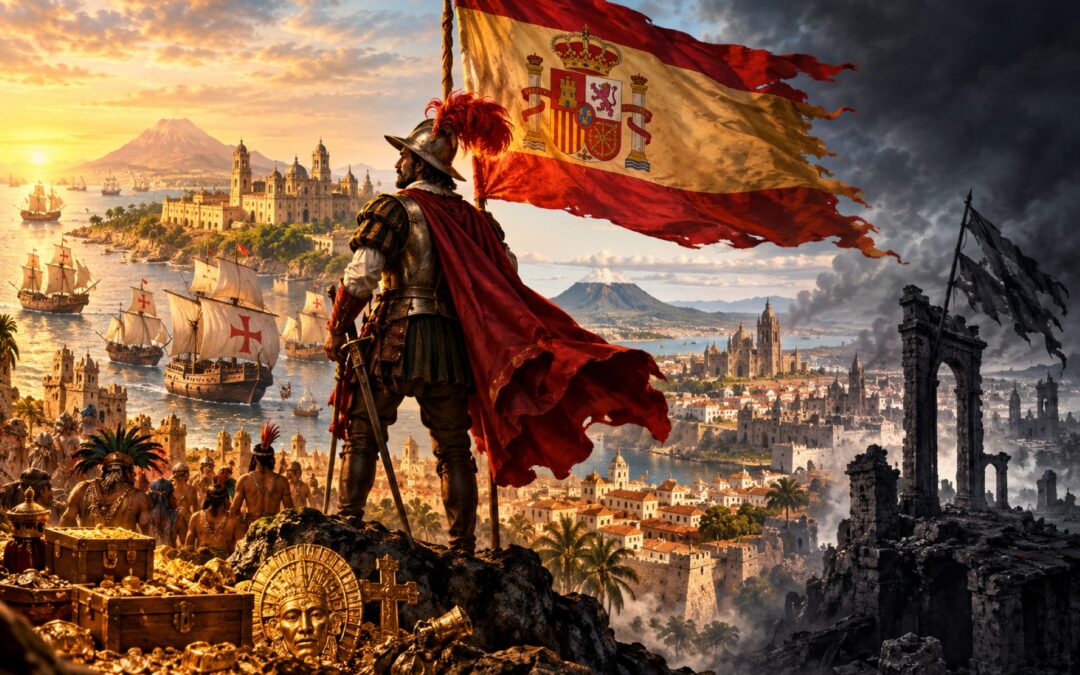
At the beginning of the sixteenth century, the rulers of Spain governed a collection of kingdoms on the Iberian Peninsula and possessed territories elsewhere in Europe. Within a few generations, their authority extended across the Atlantic to Mexico and Peru, northward into parts of what is now the United States, southward toward Chile and Argentina, and westward across the Pacific to the Philippines. The Spanish monarchy had become the center of one of history’s first truly global empires.
At its greatest territorial extent, the Spanish Empire claimed millions of square miles across several continents. American silver circulated through European and Asian markets, Spanish officials administered distant colonies, and the empire’s military and commercial networks helped transform relations between societies that had previously developed largely independently. Yet imperial maps often concealed an important reality: claiming a territory was not the same as governing it, and Spanish authority remained contested across much of its enormous domain.
The empire was neither created by a single discovery nor destroyed by a single defeat. Its rise depended on dynastic alliances, maritime exploration, military conquest, Indigenous political divisions, commercial opportunities, and increasingly elaborate institutions of government. Its eventual fragmentation emerged from European wars, fiscal pressures, international competition, colonial grievances, political reform, and revolutionary movements.
Understanding the rise and fall of the Spanish Empire therefore requires more than tracing the expansion and contraction of its borders. It requires examining how Spain acquired its power, how that power operated across oceans, and why the political relationships sustaining it eventually broke apart.
From Iberian Crowns to Atlantic Ambition
During much of the medieval period, the Iberian Peninsula was divided among competing Christian and Muslim states. Muslim armies had entered Iberia from North Africa in 711, establishing political authority over large parts of the peninsula. Over subsequent centuries, Christian kingdoms expanded southward through warfare, negotiation, settlement, and shifting alliances in the prolonged historical process commonly called the Reconquista.
By the fifteenth century, Castile and Aragon were among the most powerful Christian kingdoms in Iberia. Castile possessed extensive territory, a substantial population, and access to Atlantic ports, while Aragon ruled a collection of territories with important Mediterranean interests. Portugal had developed separately into an increasingly ambitious maritime kingdom, exploring Atlantic islands and the western African coastline.
The marriage of Isabella of Castile and Ferdinand of Aragon in 1469 helped transform the political balance. Isabella became queen of Castile in 1474, and Ferdinand inherited the Aragonese crown in 1479, establishing a dynastic union between their kingdoms. However, this did not immediately create a single centralized Spanish state. Castile and Aragon retained separate laws, institutions, fiscal systems, and political traditions, even as their rulers coordinated important policies.
The Catholic Monarchs sought to strengthen royal authority, reduce challenges from powerful nobles, and expand their political influence. Their campaign against the Emirate of Granada, the last remaining Muslim-ruled state in Iberia, culminated in its surrender on January 2, 1492. The conquest completed a major territorial objective but did not produce a uniformly peaceful or religiously tolerant society.
The same year, the monarchy ordered Jews who refused conversion to Catholicism to leave its territories. Policies toward Muslims subsequently became more coercive, culminating in forced conversions and other restrictions. The development of royal power was closely connected to religious uniformity, although religious motivations existed alongside dynastic ambitions, economic interests, and political calculations.
Meanwhile, Portugal had demonstrated the possibilities of maritime expansion. Portuguese navigators explored the Atlantic and African coasts, established trading positions, and sought access to Asian markets without depending on the established routes through the eastern Mediterranean and Middle East. Spices were especially valuable because European demand for pepper, cloves, cinnamon, and other commodities supported profitable long-distance trade.
Spain’s rulers wanted access to similar opportunities. Castile’s Atlantic orientation made overseas exploration particularly attractive, while Portuguese advances demonstrated that oceanic navigation could strengthen a monarchy’s finances, prestige, and strategic position.
The opening emerged through Christopher Columbus, a Genoese mariner who believed Asia could be reached by sailing westward across the Atlantic. His proposal did not depend on proving that Earth was round, a fact already understood by educated Europeans. The principal disagreement concerned the distance across the ocean: Columbus considerably underestimated the distance separating Europe from Asia along a westward route.
After failing to secure Portuguese sponsorship, Columbus pursued support from the Castilian monarchy. Ferdinand and Isabella eventually agreed to finance his expedition in 1492, creating an opportunity that would transform the political and economic geography of the Atlantic world.
Columbus and the Division of the Atlantic World
On August 3, 1492, Columbus departed from Palos with three vessels: the Niña, the Pinta, and the Santa María. After crossing the Atlantic, his expedition reached an island in the Bahamas on October 12. Columbus named it San Salvador, although the island already belonged to the inhabited world of the Caribbean’s Indigenous peoples.
Columbus believed he had reached islands associated with Asia. During his first voyage, he explored parts of the Bahamas, Cuba, and Hispaniola, encountered Indigenous communities, and gathered information that he interpreted through his expectations of Asian geography. His arrival was not the discovery of an uninhabited continent, nor was he the first person of European origin to reach the Americas: Norse voyagers had reached northeastern North America centuries earlier.
Nevertheless, Columbus’s voyage initiated a sustained process of European expansion and transatlantic exchange with enormous consequences. Its significance lay not merely in the crossing itself but in the permanent political, commercial, and demographic connections that followed.
Columbus returned to Europe in 1493 and subsequently undertook three more voyages. His second expedition included a much larger fleet and marked a transition from reconnaissance toward sustained colonization. His third voyage reached the northern coast of South America, while his fourth explored parts of Central America’s Caribbean coastline.
Columbus continued to interpret his discoveries within a geographical framework centered on Asia. As the Library of Congress’s account of Columbus’s ambitions and voyages explains, his original objective was to establish a westward route to Asian markets. The recognition of the Americas as a distinct geographical region developed through subsequent exploration and debate.
For Spain’s rulers, the immediate challenge was determining how the newly contacted territories would fit into their expanding political ambitions. Portugal had already established claims and navigation interests across the Atlantic, raising the possibility of a confrontation between the two Iberian monarchies.
The dispute culminated in the Treaty of Tordesillas, signed on June 7, 1494. Following earlier papal interventions and negotiations between the two crowns, the agreement established a dividing meridian approximately 370 leagues west of the Cape Verde Islands. Lands outside Europe were assigned to competing Castilian and Portuguese spheres of expansion.
The UNESCO record of the Treaty of Tordesillas explains the diplomatic arrangement and its importance for the subsequent development of European overseas empires. The eventual position of the demarcation line helped place much of what became Brazil within Portugal’s sphere, while Castile pursued expansion across much of the remaining Americas.
The treaty reflected the ambitions of the European signatories rather than an internationally accepted division of the planet. Indigenous societies had not consented to it, and other European powers eventually rejected Iberian claims to exclusive overseas dominion. The agreement also did not provide Castile or Portugal with the practical ability to control every territory assigned to them.
In the Caribbean, Spanish colonization proceeded rapidly. Settlements developed on Hispaniola, where Bartolomé Columbus established Santo Domingo in the 1490s, followed by further settlement and the development of the colonial town. Spanish expeditions expanded into Puerto Rico, Jamaica, and Cuba, creating a network of settlements from which later mainland conquests could be organized.
The consequences for Indigenous Caribbean societies were catastrophic. Warfare, forced labor, displacement, colonial exploitation, and diseases introduced through sustained contact contributed to enormous population losses. Spanish authorities established institutions that extracted labor and tribute, while settlers pursued agricultural production, gold, and increasingly valuable territorial concessions.
The Caribbean also became the starting point for exploring the mainland. In 1513, Vasco Núñez de Balboa crossed the Isthmus of Panama and became the first documented European to reach the Pacific Ocean from the American mainland. Other expeditions explored the coasts of Central America and the Gulf of Mexico, bringing Europeans into contact with complex and powerful Indigenous political systems.
Spain’s overseas expansion was beginning to move beyond coastal settlements. The next stage would involve the conquest of two of the largest imperial states in the Americas.
Conquest in Mexico and the Andes
The Spanish conquests of Mexico and Peru transformed the scale of the monarchy’s American possessions. Within a relatively short period, Spanish-led expeditions and their Indigenous allies defeated the ruling institutions of two major empires, acquired access to valuable resources, and established new colonial centers.
These victories cannot be adequately explained by imagining that a handful of Europeans overwhelmed entire civilizations through superior weapons. Indigenous alliances, political rivalries, disease, military tactics, local resistance, and the decisions of individual rulers all shaped the outcomes. Nor did the destruction of imperial governments mean the disappearance of the peoples and cultures that had lived under them.
The Fall of Tenochtitlan
At the beginning of the sixteenth century, the Mexica dominated much of central Mexico through the political and military network commonly called the Aztec Empire. Their capital, Tenochtitlan, stood on an island in Lake Texcoco and contained monumental religious buildings, markets, canals, causeways, and sophisticated infrastructure.
The empire’s strength rested partly on military expansion and tribute relationships with subordinate communities. Its rulers could demand valuable goods, labor, and political obedience, but their authority was uneven and frequently resented by communities that had experienced conquest or coercion.
Hernán Cortés arrived on the Mexican coast in 1519, leading an expedition that had originated in Cuba. He established a coastal base at Villa Rica de la Vera Cruz and began seeking information about the powerful state inland. The expedition initially possessed only a small European fighting force, making relationships with local peoples essential to its survival and expansion.
Among the most consequential developments was Cortés’s alliance with Indigenous opponents of Mexica power. Communities including the Totonacs and, especially, the Tlaxcalans provided soldiers, supplies, intelligence, and knowledge of local political conditions. Indigenous participants eventually greatly outnumbered the Spaniards within the coalition that attacked Tenochtitlan.
Malintzin, also known as Doña Marina or La Malinche, played a crucial role as an interpreter and intermediary. Her linguistic abilities and understanding of regional political relationships helped Cortés communicate with Indigenous rulers and negotiate alliances. The conquest’s diplomatic dimension would have been far more difficult without such intermediaries.
Cortés and his allies entered Tenochtitlan in November 1519, where they encountered the Mexica ruler Moctezuma II. The initial meeting involved elaborate diplomatic exchanges, but the relationship deteriorated as the Spaniards sought increasing control over the city and its ruler.
Later accounts sometimes suggested that the Mexica believed Cortés was a returning god. Historians treat this interpretation cautiously because the surviving narratives were shaped by colonial-era storytelling, translation difficulties, and competing political interests. There is insufficient justification for presenting a uniform Indigenous belief in the Spaniards’ divinity as the explanation for their initial reception.
Cortés subsequently placed Moctezuma under Spanish control, intensifying political tensions within the city. In 1520, while Cortés was temporarily absent, Spanish forces attacked participants in a religious ceremony, provoking a major uprising. Fighting spread, and the Spaniards’ position became increasingly untenable.
Moctezuma died during the crisis, but the exact circumstances remain disputed. Accounts differ over whether he was killed by hostile members of his own people or died as a result of Spanish violence. The uncertainty should not be replaced with a single confident narrative.
During the retreat commonly remembered as La Noche Triste, the Spanish forces and their allies suffered heavy losses while attempting to escape Tenochtitlan in late June and early July 1520. Cortés nevertheless retained important Indigenous alliances and gradually rebuilt his coalition.
The situation inside Tenochtitlan was further weakened by epidemic disease, particularly smallpox. The epidemic contributed to deaths and disruption during a period when the city was already facing military and political pressure. Indigenous communities had no previous population-level experience with several pathogens introduced through transatlantic contact, and the resulting epidemics became one of the most devastating consequences of European expansion.
Cortés returned in 1521 with a much larger Indigenous-led coalition. The attackers surrounded Tenochtitlan, used vessels to contest control of the lake, disrupted access to supplies, and fought through its neighborhoods during a prolonged siege.
The city fell on August 13, 1521, following months of intense fighting, starvation, disease, and destruction. The Mexica imperial government was defeated, and the Spanish Crown eventually established Mexico City as the center of a new colonial administration.
The event was enormously consequential, but it did not extinguish Indigenous civilization. Nahua communities, languages, traditions, political institutions, and historical memories survived, even as colonial conquest transformed them. The Digital Florentine Codex maintained by the Getty Research Institute provides access to Indigenous-informed accounts of the conquest and demonstrates why the event must be examined through more than the conquerors’ own narratives.
The Conquest of the Inca Realm
Farther south, the Inca Empire governed an extensive Andean territory stretching across substantial parts of present-day Peru, Ecuador, Bolivia, and neighboring regions. Its political center was Cuzco, while its administrative system connected diverse populations through roads, provincial officials, military organization, and obligations to provide labor and resources.
The Inca state had expanded rapidly before the Spaniards arrived. This created both impressive administrative capabilities and tensions among populations incorporated through conquest or political negotiation. As in Mexico, the empire’s territorial scale did not guarantee uniform loyalty to its ruling dynasty.
Epidemic diseases spread through the Andes before the decisive Spanish conquest, contributing to demographic and political disruption. The precise course of the early epidemics remains difficult to reconstruct, but disease cannot simply be attributed to Pizarro’s first expedition.
The empire was also divided by a struggle for power between Atahualpa and Huáscar. Their conflict weakened the political order and created circumstances that Francisco Pizarro and his followers exploited when they entered the region.
Pizarro had previously explored portions of the Pacific coast of South America and received royal authorization for a campaign against the Inca realm. In 1532, his expedition reached Cajamarca, where Atahualpa was staying following his success in the dynastic conflict.
The Spaniards captured Atahualpa during a violent encounter in November 1532. His imprisonment provided the invaders with political leverage over a state whose administrative relationships depended heavily on royal authority. Although an enormous ransom was collected, the Spaniards executed Atahualpa in 1533.
Spanish forces subsequently advanced toward Cuzco, relying on Indigenous allies and exploiting divisions within the empire. The conquest was neither immediate nor politically straightforward, and several Indigenous groups pursued their own interests in the changing balance of power.
Pizarro founded Lima in 1535, establishing a coastal administrative center that would become the capital of the Viceroyalty of Peru. Its location reflected the importance of Pacific maritime connections and communication with the wider Spanish imperial system.
The conquistadors themselves soon became bitterly divided. Rivalries involving Pizarro, Diego de Almagro, and their respective supporters led to violent conflicts over authority and the distribution of rewards. Pizarro was assassinated in Lima in 1541, illustrating how internal Spanish disputes continued even after major territorial victories.
Indigenous resistance also persisted. Inca leaders attempted to restore independent authority, and a successor state survived in Vilcabamba until its defeat in 1572. The Spanish conquest therefore unfolded across decades of warfare, negotiation, rebellion, and administrative change.
The Spanish monarchy established the Viceroyalty of Peru in 1542, but effective colonial authority developed gradually and varied considerably among regions. The defeat of the Inca imperial state did not erase Andean peoples or their social institutions; instead, colonial government transformed existing communities while drawing heavily on their knowledge, labor, and administrative structures.
The conquests of Mexico and Peru gave Spain access to large populations, productive agricultural regions, established political centers, and extensive mineral resources. These territories would become the central foundations of Spanish American power for centuries.
Beyond the Conquests: A Global Monarchy Takes Shape
The Spanish Empire did not stop expanding after the defeat of the Mexica and Inca governments. Exploration, military campaigns, missionary activity, commercial settlement, and diplomatic claims gradually extended Spanish influence into regions far beyond its original American centers.
Yet expansion should not be imagined as a steady process in which every newly explored territory immediately became a functioning colony. Large areas represented on European maps as Spanish possessions remained governed by Indigenous nations that maintained substantial independence.
In North America, Spanish expeditions moved through Florida, the Gulf Coast, and territories farther west. Hernando de Soto led a major expedition through the southeastern part of what is now the United States between 1539 and 1542. His forces encountered numerous Indigenous societies, engaged in violent conflicts, and suffered from disease, shortages, and the difficulties of operating across unfamiliar territory.
Other explorers traveled through the deserts and settlements of the American Southwest, while Francisco de Orellana descended the Amazon River system. These journeys helped Europeans develop new geographical knowledge but frequently failed to deliver the wealthy kingdoms or mineral discoveries their leaders hoped to find.
The experiences of Spanish conquistadors who ventured beyond the conquests of Mexico and Peru demonstrate the limitations of imperial ambition. Explorers could travel extraordinary distances without establishing permanent authority, and many expeditions depended entirely on Indigenous assistance or ended in disaster.
Permanent settlement developed unevenly. St. Augustine was established in Florida in 1565, while Spanish presence in northern New Spain expanded through missions, forts, mining settlements, and towns. The Río de la Plata region followed another trajectory: Buenos Aires was initially founded in 1536, abandoned, and reestablished in 1580.
These territories were not simply empty spaces awaiting European occupation. Indigenous societies possessed their own political structures, commercial networks, and relationships with neighboring peoples. Spanish expansion often involved war and dispossession, but also treaties, intermarriage, trade, cooperation, and prolonged negotiation.
The monarchy’s European power was equally important to understanding its expanding overseas reach. Charles I inherited the Spanish crowns in 1516 and became Holy Roman Emperor Charles V in 1519, placing the Spanish monarchy within an extraordinary network of European territories and dynastic responsibilities.
Charles governed a composite monarchy that included Spanish kingdoms and important European possessions, including territories in the Low Countries and Italy. His imperial responsibilities created opportunities for power projection but also generated repeated conflicts with France, the Ottoman Empire, and other European rivals.
When Philip II inherited the Spanish kingdoms and their overseas possessions in 1556, he presided over a monarchy whose interests extended across Europe and the Americas. This system was not administered as a single uniform state. Different territories retained their own laws, institutions, privileges, and political arrangements while acknowledging the authority of the same ruler.
Spain’s overseas reach expanded even further through the Pacific.
Ferdinand Magellan’s expedition, sponsored by the Spanish Crown, entered the Pacific after navigating around the southern tip of South America in 1520. Magellan reached the Philippine archipelago in 1521 but was killed there during a local conflict. The surviving expedition, eventually commanded by Juan Sebastián Elcano, completed the first recorded circumnavigation of the globe in 1522.
Spanish authorities subsequently organized additional Pacific expeditions. Miguel López de Legazpi established a durable Spanish colonial presence in the Philippines beginning in 1565, and Manila was founded as a Spanish colonial capital in 1571.
Spanish rule was never uniform across the entire archipelago. Authorities consolidated power over important parts of Luzon and the central islands while facing resistance from communities and political states elsewhere, particularly Muslim sultanates in Mindanao and the Sulu region. Local rulers, merchants, and populations continued to exercise influence despite colonial ambitions.
The Philippines nevertheless gave Spain a strategically important position in Asian commerce. Its greatest significance emerged through the Manila–Acapulco galleon system, which connected the Philippines with the Pacific coast of New Spain.
American silver crossed the Pacific and entered Asian markets, where it could be exchanged for silk, porcelain, textiles, spices, and other valuable goods. Many of these products traveled onward to American consumers or crossed the Atlantic into European markets.
Manila thus became a crucial commercial link between the Americas and Asia. Chinese merchants were particularly important to the city’s trading economy, while merchants, sailors, administrators, and Indigenous communities in New Spain supported the transpacific connection.
The resulting network gave the Spanish monarchy a genuinely global character. American mining production helped finance Asian commerce, European political decisions affected colonial trade, and Pacific settlements depended on resources and administrative relationships extending across enormous distances.
The empire’s geographical reach was extraordinary, but distance also complicated communication, military coordination, and government. Maintaining such a system required institutions capable of translating royal authority into local administration and economic resources into political power.
Silver, Authority, and Life Under Spanish Colonial Rule
The Spanish Empire could not have survived for centuries through conquest alone. Once territories were claimed, colonial authorities needed systems for collecting revenue, administering justice, regulating commerce, defending settlements, and negotiating relationships with local populations.
The monarchy gradually developed an extensive administrative structure to manage these responsibilities. In Spain, the Council of the Indies advised the Crown on overseas government, appointments, law, and justice, while the Casa de Contratación helped regulate Atlantic shipping and commerce.
The principal American territories were organized into viceroyalties. The Viceroyalty of New Spain was established in 1535, with Mexico City as its capital, while the Viceroyalty of Peru followed in 1542, with Lima becoming its center. Viceroys acted as representatives of the monarch, but they did not exercise unlimited independent power.
Royal audiencias performed judicial functions and possessed important administrative responsibilities. Municipal councils, governors, treasury officials, religious institutions, and Indigenous authorities also shaped everyday government. The Spanish Ministry of Culture’s account of imperial administration identifies the Council of the Indies, viceroyalties, audiencias, and town councils as central institutions of the colonial system.
Political authority was therefore distributed across overlapping institutions rather than controlled entirely from Madrid. Local officials interpreted royal orders, colonial elites negotiated privileges, and Indigenous communities sometimes used Spanish courts to defend land, property, or recognized rights.
These legal opportunities did not eliminate colonial inequality or exploitation. Indigenous litigants could sometimes obtain favorable judgments, but the capacity to enforce those decisions depended on political circumstances. Royal legislation frequently coexisted with local practices that benefited powerful colonists.
The Spanish monarchy also depended heavily on colonial revenues, especially the production and taxation of precious metals.
Major silver deposits were discovered at Potosí in present-day Bolivia in 1545 and at Zacatecas in Mexico soon afterward. These discoveries helped transform the colonial economy and contributed to the circulation of unprecedented quantities of American silver through international commercial networks.
Potosí developed into an enormous mining center. Its productive capacity depended not only on mineral deposits but also on labor organization, water systems, refining technologies, transport networks, and access to essential supplies.
The UNESCO documentation of the mining complex at Potosí describes its extensive hydraulic infrastructure, ore-processing facilities, and the urban divisions associated with colonial mining. The city’s surviving physical landscape illustrates both the remarkable scale of the mining enterprise and the inequalities that structured it.
Silver production depended on several different forms of labor. Some workers received wages, while others faced coercive obligations imposed by colonial authorities or employers. In the Andes, the colonial mita required designated Indigenous communities to provide workers for mining and associated activities.
Spanish officials adapted aspects of earlier Andean labor obligations but redirected them toward colonial extraction. Indigenous workers could face dangerous conditions, long journeys, disruption of family and community life, and exposure to hazardous mining environments. The economic benefits flowing from silver production were therefore inseparable from substantial human costs.
The refining of silver also required technological and commercial inputs. Mercury amalgamation increased the capacity to process lower-grade ores, while mercury supplies from places such as Huancavelica supported Andean production. Food, textiles, livestock, tools, and transportation services connected mining centers to extensive regional markets.
The consequences extended far beyond America. Silver crossed the Atlantic to Europe and the Pacific to Asia, where it supported trade, state finance, and monetary systems. Spanish coins became widely recognized in international commerce, while merchants and governments across several continents participated in the networks sustained by American bullion.
The inflow of precious metals contributed to the wider European Price Revolution, a prolonged rise in prices during the sixteenth and early seventeenth centuries. However, inflation cannot be attributed to American silver alone. Population growth, changing demand, monetary conditions, production, and other economic developments also influenced prices.
Nor did every shipment of silver simply increase the Spanish government’s wealth. Much bullion entered private commerce, paid for imported goods, settled debts, or circulated through foreign financial networks. The monarchy collected taxes and other revenues from mining and trade, but its access to silver was only one part of a much larger fiscal system.
Spain’s colonial economy was not limited to precious metals. Agriculture, ranching, textiles, urban manufacturing, regional trade, and plantation production supported millions of people and supplied growing markets. Sugar and other plantation crops became particularly important in Caribbean economies, where colonial authorities and private producers increasingly relied on enslaved African labor.
The transatlantic slave trade brought enslaved Africans into Spanish American territories, although the scale and organization of slavery varied considerably among regions. Some worked on plantations, others in mines, households, workshops, and urban occupations. Enslaved people resisted through escape, rebellion, legal petitions, family organization, and efforts to preserve community relationships and cultural traditions.
Colonial society also became increasingly diverse through migration, forced displacement, intermarriage, and the interaction of Indigenous, European, and African populations.
Peninsulares were Spaniards born in the Iberian Peninsula, while criollos were people of Spanish descent born in the Americas. The term mestizo generally referred to people of mixed Spanish and Indigenous ancestry, though colonial classifications changed over time and were neither perfectly consistent nor exhaustive.
People of African ancestry, including those described through terms such as mulato, occupied varied legal and social positions. Indigenous communities were also internally diverse, possessing distinct languages, political traditions, social hierarchies, and relationships with colonial authorities.
These categories influenced access to offices, legal privileges, taxation, occupation, and social status, but everyday life was more complicated than a fixed three-level hierarchy. Wealth, ancestry, occupation, locality, family networks, legal status, and personal relationships all affected people’s opportunities.
Catholicism played a central role in the colonial system. Missionaries and religious orders established churches, schools, missions, and charitable institutions, while conversion campaigns challenged Indigenous beliefs and practices. Religious institutions also acquired land, wealth, educational influence, and considerable political authority.
The results were neither uniform conversion nor the complete disappearance of older traditions. Indigenous and African communities retained, adapted, and transformed aspects of their cultural practices, sometimes producing religious and social forms that combined several historical influences.
Spanish colonial rule therefore created enduring connections while imposing unequal structures of power. Cities expanded, institutions developed, and commercial networks linked distant regions, but these changes occurred through conquest, coerced labor, displacement, negotiated accommodation, and resistance.
This complicated system proved capable of surviving for centuries. Its strength, however, depended on resources and political relationships that were increasingly exposed to military competition and economic pressure.
Why Spain’s Imperial Power Became Strained
Spain’s enormous territorial possessions made it one of the most influential monarchies of the sixteenth century, but they also generated costly responsibilities. The Crown needed to finance armies in Europe, defend Atlantic and Pacific trade, protect distant settlements, maintain fortifications, and manage political conflicts throughout its territories.
The monarchy’s continental commitments were especially demanding. Habsburg Spain participated in repeated wars involving France, the Ottoman Empire, the Dutch provinces, and other European states. These conflicts were driven by dynastic interests, religion, territory, commercial competition, and the wider struggle for political influence.
The rebellion in the Netherlands became one of Spain’s most persistent challenges. Beginning in the second half of the sixteenth century, resistance to Habsburg authority developed into a prolonged conflict involving taxation, political privileges, religious divisions, and military occupation.
The struggle required sustained military expenditure and contributed to the emergence of the Dutch Republic as a major commercial and naval competitor. Spain eventually recognized Dutch independence in 1648, although the history of the conflict and its wider European consequences extended far beyond a simple contest between Catholicism and Protestantism.
England increasingly challenged Spanish maritime influence as well. English privateers attacked Spanish shipping and overseas possessions, while commercial entrepreneurs sought access to territories and trading opportunities that Iberian monarchies claimed for themselves.
The rivalry became particularly prominent under Elizabeth I and Philip II. In 1588, Spain assembled an armada intended to support an invasion of England, but the operation failed after combat, coordination problems, logistical difficulties, and severe weather disrupted the Spanish fleet.
The defeat was politically and symbolically important, yet it did not immediately destroy Spain’s naval power or end its imperial dominance. Spain remained a formidable military and maritime state, while England’s own counter-expedition in 1589 also suffered a disastrous outcome.
Nevertheless, growing competition created long-term problems for a monarchy whose overseas possessions were widely dispersed. The expansion of England’s overseas imperial ambitions increasingly connected naval warfare, privateering, settlement, and commerce.
The Caribbean was one of the regions where this rivalry became particularly visible. Spanish ports and treasure fleets attracted privateers and pirates seeking valuable cargoes, while European competitors established settlements on islands and coastlines where Spanish political control was weak or contested.
France, England, and the Dutch Republic gradually developed their own Caribbean colonial systems. England’s seizure of Jamaica in 1655 became a major territorial setback for Spain and provided another base for English commercial and maritime influence.
The history of piracy and privateering in the Caribbean demonstrates how imperial warfare and unofficial maritime violence could reinforce each other. Governments sometimes encouraged attacks on enemy commerce before attempting to suppress similar practices when they threatened their own interests.
Spain’s financial situation was equally complex. The Crown borrowed heavily to meet military commitments, often relying on bankers who advanced funds against expected tax revenues and other royal income. These arrangements enabled large-scale expenditure but also exposed the government to disruptions when payments arrived late or military costs increased unexpectedly.
Philip II suspended certain debt payments on several occasions, including during major fiscal crises in the 1570s and 1590s. Such suspensions are frequently described as royal bankruptcies, but the term can be misleading when applied without understanding early modern lending arrangements.
Research on the sustainability of Philip II’s debts argues that the monarchy’s debt burdens were not necessarily unsustainable in the long run. The crises often reflected difficulties in meeting immediate payment obligations rather than proof that the state had permanently exhausted its resources.
The broader pressures were nonetheless substantial. Castile carried significant fiscal responsibilities, European wars repeatedly consumed resources, and political obligations limited the Crown’s freedom to reform taxation across its diverse territories.
Additional conflicts intensified these problems during the seventeenth century. The Thirty Years’ War placed enormous pressure on Habsburg power, while revolts in Catalonia and Portugal in 1640 demonstrated growing strains within the monarchy. Portugal eventually regained its independence, ending the Iberian Union that had existed since 1580.
Spain lost important political and military advantages as France, England, and the Dutch Republic expanded their international influence. However, this relative weakening should not be confused with the simultaneous collapse of every Spanish territory or colonial economy.
Older interpretations often linked Spain’s decline to falling American silver arrivals, suggesting that diminishing bullion shipments caused a general economic crisis. Yet changes in official remittances did not necessarily reflect changes in total colonial production.
The study Was There a 17th Century Crisis in Spanish America? challenges the assumption of a uniform American decline. Its analysis identifies different regional trajectories, including the relative decline of Potosí and the growth of important mining centers in New Spain.
Colonial economies also developed substantial internal trade and production, while unofficial commercial activity complicated the interpretation of royal records. Money that did not reach the Spanish treasury might still circulate productively within the Americas or through other international networks.
Spain was therefore experiencing a change in its relative position within Europe rather than the straightforward disappearance of its overseas power. Its American territories remained extensive, economically important, and politically connected to the monarchy.
The empire had become harder to defend and administer, but it had not ceased to function. The eighteenth century would demonstrate that Spanish imperial institutions could still adapt, reform, and expand their capacities.
Bourbon Reform and the Empire’s Eighteenth-Century Recovery
The death of Charles II in 1700 without a direct heir triggered a major dynastic crisis. European powers feared that the succession of Philip of Anjou, a grandson of Louis XIV of France, might place Spain and France under an excessively powerful Bourbon political alignment.
The resulting War of the Spanish Succession lasted from 1701 to 1714 and involved fighting across Europe and overseas territories. Philip V ultimately retained the Spanish throne, establishing the Bourbon dynasty, but Spain surrendered important European possessions during the peace settlements.
The treaties ending the conflict transferred several former Spanish territories in Europe to other powers. Britain acquired Gibraltar and Minorca, while Austria obtained major Habsburg possessions in Italy and the Low Countries. Spain nevertheless retained its extensive American empire and the Philippines.
The new dynasty inherited significant administrative problems but also opportunities to reorganize imperial government. Bourbon rulers sought to increase revenue, improve military defenses, regulate commerce, strengthen royal authority, and reduce practices they believed weakened the monarchy.
These measures developed over several reigns and were especially associated with Charles III in the later eighteenth century. They did not constitute one perfectly coordinated program, nor were they implemented uniformly across the empire.
The Oxford Academic overview of the Bourbon Reforms explains how successive monarchs attempted to strengthen finances, restrict contraband, reorganize administration, and increase control over institutions and overseas territories.
In Spanish America, reforms included more active fiscal administration, changes in commercial regulation, improvements to military organization, and attempts to place important offices under officials more directly accountable to the Crown.
The monarchy also created new administrative divisions to manage territories more effectively. The Viceroyalty of New Granada developed during the eighteenth century, while the Viceroyalty of the Río de la Plata was established in 1776. These arrangements reflected the changing economic and strategic importance of regions that had previously been governed through older administrative centers.
Commercial reforms sought to stimulate trade within the empire and reduce dependence on restrictive systems that encouraged smuggling. However, the measures did not amount to universal free trade; commerce remained regulated by imperial priorities and the interests of the monarchy.
Spain also invested in naval defenses, fortifications, and military organization. These efforts became particularly important after conflicts with Britain exposed vulnerabilities in major colonial ports. The temporary British occupation of Havana in 1762 demonstrated the dangers facing even heavily fortified imperial centers.
The reforms produced meaningful economic and administrative changes. In several regions, colonial revenue increased, trade expanded, and mining output grew. The empire of the late eighteenth century was therefore not simply a weakened remnant of its sixteenth-century predecessor.
Yet the Crown’s efforts to improve government could also generate resistance. American-born elites sometimes resented appointments and policies that favored officials arriving from Spain, while merchants and established local interests opposed regulations that threatened their privileges.
Taxation and administrative interventions also provoked popular unrest. Indigenous communities, mixed-ancestry populations, and other groups could experience reforms as additional demands rather than improvements in government.
Religious policy became another source of tension. The expulsion of the Jesuits from Spanish territories in 1767 disrupted educational institutions, missionary networks, and local relationships, while illustrating the monarchy’s determination to assert greater control over powerful organizations.
At the same time, Spain continued expanding settlements along parts of its northern American frontier. California became particularly important during the later eighteenth century as Spanish authorities worried about rival European interests along the Pacific coast.
Beginning in 1769, Franciscan missionaries associated with Junípero Serra helped establish a network of California missions. These operated alongside presidios, or military posts, and civilian settlements intended to secure Spanish authority over strategically important coastal territory.
The missions were not simply benign religious communities. Their development involved efforts to transform Indigenous religious beliefs, labor practices, settlement patterns, and social relationships, frequently under coercive conditions. Indigenous Californians experienced disease, restrictions on movement, forced labor, and other forms of colonial domination while continuing to resist and adapt.
California’s later cities emerged through different kinds of colonial foundations. San Diego developed around a mission and presidio, while Los Angeles was founded as a civilian pueblo in 1781. San Francisco likewise developed through a combination of military and missionary settlement rather than through one uniform model of colonization.
By the closing decades of the eighteenth century, the Spanish Empire retained enormous territory and considerable economic resources. Reforms had strengthened parts of its administration while simultaneously generating new political grievances and altering established relationships between colonial societies and the Crown.
These tensions mattered, but they did not make independence inevitable. The decisive rupture emerged when a European political crisis undermined the monarchy’s authority itself.
Napoleon and the Independence of Spanish America
The Spanish Empire entered the nineteenth century under increasing international pressure. Revolutionary and Napoleonic France had transformed European politics, while Spain’s rulers struggled to balance alliances, commercial interests, and the demands of war.
Spain had experienced growing difficulties within its royal government under Charles IV. The influence of Manuel Godoy, disputes involving the king and his son Ferdinand, and mounting dissatisfaction with government created a fragile political environment.
In 1807, French forces entered Spain under arrangements connected with an invasion of Portugal. Napoleon gradually expanded his military presence, taking advantage of political divisions within the Spanish monarchy.
The crisis culminated in 1808 when Napoleon pressured members of the Spanish royal family into surrendering their claims to the throne and installed his brother Joseph Bonaparte as king.
The intervention produced widespread resistance. Uprisings erupted in Spain, and local and provincial juntas organized opposition to French rule. The resulting Peninsular War became a major component of the wider Napoleonic conflict that consumed Europe.
For Spain’s overseas territories, however, the immediate consequences were political as well as military. If the legitimate monarch had been displaced, who possessed the authority to govern the empire in his name?
This question created a crisis of sovereignty that reached across the Atlantic. Colonial officials, local elites, municipal institutions, and other political groups disagreed about whether authority should remain with existing royal governments, pass to local juntas, or be reorganized through new constitutional arrangements.
Many early movements did not initially demand permanent independence from Spain. Some claimed to defend Ferdinand VII’s legitimate authority against Napoleon’s intervention, while others increasingly argued that American communities possessed the right to determine their own political future.
The formation of juntas in several American territories during 1809 and 1810 reflected these competing interpretations. Political divisions hardened as the crisis continued, making reconciliation increasingly difficult.
In Spain, the Cortes of Cádiz developed an important constitutional response to the monarchy’s predicament. The Constitution of 1812 attempted to redefine the relationship between monarchy, citizenship, representation, and political authority across the Spanish world.
The constitutional project, however, faced serious disagreements over representation, social equality, colonial interests, and the distribution of power. Its influence was substantial, but it did not resolve the growing conflicts throughout Spanish America.
In Mexico, Miguel Hidalgo launched an uprising in 1810 that mobilized large numbers of supporters against colonial authorities. The movement combined political opposition with social grievances, generating both enthusiasm and fear among different groups.
Hidalgo was captured and executed in 1811, but the struggle continued under other leaders, including José María Morelos. The Mexican independence movement passed through several stages rather than proceeding as a single uninterrupted campaign under one leader.
In the southern part of Spanish America, Buenos Aires became a center of revolutionary politics following the May Revolution of 1810. Over subsequent years, political movements throughout the Río de la Plata region attempted to establish new governments while confronting royalist resistance and internal disputes.
The United Provinces declared independence in 1816, although the future political organization of the region remained contested.
José de San Martín became one of the central figures in the military struggle for South American independence. Rather than attempting to defeat royalist forces through one direct campaign, he organized an army capable of crossing the Andes and attacking Spanish positions in Chile.
The campaign contributed to the defeat of royalist forces at Chacabuco in 1817 and Maipú in 1818. Chile declared independence in 1818, though conflict continued in some regions afterward. San Martín then directed attention toward Peru, one of the principal centers of Spanish royalist power.
In northern South America, Simón Bolívar played a leading role in the struggle against Spanish authority. His campaigns unfolded across territories corresponding to modern Venezuela, Colombia, Ecuador, and neighboring regions.
Bolívar experienced military defeats, political disagreements, exile, and repeated attempts to rebuild revolutionary forces. His victories eventually contributed to the establishment of Gran Colombia, proclaimed in 1819 and institutionally consolidated in the following years.
The new state brought together several northern South American territories under one republican framework. It represented an ambitious attempt to construct a political union after the collapse of Spanish rule, although regional tensions eventually undermined its durability.
The restoration of Ferdinand VII to the Spanish throne in 1814 complicated the situation further. The king rejected the liberal constitutional order and attempted to restore royal authority, including over territories that had already developed substantial independence movements.
The monarchy sent military forces to suppress rebellions, but restoration did not mean that colonial societies would return easily to their previous political arrangements. Years of warfare had transformed political loyalties, created new leadership groups, and weakened established institutions.
The final phase of independence involved campaigns across several regions. San Martín entered Lima in 1821, and Peru declared independence, but royalist armies remained powerful in the interior.
Bolívar and his commanders subsequently contributed to the campaigns that defeated major remaining royalist forces. The Battle of Ayacucho in December 1824 became a decisive moment in the struggle for Peruvian independence, although the elimination of all Spanish military positions took additional time.
Mexico followed its own political trajectory. After years of insurgency and royalist resistance, an alliance involving Agustín de Iturbide and Vicente Guerrero helped secure independence in 1821.
The country initially became the First Mexican Empire, but the monarchy quickly collapsed. Mexico established a republic in 1823, demonstrating that independence did not automatically settle fundamental disagreements over the form of government.
The Spanish American independence movements were not unified struggles in which every social group supported separation from Spain. Royalist armies included American-born soldiers and Indigenous participants, while revolutionary coalitions often incorporated people with competing objectives.
Some elites sought political autonomy while preserving existing social hierarchies. Others demanded wider changes concerning citizenship, labor, taxation, or the relationship between the state and the Church. Enslaved Africans and their descendants, Indigenous communities, and mixed-ancestry populations pursued their own interests within conflicts whose outcomes could affect their rights and livelihoods.
Independence also did not automatically create stable governments. Regional rivalries, disputes over central authority, military intervention in politics, and economic difficulties complicated the early histories of the new states.
Nevertheless, the consequences for Spain were transformative. Within a relatively short period, the monarchy lost effective control over most of its mainland American possessions, ending the imperial system that had developed through centuries of conquest and colonial administration.
The empire had not collapsed because its territories simply became impossible to govern. It fragmented when the political legitimacy connecting them to the monarchy was fundamentally disrupted and independence movements succeeded in establishing alternative sources of authority.
1898, the Last Colonies, and the Empire’s Legacy
By the middle of the nineteenth century, the Spanish Empire was dramatically smaller than it had been a century earlier. Spain retained important overseas possessions, especially Cuba and Puerto Rico in the Caribbean and the Philippines in the Pacific, but its former mainland American empire had largely disappeared.
These surviving colonies continued to provide economic and strategic advantages. Cuba was particularly valuable because of its plantation economy and sugar production, while the Philippines remained important for commerce and Spain’s political presence in Asia.
However, colonial societies experienced growing tensions over political representation, economic policy, social inequality, and continued Spanish rule. In Cuba, demands for reform and independence produced repeated conflicts, including the Ten Years’ War beginning in 1868.
Although that struggle ended without Cuban independence, it exposed the persistence of deep political divisions. A renewed independence movement began in 1895, with figures including José Martí helping articulate the case for Cuban national sovereignty.
Spanish authorities attempted to suppress the rebellion through military operations and coercive policies. The conflict caused immense suffering among civilians, while international attention increasingly focused on Spanish rule and the humanitarian consequences of the war.
In the Philippines, opposition to Spanish authority also intensified. Reform movements had challenged colonial abuses and demanded political changes, while revolutionary organizations eventually pursued independence. The Philippine Revolution began in 1896, creating another major challenge to Spain’s remaining overseas empire.
The United States became increasingly involved in the Cuban conflict, influenced by commercial interests, strategic calculations, public opinion, humanitarian arguments, and political pressures. The explosion of the American battleship USS Maine in Havana harbor in February 1898 intensified demands for intervention, although the cause of the explosion was not conclusively established at the time.
War between Spain and the United States began in 1898. American forces defeated Spanish naval forces in the Caribbean and at Manila Bay, while military operations weakened Spain’s ability to defend its remaining major overseas possessions.
The resulting peace negotiations culminated in the Treaty of Paris, signed on December 10, 1898.
The territorial terms were significant and require careful distinction. Spain relinquished sovereignty over Cuba and ceded Puerto Rico, Guam, and the Philippine Islands to the United States, as documented in the U.S. Department of State’s historical records of the 1898 peace settlement.
Cuba came under American military occupation before becoming formally independent in 1902, although subsequent political arrangements preserved substantial American influence. Puerto Rico and Guam passed under American sovereignty, while the Philippines came under American colonial rule.
For the Philippines, the end of Spanish authority did not immediately produce the independence sought by Filipino revolutionaries. Conflict followed between Filipino forces and the United States, and the islands remained under American sovereignty until independence in 1946.
The defeat of 1898 was a profound political and psychological shock for Spain. It prompted debate about national identity, political institutions, economic development, and the country’s position in the modern world.
Yet 1898 did not mark the literal disappearance of every Spanish colonial possession. Spain retained interests and territories in Africa, where colonial rule continued into the twentieth century.
Equatorial Guinea achieved independence in 1968, while Spain transferred Ifni to Morocco in 1969. These changes are recorded in the United Nations history of former non-self-governing territories.
Spain also withdrew from its administration of Western Sahara in 1975 amid an unresolved dispute over the territory’s political future. The long history of Spanish colonialism therefore extended considerably beyond the loss of Cuba, Puerto Rico, Guam, and the Philippines.
The empire’s political fragmentation did not erase its historical influence. Spanish became one of the world’s most widely spoken languages, particularly across Latin America, while Catholicism remained an important component of religious and cultural life in many formerly Spanish-governed societies.
Colonial institutions influenced the development of law, municipal government, landownership, urban settlement, and political administration. Cities founded or transformed during Spanish rule became major national capitals and commercial centers, while transoceanic connections permanently altered patterns of migration, consumption, and trade.
These legacies were neither exclusively Spanish nor uniform across the former empire. Indigenous societies continued to shape languages, agriculture, political movements, social institutions, religious practices, and national identities. African-descended communities likewise contributed profoundly to the cultures and histories of the Americas.
The costs of colonial rule also endured. Systems of coerced labor, unequal land distribution, racial hierarchy, and concentrated political power contributed to structural inequalities that outlasted Spanish government, although their later development depended on many additional historical forces.
The societies emerging from Spanish colonial rule were not passive inheritances of European institutions. They were shaped by Indigenous resistance, African survival and cultural transformation, local political struggles, independence movements, and the decisions of generations living after empire.
The Spanish Empire’s most enduring significance therefore lies not simply in how far its rulers extended their authority, but in the economic, political, social, and cultural transformations produced by centuries of imperial expansion.
Spain rose to global power through an unusual combination of dynastic inheritance, Atlantic navigation, military conquest, Indigenous alliances, colonial administration, and transoceanic commerce. Its rulers governed an immense but uneven collection of territories whose resources, populations, and institutions connected distant regions of the world.
The same system that made such power possible also created vulnerabilities. European military commitments consumed resources, international competition challenged Spain’s claims, local societies developed increasingly complex interests, and reform altered the relationships through which the monarchy exercised authority. When the political crisis of 1808 undermined royal legitimacy, independence movements transformed those tensions into a decisive breakup of the mainland American empire.
The loss of Spain’s principal remaining Caribbean and Pacific colonies in 1898 brought another major imperial era to an end, although Spanish colonial rule elsewhere persisted into the twentieth century.
The rise and fall of the Spanish Empire was thus not the story of a wealthy kingdom that conquered the world and then simply exhausted its treasure. It was the history of a vast political system that connected continents, depended on unequal and negotiated relationships, adapted to changing circumstances, and ultimately fragmented as those relationships ceased to sustain imperial rule. Its institutions disappeared from many territories, but the societies transformed through and against Spanish power continued to shape the modern world.
Last Updated on October 27, 2026 by Aseem Gupta