
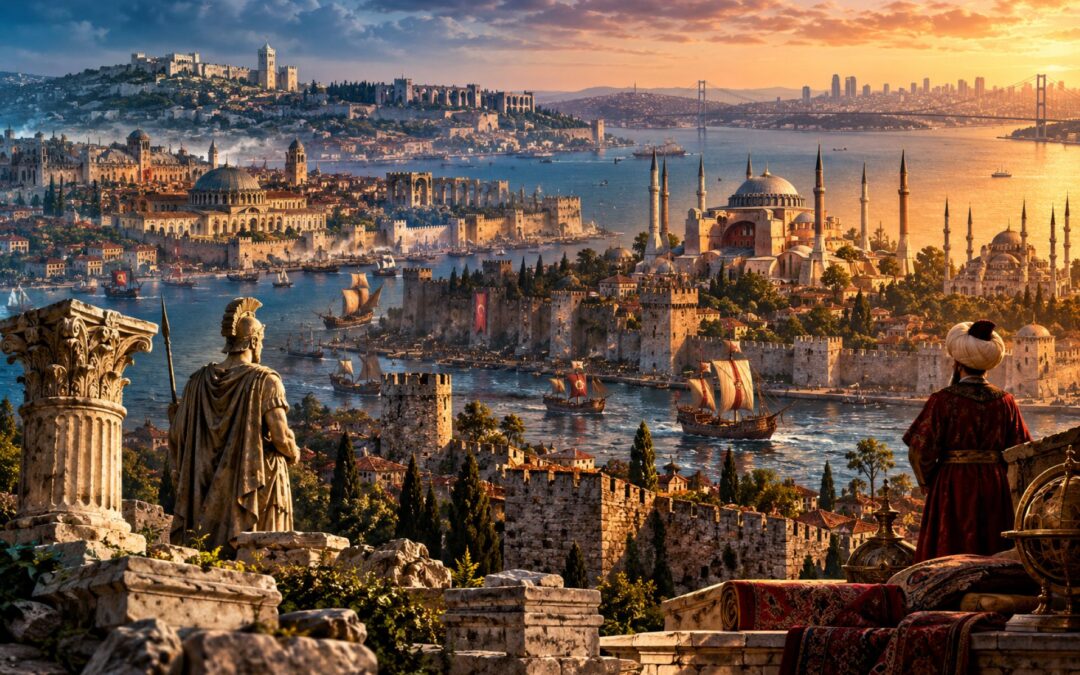
Few cities have occupied such an important place in world history for so long as Istanbul. Founded as a Greek settlement on the Bosphorus, it became the capital of the Roman Empire, the political and spiritual centre of the Byzantine world, the seat of the Ottoman sultans, and eventually the commercial and cultural heart of modern Turkey. Across more than two thousand years, its rulers, religions, languages, and populations changed, but the city remained a place where the ambitions of empires and the lives of different civilizations intersected.
Its geography helps explain this extraordinary continuity. Istanbul occupies both sides of the Bosphorus, the narrow waterway connecting the Black Sea to the Sea of Marmara and, through the Dardanelles, the Mediterranean. Its historic centre stands on a peninsula protected by the Golden Horn, a natural harbour that attracted merchants and naval fleets for centuries. Whoever controlled this position could influence trade, military movement, and communication between Europe and Asia.
Yet geography alone did not make Istanbul one of history’s great cities. Successive rulers transformed its streets, fortified its boundaries, built monumental places of worship, established institutions, and attracted or compelled people to settle within its walls. Each civilization inherited something from its predecessors, even when conquest or religious upheaval appeared to mark a complete break with the past.
The history of Istanbul is therefore more than a sequence of imperial capitals. It is the story of a city that repeatedly reinvented itself while retaining the strategic advantages, accumulated infrastructure, and cultural traditions that made it valuable in the first place.
Byzantion: The Greek City at the Bosphorus
The origins of Istanbul lie in the Greek colonization of the Bosphorus during the seventh century BCE. According to a traditional foundation story, a leader named Byzas brought settlers from Megara, a Greek city near Athens, to establish a settlement on the European side of the strait. The new city became known as Byzantion, or Byzantium in its later Latinized form.
The legend says that before departing, Byzas consulted the Oracle of Delphi and was instructed to establish his settlement opposite the land of the blind. When he reached the Bosphorus, he found the existing Greek settlement of Chalcedon on the Asian shore. He supposedly concluded that its founders must have been blind to overlook the more advantageous site across the water.
The tale illustrates how later generations understood Byzantion’s geography, although its details cannot be treated as established historical fact. The settlement’s traditional foundation is commonly placed around 660 BCE, but the precise circumstances of its establishment remain uncertain. Greek communities had already been exploring and settling around the Black Sea and its approaches, creating networks of colonies connected through maritime commerce.
The European peninsula offered several practical advantages. The Golden Horn provided shelter for vessels, while the surrounding waterways made the settlement difficult to attack. Its position near the southern entrance to the Bosphorus allowed merchants and political authorities to influence ships travelling between the Black Sea and the Mediterranean.
These commercial connections were fundamental to the city’s early prosperity. Grain, fish, timber, metals, and other commodities moved through the regional trading networks linking Greek settlements with communities around the Black Sea. Byzantion could benefit from maritime traffic even without controlling a large agricultural hinterland, although its prosperity depended on maintaining access to surrounding markets and resources.
Like other Greek city-states, Byzantion developed civic and religious institutions characteristic of the classical world. Its urban landscape included temples, public gathering places, marketplaces, and defensive walls. Political authority rested within a relatively small community of citizens, while its economy depended on merchants, craftspeople, farmers, sailors, and other inhabitants whose rights and status differed considerably.
The city’s strategic position also made it vulnerable to stronger powers. During the sixth century BCE, Byzantion came under Persian influence as the Achaemenid Empire extended its authority toward the Aegean and Black Sea. Later, its location became important during the conflicts between Athens, Sparta, and their allies, particularly because access to Black Sea grain mattered to the Greek world.
Byzantion’s political fortunes consequently changed as the balance of power shifted. It experienced periods of autonomy, external domination, and military pressure rather than enjoying uninterrupted independence. Its commercial advantages attracted powerful states, but maintaining control over a fortified city on a strategic maritime route could also prove expensive for its enemies.
As Roman influence expanded across the eastern Mediterranean, Byzantium became increasingly connected to the Roman political system. Its incorporation into Rome’s sphere of authority took place gradually during the final centuries of the Roman Republic. The city’s Greek-speaking culture and local institutions nevertheless continued to shape everyday life under Roman rule.
One particularly destructive episode occurred during the civil wars following the death of Emperor Commodus. Byzantium supported Pescennius Niger against Septimius Severus, who eventually emerged victorious in the struggle for imperial power. After a lengthy siege, Severus captured the city in 196 CE and inflicted severe punishment on the settlement that had resisted him.
Although the city suffered substantial damage, its strategic value encouraged rebuilding rather than abandonment. Roman urban projects introduced new public buildings, streets, baths, and ceremonial spaces. An early version of the Hippodrome, later one of Constantinople’s most important landmarks, developed during this period.
By the early fourth century, Byzantium was therefore an established Greek-speaking Roman city with a long commercial history, defensible geography, and infrastructure capable of further expansion. What it lacked was the political importance of an imperial capital. That changed when Constantine decided to reshape the Roman Empire around a new centre of power.
Constantine’s New Rome, 324–395
The early fourth century was a period of intense political transformation in the Roman Empire. After decades of succession struggles and attempts to divide administrative responsibility among multiple rulers, Constantine emerged as the dominant emperor. His victory over Licinius in 324 gave him control of the entire empire and created an opportunity to establish a new imperial residence.
Constantine selected Byzantium for a project of extraordinary ambition. The city’s location offered access to important eastern provinces, major military routes, and the maritime networks connecting the Mediterranean and Black Sea. Its position was particularly attractive at a time when the empire needed to manage threats along the Danube and its eastern frontiers.
The decision did not mean that Rome suddenly ceased to matter. The old capital retained enormous religious, cultural, and symbolic importance, while Roman emperors had already governed from several residences outside Italy. Nevertheless, Constantine’s investment established a permanent centre of imperial administration whose significance would eventually surpass that of the ancient city of Rome in the eastern empire.
On 11 May 330, the newly enlarged city was formally inaugurated. It became known as Constantinople, the city of Constantine, although the language of a New Rome also expressed its imperial ambitions. This was not merely a change of name: Constantine had transformed an existing provincial city into a capital equipped with institutions and buildings appropriate to Roman sovereignty.
The urban project dramatically expanded the old settlement. New streets and monumental avenues linked ceremonial spaces, administrative buildings, churches, and residential districts. Constantine established a major forum, marked by a column carrying his statue, while imperial construction extended beyond the boundaries of the earlier Greek and Roman town.
The Great Palace developed near the southeastern end of the peninsula, overlooking the Sea of Marmara. Nearby stood the Hippodrome, which Constantine expanded into one of the capital’s defining public spaces. Its chariot races became an important feature of urban life, attracting immense crowds and allowing emperors to interact visibly with their subjects.
The racing factions, especially the Blues and Greens, eventually became influential expressions of collective identity. Their supporters participated in public ceremonies and sometimes confronted one another violently. The Hippodrome was therefore more than an entertainment venue: it was a setting where imperial prestige, popular loyalties, and political tensions could become visible.
Constantine also reshaped the relationship between imperial government and Christianity. Following his rise to power, Christianity received increasingly favourable treatment, and the persecution of Christians ended under the policies associated with Constantine and Licinius. The emperor supported Christian institutions, sponsored religious construction, and became deeply involved in disputes concerning the organization and beliefs of the Church.
However, Constantine did not immediately establish Christianity as the empire’s exclusive official religion. Traditional religious practices continued, and the transformation of Roman religious life occurred over several generations. Theodosius I later promoted Nicene Christianity as the official imperial faith, contributing to a more explicitly Christian political order.
Constantinople became increasingly important within the developing Christian hierarchy. Its position as an imperial capital enhanced the authority of its bishop, while ecclesiastical councils gradually clarified its standing in relation to other leading Christian centres. The relationship with Rome would remain important and frequently contentious as different traditions developed.
Meanwhile, the city’s defenses continued to evolve. Constantine established new land walls farther west than the ancient settlement, but the famous Theodosian Walls belonged to a later stage of expansion during the fifth century. The difference matters because Constantinople’s exceptional defensive strength developed through successive investments rather than appearing fully formed at its foundation.
After Theodosius I died in 395, the empire continued under separate eastern and western imperial governments. Although these arrangements are often described as a formal division into two empires, their rulers still operated within a shared Roman imperial tradition. Constantinople became the principal centre of the eastern administration, which possessed comparatively strong financial resources and strategic advantages.
As western imperial authority disintegrated during the fifth century, Constantinople survived as the capital of the continuing Roman Empire in the east. Its inhabitants did not regard themselves as members of a newly invented civilization called the Byzantine Empire. They considered themselves Romans, even as Greek language and Christian religious traditions became increasingly prominent in their political and cultural life.
Justinian’s Constantinople: Riot, Rebuilding, and Hagia Sophia
By the sixth century, Constantinople had become one of the Mediterranean world’s great urban centres. Its imperial court, administrative institutions, workshops, religious establishments, and commercial networks drew people from across the eastern Roman territories and beyond. Greeks, Armenians, Syrians, and many other communities participated in a complex society shaped by Roman government and Christian institutions.
The reign of Emperor Justinian I, from 527 to 565, became one of the city’s most celebrated periods. Justinian sought to strengthen imperial authority, consolidate Roman law, and recover territories in the western Mediterranean that had passed beyond direct imperial control. His ambitions placed considerable financial and administrative demands on the empire, even as they generated major architectural achievements.
In 532, Constantinople experienced one of the most serious uprisings in its history. The revolt, known as the Nika riots, developed from tensions involving the Hippodrome’s racing factions but rapidly expanded into a wider confrontation with Justinian’s government. Complaints about officials, taxation, and political authority contributed to an atmosphere in which popular discontent became extraordinarily dangerous.
The Blues and Greens, ordinarily intense rivals, found common cause against the emperor. Demonstrations turned into violent unrest, and large parts of the city were burned or damaged. The rebellion eventually threatened Justinian’s position so seriously that his government confronted the possibility of losing control of the capital.
Justinian ultimately ordered a military suppression of the uprising. Forces associated with commanders including Belisarius and Mundus attacked the rebels in the Hippodrome, producing a massacre. Ancient accounts suggest that tens of thousands were killed, although the frequently repeated figure of 30,000 cannot be verified with modern precision.
The destruction created an opportunity for a rebuilding programme on an unprecedented scale. Among the buildings damaged was an earlier church of Hagia Sophia, one of Constantinople’s principal Christian places of worship. Justinian commissioned a replacement that would become perhaps the most recognizable monument in the city’s history.
The new Hagia Sophia was completed in 537, only a few years after the uprising. Designed by Anthemius of Tralles and Isidore of Miletus, it combined ambitious engineering with a monumental interior dominated by an enormous central dome. The building’s scale and spatial organization distinguished it from earlier basilicas and demonstrated the resources available to the imperial government.
Its interior was enriched with marble, decorative stone, and elaborate artistic programmes developed and modified over successive centuries. Light entered through windows around the dome, contributing to the impression of an immense space suspended above the congregation. The building became both a religious centre and a powerful statement about the relationship between Christian worship and Roman imperial authority.
The Historic Areas of Istanbul recognized by UNESCO preserve this exceptional interaction between architecture, political power, and successive civilizations. Hagia Sophia, the Hippodrome area, the city’s fortifications, and later Ottoman monuments demonstrate how different periods of urban construction transformed the same historic landscape.
Justinian’s building programme extended beyond Hagia Sophia. The Church of the Holy Apostles, associated with imperial burials, was reconstructed, while other churches, institutions, and public works received imperial support. Construction projects served religious purposes, but they also reinforced the legitimacy and visibility of the emperor’s government.
Water infrastructure was particularly important for a capital surrounded by water that did not necessarily provide reliable supplies of fresh drinking water. Aqueducts, reservoirs, and cisterns helped sustain the population, especially during periods of drought or military danger. The Basilica Cistern, built in the sixth century, became one of the most remarkable surviving examples of Byzantine engineering.
Supported by hundreds of columns, the underground reservoir stored water within the heavily populated imperial city. Its significance was practical rather than merely decorative: Constantinople’s ability to survive sieges depended partly on maintaining food, water, and essential services when access to surrounding territory was interrupted.
Commerce remained another foundation of the city’s prosperity. The Golden Horn connected merchants to networks that carried Mediterranean agricultural products, Black Sea commodities, Asian luxury goods, and materials from across the Roman territories. The imperial government benefited from taxation and regulated commerce while urban workshops and markets supplied officials, soldiers, religious institutions, and private households.
Constantinople was also a centre of learning and artistic production. Its institutions preserved and transmitted traditions of Greek philosophy, rhetoric, literature, law, and Christian theology. Schools, scholars, monasteries, and private collections all participated in this intellectual life, although access to education remained deeply unequal.
Justinian’s achievements did not eliminate the vulnerabilities facing the empire. His military campaigns, ambitious construction, taxation demands, and the devastating plague that struck during his reign placed extraordinary pressure on society. Nevertheless, the sixth-century capital established an architectural and institutional legacy that would survive political crises for many centuries.
Walls, Sieges, and Iconoclasm, 600–843
Constantinople’s survival during the early medieval period depended on defenses that had developed over several generations. The most formidable were the Theodosian Walls, constructed principally during the fifth century as the city expanded westward. Their system of walls, towers, and defensive spaces protected the landward approaches, where attackers could deploy large armies without crossing the surrounding waterways.
These fortifications became central to the city’s military history. The historic peninsula was naturally protected by the Golden Horn and the Sea of Marmara, while the Bosphorus created an additional barrier to movement. Nevertheless, water alone could not guarantee safety, and the city remained dependent on effective naval defenses, military organization, supplies, and cooperation across the empire.
During the seventh century, the Eastern Roman Empire faced a succession of major crises. War with the Sasanian Persian Empire exhausted resources and devastated important provinces. In 626, Constantinople withstood a major siege involving Avar and allied forces, while Persian armies threatened from the Asian side of the Bosphorus.
The empire subsequently confronted the rapid expansion of Muslim Arab armies. Byzantine control over Syria, Palestine, and Egypt was lost during the seventh century, weakening the empire’s economic resources and exposing Anatolia to repeated military campaigns. Constantinople was no longer the capital of a state commanding most of the eastern Mediterranean, but it remained an exceptionally valuable political prize.
The Umayyad Caliphate pursued campaigns intended to challenge the Byzantine capital. Operations associated with the traditional siege of 674–678 remain historically debated in their precise chronology and character. A later and clearly documented major siege in 717–718 placed Constantinople under intense pressure from Arab land and naval forces.
The city’s defenses, the effectiveness of Byzantine resistance, supply difficulties, and military developments beyond the immediate siege all contributed to the failure of the attacking forces. Byzantine accounts also emphasize the use of Greek fire, an incendiary weapon associated with naval combat. Its ability to continue burning under conditions that made ordinary firefighting difficult helped create its formidable reputation.
Greek fire was important, but it was not a magical solution capable of destroying every enemy on contact. Constantinople survived through a combination of defensive engineering, logistics, diplomacy, political leadership, and the problems confronting besieging armies. Its resistance helped preserve the Byzantine state despite the dramatic contraction of its territories.
Internal religious disagreements created another source of instability. During the eighth and ninth centuries, Byzantine society experienced a prolonged controversy over the religious use of images depicting Christ, the Virgin Mary, and the saints. The movement known as iconoclasm challenged the veneration of sacred images, while defenders of icons argued that such images had a legitimate place in Christian devotion.
The controversy was connected to theological debates about representation, worship, and the nature of Christ, but it also involved imperial authority, religious institutions, and political alliances. Emperors and church leaders disagreed over the proper regulation of religious practice, while monks, clergy, officials, and ordinary believers were affected by changing policies.
Historians commonly distinguish two principal periods of Byzantine iconoclasm. The first began during the reign of Leo III in the eighth century and ended with the restoration of icons in 787. A second period began in 815 and continued until 843, when the permanent restoration of icon veneration became associated with the Triumph of Orthodoxy.
The destruction, removal, or alteration of religious images affected churches and artistic programmes, although the surviving evidence does not support the assumption that every religious image disappeared during these controversies. Later artistic restoration and new mosaic decoration contributed to the changing appearance of Constantinople’s sacred buildings.
By the middle of the ninth century, the empire had survived major territorial losses, foreign attacks, religious divisions, and political instability. Its endurance reflected the capacity of the capital and its governing institutions to adapt under pressure. This resilience created the conditions for another period of cultural and political recovery.
A Byzantine Crossroads: Trade, Rus’, and Religious Power
From the ninth century onward, the Byzantine Empire experienced periods of renewed political strength, military success, and cultural achievement. The rulers traditionally associated with the Macedonian dynasty presided over an era in which imperial institutions stabilized and Byzantine power recovered in several regions. Constantinople benefited from these developments as the centre of government, diplomacy, manufacturing, and religious authority.
Its wealth depended partly on its position within extensive commercial networks. Ships brought goods from Mediterranean ports and Black Sea settlements, while overland routes connected the capital with the Balkans, Anatolia, and territories farther east. Silk, agricultural products, metals, wax, furs, precious objects, and many other commodities passed through markets linked to the city.
These commercial relationships extended into northern and eastern Europe. Scandinavian traders and warriors travelled along river systems connecting the Baltic region to the Black Sea, interacting with Slavic, Finnic, Baltic, and other communities. Their activities contributed to the emergence of the political and commercial networks associated with the Rus’.
The traders’ relationship with Constantinople was both profitable and occasionally violent. Rus’ forces attacked the Byzantine capital during several campaigns, while treaties and diplomatic arrangements gradually regulated aspects of commerce. Byzantine manufactured goods, luxury textiles, wine, and coinage could be exchanged for northern commodities including furs, wax, and enslaved people.
For Scandinavian travellers, Constantinople acquired the Old Norse name Miklagarðr, meaning the Great City. Its reputation reflected the contrast between the imperial metropolis and the smaller settlements encountered along much of the northern trading network. The connection formed an important chapter in the eastern trading networks of the Viking world, demonstrating how far Scandinavian commercial and military activity extended beyond western European shores.
One particularly distinctive institution emerged from these relationships. Around the end of the tenth century, during the reign of Basil II, warriors recruited from the Rus’ world became important members of the emperor’s personal military forces. This organization developed into the Varangian Guard, whose members became famous for their axes and their association with imperial service.
The Guard’s composition changed over time. Scandinavian recruits continued to arrive, and some Anglo-Saxons later sought employment in Byzantine service following the Norman conquest of England in 1066. Their presence illustrates the capital’s ability to incorporate foreigners into institutions closely associated with the emperor’s security and prestige.
Religious connections with the Rus’ were equally consequential. In 988, Prince Vladimir of Kyiv adopted Christianity in a development traditionally associated with Byzantine missionary and diplomatic influence. The conversion strengthened ties between the Rus’ political world and Constantinople, helping establish Eastern Christian traditions that would become deeply influential across eastern Europe.
Byzantine religious art, architecture, liturgy, and political ideas spread through these connections. Their influence did not make the Rus’ simply an extension of Constantinople, but it helped shape the religious and cultural history of communities whose descendants would eventually form different states, including Ukraine, Belarus, and Russia.
Within Constantinople itself, religious authority remained central to public life. The patriarch occupied an influential position within the Eastern Church, while imperial and ecclesiastical institutions were closely intertwined. Relations with Rome were complicated by disagreements about doctrine, jurisdiction, church customs, and the political authority claimed by different religious leaders.
The events conventionally associated with the Great Schism of 1054 became an important symbol of these divisions. Representatives of the Roman and Constantinopolitan churches exchanged condemnations amid existing tensions, but the separation of Latin Catholic and Eastern Orthodox Christianity was a gradual historical development rather than an instantaneous break understood uniformly by everyone involved.
Political rivalry, language differences, liturgical practices, theological disputes, and centuries of changing relationships contributed to the growing separation. Cooperation remained possible, and religious identities did not automatically determine military or commercial alliances. Nevertheless, tensions between Latin Christians and Byzantine Greeks would become increasingly important during the following centuries.
Constantinople remained an extraordinary centre of wealth and influence, but prosperity concealed significant vulnerabilities. The empire faced changing military threats, internal political competition, and growing difficulty maintaining control over its territories. These pressures would soon draw the city into conflicts involving armies from Western Europe.
The Crusaders Who Broke Constantinople, 1095–1204
During the eleventh century, Byzantine power came under increasing pressure from Turkic military expansion in Anatolia. The Battle of Manzikert in 1071, where the Seljuk sultan Alp Arslan defeated the Byzantine emperor Romanos IV, became an important turning point. Although the battle did not immediately destroy Byzantine authority throughout Anatolia, subsequent internal struggles and territorial losses severely weakened the empire’s position.
Byzantine rulers increasingly sought assistance from western Christian powers. Emperor Alexios I Komnenos appealed for military support as he attempted to recover territory and strengthen imperial defenses. The resulting interaction with the papacy helped create conditions for the First Crusade, although the movement developed far beyond the limited military assistance the Byzantines initially sought.
In 1095, Pope Urban II called upon western Christians to undertake a military expedition toward the eastern Mediterranean. The crusading movement combined religious devotion, papal authority, aristocratic ambitions, and political circumstances. Its participants eventually captured Jerusalem in 1099 and established Latin Christian states in the region.
Constantinople became an important passage for some of the crusading armies travelling east. Byzantine officials sought to manage these heavily armed visitors, obtain commitments regarding recovered territories, and prevent the capital from becoming the victim of uncontrolled military activity. Cooperation proved possible, but the relationship was frequently strained by disagreements over authority, obligations, and competing objectives.
Throughout the twelfth century, distrust intensified between parts of the Latin and Byzantine worlds. Commercial rivalry, religious differences, diplomatic disputes, and episodes of violence damaged relations. The economic privileges enjoyed by Italian merchants in Byzantine territories also created resentment within sections of the local population.
These tensions reached a catastrophic conclusion during the Fourth Crusade. Launched with the intention of attacking Muslim-controlled territories and ultimately recovering Jerusalem, the expedition became dependent on maritime transport supplied by Venice. Its leaders negotiated an ambitious agreement under which the Venetians would provide ships, provisions, and transport for a large crusading army.
The problem was financial as well as logistical. Fewer crusaders assembled than the Venetian authorities had expected, leaving the expedition unable to pay the agreed amount. Venice had committed substantial resources to building and provisioning the fleet, while the crusaders lacked sufficient funds to meet their obligations.
The Venetian doge Enrico Dandolo helped redirect the expedition toward Zara, a Christian city on the Adriatic coast that had resisted Venetian control. The attack exposed the contradiction between the crusade’s religious purpose and the political and commercial interests shaping its conduct. It also deepened the crusaders’ dependence on Venetian assistance.
A further opportunity emerged from a Byzantine succession dispute. Alexios Angelos, the son of the deposed emperor Isaac II, sought crusader support for restoring his family to power in Constantinople. He offered financial and political concessions that appeared capable of solving the expedition’s problems.
The crusaders accepted the proposal despite serious disagreements among participants. In 1203, their forces reached Constantinople and intervened in Byzantine politics, helping place Isaac II and his son Alexios IV on the throne. However, the restored government struggled to fulfil its promises, while opposition to the foreign armies intensified within the city.
The resulting crisis brought renewed fighting. In April 1204, crusader forces attacked and captured Constantinople, transforming a religiously framed expedition into the conquest of one of Christianity’s greatest cities. The consequences were devastating.
For several days, soldiers looted houses, palaces, churches, and public buildings. Valuable objects, religious relics, manuscripts, and works of art were carried away, damaged, or destroyed. Hagia Sophia itself was subjected to desecration, while civilians experienced robbery, violence, and displacement.
Among the treasures removed were the famous bronze horses later displayed at St Mark’s Basilica in Venice. Their transfer became a lasting symbol of how the destruction of Constantinople enriched victorious powers. The event also forms an essential part of Venice’s maritime expansion and commercial ambitions, which had long been connected to Byzantine trade and political relationships.
The sack did more than inflict immediate physical destruction. It disrupted administration, weakened commercial institutions, damaged cultural resources, and intensified the hostility between Eastern Orthodox and Latin Christian communities. Constantinople’s conquest by fellow Christians became one of the most bitter historical memories in the relationship between the churches.
The conquerors established the Latin Empire, with Constantinople as its capital. Latin religious authorities replaced Orthodox leadership in some important institutions, while western nobles and their allies divided much of the former Byzantine territory into competing political arrangements.
Yet Latin control remained deeply contested. Byzantine successor states survived elsewhere, and resistance to the conquerors continued. The eastern Roman political tradition had been broken in its own capital, but it had not disappeared entirely.
Understanding the wider history of the Crusades helps explain how religious ambition became entangled with dynastic politics, debts, diplomatic rivalries, and territorial conquest. The Fourth Crusade cannot be reduced to the Great Schism or to one Venetian conspiracy. Its destruction of Constantinople emerged from a sequence of decisions taken by leaders whose interests increasingly diverged from the expedition’s original purpose.
For Constantinople, 1204 was among the most consequential ruptures in its entire history. The city had survived centuries of foreign attacks, but it had now been conquered and systematically plundered by forces originating within the wider Christian world to which it belonged.
A Weakened Capital Between 1204 and 1453
The Latin Empire established after the Fourth Crusade inherited a city whose prestige far exceeded its immediate resources. Constantinople remained valuable because of its location and imperial symbolism, but the destruction of 1204 had weakened its economy and institutions. The new rulers struggled to consolidate authority across territories divided among competing Latin, Greek, and regional powers.
Byzantine political continuity survived outside the capital. Successor states including the Empire of Nicaea preserved claims to Roman imperial legitimacy and maintained political and religious institutions. Their rulers sought opportunities to recover Constantinople, even as they competed with other regional powers and confronted changing military threats.
In 1261, forces associated with Michael VIII Palaiologos recovered the city, restoring Byzantine government in Constantinople. The reconquest represented an extraordinary symbolic victory. After nearly six decades under Latin control, the capital once again became the seat of an emperor claiming continuity with the eastern Roman tradition.
However, restoration did not recreate the power or prosperity of the empire before 1204. Large parts of the former imperial territory remained outside direct Byzantine authority, while commercial influence had shifted toward Italian maritime powers. The government struggled with financial pressure, military threats, and the costs of maintaining institutions appropriate to an imperial capital.
The city itself had experienced substantial demographic and physical disruption. Some neighbourhoods were sparsely populated, while buildings and infrastructure required repair. Medieval population estimates vary considerably, making precise comparisons hazardous, but the available evidence indicates that the capital was far smaller and less prosperous than during some earlier periods.
Successive emperors attempted to rebuild defenses, restore churches, and revive urban life. The Theodosian Walls remained essential to the city’s survival, even as the resources available to maintain them became increasingly limited. Religious institutions and monasteries continued to support communities, cultural activity, and scholarship.
Political weakness did not mean cultural extinction. The Palaiologan period witnessed important achievements in Byzantine art, manuscript production, and intellectual life. New religious decoration and artistic patronage demonstrated that Constantinople remained a centre of cultural creativity despite shrinking imperial power.
The Metropolitan Museum’s history of Byzantium places this period within a longer tradition of artistic and religious development that continued through the final centuries of the empire. The surviving monuments and works associated with late Byzantine culture challenge any simple assumption that the city ceased to matter after 1204.
Meanwhile, the balance of regional power changed decisively. Ottoman Turkish rulers expanded from northwestern Anatolia into southeastern Europe, gradually surrounding Byzantine possessions. By the late fourteenth century, Constantinople was increasingly isolated within territories dominated by Ottoman power.
The capital survived through diplomacy, changing alliances, temporary Ottoman setbacks, and its extraordinary fortifications. Yet the strategic advantages that had once enabled Byzantium to control surrounding territories now made the weakened city an especially attractive target. Constantinople stood between the Ottoman domains in Europe and Asia, offering both military and symbolic rewards to whoever captured it.
The city’s defenders retained a powerful imperial tradition, but their government commanded only a fraction of the resources available to earlier emperors. By the middle of the fifteenth century, Constantinople had become the surviving centre of a state whose political reach was dramatically smaller than its historical reputation.
The Ottoman Conquest and Rebuilding of Istanbul, 1453–1500
In 1451, Mehmed II became sultan of the Ottoman Empire. Although still young, he inherited a state that had recovered from earlier dynastic crises and expanded across important territories in Anatolia and the Balkans. Constantinople represented both an obstacle to further political consolidation and an extraordinary opportunity for imperial prestige.
The city occupied a strategic position between Ottoman-controlled territories on either side of the Bosphorus. Capturing it would strengthen communications, improve control over maritime movement, and remove a rival political centre claiming Roman imperial legitimacy. Mehmed’s ambition was therefore military, economic, and symbolic.
Preparation began before the final siege. The Ottomans strengthened their position around the Bosphorus, most notably through the fortress of Rumeli Hisarı on its European shore. Mehmed assembled a large army, naval forces, engineers, and artillery intended to challenge defenses that had resisted many previous attackers.
The defenders faced an almost impossible imbalance in resources. Emperor Constantine XI Palaiologos commanded a relatively small force that included Byzantine troops and foreign volunteers, among them soldiers associated with the Genoese commander Giovanni Giustiniani. The exact numbers on either side remain debated, but the Ottoman army was overwhelmingly larger.
The siege began on 6 April 1453. Ottoman artillery repeatedly bombarded the Theodosian Walls, while Byzantine defenders repaired damaged sections and resisted attacks. The struggle demonstrated both the continuing effectiveness of the ancient defensive system and the growing importance of large siege guns in fifteenth-century warfare.
The surrounding waterways became another major battlefield. Byzantine defenses attempted to restrict entry into the Golden Horn, while Ottoman forces sought ways to increase pressure on the city from positions beyond the land walls. Mehmed famously ordered ships transported overland into the Golden Horn, complicating the defenders’ already difficult strategic position.
The siege continued for several weeks, during which the city’s inhabitants faced mounting uncertainty. Constantinople’s political leaders attempted to sustain morale, maintain defenses, and obtain assistance from abroad. Religious ceremonies reinforced the sense that the struggle concerned not only an imperial capital but also a city deeply associated with Christian history.
On 29 May 1453, Ottoman forces launched their final assault. The attackers broke through the defenses, and Constantine XI died during the fighting. Later traditions describe the emperor discarding his imperial insignia and fighting alongside his soldiers, although the precise circumstances of his death remain uncertain.
The conquest ended the Byzantine Empire as an independent political state. Constantinople, which had served as the principal capital of the eastern Roman world for more than eleven centuries, passed into Ottoman hands. The event became a major turning point in Mediterranean history, although its consequences should not be exaggerated into the idea that European intellectual or commercial life changed overnight.
For the inhabitants, the immediate aftermath was traumatic. The conquest involved violence, captivity, and plundering, while portions of the population were displaced. Mehmed subsequently sought to restore order and transform the damaged city into a functioning imperial capital.
One of his most significant decisions concerned Hagia Sophia. The great Byzantine church was converted into a mosque, transforming the religious purpose of the city’s most famous monument. Yet the building itself remained standing, preserving a major architectural achievement even as it acquired new rituals, decoration, and political meaning.
Mehmed made Constantinople the centre of his government and invested heavily in its reconstruction. He encouraged settlement and also ordered people from different territories to move to the city. These policies included both opportunities for migrants and coercive population transfers, reflecting the priorities of an imperial government seeking to rebuild an underpopulated capital.
Muslims, Greek Orthodox Christians, Armenians, Jews, and other communities became important participants in the city’s renewed urban life. Their relationships with the Ottoman state were not based on modern equality of citizenship. Religious communities possessed different legal obligations and privileges, while imperial authorities retained extensive powers over their institutions and leaders.
The continued presence of the Greek Orthodox patriarchate illustrates this mixture of continuity and subordination. Mehmed permitted the Orthodox Church to retain an institutional role under Ottoman oversight, recognizing the importance of religious leadership among Christian subjects. Armenian religious institutions also developed an influential position within the Ottoman capital.
Jewish settlement became another feature of the city’s changing demographic composition. Ottoman lands attracted Jewish migrants from different regions, especially following expulsions from Spain in 1492. Jewish communities contributed to commerce, craftsmanship, religious scholarship, and the cultural life of the capital.
The reconstruction programme transformed the physical city. The Topkapı Palace, begun during Mehmed’s reign and enlarged by later sultans, developed into a complex of courtyards, administrative spaces, residential buildings, and gardens overlooking the Bosphorus. Its arrangement differed from many European royal residences, reflecting the ceremonial and institutional requirements of the Ottoman court.
The Grand Bazaar emerged from commercial foundations established during this period. Over time, it developed into an extensive covered market with shops, workshops, warehouses, and connections to trading networks reaching across Ottoman territory and beyond. The bazaar became one of the city’s most recognizable economic institutions.
Mosques, schools, baths, markets, charitable foundations, and other buildings helped reshape neighbourhood life. Ottoman construction did not erase every trace of the earlier city, however. Byzantine walls, streets, cisterns, monuments, and existing settlement patterns continued to influence how the capital functioned.
The conquest belonged to the wider rise of the Ottoman Empire, which was expanding into a major power across southeastern Europe, Anatolia, and the eastern Mediterranean. For Istanbul itself, the more immediate transformation was the conversion of a damaged Byzantine capital into the political and commercial centre of a new imperial order.
The names Constantinople, Konstantiniyye, and İstanbul continued to coexist in different languages and contexts. The city’s Ottoman identity developed gradually through institutions, architecture, population, and daily practices rather than appearing fully formed after a single decree.
Istanbul at the Height of Ottoman Power, 1500–1700
During the sixteenth century, Ottoman Istanbul became one of the great imperial metropolises of the early modern world. The empire controlled territories across southeastern Europe, western Asia, and North Africa, giving its capital access to extensive political and commercial networks. People, goods, money, and information moved through Istanbul as the government coordinated an enormous and diverse state.
The reign of Süleyman I, commonly known as Süleyman the Magnificent, marked a particularly influential period. His government presided over military expansion, administrative development, and ambitious architectural patronage. Istanbul became a showcase for Ottoman imperial authority, expressing political ambition through institutions and monumental construction.
One of the most important figures in this transformation was Mimar Sinan. Originally associated with the Ottoman military establishment, Sinan became the empire’s chief architect and designed numerous mosques, bridges, baths, schools, and other structures. His work helped establish an architectural language that combined monumental domes, carefully organized interior spaces, and urban complexes supporting religious and social life.
The Süleymaniye Mosque complex, completed in 1557, became one of his greatest achievements. Positioned prominently above the Golden Horn, the mosque was surrounded by institutions including schools, charitable facilities, and other buildings. Its architectural importance cannot be separated from the broader social functions of these imperial foundations.
Ottoman mosques often formed part of complexes that organized activities beyond congregational worship. They could provide education, food distribution, medical services, commercial facilities, and spaces for community life. Charitable endowments helped finance many of these institutions, connecting religious patronage to the functioning of the city.
The skyline continued to change under later rulers. In the early seventeenth century, Sultan Ahmed I commissioned the mosque now widely known as the Blue Mosque. Its domes, minarets, and decorative interior became an enduring part of Istanbul’s architectural identity, standing near the former Byzantine Hippodrome and Hagia Sophia.
The proximity of these monuments reveals how Ottoman construction interacted with the earlier city. New buildings expressed Islamic imperial authority while occupying spaces that had already possessed political and religious importance for centuries. Istanbul’s appearance became the product of multiple civilizations building within the same urban landscape.
Topkapı Palace remained the centre of imperial ceremony and government. Officials met to conduct state business, military and administrative personnel served the court, and ambassadors arrived to negotiate with the Ottoman authorities. The palace was also a domestic environment containing the imperial family and a complex household organized around hierarchy, protocol, and service.
The imperial harem has often been portrayed through sensationalized European accounts, but it was a highly structured institution whose members included women of considerable political influence. Members of the ruling household could participate in patronage, dynastic politics, and the organization of charitable foundations. Their roles changed across different reigns and political circumstances.
Outside the palace, the city contained a diverse population of officials, merchants, sailors, artisans, scholars, religious figures, labourers, and domestic servants. Turkish-speaking Muslims lived alongside Greek, Armenian, Jewish, and other communities, while foreign diplomats and traders maintained connections with European and Mediterranean powers.
This diversity was genuine but should not be romanticized as a society without prejudice or inequality. Ottoman subjects occupied different positions within legal, fiscal, and social hierarchies. Periods of coexistence and commercial cooperation could also be accompanied by restrictions, disputes, and coercion.
Coffeehouses became influential social spaces from the sixteenth century onward. People gathered to drink coffee, exchange news, listen to stories, debate matters of public interest, and participate in the informal life of the city. Authorities sometimes viewed these establishments with suspicion because conversation and collective gathering could also generate political criticism.
The Grand Bazaar and surrounding commercial districts helped sustain Istanbul’s economic vitality. Merchants dealt in textiles, spices, precious metals, food, leather, ceramics, and other commodities. The capital was not simply a destination for imported luxury goods; it was also a centre of production, finance, redistribution, and consumption.
Istanbul’s commercial importance rested on networks connecting regional markets with distant trade routes. Ottoman control over the Bosphorus and important Mediterranean territories strengthened the city’s position, while diplomatic and commercial agreements allowed foreign merchants to remain active within imperial markets.
By the seventeenth century, the city possessed a distinctive identity shaped by imperial institutions, Islamic foundations, inherited Byzantine infrastructure, and multiple urban communities. Its prosperity was neither uniform nor permanent, but the capital remained one of the most influential political and cultural centres of its age.
An Imperial Capital Remakes Itself, 1700–1908
The eighteenth and nineteenth centuries brought profound challenges to Ottoman political power. Military competition with European states, changing commercial relationships, provincial resistance, and the growth of nationalist movements forced Ottoman leaders to reconsider the institutions that had sustained their empire. Istanbul, as the political centre, became a major arena for these transformations.
It is misleading to describe the entire period as a continuous decline from an idealized golden age. Ottoman institutions were not static, and successive governments pursued reforms, negotiated with foreign powers, and developed new administrative arrangements. The empire experienced serious territorial losses and financial difficulties, but these pressures coexisted with considerable institutional experimentation.
During the eighteenth century, changes in court culture, architecture, and elite consumption reflected greater interaction with European artistic and diplomatic traditions. Certain Ottoman patrons embraced new styles while continuing to support established forms of Islamic architecture and urban life. The resulting buildings and gardens expressed changing tastes rather than a straightforward rejection of Ottoman tradition.
Military reform became particularly urgent during the reign of Mahmud II. The Janissaries, once an essential component of Ottoman military power, had become deeply embedded in the political and social life of the capital. Efforts to reorganize military institutions repeatedly encountered resistance, culminating in the violent destruction of the Janissary corps in 1826.
The abolition opened the way for new military arrangements and broader attempts to strengthen central government. Reforms gradually affected taxation, education, legal administration, official communication, and relationships between Istanbul and the provinces. The capital became a centre for experiments intended to make government more effective within a rapidly changing international environment.
The Tanzimat reform era, beginning in 1839, represented an especially ambitious effort to reorganize Ottoman institutions. Reformers sought to improve administration, establish more predictable legal procedures, and redefine aspects of the relationship between the state and its subjects. Their goals developed through different policies and political struggles rather than through one consistent programme carried out without opposition.
These developments reshaped Istanbul’s built environment. Government offices, military institutions, schools, and other public buildings increasingly incorporated European architectural forms. Traditional Ottoman buildings continued to exist alongside new neoclassical, baroque, and eclectic designs.
The district of Pera, part of modern Beyoğlu, became especially associated with diplomatic missions, foreign commerce, hotels, entertainment, and European-influenced urban culture. Nearby Galata remained a significant commercial district with longstanding international connections. The medieval Galata Tower, built by the Genoese in the fourteenth century, stood amid neighbourhoods transformed by modern business and finance.
One of the clearest architectural symbols of change was Dolmabahçe Palace. Completed during the reign of Abdülmecid I and used as a major imperial residence from 1856, the palace stood on the European shore of the Bosphorus. Its ceremonial halls, elaborate decoration, and European-inspired architecture contrasted with the older organization of Topkapı Palace.
The new residence represented more than a change in royal taste. It demonstrated the desire of Ottoman rulers to participate visibly in the diplomatic and cultural language of contemporary European monarchy. At the same time, its extravagance reflected the tensions between imperial prestige and mounting financial demands.
Urban technology also changed everyday life. Horse-drawn tramways began operating during the nineteenth century, creating new ways for residents to move across the expanding city. In 1875, the Tünel underground funicular opened between Karaköy and the higher district of Beyoğlu, becoming one of the world’s earliest underground urban railways.
Newspapers, printing establishments, educational institutions, and theatres contributed to an increasingly active public culture. Publications appeared in Ottoman Turkish and other languages, reflecting the city’s varied communities and intellectual traditions. Debates about political representation, religious reform, national identity, and the empire’s future circulated through institutions and social networks.
The constitutional movement gained strength as reformers challenged the concentration of authority within the sultanate. In 1876, the Ottoman Empire adopted a constitution and established a parliamentary system, but Sultan Abdülhamid II suspended parliamentary government soon afterward. His reign combined authoritarian rule with further development of schools, railways, communication systems, and central administration.
Political opposition continued to develop despite censorship and repression. Reformist officials, intellectuals, and military officers organized movements demanding the restoration of constitutional government. Their activities reflected both concern about the empire’s survival and disagreement over how authority should be distributed.
By the beginning of the twentieth century, Istanbul had become a city of striking contrasts. Imperial palaces and historic mosques stood near foreign banks, modern schools, theatres, and new transport infrastructure. Its population participated in overlapping religious, linguistic, and political communities, while the Ottoman government faced pressures that would soon produce a revolutionary crisis.
War, Occupation, and the End of the Capital, 1908–1923
In 1908, the Young Turk Revolution forced the restoration of the Ottoman constitution and parliamentary government. The movement initially inspired hopes that political reform might strengthen the empire and establish a more representative political order. Istanbul became a centre of celebration, debate, and competition among groups seeking different futures for the state.
These hopes soon encountered severe difficulties. Nationalist movements, international rivalries, territorial losses, and political conflicts continued to weaken imperial authority. The Balkan Wars of 1912–1913 brought particularly damaging defeats, reducing Ottoman control over much of southeastern Europe and intensifying anxiety within the government.
In 1914, the Ottoman Empire entered the First World War alongside Germany and Austria-Hungary. Istanbul became a crucial centre of military administration, wartime mobilization, and political decision-making. Its strategic position made the surrounding waterways especially important to the military calculations of the competing powers.
The Allied campaign against the Dardanelles in 1915 sought to force a passage toward Constantinople and potentially remove the Ottoman Empire from the war. British and French naval operations were followed by landings on the Gallipoli Peninsula, where Ottoman forces mounted determined resistance. The campaign became a prolonged and costly struggle.
Mustafa Kemal, an Ottoman officer who would later become the founder of the Turkish Republic, emerged as one of the notable commanders involved in the defense. The Allied forces eventually withdrew, leaving Gallipoli as an important Ottoman military victory. The campaign also strengthened Kemal’s public reputation and future political standing.
Nevertheless, the wider war proved disastrous for the empire. Ottoman armies fought across multiple fronts, while wartime hardship affected civilian populations and the government’s ability to maintain political control. The Young Turk leadership’s responsibility for the Armenian genocide also became one of the period’s defining atrocities, revealing the catastrophic consequences of wartime nationalism and state-directed persecution.
Following military defeat, the Ottoman government agreed to the Armistice of Mudros in October 1918. Allied forces entered Constantinople in November, beginning a period of occupation and foreign military presence. British, French, Italian, and other Allied interests shaped the city’s political environment, while Ottoman authorities operated under increasingly severe constraints.
For inhabitants of the capital, the occupation represented an extraordinary reversal of imperial fortunes. A city whose rulers had once commanded extensive territories across three continents now contained foreign troops and warships representing victorious powers. Political authority became contested between the weakened Ottoman government and the emerging Turkish nationalist movement.
The Treaty of Sèvres, signed in 1920, proposed severe restrictions and territorial arrangements for the defeated Ottoman state. Turkish nationalists rejected the settlement, which was never implemented in its intended form. Resistance developed primarily in Anatolia, where Mustafa Kemal and his supporters organized political and military institutions outside the authority of the occupied capital.
In April 1920, the Turkish Grand National Assembly convened in Ankara. It became the principal political institution of the nationalist movement, claiming authority based on national sovereignty rather than the hereditary legitimacy of the Ottoman dynasty. This created an alternative political centre while Constantinople remained under occupation.
The Turkish War of Independence involved military campaigns, diplomacy, and changing relationships with foreign powers. Turkish nationalist victories in Anatolia strengthened the movement’s negotiating position and ultimately undermined the postwar settlement imposed upon the Ottoman government.
On 1 November 1922, the Grand National Assembly abolished the Ottoman sultanate. Mehmed VI, the last reigning Ottoman sultan, subsequently departed Constantinople. The decision brought an end to the hereditary political sovereignty of the dynasty that had ruled the empire for centuries.
The final settlement came through the Treaty of Lausanne in July 1923. Unlike the earlier Treaty of Sèvres, the new agreement recognized the sovereignty of the emerging Turkish state within an internationally accepted territorial framework. Allied military control of Istanbul ended during the following months.
Turkish forces entered Istanbul on 6 October 1923, marking the practical end of the Allied occupation. The city returned to Turkish control, but its future political position had already changed. The nationalist movement had established its principal institutions in Ankara, away from the old Ottoman imperial centre.
On 13 October 1923, Ankara was formally designated the capital of Turkey. Sixteen days later, on 29 October, the Republic was proclaimed, and Mustafa Kemal became its first president. The Turkish Ministry of Culture’s chronology of 1923 records this important sequence, which distinguished the designation of the capital from the formal establishment of the Republic.
For Istanbul, the consequences were immense. After many centuries as the political centre of successive imperial systems, the city was no longer the seat of the country’s national government. Its palaces, ministries, religious institutions, and monuments remained, but the political authority that had organized so much of its life now operated elsewhere.
The loss of capital status did not mean that Istanbul became unimportant. Its commercial networks, port facilities, financial institutions, cultural life, and large population ensured that it remained a major Turkish city. However, its identity would now develop within a republican nation-state rather than through the institutions of a multinational empire.
Republican Istanbul: A Megacity Layered with Empires
The foundation of the Turkish Republic initiated a new phase in Istanbul’s history. Under Mustafa Kemal Atatürk, the government pursued sweeping reforms intended to establish a secular, nationally defined, and modernizing political system. Although Ankara became the centre of government, Istanbul remained deeply affected by policies transforming education, law, religion, language, and public institutions.
The abolition of the Ottoman caliphate in 1924 marked another major break with imperial political tradition. Religious schools and institutions were reorganized, new legal frameworks were introduced, and the state’s relationship with Islamic authority changed substantially. These reforms altered institutions that had shaped Istanbul’s public life for generations.
Language reform became especially visible in the late 1920s. In 1928, Turkey adopted a modified Latin alphabet in place of the Ottoman Turkish writing system based on Arabic script. Schools, newspapers, publishers, businesses, and government offices had to adapt to the new orthography, transforming the ways written communication operated throughout the country.
The city’s name also became associated with the Republican transformation, although the actual history is more complicated than the popular claim that Constantinople was simply renamed Istanbul in 1930. İstanbul and related forms had been used for centuries, including during the Ottoman period, while Konstantiniyye continued to appear in official and other contexts.
The Republic encouraged the standardized international use of İstanbul, but this should not be mistaken for the invention of an entirely new name. A historical investigation into the supposed 1930 renaming law challenges the frequently repeated story that a particular postal law on 28 March 1930 formally changed the city’s name. The more accurate explanation involves longstanding linguistic usage and subsequent standardization.
Republican reforms also transformed the position of Istanbul’s religious and ethnic communities. The Ottoman capital had contained substantial Greek Orthodox, Armenian, Jewish, and other minority populations, but the emergence of a Turkish nationalist state created new questions about identity, citizenship, language, and belonging.
One important distinction concerns the compulsory population exchange between Greece and Turkey negotiated in 1923. The agreement involved the forced movement of large numbers of Orthodox Christians and Muslims between the two states, causing severe disruption to communities and families. However, the arrangements did not apply uniformly to everyone belonging to these religious groups.
Article 2 of the Lausanne Convention concerning the exchange of Greek and Turkish populations specifically exempted qualifying Greek inhabitants of Constantinople, together with certain Muslim inhabitants of Western Thrace. The Greeks of Istanbul were therefore not collectively expelled as part of the compulsory exchange.
Nevertheless, the survival of legal exemptions did not guarantee equality or security. Minority communities experienced economic pressures, discriminatory measures, political hostility, and episodes of violence during subsequent decades. The anti-Greek violence of September 1955 became especially consequential, while later developments further accelerated the departure of Greek residents.
The city’s population and cultural composition changed as these communities diminished. Institutions, places of worship, schools, neighbourhoods, and commercial traditions continued to preserve traces of earlier diversity, but the demographic balance became increasingly different from that of the late Ottoman capital.
Meanwhile, Istanbul’s economic role expanded. Its port, factories, trading houses, and financial institutions maintained connections with markets across Turkey and abroad. Even without political capital status, the city offered employment and commercial opportunities that attracted people from other regions.
From the middle of the twentieth century, large-scale migration from Anatolia transformed Istanbul’s population. Rural inhabitants moved to the city seeking industrial work, education, income, and new opportunities. This migration reflected broader economic and social changes within Turkey, including shifts in agricultural employment and the growth of urban industries.
The speed of population growth placed immense pressure on housing and infrastructure. New neighbourhoods expanded beyond the historic peninsula, while informal settlements developed in areas where planning and public services struggled to keep pace with demand. The city spread along the Bosphorus, the Sea of Marmara, and the surrounding districts.
Urban modernization also changed the historic centre. New roads and wider boulevards cut through parts of the older urban fabric, sometimes improving transport while damaging established neighbourhoods and historic environments. Decisions about roads, housing, industry, and public spaces reshaped the relationship between the ancient city and its expanding metropolitan surroundings.
One of the most significant transport developments occurred in 1973 with the opening of the first Bosphorus Bridge, now officially known as the 15 July Martyrs Bridge. For the first time, a permanent road bridge directly connected the city’s European and Asian sides across the Bosphorus. The bridge became an emblem of modern Istanbul’s geographical and economic integration.
Further bridges, road networks, rail systems, tunnels, airports, and commercial developments followed over subsequent decades. Istanbul gradually evolved into an enormous metropolitan region rather than a densely populated historic city confined to the peninsula and its immediate surroundings.
The city’s population expanded dramatically. Urban growth attracted businesses and investment, but also intensified problems involving traffic congestion, housing affordability, environmental pressure, and unequal access to infrastructure. The Bosphorus remained central to Istanbul’s identity, although crossing and managing it became an everyday practical challenge for millions of residents.
Economic development also produced new business districts and architectural forms. Office towers, shopping centres, modern residential buildings, and large infrastructure projects transformed areas far beyond the old imperial capital. Istanbul became Turkey’s principal financial, commercial, and cultural metropolis, even as Ankara retained the national government’s central institutions.
Yet the city’s economic modernization created a growing challenge: how to accommodate continuous development without destroying the historic environments that made Istanbul exceptional.
The historic peninsula remains a remarkable concentration of monuments belonging to different eras. The Theodosian Walls, Hagia Sophia, the remains of Byzantine imperial institutions, the Hippodrome area, Topkapı Palace, Süleymaniye Mosque, and the Blue Mosque collectively preserve layers of political, religious, and architectural history. Their presence allows the city’s past to remain visible within its modern urban life.
In 1985, UNESCO inscribed the Historic Areas of Istanbul on the World Heritage List. This recognition reflected the global importance of the city’s surviving monuments and urban landscape. It also reinforced the responsibility to protect them from deterioration, inappropriate construction, and other pressures associated with metropolitan development.
Hagia Sophia continues to illustrate the complicated relationship between heritage, religion, and political identity. After serving as a Byzantine church and then an Ottoman mosque, it became a museum in 1935 under the Turkish Republic. In 2020, its status changed again when it was reopened for Muslim worship as a mosque.
The decision generated debate involving religious freedom, national sovereignty, conservation, and the international significance of the monument. Different communities understand Hagia Sophia through distinct historical and spiritual traditions. Its changing use demonstrates how a building can remain physically continuous while acquiring new meanings under successive political systems.
The same complexity appears throughout Istanbul. Byzantine churches became mosques, Ottoman buildings found new uses, historic markets adapted to modern commerce, and neighbourhoods changed as their inhabitants moved or developed new identities. The city cannot be understood through a simple division between its Christian and Muslim periods because material, institutional, and cultural continuities crossed those boundaries.
Modern Istanbul also remains an exceptionally large population centre. According to TurkStat’s 2025 population figures, Istanbul province had approximately 15.75 million inhabitants at the end of that year. The scale of this population creates extraordinary economic possibilities alongside persistent demands for housing, transport, environmental protection, and public services.
Its location continues to shape its opportunities and vulnerabilities. The Bosphorus remains an important international maritime passage, while the wider metropolitan region connects European and Asian commercial networks. At the same time, rapid urbanization, environmental pressures, and seismic risk require sustained attention to the city’s built environment and infrastructure.
Istanbul’s position within contemporary Turkey is therefore different from its role under Roman, Byzantine, or Ottoman rule, but it remains a centre of enormous influence. The national government operates from Ankara, while Istanbul concentrates substantial economic activity, educational institutions, cultural industries, historic heritage, and international connections.
The history of Istanbul reveals that a city’s identity need not be defined exclusively by the civilization that currently governs it. Byzantion did not disappear completely when Constantine established his capital, just as Constantinople’s physical and cultural inheritance did not vanish after Mehmed II conquered it. Republican Istanbul inherited institutions, buildings, memories, and urban relationships created over many centuries.
Its continuing importance also shows that geography creates opportunities rather than fixed destinies. The Bosphorus helped attract successive empires, but the city’s prosperity and survival required political decisions, human labour, commercial relationships, military defenses, and the ability of communities to adapt to changing circumstances.
Today, Istanbul remains one of the clearest examples of a city whose past is not confined to museums or archaeological sites. Its history is present in the arrangement of streets, the forms of buildings, the languages and traditions that have shaped its communities, and the institutions that continue to organize urban life.
The Greek settlement of Byzantion, the Roman capital of Constantinople, the Byzantine Christian metropolis, the Ottoman imperial city, and the modern Turkish megacity are not entirely separate places. They are successive transformations of the same extraordinary urban environment, each leaving traces that later generations inherited, contested, adapted, or preserved.
That continuity is what makes Istanbul’s history so remarkable. Empires conquered the city, rebuilt its monuments, changed its religious institutions, and shifted its political position, yet the accumulated consequences of those transformations continued to shape what followed. Istanbul endured not because it remained unchanged, but because each historical era remade a city whose geography, infrastructure, people, and inherited institutions remained too significant to ignore.
Last Updated on October 31, 2026 by Aseem Gupta