
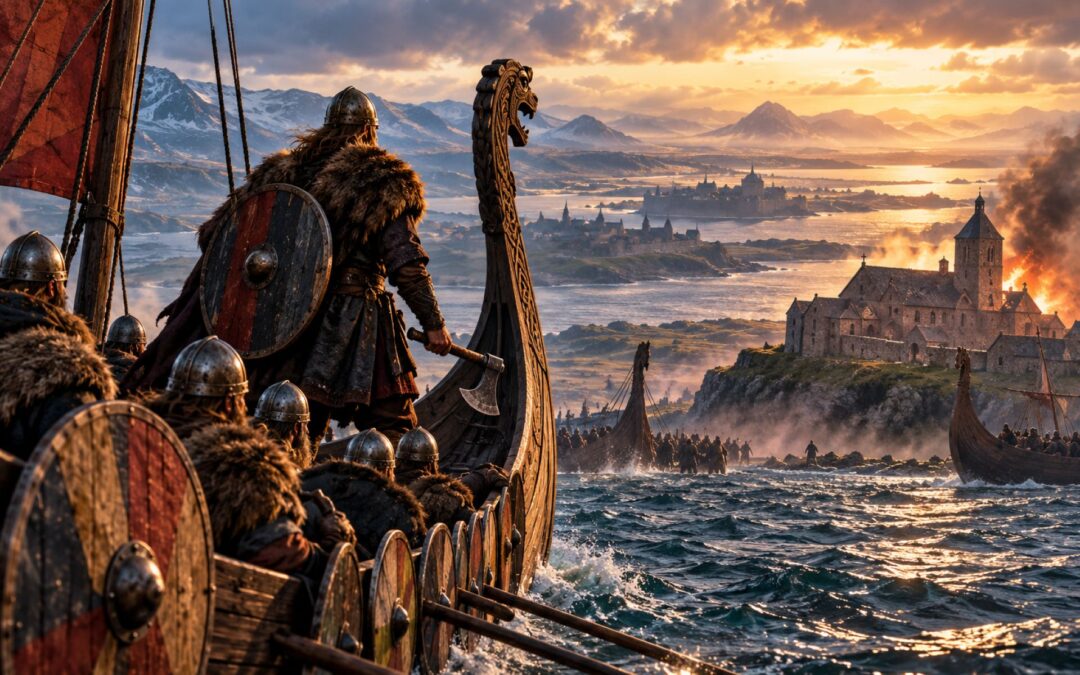
On 8 June 793, raiders from Scandinavia attacked the monastery of Lindisfarne, a religious community on an island off the northeastern coast of England. The assault shocked Christian observers, who struggled to understand how a sacred place could be attacked with such violence. To the raiders, however, Lindisfarne offered something quite different: portable wealth, a vulnerable coastal location, and an opportunity to gain riches and prestige.
The attack became one of the defining events of the Viking Age, a period conventionally dated from 793 to 1066. During these centuries, Scandinavian seafarers crossed the seas of northern Europe, sailed deep into the European interior, established kingdoms, traded with distant civilizations, and reached North America long before Christopher Columbus. Their influence stretched from the British Isles and France to the river systems of Eastern Europe, the Byzantine Empire, and the shores of the North Atlantic.
Yet the Vikings were never simply a civilization of raiders. They were also farmers, merchants, craftsmen, explorers, settlers, and political leaders. Their expeditions transformed the societies they encountered while exposing Scandinavia itself to new religions, institutions, technologies, and forms of government. Understanding the Viking Age therefore requires more than following a succession of invasions. It means examining how a maritime society expanded across the medieval world and eventually became part of the very societies it had helped transform.
Before the Raids: Scandinavia’s Maritime World
Long before the attack on Lindisfarne, Scandinavia was home to communities whose lives were shaped by a demanding landscape. The region encompassed the fjords and mountains of Norway, the forests and lakes of Sweden, and the comparatively fertile plains and islands of Denmark. Agricultural conditions varied considerably, while mountains, forests, and long distances made travel between settlements difficult. Rivers, lakes, and coastal waterways consequently became essential routes for communication and exchange.
Scandinavia was not completely isolated from the rest of Europe. During the Roman period, trade networks carried goods, precious metals, and cultural influences northward, while archaeological discoveries reveal connections extending well beyond the boundaries of the Roman Empire. Scandinavian communities participated in these exchanges without becoming politically incorporated into the Mediterranean imperial world.
By the centuries preceding the Viking Age, much of Scandinavia consisted of small political communities governed by regional chieftains and powerful families. Authority depended on landownership, personal relationships, military reputation, and the ability to reward supporters. There was no single Danish, Norwegian, or Swedish state exercising control over the entire region. Instead, competing rulers maintained networks of loyalty that could expand or collapse as political circumstances changed.
Successful leaders accumulated wealth through agriculture, tribute, commerce, and warfare. They strengthened their standing by distributing valuable goods among followers, maintaining armed retinues, and forming alliances through marriage and gift-giving. This system encouraged ambitious individuals to seek resources beyond their immediate territories, particularly when opportunities emerged to acquire wealth or establish independent authority.
The origins of Viking expansion cannot be reduced to one explanation. Population growth, competition for agricultural land, struggles among regional elites, commercial opportunities, and political instability elsewhere in Europe may all have contributed. The development of increasingly capable ships made these possibilities easier to exploit.
As Aarhus University’s examination of the Viking Age explains, trade, warfare, and royal development were interconnected features of early Scandinavian history. Maritime activity did not suddenly begin in 793. The famous raids emerged from an established world of seafaring, regional exchange, and competition for power.
Longships, Trade, and the Economics of Raiding
Ships were among the most important technological achievements of Viking Age Scandinavia. Norse shipbuilders developed vessels capable of navigating open seas while remaining sufficiently flexible for coastal waters and inland rivers. Their construction techniques allowed Scandinavian expeditions to travel quickly between places that might otherwise have been separated by forests, mountains, or difficult overland routes.
One defining feature was clinker construction, in which overlapping wooden planks formed the hull. This method produced vessels that combined strength with relative lightness and flexibility. Different designs served different purposes, including cargo transport, fishing, coastal movement, and warfare.
The longship became the most recognizable Viking vessel. Its narrow hull, shallow draft, and combination of sails and oars made it particularly effective for carrying warriors across open water and approaching shallow coastlines. Some larger examples could carry substantial crews, while smaller vessels offered greater flexibility for shorter journeys and river operations. Under suitable conditions, ships could even be dragged over short stretches of land between waterways.
These capabilities gave Viking expeditions an important advantage. Raiders could approach from the sea, strike settlements with limited warning, and depart before local defenders assembled an effective response. They could also travel upriver, bypassing coastal defenses and reaching wealthy settlements far inland.
But the same maritime expertise supported extensive commercial activity. Scandinavian merchants exchanged furs, timber, iron, amber, walrus ivory, and other commodities for silver, textiles, jewelry, glassware, and luxury goods. Trading centres such as Hedeby, Birka, and Ribe connected northern communities with markets across Europe and beyond.
Trade and raiding were not always separate occupations. A voyage might involve peaceful exchange in one location and coercion or violence elsewhere, depending on the opportunities and political circumstances encountered. Commercial relationships also provided information about foreign settlements, including their wealth, defenses, rulers, and trade routes.
Enslavement formed another important part of this economic system. Viking raiders captured people during attacks, while merchants participated in wider networks through which enslaved men, women, and children were traded. The National Museum of Denmark’s research on slaves and thralls demonstrates that slavery was embedded in Viking Age society, both as a source of labor and as part of the commercial world linking Scandinavia to other regions.
Wealth acquired through these activities strengthened the position of successful leaders. Silver, luxury goods, and other valuables could reward followers, finance ships, support households, and help ambitious chieftains attract larger groups of warriors. Military expeditions could therefore become self-reinforcing: success produced resources that made further expansion possible.
The connection between ships, commerce, and political ambition explains why Viking activity eventually extended far beyond isolated coastal raids. Scandinavians had developed the means to travel great distances, gather information, establish relationships, and use violence when they believed it would advance their interests. Those abilities would transform the political geography of medieval Europe.
From Lindisfarne to the Rivers of Europe, 793–865
The attack on Lindisfarne in 793 became a symbolic beginning of the Viking Age because of its impact on Christian contemporaries. Monasteries were religious institutions, but many also possessed valuable objects, food supplies, livestock, and accumulated wealth. Their isolated coastal locations could make them vulnerable to attackers arriving unexpectedly by sea.
The raid was not the first possible encounter between Scandinavians and the British Isles, nor did it immediately produce a continuous campaign of conquest. Nevertheless, it marked the beginning of a period in which Scandinavian attacks became increasingly prominent in the surviving written record. Raids subsequently struck communities around the Irish Sea, the northern British coast, and the islands of western Europe.
Early expeditions were often seasonal. Groups sailed during favorable weather, attacked selected targets, collected valuables and captives, and returned home before winter. Their mobility made them difficult to intercept, particularly in regions where local rulers lacked coordinated coastal defenses.
During the ninth century, the scale and geographical reach of these expeditions expanded. Viking fleets increasingly targeted settlements along the rivers of the Frankish kingdoms, using waterways to penetrate deep into the European interior. Rivers such as the Seine, Loire, and Rhine became corridors for military movement as well as commerce.
One celebrated episode occurred in 845, when a Viking force sailed up the Seine and attacked Paris. The West Frankish king Charles the Bald eventually paid a substantial sum to secure the withdrawal of the attackers. Similar payments elsewhere demonstrated that Viking leaders could profit not only from plunder but also from threatening continued destruction.
These attacks exposed weaknesses within European political systems. The Carolingian Empire had fragmented into competing kingdoms following the reign of Charlemagne, and rulers frequently struggled to coordinate military responses across their territories. Regional lords and fortified communities increasingly assumed responsibility for their own defenses.
Viking expeditions also reached the Iberian Peninsula, where they attacked coastal settlements including Lisbon and Seville in 844. Subsequent voyages carried Scandinavian raiders into the western Mediterranean, demonstrating that their maritime capabilities extended beyond the North Sea and Atlantic routes most commonly associated with them.
Meanwhile, raiding strategies were changing. Rather than returning home after every expedition, Viking groups increasingly established temporary bases and spent winters in territories they had attacked. This allowed them to maintain a military presence, store supplies, repair vessels, and organize campaigns over a wider area.
In England, Scandinavian forces overwintered on the Isle of Thanet in 850–851, an important indication of this developing approach. In Ireland, fortified ship bases had already appeared, some eventually developing into permanent settlements.
By the middle of the ninth century, Viking activity was no longer merely a succession of opportunistic attacks. Armed groups had begun establishing durable positions from which they could influence local politics, control commercial routes, and pursue territorial ambitions. The transition from seasonal raiding to conquest and settlement was underway.
Conquest and Settlement in the British Isles
Ireland became one of the earliest places where Scandinavian raiding developed into permanent settlement. Viking expeditions began attacking Irish coastal communities and monasteries toward the end of the eighth century, but their activities expanded during the following decades as fortified bases appeared along navigable waterways.
One of the most consequential developments occurred in 841, when Scandinavian forces established a fortified ship enclosure, or longphort, at Dublin. The settlement subsequently became a major centre of maritime commerce and political power, although its development was interrupted by periods of conflict and changing control. Other towns, including Waterford, Wexford, and Limerick, also developed important Scandinavian connections.
The Norse presence transformed Ireland’s political environment. Scandinavian leaders sometimes fought Irish kings, sometimes formed alliances with them, and sometimes participated directly in their struggles for supremacy. Trade, marriage, conversion to Christianity, and cultural exchange gradually produced communities combining Scandinavian and Gaelic traditions.
Similar processes unfolded in Scotland and the surrounding islands. Norse settlement became particularly important in Orkney, Shetland, the Hebrides, and the Isle of Man, linking communities across the Irish Sea and northern Atlantic. These maritime connections allowed rulers, traders, and warriors to operate within networks that crossed political and geographical boundaries.
In England, however, Viking expansion eventually developed into a much larger campaign of conquest. In 865, a substantial Scandinavian army arrived in East Anglia and began operations that would transform the Anglo-Saxon kingdoms. Known to later historians as the Great Heathen Army, it represented a more sustained and ambitious military undertaking than the seasonal raids of earlier decades.
Later traditions associated its leadership with the sons of Ragnar Lodbrok, a legendary Scandinavian warrior supposedly killed by an English king. The story of his sons seeking revenge became central to Viking legend, but the historical evidence does not establish this motive as the explanation for the invasion.
The army moved through eastern and northern England, capturing York in 866 and establishing Scandinavian dominance over Northumbria. York, known in its Norse form as Jórvík, became an important commercial and political centre. Scandinavian forces subsequently extended their control into East Anglia and Mercia, placing enormous pressure on the remaining Anglo-Saxon kingdoms.
Wessex emerged as the principal centre of resistance. Its king, Alfred, inherited a dangerous military situation in 871 and fought repeated campaigns against Scandinavian armies. In 878, after suffering a serious setback, he reorganized his forces and defeated the Viking leader Guthrum at the Battle of Edington.
The resulting settlement helped establish a division between territories under West Saxon authority and regions where Scandinavian rulers exercised considerable power. Much of northern and eastern England became associated with the Danelaw, a term referring to areas where Scandinavian political authority, settlement, and legal customs were influential.
The Danelaw was not a permanently unified Viking kingdom. It encompassed territories with different rulers, communities, and political circumstances. Scandinavian influence was nevertheless especially strong in towns such as York and the settlements later associated with the Five Boroughs of the East Midlands.
Alfred’s achievement extended beyond his military victory. He strengthened defensive arrangements, developed fortified settlements known as burhs, reorganized military obligations, and supported learning and administration. These measures helped Wessex withstand further attacks and provided foundations for later expansion.
His successors gradually extended West Saxon authority over territories previously dominated by Scandinavian rulers. Alfred’s daughter Æthelflæd, who governed Mercia, played an important role in campaigns against Viking-held towns, while Edward the Elder continued the process of consolidation.
These developments formed a decisive stage in the emergence of the English kingdom and the wider history of Britain. Yet political reconquest did not eliminate Scandinavian society. Many Norse settlers remained as farmers, merchants, craftsmen, and members of local communities.
Their influence survived in place names, vocabulary, and patterns of settlement. English words such as sky, egg, window, and take, along with pronouns including they, them, and their, reflect substantial contact with Old Norse. The linguistic legacy illustrates how conquest and migration produced lasting cultural change even after Scandinavian political control receded.
The Eastern Routes: Rus’, Byzantium, and Baghdad
While Scandinavian expeditions reshaped the British Isles and Western Europe, other Norse travelers were establishing connections across the Baltic and the river systems of Eastern Europe. These eastern networks created commercial and political relationships stretching from northern Scandinavia to the Byzantine Empire and the Islamic world.
The travelers are often described as Varangians, particularly in Eastern European and Byzantine contexts. Many originated in areas associated with present-day Sweden, although the communities and networks they entered included Slavic, Finnic, Baltic, and other peoples. Their activities cannot be understood as an exclusively Scandinavian movement into an otherwise unconnected region.
The waterways of Eastern Europe were essential to long-distance exchange. Scandinavian merchants and warriors traveled through the rivers and lakes linking the Baltic Sea to the Black Sea and the Caspian basin. Portages between river systems allowed travelers to move goods and vessels across short overland stretches, connecting regions separated by substantial geographical distances.
These networks carried furs, wax, honey, enslaved people, and other commodities southward. In return, northern merchants obtained silver, textiles, glassware, and luxury products from markets associated with the Byzantine Empire and Islamic caliphates.
Archaeological discoveries of Islamic coins and silver objects across Scandinavia demonstrate the significance of these exchanges. The movement of precious metals connected northern trading communities with an economic world extending into Central Asia and the Middle East.
Commercial involvement was accompanied by political activity. Scandinavian warriors entered local alliances, competed for control of routes, and became participants in the formation of early Rus’ political communities.
According to the Primary Chronicle, a medieval historical narrative compiled long after the events it describes, a Varangian ruler named Rurik established authority in the northern Rus’ lands in 862. The same tradition associates the expansion of this political network toward Kyiv with Oleg, who is said to have taken control of the city in 882.
These accounts require caution. Historians continue to debate the historical reliability of the Rurik narrative, the circumstances in which Rus’ authority developed, and the relative importance of Scandinavian and local political traditions. As Cambridge scholarship examining the Rurik tradition demonstrates, the later chronicle cannot simply be treated as a contemporary eyewitness record.
What is clear is that an influential political network developed around Kyiv, eventually forming the state historians generally call Kyivan Rus’. Its inhabitants and ruling elites participated in a mixed cultural environment shaped by Eastern European communities, Scandinavian contacts, steppe societies, and Byzantine influences.
Kyivan Rus’ should not be confused with the modern Russian state. Its history forms part of the shared medieval inheritance of present-day Ukraine, Belarus, and Russia, whose political identities developed through different subsequent experiences. These overlapping origins help explain why Russia’s relationship with European and Asian historical traditions cannot be understood through a single geographical or ethnic category.
Further south, Constantinople attracted Scandinavian and Rus’ merchants because of its enormous wealth and strategic position. The Byzantine capital was a centre of administration, manufacturing, religious life, and international commerce. Its markets offered goods that were difficult to obtain in northern Europe, while its political power made it both a valuable partner and an attractive military target.
Rus’ forces attacked Constantinople on several occasions, but diplomacy and commerce also produced more stable relations. Agreements regulated trade and political relationships, while Scandinavian warriors increasingly entered Byzantine military service.
The most famous expression of this connection was the Varangian Guard, an elite military formation associated with the Byzantine emperors. Its organization became particularly prominent around the end of the tenth century, following the arrival of warriors sent from the Rus’ world during the reign of Emperor Basil II.
Scandinavian fighters were especially significant in its early history, but the guard’s composition changed over time. English warriors also became important recruits, particularly after the Norman Conquest of England.
The eastern expeditions reveal a different dimension of Viking activity from the familiar attacks on Christian monasteries. Scandinavian participation in commerce, military service, and political integration helped connect northern Europe to major civilizations far beyond the Baltic. In doing so, it contributed to the development of societies whose subsequent histories extended well beyond the Viking Age.
From Chieftains to Christian Kingdoms
As Scandinavian communities expanded overseas, their homelands underwent substantial political and religious change. The fragmented world of regional chieftains and competing warrior elites gradually gave way to more centralized kingdoms. These changes unfolded unevenly across Denmark, Norway, and Sweden, and they were closely connected with the wider European societies that Scandinavians encountered.
Before Christianity became dominant, Scandinavian religious traditions centred on a diverse world of gods, spirits, supernatural beings, and sacred practices. Odin was associated with wisdom, warfare, poetry, and kingship, while Thor was closely connected with thunder, strength, and protection. Other prominent deities included Freyr and Freyja, alongside mythological beings such as dwarves, elves, and giants.
These beliefs were not governed by a single religious institution comparable to the medieval Church. Practices differed across communities, and political leaders often played important roles in religious ceremonies. Much of the mythology familiar today was preserved in written sources composed after Christianization, meaning that historians must distinguish earlier beliefs from their later literary representations.
Christianity entered Scandinavia through several routes, including missionaries, merchants, political contacts, and Scandinavian communities living abroad. Conversion was not simply the result of individual religious persuasion. It could also strengthen diplomatic relationships with Christian rulers and provide emerging monarchies with institutions capable of supporting royal authority.
Denmark became one of the earliest Scandinavian regions to develop a more recognizable territorial monarchy. During the tenth century, Harald Bluetooth extended royal authority and became associated with the adoption of Christianity. The Jelling monuments commemorate his achievements and express an emerging relationship between kingship, religion, and political identity.
Norway followed a less straightforward path. Later traditions credit Harald Fairhair with unifying much of the country following the Battle of Hafrsfjord, conventionally placed toward the end of the ninth century. The precise chronology and extent of his authority remain debated, while the development of Norwegian monarchy continued across subsequent generations.
Later rulers, including Olaf Tryggvason and Olaf Haraldsson, became closely associated with the expansion of Christianity. Conversion encountered resistance, and competing regional elites continued to challenge royal authority. Norway’s transformation was therefore a prolonged struggle involving warfare, alliances, religious change, and efforts to establish more durable institutions.
Sweden’s political consolidation proceeded more gradually. Regional centres of power retained considerable independence, and Christianization developed unevenly. Olof Skötkonung, who ruled around the turn of the eleventh century, became associated with early Christian kingship and the issuing of coinage, but the establishment of a centralized Christian kingdom took considerably longer.
The expanding power of kings altered the political environment that had sustained Viking expeditions. Royal administrations increasingly sought more regular sources of revenue, while churches and territorial institutions offered new ways to organize authority. Military service gradually became more closely connected with royal political structures rather than independent ventures led by competing chieftains.
These transformations did not immediately eliminate seafaring, warfare, or migration. Scandinavian kings themselves continued undertaking military expeditions abroad. Nevertheless, the social and political foundations of Scandinavian expansion were changing as Denmark, Norway, and Sweden became increasingly integrated into the institutions of medieval Christian Europe.
Across the North Atlantic: Iceland, Greenland, and Vinland
One of the most remarkable achievements of Viking Age navigation was the expansion across the North Atlantic. While Scandinavian expeditions elsewhere often involved raiding established settlements, movement into the Atlantic islands also included families seeking farmland, political independence, and opportunities to establish new communities.
Iceland became a major destination during the late ninth century. Norse settlement traditionally began around 870, although the precise circumstances and chronology of the earliest arrivals remain subjects of research. Many settlers came from Norway, while others traveled from Scandinavian communities around the British Isles and Irish Sea.
The island’s settlement history also includes evidence of contacts with Gaelic-speaking populations, and medieval traditions mention religious figures from Ireland who may have visited before large-scale Norse settlement. These accounts do not establish a substantial permanent population preceding the principal settlement period, but they complicate any description of Iceland as entirely unknown to earlier travelers.
The settlers established farms and developed a distinctive political society without a single king. In 930, they founded the Althing, a general assembly where leading members of the community participated in legal proceedings, political decisions, and the resolution of disputes. It became one of the most enduring institutions associated with Icelandic history.
Icelandic society nevertheless remained hierarchical. Wealthy families exercised considerable influence, while household labor included both free people and enslaved individuals. The absence of a monarchy did not create a society without inequality or political competition.
From Iceland, Norse exploration continued westward toward Greenland. Erik the Red, an Icelandic settler who had been outlawed, became associated with voyages to the island during the late tenth century. Around 985–986, he helped establish Norse communities along Greenland’s southwestern coast.
The settlers depended on farming, animal husbandry, hunting, and trade in a demanding environment. Their settlements maintained contact with Iceland and Norway, exchanging valuable products such as walrus ivory for goods that were difficult to manufacture locally. Greenland’s distance from other Norse territories made these connections particularly important.
It would be misleading to describe Greenland as an island without a wider human history. Indigenous Arctic peoples had inhabited parts of Greenland during earlier periods, and later Inuit communities developed their own extensive history there. The relationship between Norse settlers and Indigenous populations changed across time and region, and cannot be summarized as an uncomplicated occupation of empty land.
The Norse eventually pushed even farther west. Medieval Icelandic sagas describe voyages associated with Leif Erikson and other explorers who encountered territories they called Helluland, Markland, and Vinland. Although the geographical identification of every saga location remains uncertain, archaeological evidence establishes that Norse travelers reached northeastern North America.
The decisive discovery was made at L’Anse aux Meadows, on the northern tip of Newfoundland. Excavations revealed buildings and objects associated with Norse occupation, including structures resembling those found in the North Atlantic Scandinavian world. The site provides physical evidence that Europeans had reached North America centuries before Columbus.
The chronology became more precise through scientific research. A 2021 study published in Nature establishing Norse activity in North America in 1021 used a distinctive atmospheric radiocarbon signal to date worked wood recovered at L’Anse aux Meadows. The evidence demonstrates human activity there in that year, although it does not establish the precise founding date of the settlement or identify the individuals involved.
The Icelandic sagas also describe encounters with Indigenous inhabitants whom the Norse called Skrælings. These narratives include both trade and conflict, but were written long after the voyages they describe. Their details cannot always be independently confirmed, and Indigenous societies must not be reduced to the hostile figures sometimes presented in European accounts.
The Newfoundland settlement did not develop into a lasting Norse colony. Its limited population, geographical distance from established communities, demanding supply requirements, and potential tensions with Indigenous peoples may all have complicated sustained occupation. The precise reasons for abandonment remain uncertain.
The wider Norse presence in Greenland lasted much longer, but its settlements eventually disappeared during the late medieval period. Climate variability, changing commercial conditions, isolation, and other social or environmental pressures may have contributed, although no single explanation accounts conclusively for their decline.
The Atlantic voyages demonstrate the extraordinary reach of Scandinavian maritime networks. They also reveal their limits: ships could carry explorers across immense distances, but founding lasting communities required dependable resources, relationships, and connections that navigation alone could not provide.
Cnut, Clontarf, and the Struggle for the North Sea
By the beginning of the eleventh century, Scandinavian involvement in Western Europe had produced political structures much more substantial than the raiding bands of earlier generations. The North Sea had become a connected political and commercial world in which rulers from England, Denmark, Norway, and the Irish Sea competed for power.
In England, Alfred’s successors had gradually brought territories previously controlled by Scandinavian rulers under West Saxon authority. Æthelstan’s capture of York in 927 was a decisive stage in the creation of a more unified English kingdom. His victory at the Battle of Brunanburh in 937 strengthened his position against a coalition of regional opponents, although Scandinavian political influence persisted.
The expulsion of the final Scandinavian king from York in 954 further reduced independent Viking rule within England. However, Danish attacks intensified again toward the end of the tenth century, exposing the kingdom to renewed military and financial pressure.
King Æthelred II attempted to respond through a combination of warfare, diplomacy, and payments to invading forces. His reign became associated with substantial tribute payments, often called Danegeld, which temporarily secured withdrawals without removing the underlying military threat.
In 1013, the Danish king Sweyn Forkbeard successfully invaded England and gained control of the kingdom, although he died the following year. His son Cnut eventually secured the English throne in 1016 after renewed warfare and political struggle.
Cnut subsequently became king of Denmark and acquired authority over Norway, creating a powerful North Sea monarchy. His territories were not administered as a single centralized state, but their union under one ruler demonstrated how far Scandinavian political ambition had developed since the early coastal raids.
Cnut governed England through established institutions while maintaining relationships with the Church and influential aristocratic families. His rule illustrates the transformation of a Scandinavian conqueror into a Christian monarch operating within the political conventions of medieval Europe.
Across the Irish Sea, Scandinavian-founded towns remained important centres of trade and political power. Dublin, Waterford, and Limerick had become deeply involved in Irish political affairs, while their rulers maintained connections with communities throughout the surrounding maritime region.
These relationships contributed to the conflict that culminated in the Battle of Clontarf on 23 April 1014. The Irish High King Brian Boru faced a coalition involving rulers from Leinster, Scandinavian-associated Dublin, and warriors connected with the wider Irish Sea world.
Brian’s forces won the battle, but the victory came at enormous personal cost. Brian himself was killed, along with several members of his family and other prominent leaders. His death undermined the political structure through which he had exercised authority over much of Ireland.
The battle later became celebrated as a decisive Irish victory over the Vikings. That interpretation simplifies a much more complicated political struggle involving Irish and Scandinavian rulers whose alliances frequently crossed ethnic and religious boundaries.
Brian had previously cooperated with Scandinavian leaders, and important Norse communities in Ireland had already adopted Christianity. The conflict was therefore not a straightforward war between Christian Ireland and pagan invaders.
The larger significance of Clontarf lies in the changing balance of power within Ireland and its Scandinavian-connected political networks. The battle weakened particular ruling coalitions, but it did not eliminate Norse populations or end the economic importance of their towns. The more detailed political and military circumstances belong to the history of Brian Boru and his struggle for supremacy in Ireland.
The North Sea monarchy created by Cnut also proved difficult to preserve. After his death in 1035, succession disputes weakened the political union, and its component kingdoms gradually passed to different rulers. In England, the Anglo-Saxon royal line was restored in 1042 under Edward the Confessor.
These developments marked another stage in the transformation of Viking political power. Scandinavian rulers had demonstrated that they could conquer and govern established kingdoms, but sustaining those territories required more than military success. Dynastic succession, local institutions, alliances, and political legitimacy increasingly determined whether their achievements would endure.
1066 and the Transformation of the Viking World
The year 1066 is traditionally associated with the end of the Viking Age, largely because two major invasions of England brought centuries of Scandinavian political involvement to a dramatic turning point. Yet the events of that year also demonstrate how thoroughly Viking history had become intertwined with the development of medieval European states.
Edward the Confessor died in January 1066 without a direct heir, leaving the English throne vulnerable to competing claims. Harold Godwinson, England’s most powerful nobleman, was chosen as king. His accession was challenged by Harald Hardrada of Norway and William, Duke of Normandy.
Hardrada was an experienced military commander whose career reflected the geographical reach of Scandinavian warfare. Before becoming king of Norway, he had fought abroad and served in the Byzantine Empire’s Varangian Guard. His claim to England drew upon earlier Scandinavian dynastic arrangements and ambitions associated with the North Sea kingdoms.
In September 1066, Hardrada invaded northern England with a substantial army, supported by Harold Godwinson’s estranged brother Tostig. The invaders defeated English forces at the Battle of Fulford on 20 September and occupied York.
Harold Godwinson responded by marching rapidly north with his army. On 25 September, he defeated the invaders at the Battle of Stamford Bridge, where both Hardrada and Tostig were killed.
The victory effectively destroyed that Norwegian attempt to seize the English throne. As English Heritage’s account of the northern battles of 1066 explains, Fulford and Stamford Bridge formed part of the wider succession struggle that forced Harold to confront two formidable threats within a matter of weeks.
Almost immediately, the English king faced another invasion. William, Duke of Normandy, landed in southern England on 28 September, bringing an army assembled from Normandy and neighboring territories.
Normandy itself originated in earlier Viking settlement. In the early tenth century, the Frankish king Charles the Simple reached an agreement with the Scandinavian leader Rollo, traditionally dated to 911. Rollo received authority over territory around the lower Seine in return for allegiance and cooperation, providing the foundation of the Norman duchy.
Over subsequent generations, the descendants of these Scandinavian settlers adopted Christianity, developed connections with local aristocratic families, and increasingly spoke forms of French. By William’s lifetime, Normandy possessed a distinctive political and military culture deeply integrated into medieval France.
William was therefore descended from Scandinavian settlers, but he was not a Viking chieftain leading a traditional Norse raiding expedition. His invasion represented the ambitions of a powerful Norman duke operating within the political and religious world of eleventh-century Western Europe.
On 14 October 1066, William defeated Harold Godwinson at the Battle of Hastings. Harold was killed, and William subsequently established himself as king of England, transforming the country’s aristocracy, landholding, administration, and cultural relationships with continental Europe.
The conquest also produced lasting linguistic consequences. Norman French became influential among the ruling elite, while English remained the principal language of most inhabitants. Over centuries, interaction among English, French, and Latin contributed to the transformation of the English language after the Norman Conquest.
The events of 1066 therefore brought together two different legacies of Scandinavian expansion. Hardrada represented the continuing ambitions of northern kings to control territories across the North Sea. William represented the descendants of Viking settlers who had already become part of a different medieval political and cultural society.
Normandy’s development was itself one chapter in the broader history of France and the emergence of medieval royal power. Scandinavian settlement had helped create a powerful duchy that eventually played a decisive role in English history, even after its rulers had largely abandoned their ancestors’ language and religious traditions.
Yet it would be mistaken to suggest that the Viking Age ended suddenly at Stamford Bridge or Hastings. Scandinavian kingdoms continued to wage wars, maintain overseas interests, and influence neighboring societies. Norse-derived political communities survived in parts of the British Isles and North Atlantic, while Scandinavian settlement and cultural traditions remained visible for generations.
In Scotland, the Northern and Western Isles continued to maintain important connections with Norway, and some remained under Norwegian sovereignty for centuries. Iceland retained its own political institutions until it accepted Norwegian rule in the thirteenth century. Scandinavian maritime commerce likewise continued long after the conventional Viking Age had ended.
In Eastern Europe, the Rus’ principalities evolved through their own political, cultural, and religious histories. Scandinavian connections became increasingly integrated into broader Slavic and Byzantine-influenced societies rather than remaining the defining characteristic of the region’s political structures.
The Varangian Guard also endured beyond the period of predominantly Scandinavian recruitment. Its changing composition, including significant participation by English warriors, demonstrated how a military institution associated with Norse expansion could survive while adapting to new circumstances.
Within Scandinavia itself, the most important transformation was the growth of Christian monarchies. Kings increasingly exercised authority through territorial administration, organized military obligations, law, taxation, and relationships with ecclesiastical institutions. The forms of independent maritime warfare associated with the earlier Viking Age gradually became less distinctive.
The conventional ending in 1066 is therefore useful because it captures a major turning point, not because it represents a decisive extinction of Viking peoples or traditions. Scandinavian societies had changed, and so had the political world in which their earlier expeditions had flourished.
The Viking Age left a legacy far greater than the raids that made it famous. Scandinavian ships connected distant regions, merchants participated in trading networks stretching toward the Islamic world, and settlers reshaped communities across Europe and the North Atlantic. Their political ambitions helped influence the development of kingdoms, while their languages and customs left enduring marks on the societies where they settled.
The Vikings did not disappear when the Viking Age ended. The peoples of Scandinavia continued to develop within increasingly recognizable medieval kingdoms, while overseas Norse communities became part of the broader societies around them. What ended was a particular historical era of expansion, in which maritime mobility, decentralized political competition, trading opportunities, and warfare had combined to give Scandinavian groups an extraordinary influence across much of the known medieval world.
Last Updated on October 31, 2026 by Aseem Gupta