
Reading Time: 17 Minutes
When RadioShack filed for bankruptcy on 5 February 2015, the news sounded less like the sudden death of an American institution than confirmation of something many shoppers thought had happened already. The chain had once occupied thousands of malls and neighborhood shopping centers. It was where people went for an obscure battery, an antenna connector, a component for a homemade project or an explanation of why a piece of equipment had stopped working. Yet by the time its financial crisis became impossible to ignore, a RadioShack often looked like a cramped mobile-phone outlet struggling to explain why anyone should visit it instead of a carrier store.
That contrast makes the company’s history more complicated than a familiar tale of a retailer defeated by the internet. RadioShack had survived enormous technological transitions before, and it had helped bring one of them about. In 1977, it put an affordable, assembled personal computer within reach of customers across the United States. The deeper question is how a business so good at making new technology accessible eventually lost the distinctive purpose that brought people through its doors.
From a Boston Radio Shop to Charles Tandy’s Rescue
RadioShack began in Boston in 1921, when brothers Theodore and Milton Deutschmann opened a business serving people fascinated by radio. Wireless communication was still young enough that enthusiasts often assembled their own receivers, learned by experimenting with components and relied on specialist suppliers for equipment that ordinary shops did not stock. The company’s name evoked the small radio room aboard a ship, an appropriately practical image for a business built around the machinery of communication.
The brothers were selling more than completed radios. Their trade included parts, accessories and mail-order supplies for amateur operators and technically curious customers across the country. A catalog could be especially valuable to someone far from a specialist store: it connected a rural enthusiast to switches, wire, tubes and instruments that might otherwise be difficult to obtain. RadioShack developed an identity as a supplier to people who wanted to understand electronics, not simply purchase a finished appliance.
For all its cultural appeal, the business struggled to become financially durable. Over four decades, it expanded to only a small regional network—roughly nine stores by the early 1960s—and accumulated an unwieldy assortment of merchandise. Accounts of its difficulties describe a catalog of some 40,000 items, many slow-moving, alongside overly generous customer credit and weak financial controls. An impressive range was little comfort when inventory tied up cash and customers were slow to pay.
The turning point came in 1963, when the Fort Worth-based Tandy Corporation bought the failing business for approximately $300,000. Tandy was associated with leather goods and craft retailing, making the acquisition seem an unlikely route into the future of electronics. But Charles Tandy saw a model that could work far better than the existing operation: small specialty stores, tightly controlled costs and products whose margins justified the shelf space they occupied.
He attacked the complexity that had nearly overwhelmed the company. Product selection was reportedly cut from tens of thousands of items to around 2,500; loose credit practices were curtailed; and attention shifted toward fast-selling accessories, components and proprietary lines. Tandy did not abandon the enthusiast customer. He made serving that customer economically repeatable, reducing the capital and floor space needed to open the next shop.
The distinction mattered. RadioShack had already discovered that an ordinary customer might travel considerable distance for a particular electronic part. Tandy’s insight was that thousands of customers could make the same trip far more easily if a dependable specialist opened around the corner. The RadioShack company history presented by Unicomer traces the brand from its Boston origins through the Tandy era and later international expansion. What emerged from the 1963 rescue was not merely a solvent version of the old mail-order supplier, but the foundation of a national retail network.
How RadioShack Became America’s Neighborhood Electronics Store
Tandy expanded with the geography of postwar America. As families moved into suburbs, small stores in shopping centers could reach customers without the expense of enormous showrooms. RadioShack also worked with independent dealers, extending the sign into towns that might not support a large company-operated outlet. Managers had incentives tied to store performance, encouraging the attention to inventory and regular customers on which this format depended.
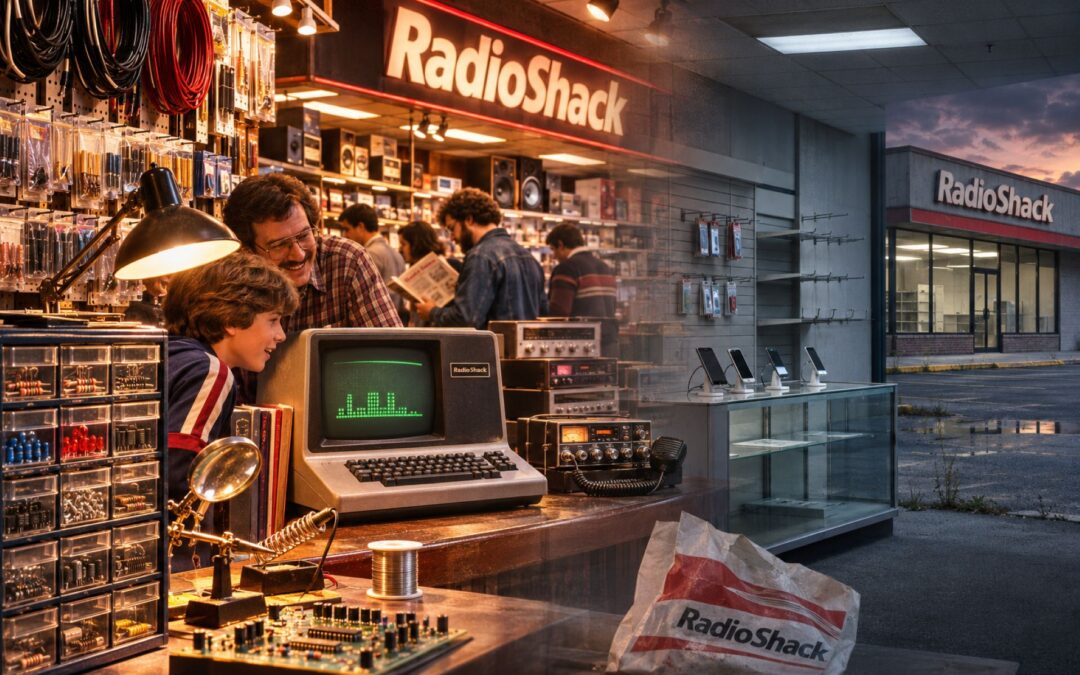
A typical RadioShack did not resemble a department store. Much of its value was concentrated in small objects: transistors, resistors, capacitors, plugs, fuses, batteries, antenna wire and connectors in sizes that were easy to overlook until the exact one was needed. A customer might spend little on the part itself, but finding it nearby could save an entire afternoon or restore an expensive device to working order. The store’s modest footprint was a strength because expertise and useful assortment mattered more than spectacle.
The people behind the counter were part of the attraction. Many were electronics enthusiasts familiar with the products they sold, able to help a customer distinguish similar-looking plugs or work out which component belonged in a project. Knowledge varied by store and employee, of course, but the possibility of obtaining practical advice made RadioShack feel different from a retailer whose only function was to process a sale. An inexperienced hobbyist could walk in with a problem and leave with both a part and a better understanding of the problem.
Tandy reinforced that relationship through its own brands. Realistic appeared on audio equipment and speakers; Archer on assorted electronic accessories; and Micronta on tools, meters and testing equipment. These labels allowed RadioShack to offer products selected for its customers and retain more control over margins than it would have had selling only national brands. A stereo enthusiast could buy speakers, cable and a small replacement component under the same roof.
The chain also learned how to turn an occasional need into a recurring visit. Its free battery promotions, remembered especially through the Free Battery Club, gave customers a reason to return even when nothing had broken. A visit for a battery could lead to another purchase, a question about a radio or a look at a new gadget. The promotion was modest, but it fit an economic model built around frequent contact with nearby consumers.
National enthusiasms supplied further opportunities. During the citizens band radio boom of the 1970s, RadioShack sold the radios and the antennas, microphones and accessories that made them useful. As home audio became a mainstream hobby, its Realistic equipment served customers seeking affordable ways to assemble a stereo system. By 1975 the chain had more than 2,600 stores, and its expansion was continuing.
A RadioShack could be a shop, a repairer’s supply cabinet and a meeting point for people who liked understanding how devices worked. Its thick catalogs showed households what was available even when local shelves could not hold every item. In some communities, particularly outside major cities, it was the only nearby business devoted to electronics. That combination of convenience, breadth and approachable technical knowledge gave the company a place in American daily life that was difficult for an ordinary competitor to copy.
The TRS-80 and RadioShack’s Personal Computer Revolution
The most remarkable demonstration of RadioShack’s willingness to embrace a new market came when personal computing was still an experiment. In the mid-1970s, computers were associated with businesses, universities and technically confident hobbyists. Early microcomputers were often sold as kits or through specialist channels, leaving buyers to assemble hardware, obtain peripherals or learn unfamiliar procedures before the machines became useful.
Inside Tandy, Don French recognized the promise of small computers, while engineer Steve Leininger helped turn that idea into a practical retail product. The project involved a commercial gamble: nobody could be certain how many ordinary shoppers would spend hundreds of dollars on a computer or what they would do with it once they got home. But RadioShack already had thousands of outlets where those shoppers could see a machine demonstrated and ask questions without entering an unfamiliar computer dealership.
On 3 August 1977, RadioShack announced the TRS-80, named for Tandy, RadioShack and the Zilog Z80 processor. The entry-level system was advertised at approximately $599.95, a remarkable proposition at the time: a keyboard containing the computer, a display and a way to load or store programs using cassette tape. Depending on the configuration, buyers had only a few kilobytes of memory and relatively primitive graphics. The limitations seem severe today, but they were manageable costs for making computing available beyond laboratories and dedicated clubs.
The machine offered a version of BASIC that let users type instructions and watch the computer respond. Someone could enter a small program, make a calculation, play a simple game or begin writing software of their own. It invited experimentation in a way that many of RadioShack’s other products already did. Instead of only selling the components from which a device might be built, the company was selling a programmable device that consumers could explore, alter and extend.
Its competitors were significant. Apple’s Apple II and Commodore’s PET also arrived in 1977, and all three helped define the early ready-to-use personal-computer market. The machines differed in price, design, software and distribution, but RadioShack possessed a particular advantage: customers could encounter the TRS-80 in an established national chain rather than needing to locate a specialist computer retailer. According to the Computer History Museum’s account of the 3 August launch, the announcement became a milestone in the emergence of consumer computing.
Demand surprised even those closest to the project. Early production plans proved conservative, the initial production run sold out, and the TRS-80 became one of the most commercially successful computers of its generation. Its reputation was not uniformly glowing: it had technical compromises, a modest display and weaknesses that enthusiasts enjoyed criticizing. None of that erased the significance of a broadly available computer backed by an organization able to distribute machines, peripherals, documentation and support.
The TRS-80 also shows why RadioShack’s eventual decline cannot be explained as a permanent hostility to technological change. In 1977, the company recognized that the next generation of electronics enthusiasts might need an entirely new kind of product, and it acted while the market was still uncertain. Its stores gave an unfamiliar technology a familiar point of entry. Later, the challenge would be less about noticing that a new device existed than about changing a profitable retail system when the underlying reasons for visiting it were disappearing.
A Seven-Thousand-Store Empire Meets a Changing World
By the end of the twentieth century, RadioShack was nearly impossible to avoid in the United States. Its network included company-operated stores and independent dealers, many in malls or neighborhood shopping centers. A shopper in a small town might rely on it for a replacement adapter; someone in a suburb could stop for a cable without making a longer trip to a warehouse retailer. In 2001, the network exceeded 7,300 outlets, a measure of how deeply it had entered the country’s retail landscape.
That reach was complemented by a familiar culture. The annual catalog remained a source of discovery for people interested in electronics, while the advertising line “You’ve got questions. We’ve got answers” captured the value of finding a knowledgeable person nearby. RadioShack was also remembered for requesting customer names and addresses at the checkout, even for inexpensive purchases. That practice could be irritating, but it was part of a business built around repeat customers and direct marketing.
Scale, however, could not protect the reasons people shopped there. The world of repairable radios, modular stereo systems and home electronic projects did not disappear, but consumer devices increasingly arrived as compact products that required specialized service rather than replacement of individual parts by their owners. Manufacturers integrated functions into fewer components; later, smartphones absorbed tasks once performed by separate cameras, music players, navigation units and portable radios. Each change reduced some familiar reasons to buy a specialized accessory or to tinker with the device itself.
At the same time, pricing and distribution shifted. Best Buy and other large retailers could offer broad selections of major electronics with economies of scale that a tiny RadioShack struggled to match. Walmart brought mass-market devices into everyday shopping. Online sellers expanded the selection of obscure parts and cables beyond anything one small store could stock, often allowing customers to compare prices without traveling anywhere. RadioShack was being squeezed between stores built for volume and websites built for almost unlimited assortment.
The company was not entirely absent from the internet. Its annual filing covering the launch of RadioShack.com documents an e-commerce-enabled website that began operating in October 1999. The relevant question is not whether RadioShack had a website, but whether the online business changed how it competed. Digital availability weakened the urgency of going to a particular storefront for a small item that once would have been difficult to find.
The predicament resembled the one faced by another established retailer, though their businesses were different. Sears’s struggle to renew a once-powerful retail system shows why history, brand recognition and a large store network can become burdens when customer expectations change and the organization struggles to reinvest. RadioShack had an advantage that remained potentially valuable—proximity and technical advice—but maintaining thousands of stores required enough profitable reasons for customers to keep returning. Increasingly, those reasons were harder to find.
How the Mobile Phone Business Became a Trap
Wireless phones appeared to offer RadioShack the solution. Unlike a resistor or a replacement fuse, a mobile phone was a product consumers would routinely replace, and each activation could generate compensation through a partnership with a carrier. The stores already operated in convenient locations, and staff were accustomed to demonstrating electronic equipment. Selling wireless service seemed a reasonable way to bring a stream of customers into a network that was losing demand for other items.
During the 2000s, the wireless business came to occupy a central place in RadioShack’s merchandising and finances. Displays that once emphasized components and experiments increasingly promoted handsets, accessories and service plans. The shift did not instantly eliminate every electronics hobbyist product, but it changed the store’s atmosphere. A visitor seeking a connector or an uncommon battery could find the employee occupied with the much longer process of enrolling another customer in a phone contract.
An activation was not a straightforward product sale. It might involve checking eligibility, choosing a plan, explaining terms, transferring information and resolving questions about a carrier’s network. That work could be valuable when a commission justified it, but it consumed time and tied staff attention to systems the retailer did not control. The transaction could make a small location look busy while weakening its ability to offer the quick expert assistance on which its older reputation depended.
The strategic risk lay deeper than inconvenience. RadioShack did not own the wireless networks, set the major service terms or control the products customers most wanted. Carriers determined important elements of compensation and increasingly invested in their own stores. Handset makers developed powerful identities of their own. RadioShack could sell access to these products and services, but customers had less reason to choose RadioShack specifically when they could reach the same network or phone elsewhere.
Then the smartphone intensified the change. It was not merely a more desirable handset; it combined the functions of numerous electronics categories. A pocket camera, portable music player, organizer, GPS navigator and radio-like listening experience could increasingly be replaced by apps and services on one device. The old RadioShack could have sold many of these things individually, along with the cords and batteries that supported them. Now the most commercially important item on the counter often contained much of that former assortment.
There was an instructive contrast with BlackBerry’s loss of its once-dominant position in mobile communication. BlackBerry had built a strong device-and-service ecosystem around mobile email, but changing customer expectations undermined its leading position. RadioShack’s problem was different: it depended increasingly on selling other companies’ phones and carrier relationships, without possessing a comparable ecosystem of its own. In both cases, success in an earlier technological environment became difficult to reproduce once the market’s center of value moved.
None of this means that carrying phones was obviously foolish. Without that business, many locations might have struggled sooner. Wireless sales bought time and revenue while other categories weakened. The problem was that a temporary source of traffic did not necessarily solve the underlying issue of why customers should prefer RadioShack. The more the chain became a general-purpose phone seller, the less it resembled the distinctive electronics specialist that had made its vast store network possible.
Failed Reinvention and the Store-Closure Trap
As its business changed, RadioShack struggled to present a convincing identity. The company had long benefited from a promise of competent advice, but the practical experience varied from store to store, and aging interiors competed with the bright, expansive displays of newer technology retailers. Products that felt revolutionary in one decade could look ordinary in the next. RadioShack needed to decide whether it was a technical specialist, a convenient accessories shop, a wireless retailer or some combination that would give customers a clear reason to return.
Leadership problems added to the uncertainty. In 2006, chief executive David Edmondson resigned after questions arose about academic qualifications listed in his background. His departure did not cause RadioShack’s structural difficulties, but it became a public embarrassment for a business already in need of confident direction. Subsequent management teams pursued different approaches to the product mix, presentation and store footprint as the economics of the chain became more challenging.
In 2009, RadioShack adopted “The Shack” in a prominent advertising campaign. The attempt was to make a familiar name sound less dated and more approachable to contemporary electronics shoppers; it did not amount to a formal abandonment of the RadioShack corporate name. Marketing could refresh the store’s image, but an abbreviated name was no substitute for a consistently useful product selection, differentiated service or a credible answer to intensifying competition.
Store economics eventually became the central problem. Rent, wages and operating expenses continued even when demand was too thin to justify keeping a particular shop open. With thousands of locations, poor performers could absorb cash and management attention needed elsewhere. Closing stores also carried costs, including lease obligations and inventory adjustments, but the company could not indefinitely preserve every part of a footprint created for an earlier market.
In 2014, management described plans to close up to 1,100 stores, yet its options were constrained by financing agreements negotiated during the previous year. The lenders had legitimate interests in protecting the value behind their loans, while executives argued that accelerated closures were necessary to reduce losses. The company’s restructuring disclosure to investors illustrates how required lender consent and restrictions on aggregate store closures frustrated the scale of the planned changes.
This was more than an argument about the number of storefronts. A company that loses money must often shrink to preserve capital, but lenders may fear that rapid contraction will destroy the collateral or operating capacity supporting repayment. RadioShack found itself negotiating that conflict while sales continued to deteriorate. Its weakest outlets remained costly, yet the company lacked unrestricted freedom to close them in the numbers it wanted.
Even complete freedom to shut stores would not have guaranteed a turnaround. A smaller chain still needed merchandise and services that customers valued enough to seek out, at prices that left sufficient profit after rent and wages. RadioShack’s problem was simultaneously operational, financial and strategic: it had too many locations for its weakening business model, too little flexibility to reshape them quickly and no compelling replacement for the role it had once owned in neighborhood electronics.
Two Bankruptcies and a Rescue That Failed
By 2014, RadioShack’s financial decline had become acute. Sales were falling, losses had accumulated across eleven consecutive quarters, and concerns about liquidity made it harder to imagine an orderly recovery. The shares were eventually delisted from the New York Stock Exchange. On 5 February 2015, RadioShack Corporation and related entities filed for Chapter 11 bankruptcy protection, bringing an extraordinary chapter in American retailing to an end.
Chapter 11 was not the immediate disappearance of every store. It was a legal process through which assets could be sold, obligations addressed and surviving operations reorganized. At the time of filing, thousands of company-operated locations formed part of the struggling business, but not all would share the same fate. Many were slated for closure, while others were considered valuable enough to keep operating under new ownership.
The rescue plan involved Standard General, a major investor, and an affiliated company called General Wireless. Following the bankruptcy process, General Wireless acquired 1,743 RadioShack stores, with plans for a substantial number of locations to host a Sprint presence. The RadioShack SEC filing documenting the sale records the transaction and distinguishes the stores sold from the wider network that had existed before the bankruptcy. The remaining company-operated outlets were largely liquidated or closed.
In many surviving shops, the solution made RadioShack’s dilemma newly visible. Sprint’s name and wireless services occupied prominent space, while RadioShack merchandise had to share an increasingly restricted retail environment. The arrangement offered a way to retain locations and customers without entirely rebuilding the business from scratch. But it also entrenched dependence on the carrier business that had failed to provide a durable competitive advantage in the first place.
For customers, the disappearance was physical and immediate. Closing sales emptied shelves of tools, parts, cables, toys, audio gear and whatever else remained. Familiar signs came down from malls and strip centers. In towns where the shop had been an unusually convenient source of obscure electronic supplies, the loss could be felt long after the national headlines moved on. The stores had been small, but their usefulness had sometimes been disproportionate to their size.
The post-bankruptcy organization did not achieve a lasting recovery. Wireless competition continued to change, the economics of the surviving network remained difficult and the partnership with Sprint failed to produce the expected stability. On 8 March 2017, General Wireless Operations—the successor retail operator, not simply the old RadioShack Corporation filing again—sought Chapter 11 protection. Contemporary coverage of the second bankruptcy described further closures and the strain surrounding the Sprint arrangement.
The two filings tell related but distinct stories. The first followed years in which the original chain had accumulated too many costly stores and lost much of its relevance. The second exposed the weakness of a rescue strategy that kept part of the network alive without rebuilding a sufficiently distinctive retail proposition. Bankruptcy could transfer assets, reject obligations and close locations; it could not by itself restore the customer habits or economics that had once supported thousands of RadioShacks.
What Survived RadioShack—and What Didn’t
It would be inaccurate to say that RadioShack vanished completely in 2017. The original national chain suffered catastrophic contraction, but its name, some independent dealerships and businesses operating under the brand in other countries followed different paths. Store closures in the United States did not mean that every licensed operation elsewhere was part of the same bankruptcy or had ceased to trade. The brand survived in forms that were much smaller and less unified than the old American network.
The ownership history continued after the bankruptcies. In 2023, Unicomer Group announced the acquisition of the global RadioShack brand, adding it to a retail business with established operations in Latin America and the Caribbean. A US online retail relaunch followed in 2024. Those developments show that RadioShack could still have recognition and commercial uses, but they should not be confused with a recovery of the same thousands of company-operated American stores that once defined the business.
What is harder to reconstruct is the social role those stores performed. Before online tutorials, global marketplaces and an abundance of electronic devices, a local employee who understood an uncommon connector or component could be remarkably valuable. A small shop with drawers of parts gave people permission to experiment, repair and learn. A student might enter for a battery and discover a project kit; a homeowner might arrive with a broken plug and leave knowing how to replace it; a computer enthusiast could see a machine that previously seemed beyond reach.
RadioShack’s history is therefore not a simple argument that physical retail was doomed. Stores remained useful in many industries, and physical access, demonstrations and advice continued to matter in technology retail. Nor was the company incapable of recognizing a new market: the TRS-80 is enduring evidence that it once understood how to put unfamiliar technology into ordinary hands. Its greater failure was to preserve the scale of its network without continually renewing the distinctive advantage that had made that scale worthwhile.
The rise of RadioShack depended on a world where electronic knowledge, accessories and specialist products were difficult to access. Charles Tandy built a profitable business by making them available in small stores almost everywhere. As products grew more integrated, retail competitors grew larger and online selection expanded, RadioShack needed to find a new form of that same usefulness. Selling someone else’s phone and wireless contract could generate revenue, but it did not necessarily give the customer an enduring reason to seek out the RadioShack sign.
For generations, the company had helped Americans open a box, look inside and discover what a machine could do. Its decline was not just the loss of a familiar retailer; it was the disappearance of a particular relationship between shops, technology and curious people. RadioShack had once made the future feel approachable from a counter around the corner. When that future changed, the company struggled to make the counter matter again.
Last Updated on November 10, 2026 by Aseem Gupta