
Reading Time: 23 Minutes
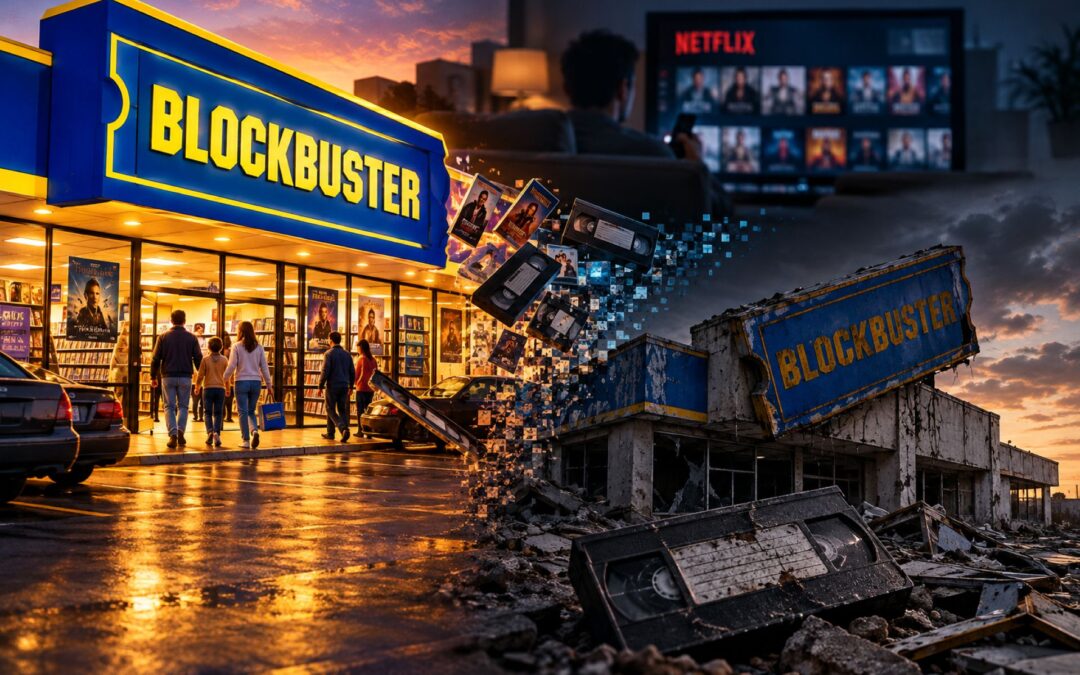
In September 2000, Reed Hastings and Marc Randolph traveled to Dallas with an extraordinary proposal. Their young company, Netflix, delivered DVDs through the mail and was struggling to establish a viable business. They wanted Blockbuster, the world’s dominant video-rental chain, to buy it for $50 million and let Netflix run the larger company’s online operation. Blockbuster declined.
The meeting has since become a symbol of corporate arrogance. In Randolph’s recollection, executives struggled to contain their amusement; former Blockbuster chief executive John Antioco has challenged important details of that account. Whatever happened in the room, the two companies went their separate ways. Almost exactly ten years later, Blockbuster filed for bankruptcy while Netflix was building a new entertainment business.
It is tempting to make that rejected offer the whole story. But Blockbuster was not simply a giant that failed to notice the internet. It developed DVD-by-mail subscriptions, experimented with digital delivery, and eventually created a hybrid service that made Netflix’s competitive position uncomfortable. The more revealing question is why an industry pioneer could recognize a threat, devise a serious response, and still fail to escape the business model that had made it powerful.
How David Cook Reinvented the Video Store
In the early 1980s, renting a film could be an exercise in frustration. The American home-video market was populated by independent shops, often with modest collections and limited systems for tracking which titles were available. A customer hoping to watch the newest hit might find the relevant shelf empty, then have to visit another store or settle for something else. A rental outlet’s success depended heavily on the judgment of its owner and the inventory that owner could afford.
David Cook came to the industry from an unexpected direction. He was a Dallas software entrepreneur whose business developed computer systems for the oil and gas industry. As falling oil prices damaged that market, he began considering other opportunities. His wife, Sandy Cook, enjoyed movies and recognized the attraction of home-video rental; David saw an industry where information management might solve everyday retail problems.
Which films were popular? How many copies did each store need? How quickly were particular titles moving, and which were becoming obsolete? A retailer that could answer those questions accurately would be able to offer greater choice without losing control of its stock. Cook initially considered working with the Video Works franchise, but disagreements about its appearance and operation encouraged him to develop a different format.
On 19 October 1985, the first Blockbuster Video store opened in Dallas. It carried approximately 8,000 VHS tapes and 2,000 Betamax tapes, an unusually deep selection for the era. Customers could browse clearly organized shelves rather than depend entirely on a clerk to find a title. Computerized systems and barcodes helped employees keep track of films, transactions and inventory, making the large collection manageable.
The store’s appearance mattered as much as its technology. Bright lighting, recognizable blue-and-yellow branding, extended hours and a family-friendly atmosphere made it feel more like a modern supermarket for entertainment than a cramped neighborhood video shop. Blockbuster avoided adult titles, giving parents a reason to browse comfortably with their children. A visit could become part of the family’s evening rather than a brief transaction at a counter.
Behind that inviting display, the checkout system captured what had happened to every rental. Employees were better equipped to determine whether a title was available, account for its movement and understand which parts of the collection were earning their space. For an industry that often relied on manual records and the intuition of individual shopkeepers, bringing reliable information to everyday decisions was itself an important competitive advantage.
These choices reinforced one another. The software made a bigger collection practical; the collection gave customers a reason to visit; the welcoming retail design made them willing to stay and explore. Instead of solving the problem of movie availability one rental at a time, Cook had devised an operating system that could be reproduced in other locations.
Within roughly a year, Blockbuster had grown to four stores. The idea was promising, but expansion required substantial financing and the ability to manage acquisitions, leases, employees and distribution across a far larger network. Cook had transformed the video store. Another entrepreneur would transform the scale of the company he created.
Wayne Huizenga Turns Blockbuster Into an Empire
Wayne Huizenga understood the opportunities hidden inside fragmented service industries. Starting with a small garbage-collection operation in Florida, he had helped build Waste Management into a national company. His method relied on acquiring independent businesses, integrating their operations, standardizing systems and using the resulting scale to finance further expansion.
Video rental presented a similar landscape. Thousands of independent operators occupied local markets, while a national chain could negotiate better purchasing arrangements, standardize its stores and build a brand customers recognized anywhere. In 1987, John Melk, a Blockbuster franchise operator and associate of Huizenga, introduced him to the business. Huizenga and his partners committed approximately $18 million that year, and Blockbuster moved rapidly toward an acquisition-led growth strategy.
The transition came at a personal cost for Cook. His original approach had emphasized the systems and retail concept he had developed, but expansion under new investors was increasingly shaped by dealmaking and the demands of capital. Cook left the company in 1987. The stores that would carry his innovation across continents would do so without the person who had devised their original operating model.
Huizenga’s Blockbuster purchased regional chains, acquired established locations, expanded through franchising and applied its blue-and-yellow identity to a growing estate. By the end of 1987, it operated or franchised around 133 stores. In 1989, the purchase of Major Video, one of the largest American rental chains, was valued at approximately $92.5 million. Instead of having to persuade every community to adopt an entirely new retailer, Blockbuster could buy its way into established markets and convert existing customer relationships.
Acquisition also compressed the time between finding an opportunity and putting a recognizable sign above the door. An existing store might already have staff, shelves and loyal customers; Blockbuster could reorganize those resources around centralized purchasing and a common retail format. The chain grew through a combination of its own locations, franchises and businesses absorbed into the network, not simply by building every new outlet from scratch.
The pace was striking. By 1993, the chain had approximately 4,300 stores, with annual revenue exceeding $2 billion. A concept launched in one Dallas location had become an international operation. Its scale also strengthened its relationship with Hollywood studios, for which a national chain offered a direct route into millions of homes.
The brand acquired a cultural significance that numbers alone cannot explain. In different towns, the stores offered the same recognizable promise: rows of films, a familiar membership system, new-release displays and the possibility of finding something worth watching that night. A rented movie often began with a family discussion among the shelves. For customers who remembered independent stores with limited stock, the consistency could be reassuring.
That consistency was expensive. Stores required leases, workers, electricity, shelves, films, distribution and constant restocking. Success made the physical network bigger, but also created more obligations that would remain even if rental traffic weakened. The company had found a highly effective way to scale its model without yet confronting how difficult that model might be to replace.
In 1994, Viacom agreed to acquire Blockbuster in a deal valued at roughly $8.4 billion. Viacom, led by Sumner Redstone, was then engaged in a wider contest for control of Paramount Communications. Blockbuster’s cash-generating operations and financial resources were valuable to the media conglomerate’s ambitions, even though video rental was only one element of its entertainment strategy.
For Huizenga, the transaction crowned seven years of extraordinary expansion. For Blockbuster, it meant becoming part of a much larger corporation whose priorities would not always match those of the rental chain. The company was near the top of its industry, but its fortunes would increasingly depend on decisions made against a changing technological and financial background.
The Business Model That Made Blockbuster Powerful—and Vulnerable
At its height, Blockbuster was woven into the weekly routines of millions of households. Friday or Saturday night could begin with a trip to the store: browsing glossy cases, comparing recommendations, choosing a new release, perhaps adding popcorn or candy at the counter. Customers carried membership cards, recognized the bright sign from a distance and learned that an empty slot on the new-release wall could mean their first choice was already gone.
This was more than nostalgia waiting to happen. A nearby store let a family decide to watch a film and take it home immediately. Video games, snacks and previously viewed movies gave the business additional ways to earn money from a visit. Its presence in so many neighborhoods made renting seem almost effortless, provided the film was in stock and the customer returned it on time.
By 2004, Blockbuster operated or franchised roughly 9,100 stores worldwide and generated close to $6 billion in annual revenue. Its 2004 annual filing also recorded approximately 84,300 employees. The scale was remarkable for a chain that had not existed twenty years earlier. It also meant that even relatively small shifts in visits, staffing requirements or inventory costs could have large consequences across the system.
One fundamental challenge was the price of films themselves. During the VHS era, a new-release tape might cost a rental shop around $65. The shop had to rent that copy repeatedly to earn back its purchase price, even though demand for the latest hit could fade quickly after its first few weeks. Stock too many copies, and capital became trapped in unwanted tapes. Stock too few, and customers left disappointed.
John Antioco, who became chief executive in 1997, pursued a solution through revenue-sharing agreements with major studios. Rather than paying the full high upfront price for every cassette, Blockbuster could obtain large quantities at lower initial costs and give the studios a share of rental revenue. The arrangement improved availability of new releases and aligned the studios’ interests with the rental chain’s ability to circulate their films.
The impact was practical. A larger stock of desirable films meant fewer empty shelves, more satisfied customers and more reasons to return. Antioco’s agreements were one of the important ways Blockbuster strengthened the economics of its core service. Yet solving the VHS inventory problem did not protect the company against a change in how home entertainment was sold.
DVDs offered improved picture quality, a compact format and greater convenience than VHS. But the more disruptive change was their price. Whereas many tapes were priced primarily for the rental trade, DVDs were increasingly affordable for consumers who wanted to own a film. Warner Home Video executive Warren Lieberfarb was an important advocate of the new format, and Blockbuster had opportunities to participate more closely in early DVD rental arrangements that it did not fully embrace.
Blockbuster’s historical disclosures on DVD pricing and changing rental economics reflected this shift. Walmart and other mass-market retailers could sell popular films beside groceries and electronics. Someone who expected to watch a favorite movie repeatedly might buy it outright rather than keep renting it. Blockbuster was now competing not only with other rental stores, but with a model in which customers could bypass rentals entirely.
The company’s revenue structure created another weakness. Traditional rentals carried a deadline, and a customer who brought a film back late paid additional charges. Those fees could feel disproportionate to the underlying service: the customer had already paid to rent a movie, yet forgetting to return it on Tuesday might turn a modest purchase into a far more expensive one. The rental clock helped keep popular films circulating, but it also made the checkout agreement a potential source of resentment after the entertainment itself was over.
There was a financial reason Blockbuster tolerated the resentment. Contemporary reporting put late-fee revenue at approximately $795.8 million in 2000, around 19% of rental revenue and roughly 16% of total revenue for that period. Those percentages have different denominators; neither should be mistaken for a timeless figure applying to every year of the company’s existence. The same reporting described litigation challenging the company’s late-fee practices.
From a short-term accounting perspective, overdue rentals delivered considerable income. From the customer’s perspective, the penalty could poison an otherwise enjoyable experience. Customers might love browsing the shelves and resent the charge on their next visit. A business that earns heavily from an inconvenience its customers dislike has an incentive to preserve that inconvenience, even as competitors gain a reason to eliminate it.
This was not the sole cause of Blockbuster’s collapse, and dissatisfaction did not immediately erase its advantages. Customers still valued being able to choose a film and carry it home that evening. But late fees exposed a basic conflict: the practices that supported the established business were not always the practices that would persuade customers to stay when alternatives appeared.
Netflix Offers a Different Way to Rent Movies
Netflix began with a different assumption about convenience. Reed Hastings and Marc Randolph founded the company in 1997, and it launched a website offering DVD rentals by mail in 1998. Instead of driving to a store and hoping the right title was available, customers could choose films online and receive discs at home. The company’s early pricing and delivery arrangements changed as its founders tested what customers were actually willing to pay for.
Its later subscription approach proved more compelling. For a recurring fee, customers could keep a queue of titles, receive DVDs through the post and return them without traditional late-fee deadlines. A central inventory could offer selection unconstrained by the shelf space of a particular neighborhood store. The frustration of discovering that the last copy of a popular movie had been rented was replaced by the inconvenience of waiting for the post.
That trade-off mattered. Someone planning films in advance might prefer Netflix’s selection and predictable costs; someone choosing a movie at the last minute could still find Blockbuster’s immediate rental more convenient. The contest was not originally between an obviously obsolete store and an obviously superior replacement. It was between different definitions of convenience, each with advantages and drawbacks.
Netflix also made the customer’s relationship with a film different. Instead of paying separately for every trip to a store and calculating whether the return deadline was approaching, subscribers could think in terms of an ongoing queue of titles they wanted to watch. That did not remove the wait for a disc, but it helped turn renting from an occasional errand into a service managed from home.
Netflix was also financially vulnerable. Discs, postage, distribution centers, software and the acquisition of subscribers required money before a dependable business had been established. By 2000, its founders were seeking a partnership that might provide greater resources and a path to market. They approached Blockbuster with a proposal to sell Netflix for $50 million and operate the larger company’s online service.
As Randolph has explained in his account of Netflix’s early years and the Blockbuster proposal, the price partly reflected the money Netflix had raised and spent rather than a valuation of a mature, profitable company. The proposed arrangement appeared to offer complementary strengths: Blockbuster would operate its familiar stores while Netflix managed a delivery model with no need for a local rental counter.
The meeting acquired legendary status only later. Randolph recalled a dismissive reception and executives struggling to suppress laughter. Antioco has disputed the popular retelling, including accounts that place him in a particular meeting at which the Netflix founders were supposedly laughed away. Their recollections should not be collapsed into a single unquestioned scene. What is clear is that a $50 million proposal was made and Blockbuster did not acquire Netflix.
The refusal looks catastrophic in hindsight because Netflix eventually became so valuable. In 2000, however, its future was uncertain, and the internet had not yet proven that DVD-by-mail rentals would become a profitable mass-market business. The meeting is useful evidence of a missed opportunity, but it is not enough to explain a decade of subsequent decisions.
Another familiar origin story needs similar caution. Hastings has recounted being charged about $40 for returning Apollo 13 late and finding inspiration for Netflix. Randolph has described a wider process of testing potential business concepts rather than a company springing fully formed from one overdue rental. The anecdote neatly expresses Netflix’s eventual appeal; it is a less reliable account of the company’s entire founding process.
Nor was Blockbuster blind to the possibilities of delivering films without a conventional rental visit. In 2000 it partnered with Enron Broadband Services to explore distributing movies over broadband networks. Limited video-on-demand trials followed before the arrangement ended in 2001 amid technological and commercial difficulties. The experiment did not become a sustainable business, but it demonstrated that Blockbuster was thinking about distribution methods beyond the shelves of its stores.
The question was therefore not whether Blockbuster’s executives could imagine change. It was which technology to back, how quickly consumers would adopt it, how to fund experimentation and whether an established company could build a new business without undermining the revenues that supported the old one. Viacom’s next decision made those questions even more consequential.
The Debt-Funded Split That Narrowed Blockbuster’s Options
By 2004, Blockbuster remained a retail giant, but the company was no longer operating in a stable market. Lower-priced DVDs were encouraging ownership, Netflix was developing a subscription alternative, and the cost of maintaining a vast physical network remained high. Revenue close to $6 billion could make the business appear secure without revealing how much flexibility it would need in the years ahead.
Viacom decided to separate Blockbuster from its wider media operations. Before the separation, Blockbuster made a substantial distribution to shareholders. The company’s SEC disclosure of the 2004 transaction recorded a distribution of approximately $905.6 million, with about $738.1 million going to Viacom. It is inaccurate to describe the entire distribution as a payment solely to Viacom; the total was paid to shareholders and was financed through substantial borrowing.
The result was an independent Blockbuster carrying a heavier debt burden. Borrowing did not make its failure inevitable, and financing distributions or acquisitions with debt is not automatically reckless. But interest, repayments and negotiations with creditors limit a company’s choices, particularly when operating cash must also support an expensive transformation. The timing was dangerous: Blockbuster needed to invest in new delivery systems just as the structure of its established industry was being unsettled.
This is why the debt matters beyond the headline amount. A retailer with a healthy balance sheet might accept several years of losses while testing a successor business. A company already facing pressure from lenders and declining store economics has less room to make the same gamble. Even an intelligently designed online offering can become difficult to nurture if every dollar spent today must be weighed against obligations that cannot be postponed.
Antioco had already begun responding. In 2004, Blockbuster launched Blockbuster Online, a DVD-by-mail subscription service designed to compete with Netflix. That required purchasing discs, building systems for customer orders, operating mail distribution and acquiring subscribers. For a conventional store operator, the investment represented a commitment to a service that might eventually reduce the need to enter its stores at all.
He also moved against late fees. Beginning in January 2005, Blockbuster announced that participating company-owned stores would eliminate conventional late fees. Removing a feature that customers disliked made strategic sense, but it also threatened an important historical revenue stream. A company could not simply abandon hundreds of millions of dollars in charges without considering how to replace that income and whether other operations could support the transition.
The advertised policy was more complicated than the slogan suggested. Under its terms, customers who kept movies beyond an extended rental period could be charged a purchase price, with a restocking fee applying in some circumstances if they later returned the disc. State attorneys general challenged how the terms were explained, and Blockbuster reached a multistate settlement concerning the no-late-fees campaign in 2005.
This controversy captured the awkwardness of the transition. Blockbuster wanted the customer goodwill associated with an easy, penalty-free experience, yet its existing systems and economics were not built around that promise. Meanwhile, it was spending money to develop a new subscription model whose success might make the store network less central.
The old and new operations each needed resources. Stores needed attractive stock, staffing and customer traffic; online subscriptions needed infrastructure, marketing, mail handling and time to develop a viable cost structure. Blockbuster could neither abandon the old model overnight nor assume that maintaining it would finance the future indefinitely. Antioco’s next move attempted to turn that apparent contradiction into an advantage.
Total Access: The Strategy That Almost Changed the Ending
Blockbuster’s greatest liability was also something Netflix lacked: an immense network of physical stores. Where Netflix could provide broad selection and home delivery, Blockbuster could still offer instant access to a movie on a particular evening. Antioco recognized that these strengths did not have to remain in separate businesses. The challenge was to make the store network useful to subscription customers rather than treat it exclusively as an expensive legacy.
Launched in November 2006, Total Access combined Blockbuster’s online DVD rental service with participating stores. A subscriber could order a film by mail, then bring an eligible mailed disc to a Blockbuster location and exchange it for an in-store rental. Instead of always waiting for the next envelope, a customer could visit a nearby shop when an immediate choice mattered. The online queue and the local shelves became parts of one service.
Consider the difference for a household planning a weekend. A DVD-by-mail subscription was useful for a film chosen days earlier, but it could not necessarily satisfy an unexpected desire to watch something that night. Total Access offered the subscriber a way to make that spontaneous decision without giving up the benefits of a broad online catalog. A store that had seemed like a relic of an older model could become a distinctive asset in a new one.
The strategy also encouraged online customers to enter the stores, where they might find additional rentals, games, candy or previously viewed films. It allowed Blockbuster to build on its existing customer relationships instead of starting a wholly separate internet business. This was not simply an imitation of Netflix. It was a genuine attempt to combine forms of convenience that neither company could offer in exactly the same way on its own.
The initial response was encouraging. Blockbuster’s 2006 annual report recorded approximately 2.2 million online subscribers at the end of the year, around 2 million of them paying subscribers. The stores, which had often been presented as the reason Blockbuster would lose, were now part of the company’s competitive answer.
Netflix noticed. Its 2007 annual filing discussed Total Access as a competitive offering, showing that Blockbuster had developed more than a symbolic response to the DVD-by-mail business. The challenge was real enough to demand attention. But the record also makes clear that Total Access’s rapid subscriber growth came alongside substantial financial losses. Evidence that a service attracted customers is not proof that it could profitably retain them.
This distinction is easy to miss in the familiar version of the story, where Total Access is described as a nearly victorious counterattack abruptly abandoned by misguided executives. A rival may feel pressure to defend its subscriber base or change its spending without the challenger having discovered a durable profit formula. To judge the initiative fairly, both things have to remain visible: Netflix took it seriously, and Blockbuster still had to demonstrate that the extra usage it encouraged could pay for itself.
Every mail shipment cost money to process and deliver. When a customer exchanged a mailed DVD at a store, Blockbuster also supplied an immediate physical rental while continuing to service the online account. Heavy users could enjoy considerable value from the subscription price while generating expenses that were difficult for the company to recover. Promotional offers made the service even more attractive to subscribers and potentially less attractive to shareholders seeking near-term earnings.
The stores were not free distribution centers. Employees had to be paid, inventory purchased and replenished, leases maintained and utilities covered regardless of whether a particular customer visited to make a profitable traditional rental or a subsidized Total Access exchange. The network created a competitive advantage only if the company could afford to use it that way. Finding the right prices, limits and customer mix was therefore central to whether Total Access could survive.
There was another complication: a subscriber taking advantage of unlimited or generous exchanges could be exactly the kind of enthusiastic customer the company wanted to win, while also being the most costly to serve. Limiting the benefit could improve the arithmetic but reduce the distinctive appeal of the service. Total Access made Blockbuster’s existing assets strategically relevant again, yet it exposed how difficult it was to price that relevance.
That debate brought Antioco into conflict with Carl Icahn, the activist investor who had acquired a significant shareholding in 2005 and gained representation on Blockbuster’s board. Antioco believed that spending aggressively on online subscriptions was necessary to win customers while the company still had the reach and brand to compete. He was willing to accept losses during the transition in the hope of building a more durable business.
Icahn worried about the other side of the equation. The company already carried substantial debt, its stores were under competitive pressure and there was no guarantee that discounted subscriptions would eventually become profitable. From that perspective, adding subscribers at a loss could destroy cash that Blockbuster needed simply to survive. Both positions addressed real risks rather than an easy choice between vision and ignorance.
The conflict intensified amid disagreements over strategic direction and executive compensation. In 2007, Antioco left the company. His departure ended the leadership of the executive who had developed studio revenue sharing, launched Blockbuster Online, tried to eliminate conventional late fees and built Total Access. Losing that continuity mattered even if the strategy itself was not yet proven.
Jim Keyes, a former 7-Eleven executive, took over. He placed greater emphasis on profitability and the continued potential of physical stores, and Blockbuster changed online pricing and promotional terms. The company reported approximately 3.6 million online subscribers in July 2007, falling to around 3.1 million by September. Some customers evidently found the less generous service less attractive.
There was a financial rationale behind the changes. Blockbuster’s 2007 disclosures indicated that the company shed many unprofitable subscribers and improved the economics of those who remained. That complicates the story that Keyes simply destroyed an unquestionably successful business through a preference for stores. A fast-growing service can be strategically important yet financially unsustainable at its existing prices.
The opposing argument is equally important. A company replacing an established model may need years of investment before the new one becomes efficient, well known and profitable. Netflix itself had endured difficult early years. Reducing Blockbuster’s subscriber incentives may have protected short-term finances while weakening the company’s ability to develop a serious alternative to declining store rentals.
It remains impossible to establish that retaining Antioco or investing more heavily in Total Access would have guaranteed victory over Netflix. Blockbuster needed to solve real costs of mail delivery, in-store exchanges and fixed retail infrastructure, while operating under financial constraints. What Total Access proved was narrower but still significant: the company had conceived an innovative, credible answer to a new competitor, and for a time customers responded. Its failure to sustain that response was one of the central episodes in Blockbuster’s decline.
Why Blockbuster Collapsed—and What Survived
When Keyes became chief executive in 2007, Blockbuster still operated thousands of stores and possessed a widely recognized brand. But the world around them was changing faster than the company could comfortably adapt. Traditional rental rivals remained, discount sellers were making DVD ownership affordable, and Netflix was teaching customers to think of movies as something selected at home rather than found at a store.
A different threat arrived through kiosks. Redbox made inexpensive, often dollar-a-night rentals available in convenient locations, taking business from customers who primarily wanted a low-cost physical disc. Blockbuster’s full-service shops had to compete with a model that delivered the central product without supporting a large store, extensive shelves and a staff dedicated to entertainment retail.
Meanwhile, Netflix began offering streaming video in 2007. Streaming did not instantly render DVD rentals obsolete: broadband access, television connectivity, licensing rights and limited catalogs made early services less comprehensive than later ones. But the direction was unmistakable. Consumers were moving toward a world where a movie could arrive without a store visit or even a disc in the mail.
Keyes still saw value in physical locations. They allowed immediate rentals, could sell other entertainment products and served customers who preferred a familiar in-person experience. Those advantages did not vanish overnight. Yet every consumer who switched to buying DVDs, using a kiosk, receiving discs by mail or watching online made the traditional store network a little harder to sustain at its previous scale.
One illustration of the company’s search for another direction came in 2008, when Blockbuster proposed acquiring Circuit City, the struggling consumer-electronics retailer. The concept suggested a possible connection between entertainment and the devices used to watch it. But Circuit City was itself under severe competitive and financial pressure, and the proposal attracted skepticism. Blockbuster abandoned it; Circuit City filed for bankruptcy later that year.
Then the financial crisis made Blockbuster’s weaknesses harder to manage. Credit markets tightened, refinancing became more difficult and creditors had less appetite for troubled borrowers. The company’s debt obligations reduced the room available to experiment or endure operating losses. Financial stress also complicated relationships with suppliers and film studios, whose cooperation was essential to keeping desirable new releases in stock.
Management later placed substantial blame on the crisis, and there was truth in the argument that extraordinary financial conditions intensified the collapse. But the pressures from Netflix, DVD ownership, kiosks and costly stores were already present. The recession did not create the strategic problem; it reduced Blockbuster’s ability to survive it. In 2009, hundreds of stores closed as the company tried to conserve cash.
On 23 September 2010, Blockbuster sought Chapter 11 bankruptcy protection. A chain that had once seemed almost synonymous with the American weekend could no longer sustain its obligations and operating structure. The filing marked the financial collapse of the corporation, but the disappearance of its stores would continue over several years.
In April 2011, DISH Network acquired substantially all of Blockbuster’s assets through the bankruptcy process in a transaction valued at approximately $320.6 million, subject to contractual terms and adjustments. The SEC filing covering the DISH acquisition records the deal. Comparing its price with Viacom’s roughly $8.4 billion transaction in 1994 is dramatic but imperfect: Viacom acquired a thriving operating company, whereas DISH bought distressed assets after bankruptcy, under fundamentally different conditions.
DISH tried to preserve value in the brand and selected services, but the store network kept shrinking. Operations closed in market after market, and by early 2014 the remaining company-owned American stores had shut. The familiar bright signs disappeared from shopping centers where they had long marked the place families went to find a film for the weekend.
For former customers, the loss could feel larger than the disappearance of a retailer. Blockbuster represented a particular kind of choice: walking the aisles with friends, deciding between two movies by studying their covers, picking up a snack, or discovering something unexpected while looking for a specific title. Streaming offered far greater convenience, but it could not reproduce the social experience of going out to choose a film together. That experience had real value, even though not enough customers were willing to support thousands of stores indefinitely.
One store kept the ritual alive. In Bend, Oregon, an independently owned Blockbuster franchise continued renting movies after the corporate chain had disappeared. Managed by Sandi Harding, it eventually became the last remaining Blockbuster in the world and a destination for people who remembered the old blue-and-yellow storefronts. Visitors could browse physical shelves and rent a movie rather than simply photograph the sign; the place remained a functioning store as well as a piece of cultural memory.
Its official history describes the franchise’s survival, and as of October 2026 the Bend store was still operating. Its appeal is partly nostalgic, but nostalgia alone does not explain the experience: picking a case from a shelf and speaking to someone about what to watch offer a kind of connection that selecting a thumbnail on a screen does not. The surviving store preserves a ritual, not an economic formula capable of sustaining the old empire.
Blockbuster’s history is most revealing when it is not reduced to the $50 million offer that Netflix survived. The company had once reinvented video retail by combining software, inventory and a welcoming environment. Later it tried online subscriptions, explored broadband delivery, changed its late-fee policy and built Total Access. None of those efforts solved the joint problem of costly stores, weakened customer incentives, debt and an industry whose basic method of delivering films was changing.
There was no single fatal decision, and failure was not predetermined. Different executives made difficult choices amid genuine uncertainty, sometimes protecting earnings that financed the company and sometimes pursuing a future that required spending money the company could scarcely spare. Blockbuster recognized much of the change ahead; it simply could not turn that recognition into a sustainable business quickly enough.
The last store in Bend offers an unexpectedly gentle ending. What began in 1985 as a bold attempt to make movie rental easier now survives as a reminder that choosing a film used to be an outing in itself. Blockbuster helped turn that outing into a shared weekend ritual. The tragedy of its rise and fall is that the very stores that made the ritual so accessible became too expensive to preserve once people found easier ways to watch movies.
Last Updated on November 10, 2026 by Aseem Gupta