
Reading Time: 16 Minutes
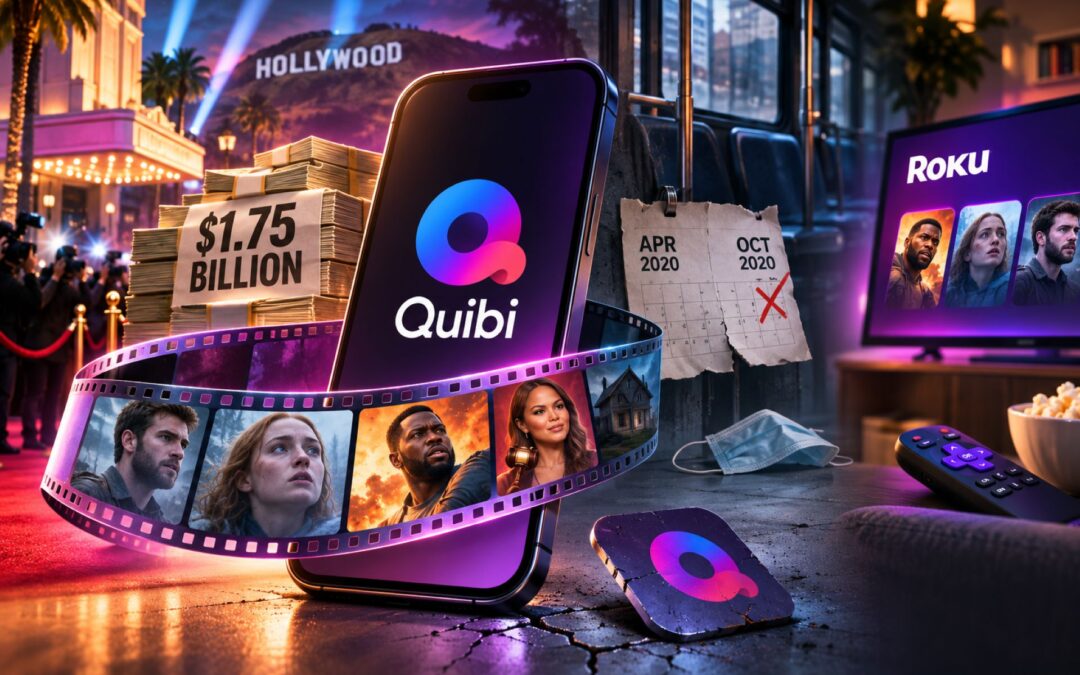
On 21 October 2020, two of America’s most accomplished executives published an open letter admitting that the entertainment company they had spent years assembling was finished. Quibi had launched just 198 days earlier, backed by $1.75 billion in financing, an extraordinary roster of Hollywood talent and a technology built specifically for smartphones. Its founders had promised a new way to watch television. Now they were preparing to close the service before it was seven months old.
The money bought impressive productions, a polished app and a spectacular campaign, but not enough people willing to pay. Quibi did not spend every dollar raised, and not every show failed creatively. Its commercial proposition nevertheless collapsed with remarkable speed.
How could a company with so much expertise and capital misunderstand its audience? The answer lies in an ambitious vision of how people would spend their spare minutes, a product designed around that vision, and a pandemic that exposed weaknesses already embedded in the business.
The Hollywood Visionaries Who Bet on Mobile Television
Jeffrey Katzenberg was not an entrepreneur searching for his first breakthrough. As chairman of Walt Disney Studios, he had helped oversee an animation revival associated with The Little Mermaid, Beauty and the Beast, Aladdin and The Lion King. After an acrimonious departure from Disney in the 1990s, he co-founded DreamWorks with Steven Spielberg and David Geffen. DreamWorks Animation would go on to establish franchises such as Shrek, demonstrating Katzenberg’s ability to build commercially valuable entertainment far beyond Disney.
Katzenberg understood expensive entertainment bets and how to enlist writers, actors, directors and studios. By the late 2010s, he believed the next opportunity was not another cinema or television channel. It was the phone already in everyone’s hand.
Katzenberg observed that people watched brief videos while commuting, waiting in queues or filling small gaps in the day. Those moments seemed poorly served by traditional television episodes, which might run for half an hour or longer. Why not create professionally produced stories that could be enjoyed in five to ten minutes, with the production values of Hollywood rather than the casual aesthetics of social media? The wager was that people would want premium entertainment during time that conventional streaming services supposedly overlooked.
The venture initially went by the working name NewTV. Katzenberg brought in Meg Whitman as chief executive, acknowledging the need for a leader with deeper experience in technology businesses. Whitman had scaled eBay from a small company into a major global marketplace and later led Hewlett-Packard. Katzenberg could open doors in Hollywood; Whitman could lend credibility to a proposed technology platform with substantial operational demands.
Their combined reputations proved extraordinarily persuasive. In August 2018, NewTV announced an initial $1 billion financing round involving Disney, Fox, NBCUniversal, Sony, WarnerMedia, Lionsgate and other entertainment and financial investors. The backing mattered beyond the cash itself: companies that normally competed for audiences were willing to support the venture. After a further $750 million raise ahead of launch, Quibi had secured approximately $1.75 billion without having established a paying subscriber base.
The name, announced in 2018, shortened “quick bites.” Mobile video consumption was visibly growing, but that did not establish demand for a separate paid service selling short premium shows. Prestigious backers made the proposition credible without proving that customers had developed the necessary habit.
Building Premium Entertainment in Ten-Minute Pieces
Quibi was never intended to be a miscellaneous collection of amusing clips. Its executives imagined an entertainment company combining studios’ storytelling skills with a phone-native interface. The service would offer longer scripted narratives divided into short chapters, reality and documentary programs built around brief episodes, and daily news, sport and entertainment updates designed to fit into spare moments.
The longer narratives were marketed as “movies in chapters.” Viewers would follow a thriller, drama or comedy over successive instalments, many lasting roughly seven to ten minutes. This structure promised the suspense and emotional investment of conventional storytelling without requiring someone to sit through a complete film at once. There were also recurring unscripted programs and the “Daily Essentials” category, intended to give people fresh reasons to open the app regularly.
The ambition was visible in the names recruited. Liam Hemsworth and Christoph Waltz appeared in the thriller Most Dangerous Game. Sophie Turner starred in Survive, a drama about two people facing the aftermath of a plane crash. Chrissy Teigen presided over small-claims disputes in Chrissy’s Court, while Kevin Hart played an exaggerated version of himself pursuing action-hero status in Die Hart. Murder House Flip brought reality television’s makeover format to homes associated with murders, and Reno 911! returned in short episodes. The common promise was recognizable talent delivering polished entertainment.
Steven Spielberg’s proposed horror project added a particularly theatrical flourish. The announced concept, often called Spielberg’s After Dark, would make episodes available only after sunset in the viewer’s location. The idea used the phone’s awareness of place and time to turn watching into part of the story’s atmosphere. It was an attention-grabbing announcement, although it should not be confused with a completed series available in Quibi’s launch library.
Quibi planned aggressively. At the January 2020 Consumer Electronics Show, Katzenberg outlined a first-year target of approximately 175 original shows and 8,500 short episodes or “quick bites.” These were planned outputs across the year, not thousands of completed episodes sitting ready before the platform opened. The initial launch lineup was much smaller, at roughly 50 shows, with new instalments intended to arrive continually.
The cost of such a slate was staggering. Katzenberg and Whitman spoke of spending as much as $100,000 per minute on the most expensive productions, a figure intended to separate Quibi from cheap online video. A high-end hour could therefore cost millions of dollars even though no individual chapter lasted very long. Familiar actors, established production companies, elaborate photography and large creative commitments all raised the financial stakes before audience demand could be measured at scale.
The most distinctive piece of engineering was Turnstyle. On a normal streaming application, rotating a phone might simply enlarge a landscape picture or crop it to fit the display. Quibi wanted both vertical and horizontal viewing to feel native. Turnstyle could switch seamlessly between compositions, sometimes revealing a different framing or visual perspective when the viewer rotated the handset. Productions could plan and capture imagery for both orientations rather than treating portrait mode as an afterthought.
Filmmakers and software engineers had to coordinate closely. Some scenes could use the change in orientation expressively, but innovation and usefulness are different tests. A viewer might admire the transition once without choosing a subscription because of it. Quibi had spent heavily to perfect a distinctive experience before proving that its distinctiveness solved a problem people cared enough about to pay to solve.
The Spectacular Launch That Failed to Find an Audience
Quibi entered 2020 with the confidence of a heavily financed entertainment launch. At CES in Las Vegas, Katzenberg and Whitman presented their vision of mobile-first storytelling and Turnstyle. The pitch was not merely that videos would be short; it was that the entire service—from content to interface—had been designed for the movements and interruptions of life outside the home.
Advertisers were interested, too. Quibi had reportedly secured large commitments before launching, offering brands a chance to enter a service built around premium programming rather than user-generated feeds. But an advertising commitment was not the same as evidence that millions of subscribers would arrive. Quibi still needed to explain what a “quick bite” was, why it differed from YouTube or Netflix, and why anyone needed another bill for video entertainment.
The marketing campaign offered one revealing example. During the 2020 Super Bowl, Quibi ran a 30-second commercial reportedly costing $5.6 million. Bank robbers were waiting for their getaway driver, who announced that he would be there in a “Quibi” because he was watching a short show. The joke depended on making the unfamiliar brand sound like a unit of time. It was memorable enough to provoke confusion, but not necessarily clear enough to explain the service’s value. A Los Angeles Times investigation of Quibi’s marketing later described disagreements about how best to introduce the concept to consumers.
The company continued promoting itself through television spots, digital campaigns, billboards and entertainment coverage. Industry attention was abundant, but its target viewers were not necessarily following Hollywood business news or technology conferences. They needed a simple reason to make the app part of their daily routine.
On 6 April 2020, Quibi launched in the United States and Canada. As its announced launch lineup and pricing showed, viewers could choose a $4.99 monthly subscription with advertisements or a $7.99 advertising-free plan. An introductory 90-day free trial reduced the immediate barrier to trying it. The roughly 50 initial shows offered scripted fiction, reality, documentaries and daily updates, with new episodes scheduled to arrive on weekdays.
The first figures were not uniformly disastrous. Sensor Tower estimated more than 300,000 installations on opening day, and the app briefly climbed high in Apple’s rankings. Whitman said approximately 1.7 million people downloaded it during the first week and that a large majority who began a program watched through its first episode. Those details suggested that the app could attract curiosity and that at least some people who tried individual programs kept watching. They did not establish whether users would return regularly or pay after their trials expired.
The timing could hardly have been more awkward. The COVID-19 pandemic had already forced widespread restrictions and stay-at-home orders, emptying commuter trains, offices, coffee shops and airports. Quibi had been designed around precisely the spare moments generated by those journeys. Its launch arrived when many of the situations at the center of its marketing had suddenly vanished.
People were still watching enormous amounts of entertainment. The crucial change was where and how they were watching it. Confined to their homes, viewers could settle into longer films or series on televisions and laptops, often alongside other people. Netflix and Disney+ were already established destinations for that kind of viewing. Quibi, by contrast, initially asked people to watch premium drama only on a phone, even when a larger screen was available a few feet away. The pandemic made that limitation especially visible, but it had not created the limitation.
Why Quibi Could Not Turn Viewers into Subscribers
Quibi’s problem was not that short video lacked an audience. YouTube had spent years teaching people to search for, watch and share videos of every length. TikTok was rapidly demonstrating how compelling short clips could become when discovery and participation were built into the product. The problem was that these audiences were accustomed to very different arrangements from the one Quibi offered. On TikTok, users could scroll through an enormous stream of free clips, respond, remix, follow creators and send discoveries to friends. On Quibi, they were asked to subscribe to expensive professionally produced shows divided into small pieces.
That distinction changed the competitive comparison. Quibi’s executives argued that their service was not simply competing with Netflix’s living-room experience or YouTube’s amateur productions. They hoped to establish a category of premium viewing for brief daytime intervals. But consumers do not organize their attention neatly into separate business categories. Ten spare minutes could be spent on YouTube, social media, a podcast, a message exchange or a familiar Netflix series paused at a convenient point. Quibi had to become more appealing than those alternatives, not merely different from them.
The attempt to create a new habit was complicated by the design restrictions that made Quibi distinctive. At launch, there was no normal way to cast its programs to a television, despite their cinematic production values. Someone enjoying a thriller on a phone could not readily move it onto the family screen. It was particularly jarring during lockdown, when an app advertised for a bus ride had to compete for attention in a living room. The rule also made its premium productions seem less flexible than the movies and series viewers could already access elsewhere.
Sharing posed a different challenge. Quibi’s early digital-rights restrictions prevented ordinary screenshots and straightforward clipping. If a moment in Chrissy’s Court was hilarious or a scene from Survive captured someone’s imagination, the viewer could talk about it but could not easily circulate a fragment through a social feed. That limited the informal recommendation cycle on which new entertainment often depends. A show might have excellent production values yet struggle to become part of public conversation if its most memorable scenes could not travel.
This was not a claim that every streaming service allowed free copying. Major competitors also protected their intellectual property, and restrictions on redistribution are commercially understandable. The issue was the fit between those protections and Quibi’s particular audience proposition. A service courting younger smartphone viewers with short episodes was making some of the ordinary behaviors of smartphone culture unusually difficult. Its content was meant for personal devices but not easily shared through the networks that helped those devices shape taste.
The contrast with Vine’s rise and fall is instructive. Vine’s six-second looping videos were created and distributed through social participation; the platform helped ordinary people develop visual jokes, accumulate followers and circulate clips well beyond the original app. Vine later struggled with creator economics, competition and its own business model, so shareability alone was no guarantee of commercial success. But Vine illustrates an important distinction: short-form video can spread through social relationships, while Quibi largely treated the brief episode as a miniature piece of conventional television.
The economics heightened the mismatch. Premium production required steady subscriber revenue or valuable advertising audiences, while the app’s generous trial made it easy to sample the service without paying. Downloads could look reassuring, especially after a highly publicized launch, but were only the beginning of the commercial relationship. A download was not a paying customer; a started episode was not evidence of long-term loyalty. What mattered was whether people returned frequently enough to make another subscription feel worthwhile.
By the middle of 2020, the gap between aspiration and performance was difficult to ignore. Reporting based on internal projections described a goal of around 7.4 million paying subscribers in the first year, while a subsequent forecast suggested Quibi might attract fewer than two million. Analysts also produced competing download estimates, and Quibi publicly challenged some outside measurements. The direction of travel was worrying, but the precise scale of paying users was not transparent enough to treat every number as settled fact.
The most widely repeated figure was an estimated 8% conversion rate after the initial free trials. Sensor Tower inferred that no more than roughly 72,000 of approximately 910,000 early users in a particular launch cohort had converted to paid subscriptions. As Mobile World Live reported when Quibi disputed the estimate, the company said the calculation materially understated its subscriber figures. The estimate applied to a limited early cohort and could not responsibly be presented as the platform’s verified overall conversion rate.
Even without a definitive conversion percentage, Quibi’s basic challenge was apparent. People who opened a short episode sometimes finished it, but a successful episode was not automatically a reason to keep the subscription. Its service needed enough distinctive programs, frequent enough engagement and sufficiently convenient viewing to compete with entertainment that was already free or included in a household’s other plans. Hollywood production quality could help retain attention; it could not guarantee that viewers would develop the habit of opening Quibi every day.
Six Months of Fixes, Litigation and a Final Surrender
Quibi did not simply refuse to change after launch. As complaints accumulated, the company began dismantling some restrictions that had originally been central to its identity. In May 2020 it added Apple AirPlay support, followed by Chromecast compatibility, making it possible to send programs from a phone to larger screens. It later experimented with screenshot-sharing tools and other adjustments to help content circulate. By then, however, those fixes were catching up with capabilities that many viewers already considered ordinary.
The changes exposed a dilemma. Staying mobile-only preserved Quibi’s distinction but reduced flexibility; television viewing improved convenience while weakening its original positioning. Product changes could not make consumers retrospectively accept the premise behind its investment and launch.
Katzenberg initially placed extraordinary weight on COVID-19. In a May interview, he attributed the launch’s problems to the coronavirus, arguing that Quibi had been designed for the moments lost when people stopped commuting. That explanation captured a real disruption. But it did not answer why the platform had launched with so few options for changing screens, why sharing was difficult or why paying for bite-sized programs would be attractive against free alternatives. Pandemic conditions intensified those weaknesses rather than supplying the whole explanation.
There was also a legal dispute over Turnstyle. Interactive-video company Eko alleged that Quibi’s orientation-switching technology incorporated ideas or information shown to Katzenberg and others before launch. Quibi denied misappropriating technology and defended its own development work. The litigation drew attention because Turnstyle was the signature feature supposed to distinguish the service, but the allegations were contested and must not be confused with proven theft. The consolidated litigation was ultimately dismissed by agreement in September 2021, after Quibi itself had ceased operating.
Meanwhile, content commitments and operating expenses did not disappear just because download growth slowed. Production contracts, marketing costs, staff, engineering and the organization required to commission a substantial slate had been built around ambitious expectations. Reports in 2020 described heavy expenditure on programming and a business that was far short of its original subscriber trajectory. The $1.75 billion figure was total capital raised, however, not an audited measure of what Quibi spent or ultimately lost.
As the summer progressed, executives explored possibilities for the business and its assets. A sale, partnership or restructuring might have given the shows a wider distribution network without requiring Quibi to win a standalone subscription battle. But finding a willing buyer for the company, rather than selected valuable programs, proved difficult. An expensive organization built around a struggling original product was a less attractive acquisition than individual rights that could be placed inside an established service.
On 21 October 2020, Katzenberg and Whitman stopped describing Quibi’s problems as temporary. Their open letter announcing the wind-down said the company had exhausted its options. In its most candid passage, it acknowledged that either the central idea was not sufficiently strong to support a separate streaming service or the timing was wrong, and that the answer might involve both. The letter also recognized that other companies had faced the pandemic and managed to adapt where Quibi had not.
The company intended to sell assets and return remaining cash to investors. Contemporary reporting placed that cash at roughly $350 million, although outstanding obligations meant it should not be treated as a final guaranteed distribution. More than 200 employees faced the consequences of a company winding down during a public-health crisis. For the people who had joined Quibi to build a new form of entertainment, the speed of the reversal made the news especially painful.
Quibi told customers it expected streaming to cease on or about 1 December 2020, roughly eight months after its April launch. The original announcement on 21 October was therefore the decisive business surrender, not the exact moment every screen went dark. What remained was a valuable but unsettled collection of programs and rights, produced for a distribution model that no longer existed.
Quibi’s Unexpected Second Life on Roku
The most revealing part of Quibi’s story unfolded after the app disappeared. In January 2021, Roku announced that it had acquired global distribution rights to more than 75 Quibi programs. The terms were not publicly disclosed, but the Los Angeles Times reported that the price was below $100 million, citing a person familiar with the transaction. This was a rights acquisition, not proof that Roku bought the whole company or its intellectual property outright.
The destination changed the economics of the content. Roku’s advertising-supported channel already reached people looking for free entertainment across televisions, streaming devices and other screens. It did not have to persuade those viewers to buy a separate Quibi subscription or organize their day around brief mobile sessions. Instead, it could make the programs part of a much larger catalogue, earning advertising revenue from viewing that happened within an existing service.
In May 2021, the first wave of titles appeared as Roku Originals. Short chapters could still be watched in their original form, but the content was no longer limited by the original mobile-only premise. The viewing occasion had changed: someone could discover an unfamiliar series while browsing a free channel on a television, rather than deciding in advance that a specific short-video subscription deserved a place in their budget. Roku’s distribution made the programs more accessible, though it did not retroactively recover Quibi’s development and production costs.
Some of those shows had already demonstrated artistic merit. Quibi received Emmy recognition in 2020, including two acting awards for #FreeRayshawn: Laurence Fishburne won for playing Lieutenant Steven Poincy and Jasmine Cephas Jones for playing Tyisha. These were genuine achievements by the filmmakers, performers and production teams involved. They showed why it would be inaccurate to describe Quibi’s entire programming experiment as a creative failure simply because the service was commercially unsustainable.
Kevin Hart’s Die Hart supplied an additional sign that useful entertainment had survived the platform. The action comedy, in which Hart plays a version of himself trying to become an action star, found a new home in Roku’s library. Its sequel season, Die Hart 2: Die Harter, arrived in March 2023 and Roku reported strong viewing. In its 2021 annual filing, Roku described launching Roku Originals from the Quibi catalogue and subsequently greenlighting second seasons of some acquired shows. The company saw a programming asset where Quibi’s investors had once expected the foundation of a new platform.
There is a limit to what that afterlife proves. Roku obtained the rights at a reported price far below Quibi’s aggregate fundraising and did not carry the original company’s full cost base. A show that works as inexpensive programming inside a free, widely distributed service might never have supported the high production budgets and paid acquisition costs of its first home. Nor did every Quibi production become a hit merely because a handful continued successfully. The important distinction is between the potential value of the content and the viability of the business model built to distribute it.
Quibi had approached entertainment from the supply side: assemble famous people, finance remarkable productions, build custom technology and advertise the resulting service at enormous scale. Roku approached the same programs with an established audience and a different payment model. The comparison does not establish that Quibi would have succeeded simply by launching a television app or offering its shows free. It demonstrates that distribution, discovery, pricing and user habits are not secondary details to be solved after the creative work is complete. They help determine what that work can be worth.
Quibi’s collapse is often treated as a warning about executive overconfidence or the hazards of launching during a pandemic. Both belong in the story, but neither is sufficient. Katzenberg and Whitman assembled remarkable talent and built much of the product they had promised; the decisive missing piece was a demonstrated audience willing to incorporate that product into everyday life and pay to do so. The shows could be beautifully made and the technology genuinely inventive while the proposed habit failed to take hold.
The streaming service lasted only months, yet some of its entertainment continued elsewhere. That is the enduring paradox of Quibi: Hollywood succeeded in making pieces of television small enough to fit into the gaps of a day, but the company never established that those gaps needed a new television business to fill them.
Last Updated on November 11, 2026 by Aseem Gupta