
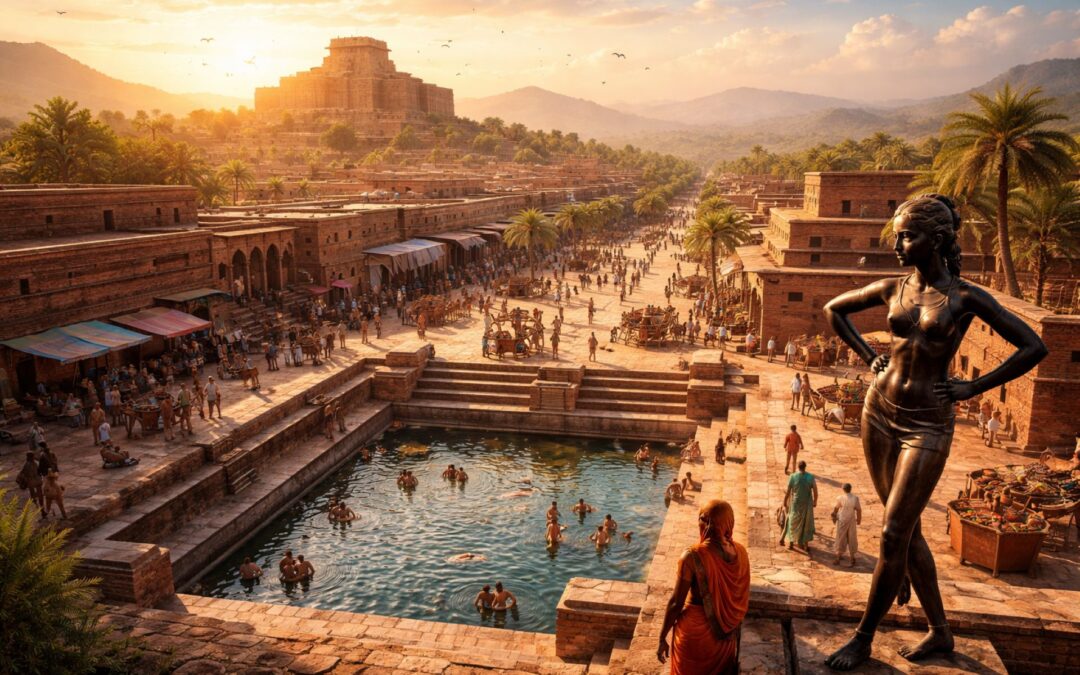
We built a civilization meant to stand the test of time.
Now we are nothing more than dust.
There is something uniquely unsettling about the idea of a civilization that simply… disappears. Not conquered in a blaze of glory. Not immortalized in epic poetry. Not even remembered by those who came after. Just gone—its cities buried, its language unreadable, its people reduced to fragments of pottery, brick, and bone.
This is the story of the Indus Valley Civilization.
Five thousand years ago, across the floodplains of the Indus River, one of the most advanced urban civilizations in the ancient world flourished. Its cities were not chaotic clusters of huts but carefully planned grids. Its people enjoyed sanitation systems that would not become common elsewhere for thousands of years. Its merchants traded across seas. Its artisans produced goods of remarkable precision and beauty.
And yet, for all its sophistication, it left behind no deciphered texts, no triumphant inscriptions, no clear narrative of its rise or fall.
In many ways, the Indus Valley Civilization feels less like history and more like a puzzle—one where half the pieces are missing.
This article is an attempt to walk those lost streets again. To reconstruct not just what the Indus people built, but how they lived, what they valued, and why their world faded into silence. Along the way, we will also confront the myths, assumptions, and unanswered questions that still shape how we understand this ancient civilization.
Because the real mystery is not just how the Indus Valley Civilization disappeared.
It’s how something so advanced could ever be forgotten at all.
The Discovery of a Civilization Buried in Plain Sight
For most of human history, the Indus Valley Civilization did not exist—at least, not in the collective memory of the world.
There were no surviving chronicles describing its cities. No myths celebrating its rulers. No continuous tradition preserving its name. Even in India itself, where its descendants likely lived on in altered forms, there was no clear awareness of a great, ancient urban civilization that had once dominated the northwest of the subcontinent.
And yet, its ruins were always there.
Scattered across the plains of Punjab and Sindh were strange mounds of earth, littered with ancient bricks. Local communities had long known of these sites. Some believed they were the remains of cursed cities, others associated them with forgotten kings. But no one suspected the truth—that beneath these mounds lay the remnants of a civilization older than most of the ancient world known at the time.
The first real encounter came in the early 19th century, almost by accident.
In 1826, a man named James Lewis—on the run from the British East India Company—wandered through the region under the alias Charles Masson. While traveling near the village of Harappa, he noticed massive brick ruins and began investigating. Like many after him, he misjudged what he had found. He believed the site belonged to a relatively recent historical period, perhaps a few centuries old.
He was not alone in this mistake.
For decades, even trained archaeologists failed to recognize the true antiquity of these sites. The bricks were too well-made, too uniform, too “modern” in their appearance to be truly ancient—or so they thought. In fact, the bricks were so durable that British engineers began using them as ready-made material for railway construction, unknowingly dismantling parts of a 5,000-year-old civilization to build colonial infrastructure.
It was one of the great ironies of history: a lost civilization literally fueling the machinery of empire.
The turning point came in the early 20th century. Under the leadership of John Marshall, the Archaeological Survey of India finally initiated systematic excavations at Harappa and, soon after, Mohenjo-daro.
What they uncovered shocked the world.
Beneath the soil lay not isolated ruins, but entire cities—vast, planned, and eerily sophisticated. Streets laid out in precise grids. Drainage systems running beneath homes. Public structures built with a level of engineering that rivaled, and in some ways surpassed, their contemporaries in Egypt and Mesopotamia.
This was no minor culture or forgotten outpost.
This was a full-fledged civilization.
And it had been hiding in plain sight for thousands of years.
What made the discovery even more extraordinary was its timing. In the early 20th century, the story of civilization was still largely centered around Egypt and Mesopotamia. The discovery of the Indus Valley Civilization forced historians to redraw that map, recognizing South Asia as home to one of the earliest great urban societies in human history.
But with discovery came a new problem.
For all that had been uncovered—cities, artifacts, tools, and systems—the people themselves remained silent. Their script was undeciphered. Their voices, locked away in symbols no one could read.
The Indus Valley Civilization had finally been found.
But it still refused to fully reveal itself.
Before the Cities: The Deep Roots of the Indus World
Civilizations do not appear overnight.
They are not born in a single moment of brilliance, nor do they emerge fully formed from the earth. Instead, they grow—slowly, quietly—through thousands of years of experimentation, adaptation, and survival.
To understand the Indus Valley Civilization, we have to go back long before its cities, before its trade networks, before even the Indus River became its lifeline.
We have to begin in a place called Mehrgarh.
Around 7000 BCE, in the foothills of what is now Balochistan, small communities of semi-nomadic hunter-gatherers began to settle down. At first, their lives would have looked simple—mud-brick houses, basic tools, and a subsistence lifestyle dependent on the land. But something important was happening here.
They were learning to farm.
By around 6500 BCE, the people of Mehrgarh had domesticated plants and animals, cultivating crops like barley and wheat and herding cattle, sheep, and goats. This shift—from foraging to farming—was one of the most important turning points in human history. It meant stability. It meant surplus. And eventually, it meant the possibility of complexity.
But Mehrgarh was not an isolated village at the edge of the world.
Even at this early stage, there are signs of connection. Archaeologists have found materials like turquoise, lapis lazuli, and marine shells—resources that could only have come from distant regions. This suggests that long-distance trade networks, however primitive, were already taking shape.
More remarkably, Mehrgarh reveals an early spirit of innovation.
Among its most fascinating discoveries is evidence of what may be the world’s earliest dental surgery. Using tiny drills—similar to those used in bead-making—these early inhabitants treated tooth decay with surprising precision. It is a small detail, but it tells us something profound: these were not passive survivors of their environment. They were problem-solvers, experimenters, and craftsmen.
Over the centuries, this culture continued to evolve.
We begin to see more advanced pottery, terracotta figurines, beads, and tools. Metallurgy emerges in the form of copper working. Kilns become more sophisticated. Artistic expression becomes more refined. The seeds of specialization—of people dedicating themselves to specific crafts—are already visible.
And then, something else happens.
Around 4500 BCE, new groups begin to arrive from the west—people connected to the Zagros region of present-day Iran. These migrants do not replace the local population. Instead, they mix with them, blending genetic and cultural traits. What emerges is not a rupture, but a continuity—a civilization in the making, shaped by both local traditions and external influences.
But history is rarely stable for long.
Over time, environmental pressures began to reshape the world of Mehrgarh. Climate patterns shifted. The monsoon weakened in some regions. Parts of Balochistan grew drier and less hospitable. The land that had once supported early agricultural communities could no longer sustain them as easily.
Faced with these challenges, people did what humans have always done.
They moved.
Beginning around 3300 BCE, populations started migrating from the uplands of Balochistan into the fertile floodplains of the Indus River system. Compared to their old homes, this new environment must have seemed almost miraculous—rich soil, abundant water, and the promise of agricultural stability.
But what they found was more than just better land.
They found the conditions for something much bigger.
Because floodplains do not just support farming—they enable civilization. Seasonal flooding replenishes nutrients in the soil, making it exceptionally fertile. Surplus food becomes possible. And with surplus comes population growth. With population comes specialization. With specialization comes trade, governance, and eventually, urban life.
In other words, the move to the Indus floodplain did not just change where people lived.
It changed what they could become.
What began as scattered farming communities would, over the next millennium, transform into one of the most remarkable urban civilizations the world had ever seen.
And yet, at this stage, nothing about that future was guaranteed.
There were no grand cities yet. No vast trade networks. No standardized systems.
Only a slow accumulation of knowledge, skill, and opportunity—quietly building toward something extraordinary.
How the Indus Valley Civilization Emerged
If Mehrgarh represents the roots of the Indus world, then the Indus floodplains represent its turning point.
Because this is where everything accelerates.
When the early settlers moved into the Indus River basin around 3300 BCE, they were not stepping into an empty landscape. They were entering one of the most fertile ecological zones in the ancient world—a vast network of rivers, seasonal floods, and nutrient-rich soil that could support agriculture on a scale previously unimaginable.
And with that came a chain reaction.
Floodplains operate on a simple but powerful principle. Each year, rivers like the Indus overflow their banks, depositing layers of fresh silt across the surrounding land. This natural irrigation system replenishes the soil, allowing crops to grow in abundance without the need for complex artificial systems.
More food means more people.
More people means new problems—and new possibilities.
As agricultural output increased, populations began to grow rapidly. Villages expanded. New settlements appeared. And gradually, something new began to take shape: proto-urban centers.
These early settlements—places like Harappa, Kot Diji, Nausharo, and Dholavira—were not yet the fully developed cities of the mature Indus Civilization. But they already showed signs of organization, planning, and emerging complexity.
We begin to see:
- Structured layouts rather than random clusters of homes
- Early fortifications and defined settlement boundaries
- Craft specialization, with certain areas dedicated to production
- The first hints of administrative control
Dholavira, in particular, offers a fascinating glimpse into this transitional phase. Even in its early stages, the settlement shows evidence of water management systems—reservoirs, channels, and storage structures designed to cope with the challenges of a semi-arid environment. This was not reactive survival. It was proactive engineering.
Over time, these proto-cities became more interconnected.
Trade routes expanded, linking settlements across the region. Goods, ideas, and technologies flowed between communities, creating a shared cultural and economic framework. This networked system allowed innovations—whether in pottery, metallurgy, or construction—to spread quickly and consistently.
And then, something remarkable happens.
Standardization begins to emerge.
Bricks start following uniform proportions. Weights become consistent across regions. Seals begin to appear as markers of identity and control. These are not small developments. They point to a level of coordination and shared norms that go far beyond isolated communities.
They suggest a civilization.
By around 2600 BCE, the Indus Valley Civilization enters what archaeologists call its Mature Phase—its golden age. This is when cities like Harappa and Mohenjo-daro reach their full scale and sophistication. Urban planning becomes highly refined. Trade networks stretch across thousands of kilometers. Social organization becomes more complex and structured.
And yet, what makes this emergence so fascinating is not just that it happened—but how it happened.
Unlike Egypt, with its monumental pyramids and divine kings, or Mesopotamia, with its towering ziggurats and written records of rulers and wars, the Indus Valley Civilization leaves behind a very different imprint.
There are no massive royal tombs.
No grand statues of kings proclaiming their victories.
No clear evidence of a single, dominant ruler.
Instead, what we see is something subtler—and in many ways, more impressive.
A civilization built not around spectacle, but around systems.
Its priorities seem to lie in:
- Order rather than ostentation
- Function rather than display
- Collective organization rather than individual glorification
Cities were not designed to impress the gods. They were designed to work—for the people who lived in them.
And this is what sets the Indus Valley Civilization apart.
It did not emerge as a civilization of kings and monuments.
It emerged as a civilization of planners, engineers, traders, and administrators—a society that invested its energy not in being remembered, but in building something that functioned.
Ironically, that very choice may be why it was forgotten.
Because when a civilization leaves behind systems instead of stories, it becomes much harder for history to hold onto it.
Cities Built With Logic, Order, and Precision
If there is one feature that defines the Indus Valley Civilization more than any other, it is this:
Its cities were not accidental.
They were planned—deliberately, systematically, and with a level of precision that feels strikingly modern even today.
Walk through the ruins of cities like Harappa or Mohenjo-daro, and a pattern immediately reveals itself. Streets do not twist unpredictably. They do not grow organically over time like many ancient settlements. Instead, they follow a clear logic—laid out in straight lines, intersecting at right angles, forming a grid.
This was urban planning.
At a time when much of the world was still experimenting with basic settlement patterns, the people of the Indus had already embraced a structured approach to city design. Major streets ran north–south and east–west, dividing the city into organized blocks. Smaller lanes branched off these main roads, connecting residential areas with remarkable efficiency.
It is the kind of layout you might expect in a modern city.
But the planning went far beyond street grids.
Most large Indus cities were divided into two main sections: a raised citadel and a lower city. The citadel, built on an elevated platform, likely housed important public structures—administrative buildings, storage facilities, and possibly spaces for communal or ritual activity. The lower city, on the other hand, was where the majority of people lived.
This separation suggests an organized approach to space and function—one that balanced public, administrative, and residential needs.
In some cities, like Dholavira, this structure became even more sophisticated, with three distinct zones: a citadel, a middle town, and a lower town. Each zone appears to have served a specific purpose, reflecting an even deeper level of planning and hierarchy within the urban landscape.
But perhaps the most astonishing feature of Indus construction is something far less visible at first glance:
Standardization.
Across a vast region stretching over thousands of square kilometers, bricks used in construction followed a consistent ratio—1:2:4. This means that whether you were in Harappa, Mohenjo-daro, or a smaller settlement hundreds of kilometers away, the bricks would be nearly identical in proportion.
Think about what that implies.
- Shared measurement systems
- Agreed-upon construction norms
- Coordination across distant regions
- A culture that valued uniformity and precision
This was not random coincidence. It was a sign of an interconnected civilization operating under common standards.
The materials themselves also tell a story. Buildings were typically made of sun-dried or kiln-fired bricks, with stone used for foundations where necessary. This combination provided both durability and adaptability, allowing structures to withstand environmental pressures like flooding.
And then there are the houses.
Indus homes were not just functional—they were thoughtfully designed for comfort and climate. Most houses were built around central courtyards, which allowed for ventilation and natural light. In the intense heat of the region, this design would have made a significant difference in maintaining livable indoor temperatures.
Doors and windows were often positioned to maximize airflow while maintaining privacy. Many homes opened onto narrow side lanes rather than main streets, reducing noise and congestion. Some even featured multiple stories, indicating both architectural capability and a degree of social variation.
There is also evidence of aesthetic consideration. Carved elements, painted woodwork, and decorative features suggest that these were not purely utilitarian spaces—they were homes meant to be lived in and appreciated.
But what truly elevates Indus urbanism is not any single feature.
It is the integration of all these elements into a cohesive system.
- Streets aligned with drainage networks
- Houses connected to city-wide infrastructure
- Public and private spaces clearly defined
- Construction standards maintained across vast distances
This level of coordination does not happen by accident. It requires planning, governance, and a shared understanding of how a city should function.
And yet, there is a striking absence of something we might expect.
There are no towering palaces dominating the skyline.
No massive statues celebrating rulers.
No obvious symbols of centralized, authoritarian power.
Instead, the Indus cities present a different vision of urban life—one where the emphasis is not on glorifying elites, but on creating an environment that works for everyone.
It is a quiet kind of sophistication.
Not designed to impress the outside world, but to serve the people within it.
And in that sense, the cities of the Indus Valley Civilization feel less like relics of the past—and more like blueprints for the future.
The Sanitation Revolution of the Ancient World
If the city planning of the Indus Valley Civilization feels modern, its approach to sanitation feels almost unbelievable.
Because while other ancient civilizations were building monuments to gods and kings, the people of the Indus were solving a far more practical problem:
How to keep a city clean.
And they solved it with a level of sophistication that would not be matched in many parts of the world for thousands of years.
At the heart of this system was something deceptively simple: water management.
Across major Indus cities, water was not treated as an afterthought. It was engineered into the very foundation of urban life. Wells were everywhere—private wells inside homes, public wells along streets, and large reservoirs designed to store and distribute water efficiently.
In Mohenjo-daro alone, archaeologists have uncovered hundreds of wells, suggesting that access to clean water was not limited to elites but widely available across the population.
But clean water is only half the story.
What truly sets the Indus Civilization apart is what they did with waste.
Every major city featured an extensive network of covered drainage systems. These were not crude ditches running along the side of roads. They were carefully constructed, often lined with bricks, and covered with removable slabs for maintenance. Wastewater from homes flowed into these drains, which then carried it away from residential areas.
And this system was not limited to public infrastructure.
Individual houses were directly connected to it.
Many homes contained designated bathing areas—small rooms with sloped floors that allowed water to drain out efficiently. Some even had what can only be described as early toilets: clay seats or platforms connected to vertical chutes that directed waste into the city’s drainage network.
Let that sink in.
Five thousand years ago, ordinary households—not just palaces or temples—had access to private bathing spaces and integrated waste disposal systems.
This was not luxury.
This was standard.
In fact, it is often said that the Indus Valley Civilization may have developed the world’s earliest form of the flush toilet. While it did not operate exactly like modern systems, the principle was the same: water was used to carry waste away from living spaces through a controlled network.
Compare this to many other ancient societies, where waste was often disposed of in open pits, streets, or nearby water sources, and the difference becomes stark.
The Indus cities were not just advanced.
They were hygienic.
And the system scaled.
This is perhaps the most impressive part. It is one thing to design a clean household. It is another to maintain sanitation across an entire city—thousands of homes, interconnected through a unified network of drains, channels, and disposal systems.
This required:
- Consistent construction standards
- Regular maintenance
- Administrative oversight
- A cultural emphasis on cleanliness
It was not just engineering. It was a societal priority.
Public sanitation facilities also existed, reinforcing the idea that hygiene was a collective concern. The most famous example is the Great Bath of Mohenjo-daro—a large, carefully constructed tank lined with waterproof materials, complete with steps leading down into the water.
Its exact purpose remains debated, but many scholars believe it was used for ritual bathing. If so, it suggests that cleanliness was not just practical, but also symbolic—possibly tied to ideas of purity, community, or spirituality.
Different cities adapted water management to their specific environments.
- Mohenjo-daro relied heavily on wells
- Harappa combined wells with large storage systems
- Dholavira developed reservoirs and channels to capture scarce water
- Lothal integrated its drainage system with its dockyard to manage tidal flows
This adaptability shows that Indus engineers were not just copying a single model. They were problem-solvers, tailoring their systems to local conditions while maintaining overarching principles.
And those principles were clear:
Control water.
Manage waste.
Protect the city.
Even today, many rapidly growing urban centers struggle with exactly these challenges—drainage failures, water scarcity, sanitation breakdowns.
Yet over four millennia ago, the people of the Indus Valley had already built cities that addressed them with remarkable foresight.
They may not have left behind towering monuments or royal inscriptions.
But they left behind something arguably more impressive:
A civilization that understood that the true foundation of urban life is not grandeur—
It is infrastructure.
Daily Life in the Indus Valley
It is easy to admire the Indus Valley Civilization for its engineering and planning. The straight roads, the drains, the wells—they all point to a society that understood systems.
But a civilization is not just its infrastructure.
It is its people.
And through the fragments they left behind—pots, tools, toys, and traces of food—we can begin to piece together what everyday life might have felt like inside these carefully planned cities.
Start with something universal: food.
The people of the Indus Valley cultivated crops that still form the backbone of South Asian diets today. Barley and wheat were staples. Sesame was grown for oil. Evidence also points to the consumption of lentils, fruits, and possibly dairy products. These were not just subsistence meals—they were part of a stable and productive agricultural system that supported urban life.
And like any thriving society, they did not stop at necessity.
There are signs of indulgence.
Archaeologists have discovered specialized pottery that appears to have been used for fermentation. Residue analysis suggests that the Indus people brewed alcoholic beverages—likely from grains or fruits. Some vessels even resemble early distillation devices, hinting at a level of experimentation that goes beyond simple brewing.
In other words, they knew how to relax.
And they knew how to entertain themselves.
Excavations across Indus sites have uncovered dice, game boards, and intricately carved playing pieces. These were not crude objects. They were carefully shaped, often standardized, suggesting that games had rules—possibly even strategies that players had to master.
Some of these dice bear a striking resemblance to those described in later Indian texts like the Mahabharata, raising the possibility of a cultural continuity in gaming traditions that spans thousands of years.
But leisure was not just for adults.
Children had their own world too.
Archaeologists have found a variety of toys—miniature carts with wheels, animal figurines, whistles, and simple mechanical objects. These were not symbolic artifacts. They were meant to be played with. To imagine a child in Mohenjo-daro pulling a tiny clay cart along a street is to suddenly feel the past come alive in a very human way.
Daily life also unfolded within the architecture of the home.
The courtyard-centered design of Indus houses was not just practical—it shaped how families interacted. These open spaces would have been gathering points, places for cooking, working, and socializing. Light filtered in. Air circulated. Life happened in these shared, open environments.
Privacy, too, was considered. Homes often opened onto side lanes rather than main streets, creating a buffer between public and private life. This suggests a society that valued both community and personal space—a balance that modern cities still struggle to achieve.
Clothing and personal appearance were also important.
Based on terracotta figurines and sculptures, we can infer that people wore draped garments resembling early versions of sarees and dhotis. The use of cotton—first pioneered at scale by the Indus Civilization—meant that these garments were lightweight and suited to the climate.
Jewelry was everywhere.
Men and women alike wore bangles, necklaces, rings, and earrings. The sheer volume of jewelry discovered—hundreds of thousands of pieces across different sites—suggests that adornment was not limited to elites. It was part of everyday identity.
Bead-making workshops found in multiple cities reveal a high level of craftsmanship. Artisans used techniques like heat glazing and precision drilling to create intricate designs from materials such as carnelian, lapis lazuli, and shell.
This was not a society of crude tools and simple aesthetics.
It was a society that appreciated detail.
Even in something as mundane as a household object, there is a sense of refinement. Pottery is often symmetrical and well-finished. Tools are functional but carefully made. There is a quiet elegance to the material culture—an attention to quality that reflects both skill and pride.
And yet, for all its sophistication, daily life in the Indus Valley was not defined by luxury.
It was defined by balance.
Work and leisure.
Function and beauty.
Individual expression within a larger, organized system.
This is perhaps what makes the Indus Civilization feel so relatable.
Strip away the thousands of years, and what remains is a society of people who worked, ate, played, dressed, built homes, raised children, and found ways to enjoy life within the structure of their world.
They were not just inhabitants of a great civilization.
They were the reason it existed.
A Civilization of Style, Craft, and Material Refinement
If infrastructure reveals how a civilization functions, its crafts reveal how it feels.
And in the case of the Indus Valley Civilization, what we see is a world that cared deeply about precision, aesthetics, and material excellence.
This was not a rough, utilitarian society.
It was a civilization of makers.
Across Indus cities, archaeologists have uncovered an astonishing range of crafted objects—pottery, beads, jewelry, figurines, tools—each one hinting at a highly developed culture of specialized labor. Entire neighborhoods appear to have been dedicated to specific crafts, suggesting that production was not random or household-based, but organized and scaled.
One of the most remarkable achievements of the Indus people was their mastery of textiles.
They were among the first in the world to cultivate and process cotton, spinning it into fine threads and weaving it into breathable fabrics. In a hot, semi-arid climate, this was more than a technological innovation—it was a practical necessity that they perfected.
Fragments of cloth rarely survive over millennia, but impressions left on pottery and tools, along with depictions in figurines, give us a glimpse of what people wore. Draped garments—similar in form to modern sarees and dhotis—appear to have been common.
But the real story lies in quality.
Indus cotton textiles were so well-made that they became a major export item, traded across regions as a valued commodity. This implies not just production, but consistency—standards that ensured reliability in long-distance trade.
Jewelry offers an even clearer window into Indus craftsmanship.
Excavations have revealed vast quantities of bangles, necklaces, pendants, rings, and earrings made from a wide variety of materials—carnelian, lapis lazuli, agate, shell, gold, and copper. These were not rare, ceremonial items reserved for a small elite. They were widespread, suggesting that personal adornment was a shared cultural practice.
The scale is staggering.
Hundreds of thousands of bangles have been found across Indus sites.
To produce such volume, artisans must have operated within organized workshops, using standardized techniques and tools. Bead-making, in particular, reached an extraordinary level of sophistication. Craftsmen used advanced drilling methods—some involving extremely fine, high-speed tools—to create beads with precision that still impresses modern researchers.
Heat treatment techniques were also employed to enhance color and durability, especially in carnelian beads. This level of control over materials indicates not just skill, but experimentation and accumulated knowledge.
Metalwork, too, played a significant role.
The Indus people worked with copper and bronze, producing tools, ornaments, and small sculptures. However, their use of metals was shaped by geography. While copper was locally available, tin—necessary to produce bronze—had to be imported from distant regions. This made bronze items more valuable and less common.
Even so, the quality of metal objects suggests a strong understanding of metallurgy.
But perhaps what is most striking is how all these crafts connect back to a larger system.
Craft production in the Indus Valley was not isolated from the rest of society. It was integrated into the economic and social fabric of the civilization. Specialized labor required food surpluses. Food surpluses required agricultural efficiency. And one of the key innovations that made this possible was double cropping—the practice of growing two sets of crops in a single year.
This was a game-changer.
Double cropping dramatically increased agricultural output, allowing a portion of the population to move away from farming and into full-time craftsmanship, trade, and administration. It is one of the clearest indicators of a mature, complex economy.
In this sense, every bead, every bangle, every carefully shaped pot is not just an object.
It is evidence of a system working in harmony.
A system where farmers, artisans, traders, and administrators all played interconnected roles.
And within that system, there was space for beauty.
The Indus Valley Civilization did not just produce goods.
It produced refinement.
Not loud or ostentatious, but subtle, precise, and deeply embedded in everyday life.
A quiet sophistication that, like much of the civilization itself, reveals its brilliance not through spectacle—
But through detail.
Trade, Merchants, and the Indus Maritime Network
If the cities of the Indus Valley Civilization were its foundation, then trade was its bloodstream.
Because no civilization reaches this level of scale, coordination, and refinement in isolation.
The Indus world was deeply connected—to its own regions, to distant lands, and to a wider Bronze Age network that stretched across continents.
At the heart of this system were merchants.
But these were not loosely organized traders moving goods in small quantities. Trade in the Indus Valley appears to have been structured, standardized, and remarkably efficient. Goods moved across vast distances, and they did so within a system that emphasized control, identity, and trust.
One of the key tools that made this possible was the seal.
Indus seals—small, carved objects often made of steatite—are among the most iconic artifacts of the civilization. They typically feature animal motifs—bulls, elephants, rhinoceroses, and the famous “unicorn”—alongside short inscriptions in the still-undeciphered Indus script.
But these seals were not just decorative.
They likely functioned as markers of identity and ownership.
Pressed into clay or wax, they could seal containers, mark goods, or verify the sender of a shipment. If a seal remained intact upon arrival, it would indicate that the contents had not been tampered with. In this sense, seals acted much like modern signatures, trademarks, or even security systems.
Alongside seals, the Indus people developed a highly precise system of weights and measures.
These weights followed a binary progression—doubling and halving units—which allowed for consistent and scalable calculations. What makes this even more impressive is that similar weight systems have been found in regions like Mesopotamia and Arabia, suggesting that trade between these regions was not just possible, but standardized.
This is a critical point.
Trade across long distances requires trust. And trust requires systems.
The Indus Valley Civilization built those systems.
Goods moved along both land and water routes. Riverboats transported materials along the Indus and its tributaries, while larger, ocean-going vessels carried cargo across the Arabian Sea. Archaeological evidence—including models of boats and depictions on seals—suggests that these ships were well-designed, with sails, steering mechanisms, and cargo space.
The port city of Lothal stands as a testament to this maritime capability.
Here, archaeologists have uncovered what is widely considered the world’s oldest known dockyard. It was not a simple landing area, but a carefully engineered structure with a lock-gate system to regulate water levels, prevent silting, and ensure smooth loading and unloading of goods.
Even more impressively, the dockyard was integrated with the city’s drainage system, protecting it from flooding during monsoons.
This is infrastructure meeting commerce.
And it allowed the Indus Civilization to reach far beyond its geographic boundaries.
Evidence of Indus trade has been found across Central Asia, the Arabian Peninsula, and Mesopotamia. In Mesopotamian texts, the Indus region is referred to as Meluhha, a distant but important trading partner.
These texts mention Meluhhan merchants, goods, and even settlements.
In fact, there is evidence that Indus traders lived in Mesopotamian cities, forming communities abroad. One such settlement near the city of Ur is described in records, complete with its own cultural features—suggesting that these were not temporary visits, but long-term presences.
Even more fascinating is the existence of a Mesopotamian figure named Shu-ilishu, described as a translator of the Meluhhan language. This implies that there were enough Indus traders in the region to require linguistic mediation—a clear sign of sustained interaction.
The exchange was not one-sided.
Foreign traders also lived in Indus cities, possibly in designated quarters. This would have facilitated the flow of goods, ideas, and cultural influences in both directions.
And those influences are visible.
Some Indus seals appear to depict scenes reminiscent of Mesopotamian mythology, such as elements of the Epic of Gilgamesh. Whether these are direct borrowings or shared motifs is still debated, but they point to a world that was interconnected in ways we are only beginning to understand.
Trade also shaped the internal structure of the civilization.
The need to produce goods at scale, maintain quality, and coordinate distribution likely contributed to the high degree of standardization we see in Indus society—from weights and measures to brick proportions and urban layouts.
In many ways, the Indus Valley Civilization can be seen as a commercial civilization.
Not driven by conquest or monumental display, but by exchange, organization, and economic networks.
And at the center of it all were its merchants—individuals and groups who connected cities, regions, and cultures through the movement of goods.
They did not leave behind grand inscriptions celebrating their achievements.
But their impact is written into the very fabric of the civilization.
Because without them, the Indus world would not have been a network.
It would have been just a collection of cities.
The Script, the Seals, and the Limits of What We Know
For all that we have uncovered about the Indus Valley Civilization—its cities, its systems, its trade networks—there remains a frustrating silence at its core.
Because the people of the Indus left behind a script.
And we still cannot read it.
Scattered across thousands of seals, tablets, pottery fragments, and small artifacts are short sequences of symbols—intricate, deliberate, and clearly meaningful. These inscriptions are not random markings. They follow patterns. They repeat. They adhere to certain structural rules.
In every sense, they behave like language.
And yet, they remain undeciphered.
This is one of the greatest unsolved puzzles in archaeology.
Unlike Egyptian hieroglyphs or Mesopotamian cuneiform, the Indus script has no known bilingual inscription—no “Rosetta Stone” that allows us to map its symbols onto a known language. The inscriptions themselves are also very short, often consisting of just a few characters, which makes it difficult to detect grammatical patterns or build a reliable linguistic framework.
We do not know what language the Indus people spoke.
We do not know how their script worked.
We do not know what their inscriptions say.
And this has profound consequences.
Without readable texts, we are forced to reconstruct the entire civilization through material evidence alone—through bricks, tools, bones, and artifacts. We can see what they built. We can infer how they lived. But we cannot hear their voices.
We cannot read their thoughts, their laws, their stories, or their beliefs in their own words.
This is why so much of what we “know” about the Indus Valley Civilization is actually interpretation.
Take the seals, for example.
They are among the most common artifacts found across Indus sites. Typically square in shape, they feature a combination of animal imagery and short inscriptions. The animals—bulls, elephants, rhinoceroses, and the enigmatic unicorn—are rendered with remarkable detail and consistency.
But what do they mean?
Were they symbols of clans or families?
Markers of profession or trade?
Religious icons?
Administrative tools?
The most widely accepted theory is that they functioned as identifiers—used in trade to mark ownership, authenticate goods, or represent individuals and institutions. But without deciphering the script, we cannot be certain.
Even the direction of writing is inferred rather than confirmed.
Most inscriptions appear to run from right to left, based on the positioning of symbols and patterns of wear. But this, too, is an educated guess.
The same uncertainty applies to the broader question of literacy.
Was writing widespread, or limited to a small administrative class? Were these inscriptions part of a larger, more complex writing system that has not survived? Or was the script itself inherently concise, used primarily for labeling and identification rather than extended texts?
We do not know.
And because we do not know, a boundary emerges—one that separates evidence from speculation.
On one side, we have what archaeology can show us:
- Urban planning
- Trade networks
- Craft production
- Environmental adaptation
On the other side, we have what we can only guess:
- Political structures
- Religious beliefs
- Social identities
- Cultural narratives
This gap has often been filled—sometimes responsibly, sometimes not—by interpretation.
Over the years, scholars and enthusiasts alike have proposed countless theories about the Indus script. Some claim it encodes an early form of Dravidian language. Others suggest connections to Indo-Aryan or even entirely unrelated linguistic families. A few have gone further, arguing that the script is not a language at all, but a system of symbols without phonetic meaning.
Each theory has its arguments. Each has its limitations.
And none has been definitively proven.
This uncertainty can feel frustrating. It leaves us with a civilization that is visible, but not fully comprehensible. Present, but not entirely knowable.
But there is also something powerful in that.
Because it forces us to confront the limits of human knowledge.
The Indus Valley Civilization reminds us that history is not always a complete narrative. Sometimes, it is a reconstruction built from fragments—an attempt to piece together a world that does not want to be fully revealed.
We can walk its streets.
We can study its systems.
We can admire its achievements.
But when it comes to understanding its inner life—its language, its stories, its self-perception—we are still standing outside, looking in.
And perhaps, for now, that is as close as we can get.
How Modern Labels Distorted the Indus Past
When the Indus Valley Civilization was first uncovered, archaeologists were not just discovering artifacts.
They were interpreting them.
And interpretation, especially in the early days of archaeology, was never neutral.
Faced with a civilization that had no readable texts and no clear historical continuity, early scholars did what humans instinctively do when confronted with the unknown:
They filled in the gaps.
Sometimes with logic.
Sometimes with imagination.
And sometimes with bias.
One of the most revealing examples of this comes from a small bronze figurine discovered at Mohenjo-daro.
Today, it is famously known as the “Dancing Girl.”
The name sounds authoritative, almost factual—as if we know exactly who she was and what she was doing. But in reality, the label was based on little more than impression.
The figure stands with one hand on her hip, the other relaxed, her posture slightly tilted. To the archaeologist who named her, she appeared confident, expressive—perhaps even playful. And so, she became the “Dancing Girl.”
But there is no inscription confirming this.
No accompanying evidence linking her to dance.
No contextual proof of performance culture tied to the object.
It was a guess.
A compelling guess, perhaps—but still a guess.
The same applies to another well-known artifact: the so-called “Priest-King.”
This figure, carved from stone, depicts a man with a composed expression, draped in a patterned garment. To early archaeologists, he looked dignified—authoritative, even. And so, they assumed he must represent a ruler or a religious leader.
A priest. A king.
But again, there is no direct evidence to support this interpretation.
No inscriptions identifying him.
No accompanying structure that clearly marks him as a central authority figure.
No broader pattern confirming a ruling class in the way we see in Egypt or Mesopotamia.
The label stuck not because it was proven, but because it was convenient.
It made the unfamiliar familiar.
And this pattern repeats across the study of the Indus Civilization.
Early scholars, working within the intellectual frameworks of their time, often tried to fit the Indus world into models they already understood—models shaped by other ancient civilizations and, in some cases, by colonial assumptions.
If Egypt had kings, the Indus must have kings.
If Mesopotamia had temples, the Indus must have temples.
If European societies valued hierarchy and monumentality, then surely the Indus did too.
But the evidence does not always support these parallels.
The Indus Valley Civilization does not conform neatly to the patterns we expect. It lacks the grand monuments, royal tombs, and overt displays of power that define many other ancient societies. Its structures are more subtle. Its organization more distributed. Its priorities, perhaps, fundamentally different.
And yet, for a long time, interpretations continued to force it into familiar categories.
Even broader narratives were shaped by these tendencies.
The idea of a peaceful, almost utopian Indus society.
The assumption of a rigidly egalitarian structure.
The belief in a sudden, catastrophic destruction.
Many of these narratives gained traction not because they were strongly supported by evidence, but because they fit certain expectations—whether academic, cultural, or ideological.
Over time, however, these interpretations have been challenged.
New excavations, improved dating techniques, and more rigorous analytical methods have revealed a more complex picture—one that resists simple labels and easy conclusions.
What emerges instead is a civilization that cannot be fully understood through borrowed frameworks.
It demands to be understood on its own terms.
This is not just a lesson in archaeology.
It is a lesson in how we construct history.
Because every time we name an artifact, assign a role, or build a narrative, we are making choices—choices that shape how future generations will understand the past.
The Indus Valley Civilization reminds us to be cautious with those choices.
To question what we think we know.
To separate evidence from assumption.
And to accept that sometimes, the most honest answer is uncertainty.
Because the past is not just something we discover.
It is something we interpret.
And interpretation, if we are not careful, can become distortion.
Was the Indus Valley Civilization Egalitarian or Hierarchical
For a long time, the Indus Valley Civilization was imagined as something almost utopian.
A society without kings.
Without rigid hierarchies.
Without the stark inequalities seen in other ancient civilizations.
Compared to Egypt’s towering pyramids or Mesopotamia’s grand palaces, the Indus world seemed… different. There were no obvious royal tombs, no colossal statues of rulers, no monuments celebrating conquest or divine authority.
To early scholars, this absence suggested something radical.
Perhaps the Indus people had built an egalitarian society—one where power was distributed, where no single individual dominated, and where the community functioned without the need for visible hierarchy.
Some even went as far as to describe it as a kind of ancient “proto-communist” system.
But as more evidence emerged, this interpretation began to unravel.
Because absence of evidence is not evidence of absence.
Just because the Indus Civilization did not display power in the same way as Egypt or Mesopotamia does not mean that power did not exist.
In fact, the more closely archaeologists examined Indus cities, the more signs of social differentiation began to appear.
Some houses were clearly larger and more elaborate than others—multi-room structures, sometimes even multi-storied, with better access to water and infrastructure. These were not just marginal differences. They point to variations in wealth and status.
At the same time, the very features that define the Indus Civilization—standardized construction, coordinated urban planning, regulated trade networks—imply a level of centralized organization.
Think about what it would take to maintain:
- Uniform brick ratios across vast regions
- Standardized weights and measures
- Integrated drainage systems in every major city
- Large-scale distribution of resources
This is not the result of a loosely organized, fully egalitarian society.
It requires governance.
It requires authority.
The question, then, is not whether hierarchy existed—but what form it took.
And here, the Indus Civilization becomes even more intriguing.
Because while there is evidence of organization and inequality, there is no clear indication of a single, dominant ruling figure—no obvious king, no centralized monarchy in the traditional sense.
This has led some scholars to propose alternative models.
One possibility is that the Indus world was governed by a collective elite—perhaps powerful merchant groups, clan leaders, or administrative councils that worked together to manage the system.
This would align with the civilization’s strong emphasis on trade and economic coordination. If merchants played a central role in society, they may have also held political influence.
Another possibility is a more decentralized network of authority, where different cities operated semi-independently but adhered to shared cultural and administrative norms. This could explain the remarkable consistency across regions without requiring a single, unified state.
There is also evidence—though more indirect—that suggests the existence of leadership roles.
For instance, Mesopotamian records mention individuals associated with the Indus region, including figures that could be interpreted as rulers or representatives. One inscription refers to a “man of Meluhha,” which some scholars believe may indicate a form of leadership or official status.
If such figures existed, they may not have been absolute rulers like the pharaohs of Egypt, but rather leaders within a more constrained or negotiated system of power.
A kind of “first among equals.”
Even the architecture of the citadel areas raises questions.
While they do not resemble palaces in the traditional sense, these elevated zones clearly held importance. They may have functioned as administrative centers, storage facilities, or spaces for governance—suggesting that authority was embedded in institutions rather than in individuals.
And this might be the key difference.
In many ancient civilizations, power is visible—it announces itself through monuments, inscriptions, and displays of dominance.
In the Indus Valley Civilization, power appears to be quieter.
Less about spectacle.
More about systems.
A society where authority existed, but was not constantly advertised. Where coordination mattered more than glorification. Where the functioning of the whole may have taken precedence over the elevation of any single part.
This does not make it egalitarian.
But it does make it different.
And perhaps that difference is why it has been so difficult to understand.
Because we are used to recognizing power when it is loud.
The Indus Civilization asks us to recognize it when it is silent.
Was the Indus Valley Civilization Really Peaceful
Few ideas about the Indus Valley Civilization have been as persistent—or as appealing—as the notion that it was uniquely peaceful.
A civilization without war.
Without conquest.
Without violence.
Compared to the militaristic histories of Egypt, Mesopotamia, and later empires, the Indus world seemed almost serene. There were no grand depictions of battles, no glorified warrior kings, no obvious monuments celebrating victory.
To some scholars, this absence of evidence suggested something extraordinary:
Perhaps the Indus people simply chose peace.
But like many early interpretations, this idea does not hold up under closer scrutiny.
Because once we move beyond what is missing and focus on what is actually present, a different picture begins to emerge.
Start with the most basic question:
Did the Indus people have weapons?
Yes.
Excavations at sites like Harappa and Mohenjo-daro have uncovered a range of objects that can clearly function as weapons—spears, axes, daggers, arrowheads, and more. These are not ambiguous tools that might have had secondary uses. Some are explicitly designed for combat.
And they are not rare.
They appear in sufficient numbers to suggest that violence—whether organized or localized—was a part of life.
Art offers further clues.
At sites like Kalibangan, seals and carvings depict scenes of human conflict—figures engaged in what appears to be combat, using weapons against one another. These are not detailed battle narratives, but they are unmistakable in their implication.
People fought.
Then there is the evidence from the human remains themselves.
Skeletal studies from Indus sites show a notable incidence of cranial injuries—fractures and trauma consistent with violent encounters. In some cases, the frequency of these injuries is higher than in later historical periods, suggesting that conflict may have been more common than previously assumed.
This is not the profile of a completely peaceful society.
It is the profile of a human one.
Even the architecture tells a story.
Many Indus cities were surrounded by substantial walls—thick, layered fortifications that enclosed key areas like the citadel. In some cases, these walls are massive, measuring several meters in thickness.
For a long time, these structures were explained away as flood defenses or barriers against wild animals.
But this explanation raises questions.
Flood control structures are usually designed differently, with specific features to manage water flow. And walls of such scale are excessive if their sole purpose is to keep out animals.
More recently, archaeologists have identified features like watchtowers and strategic positioning that suggest a defensive function.
In other words, these cities were not just built to function.
They were built to be protected.
And this makes sense when we consider the broader context.
The Indus Valley Civilization was not isolated. It was connected to a wider network of regions through trade. Its cities were wealthy, organized, and resource-rich—all qualities that would make them attractive targets for external threats or internal competition.
Even if the Indus people preferred diplomacy and trade over conflict, that would not have made them immune to violence.
On the contrary, wealth often invites it.
There is also evidence of interaction with other civilizations that involved conflict. Mesopotamian records describe campaigns and rivalries across regions that were connected to the Indus world. While direct invasions of major Indus cities remain debated, the possibility of military encounters cannot be dismissed.
And then there is the internal dimension.
As we will see later, the final phases of the Indus Civilization show signs of social stress—declining infrastructure, resource shortages, and evidence of violence within urban areas. These are not the signs of a society untouched by conflict.
They are the signs of a system under pressure.
So why did the idea of a peaceful Indus Civilization become so popular?
Partly because of contrast.
In a world where other ancient civilizations loudly advertised their wars and conquests, the relative silence of the Indus record created the illusion of absence. Without inscriptions boasting of victories or monuments celebrating kings, it was easy to assume that conflict simply did not exist.
But silence does not equal peace.
It only means that peace—or conflict—was not recorded in the same way.
The Indus Valley Civilization may well have been less militaristic than some of its contemporaries. It may have placed greater emphasis on trade, organization, and internal stability.
But it was not outside the realities of human history.
It was a society where people built, traded, lived—and, when necessary, fought.
And recognizing that does not diminish its achievements.
If anything, it makes them more real.
Because the true accomplishment of the Indus Civilization was not that it avoided conflict entirely.
It was that, despite the presence of conflict, it built one of the most organized and sophisticated urban systems of the ancient world.
What Did the People of the Indus Believe
Of all the mysteries surrounding the Indus Valley Civilization, none is more elusive than its inner world.
We can map its cities.
We can reconstruct its trade networks.
We can analyze its tools and crafts.
But when it comes to belief—what the people of the Indus thought about the universe, the divine, and their place within it—we are left with fragments.
Because without deciphered texts, religion becomes archaeology’s most difficult puzzle.
There are no sacred books.
No hymns.
No clear doctrines.
Only clues.
And those clues are scattered across seals, figurines, structures, and symbols—each one offering a glimpse, but never a complete picture.
One of the most striking features of the Indus Civilization is what it lacks.
There are no massive temples dominating the cities.
No grand religious complexes comparable to the pyramids of Egypt or the ziggurats of Mesopotamia.
No obvious priestly class preserved in monumental art.
At first glance, this absence led some scholars to suggest that the Indus people practiced a form of animism—a belief system centered on the spiritual presence within nature, rather than on organized institutional religion.
But the evidence is more complex than that.
Across multiple sites, archaeologists have uncovered fire altars—structured spaces that appear to have been used for controlled burning rituals. These are not random hearths. They are deliberate constructions, suggesting that fire may have held ritual significance.
There is also evidence of ritual bathing.
The Great Bath of Mohenjo-daro, with its carefully sealed bricks and controlled access, is unlikely to have been purely recreational. Its design suggests a ceremonial function—possibly tied to purification, a concept that would later become central in many South Asian traditions.
Water, in this context, may have been more than a resource.
It may have been sacred.
Then there are the symbols.
The swastika, a symbol that appears across Indus artifacts, would later become widespread in many cultures, including in South Asia where it carried auspicious meanings. Its presence in the Indus context suggests that symbolic systems—possibly tied to belief or identity—were already in place.
And then we come to one of the most debated artifacts of all:
The so-called Pashupati seal.
This seal depicts a seated figure, possibly with multiple faces, wearing a horned headdress and surrounded by animals. The figure sits in a cross-legged posture that resembles later yogic positions.
To some scholars, this image is strikingly familiar.
They have suggested that it may represent an early form of a deity later associated with Shiva—often referred to as Pashupati, “Lord of Animals.” The posture, the animals, the symbolism—all seem to align.
But here, caution is essential.
There is no inscription identifying the figure.
No direct continuity that can be definitively proven.
No certainty that the figure is even divine.
It could represent a god.
A shaman.
A symbolic motif.
Or something else entirely.
And this is the challenge of interpreting Indus religion.
The temptation to project later traditions backward is strong—especially in a region where cultural continuity spans thousands of years. It is natural to look at familiar elements—fire rituals, water purification, symbolic motifs—and see echoes of later Vedic or Hindu practices.
And those echoes may be real.
But they are not guaranteed.
What we can say with more confidence is this:
The people of the Indus Valley Civilization engaged in practices that suggest a structured relationship with the natural and possibly the spiritual world.
- Fire was used in controlled, possibly ritual contexts
- Water was managed and possibly revered
- Symbols carried meaning beyond mere decoration
- Certain figures and motifs appeared repeatedly, indicating importance
What we cannot say—at least not yet—is how these elements fit together into a coherent system of belief.
There are no myths to guide us.
No scriptures to interpret.
No voices explaining what these practices meant.
And so, we are left with a kind of silence.
But it is not an empty silence.
It is a silence filled with patterns, hints, and possibilities—a reminder that belief does not always leave behind clear traces.
In the end, the religion of the Indus Valley Civilization remains what it has always been:
Not a known system.
But a question.
One that invites us to look closely, think carefully, and accept that some aspects of the past may never be fully recovered.
Why the Indus Cities Declined
For a long time, the end of the Indus Valley Civilization was imagined as a dramatic collapse.
A violent invasion.
A sudden catastrophe.
A civilization wiped out in a single, decisive moment.
It made for a compelling story.
But like many compelling stories about the Indus, it turns out to be wrong.
Because the decline of the Indus cities was not a single event.
It was a process.
Slow, uneven, and deeply tied to the environment that had once made the civilization possible.
At the heart of the Indus world was water.
The rivers of the region—the Indus and its tributaries—were not just geographical features. They were the foundation of agriculture, trade, and urban life. Seasonal floods replenished the soil, sustained crops, and supported dense populations.
But rivers are not permanent.
They shift.
They dry.
They change course.
And around 1900 BCE, that is exactly what began to happen.
Climatic patterns shifted across the region. The monsoon weakened and moved eastward. Some rivers that had once flowed strongly began to shrink or disappear. Others altered their courses, leaving settlements stranded away from reliable water sources.
The fertile floodplains that had sustained the Indus Civilization began to lose their reliability.
And with that, the system started to strain.
Agricultural output declined.
Food surpluses shrank.
Populations that had grown under stable conditions now faced uncertainty.
This alone would have been enough to challenge any civilization.
But the Indus world was not just an agricultural system—it was also an economic network.
Its cities depended on trade, both internal and international. Goods moved across regions, connecting producers, merchants, and consumers. But around the same time that environmental changes were unfolding in the Indus region, other parts of the Bronze Age world were also experiencing disruptions.
Mesopotamia, one of the Indus Civilization’s key trade partners, entered a period of instability. As political and economic systems in these distant regions faltered, the trade networks that connected them began to weaken.
For the Indus cities, this was a double blow.
Less food.
Less trade.
And as these pressures mounted, the signs of decline began to appear.
Urban planning—once precise and orderly—started to break down. Streets became irregular. Buildings were constructed with less care and lower-quality materials. Drainage systems, once meticulously maintained, fell into disrepair. Waste accumulated in areas that had once been clean and organized.
This is one of the most telling aspects of the decline.
The Indus Civilization did not lose its knowledge overnight.
It lost its ability to maintain its systems.
And when a civilization built on systems begins to lose control of them, the effects are visible everywhere.
There is also evidence of increasing stress within the population.
Archaeological findings from the later phases of Indus cities include human remains showing signs of trauma—injuries that suggest violence. But this violence does not appear to be the result of a large-scale foreign invasion.
Instead, it points to something more localized.
Internal conflict.
Competition over resources.
Breakdowns in social order.
As food became scarce and economic systems faltered, tensions likely rose within communities. Small-scale conflicts, raids, and instability would have further weakened already strained urban centers.
At the same time, maintaining large cities became increasingly difficult.
Urban life depends on density, coordination, and infrastructure. When those systems begin to fail—when food supply becomes uncertain, when sanitation breaks down, when trade slows—the advantages of city life diminish.
And so, people began to leave.
Not all at once.
Not in a single wave.
But gradually.
Populations dispersed from major urban centers into smaller, rural settlements. Some groups moved eastward toward the Ganges basin. Others migrated south into the Deccan Plateau. These movements were not acts of escape from a sudden disaster, but adaptations to changing conditions.
A reorganization of life.
The cities did not burn in a final blaze.
They emptied.
And over time, as fewer people remained to maintain them, they fell into ruin.
What is important to understand is that the decline of the Indus Valley Civilization was not a failure in the way we often imagine collapse.
It was not caused by a single enemy, a single event, or a single mistake.
It was the result of multiple pressures—environmental, economic, and social—interacting over time.
A system stretched beyond its limits.
And when it could no longer sustain itself, it transformed.
Because that is the key idea.
The Indus Civilization did not simply end.
It changed.
How a Civilization Vanished Without Truly Disappearing
If the Indus Valley Civilization had ended in a single catastrophic moment, it would have been easier to understand.
A final battle.
A dramatic destruction.
A clear break between before and after.
But that is not what happened.
Instead, the Indus world faded.
Not with a crash—but with a slow, almost invisible unraveling.
As environmental pressures mounted and urban systems began to break down, people did not vanish. They adapted. They moved. They changed how they lived.
Cities that once housed tens of thousands gradually lost their populations. Streets fell quiet. Infrastructure went unmaintained. The intricate systems that had defined urban life—drainage, planning, standardization—became harder to sustain.
And so, the center of gravity shifted.
From cities to villages.
From dense networks to dispersed communities.
From complexity to resilience.
This process is often described as ruralization—a transition away from large urban centers toward smaller, more localized ways of living.
It was not a step backward in the sense of failure.
It was a response to new realities.
Without reliable rivers, without stable trade networks, without the surplus needed to support large populations, the advantages of urban life diminished. Smaller communities, closer to local resources, became more viable.
And as people dispersed, so did their culture.
Fragments of the Indus world spread across the subcontinent.
- Agricultural practices adapted to new environments
- Craft techniques continued in modified forms
- Settlement patterns evolved but retained echoes of earlier designs
- Cultural habits—some visible, some subtle—persisted
Over time, these fragments blended with new influences, giving rise to regional cultures that were both connected to and distinct from their Indus origins.
This is why the Indus Civilization seems to disappear.
Not because its people ceased to exist—but because its defining structures dissolved.
Its cities were abandoned.
Its script fell out of use.
Its systems were no longer maintained at scale.
And without those visible markers, the civilization became harder to recognize as a single, unified entity.
Memory faded.
Unlike later empires, the Indus world did not leave behind inscriptions celebrating its achievements or narratives preserving its identity. There were no epics recounting its rise, no monuments proclaiming its legacy.
So when its urban phase ended, there was little to anchor it in collective memory.
This is not unique.
History is full of examples of forgotten figures and lost stories. Even powerful rulers—like the Mauryan emperor Ashoka—were lost to history for centuries before being rediscovered through inscriptions.
But the Indus case is more extreme.
An entire civilization—one of the largest and most advanced of its time—slipped out of memory almost completely.
And yet, if we look closely, it never truly disappeared.
Its influence lingers.
In agricultural traditions that trace back thousands of years.
In craft practices that echo ancient techniques.
In patterns of settlement and adaptation shaped by the same geography.
Possibly even in elements of cultural and symbolic life that have been transformed over time.
The Indus Valley Civilization did not end.
It dissolved into the fabric of what came after.
And that may be the most important insight of all.
Because we often think of civilizations as discrete entities—with clear beginnings and endings.
But the reality is more fluid.
Civilizations evolve.
They fragment.
They merge into new forms.
And in that process, they can become almost invisible—not because they are gone, but because they are everywhere, scattered across time.
The Indus world is not just a lost civilization.
It is a reminder that disappearance does not always mean extinction.
Sometimes, it means transformation.
Conclusion
The Indus Valley Civilization does not fit neatly into the way we usually tell history.
There are no legendary kings at its center.
No epic wars to define its timeline.
No grand monuments built to immortalize its rulers.
And yet, it was one of the most sophisticated civilizations of the ancient world.
It built cities that worked—efficiently, intelligently, and at scale.
It developed systems of sanitation, trade, and standardization that feel strikingly modern.
It fostered a culture of craftsmanship, precision, and quiet refinement.
Its achievements were not loud.
They were structural.
And perhaps that is why it was forgotten.
Because history tends to remember spectacle.
It remembers empires that conquer, rulers who proclaim, monuments that dominate the landscape. It remembers what demands attention.
The Indus Civilization, by contrast, invested in something less visible but far more enduring:
Function.
It built systems that served people rather than glorified power. It organized its cities not around dominance, but around livability. It created a world where the extraordinary was embedded in the ordinary—in bricks, in drains, in beads, in the rhythm of daily life.
And when that system could no longer be sustained, it did not collapse in a single dramatic moment.
It changed.
Its people moved.
Its structures dissolved.
Its identity faded.
But its influence remained—fragmented, transformed, and woven into the cultures that followed.
Today, we stand at a distance of five thousand years, looking back at a civilization that still refuses to fully reveal itself. Its script remains undeciphered. Its beliefs are still debated. Its social structure is only partially understood.
And yet, in many ways, we understand enough.
We understand that it was advanced.
We understand that it was organized.
We understand that it was human.
And perhaps that is what matters most.
Because the true mystery of the Indus Valley Civilization is not just how it disappeared.
It is how something so remarkable could exist—quietly, efficiently, without spectacle—and still shape the course of history in ways that are only now being rediscovered.
To walk its streets, even in imagination, is to confront a different vision of civilization.
One that asks a simple but powerful question:
What if greatness is not defined by what a civilization leaves behind—
But by how well it worked while it existed?