
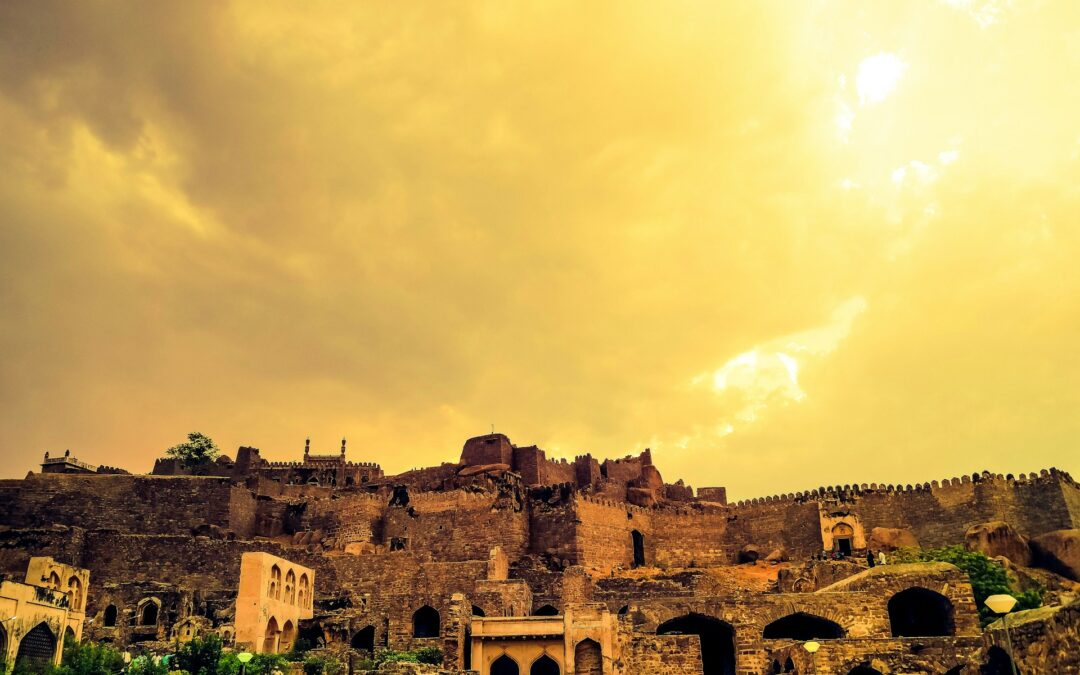
For most of us, ancient cities come with ready-made imagery. Say Rome, and we picture towering marble columns, grand forums, and bustling stone-paved streets. Say Athens, and we imagine open plazas, philosophers debating beneath porticoes, and temples rising above the skyline. These civilizations feel visually alive—almost cinematic.
But say Ancient India, and the image is… vague.
At best, we might think of a temple. At worst, nothing at all.
This isn’t because ancient India lacked cities. Quite the opposite. Between 500 BCE and 500 CE, the subcontinent was home to some of the most densely populated, economically vibrant, and technologically advanced urban centers in the world. These were not scattered settlements—they were fully realized megacities with infrastructure, governance, entertainment, healthcare, and complex social life.
The real problem is this: we’ve lost the visual language of these cities.
Unlike Rome or Greece, where stone monuments dominate the ruins, much of urban India was built using materials that didn’t survive the passage of time. What remains today—temples, monasteries, and a handful of stone structures—offers only a narrow glimpse into what was once a rich and layered urban world. The everyday life of these cities—the homes, markets, streets, and public spaces—has largely disappeared.
So how do you reconstruct a city that no longer exists?
You combine archaeology, ancient texts, and accounts from foreign travelers. You piece together fragments. You read between the lines. And slowly, a picture begins to emerge—not of a silent ruin, but of a living, breathing city.
In this article, we’re going to rebuild that world from the ground up.
Not as a collection of facts, but as an experience.
By the end, you won’t just know what ancient Indian cities looked like—you’ll be able to walk through one in your mind.
The Problem With Imagining Ancient India
Close your eyes and try to picture an ancient Indian city.
What do you see?
For most people, the answer is either a temple… or a blank canvas.
This is the core problem. Unlike Rome or Athens, ancient Indian cities don’t come with a ready-made visual identity in our collective imagination. There are no universally recognized street scenes, no standardized “look” that instantly brings the urban world to life. Instead, India’s past often feels abstract—reduced to ideas, philosophies, and spirituality, rather than lived, physical environments.
This gap isn’t accidental. It’s the result of how history has been preserved—and more importantly, how it hasn’t.
When we think of ancient civilizations, we rely heavily on what survives. In the case of Rome, stone architecture dominates: amphitheaters, aqueducts, roads, and public buildings that still stand in varying states of preservation. These ruins act like visual anchors, helping us reconstruct the rest of the city with ease.
Ancient India doesn’t offer the same luxury.
What survives here is selective. Temples, stupas, and monasteries—structures built to endure—form the bulk of what we see today. They are grand, intricate, and visually striking. But they represent only a fraction of the urban landscape. The everyday city—the houses, markets, administrative buildings, and entertainment districts—has largely vanished.
As a result, we’ve inherited a distorted image.
Ancient India begins to look like a civilization of temples and monks, rather than one filled with merchants, artisans, officials, performers, and ordinary families going about their daily lives. The streets disappear. The noise disappears. The city itself disappears.
And when the city disappears, so does the ability to imagine it.
This is why reconstructing ancient Indian cities isn’t just about uncovering ruins—it’s about restoring a lost way of seeing.
Where Did All the Cities Go?
If ancient India had such rich and complex cities, a natural question follows:
Where did they go?
Why don’t we see their streets, houses, markets, and public buildings the way we do in places like Rome or Pompeii?
The answer lies not in a single catastrophic event—but in two quiet, persistent forces: perishable materials and repurposing.
To begin with, much of ancient Indian urban architecture was built using materials like wood, mud brick, bamboo, and stucco. These weren’t crude choices—they were practical, climate-sensitive, and often beautifully crafted. Wooden beams were carved, walls were plastered and painted, and structures were designed to breathe with the environment.
But these materials came with a trade-off: they didn’t last.
Over time, exposure to rain, heat, humidity, and neglect would cause these structures to decay. Roofs would collapse. Walls would erode. Entire neighborhoods could vanish within a few centuries if not continuously maintained. Unlike stone, which can endure for millennia, these materials returned quietly to the earth.
Even stone buildings weren’t safe.
Across centuries, cities experienced cycles of political upheaval, economic decline, and shifting populations. When that happened, abandoned structures weren’t left to stand as ruins—they were treated as resources. Stone blocks were dismantled and reused in new constructions. Old foundations were cleared to make way for fields or settlements. What we might consider “heritage,” people of the time often saw as raw material.
In many cases, entire cities were effectively quarried out of existence.
This process of reuse was so extensive that it erased not just buildings, but entire urban layouts. Streets disappeared. Public squares vanished. Infrastructure was dismantled piece by piece and redistributed elsewhere.
What survived this cycle were the structures that people were least likely to dismantle: religious buildings.
Temples, stupas, and monasteries carried cultural and spiritual significance that protected them from being reused as building material. They continued to be maintained, restored, and rebuilt over generations. As a result, they dominate the archaeological record today.
But this creates a powerful illusion.
Because temples are what remain, we begin to assume they are what defined the city. The bustling markets, the crowded neighborhoods, the administrative offices, the entertainment districts—all fade into invisibility.
The truth is, ancient Indian cities didn’t disappear in a dramatic collapse.
They were slowly, systematically recycled out of existence.
And to see them again, we have to reconstruct what time—and human hands—have erased.
Reconstructing an Ancient Indian Megacity
So if the physical city is gone, how do we bring it back?
You don’t rely on a single source—you assemble a mosaic.
Archaeological excavations provide the physical clues: fragments of drainage systems, foundations of houses, remnants of roads, storage pits, and workshop areas. Ancient texts like the Arthashastra, Manasara, and Vastu Shastra offer guidelines on urban planning, architecture, and civic administration. And then there are foreign observers—Greek diplomats, Chinese monks, and travelers—who described Indian cities with a mix of curiosity and astonishment.
Individually, each source is incomplete. Together, they form a surprisingly coherent picture.
What emerges is not a single city, but a composite urban model—a kind of “typical” ancient Indian megacity that captures the shared features seen across the subcontinent between roughly 500 BCE and 500 CE, a period marked by intense urbanization.
This was an age of thriving capitals like Pataliputra, bustling trade hubs, and growing regional centers connected by networks of commerce and culture. Cities were not accidental—they were planned, organized, and actively managed.
For the sake of clarity, imagine we are constructing one such city from scratch.
A living, breathing urban space. Let’s call it a composite city—an idealized version built from real evidence.
As you enter this city, you’re not walking into a chaotic sprawl. You’re stepping into a carefully structured environment.
Wide streets stretch ahead, designed to handle the flow of carts, chariots, and pedestrians. Neighborhoods are laid out with intention. Public spaces are placed at key intersections. Infrastructure—often invisible at first glance—runs beneath your feet and behind the walls, quietly sustaining urban life.
Nothing important is left to chance.
This city has systems—for water, for sanitation, for trade, for governance, for entertainment, for education. It is not just a place where people live. It is a place that works.
And now that we have the blueprint, we can begin building it piece by piece.
Starting with the most fundamental question any city must answer:
What happens when thousands—or even hundreds of thousands—of people live in one place?
How do you keep it clean?
Sanitation and Urban Cleanliness
Before grand palaces or bustling markets, a real city begins with something far less glamorous:
Waste.
And this is where ancient Indian cities were quietly ahead of their time.
Archaeological evidence shows that sanitation wasn’t an afterthought—it was engineered into the very fabric of urban life. Homes, streets, and public spaces were all connected through a planned and functional waste management system that rivaled, and in some cases surpassed, many contemporary civilizations.
Start inside the home.
Many houses were equipped with private toilets, typically built over shallow pits lined with terracotta bricks or stone. These weren’t isolated setups. They were connected to a broader network of drains that carried waste away from the household. It wasn’t crude disposal—it was integration.
Step outside, and the system expands.
Running along the main streets were primary drainage channels, constructed from brick or stone. Smaller drains from individual homes fed into these larger lines, creating a hierarchical network that efficiently moved waste through the city. These drains were carefully sloped, ensuring that gravity did most of the work.
And perhaps most impressively—they were often covered.
Stone slabs were placed over the drains, minimizing odor, reducing exposure, and maintaining hygiene. This wasn’t a city of open sewage flowing through the streets. It was a city that understood containment, flow, and maintenance.
Public sanitation complemented private systems.
Public toilets were strategically located in high-traffic areas—near marketplaces, administrative buildings, and gathering spots. These ensured that even those without private facilities had access to hygienic options.
But sanitation didn’t stop at sewage.
Cities also had systems for solid waste management. Garbage wasn’t left to pile up randomly. It was collected in designated areas and then transported to the outskirts of the city. There, it could be composted into fertilizer, burned, or buried. Excavations have revealed large, brick-lined pits that likely served as organized dumping grounds.
Maintaining all of this required more than infrastructure—it required governance.
Officials were appointed to oversee cleanliness, and sanitation workers were responsible for regularly sweeping streets and removing waste. Even citizens were expected to maintain hygiene standards around their homes and workplaces. Failure to do so could result in fines.
In other words, cleanliness was not just a personal virtue—it was a civic responsibility.
What you end up with is a city that doesn’t just look organized—it functions smoothly beneath the surface. Waste is managed, streets remain usable, and public health is protected.
It’s easy to overlook systems like these because they’re designed to be invisible.
But without them, no ancient city—no matter how grand—could survive.
Water Systems and Daily Life
If sanitation kept the city clean, water made it possible for the city to live.
In ancient Indian cities, access to water wasn’t left to chance or seasonal luck—it was engineered, stored, and distributed with remarkable sophistication. Every layer of the city, from humble homes to busy marketplaces, was connected to a broader water ecosystem designed for reliability and accessibility.
At the most basic level, there were wells.
These were scattered throughout the city, often serving clusters of households rather than single families. Built with stone or brick lining, these wells tapped into groundwater and provided a steady supply of fresh water. In larger or wealthier homes, private wells could be found within the compound itself, sometimes equipped with pulley systems to draw water more efficiently.
But wells alone weren’t enough—especially in regions with fluctuating rainfall.
To address this, cities invested in water storage systems: tanks, reservoirs, and perhaps most famously, stepwells. These structures were designed not just to store water, but to ensure access even as water levels rose and fell. With steps descending deep into the earth, people could reach the water regardless of the season.
And stepwells were more than utilitarian.
They were often elaborately designed, with carved pillars, shaded corridors, and open spaces that turned them into social hubs. People gathered here to rest, talk, and escape the heat. In a sense, water infrastructure doubled as public architecture.
From these sources, water was distributed across the city.
Networks of terracotta pipes, canals, and channels carried water to key locations—public fountains, spouts, baths, and marketplaces. These access points were strategically placed so that no part of the city was too far from a usable water source. Many of them were decorated, blending function with aesthetic appeal.
Cleanliness extended to water itself.
People were aware of the need to maintain water purity. Boiling water before drinking was a known practice, and simple filtration methods—using cloth or sand—were employed to remove impurities. At a civic level, there were also restrictions on contaminating shared water sources, indicating an early understanding of public health.
Water wasn’t just for drinking—it shaped daily routines.
Bathing was central to life. Many homes included designated bathing areas with slightly sloped platforms that directed used water into the drainage system. Public baths, often attached to social or recreational spaces, offered more elaborate facilities with sections for different uses, sometimes even separating hot and cold water.
What emerges is a city where water flows constantly—drawn from the ground, stored for the future, circulated through the streets, and returned through drainage.
It’s not chaotic. It’s cyclical.
And at every step, it reflects a deep awareness: a city without water isn’t just inconvenient—it’s unsustainable.
Neighborhoods and Urban Planning
With sanitation and water systems in place, the city begins to take shape—not as a random cluster of buildings, but as an organized, intentional space.
Ancient Indian cities were not built haphazardly. Their layouts were influenced by a combination of practical governance and architectural principles laid out in texts like the Vastu Shastra and Manasara. These works didn’t just concern themselves with individual buildings—they extended to entire towns, offering guidelines on orientation, zoning, and spatial hierarchy.
The result was a city that felt structured.
Streets were often broad and well-defined, designed to accommodate both foot traffic and vehicles like carts and chariots. Major roads connected key parts of the city—markets, administrative centers, religious complexes—while smaller lanes branched into residential areas.
Neighborhoods were not random mixtures of everything.
There is evidence to suggest that cities were divided into distinct quarters, sometimes based on occupation, social grouping, or administrative function. Artisans might cluster in one area, merchants in another, officials in yet another. This kind of zoning made economic activity more efficient and governance more manageable.
Foreign observers noticed this order.
Greek accounts describing cities like Pataliputra speak of rows of houses, wide streets, and a sense of planned arrangement, suggesting that urban organization was visible even to outsiders unfamiliar with Indian systems.
But a neighborhood was more than just its layout.
At its heart were shared spaces—the social glue that held communities together. Small temples, courtyards, gardens, meeting halls, and bathing areas were often placed at central points within neighborhoods, making them easily accessible. These were places where people gathered, celebrated, debated, and simply spent time together.
Design reinforced interaction.
By placing these communal spaces at intersections or central nodes, the city naturally encouraged movement and convergence. People didn’t just pass through neighborhoods—they participated in them.
There was also a balance between public and private life.
While streets and shared spaces were active and social, homes were often inward-looking, centered around private courtyards. This created a rhythm to urban life—open and communal outside, quiet and personal inside.
What you get, then, is not just a planned city, but a livable one.
A place where infrastructure supports movement, zoning supports productivity, and shared spaces support community.
It’s the difference between a city that merely exists—and one that actually works for the people inside it.
Inside an Ancient Indian Home
Step off the street and into a home, and the city transforms.
The noise of carts, merchants, and crowds fades away, replaced by a quieter, more intimate world—one designed not just for shelter, but for comfort, climate, and daily life.
The most common layout you would encounter is the courtyard house.
From the outside, these homes might appear modest—plain walls, minimal openings to the street, a simple entrance. But once inside, the space opens up dramatically. At the center lies an open courtyard, the heart of the home.
This courtyard wasn’t decorative—it was functional.
It allowed sunlight to enter, ensured ventilation in a warm climate, and created a private outdoor space for daily activities. Cooking, cleaning, socializing, even small rituals—all of it revolved around this central area.
Rooms were arranged around this courtyard in a thoughtful hierarchy.
Near the entrance, you might find more public-facing spaces—areas to receive guests or conduct business. As you move deeper into the house, the spaces become more private: family quarters, storage rooms, and sleeping areas. This layered design created a natural transition from public to private life within a single structure.
The materials and style of these homes varied depending on geography.
In drier inland regions, houses were often built with stone or baked brick, featuring flat roofs and plastered walls that helped regulate temperature. In coastal or high-rainfall regions, homes leaned more heavily on wood, bamboo, and terracotta, with sloping roofs designed to quickly drain rainwater.
Despite these differences, the underlying logic remained the same: adapt to the environment.
These weren’t single-story huts.
Many urban homes were multi-storied, especially in densely populated areas or among wealthier families. Larger residences could include multiple courtyards, upper floors with balconies, and even dedicated spaces for servants or storage.
And the interiors were far from bare.
Walls were often decorated with murals, carvings, and intricate woodwork. Courtyards might include plants, small water features, or sculptural elements. Even everyday objects—doors, windows, pillars—could carry aesthetic detailing.
This attention to design reveals something important.
Ancient Indian homes weren’t just built to function—they were built to feel alive.
They balanced privacy with openness, practicality with beauty, and structure with flexibility. And perhaps most importantly, they were deeply connected to the rhythms of daily life—light, air, water, and movement all carefully considered.
In a city that could be loud and crowded, the home was a controlled, intentional space.
A world within a world.
Public Spaces and Social Life
Step back out onto the streets, and the city opens up again—not just as a place of movement, but as a place of gathering.
Ancient Indian cities were not built solely for efficiency. They were designed with public life in mind. Between homes, markets, and institutions lay a network of shared spaces where the city truly came alive.
At the center of this network were town squares.
Typically located at the intersection of major roads, these open spaces acted as the city’s beating heart. They were wide, often paved, and intentionally kept accessible. Pillars, statues, gateways, and shaded areas gave them both structure and character, while trees provided relief from the heat.
But these squares weren’t static monuments—they were dynamic.
On any given day, one section might host a public meeting or announcement, another might transform into a temporary marketplace, and yet another could become a stage for performances or gatherings. These were multi-functional spaces, constantly shifting based on the needs of the city.
And with that came people.
Merchants, travelers, officials, artisans, and ordinary citizens all converged here. Conversations flowed as freely as goods—news was shared, gossip exchanged, ideas debated. If you wanted to understand the pulse of the city, this is where you would stand.
Beyond the squares, there were parks and gardens.
These spaces offered something different: calm. Carefully maintained, they featured shaded walkways, groves of trees, ponds, flowering plants, and sometimes pavilions or benches. They were places to walk, rest, and escape the density of urban life.
But even here, the city didn’t fall silent.
Scholars might stroll while engaged in deep discussion. Families gathered during festivals. Community events unfolded in open spaces. These parks were not isolated retreats—they were extensions of social life, just in a more relaxed form.
Design played a key role in all of this.
Public spaces were positioned strategically—at crossroads, near important buildings, within reach of multiple neighborhoods. Accessibility wasn’t an accident; it was planned. The goal was to encourage movement, interaction, and participation.
What you begin to see is a city that doesn’t just function—it connects.
People aren’t confined to private spaces. They move through shared environments that invite interaction, whether through trade, conversation, or leisure.
In these squares and gardens, the abstract idea of a “city” becomes something tangible.
It becomes a community.
Markets and Economic Activity
Follow the flow of people from the town square, and sooner or later, you arrive at the most energetic part of the city:
The market.
This is where the city breathes fastest.
Ancient Indian markets were not scattered stalls lining a road—they were organized commercial zones, often built around large open courtyards and surrounded by dense clusters of shops and workshops. The ground was paved to handle constant foot traffic, and entry points were sometimes controlled, with guards managing access and collecting tolls.
Inside, the space was anything but quiet.
Merchants called out to passersby, advertising their goods. Buyers examined items, negotiated prices, and moved from stall to stall. The air carried a mix of sounds—voices, clinking metal, rustling textiles—and a mix of scents from food, spices, and raw materials.
Markets were not random in their layout.
Different sections were often designated for specific goods. One area might specialize in textiles, another in pottery, another in metalwork or jewelry. This zoning made it easier for buyers to navigate and for traders to cluster with others in the same profession.
Beyond the main marketplace, entire commercial districts developed around particular industries.
Rows of workshops and storage spaces lined the streets, where artisans produced goods in large quantities. You might find an entire neighborhood dedicated to weaving, another to metal casting, another to ceramics. These were not small-scale operations—they were organized, productive, and deeply integrated into the city’s economy.
At the center of this system were guilds.
Guilds acted as regulators, coordinators, and protectors of trade. They set quality standards, managed pricing practices, and often represented the interests of their members. Their influence was so significant that they maintained dedicated spaces—guild halls—within the city.
Markets also had systems for conflict resolution.
Disputes between buyers and sellers weren’t left to escalate. Special courts or officials were often located within or near market areas, ensuring that disagreements could be resolved quickly and fairly. This added a layer of trust to commercial activity.
And then there was the atmosphere.
Markets were not just economic centers—they were social spaces. People came not only to buy and sell, but to meet, observe, and participate in the rhythm of city life. News spread quickly here. Trends emerged here. The pulse of the economy—and in many ways, the pulse of the city—could be felt here.
What you see in these markets is more than trade.
You see organization, regulation, specialization, and energy—all working together to sustain a complex urban economy.
This is where the city earns its living.
Entertainment, Sports, and Nightlife
As the day progresses and the intensity of the markets begins to ease, the city doesn’t slow down—it shifts.
Work gives way to leisure. Trade gives way to performance. And the city reveals another side of itself: one built for entertainment, competition, and pleasure.
At the heart of this world were theaters.
Often located near central districts or close to royal complexes, these venues were carefully designed according to principles laid out in texts like the Natyashastra. Stages were elevated, allowing performers to be clearly seen, and seating areas were arranged in semicircular or rectangular patterns to maximize visibility and acoustics.
These weren’t small gatherings.
Large theaters could host hundreds, sometimes thousands, of spectators. Music, dance, drama, and storytelling unfolded here, drawing audiences from across the city. For a few hours, the noise of daily life gave way to curated performance—structured, expressive, and deeply cultural.
But performance wasn’t confined to formal spaces.
The city also had districts dedicated to nightlife and adult entertainment. These areas, often located near busy commercial zones, were vibrant and active after dark. Taverns, gambling houses, and entertainment venues lined the streets, creating pockets of energy that contrasted with the more regulated daytime economy.
Within these districts were the homes and salons of courtesans—figures who occupied a complex social space.
Their residences were not hidden or crude. They were often well-designed, featuring reception areas, courtyards, and private chambers. These spaces were decorated with care—furnishings, artwork, and musical instruments—reflecting both wealth and cultural refinement. They served as places of conversation, performance, and social interaction as much as pleasure.
Meanwhile, for those drawn to physical activity, the city offered sports and training grounds.
Fighting pits provided spaces for wrestling and boxing competitions, with spectators gathered on raised platforms around the arena. Horse races and chariot races took place on purpose-built tracks, echoing the scale and excitement of similar events in other ancient civilizations.
And then there were gymnasiums.
These were not just places to exercise. They were social hubs where men gathered to train, bathe, and discuss ideas. Philosophy, politics, and daily life all found their way into these spaces, blending physical and intellectual engagement.
What ties all of this together is diversity.
Entertainment in ancient Indian cities wasn’t limited to one form or one class of people. It ranged from formal performances to informal gatherings, from physical contests to intellectual exchange, from structured venues to lively districts.
The city didn’t just work—it lived.
And when the sun set, it didn’t fall silent.
It came alive in a different way.
Healthcare and Medical Institutions
Beneath the energy of markets and the vibrancy of public life, another system quietly sustained the city:
Healthcare.
Ancient Indian cities were not indifferent to illness or injury. In fact, they developed a surprisingly organized and accessible medical infrastructure, one that combined practical care with formal training and specialization.
At the center of this system were hospitals.
References from Buddhist sources and historical accounts indicate that these institutions were often funded by rulers, wealthy patrons, or religious establishments. They weren’t makeshift shelters—they were structured facilities designed to treat different kinds of ailments.
Inside, patients were not grouped randomly.
Hospitals were typically divided into separate wards, each catering to specific conditions—general illnesses, surgical cases, and even infectious diseases. This level of categorization suggests a clear understanding of medical specialization and the need for organized care.
The design of these spaces reflected both function and comfort.
Buildings often included open courtyards, shaded verandas, and well-ventilated rooms. Airflow, light, and accessibility were carefully considered, creating an environment that supported recovery rather than confinement.
But hospitals weren’t just places for treatment—they were also centers of learning.
Young medical students trained under experienced physicians, gaining hands-on experience in diagnosing and treating patients. This integration of education and practice ensured that medical knowledge was not only preserved, but actively developed.
Beyond large hospitals, the city also offered smaller healthcare facilities.
Clinics and herbal dispensaries provided outpatient care for minor ailments. These were often run by practitioners trained in various branches of Ayurvedic medicine, offering treatments based on herbs, diet, and lifestyle adjustments.
And then there were specialized surgical centers.
Ancient Indian medicine was not limited to theory—it included advanced procedures. The physician Sushruta, often regarded as a pioneer of surgery, described techniques ranging from cataract operations to reconstructive procedures like rhinoplasty. These weren’t isolated experiments; they were part of a broader medical tradition practiced in urban centers.
Perhaps most striking is the accessibility of care.
Historical accounts suggest that medical treatment was often available regardless of a person’s wealth or social status. To foreign observers, this was unusual—even remarkable. It pointed to a system where healthcare was not purely transactional, but also seen as a social responsibility.
What emerges is a city that doesn’t just accommodate life—it supports it.
Injury, illness, and recovery are not left to chance. They are addressed through institutions, knowledge, and organized care.
And in doing so, the city becomes not just a place to live, but a place where life can be sustained and restored.
Education and Centers of Learning
If healthcare sustained the body, education sustained the mind.
Ancient Indian cities were not just centers of trade and governance—they were also hubs of knowledge, attracting students, teachers, and scholars from across regions and cultures. Learning was not confined to isolated spaces. It was woven into the urban fabric.
At the highest level were universities.
Institutions like Takshashila and Nalanda were not single, centralized buildings as we might imagine today. Instead, they functioned as networks of colleges and schools, often spread across different parts of the city. Each center specialized in particular disciplines—medicine, law, mathematics, military science, philosophy, and the arts.
Students traveled long distances to study here.
From across India, as well as Central Asia, China, and Southeast Asia, learners came to immerse themselves in these intellectual environments. Admission wasn’t automatic—students often had to demonstrate prior knowledge or pass oral examinations before being accepted.
The infrastructure supported serious scholarship.
Lecture halls hosted formal instruction. Libraries stored collections of manuscripts written on palm leaves or bark. Residential quarters housed students and teachers, creating a fully immersive academic environment where learning extended beyond the classroom.
But education wasn’t limited to elite institutions.
Across the city, there existed smaller centers of learning—informal yet significant. Teachers conducted classes in homes, temples, or dedicated spaces. Discussions, debates, and recitations formed the backbone of this system, emphasizing oral transmission alongside written knowledge.
Public access to knowledge also existed.
Libraries—often attached to temples, palaces, or major institutions—served as repositories of texts. These were carefully designed spaces, with attention given to ventilation and preservation to protect delicate manuscripts. Reading rooms and open areas allowed scholars to study individually or engage in group discussions.
Learning, in this environment, was not passive.
It was interactive, dialog-driven, and deeply social. Scholars debated ideas in courtyards, students questioned teachers, and intellectual exchange extended into public spaces like gardens and gathering areas.
What stands out is the decentralized nature of education.
There was no single authority controlling knowledge. Instead, it flowed through multiple institutions, teachers, and traditions—creating a dynamic and resilient intellectual ecosystem.
In such a city, knowledge wasn’t hidden behind walls.
It was part of daily life.
And in many ways, it was one of the city’s greatest assets.
Governance and Administration
Behind the visible life of the city—its markets, homes, and public spaces—was a system that kept everything running:
Governance.
Ancient Indian cities were not loosely organized settlements. They were actively administered environments, where authority, regulation, and decision-making were embedded into the urban structure.
At the center of this system stood the palace complex.
More than just a royal residence, the palace was the nerve center of the state. It housed not only the ruler’s private quarters, but also the machinery of governance—administrative offices, treasury rooms, assembly halls, and courts of law.
These complexes were often expansive.
Grand entrances, large courtyards, and carefully designed gateways reinforced the authority of the state. Within, different sections served different functions. Council meetings took place in assembly halls. Officials managed state affairs in administrative chambers. The treasury safeguarded wealth. And the courts handled disputes, both civil and criminal.
Justice, in particular, was not informal.
Royal courts operated as structured spaces where judges presided over cases, ensuring that disputes were resolved through recognized procedures. Law and order were not left to chance—they were institutionalized.
But governance didn’t stop at the palace gates.
Across the city were administrative offices responsible for day-to-day operations. These offices managed everything from tax collection and trade regulation to record-keeping and public works. Built with durable materials like brick and stone, they often included storage areas for documents and large halls for official business.
The presence of these offices points to something important:
Urban life required constant oversight.
Markets needed regulation. Sanitation systems needed maintenance. Infrastructure needed coordination. None of this could function without an administrative framework to support it.
And governance wasn’t entirely top-down.
Local guilds, community leaders, and neighborhood groups often worked alongside officials, creating a more distributed form of management. This allowed the system to operate at multiple levels—central authority setting direction, local actors ensuring execution.
What emerges is a city that is not just physically organized, but administratively structured.
Rules exist. Institutions exist. Processes exist.
And because of that, the city doesn’t descend into chaos.
It operates—with intent, with coordination, and with continuity.
Religion as Urban Infrastructure
By now, the city feels complete—homes, markets, institutions, governance.
But there is another layer woven through all of it, one that is both visible and deeply embedded:
Religion.
In ancient Indian cities, religious structures were not isolated or peripheral. They were central components of urban life, functioning not just as places of worship, but as hubs of education, economy, and community.
Across the city, you would find temples, stupas, monasteries, and other sacred complexes, each associated with different traditions and beliefs. These structures varied in design, but they shared certain core features—courtyards, shrines, ritual spaces, and often towering elements that made them visible from a distance.
Their presence shaped the city’s landscape.
Religious complexes were often located along major roads, near marketplaces, or at significant urban nodes, ensuring accessibility and visibility. They weren’t hidden—they were integrated into daily movement and activity.
But their role went far beyond ritual.
These complexes acted as centers of community life. People gathered here not just to pray, but to learn, meet, and participate in social activities. Monasteries, in particular, doubled as educational institutions, while temples often hosted discussions, performances, and gatherings.
They were also economic engines.
Religious institutions could own land, employ workers, and attract continuous flows of donations. Merchants and rulers often funded their construction and maintenance, not only for spiritual reasons but also for prestige and influence. In doing so, these complexes became active participants in the city’s economy.
Construction itself was a massive undertaking.
Building a temple or monastery required labor, materials, and coordination on a large scale. Artisans, sculptors, laborers, and planners all contributed, turning these projects into major civic efforts that engaged the wider population.
And then there was the visual impact.
These structures were often richly decorated—carvings depicting mythological stories, symbolic motifs, intricate designs that transformed stone into narrative. They weren’t just functional—they were expressive, telling stories that connected people to shared beliefs and cultural memory.
Over time, these are the structures that survived.
While homes decayed and markets were dismantled, temples and monasteries continued to be maintained, restored, and revered. This is why they dominate our view of ancient India today.
But in their original context, they were not the whole city.
They were one part of a much larger system—integrated, influential, and deeply embedded in everyday life.
Religion, in this sense, was not separate from the city.
It was part of its infrastructure.
Food, Travel, and Hospitality
A city this large doesn’t just house its residents—it feeds them, hosts them, and keeps them moving.
Ancient Indian cities developed a vibrant ecosystem around food, travel, and hospitality, ensuring that both locals and visitors could find nourishment, rest, and social connection.
Start with food.
Scattered across marketplaces, busy streets, and entertainment districts were taverns and eateries serving a wide variety of dishes and drinks. These establishments ranged from simple setups to more organized spaces with designated seating and shared dining areas.
The layout was often open and inviting.
Low tables, cushions, and group seating arrangements encouraged people to eat together rather than in isolation. Meals were not just about sustenance—they were social experiences. Conversations flowed alongside food, turning these spaces into informal gathering points within the city.
And the menu wasn’t limited to local fare.
In major urban centers connected by trade, you could find regional specialties and imported delicacies, reflecting the city’s role as a crossroads of culture and commerce. Food, in this sense, became another way the outside world entered the city.
For travelers, the city offered more than just food—it offered shelter.
Near the main gates and along key routes were rest houses, designed to accommodate merchants, pilgrims, and visitors. These were not makeshift lodgings. They were structured facilities with basic but thoughtful amenities—dormitory-style sleeping arrangements, communal dining areas, and bathing facilities.
At the center of these rest houses was often a courtyard.
Much like private homes, this space allowed travelers to gather, share stories, exchange news, and build connections. In a world where long-distance travel was slow and uncertain, these rest houses provided not just physical comfort, but a sense of temporary community.
Many of these establishments were supported by the state or funded by wealthy patrons, reflecting a broader cultural emphasis on hospitality and service.
But hospitality extended beyond formal structures.
The presence of food stalls, eateries, and communal spaces throughout the city meant that even a newcomer could quickly find their place—somewhere to sit, eat, and observe the life of the city unfolding around them.
What emerges is a city that is not closed or insular.
It is open.
Open to movement, to exchange, to strangers passing through. It feeds them, houses them, and folds them—however briefly—into its rhythm.
And in doing so, it becomes not just a place to live, but a place to arrive.
Roads, Transport, and Movement
All of this—homes, markets, institutions, public spaces—depends on one thing:
Movement.
A city only works if people, goods, and ideas can flow through it. And in ancient Indian cities, this flow was not left to chance. It was designed, structured, and maintained.
The first thing you notice is the roads.
These were not mere dirt paths worn down by use. Major streets were often paved with stone or compacted gravel, built to endure heavy traffic and changing weather conditions. They were wide enough to accommodate carts, chariots, animals, and pedestrians moving simultaneously.
And there was a hierarchy.
Main roads connected key parts of the city—gates, markets, administrative centers, and major public spaces. From these arteries branched smaller streets and lanes that led into residential neighborhoods and specialized districts. This layered structure ensured both accessibility and organization.
Traffic was constant.
Accounts from observers describe streets filled with chariots, carts, and foot traffic, indicating not just movement, but volume. Goods were transported from workshops to markets, from markets to homes, and from the city to the outside world. People moved for work, trade, social interaction, and governance.
The design supported this intensity.
Straight stretches allowed for smoother movement, while intersections often connected to public spaces like squares or marketplaces, naturally distributing traffic. The presence of drainage systems alongside or beneath roads ensured that water didn’t accumulate and disrupt movement.
But roads didn’t just serve the inside of the city.
They connected it to the outside world.
Major urban centers were linked by long-distance routes, facilitating trade, communication, and cultural exchange across regions. Merchants, pilgrims, officials, and travelers moved along these networks, bringing with them goods, ideas, and information.
Inside the city, movement was also about experience.
Walking through these streets, you would pass through changing environments—quiet residential lanes opening into busy commercial zones, shaded areas giving way to open squares, narrow passages leading to expansive courtyards. The city revealed itself gradually, shaped by the paths you took.
And importantly, movement was regulated and maintained.
Roads required upkeep. Traffic needed to be managed. Access points like gates could be monitored and controlled. This wasn’t a free-for-all—it was a system that balanced openness with order.
What you end up with is a city in motion.
Not chaotic, not stagnant—but flowing.
Because in the end, a city is not defined by its buildings alone.
It is defined by how people move through it.
Defense, Security, and Law Enforcement
A city this prosperous—full of wealth, people, and activity—would inevitably attract attention.
And not all of it friendly.
To protect itself, ancient Indian cities developed layered systems of defense and security, combining physical fortifications with active enforcement inside the walls.
The most visible element was the city’s fortifications.
Massive walls, built from stone or brick, encircled the urban core. These were not symbolic barriers—they were engineered for defense. Thick, high, and often reinforced with bastions, they allowed defenders to monitor and respond to threats from elevated positions.
But a single wall wasn’t always enough.
Many cities employed multiple layers of defense, with outer and inner walls creating successive barriers. If an attacker breached one layer, they would still have to contend with another.
Access to the city was tightly controlled through fortified gates.
These gates were among the most vulnerable points—and therefore the most heavily defended. Doors made of reinforced wood or iron could be shut to block entry, often fitted with spikes to prevent war elephants from breaking them down. Entryways were designed to be narrow, limiting how many people could pass through at once and making it easier to defend against incoming forces.
Some gates even incorporated defensive mechanisms—concealed positions for archers, traps, or chokepoints that could slow or neutralize attackers.
And in extreme cases, there were hidden passages and tunnels.
These allowed defenders to move unseen, launch counterattacks, or escape if the city was overrun. Defense was not just about holding ground—it was about adaptability.
Inside the walls, security continued.
Garrisons and watchtowers were placed at strategic points across the city. From these elevated positions, guards could monitor both internal activity and external threats. Troops were stationed throughout the city, ready to respond to disturbances or emergencies.
But security wasn’t only about war—it was also about law and order.
Government-appointed officials acted as law enforcement, patrolling streets, investigating crimes, and maintaining public safety. They often worked alongside local guilds and community leaders, creating a network of oversight that extended into neighborhoods and marketplaces.
And then there were emergencies.
Fire, in particular, posed a constant threat—especially in a city where many structures were made of wood. To address this, cities maintained firefighting systems, including organized fire brigades equipped with water, sand, and other tools. Public wells were strategically placed to ensure quick access in case of fire.
What you see here is a city that understands risk.
It anticipates attack. It prepares for disaster. It enforces order.
Because prosperity without protection is fragile.
And for a city to endure, it must be able to defend not just its walls—but everything within them.
What Made Ancient Indian Cities Unique
By now, the city stands fully formed.
It has infrastructure, governance, markets, homes, institutions, and defenses. It functions efficiently. It supports life at every level. It feels complete.
So what sets it apart?
What makes an ancient Indian city different from its counterparts in Rome, Greece, or China?
The answer lies not in any single feature, but in the way everything is integrated.
Start with infrastructure.
In many ancient civilizations, systems like sanitation and water management existed—but in Indian cities, they were often deeply embedded into everyday life. Drainage wasn’t limited to elite areas. Water access wasn’t restricted to monumental structures. These systems extended into homes, neighborhoods, and public spaces, creating a more uniformly functional environment.
Then there’s the balance between function and experience.
Indian cities were not just practical—they were livable. Stepwells doubled as social spaces. Courtyards blended private life with open air. Markets were economic centers but also social hubs. Public spaces were designed not just for movement, but for interaction.
Nothing existed in isolation.
Even religion was integrated differently.
Temples and monasteries were not detached sacred zones—they were active participants in urban life, tied into education, economy, and community. This blurred the line between the spiritual and the everyday, making religion part of the city’s operating system rather than a separate domain.
There was also a strong emphasis on decentralization.
Instead of relying solely on central authority, cities functioned through a combination of state control, local governance, guild systems, and community participation. This distributed structure allowed for flexibility and resilience, with different parts of the city managing their own roles while remaining connected to the whole.
And perhaps most importantly, there was an underlying attention to environmental adaptation.
From the materials used in construction to the design of homes and water systems, cities were built in response to climate and geography. Sloping roofs in high-rainfall areas, courtyards for ventilation, water storage for dry seasons—these weren’t aesthetic choices, but practical solutions.
What you get, then, is a city that feels less rigidly monumental and more organically functional.
It may not leave behind towering ruins like Rome, but in its time, it offered something just as remarkable:
A system where infrastructure, society, economy, and culture were not separate layers—but parts of a single, interconnected whole.
And once you see it that way, the image of ancient India stops being vague.
It becomes vivid.
Conclusion
What began as a blank canvas now feels like a city you’ve walked through.
You’ve seen its streets—busy, organized, constantly in motion. You’ve stepped inside its homes, gathered in its squares, navigated its markets, and witnessed the systems that kept it alive. What once felt abstract now has texture, sound, and structure.
And that changes everything.
Because the biggest misconception about ancient India isn’t that it lacked cities—it’s that those cities were somehow less real, less developed, or less vivid than those of other civilizations. In reality, they were every bit as complex, every bit as alive—just built in ways that didn’t survive in stone.
What time erased, we mistook for absence.
But when you piece together the evidence—archaeology, texts, traveler accounts—a different picture emerges. Not of isolated temples or silent ruins, but of thriving urban worlds: engineered, organized, and deeply human.
Cities where sanitation systems ran beneath the streets. Where water flowed through carefully designed networks. Where markets buzzed with trade, theaters echoed with performance, and institutions supported health, learning, and governance.
Cities that worked.
And perhaps that’s the most important takeaway.
Ancient Indian cities were not defined by what remains today, but by how they functioned when they were alive. They were not just places of worship or philosophy—they were places of living, building, exchanging, and evolving.
Once you see that, the facelessness disappears.
In its place, you get something far more powerful:
A city you can finally imagine.