
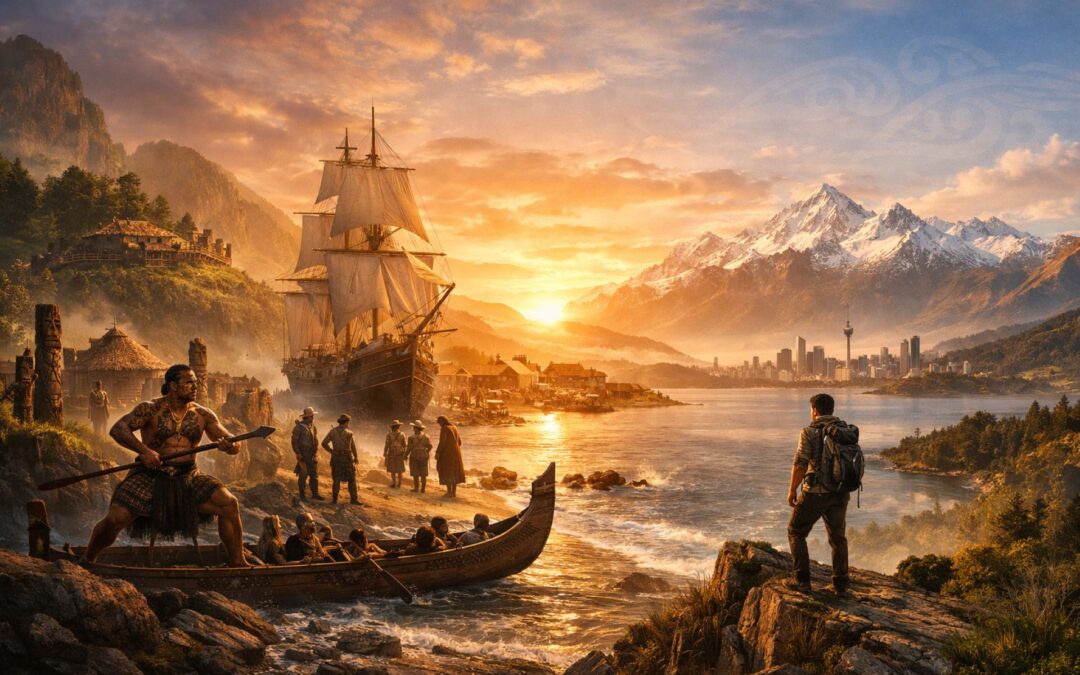
Few countries on Earth have a history as unusual as that of New Zealand. Located deep in the South Pacific and separated by thousands of kilometers of ocean from the nearest major landmasses, it remained untouched by humans for nearly the entirety of human history. While most parts of the world had been inhabited for tens of thousands of years, the islands of New Zealand were settled only around eight centuries ago, making them the last major landmass on the planet to be permanently inhabited by people.
Yet in the remarkably short span of those eight hundred years, the islands—known to the indigenous Māori as Aotearoa, meaning “land of the long white cloud”—have undergone a dramatic transformation. From the arrival of Polynesian voyagers navigating vast ocean distances using the stars and currents, to the formation of complex tribal societies, and later to encounters with European explorers and colonists, New Zealand’s history has been shaped by successive waves of migration and cultural change.
The arrival of Europeans in the seventeenth and eighteenth centuries connected the islands to global networks of trade, empire, and exploration. Figures such as Abel Tasman and James Cook brought New Zealand onto European maps, opening the way for traders, missionaries, and eventually British settlers. Their arrival set in motion profound transformations that would reshape Māori society and lead to political struggles over land, sovereignty, and governance.
During the nineteenth century, New Zealand became part of the expanding British imperial world. The signing of the Treaty of Waitangi laid the foundations of British authority in the islands, but also created long-lasting disputes over its interpretation and the rights it promised to Māori communities. The conflicts that followed, particularly during the New Zealand Wars, left deep marks on the nation’s history and identity.
Over time, however, New Zealand developed into one of the most distinctive societies within the former British Empire. It pioneered major social reforms, including becoming the first country in the world to grant women the right to vote, and gradually moved toward political independence while maintaining ties to the British monarchy.
Today, New Zealand stands as a modern multicultural nation shaped by both its Māori heritage and centuries of migration from across the world. Its history is a story not only of exploration and colonization, but also of cultural resilience, political evolution, and the ongoing effort to reconcile its indigenous past with its global present.
A Land Without Humans
For most of Earth’s history, the islands that would later become New Zealand existed in total isolation. Located more than 2,000 kilometers southeast of Australia and surrounded by the vast expanse of the Pacific Ocean, the archipelago remained separated from other continents for millions of years. This geographic isolation profoundly shaped the natural environment of the islands long before humans ever arrived.
New Zealand was once part of the ancient supercontinent Gondwana, which also included modern-day South America, Africa, Antarctica, Australia, and India. Around 80 million years ago, the fragment of land that would become New Zealand broke away and drifted into the Pacific. Over time, most of this continental fragment—known today as Zealandia—submerged beneath the ocean, leaving only the highest mountain ranges and plateaus above sea level as the islands we recognize today.
Because of this long geological isolation, New Zealand developed one of the most unusual ecosystems on Earth. Unlike most continents, it had almost no native land mammals. Instead, birds evolved to occupy many ecological niches typically filled by mammals elsewhere. Some species grew exceptionally large, including the now-extinct giant moa, a flightless bird that could stand over three meters tall. Other birds, such as the kiwi and the kakapo, adapted to life on the forest floor, evolving unique behaviors and characteristics that made them unlike any creatures found elsewhere in the world.
The absence of major predators also allowed many species to evolve in remarkable ways. Birds often lost the ability to fly because they no longer needed to escape from land-based hunters. Dense forests, wetlands, and mountainous landscapes became home to a wide array of unique plants and animals that developed in isolation for millions of years.
Despite its rich natural environment, however, New Zealand remained uninhabited by humans for most of recorded history. While people had already spread across Asia, Europe, Africa, and the Americas, and even reached remote Pacific islands such as Hawaii and Easter Island, New Zealand remained beyond the reach of human exploration.
It was not until the great wave of Polynesian oceanic expansion during the late medieval period that skilled navigators finally reached these distant islands. Their arrival around the thirteenth century would mark the beginning of human history in New Zealand, transforming an untouched natural world into a new cultural homeland known as Aotearoa.
The Polynesian Discovery and Settlement of Aotearoa (c. 1250–1300)
The human story of New Zealand began relatively recently compared with most parts of the world. Around the late thirteenth century—sometime between 1250 and 1300—Polynesian explorers reached the islands after long voyages across the Pacific Ocean. These settlers were part of one of the greatest episodes of human exploration, a vast migration known as the Great Polynesian Expansion, which saw people settle islands scattered across nearly a third of the globe.
The Polynesians were extraordinary navigators. Without the use of modern instruments, they traveled enormous distances across open ocean using knowledge passed down through generations. They navigated by observing the stars, the position of the sun, ocean swells, wind patterns, and the flight paths of birds. Using large double-hulled ocean-going canoes known as waka, these voyagers crossed thousands of kilometers of water to settle islands throughout the Pacific, including Hawaii, Easter Island, and eventually New Zealand itself.
When the first settlers arrived in the islands they called Aotearoa, meaning “the land of the long white cloud,” they encountered a landscape unlike anything they had previously known. The climate was cooler than most tropical Polynesian islands, the terrain was rugged and mountainous, and the flora and fauna were entirely unfamiliar. Nevertheless, these early settlers successfully adapted their Polynesian traditions to this new environment.
From these first communities emerged the ancestors of the indigenous Māori people. They brought with them a sophisticated culture that included agricultural knowledge, fishing techniques, social organization, and spiritual beliefs rooted in Polynesian tradition. Crops such as kumara (sweet potato) were cultivated in suitable regions, while hunting and fishing provided additional food sources.
Over time, the early settlers spread across both the North and South Islands, establishing communities along coastlines, river valleys, and fertile plains. These settlements were often connected by networks of kinship and shared ancestry, forming tribal groups known as iwi. Within these communities, genealogy—known as whakapapa—played a central role in defining identity, linking individuals not only to their families and ancestors but also to the land itself.
Within just a few generations, the descendants of the first Polynesian voyagers had developed a distinct culture shaped by both their Polynesian heritage and the unique environment of Aotearoa. This evolving society would soon form the foundations of Māori civilization, one that would dominate the islands for centuries before the arrival of Europeans.
The Rise of Māori Society
Within a few centuries of the first Polynesian arrivals, the descendants of those settlers had developed a distinct and highly organized society. These people became known as the Māori, whose culture evolved in response to both their Polynesian heritage and the unique environment of New Zealand.
Māori society was deeply rooted in kinship and ancestry. Communities were organized into tribes known as iwi, which were further divided into smaller sub-tribes called hapū. These groups were bound together by shared lineage and genealogy, known as whakapapa, which formed the foundation of social identity. Through whakapapa, individuals traced their connections not only to their ancestors but also to the land, rivers, and mountains that defined their tribal territories.
Leadership within Māori communities rested with chiefs known as rangatira. Their authority did not come solely from birthright but also from their ability to maintain unity within the tribe, manage disputes, and demonstrate strength in times of conflict. Respect and consensus were essential to leadership, and successful chiefs were those who could balance diplomacy with the capacity to defend their people.
Spiritual beliefs also played a central role in Māori life. Their worldview was deeply connected to the natural world, with a pantheon of gods and ancestral spirits believed to govern various elements of existence. Maintaining harmony between people, the land, and the spiritual realm was seen as essential to the wellbeing of the community.
Oral traditions became the primary means of preserving knowledge and history. Through stories, chants, and rituals, Māori communities passed down their genealogies, legends, and cultural teachings across generations. These traditions ensured that collective memory remained alive even in the absence of a written language.
Fortified Settlements and Warfare
As Māori society grew in complexity, competition over resources and territory sometimes led to conflict between tribes. To defend themselves, communities constructed fortified villages known as pā. These settlements were typically built on elevated ground and protected by earthworks, wooden palisades, and defensive trenches, making them formidable strongholds.
Warfare played an important role in shaping social and political life. Māori warriors were highly trained in close combat, using weapons crafted from wood, bone, and stone, since metalworking technologies had not yet reached the islands. Despite the limitations of these materials, Māori warfare was sophisticated and strategic, often involving ambushes, tactical positioning, and psychological intimidation.
One of the most striking cultural expressions associated with warfare was the haka, a ceremonial dance performed before battle. Through powerful movements, chants, and rhythmic stomping, warriors demonstrated unity, strength, and determination while attempting to intimidate their opponents.
By the sixteenth century, Māori society had developed a rich and dynamic cultural identity across the islands of Aotearoa. For generations afterward, life continued largely within this indigenous framework—until the arrival of Europeans in the seventeenth century brought new encounters that would profoundly alter the course of New Zealand’s history.
First Encounters with Europe (1642–1769)
For centuries after the rise of Māori society, the islands of New Zealand remained unknown to the outside world. That isolation ended in the seventeenth century when European exploration of the Pacific Ocean began to expand. The first recorded contact between Europeans and the inhabitants of Aotearoa occurred in 1642, when the Dutch explorer Abel Tasman sailed into the waters surrounding the islands.
Tasman had been dispatched by the Dutch East India Company to explore the largely uncharted regions of the South Pacific. During his voyage, he sighted the northwest coast of New Zealand’s South Island and anchored in what is now known as Golden Bay. Shortly after arriving, Tasman’s crew encountered a group of Māori who approached the Dutch ships in waka canoes.
The encounter quickly turned violent. A confrontation between the two sides resulted in the deaths of four Dutch sailors. Interpreting the Māori response as hostile and fearing further attacks, Tasman decided not to attempt a landing. Instead, he departed the area and continued his voyage without establishing any lasting contact with the islands.
Despite the brevity of the encounter, Tasman’s voyage had an important consequence: it placed the islands on European maps. Soon afterward, they were recorded in Latin as Nova Zeelandia, named after the Dutch province of Zeeland. For more than a century, however, no further European expeditions returned to investigate the distant archipelago.
The next major European arrival occurred in 1769, when the British explorer James Cook reached New Zealand aboard his ship, the HMS Endeavour. Unlike Tasman, Cook spent considerable time exploring the islands. Over several months he circumnavigated and mapped both the North and South Islands with remarkable accuracy, creating charts that would guide future explorers and settlers.
Cook’s interactions with Māori communities were mixed. In some cases, misunderstandings and cultural differences led to violent confrontations. In others, the two sides engaged in trade and exchange, establishing the first sustained contacts between Māori and Europeans. Cook also collected extensive information about the geography, plants, animals, and people of New Zealand, helping to introduce the islands to the wider European world.
Although Cook formally claimed New Zealand for Great Britain, the British government did not immediately attempt to establish a colony there. Instead, Cook’s voyages opened the door for a new wave of visitors—traders, whalers, missionaries, and adventurers—who would soon begin to transform the relationship between Māori society and the outside world.
Trade, Missionaries, and Early European Influence
Following the voyages of James Cook in the late eighteenth century, the islands of New Zealand gradually became integrated into wider global networks of exploration and trade. Although the British government did not immediately establish formal colonies, the region began attracting increasing numbers of foreign visitors.
During the late eighteenth and early nineteenth centuries, ships from Britain, France, and the United States regularly sailed to New Zealand’s coasts. Many of these vessels were involved in the lucrative whaling industry, which operated throughout the Pacific. Whalers and merchant sailors established temporary bases along the coastline, particularly in areas such as the Bay of Islands, where ships could easily anchor and resupply.
These early visitors quickly began trading with the indigenous Māori communities. European traders exchanged goods such as iron tools, weapons, cloth, and other manufactured items for local resources including timber, flax, and food supplies. Iron tools in particular proved highly valuable, as they dramatically improved the efficiency of tasks such as carving, building, and agriculture.
Although relations between Europeans and Māori were often cooperative, tensions sometimes arose. Cultural misunderstandings and disputes over trade occasionally led to violence. One of the most infamous incidents occurred in 1809, when the crew of the British ship Boyd was attacked and killed after a conflict with Māori warriors. Events like this alarmed Europeans but did not stop the steady growth of contact between the two worlds.
As interaction increased, a small number of Europeans began settling permanently among Māori communities. Some were runaway sailors or escaped convicts from nearby Australia who chose to remain in New Zealand rather than return to colonial society. These individuals often adopted Māori customs and became known as Pākehā Māori, Europeans who had integrated themselves into Māori tribal life.
Another important group that arrived during this period were Christian missionaries. Among the earliest and most influential was Samuel Marsden, who established the first Christian mission in 1814 at the Bay of Islands. Missionaries sought to convert Māori communities to Christianity, but their influence extended beyond religion.
They also introduced literacy and education. Missionaries worked with Māori leaders to develop a written form of the Māori language, allowing it to be recorded for the first time. Written texts, religious materials, and schooling gradually spread throughout Māori communities, creating new forms of communication and cultural exchange.
Despite these growing interactions, New Zealand still remained outside formal imperial control during the early nineteenth century. Yet the increasing number of European traders, missionaries, and settlers was already beginning to reshape Māori society in profound ways—changes that would soon accelerate with the arrival of a powerful and transformative new technology: firearms.
The Musket Wars and the Transformation of Māori Power
One of the most dramatic transformations in early nineteenth-century New Zealand came with the introduction of firearms. As European traders and sailors increasingly visited the islands of New Zealand, they brought with them goods that were highly valued by the indigenous Māori communities. Among these items, muskets quickly became the most sought-after.
Before the arrival of Europeans, Māori warfare had been conducted using weapons made from wood, bone, and stone. While conflicts between tribes were common, these battles were generally limited in scale. The introduction of firearms, however, radically altered the balance of power between different groups.
Tribes that gained early access to muskets suddenly possessed a major military advantage over their rivals. This imbalance triggered a widespread arms race as tribes sought to obtain firearms through trade with European merchants. Muskets were often exchanged for resources such as flax, timber, and food, which were in high demand among visiting ships.
As firearms spread across the islands, intertribal warfare intensified dramatically. Between roughly 1806 and 1845, a series of conflicts known collectively as the Musket Wars reshaped Māori society. These wars were not a single continuous conflict but rather a long period of battles, raids, and retaliatory campaigns fought between different tribes seeking revenge, territory, or dominance.
The scale of violence during this period was unprecedented in New Zealand’s history. Historians estimate that nearly 3,000 battles were fought, leading to the deaths of between 20,000 and 40,000 people. Entire communities were displaced as tribes migrated in search of safer territories or strategic advantages.
The Musket Wars had lasting consequences for the demographic and political landscape of the islands. Some tribes expanded their influence dramatically, while others were forced to abandon traditional homelands. Tribal boundaries were redrawn, alliances shifted, and population movements reshaped the map of Māori settlement.
At the same time, these conflicts also deepened Māori engagement with European traders. The demand for muskets encouraged greater participation in the emerging global trade networks that linked New Zealand to Australia, Asia, and Europe.
By the early nineteenth century, the effects of these wars had transformed Māori society and altered the balance of power within the islands. Yet even as these conflicts unfolded, another major development was underway. Small but growing numbers of Europeans had begun establishing permanent settlements in New Zealand, setting the stage for a new phase in the islands’ history—one that would soon involve formal imperial authority and the creation of a British colony.
The Treaty of Waitangi and the Birth of a British Colony
By the late 1830s, the presence of Europeans in New Zealand had grown significantly. Traders, missionaries, and settlers were increasingly establishing permanent communities, particularly in the northern regions of the islands. However, despite this growing European population, New Zealand was not yet formally part of any empire, and no clear system of governance existed to regulate the rapidly expanding settlements.
This lack of authority began to worry the British government. At the same time, the ambitions of private colonization groups threatened to reshape the islands without official oversight. One of the most influential of these organizations was the New Zealand Company, a consortium of investors that planned to establish large-scale European settlements in the territory. The company sought to purchase vast areas of land from Māori communities in order to attract settlers and build a profitable colony.
These plans raised serious concerns among both Māori leaders and British officials. Reports of questionable land purchases and fears that other European powers—particularly France—might attempt to establish their own colonies in the region pushed Britain to take decisive action. In response, the British government appointed William Hobson as lieutenant governor and sent him to New Zealand to negotiate a formal agreement with Māori chiefs.
The result was the signing of the Treaty of Waitangi on February 6, 1840. The treaty was initially signed by Hobson and around forty Māori chiefs at the settlement of Waitangi in the Bay of Islands. In the months that followed, many more chiefs across the islands added their signatures.
The treaty was intended to establish British sovereignty over New Zealand while simultaneously guaranteeing certain rights to Māori communities. In principle, it recognized Māori ownership of their lands and resources while granting the British Crown the authority to govern the territory and regulate land sales.
However, the treaty was written in two versions—one in English and one translated into the Māori language—and the meanings of key terms differed between them. These differences would later lead to deep disputes about what exactly had been agreed upon, particularly regarding sovereignty and land rights.
Despite these ambiguities, the treaty laid the foundations for British rule in the islands. In 1841, New Zealand was formally declared a separate British crown colony, no longer administered as part of the colony of New South Wales in Australia.
The new colonial government soon encouraged immigration from Britain, and increasing numbers of settlers began arriving in search of land and opportunity. While some Māori communities initially welcomed the economic possibilities that came with European settlement, tensions soon began to rise as the number of settlers grew and demands for land intensified. These pressures would soon erupt into open conflict, leading to a series of wars that would profoundly shape the future of New Zealand.
The New Zealand Wars and the Struggle for Land
The establishment of British rule in New Zealand did not immediately bring stability to the islands. Instead, the rapid expansion of European settlement soon created deep tensions between the colonial government and the indigenous Māori population.
At the heart of the conflict was land. Many Māori leaders had initially welcomed trade with Europeans and the opportunities that came with increased contact. However, the scale of British immigration in the 1840s and 1850s quickly exceeded expectations. As settlers arrived in growing numbers, colonial authorities and private companies pushed for the purchase of ever larger areas of Māori land.
These demands often clashed with Māori concepts of land ownership. In traditional Māori society, land was not simply a commodity that could be bought or sold outright. Instead, it was tied to tribal identity, ancestry, and collective rights. Many Māori communities therefore resisted attempts to transfer large tracts of land to European settlers.
The first major conflict between the two sides erupted in 1845 in the far north of the country. Known as the Flagstaff War, it involved Māori leaders who opposed the growing authority of the British Crown. Although the war ended in a ceasefire the following year, it marked the beginning of a longer period of conflict between Māori groups and colonial forces.
Tensions escalated further during the 1860s in what became known collectively as the New Zealand Wars. These conflicts involved a series of campaigns fought across several regions of the country. On one side were British troops and colonial militia, often supported by Māori allies loyal to the government. On the other were Māori resistance fighters determined to defend their lands and autonomy.
At their height, the wars involved thousands of combatants. Around 18,000 British and allied forces were deployed against several thousand Māori warriors who used their knowledge of the terrain and innovative defensive tactics to challenge the colonial armies. Māori fighters constructed sophisticated fortified positions and conducted guerrilla-style operations that made the campaigns far more difficult than colonial authorities had anticipated.
Despite these efforts, the colonial government ultimately prevailed. By the early 1870s, organized resistance had largely been suppressed. In the aftermath of the conflicts, the government confiscated vast areas of Māori land—amounting to roughly 6,000 square miles. These confiscations had devastating consequences for many Māori communities, undermining their economic foundations and weakening their traditional social structures.
The legacy of these wars left deep scars in New Zealand’s history. For many Māori, the loss of land and autonomy became a lasting source of grievance that would continue to shape political and cultural debates for generations.
At the same time, however, the colonial government continued to expand settlement and develop infrastructure across the country. As immigration increased and the economy grew, New Zealand began to transform from a frontier colony into a more structured and prosperous society.
Settlement, Gold, and Economic Expansion
Despite the turbulence of the New Zealand Wars, the second half of the nineteenth century saw rapid economic and demographic growth across New Zealand. Increasing numbers of European settlers continued to arrive, drawn by the promise of land ownership, new opportunities, and the possibility of building prosperous communities in a developing colony.
Several important settlements were founded or expanded during this period. Cities such as Auckland and Christchurch emerged as major urban centers, while Wellington gradually developed into the country’s political heart. In 1865, Wellington was formally designated as the capital, replacing Auckland.
Agriculture became the backbone of the colony’s economy. Sheep farming in particular expanded rapidly across the countryside, supplying wool to global markets and connecting New Zealand to the broader trade networks of the British Empire. Large pastoral estates spread across fertile plains, helping transform the rural landscape into a productive agricultural economy.
Another major catalyst for growth came with the discovery of gold. In the early 1860s, significant gold deposits were discovered in regions such as Otago and on the West Coast of the South Island. These discoveries triggered a dramatic influx of migrants from across the world who hoped to strike it rich during the gold rush. Prospectors arrived not only from Britain but also from Australia, China, the United States, and other parts of Europe.
The gold rush caused the colony’s population to surge. Within just a few years, the population nearly doubled—from about 71,000 in 1859 to roughly 164,000 by 1863. New towns sprang up around mining districts, and infrastructure expanded to support the growing population.
During this period, New Zealand also began to invest heavily in national development. One of the most influential figures behind these efforts was Julius Vogel, who promoted an ambitious program of public works. Under his leadership, the government financed the construction of railways, roads, and telegraph lines that connected distant regions of the country and facilitated economic growth.
Immigration policies also encouraged further settlement. While many newcomers continued to arrive from the British Isles, migrants from other parts of the world—including China, India, continental Europe, and the United States—also contributed to the colony’s growing diversity.
By the late nineteenth century, these developments had transformed New Zealand from a sparsely populated frontier into a rapidly developing society with expanding infrastructure, growing cities, and a thriving agricultural economy. Alongside this economic progress, the country also began to develop a reputation for bold political experimentation and progressive social reform.
A Pioneer of Social Reform
By the late nineteenth century, New Zealand had begun to develop a reputation that distinguished it from many other colonies within the British Empire. While economic growth and settlement continued, the country also emerged as a global leader in progressive political and social reforms.
One of the most significant developments during this period was the rise of reform-minded governments that sought to address the challenges of a rapidly changing society. Industrialization, urbanization, and growing economic inequality were reshaping the country, prompting political leaders to introduce policies aimed at improving the welfare of ordinary citizens.
A central figure in this transformation was Richard Seddon, who served as prime minister from 1893 until his death in 1906. Under his leadership, the government introduced a series of reforms designed to protect workers and reduce poverty. These measures included labor regulations, minimum wage protections, and the establishment of one of the world’s earliest welfare systems.
Among the most groundbreaking reforms was the introduction of old-age pensions in 1898. This policy provided financial support to elderly citizens who had limited means of supporting themselves, reflecting a growing belief that the state had a responsibility to ensure basic social security for its people.
Perhaps the most famous reform, however, came earlier in 1893 when New Zealand became the first country in the world to grant women the right to vote in national elections. The campaign for women’s suffrage had been led by activists such as Kate Sheppard, whose efforts mobilized thousands of supporters across the country. After years of petitions and political pressure, the government passed legislation allowing women to participate fully in the democratic process.
This historic decision attracted international attention and placed New Zealand at the forefront of the global movement for women’s rights. It also reinforced the country’s emerging identity as a society willing to experiment with new political ideas and social policies.
These reforms helped shape a political culture that valued fairness, civic participation, and social responsibility. By the dawn of the twentieth century, New Zealand had established itself as one of the most progressive societies in the British Empire, combining economic prosperity with innovative approaches to governance and social welfare.
At the same time, discussions about the nation’s political future were becoming increasingly prominent. As New Zealand matured as a colony, many began to question the extent of its dependence on Britain and whether it should pursue a greater degree of autonomy within the empire.
Dominion Status and the Path Toward Independence
By the early twentieth century, New Zealand had matured into one of the most prosperous and politically stable territories within the British Empire. Its expanding economy, growing population, and developing political institutions encouraged many leaders to consider whether the country should exercise greater autonomy from Britain.
At the time, several other British colonies were beginning to move toward a new political status within the empire. Instead of being governed directly as colonies, these territories were granted the designation of dominions, allowing them to manage their own domestic affairs while still maintaining constitutional ties to the British Crown.
A major moment in this discussion came in 1900, when neighboring Australia was preparing to unite its separate colonies into a single federated dominion. Some political figures in New Zealand considered the possibility of joining this federation. However, many New Zealanders opposed the idea. Geographic distance, economic differences, and a strong sense of national identity convinced most leaders that the two countries should remain politically separate.
As a result, Australia formed its federation in 1901 without New Zealand. A few years later, New Zealand itself followed a similar path toward greater autonomy. In 1907, the country was officially granted dominion status, becoming the Dominion of New Zealand.
This new status granted New Zealand a higher degree of independence in managing its internal affairs. The country maintained its own parliament and government, while the British monarch remained the symbolic head of state. However, Britain still retained control over certain aspects of foreign policy and international relations.
Although dominion status did not represent full independence, it marked an important step in the development of New Zealand’s national identity. The country increasingly saw itself as a distinct political entity rather than simply a distant outpost of Britain.
Yet even as New Zealand gained greater autonomy, its ties to the British Empire remained strong. These ties would soon have dramatic consequences when Europe plunged into conflict in 1914. As part of the empire, New Zealand would be drawn into the global catastrophe of the First World War—an event that would profoundly shape its national consciousness.
New Zealand in the World Wars
The outbreak of World War I in 1914 marked a defining moment in the history of New Zealand. Although geographically distant from the main theaters of the conflict, the country was still closely tied to the British Empire. When Britain declared war on Germany, New Zealand automatically entered the conflict as part of the empire.
One of New Zealand’s first military actions was the occupation of German Samoa in 1914. Soon afterward, thousands of New Zealand soldiers were deployed overseas as part of the ANZAC, a joint military force formed with neighboring Australia. The ANZAC troops would go on to fight in several major campaigns during the war.
The most famous of these was the Gallipoli campaign in 1915, an Allied attempt to seize control of the Dardanelles and knock the Ottoman Empire out of the war. The campaign proved disastrous, with heavy casualties and difficult fighting conditions. Although it ultimately ended in failure, the bravery and sacrifice of the ANZAC soldiers became central to New Zealand’s national identity.
In total, around 100,000 New Zealand soldiers served overseas during the war—an enormous contribution for a country with a population of just over one million at the time. More than 18,000 of them lost their lives. The scale of the sacrifice had a profound emotional impact on the nation and helped strengthen a growing sense of independence and shared national identity.
The interwar period that followed brought new challenges. Like many countries around the world, New Zealand struggled during the economic downturn of the Great Depression. Unemployment rose sharply, and economic hardship affected many communities.
Just as the country was beginning to recover, the outbreak of World War II once again drew New Zealand into global conflict. Despite being located far from Europe, the nation again committed significant military forces to the war effort.
New Zealand troops served in major campaigns in North Africa, Italy, and other parts of the European theater. At the same time, the threat posed by Japan’s expansion across the Pacific brought the war closer to New Zealand’s own region. The possibility of Japanese attacks heightened fears and reinforced the importance of regional defense.
In addition to its military contributions, New Zealand played a vital role in supporting the Allied war effort by supplying food and agricultural products to Britain. These shipments helped sustain the British population during the difficult wartime years.
By the end of the Second World War, New Zealand had once again demonstrated its commitment to global conflict in support of its allies. However, the war also marked the beginning of a major shift in the country’s international relationships. As Britain’s influence declined and the United States emerged as a dominant power in the Pacific, New Zealand began to rethink its place in the world and the alliances that would shape its future security.
Postwar Realignment and the American Alliance
The end of World War II marked the beginning of a new era in the international position of New Zealand. Although the country had long been closely tied to Britain, the postwar world saw the gradual decline of British influence and the rise of new geopolitical realities.
For decades, New Zealand had relied on the British Empire for political guidance and military protection. However, Britain’s weakened economic position after the war and its shifting focus toward Europe made it increasingly difficult for London to maintain the same level of influence in the Pacific region.
At the same time, the United States emerged as the dominant military and political power in the Pacific. As Cold War tensions intensified in the decades following the war, New Zealand began to align its security strategy more closely with the United States and its regional partners.
This shift was formalized in 1951 with the creation of the ANZUS, a defense alliance linking Australia, New Zealand, and the United States. The agreement committed the three countries to cooperate on matters of security in the Pacific and to consult each other in the event of threats to regional stability.
New Zealand’s involvement in Cold War conflicts soon followed. In the 1960s, the country sent troops to participate in the Vietnam War alongside American and allied forces. The decision proved controversial at home, sparking protests and political debate within New Zealand society.
By the 1980s, the country began to pursue a more independent foreign policy. One of the most significant moments came in 1986, when New Zealand adopted a strong anti-nuclear stance and banned nuclear-powered or nuclear-armed ships from entering its ports. This decision placed the country at odds with the United States, which subsequently suspended New Zealand from certain obligations within the ANZUS alliance.
Despite these tensions, New Zealand continued to maintain close relations with both the United States and Australia while increasingly defining its own approach to global affairs. The postwar decades therefore marked an important transition—from a nation that had once relied heavily on Britain to one that pursued a more independent role in international politics.
The Māori Renaissance and a Changing Society
During the latter half of the twentieth century, New Zealand experienced profound cultural and social change. One of the most significant developments of this period was the revival of Māori identity and political activism, often referred to as the Māori Renaissance.
For much of the nineteenth and early twentieth centuries, the indigenous Māori population had faced severe challenges. The loss of land following the New Zealand Wars, the pressures of colonial settlement, and government assimilation policies had led to declining economic conditions and the gradual erosion of traditional culture and language.
By the mid-twentieth century, however, a new generation of Māori leaders and activists began working to reverse this trend. They sought to revitalize Māori language, traditions, and political representation while also challenging the historical injustices associated with colonization and land confiscations.
One important milestone came in 1975 with the establishment of the Waitangi Tribunal. This body was created to investigate claims that the government had violated the promises made in the Treaty of Waitangi. Through its investigations and recommendations, the tribunal helped bring national attention to historical grievances and encouraged negotiations between the government and Māori communities.
At the same time, efforts were made to preserve and promote the Māori language. After decades in which its use had declined sharply, the language gained official recognition when it was declared an official language of New Zealand in 1987. Schools, cultural institutions, and media organizations began actively promoting Māori language education, helping to revive its use among younger generations.
The period also saw growing Māori participation in national politics and public life. Māori leaders increasingly held positions in government and worked to ensure that indigenous perspectives were represented in national decision-making. Cultural traditions such as kapa haka performances, traditional carving, and ceremonial practices gained renewed prominence both within Māori communities and across wider New Zealand society.
Alongside this cultural revival, New Zealand itself was becoming more diverse. Immigration policies were gradually liberalized, allowing greater numbers of migrants from Asia and other regions to settle in the country. As a result, New Zealand evolved into a more multicultural society while still maintaining strong ties to its Māori heritage.
These changes helped reshape the nation’s identity. Rather than viewing itself solely as a former British colony, New Zealand increasingly embraced the idea of a bicultural and multicultural society—one that acknowledged the importance of Māori traditions while also reflecting the diverse backgrounds of its modern population.
Modern New Zealand in a Globalized World
By the late twentieth and early twenty-first centuries, New Zealand had evolved into a modern and globally connected nation. While its historical roots remained tied to Polynesian settlement and British colonization, contemporary New Zealand increasingly defined itself through diversity, cultural recognition, and international engagement.
One of the most significant transformations during this period came through immigration. Changes to immigration policy in the late twentieth century opened the country to new waves of migrants from across Asia, the Pacific Islands, and other parts of the world. While earlier immigration had been dominated by settlers from the British Isles, these new migration patterns contributed to the development of a more multicultural society.
Cities such as Auckland became especially diverse, evolving into major hubs of commerce, culture, and international trade in the Pacific region. The city’s population grew rapidly, reflecting the broader demographic shifts that were reshaping the country.
At the same time, New Zealand strengthened its reputation as a stable democracy with a high standard of living. Its political institutions continued to emphasize social welfare, transparency, and strong civic participation. Internationally, the country became known for its independent foreign policy, environmental initiatives, and commitment to nuclear disarmament.
Economic development also played a major role in shaping modern New Zealand. Agriculture remained a cornerstone of the economy, particularly dairy and livestock exports. At the same time, new sectors—including technology, film production, and tourism—began contributing significantly to national growth.
Tourism in particular emerged as one of the country’s most important industries. Visitors from around the world were drawn to New Zealand’s dramatic landscapes, which range from snow-capped mountains and vast forests to rugged coastlines and geothermal regions. Global exposure increased further when the country served as the filming location for major film franchises such as The Lord of the Rings, bringing international attention to its natural scenery.
Cultural recognition also continued to expand during this period. Māori language and traditions became increasingly visible in public life, education, and government institutions. Many national ceremonies, events, and official proceedings incorporated Māori customs, reflecting the country’s commitment to acknowledging its indigenous heritage.
Today, New Zealand stands as a nation shaped by centuries of migration and cultural interaction. Its modern identity blends indigenous Māori traditions, European influences, and the contributions of newer immigrant communities. As a result, the country has emerged as one of the most distinctive societies in the world—one that balances respect for its past with a forward-looking role in an increasingly interconnected global landscape.
Conclusion: The Rapid Creation of a Nation
The history of New Zealand is remarkable not only for what happened, but for how quickly it happened. While most civilizations developed over thousands of years, New Zealand’s entire human history spans little more than eight centuries. In that short time, the islands transformed from an uninhabited landscape into a complex modern nation shaped by migration, conflict, and cultural exchange.
The first Polynesian voyagers who reached Aotearoa laid the foundations of a vibrant Māori civilization that thrived for generations before the arrival of Europeans. Their traditions, social structures, and deep connections to the land remain central to New Zealand’s identity today. The arrival of European explorers, traders, and settlers in the seventeenth and eighteenth centuries brought the islands into the orbit of global exploration and empire, triggering profound social and political change.
Colonial expansion during the nineteenth century reshaped the country through immigration, economic development, and the extension of British rule. The signing of the Treaty of Waitangi created the constitutional foundation of the nation, even as disagreements over its meaning produced lasting tensions between Māori communities and the colonial government.
Over time, New Zealand developed into a society known for its political innovation, pioneering reforms such as women’s suffrage and early welfare policies. Participation in global conflicts during the twentieth century further strengthened a shared national identity, while postwar developments gradually shifted the country toward greater independence in international affairs.
In recent decades, New Zealand has continued to evolve as a multicultural democracy that acknowledges both its indigenous heritage and its global connections. The revival of Māori language and culture, combined with immigration from around the world, has helped shape a society that values diversity and historical awareness.
From the first Polynesian navigators crossing the Pacific to the modern nation welcoming new arrivals from across the globe, the story of New Zealand is ultimately one of movement and transformation. It is a history defined by exploration, resilience, and the constant negotiation between past traditions and future possibilities.