
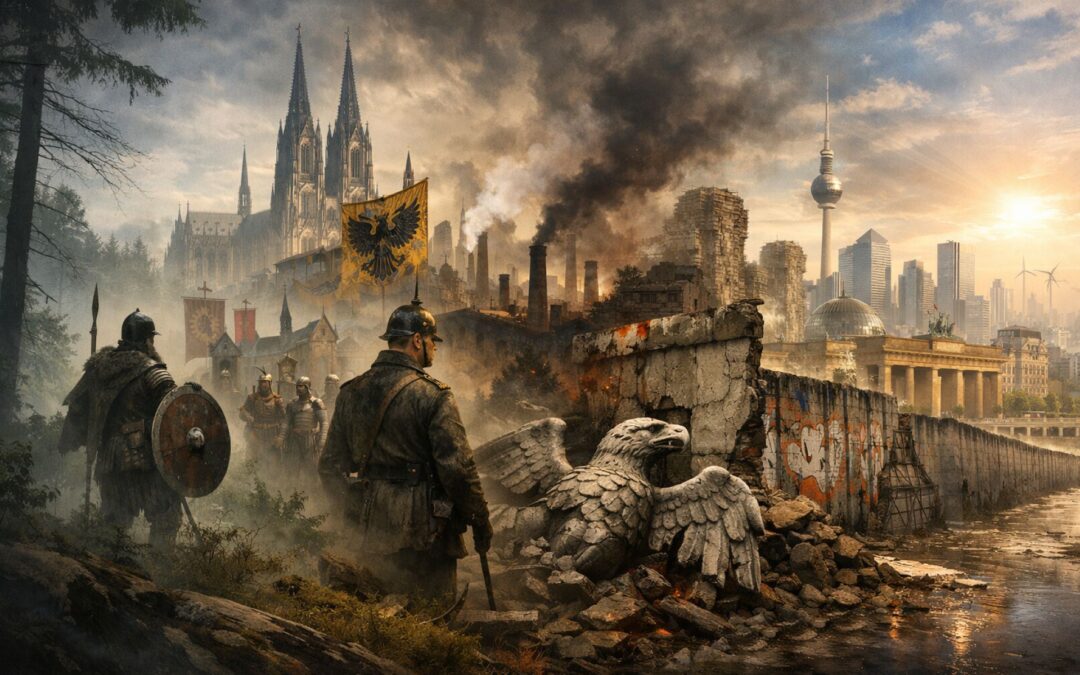
Few countries have shaped the course of European history as profoundly as Germany. Situated at the heart of the continent, the German lands have long stood at the crossroads of cultures, empires, and ideas. Yet for much of its past, Germany was not a unified nation at all. Instead, it was a patchwork of tribes, kingdoms, duchies, and city-states, loosely bound together by shifting alliances and competing dynasties.
For centuries, the region that would eventually become Germany existed more as a cultural and linguistic space than as a political entity. From the early Germanic tribes that confronted the expanding Roman Empire to the sprawling yet fragmented Holy Roman Empire of the Middle Ages, political unity remained elusive. Religious upheaval during the Protestant Reformation, devastating wars such as the Thirty Years’ War, and the rise of rival powers like Austria and Prussia all further complicated the German story.
Only in the nineteenth century did the dream of a unified German nation finally materialize. Through the calculated diplomacy and warfare of the Prussian statesman Otto von Bismarck, dozens of independent states were brought together into a single German Empire in 1871. Within decades, this new nation had become one of the most powerful industrial and military states in the world.
But Germany’s rapid rise would also lead to catastrophe. The twentieth century saw the country plunged into two world wars, followed by the horrors of Nazi rule and the devastation of the Second World War. In the aftermath, Germany was divided between rival ideological blocs during the Cold War, symbolized by the Berlin Wall that split its capital for nearly three decades.
Yet Germany’s story did not end in division. The fall of the Berlin Wall in 1989 and the peaceful reunification of the country the following year marked a new chapter. Today, Germany stands as Europe’s largest economy and one of its most influential democratic nations—a country that has transformed itself after centuries of upheaval.
The history of Germany is therefore not just the story of one nation, but of Europe itself: a tale of migration and empire, faith and conflict, destruction and renewal. From ancient tribal societies to a modern democratic state, Germany’s long and complex journey reveals how a once fragmented land gradually forged a shared identity and place in the world.
Prehistoric Germany and the Germanic World
Long before the emergence of any political entity called Germany, the lands between the Baltic Sea, the North Sea, and the Alps were inhabited by early human communities shaped by the dramatic environmental changes of the Ice Ages. As the glaciers gradually retreated around 12,000 years ago, groups of Mesolithic hunter-gatherers began moving into the fertile valleys and forests of central Europe. These early inhabitants lived in small, mobile communities, relying on hunting, fishing, and gathering to sustain themselves.
Over time, the gradual warming of the climate allowed for the spread of agriculture. During the Neolithic period, farming communities began to establish more permanent settlements across the region. These early farmers cultivated crops such as wheat and barley and domesticated animals including cattle, pigs, and sheep. Their villages formed the foundations of increasingly complex societies, and archaeological evidence from burial sites, pottery, and tools suggests that social hierarchies and trade networks slowly began to develop.
By the Bronze Age, which began around 2000 BC in central Europe, the region had become home to a variety of distinct cultures linked by trade and technological innovation. The production of bronze tools and weapons enabled advances in farming, craftsmanship, and warfare. Trade routes connected these communities with distant regions, allowing valuable materials such as tin, copper, and amber to circulate across Europe.
The Iron Age, beginning around 800 BC, brought further transformation. During this period, the southern regions of what is now Germany were dominated by Celtic cultures, most notably the Hallstatt and later La Tène civilizations. These Celtic societies developed fortified hilltop settlements, engaged in long-distance trade, and produced distinctive art and metalwork that spread across large parts of Europe.
Meanwhile, in the northern regions of central Europe, a different cultural group began to emerge. These were the Germanic tribes, believed to have originated in southern Scandinavia before gradually expanding southward. Over several centuries, these Germanic peoples moved into the forests and plains of central Europe, pushing into territories previously occupied by Celtic communities.
By the final centuries before the Common Era, this expansion had created a broad cultural divide. Celtic tribes remained dominant in the south and west, while Germanic tribes increasingly occupied the northern and eastern regions. Eventually, many of the Celtic populations were absorbed into these expanding Germanic societies, leaving Germanic languages and cultural traditions to dominate the region.
These early Germanic societies were not unified states but rather loose collections of tribes bound together by kinship, warrior traditions, and shared religious beliefs. Their societies were typically organized around small agricultural communities led by warrior elites, and their religious practices centered on a pantheon of pagan gods such as Odin and Thor. Without cities, centralized governments, or written laws, these tribes maintained social order through oral traditions, assemblies, and the authority of tribal leaders.
It was within this world of decentralized tribal societies that the Germanic peoples first encountered one of the greatest powers of the ancient world: the expanding Roman Empire. The interaction between Rome and the Germanic tribes would profoundly shape the history of central Europe and define the boundaries that separated the Roman world from the lands beyond its frontier.
Rome and the Frontier of Germania
By the first century BC, the expanding Roman Republic had begun to encounter the Germanic tribes inhabiting the lands beyond the Rhine River. As Roman power steadily advanced northward through Gaul under the leadership of generals such as Julius Caesar, the frontier between the Roman world and the Germanic tribes became increasingly defined. Caesar himself led several expeditions across the Rhine, partly to demonstrate Roman power and partly to discourage Germanic incursions into Roman-controlled territory. These campaigns brought the Romans into closer contact with the peoples they collectively referred to as the Germans.
Despite these early encounters, Rome’s initial military ventures into Germania produced limited success. The forests and marshlands of the region made campaigning difficult, while the decentralized nature of Germanic tribal society meant that there was no single authority whose defeat could guarantee Roman control. Nevertheless, by the reign of Augustus in the early first century AD, Roman leaders became determined to push their frontier farther eastward and incorporate Germania into the empire.
For several years, Roman armies advanced deep into Germanic territory, establishing forts and attempting to integrate local tribes into the imperial system. However, these ambitions came to a dramatic and disastrous end in the year 9 AD during the Battle of the Teutoburg Forest. In this encounter, three Roman legions commanded by the governor Publius Quinctilius Varus were ambushed in dense woodland by a coalition of Germanic tribes.
The ambush had been orchestrated by Arminius, a Germanic chieftain who had previously served in the Roman army and was familiar with Roman tactics. Using this knowledge, Arminius united several tribes and lured the Roman forces into difficult terrain, where they were attacked over several days. The result was catastrophic: the Roman legions were annihilated, and Varus himself took his own life.
The shock of this defeat reverberated throughout the Roman Empire. It effectively ended Rome’s ambitions to permanently conquer the lands east of the Rhine. Instead, Roman leaders decided to consolidate their borders along a defensive frontier formed by the Rhine and Danube rivers. To reinforce this boundary, they constructed a vast network of forts, watchtowers, and defensive walls known as the Limes Germanicus.
Although the frontier marked the formal limit of Roman power, the boundary between the Roman world and Germania was far from sealed. Germanic tribes living near the frontier engaged in trade with Roman provinces, exchanging furs, livestock, and slaves for Roman goods such as pottery, metal tools, and luxury items. Many Germanic warriors also served in Roman auxiliary units, gaining military experience and exposure to Roman culture.
Roman influence gradually filtered into some Germanic communities. Certain tribes adopted elements of Roman technology, agricultural practices, and even aspects of Roman administration. Roman-founded settlements such as Cologne, Mainz, and Regensburg emerged along the frontier and became important centers of trade and cultural exchange.
Despite these interactions, most Germanic societies retained their traditional way of life. They remained largely rural, organized around farming communities and warrior aristocracies rather than cities and centralized states. Their religious beliefs also remained rooted in pagan traditions, centered on gods and rituals tied closely to the natural world.
For several centuries, this frontier between Rome and Germania remained relatively stable. But by the late fourth century, events far beyond the Roman borders would trigger a wave of migrations that would permanently transform both the Germanic world and the Roman Empire itself.
The Migration Period and the Fall of Rome
For several centuries, the frontier between the Roman Empire and the Germanic tribes remained relatively stable. Germanic peoples lived beyond the imperial borders while maintaining trade, military service, and occasional conflict with Rome. However, this delicate balance began to collapse during the late fourth century when powerful forces from the east set large-scale migrations in motion.
The catalyst for this upheaval was the sudden arrival of the Huns in eastern and central Europe. Emerging from the Eurasian steppe, the Huns were highly mobile horse warriors whose raids and conquests caused panic among the many tribal societies living along Europe’s eastern frontiers. Their advance triggered a domino effect, pushing numerous Germanic tribes westward into the territories of the weakening Roman Empire.
This massive population movement became known as the Migration Period, sometimes referred to as the “barbarian migrations.” Tribes that had long lived beyond the Roman frontier now began crossing the empire’s borders in large numbers, seeking new lands and security from the advancing Huns.
Among the first of these groups were the Visigoths. Pressured by the Huns, they crossed the Danube into Roman territory in the late fourth century. Although initially admitted as refugees, tensions between the Goths and Roman authorities soon erupted into conflict. In 378, the Goths inflicted a stunning defeat on Roman forces at the Battle of Adrianople, signaling that the empire could no longer control its frontiers as it once had.
Over the following decades, Germanic groups moved deeper into the Roman world. In 410, the Visigoths under their leader Alaric I famously captured and looted the city of Rome itself, an event that shocked the ancient world. Other tribes soon carved out kingdoms of their own within the former Roman provinces.
The Vandals swept across Gaul and Spain before establishing a powerful kingdom in North Africa. The Burgundians formed a realm in southeastern Gaul, while the Angles and Saxons crossed the North Sea to settle much of Britain.
Meanwhile, within the German lands themselves, the movement of peoples also reshaped the demographic landscape. Many Germanic groups migrated into Roman territory, leaving parts of eastern Germany relatively sparsely populated. These areas were soon settled by Slavic tribes moving westward from eastern Europe, creating a new cultural frontier between Germanic and Slavic societies.
By the late fifth century, the Western Roman Empire had effectively collapsed. In 476 AD, the last Roman emperor in the west was deposed, bringing an end to centuries of imperial rule. In its place arose a patchwork of successor kingdoms founded by Germanic leaders who combined their tribal traditions with elements of Roman governance.
These new rulers gradually adopted aspects of Roman culture, including Roman law, administrative structures, and Christianity. Over time, the distinction between Roman and Germanic societies began to blur as these cultures merged.
Among the many Germanic groups that established kingdoms in the former Roman world, one in particular would prove especially influential in shaping the future of central and western Europe: the Franks.
The Rise of the Franks and the Carolingian Empire
Among the many Germanic peoples who rose to prominence during the collapse of Roman authority, none would shape the future of central Europe more decisively than the Franks. Originally a loose confederation of tribes inhabiting regions along the lower Rhine, the Franks gradually expanded their influence during the late fifth century as Roman power receded across Gaul.
The decisive turning point came under the leadership of Clovis I. Ascending to power in 481, Clovis embarked on a series of military campaigns that united various Frankish groups under his rule and extended his authority across much of what is now modern France and western Germany. One of his most consequential decisions was his conversion to Christianity, specifically to the Roman Catholic faith rather than the Arian form of Christianity practiced by many other Germanic rulers. This move helped secure the support of the powerful Catholic clergy and the largely Romanized population of Gaul.
Under Clovis and his successors of the Merovingian dynasty, the Frankish kingdom continued to expand, becoming one of the dominant political powers in post-Roman Europe. However, over time the authority of the Merovingian kings weakened, and real political power increasingly shifted to the office of the mayor of the palace, a position that effectively served as the kingdom’s chief administrator.
It was through this office that a new dynasty rose to prominence. In the early eighth century, the Frankish leader Charles Martel consolidated control over the Frankish realms and strengthened the kingdom’s military institutions. His most famous achievement came in 732 when his forces defeated a Muslim army advancing from Iberia at the Battle of Tours, an event that later historians viewed as a key moment in halting the spread of Islamic expansion into western Europe.
Charles Martel’s descendants would transform the Frankish kingdom into a powerful empire. His grandson, Charlemagne, proved to be one of the most influential rulers of the early medieval period. Ascending the Frankish throne in 768, Charlemagne embarked on an ambitious campaign of conquest that dramatically expanded his realm.
Over the course of several decades, Charlemagne defeated numerous rival powers and incorporated vast territories into his empire. He waged a prolonged and brutal war against the pagan Saxons in northern Germany, forcing their conversion to Christianity and integrating their lands into his growing dominion. He also conquered the Lombard Kingdom in northern Italy and extended Frankish authority deep into central Europe.
By the end of the eighth century, Charlemagne ruled an enormous territory stretching from the Pyrenees in the southwest to the Elbe River in the east. His reign marked a revival of centralized authority and cultural development in western Europe, often referred to as the Carolingian Renaissance.
The symbolic high point of Charlemagne’s rule came on Christmas Day in the year 800, when Pope Leo III crowned him Emperor of the Romans in Rome. This act effectively revived the imperial title in the west and created the ideological foundation for what would later be known as the Holy Roman Empire.
Although Charlemagne had restored the idea of empire in western Europe, the unity he created proved fragile. Following his death in 814, the vast Carolingian realm struggled to remain intact, and within a generation it would be divided among his heirs—setting the stage for the emergence of a distinct eastern kingdom that would eventually evolve into the German state.
From East Francia to the Holy Roman Empire
After the death of Charlemagne in 814, the vast empire he had created proved difficult to hold together. Like many early medieval realms, the Carolingian Empire was deeply tied to personal rule and dynastic inheritance rather than strong centralized institutions. As a result, competing claims among Charlemagne’s descendants soon fractured the empire into separate kingdoms.
This division was formalized in 843 through the Treaty of Verdun. The empire was split into three parts among Charlemagne’s grandsons. The western portion became the foundation of what would eventually evolve into France. The central realm stretched from the North Sea to northern Italy, though it would soon fragment further. The eastern territories, ruled by Louis the German, formed the kingdom known as East Francia.
East Francia encompassed much of the territory that later became Germany. Unlike the more unified western kingdom of France, however, this eastern realm remained politically fragmented. Power was shared among powerful regional dukes who ruled territories such as Saxony, Bavaria, Franconia, and Swabia. Kings depended heavily on these local rulers for military and political support.
A turning point came in 919 when the German nobles elected Henry the Fowler as king, marking the beginning of the Saxon, or Ottonian, dynasty. Henry worked to strengthen royal authority while maintaining the cooperation of the powerful dukes. He also successfully defended the kingdom from external threats, including raids by the Magyar horsemen who had terrorized central Europe for decades.
It was Henry’s son, Otto I, who laid the foundations for a more unified German kingdom. Otto consolidated royal authority and defeated the Magyars decisively at the Battle of Lechfeld in 955. This victory secured the eastern frontier of the kingdom and elevated Otto’s prestige throughout Europe.
Otto also expanded his influence into Italy, where political instability and papal conflicts offered opportunities for intervention. In 962, he traveled to Rome where Pope John XII crowned him emperor. This event marked the formal beginning of what historians later termed the Holy Roman Empire.
Despite its impressive title, the Holy Roman Empire was never a centralized state in the modern sense. Instead, it functioned as a complex political structure that united numerous territories under a single emperor. These territories included duchies, bishoprics, counties, and free imperial cities, each with its own rulers and varying degrees of autonomy.
Nevertheless, the empire provided a framework for political order across central Europe for centuries. German kings continued to seek imperial coronation in Rome, reinforcing the idea that their authority derived from the legacy of the Roman Empire and the protection of Christendom.
Over time, however, the balance of power increasingly shifted toward the regional princes within the empire. While emperors possessed prestige and influence, they struggled to impose centralized control over the diverse and often competing territories that made up the German lands. This fragmentation would become one of the defining characteristics of German history throughout the Middle Ages.
The Fragmented World of Medieval Germany
Throughout the High Middle Ages, the Holy Roman Empire stood as one of the most powerful political entities in Europe. Yet despite its impressive imperial title, the empire never developed into a unified state. Instead, the German lands were divided into a vast mosaic of semi-independent territories, each ruled by its own princes, bishops, or city governments.
The emperor theoretically stood at the top of this system, but in practice his authority was limited. Powerful regional rulers governed large duchies such as Saxony, Bavaria, Swabia, and Franconia, while countless smaller lordships controlled their own lands and armies. Free imperial cities—urban centers that answered directly to the emperor rather than to local nobles—also played a significant role in the political landscape. As a result, the empire functioned less as a centralized monarchy and more as a loose federation of territories bound together by tradition and the authority of the imperial crown.
Several emperors attempted to strengthen central power. Among the most ambitious was Frederick I Barbarossa in the twelfth century. Barbarossa sought to assert imperial authority across the German lands and reassert control over northern Italy, where wealthy city-states had begun to resist imperial rule. Despite his military campaigns and political reforms, however, the emperor ultimately struggled to overcome the entrenched autonomy of the regional princes.
His grandson, Frederick II, faced similar challenges in the thirteenth century. Though an exceptionally capable and cultured ruler, Frederick spent much of his reign governing Italy and clashing with the papacy. During his absence, the German princes continued to strengthen their independence, further weakening centralized imperial authority.
By the late Middle Ages, this decentralized political structure had become firmly entrenched. One of the most significant developments came in 1356 when Charles IV issued the Golden Bull of 1356. This landmark decree established that the emperor would be elected by a group of seven powerful princes known as prince-electors.
While the Golden Bull provided a clear constitutional framework for choosing emperors, it also formalized the political fragmentation of the empire. By granting the electors extensive privileges and confirming their autonomy, the decree further strengthened the power of regional rulers at the expense of imperial authority.
As a result, by the late medieval period the German lands remained divided among hundreds of principalities, duchies, ecclesiastical states, and independent cities. Although they shared a common emperor and many cultural traditions, these territories often pursued their own political interests and frequently competed with one another for influence and power.
Yet political fragmentation did not prevent the development of a shared cultural identity among German-speaking peoples. Across the empire, merchants, scholars, craftsmen, and knights participated in a broader German cultural world defined by language, religion, and economic exchange. This shared culture would continue to evolve even as political unity remained out of reach.
German Society, Culture, and Expansion in the Middle Ages
Despite the political fragmentation of the German lands during the Middle Ages, the period witnessed remarkable cultural, economic, and social development. Across the territories of the Holy Roman Empire, German-speaking communities shared linguistic ties and participated in a broadly common medieval culture that connected towns, nobles, and clergy across hundreds of independent states.
One of the most visible expressions of this cultural flourishing was the construction of monumental Gothic cathedrals and churches. Cities across the German lands invested heavily in these architectural projects, which symbolized both religious devotion and civic pride. Among the most famous examples was the cathedral in Cologne, whose construction began in 1248 and would eventually become one of the largest and most iconic Gothic churches in Europe.
Urban life also expanded significantly during this period. Many towns gained special privileges that allowed them to govern themselves with a degree of independence from local nobles. Some of these towns became free imperial cities, meaning they were subject only to the emperor rather than to regional lords. These cities developed vibrant economies based on trade, craftsmanship, and manufacturing.
Commerce flourished especially in the northern German ports along the Baltic and North Sea coasts. Here, merchants organized themselves into a powerful commercial alliance known as the Hanseatic League. Beginning in the thirteenth century, this network of trading cities dominated maritime commerce across northern Europe. German merchants traded goods such as timber, grain, furs, and fish across a vast network that connected cities from England and the Low Countries to Scandinavia and Russia.
Education and scholarship also expanded during the medieval period. Universities began to appear across the German lands, providing centers for intellectual life and theological study. One of the earliest and most influential was the University of Heidelberg, which attracted scholars and students from across Europe.
Meanwhile, German knights and nobles participated actively in the wider religious and military movements of medieval Christendom. Many joined crusading expeditions to the Holy Land, while others took part in campaigns closer to home that aimed to expand Christian rule in eastern Europe.
These efforts contributed to a broader movement known as the eastward expansion of German settlement. Beginning in the twelfth century, German farmers, merchants, and craftsmen migrated eastward into regions that are today part of Poland, the Czech Republic, and the Baltic states. This migration established numerous German-speaking communities and spread German legal systems, agricultural techniques, and urban institutions into these frontier regions.
A particularly prominent role in this expansion was played by the Teutonic Order. Composed largely of German knights, this religious military order launched campaigns against pagan Baltic peoples and established a powerful crusader state along the Baltic coast. From their fortified strongholds, the Teutonic Knights sought to spread Christianity while also promoting German settlement and influence in the region.
Through trade, migration, and cultural exchange, the German-speaking world of the Middle Ages became deeply interconnected despite its political divisions. These shared experiences helped reinforce a sense of cultural cohesion among German communities—a foundation that would later contribute to the emergence of German nationalism in the centuries to come.
The Protestant Reformation and Religious Division
At the beginning of the sixteenth century, the German lands of the Holy Roman Empire appeared to be entering a period of gradual political reform. Emperor Maximilian I attempted to strengthen imperial institutions and create more standardized systems of law and governance across the empire. Yet these efforts were soon overshadowed by a religious upheaval that would fundamentally reshape German society and divide Europe for generations.
The catalyst for this transformation came in 1517 when a German monk and theology professor named Martin Luther publicly challenged the authority of the Catholic Church. Luther circulated a document known as the Ninety-Five Theses, criticizing practices such as the sale of indulgences, which he believed represented corruption within the church.
Luther’s protest began as a theological debate but quickly escalated into a much broader religious and political movement. His ideas spread rapidly across the German lands, aided by the revolutionary technology of the printing press. Invented several decades earlier by Johannes Gutenberg in the city of Mainz around 1440, the printing press allowed pamphlets, sermons, and translations of the Bible to circulate among a much wider audience than ever before.
Many rulers within the empire soon realized that Luther’s ideas offered more than just religious reform. For some princes, embracing Protestantism provided an opportunity to assert independence from the authority of the Catholic emperor and the papacy in Rome. As a result, the German lands gradually split along religious lines. Northern and eastern territories increasingly adopted Lutheran Protestantism, while most southern and western regions remained loyal to Catholicism.
The religious conflict soon escalated into open political confrontation. The Catholic emperor Charles V attempted to suppress the Protestant movement and restore religious unity within the empire. Although imperial forces achieved some temporary victories, they were unable to eliminate the growing number of Protestant states.
Eventually, a compromise was reached in 1555 with the signing of the Peace of Augsburg. This agreement introduced the principle of cuius regio, eius religio—meaning that each prince within the empire could determine the official religion of his territory, choosing either Catholicism or Lutheranism.
While the Peace of Augsburg temporarily reduced tensions, it did not resolve the deeper divisions within the empire. Religious rivalries continued to simmer for decades as both Catholic and Protestant rulers sought to expand their influence. These tensions would eventually erupt into one of the most devastating conflicts in European history.
The Thirty Years’ War and the Devastation of Germany
Religious tensions within the Holy Roman Empire continued to escalate after the Peace of Augsburg. The agreement had recognized only Catholicism and Lutheranism, leaving other Protestant groups—such as Calvinists—outside its protections. At the same time, rival princes and foreign powers increasingly used religion as a justification for political competition and territorial ambitions.
These simmering tensions finally erupted in 1618 in the kingdom of Bohemia, when Protestant nobles rebelled against the Catholic Habsburg ruler. The crisis famously began with the Defenestration of Prague, in which imperial officials were thrown from a castle window by angry Protestant leaders. What began as a regional revolt quickly spiraled into a continent-wide conflict.
The resulting war—known as the Thirty Years’ War—would become one of the most destructive conflicts in European history. Initially fought between Protestant and Catholic factions within the empire, the war soon drew in many of the great powers of Europe. Denmark, Sweden, Spain, and France all became involved at various stages, transforming the conflict into a wider struggle for political dominance.
For the German lands, the consequences were catastrophic. Armies from multiple nations marched across the fragmented territories of the empire, fighting battles, laying siege to cities, and living off the land. Soldiers frequently looted villages, destroyed crops, and carried out widespread atrocities against civilian populations. Famine and disease spread rapidly as communities struggled to survive in the midst of constant warfare.
The human toll was staggering. Historians estimate that between four and eight million people died during the war, either directly from combat or from the famine, plague, and displacement that followed in its wake. In some regions of Germany, entire villages disappeared, and populations declined by more than half.
The devastation fundamentally altered the political and economic landscape of central Europe. Large areas of farmland were abandoned, trade networks collapsed, and many towns and cities were left in ruins. Recovery would take generations.
The war finally ended in 1648 with the signing of the Peace of Westphalia. These treaties established new principles that reshaped European politics. They confirmed the sovereignty of the many princes within the Holy Roman Empire, allowing them to conduct their own foreign policy and further weakening imperial authority.
While the empire technically survived, the Peace of Westphalia reinforced the decentralized structure that had long characterized the German lands. Instead of becoming a unified kingdom like France or England, Germany remained divided into hundreds of semi-independent states.
Yet out of this fragmented landscape, two powers would gradually rise above the rest. Over the following centuries, the rivalry between Austria and Prussia would come to dominate German politics and ultimately determine the path toward German unification.
Austria and Prussia: Rival Powers in the German Lands
After the devastation of the Thirty Years’ War, the political landscape of the German lands remained deeply fragmented. Hundreds of duchies, principalities, ecclesiastical territories, and free cities continued to exist within the loose framework of the Holy Roman Empire. Yet within this patchwork of states, two powers gradually emerged as the dominant forces in German affairs: Austria and Prussia.
For centuries, the most prestigious position within the empire—the imperial crown—had been held by the powerful House of Habsburg. From their capital in Vienna, the Habsburg rulers governed a vast and diverse empire that extended far beyond the German lands. Their domains included Austria itself, as well as large territories in Bohemia, Hungary, and other parts of central and eastern Europe. Because of this extensive realm, the Habsburg emperors often focused more on maintaining their multinational empire than on unifying the German territories under centralized rule.
Meanwhile, a new rival power was rising in northern Germany. The state of Brandenburg-Prussia, ruled by the House of Hohenzollern, began transforming itself from a relatively modest territory into a formidable military state. Much of this transformation occurred under the leadership of Frederick William during the seventeenth century. Recognizing the vulnerability of his scattered territories, Frederick William built a strong standing army and centralized the administration of his lands.
Prussia’s rise continued in the eighteenth century under the rule of Frederick the Great. An ambitious and highly capable ruler, Frederick reformed the Prussian bureaucracy, strengthened the military, and pursued an aggressive foreign policy. His campaigns during the Silesian Wars and the Seven Years’ War dramatically altered the balance of power in Europe.
Despite facing powerful enemies—including Austria, France, Russia, and others—Prussia managed to survive these conflicts and even expand its territory. By the end of the Seven Years’ War in 1763, Prussia had firmly established itself as one of Europe’s great powers. Its disciplined army and efficient administration earned it a reputation as one of the most formidable states on the continent.
From this point onward, the political future of the German lands was shaped largely by the rivalry between Austria and Prussia. Both powers competed for influence over the numerous German states within the Holy Roman Empire, each seeking to lead the German world in its own way.
At the same time, the eighteenth century also witnessed a flourishing of intellectual and cultural life across the German lands. Philosophers, writers, composers, and scientists helped elevate German culture to new heights during the Age of Enlightenment, contributing to a growing sense of shared identity among German-speaking peoples.
These cultural developments would play an important role in nurturing the early ideas of German nationalism—ideas that would later become central to the movement for political unification.
Enlightenment Culture and the Rise of German Identity
While the German lands remained politically fragmented during the eighteenth century, they experienced a remarkable flowering of intellectual and cultural life. Across the territories of the Holy Roman Empire, writers, philosophers, scientists, and musicians helped transform the region into one of the leading centers of European thought and creativity.
The German Enlightenment—often referred to as the Aufklärung—was shaped by the broader intellectual movement sweeping across Europe that emphasized reason, scientific inquiry, and the pursuit of knowledge. German thinkers contributed profoundly to this intellectual revolution. Among the most influential was the philosopher Immanuel Kant, whose works on ethics, metaphysics, and human reason became foundational texts of modern philosophy. Similarly, the polymath Gottfried Wilhelm Leibniz made groundbreaking contributions to mathematics, philosophy, and political thought.
German literature also entered a golden age during this period. Writers such as Johann Wolfgang von Goethe and Friedrich Schiller produced works that profoundly influenced European literature and culture. Their writings explored themes of individual freedom, human emotion, and the search for meaning—ideas that resonated strongly in a time of intellectual and social transformation.
Music was another sphere in which German-speaking lands excelled. Composers such as Johann Sebastian Bach and Wolfgang Amadeus Mozart created works that became enduring masterpieces of Western music. These composers often worked under the patronage of royal courts and aristocratic households, reflecting the close relationship between cultural production and elite sponsorship during the era.
Beyond the arts and philosophy, the German Enlightenment also fostered new ideas about national identity. Although the German lands remained divided into dozens of independent states, intellectuals and writers increasingly began to speak of a broader German cultural community defined by shared language, traditions, and historical experiences.
This growing sense of cultural unity did not yet translate into political unity. The power of regional princes and the complex structure of the Holy Roman Empire continued to prevent the emergence of a single German state. Nevertheless, the intellectual and cultural achievements of the eighteenth century helped cultivate a consciousness that Germans shared more than just geography—they shared a common cultural heritage.
These ideas of cultural identity and nationalism would soon gain new urgency in the wake of the revolutionary upheavals that erupted across Europe at the end of the eighteenth century. The French Revolution and the rise of Napoleon would dramatically reshape the political map of Europe—and in the process, bring an end to the thousand-year-old Holy Roman Empire.
Napoleon and the End of the Holy Roman Empire
At the end of the eighteenth century, Europe was shaken by a political earthquake that would profoundly transform the German lands. The outbreak of the French Revolution unleashed a wave of radical political ideas across the continent. Concepts such as liberty, equality, and popular sovereignty inspired some reformers in the German states, while others—especially monarchs and aristocrats—feared the revolutionary movement as a threat to the traditional order.
In 1792, several European powers, including Austria and Prussia, joined a coalition to invade revolutionary France and restore the French monarchy. Instead of suppressing the revolution, however, the war strengthened it. French armies soon moved onto the offensive, beginning a series of conflicts that would engulf much of Europe for more than two decades.
Out of this turmoil emerged one of the most formidable military leaders in European history: Napoleon Bonaparte. Through a series of brilliant military campaigns, Napoleon defeated multiple European coalitions and established French dominance across large parts of the continent.
The German lands were among the regions most dramatically affected by Napoleon’s victories. In 1806, after defeating Austrian and Russian forces, Napoleon reorganized much of western and southern Germany into a new political entity known as the Confederation of the Rhine. This confederation consisted of numerous German states that were effectively aligned with and dependent upon France.
The creation of this French-backed confederation had enormous consequences. Facing mounting pressure from Napoleon and the shifting political realities of Europe, the last emperor of the Holy Roman Empire, Francis II, formally abdicated the imperial title in August 1806. With this act, the Holy Roman Empire—an institution that had existed for more than a thousand years—ceased to exist.
Napoleon’s domination of the German lands brought both disruption and reform. Many of the smaller states of the former empire were consolidated into larger political units, dramatically reducing the number of independent territories. Feudal privileges were weakened or abolished in several regions, and legal and administrative reforms inspired by the French model were introduced.
At the same time, French occupation and political control provoked a growing sense of resistance among many Germans. Intellectuals, students, and reformers increasingly began to speak of a shared German nation that should be free from foreign domination. This emerging nationalism was fueled by both resentment toward French rule and admiration for the ideals of political reform.
Napoleon’s power began to decline after his disastrous invasion of Russia in 1812. In the following years, a coalition of European powers—including many German states—rose up against him. The decisive turning point came with the Battle of Leipzig, also known as the Battle of Nations, where allied forces delivered a crushing defeat to the French army.
By 1815, Napoleon had been defeated and exiled, bringing an end to the revolutionary and Napoleonic wars. European leaders then gathered at the Congress of Vienna to restore stability and reorganize the political map of the continent.
One of the outcomes of this settlement was the creation of the German Confederation, a loose association of thirty-nine German states designed to replace the defunct Holy Roman Empire. While the confederation maintained the independence of its member states, it also reflected the growing awareness that the German lands shared common political and cultural interests.
Although Germany remained politically divided after 1815, the events of the Napoleonic era had awakened powerful forces—nationalism, reform, and the desire for unity—that would shape the future of the German world.
Nationalism and the Struggle for German Unity
After the defeat of Napoleon Bonaparte and the settlement of Europe at the Congress of Vienna, the German lands remained politically fragmented within the framework of the German Confederation. This confederation consisted of thirty-nine independent states ranging from powerful kingdoms such as Prussia and Austria to small duchies and city-states. While it provided a loose diplomatic structure, it lacked the authority to create true political unity.
Despite this continued fragmentation, the nineteenth century saw the rise of a powerful new idea: nationalism. Inspired partly by the upheavals of the Napoleonic era, many intellectuals and political reformers began to argue that people who shared the same language, culture, and history should belong to a single nation-state. Among German students, writers, and political activists, the concept of a united Germany began to gain increasing support.
Economic integration also helped strengthen the sense of unity among the German states. In 1834, the Kingdom of Prussia established the Zollverein, a customs union that abolished internal tariffs and created a large free-trade area across much of the German Confederation. By promoting trade and industrial growth, the Zollverein tied the economies of many German states closely together and enhanced Prussia’s influence within the German world.
Political reform movements gained momentum in 1848 when revolutionary uprisings swept across much of Europe. In the German lands, liberal activists demanded constitutional government, civil liberties, and national unification. Representatives from across the German states gathered in Frankfurt to create the Frankfurt Parliament, which attempted to draft a constitution for a unified German nation.
After months of debate, the parliament offered the imperial crown of a united Germany to Frederick William IV. However, the king refused to accept a crown granted by a revolutionary assembly, famously declaring that he would not accept a “crown from the gutter.” Without the support of the major monarchies, the Frankfurt Parliament collapsed, and conservative forces soon suppressed the revolutionary movement.
Although the revolutions of 1848 failed to achieve immediate unity, they demonstrated the growing strength of nationalist sentiment among German populations. At the same time, industrialization began transforming the German economy. Railways expanded rapidly, coal and steel production surged, and cities such as Berlin and the industrial centers of the Rhineland experienced dramatic growth.
In this changing political and economic environment, the leadership of the unification movement gradually shifted away from liberal revolutionaries toward the powerful state of Prussia. It would ultimately be Prussian leadership—and particularly the strategy of one remarkable statesman—that would succeed in forging a unified German nation.
Bismarck and the Unification of Germany
By the middle of the nineteenth century, the question of German unity remained unresolved. Liberal reformers had failed to create a unified state through revolution, and the German lands continued to exist as a collection of independent states within the German Confederation. Yet the balance of power was gradually shifting toward the Kingdom of Prussia, whose military strength, economic growth, and leadership positioned it to shape the future of Germany.
The architect of this transformation was the Prussian statesman Otto von Bismarck. Appointed Minister-President of Prussia in 1862 by Wilhelm I, Bismarck believed that German unification would not be achieved through parliamentary debate or liberal idealism. Instead, he argued that the great questions of the time would be decided through “blood and iron”—a combination of military strength, political strategy, and diplomatic maneuvering.
Bismarck’s strategy unfolded through a carefully calculated series of conflicts designed to strengthen Prussia’s position while isolating its rivals. The first of these came in 1864, when Prussia joined Austria in a war against Denmark over the duchies of Schleswig and Holstein. The resulting Second Schleswig War ended with Denmark’s defeat and the transfer of the disputed territories to Prussian and Austrian administration.
The alliance between Prussia and Austria was short-lived. Bismarck soon engineered a confrontation between the two powers, leading to the Austro-Prussian War. In this brief but decisive conflict, the Prussian army defeated Austrian forces at the Battle of Königgrätz. The outcome dramatically altered the political landscape of central Europe.
Following this victory, Austria was excluded from German political affairs, and the old German Confederation was dissolved. In its place, Prussia established the North German Confederation in 1867. This new political structure united many northern German states under Prussian leadership while leaving the southern German kingdoms—such as Bavaria and Württemberg—formally independent but closely aligned with Prussia.
Bismarck believed that a final external conflict would be necessary to bring these southern states fully into a united Germany. That opportunity arose in 1870 when tensions between Prussia and France escalated into the Franco-Prussian War. The conflict quickly turned in Prussia’s favor. German forces defeated the French army and captured Napoleon III at the Battle of Sedan.
The war generated a surge of nationalist enthusiasm across the German states. Southern German kingdoms rallied behind Prussia, recognizing the opportunity to join a powerful unified nation. In January 1871, amid the triumph of victory over France, the leaders of the German states gathered at the Palace of Versailles.
There, in the Hall of Mirrors, Wilhelm I was proclaimed German Emperor, marking the creation of the German Empire. For the first time in history, most German-speaking territories were united within a single nation-state.
The unification of Germany dramatically reshaped the balance of power in Europe. A new and formidable industrial and military state had emerged in the center of the continent—one whose rise would soon transform European politics and set the stage for the turbulent decades that followed.
The German Empire and Its Rise as a Great Power
The creation of the German Empire in 1871 marked the beginning of a new era in European history. Within only a few decades, the newly unified Germany would transform itself into one of the most powerful industrial, economic, and scientific nations in the world.
The empire was structured as a federal monarchy composed of numerous kingdoms, duchies, and smaller states, all united under the leadership of the Prussian king, who now held the title of emperor. Wilhelm I served as the first Kaiser, while the architect of unification, Otto von Bismarck, became the empire’s first chancellor.
Bismarck’s primary goal after unification was to preserve stability in Europe and secure Germany’s position as a satisfied power. Recognizing that the new empire might alarm other nations, he sought to maintain peace through a carefully constructed system of alliances. In 1882 Germany joined with Austria-Hungary and Italy to form the Triple Alliance, which aimed to isolate France and prevent the formation of hostile coalitions.
Domestically, the empire underwent an extraordinary period of economic growth and industrial expansion. Rich deposits of coal and iron in regions such as the Ruhr Valley fueled the rapid development of heavy industry. Railways spread across the country, connecting cities and industrial centers and enabling the efficient movement of goods and resources.
By the end of the nineteenth century, Germany had become one of the leading industrial powers in the world, rivaling both Britain and the United States. German factories produced steel, machinery, chemicals, and electrical equipment on a massive scale, while cities such as Berlin, Hamburg, and Essen expanded rapidly as millions of workers migrated from rural areas to urban centers.
Alongside this economic transformation, Germany also emerged as a center of scientific and cultural innovation. The empire produced many of the most influential thinkers and creators of the age. Physicists such as Albert Einstein and Max Planck made groundbreaking contributions to science, while composers like Johannes Brahms and Richard Wagner helped define European music. Philosophers such as Friedrich Nietzsche challenged traditional ideas about morality, religion, and society.
Bismarck also introduced pioneering social welfare programs in an effort to stabilize German society and weaken the appeal of socialist movements. His government created systems of health insurance, accident insurance, and old-age pensions—some of the earliest social welfare policies implemented by a modern state.
Despite these achievements, tensions remained beneath the surface. Germany’s rapid industrial and military growth unsettled other European powers, while internal political conflicts between conservatives, liberals, and socialists continued to shape domestic politics.
These tensions would intensify after the departure of Bismarck from power. The new emperor who succeeded Wilhelm I would pursue a far more aggressive foreign policy—one that ultimately pushed Europe closer to the brink of war.
Kaiser Wilhelm II and the Road to World War I
The political balance that Otto von Bismarck had carefully constructed began to unravel toward the end of the nineteenth century. In 1888, Wilhelm I died after a long reign, marking the beginning of a turbulent transition in German leadership. His son, Frederick III, briefly succeeded him but ruled for only ninety-nine days before dying of illness.
The throne then passed to Frederick’s son, Wilhelm II. Young, ambitious, and eager to assert his authority, Wilhelm II soon clashed with Bismarck over the direction of German policy. In 1890, the emperor dismissed the aging chancellor, bringing an end to the diplomatic system that had maintained European stability since German unification.
Under Wilhelm II, Germany embarked on a far more assertive foreign policy known as Weltpolitik, or “world policy.” The emperor sought to transform Germany into a global power capable of rivaling the great imperial empires of Britain and France. To achieve this goal, Germany began expanding its overseas colonies in Africa and the Pacific and embarked on an ambitious program to build a powerful modern navy.
The expansion of Germany’s naval forces soon sparked a fierce rivalry with United Kingdom, whose global empire relied on its long-standing naval dominance. The resulting naval arms race heightened tensions between the two nations and contributed to a broader climate of mistrust across Europe.
At the same time, the system of alliances on the continent became increasingly polarized. Germany strengthened its partnership with Austria-Hungary, while rival alliances formed between France, Russia, and Britain. These competing blocs created a precarious balance of power in which a regional conflict could easily escalate into a wider war.
That spark arrived in June 1914 when Archduke Franz Ferdinand was assassinated in Sarajevo by a nationalist linked to Serbian revolutionary groups. The assassination triggered a chain reaction among the alliance systems of Europe. Austria-Hungary declared war on Serbia, Russia mobilized in support of Serbia, and Germany backed its Austrian ally.
Within weeks, the continent was engulfed in the World War I. Germany and its allies—including Austria-Hungary, the Ottoman Empire, and Bulgaria—faced the Allied powers of France, Britain, Russia, and eventually the United States.
At the beginning of the war, German forces launched an ambitious offensive through Belgium aimed at quickly defeating France before turning east against Russia. The initial campaign brought German armies close to Paris, but they were halted at the First Battle of the Marne. The war soon settled into a brutal stalemate along the Western Front, characterized by trench warfare, artillery bombardments, and immense casualties.
Although Germany achieved major victories against Russia in the east, the prolonged conflict gradually exhausted the German war effort. A British naval blockade restricted vital supplies, and by 1918 the country faced severe economic hardship and widespread unrest at home.
As defeat became inevitable, the imperial government collapsed. On November 9, 1918, Wilhelm II abdicated and fled into exile. Two days later, Germany signed an armistice that ended the fighting.
The war had cost Germany more than two million soldiers and left the nation politically and economically shattered. The empire that had risen so rapidly after 1871 had now collapsed, giving way to a new and uncertain political experiment.
The First World War and the Collapse of the Empire
By the autumn of 1918, the outcome of World War I had turned decisively against Germany and its allies. Years of brutal trench warfare, combined with economic exhaustion and the effects of the Allied naval blockade, had pushed the German Empire to the brink of collapse. Food shortages, declining morale among soldiers, and mounting political unrest began to destabilize the country from within.
Germany’s military position had also deteriorated rapidly. Although the German army had launched a final series of offensives on the Western Front in early 1918, these operations ultimately failed to break the Allied lines. Meanwhile, fresh American troops arriving in Europe strengthened the Allied forces and tipped the balance of the war.
As defeat loomed, unrest spread across Germany. In late October 1918, sailors in the German navy mutinied rather than carry out what they believed would be a final, futile naval attack against the British fleet. The uprising quickly spread to cities across the country as workers and soldiers formed revolutionary councils demanding political change.
Amid this revolutionary atmosphere, the imperial government began to disintegrate. On November 9, 1918, Wilhelm II abdicated the throne and fled into exile in the Netherlands, bringing an end to the German Empire. On the same day, German political leaders proclaimed the creation of a new republican government.
Two days later, on November 11, 1918, Germany signed an armistice with the Allied powers, formally ending the fighting on the Western Front. The war had inflicted enormous losses. More than two million German soldiers had been killed, and millions more were wounded. The country’s economy had been severely damaged, and the social fabric of German society had been strained by years of hardship.
The peace negotiations that followed proved deeply controversial. In 1919, the victorious Allied powers imposed the Treaty of Versailles on Germany. The treaty required Germany to accept responsibility for the war, surrender significant territories to neighboring countries such as France and Poland, and relinquish all of its overseas colonies. It also imposed heavy financial reparations that placed a severe burden on the already struggling German economy.
For many Germans, the treaty represented a national humiliation. Across the political spectrum, people viewed its terms as unjust and punitive. The new democratic government that emerged after the war—known as the Weimar Republic—was forced to implement the treaty’s provisions, which undermined its legitimacy in the eyes of many citizens.
Although the Weimar Republic introduced democratic institutions and political freedoms, it began its existence under extraordinarily difficult conditions. Economic crisis, political extremism, and deep social divisions soon threatened the fragile republic.
These challenges would ultimately open the door for radical political movements—most notably the rise of Adolf Hitler and the Nazi Party—ushering Germany into one of the darkest chapters of its history.
The Weimar Republic and the Crisis of Democracy
The collapse of the German Empire in 1918 led to the creation of a new democratic government known as the Weimar Republic. Named after the city of Weimar where its constitution was drafted, the republic represented Germany’s first attempt at establishing a parliamentary democracy.
The new political system introduced many modern democratic features. Germany adopted a constitution that guaranteed civil liberties, universal suffrage, and a representative parliament known as the Reichstag. Political parties from across the ideological spectrum participated in elections, and the republic aimed to build a democratic society after the collapse of imperial rule.
However, the Weimar Republic was born under extremely difficult circumstances. The country was burdened by the harsh terms of the Treaty of Versailles, which required Germany to pay massive reparations to the victorious Allied powers and accept responsibility for the war. These provisions fueled widespread resentment among Germans, many of whom blamed the new democratic government for accepting the treaty.
Political instability quickly became a defining feature of the republic’s early years. Radical groups on both the left and the right attempted to overthrow the government. Communist uprisings broke out in several cities, while nationalist paramilitary groups sought to restore authoritarian rule. One of the most notable challenges came in 1923 when the nationalist politician Adolf Hitler attempted a failed coup known as the Beer Hall Putsch.
Economic crises further undermined the republic’s stability. In 1923, Germany experienced one of the most severe episodes of hyperinflation in modern history. As the government printed vast amounts of money to meet its financial obligations, the value of the German currency collapsed. Savings became worthless, and everyday goods skyrocketed in price, devastating the middle class and eroding public confidence in the government.
Despite these challenges, the mid-1920s brought a period of relative stabilization. Economic reforms and international loans helped restore some stability to the German economy, while cultural life flourished in cities such as Berlin. The era became known for artistic experimentation, new political ideas, and vibrant intellectual life.
Yet beneath this temporary recovery, deep structural problems remained unresolved. Germany’s economy remained heavily dependent on foreign loans, and political divisions continued to fracture the democratic system.
These weaknesses became painfully clear after the outbreak of the Great Depression. As the worldwide economic collapse spread to Germany, banks failed, unemployment soared, and millions of people fell into poverty. The economic disaster shattered public faith in democratic institutions and fueled support for radical political movements promising decisive solutions.
In this atmosphere of desperation and political polarization, extremist parties gained increasing support. Among them, the National Socialist German Workers’ Party—commonly known as the Nazi Party—would soon rise to power under the leadership of Adolf Hitler, dramatically altering the course of German and world history.
Nazi Germany and the Catastrophe of the Second World War
The political and economic turmoil of the early 1930s created fertile ground for extremist movements in Germany. Amid the widespread unemployment and social disillusionment caused by the Great Depression, the Nazi Party gained rapidly increasing support. Its leader, Adolf Hitler, promised to restore Germany’s strength, overturn the humiliating provisions of the Treaty of Versailles, combat communism, and revive national pride.
Through a combination of mass propaganda, political maneuvering, and electoral success, Hitler was appointed Chancellor of Germany in January 1933. Once in power, he quickly dismantled Germany’s democratic institutions. Political opponents were arrested, independent parties were banned, and the country was transformed into a one-party dictatorship under Nazi rule.
The Nazi regime was built upon extreme nationalism, authoritarian control, and a racist ideology that placed so-called “Aryans” at the top of a hierarchical racial system. Central to this ideology was virulent antisemitism. Jewish citizens—who had lived in German lands for centuries—were gradually stripped of their civil rights, excluded from economic and social life, and subjected to increasingly severe persecution.
During the late 1930s, Hitler also pursued an aggressive foreign policy aimed at overturning the post–World War I order and expanding German territory. In violation of the Versailles Treaty, Germany rapidly rebuilt its armed forces and remilitarized the country. Western powers such as Britain and France initially responded with a policy of appeasement, hoping to avoid another devastating war.
Hitler first annexed Austria in an event known as the Anschluss. He then pressured neighboring Czechoslovakia to surrender the Sudetenland, a region inhabited largely by German-speaking populations. These territorial expansions emboldened the Nazi leadership and further destabilized Europe.
The decisive step toward global conflict came on September 1, 1939, when Nazi Germany invaded Poland. Two days later, United Kingdom and France declared war on Germany, marking the beginning of World War II.
In the early years of the war, Germany achieved astonishing military successes. German forces rapidly conquered Poland and then swept across much of Western Europe, occupying countries such as France, the Netherlands, Belgium, and Denmark. By 1941, German armies had extended their reach across most of continental Europe.
At the same time, the Nazi regime implemented one of the most horrific crimes in human history. Under Hitler’s rule, the persecution of Jews escalated into systematic genocide known as the Holocaust. Millions of Jews, along with other targeted groups including Roma, disabled people, and political opponents, were deported to concentration and extermination camps where they were murdered on an industrial scale.
Germany’s fortunes in the war began to reverse after 1942. Key defeats, particularly on the Eastern Front against the Soviet Union and in North Africa against Allied forces, gradually weakened the German military position. As the United States joined the Allied coalition and the Soviet Union pushed westward, Germany found itself fighting a war on multiple fronts.
By 1945, Allied armies were advancing into Germany from both east and west. Cities across the country had been devastated by bombing, and millions of civilians had been displaced. In April 1945, as Soviet forces closed in on Berlin, Hitler took his own life in a bunker beneath the city.
On May 8, 1945, Germany surrendered unconditionally, bringing the war in Europe to an end. The conflict had left the country physically destroyed, politically shattered, and morally scarred by the crimes of the Nazi regime.
In the aftermath of the war, Germany once again ceased to exist as a unified state. Instead, the victorious Allied powers divided the country into occupation zones—a division that would soon become one of the central fault lines of the emerging Cold War.
Division, the Cold War, and the Berlin Wall
Following the defeat of Nazi Germany in 1945, the country lay devastated. Cities had been reduced to rubble, millions of people were displaced, and the political institutions of the Nazi regime had collapsed completely. The victorious Allied powers—the United States, United Kingdom, France, and the Soviet Union—divided Germany into four occupation zones in order to administer the country and oversee its reconstruction.
Even the capital city of Berlin, located deep within the Soviet zone, was itself divided into four sectors controlled by the occupying powers. Initially, the Allies intended to govern Germany jointly while determining the nation’s long-term future. However, growing ideological tensions between the Western powers and the Soviet Union soon made cooperation increasingly difficult.
As the broader confrontation known as the Cold War intensified, Germany became one of its central battlegrounds. In 1949, the western occupation zones were formally merged to create the Federal Republic of Germany, commonly known as West Germany. This new state adopted a democratic political system and a capitalist economic model aligned with the Western alliance.
In response, the Soviet Union established the German Democratic Republic in the eastern zone. East Germany became a communist state governed by a single-party system under strong Soviet influence. The result was the emergence of two separate German nations, each aligned with opposing ideological blocs.
The contrast between the two states quickly became stark. West Germany experienced rapid economic recovery during the postwar decades, benefiting from Western aid and economic reforms that produced what became known as the “economic miracle.” Meanwhile, East Germany maintained a centrally planned economy and a tightly controlled political system enforced by a powerful security apparatus.
One of the most visible symbols of this division emerged in 1961 with the construction of the Berlin Wall. The wall was built by the East German government to prevent citizens from fleeing to the more prosperous West. Over time, it became one of the most powerful symbols of the Cold War and the ideological divide separating communist Eastern Europe from the democratic West.
For nearly three decades, the Berlin Wall physically and politically divided Germany. Families were separated, escape attempts were often met with deadly force, and the wall stood as a stark reminder of the geopolitical tensions shaping the postwar world.
Yet by the late twentieth century, the political landscape of Eastern Europe began to shift. Economic stagnation and growing public dissatisfaction with communist governments weakened the stability of the Soviet bloc. These pressures would soon lead to dramatic political changes that ultimately brought an end to Germany’s division.
The Fall of the Berlin Wall and German Reunification
By the 1980s, the communist system in the German Democratic Republic was increasingly strained. Although East Germany had once been one of the more economically stable states in the Eastern Bloc, its centrally planned economy was beginning to stagnate. Consumer goods were scarce, living standards lagged behind those of the West, and dissatisfaction among the population was steadily growing.
At the same time, dramatic political changes were unfolding across Eastern Europe. In the Soviet Union, reforms introduced by leader Mikhail Gorbachev encouraged greater openness and restructuring within the communist system. These reforms weakened the rigid control that the Soviet Union had previously exercised over its satellite states.
Inspired by these developments, mass protests began to erupt across East Germany in 1989. Demonstrators demanded political reform, freedom of movement, and democratic rights. Large crowds gathered in cities such as Leipzig and East Berlin, participating in what became known as the peaceful revolution.
Faced with mounting pressure and a rapidly deteriorating political situation, the East German government made a historic announcement on November 9, 1989. Officials declared that East German citizens would now be allowed to travel freely across the border. The news spread rapidly, and thousands of people gathered at the checkpoints dividing the city of Berlin.
As border guards struggled to respond to the massive crowds, the checkpoints were eventually opened. Jubilant Berliners from both East and West flooded across the border, celebrating together atop the Berlin Wall. Many began physically dismantling the wall with hammers and tools, symbolizing the end of the division that had defined Germany for nearly three decades.
The fall of the Berlin Wall became one of the most iconic moments of the late twentieth century and marked the beginning of the end of communist rule in East Germany. Over the following months, negotiations began to determine the future of the two German states.
In October 1990, the five eastern states that had been part of East Germany formally joined the Federal Republic of Germany. This act completed the process of reunification and restored Germany as a single sovereign nation for the first time since the end of the Second World War.
The reunified Germany faced enormous challenges in integrating the economies and institutions of the former East and West. Nevertheless, the reunification process marked a turning point in European history, symbolizing not only the end of Germany’s division but also the broader collapse of the Cold War order that had dominated the continent for decades.
Modern Germany and Its Role in Europe
Since reunification in 1990, Germany has emerged as one of the most influential nations in the world. The integration of the former German Democratic Republic into the Federal Republic of Germany presented immense economic and political challenges. The eastern regions required massive investment to rebuild infrastructure, modernize industries, and improve living standards. Despite the difficulties and ongoing disparities between east and west, Germany gradually succeeded in stabilizing and integrating the country into a unified political and economic system.
The capital was officially moved from Bonn back to Berlin, restoring the city as the political center of the nation. Berlin itself underwent dramatic transformation, evolving from a symbol of Cold War division into a vibrant capital of a reunified Germany.
Economically, Germany quickly reestablished itself as Europe’s dominant industrial and financial power. Known for its engineering expertise, manufacturing strength, and export-oriented economy, the country became the largest economy in Europe and one of the largest in the world. German industries—particularly in automobiles, machinery, chemicals, and advanced manufacturing—have remained globally competitive.
Germany also assumed a leading role in the development of European integration. As a founding member of the European Union, Germany has been central to shaping European economic policy, trade, and diplomacy. The country also played a major role in the creation of the euro currency and the expansion of the European Union eastward after the end of the Cold War.
Politically, modern Germany has embraced a democratic system built on strong constitutional safeguards. The lessons of the twentieth century—particularly the experience of Nazi dictatorship and war—have deeply influenced German political culture. Modern German governments place great emphasis on democratic institutions, human rights, and international cooperation.
Today, Germany stands as one of the most populous nations in Europe and a key actor in global affairs. It is widely recognized for its economic strength, technological innovation, and commitment to multilateral diplomacy.
From its origins among scattered tribal societies to its role as a modern democratic powerhouse, Germany’s history reflects centuries of transformation. The country’s journey—from fragmentation to unification, from catastrophe to reconstruction—has made it one of the central forces shaping the history of Europe and the modern world.
Conclusion
Germany’s history is one of the most dramatic and transformative journeys in European civilization. For centuries, the German lands existed as a fragmented mosaic of tribes, duchies, and principalities loosely tied together within the framework of the Holy Roman Empire. Political unity remained elusive even as German culture, language, and intellectual life flourished across the continent.
The nineteenth century finally brought unification under Prussian leadership, creating a powerful German Empire that rapidly rose to prominence as an industrial and military power. Yet this rise was followed by profound tragedy in the twentieth century. Two devastating world wars, the horrors of Nazi rule, and the destruction of the Second World War left Germany divided and scarred.
The Cold War division between East and West symbolized the broader ideological struggle that shaped the postwar world. But the peaceful fall of the Berlin Wall in 1989 and the reunification of Germany in 1990 marked a remarkable turning point. From the ruins of war and dictatorship, Germany rebuilt itself into a stable democracy and one of the leading economic and political powers in Europe.
Today, Germany’s story stands as a testament to the resilience of societies and the possibility of renewal after catastrophe. From ancient tribal societies to a modern democratic nation, the long history of Germany reflects both the turmoil and the transformation that have shaped the European continent itself.