
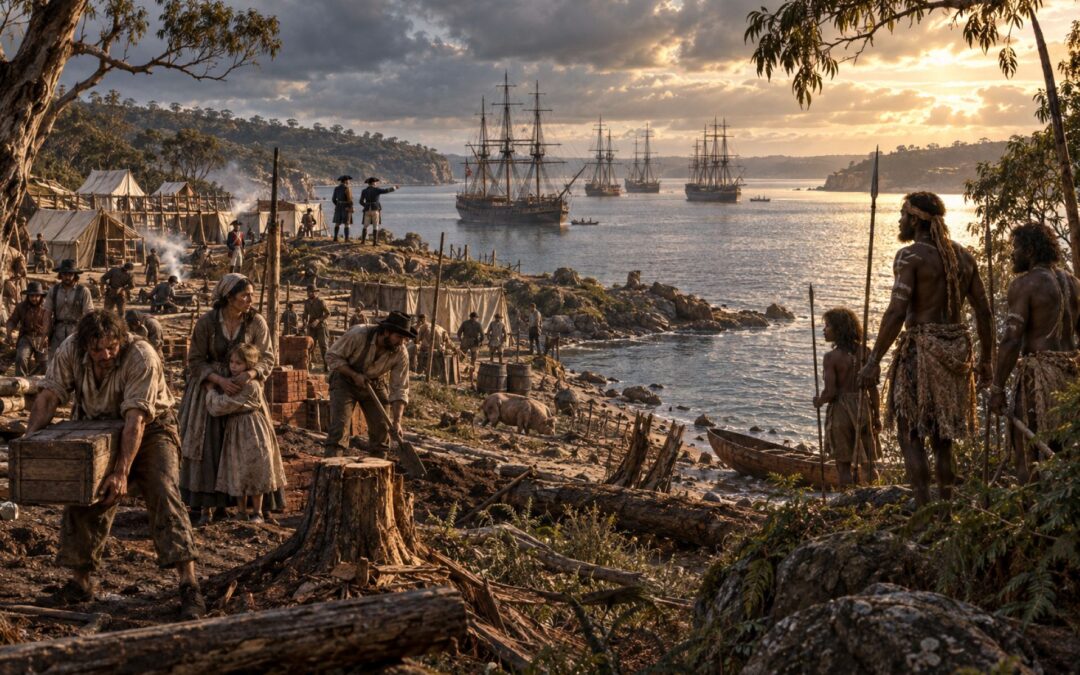
Thomas Keneally’s A Commonwealth of Thieves: The Improbable Birth of Australia tells the story of one of the strangest state-building experiments of the eighteenth century. Britain did not initially send a conventional colony of farmers, merchants, families, and investors to the eastern coast of Australia. It sent hundreds of convicted people, guarded by soldiers and administered by officials, to a place almost unimaginably distant from the government that had sentenced them. The settlement was expected to function simultaneously as prison, agricultural community, strategic possession, and self-supporting society even though its founders knew remarkably little about the land on which they intended to survive.
Keneally was drawn to precisely that contradiction. In a Publishers Weekly interview about the book, he described his fascination with Australia beginning as a deliberately created penal settlement and with the improbability of something resembling a functioning society emerging from it. His history therefore operates on two levels. It reconstructs the practical struggle to keep the settlement alive, but it also follows people whom Britain had classified as criminals as they become spouses, parents, farmers, entrepreneurs, property holders, and permanent colonists.
The transformation is inseparable from another story, however. The British did not found Sydney on empty land. They entered Aboriginal Country occupied by peoples with their own laws, kinship systems, economies, political relationships, and obligations to place. As the penal colony survived and expanded, the Eora and neighbouring communities experienced resource appropriation, abduction, violence, epidemic disease, and increasingly permanent dispossession. Keneally recognizes that collision, even if later scholarship has complicated some of his interpretations.
That double movement gives A Commonwealth of Thieves its real force. The colony becomes a remarkable social experiment for people such as Henry Kable and James Ruse precisely while it becomes a catastrophe for many of the people whose Country the newcomers occupy. This article follows Keneally’s complete narrative from Britain’s penal crisis through Arthur Phillip’s departure in 1792 and the book’s epilogue, then examines the people, ideas, historical method, later scholarship, strengths, and limitations that determine how the book should be read today. The complete historical outcomes are discussed throughout.

Britain’s Penal Crisis and the Making of the First Fleet
Keneally begins the story of Sydney not in Australia but within Britain’s eighteenth-century system of punishment. The criminal law contained a striking number of capital offences, particularly offences against property, yet execution was only one part of the machinery. Judges and the Crown could commute death sentences to transportation, allowing the state to remove offenders without killing them. For decades, many transported British convicts had been sent across the Atlantic, where their labour could be sold in the American colonies.
The American Revolution disrupted that system. Once Britain lost the colonies that had absorbed many of its transported prisoners, the government faced an increasingly visible problem. Gaols were crowded, reform was limited, and prison hulks—old ships converted into floating places of confinement—provided a grim temporary solution. The state possessed neither a modern national prison system nor an attractive replacement destination for transportation, while people continued to receive sentences that presumed transportation remained possible.
Keneally uses this background to undermine the later mythology that Australia was populated by a uniquely dangerous criminal class. Many of the people who would sail with the First Fleet had committed property crimes arising within an unequal society in which economic insecurity could be severe. Some were repeat offenders, some had committed serious crimes, and Keneally does not pretend otherwise, but a considerable number were thieves, receivers, burglars, counterfeiters, or people caught in other forms of property crime rather than the exceptionally violent monsters suggested by caricature.
Individual cases give the system its human scale. Sarah Bellamy’s story reveals the vulnerability of impoverished rural people. John Hudson is particularly startling because his encounters with the criminal justice system begin while he is still a child. Others move between precarious work, petty crime, trial, imprisonment, reprieve, and transportation in ways that make the penal system appear less like a carefully calibrated moral institution than an immense mechanism for managing troublesome poverty and property offences.
The circumstances matter because transportation did more than punish an act. It severed people from their existing social world. A sentence could separate an offender from parents, siblings, spouses, children, employment, language communities, and any realistic expectation of return. Even when transportation formally lasted a fixed number of years, the enormous distance between Britain and New South Wales meant that completing a sentence did not guarantee the means to go home.
British officials considered several possible destinations as the post-American transportation crisis deepened. Proposals connected with Africa and other imperial spaces appeared before New South Wales acquired momentum. James Matra, who had sailed with James Cook, promoted the possibilities of settlement in the Pacific, while Joseph Banks’s authority as a naturalist who had visited the Australian east coast gave Botany Bay additional credibility. Lord Sydney, Evan Nepean, and other officials participated in converting a geographical possibility into government policy.
Keneally’s interpretation places the convict problem at the centre of this decision. Britain needed somewhere to put people whom the courts continued to sentence to transportation, and Botany Bay offered distance on a scale that made escape to Britain nearly inconceivable. The colony might later provide strategic or commercial advantages, but in Keneally’s telling the immediate administrative pressure was the overflowing penal system. Later historians have placed more emphasis on the wider imperial calculations behind the choice, but Keneally’s narrative begins from the proposition that a prison crisis created the urgency.
Once the government committed itself to New South Wales, it needed someone to command a mission for which Britain possessed little precedent. Arthur Phillip was not an obvious celebrity appointment. He had a professional naval background, experience at sea, service connected with the Portuguese navy, familiarity with imperial environments, and a record suggesting competence rather than glamour. Keneally presents those qualities as crucial because the colony’s survival would depend less on theatrical leadership than on obsessive management of provisions, health, labour, ships, and conflicting personalities.
Phillip understood something that many officials planning the expedition could easily ignore from London: dead or incapacitated convicts would be useless settlers. He argued for adequate clothing, food, ventilation, medical care, and opportunities for prisoners to leave their irons and exercise during the voyage. These measures were not equivalent to modern humanitarianism, but they reflected an unusually practical recognition that punishment could not be allowed to destroy the labour force on which the settlement depended.
The same pragmatism appeared in Phillip’s opposition to reducing the convicts to a permanent slave caste. Britain was sending prisoners, but the colony would eventually contain people whose sentences expired. Phillip anticipated that those people would need a place within the new society. That distinction between temporary penal status and permanent human degradation becomes increasingly important as Keneally follows the first generation of convicts into marriage, landholding, business, and family life.
Preparation exposed serious weaknesses in the government’s scheme. A colony expected to feed itself was not supplied with a population carefully selected for agricultural expertise. Skilled workers were limited, equipment could be inadequate, and officials thousands of miles away had only uncertain knowledge of Australian soils, climate, plants, and seasons. Phillip’s insistence on improving provisions and preparations therefore became one of the first ways in which local survival requirements altered metropolitan planning.
The First Fleet ultimately consisted of eleven ships: the naval vessels Sirius and Supply, convict transports, and store ships carrying provisions and equipment. The people aboard included convicts, marines, sailors, officials, and a relatively small number of wives and children. Keneally introduces figures who will shape the narrative for years, including Judge Advocate David Collins, surgeon John White, marine officer Watkin Tench, Major Robert Ross, and Philip Gidley King.
Among the convicts, Henry Kable and Susannah Holmes become early examples of how individual stories disrupt the abstract category of “criminal.” Their relationship and their effort to remain with their child attracted public sympathy before departure. They would later marry in New South Wales and become part of Keneally’s larger argument that the transported population did not remain socially frozen in the identities assigned to them by British courts.
Mary Broad, later Mary Bryant, enters the story under very different circumstances but becomes equally important. Her relationship with William Bryant will eventually lead to one of the most extraordinary escapes in the history of transportation. At this stage, however, she is one among hundreds of people entering a system whose ultimate shape none of them can know.
The fleet sailed in May 1787. Its route took it first to Tenerife and then across the Atlantic to Rio de Janeiro, down to the Cape of Good Hope, and finally through the southern oceans toward Australia. Keneally treats the voyage as a logistical achievement in its own right because an outbreak of catastrophic disease could have destroyed the expedition before it reached the Pacific.
Conditions varied from ship to ship. Heat, sanitation, confinement, sexual relationships, rumours of mutiny, illness, childbirth, discipline, and the physical strain of months at sea shaped everyday life. Some transports, particularly the Alexander, suffered serious health problems. Even so, the mortality of the First Fleet remained dramatically lower than that of the contractor-dominated Second Fleet that would follow.
Phillip and the medical officers repeatedly tried to protect health by bringing convicts on deck when circumstances allowed and reducing unnecessary confinement in irons. The measures were practical rather than sentimental. A settlement created from transported labour could not afford to arrive with hundreds of dying people, and the later horror of the Second Fleet demonstrates how much administrative choices mattered.
Rio offered a major opportunity to restore the expedition. Phillip’s previous association with Portuguese service helped him navigate the visit, while the ships obtained fresh food and supplies. At the Cape, the fleet gathered livestock, seed, plants, and other essentials intended to transform a shipborne penal population into an agricultural settlement. Animals and plants were not secondary cargo; they were part of the colony’s intended economic future.
The final passage through southern waters reminded everyone how isolated New South Wales would be. Once the fleet left the Cape, it entered a world in which substantial resupply could not be assumed. Britain had created an expedition capable of crossing half the globe, but successful navigation was only the beginning. The real question was whether the people on those ships could convert supplies, labour, uncertain knowledge, and distant authority into a society capable of staying alive.
The First Fleet Voyage and the Founding of Sydney Cove
The first encounter with Botany Bay immediately destabilized the assumptions behind the expedition. The place James Cook and Joseph Banks had described did not offer Phillip the combination of secure anchorage, reliable freshwater, fertile ground, and defensible settlement conditions that he needed. A harbour good enough to appear promising from an exploratory voyage was not automatically suitable for supporting a permanent population of more than a thousand people.
Keneally uses this moment to widen the narrative beyond the newcomers. Botany Bay, Port Jackson, and the surrounding region were not wilderness waiting to be activated by British occupation. Aboriginal peoples had lived within and maintained these environments for an immense span of time. Their subsistence systems, fishing practices, burning regimes, social organization, ceremonial obligations, and knowledge of Country made the British idea of an unoccupied land fundamentally false even if the newcomers lacked the intellectual framework—or political incentive—to recognize Indigenous possession on its own terms.
The British initially encountered Aboriginal people through a mixture of curiosity, apprehension, performance, and misunderstanding. Europeans expected gestures or exchanges to carry meanings familiar to them, while Aboriginal people interpreted strangers entering fishing grounds, taking objects, cutting timber, or demanding access through their own systems of law and obligation. Keneally is especially interested in those moments when each side acts according to assumptions the other does not understand.
Phillip quickly concluded that Botany Bay could not support the settlement as planned. Exploring the coast to the north, he entered Port Jackson and found a harbour of extraordinary quality. Within it, a cove at Warrane offered freshwater and anchorage. The British would call it Sydney Cove, and the decision to move there became the first great local departure from the imperial plan drawn up in Britain.
The arrival of the French expedition commanded by Jean-François de La Pérouse at Botany Bay added another dimension to the moment. The Pacific was not an empty British sphere, and the presence of a rival European expedition reminded the colonists that imperial rivalry existed alongside the penal purpose of their mission. Nevertheless, the immediate concern was survival rather than geopolitics. Phillip began transferring people, equipment, and supplies to Port Jackson.
On 26 January 1788, working parties began establishing the settlement at Sydney Cove. Nothing about the place resembled the later city. Tents, rough structures, stores, areas for officials, hospital facilities, gardens, workshops, and convict accommodation gradually appeared in a landscape being altered at tremendous speed. William Dawes established his observatory, while builders and labourers tried to transform unfamiliar timber, stone, soil, and shoreline into European infrastructure.
The colony’s prison was geographic more than architectural. There was no need to surround the entire settlement with conventional walls because almost every escape route appeared impossible. The ocean separated the convicts from Britain, the interior was unknown to them, and survival outside the settlement required knowledge they generally did not possess. Distance had become one of the penal system’s most effective instruments.
Yet geography did not solve the settlement’s material problems. Agriculture proved difficult almost immediately. Some soil around Sydney Cove was unsuitable, tools were limited, labour was inexperienced, and officials had only a shallow understanding of the local seasons. Livestock was precious, crops uncertain, and the colony’s food supply remained heavily dependent on stores brought from overseas.
Relations between Phillip and the marine officers added another source of instability. Major Robert Ross and others resisted the idea that marines should simply become ordinary overseers of convict labour. They believed their military role did not automatically make them gaol warders, while Phillip needed every institutional group to contribute to the practical maintenance of the colony. That conflict between military status and colonial necessity would recur throughout the administration.
The women convicts came ashore on 6 February. A violent rainstorm accompanied a night that later entered colonial memory as a scene of sexual disorder, but Keneally is more interested in what the arrival of women meant for the society taking shape. The settlement was not going to remain a temporary male work camp. Sexual relationships, marriages, pregnancies, households, and children were already transforming a penal expedition into something more complicated.
On 7 February, the formal machinery of civil government was proclaimed. Phillip possessed extraordinary authority because distance made ordinary supervision from London impossible, yet Keneally emphasizes that authoritarian power did not automatically mean arbitrary rule. The colonial courts began operating, and the new society developed a legal identity separate from the immediate wishes of individual soldiers or officers.
One of Phillip’s most important principles concerned food. During scarcity, he insisted that officers and convicts receive the same basic ration. The equality was limited—rank still brought enormous differences in comfort, authority, and opportunity—but the principle mattered symbolically and practically. A governor who demanded sacrifices from convicts while protecting the elite from the consequences of shortage would have made an already unstable society much harder to govern.
The courts also demonstrated that convict status did not eliminate every legal right. A marine could be punished for assaulting a convict woman, and in later proceedings convicts could defend property interests through civil law. These moments are central to Keneally’s understanding of the settlement because they show a penal colony producing institutions that partially contradicted the absolute degradation implied by transportation.
Religion and marriage provided another kind of order. Chaplain Richard Johnson conducted services, marriages, and baptisms, bringing a familiar institution into a place where almost every other social structure had been disrupted. Henry Kable married Susannah Holmes, while Mary Broad married William Bryant. Such marriages did not erase coercion or poverty, but they gave individuals recognized domestic identities that British punishment had threatened to destroy.
The Bryants soon became valuable because William could fish. Food was so important that a convict with a useful skill could acquire leverage unavailable under ordinary prison conditions. Yet the privilege contained its own danger. Fishing offered access to boats, shorelines, and knowledge of the harbour, making it part of the later escape story.
Punishment remained brutal. Theft from government stores or other offences involving scarce necessities could produce floggings whose severity reminds the reader that this was still a coercive penal regime. Women as well as men could be punished physically, and the same administration capable of recognizing legal rights also inflicted violence designed to terrorize and deter.
That contradiction is essential. Keneally does not describe an early liberal democracy growing gently from benevolent principles. He describes a society in which harsh corporal punishment coexisted with legal procedures, convicts could be whipped and yet sue for property, and a governor could insist upon ration equality while exercising immense personal authority.
The British relationship with Aboriginal people meanwhile deteriorated. Settlers took fish, timber, tools, weapons, and other objects according to their own assumptions about access and possession. Aboriginal people removed British goods or resisted British intrusion according to rules the colonists frequently interpreted as theft or hostility. Neither society entered the encounter with a shared legal language.
Keneally repeatedly suggests that the British failed to grasp the extent to which the environment around Sydney was already possessed, managed, named, and socially structured. A fishing place or stand of trees that looked available to newcomers could belong within networks of customary responsibility invisible to them. The resulting conflict was therefore not produced simply by irrational fear. It emerged from two incompatible systems occupying the same physical space, with one side possessing ships, firearms, imported supplies, and the backing of an expanding empire.
By the end of the first phase, many Eora people kept their distance from Sydney Cove even though encounters continued around the harbour. Initial curiosity had not developed into the easy friendship Phillip hoped to cultivate. The colony had survived its landing, but it had already created the basic conditions for a much larger confrontation over resources, land, and political authority.
Law, Hunger, Norfolk Island, and the First Colonial Crisis
Norfolk Island became one of Phillip’s early attempts to reduce the colony’s vulnerability. Philip Gidley King led a small party to establish a settlement there, partly because the island’s pines and flax seemed potentially valuable and partly because British possession carried strategic significance. What appeared useful on paper immediately proved difficult in practice: landing could be dangerous, cultivation was hard, supplies were limited, and the tiny community had to reproduce many of Sydney’s penal and administrative structures on an even smaller scale.
King’s relationship with the convict Ann Innett also demonstrated how quickly rigid categories blurred in these isolated communities. Officers, convicts, soldiers, and settlers did not remain socially sealed off from one another. Intimacy, dependency, work, and family formation created relationships that the original penal bureaucracy could never fully regulate.
Back at Sydney Cove, the criminal law acquired its most frightening expression. Thomas Barrett was executed for stealing from government stores, while James Freeman, after receiving a reprieve, became the colony’s hangman. Keneally presents the episode as a grim reminder that the new settlement could produce new opportunities without relinquishing the violence of the legal order that had created it.
At the same time, the colony was becoming physically more permanent. James Bloodworth’s brickmaking allowed buildings to replace some of the temporary structures of the first months. Bricks seem mundane beside executions and exploration, but in Keneally’s narrative they carry tremendous significance. A society investing labour in durable buildings has begun to behave as though it expects to remain.
Food remained the more urgent measure of survival. Rations had to be reduced as stores declined, while scurvy and other illness remained persistent threats. Agriculture around Sydney failed to produce enough food, forcing Phillip to look toward better land at Rose Hill, later Parramatta, and to explore farther along the waterways and inland.
These expeditions expanded British geographical knowledge at the same time that they widened colonial intrusion into Aboriginal Country. Encounters with Aboriginal people included trade and observation but also violence. Convicts sometimes travelled beyond official control, and Phillip suspected that attacks attributed simply to Aboriginal hostility could be responses to unrecorded British aggression.
His response was initially restrained by the standards of the period. He discouraged indiscriminate retaliation and understood that uncontrolled violence by convicts could destroy any prospect of coexistence. That restraint should not be confused with recognition of Aboriginal sovereignty, however. Phillip still assumed that the British settlement had a right to occupy and transform the land.
An important legal episode involving Henry Kable illustrates the colony’s other emerging logic. Kable pursued a civil claim relating to property that had been entrusted for transport and lost. The details matter less than the institutional result: a transported convict could appear before a colonial court to defend a property interest. The penal system had carried him across the world as a criminal, yet the society created by that system was already treating him as a person capable of owning property and invoking law.
The contrast with Aboriginal people is striking. Convicts could gradually acquire rights within British legal institutions because the colonial state recognized them as subjects under its law. Aboriginal people, whose own systems of land tenure and law predated the settlement, received no equivalent recognition of territorial sovereignty. The colony could therefore be unexpectedly liberating for some transported Britons while simultaneously dispossessing people who had never consented to British rule.
By late 1788 the settlement’s inability to establish stable communication with local Aboriginal communities deeply frustrated Phillip. He concluded that the British needed an Aboriginal intermediary who could learn English and explain local society. The means chosen to achieve that goal exposed the contradiction within his diplomacy: he ordered the kidnapping of an Aboriginal man.
In December, a British party seized the man who became known to the colonists as Arabanoo. He was restrained, watched, taught English words, and gradually introduced to colonial life. The British treated him with curiosity and often with personal kindness, but those facts did not alter the essential condition of the relationship. Arabanoo had not voluntarily chosen to become a cultural intermediary; the government had imprisoned him in order to extract knowledge.
Keneally uses Arabanoo to reveal both British ignorance and the possibility of human recognition across the cultural divide. He learns from his captors while they learn from him. His reactions to punishment, food, relationships, and other aspects of colonial behaviour become evidence through which British observers attempt to understand Aboriginal society, although every surviving description is filtered through the observers themselves.
Then the colony encountered a disaster more destructive to the Eora than any armed clash yet described. In April 1789, Aboriginal people around Port Jackson began appearing with the unmistakable symptoms of smallpox. Bodies were found near camps and waterways, and communities that had seemed numerous only months earlier were suddenly devastated.
The British were shocked by what they saw. Smallpox did not spread comparably through the colonial population, whose members generally possessed greater acquired or inoculated immunity, but Aboriginal communities had no comparable recent experience of the disease. Nanbaree and a girl called Abaroo survived and were taken into the settlement, becoming part of a small group whose lives were increasingly entangled with the newcomers.
Arabanoo responded to the epidemic with compassion, helping care for sick people. He then contracted smallpox himself and died. His death ended Phillip’s first experiment in forced mediation almost exactly when the need for communication became more urgent than ever.
Keneally discusses competing possibilities for the origin of the epidemic. The First Fleet had carried variolous material used for inoculation, making a colonial source imaginable, while other theories suggested that disease might have reached southeastern Australia through older chains of northern contact. Keneally stops short of claiming that the mechanism can be known with certainty, a question that has remained historically contentious and that later research has substantially revisited.
The epidemic occurred while the British themselves remained dangerously short of food. This coincidence is essential to Keneally’s structure. The settlers could experience their own struggle as a near-famine emergency while simultaneously witnessing an Aboriginal disaster vastly more destructive than their own privations.
Scarcity also exposed the fragility of military discipline. Marines became involved in an attempt to steal from government stores, and several were executed. The episode dissolved any easy distinction between criminal convicts and morally superior custodians. Hunger could drive soldiers toward the same property crimes for which others had been transported across the world.
The Sirius had meanwhile undertaken an arduous voyage to the Cape to obtain provisions. John Hunter’s navigation and the supplies eventually returned to the colony gave Sydney additional time. Survival was not the result of one decisive breakthrough. It depended on a chain of partial solutions—ration discipline, risky voyages, shifting agriculture, Norfolk Island, improvised labour, and the willingness of people to continue operating when they could not know whether the next ship would arrive.
By the end of Book One, the British settlement has not become secure, but it has passed through crises that might easily have destroyed it. For the Eora, the same period has brought a much darker transformation. The strangers who initially seemed temporary have built permanent structures, expanded their agricultural search, taken people captive, appropriated resources, and remained in place after an epidemic has catastrophically weakened surrounding communities.
The Second Fleet and the Colony’s Fight to Survive
Book Two returns to Britain because the forces that created the First Fleet have not disappeared. Gaols and hulks are still crowded, courts continue imposing transportation sentences, and New South Wales has become the destination into which the state can keep pouring prisoners. The colony’s survival therefore encourages the very process that increases pressure on its food, housing, and medical resources.
The Lady Juliana represents one branch of that continuing system. It carries more than two hundred female convicts and becomes famous enough to acquire a reputation as a “floating brothel,” though Keneally avoids reducing the women to sexual caricatures. Shipboard relationships could involve exploitation, prostitution, practical exchange, affection, and genuine attachment, all within a context in which imprisoned women possessed limited power over their circumstances.
John Nicol’s relationship with Sarah Whitelam gives this part of the book much of its emotional force. Nicol is a sailor rather than a convict, but his attachment to Sarah crosses the institutional line separating free crew from transported prisoner. He imagines a future in which he might return with her to Britain after her sentence, revealing how quickly intimate relationships could create plans that the transportation system was designed to frustrate.
In Sydney, Phillip confronts another problem generated by distance: some convicts may have completed the terms specified by their sentences, but the colony does not always possess reliable paperwork proving the relevant dates. Even when freedom can be established, the practical question remains. A person released in New South Wales is still on the other side of the world from Britain without an automatic right to a paid voyage home.
That problem becomes one of the mechanisms by which the penal colony evolves into a settler society. An expiree may formally cease to be a prisoner but remain geographically trapped. Land, work, marriage, and independent farming can therefore become more realistic routes to a future than waiting for an unlikely return passage.
James Ruse becomes Keneally’s great example of that transition. Phillip allows him to experiment with individual farming because the colony urgently needs to discover whether private incentive can produce food more effectively than large groups of convicts working under direct government supervision. Ruse is not simply given prosperity. He has to prove that he can clear, cultivate, and support himself from difficult land.
At the same time, Phillip returns to the problem that had led to Arabanoo’s kidnapping. In November 1789, a party captures two Aboriginal men, Bennelong and Colebee, at Manly. The operation again reveals how easily Phillip’s stated desire for diplomacy turns into coercion whenever voluntary communication fails.
Colebee escapes relatively quickly. Bennelong remains for several months and becomes one of the central figures of Keneally’s book. He learns English vocabulary, supplies the British with information about relationships among Aboriginal groups, and develops a particularly significant relationship with Phillip. Yet even during captivity he is not merely a passive student being absorbed into colonial culture. He observes the British, negotiates, jokes, tests boundaries, and begins learning how the newcomers’ hierarchy operates.
The settlement, meanwhile, is approaching another food crisis. Phillip sends additional people to Norfolk Island partly to reduce the number of mouths dependent on Sydney’s shrinking stores. The decision makes sense on paper but increases the importance of maritime transport between two precarious settlements.
That dependence produces catastrophe when the Sirius is wrecked at Norfolk Island in March 1790. The loss of the colony’s principal naval vessel is potentially existential. People risk their lives salvaging provisions from the wreck, while the island community suddenly faces the prospect of being crowded with additional inhabitants and cut off from dependable shipping.
Robert Ross, previously one of Phillip’s most difficult subordinates, acquires a more complicated role during the crisis. Governing Norfolk Island forces him to confront the same arithmetic that confronted Phillip: food must be divided among people who cannot simply leave. Under extreme scarcity, communal rationing becomes less ideological than unavoidable.
Nature provides temporary relief through the enormous seasonal arrival of seabirds, but the episode reinforces one of Keneally’s recurring ideas. Colonial survival frequently depends on phenomena that British planners could not have anticipated. A government may issue instructions from London, yet the real colony is governed by reefs, rainfall, soil, animal migrations, sickness, shipwreck, and the number of days remaining before a storehouse becomes empty.
The destruction of the Sirius is not the only supply disaster. The Guardian, carrying urgently needed goods to New South Wales, strikes an iceberg in the southern ocean. Lieutenant Edward Riou and those who remain with him perform an extraordinary feat of seamanship to keep the damaged vessel afloat, but most of the cargo intended for Sydney is lost.
These accidents make the coming Second Fleet still more important. Unfortunately, the administrative system governing those transports differs disastrously from Phillip’s approach to the First Fleet. Private contractors operate under incentives that do not place the health of prisoners at the centre of the voyage, and the result is one of Keneally’s most powerful indictments of the transportation system.
The Neptune, Scarborough, and Surprize carry prisoners under conditions in which crowding, irons, inadequate food, disease, and indifference combine lethally. Keneally draws attention to methods and personnel influenced by the Atlantic slave trade. The comparison is not an assertion that convict transportation and chattel slavery were identical institutions, but it demonstrates the transfer of maritime practices designed to move captive human beings at minimum cost.
The Neptune also carries people who will later become central to colonial history. John and Elizabeth Macarthur are already marked by ambition, conflict, and expectations far removed from those of the chained convicts below decks. D’Arcy Wentworth, an Irish gentleman and surgeon whose repeated highway-robbery trials ended in acquittal, represents another social ambiguity: a man who arrives with professional status while carrying a reputation that refuses to fit the colony’s simple division between respectable rulers and criminal prisoners.
Wentworth’s relationship with the convict Catherine Crowley reinforces that ambiguity. So does the future of the Macarthurs, whose ascent will eventually place them among the most powerful colonial families. New South Wales is becoming a place in which the social identities imported from Britain remain important but no longer determine every possible future.
The Lady Juliana reaches Sydney first, followed by the supply ship Justinian, and for a moment the colony experiences relief. Then the principal Second Fleet transports appear in June 1790. What the settlers see when prisoners are brought ashore horrifies even men already familiar with Georgian punishment.
Hundreds have died during the passage, and many survivors are severely ill. Scurvy, starvation, disease, prolonged chaining, and overcrowding have reduced human beings to a condition that overwhelms the colony’s medical resources. John White, Richard Johnson, Watkin Tench, and others record disgust at the treatment.
The comparison with the First Fleet is devastating because it prevents the suffering from being dismissed as an inevitable consequence of eighteenth-century ocean travel. Phillip’s fleet had faced tremendous risks over the same basic route, yet its mortality was much lower. Administration, provisioning, incentives, and decisions about confinement made a material difference.
Keneally’s critique is therefore institutional rather than merely emotional. When contractors can economize on food or conditions while still receiving payment, human suffering becomes part of a business calculation. The Second Fleet shows what the penal system can become when the state’s desire to remove prisoners is detached from the practical requirement that those prisoners arrive capable of working and living.
Against that horror, James Ruse’s farm provides a quieter turning point. By early 1791, he has demonstrated that an individual emancipist farmer can support himself without government rations. Phillip rewards the achievement with land, and the implications are enormous.
The colony has discovered a possible route out of permanent dependence on public stores. More importantly, it has discovered a social mechanism that transforms an ex-convict into a small proprietor. The man transported as a criminal can now become part of the agricultural class needed to make the settlement permanent.
Bennelong’s presence, the Second Fleet disaster, Ruse’s farm, and the loss of the Sirius may look like separate stories, but Keneally places them within the same transition. Sydney is simultaneously learning how to feed itself, absorbing new waves of prisoners, deepening contact with Aboriginal people, and developing institutions that make staying more plausible than leaving. Every success increases the chance that Britain will send more people, and every new arrival makes the consequences of permanent colonisation larger.
Bennelong, Pemulwuy, and the Breakdown of Colonial Diplomacy
Bennelong’s escape from British custody does not end his relationship with the colony. Instead, the relationship enters a new and more ambiguous phase in which he can approach the settlers without being literally chained to them. The encounters that follow become central to Keneally’s attempt to understand whether Aboriginal and British political worlds ever came close to establishing rules for coexistence.
In September 1790, a whale stranded at Manly draws Aboriginal people to a great feast. Bennelong is present and sends word that he wants to see Phillip. The governor goes to meet him with relatively little protection, an action Keneally reads as evidence of Phillip’s confidence that personal trust can repair the violence surrounding Bennelong’s original capture.
The meeting goes badly. During the encounter, an Aboriginal man, Willemerring, drives a spear through Phillip’s shoulder. The weapon passes deeply enough to create a potentially fatal wound, and the governor has to endure a difficult return for treatment.
What matters to Keneally is Phillip’s reaction. He refuses to authorize indiscriminate retaliation. Rather than interpreting the spearing simply as proof that Aboriginal people are treacherous, he appears willing to accept that the event may belong to a system of punishment or political redress that the British do not fully understand.
The interpretation remains plausible rather than certain. The updated Australian Dictionary of Biography account of Bennelong notes continuing disagreement about the episode, including whether it represented deliberately limited payback, whether Bennelong had a significant organizing role, or whether events developed differently from later colonial assumptions. The important point is that a seemingly inexplicable attack becomes intelligible once the British stop assuming that only their own system of law can give violence a political meaning.
Phillip’s refusal to retaliate helps reopen relations. Bennelong returns more frequently to Sydney, Aboriginal visitors enter colonial spaces, gifts circulate, and some stolen or disputed objects are returned or renegotiated. Yet increased contact does not resolve the underlying question of land and resources. British settlement continues expanding whether diplomacy improves or not.
Bennelong’s personal relationships also reveal the danger of treating him merely as a symbol of cross-cultural contact. He exists within Aboriginal kinship and political networks independent of Phillip. His relationships with women including Barangaroo and Kurubarabula belong to a social world the colonists observe imperfectly and often misunderstand.
Barangaroo is especially important because she resists the tendency of colonial accounts to make Aboriginal people meaningful only when they move toward British expectations. She can be confrontational, politically alert, and unwilling to accept the settlers’ assumptions about food, behaviour, and dependence. Her presence makes Bennelong’s closeness to the colony look like one Aboriginal strategy among several rather than the inevitable direction of cultural change.
The apparent improvement in relations also coexists with continuing frontier violence. Convicts and settlers travel farther, hunt animals, fish, take resources, and sometimes attack Aboriginal people beyond the sight of officials. British records therefore capture only part of the violence that produces later retaliation.
John McEntire, Phillip’s gamekeeper, acquires an especially hostile reputation among Aboriginal people. Keneally presents evidence suggesting that his behaviour toward them has been violent. In December 1790, Pemulwuy spears him.
Pemulwuy emerges here as one of the most significant Aboriginal figures in the book. A Bidjigal man, he becomes associated with increasingly organized armed resistance to colonial expansion. McEntire’s spearing is therefore not narrated as an isolated criminal assault but as an event embedded within an escalating frontier relationship.
Phillip’s response to McEntire’s eventual death exposes one of the clearest contradictions in his Aboriginal policy. When he himself had been speared, he rejected retaliation. After the death of his huntsman, he orders Watkin Tench to lead a punitive expedition and demands Aboriginal prisoners or deaths, including the grotesque idea that heads could be brought back as proof.
Tench is appalled and succeeds in reducing the scale of what is required. William Dawes objects more directly, damaging his relationship with the administration. The expeditions themselves fail, partly because British soldiers moving through unfamiliar country are poorly equipped to capture people who know the terrain intimately.
The failure prevents a larger massacre, but it does not erase Phillip’s decision. Any portrait of him as a consistently humanitarian founder has to accommodate the fact that he could move from restrained diplomacy to collective punishment when his conception of colonial authority was challenged.
Keneally also uses this period to describe Aboriginal initiation, ritual combat, and systems of payback. These passages are important because colonial observers often labelled Aboriginal violence as random savagery while failing to understand the law governing who could legitimately punish whom, what injuries required redress, and how violence could restore social balance.
David Collins increasingly recognizes that attacks on British people cannot always be separated from prior British offences. That realization does not produce recognition of Aboriginal sovereignty, but it represents a significant shift from interpreting every act of resistance as irrational hostility. The colonists are slowly learning that they have entered a political landscape rather than an empty natural one.
The tragedy is that improved understanding does not halt expansion. Even when individual British officers become more capable of interpreting Aboriginal law, farms continue spreading, game is hunted, fishing grounds are disrupted, and settlers occupy more land. Diplomacy therefore operates inside a process whose material direction remains unchanged.
Bennelong and Pemulwuy are often retrospectively placed on opposite sides of a simple choice: accommodation or resistance. Keneally’s own narrative, despite some older assumptions, contains enough evidence to show why the division fails. Bennelong can maintain relationships with the British while remaining embedded in Aboriginal law and kinship, and violent payback can exist within diplomatic relationships. Pemulwuy’s armed resistance, meanwhile, is not evidence that other Aboriginal people accepting gifts or visiting Sydney have accepted British sovereignty.
The breakdown of colonial diplomacy is therefore not a moment when friendship suddenly becomes war. It is the recognition that personal relationships cannot resolve a structural conflict over Country. Phillip can admire Bennelong, Bennelong can exploit his access to Phillip, individuals can learn one another’s languages, and ceremonies can be understood more accurately, yet the British settlement continues taking the resources and land upon which Aboriginal independence depends.
Escape, Expansion, and the Third Fleet
As the colony grows, Keneally returns to the convicts’ most obvious dream: leaving it. Escape had always been possible in a narrow physical sense, but geography made most attempts irrational. A person could run into the bush and quickly confront hunger, unfamiliar terrain, and the absence of knowledge necessary to survive. Reaching another European settlement required crossing distances that many convicts barely understood.
William and Mary Bryant develop a more plausible plan because William’s work as a fisherman gives him maritime knowledge and access to boats. His privileged position has not made him content with colonial life. Punishment for misusing his government fishing role sharpens his resentment, and the couple begin preparing for an escape far more ambitious than simply hiding outside Sydney.
William obtains navigational equipment and information, including assistance or knowledge gained through contact with a Dutch sailor. The goal is astonishing: steal a government cutter, travel north along the Australian coast, cross dangerous seas, and reach a Dutch settlement in Timor.
The Bryants are not alone. Several other convicts join them, and the presence of Mary and William’s two young children makes the plan even more extraordinary. They are attempting to move a family and a group of fugitives across thousands of kilometres in an open boat with limited provisions.
In March 1791, they seize the cutter and leave. Keneally turns the escape into one of the book’s great adventure sequences, but he does not detach it from the penal story. The courage required to attempt the voyage demonstrates how intolerable the fugitives consider the alternatives available to them.
They travel north along the coast, navigating reefs, storms, difficult landings, hunger, and the constant possibility of drowning. Their survival requires cooperation and discipline. The very people whom British law has classified as dangerous social failures prove capable of carrying out a maritime undertaking demanding skill, endurance, and collective organization.
Eventually they reach Koepang in Timor. The escapees pose as shipwreck survivors rather than transported convicts and briefly experience the possibility that they have genuinely escaped the reach of British punishment. Their freedom depends on maintaining the deception.
The Bryant story runs alongside the beginning of the Third Fleet because Britain has no intention of reducing transportation simply because Sydney struggles to feed its population. Additional prisoners are prepared for New South Wales, and the colony’s institutional future becomes clearer. Transportation is no longer an extraordinary one-time expedition. It is turning into a continuing system.
The Mary Ann reaches the colony in comparatively good condition, but later transports continue producing sickness and death. The brutality of the Second Fleet creates scandal, yet the administrative lesson is unevenly absorbed. Keneally’s wider point is that the transportation system can produce both relatively successful voyages and catastrophic ones depending on incentives, provisioning, discipline, and medical practice.
Among the new arrivals are Irish convicts whose political and cultural circumstances differ from those of many earlier prisoners. Some are connected with oath-bound organizations or political anxieties, while language differences can complicate colonial administration. Their presence begins broadening New South Wales beyond the largely English penal society of the First Fleet.
Stories circulate among some Irish prisoners about escaping overland to China. The fantasy is geographically absurd, but its persistence reveals how little many transported people know about the continent on which they have been deposited. They understand New South Wales as somewhere far from Britain without necessarily possessing a reliable map of what surrounds it.
Other figures arrive whose later importance far exceeds their initial status. George Barrington had become a celebrity thief in Britain, and stories accumulated around him even before he reached Australia. Keneally carefully separates some of the legend from the historical man, showing how the colony’s inhabitants could become characters in metropolitan mythology.
The Gorgon brings supplies and personnel while also preparing to carry marines and other First Fleet figures back toward Britain. Their departure forces choices. Some soldiers can leave, some may transfer into the New South Wales Corps, and some can become settlers. Once again the colony converts what began as temporary service into permanent residence.
D’Arcy Wentworth’s trajectory develops in the same direction. He moves into medical and administrative importance, bringing with him a biography that would have made him socially ambiguous in Britain. In New South Wales, usefulness and opportunity can reorder reputation.
The Bryants’ freedom in Timor does not last. Their story becomes known, and they are arrested. Captain Edward Edwards, involved in the search for the Bounty mutineers, takes custody of them during the long process that will eventually return the fugitives toward Britain.
The journey becomes a tragedy. The family that survived an almost impossible escape cannot survive the diseases and hardships of recapture and return. Their infant son Emmanuel dies. Later, their daughter Charlotte also dies, and William Bryant dies before Mary reaches England.
Mary eventually arrives back in Britain having lost her husband and children. Her case attracts the interest of James Boswell, who helps turn her into a public cause. The woman transported across the world, who escaped by open boat and survived recapture only to lose her family, ultimately receives a pardon.
Keneally does not convert her story into uncomplicated triumph. Mary survives, but the price of survival is devastating. Her narrative exposes the emotional cost hidden by administrative categories such as “transported,” “escaped,” “recaptured,” and “pardoned.”
While the Bryant drama unfolds, the colony itself becomes harder to escape because it is becoming more substantial. Agricultural settlement expands around Parramatta, Prospect, and Toongabbie. Watkin Tench surveys farms whose success varies dramatically. Some settlers prove energetic and productive; others struggle with poor soil, limited skill, illness, or insufficient labour.
The mixed results are important. James Ruse has proved that private farming can work, but Keneally does not present him as discovering a universal formula. Agriculture remains dependent on local knowledge, rainfall, land quality, work, tools, and access to government support.
Private trade also develops. Although government stores continue dominating the economy, imported goods, ships from India and elsewhere, and private enterprise begin creating spaces outside strict ration distribution. The penal settlement is slowly acquiring something resembling a market society.
Every acre placed under European cultivation, however, intensifies dispossession. What British officials describe as granting land involves assigning exclusive rights over Country that Aboriginal people have never ceded. The transition from government camp to private property therefore transforms the frontier conflict. A tent settlement might conceivably appear temporary; fenced farms, livestock, roads, and legal grants declare permanence.
Barangaroo’s story gives that transformation a deeply personal dimension. Pregnant and resistant to some aspects of colonial interference, she insists upon giving birth according to her own practices rather than the expectations of British observers. Her infant daughter, Dilboong, dies, and Barangaroo later dies as well.
Bennelong’s grief and the funerary practices surrounding her death allow Keneally to present Aboriginal emotional and ceremonial life more fully than the early colonists’ simplistic labels normally permit. The episode also reminds the reader how much of the Aboriginal story reaches us through the fragmentary observations of outsiders who understood only portions of what they saw.
Pemulwuy continues appearing within the expanding frontier. Resistance is no longer confined to immediate Sydney Cove but develops wherever colonial activity intrudes into hunting, fishing, and living spaces. The westward movement of settlement makes conflict more geographically extensive.
One especially disturbing detail complicates Phillip’s reputation further. He expresses interest in obtaining an Aboriginal skull for Joseph Banks or British scientific purposes. The request belongs to an imperial culture in which human remains could be collected as anatomical specimens, but historical context does not make the act morally neutral. It demonstrates how easily European curiosity about Aboriginal people could coexist with a profound refusal to treat their bodies and sovereignty as inviolable.
The arrival of the Pitt in 1792 brings Major Francis Grose, who will assume authority after Phillip’s departure. It also brings more sickness, reinforcing the fact that transportation remains lethal even as the colony becomes more secure.
Richard Johnson continues his religious and welfare work, but the social order developing around him is increasingly driven by land, labour, and private accumulation. Former convicts receive grants. Officers and future elites imagine larger estates. Government begins creating the legal landscape from which a settler economy will expand.
The Third Fleet period therefore marks an important transition in Keneally’s story. Sydney is still dependent, hungry, and violent, but it is no longer merely the precarious beachhead of 1788. Enough people now have reasons to stay, enough land has been cleared, enough institutions have taken root, and enough new transports keep arriving that the experiment is becoming self-perpetuating.
Phillip’s Departure and the Fate of the “Thief Colony”
By 1792 the settlement remains vulnerable enough that hunger cannot be dismissed as a thing of the past. Seed and food theft continue because scarcity remains real. Agricultural production is improving, but local farming has not yet completely freed the colony from dependence on ships arriving from elsewhere.
New supplies gradually change that balance. Vessels from Bengal and other parts of the imperial world bring rice, grain, livestock, and commercial goods. The colony’s geography is beginning to look different: rather than a terminal outpost connected only to London, Sydney is becoming part of a wider Indian Ocean and Pacific network of shipping and exchange.
Private agriculture expands alongside government cultivation. Former convicts receive land, settlers accumulate livestock, and people who once worked only under state coercion have a direct incentive to improve their own holdings. Keneally repeatedly emphasizes the obvious but transformative discovery that people work differently when the results of their effort can belong to them.
That does not mean the penal system disappears. New convicts continue arriving, punishments continue, and coercive labour remains central. What changes is that penal New South Wales begins acquiring a second social layer composed of expirees, private farmers, merchants, soldiers considering settlement, officials building careers, and families whose children have no practical connection to Britain beyond imperial citizenship.
Arthur Phillip has spent almost five years managing this transformation, and the effort has damaged his health. Chronic illness makes the prospect of remaining increasingly difficult. He has repeatedly requested permission or contemplated returning to Britain, and by late 1792 he decides that he cannot continue.
His departure occurs before the colony is fully secure. That fact matters because it prevents the story from turning into a neat founder narrative in which Phillip stays until his creation is triumphantly complete. New South Wales remains hungry, politically fragile, and deeply dependent on imperial supply, but it has crossed a threshold beyond which abandonment has become less likely than continued expansion.
By the time Phillip leaves, thousands of acres have been granted or cultivated, livestock numbers have increased, and private farming has begun supplementing public agriculture. The colony contains people whose futures depend upon its permanence. Britain is still sending transports, ensuring that the population will continue growing even if officials in Sydney might prefer a pause.
On 11 December 1792, Phillip formally leaves the government he has built. Bennelong and Yemmerrawanne decide to travel with him to Britain. Their decision turns Phillip’s return into something more than the conclusion of a governor’s term: two Aboriginal men who have experienced invasion, captivity, diplomacy, violence, and growing familiarity with the British now enter the imperial centre itself.
The Atlantic leaves Sydney and eventually carries the party around Cape Horn and into the Atlantic. When Phillip, Bennelong, and Yemmerrawanne land at Falmouth in 1793, the geographical reversal is striking. The empire that had projected prisoners and soldiers toward New South Wales now receives two men from the Country it has begun colonizing.
Keneally’s epilogue then demonstrates why the story cannot end with Phillip’s ship disappearing over the horizon. The real test of the “Sydney experiment” lies in what happens to the people it has gathered. Many biographies continue in ways that would have seemed impossible when the First Fleet sailed.
Sarah Bellamy and James Bloodworth become associated with a more established colonial family life. Bloodworth’s practical usefulness as a builder contributes to a reputation larger than his original convict status. Their trajectory exemplifies the process through which labour and domestic stability can produce social standing.
James Ruse remains identified with the breakthrough toward private self-supporting agriculture and later moves toward the Hawkesbury. His significance exceeds the size of his first farm because he provides an early institutional answer to the problem of feeding expirees without maintaining them permanently from government stores.
Henry Kable undergoes an even more dramatic transformation. The convict who had struggled merely to keep his family together becomes a businessman and property holder. He participates in trade, accumulates assets, and acquires a position in the colony that directly contradicts the social identity imposed on him at transportation.
Mary Haydock, better known later as Mary Reibey, becomes one of the most famous examples of convict reinvention. Transported as a young offender, she eventually becomes a substantial merchant and businesswoman. Her later prominence demonstrates how radically colonial circumstances could reorder the relationship between origin, reputation, gender, and opportunity.
D’Arcy Wentworth develops into an important medical, administrative, and commercial figure. John and Elizabeth Macarthur rise into the colonial elite and become deeply associated with the pastoral economy and political power. George Johnston and Esther Abrahams build prosperity and eventually formalize a relationship that began within the radically unequal circumstances of transportation.
George Barrington also acquires a colonial identity very different from his metropolitan celebrity as a thief. Keneally is careful with the legends surrounding him, but his later association with official responsibility contributes to the book’s recurring inversion of respectable and criminal categories.
The Aboriginal trajectories are far darker. Nanbaree survives the smallpox epidemic and later works as a seaman, showing that Indigenous lives after 1788 cannot be summarized only as disappearance. Yet the broader environment around him is one of demographic catastrophe, expanding settlement, and intensifying pressure on Country.
Pemulwuy continues resisting colonial expansion. He is shot, survives, escapes custody, and becomes a persistent target of British authorities. Eventually he is killed, and his head is sent to Joseph Banks in Britain. The fate of his body gives grotesque material form to the colonial mixture of warfare, scientific collecting, and dehumanization.
Bennelong’s experience in Britain is complicated. Yemmerrawanne dies there, while Bennelong eventually returns to Sydney. Keneally inherits an older interpretation in which the returned Bennelong becomes increasingly alienated, caught between societies and diminished by alcohol and violence. Later scholarship has substantially challenged that portrayal, but within Keneally’s epilogue it reinforces the tragic side of the colony’s success.
Philip Gidley King later becomes governor of New South Wales. Watkin Tench continues his military career and leaves some of the most important written records of the founding years. Other marines, officials, convicts, and sailors disperse into lives that connect the tiny settlement of 1788 to a much larger nineteenth-century colonial society.
Phillip himself does not retire into obscurity. He resumes naval service, gains seniority, remarries, and remains professionally connected to the world from which he had temporarily disappeared. Later strokes damage his health, and he dies in 1814.
The epilogue transforms the meaning of the entire book. If the narrative ended in 1792, the colony could still appear primarily as an extraordinary survival story. By following its people forward, Keneally shows that survival has created durable social consequences.
For former convicts such as Kable, Ruse, and Reibey, the “thief colony” can become a place of reinvention. Britain intended transportation as exclusion, yet New South Wales creates conditions under which some excluded people acquire property, status, and descendants embedded in a new society.
For Aboriginal people, that same permanence means the opposite. Farms, land grants, imported livestock, new roads, additional transports, and a growing settler population turn an initially precarious camp into a colonial system capable of taking more Country every year. Keneally’s ending therefore refuses a single verdict of triumph. The experiment succeeds, but what counts as success depends entirely on whose history is being measured.
Arthur Phillip: Pragmatic Founder and Contradictory Humanitarian
Keneally’s book possesses a huge cast, but Arthur Phillip supplies its principal administrative spine. The colony’s first years make narrative sense because the reader can repeatedly return to one question: what will Phillip do next? That focus is justified to a considerable degree because his powers were extraordinary and many survival decisions did depend upon him, although it also creates the risk of treating structural developments as the achievements of one unusually competent man.
The broad biographical record behind Keneally’s portrait is consistent with the Australian Dictionary of Biography account of Arthur Phillip: he was an experienced naval officer whose career included service outside the conventional path that might have produced a more famous appointment. His value to New South Wales lay precisely in professional adaptability. He was not selected because he embodied a romantic vision of nation-building but because the government needed someone capable of commanding ships, soldiers, prisoners, administrators, and an unknown settlement thousands of miles from ordinary supervision.
Phillip’s strongest quality in Keneally’s account is pragmatic intelligence. He recognizes before departure that neglecting prisoner health would sabotage the colony. He argues for adequate provisions, permits greater movement aboard the transports where possible, and resists unnecessary use of irons. The relatively low mortality of the First Fleet compared with the Second Fleet strongly supports Keneally’s emphasis on competent preparation.
The same pragmatism shapes his approach to rationing. During food crises, Phillip shares reductions across rank rather than preserving officers at full allowance while convicts starve. It is difficult to overstate the political importance of that decision. The colony remains profoundly hierarchical, but the governor accepts that survival requires a minimum sense that scarcity is a common condition rather than punishment directed only downward.
His treatment of convict status is similarly unusual. Phillip does not imagine every transported person as permanently contaminated by criminality. Once sentences expire, the colony needs farmers and householders. The creation of opportunities for Ruse and others emerges from necessity, but it also produces a social order in which legal identity can change.
This flexibility separates Phillip from a purely custodial governor. He is trying to create a society capable of functioning after punishment. Courts operate, marriages are encouraged, private cultivation develops, and some convicts can defend legal interests. Keneally is persuasive when he argues that these decisions helped prevent New South Wales from becoming merely an enormous, permanently militarized prison camp.
Yet the word “humanitarian” becomes dangerous if it is detached from the limits of Phillip’s moral universe. His concern for convicts does not amount to opposition to transportation. He administers a system built on coerced exile and corporal punishment, approves executions, and uses flogging as a normal instrument of order. Comparative moderation within Georgian punishment is not the same thing as modern liberal governance.
The contradiction becomes sharper in his dealings with Aboriginal people. Phillip often tries to prevent indiscriminate settler violence, discourages random retaliation, seeks communication, and refuses vengeance after his own spearing. These choices are real and distinguish him from administrators who might have answered resistance with immediate massacre.
However, his desire for communication repeatedly becomes coercive when Aboriginal people do not cooperate on British terms. Arabanoo is kidnapped. Bennelong and Colebee are kidnapped. The purpose may be diplomacy, but the method is detention.
Phillip’s assumption that the British have a right to remain is more fundamental still. He never negotiates a transfer of sovereignty or land. Farms expand, trees are cut, animals are hunted, fishing grounds are disrupted, and British law begins assigning private property over Country already governed through Aboriginal relationships and obligations.
The punitive expedition ordered after McEntire’s death exposes the limits of Phillip’s restraint. His response to his own spearing is impressive precisely because he refuses collective vengeance. His later willingness to kill or capture Aboriginal men after McEntire’s spearing demonstrates that such restraint is contingent rather than principled recognition of Aboriginal jurisdiction.
His interest in an Aboriginal skull pushes the contradiction further. Scientific curiosity, Enlightenment classification, and colonial possession can coexist inside the same administrative worldview. A governor may regard Aboriginal people as intellectually interesting and capable of friendship while still participating in a system that treats their bodies as objects available for collection.
Keneally ultimately admires Phillip, and that admiration is understandable. Without competent provisioning, equal rationing, logistical persistence, agricultural experimentation, and refusal to indulge every demand for violence, the settlement might have suffered even more catastrophic outcomes. Phillip’s leadership mattered.
The fairest assessment, however, is not that Phillip was either benevolent founder or hypocritical tyrant. He was a comparatively pragmatic and at times compassionate administrator operating inside, and actively enforcing, an imperial project that did not recognize Aboriginal consent as necessary. His virtues shaped the manner in which colonisation proceeded; they did not remove the colonial nature of what he was doing.
That distinction is crucial to understanding Keneally’s achievement and limitation. The book is strongest when it allows Phillip’s contradictory decisions to remain visible. It is weaker whenever admiration for his administrative decency threatens to turn the survival of British Sydney into proof of the righteousness of the project itself.
From Convicts to Settlers: Class, Gender, Law, and Social Mobility
The title A Commonwealth of Thieves works because Keneally gradually makes the category “thief” unstable. The British government transports people after defining them primarily through their crimes. New South Wales forces the same individuals to acquire new identities because a functioning settlement cannot be built entirely out of prisoners understood only as objects of punishment.
The process begins with labour. The colony needs brickmakers, farmers, fishermen, carpenters, servants, boatmen, and workers capable of improvising skills under unfamiliar conditions. A convict who possesses useful knowledge can become more important to immediate survival than a socially respectable person whose rank contributes little to food production.
James Bloodworth is one example. Building makes him valuable because permanent structures are necessary. William Bryant’s fishing knowledge gives him privileges because the colony needs food. James Ruse receives an opportunity to cultivate independently because Phillip needs evidence that a former convict can become self-supporting.
Private incentive alters the social logic of labour. Convicts working entirely for government may experience effort only as coerced obligation, while people cultivating land assigned to them possess an obvious reason to improve it. Keneally does not romanticize the difficulty of farming, but he treats the movement from compulsory gang labour toward personal holdings as one of the settlement’s most consequential transitions.
Law contributes to the same transformation. Henry Kable’s ability to pursue a civil claim is symbolically important because it recognizes property rights in a man whom British justice has forcibly transported. That right does not make him equal to a free officer, but it establishes that conviction has not permanently removed his legal personality.
Marriage and family formation deepen the shift. Kable and Susannah Holmes begin their colonial life under the stigma and coercion of transportation, yet their relationship becomes part of a recognized household. Mary and William Bryant marry while planning a future fundamentally opposed to the one the government has assigned them.
Women’s role in the settlement cannot therefore be reduced to the sexual disorder that fascinated some chroniclers. Convict women work, form households, bear children, trade, negotiate relationships, endure punishment, and eventually participate in business and property ownership. Their vulnerability to male power is profound, but the colony cannot become a permanent society without them.
Esther Abrahams’s later prosperity with George Johnston demonstrates how colonial intimacy could destabilize British class boundaries. Mary Reibey’s later commercial success goes further still. Her trajectory from transported young offender to prominent merchant would have been difficult to imagine within the metropolitan hierarchy that originally criminalized and expelled her.
D’Arcy Wentworth provides the reverse example. He arrives with the education and professional credentials of a gentleman despite the cloud created by repeated criminal accusations. In New South Wales, his usefulness as a surgeon and administrator gives him opportunities to convert ambiguous British status into colonial power.
John and Elizabeth Macarthur reveal that traditional hierarchy does not disappear; it is reconstructed. Their rise shows how free and military settlers can accumulate land and influence on a scale unavailable to most former convicts. The new society offers mobility, but it does not become egalitarian.
The position of expirees creates the institutional foundation for this change. Once a sentence ends, Britain does not automatically provide a return passage. A former convict may therefore be legally free but geographically stranded. The colony solves that problem by converting freedom into settlement: land, work, family, and local opportunity make remaining possible.
This development gives transportation an unintended outcome. Britain imagines distance as part of punishment, but the same distance weakens the ability of British class reputation to follow people indefinitely. A transported thief who becomes a competent farmer or merchant can gradually acquire a social identity based on colonial usefulness and property rather than the trial that first sent them there.
The possibility should not be exaggerated. Many convicts remain poor, exploited, sick, punished, or dependent. Transportation destroys families and can subject prisoners to years of violence and insecurity. The Bryant story alone prevents any sentimental claim that New South Wales simply gave criminals a second chance.
Nor does convict mobility make the colony socially progressive in a universal sense. Former British prisoners can obtain land because the state is willing to distribute Aboriginal Country. An emancipist’s escape from one hierarchy may therefore depend on the extension of another.
Keneally’s “commonwealth” is consequently an ironic social formation. Convicts, soldiers, officials, and merchants create a society in which the original moral labels become unreliable. Respectable contractors can behave with murderous negligence, soldiers can steal food, convicted thieves can become prosperous citizens, and administrators committed to legal order can participate in dispossession.
That irony is one of the book’s most enduring insights. Colonies do not merely reproduce the society that sends them. New conditions rearrange status, incentives, relationships, and opportunity, even while old structures of power survive in altered forms.
Eora Country, Aboriginal Law, and the Limits of the Colonial Archive
Keneally gives Aboriginal people far more sustained attention than many older popular accounts of the First Fleet, but the structure of his evidence imposes an unavoidable limit. The surviving written archive is overwhelmingly British. Officers, surgeons, sailors, and officials recorded Aboriginal actions, words, ceremonies, and relationships, but those observations passed through European languages and assumptions before reaching the historian.
A responsible reading therefore has to distinguish behaviour that the sources document from motives that Europeans inferred. Aboriginal people around Port Jackson were not one undifferentiated population, nor did they collectively make a single decision to resist or accommodate. Kinship, Country, personal history, ritual law, local conflict, and strategic judgment could produce very different responses to the newcomers.
Arabanoo and the Violence of Forced Mediation
Arabanoo’s story condenses one of the central contradictions in Phillip’s Aboriginal policy. Phillip recognizes that the British cannot understand the people around them without sustained communication. Yet when voluntary contact does not produce the relationship he wants, he authorizes abduction.
Arabanoo is therefore simultaneously an individual whom British observers come to respect and a prisoner created by colonial policy. He is restrained because his captors fear escape. They teach him words, ask questions, watch his reactions, and use him as a source of information about a society they have entered without invitation.
The personal warmth that later develops does not erase the violence of the beginning. This distinction matters because benevolent intention can otherwise become a way of sanitizing coercion. Phillip wants knowledge rather than Arabanoo’s destruction, but he still assumes the right to seize another human being for governmental purposes.
Arabanoo’s response to the smallpox epidemic gives him a moral presence that exceeds his function as intermediary. He assists the sick and then contracts the disease himself. His death makes the episode especially devastating because the man abducted to help bridge two societies dies from the catastrophe engulfing his own people shortly after British settlement.
Keneally uses Arabanoo to imagine the possibility of mutual human recognition, and that is one of the book’s most moving impulses. The limitation is that Arabanoo’s interior perspective remains largely inaccessible. We know him through people who observed him under conditions they created.
Bennelong Beyond the “Tragic Intermediary”
Bennelong becomes much more than a replacement for Arabanoo. He is Wangal, embedded in networks of kinship extending across the Sydney region, and his political life cannot be reduced to his relationship with Phillip. His capture in 1789 begins another coercive encounter, but he gradually develops an ability to move between Aboriginal and colonial spaces that neither side completely controls.
The British value him because he supplies information about language, relationships, ceremonies, places, and law. Bennelong gains information in return. He learns how British authority is organized, which individuals possess power, how goods circulate, and how personal relationships might be used strategically.
His departure from captivity demonstrates that familiarity does not equal assimilation. When he later reappears, he does so on different terms. The relationship with Phillip becomes more reciprocal because Bennelong can leave.
The spearing of Phillip illustrates the complexity. Older narratives often presented the event either as inexplicable treachery or as a straightforward ritual punishment. More recent scholarship, including the 2026 Australian Dictionary of Biography reassessment of Bennelong, stresses that the surviving evidence supports multiple interpretations and does not justify treating Bennelong’s precise role as certain.
Whatever the exact orchestration, the aftermath is revealing. Bennelong does not vanish into permanent hostility, and Phillip does not answer with massacre. Relations continue, suggesting that the spearing can coexist with diplomacy inside a political world more complicated than the British categories of friendship and enemy.
Bennelong’s relationship with Barangaroo also resists the image of a man simply moving toward British life. Barangaroo remains strongly rooted in her own expectations and frequently rejects colonial behaviour. Through their relationship, Keneally shows Bennelong inhabiting Aboriginal social obligations even while he becomes unusually familiar with the settlement.
The trip to Britain is perhaps the most dramatic expression of that mobility. Travelling with Phillip and Yemmerrawanne exposes Bennelong directly to the imperial society from which colonisation originates. In older historical storytelling, this journey often becomes the beginning of a tragedy in which he returns psychologically stranded between two worlds.
That interpretation has increasingly been challenged. Later evidence emphasizes Bennelong’s continuing kinship relations, his residence at Kissing Point, his family life after returning, his participation in Aboriginal Law, and his ongoing status among his own people. The existence of substantial mourning and commemorative activity after his death is difficult to reconcile with the notion that he simply became a rejected outcast.
Bennelong is better understood as someone navigating a transformed political landscape rather than as a failed experiment in Europeanization. He could engage with governors, use British resources, travel to England, and maintain relationships with settlers while continuing to participate in Aboriginal networks.
This reading changes the moral geometry of Keneally’s narrative. Bennelong is not valuable because Phillip manages to “civilize” him. He is historically important because he responds creatively to an invasion that has created new dangers, opportunities, and obligations without abolishing his pre-existing identity.
Barangaroo, Pemulwuy, and Different Forms of Resistance
Barangaroo matters partly because she makes the inadequacy of a simple accommodation narrative impossible to ignore. She is frequently unwilling to adapt her behaviour to colonial expectations and appears acutely conscious of the danger of dependence. Her resistance can involve food, presence, social relationships, and the terms on which she engages with British people.
Her choices demonstrate that resistance is not limited to armed attack. Refusing colonial norms, maintaining ceremonial practices, controlling one’s body and relationships, and declining certain forms of dependence can all express political autonomy. Her childbirth and later death become especially important because they reveal a woman whose life is not reducible to Bennelong’s biography even though the written archive often reaches her through male observers.
Pemulwuy represents a more explicitly military form of opposition. His attacks occur as colonial settlement spreads and as people such as McEntire acquire reputations for violence against Aboriginal people. Keneally’s narrative makes it increasingly difficult to describe such resistance as unprovoked criminality.
McEntire’s spearing becomes a turning point because Phillip interprets it as requiring severe retaliation. The punitive expedition order shows how quickly British officials can move from acknowledging Aboriginal law to denying it whenever Indigenous punishment targets someone inside the colonial system.
Pemulwuy’s later survival after being shot, escape from custody, and continued resistance make him a figure of extraordinary persistence. His eventual death and the removal of his head to Britain expose the violence beneath scientific and administrative claims to civilization.
It would still be misleading to convert Barangaroo, Bennelong, and Pemulwuy into three neat ideological positions. Individuals could use different strategies at different times, and Aboriginal communities were not politically homogeneous. Diplomacy, avoidance, ritual punishment, exchange, refusal, and armed resistance could overlap.
The most important analytical shift is therefore away from judging Aboriginal people according to how cooperative they were with settlement. The central question is how people attempted to preserve life, Country, kinship, status, and law under rapidly changing conditions. Once that question replaces the colonial measure of “friendliness,” much of the apparent inconsistency in British accounts becomes easier to understand.
Survival as a System: Food, Labour, Shipping, Land, and Empire
Keneally’s history repeatedly returns to material questions because the survival of Sydney depends less on abstract national destiny than on whether people can eat. Food, ships, tools, labour, livestock, soil, and weather collectively form the hidden machinery of the narrative. The colony remains alive because enough parts of that machinery keep functioning at critical moments.
The First Fleet’s relatively careful provisioning creates the initial margin. Supplies obtained at Rio and the Cape extend it. Phillip’s ration policies preserve social order when stores shrink, but rationing can only redistribute what already exists. It cannot create food.
Agriculture is therefore the fundamental long-term problem. Sydney Cove itself performs poorly, forcing attention toward Rose Hill and Parramatta. Clearing unfamiliar land requires enormous labour, and the first crops must be grown by people learning simultaneously about soil, rainfall, planting seasons, tools, and local pests.
Government gang labour can clear and cultivate, but it does not automatically maximize effort. James Ruse’s experiment demonstrates how the structure of incentives matters. When people can work toward their own independence rather than simply complete assigned labour, productivity can change.
Ships repeatedly buy time while agriculture develops. The Sirius voyage to the Cape, the arrival of supply vessels, and later connections with India and the wider imperial world prevent local agricultural weakness from becoming immediate extinction. Conversely, the Sirius wreck and the Guardian disaster show how one maritime accident can threaten the entire settlement.
Norfolk Island belongs within the same survival system. It is imagined as a source of valuable materials and an additional agricultural base, but its difficult landing conditions and dependence on shipping reveal the danger of assuming that expansion automatically creates security. When Sirius is wrecked there, the supposed auxiliary settlement becomes another population requiring rescue and provisions.
The Second Fleet proves that people themselves are also part of the logistical system. A transport arriving with hundreds of sick prisoners does not merely produce a humanitarian crisis. It reduces productive labour while increasing demand for food, medicine, shelter, and care.
This is why Keneally’s comparison between the First and Second Fleets is so important. Maritime administration determines the physical condition in which new labour reaches the colony. A government that treats convicts as disposable during transport weakens the very settlement meant to absorb them.
Livestock forms another long-term component. Cattle, pigs, sheep, and other animals represent food, breeding stock, wealth, and the transplantation of a European agricultural economy. Lost or expanding herds also begin altering the environment outside direct colonial control.
Land grants eventually connect all these elements. Granting land to expirees encourages private cultivation, reduces dependence on government rations, and gives former prisoners a reason to remain. The policy therefore solves food, labour, and population problems at once.
For Aboriginal people, the same solution is dispossession. A British land grant is not simply an economic incentive; it is a legal declaration that the colonial state can assign exclusive ownership over Country. The more successful private farming becomes, the harder the colony is to remove and the more land it requires.
The imperial economy finally reduces Sydney’s isolation. Ships from India and elsewhere carry food and goods, while private trade creates alternatives to the government store. The colony begins surviving not because it has achieved complete autarky but because it has become connected to larger networks of imperial commerce.
Keneally’s survival story is therefore more persuasive when understood as a system rather than as Phillip’s personal triumph. Leadership matters, but survival emerges from repeated interactions among good decisions, individual skill, environmental opportunity, shipping luck, convict labour, imported capital, imperial persistence, and the increasing occupation of Aboriginal land.
That complexity also makes the colony’s eventual success less miraculous. Each crisis produces an institutional adaptation: equal rationing, new farmland, supply voyages, Norfolk Island, private farming, land grants, external trade. By 1792 enough of those adaptations have accumulated that New South Wales can plausibly continue without the man who governed it from the beginning.
Keneally’s Narrative Method: Journals, Mini-Biographies, and Novelistic History
Keneally approaches history with the instincts of a novelist but the documentary apparatus of a historian. Rather than organizing A Commonwealth of Thieves around abstract themes, he builds it from episodes, people, journals, voyages, court cases, meals, punishments, relationships, deaths, and administrative decisions. The result is a history that often feels lived before it feels analyzed.
This quality was noticed immediately by reviewers. Publishers Weekly described the book as a “novelistic chronicle” built around vivid miniature portraits, while also observing that the immense level of detail can sometimes feel dutiful. That combination captures both the book’s strongest narrative quality and one of its weaknesses.
Keneally relies heavily on contemporary written accounts. Watkin Tench, David Collins, John Hunter, John White, Philip Gidley King, William Bradley, Ralph Clark, John Easty, John Nicol, John Nagle, official dispatches, court records, and later memoirs allow him to shift repeatedly among viewpoints.
These sources give the book texture. Instead of merely stating that the colony was hungry, Keneally can describe what people ate, how rations changed, who stole food, how officials reacted, and what ships they watched for on the horizon. Instead of saying relations with Aboriginal people were complicated, he can reconstruct individual encounters in which gestures, gifts, fear, misunderstanding, and violence collide.
The method also prevents the convicts from becoming an anonymous mass. Keneally repeatedly pauses the larger narrative to tell the history of a particular thief, sailor, woman prisoner, marine, surgeon, or farmer. Some figures remain in the book for only a short time, but their stories make the penal system tangible.
Kate Grenville emphasized exactly this strength in her Guardian review of the book, praising Keneally’s ability to make a coherent sequence from very different contemporary voices while keeping the documentation visible enough for interested readers to investigate further. His extensive notes and bibliography matter because the prose itself often moves with the freedom of narrative fiction.
That freedom produces a methodological tension. Keneally sometimes speculates about what a person must have felt, probably thought, or might have understood. Such phrases can bridge gaps in records and make historical figures psychologically legible, but they also move beyond what documentation can strictly prove.
The danger is especially acute when the subject is Aboriginal. British officers left enough material for historians to reconstruct parts of Bennelong’s life, but an apparently reasonable inference about his feelings remains an inference filtered through colonial evidence. Keneally usually signals uncertainty, yet his narrative fluency can make speculation feel more settled than it is.
The episodic structure creates another trade-off. Because readers accompany the settlement almost day by day, they understand its fragility with unusual immediacy. The cost is that larger questions—imperial strategy, political economy, the comparative history of punishment, or the full structures of Aboriginal sovereignty—sometimes receive less systematic attention than an anecdote about one sailor or court case.
Keneally’s humour keeps the density readable. Georgian sexual attitudes, military vanity, bureaucratic absurdity, and human self-importance frequently invite irony. The humour usually works because it does not erase suffering; instead, it prevents the historical actors from becoming solemn museum figures.
His prose is at its strongest when a small incident reveals a larger system. A missing ration demonstrates political legitimacy. A marriage demonstrates social permanence. A civil suit demonstrates the unstable meaning of convict status. An escaped cow becomes evidence that ecological change is moving beyond colonial control.
The book’s two-part structure also produces an effective escalation. Book One establishes the colony and brings it close to collapse. Book Two shows that survival does not simplify the experiment but multiplies it: more convicts, worse transports, deeper Aboriginal entanglement, private farms, escape, commerce, land grants, and finally succession after Phillip.
The epilogue supplies the structural payoff. Keneally has spent hundreds of pages introducing people who might otherwise seem like temporary fragments of penal administration. By showing their later lives, he proves that the colony has generated biographies rather than merely sentences.
The same epilogue exposes the imbalance in what can be recovered. Former convicts often leave traces through property, business, marriage, court records, and official positions. Aboriginal people appear in a colonial archive increasingly shaped by the expansion that damaged their communities. The difference in documentation is itself part of the history.
Keneally’s narrative method therefore succeeds because it refuses to treat institutions as separate from the people experiencing them. Its limitation is the reverse: a reader can become so absorbed in the people that institutional and historiographical questions occasionally require reconstruction outside the immediate narrative. That is why the book benefits from being read alongside later scholarship rather than being treated as a final synthesis.
What Later Scholarship Changes About the Book
A Commonwealth of Thieves was originally published in 2005. Much of its fundamental narrative remains secure, but history is not a field in which publication freezes interpretation. New evidence, new methods, Indigenous scholarship, and renewed scrutiny of colonial assumptions have changed the balance on several consequential questions.
Three issues particularly matter because they affect the book’s larger meaning rather than minor details: the origin and scale of the 1789 smallpox epidemic, the motives behind Britain’s choice of New South Wales, and the interpretation of Bennelong and Phillip. Updating those questions does not require rewriting Keneally’s entire narrative, but it does change how confidently some of his conclusions can be accepted.
The 1789 Smallpox Epidemic
Keneally presents the smallpox outbreak as both devastating and historically mysterious. He knows that the First Fleet carried variolous material associated with inoculation, making a source connected to the British possible. He also discusses theories in which smallpox could have reached Aboriginal communities through older northern contact networks before spreading south.
For years, the debate was difficult because the historical record cannot simply tell us who transmitted the first infection around Port Jackson. The absence of a documented act of release also means that claims of deliberate biological warfare require evidence beyond the fact that variolous material existed in the colony.
A major development arrived in July 2026. A Nature Human Behaviour study using historical evidence and stochastic epidemiological modelling tested competing geographical scenarios for the epidemic’s introduction and spread. The modelling strongly supported an origin in southeastern Australia and found that an epidemic entering through northern Makassan contact was highly unlikely to travel to Sydney in the required way.
The researchers also rejected the idea that the 1789 outbreak swept uniformly across the entire continent. Their simulations instead indicated catastrophic spread through large parts of southeastern Australia while leaving much of the continent outside the initial epidemic.
Under the mortality assumptions used in the model, the estimated deaths across affected southeastern regions could have reached approximately 220,000 people. That figure is dramatically larger than the localized Port Jackson mortality estimates appearing in older histories, although the numbers answer different questions: Keneally is describing the immediate communities visible to colonial observers, while the model estimates a much larger epidemiological process.
The study changes the balance of probability concerning geography. It does not demonstrate the exact individual or object through which variola entered an Aboriginal community, nor does it prove intentional release. The responsible modern formulation is therefore that colonial exposure in the southeast now has much stronger support than a northern-origin explanation, while the precise introduction mechanism remains unresolved.
This matters for Keneally’s book because smallpox is not an incidental event. The epidemic radically changes the demographic and political relationship between Aboriginal communities and the British settlement at the moment Sydney is struggling to survive. A larger southeastern catastrophe makes that asymmetry even more historically significant than Keneally’s local narrative could fully demonstrate.
Why Britain Chose New South Wales
Keneally strongly emphasizes Britain’s penal crisis. The end of large-scale transportation to the American colonies, overcrowded gaols and hulks, and the government’s need for a new destination undoubtedly provide the immediate pressure behind the First Fleet.
The question is whether penal disposal by itself adequately explains why the government chose Botany Bay rather than another possible destination. Here later and competing historiography becomes important.
Historian Alan Frost argues in Botany Bay: The Real Story that the familiar image of New South Wales as merely a distant dumping ground understates wider British ambitions. Strategic position, Pacific commerce, naval resources, flax, timber, and the international competition of empire formed part of the context in which ministers evaluated the proposal.
This does not require replacing Keneally’s explanation with the opposite claim that transportation was merely a pretext for empire. The penal crisis was real, the government urgently needed somewhere to send convicts, and the settlement’s initial population and institutions unmistakably reflect that purpose.
The stronger conclusion is that motives can be layered. A destination might solve an immediate penal problem while also appealing because ministers perceive strategic or commercial possibilities. Governments rarely need only one reason to prefer an expensive imperial project over competing alternatives.
Keneally himself acknowledges some of those wider possibilities, but his narrative emphasis remains firmly penal. Readers should therefore understand his “outdoor prison” interpretation as a strong lens rather than the only defensible account of British decision-making.
Reassessing Bennelong and Phillip
The most important historiographical change concerns the relationship that gives Keneally much of his emotional and moral architecture. Older histories frequently paired Phillip and Bennelong in a familiar pattern: Phillip became the enlightened founder trying to create humane relations, while Bennelong became the tragic intermediary who travelled to England, returned culturally displaced, and ultimately belonged fully to neither society.
That story has enormous narrative appeal because it turns colonisation into a personal tragedy between two men. It is also increasingly difficult to sustain.
Kate Fullagar’s Bennelong & Phillip: A History Unravelled explicitly challenges the conventional images of Phillip as uncomplicated benevolent founder and Bennelong as failed or traitorous intermediary. Her reinterpretation treats both lives as more politically complicated and gives greater weight to Bennelong’s own diplomatic position rather than measuring him by proximity to British society.
The new Australian Dictionary of Biography account of Bennelong reinforces that shift with a reassessment of his later life. Bennelong maintained extensive kinship connections, continued participating in Aboriginal social and legal worlds, lived for a period around Kissing Point, formed later family relationships, and remained important enough that his death produced substantial Aboriginal commemoration.
That evidence does not make his post-England life easy. Alcohol, colonial violence, disease, personal loss, and the rapid transformation of his Country were real pressures. The correction is not from “tragic” to “happy.” It is from “culturally ruined outcast” to a more complex Aboriginal man continuing to operate within his own society under radically altered conditions.
Phillip’s image changes with Bennelong’s. Once Bennelong ceases to be treated primarily as the governor’s Indigenous pupil, Phillip can no longer monopolize the agency in their relationship. Bennelong can cultivate, manipulate, resist, avoid, and reinterpret contact as well.
Fullagar also reopens the diplomatic possibilities surrounding their relationship, including questions about whether some form of negotiation might once have been imaginable. Such possibilities should not be converted into established evidence of a treaty that never occurred. Their value lies in demonstrating that the early encounter was politically contingent rather than predetermined in every detail.
The kidnapping of Bennelong becomes especially important under this interpretation. It cannot be softened into a quaint beginning to friendship. Phillip forcibly creates the relationship because the Aboriginal population has not voluntarily supplied the intermediary he wants.
Likewise, the spearing at Manly cannot confidently be turned into a simple scene in which Bennelong arranges ritual justice for Phillip. It may involve payback, controlled violence, political signalling, personal grievance, or a combination that the surviving record cannot fully recover.
The revised picture is richer than the older binary. Phillip remains capable of moderation and genuine curiosity while exercising coercive authority. Bennelong can develop relationships with the newcomers without surrendering Aboriginal identity. Their personal connection matters, but it does not resolve the larger conflict created by British occupation.
These revisions do not make Keneally’s book obsolete. In some ways, his own attention to contradiction prepared the ground for them. He already shows abduction inside diplomacy, violence inside friendship, and catastrophe inside colonial success. Later scholarship asks the reader to follow those contradictions further than his 2005 interpretation sometimes did.
Critical Review: What A Commonwealth of Thieves Achieves—and Where It Falls Short
The greatest achievement of A Commonwealth of Thieves is that it makes the first years of British New South Wales feel contingent. The colony that later generations know will survive does not feel inevitable while Keneally is describing it. Food disappears, crops fail, ships vanish over horizons, expected supplies do not arrive, people become sick, officers quarrel, and the settlement repeatedly reaches points at which a few additional failures might have produced collapse.
That sense of contingency gives the history unusual explanatory power. Readers understand why the Sirius matters because they have watched ration stores diminish. James Ruse matters because agriculture has already failed. Phillip’s equal rationing matters because hunger is political as well as biological.
Keneally is particularly good at converting administrative history into human experience. Government policy might tell us that transportation continued; John Nicol and Sarah Whitelam show what that policy does to a relationship. Penal law explains sentences; John Hudson shows what those sentences mean when applied to a child.
Mary Bryant’s story is one of the book’s finest examples of this approach. Her escape could easily become a detached adventure tale, but Keneally keeps it connected to the conditions that make escape worth an almost suicidal risk. The later deaths of her family prevent the narrative from becoming easy celebration.
The miniature biographies also support Keneally’s revision of convict mythology. His transported population is neither an army of innocent political victims nor a collection of irredeemable criminals. It contains opportunists, repeat thieves, vulnerable poor people, skilled workers, children, ambitious individuals, violent offenders, and people whose later lives reveal capacities their trial records cannot capture.
The epilogue vindicates this attention to individuals. Henry Kable’s later success means more because the reader remembers him before transportation. Mary Reibey’s commercial importance matters because it grows from a society initially organized to confine people like her.
The contrast between the First and Second Fleets is another major strength. Keneally demonstrates that suffering cannot always be explained by the general harshness of the eighteenth century. Choices matter. Phillip’s emphasis on health, provisioning, and deck access helps produce one outcome, while disastrous contracting incentives and confinement help produce another.
His treatment of Arthur Phillip is compelling because administrative competence becomes narratively interesting. Phillip is not a glamorous conqueror. His heroism, where it exists, consists of asking whether there is enough flour, whether a ship can reach the Cape, whether a ration reduction can be shared, whether convicts can become farmers, and whether officers will cooperate.
The problem is that the very effectiveness of Keneally’s characterization can cause the colony’s survival to become too closely identified with Phillip personally. Publishers Weekly noted that the book credits Phillip with much of the settlement’s success, and that remains one of the fairest criticisms of its architecture.
Phillip undoubtedly matters, but Keneally’s own narrative supplies the evidence for a more distributed explanation. John Hunter’s seamanship matters. Convict labour matters. James Ruse matters. Aboriginal knowledge sometimes matters. Ships from India matter. Weather, seabirds, soil, livestock, contractors, marines, and countless individual decisions matter.
A second major strength is Keneally’s refusal to write a triumphalist founding myth. Aboriginal people are present from the moment the Fleet arrives, and the narrative repeatedly acknowledges that British settlement causes loss rather than merely encountering unexplained hostility. The smallpox catastrophe receives substantial attention, as do abduction, retaliation, resource conflicts, and land expansion.
For a popular history published in 2005, that emphasis remains significant. The book does not treat Aboriginal people as a brief preface before the “real” history of Australia begins. Bennelong, Arabanoo, Barangaroo, Pemulwuy, Nanbaree, Colebee, and others remain inside the main narrative.
Nevertheless, the colonial archive limits what Keneally can achieve. The British leave the journals, dispatches, court documents, and memoirs from which much of the book is constructed. Aboriginal voices therefore arrive disproportionately through British ears.
Keneally is aware of the problem and often suggests alternative interpretations where colonial observers misunderstood what they saw. Grenville’s contemporary Guardian assessment praised his effort to use empathy and imagination without pretending that the archival imbalance could simply be overcome. Even so, later Indigenous biography and scholarship demonstrate that some of the older interpretive patterns still entered his account.
Bennelong is the clearest case. Keneally gives him dignity, intelligence, humour, and complexity, but the epilogue still carries traces of the old tragic-intermediary narrative. The 2026 reassessment of Bennelong’s later life makes that interpretation much harder to defend.
The treatment of Phillip produces a similar problem from the opposite direction. Keneally correctly identifies decisions that were comparatively humane for their period. Equal rationing, concern for convict health, refusal to retaliate after his own spearing, and recognition that expirees need a future all deserve emphasis.
Yet “benevolent founder” becomes inadequate once the full record is kept in view. Phillip orders kidnappings, assumes British possession without Aboriginal consent, authorizes a punitive expedition after McEntire’s death, and participates in a culture of collecting Indigenous human remains. These acts do not erase his better qualities, but they prevent moral admiration from becoming the book’s final explanatory frame.
The language of the American subtitle, The Improbable Birth of Australia, has also aged awkwardly. It communicates Keneally’s subject efficiently—the emergence of colonial Australia from the First Fleet experiment—but “birth” can imply that Australian history begins when Britain arrives. Human societies had existed on the continent for tens of thousands of years before Sydney Cove.
A more precise description would be the improbable survival of the first British penal settlement in eastern Australia and its transition toward a permanent settler colony. That formulation preserves Keneally’s central question without turning European settlement into the creation of Australia itself.
The smallpox discussion is another area where the book now requires supplementation. Keneally’s caution reflected the evidence and historiographical debate available when he wrote. The 2026 epidemiological modelling does not answer every question, but it materially changes the plausibility of competing geographical explanations.
This is an example of a book aging through scholarship rather than through carelessness. Keneally did not ignore a settled fact. The evidence changed. A responsible reader should therefore update the chapter rather than treat the later research as proof that the entire history was unreliable.
The debate over Britain’s motives is somewhat different. Alan Frost’s emphasis on strategic and commercial considerations challenges Keneally’s preference for a strongly penal explanation, but both can be partly true. Britain unquestionably needed a new transportation destination; officials could simultaneously perceive naval, commercial, and resource opportunities in the Pacific.
Keneally’s larger weakness is therefore not factual simplification so much as narrative emphasis. Because the penal crisis provides such a satisfying causal beginning, competing imperial motives receive less structural weight than they might in a more analytical history.
His prose mostly compensates for the density of information. The book contains a daunting number of names, ships, offices, marriages, punishments, voyages, and minor incidents, yet the reader is usually carried forward by Keneally’s curiosity about individual people. He has a novelist’s instinct for choosing the odd detail that makes an eighteenth-century figure recognizable.
The same abundance can become exhausting. Some chapters accumulate miniature stories faster than the reader can determine which will matter later. The book occasionally feels as though Keneally is reluctant to discard an interesting archival discovery simply because it is not essential to the central narrative.
That weakness is inseparable from one of the book’s pleasures. A more ruthlessly organized history would be easier to summarize but would lose much of the social texture that allows Keneally to show the colony being made by hundreds of lives rather than by policy alone.
The historical notes and bibliography add credibility because they allow readers to see the documentary foundation beneath the fluent narrative. This matters especially where Keneally writes with novelistic intimacy. His history is not fiction masquerading as fact, but he sometimes occupies the uncertain territory between what a document records and what an experienced storyteller can plausibly infer from it.
Readers should pay attention to his qualifying language in those moments. When Keneally tells us what a person “must have” thought or might have felt, the phrase is doing interpretive work. It can illuminate a situation without becoming equivalent to documentary evidence.
The book’s emotional power comes largely from refusing to preserve later historical hierarchies of importance. A governor, a child convict, an Aboriginal captive, a sailor in love, a future merchant, and a condemned thief can all become central for several pages. That democratization of attention is exceptionally well suited to the subject because the colony itself is destabilizing conventional judgments about whose life deserves to matter.
The strongest contribution of A Commonwealth of Thieves is therefore not a single new thesis. It is the reconstruction of early Sydney as a dense field of human decisions made under uncertainty. Institutions become understandable because Keneally shows the people trapped inside them.
Its most important limitation is the perspective produced by those same sources. The documentary intimacy is deepest where British records are richest. Aboriginal lives appear powerfully, but the book cannot provide equal archival access to their interpretations of the transformation of Country.
That limitation affects the moral balance of the narrative. The reader experiences every detail of British hunger, administrative frustration, maritime danger, and convict suffering. Aboriginal catastrophe can sometimes appear in shorter, more fragmentary bursts because the archive itself was created by the colonizers.
Later scholarship makes that asymmetry easier to see. It does not mean Keneally was indifferent to Aboriginal history; quite the opposite. His willingness to acknowledge uncertainty and contradiction is part of what allows the book to remain useful even when specific interpretations require revision.
What has aged best is Keneally’s rejection of easy moral categories. Convicts can become citizens. Officers can behave criminally. A humane governor can order violent retaliation. A captive can become a diplomat without ceasing to belong to his own people. Colonial survival can be an impressive administrative achievement and a disaster for those already living on the land.
What has aged less well is any tendency to resolve those contradictions by returning to Phillip as the essentially good founder or Bennelong as the essentially tragic cultural casualty. The available history is now more complex, and the book benefits from being read with that complexity rather than protected from it.
For readers seeking a comprehensive institutional history of British punishment or the entire dispossession of Aboriginal Australia, A Commonwealth of Thieves is not sufficient by itself. Its focus is geographically and chronologically concentrated around the First Fleet era and Phillip’s governorship.
For readers wanting to understand what the first years of Sydney actually felt like as a political, logistical, penal, and human experiment, it remains exceptionally effective. The detail that can occasionally slow the narrative is also what gives the settlement substance.
The book remains worth reading because its central paradox has not lost force. Britain attempted to solve a domestic punishment problem by sending people across the world, and in doing so created conditions under which some of those punished people could build lives unavailable to them at home. That outcome was neither planned in full nor achieved cleanly.
The same process established an expanding colonial society on Aboriginal Country without obtaining the consent of its owners. Epidemic disease, resource competition, abduction, violence, land grants, and permanent settlement transformed the balance of power with devastating speed.
Keneally is most convincing when he refuses to separate those realities. The “commonwealth” succeeds precisely as a permanent settler project takes root, and that permanence is why the story cannot end as a celebration of endurance.
The book’s enduring value lies in making historical creation look messy enough to be believable. Sydney does not emerge because everyone involved shares a plan. It emerges from competing plans, accidental survival, coercion, opportunism, courage, administrative competence, human attachment, violence, and the inability of Britain or its transported population to return easily to the world they left.
That is why A Commonwealth of Thieves still deserves to be read, even after later research has revised important parts of its interpretation. It is not the final word on the First Fleet, the origins of New South Wales, Phillip, Bennelong, or the 1789 smallpox epidemic, and readers interested in the current publication context can see the book’s continuing edition history through Penguin Random House’s listing of A Commonwealth of Thieves. Its value instead lies in how vividly it reconstructs the improbable process through which a temporary penal solution began becoming a society.
The fairest final judgment is therefore double, just as Keneally’s history is double. The book succeeds brilliantly as a human-scale narrative of colonial survival, social reinvention, and administrative improvisation, while requiring modern readers to push further than some of its founder-centred and Aboriginal interpretations. Read with those qualifications, it remains one of the most compelling ways to enter the first years of British Sydney—not because it turns the colony into a national origin legend, but because it shows how unstable, contradictory, contingent, and costly that origin actually was.
Last Updated on September 8, 2026 by Aseem Gupta