

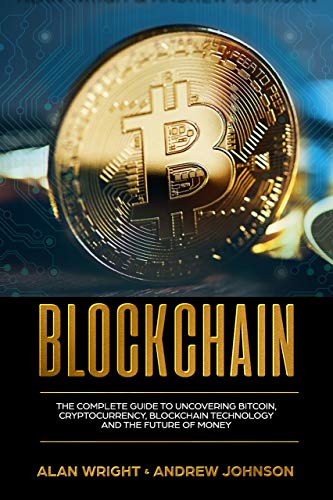
Alan Wright’s Blockchain: Uncovering Blockchain Technology, Cryptocurrencies, Bitcoin and the Future of Money belongs unmistakably to the cryptocurrency boom of 2017. It was written for readers who had heard that Bitcoin was rising, that blockchain might transform business, and that fortunes were being made, but who did not yet understand how any of it worked. Wright’s answer is deliberately broad: explain blockchain, introduce Bitcoin, show readers how to use it, explain mining, suggest cryptocurrency businesses, discuss investing, and then survey Ethereum, Ripple, and Litecoin.
That breadth is both the book’s appeal and its central weakness. Blockchain remains capable of giving a beginner an intuitive sense of distributed ledgers, decentralization, proof of work, smart contracts, and the distinction between Bitcoin and blockchain. Yet the book is no longer reliable as a current operating guide, and some important claims were already stale or inaccurate when it appeared. Its practical instructions are tied to the cryptocurrency environment of the mid-2010s, its investment sections often move faster than the evidence, and substantial portions closely correspond to previously published articles and online guides without adequate attribution in the supplied edition.
The fairest way to read the book today is therefore on two levels at once. First, it is a beginner’s introduction to the ideas and commercial possibilities that surrounded blockchain in 2017. Second, it is a historical document of the cryptocurrency boom itself: enthusiastic, opportunistic, technologically optimistic, and often willing to move from “this technology can do something interesting” to “this technology will transform an industry” before the intervening steps have been demonstrated.
How Wright Introduces Blockchain
The opening two chapters establish the conceptual vocabulary that supports everything else. Wright does not begin with cryptography or computer science. Instead, he begins with technological change and everyday transactions, trying to persuade readers that blockchain can be understood without specialist training and may eventually become as ordinary as other digital technologies that once seemed obscure.
That choice makes the early chapters approachable, but it also establishes the book’s habit of moving rapidly from basic mechanism to very large historical claims. Blockchain is introduced not merely as a new database architecture but as infrastructure capable of changing how societies coordinate trust, ownership, contracts, records, and economic exchange.
A Five-Stage History of Blockchain
Wright opens by comparing blockchain’s rise with the evolution of smartphones and the internet. The implication is that technologies with enormous consequences often begin as awkward or specialist tools before becoming invisible parts of everyday life. Blockchain, in this framing, is still in its early stages, but the reader is encouraged to imagine that its eventual reach could be comparable.
The chapter then presents blockchain’s history as a sequence of major innovations. The first is Bitcoin itself, which demonstrates that a decentralized network can maintain a monetary ledger without a central bank or payment company controlling every entry. Bitcoin matters here not simply as digital money but as the first large-scale proof that blockchain-style coordination can work in practice.
The second stage is the recognition that blockchain can be separated conceptually from Bitcoin. Once developers and businesses understand that the distributed ledger is the underlying mechanism, they can begin asking what else could be recorded on such a system. Ownership records, payments, identities, contracts, supply-chain events, and institutional transactions all become candidates.
Ethereum represents the third stage because it expands the concept from recording transactions to executing programmable agreements. Instead of a blockchain functioning only as a ledger of transfers, Wright presents smart contracts as a way for rules themselves to be encoded and executed by a decentralized network. This expands the imagination of blockchain from “digital money” toward programmable infrastructure.
The fourth development is proof of stake, introduced as an alternative to the energy- and hardware-intensive proof-of-work model associated with Bitcoin and early Ethereum. Wright treats the emergence of alternative consensus models as evidence that blockchain is not a single frozen technology but a family of systems whose design can continue evolving. The fifth challenge is scaling: if blockchains are to become infrastructure for large economies, they must handle much greater transaction volumes without sacrificing their defining properties.
From there, the chapter becomes increasingly expansive. Wright imagines machine-to-machine transactions, global settlement, supply-chain coordination, government records, commercial agreements, and other applications being built on distributed systems. Dubai’s blockchain initiatives are presented as an example of governments experimenting with the technology rather than merely resisting it, and Wright ultimately reaches the idea of an “Internet of Agreements” in which programmable rules connect institutions, people, and machines.
The progression is ambitious, but it is important to recognize that much of this chapter closely follows Vinay Gupta’s 2017 Harvard Business Review article on the history of blockchain. That issue becomes important later when evaluating the book’s sourcing and originality. For the moment, what matters is the conceptual role of the chapter: blockchain is presented as a general-purpose coordination technology whose significance extends far beyond cryptocurrency.
How the Ledger Works and Why Trust Matters
Chapter 2 shifts from technological history to mechanism. Wright begins with a familiar financial situation: one person wants to pay another, and a bank records the transaction. The bank’s ledger determines who owns what, and participants trust the institution to maintain that ledger accurately, prevent double spending, and settle disputes.
Blockchain changes the location of that record. Instead of a single institution maintaining the authoritative ledger, copies can be distributed across many computers, or nodes, participating in a network. When a new transaction occurs, information about it is broadcast to the network, validated according to agreed rules, grouped into blocks, and incorporated into the continuing chain of records.
Wright uses Bitcoin mining to illustrate how such a network can coordinate without a central bookkeeper. Miners compete to perform computational work, and the system rewards successful participation. The technical details are simplified, but the conceptual point is clear: economic incentives, cryptographic verification, and distributed recordkeeping can combine to maintain a ledger without one bank controlling it.
This leads to the book’s most important recurring concept: trust. Traditional commerce often depends on trusted intermediaries such as banks, governments, registries, notaries, payment processors, and clearing institutions. Wright argues that blockchain can reduce the need to trust such intermediaries because participants can instead rely on protocol rules and a shared record.
That claim is useful but needs qualification. A blockchain can reduce reliance on a particular central recordkeeper, yet it does not remove every form of trust from an economic system. Users still depend on software implementations, developers, cryptographic assumptions, governance procedures, exchanges, wallet providers, hardware, legal frameworks, and the accuracy of whatever information is entered into the blockchain from outside the network.
Wright then expands the model beyond payments. Smart contracts could execute predefined conditions automatically. Distributed storage could reduce dependence on centralized cloud providers. Blockchain-based identity systems could let individuals control verifiable credentials, while blockchain voting systems might make records more resistant to tampering.
The chapter’s explanatory strategy is effective because it moves from something ordinary—a bank ledger—to progressively less familiar applications. However, much of the sequence closely corresponds to Marc Crouch’s earlier beginner-oriented blockchain explainer, including the movement from payments toward trust, smart contracts, storage, identity, and voting. That correspondence matters because one of the book’s strengths, its accessible explanatory voice, cannot always be separated cleanly from the earlier material it incorporates.
Where Blockchain Might Be Used
After explaining the basic mechanism, Wright spends three chapters broadening the scope. The book’s central argument is no longer merely that blockchain makes Bitcoin possible. It is that distributed ledgers could change industries wherever organizations currently pay intermediaries to establish trust, maintain records, verify ownership, coordinate transactions, or enforce agreements.
These chapters are also where the book becomes more interesting than a simple cryptocurrency manual. Wright explores both optimistic applications and some of the legal and institutional complications that arise when supposedly immutable technical systems encounter privacy law, human disputes, political authority, and organizations that still need someone to make difficult decisions.
Industries Beyond Finance
Chapter 3 surveys blockchain applications across a wide range of industries. Finance naturally comes first because payments, securities, clearing, settlement, and recordkeeping already depend heavily on ledgers. If several institutions can share a synchronized record rather than reconciling separate databases, Wright argues, transactions could become faster and administrative costs could fall.
Media and telecommunications offer another class of possibilities. Blockchain-based systems could theoretically record ownership, licensing, or payments for digital content, allowing creators to receive compensation more directly. Micropayments become especially attractive in this vision because a low-cost digital payment network could support transactions too small to justify conventional banking or card-processing fees.
The Internet of Things extends the idea into machine-to-machine coordination. Connected devices could theoretically exchange value, verify events, or trigger contracts without constant human supervision. A sensor might record data that causes a payment to occur, while a machine could purchase a service when specified conditions are met.
Retail, travel, and hospitality appear as additional fields for loyalty systems, identity verification, payments, and record management. Healthcare receives particular attention because medical records must be shared securely across institutions while remaining accurate and accessible. Wright sees blockchain as a possible way to create durable records and improve interoperability, although the practical problem of protecting sensitive data is much harder than the general description suggests.
Government applications include land registries, public records, identity, voting, and administrative documentation. Energy systems could use distributed ledgers to track production, consumption, and payments, potentially supporting peer-to-peer electricity markets. Across these examples, the repeating logic is that blockchain becomes attractive whenever several parties need a common record but do not want one participant to possess unilateral control over it.
The chapter concludes by dividing the blockchain ecosystem into layers. Applications sit at the top, middleware and services connect those applications to underlying networks, and infrastructure or protocols provide the foundational systems. Projects and companies such as Factom, BlockCypher, Colu, Chain, Ethereum, and Ripple illustrate the kinds of businesses appearing at different levels.
The breadth of this chapter makes blockchain seem almost universally applicable, but many examples remain possibilities rather than demonstrated necessities. A normal database may still be cheaper and simpler when participants already trust a central administrator. The chapter’s structure and much of its material closely parallel Lester Coleman’s survey of blockchain applications beyond finance, which itself drew on contemporary industry research.
Law, Privacy, Identity, and Irreversibility
Chapter 4 is one of the book’s most valuable sections because it complicates the optimism of the preceding chapters. Once blockchain systems begin handling identities, contracts, property, and legally significant transactions, technical immutability collides with the fact that human societies routinely need to correct mistakes, reverse fraud, protect private information, and resolve ambiguous disputes.
Wright distinguishes between public blockchains and more customized or permissioned systems. A completely open network such as Bitcoin is designed around broad participation and public verification, whereas businesses may prefer networks in which access, validation, or visibility is restricted. That distinction immediately weakens the simple narrative that blockchain always eliminates intermediaries, because permissioned systems often restore identifiable institutions to privileged positions.
Privacy creates another difficulty. A ledger can be secure against alteration while still exposing too much information. If identities can be connected to transactions, a permanent record may become a permanent privacy problem. Businesses also possess commercially sensitive information that cannot simply be placed on an openly visible ledger.
Identity itself introduces a related contradiction. Blockchain advocates often praise pseudonymity and resistance to centralized control, but many legally significant transactions require participants to prove who they are. A system for transferring property, complying with regulation, or enforcing contracts may therefore require trusted identity providers even if the underlying transaction ledger is decentralized.
Immutability creates perhaps the sharpest conflict. The inability to alter past records can protect against fraud, but legal systems sometimes require records to be corrected, transactions to be reversed, or rights to be reallocated after a court decision. Software cannot eliminate those social decisions merely by declaring the underlying database permanent.
Smart contracts raise similar questions. Code can automatically execute a clearly defined condition, but real contracts involve interpretation, mistakes, changed circumstances, fraud, coercion, and ambiguity. If the code behaves exactly as written but produces an outcome that the parties did not intend, someone still needs a mechanism for deciding whether the technical result should be treated as legally final.
Wright also touches on intellectual property, public records, international regulation, and national experiments with blockchain systems. These sections reveal a more cautious insight than the book’s promotional passages often allow: technologies that redistribute authority do not make governance disappear. They create new questions about who writes the rules, who can change them, which jurisdiction applies, and how technical systems interact with legal authority.
The legal and policy discussion closely follows Norton Rose Fulbright’s 2017 analysis of blockchain and the sharing economy. Even so, its inclusion improves the book because it prevents decentralization from being presented solely as a frictionless technological upgrade.
Finance and Network Business Models
Chapter 5 returns to finance but places blockchain inside a larger theory of economic disruption. Wright argues that many established institutions operate through centralized business models: they maintain proprietary systems, control access, and charge customers for intermediation. Digital networks can challenge those structures by allowing participants to connect more directly.
The chapter describes control as shifting away from centralized institutions and toward networks. In financial services, this could mean distributed systems handling functions traditionally performed by banks, clearinghouses, settlement organizations, or centralized registries. Blockchain becomes one example of a broader transition from hierarchical organizations toward network-based coordination.
Wright then argues that network business models will increasingly dominate. The attraction is not simply lower cost. A network may grow more useful as more participants join, creating feedback loops that favor platforms capable of connecting large numbers of users, institutions, or assets.
Blockchain supposedly strengthens this model by allowing participants to share a record without handing complete control to a central platform owner. Assets such as money, property deeds, music rights, and other forms of ownership could theoretically be transferred through networks governed by transparent rules. The idea is appealing because it combines the scale of digital platforms with the political promise of decentralization.
The chapter points to interest from established companies and financial institutions as evidence that blockchain is no longer confined to cryptocurrency enthusiasts. The significance of firms such as IBM and JPMorgan experimenting with distributed-ledger technology is that incumbents themselves recognize potential efficiencies in shared infrastructure.
Yet the chapter sometimes moves too quickly from experimentation to inevitability. A bank testing blockchain does not prove that decentralized networks will replace banks, and a permissioned ledger operated by large institutions may preserve much of the centralized power blockchain is supposed to disrupt. That tension remains unresolved.
The structure and argument of the chapter closely align with a 2016 Knowledge@Wharton discussion published by the World Economic Forum. It provides the bridge the book needs, however, because the next chapters narrow from blockchain as institutional infrastructure to Bitcoin as something the individual reader can personally obtain, use, mine, and invest in.
Bitcoin: Money, Wallets, and Everyday Use
The book changes character when it reaches Bitcoin. The first five chapters ask what blockchain could do to industries and institutions; Chapters 6 and 7 ask what a reader can actually do with cryptocurrency. Wright’s strategy is to make Bitcoin feel less mysterious by comparing it with forms of money and digital banking readers already use.
This practical turn is essential to understanding the book’s larger purpose. Wright does not want the reader merely to comprehend cryptocurrency as an abstract innovation. He wants the reader to become a participant.
What Bitcoin Is
Chapter 6 introduces Bitcoin as a form of virtual money, but Wright immediately complicates the distinction between “virtual” and “real” currency. Much of ordinary money already exists as numbers in banking systems rather than physical notes or coins. Salaries arrive electronically, balances are stored digitally, and payments move through networks.
Wright therefore argues that Bitcoin is not strange merely because it is digital. Its distinctive feature is that the monetary system is not controlled in the same way as conventional state-backed currency. Bitcoin’s issuance and transaction rules are encoded in its protocol, and ownership can be transferred without a bank maintaining the central account ledger.
The discussion of conventional banking attempts to explain why advocates find this attractive. Wright presents commercial banks and central banking systems as institutions capable of expanding the money supply and operating through credit creation. The explanation is simplified and sometimes tied to textbook reserve-ratio models that do not capture the full reality of modern banking, but its rhetorical purpose is clear: conventional money depends on institutions whose policies affect purchasing power, whereas Bitcoin has an algorithmically limited supply.
Satoshi Nakamoto enters as the pseudonymous creator of Bitcoin. Wright explains that Bitcoin transactions are recorded collectively by the network and that mining helps secure the system. No government determines how many bitcoins should be created in response to political or economic conditions; issuance follows the protocol.
Scarcity then becomes central to the investment logic. Because the eventual Bitcoin supply is limited, Wright suggests that increasing demand could increase value. That is plausible as a supply-and-demand observation, but scarcity alone does not guarantee high value. An asset can be scarce without being desirable, and future prices depend on demand, competition, regulation, technological development, market structure, and expectations.
The chapter also emphasizes that Bitcoin can actually be spent. Its purpose is not limited to speculative trading. In Wright’s framing, Bitcoin is simultaneously money, network, technology, and scarce digital asset, and these identities become increasingly mixed as the book proceeds.
Wallets, Buying, Receiving, and Security
Chapter 7 is essentially a beginner’s Bitcoin tutorial. Wright argues that the quickest way to understand Bitcoin is to acquire a small amount and use it. That recommendation reflects the culture of early cryptocurrency adoption, when learning frequently meant downloading software, creating a wallet, experimenting with addresses, and sending small transactions.
A wallet is introduced as the tool through which a user manages Bitcoin. The book describes software wallets installed on personal computers and explains that users need addresses through which funds can be received. The treatment is introductory rather than cryptographically precise, but it gives readers the practical idea that cryptocurrency ownership depends on controlling credentials rather than possessing physical coins.
Wright discusses several ways of acquiring small amounts of Bitcoin. Faucets once distributed tiny amounts to encourage experimentation. Users could purchase Bitcoin directly from other people, obtain it through local trading services, or meet sellers in person. QR codes made addresses easier to exchange and reduced the inconvenience of typing long strings of characters.
Transactions require confirmation because the network needs time to incorporate them into the blockchain with increasing certainty. Fees may be attached, and the user must balance speed, cost, and convenience. For a 2017 beginner, these explanations would have demystified an experience that still felt technically unusual.
The chapter also mentions services such as LocalBitcoins and cryptocurrency meetups. Physical Bitcoin products and in-person transactions appear as ways of making an intangible asset feel more familiar. At the same time, Wright warns readers about sending money to strangers and emphasizes that scams are possible.
Much of this material should now be read historically. The cryptocurrency service landscape has changed significantly, wallet design has matured, regulatory requirements are different in many jurisdictions, and some services familiar to 2017 users no longer occupy the same role. The principles of wallet security, confirmation, and caution remain relevant, but the chapter should not be treated as a current setup guide.
Mining, Business Opportunities, and Investment
Chapters 8 through 10 reveal the commercial heart of the book. Wright moves from showing readers how cryptocurrency works to showing them how they might earn from the ecosystem. Mining becomes one route, entrepreneurship another, and investing a third.
This progression captures the atmosphere surrounding cryptocurrency in 2017. Technical curiosity, ideological enthusiasm, entrepreneurial experimentation, and speculation were often intertwined, and the book rarely attempts to separate them completely.
Mining and Proof of Work
Chapter 8 begins with an important warning: most Bitcoin users do not need to mine, and mining is not automatically profitable. By the time Wright was writing, Bitcoin mining had already evolved from a hobbyist activity into a specialized industry in which hardware costs, electricity prices, and scale mattered enormously.
Mining is explained as a competitive process through which participants try to solve a computational problem. A miner repeatedly applies the SHA-256 hash function while changing a value known as a nonce, attempting to produce a hash that satisfies the network’s current difficulty target. The successful miner can propose a new block and receive the associated reward.
The lottery analogy helps beginners understand why computing power matters. Each hashing attempt is like another chance to produce a valid result, so a miner capable of performing more calculations receives more chances. As more mining power joins the network, Bitcoin adjusts difficulty so that blocks do not arrive dramatically faster merely because miners have become more powerful.
Wright then traces mining hardware through several technological generations. Early users could mine with central processing units. Graphics cards offered more parallel computing power, followed by field-programmable gate arrays and eventually specialized ASIC hardware designed specifically for Bitcoin’s hashing algorithm.
This evolution changes mining economics. Once specialized equipment becomes standard, a person using an ordinary computer is competing against industrial operations with purpose-built machines and lower electricity costs. Mining therefore becomes less like earning free Bitcoin and more like operating an infrastructure business.
Solo mining and pool mining offer different risk profiles. A solo miner keeps the full block reward when successful but may wait an extremely long time for a result. A mining pool combines the work of many participants and distributes proceeds according to contribution, producing smaller but more regular returns.
Cloud mining is presented with greater skepticism. In theory, a customer rents mining capacity from a remote provider and avoids purchasing equipment directly. In practice, the field attracted numerous dubious schemes, and Wright correctly warns that contracts promising easy passive returns deserve caution.
The chapter also explains proof of work as Bitcoin’s security mechanism. Producing blocks requires real computational expenditure, making it expensive to rewrite transaction history. The system rewards honest mining while making attacks costly, although the actual security model is more complex than the simplified “millions of computers” rhetoric that appears elsewhere in the book.
One factual problem is especially important because it was already outdated when the book appeared. Wright describes the Bitcoin block subsidy as 25 BTC, wording that also appears in the WeUseCoins mining guide closely followed by the chapter. Bitcoin’s subsidy had fallen from 25 BTC to 12.5 BTC in July 2016, more than a year before Blockchain was published.
Bitcoin Business Models
Chapter 9 shifts from mining to entrepreneurship. Wright’s basic assumption is that a young and expanding technological ecosystem creates opportunities not only for people building the core protocol but also for businesses helping ordinary users interact with it.
One option is brokerage. Many newcomers want cryptocurrency but find exchanges, wallets, and technical procedures confusing. A broker can simplify the transaction and charge for convenience, although the business naturally depends on local financial regulation and compliance obligations.
Bitcoin ATMs represent a more physical version of the same idea. A machine can allow users to buy or sometimes sell Bitcoin using familiar interfaces. Wright presents this as part of a wider category of vending and payment businesses that make cryptocurrency accessible outside specialist online communities.
White-label services and franchises offer another route. An entrepreneur need not build every piece of infrastructure from scratch if another company provides the underlying technology. Retailers might accept Bitcoin, resellers could target cryptocurrency users, and dropshipping businesses could use digital currencies as part of their payment systems.
Wright also highlights roles that exist because decentralized transactions still require connections to the outside world. Escrow services can help parties manage risk when a transaction depends on performance. Oracles provide external information that blockchain-based systems or smart contracts cannot discover independently.
Consulting appears as an obvious opportunity because businesses may want to understand blockchain without possessing internal expertise. Wright also suggests buying existing cryptocurrency websites, applications, or small businesses and improving them, as well as operating informational websites or faucets that attract cryptocurrency users.
The chapter is revealing because it contradicts any simplistic idea that decentralized technology eliminates businesses and intermediaries. Wright’s own opportunity list contains brokers, consultants, escrow services, infrastructure providers, and other intermediating roles. Blockchain may change who performs coordination and how it is organized, but economic activity continues to generate new layers of service around the supposedly disintermediated network.
Investing, Risk, and Wallet Choices
Chapter 10 addresses cryptocurrency explicitly as an investment. Wright acknowledges that nobody can know future Bitcoin prices with certainty, but the chapter assumes that readers are interested in capturing upside while controlling risk. The result mixes portfolio ideas, speculation, technical analysis, and custody advice.
Diversification is one of the central recommendations. Rather than committing everything to a single asset, investors can spread exposure across cryptocurrencies or related opportunities. Wright also distinguishes investing in a broad technological idea from choosing one particular project, suggesting that a reader might believe in blockchain’s future without knowing which individual cryptocurrency will ultimately dominate.
Hedging and liquidity receive attention because cryptocurrency markets can move quickly. Investors need to consider whether they can exit a position, how much volatility they can tolerate, and whether an asset’s apparent upside justifies the possibility of losing a large portion of the investment. Smaller cryptocurrencies are presented as potentially having more “room to grow,” although that same characteristic can mean greater risk and weaker liquidity.
Technical analysis also appears as a way of interpreting market behavior. The book treats historical prices and trading patterns as potentially useful tools, though it does not provide a rigorous empirical case for their predictive power. Proof-of-stake systems are presented as another possible source of returns because holders may receive rewards for participating in network consensus.
A substantial part of the chapter closely resembles ideas appearing in Frisco d’Anconia’s 2017 Cointelegraph discussion of Bitcoin and altcoin investment strategies. The correspondence reinforces the broader pattern in which practical sections often read like compiled contemporary cryptocurrency guidance rather than a unified investment framework developed by Wright himself.
The chapter eventually turns from choosing assets to protecting them. Wright distinguishes wallet types according to frequency of use and the amount being stored. A mobile or easily accessible wallet may be convenient for small routine transactions, while hardware or offline storage may be more appropriate for larger long-term holdings.
Paper wallets are also discussed as a form of offline storage. In the 2010s, generating and securely storing private-key material on paper was frequently recommended, but modern wallet practices have evolved and paper-wallet procedures can create serious risks if implemented incorrectly. The enduring principle is not that a particular 2017 storage method remains ideal; it is that convenience and security usually trade off against one another, and the appropriate custody method depends on what the user is trying to protect.
Bitcoin Culture and the Move Beyond Bitcoin
By Chapter 11, Wright has covered blockchain theory, Bitcoin operation, mining, entrepreneurship, and investment. The final major phase widens the lens again, first through Bitcoin anecdotes and then through competing cryptocurrency networks. This allows the book to show that Bitcoin is both a technological system and a cultural phenomenon—and that it may not be the only important blockchain.
The material is uneven. Chapter 11 is largely a collection of curiosities, while Chapter 12 is one of the book’s most substantial sections because Ethereum, Ripple, and Litecoin embody three different ideas about what cryptocurrency and blockchain could become.
Ten Bitcoin Facts and Anecdotes
Chapter 11 presents ten “awesome facts” designed to emphasize how unusual Bitcoin’s early history had been. One concerns institutions accepting Bitcoin for tuition, illustrating the spread of cryptocurrency beyond technology communities. Another describes a “Bitcoin Boulevard” in The Hague, where multiple businesses accepted the currency.
The chapter also recounts the first peer-to-peer Bitcoin transfer, the famous transaction in which bitcoins were exchanged for pizzas, and the Trendon Shavers or “Pirateat40” fraud case. These stories serve different purposes: some celebrate adoption, while others demonstrate that decentralized technology does not eliminate deception or financial misconduct.
Other sections compare Bitcoin adoption in different countries, estimate the amount of Bitcoin that may be inactive or permanently lost, and marvel at the computational power devoted to the network. A very large 194,993 BTC transaction is included to demonstrate how significant value can move across the network, while another example calculates the extraordinary wealth an extremely early Bitcoin buyer might have accumulated.
The chapter closely follows an earlier 2014 “Top 10 awesome facts about Bitcoin” article, which explains why several statistics feel older than the 2017 publication date. It also reproduces a factual inconsistency regarding Bitcoin’s first peer-to-peer payment: the chapter gives 100 BTC in one place even though the historically recognized January 2009 transfer from Satoshi Nakamoto to Hal Finney was 10 BTC.
The chapter is therefore more valuable as a record of Bitcoin mythology than as a set of durable statistics. Pizza, early transfers, lost coins, gigantic transactions, and early fortunes became part of the narrative through which Bitcoin communities understood their own history.
Ethereum
Ethereum receives by far the most substantial treatment among the alternatives to Bitcoin. Wright presents it not simply as another cryptocurrency but as a programmable blockchain capable of running decentralized applications. Ether, or ETH, is the native asset that helps power activity on the network, but the larger ambition is a general-purpose computing platform.
The Ethereum Virtual Machine is central to that model. Developers can write programs that are executed according to the network’s rules, allowing decentralized applications to perform functions that go beyond moving currency from one address to another. Solidity is introduced as the principal smart-contract programming language.
Wright’s description captures a fundamental distinction. Bitcoin was designed primarily around a decentralized monetary ledger, even though its scripting system can support additional functions. Ethereum was designed from the beginning to make programmable applications a central feature of the network.
The DAO episode demonstrates both the power and danger of that flexibility. The DAO was an ambitious decentralized investment organization implemented through Ethereum smart contracts. A vulnerability allowed an attacker to redirect a large amount of Ether, creating a crisis over whether the blockchain community should accept the technical result as irreversible or intervene.
The eventual hard fork produced two continuing networks. Ethereum adopted the fork that effectively reversed the consequences of the exploit, while Ethereum Classic preserved the original chain. For a book fascinated by immutable rules, this episode is especially revealing because it shows that human communities still make political and ethical judgments about what a blockchain should do.
Wright discusses practical uses of ETH, including transferring value, paying for network operations, purchasing the asset, and potentially earning from appreciation or participation in the ecosystem. Risks include technical failure, competition, regulatory uncertainty, market volatility, and the possibility that applications built on Ethereum may not achieve widespread adoption.
At the time of publication, Ethereum’s expected transition from proof of work to proof of stake remained a future development. That prediction eventually became reality, but only after years of engineering work. The later transition is one of the clearest examples of the book identifying a genuinely important direction even though the details and timing remained unresolved in 2017.
Ripple and XRP
Ripple represents a very different cryptocurrency model. Wright presents the network primarily as infrastructure for payments and settlement, particularly across financial institutions. Rather than defining itself through maximal opposition to banks, Ripple’s strategy has long involved working with them.
XRP is discussed as the digital asset associated with the ecosystem. Transactions can settle quickly, and the system is designed to facilitate transfers across currencies and institutions. This makes Ripple relevant to the problem of international payments, where legacy correspondent-banking networks can be slow and expensive.
Wright emphasizes that Ripple differs from Bitcoin in architecture, governance, distribution, and institutional orientation. These differences create potential advantages for speed and business integration but also generate criticism from users who value Bitcoin’s stronger decentralization ethos.
The chapter discusses buying and transferring XRP as well as speculation on its future value. Wright treats adoption by banks or payment organizations as a key factor in the asset’s prospects. If institutional usage grows, he suggests, the ecosystem could become increasingly important.
That logic is understandable but does not establish a simple relationship between institutional interest and token returns. A network can succeed operationally without producing the investment outcome holders expect, and token economics require more careful analysis than the chapter provides.
Litecoin
Litecoin is introduced as an early cryptocurrency derived from Bitcoin’s basic model but modified in several ways. Its shorter block interval allows transactions to receive confirmations more quickly, and its original use of the scrypt mining algorithm distinguished its mining ecosystem from Bitcoin’s SHA-256 system.
Wright also discusses Litecoin’s adoption of Segregated Witness and its role as a network on which new cryptocurrency technology could be demonstrated. In the 2017 environment, Litecoin was often described as a complementary system to Bitcoin rather than a radically different blockchain platform.
The chapter considers the usual avenues of participation: buying Litecoin, transferring it, mining it, accepting it as payment, or speculating on future appreciation. Its risks are equally familiar. Litecoin must compete for users, developers, liquidity, merchant acceptance, and relevance in an ecosystem crowded with other cryptocurrencies.
Atomic swaps appear as one possible future development. The idea is that users could exchange assets across different blockchains without relying on a conventional centralized exchange, strengthening the broader decentralized-finance vision even before that terminology became common.
Taken together, Ethereum, Ripple, and Litecoin demonstrate that the cryptocurrency market was already fragmenting into different technological philosophies. Ethereum emphasizes programmability, Ripple emphasizes payment infrastructure and institutional integration, and Litecoin modifies Bitcoin’s peer-to-peer currency model. Wright does not provide a deep comparative framework, but he correctly shows that “cryptocurrency” is not one homogeneous technology.
The Book’s Closing Case for Cryptocurrency
Chapter 13 is brief, but it states the worldview that has been implicit throughout the book. Wright frames cryptocurrency as the subject of a growing conflict between supporters who see technological progress and critics who see volatility, fraud, instability, or threats to established monetary systems.
The positive case emphasizes utility, increasing adoption, technological innovation, investment potential, and the possibility that blockchain systems can support forms of ownership and exchange beyond conventional banking. The negative case emphasizes price instability, uncertain future demand, criminal use, financial risk, and hostility or skepticism from governments and established institutions.
Wright ultimately interprets the debate as a confrontation between cryptocurrency and fiat money. Central banks possess strong incentives to defend their role in issuing and managing national currencies, while decentralized cryptocurrencies attempt to create monetary systems that can function without that authority. From this perspective, institutional resistance is not merely skepticism about an immature technology; it is partly a defense of existing power.
The framing is rhetorically powerful but stronger than the evidence assembled by the book. Cryptocurrencies can coexist with state currencies, banks can adopt blockchain-related infrastructure, governments can regulate rather than prohibit digital assets, and centralized financial institutions can participate in cryptocurrency markets. The book’s own examples repeatedly demonstrate hybrid arrangements, making the final “crypto versus fiat” narrative more dramatic than the preceding chapters require.
Still, the conclusion completes Wright’s progression. What began as a technical explanation of shared ledgers ends as an argument about who should control money, records, agreements, and economic coordination. That question gives the book greater coherence than its otherwise modular structure initially suggests.
Decentralization, Trust, and Disintermediation
The most important idea running through Blockchain is not Bitcoin itself but disintermediation. Banks maintain financial ledgers, governments maintain property registers, corporations operate platforms, and other institutions certify identity, enforce contracts, or process payments. Wright repeatedly asks whether software and distributed networks can perform some of those functions without the same centralized authority.
This is the strongest conceptual contribution of the book because it gives beginners a useful way to think about blockchain. The technology is not simply a strange database or a mechanism for producing digital coins. It is an architectural choice about how agreement is reached and who gets to control the authoritative record.
Bitcoin illustrates the model clearly. A bank does not decide which Bitcoin transaction is valid, and no central administrator maintains the master ledger. Instead, transactions are validated according to network rules and incorporated into a shared history secured by proof of work. Participants can therefore transact without having to trust one bank to maintain everyone’s balances correctly.
Yet “trustless” is easily misunderstood. Users still trust that the software behaves as expected, that cryptographic assumptions remain secure, that their wallet is not compromised, that developers do not introduce catastrophic bugs, and that exchanges or custodians holding assets on their behalf behave honestly. When real-world property or legal rights enter the system, users must also trust whatever process connects blockchain records to external reality.
The oracle problem demonstrates the limitation particularly well. A smart contract can automatically respond to a data input, but the blockchain may have no independent way to know whether that input accurately represents the outside world. If a contract depends on a weather reading, shipping event, election result, market price, or legal judgment, someone or something must supply the information.
Chapter 4 implicitly recognizes this problem by discussing identity, enforceability, privacy, and irreversibility. A distributed ledger can make records difficult to alter, but societies may still need mechanisms for declaring a transaction fraudulent or a contract invalid. Technology can change the cost and architecture of trust, but it cannot automatically settle every disagreement about legitimacy.
The distinction between public and permissioned blockchains further complicates the argument. A network restricted to approved institutions may improve data sharing without meaningfully democratizing power. If a consortium of banks controls validator access, governance, and upgrades, blockchain may reduce reconciliation costs while leaving institutional hierarchy largely intact.
Disintermediation can also produce reintermediation. Cryptocurrency markets generated exchanges, custodians, brokers, payment processors, wallet providers, analytics companies, mining pools, consultants, and stablecoin issuers. Wright’s own business-opportunity chapter inadvertently demonstrates this process: remove one intermediary and economic complexity often creates another.
The book is therefore most persuasive when interpreted modestly. Blockchain can make certain kinds of centralized recordkeeping unnecessary and can allow parties to coordinate through shared protocols. It is much less convincing when that observation is expanded into the idea that trust, governance, regulation, or institutions themselves can simply be engineered away.
The Book’s Practical Model: Learn, Use, Mine, Build, Invest
The apparent disorder of Chapters 6 through 10 makes more sense when understood as a practical progression. Wright moves the reader through increasingly committed forms of participation: first understand Bitcoin, then obtain and use it, then learn how the system produces new coins, then search for businesses serving the ecosystem, and finally consider investing.
This structure reflects an assumption that knowledge should lead to participation. Blockchain is not presented like a scientific subject that readers might study without personal involvement. Understanding the technology is repeatedly connected to the possibility of owning cryptocurrency, earning from it, or building a business around it.
The first step is psychological. By comparing Bitcoin with the digital balances people already use in banks, Wright reduces the feeling that cryptocurrency is inherently unreal. Once that barrier has been lowered, a wallet and a small transaction make the abstract system tangible.
Mining introduces the idea that participation can produce direct economic rewards. Wright does warn that mining is difficult and capital-intensive, but the chapter still connects technical infrastructure with the prospect of income. It makes the blockchain seem not only understandable but economically accessible.
The entrepreneurship chapter widens the opportunity set. A reader who cannot profitably mine can become a broker, operate a Bitcoin ATM, build a payment business, consult for companies, provide escrow, run websites, or supply other services. In effect, Wright converts every source of friction in the cryptocurrency ecosystem into a possible business opportunity.
The investment chapter completes the progression by allowing participation without operating infrastructure or a company. A reader can simply own assets believed to benefit from future adoption. At this point technological optimism becomes financial exposure.
That movement is central to the book’s identity. Wright rarely pauses to separate the proposition that blockchain technology may become important from the proposition that buying a particular cryptocurrency is therefore a good investment. The two claims are related but not equivalent. A technology can succeed while specific assets fail, while early projects lose market share, or while expected economic value accrues to users and businesses rather than token holders.
The 2017 context helps explain the book’s confidence. Cryptocurrency markets were experiencing extraordinary growth, new projects were appearing rapidly, and early adopters had vivid examples of enormous gains. In such an environment, technological education and fear of missing out could easily reinforce one another.
That atmosphere does not make every recommendation irrational, but it changes how modern readers should interpret the advice. Blockchain is not merely teaching an emerging technology. It is teaching that technology during a speculative boom in which understanding the system is repeatedly presented as a route toward economic opportunity.
What Has Changed Since 2017
A technology book does not become worthless merely because details change. Concepts such as distributed ledgers, proof of work, smart contracts, and network incentives remain relevant even when specific services, prices, or hardware become obsolete. The problem arises when historical instructions are read as though they still describe the present.
Several developments since 2017 materially change the meaning of Wright’s practical claims. Bitcoin mining economics have moved through multiple halvings, Ethereum completed a transition that the book still described as prospective, cryptocurrency regulation became far more developed, and institutional access to digital assets changed considerably.
Bitcoin Mining and Market Infrastructure
The mining chapter contains the clearest example of information that was not merely overtaken by later events but already outdated when the book appeared. Wright states that a successful Bitcoin miner receives a 25 BTC block subsidy. According to Bitcoin’s documented halving history, that subsidy had fallen to 12.5 BTC in July 2016.
The next halving reduced the subsidy to 6.25 BTC in May 2020, and the April 2024 halving reduced it again to 3.125 BTC. The underlying mechanism Wright explains remains valid—the subsidy declines over time according to Bitcoin’s issuance schedule—but the numerical example illustrates the danger of relying on copied or insufficiently updated technical material.
Mining has also become increasingly industrialized. The logic Wright describes regarding ASICs, electricity costs, pools, and economies of scale was already visible in 2017 and became even more important afterward. For most ordinary users, Bitcoin mining is now even further removed from the image of running software on a household computer.
The surrounding market infrastructure changed as well. Wright wrote at a time when cryptocurrency was still commonly framed as an alternative financial world operating outside mainstream institutions. In January 2024, however, the U.S. Securities and Exchange Commission approved the listing and trading of multiple spot Bitcoin exchange-traded products, giving investors a regulated market structure through which they could obtain Bitcoin price exposure without personally managing wallets.
That development does not make Bitcoin centralized, nor does it erase cryptocurrency-native markets. It does show how thoroughly the line between conventional finance and cryptocurrency can blur. Rather than replacing traditional financial infrastructure, Bitcoin became an asset around which traditional infrastructure could also be built.
Ethereum After the Merge
Ethereum provides the book’s most striking example of a technological prediction that eventually became reality. Wright describes the network’s intended move away from proof of work toward proof of stake as a future development, reflecting the state of Ethereum in 2017.
That transition eventually occurred on September 15, 2022, when Ethereum completed The Merge. The network’s execution layer was joined to its proof-of-stake consensus system, ending proof-of-work mining on Ethereum.
The change had major consequences for the network’s energy consumption. Ethereum’s own documentation estimates a reduction of roughly 99.95 percent. A future possibility discussed in Wright’s book therefore became one of the most important architectural changes in the network’s history.
The episode shows why some of the book’s older material remains useful when read historically. Wright was correct that consensus mechanisms were still evolving and that proof of stake could become a major alternative to proof of work. What could not be known in 2017 was how difficult the transition would be, when it would occur, and what the mature Ethereum ecosystem would look like afterward.
The DAO episode also became increasingly important in retrospect. It demonstrated that blockchain communities could intervene socially when technical outcomes violated community expectations. The later success of Ethereum did not eliminate that philosophical tension; it made the event foundational to debates over immutability and governance.
Regulation, Ripple, and Institutional Adoption
Regulation is another area where the world surrounding the book changed dramatically. Wright wrote when governments were still experimenting with how to classify cryptocurrencies, exchanges, tokens, and blockchain businesses. That uncertainty remains in some areas, but the regulatory environment is far more developed than the book suggests.
The European Union’s Markets in Crypto-Assets framework provides a clear example. MiCA created a broad regulatory framework for crypto-asset issuers and service providers across the EU, with stablecoin provisions applying from June 2024 and the wider regime applying from December 2024.
That does not mean global regulation has become uniform. Different jurisdictions continue to classify and supervise cryptocurrencies differently. It does mean that a modern reader should not treat cryptocurrency as occupying the largely unsettled regulatory frontier described in 2017.
Ripple’s later history is particularly relevant because Wright presents institutional adoption as the central question around XRP. In the United States, the relationship between Ripple and securities law became the subject of years of litigation. By August 2025, the SEC reported that the parties had dismissed their appeals, while the district court’s final judgment—including an injunction and a civil penalty of $125,035,150—remained in place, as summarized in the SEC’s Ripple litigation release.
The significance for Wright’s book is not that a modern article should retell the entire lawsuit. It is that the chapter’s simple adoption-versus-failure framework proved inadequate. Cryptocurrency networks operate inside legal institutions, and those institutions can materially affect how tokens are distributed, sold, marketed, and integrated into financial markets.
The broader pattern is equally important. Wright often imagines decentralized systems and established finance as competing camps. The subsequent market produced something more complicated: exchanges became regulated businesses, banks offered cryptocurrency services, institutional funds gained Bitcoin exposure, governments created detailed rules, and blockchain companies sought partnerships with incumbent financial institutions.
Evidence, Attribution, and Technical Reliability
A beginner’s technology book depends heavily on trust. Most readers cannot independently verify every statement about consensus mechanisms, monetary systems, regulation, cryptography, or market infrastructure. They therefore rely on the author to distinguish established fact from prediction, update borrowed material carefully, and identify where information comes from.
That makes Blockchain’s source practices more than a peripheral editorial concern. Extensive correspondence between multiple chapters and previously published online material affects how readers should evaluate the book’s originality, internal coherence, and factual reliability.
The Book’s Dependence on Earlier Published Material
Chapter 1 closely corresponds to Vinay Gupta’s Harvard Business Review article, including the comparison with smartphones and the staged account of blockchain’s development. The overlap extends beyond a shared subject: the progression of ideas, examples, and framing is strikingly similar.
Chapter 2 similarly tracks Marc Crouch’s earlier blockchain introduction. The ordinary-ledger example, explanation of distributed trust, and movement toward smart contracts, storage, identity, and voting appear in closely corresponding sequence.
Chapter 3 follows Lester Coleman’s article on blockchain applications beyond finance. The chapter’s sector-by-sector survey and ecosystem categories align with the earlier publication closely enough that the relationship materially affects how the book should be read.
Chapter 4 corresponds to Norton Rose Fulbright’s discussion of blockchain and the sharing economy. The similarity is especially significant because this is one of the book’s more nuanced chapters; much of its sophistication regarding legal enforceability, privacy, identity, and permanence appears to derive from specialist legal analysis published elsewhere.
Chapter 5 closely follows the structure and argument of a Knowledge@Wharton article published by the World Economic Forum. Its discussion of networks, shifting control, and financial-services disruption therefore belongs partly to a broader contemporary conversation rather than representing an independently developed thesis unique to Wright.
The pattern continues into the practical material. Chapter 8 tracks the WeUseCoins mining guide, including the stale block-reward figure that helps reveal the consequences of insufficient updating. Chapter 10 contains investment-strategy passages corresponding to contemporary cryptocurrency commentary, including material associated with Cointelegraph’s discussion of Bitcoin and altcoin risk management.
Chapter 11 is one of the clearest examples because it closely reproduces the concept and sequence of a 2014 list of Bitcoin facts. Several statistics therefore represent the cryptocurrency world of 2013 or 2014 rather than 2017, even though a casual reader could reasonably assume the data had been selected and updated for the book’s publication.
The important conclusion is narrower than a legal accusation. The supplied edition contains substantial textual and structural overlap with earlier material, while chapter text does not adequately signal that dependence to the reader. It would be irresponsible to make a legal finding of plagiarism without a much more specialized analysis of copyright, permissions, attribution, and publication arrangements, but the editorial problem is clear.
This dependence helps explain the book’s inconsistent voice. Some chapters sound like accessible consumer education, others like legal analysis, others like entrepreneurial blogging, and still others like investment commentary. The book feels less like one argument developed through thirteen chapters than a compilation of the blockchain discourse circulating online during the boom.
Factual Errors, Simplifications, and Stale Data
The provenance problem would matter even if every imported detail were correct. It becomes more consequential because several sections preserve stale or incorrect information, suggesting that source material was not always carefully reconciled with the book’s publication date.
The block-reward example is the strongest case. A 25 BTC subsidy had ceased to be current in July 2016, yet the 2017 book still presents it as the mining reward. This is not an unavoidable consequence of a fast-moving technology changing after publication; it is a factual update that should have been made before publication.
The first Bitcoin transaction contains another concrete error. Wright gives 100 BTC in one passage, while the historical transfer from Satoshi Nakamoto to Hal Finney was 10 BTC. The inconsistency is especially revealing because the source tradition from which the anecdote appears to have been taken contains wording that points toward the correct figure.
Other problems fall into the category of dated data rather than outright error. Network hash rates, country-adoption comparisons, cryptocurrency prices, market rankings, and estimates of early fortunes can become obsolete rapidly. Such figures can still be historically interesting, but the book often presents them without enough temporal framing.
Some technical simplifications are understandable in a beginner’s guide. Wright’s description of bank money creation, for example, uses familiar fractional-reserve explanations that make the contrast with Bitcoin easy to grasp. The problem is that a simplified model can become misleading when it is used to support large claims about how conventional monetary systems work.
Security is similarly simplified. Blockchain records are difficult to alter because consensus mechanisms make rewriting history costly under certain assumptions. That does not mean an attacker must simply “hack millions of computers,” and it does not mean cryptocurrency users are protected from wallet theft, exchange failures, software vulnerabilities, fraud, coercion, or governance attacks.
The strongest early chapters are often those that admit these complications. Chapter 4’s discussion of privacy, identity, forks, enforceability, and legal authority is considerably more sophisticated than the book’s more absolute statements about trustlessness. The contradiction could have been productive if the book had explicitly developed it, but the modular structure leaves the reader to reconcile the tension.
Investment claims require another kind of caution. Wright often moves from plausible technological arguments to optimistic financial implications without demonstrating the causal bridge. A network can have useful technology while its token remains overvalued; a cryptocurrency can gain users without producing permanent investment returns; an innovative industry can create enormous value while most individual projects fail.
The distinction among three kinds of aging is therefore essential. Some material was accurate enough in 2017 but is obsolete today, such as services, prices, mining economics, and Ethereum’s consensus mechanism. Some claims were simplifications even then, particularly around banking, trustlessness, and security. A smaller but important set—including the 25 BTC mining reward and the 100 BTC first-transfer claim—was demonstrably wrong or stale at publication.
Structure, Style, and Intended Reader
Wright’s greatest stylistic strength is accessibility. The book rarely assumes technical knowledge and usually introduces blockchain through familiar comparisons before adding jargon. Ledgers, banks, wallets, mining lotteries, and ordinary transactions provide conceptual anchors that can help a novice understand systems that otherwise seem abstract.
The pace is also brisk. Readers are not required to endure long explanations of cryptographic mathematics before learning why blockchain exists. Each chapter quickly establishes a practical question: What is blockchain? Where can it be used? What is Bitcoin? How do wallets work? Can mining make money? What businesses could be built? What other cryptocurrencies matter?
That speed comes at the cost of depth. Technical concepts are often introduced only far enough to support the next practical claim. A reader may finish understanding the intuition behind proof of work without understanding the finer security assumptions, or grasp smart contracts conceptually without appreciating the difficulties of software verification and external data.
The book also changes register repeatedly. The legal analysis of Chapter 4 is cautious and institutionally aware, whereas business and investment chapters can sound far more promotional. The reader moves from discussions of privacy law and contractual enforcement to lists of money-making opportunities with surprisingly little mediation.
Repetition appears because the same core ideas are repeatedly reintroduced from different source contexts. Decentralization, removal of middlemen, reduced transaction costs, institutional disruption, and rapid technological growth recur without always being deepened. A more integrated book would have turned those repetitions into cumulative arguments.
The dependence on previously published material contributes strongly to this unevenness. Chapters developed from different source traditions inherit different assumptions, tones, and levels of sophistication. The book therefore works better as a broad compilation than as a tightly constructed monograph.
Its intended reader is nonetheless easy to identify. Wright is writing for someone who has little technical knowledge, is intrigued by Bitcoin’s rise, and wants a fast introduction that connects explanation with practical participation. The reader is not expected to be a programmer, economist, cryptographer, securities analyst, or lawyer.
For that audience in 2017, the breadth would have been attractive. One short book promised to explain not just blockchain but how to acquire Bitcoin, mine it, build around it, invest in it, understand Ethereum, and think about the future of money. The same breadth now makes the book particularly vulnerable to aging because almost every practical domain it touches changed substantially.
Critical Review: A Beginner’s Snapshot of the 2017 Crypto Boom
The appropriate standard for Blockchain is not whether it predicts the cryptocurrency world of 2026 perfectly. A technology book written during a rapidly evolving market will inevitably age. The more important questions are whether it represented the technology accurately at publication, whether its reasoning remains coherent, whether readers can distinguish explanation from speculation, and whether the work offers enough original synthesis to justify relying on it as a book rather than a collection of online material.
On those criteria, the result is mixed. Wright succeeds at making blockchain and cryptocurrency feel approachable, but the book’s technical reliability, sourcing practices, and tendency to convert technological possibility into economic opportunity materially weaken its authority.
What the Book Accomplishes
The strongest achievement is conceptual accessibility. A reader who begins with little understanding of blockchain can finish with a workable intuitive model of a distributed ledger, nodes, mining, proof of work, wallets, smart contracts, and the distinction between Bitcoin and blockchain. These are not trivial achievements for an introductory book.
The book also resists one common beginner mistake: treating blockchain and Bitcoin as identical. By spending its first five chapters on distributed ledgers, industrial applications, law, and finance before shifting to Bitcoin, Wright makes clear that cryptocurrency is one application within a broader technological family.
Chapter 4 adds important nuance. Privacy, identity, legal enforcement, intellectual property, irreversibility, and governance complicate the idea that blockchain can simply automate trust away. Even though much of this material derives from specialist legal writing, its presence improves the reader’s conceptual picture.
The practical orientation can also be useful pedagogically. Explaining wallets, confirmations, addresses, mining hardware, and business models gives abstract ideas concrete consequences. The reader sees not just what blockchain theoretically is but how people in the 2017 ecosystem interacted with it.
Ethereum is handled reasonably well for the period. The distinction between a programmable blockchain and a primarily monetary blockchain is important, and the discussion of the DAO and Ethereum Classic exposes genuine questions about immutability, governance, and community decision-making. The anticipated move toward proof of stake also points toward a development that ultimately became central to Ethereum.
Finally, the book is valuable as a historical artifact. Few things capture the 2017 cryptocurrency atmosphere more clearly than the seamless movement from explaining a new protocol to discussing mining profits, startup opportunities, altcoin diversification, and future monetary disruption. The book preserves the optimism and urgency of that moment in unusually concentrated form.
Where Its Central Project Breaks Down
The greatest weakness is reliability. A beginner cannot easily distinguish a harmless simplification from an outdated figure or factual mistake. When the same book that explains mining gives a block subsidy that had already been obsolete for more than a year, confidence in the surrounding technical details naturally declines.
The sourcing problem magnifies that weakness. Extensive overlap with earlier articles and guides means that errors, assumptions, and dated examples can migrate into the book along with the useful explanations. Without clear attribution, readers have little way of knowing which passages reflect Wright’s own synthesis, which come from specialist analysis, and which may have been imported without sufficient updating.
That issue also undermines originality. A compilation can still be valuable if it transparently curates excellent material, reconciles disagreements, updates data, and builds a coherent framework. Blockchain does not consistently perform that higher-level editorial work.
The movement from technology to investing is another major weakness. Wright frequently treats adoption, scarcity, and technological significance as reasons for financial optimism. Those factors can influence value, but they do not by themselves establish that a particular cryptocurrency is attractively priced or that an investor will earn a positive return.
Business recommendations suffer from a similar problem. Many of the proposed opportunities are plausible—brokers, payment services, consulting, infrastructure, escrow, and software businesses genuinely emerged around cryptocurrency. Yet the book gives relatively little attention to regulation, competitive advantage, customer acquisition, margins, fraud exposure, compliance costs, or how quickly opportunities disappear when a market matures.
Its decentralization thesis is also less stable than it initially appears. The book celebrates the removal of intermediaries but repeatedly introduces new ones. Exchanges help users trade, wallet providers simplify custody, mining pools coordinate miners, brokers assist newcomers, consultants advise businesses, and oracles supply real-world information.
That does not disprove blockchain’s value. It shows that the meaningful question is rarely whether intermediaries vanish entirely. It is which intermediaries remain, what power they hold, and whether the new architecture improves security, efficiency, competition, or user control.
The book’s ending overstates the conflict between cryptocurrency and fiat money for the same reason. Subsequent developments showed extensive coexistence and integration. Traditional financial firms entered cryptocurrency markets, regulators developed frameworks, institutional investment products emerged, and blockchain companies sought partnerships with banks.
The book therefore struggles most when it turns technological possibility into historical inevitability. Its explanations are frequently stronger than its forecasts.
What Lasts
Several foundational ideas survive the book’s aging remarkably well. The distinction between a centralized ledger and a distributed one remains the right place for a beginner to start. So does the idea that Bitcoin combines a shared transaction history with economic incentives and proof of work rather than relying on a central operator.
The blockchain-versus-Bitcoin distinction also remains essential. Whatever one thinks of the broader claims made for blockchain, cryptocurrency is not the only possible use of distributed-ledger architecture, and different networks make different trade-offs among decentralization, speed, programmability, privacy, governance, and institutional control.
Smart contracts remain an important concept, as does the warning that programmable agreements cannot escape the world outside the code. The DAO episode continues to illustrate why technical immutability and social legitimacy can diverge.
The book’s treatment of intermediaries also remains useful once its claims are moderated. Blockchain can reduce reliance on some centralized coordinators, but trust usually moves rather than disappears. Modern readers who understand that distinction will have a stronger framework for assessing almost any decentralized technology.
Even the dated investment and business chapters retain historical value. They reveal how cryptocurrency was sold to newcomers during the 2017 boom: not only as a technology worth understanding but as a frontier on which early participation might produce disproportionate rewards.
What does not last is the book’s operational authority. Mining rewards, wallet practices, service providers, regulations, Ethereum consensus, market structure, and institutional adoption have all changed too much for a modern reader to follow the text as a current handbook.
Who Should Read It Today?
Blockchain is most useful today for readers interested in how cryptocurrency was explained to mainstream beginners during the 2017 boom. In that role, its weaknesses are partly transformed into evidence. The optimism, the investment emphasis, the fascination with Bitcoin anecdotes, and the assumption that blockchain might disrupt almost every intermediary all reveal how the technology was being imagined at a pivotal moment.
A complete beginner could still learn several durable concepts from the book, especially the basic idea of a distributed ledger, the difference between Bitcoin and blockchain, the role of mining, the concept of smart contracts, and the existence of different blockchain architectures. Those ideas should, however, be checked against current technical material rather than accepted as sufficient preparation on their own.
Readers looking for a current Bitcoin setup guide should use something newer. Wallet security, exchange practices, regulations, transaction economics, custody standards, and institutional infrastructure have changed too much. The same applies to readers trying to decide whether mining is profitable or which cryptocurrency businesses make sense now.
It is even less suitable as a contemporary investment manual. Nothing in the book can substitute for current market data, legal analysis, risk assessment, or independent financial judgment. Its investment sections are better understood as examples of how cryptocurrency opportunities were framed in 2017 than as strategies to follow today.
Researchers interested in technology publishing, cryptocurrency culture, or the intellectual history of blockchain may find the book more revealing than ordinary readers do. Its dependence on earlier journalism, legal analysis, online guides, and investment commentary shows how rapidly an emerging field’s discourse was being assembled, recycled, simplified, and commercialized.
Alan Wright’s Blockchain ultimately succeeds at one task better than any other: it captures what blockchain and cryptocurrency looked like when the technology still seemed simultaneously like a new form of money, a new internet, a new business frontier, and a new investment opportunity. The book’s enduring value lies less in the specific instructions it gives than in that concentrated picture of the moment.
As a present-day guide, it is too dated and insufficiently reliable to stand alone. As a historical beginner’s introduction, however, it remains instructive because its strengths and weaknesses are inseparable from the era that produced it. The ledger analogy, proof-of-work explanation, smart-contract discussion, and questions about intermediaries still illuminate important ideas, while the stale mining reward, dated market assumptions, sourcing problems, and speculative enthusiasm show why rapidly changing technologies demand unusually careful authorship.
The central lesson a modern reader can take from the book is therefore broader than Wright intended. Blockchain may redistribute trust, but understanding blockchain still requires deciding whom and what to trust: software, institutions, developers, markets, regulators, intermediaries, and the people explaining the technology. Blockchain makes that problem visible not only through what it teaches, but through the limits of the book itself.
Last Updated on September 18, 2026 by Aseem Gupta