
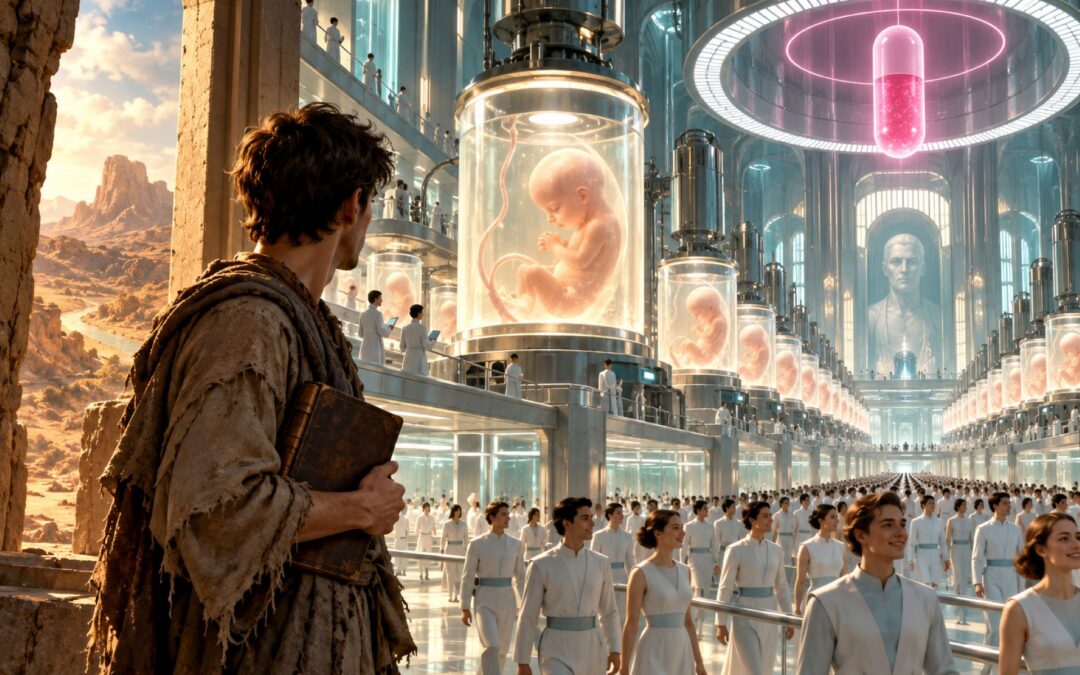
Aldous Huxley’s Brave New World, originally published in 1932, imagines a future in which humanity has solved many of the problems that have troubled civilisation for centuries. Poverty, disease, unwanted pregnancy, loneliness, political unrest, and emotional suffering have been largely eliminated. People enjoy comfortable lives, plentiful entertainment, sexual freedom, and a pharmaceutical escape from anything unpleasant. The government no longer needs to terrify its citizens into obedience because most of them are genuinely satisfied with their circumstances.
The achievement comes at an extraordinary price. Human beings are manufactured in laboratories, divided into predetermined social classes, and psychologically conditioned to accept their assigned roles. Families have disappeared, lasting romantic attachments are discouraged, and independent thought is regarded as a threat to collective happiness. Scientific knowledge, literature, religion, and personal freedom survive only to the extent that they serve the governing ideal of stability.
Huxley develops this society through the experiences of several dissatisfied individuals, most importantly Bernard Marx and John, a young man raised outside the supposedly perfect civilisation. Their encounters with the World State expose the contradictions of a system that can provide almost everything people want because it has already determined what they are allowed to desire.
The novel raises a difficult question: what remains of human freedom when happiness is guaranteed through the control of human nature itself? Its answer emerges through social satire, conflicting characters, philosophical debate, and an increasingly disturbing tragedy.
Spoiler warning: This article provides a complete summary, analysis, and critical review of Brave New World, including all major plot developments and the ending.
How the World State Manufactures Happiness
The novel opens in the Central London Hatchery and Conditioning Centre, a thirty-four-storey building devoted to the industrial production of human beings. Above its entrance appears the World State’s governing motto: “Community, Identity, Stability.” The society operates in the year 632 A.F., or After Ford, placing Henry Ford’s industrial legacy at the centre of its calendar and cultural identity.
The Director of Hatcheries and Conditioning leads a group of students through the facility, explaining how human reproduction has been transformed from a biological and familial process into an exercise in scientific administration. Babies are no longer born to mothers. Instead, embryos are artificially fertilised, manipulated, incubated, and eventually removed from their bottles through a process called decanting.
The Director introduces the Bokanovsky Process, which allows a single fertilised egg to produce numerous genetically identical individuals. Through carefully managed interruptions of normal development, the Hatchery can create large groups of identical workers suited to the same tasks. The related Podsnap Technique accelerates the maturation of eggs, making mass reproduction more efficient.
The language resembles a factory demonstration. Processes are praised for their productivity, efficiency, and consistency, and the students diligently record the Director’s explanations. Human life is discussed as something that must be manufactured according to the requirements of an existing economic system.
The population is divided into five principal castes: Alphas, Betas, Gammas, Deltas, and Epsilons. Alphas occupy positions requiring relatively sophisticated intellectual abilities, while Epsilons perform repetitive and menial labour. The distinction is established before birth through selective biological treatment. Lower-caste embryos may receive restricted oxygen supplies and other interventions intended to limit their physical or intellectual development.
The Social Predestination Room coordinates these processes with the demands of society. The authorities know how many people of each type will be required and manufacture them accordingly. Rather than adapting institutions to the varied abilities of naturally developing people, the World State creates people whose abilities match its institutional needs.
Biological manipulation is only the beginning. The Director next demonstrates how children are conditioned after decanting.
In one nursery, Delta infants are placed near books and flowers. As they approach these attractive objects, frightening noises and electric shocks teach them to associate reading and nature with distress. The children will eventually avoid both without understanding why.
The experiment serves two purposes. Books may encourage independent thinking, while an appreciation of nature may provide satisfaction without stimulating sufficient consumption. Citizens can be encouraged to enjoy outdoor activities, but preferably activities requiring expensive equipment, transport, or other manufactured goods.
The World State has therefore transformed psychological conditioning into an economic instrument. People are encouraged to enjoy precisely those activities that maintain social stability and industrial production.
Another important technique is hypnopaedia, or sleep-teaching. Children repeatedly hear recorded phrases reinforcing approved beliefs about caste distinctions, consumption, sexuality, and social behaviour. These lessons are absorbed long before the children can evaluate their meaning.
Through repetition, official doctrine becomes automatic thought. Citizens do not need to remember being taught that their caste is desirable or that conformity is virtuous. They simply experience these ideas as obvious truths.
The third chapter moves from institutional instruction into everyday life. Children play in the gardens, including games that encourage sexual experimentation. The Director explains that behaviours once considered private or inappropriate are now normal parts of childhood conditioning.
The World Controller Mustapha Mond joins the students and describes how the present system replaced the unstable civilisation of the past. Family relationships, exclusive romantic attachments, religious commitments, and strong personal loyalties are presented as dangerous because they produce intense emotions that cannot be easily regulated.
Mond explains that the old world was disrupted by war, economic instability, and resistance to the institutions that eventually became dominant. In response, the new civilisation reorganised human life around predictability and collective satisfaction. Historical knowledge has been suppressed because the past offers competing standards by which people might judge the present.
The chapter repeatedly shifts between Mond’s exposition and conversations among ordinary citizens. Lenina Crowne, a young Beta worker at the Hatchery, discusses her relationship with Henry Foster with her friend Fanny Crowne. Fanny worries that Lenina has been seeing Henry too exclusively and encourages her to pursue other partners.
Meanwhile, Bernard Marx, an Alpha psychologist, becomes uncomfortable when other men discuss Lenina as though she were an object available for their amusement. His reaction appears unusually serious in a society where sexual relationships are expected to be casual and widely shared.
The chapter also introduces soma, the World State’s pharmaceutical solution to unhappiness. Rather than enduring distress or investigating its causes, citizens can consume a drug that produces tranquillity and pleasure without the obvious physical consequences associated with older intoxicants.
By the end of these opening chapters, Huxley has established the principal mechanisms of his dystopia. People are biologically designed for particular social functions, trained to prefer those functions, and provided with continuous pleasures that discourage dissatisfaction. The apparent harmony depends upon an immense system of control operating before individuals have any meaningful opportunity to choose.
Bernard Marx and the First Cracks in Stability
Bernard Marx belongs to the Alpha caste, but he lacks the physical confidence and social ease expected of someone in his position. He is unusually short for an Alpha, and rumours suggest that something went wrong during his embryonic development. Other Alphas treat him with condescension, leaving him resentful of the people whose approval he nevertheless desires.
His discomfort becomes particularly visible around Lenina Crowne. When she openly accepts his invitation to visit the Savage Reservation in New Mexico, Bernard feels embarrassed by the attention their conversation attracts. He wishes their relationship could possess some privacy and emotional significance, whereas Lenina sees nothing unusual about publicly discussing a prospective holiday with a sexual partner.
Bernard’s unease extends to the ordinary practices of the World State. He dislikes its constant social activity, compulsory cheerfulness, and expectation that people should never spend meaningful time alone. Yet his objection is complicated by his resentment of the men who enjoy greater social prestige. His desire for individuality is difficult to separate from his desire to feel superior.
Bernard’s closest friend is Helmholtz Watson, a remarkably successful Alpha lecturer and writer of propaganda. Helmholtz is intellectually gifted, physically attractive, and socially popular. Unlike Bernard, he has no obvious reason to feel excluded, but he has become dissatisfied with the trivial purposes to which his abilities are devoted.
Helmholtz can produce effective slogans and fashionable writing with little effort. What troubles him is the suspicion that language could express experiences more important than those the World State permits. He feels capable of something greater without knowing what that achievement might be.
The friendship establishes two different forms of alienation. Bernard is unhappy partly because he feels inferior to his peers. Helmholtz is unhappy because he senses that his environment offers too little scope for his abilities.
Elsewhere, Lenina spends an evening with Henry Foster. They enjoy recreational activities, aerial travel, dancing, and the reassuring effects of soma. Passing above a crematorium, they discuss the processing of human bodies after death, including the recovery of useful materials. Even mortality has been incorporated into the civilisation’s industrial efficiency.
Lenina wonders whether Epsilons truly enjoy their inferior lives. Henry assures her that their conditioning makes them satisfied. The conversation exposes the moral assumption supporting the caste system: inequality supposedly ceases to be objectionable when everyone has been taught to accept it.
Bernard’s evening provides a contrasting experience. He attends a Solidarity Service, a collective ritual designed to dissolve individual consciousness into a shared emotional and spiritual state. Twelve participants consume soma, sing repetitive hymns, and participate in a ceremony that combines religious imagery, sexual excitement, and group psychology.
The participants gradually experience ecstatic unity, but Bernard cannot surrender himself as expected. He imitates their enthusiasm while remaining painfully aware of his isolation. His failure is especially humiliating because the ceremony is designed to make alienation impossible.
His developing relationship with Lenina reveals similar tensions. During an excursion, Bernard seeks solitude and attempts to explain why he wants to feel like an independent person rather than a component of a larger social body. He deliberately confronts experiences that Lenina finds disturbing, including the threatening atmosphere of the sea and the apparent emptiness of being away from other people.
Lenina responds with confusion and anxiety. She has been trained to associate solitude with abnormality and discomfort with something that should be immediately corrected through soma. Bernard’s desire to experience difficult feelings makes little sense to her.
Despite these disagreements, the relationship becomes physically intimate. Bernard’s dissatisfaction does not make him immune to ordinary desires, and he continues struggling between his unconventional ideas and the habits imposed by his society.
Before travelling to New Mexico, Bernard requires the Director’s approval for his Reservation permit. The Director unexpectedly recalls an earlier visit to the same region with a young woman who became separated from him during a storm and disappeared. He returned to civilisation without finding her.
The memory briefly exposes an emotional vulnerability beneath the Director’s official manner. Embarrassed by his disclosure, he abruptly changes tone and reprimands Bernard for unconventional behaviour. He warns that continued misconduct may result in his transfer to Iceland.
Bernard initially interprets the threat as evidence of his courageous opposition to society. The possibility of punishment briefly makes him feel important, but the reality proves less flattering.
After reaching the Reservation, he learns that the Director intends to carry out the transfer. Bernard immediately becomes frightened, losing much of the confidence he had derived from imagining himself as a persecuted individualist.
The threatened exile supplies an important motive for what follows. Bernard’s discovery in New Mexico will offer him a way to defeat the Director and recover the status he fears losing.
John and Linda in the Savage Reservation
Bernard and Lenina arrive at the Savage Reservation, a territory outside the World State where people continue to reproduce naturally and live according to customs that the technologically advanced civilisation has abandoned.
Their destination is Malpais, a settlement amid the dramatic landscape of New Mexico. The physical environment differs sharply from London. Instead of orderly laboratories and carefully regulated buildings, the visitors encounter dust, crowded dwellings, domestic animals, religious ceremonies, and people whose bodies reveal the effects of age and illness.
Lenina reacts with horror. She has never been accustomed to seeing elderly people whose faces and bodies display ordinary biological deterioration. The sight of mothers breastfeeding their children is equally shocking because she regards motherhood and natural reproduction as indecent.
Bernard, who has frequently condemned the attitudes of his society, is less independent in practice than he imagines. He is also affected by the discomfort, dirt, and visible suffering of the Reservation.
The visitors witness a ceremonial gathering combining Indigenous and Christian religious imagery. The ritual involves dancing, snakes, and a young man enduring repeated whipping as part of a communal act of sacrifice. Bernard and Lenina struggle to understand a culture in which suffering can possess religious or social significance.
They meet a young man named John, who has wanted to participate in the ceremony but has been excluded because he is considered different from the other inhabitants.
John speaks English and has an unusual background. His mother, Linda, was originally a member of the World State. She became separated from her companion during a visit to the Reservation many years earlier and never returned home.
Bernard soon learns that her companion was the Director of Hatcheries and Conditioning.
Linda now lives in poverty, and her appearance appals Lenina. Years of hardship, ageing, and substance use have left her physically deteriorated. She remains emotionally attached to the comforts of civilisation and constantly remembers the conveniences and pleasures she has lost.
Her situation has been especially difficult because she became pregnant after being stranded. In the World State, pregnancy is normally prevented, and motherhood is treated with disgust. On the Reservation, however, Linda’s conditioned sexual attitudes brought her into conflict with local expectations.
She continued having relationships with men rather than conforming to the norms of the community around her. Other women punished and ostracised her, while John grew up witnessing the hostility directed toward his mother.
John explains his childhood to Bernard.
Linda taught him to read and described the technological wonders of the civilisation she remembered. Her stories filled him with images of a place where physical suffering was rare, people were constantly entertained, and life was organised around ease and comfort.
Yet she was frequently unhappy and unreliable as a parent. She used alcohol and other intoxicants to escape her circumstances, while her relationships with men provoked arguments and sometimes violence.
One of these men was Popé, whom John deeply resented. The boy’s jealousy reflected his desire to protect his mother, his confusion about sexuality, and his growing sense that the adults around him were violating standards he could not yet clearly articulate.
John eventually discovered a volume containing the works of William Shakespeare. The plays and poems transformed his emotional and intellectual life.
Shakespeare gave him a language for experiences that his mother could not adequately explain. Through the plays, he encountered romantic devotion, jealousy, honour, betrayal, shame, courage, suffering, and moral conflict. Their heightened language provided a framework through which he could interpret the painful events of his childhood.
His education was nevertheless highly unusual. John did not encounter Shakespeare as one literary tradition among many. He absorbed the plays as an almost authoritative guide to human behaviour, often applying their moral and emotional expectations directly to his own circumstances.
His admiration for the surrounding community was equally complicated. He wished to participate in its practices and learn its skills, but the other young men rejected him because of his background. He was white, the son of an outsider, and culturally different from the people among whom he had grown up.
An important exception was Mitsima, an older man who taught John practical crafts, including pottery. Through such instruction, John experienced the satisfaction of patient, skilled work, something that would later become important in his attempt to live independently.
John’s exclusion reached a particularly painful point when he was prevented from taking part in a communal initiation. He responded with humiliation and despair, longing for the recognition and belonging that the ritual might have provided.
His relationship with suffering became increasingly deliberate. He experimented with forms of physical endurance and self-punishment, associating pain with discipline, religious meaning, and moral worth.
Bernard recognises that John’s life contains the answer to his own immediate problem. If John is the Director’s son, then bringing him to London will expose a secret capable of ruining the man who has threatened Bernard’s career.
He proposes that John and Linda accompany him back to civilisation.
John is overjoyed. He has spent his life hearing about the World State without experiencing it, and the prospect of finally visiting his mother’s former home seems extraordinary. His excitement draws on Shakespeare’s language of wonder, especially the idea of discovering a beautiful new world.
Bernard is pleased by the opportunity for revenge, but he also notices John’s interest in Lenina.
After returning to their accommodation, Lenina takes a large dose of soma to escape the disturbing memories of Malpais. While she sleeps, Bernard travels to obtain official permission to bring John and Linda to London.
John enters Lenina’s room and sees her sleeping. He is captivated by her beauty, and his response becomes a struggle between sexual desire and the ideal of romantic purity that he has learned from Shakespeare.
He is tempted to touch her but restrains himself, believing that his feelings demand reverence rather than immediate possession. His behaviour establishes the conflict that will later dominate their relationship.
When Bernard returns, John leaves with him, still imagining that the civilisation awaiting him will fulfil the promise contained in his mother’s stories.
London Turns John Into a Celebrity
Back in London, the Director prepares to publicly humiliate Bernard and announce his dismissal from the Hatchery. The confrontation takes place before a gathering of employees, giving the Director an opportunity to reinforce the importance of conformity.
Bernard, however, has prepared a devastating surprise.
He brings Linda into the room. She recognises the Director and addresses him by the familiar name she used during their earlier relationship. Her appearance is already shocking, but the situation becomes intolerable when John enters, approaches the Director, and publicly identifies him as his father.
The employees erupt in laughter.
In a society where biological parenthood has been eliminated and the language of family is regarded as embarrassing or obscene, the revelation destroys the Director’s dignity. A man responsible for enforcing the World State’s reproductive ideology is exposed as the father of a naturally born child.
The Director flees the room and subsequently resigns. Bernard’s punishment disappears, and his position changes dramatically.
John becomes an object of intense fascination throughout upper-caste London. Although civilisation considers the Reservation primitive, its inhabitants are also exotic curiosities. John is especially interesting because he looks and speaks sufficiently like a civilised person while behaving according to unfamiliar values.
Bernard acts as his guardian and controls access to him. People who previously mocked Bernard now compete for his attention because he can arrange meetings with the famous Savage.
The change is intoxicating. Bernard begins enjoying fashionable company, sexual relationships, and the prestige he had previously claimed to despise. His personality becomes more self-satisfied, and his criticisms of the World State diminish as his popularity increases.
Helmholtz observes the change with disappointment. Their friendship suffers because Bernard’s new social identity depends on precisely the superficial approval that Helmholtz increasingly finds inadequate.
Linda’s return produces a different outcome. She has spent years longing for the pleasures of civilisation, but she is no longer physically or socially suited to its standards of youth and attractiveness.
She finds refuge in soma, consuming the drug so continuously that ordinary consciousness becomes almost irrelevant to her. Instead of rebuilding a meaningful life, she enters an extended chemical escape.
John, meanwhile, is introduced to the institutions his mother once described.
He visits schools, laboratories, industrial workplaces, and other establishments that demonstrate the achievements of the World State. His reactions become increasingly hostile as he recognises the consequences of its apparent perfection.
At a school for girls, he encounters the systematic teaching of contraception and the casual treatment of sexuality. Elsewhere, the controlled organisation of labour and human development makes him aware of the diminished possibilities available to lower-caste citizens.
His visit to an industrial workplace is particularly disturbing. He sees large groups of nearly identical workers engaged in repetitive labour, revealing how successfully the Bokanovsky Process has converted human beings into standardised instruments of production.
John is also horrified by the ways in which entertainment replaces deeper forms of experience.
He accompanies Lenina to a feely, a technological entertainment resembling a film but incorporating artificial physical sensations. The spectators experience elaborate sensory stimulation intended to make the spectacle pleasurable and absorbing.
Lenina enjoys the experience. John is disturbed by its emotional shallowness and the crude treatment of sexual desire, yet his own attraction to Lenina grows stronger.
After the performance, Lenina expects their evening to develop into sexual intimacy. John instead returns her to her accommodation, leaving her disappointed and confused. He withdraws to Shakespeare, attempting to reconcile his desire with his ideal of honourable love.
Bernard’s fortunes then reverse.
He organises an important social gathering attended by prominent figures who expect to meet John. The Savage, however, refuses to appear. He is tired of being treated as a curiosity and does not feel obliged to satisfy the expectations of Bernard’s guests.
The refusal humiliates Bernard. Without John, his new prestige evaporates, and the fashionable people who had sought his company treat him with contempt.
Bernard responds with anger and self-pity. He blames John despite recognising that his guests’ behaviour demonstrates the worthlessness of relationships based entirely on celebrity.
His friendship with Helmholtz becomes strained by jealousy, but John and Helmholtz increasingly develop an affinity of their own.
Helmholtz has been disciplined for writing a poem about solitude, a subject regarded as socially undesirable. John admires his desire to express genuine experience, and the two begin sharing their intellectual interests.
John introduces Helmholtz to Shakespeare. Although Helmholtz recognises the power of the language, he struggles to understand the social assumptions behind some of the plays.
The family conflicts surrounding Romeo and Juliet, for instance, strike him as absurd because he has been conditioned to regard parents, marriage, and exclusive romantic relationships as indecent or ridiculous.
The scene reveals an important difference between the two men. Helmholtz possesses creative ability but lacks access to certain forms of emotional experience. John understands those experiences through literature, though his understanding is itself shaped by idealisation and misunderstanding.
Their friendship nevertheless offers John one of his few genuine connections in London.
Lenina, Linda, and the Failure of Human Connection
Lenina becomes increasingly preoccupied with John. She is accustomed to a society in which sexual attraction ordinarily leads to physical intimacy without complicated moral negotiation. John’s obvious interest in her, combined with his repeated refusal to act on it, leaves her frustrated and uncertain.
Fanny encourages Lenina to take the initiative. From Fanny’s perspective, the problem appears straightforward: if Lenina wants John, she should make her intentions clear and pursue the relationship.
John’s feelings are more complicated.
He loves Lenina, or at least believes he does, but understands love through Shakespearean models of devotion, restraint, sacrifice, and moral purity. He imagines that affection must be proved through some difficult achievement before it can legitimately lead to intimacy.
When Lenina visits his apartment, John tries to explain his feelings. He speaks of marriage and the desire to demonstrate his worthiness through extraordinary deeds. Lenina struggles to understand these ideas because lifelong romantic exclusivity and marriage are foreign to her upbringing.
She nevertheless recognises his declarations as an expression of desire and attempts to embrace him.
John reacts with horror.
What Lenina sees as an ordinary and affectionate sexual response, he interprets as evidence of moral corruption. His idealised image of her cannot accommodate the reality of a woman who openly expresses desire.
His language becomes abusive, and he physically threatens her. Lenina, terrified, retreats to the bathroom and locks the door.
The confrontation exposes the incompatibility of their emotional expectations. Both are products of their cultural environments, and neither can adequately understand the other. But the scene also shows John’s own capacity for cruelty: his moral beliefs do not justify his violence toward Lenina.
Their confrontation is interrupted by a telephone message informing John that Linda is seriously ill.
John hurries to the Park Lane Hospital for the Dying. The building is comfortable and technologically advanced, designed to make death a calm and undisturbing event.
Linda lies in a ward under the influence of soma. Her consciousness is absorbed in pleasurable fantasies, and she barely recognises the world around her.
John sits beside her, overwhelmed by memories of their difficult life together. He recalls moments of childhood affection, his mother’s instruction, and the conflicting emotions that have shaped their relationship.
He wants her to recognise him and recover the intimacy that has been damaged by years of resentment and misunderstanding. Instead, Linda’s confused speech returns to fragments of the past, including memories of Popé.
John becomes frustrated and angry. He desperately wants his mother to come back to him emotionally, even as she is approaching death.
The hospital staff respond to the situation with an indifference that he finds unbearable.
A group of children has been brought into the ward as part of its death-conditioning programme. They are encouraged to encounter dying people in pleasant surroundings so that mortality will never acquire frightening emotional associations.
The children receive treats and enjoy the experience as an educational outing. Their curiosity about Linda’s appearance and condition repeatedly disrupts John’s attempts to mourn privately.
When Linda finally dies, John is devastated. His grief combines genuine affection with regret over his resentment and his inability to reach her during her final moments.
The nurse is more concerned that his reaction will disturb the children’s conditioning than with his suffering. To the institution, death is an ordinary biological event that should not produce significant emotional disruption.
John leaves the ward in a state of anguish and encounters a group of Delta workers collecting their daily soma ration.
Suddenly, he sees a direct connection between the drug that has consumed his mother’s life and the larger system of psychological control governing the workers. His private grief turns into an attempt at public rebellion.
He urges the Deltas to reject soma and recognise their condition as slavery. They do not understand him. Conditioned to regard their lives as satisfactory, they experience his interference as an attack on something valuable.
John begins throwing their soma ration away.
The workers become angry, and the disturbance escalates. Helmholtz arrives with Bernard and joins John’s attempt to resist the crowd. Bernard, however, hesitates repeatedly between helping his friends and protecting himself.
The police restore order using the World State’s characteristic methods. Rather than relying solely on physical force, they deploy soothing messages, emotional manipulation, and soma-based interventions to pacify the crowd.
The workers return to their routine, and the disturbance ends.
John’s rebellion fails because the people he is trying to liberate do not share his understanding of freedom. He assumes that they should reject their condition once someone explains it to them, but their desires and expectations have already been shaped by the system he opposes.
John, Bernard, and Helmholtz are taken into custody and brought before Mustapha Mond.
Mustapha Mond Explains the Price of Stability
The three men are taken to the World Controller’s study. They expect punishment, but Mond surprises them by engaging John in a serious philosophical discussion about civilisation.
Unlike most citizens, Mond understands the literature, history, religion, and scientific inquiry that the World State has suppressed. He possesses forbidden books and is familiar with Shakespeare, making him one of the few people capable of discussing John’s ideas on their own terms.
John begins by expressing his dislike of civilisation. Mond does not dismiss him as ignorant or irrational. Instead, he explains why the World State deliberately excludes many of the experiences John values.
Their first major disagreement concerns literature.
John wants to know why Shakespeare’s plays are prohibited. Mond explains that the works belong to an older civilisation whose emotional experiences are largely incomprehensible to modern citizens.
The conflicts, passions, jealousies, and commitments presented in Shakespeare depend upon family structures, social institutions, and emotional attachments that the World State has abolished. Citizens would struggle to understand such works, much less find them relevant to their own lives.
John suggests creating new works of equivalent greatness. Mond replies that the kind of emotional intensity required for such art would destabilise society.
Great tragedy depends upon suffering, conflict, and the possibility of serious loss. The World State has intentionally removed or restricted those conditions.
The choice is therefore between the predictable happiness of the majority and the forms of artistic achievement that arise from uncertain, passionate human lives.
Mond openly acknowledges that the World State has sacrificed high art in favour of stability.
The conversation then turns to the caste system.
John questions why the authorities manufacture lower-caste workers when they possess the technology to produce more intellectually capable people.
Mond argues that an entire society of Alphas would be unworkable. Highly capable individuals, he claims, would resist repetitive labour, compete for prestigious positions, and refuse the sacrifices necessary to maintain the social order.
He describes a historical experiment on Cyprus, where a population composed entirely of Alphas was allowed to organise its affairs. The experiment ended disastrously as conflict, political instability, and economic dysfunction disrupted the society.
For Mond, this demonstrates the necessity of matching human abilities and expectations to the practical demands of social organisation.
John’s objection exposes the moral problem. The system does not merely assign unpleasant work to those who happen to possess fewer opportunities. It deliberately creates people who will have restricted abilities and then conditions them to accept the resulting limitations.
Mond regards this as a reasonable arrangement because the workers are satisfied.
The Controller also explains why scientific inquiry is restricted.
The World State depends upon sophisticated technology, but its rulers do not permit unrestricted scientific investigation. Research is valuable only when it strengthens the existing order.
Discoveries that might disrupt economic arrangements, alter social relationships, or introduce uncontrollable consequences are discouraged or suppressed.
Mond reveals that he once pursued independent scientific research and faced the possibility of exile because his work threatened established boundaries. He chose political authority rather than intellectual freedom.
His position is particularly important because he understands the sacrifices his society has made. He has consciously accepted the restrictions that he imposes on others.
Bernard and Helmholtz are informed that they will be sent to islands populated by people who cannot conform to ordinary social life.
Bernard reacts with panic. He imagines the punishment as the destruction of everything that makes life worthwhile and struggles desperately to avoid it.
Helmholtz responds almost enthusiastically. He recognises exile as an opportunity to encounter other independent thinkers and develop his creative abilities away from the restrictions of ordinary civilisation.
Mond explains that such islands contain many of the world’s most interesting people. The authorities have effectively separated independent minds from the population rather than attempting to destroy them.
Helmholtz even expresses a preference for a harsh climate, believing that difficult conditions might help him write better.
John, however, is not offered exile. Mond wants to keep him in civilisation as part of an experiment.
After Bernard and Helmholtz leave, John continues questioning Mond. Their discussion becomes increasingly concerned with religion, suffering, morality, and freedom.
John argues that human beings need spiritual meaning and that religion offers a way of confronting experiences that cannot be reduced to pleasure.
Mond explains that traditional religion developed in response to insecurity, ageing, sickness, and death. In a society where most ordinary forms of suffering have been minimised, people have less need for religious consolation.
He acknowledges the possibility of God without accepting that religion should govern the organisation of human life. What matters to him is whether religious beliefs promote or undermine social stability.
John responds that hardship has consequences beyond the immediate pain it produces. Difficult experiences can create the conditions for courage, loyalty, discipline, heroism, and moral growth.
Mond’s society eliminates the need for such virtues by removing many situations in which they might be exercised.
Even intense emotions can be imitated through carefully controlled physiological treatments. The citizens receive a Violent Passion Surrogate that recreates some bodily effects of fear and rage without requiring actual danger or conflict.
The World State therefore does not simply suppress unpleasant emotions. It attempts to preserve whatever benefits they might provide while eliminating their unpredictable causes.
John finds this arrangement intolerable. He wants the possibility of genuine experience, including the risk of suffering, rather than a carefully administered substitute.
When he claims the right to be unhappy, Mond responds by listing the many painful conditions that freedom might also entail: disease, ageing, insecurity, deprivation, and physical torment.
John accepts the consequences.
The conversation closes without either man converting the other. Mond remains committed to the greatest achievable stability, while John insists that a fully human life requires possibilities the World State has deliberately excluded.
Their disagreement leaves an unresolved practical question: whether John can find a way to live according to his principles without being destroyed by the conditions around him.
John’s Retreat and Death at the Lighthouse
Following his conversations with Mond, John is physically and emotionally exhausted. His friends visit him and discover that he has been making himself sick as part of an attempt at purification.
He feels contaminated by his experiences in London and wants to escape the society that has humiliated him, destroyed his mother’s remaining life, and turned his own identity into a public spectacle.
John asks Mond for permission to accompany Bernard and Helmholtz into exile, but the Controller refuses. Mond remains interested in observing how John responds to civilisation.
Denied the possibility of joining an alternative community, John resolves to withdraw from society altogether.
He finds an abandoned lighthouse in the countryside, near a small village and stretches of open land. The location appears sufficiently remote to allow him to live according to his own values.
John begins constructing a simple existence based upon work, discipline, and solitude.
He cultivates the land, makes practical objects, and works with wood using skills he acquired on the Reservation. His efforts provide a form of satisfaction entirely different from the effortless convenience of London.
When he makes a bow, for example, the work requires patience, attention, and physical skill. The process itself gives him pleasure because he has achieved something through his own effort.
He initially regards such satisfaction with suspicion, however, believing that he has come to the lighthouse for penitence rather than enjoyment.
His memories of Linda continue to torment him. He recalls her suffering and death, and he reproaches himself for the anger and resentment he felt toward her.
His desire for Lenina creates an additional conflict. He cannot reconcile his attraction to her with the moral ideal of chastity and purity he believes he must uphold.
John turns increasingly toward physical self-punishment. He prays, fasts, and whips himself in an attempt to overcome his desires and atone for his perceived failures.
His solitude does not last.
A reporter discovers his location and attempts to interview him. John reacts violently, driving the intruder away. Other journalists follow, attracted by the prospect of obtaining sensational material about the famous Savage.
A photographer named Darwin Bonaparte eventually films John’s self-punishment without his knowledge. The resulting spectacle becomes a public sensation, attracting widespread curiosity.
The lighthouse, which John hoped would provide refuge from civilisation, becomes another entertainment destination.
Crowds arrive in helicopters to watch him. They demand that he repeat the whipping they have seen in the recorded spectacle, treating his spiritual anguish as an exciting performance.
John tries to drive them away, but the visitors are protected by their numbers and cannot understand why he resists the attention.
The situation becomes especially disturbing when Lenina arrives.
John sees the woman who has become the focus of his unresolved desire and moral hatred. Lenina approaches him with visible emotion, apparently hoping for some form of reconciliation or intimacy.
He responds with furious abuse and lashes out with his whip. She attempts to escape while the surrounding crowd becomes excited by the scene.
The spectators begin participating in a collective frenzy. Their excitement develops into an orgiastic gathering resembling the emotionally charged group rituals of the World State.
John becomes swept into the atmosphere he had intended to resist.
When he awakens the following morning, he remembers his participation with horror. His effort to escape civilisation has ended in an experience that seems to confirm everything he despises about himself.
He cannot reconcile his ideal of spiritual purity with what has happened.
The next day, another group of visitors arrives at the lighthouse. They receive no response when they call for him.
Inside, they discover that John has hanged himself.
The novel ends with the movement of his suspended body, a final image that gives his death a chilling mechanical quality. The World State survives untouched, while the person who attempted to reject its values has been destroyed.
How the World State Works
The World State’s power rests on the coordination of biological engineering, psychological conditioning, economic organisation, and political authority. These systems are designed to support one another so thoroughly that resistance becomes difficult even to imagine.
Its first advantage is control over human development.
By manufacturing embryos according to predetermined social requirements, the state shapes the distribution of abilities across the population. The caste hierarchy is therefore reproduced through biological intervention rather than through education or economic inheritance alone.
Alphas are prepared for complex work and authority, while lower castes are deliberately given more restricted capacities. The Bokanovsky Process creates large groups of interchangeable workers, making the labour force predictable and easily organised.
Yet biological differences alone would not guarantee obedience. An intelligent worker might resent a low-status occupation, while someone assigned repetitive labour might still desire another kind of life.
The state addresses this problem through conditioning.
Children are taught to associate approved activities with pleasure and disapproved activities with discomfort. Hypnopaedic repetition turns social rules into deeply familiar assumptions. Citizens learn to enjoy their assigned positions before they have the intellectual freedom to question the hierarchy itself.
The result is a distinctive form of domination. The state does not constantly have to prevent people from pursuing forbidden ambitions because it has already shaped their ambitions into acceptable forms.
The economy operates according to similar principles.
Citizens are encouraged to consume continuously, replace goods rather than repair them, and seek commercial entertainment. Activities that provide too much independent satisfaction are discouraged when they threaten demand for manufactured products.
Outdoor recreation is acceptable when it requires equipment. Entertainment is encouraged when it depends upon industrial production. Personal desires are organised so that their satisfaction helps maintain the economic system.
This arrangement makes consumer behaviour part of citizenship. Buying, travelling, enjoying fashionable amusements, and using technological conveniences become ordinary expressions of social conformity.
Soma provides another form of stability.
The drug allows citizens to escape anxiety, disappointment, and emotional disturbance without experiencing the immediate discomfort associated with older intoxicants. Its significance is political because it reduces the likelihood that unhappiness will develop into sustained reflection or resistance.
A worker frustrated by an unpleasant situation can temporarily remove the feeling rather than investigate its cause. A person facing emotional disappointment can retreat into pleasure instead of changing the relationship or confronting the loss.
The government also controls the social conditions under which such dissatisfaction might arise.
Lasting romantic attachments are discouraged because they generate unpredictable loyalties. Families have disappeared because the emotional intensity of parenthood might compete with collective obligations. Religion and traditional literature are suppressed because they offer alternative meanings and standards of value.
Even death is carefully managed. Children are conditioned to regard it without fear or grief, while cremation transforms bodies into recoverable materials. Mortality is treated as an administrative process rather than an occasion for disruptive personal attachment.
Political authority is concentrated in the World Controllers, who possess knowledge unavailable to ordinary citizens. They understand history, forbidden books, and the limitations of the governing system. Their commitment is to preserve stability rather than expand individual understanding.
The World State consequently combines extensive technological sophistication with severe intellectual restriction. Research is encouraged when it serves existing institutions but suppressed when it might generate unpredictable change.
This distinction matters for interpreting Huxley’s relationship with science. As Jay Clayton explains in his study of genetics and dystopia within Huxley’s intellectual circle, the novel emerged from close engagement with contemporary scientific debate, including ideas associated with J. B. S. Haldane and Huxley’s brother Julian.
The novel’s artificial reproduction and conditioning procedures are speculative constructions, not descriptions of actual biological capabilities. Their literary purpose is to imagine what happens when scientific methods become instruments of comprehensive social planning.
The political system also contains an important contradiction. Although it claims to provide universal happiness, it deliberately prevents large sections of the population from developing capacities that might make other kinds of happiness possible.
Mond justifies this arrangement through social outcomes. If individuals feel satisfied, he believes the system has achieved its purpose.
The deeper question is whether satisfaction remains a sufficient measure of well-being when the people experiencing it have been systematically prevented from understanding or desiring alternatives.
The Main Characters and Their Conflicting Desires
Huxley constructs much of the novel through characters who respond differently to the same social order. Their motivations are not interchangeable, and the contrast between them is essential to the story’s argument. Some reject conformity because it frustrates their ambitions, others because it denies their deepest values, while the most powerful character understands those values and consciously chooses to suppress them.
John: A Mind Divided by Two Worlds
John occupies the novel’s most difficult position because he belongs fully to neither of the societies he encounters.
Growing up on the Reservation, he is rejected because of his parentage and cultural difference. Yet the World State, which his mother describes as a place of technological wonders, becomes an imagined alternative to the painful realities of his childhood.
His understanding of civilisation is shaped by two sources that rarely agree: Linda’s memories of London and Shakespeare’s representation of human life.
Linda teaches him to admire comfort, technological progress, and freedom from physical hardship. Shakespeare teaches him to value devotion, honour, beauty, sacrifice, and emotions intense enough to inspire heroic or tragic action.
This combination creates expectations that no society can easily satisfy.
John longs for belonging, but he also wants his identity to possess a special moral significance. He idealises people and institutions before encountering them, then reacts with anger when they fail to meet his expectations.
His attitude toward Linda reveals this contradiction. He loves his mother and suffers deeply when she dies, but he has also judged and resented her sexual relationships. He cannot fully separate his affection from his desire for her to embody an ideal of maternal purity.
The same pattern appears in his relationship with Lenina.
John is attracted to her as a person, but he also transforms her into an image of Shakespearean romantic perfection. When she expresses desire in terms shaped by her own upbringing, he interprets her behaviour as an offence against that image.
His violence exposes the danger of confusing moral idealism with understanding another human being.
John’s criticism of the World State is often compelling. He recognises that its inhabitants have been deprived of meaningful freedom, that its pleasures discourage reflection, and that its rejection of suffering also diminishes courage and emotional depth.
Yet his alternative remains uncertain. He wants a life governed by spiritual discipline and freely chosen hardship, but his relationship with suffering becomes punitive rather than constructive.
His suicide emerges from the collision between social coercion and an increasingly inflexible moral imagination. He is a victim of the World State, but the novel also shows how his inability to accept his own desires contributes to his destruction.
John is therefore a tragic protagonist whose most important insights coexist with serious psychological and ethical limitations.
Bernard Marx: Outsider, Opportunist, and Conformist
Bernard initially appears to be the novel’s principal dissenter. He resents social expectations, desires privacy, and objects to the casual treatment of intimate relationships.
His dissatisfaction, however, is closely connected to personal insecurity.
Because he is physically smaller than other Alphas, Bernard feels excluded from the effortless authority his caste is supposed to enjoy. His criticism of social hierarchy frequently emerges from his discomfort with his own position within it.
He wants to experience himself as an independent individual, but he also wants other people to acknowledge his importance.
These desires become especially visible after John’s arrival in London. Bernard gains popularity through his association with the Savage and quickly embraces the privileges he once condemned.
He enjoys fashionable gatherings, sexual attention, and the deference of influential people. His opposition to conformity weakens when conformity begins rewarding him.
The collapse of his social standing after John’s refusal to attend the party reveals how dependent Bernard remains on public approval.
His behaviour toward John is similarly contradictory. He initially helps bring him to London, but his motives include revenge against the Director. He later treats John as a source of prestige and resents him when that arrangement fails.
Bernard’s friendship with Helmholtz is more genuine, yet he struggles to avoid jealousy when Helmholtz and John discover shared interests.
The threat of exile completes his character arc. Rather than embracing independence, Bernard begs to remain within the system he has criticised.
Huxley uses Bernard to distinguish the desire for freedom from the desire to be admired. Bernard possesses moments of genuine insight, but he lacks the independence necessary to act consistently upon them.
Lenina Crowne: Desire Within the Limits of Conditioning
Lenina is one of the World State’s most thoroughly socialised characters, but her conformity should not be mistaken for the absence of feeling.
She enjoys fashionable clothing, recreation, sexual relationships, and the reassurance of familiar social expectations. Her repeated reliance on hypnopaedic phrases reveals how deeply the state’s teachings have shaped her thoughts.
When confronted with ageing, dirt, emotional intensity, or solitude, she usually experiences discomfort and seeks the psychological protections her society provides.
Yet Lenina is also capable of attraction, curiosity, disappointment, and genuine emotional distress.
Her relationship with Bernard demonstrates an initial willingness to engage with someone regarded as socially unusual. Although she struggles to understand his desire for privacy, she does not immediately reject him because of his differences.
Her feelings for John are more intense.
She finds him attractive and becomes increasingly troubled by his apparent refusal to reciprocate. His behaviour introduces uncertainty into a form of intimacy that she expects to be straightforward.
Lenina’s tragedy is partly linguistic and cultural. She lacks a vocabulary for the romantic seriousness John expects, just as he lacks the willingness to understand her openness about sexuality.
Neither character can adequately translate desire into terms the other recognises.
John’s response, however, is more than a misunderstanding. His abusive language, threats, and eventual violence transform Lenina’s attempts at connection into experiences of fear.
The novel sometimes treats her primarily through the desires and judgments of male characters, leaving much of her inner life unexplored. Nevertheless, the emotions Huxley does provide are significant enough to complicate any interpretation of her as a mere symbol of superficial pleasure.
Helmholtz Watson: The Search for Creative Freedom
Helmholtz offers a more intellectually coherent challenge to the World State than Bernard.
He possesses nearly everything the system considers desirable: intelligence, physical attractiveness, social popularity, professional success, and sexual opportunity.
Yet he feels that his talents have no adequate purpose.
As a writer of official propaganda, Helmholtz can manipulate language with remarkable skill. What troubles him is that the society supplies so little worth saying.
His desire for creative freedom therefore arises from abundance rather than deprivation. Unlike Bernard, he is not primarily seeking compensation for humiliation.
The poem about solitude demonstrates his willingness to express an experience condemned by his culture. It also reveals the limitations of his understanding, since he has not yet discovered the full range of emotions and conflicts that serious literature might represent.
His friendship with John expands that understanding. He recognises Shakespeare’s verbal power even when the dramatic situations remain strange to him.
Helmholtz’s response to exile is particularly revealing. He welcomes separation from the World State because it may provide the conditions needed for meaningful artistic work.
His preference for a difficult climate suggests that he has begun to recognise a connection between challenge and creativity.
Unlike John, however, Helmholtz does not treat suffering as an absolute moral good. His desire is directed toward the productive use of his abilities, making him one of the novel’s most plausible examples of independent aspiration.
Mustapha Mond: The Intelligent Defender of Control
Mustapha Mond is the novel’s most intellectually formidable representative of political authority.
He understands the achievements of the civilisation that preceded the World State and possesses access to knowledge forbidden to ordinary citizens.
His ability to discuss Shakespeare, religion, science, and philosophy makes him more sophisticated than many of the people who oppose him.
Mond’s importance lies in the fact that he does not defend social control through ignorance.
He knows that the World State has sacrificed significant human possibilities. He acknowledges the value of serious art, independent inquiry, and spiritual experience, but argues that their social consequences are incompatible with permanent stability.
His earlier career as a scientist gives this position personal significance. Mond once had the capacity to pursue knowledge for its own sake but chose authority and institutional security.
He now enforces restrictions that he understands better than most of the people who obey them.
His political reasoning is consequentialist. He judges institutions largely by their ability to preserve predictable happiness and minimise conflict.
The problem with his position is that he treats the population’s conditioned satisfaction as evidence that the system is justified.
If people’s preferences have been deliberately manufactured, their contentment cannot straightforwardly establish that their freedom has been respected.
Mond recognises some of these tensions but continues to prioritise stability. His willingness to defend the trade-off makes him more disturbing than a ruler who simply enjoys domination.
Linda: Motherhood, Exile, and Social Abandonment
Linda is central to the novel because her life exposes the inability of either society to accommodate someone shaped by the other.
She grows up in the World State, where sexual relationships are casual, motherhood is unthinkable, and physical comfort is taken for granted.
Her accidental pregnancy and isolation on the Reservation destroy the assumptions through which she understands ordinary life.
She cannot return to civilisation, but she also struggles to adapt to the society surrounding her.
Her sexual behaviour brings hostility from the local women, and her dependence on intoxicants reflects her inability to endure the discomfort and exclusion of her new circumstances.
Linda’s relationship with John is affectionate but deeply troubled.
She teaches him to read, introduces him to the society she remembers, and provides much of his earliest emotional world. Yet she is frequently absent, distressed, or unable to meet his needs.
Her inability to conform to local expectations exposes John to rejection and humiliation.
When Linda finally returns to London, she expects the recovery of everything she has lost. Instead, her altered appearance makes her socially undesirable, and the civilisation offers her little beyond chemically induced pleasure.
Her death reveals the limitations of a system that can manage physical discomfort but has no meaningful place for grief, family attachment, or the emotional responsibilities of care.
Linda is therefore more than an example of forbidden motherhood. She is a displaced person whose suffering arises from incompatible social systems and the absence of a community capable of accepting her.
The Director, Fanny, and Other Social Enforcers
The Director of Hatcheries and Conditioning embodies institutional respectability. He teaches the principles of artificial reproduction and social conformity, yet his hidden history with Linda exposes a personal connection to the family relationships his society condemns.
His humiliation illustrates the fragility of authority built upon rigid public standards. The revelation does not prove that he secretly rejects the World State; rather, it shows how easily an institution can turn ordinary human circumstances into scandal.
Fanny Crowne performs a quieter form of social enforcement. Her advice to Lenina reflects sincere concern, but it also reproduces the state’s expectations about sexuality and conformity.
Henry Foster represents another kind of acceptance. His professional competence and enthusiasm for the existing order demonstrate how thoroughly its values can become part of an apparently successful life.
Popé occupies an important position in John’s childhood, functioning both as one of Linda’s companions and as an object of John’s jealousy and moral disgust. Mitsima, by contrast, provides John with practical skills and a limited form of connection to the Reservation’s traditions.
These secondary figures help establish that social control operates through personal relationships as well as through official institutions. Ordinary people continually reinforce the expectations that give their societies coherence.
How the Novel Portrays Love, Sex, and Family
One of the World State’s most radical achievements is the elimination of the family as a social institution.
The authorities regard parenthood, marriage, and exclusive romantic attachment as sources of instability because they create powerful personal loyalties. A person devoted to a partner or child may value that relationship more highly than collective expectations, and the possibility of losing someone deeply loved creates forms of suffering that cannot be easily controlled.
The World State attempts to remove these problems by separating reproduction from intimacy.
Children are produced in laboratories rather than families, while sexual relationships are encouraged to remain casual and widely distributed. Citizens are conditioned to regard exclusivity as antisocial and prolonged emotional attachment as undesirable.
This arrangement should not be confused with simple sexual liberation. Although citizens experience considerable freedom to pursue physical intimacy, the emotional meaning of their relationships is tightly regulated.
Lenina’s feelings for John reveal the limits of that freedom. She can express sexual desire openly, but she has difficulty understanding John’s expectation that love should involve restraint, exclusive commitment, and moral sacrifice.
John approaches the relationship from the opposite direction.
His experiences with Shakespeare have taught him to associate love with idealised devotion and the possibility of heroic achievement. He wants to see Lenina as a figure worthy of reverence, and he regards unrestrained sexual desire as a threat to that ideal.
Neither approach allows the characters to understand the other completely.
The novel’s treatment of their conflict is especially troubling because John’s moral expectations are deeply affected by his feelings about Linda. He has witnessed his mother’s relationships with men and responded with jealousy, embarrassment, and anger.
When Lenina expresses desire, John reacts as though she has betrayed the elevated role he has assigned her.
His violence exposes a contradiction in his conception of love. He celebrates devotion and moral seriousness but cannot respect the autonomy of the woman he claims to love when her wishes differ from his expectations.
The relationship between John and Linda complicates the novel’s broader account of family.
The World State insists that family attachments are sources of suffering, and John’s childhood provides evidence that they can indeed involve jealousy, neglect, resentment, and emotional damage.
Nevertheless, Linda’s death reveals something the World State cannot reproduce: the depth of an attachment formed through shared history.
John’s grief is painful partly because he loves his mother despite her failures and his own resentment. Their relationship contains memories, obligations, and regrets that cannot be replaced by an immediately available pleasure.
Huxley does not establish that traditional family structures are inherently virtuous. Instead, the novel suggests that relationships acquire significance through the possibility of lasting attachment, conflict, vulnerability, and loss.
The most disturbing feature of the World State is that it eliminates many painful relationships by eliminating the conditions under which those relationships could become meaningful.
Happiness, Freedom, and the Cost of Suffering
The governing ethical conflict of Brave New World concerns the meaning of happiness.
The World State defines successful social organisation largely through the satisfaction of its citizens. People enjoy comfortable lives, rarely experience significant material deprivation, and possess reliable means of escaping emotional distress.
From Mond’s perspective, these achievements provide compelling evidence that the system works.
John challenges the conclusion because he believes human well-being requires more than pleasant subjective experience.
The distinction becomes clear in the treatment of soma.
Soma can eliminate anxiety and produce pleasure, but it does not resolve the circumstances that generate dissatisfaction. Linda uses it to escape the difficulties of her return to civilisation, eventually withdrawing from meaningful engagement with her son and surroundings.
Bernard also uses soma when social humiliation becomes too painful.
These episodes suggest that the political significance of the drug lies in its ability to replace confrontation with temporary relief.
The same principle governs childhood conditioning.
A person trained from birth to desire a limited range of experiences may sincerely report satisfaction. Yet that satisfaction does not settle whether the person has been denied opportunities for development.
The lower-caste workers illustrate this problem. Their abilities and preferences have been deliberately restricted, leaving them content with labour that someone possessing a different range of capacities might find unbearable.
Mond believes the arrangement is justified because it prevents conflict and misery. John objects because the workers have been deprived of a meaningful opportunity to choose.
The novel therefore raises a question about autonomy: can a decision be considered fully voluntary when the person making it has been designed to prefer one option?
John’s answer emphasises the right to suffer.
He regards grief, uncertainty, moral struggle, and the possibility of failure as unavoidable dimensions of a freely chosen human life.
His position has considerable force. Courage cannot exist without danger, fidelity matters partly because betrayal is possible, and serious artistic expression often depends upon experiences that resist easy resolution.
However, the novel also reveals the limitations of treating suffering as intrinsically valuable.
John’s deliberate self-punishment at the lighthouse does not produce moral clarity or a workable form of independence. His effort to destroy his desires becomes increasingly destructive.
His tragedy suggests that suffering can deepen human experience without necessarily making people wiser or more virtuous.
This distinction is important when applying the novel to real-world questions about medicine and psychological well-being. As M. H. N. Schermer discusses in a philosophical comparison of Brave New World and Huxley’s later novel Island, the ethical significance of psychopharmacology depends upon how substances are used and what purposes they serve.
Relieving suffering need not be equivalent to suppressing human freedom. Medical treatment can support autonomy rather than undermine it.
What makes soma disturbing is its systematic role within a society committed to preventing dissent, conflict, and independent reflection.
The novel’s strongest ethical challenge is therefore directed less at happiness itself than at the political organisation of happiness. It questions whether a society can legitimately guarantee satisfaction by controlling the range of experiences, values, and possibilities available to its citizens.
Science, Censorship, Art, and Religion
The World State depends upon scientific sophistication while deliberately limiting the pursuit of knowledge.
Its laboratories can manipulate human reproduction, produce standardised groups of workers, regulate physical development, and manufacture pharmaceutical pleasure.
Yet Mond explains that scientific inquiry is permitted only within boundaries established by the government.
Discoveries that improve stability are valuable. Discoveries that threaten established arrangements are dangerous, regardless of their intellectual importance.
This distinction exposes the political character of the World State’s relationship with science.
The authorities do not pursue understanding as an independent good. They use technical knowledge to preserve a predetermined social order.
Mond’s personal history makes the contradiction explicit. As a scientist, he once valued discovery and independent investigation. As a Controller, he restricts the same intellectual freedom because he believes unrestricted inquiry would undermine collective stability.
Literature occupies a similarly dangerous position.
Shakespeare’s plays contain forms of emotional experience that the World State has attempted to eliminate. Their conflicts involve jealousy, loyalty, parental authority, marriage, betrayal, ambition, and the possibility of catastrophic loss.
For John, Shakespeare provides a vocabulary capable of expressing the intensity of human existence. For Helmholtz, the works reveal the extraordinary possibilities of language.
But their friendship also exposes the limits of literature as a universal source of understanding.
Helmholtz appreciates Shakespeare’s verbal force while finding some of its social assumptions absurd. Without personal or cultural familiarity with marriage and parental authority, he struggles to understand why certain conflicts should matter.
The scene suggests that art depends partly upon the experiences available to its audience. A society that systematically prevents particular experiences may also undermine the capacity to understand their artistic representation.
The World State compensates with entertainment designed to stimulate the senses rather than challenge the imagination.
Feelies, synthetic music, fashionable spectacles, and carefully managed recreational activities provide pleasurable experiences with little risk of disturbing established beliefs.
The difference is not simply between high and low culture. It concerns whether artistic expression is permitted to reveal experiences that cannot be easily incorporated into the approved understanding of life.
Religion faces the same restriction.
The World State has replaced traditional religious commitments with a culture centred upon Ford, collective ritual, technological efficiency, and social unity.
Its Solidarity Services imitate religious ceremonies while directing participants toward emotional synchronisation rather than spiritual inquiry.
Mond argues that religion becomes less necessary when the conditions that traditionally produce spiritual need have been eliminated.
John disagrees because he associates religious experience with discipline, moral seriousness, and the capacity to confront suffering.
Their disagreement raises a further difficulty. If a society removes nearly every occasion for spiritual struggle, its citizens may have little reason to seek religious meaning. But whether that absence constitutes liberation or deprivation depends upon how one understands the purpose of religion itself.
Huxley’s satire is most persuasive when it exposes the subordination of knowledge, imagination, and spiritual life to political stability. It is less convincing if interpreted as proof that scientific advancement or material comfort must inevitably destroy these values.
The novel’s real target is the assumption that institutions should determine in advance which truths, experiences, and questions are socially permissible.
Ford, Soma, Shakespeare, and Other Symbols
Brave New World develops its meaning through recurring objects, phrases, institutions, and literary references. These motifs are integrated into the everyday functioning of the fictional society rather than appearing only as decorative symbols.
Henry Ford is among the most important.
Ford’s association with mass production, standardisation, and industrial efficiency becomes the foundation of the World State’s cultural imagination. Time is measured from the Fordian era, and religious language is adapted to honour the principles of industrial civilisation.
The traditional Christian cross is displaced by the sign of the T, associated with the Model T automobile.
This transformation connects technological production with quasi-religious authority. The World State treats efficiency and stability as principles worthy of unquestioning reverence, replacing older forms of spiritual commitment with an ideology of industrial organisation.
The Hatchery and its bottles extend this symbolism.
Human beings are manufactured through processes resembling production lines, reinforcing the idea that people have been converted into standardised outputs.
The bottle becomes an image of planned identity. It represents the substitution of administrative design for unpredictable biological and personal development.
Soma carries a different but equally central meaning.
The drug symbolises the ability to eliminate unwanted consciousness. It provides comfort, but that comfort repeatedly appears at moments when a character might otherwise confront a painful truth.
Linda’s dependence on soma becomes especially significant because her final retreat into chemical pleasure prevents the intimate recognition John desperately seeks.
The drug also appears during the failed rebellion, revealing that the authorities can pacify conflict by changing people’s emotional states rather than addressing their grievances.
Shakespeare provides the novel’s most complex literary framework.
The title comes from Miranda’s speech in The Tempest, in which she responds with wonder to the discovery of people beyond the world she has known.
John repeatedly draws upon that language when imagining or encountering the World State.
Initially, the expression reflects his excitement at the prospect of civilisation. He expects the new world to fulfil the extraordinary promises contained in Linda’s memories.
As his experiences become increasingly disturbing, the same language acquires an ironic meaning.
The society he encounters is technically impressive but emotionally impoverished, and the people he once expected to admire frequently become objects of disillusionment.
Shakespeare also functions as a kind of substitute inheritance. John has not received a stable cultural education from either society, so the plays supply an inherited vocabulary through which he attempts to interpret his own life.
Their limitations become evident when he applies dramatic ideals too rigidly to real people.
The Savage Reservation provides another recurring contrast.
It preserves childbirth, ageing, religious ritual, manual labour, and traditional attachments. These experiences reveal what the World State has excluded, but the Reservation also contains cruelty, exclusion, and suffering.
Its symbolic function is therefore more complicated than representing an untouched paradise.
The Solidarity Service and the final crowd form an important structural parallel.
Both involve individuals surrendering their separate identities to collective excitement. Bernard struggles to participate in the former, while John is overwhelmed by the latter.
The resemblance suggests that emotional conformity can operate through collective pleasure as effectively as through institutional instruction.
Death is another recurring motif.
The crematorium treats dead bodies as recoverable material, and the hospital trains children to regard dying without grief. John’s response to Linda’s death exposes the emotional experiences excluded from this approach.
Finally, the lighthouse represents John’s attempted separation from civilisation.
Its physical isolation seems to promise independence, while his practical work suggests the possibility of a life based upon skill and discipline.
Yet the building becomes visible to the public and is eventually transformed into a spectacle. The refuge fails because neither geography nor self-punishment can free John from the social pressures and psychological conflicts that follow him.
The novel’s epigraph, attributed to the philosopher Nicolas Berdiaeff, frames these symbols through the problem of utopia. It introduces the possibility that a perfectly organised society might become something from which human beings need to escape.
Huxley’s fictional world gives that possibility concrete social and emotional form.
The Reservation, Race, and the Limits of the Contrast
The Savage Reservation plays a crucial role in Brave New World because it establishes an alternative environment against which the achievements of the World State can be judged.
In London, human reproduction is controlled, ageing is carefully managed, and emotional disturbance is discouraged. On the Reservation, people are born naturally, form families, experience disease and physical decline, and participate in religious and communal traditions.
The contrast exposes the hidden costs of technological civilisation.
Lenina’s horror at breastfeeding and ageing reveals how thoroughly she has been conditioned to regard ordinary human experiences as shameful or disgusting.
John’s childhood demonstrates the importance of belonging, cultural inheritance, manual skill, and the desire for recognition.
Yet the Reservation is not presented as an ideal society.
John suffers because his background makes him an outsider. Linda is mistreated because her behaviour violates local expectations. Religious rituals involve physical pain, and social life can be harsh and exclusionary.
The community possesses forms of meaning that the World State has suppressed, but it also imposes restrictions upon individuals who do not conform.
This duality is essential to the novel’s argument.
John’s suffering on the Reservation leads him to idealise civilisation, while his suffering in civilisation leads him to seek escape from it. His inability to belong fully in either society prevents the contrast from resolving into an easy choice between traditional and modern life.
Nevertheless, the way Huxley constructs the Reservation deserves criticism.
The society is presented through a mixture of Indigenous cultural references, Christian imagery, and exoticised customs, often filtered through the disgust or fascination of outsiders.
The word “Savage” itself is central to the language of the novel. Although its repeated use exposes the World State’s arrogance, the narrative also relies upon racialised and colonial categories familiar to its historical context.
The inhabitants of the Reservation rarely receive the psychological depth afforded to the main characters from London.
Their community functions primarily as a contrast that helps explain John’s identity and reveal the limitations of the World State.
This creates a representational imbalance. The novel questions the humanity of technological civilisation while frequently treating Indigenous life as a symbolic resource for a debate conducted among outsiders.
Contemporary approaches to the novel, including scholarship examining consumer culture and its colonial assumptions, help clarify why these features matter to its continuing interpretation.
The fictional Reservation should not be mistaken for an accurate description of any particular Indigenous community.
Its rituals and cultural arrangements belong to Huxley’s speculative construction, and its literary usefulness does not remove the limitations of that construction.
The novel remains strongest when it allows both societies to expose the inadequacies of the other.
The Reservation demonstrates that suffering and tradition do not automatically produce justice or belonging. The World State demonstrates that comfort and stability do not automatically produce freedom or meaning.
John’s tragedy emerges partly because neither environment provides a sustainable home for someone whose values and experiences cross the boundary between them.
Satire, Shifting Viewpoints, and the Structure of the Novel
Huxley’s narrative structure is unusually important because the novel changes its dominant mode as the story develops.
The opening chapters resemble a satirical tour of a functioning institution.
Readers encounter the World State through the Director’s explanations, the students’ unquestioning attention, and the detailed processes of artificial reproduction and psychological conditioning.
The method is deliberately impersonal. Human beings are discussed through administrative and industrial language, creating a disturbing contrast between the technical efficiency of the procedures and their moral consequences.
Much of the humour arises from the calm seriousness with which characters describe practices the reader is expected to find troubling.
The Director explains the manipulation of embryos as an industrial achievement, while children are trained to fear books and flowers for economic reasons.
The satire works because the characters rarely recognise the absurdity of their own assumptions.
The third chapter develops a more experimental technique by shifting rapidly among conversations and situations.
Mond’s historical explanations intersect with Lenina and Fanny’s discussion of sexual behaviour, Bernard’s private resentment, and other fragments of ordinary life.
The juxtapositions connect official ideology with everyday language. The state does not merely proclaim its values through government institutions; its citizens repeat them through gossip, romantic expectations, and casual conversation.
Hypnopaedic slogans become part of the prose’s rhythm, demonstrating how repetition can transform political instruction into familiar common sense.
The narrative then gradually moves toward character-driven conflict.
Bernard’s dissatisfaction initially provides the principal perspective through which readers recognise the limitations of conformity. However, his behaviour becomes less admirable as he acquires status.
John’s arrival changes the structure again.
The World State has already been explained through its own institutions, allowing the reader to understand its logic before seeing it through the eyes of an outsider.
John encounters familiar elements of the society as shocking discoveries. Ordinary sexual practices, automated labour, sensory entertainment, and the treatment of death become strange again because his expectations differ so sharply from those of the people around him.
This shifting perspective gives the satire greater complexity. The reader can recognise the achievements of the society while also understanding John’s disgust.
Huxley frequently uses dialogue to establish philosophical differences.
Bernard and Helmholtz reveal contrasting motives for discontent, while John and Lenina expose incompatible understandings of sexuality and love.
The most explicit example occurs in the conversations between John and Mustapha Mond.
These chapters temporarily suspend much of the dramatic action in favour of sustained argument about art, science, religion, happiness, and freedom.
The approach gives the novel unusual intellectual clarity. Mond’s defence of stability is expressed directly rather than being left entirely to inference.
It also creates a literary limitation.
The characters sometimes function as representatives of competing ideas, and the narrative becomes less dramatically active when they explain the society’s philosophical foundations.
Nevertheless, the position of these conversations within the structure is effective.
John has already experienced the system’s consequences through Lenina, Linda, the hospital, and the soma revolt. Mond’s explanations therefore arrive after the reader has encountered the human costs of the institutions he defends.
The final chapter shifts the tone decisively toward tragedy.
Earlier scenes frequently expose social absurdity through comedy, embarrassment, and intellectual contrast. At the lighthouse, the same mechanisms become destructive.
The public curiosity surrounding John, previously a source of social advantage for Bernard, turns into an invasion that prevents John from living independently.
The closing image abandons the novel’s earlier conversational wit and leaves the reader with the physical fact of John’s death.
This progression from institutional satire to philosophical confrontation and personal catastrophe gives Brave New World much of its distinctive force.
Why John’s Ending Is Both Tragic and Troubling
John’s death is the culmination of several conflicts that have developed throughout the novel.
His childhood taught him to associate belonging with moral and religious achievement. Rejection on the Reservation intensified his desire to prove himself through discipline, suffering, and heroic conduct.
Shakespeare supplied ideals through which he could imagine a more meaningful life, but those ideals also encouraged him to interpret ordinary human limitations as moral failures.
His encounter with the World State destroys his expectation that technological civilisation will provide an escape from the hardships of Malpais.
Instead, he finds a society where the experiences he values most deeply have been deliberately removed or trivialised.
Linda’s death makes this conflict intensely personal.
The World State can provide physical comfort and pharmaceutical pleasure, but it cannot recognise John’s need for emotional reconciliation with his mother.
His response to the soma distribution represents an attempt to transform grief into resistance. Yet the workers’ refusal to accept liberation reveals how little he understands the people he is trying to help.
His philosophical debate with Mond then exposes the scale of the problem.
The World State’s stability is not an accidental consequence of misguided policies. Its institutions have been consciously organised around the sacrifice of values John considers indispensable.
Unable to change that system, John retreats to the lighthouse.
His withdrawal initially contains the possibility of a different life. Manual labour gives him satisfaction, and solitude allows him to pursue his own spiritual practices.
But he cannot escape his internal conflicts.
He continues blaming himself for his treatment of Linda and remains unable to reconcile his sexual desire for Lenina with his ideal of moral purity.
His response is to punish his body rather than develop a more forgiving understanding of himself.
The arrival of journalists and spectators destroys his remaining privacy. Even his suffering becomes a commodity that the World State can turn into entertainment.
This is one of the ending’s sharpest ironies. John wants his actions to possess spiritual significance, while the public interprets them as sensational performances.
His individual meaning is absorbed into the system he is resisting.
The final crowd also reveals the limitations of his attempt to achieve purity through violent rejection.
John’s abuse of Lenina and the collective frenzy that follows demonstrate how easily his own actions can become entangled with the behaviour he condemns.
He cannot maintain the separation between himself and civilisation upon which his ideal depends.
His suicide may therefore be interpreted as the World State’s ultimate victory over an individual who refuses its values.
Yet this explanation is incomplete.
John’s moral absolutism, particularly his hostility toward sexuality and his reliance on self-punishment, contributes to his inability to imagine a sustainable existence.
The novel provides no convincing way for him to combine freedom with emotional acceptance, ordinary companionship, and practical independence.
Huxley himself later recognised the limitations of this arrangement. In the 1946 foreword, he reconsidered the stark alternatives offered to John and imagined a more constructive possibility involving a community that could combine personal freedom with elements of technological civilisation.
That retrospective suggestion is not part of the original novel’s ending, but it is important to its evaluation.
John’s death is powerful because it reveals both the cruelty of a society that commodifies suffering and the destructive consequences of a morality incapable of accommodating human imperfection.
The ending refuses a simple victory for either position. The World State continues functioning, but its stability has been exposed as morally restrictive. John dies defending values the novel takes seriously, but his conduct has also revealed the inadequacy of his own response.
The tragedy lies in the absence of a viable place for someone who wants freedom without surrendering the possibility of human connection.
The Novel’s Greatest Literary and Intellectual Achievements
The most impressive achievement of Brave New World is the coherence of its imagined society.
Huxley does not simply invent a powerful government and declare its citizens oppressed. He constructs a system in which reproduction, education, leisure, consumption, sexuality, emotional regulation, and political authority work together.
The Hatchery determines the population’s biological capacities. Conditioning establishes appropriate preferences. Economic arrangements direct those preferences toward consumption, while soma provides relief from whatever dissatisfaction remains.
These institutions are connected through an intelligible governing purpose.
The World State’s strength lies in its ability to make obedience compatible with ordinary happiness. Its citizens are not uniformly miserable, secretly rebellious, or constantly afraid.
Many genuinely enjoy their lives.
That feature distinguishes the novel from dystopias organised principally around visible terror or deprivation.
The reader must confront the possibility that a society can achieve many desirable outcomes while undermining the conditions necessary for independent judgment.
Huxley’s satire is especially effective in its treatment of language.
The repeated slogans are simple enough to become memorable, but their function is disturbing because they replace reflection with familiar responses.
The characters’ casual repetition of official values demonstrates how political power can become embedded in ordinary speech.
The novel also makes effective use of irony.
The Director’s disgrace exposes the social danger of an ordinary biological relationship in a civilisation that has abolished parenthood.
Bernard’s rise and fall reveal the difference between principled independence and resentment of one’s social position.
The Solidarity Service promises emotional unity while leaving Bernard painfully isolated.
John’s attempts to find freedom become increasingly entangled with the society’s desire to turn every unusual experience into entertainment.
These scenes make the novel’s arguments dramatically visible.
The contrast between Bernard and Helmholtz is another notable achievement.
Both are dissatisfied, but their motivations differ substantially. Bernard wants recognition, whereas Helmholtz seeks meaningful intellectual work.
Their divergent responses to exile provide an efficient test of those motivations.
Mustapha Mond is equally important to the book’s intellectual strength.
He is capable of explaining the benefits of his society and the sacrifices required to maintain them. His arguments are often plausible enough to demand serious engagement.
By giving the defence of stability to an intelligent, knowledgeable character, Huxley avoids making the central conflict entirely dependent upon a foolish or obviously hypocritical antagonist.
John’s position, meanwhile, is made emotionally intelligible through his childhood, his attachment to Linda, and his education in Shakespeare.
His grief at the hospital and his despair at the lighthouse give personal consequences to the abstract concepts discussed with Mond.
The combination of philosophical debate and emotional tragedy allows the novel to explore the price of stability from several directions.
Its enduring significance also rests on the questions it leaves unresolved.
How much freedom should be sacrificed to prevent suffering? Can a person’s satisfaction justify a life whose possibilities have been deliberately restricted? What distinguishes genuine autonomy from desires shaped by social institutions? And what role should discomfort, uncertainty, and conflict play in a flourishing human life?
These questions remain difficult precisely because the novel refuses to make every advantage of the World State imaginary.
Some of its achievements would be genuinely attractive.
The challenge is to judge whether those benefits can justify the comprehensive restrictions imposed upon human development and experience.
Huxley’s strongest literary accomplishment is making that conflict concrete through a society whose institutions seem internally purposeful and whose inhabitants often understand happiness differently from the people who criticise them.
Where Brave New World Falls Short
The novel’s intellectual ambition creates several literary weaknesses.
Its characters are sometimes developed less as psychologically complex individuals than as representatives of contrasting positions.
Bernard embodies insecure dissatisfaction, Helmholtz creative aspiration, John idealistic resistance, and Mond political pragmatism.
These distinctions are effective for the argument, but they can make the characters’ interactions feel arranged primarily to demonstrate philosophical problems.
Bernard receives one of the more convincing psychological portraits because his motives are contradictory and frequently unflattering.
His resentment, vanity, fear, and occasional sincerity make him difficult to reduce to a single moral category.
John is similarly complicated, although his psychological development is sometimes subordinated to the requirements of tragedy.
His movement from romantic wonder to violent disgust and self-destruction is understandable in broad terms, but the intensity of his reactions can also feel shaped by the novel’s need for an extreme confrontation between competing worldviews.
Lenina is a more significant limitation.
She plays an essential role in the emotional conflict, yet the narrative often presents her through John’s idealisation or condemnation.
Her conditioned attitudes are carefully established, but her capacity for independent reflection remains comparatively underdeveloped.
The imbalance matters because the novel raises substantial questions about sexual freedom, romantic attachment, and the social construction of desire.
A fuller exploration of Lenina’s perspective could have made those questions more complex.
The treatment of women more generally is uneven.
Linda receives a memorable and disturbing narrative, but much of her significance depends upon the consequences of motherhood and sexual nonconformity.
Fanny principally reinforces the sexual expectations of the World State.
The central philosophical debate is ultimately conducted between two men, John and Mond, leaving the female characters’ experiences less fully integrated into the novel’s explicit intellectual argument.
The representation of the Savage Reservation presents a different problem.
Huxley’s fictional community provides a useful contrast to the World State, but its mixture of religious practices and cultural references can reproduce exoticising assumptions.
The inhabitants rarely receive the depth or intellectual independence granted to the novel’s principal European characters.
Their society becomes a narrative instrument through which outsiders examine the meaning of civilisation.
This weakens the novel’s capacity to represent cultural difference on its own terms.
The book also relies heavily on exposition.
The opening tour of the Hatchery is brilliantly designed, but much of the social system is explained directly through institutional representatives rather than discovered gradually through dramatic action.
The conversations with Mond intensify this tendency.
They contain some of the novel’s most important ideas, yet their length and explanatory character reduce the narrative’s immediate momentum.
Readers primarily interested in psychological realism or sustained dramatic suspense may find these passages demanding.
The philosophical contrast itself is occasionally restrictive.
Mond presents a choice between stability and the freedoms that generate conflict, while John defends the value of suffering and independent experience.
The novel gives comparatively little sustained attention to institutions capable of combining technological progress, political freedom, and meaningful personal relationships.
This omission matters because many of the World State’s achievements do not logically require the elimination of individuality.
Reliable healthcare need not abolish family relationships. Scientific advancement need not require censorship. Economic security need not depend upon manufacturing restricted human capacities.
The novel’s structure tends to concentrate these possibilities into two extreme alternatives, strengthening the satire while limiting its constructive political imagination.
The account of science also requires careful interpretation.
The fictional society uses biological engineering with extraordinary precision, but its methods should not be mistaken for realistic predictions about genetics or human development.
The novel remains valuable as a speculative investigation of political control, not as evidence that actual technologies operate in the way Huxley describes.
John’s ending crystallises several of these limitations.
His suicide produces a powerful tragic conclusion, but it also depends upon the absence of a persuasive alternative to either complete conformity or destructive isolation.
The intensity of his moral self-punishment can narrow the possibilities of resistance instead of illuminating them.
These weaknesses were not invisible to contemporary readers. A review published in The Guardian in February 1932 recognised the force of Huxley’s satire while questioning the limitations of its vision of human life.
The novel’s shortcomings do not cancel its achievement, but they affect how its argument should be understood.
Brave New World is more persuasive as a diagnosis of the dangers of comprehensive social engineering than as a demonstration that technological civilisation necessarily leads to the kind of society Huxley imagines.
Its finest insights remain compatible with recognising that some of its characters, cultural contrasts, and philosophical alternatives are deliberately exaggerated or insufficiently developed.
What Has Aged Well and Who Should Read It
The continuing relevance of Brave New World does not depend upon its fictional technologies becoming real.
Its most durable insight concerns the relationship between power and desire.
The World State maintains stability partly by ensuring that citizens find approved behaviours pleasurable. This idea remains useful for thinking about political influence, commercial persuasion, behavioural conditioning, and institutions that shape the choices people experience as natural.
The novel’s treatment of consumption is similarly significant.
It imagines an economy that depends upon continuously directing attention toward new experiences and products, while discouraging forms of satisfaction that reduce commercial dependence.
Modern societies are not identical to Huxley’s World State, but the novel provides a framework for examining the relationship between economic incentives and the organisation of everyday life.
Its account of entertainment also remains suggestive.
The feelies and collective spectacles provide sensations without necessarily encouraging understanding. John’s transformation into a public attraction demonstrates how even suffering and resistance can be converted into consumable entertainment.
These episodes invite comparison with forms of mediated attention in which spectacle can become more important than the human experience being represented.
Such parallels require restraint, however.
Contemporary medicine, contraception, assisted reproduction, entertainment technology, and psychological treatment do not inherently reproduce the World State’s political order.
The defining feature of Huxley’s dystopia is the coordinated use of these institutions to restrict autonomy and maintain permanent stability.
His ideas about control also benefit from comparison with other dystopian traditions. In his October 1949 letter to George Orwell, Huxley suggested that psychological and physiological methods of domination might eventually prove more effective than systems relying primarily upon overt brutality.
The distinction helps explain the novel’s continuing importance. Huxley imagines a form of domination that frequently operates through satisfaction rather than fear.
The book is particularly rewarding for readers interested in dystopian fiction, political philosophy, psychology, social institutions, consumer culture, and the ethical consequences of technological power.
Readers who enjoy novels driven primarily by realistic relationships and subtle character development may find some of its dialogue overly explanatory or its characters too closely connected to philosophical positions.
Nevertheless, the novel remains worth reading because its literary construction gives tangible form to questions that are difficult to settle through abstract argument alone.
Its value is not that it correctly predicts the future in every detail. It is that it makes readers examine the conditions under which comfort, happiness, and apparent freedom might become instruments of control.
Brave New World remains one of the most intellectually compelling dystopian novels of the twentieth century. Its imagined society is coherent enough to make its promises attractive and disturbing enough to expose the human costs concealed beneath them. Its satire, symbolism, institutional detail, and philosophical confrontations give the book a significance extending beyond the fate of its central characters.
The novel is not without serious flaws. Its representation of women and Indigenous communities is limited, its philosophical conflicts sometimes overshadow psychological realism, and its tragic ending offers little constructive vision of freedom. Yet these weaknesses also help define the terms on which the book should be judged: as a powerful speculative satire rather than a complete political philosophy.
Huxley’s most enduring contribution is his insistence that happiness and freedom cannot simply be treated as interchangeable achievements. A society may remove suffering while also removing opportunities for independent judgment, meaningful attachment, and personal development. Brave New World remains important because it compels readers to examine that distinction without allowing either pleasure or suffering to become an unquestioned ideal.
Last Updated on October 14, 2026 by Aseem Gupta