
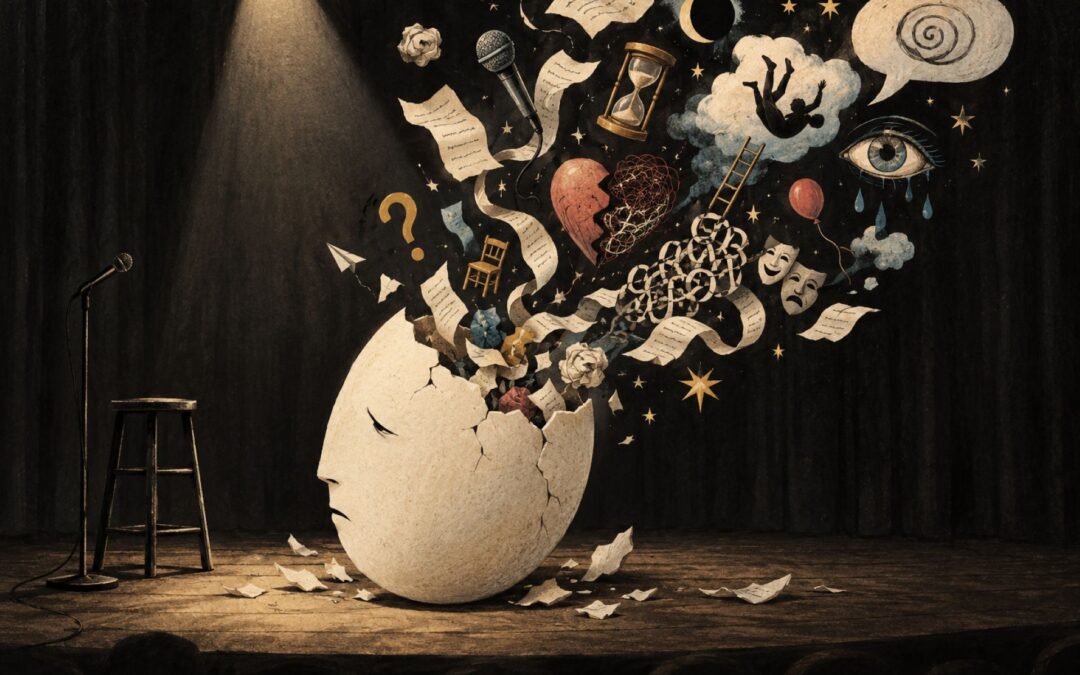
Bo Burnham’s Egghead: Or, You Can’t Survive on Ideas Alone is easy to misdescribe. Calling it a poetry collection makes it sound more solemn and orderly than it is; calling it a comedy book makes it sound less formally inventive; calling it a collection of jokes misses the passages in which the jokes suddenly expose loneliness, insecurity, fear of death, romantic dependence, or uncertainty about God. The book is all of those things at once: an illustrated collection of nearly two hundred short poems, verbal tricks, miniature narratives, absurd observations, obscene jokes, visual poems, and flashes of unexpected sincerity.
The governing tension is between cleverness and feeling. Burnham’s speakers continually turn experience into language games, as though a pun, rhyme, grotesque image, or absurd escalation can keep anything from becoming too serious. Yet many of the strongest pieces work because that defensive cleverness briefly fails, allowing affection, grief, embarrassment, isolation, or fear to become visible before the next joke arrives.
This is a complete discussion of the collection, so it reveals the endings and reversals of individual pieces. It also discusses the book’s explicit sexual language, profanity, references to suicide and death, irreverent treatment of religion, prejudice, and deliberately uncomfortable material.

What Egghead Is and How the Collection Works
Egghead was published by Grand Central Publishing in 2013, with illustrations by Chance Bone. Grand Central Publishing’s description of the book presents it as an extension of Burnham’s combination of intellectual comedy and emotional unease, but its form matters as much as its subject matter. There are no conventional chapters, no numbered parts, and no sustained plot or thesis; instead, the book proceeds through a long sequence of individually titled pieces whose cumulative effect matters more than any formal narrative progression.
The most obvious literary comparison is Shel Silverstein, whom Burnham explicitly thanks in the acknowledgments alongside George Carlin. The comparison is not superficial: like Silverstein, Burnham frequently combines short verse, simple drawings, childish rhythms, grotesque literalization, and conceptual reversals. A contemporary NPR interview about Egghead and Silverstein makes that influence especially useful for understanding the book, although Burnham’s sexual language, nihilistic jokes, social satire, and darker subject matter make Egghead unmistakably an adult collection.
Carlin represents the other important pole. Where Silverstein helps explain the illustrated brevity and playful manipulation of ordinary language, Carlin helps explain Burnham’s obsession with clichés, euphemisms, social scripts, linguistic hypocrisy, and the idea that the words people use often expose assumptions they have not consciously examined. Egghead repeatedly asks what happens when a phrase is taken too literally, when a metaphor is pushed beyond usefulness, when one grammatical ambiguity is treated as reality, or when a socially acceptable way of speaking is translated into what it actually implies.
The book therefore does not need a plot to have movement. Its progression is cumulative: early pieces establish the machinery of wordplay, sexual irreverence, anti-poetry, and romantic contradiction; later pieces repeatedly return to mortality, belief, identity, conformity, alienation, and the limitations of verbal cleverness. Serious material never takes over permanently, because the book refuses to segregate important thoughts from ridiculous ones. A poem about death can be followed by a genital pun, and an observation about prejudice can sit beside nonsense without the collection announcing that one deserves more dignity than the other.
Chance Bone’s role is equally important. Several pieces depend on drawings, typography, scale, page position, or the interaction between text and image, so Egghead is not simply a transcript of material that could have existed unchanged as stand-up. Its physical and visual construction becomes part of the joke, particularly when a word falls down the page, a figure’s appearance contradicts the language surrounding it, or the reader must reinterpret a caption after seeing an illustration.
The Complete Collection, From “Effortless” to “Stuck”
The book begins by teaching the reader how to read it. Words will be treated as physical objects, metaphors will be literalized, sentiment will be interrupted before it becomes comfortable, and serious themes will often arrive disguised as stupidity. The sequence remains deliberately irregular, but its recurring subjects and techniques become increasingly recognizable as the pieces accumulate.
Language, Love, Sex, and the Rules of Poetry
The brief Dedication immediately undercuts the ceremoniousness of dedicating a book by offering itself to the reader only “hopefully,” setting a tone of qualified sincerity. “Effortless” then claims that poetry comes easily before degenerating into sound-driven nonsense, using rhyme itself as both craft and parody. “A Dog’s Poem” rewrites the exhausted “roses are red” structure through canine perception, while “Kiss You” begins with an exaggerated fantasy of constant kissing and keeps escalating until physical exhaustion, sex, irritation, and the need for personal space destroy the fantasy of uninterrupted romantic fusion.
“The Squares” introduces social satire through geometric prejudice. Squares react suspiciously to Circles, and the poem eventually makes its metaphor for racism explicit, producing a double joke: prejudice is ridiculous, but so is allegory that explains itself so aggressively that no interpretation remains necessary. “Convenience” similarly sabotages romantic exaggeration, as the promise to give someone the moon becomes conditional on convenience and then environmentally catastrophic when taken literally.
“Magic” is one of the collection’s first pieces to demonstrate that Burnham’s interest in language is not limited to jokes. By instructing readers to hear silent reading in different internal voices, the poem transforms an ordinary cognitive process into something uncanny. Reading becomes a kind of private ventriloquism, and the piece implicates the reader directly in the collection’s experiments with voice, consciousness, and the strange fact that written symbols can produce an apparently audible presence inside the mind.
“Anteater, Blender, Butthole” plays with the transparency of compound words and labels, using illustration to compare terms whose meanings can be guessed from their components with those that resist literal explanation. “Two Parties” reduces supposedly different pre-wedding rituals for men and women to matching sexual imagery, while “I Eat Words” imagines language as food whose sounds carry tastes and textures. The joke is childish, but the underlying principle recurs throughout Egghead: words do not merely signify things; they seem to possess physical properties of their own.
That principle also drives “On Poets and Farts,” which mocks poetry’s habit of granting oceans, sunsets, and grand natural imagery automatic prestige while excluding ordinary bodily phenomena from aesthetic dignity. The poem uses flatulence not merely for shock but to challenge the hierarchy that declares one physical event “poetic” and another embarrassing. “Chameleon” turns a color-changing animal and a dildo into a visual blush joke, while “Flowers” imagines people replaced by flowers until the world becomes less cruel, briefly allowing a silly transformation to shade into utopian wishfulness.
In “Hell Waits,” Hell is personified as an anxious figure in a doctor’s waiting room, and “Alfred” centers on an angry attempt to tell a rabbit that it cannot simply decide to be an elephant. The latter can suggest debates about identity and social policing, but its ambiguity should be preserved: the poem works because categorical certainty itself becomes absurd when applied to a cartoonishly impossible situation. “Suits,” with rows of visually similar figures, makes conformity visible rather than merely describing it.
“Sully” is more formally ambitious. Its alliteration and densely patterned sounds reproduce the difficulty of a stutter while allowing the character’s thoughts to flow with a freedom that ordinary speech denies him. The poem therefore makes language simultaneously an obstacle and a refuge, a pattern that becomes increasingly important later in the collection.
“Old Sea Captain” builds a romantic archetype only to deflate it through modern spectatorship, while “Fitting” uses shape and bodily accommodation to literalize the social pressure to “fit in.” “You” is comparatively tender, celebrating another person’s irreducible individuality without fully surrendering Burnham’s taste for verbal transformation. In “The Flirt,” however, emotion becomes technique: jokes, sad stories, facts, and frightening tales are presented as interchangeable instruments for producing reactions in someone else, making courtship look uncomfortably similar to performance.
“My Rabbit’s Foot” reverses the perspective of a lucky charm by asking what kind of luck the rabbit must have had to lose its foot. “Onion” dismantles the cliché of a person having layers, substitutes a more botanically accurate artichoke, and turns intimacy into a comic process of plucking and excavation. “I Fuck Sluts” then performs one of the collection’s most important tonal reversals: the speaker initially sounds like a caricature of aggressive sexual bravado, but the persona gradually reveals that the misogynistic pose protects a fear of emotional attachment and abandonment.
That reversal does not erase the ugliness of the persona, but it changes the mechanism of the poem. The obscenity becomes defensive theater rather than the final point, and the piece establishes a pattern that Egghead will revisit repeatedly: an exaggerated claim of sexual confidence or emotional indifference hides someone who is terrified of needing another person.
“Incomparable” makes the concept of comparison collapse while trying to praise someone as beyond comparison. “Gangly” offers an absurd self-portrait through increasingly exaggerated descriptions of a tall, awkward body, and “Advice” reduces bad poetry to the mechanical ability to rhyme. “Can I Have a Word?” treats language as private property, imagining the possibility of owning one word and lending it to others only under chosen conditions.
“Fear” builds elaborate phobias only to trivialize an ordinary fear, while “Flower Sex” translates pollination into extravagant sexual vocabulary. “Angel” begins with gentle snow imagery before revealing that its angel was made in dog feces, a perfect miniature of Burnham’s favorite high-to-low tonal collision. “Your Mom” uses familiar insult logic as a kind of financial arithmetic, and “Toast” literalizes the ceremonial toast into bread.
The opening movement closes with “The Letter,” which builds from letters to words, words to sentences, and sentences back into a letter sent to another person. Its joke about “yours truly” captures one of the book’s deeper concerns: language can identify, disguise, possess, and misrepresent the self at the same time. By this point, Egghead has already established nearly all of its central tools—rhyme, cliché, literalization, obscenity, visual form, romantic insecurity, social satire, and skepticism toward supposedly elevated language.
Work, Death, Relationships, and Perspective
“Rock Bottom” turns an emotional cliché into page architecture by making the reader descend visually toward the bottom of the page. The physical arrangement does most of the work, showing how Egghead can convert metaphor into spatial experience. “Us” offers eternal devotion and immediately demands some personal time after death, treating romantic fusion and autonomy as equally necessary.
In “Searching,” a cliché about looking in every “nook and cranny” is interrogated as if the distinction mattered practically, while “Baby Turtles” turns the familiar image of hatchlings racing toward the sea into a miniature survival story in which disappearing competitors and predators make “winning” darkly ambiguous. “Cup of Joe” elevates coffee into a life-restoring force and then absurdly imagines spilled coffee generating another coffee shop, bringing consumer routine and magical thinking together.
“Sandy Claws” subjects Christmas sentimentality to profanity, while “My Daughter” combines parental language with grotesque nursery-rhyme imagery. “Entrance” relies on page design and visual expectation, demonstrating again that some Egghead pieces cannot be understood from verbal transcription alone. “Nine to Five” condenses office life into cubicles, phones, cuticles, and pharmaceutical work, presenting employment as cramped repetition rather than adult fulfillment.
“Boooop” stages a painfully awkward attempt to ask for consensual sex, repeatedly revising its own wording as the speaker tries not to become coercive or offensive. The comedy comes from social anxiety as much as sexuality. “Perched” depends on visual misrecognition, as the viewer’s understanding of a man apparently sitting on a horse changes once the animal is recognized as a unicorn.
“Her” parodies idealized romantic description by mixing conventionally attractive details with grotesque or absurd ones, while “Subtext” separates spoken language from sexually explicit implication and literalizes the very idea of a hidden layer beneath conversation. “Pumpkin” takes one of the most familiar decorative objects imaginable and makes it strange: a jack-o’-lantern’s expressive face exists because pieces have been removed from it, and the warmth inside becomes eerie once the object is understood as a mutilated body containing fire.
“Martha” uses grotesque visual transformation to parody reinvention, and “Disembodied Heads” reverses the usual distribution of sympathy in stories about severed heads by focusing on the neglected bodies that did the labor. The absurd premise becomes a miniature parody of class politics: the part that receives attention is not necessarily the part that worked. “Benches” creates an invented natural history of old men sitting on public benches, treating a social observation like zoology.
“Count of Six” uses the rhythm of counting to track changing emotion. What initially sounds controlling or confrontational gradually becomes an admission that the speaker does not want the other person to leave. “The Commercial” expands in the opposite direction, imitating the speed and manipulation of advertising language until discounts, loyalty, patriotic imagery, branding, and consumer excitement merge into a single machine for creating desire.
“The Nudist” is primarily visual, while “Homonyms” turns mistakes involving similar-sounding words into the subject of the joke itself. “There” plays with the phrases “there goes someone” and “here goes nothing,” producing meaning through tiny changes in deictic language. “Lou” is more substantial: its protagonist follows dream after dream into different pursuits and eventually winds up ruined, making the piece a direct attack on the motivational cliché that desire alone is evidence of destiny.
“Another Day on the Ant Farm” reverses human perspective by allowing an ant to wonder whether the observing human can see or understand him. The joke opens into an epistemological problem: the creature that seems insignificant from one scale experiences itself as central from another. “Fuck” reduces the poem to a single expletive, an anti-poem whose emptiness is itself part of the gag.
“The Light” takes the consoling image of a bright light at death and rejects it because bright light is physically unpleasant. The speaker prefers the darkness behind closed eyes, turning a spiritual cliché into bodily preference without resolving the fear that produced the cliché. “Cat Lady” literalizes another familiar phrase, while “Big” recalls childhood cruelty toward ants through a magnifying glass and connects size with power: being larger than another creature can make harm effortless even when the stronger person does not fully appreciate what he is doing.
That concern with power enters intimacy in “Using You,” where a lover is described through practical and sexual functions before the speaker becomes uneasy about whether the relationship has become exploitative. In “…”, a supposed nihilist insists that nothing has meaning while compulsively producing rhymes, labels, patterns, and online self-expression. His performance disproves him; he may declare that nothing matters, but he behaves like someone desperate to organize experience into significance.
“Armadilla” is largely nonsense rhyme, and “My Barber Is Bald” lists professionals who fail to embody the competence associated with their roles before making the speaker himself the culminating failure. “Different” initially acknowledges the safety of sameness but ultimately celebrates departure from the mold. “Three Little Words” exploits the expectation of a romantic declaration and then withholds it, while “The Martian” shows a human patronizing an obviously intelligent alien because the human cannot recognize intelligence outside familiar categories.
The sequence culminates in “Xia Cobolt,” one of the book’s most explicitly speculative pieces. Fear of death becomes a thought experiment in which an entire life may be only a fleeting simulation experienced by someone in the future. Rather than solving mortality, the poem destabilizes the self: if one’s supposedly continuous identity could be an artificial experience occupying almost no external time, then certainty about what constitutes a life becomes difficult to maintain.
Time, Religion, Social Rules, and the Absurd
“Father Time” turns Time and Nature into participants in obscene cosmic mythology, fusing environmental destruction, sexuality, and personification. “Playground” imagines enormous insects confronting recreational structures built for much smaller beings, once again using scale to destabilize assumptions about who the world is designed for. “Vampeers” complains about inconsistent fictional rules governing vampires and bats, treating genre conventions as though they should obey accounting principles.
“Split Decision” uses a divided figure to embody indecision, while “Bee Guys” spins out an extended sequence of hive and honey puns. “Hold the Cheese” sexualizes a restaurant instruction by insisting on a literal act of holding, and “This Hour” imagines slowing an hourglass by adding a beach, converting temporal anxiety into physical sand management.
“Time Blows” develops the familiar idea of life as a book but introduces time as an oscillating fan turning its pages faster than the speaker can read. The metaphor eventually becomes more than a joke: once controlling time proves impossible, the speaker learns to skim and occasionally appreciate the breeze. Rather than offering triumph over mortality, the poem suggests adaptation to speed and incompleteness.
“My Stamen” turns botanical reproduction into a relationship joke, while “Secret Ingredient” attacks the sentimental claim that food contains a “pinch of love” by letting literal cinnamon overwhelm the supposed emotion. “Confession” takes the adolescent claim that nobody understands the speaker and attaches it to an absurd visual detail, making self-dramatization ridiculous without entirely denying the feeling beneath it.
“Feels” mixes romantic idealization, explicit sex, and imagery of pinned butterflies, making desire simultaneously affectionate and possessive. “The Fall” constructs lyrical autumnal beauty only to destroy the elevated mood with a sexual punch line. “Touch Me Back” shows how a simple phrase can generate a private pirate association that the other person cannot share, turning wordplay into a miniature example of failed communication.
“Life” parodies inspirational reasoning by combining metaphors as though they formed a valid syllogism. “Imagination” rejects the assumption that adulthood destroys imagination, arguing instead that adults merely fantasize about different things, particularly silence and sex. “TreeHouseTree” inverts the relationship between a treehouse and a Christmas tree indoors, while “Above and Below” describes a loved person as both a puppy and a goddess, capturing the contradictory mixture of reverence, tenderness, condescension, and desire that often characterizes intimate relationships.
“One and Another” turns inclusive pronoun confusion into an absurdly violent solution, and “Senator” dresses political imagery in fairy-tale language before colliding it with patriotic violence. “Boston Poem” uses regional pronunciation as the basis of rhyme, and “Sharks” dismisses fear of a boneless predator by absurdly comparing it with ears because both involve cartilage.
Religion returns centrally in “Our Father,” which rewrites the Lord’s Prayer through profanity, suburban anxiety, guns, food, and commercial language. The poem does not build a systematic theological argument; instead, it demonstrates how sacred phrases can be overwritten by the cultural vocabulary surrounding contemporary life. “Sasquatch” then produces one of the collection’s gentlest reversals: the mythical creature waits with flowers for someone who never arrives, and a ridiculous premise becomes a recognizable image of rejection.
“Socrates” humiliates a canonical philosopher through bodily comedy and wordplay, continuing the book’s suspicion of anything protected by cultural seriousness. “Light Up” turns the romantic claim that someone’s smile illuminates a room into a flamethrower joke, while “Wind” physically scatters language across the page. In that piece, typography is not decoration; the speaker’s inability to communicate is enacted by the words themselves being blown beyond control.
“They” attacks the phantom authority invoked whenever people say “they say,” questioning who exactly “they” are and why anonymity makes a claim sound more trustworthy. “Timmy” turns a sandbox into lethal quicksand, and “Scarf” imagines wrapping words so that they stay warm before hitting another person in the face. “Wise” similarly uses the relationship between image and text to undermine conventional ideas of wisdom and authority.
“Preposition” repeatedly violates the supposedly improper practice of ending sentences with prepositions, allowing grammar rules themselves to become comic material. “Judge Jesus” literalizes the phrase “only Jesus can judge me” by confronting it with an actual legal judge and a serious crime. “Fireflies” is comparatively innocent, imagining the insects as baby stars escaping back toward the sky and allowing wonder to survive without an immediate cynical reversal.
That innocence vanishes in “Land of Really Fucked Thoughts,” which catalogs grotesque and taboo images before implicating the reader simply for having imagined them. The piece makes imagination ethically uncomfortable: language can place an image in the mind even when the reader would never voluntarily choose it. “Bombs” similarly makes wordplay increasingly ominous as successive bombs move toward annihilation.
“The Seaward” juxtaposes present hostility with the residue of old romance, allowing carved initials and insult to occupy the same emotional space. “Rollersnakes” is exuberant nonsense, while “Silly” comes close to an aesthetic manifesto by defending absurdity even when seriousness would be professionally safer. “Perfect” reverses a cliché about searching for perfection, and “Mmmmmm” uses a sexual setup to make ordinary speech unexpectedly desirable.
“She Waits” inflates a woman’s act of waiting into near-sacred observation before acknowledging that the observer may be the ridiculous one. “Put You in My Pocket” transforms romantic closeness into an unsettling fantasy of shrinking, crushing, and carrying another person, showing how easily intimacy can turn into possession when language is literalized. “All Clear” finds enormous satisfaction in an ordinary bathroom experience, returning poetry to bodily life with almost defiant triviality.
“The Biker Gang” undercuts toughness with a practical concern about sleeves, while “Linda” creates a miniature black comedy in which a woman skydiving has disastrously confused equipment associated with her pet rat. “Donald” begins from an inclusive structure involving race, creed, species, and other categories only to conclude that everybody can still unite in disliking one particular individual. The joke does not abolish difference; it relocates judgment from identity categories to personal unpleasantness.
Loneliness, Belief, Violence, and Identity
“Unstick Me” turns unwanted physical attachment into surreal entrapment, and “From the Puppy’s Perspective” imagines a dog interpreting car travel without understanding vents, vehicles, or human intention. Like the ant poem, it reveals how a coherent worldview can be constructed from incomplete information, reminding the reader that confidence does not guarantee comprehension.
“Conversation” is quieter and more painful. Two unhappy people fail to reach one another through speech, and the scene dissolves toward rain and silence rather than resolution. The piece anticipates a larger pattern in Egghead: language is endlessly inventive when nobody urgently needs to be understood, but it becomes unreliable precisely when emotional communication matters most.
“Heart Surgeon” exploits the literal and metaphorical meanings of the heart, with the visual component supplying the final disruption. “Routine” uses circular form to make repetition visible, while “Hanged” treats suicide with an intentionally disorienting combination of seriousness and grammatical deadpan. Suspended after hanging himself, the speaker reflects on language, loneliness, height, irony, and desire as though linguistic precision might still matter at the moment when everything else has failed.
The comedy in “Hanged” is uncomfortable because it neither turns suicide into simple tragedy nor escapes the fact of death through a joke. Instead, linguistic self-consciousness persists grotesquely past the point where language could save the speaker. “Nothing” compresses a similar existential problem into ambiguity: claiming to fear nothing can also mean fearing Nothing, turning grammatical interpretation into metaphysics.
“Stars” makes mortality cosmic by recognizing that the stars will continue after the speaker disappears. “Hello, My Old Friend” approaches aging through a meeting with someone whose decline reflects the passage of time, while the speaker’s insistence that he is merely “okay” hints at emotional evasion rather than contentment. “:'(” satirizes an adolescent analogy between love and searching for Wi-Fi, but the poem’s mockery is directed as much at the desire to make pain seem unique and internet-cool as at heartbreak itself.
“Gay Parading” begins by mimicking the language of someone irritated by gay people “parading around,” only to make the phrase literally refer to Pride parades. By exposing how prejudice can disguise itself as irritation with visibility, the poem shows Burnham using linguistic framing as social critique. “Jesus” is stranger and more tender: divinity appears not in revelation or moral certainty but in a diner, struggling unsuccessfully with a claw machine and sharing the ordinary frustration of a rigged or indifferent system.
“Strange Adjectives” piles unexpected descriptors onto ordinary nouns, while “Gone” shows how a tiny remembered physical gesture by an absent woman can retain disproportionate emotional force. “Gypsy” begins from the mechanics of fortune-telling and skepticism but shifts toward a simpler emotional insight: whatever a palm may or may not reveal, a person’s face can display pain, and the presence of another hand to hold can matter more than prediction.
“Bar Joke” dismantles the familiar priest-rabbi-horse structure by repeatedly changing the ontology of the joke until expectations become impossible to stabilize. “I’m Smart Like a Genius” presents intelligence as ludicrous boasting, allowing insecurity to show through the need to announce superiority. “The Grade” extends an academic mark beyond normal notation, and “The Farmer” uses counting, sheep, lovers, and sheep-derived bedding to sustain an elaborate pun.
“I Want to Beat You to Death” escalates murderous fantasy into such excessive specificity that aggression becomes grotesque performance rather than credible plan. The extremity is part of the joke, but it also demonstrates the collection’s willingness to use imagined violence as linguistic material regardless of comfort. “Don’t” builds a chain of prohibitions that moves from manners and bodily absurdity toward compost and soil, unexpectedly landing on wonder at biological recycling.
“Public Speaking” reverses the classic advice to imagine an audience naked by giving that problem to an actual nudist, and “Woman” reduces gender declaration to a minimalist act of self-assertion followed by hostility toward anyone who would police it. Neither piece sustains an argument, but both illustrate how Burnham repeatedly attacks fixed social scripts through inversion rather than through systematic exposition.
Anxiety, Sincerity, Mortality, and the Final Language Games
“Strange” describes emotional instability through shifting sensory comparisons until ordinary relief arrives through bathing and sleep. “Sirens” is much more difficult, juxtaposing a supposedly poetic description of teenage girls with a deliberately ugly admission of sexual thought. The poem exposes the dishonesty of aesthetic euphemism, but the underlying sexualization remains ethically uncomfortable; recognizing the mechanism does not require treating provocation itself as profound.
“God” leaves the central metaphysical question unresolved rather than manufacturing revelation. “Crazy” features a speaker who insists on sanity while providing increasingly strong evidence against himself, and “Mannish” turns an attempted reassurance about a woman’s body into another insult. “The Epiphany” is sharper: a man who has reduced women to sexual anatomy suddenly recognizes the people attached to the body parts, making basic humanization feel embarrassingly like a revelation.
“No to Drugs” undermines its own anti-drug stance by revealing intoxication within the refusal. “Ashley” depicts a girl surrounded by glamorous female imagery while the mirror becomes the one image she cannot comfortably confront, linking media ideals with self-disgust in unusually economical fashion. “Clowns” shifts fear away from costumed clowns toward the disturbing possibility of off-duty clowns who cannot be identified.
“Turn-Ons” exaggerates erotic attention until it becomes grotesque and then pretends the speaker is merely interested in faces. “Pigs Are Smarter Than Dogs” points out the inconsistency of loving one intelligent animal while eating another, only to let the speaker choose bacon anyway. The poem offers moral recognition without moral improvement, a recurring Burnham move in which self-awareness does not automatically produce virtue.
“A Ghost Story” begins with the supernatural but quickly becomes a story about worldview. One boy can absorb the existence of a ghost with relative calm; another understands that genuine proof of the supernatural would overturn his assumptions about physical law and reacts catastrophically. The piece is funny because the supposedly more rational response becomes the more destabilizing one: what terrifies him is not the ghost itself but the destruction of the conceptual structure that made reality intelligible.
“Look” turns spatial prepositions into nested visual absurdity, while “Let’s See What the Robots Think” repeatedly delays human judgment until machines have been consulted. The technology is less important than the surrender of autonomy: people no longer trust themselves to act before receiving external validation. “Plate Spinner” depends on an illustration revealing why a performer’s effort keeps failing, and “Drink Umbrellas” similarly makes an everyday object strange through invented visual logic.
“Ed” juxtaposes romantic rejection with later sexual abundance, disrupting the assumption that loneliness and sex move predictably together. “Right, Left” converts emotional abandonment into grotesque literal dismemberment, while “Masturbitosis” translates sexual self-absorption into cell biology, turning organelles and scientific vocabulary into obscene metaphor.
Then comes “Beautiful,” one of the collection’s most successful sincere poems. Rather than insisting that lasting love means being perpetually astonished by someone’s appearance, it argues that familiarity naturally normalizes beauty; a beloved person can become visually ordinary precisely because their presence has become part of everyday life. The insight matters because it refuses a romantic cliché without replacing love with cynicism.
“Relax” exploits the trust required by guided relaxation by making the guide a thief. “Him” compresses hostile recognition into almost nothing, while “Be Patient” parodies inspirational patience by imagining Rome literally constructing itself while everyone waits. “A Final Wish” fuses death and sexuality by giving cremated remains an absurdly erotic destination.
“The Party” is another piece in which comedy yields to belated emotional recognition. After a social gathering characterized by drinking and ordinary distraction, the narrator realizes too late that someone else was deeply unhappy. What matters is the failure of perception: social performance allowed distress to remain invisible until the opportunity to respond had already passed.
“Change” is unusually direct, suggesting that conversation may not transform a mind instantly but can gradually alter it. “Rock” returns to performance through satire of indie authenticity, rebellion, anti-label identity, and cultivated intellectual posture. The poem’s target is not a specific musical genre so much as the way anti-conformity can harden into another recognizable costume.
“A Wonderful Day to Be Dead” confronts mortality by refusing the assumption that the day one dies must be retroactively defined only by death. Because death is inevitable, the poem imagines that an ordinary or even beautiful day might happen to contain it. The thought is morbid but not purely nihilistic: mortality is admitted into life rather than allowed to cancel everything surrounding it.
“Up Above” begins from the familiar airplane realization that people look tiny from high altitude, then reverses humility into godlike ego. “Roller Coaster” literalizes the relationship-as-ride metaphor, allowing one partner to desire repetition while the other feels physically sick. “The Pussy” transforms sexual abundance into a grotesque substance overwhelming domestic space, pushing obsession beyond erotic fantasy into material absurdity.
“Offence” makes homophones carry the social joke, shifting between “offense” and a literal fence. “Wooden Soldiers” allows childhood imagination to function without mockery, as toy soldiers protect a bedroom from monsters. “Walk with Me” then uses increasingly tangled modal verbs—what someone would or would not do, must or must not do, can or cannot do—to delay one simple admission: the speaker does not want to be alone.
“Fixed” turns self-correction into bodily horror by imagining better eyes hidden beneath the existing ones. “Listen” shows how punctuation can transform “you’re nothing, Special” from insult to an oddly affirming address, making meaning depend on a tiny written mark. “On the Virg” converts a religious apparition in toast into a pun that ends with the sacred image being eaten.
“I Don’t Give a Fuck” is built on contradiction. The speaker repeatedly insists that reputation and judgment do not matter while fantasizing about monuments, libraries, admiration, and how other people will remember him. The performance of indifference therefore becomes proof of investment, making the poem a companion to earlier pieces in which bravado conceals fear.
“Youth vs. Man” romanticizes youthful rebellion against authority only to show it being rapidly defeated. “Fishing” reverses human language by imagining fish calling ordinary aquatic life “fishing” and predation on humans “peopling,” reminding the reader that naming systems are usually created by whoever assumes their own perspective is central.
“The Future” carries that concern with language into prejudice. It imagines gay parents objecting to their son marrying his clone and using familiar rhetoric about what is “natural,” suggesting that social acceptance of one previously stigmatized relationship does not eliminate the underlying human impulse to create a new boundary. The specific target changes, but the logic of exclusion survives.
“Whole” turns penetration, holes, and psychological wholeness into a sexual pun. “I Can’t Stand Trees” attacks theatrical or sentimental trees while simultaneously depending on paper made from trees to deliver the complaint, making the poem’s physical existence contradict its speaker. “Old” jokes about age and lost rhyme-energy, while “Dating” pairs a gargoyle and an angel whose differences become complementary rather than disqualifying.
“Cyclops” derives misunderstanding from the physical impossibility of a conventional wink, and “Sea Monkeys” takes the apparent miracle of dormant life and ends in disenchantment rather than revelation. “Knots in the Grass” follows a mysterious figure whose inexplicable lifelong activity leaves traces across landscapes, making vocation and meaning strange without explaining them.
“Her Eyes” dismantles the cliché that someone has eyes like fire by pointing out the comparison’s literal absurdity, then carefully rebuilds it. Fire and eyes need not share physical properties to share experiential qualities: both can feel familiar, extraordinary, comforting, and worth looking at after a long day. It is one of the clearest examples of Burnham moving beyond merely destroying clichés toward asking why some clichés existed in the first place.
“Hobgoblin” reverses Halloween disguise by making a monster imitate a child. “Fuck in the Woods” turns outdoor sex into an extended exercise in rhyme and nature vocabulary, combining obscenity with technical exuberance. “Like” keeps producing inadequate comparisons until the woman being compared to the speaker’s girlfriend turns out simply to be the girlfriend, exposing the uselessness of simile when identity is available.
The last major emotional turn arrives in “Progress.” The speaker realizes he has almost gone an entire day without thinking about an absent or lost person, initially treating that forgetting as advancement, only for an ordinary moment to reactivate intimate memory. Progress therefore becomes ambiguous: moving on may be necessary, but the disappearance of grief can itself feel like another form of loss.
“Bustle” shows language becoming an obsession that disrupts social attention, as fascination with a single word takes priority over the surrounding interaction. “You There” pushes pronouns and spatial terms toward collapse, making “you,” “me,” “here,” and “there” increasingly unstable as reference points. “Forever and an Instant” personifies enormous and tiny scales of time meeting briefly before continuing in opposite temporal directions.
“Third Person” brings the linguistic self-consciousness nearly full circle. A narrator attempts to describe himself from outside himself until pronouns destabilize the separation between speaker, subject, and reader. The collection then reaches its acknowledgments, where Burnham explicitly names influences including George Carlin and Shel Silverstein, before “Stuck” turns the physical book into one final conceptual joke: the speaker claims to be trapped on the page and asks the reader to carry him away inside the mind.
There is no conventional resolution because Egghead never had a conventional story to resolve. Its endpoint instead returns to the book’s oldest fascination—how marks on a page can become voice, image, consciousness, memory, and apparent presence inside another person.
Language Is Both the Toy and the Trap
The most consistent subject in Egghead is language itself. Burnham rarely treats words as transparent containers that simply convey an idea; he treats them as unstable objects whose sounds, shapes, grammatical rules, double meanings, clichés, and social associations can generate entirely different realities. “Effortless” announces this immediately by allowing rhyme to overwhelm substance, while “I Eat Words” imagines vocabulary as something with literal taste and texture.
“Magic” pushes this concern beyond comedy by making the reader notice the internal voice produced during silent reading. Nothing supernatural actually happens, yet directing attention toward the phenomenon makes it feel uncanny. The poem reveals one of writing’s basic miracles: an absent person can arrange symbols so that another consciousness later experiences something resembling a voice.
“Sully” demonstrates the inverse problem. Spoken language is difficult for its character, but written language allows his thoughts to appear fluidly, so verbal expression is both limitation and liberation depending on medium. “The Letter” similarly moves from individual letters to larger structures of meaning and then returns to personal correspondence, making the distinction between language as abstract system and language as emotional address almost disappear.
Many minor poems work by exploiting semantic instability. “Homonyms” lets confusion between similar sounds become the joke, “Preposition” turns a prescriptive grammar rule into material, and “Listen” shows that punctuation can transform apparent insult into affirmation. These pieces are slight individually, but together they support a larger point: meaning often depends on tiny conventions that speakers normally use without noticing.
Other poems show how private language can isolate rather than connect. In “Touch Me Back,” an ordinary phrase triggers an idiosyncratic association that exists only inside the speaker’s mind. “Bustle” makes fascination with a word interfere with social presence, and “You There” pushes pronouns so far that the basic architecture of conversation begins to fail.
The deepest version of this pattern appears in “Walk with Me.” Grammatical complication becomes emotional avoidance as a succession of woulds, wouldn’ts, musts, and can’ts delays the admission that the speaker fears being alone. The cleverness is not separate from the feeling; it is the mechanism used to postpone saying the feeling plainly.
“Her Eyes” demonstrates that Burnham’s relationship with cliché is more complicated than simple mockery. He first attacks a tired metaphor by insisting on its literal absurdity, then reconstructs it around emotional resemblance rather than physical similarity. In doing so, the poem suggests that clichéd language can become empty through repetition without necessarily having begun empty.
“Fishing” extends the argument into perspective. Humans call an activity “fishing” because humans name the world from their side of the hook; the poem imagines fish using equally self-centered language. Naming is therefore a form of power, because the vocabulary that appears neutral often assumes one observer’s position as the default.
The late pieces “Bustle,” “You There,” and “Third Person” make language increasingly unreliable as a tool for locating the self. Words can describe identity, but every pronoun changes depending on who speaks and who listens. By ending near this point of grammatical instability and then placing “Stuck” after the acknowledgments, Egghead gives language a paradoxical final status: words cannot perfectly stabilize meaning, but they are powerful enough to move an invented voice from a printed page into another person’s mind.
How the Comedy Works: Silliness, Shock, Bathos, and the Anti-Joke
Burnham’s most recognizable comic technique in Egghead is bathos: a piece rises toward poetry, romance, philosophy, or moral seriousness and then crashes into something bodily, sexual, profane, or stupid. “Angel” transforms snow imagery into dog feces, “The Fall” turns autumnal lyricism into explicit sex, and “Socrates” places philosophical prestige beside an undignified bodily joke. The collision works because the book understands cultural hierarchy well enough to violate it precisely.
“On Poets and Farts” is almost a statement of method. Its argument is not simply that flatulence is funny; it is that poets routinely treat some aspects of the physical world as inherently meaningful while declaring other equally physical events beneath artistic attention. Burnham’s response is to deny that division, letting oceans, bodily functions, sex, stars, vomit, prayer, loneliness, poop, and grief inhabit the same artistic space.
Shock therefore has more than one function. Sometimes it exposes hypocrisy or emotional defense, as in “I Fuck Sluts.” Sometimes it is deliberately childish, as in “Fuck,” “Your Mom,” or “All Clear.” Sometimes it pushes an image past comfort until imagination itself becomes suspect, as in “Land of Really Fucked Thoughts” or “I Want to Beat You to Death.”
The problem is that the same mechanism inevitably produces diminishing returns. Once readers learn that a beautiful setup may end in sex, feces, death, or profanity, the surprise becomes easier to anticipate. That predictability is one of the collection’s principal weaknesses, because some pieces rely almost entirely on the belief that vulgarity will automatically overturn the reader’s expectations.
Burnham compensates through anti-jokes, which dismantle not only polite expectation but joke structure itself. “Bar Joke” destabilizes the familiar priest-rabbi-horse setup until its basic categories become meaningless, while “Relax” turns a soothing instructional form into a robbery. “Be Patient” destroys motivational cliché by pretending patience literally built Rome, and “No to Drugs” invalidates its own moral statement through intoxication.
The strongest anti-jokes do more than refuse a punch line; they reveal the assumptions that make a familiar structure work. “Pigs Are Smarter Than Dogs,” for instance, allows the speaker to recognize a moral inconsistency and then continue behaving inconsistently anyway. The joke lands because human beings are often capable of understanding a contradiction without becoming motivated enough to resolve it.
Silliness also has a protective function. “Rollersnakes,” “Bee Guys,” “Armadilla,” and similar pieces contain little hidden depth, and the collection would be distorted if every nonsense rhyme were decoded as psychology. Their importance lies partly in preserving the book’s refusal to become relentlessly meaningful. Burnham repeatedly insists that intellectual seriousness without play can become another form of pretension.
That refusal is why Egghead can contain sincere poems without changing genres. Silliness lowers the pressure surrounding seriousness, so a piece such as “Sasquatch,” “Beautiful,” or “Progress” can affect the reader precisely because it appears in a book where emotional earnestness is never guaranteed. The jokes create defensive distance, but they also make the rare moments when that distance collapses feel earned.
Love, Sex, Loneliness, and the Fear Behind the Joke
Romantic and sexual material occupies an enormous share of Egghead, but the collection rarely presents desire as simple pleasure. Attraction is repeatedly entangled with anxiety about autonomy, abandonment, objectification, possession, awkwardness, and performance. Even “Kiss You,” one of the earliest romantic pieces, refuses the fantasy that perfect closeness means endless physical contact; intimacy eventually collides with fatigue and the need for individual space.
“I Fuck Sluts” makes the defensive structure explicit. The speaker adopts aggressive sexual language that treats women as disposable proof of status, then gradually exposes fear of attachment underneath the performance. The poem does not excuse misogyny by revealing vulnerability, but it does show how contempt can become armor for someone who believes emotional dependence creates unacceptable risk.
“Count of Six” works more quietly. Its controlling countdown gradually reveals itself as a plea against departure, transforming apparent authority into need. “Using You” explores the complementary fear that intimacy can become instrumental, as another person is described in terms of the functions they provide until the speaker becomes uncertain whether affection has become exploitation.
Several pieces expose contradictions inside romantic idealization. “Above and Below” describes a loved figure using both reverent and diminutive imagery, while “She Waits” exaggerates an ordinary scene into something sacred before turning the joke back on the observing speaker. “Put You in My Pocket” pushes the desire to keep someone close until tenderness becomes physically controlling, revealing how possessive fantasies can hide inside romantic language.
“Sasquatch” strips the problem down further. The mythical creature waits with flowers, and the joke of the premise gradually gives way to recognition of rejection. The emotional situation is ordinary even though the character is impossible, suggesting that absurdity can sometimes clarify feeling better than realism because it removes familiar social defenses.
“Conversation” presents the opposite failure: ordinary people possess language but still cannot reach one another. The piece ends not with verbal breakthrough but with silence and weather, emphasizing that having words is different from communicating. “Gypsy” reaches toward connection from another direction, moving beyond fortune-telling mechanics to the simpler fact that distress can be seen and companionship can be physically felt.
Sex in the collection can function as intimacy, comedy, aggression, escape, status performance, or objectification. “The Epiphany” satirizes the reduction of women to anatomy by making recognition of their humanity feel like a shocking discovery. “Turn-Ons,” “The Pussy,” “Masturbitosis,” and “Fuck in the Woods” push sexual language toward grotesque excess, sometimes achieving linguistic virtuosity and sometimes merely testing how much obscenity a form can contain.
That unevenness is part of the book’s identity. Some sexual poems reveal character by showing what the speaker is trying not to admit; others are essentially elaborately engineered dirty jokes. The distinction matters because treating every obscene piece as secretly profound would be as reductive as dismissing the entire book because it contains obscene pieces.
“Beautiful” is one of the places where the book’s skepticism toward cliché produces genuine emotional clarity. Romantic culture often treats continual astonishment at a partner’s beauty as evidence of enduring love, but the poem recognizes that familiarity changes perception. Someone can become ordinary to the eye while becoming more deeply embedded in one’s life, so the loss of perpetual surprise is not necessarily the loss of affection.
“The Party” broadens intimacy beyond romance. The narrator discovers another person’s unhappiness only after a social performance has ended, suggesting that people can occupy the same space without truly seeing one another. The failure is not malicious; it is a limitation of attention, alcohol, expectation, and the roles people play while surrounded by others.
“Roller Coaster” translates incompatible relationship experiences into a familiar metaphor, allowing one partner to crave another ride while the other feels sick. “Walk with Me” hides fear beneath grammatical complexity, and “Her Eyes” reconstructs a romantic cliché after dismantling it, acknowledging that imperfect metaphors can still contain emotional truth.
The late “Progress” gives the collection one of its most mature treatments of attachment. Moving on from someone means thinking about them less often, yet noticing that reduction can itself feel like betrayal or another loss. The poem understands that grief does not always disappear through dramatic closure; sometimes it fades through ordinary distraction and returns because a mundane detail suddenly restores the absent person to consciousness.
Across these pieces, Egghead repeatedly suggests that loneliness is not solved by simply obtaining sex, romance, or company. A person can be sexually successful and emotionally isolated, deeply attached and still afraid of intimacy, surrounded by people and still fail to notice distress. The recurring problem is not lack of contact but the difficulty of being known without first turning the self into a performance.
Death, Time, God, and the Problem of Meaning
Death appears throughout Egghead without acquiring a single stable meaning. “The Light” rejects a comforting image of dying because its sensory details sound unpleasant, demonstrating how easily spiritual language can collapse when translated back into bodily experience. “A Final Wish” combines cremation and sexual comedy, while “A Wonderful Day to Be Dead” treats mortality with an unexpectedly calm acceptance that a day need not become worthless merely because death occurs during it.
The book is especially interested in time because time converts every joke, relationship, body, and identity into something temporary. “This Hour” wants to slow an hourglass through impossible intervention, whereas “Time Blows” accepts that the pages of life cannot all be read carefully before the fan turns them. The latter piece does not conquer time; its modest insight is that skimming, missing things, and occasionally enjoying the sensation may be the only realistic response.
“Stars” expands the scale until human mortality becomes almost negligible. The stars will continue after the speaker disappears, which can be read as either consoling or annihilating depending on whether permanence outside the self feels reassuring. “Forever and an Instant” compresses the same idea into personification, allowing eternity and a moment to touch briefly before returning to radically different temporal scales.
“Xia Cobolt” takes mortality into speculative philosophy by imagining a life as a simulation occupying almost no external time. The scenario destabilizes the relationship between duration and significance: a life could feel complete from within even if, from another perspective, it lasted only an instant. Rather than proving that reality is simulated, the poem uses science-fiction possibility to reveal how little access a person has to the metaphysical structure underlying experience.
Religion receives similarly irreverent but inconsistent treatment. “Our Father” contaminates sacred language with profanity, consumer vocabulary, food, suburban fear, and guns, showing how prayer exists inside rather than outside ordinary culture. “Judge Jesus” destroys a slogan by literalizing it, while “On the Virg” turns apparent sacred revelation into a pun and then into consumption.
Yet the collection should not be reduced to a straightforward atheist statement. “God” leaves uncertainty intact, and “Jesus” is notable because the divine figure appears not as an object of pure ridicule but as someone sharing the humiliation of losing to an unfair machine. The poem makes transcendence ordinary without necessarily making it meaningless.
“A Ghost Story” shows why metaphysical questions matter even to someone who thinks they do not believe. The rational boy’s panic follows from understanding that an actual ghost would not be one unusual event inside an otherwise unchanged world; it would imply that his fundamental assumptions about reality were incomplete. What frightens him is therefore epistemological collapse.
“Hanged” is the darkest intersection of death and language. Even after suicide, the speaker remains preoccupied with grammar, irony, and phrasing, as though intellectual control might persist after practical control has disappeared. The absurdity does not neutralize the loneliness of the situation; it makes that loneliness stranger by showing how the mind can continue formatting experience when formatting no longer solves anything.
The nihilistic speaker in “…” insists that nothing has meaning while producing evidence of his own need for structure. “Nothing” similarly turns metaphysics into grammar by making the word’s meaning depend on how the sentence is parsed. These poems do not answer whether existence has objective meaning; they demonstrate that human beings keep manufacturing patterns, language, jokes, identities, and relationships even while claiming meaning is absent.
That tension is perhaps the book’s most durable existential observation. Egghead distrusts grand answers, but it also distrusts the performance of total indifference. Whether discussing death, time, God, or nothingness, its speakers continue writing, joking, arguing, imagining, desiring, and addressing another person, which suggests that lived behavior often contradicts philosophical declarations of emptiness.
Society, Identity, and the People Who Make the Rules
Egghead contains social and political satire, but it does not develop a systematic ideology. Burnham’s recurring target is more basic: the human tendency to create rules, categories, scripts, and hierarchies and then forget that people created them. “The Squares” turns prejudice into geometry, making exclusion look ridiculous by stripping away historical complexity while retaining the logic of hostility toward an unfamiliar group.
“Alfred” similarly stages category policing through a rabbit who supposedly claims elephant identity, but the piece is too ambiguous to support a single contemporary political reading. Its more defensible target is certainty itself: the speaker becomes enraged because someone or something refuses to stay inside the category assigned to it. “Suits” and “Fitting” approach conformity visually, showing sameness and social accommodation as questions of shape and repetition.
“Different” more openly defends departure from sameness, though Egghead is skeptical of easy rebellion as well. “Youth vs. Man” mocks the romantic fantasy that youthful opposition automatically defeats entrenched power, while “Rock” attacks subcultures that turn rebellion, authenticity, and anti-label posturing into recognizable uniforms. Nonconformity can become another form of conformity once its symbols are standardized.
Economic and consumer systems are mocked in similar fashion. “The Commercial” reproduces the breathless logic of advertising until sales, patriotism, loyalty, and desire become inseparable. “Lou” attacks the motivational marketplace from another angle by showing how “follow your dreams” can become dangerous when treated as an unconditional decision rule rather than inspiration constrained by reality.
“They” questions anonymous social authority, asking why a claim gains force simply because unspecified people supposedly repeat it. “Let’s See What the Robots Think” updates the same problem through technology: judgment is outsourced to an external system before humans trust themselves to proceed. The poem is not a detailed argument about artificial intelligence; its target is the habit of surrendering agency to whatever institution currently appears objective.
The book’s treatment of prejudice is most effective when it exposes reusable language. “Gay Parading” literalizes the complaint that gay people are “parading around,” revealing how hostility can hide inside apparently neutral irritation with visibility. “Offence” builds its joke through homophones, while “The Future” imagines gay parents using “unnatural” rhetoric against their son’s relationship with a clone.
The point of “The Future” is not that one specific future prejudice is inevitable. It is that the structure of exclusion can survive even when yesterday’s excluded group enters the mainstream, because moral vocabulary can simply be redirected toward a new boundary. Historical progress does not automatically eliminate the psychological desire to define somebody else as beyond the acceptable line.
“Ashley” shifts from public rules to internalized standards. Surrounded by idealized female images, the character appears comfortable with beauty everywhere except in the mirror, suggesting that media ideals acquire power when they become standards against which the self is measured. The poem’s economy is important: it does not require a long argument about beauty culture because the room itself becomes the argument.
“Pigs Are Smarter Than Dogs” attacks another socially inherited distinction by asking why intelligence and affection protect some animals from consumption while leaving others available as food. The ending deliberately refuses moral transformation, which makes the satire harsher rather than weaker. Awareness alone does not dismantle habit, appetite, or convenience.
Taken together, these poems show Burnham at his best when social criticism emerges from ordinary phrases and contradictions rather than from declarations. The collection is less interested in constructing a political program than in demonstrating how quickly familiar language becomes invisible, allowing assumptions about normality, authenticity, morality, identity, consumption, and authority to pass unexamined.
Chance Bone’s Illustrations and Egghead as a Visual Book
Chance Bone’s illustrations are not merely decorative accompaniment. A contemporary review of Egghead noted how strongly several pieces depend on page design and illustration, and that dependence becomes obvious whenever the verbal premise alone would be incomplete. In these poems, the reader does not simply read a joke and then look at a picture; the joke exists in the gap between text and image.
“Rock Bottom” is perhaps the clearest example because typography turns metaphor into physical descent. The reader’s eye must travel downward, so the page performs the emotional concept. “Wind” similarly makes words appear vulnerable to the force described by the poem, transforming failed communication into a visual event rather than an abstract statement.
Other pieces depend on immediate contradiction between caption and illustration. “Anteater, Blender, Butthole” uses images to interrogate how words visually or semantically map onto objects, while “Subtext” makes the distinction between spoken and implied meaning spatially legible. “Suits” turns conformity into repetition of bodies, and “Split Decision” converts indecision into a physically divided figure.
Scale becomes especially effective in “Another Day on the Ant Farm” and “Big.” The illustrations help reverse perspective, forcing readers to reconsider the relationship between observer and observed. What looks trivial from a human vantage point can be a complete world from the ant’s position, while physical size becomes inseparable from responsibility once the larger being can destroy the smaller almost accidentally.
Some visual poems are closer to cartoons than conventional verse. “Chameleon,” “Perched,” “The Nudist,” “There,” “Look,” “Plate Spinner,” and “Drink Umbrellas” rely on a visual reveal or contradiction that would become cumbersome if explained in prose. Their presence matters because Egghead is deliberately hybrid: it moves freely between poem, caption, cartoon, prose joke, typography experiment, and miniature story.
“Routine” uses circular construction to embody repetition, while “Fitting” makes social conformity a problem of bodily shape. “Vampeers” derives humor partly from visualizing absurd rules, and “Wise” undermines the authority suggested by its language through the accompanying imagery. “God,” “Entrance,” “Martha,” and “My Daughter” similarly rely on Bone’s drawings to provide information the text intentionally withholds.
The drawings also help control tone. Burnham’s language can be aggressive, obscene, violent, or philosophically anxious, but Bone’s style frequently gives the page a childlike visual simplicity that clashes with adult content. That tension strengthens the Silverstein comparison while also separating Egghead from Silverstein: the familiar grammar of illustrated children’s verse becomes a container for material about sex, suicide, prejudice, existential doubt, and bodily disgust.
This visual component also explains why the collection works best as a book rather than merely as a repository of quotable jokes. The physical page contributes pacing, surprise, negative space, and sequence. Some pieces are slight, but their slightness is partly intentional because they function like visual beats between denser passages, resetting the reader before the next shift in tone.
Voice, Structure, and the Fight Between Cleverness and Sincerity
Egghead has no unified narrator in the conventional sense. Some speakers resemble versions of Burnham’s comic persona, others are obvious characters, animals, monsters, objects, grotesque exaggerations, or deliberately unreliable voices. Treating every statement as autobiographical would collapse one of the collection’s most important techniques: persona allows Burnham to test ugly, foolish, insecure, arrogant, frightened, or absurd positions without automatically presenting them as direct confession.
That distinction is particularly necessary in pieces such as “I Fuck Sluts,” “Crazy,” “I Want to Beat You to Death,” “Sirens,” and “I Don’t Give a Fuck.” Each speaker performs a recognizable identity so strongly that the performance eventually exposes its own instability. Bravado reveals fear, sanity reveals irrationality, indifference reveals obsession, and poetic sophistication can reveal ethical ugliness rather than erase it.
The book’s fragmented architecture supports this instability. Because there are no parts telling readers when comedy ends and seriousness begins, a sentimental poem may be immediately followed by nonsense, and a grotesque joke may be followed by something unexpectedly gentle. The result can feel uneven, but the unevenness is also structural: Burnham refuses to present sincerity as a special elevated mode separate from ordinary stupidity.
A 2013 interview in which Burnham discussed writing, influences, and new media helps situate that compressed style. His early career developed inside environments where jokes, songs, short videos, comments, and fragments circulated rapidly, and Egghead frequently behaves as though the concentrated verbal forms of that culture have been transferred onto the printed page. Many pieces are brief enough to function almost like self-contained posts, yet the best gain additional meaning through their placement among recurring subjects.
The collection’s strongest structural pattern is the conflict between cleverness and sincerity. Cleverness gives the speakers control: if an emotion can be rhymed, sexualized, literalized, or turned into a pun, then the speaker remains the person constructing the experience rather than the person being overwhelmed by it. This is why pieces about loneliness and fear often become complicated precisely when they approach direct confession.
“I Fuck Sluts” hides abandonment anxiety inside sexual bravado. “Walk with Me” hides loneliness inside grammar. “I Don’t Give a Fuck” hides the desire for recognition inside extravagant declarations of indifference. “The Party” shows social performance hiding another person’s distress, while “Progress” shows grief returning after the speaker has almost succeeded in not thinking about it.
The more sincere pieces therefore gain power because they exist in a book that distrusts sincerity. “Beautiful” does not succeed because it becomes conventionally romantic; it succeeds because it subjects a romantic cliché to skeptical analysis and discovers a more durable form of affection underneath it. “Her Eyes” follows the same path by first breaking a metaphor and then reconstructing the emotional experience that made the metaphor useful.
That strategy also explains the importance of the ending. “Third Person” destabilizes the grammatical boundaries surrounding identity, and “Stuck” asks the reader to transport the speaker out of the page and into the mind. After a book full of failed communication, private jokes, unstable pronouns, and anxiety about being understood, the final gag depends on one undeniable achievement: language has, in fact, moved something from one consciousness into another.
The title’s subtitle, Or, You Can’t Survive on Ideas Alone, should not be treated as a formal thesis that every poem exists to prove. It does, however, fit the collection’s recurring tension. Intelligence, concepts, language, and cleverness are powerful, but the poems keep returning to bodies, sex, embarrassment, affection, food, aging, loneliness, death, touch, and other people—the parts of experience that cannot be replaced by verbal brilliance alone.
Critical Review
Egghead is best judged as a hybrid rather than by demanding that it behave like either a conventional poetry collection or a transcript of stand-up comedy. Its criteria are therefore comic invention, verbal craftsmanship, formal variety, integration of text and image, emotional range, durability on rereading, coherence as a collection, and whether its provocations accomplish more than momentary shock. On those terms, the book is both impressively inventive and conspicuously uneven.
The unevenness is not a minor side effect. A collection containing so many short pieces inevitably includes poems whose complete effect is exhausted once the reader recognizes the pun, sees the picture, or reaches the reversal. Yet the scale also creates something the strongest individual pieces could not produce alone: a sustained portrait of a mind that compulsively converts everything into language and then discovers that language does not protect it from ordinary vulnerability.
What Egghead Does Especially Well
Burnham’s greatest strength is compression. He can establish a premise, destabilize it, and produce an unexpected emotional or conceptual turn in remarkably little space. “Sasquatch,” “Ashley,” “Big,” “The Party,” “Progress,” and “Beautiful” all demonstrate different versions of that skill, using compact forms without making the underlying idea feel merely abbreviated.
His verbal control is equally strong. Rhyme is not simply ornament but subject matter, as “Effortless” shows; syntax becomes emotional avoidance in “Walk with Me”; punctuation changes meaning in “Listen”; pronouns threaten the stability of identity in “You There” and “Third Person.” The best poems are constructed around linguistic mechanisms that cannot be separated from what the poem means.
The collection is also accessible without being formally simplistic. Readers who rarely seek out poetry can understand the immediate comic logic of most pieces, while attentive reading reveals recurring concerns about metaphor, language, perspective, identity, mortality, and performance. That accessibility is one reason the Silverstein comparison remains useful: the book understands that conceptual sophistication does not require difficult diction or elaborate poetic solemnity.
Chance Bone’s contribution substantially improves the collection. The illustrated pieces interrupt the rhythm of text-heavy sections, create jokes that language alone could not deliver, and give physical form to concepts such as conformity, descent, indecision, scale, subtext, and repetition. The partnership prevents Egghead from feeling like a pile of material copied out of a notebook.
The emotional reversals are perhaps the book’s most lasting achievement. Burnham is particularly effective when a crude or ridiculous premise turns out to conceal something recognizable: the aggressive persona afraid of abandonment, the monster waiting with flowers, the speaker who cannot simply ask someone to stay, the grieving person disturbed by his own progress, or the lover who realizes that familiarity has changed the experience of beauty without destroying love.
Those pieces also demonstrate why the collection should not be dismissed as juvenile merely because juvenility is one of its chosen modes. Childishness, profanity, and stupidity can be deliberate aesthetic tools, especially in a book hostile to the idea that seriousness must announce itself through elevated language. At its best, Egghead allows a dirty joke and a genuine insight to occupy the same few lines without asking the reader to pretend they are separate species of writing.
Where the Collection Is Weaker
The same freedom creates significant inconsistency. Some pieces are memorable poems; others are clever cartoons; others are competent jokes; still others feel like ideas that might have been better left as marginal notes. A one-line pun can provide useful pacing, but nearly two hundred pieces mean that not every miniature earns lasting attention.
Profanity also loses force through repetition. Burnham often uses obscenity to puncture aesthetic pretension or expose the violence hidden inside romantic or social language, but the device becomes predictable when too many setups resolve through sex, genitals, excrement, or a sudden swear word. Shock works best when it changes the interpretation of what came before; it works less well when shock itself is the entire destination.
Several poems have similarly short half-lives because their structure depends on a single recognition. “Toast,” “Cyclops,” “Homonyms,” and other compact jokes can be enjoyable, but once the mechanism is known, rereading offers relatively little beyond craft appreciation. The best poems survive repetition because their punch lines open a second problem rather than closing the first.
Some material has also become more uncomfortable with time, especially where provocation relies on sexualization, casual violence, or personas whose ugliness can overwhelm whatever formal experiment surrounds them. “Sirens” is the clearest example: understanding the piece as an attack on poetic euphemism does not make its sexual framing ethically neutral. A fair reading can acknowledge intentional discomfort while still asking whether the provocation produces enough insight to justify itself.
The broader danger is that cleverness can become self-insulating. Because almost anything can be converted into a language game, the book occasionally seems unwilling to remain with an emotion long enough for it to deepen. The poems that resist this tendency—“Beautiful,” “The Party,” “Progress,” “Stars,” “Sasquatch,” “Big,” and parts of “Hanged”—stand out partly because they allow the joke to coexist with vulnerability rather than using the joke to end it.
The collection’s lack of formal divisions compounds the unevenness. The sequence produces productive tonal surprise, but it can also feel arbitrary, and there is limited evidence of a deliberate large-scale progression comparable to the careful construction within individual poems. Egghead is therefore more coherent through recurrent preoccupations than through architecture.
None of these flaws destroy the project because the book does not promise uniform profundity. It is intentionally promiscuous about form and seriousness, and some throwaway material is part of that atmosphere. The problem appears only when disposability becomes indistinguishable from experimentation, because silliness can be purposeful without every silly piece becoming equally successful.
Who Should Read It and What Lasts
Egghead is particularly well suited to readers who enjoy Bo Burnham’s verbal comedy, comic poetry, illustrated humor, absurdism, language games, and writing that moves abruptly between obscenity and introspection. It can also work for readers who usually find poetry intimidating, because almost every piece offers an immediate point of entry through joke, image, narrative, or recognizable phrase.
Readers seeking sustained narrative, consistently serious lyric poetry, systematic philosophy, or restrained humor are much less likely to enjoy it. The volume of sexual material, profanity, bodily comedy, violent imagery, and deliberate provocation is not incidental; removing those elements would mean removing much of the book’s method.
For readers familiar mainly with Burnham’s later work, Egghead is interesting because several recurring concerns are already unmistakable: performance, self-consciousness, authenticity, audience judgment, loneliness, identity, language, mediated experience, and the gap between what people perform and what they feel. It would be too simple to treat the book merely as a rough draft of later projects, however, because its illustrated miniature form has pleasures and limitations of its own.
What lasts best are the pieces in which formal wit changes the emotional meaning rather than merely delivering a punch line. “Magic” turns reading itself strange, “Sully” makes form embody difficulty, “Big” connects scale with responsibility, “Xia Cobolt” destabilizes identity, “Hanged” lets language persist inside despair, “Beautiful” revises romantic idealization, “The Party” exposes failures of attention, “The Future” shows exclusion reproducing itself, and “Progress” captures the uneasy relationship between healing and forgetting.
As a whole, Egghead is therefore better than its weakest jokes and less profound than its strongest admirers might want every poem to be. Its achievement lies in creating a space where low comedy, visual invention, verbal obsession, social skepticism, and real vulnerability are allowed to contaminate one another. The collection is messy because the sensibility it represents is restless, constantly trying another angle before any single mood becomes comfortable.
The subtitle, You Can’t Survive on Ideas Alone, ultimately feels less like a doctrine than a useful description of the book’s predicament. Burnham’s speakers are extraordinarily good at turning experience into ideas, patterns, rhymes, jokes, metaphors, and arguments, yet the collection keeps returning to everything those constructions cannot replace: bodies that age and desire, people who leave, embarrassment that cannot be reasoned away, death that language cannot cancel, and connection that cannot be achieved merely by finding the cleverest sentence.
That is why the best pieces survive after their mechanisms are understood. The reader may already know the punch line, but “Beautiful,” “Progress,” “Sasquatch,” “Magic,” “The Party,” “Hanged,” or “Walk with Me” still contain a second experience beneath the first. Egghead is uneven, often crude, sometimes disposable, and occasionally far more emotionally precise than its comic surface suggests; taken together, those qualities make it a distinctive illustrated record of a writer discovering that cleverness is both an extraordinary tool and an inadequate shelter.
Last Updated on September 23, 2026 by Aseem Gupta