

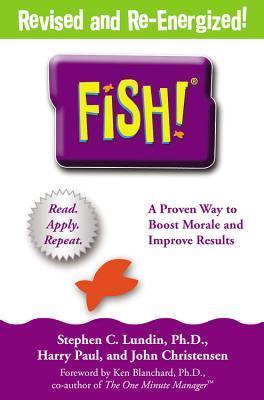
FISH! is one of those business books whose reputation has become simpler than the book itself. Stephen C. Lundin, Harry Paul, and John Christensen are usually remembered for four short workplace principles—Choose Your Attitude, Play, Make Their Day, and Be Present—but the original 2000 book does considerably more than attach slogans to an energetic Seattle fish market. It builds those principles into a parable about grief, fear, management, employee disengagement, customer service, and the difficult process of changing a workplace whose people have stopped believing that their behavior can make any difference.
The original edition was published as FISH! A Remarkable Way to Boost Morale and Improve Results. A revised twentieth-anniversary edition appeared in 2020 under the slightly different subtitle A Proven Way to Boost Morale and Improve Results. This article follows the complete original parable, which remains the foundation of the FISH! philosophy. Its inspiration is the real Pike Place Fish Market in Seattle, whose employees became famous for turning the ordinary work of selling seafood into a public performance built around energy, interaction, and customer attention.
What makes FISH! more interesting than its four catchphrases is the way the fictional workplace actually changes. Mary Jane Ramirez does not simply hang motivational posters and demand a better attitude. She changes herself first, exposes her employees to a different model of work, lets them challenge what they see, gives them time and resources to experiment, asks them to design their own practices, and eventually turns a manager-led initiative into a culture the employees themselves help create. That hidden change-management story is both the book’s strongest idea and an important qualification of its more simplistic message about personal choice.
Spoiler warning: this article discusses the entire parable, including the transformation of the third floor and Mary Jane’s personal ending.
From the Toxic Energy Dump to a Different Workplace: The Complete FISH! Summary
The story begins with a workplace problem, but the authors make sure that Mary Jane Ramirez is more than a manager facing an underperforming department. Her professional crisis arrives after a personal catastrophe that has changed her relationship with risk, security, and the future. Understanding that history is essential because the book’s first principle, Choose Your Attitude, becomes meaningful only when Mary Jane discovers how difficult choice can feel when life has already taken something important away from you.
Mary Jane Ramirez and the Third Floor
Mary Jane lives in Seattle with her two children, Brad and Stacy. Three years earlier, she and her husband Dan had moved north from Southern California after Dan accepted a promising job with a company called Microrule. The transition initially went remarkably well. Their house sold quickly, they found childcare, Mary Jane secured a supervisory position at First Guarantee Financial, and Dan loved his new work.
Their marriage is described as unusually close. Dan would come home excited about his company and its projects, but his enthusiasm did not make him indifferent to Mary Jane’s life. The two talked late into the evening about work, family, and the challenges each was facing. Their move seemed to have confirmed that they could plan well, take risks, and build a new life together.
Then, without meaningful warning, Dan suffered a burst aneurysm. He was rushed to the hospital and died of internal bleeding without regaining consciousness. The family had not even been in Seattle a full year.
Two years later, Mary Jane has continued functioning with impressive competence, but she has not emerged unchanged. She is now a single mother with medical expenses, financial obligations, and two children depending on her income. Before Dan’s death, she had been comfortable taking risks. Afterward, security became much more important because she no longer trusted life to remain stable merely because she had planned carefully.
At First Guarantee, however, Mary Jane has built an excellent reputation. She is efficient without becoming frantic, listens to her staff, helps employees when family problems arise, and gets work completed accurately and on time. Her original department becomes known as a team other people can depend on.
That reputation leads to a promotion she accepts reluctantly: manager of the operations group on the third floor.
The third floor is notorious throughout First Guarantee. Other employees describe it with terms such as “zombie,” “wasteland,” “slow,” and “unpleasant.” Because the group processes transactions required by many other departments, avoiding it is impossible. Almost everyone in the company has a story about unanswered calls, slow work, missing information, or employees who appear irritated when anyone asks them to do something.
Mary Jane soon discovers that the reputation is deserved. She sees an employee deliberately disconnect a ringing phone rather than answer it. She hears another describe burying a file belonging to someone who had pushed for faster processing. People regularly arrive after the official start of the day, the phones ring unattended, and employees sleep in the break room. Some continue using obsolete procedures simply because they prefer doing things the old way.
Yet Mary Jane’s journal reveals that the problem is more complicated than laziness. The people are not monsters. Many have significant responsibilities outside work. Some are single parents. One employee is caring for an ailing father, while another household has unexpectedly taken in grandchildren. For many of them, the job is held together by three practical attractions: salary, security, and benefits.
The work itself also has a demoralizing structure. It happens behind the scenes. When the third floor performs well, almost nobody notices because the transactions simply proceed as expected. When it makes a mistake, the failure becomes visible immediately. Employees therefore receive plenty of complaints but little recognition for ordinary competence.
Mary Jane can also see something her staff has largely avoided confronting. The financial-services industry is changing, and the supposedly secure back-office jobs may not remain secure forever. If the department does not improve, retirement may not arrive before restructuring or outsourcing does.
Her own boss, Bill, adds another difficulty. He is impatient, dismissive, and inclined to issue commands rather than listen. Mary Jane is already the third person to manage the floor in two years, suggesting that the organizational problem extends beyond the employees she has inherited.
The pressure becomes explicit when Bill calls after a leadership meeting. Senior management believes First Guarantee needs more energy, productivity, and enthusiasm if it is going to remain competitive. The third floor has been singled out as the worst example of the opposite condition. The group vice president has given it a memorable name: a “toxic energy dump.”
Bill wants it fixed, and he wants Mary Jane to fix it quickly.
For Mary Jane, the phrase is painful partly because she knows it is accurate. She does not want to manage a place where people have gradually stopped caring, but she does not yet know what a realistic alternative looks like. The problem is not merely that employees need to work faster. The third floor has developed a culture in which apathy has become normal and new employees soon adapt themselves to the same low expectations.
The Fish Market That Changes the Question
After another exhausting morning of putting out fires, Mary Jane leaves the building for lunch. She usually walks toward the waterfront, where the atmosphere is quiet enough to provide temporary relief from work. On this particular day, still thinking about the phrase “toxic energy dump,” she changes direction and eventually reaches Pike Place Market.
What catches her attention is laughter.
A crowd has gathered around a fish market where the employees appear to be doing almost everything a conventional office would discourage. Fish fly through the air. Orders are shouted and repeated by the entire crew. Workers joke with customers, juggle seafood, tease children, and turn routine transactions into miniature performances. The atmosphere is noisy without seeming chaotic and playful without seeming careless.
Mary Jane finds herself relaxing as she watches. The contrast with the third floor could hardly be greater.
One of the fishmongers, Lonnie, notices her. He approaches and begins a conversation that quickly demonstrates one of the behaviors Mary Jane will later identify as central to the market. Although activity is exploding around them, Lonnie pays close attention to her. He appears genuinely interested in what she says.
Mary Jane initially has no intention of telling a stranger about her workplace, but she soon describes the third floor and its poisonous reputation. Lonnie listens and then asks what she notices about the fish market.
Her answer is immediate: noise, action, and energy.
Lonnie explains that the market was not always like this. It had once been an unpleasant place to work as well. The employees had deliberately changed the way they approached the job, eventually creating the atmosphere Mary Jane now sees.
That fact changes the meaning of the market. Its energy is not simply the result of lucky personalities or an inherently exciting occupation. The workers themselves claim to have created something that did not previously exist.
Mary Jane’s first reaction is understandably literal. Her department cannot throw fish. Its work consists of transactions, paperwork, phone calls, and repetitive processing. Lonnie asks her to look beneath the spectacle. The point is not that every workplace should imitate the outward behavior of a fish market. The useful question is whether the principles producing the market’s energy can be translated into a completely different kind of work.
He invites her to return.
Choose Your Attitude and Mary Jane’s Return to Leadership
On her second visit, Mary Jane learns more about the actual work of a fishmonger. Beneath the theatrical surface are tedious tasks, cold conditions, heavy lifting, wet floors, repetitive preparation, and long stretches of ordinary labor. She realizes that her assumption about the market was wrong. These workers have not escaped boring work; they have changed the way they experience and perform it.
That leads Lonnie to the first and most important principle: Choose Your Attitude.
His argument is not that people can always choose their jobs. Mary Jane correctly points out that technically a person can resign, but Lonnie acknowledges that financial responsibilities and other circumstances may make leaving unrealistic. The more useful distinction is between choosing what must be done and choosing something about the way one does it.
Lonnie illustrates the point with a memory of his grandmother. She made ordinary kitchen work enjoyable for the grandchildren who helped her. The important distinction, as he understands it later, is that she did not necessarily love washing dishes. She brought warmth, attention, and affection to the activity of washing dishes.
The fishmongers eventually made a similar decision. If they were already going to spend the day selling fish, they could spend that day resentful and miserable or attempt to create a different experience. Their decision to become “world famous” gave them a playful identity around which that choice could be organized.
The phrase has roots in the real market rather than being invented solely for the parable. According to Pike Place Fish Market’s own history, owner John Yokoyama and his crew committed in 1986 to becoming “World Famous,” using that aspiration to rethink the experience they created for customers and one another.
Lonnie is careful not to pretend that choosing an attitude is effortless. He tells Mary Jane that he resisted the idea himself. His personal life had been troubled, and he had invested heavily in thinking of himself as a victim. Accepting that he could choose something about the way he participated in each day required giving up part of that identity.
Mary Jane accepts the idea intellectually, but applying it becomes another matter. For the next several days, she remains busy enough to postpone action. Eventually she recognizes that busyness is partly an excuse. To introduce a new culture on the third floor, she would have to take a risk, and risk has become frightening since Dan died.
An unexpected confrontation with Bill begins to change her. When she asks about the workplace-spirit conference attended by senior leadership, Bill dismisses it as soft and fashionable. Instead of backing down, Mary Jane tells him plainly that he is involved in the third-floor problem too and needs either to help her or stop making the work harder.
The assertiveness surprises even Mary Jane. Bill, interestingly, responds better to the direct challenge than to deference. He gives her an audio recording from the conference.
During the drive home, Mary Jane listens to poet David Whyte discussing the idea of bringing one’s whole self to work. His reflections and his poem “Faith” strike her at exactly the point where professional anxiety and personal grief overlap. She recognizes that Dan’s death did more than leave her lonely. It damaged her confidence in her own ability to survive another major failure.
That insight transforms the workplace decision. Attempting to change the third floor could fail, and failure could threaten a job she desperately needs. Yet doing nothing also carries risk. The department is already in trouble. If it continues declining, the security she is trying to protect may disappear anyway.
More importantly, Mary Jane realizes what years in an emotionally dead workplace could do to her. She has already allowed fear to narrow her life once. Continuing to live defensively would affect not only her work but also the example she gives her children.
She decides that the first attitude she needs to choose is faith: not certainty that the third-floor project will succeed, but confidence that she will remain capable of responding even if it does not.
Her Sunday reading reinforces the change. Sarah Ban Breathnach’s Simple Abundance prompts Mary Jane to think about ordinary choice as a form of creativity. Material from John Gardner then gives her another metaphor. Gardner writes about people who, somewhere in life, stop learning and growing. Their energy and ability do not necessarily disappear, but they become unused.
Mary Jane sees both her department and herself in that description. Her employees’ internal clocks have stopped, but she cannot wind them up while leaving her own untouched.
She arrives at work early Monday and prepares for two staff meetings. Rather than beginning with games or motivational slogans, she tells her employees the truth. Senior management has called their floor a toxic energy dump, and she agrees that the reputation is deserved.
She also explains why she cares.
Mary Jane tells them about Dan, her fear, her financial dependence on the job, and her recent realization that protecting security by avoiding all risk has not made her secure. She does not want to spend a large part of her life in a place where people feel dead inside. If work occupies so much of their time, she believes they should at least attempt to make the experience more humane.
Then she introduces Choose Your Attitude.
Steve, one of the employees, objects with a simple example. Suppose someone cuts him off in traffic and he becomes furious. The other driver caused the situation, so where exactly was his choice?
Mary Jane asks whether Steve would respond with the same gesture if the incident happened in a dangerous neighborhood where provoking the other driver might carry serious consequences. Steve admits he would control himself.
Her point is not that the other driver’s behavior was acceptable. It is that Steve has demonstrated the ability to choose his response when the stakes force him to recognize that ability. The third floor cannot determine every task it receives or every way other departments behave, but its employees still have choices about how they respond.
The first breakthrough comes later that week. Mary Jane arrives to find a large homemade “Choose Your Attitude” menu with cheerful and unhappy options for the day. She does not know who created it.
That anonymity matters. The first visible cultural artifact of the experiment has come from the employees themselves.
Play, Make Their Day, and Be Present
Mary Jane calls Lonnie, eager to learn the rest of the philosophy. Instead of waiting until the following week, she agrees to visit the fish market on Saturday and brings Brad and Stacy with her.
The market is quieter early in the morning, and Lonnie puts the children to work helping arrange fish. Brad is fascinated by the cold storage area and thrilled to handle fish almost as large as he is. Lonnie jokes with him, pretends fish are biting, and turns a necessary setup task into an adventure without neglecting the work itself.
That is the second principle: Play.
Lonnie emphasizes that the market is a real business. Salaries depend on it, customers expect quality, and the workers take their responsibilities seriously. The lesson is not to replace competence with entertainment. It is that seriousness about the work does not require everyone to behave solemnly throughout the workday.
At Pike Place, play changes the subjective experience of repetitive labor. It also strengthens relationships among employees and creates something customers want to participate in. The fish throwing is memorable, but the deeper mechanism is that the workers have found room for improvisation, humor, and creativity inside the job.
The third principle appears through one of those interactions. A fishmonger nicknamed Wolf approaches Mary Jane with a fish head and jokingly offers it for sale as “smiling sushi.” Brad immediately wants one, and Stacy soon joins in.
Lonnie asks Mary Jane to think about the experiences she remembers most strongly from the market. She recalls customers being invited to catch fish and becoming part of the spectacle. Brad will remember being allowed behind the scenes and helping Lonnie.
The third principle is Make Their Day.
The fishmongers do not merely entertain one another while customers wait to be served. They deliberately look for respectful opportunities to involve other people. That outward direction is essential. Play becomes more valuable when it creates connection rather than functioning only as private amusement among employees.
Making someone’s day can be theatrical, but it does not have to be. Its central idea is to notice opportunities to make another person’s experience better and then act on them.
The fourth principle becomes visible when Mary Jane watches the market from a café across the street. She notices that even between obvious performances, the workers remain alert. Their eyes move through the crowd. They seem ready for the next customer, question, problem, or opening for interaction.
Mary Jane contrasts this with a recent experience in which a store employee kept her waiting while chatting with a coworker. The employees may have been having fun, but their fun excluded the customer.
The fishmongers are different because they attempt to Be Present.
Lonnie confirms her interpretation. Presence means giving attention to the person or task in front of you rather than physically occupying the same space while mentally remaining elsewhere. It is the principle that stops Play from turning into distraction and Make Their Day from turning into a scripted technique.
Before leaving, Lonnie gives Mary Jane advice more important than any slogan. She cannot simply return to the office and announce that she has discovered four rules everyone must obey. Her employees need some opportunity to discover the ideas for themselves.
Mary Jane realizes that in her urgency to fix the department, she could easily become controlling. The fish market worked on her because she experienced it before she understood it. Her employees deserve a similar process.
The Field Trips and the Moment the Staff Starts Choosing
Mary Jane first consolidates the four principles for herself. Choose Your Attitude remains foundational; without it, the other practices can become exercises performed resentfully because management requires them. Play introduces energy, Make Their Day turns attention outward, and Be Present keeps people connected to whoever actually needs them.
She also begins experimenting with the philosophy in her relationship with Bill. One morning she hands him a bag containing a piece of “smiling sushi.” The gift is absurd enough to make him laugh, and their relationship continues to become less defensive. Bill still does not fully understand what a fish market has to do with a financial institution, but he starts encouraging Mary Jane to continue.
Her next major step is to arrange lunchtime field trips to Pike Place for the third-floor employees. Some immediately produce scheduling objections. Mary Jane insists that the visits matter and asks them to make the necessary arrangements.
At the market, she does not deliver a lecture. She tells employees to observe.
The first group begins dispersing through the crowd, and some employees independently speak with fishmongers. Mary Jane overhears one worker explaining what presence feels like: despite everything happening around him, he gives the person in front of him the kind of attention he might give a close friend.
The second visit produces a more dramatic breakthrough. Stephanie, a quiet longtime employee, is invited behind the counter to catch a fish. She misses at first, then succeeds on her third attempt to cheers from coworkers, market employees, and strangers.
For Stephanie, the moment is not a theoretical demonstration of “employee engagement.” Someone has included her in an experience and made her feel unusually alive.
When the groups meet again at First Guarantee, however, enthusiasm collides with reality. Employees point out that they do not sell fish. Their work is different. They have nothing appropriate to throw through the office, and copying a fish market literally would be ridiculous.
Mary Jane agrees.
She is not asking them to reproduce Pike Place. She asks whether they want the third floor to possess some of the energy they experienced there. Could they build a workplace where people smile more often, feel less trapped, and take greater pride in what they do?
Stephanie gives the discussion weight by admitting that she has been looking for another job. She likes many of her coworkers but hates coming to work because the floor feels lifeless. If the environment genuinely changed, she might stay.
Randy then shares something more personal. As a single father, he depends on his salary and benefits and has felt trapped by that dependence. He realizes that resentment toward the job has sometimes leaked into the way he treats people from other departments. Mary Jane’s message has forced him to confront an uncomfortable possibility: if employees helped create the “pit” through repeated behavior, they may also possess some capacity to create something else.
The group leaves with Mary Jane’s written outline of the four principles and an invitation to think independently about them over the weekend.
Several employees do much more than that. They return to Pike Place on their own time.
Stephanie still struggles with Choose Your Attitude. It feels too easy to say that attitude is a choice when circumstances can be genuinely painful. Lonnie directs her to Wolf, whose personal history gives the idea more weight.
Wolf had once hoped to become a professional race-car driver. A serious accident destroyed that future. He spent a period consumed by self-pity until the deterioration of his relationships forced him to confront what was happening. He could not undo the accident, but he could decide whether the rest of his life would become a sequence of missed opportunities.
Randy and Stephanie come away from the conversation recognizing another important point. Some of their coworkers are not merely cynical; they are frightened. If the philosophy is going to spread, they may need examples and support rather than accusations.
By the next staff meeting, Mary Jane no longer has to carry the entire initiative. Stephanie, Randy, and Steve report what they learned. Other employees contribute ideas.
Then someone suggests creating four teams, one for each FISH! principle.
The change process is beginning to belong to the third floor.
The Four Teams Turn FISH! Into a Workplace System
Mary Jane agrees to the team structure and gives the employees six weeks to study their assigned principle, gather ideas, and prepare a presentation for the full department. Each presentation must include actions the third floor could realistically implement.
The resources she provides are easy to overlook but extremely important. Every team may use two hours of paid work time each week for the project. Each receives a $200 discretionary budget. Teams organize and facilitate their own meetings, while Mary Jane remains available when they reach genuine obstacles.
She explicitly tries not to take over.
By the time the presentation day arrives, even Bill has changed his behavior. Mary Jane asks for help arranging operational coverage so the whole department can attend an off-site session. Bill not only organizes the coverage but offers to help personally. He tells her he can already feel a different level of energy on the third floor.
The Play Team presents first and turns its report into a game. Participants move between colored circles while music plays, reading ideas when the music stops. The format itself demonstrates the principle.
The team identifies several benefits of play. Happier people may treat others better, creativity becomes easier, time can feel less oppressive, and work can become rewarding in itself rather than existing only as a path to salary or life after work.
Its implementation ideas range from practical to deliberately silly. Employees propose adding more color to the floor, bringing in plants and an aquarium, holding humor contests, creating a designated area for creativity, arranging occasional special events, and maintaining a committee responsible for continuing to generate playful ideas.
Some proposals would be easy to dismiss as office decoration, but the real change is that employees who once protected the dullest possible version of their routine are now voluntarily discussing how their environment might feel different.
The Make Their Day Team takes a more serious approach. Before developing recommendations, its members survey their internal customers: the people in other First Guarantee departments who depend on third-floor work.
The feedback is painful.
Other employees describe the third floor as sedated, impersonal, unhelpful, and difficult to deal with. They believe the group completes basic work but rarely extends itself to help another department serve the company’s external customers. Callers feel as though they are interruptions. Problems are passed between employees without anyone taking clear responsibility.
Some respondents also notice the department’s eagerness to leave at the end of the day and question whether the group is truly committed to the organization. Most seriously, discussion has begun about whether the work might be better handled by an outside contractor.
The team’s initial reaction is anger. Eventually, however, its members reach an important conclusion: explanations do not change the fact that customers experience the department this way. If Make Their Day is going to mean anything, the third floor must take that experience seriously.
The entire department is divided into groups and asked to develop service improvements.
Their ideas go well beyond telling employees to smile. They propose staggering work hours so customers receive broader coverage, holding focus groups to understand different internal-customer needs, exploring specialization around customer groups, introducing feedback and service recognition, and creating a task force focused on surprising customers with unusually helpful service.
The team also wants to study the idea of turning routine customer interactions into deliberately positive “moments of truth.” In other words, Make Their Day evolves from a slogan about friendliness into a small programme of customer research and service redesign.
The Present Moment Team chooses an entirely different presentation style. Its members use quiet music, relaxation, and personal stories to demonstrate what divided attention can cost.
John tells the most painful story. Years earlier, his daughter asked him to go to the park. He kept postponing the trip because work always felt urgent. Days became weeks, weeks became months, and eventually years passed. His daughter is now fifteen and no longer wants the childhood outing he repeatedly delayed.
A conversation with a fishmonger makes John realize how rarely he is fully present at home or work. He begins trying to repair the relationship by giving his children undivided attention rather than assuming there will always be a better time later.
Janet remembers a previous coworker who repeatedly seemed to need help while Janet remained distracted by her own problems. The coworker was hiding the fact that an important project had fallen badly behind. By the time the truth emerged, the damage was too extensive: the company lost a client, and Janet eventually lost her own job when the lost business could not be replaced.
Beth offers a more hopeful example. When her son approaches her visibly distressed, she resists her normal habit of multitasking. She stops exercising, turns away from the television and reading material around her, and spends the next hour actually listening to him.
The team translates those stories into specific behavioral expectations. Employees commit to giving customers and colleagues real attention, avoiding distractions during important conversations, and using a mutually accepted phrase when someone seems mentally absent. They also agree not to read or answer email while speaking on the phone with a colleague or customer.
Choose Your Attitude presents last because Mary Jane continues to regard it as the foundation of everything else.
The team connects the principle with personal accountability and proactive behavior, but it also introduces a qualification that prevents the message from becoming completely harsh. Margaret acknowledges that some employees have endured extremely difficult experiences and may need time before the language of choice feels believable. The group believes people should encourage one another to recognize agency while remaining compassionate about how hard that recognition can be.
Its implementation plan includes further reading and group discussion, along with personal attitude menus modeled on the sign that appeared earlier on the third floor. The menu contrasts states such as bitterness and disinterest with qualities such as energy, creativity, care, and support.
Mary Jane can now see that the department is no longer waiting for her to manufacture enthusiasm. Employees are producing language, practices, stories, customer information, and rituals of their own.
Her own relationship to work has changed too. A competitor offers her a substantially better financial package, but she turns it down. Earlier in the story, remaining at First Guarantee was partly a defensive choice because she needed security. Now she stays because she wants to see what the third floor is becoming.
One Year Later
The final section returns to Mary Jane one year after the crisis began. She sits in the same coffee shop where she had once wondered whether she was capable of changing the third floor.
The department is now so different that First Guarantee employees from elsewhere in the company want to transfer into it. The group that once embarrassed senior leadership has received the Chairwoman’s Award.
Mary Jane has insisted that the recognition be shared. Copies go not only to her but also to Bill, the third-floor employees, Lonnie, and the fishmongers whose workplace provided the original model. The choice fits the larger change process: Mary Jane may have initiated the transformation, but the book refuses to make her its sole owner.
She again reflects on John Gardner’s idea of meaning. Meaning, in this view, is not a treasure hidden somewhere in the world waiting to be found. People construct it from their experiences, commitments, values, relationships, abilities, and choices.
The personal narrative receives an equally neat resolution. Lonnie is sitting across from Mary Jane in the coffee shop. When she reaches for a piece of food, she instead finds an engagement ring placed inside the mouth of a fish head. Lonnie proposes, and Mary Jane accepts while teasing him that he must never stop playing.
The Chairwoman’s Award ceremony then turns the third floor’s experiment into an institutional lesson. The company celebrates a group that rediscovered the possibility of satisfying work without changing the fundamental category of work it performs. The final workplace statement incorporates all four principles: choose the kind of day you intend to create, find room for play, remain present to the people who need you, and restore your own energy by doing something that makes another person’s day better.
The parable began on a cold, dark Seattle day with Mary Jane feeling trapped by circumstances. It ends by repeating the contrast between outside conditions and what can be created inside them. The weather has not been transformed. The book’s claim is that the human response to it can be.
The Four FISH! Practices and How They Work Together
The four practices are simple enough to remember after one reading, which is one reason FISH! became so widely used in workplaces. Their simplicity can also make them look like four interchangeable motivational tips, but the parable gives them a more coherent relationship. Choose Your Attitude establishes agency, Play changes how work is experienced, Make Their Day directs energy toward other people, and Be Present ensures that the resulting interactions remain attentive rather than superficial.
The framework therefore works best when treated as a system of behavior rather than a checklist. Each principle compensates for a potential weakness in another, and the sequence in which Mary Jane encounters them is not accidental.
Choose Your Attitude: Agency Before Technique
Choose Your Attitude is the most famous FISH! principle and the most vulnerable to misunderstanding. Taken carelessly, it can sound as though people simply decide whether to be happy, making anyone who remains angry, exhausted, frightened, or depressed responsible for failing to choose correctly. The book’s actual treatment is more complicated than that slogan suggests, although not complicated enough to eliminate the problem entirely.
Lonnie does not claim that Mary Jane can choose whether Dan died, whether she has children to support, whether her medical bills exist, or whether First Guarantee is changing. Wolf cannot choose whether his racing career was destroyed by an accident. The third-floor employees cannot independently decide which transactions the company requires them to process.
The claimed area of choice is narrower: given circumstances that may not be immediately changeable, what kind of behavior, attention, and stance will a person bring to the next action?
Steve’s traffic example clarifies the distinction. He does not control the person who cuts him off, but his ability to restrain his reaction under dangerous circumstances shows that the reaction is not completely automatic. The choice may be difficult, emotionally expensive, or imperfect, but some room for response exists.
Mary Jane’s arc gives the principle more weight because her problem is not simple pessimism. Dan’s death has taught her that catastrophe can arrive despite careful planning. Her fear of risk is therefore psychologically understandable, and the book does not portray her as foolish for feeling it. Choosing faith means deciding that fear will no longer determine every managerial action, not convincing herself that another loss is impossible.
Wolf serves the same function in a more compressed way. He cannot reclaim the career the accident took from him. His choice concerns whether that loss will control the remaining shape of his life.
Margaret’s presentation near the end adds the book’s most important ethical qualification. Some people have experienced enough pain that reclaiming a sense of agency may take time. Coworkers should encourage responsibility without abandoning compassion.
That qualification matters because Choose Your Attitude is useful precisely where it identifies genuine agency and dangerous where it denies genuine constraint. The principle is strongest as a question—What is still within my control here?—rather than as a verdict imposed on another person.
Play: Serious Work Without Constant Seriousness
Play is easy to misread as permission to turn the workplace into permanent entertainment. The fish market demonstrates something narrower. The workers remain serious about selling seafood, maintaining quality, serving customers, and operating a profitable business. What they reject is the assumption that performing serious work requires maintaining a serious emotional posture every minute.
Brad’s Saturday visit makes the distinction obvious. He helps Lonnie arrange fish, which is necessary preparation for the market’s opening. The task still gets done. Lonnie simply introduces jokes, imagination, and participation into the process.
The Play Team later tries to translate that principle into the third floor through humor, visual changes, creative spaces, events, and small rituals. Some ideas are more substantial than others, but the common goal is to give employees permission to participate in shaping the emotional texture of work.
The deeper value of Play lies in altering the relationship between routine and attention. Repetitive work can encourage people to withdraw mentally because nothing about the task seems to require their personality. Play reintroduces improvisation. It creates opportunities for someone to contribute something beyond mechanical compliance.
Yet FISH! also implicitly establishes a boundary. Lonnie’s example of employees amusing one another while ignoring a customer is not successful play. Fun that excludes the person needing service has become self-indulgence. That is why Play cannot be separated from Make Their Day and Be Present.
Make Their Day: Turning Energy Toward Other People
Make Their Day gives the framework an outward direction. Without it, the FISH! philosophy could become a private project in which employees focus primarily on improving their own emotional state. The fishmongers instead look for opportunities to create a positive experience for someone else.
The market’s theatrical examples are memorable because they are exaggerated. A customer catches a fish. A child is allowed into a space normally reserved for workers. A fish head becomes a joke and a souvenir. People leave with stories as well as seafood.
The third floor has to find a less theatrical version. Its customers are other departments, and those customers are not asking for entertainment. They want responsiveness, responsibility, accuracy, and evidence that someone cares about solving their problem.
The internal-customer survey therefore becomes one of the book’s most important episodes. The Make Their Day Team does not assume it already knows how to delight customers. It asks them about their actual experience and receives uncomfortable answers.
That movement from sentiment to feedback makes the principle more credible. Making someone’s day may sometimes involve warmth or surprise, but in a back-office financial operation it can also mean answering a phone, extending coverage, resolving a problem without passing it elsewhere, or redesigning a service around what another department genuinely needs.
The principle also changes the source of energy. When employees focus exclusively on their own frustration, the work environment can become an echo chamber in which dissatisfaction continuously reinforces itself. Service interrupts that loop by giving attention a destination beyond the self.
Be Present: Attention as a Form of Respect
Be Present is the least theatrical FISH! principle and arguably the one with the widest application. Its importance becomes obvious from Lonnie’s first conversation with Mary Jane. Fish are flying, customers are shouting, and the market is noisy, yet she feels as though he is actually listening to her.
The Present Moment Team later shows why that matters far beyond customer service. John’s failure to make time for his daughter demonstrates the cumulative cost of postponing attention. Janet’s story shows how distraction at work can allow a struggling colleague’s problem to grow unnoticed. Beth demonstrates the opposite possibility when she stops multitasking and gives her distressed son the attention he needs.
Presence is not equivalent to passive listening. It means allocating enough attention to notice what the interaction requires. Sometimes that means hearing someone out; sometimes it means recognizing a problem before it becomes a crisis; sometimes it simply means allowing another person to feel that they are not an interruption.
Within the four-principle system, Be Present also provides discipline. Play without presence can become distraction. Make Their Day without presence can become canned customer-service behavior. Even Choose Your Attitude can become abstract if a person is so preoccupied with managing an internal emotional state that they stop noticing the people around them.
The practices therefore reinforce one another. FISH! is most coherent when attitude creates intentionality, play creates vitality, service gives that vitality direction, and presence keeps the resulting behavior connected to reality.
The Change-Management Model Hidden Beneath the Four Slogans
The most useful part of FISH! may be the part least visible on a motivational poster. Mary Jane does not transform the third floor simply by explaining four principles more persuasively than previous managers explained their expectations. The parable describes a recognizable sequence through which employees gradually move from being the targets of change to becoming participants in it.
The process begins with the leader. Before Mary Jane changes anyone else, she confronts the fear governing her own behavior. That does not make her morally superior to her employees; it makes her more credible when she later asks them to examine their own choices. She also speaks with unusual vulnerability about why she has been afraid, connecting organizational change with a problem she genuinely shares.
Her second move is experiential rather than instructional. Employees visit Pike Place instead of receiving a presentation filled with secondhand descriptions. The market does not give them a ready-made answer for a financial-services office. It gives them an example vivid enough to provoke argument.
That argument is necessary. Employees object that they do not sell fish, cannot throw purchase orders, and perform intrinsically different work. Mary Jane does not suppress those objections because the goal is not imitation. She keeps redirecting attention toward the underlying question: what would greater energy, attention, and ownership look like here?
The next shift happens outside her control. Employees voluntarily return to the market on their own time. Stephanie asks questions. Randy rethinks his resentment. Steve deepens his understanding of response and choice. At that point the ideas begin spreading horizontally rather than only moving downward from manager to employee.
Mary Jane then gives the group real responsibility. The four teams are not decorative committees. They receive six weeks, paid work time, small budgets, autonomy over meetings, and permission to develop actions rather than merely repeat slogans. Those resources make the book’s implementation story more substantial than the headline message “choose your attitude.”
The distinction matters because employee participation requires capacity as well as encouragement. Telling people to redesign their work while giving them no time to meet would communicate that management does not really value the experiment. Giving them time inside the working week makes the initiative part of the job rather than an extracurricular demand.
Mary Jane’s restraint is equally important. She makes herself available but tries not to solve every disagreement. The teams choose their presentation styles, conduct their own research, and determine which actions seem appropriate. The employees who once avoided responsibility are being asked to practice it.
The Make Their Day Team introduces another essential element: external feedback. A culture can easily congratulate itself while remaining unpleasant to everyone who has to interact with it. The internal-customer survey forces the third floor to confront a reality that enthusiasm alone cannot erase. Other departments experience them as difficult, and cultural change must eventually alter that experience.
Bill’s development adds a further layer. He begins as a boss who pressures Mary Jane while contributing little useful support. Later, he arranges operational coverage and even offers his own labor so the group can attend its off-site meeting. The change therefore travels upward as well as downward.
Finally, the Chairwoman’s Award supplies institutional reinforcement. Recognition is not what creates the change, but it signals that the organization values what the team has built. A local experiment has become part of the company’s language.
Seen this way, FISH! presents more than four personal behaviors. Its change process involves modeling, psychological safety, shared experience, employee autonomy, resources, customer feedback, peer reinforcement, managerial support, and organizational recognition. Ironically, the story itself demonstrates that workplace culture requires much more than attitude alone.
Characters and Relationships: Why the Parable Needs More Than Four Principles
Because FISH! is short and overtly instructional, none of its characters has the psychological complexity of a literary novel. They are designed partly to carry ideas. Even so, the parable works because the principles are attached to people who change in different ways, and Mary Jane’s story gives the framework an emotional structure it would lack as a conventional management checklist.
The most important relationships also reveal how the book understands leadership. Change does not happen because one charismatic expert arrives and solves everything. Lonnie teaches Mary Jane, Mary Jane creates conditions for employees to learn, employees teach one another, customers supply uncomfortable information, and even Bill eventually becomes part of the process.
Mary Jane Ramirez: From Security-Seeking Manager to Culture Leader
Mary Jane begins the book as a capable manager whose confidence has become narrower than her competence. Nothing about her professional history suggests that she lacks ability. Her previous department is respected, her work is reliable, and employees like working for her. The obstacle is that Dan’s death has changed the risks she is willing to take.
That distinction makes her a stronger protagonist than a simple “bad boss learns leadership” character would have been. Mary Jane already knows how to manage tasks and treat employees decently. What she has lost is confidence in her ability to survive uncertainty.
Her promotion intensifies the conflict. She accepts partly because she needs the additional money, but the position requires exactly the kind of risk she has been avoiding. The third floor cannot be repaired through competent maintenance because maintenance is the problem. Someone has to challenge its established culture.
Mary Jane’s first major development is therefore internal. She recognizes that fear has been shaping her choices while disguising itself as prudence. Her confrontation with Bill matters because it is one of the first times since Dan’s death that she acts without certainty that the result will be safe.
The most effective thing she does with employees is not demonstrate confidence but reveal vulnerability. She tells them she needs the job, has been afraid, and understands why security matters. That admission narrows the emotional distance between manager and staff. She is asking them to confront a problem she has begun confronting in herself.
Her leadership then becomes progressively less controlling. Early in the story she desperately wants an answer she can take back to the third floor. Lonnie teaches her that an answer imposed too quickly will not create ownership. By the time the teams form, Mary Jane is deliberately giving away control over how the philosophy will be translated into practice.
The competing job offer completes her arc. At the beginning, she stays at First Guarantee because leaving feels dangerous and remaining offers security. Near the end, she turns down a more lucrative alternative because she has become genuinely invested in the environment she helped create. The external job has not necessarily become intrinsically fascinating; her relationship to it has changed from dependence to commitment.
That transformation embodies the book’s original distinction between doing what you love and learning to love what you are doing. Mary Jane does not discover a hidden vocation in financial processing. She helps create conditions under which the work becomes connected to people, purpose, and agency.
Lonnie and the Mentor Relationship
Lonnie functions as the book’s mentor, but his most important characteristic is that he rarely behaves like a conventional consultant. Mary Jane wants solutions, and he repeatedly gives her experiences and questions instead.
His first lesson occurs before he explains any principle. In a noisy market, he listens to Mary Jane with focused attention. She experiences Be Present before she knows its name.
The same pattern continues when she tries to reduce the market’s success to fish throwing. Lonnie redirects her toward what lies underneath the visible behavior. When she is ready for the remaining principles, he involves her children rather than delivering a classroom explanation. When the time comes to involve her staff, he warns her that their own discovery matters more than her ability to teach the ideas correctly.
That mentoring style mirrors the change Mary Jane eventually practices with her employees. Lonnie does not make her dependent on him. The goal is for her to internalize the framework and adapt it herself.
As a character, however, he is deliberately idealized. He is patient, insightful, playful, emotionally available, and almost perfectly suited to whatever Mary Jane needs at each stage. His later romantic relationship with her adds warmth but also reinforces the parable’s tendency to resolve every major thread neatly.
The Third Floor, Bill, and the Shift From Subjects to Participants
At the beginning, the third-floor employees are described largely through behaviors other people dislike: avoidance, lateness, cynicism, slow work, and indifference. The book gradually complicates that picture by showing that many have become psychologically attached to the job’s security while feeling emotionally trapped inside it.
Stephanie embodies the cost most visibly. She likes the people around her but has begun looking for another job because she cannot tolerate the atmosphere. Her successful fish catch at Pike Place gives her an experience of being animated and publicly celebrated that contrasts sharply with her ordinary work identity.
Randy represents another form of disengagement. He needs the job and benefits because he is raising a child alone, yet that dependence has produced resentment. He recognizes that he has sometimes punished people from other departments for frustrations they did not cause. The FISH! process becomes useful to him because it offers a way of recovering agency without pretending that his financial constraints are imaginary.
Steve performs a similar role through skepticism. His traffic question gives the philosophy a necessary challenge and forces Mary Jane to explain what she means by choice. Later, he acknowledges that reacting automatically has become a pattern in other parts of his life as well.
Margaret complicates Choose Your Attitude by introducing compassion. John, Janet, and Beth expand Be Present beyond customer service into family relationships and coworker awareness. Wolf demonstrates that the language of choice is meant to apply after genuinely painful loss, not just minor workplace annoyance.
Collectively, the employees undergo the book’s most important organizational transformation. They stop being people Mary Jane is trying to fix and become people designing their own workplace. The voluntary weekend visits, team reports, customer research, and behavioral commitments matter more than whether every employee becomes permanently cheerful.
Bill’s change is smaller but revealing. He initially treats the third floor as Mary Jane’s problem and clerical employees as people from whom little should be expected. As the initiative develops, he becomes more respectful of Mary Jane and more willing to provide resources. The book therefore acknowledges, even if only lightly, that managers above the immediate team can either obstruct or enable culture change.
Work, Meaning, Choice, and the Book’s Deeper Philosophy
Beneath its management vocabulary, FISH! is concerned with a more personal problem: what should people do when a large portion of life must be spent on work they would not have chosen as their ideal calling? The book refuses one easy answer. It does not tell everyone to quit and pursue a passion, because responsibilities, money, uncertainty, and family obligations can make that advice unrealistic.
Instead, it asks whether meaning can be created inside imperfect circumstances. That question connects the opening reflection on loving what you do with Mary Jane’s grief, Gardner’s writing about vitality, the fishmongers’ “world famous” identity, and the final transformation of the third floor.
Loving What You Do When You Cannot Yet Do What You Love
The short “Loving What You Do” section before the parable establishes a distinction the rest of the book keeps illustrating. The cultural ideal of finding work one already loves can become another way of postponing life. If fulfillment is imagined as something available only after the perfect career appears, the present job becomes dead time.
FISH! does not argue that people should never seek better jobs. Mary Jane could leave First Guarantee, Stephanie actively considers leaving, and Lonnie acknowledges that changing work can be a legitimate choice. The point is that not everyone can or should leave immediately.
That makes the question more practical. If circumstances keep someone in a particular job for now, must the emotional quality of those hours be entirely determined by the job description?
The fish market answers no. Selling fish remains selling fish. The third floor continues processing financial transactions. Neither workplace becomes meaningful because the underlying labor suddenly acquires glamorous content.
Meaning comes partly from the way people perform the work, the relationships they create around it, and the standards they choose to associate with it.
The phrase “world famous” illustrates this process. It gives fishmongers an identity larger than completing transactions. The third-floor teams do something similar when they begin treating internal customer service, creativity, attention, and accountability as aspects of who they want to be rather than merely instructions from management.
Faith, Fear, and Personal Accountability
Mary Jane’s grief prevents FISH! from reducing its philosophy entirely to everyday cheerfulness. Her fear is rooted in evidence. Life really did become dangerous without warning, and careful planning did not save Dan.
The book’s response is not that Mary Jane should stop grieving or convince herself that bad things never happen. Instead, she distinguishes between uncertainty and incapacity. She cannot guarantee success, but she can recover confidence in her ability to respond if the outcome is bad.
That is why faith matters to her. It is less a prediction about the future than a willingness to act without complete protection from the future.
Personal accountability operates similarly. Randy cannot erase the financial constraints that make him dependent on First Guarantee, but he can acknowledge that resentment has shaped how he treats other people. Steve cannot control other drivers but can examine his own response. Wolf cannot reclaim the future his accident destroyed but can decide whether the loss becomes the organizing principle of everything that follows.
The idea becomes ethically questionable when extended too far. Some circumstances reduce human choice much more severely than the parable explores, and emotions are not always voluntarily adjustable. Yet the book is at its strongest when accountability means refusing to surrender the portion of agency that remains, rather than denying the reality of what happened.
Meaning Is Built Through Participation
John Gardner’s reflections give FISH! a philosophy of meaning broader than workplace morale. Mary Jane is drawn to the idea that meaning is built from experience, commitments, values, relationships, talents, and the things a person is willing to care about.
That idea explains why the third floor cannot become meaningful through motivational language alone. Employees have to participate in constructing something.
The difference between the first and second halves of the book is therefore significant. Early on, culture happens to the employees. They inherit habits, assumptions, low expectations, and an identity as the company’s worst department. Later, they begin choosing practices, gathering information, designing presentations, and deciding what kind of workplace they want to inhabit.
Their work acquires meaning partly because they become authors of the environment in which it occurs.
Mary Jane undergoes the same change on a personal level. She begins the story trying to preserve a life that catastrophe has already altered. By the end, she is creating new commitments instead of merely defending what remains.
The engagement to Lonnie makes that theme almost too explicit. Her new relationship, transformed workplace, restored confidence, and professional recognition all converge in a storybook ending. Yet the underlying point remains coherent: meaning does not arrive because external conditions finally become perfect. Mary Jane begins building it while those conditions are still uncertain.
How FISH! Is Written: Why the Parable Is So Memorable
FISH! belongs to the tradition of short business parables that package management ideas inside a simple narrative. That form is central to its success. Instead of opening with definitions of engagement, service culture, and behavioral agency, the book gives readers a dreary office, a grieving manager, a loud fish market, and a problem that can be visualized immediately.
The narrative follows Mary Jane closely enough that her journals and private reflections provide access to the emotional side of the problem. This allows the book to move between organizational diagnosis and personal development without turning either into a separate lecture. Her fear of failure gives Choose Your Attitude a dramatic context before the principle becomes an employee exercise.
The fish market also functions as an unusually effective teaching device because it is concrete and difficult to forget. A reader may not remember the details of every staff meeting, but flying fish, smiling sushi, attitude menus, and employees catching seafood provide images to which the four practices can be attached.
Repetition reinforces that memorability. The book keeps returning to the same language until the principles become easy to recall. From a literary perspective, the repetition can feel heavy-handed; from the perspective of a management book designed to create shared vocabulary, it is highly functional.
The team-report sequence changes the form again. The first half resembles a mentor parable in which a protagonist encounters wisdom through a guide. The second half increasingly resembles a facilitated workshop. Employees create exercises, report findings, tell personal stories, conduct customer research, and propose implementation ideas.
That structural shift is valuable because it demonstrates application instead of ending immediately after Mary Jane learns the four principles. Many prescriptive books explain an insight and leave implementation to the reader. FISH! devotes a substantial portion of its short narrative to showing how resistance, participation, experimentation, and reinforcement might work.
The weaknesses of the parable form are equally visible. Characters often speak with exactly the insight required to advance the lesson. Emotional disclosures arrive at convenient moments. Employees who begin deeply disengaged become enthusiastic participants with limited conflict, and the one-year epilogue resolves the transformation with almost no evidence of relapse, turnover, failed experiments, or new organizational pressures.
The romance between Mary Jane and Lonnie adds emotional warmth but contributes to the same neatness. By the end, Mary Jane has restored her confidence, transformed her department, earned senior recognition, rejected a competitor because she genuinely wants to stay, and found a new partner. The symbolism is satisfying, but life and organizational change rarely align so completely.
That is the tradeoff FISH! makes throughout. It sacrifices complexity for clarity and realism for portability. The result is not psychologically or organizationally exhaustive, but it is unusually easy to remember and retell.
What Later Workplace Research Supports—and What FISH! Leaves Out
The fictional transformation at First Guarantee is a demonstration of the authors’ philosophy, not empirical proof that four practices will reliably produce the same outcome in real organizations. Evaluating FISH! fairly therefore requires separating plausible behavioral advice from broader claims about what creates engagement, morale, and burnout.
Later organizational research gives the book partial support while also revealing the largest gaps in its model. Personal agency, playful work, supportive relationships, customer meaning, and focused attention can matter, but people experience work inside systems of demands, resources, job design, leadership, autonomy, and organizational context that attitude cannot simply override.
Engagement Requires More Than Attitude
The strongest limitation of FISH! is not that Choose Your Attitude is false. It is that the principle is incomplete when treated as the primary explanation for workplace energy.
Modern Job Demands–Resources research offers a much broader account. Engagement and burnout emerge from interactions between people and the situations in which they work, including job demands, job resources, job design, proactive behavior, personal resources, and wider organizational influences.
That perspective helps explain why parts of the FISH! story are plausible. Employees are not completely passive. People can proactively alter how they approach tasks, seek support, strengthen relationships, and influence aspects of their environment. Mary Jane’s employees demonstrate exactly that kind of agency when they redesign service practices and create new team norms.
At the same time, the research highlights what the parable largely leaves outside the frame. Morale can be damaged by excessive workload, inadequate staffing, poor compensation, lack of autonomy, insecure employment, unfair treatment, abusive leadership, unclear roles, conflicting demands, or insufficient resources. A playful attitude cannot reliably neutralize those conditions.
Even the story itself quietly proves this. Mary Jane does not merely ask people to feel differently. She gives them paid time to meet, discretionary budgets, authority over decisions, opportunities to learn, better managerial support, customer information, and institutional recognition. Those are job resources.
The deeper lesson is therefore stronger than the slogan. Attitude can influence how people engage with circumstances, but healthy engagement also requires circumstances that give effort somewhere useful to go.
Managers who ignore that distinction can turn Choose Your Attitude into a form of blame. An exhausted employee facing an impossible workload does not necessarily need an attitude menu; they may need fewer demands, better staffing, clearer priorities, or a manager willing to change the system.
Used properly, the FISH! principle asks employees and leaders alike to identify their available agency. Used badly, it asks workers to compensate emotionally for conditions management refuses to improve.
Play Can Help, but Forced Fun Can Backfire
Play is another area where later research supports the basic intuition while complicating the prescription. A 2025 meta-analysis of fun at work found a substantial relationship between workplace fun and engagement, but it also emphasized that “fun” is not one uniform intervention. Employee-driven fun, organization-sponsored activities, socializing, task-related enjoyment, and managerial attempts to manufacture levity can operate differently.
That distinction is especially relevant to FISH!. The Pike Place scenes work because the employees appear to own the play. Their joking emerges from the activity of the market and is connected to customer interaction. The third-floor Play Team also develops its own ideas rather than receiving a compulsory entertainment programme from Mary Jane.
Research on managed and organic workplace fun similarly suggests that fun can generate positive emotions and engagement while also producing distraction, discomfort, or disengagement when employees experience it as imposed or inappropriate. Not everyone wants to participate in the same kind of social behavior, and an activity designed as morale-building can become another demand.
That is a limitation the parable barely explores. An employee who dislikes public performance at Pike Place would complicate the story. So would someone who finds a mandated joke contest irritating rather than energizing.
The best interpretation of Play is therefore permission rather than obligation. It asks whether a workplace leaves room for humor, creativity, informal connection, and personal style when those things are compatible with the work. It should not require employees to perform enthusiasm for management.
The fish market also reminds readers that successful play is usually connected to purpose. The fishmongers’ humor helps create memorable customer interactions, and their calls coordinate activity as well as entertain. Play becomes weaker when it is detached completely from the work and imposed as a separate corporate ritual.
Culture Interventions Work Unevenly
The transformation of the third floor is intentionally dramatic. Within a relatively short period, employees become more engaged, the department’s reputation changes, people elsewhere want to transfer into it, senior leadership celebrates the team, and Mary Jane turns down a better-paid job because the workplace has become somewhere she wants to remain.
Real interventions are less predictable.
A systematic review and meta-analysis of work-engagement interventions found that workplace interventions can improve engagement, but the overall effect was positive rather than miraculous, and results varied across contexts and implementation approaches. That is exactly what should be expected when organizations differ in leadership, resources, job demands, culture, industry, and employee needs.
This does not make the FISH! story useless. Parables exaggerate clarity so readers can see a mechanism that would be messier in ordinary life. The danger appears only when the fictional outcome is treated as evidence that the same intervention will work universally.
A realistic FISH!-style programme might produce enthusiastic champions, skeptical employees, practices that succeed, practices that disappear, improvements in one part of customer service, continued frustration in another, and periodic regression when workloads increase or managers change.
The book gives little attention to maintaining a culture through such setbacks. Its one-year leap moves directly to success. That makes the story emotionally satisfying but leaves the most difficult organizational question largely unanswered: how do teams preserve desirable behavior when the novelty disappears?
Even so, the earlier implementation sequence contains useful clues. Employee ownership, experimentation, resources, feedback, and leadership support are more durable mechanisms than motivational enthusiasm alone. Readers who focus on those elements will take more from FISH! than readers who focus primarily on posters and slogans.
Critical Review: Is FISH! Still Worth Reading?
FISH! succeeds because it understands something many more sophisticated management books forget: an idea that cannot be remembered is difficult to practice. Choose Your Attitude, Play, Make Their Day, and Be Present can be recalled without consulting notes, and the fish-market story gives each principle a visual identity strong enough to survive long after the details of the parable fade.
Its strongest contribution, however, is not the four-part framework by itself. None of the individual ideas is especially original. Personal accountability, attentiveness, customer service, humor, meaning, and employee participation all predate the book. What FISH! does unusually well is combine them into a compact shared language and then dramatize how that language can become collective behavior.
The change-management sequence is the book’s most underappreciated achievement. Mary Jane does not simply import Pike Place culture into an office. She experiences the philosophy herself, exposes employees to it, allows skepticism, creates opportunities for independent discovery, gives teams resources and autonomy, incorporates customer feedback, and lets employees define what the principles mean in their own environment.
That is substantially better management than the book’s reputation for motivational slogans suggests.
The internal-customer survey is probably the strongest practical episode. It forces employees to move beyond how they feel about themselves and confront how other people experience them. Make Their Day becomes meaningful because it produces operational questions: Are customers able to reach us? Do we take ownership of problems? Are our hours appropriate? Do people feel passed around? What would genuinely improve their experience?
Be Present has also aged well. In a work environment saturated with email, messaging platforms, notifications, video calls, and constant partial attention, the idea that attention itself is a form of respect may be even easier to recognize than it was when the book appeared.
Play remains useful when interpreted flexibly. Workplaces can become unnecessarily rigid, and people often perform better socially when they have room for humor, imagination, and informal human connection. The principle becomes much weaker when managers translate it into mandatory enthusiasm or organized fun that employees are expected to enjoy on command.
Choose Your Attitude is both the framework’s deepest principle and its biggest liability. At its best, it helps people distinguish between what has happened to them and what remains within their influence. Mary Jane, Wolf, Randy, and Steve all use the idea to reclaim some agency without changing the past.
At its worst, the same language can slide into the suggestion that unhappiness at work is mainly a personal failure. That interpretation would ignore the very organizational conditions that modern engagement research emphasizes. Employees cannot choose adequate staffing, fair pay, competent management, reasonable workloads, psychological safety, or job security into existence through optimism.
The irony is that FISH! itself partly understands this. Mary Jane changes the environment as well as asking employees to change themselves. She supplies resources. Employees gain autonomy. Customers are consulted. Bill becomes more supportive. The third floor redesigns aspects of service and develops new norms.
The book would be intellectually stronger if it stated that interaction more clearly. Individual behavior shapes culture, but culture also shapes individual behavior. Managers and institutions possess forms of power that frontline employees do not, and responsibility for morale cannot be distributed as though everyone controls the workplace equally.
As literature, FISH! is functional rather than subtle. Characters are likable, the story moves quickly, and several scenes are genuinely memorable, but dialogue often exists primarily to explain an idea. Secondary characters tend to appear precisely when the philosophy needs an example, and conflict resolves with a convenience that real organizational change rarely provides.
The ending is especially neat. Mary Jane does not merely improve as a leader; she repairs her confidence, transforms the most despised department in the company, earns institutional recognition, rejects a more lucrative offer because she now loves her workplace, and becomes engaged to the mentor who helped begin the process. The symmetry fits a parable, but readers looking for organizational realism will find it sentimental.
The lack of empirical evidence is another limitation, though it should be judged in relation to the book’s purpose. FISH! is not presented as an academic theory of employee engagement. Its narrative is designed to inspire reflection and conversation rather than establish causal effects through research.
Problems arise when organizations treat the philosophy as if its simplicity were proof. The real Pike Place Fish Market demonstrates that a distinctive service culture can exist, but First Guarantee is fictional, and the transformation of its third floor cannot establish that adopting four practices will produce higher retention, productivity, or customer satisfaction everywhere.
The book has also aged differently depending on how it is used. Its language of personal responsibility can sound dated in workplaces where employees have become more willing to discuss burnout, harmful management, psychological safety, and structural sources of dissatisfaction. Asking someone facing chronic overload to “choose a better attitude” can be insulting.
Yet the broader emphasis on agency has not become irrelevant. A workplace can contain genuine structural problems while employees still possess meaningful choices about whether they listen to colleagues, take responsibility for a customer problem, contribute to cynicism, support one another, or create small improvements within their control. Structural explanation and personal agency are not mutually exclusive.
That distinction should determine who benefits most from the book. FISH! remains useful for managers and teams looking for a simple vocabulary through which to discuss everyday behavior. It is particularly effective when people are invited to translate the ideas themselves rather than handed a corporate script.
Leaders can also learn something from Mary Jane that the slogans do not capture. Do not ask employees to transform while exempting yourself. Do not confuse explaining an idea with creating ownership. Give people time, resources, permission, and information. Listen to customers. Allow skepticism. Let the people doing the work decide what the philosophy should look like in their environment.
Readers seeking a comprehensive theory of motivation, burnout, organizational behavior, or job design will need much more than FISH!. The book does not adequately explain why some workplaces become unhealthy, how power and incentives affect culture, or which interventions work under different conditions. Its examples illustrate principles rather than test them.
Readers who accept that limitation can still find considerable value in it.
The FISH! Philosophy continues to be presented as a workplace-culture programme, which says something about the durability of its basic vocabulary. Four ideas survived because they are easy to understand and because they describe behaviors people can actually notice in everyday interaction.
The fairest judgment is therefore neither that FISH! contains a profound scientific discovery nor that it is merely shallow corporate optimism. It is a highly effective parable about recovering agency and human connection inside routine work, supported by a surprisingly thoughtful model of employee participation but weakened by an incomplete account of the structural conditions that shape morale.
Its central question remains useful: if you are going to spend a significant part of your life doing this work, what kind of person and coworker will you be while you are there? The strongest modern answer goes one step beyond the book. Individuals should take responsibility for the choices genuinely available to them, while leaders should take equal responsibility for creating workplaces in which those choices have a realistic chance of producing something better.
Read that way, FISH! is still worth reading—not as permission for management to demand happiness, but as an invitation for people to participate in creating a workplace they would rather inhabit.
Last Updated on August 11, 2026 by Aseem Gupta