

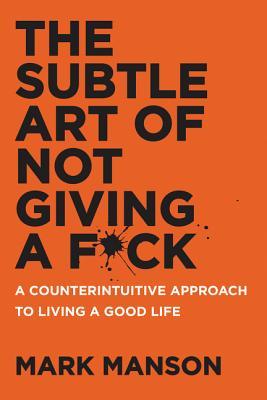
Mark Manson’s The Subtle Art of Not Giving a F*ck became famous partly because its title sounds like an instruction to stop caring. That interpretation is catchy, but it is almost the opposite of what the 2016 book argues. Manson does not recommend emotional indifference, nihilism, laziness, or withdrawing from responsibility. He argues that people inevitably care about something, and that the real problem is wasting limited attention on values, ambitions, judgments, comparisons, and anxieties that produce bad problems.
His alternative begins with an uncomfortable premise. A good life is not one in which suffering, uncertainty, rejection, failure, embarrassment, grief, and limitation have somehow been removed. Those things are unavoidable features of being human, so the meaningful question is what a person is willing to suffer for. Manson gradually turns that idea into a philosophy of selective commitment: choose better values, accept responsibility for your response to circumstances, remain uncertain enough to revise your beliefs, learn through failure, reject alternatives that conflict with what matters, and remember that mortality makes both time and attention finite.
That progression matters because The Subtle Art is often remembered as a collection of provocative slogans when it is actually more structurally coherent than its reputation suggests. The early chapters dismantle conventional assumptions about positivity, happiness, self-esteem, and exceptionalism; the middle of the book develops a theory of values and personal responsibility; and the final chapters examine uncertainty, failure, relationships, commitment, and death. Its strongest ideas form a surprisingly consistent practical philosophy, even though Manson’s psychological evidence, social commentary, and sweeping cultural claims are considerably less rigorous than his confident prose sometimes implies.
The result is a book that works better as practical philosophy and essayistic synthesis than as empirical psychology. Its enduring value lies not in teaching readers to care about nothing, but in forcing them to ask a more demanding question: given that life will contain problems no matter what, which problems are important enough to choose?
The Complete Argument, Chapter by Chapter
Manson builds that question gradually rather than presenting a formal system at the outset. Each chapter challenges one common assumption about living well, then creates the conceptual problem that the next chapter attempts to solve. By the time he introduces his five central values in Chapter 4, the apparently irreverent anti-self-help book has become an argument about responsibility, uncertainty, failure, commitment, and mortality.
Don’t Try: What “Not Giving a F*ck” Actually Means
Manson begins in an unlikely place for a self-help book: with Charles Bukowski. Bukowski spent much of his early life drinking heavily, gambling, working unglamorous jobs, writing material publishers repeatedly rejected, and generally behaving in ways that make him a poor conventional model of personal development. When literary success finally arrived, Manson refuses to turn the story into the usual inspirational narrative in which persistence transforms an unsuccessful man into the successful person he was always meant to become.
The point, as Manson presents it, is almost the reverse. Bukowski did not build his appeal by maintaining an aggressively positive self-image or pretending that his failures were temporary evidence of secret greatness. He wrote openly about weakness, humiliation, drinking, ugliness, failure, and the less flattering parts of himself. Manson uses him to introduce the paradox that will govern the book: obsessively trying to become better can continuously remind you that the person you currently are is supposedly not good enough.
That paradox becomes more explicit in what Manson calls the “Feedback Loop from Hell.” A person feels anxious and then becomes anxious about being anxious; another person gets angry and then feels ashamed of the anger; someone feels insecure and then condemns himself for lacking confidence. The original emotion may be unpleasant, but resistance to having that emotion generates a second layer of suffering. Instead of dealing with one difficult experience, the person begins judging himself for experiencing it at all.
Manson connects this to an idea associated with Alan Watts that he calls the backwards law. Pursuing a positive state too desperately can reinforce awareness of its absence: desperately trying to feel confident reminds you that you feel insecure, obsessively trying to become rich can keep your attention fixed on feeling poor, and continuously trying to prove that you are successful keeps raising the question of whether you actually believe you are. Conversely, accepting that an experience is unpleasant can reduce the additional suffering created by demanding that reality be different.
This is where the title needs to be interpreted carefully. In Manson’s original essay explaining the idea, as in the book, “not giving a f*ck” is not the same thing as becoming indifferent. Someone who genuinely cared about nothing would have no reason to act, endure difficulty, protect a relationship, develop a skill, pursue justice, or make a sacrifice. Manson instead describes a disciplined selectivity in which a person decides which discomforts are worth tolerating because something more important is at stake.
He develops the distinction in several ways. First, not giving a f*ck about adversity means refusing to let lesser difficulties overpower a larger value; someone can tolerate embarrassment, criticism, or failure when the goal matters more than avoiding those experiences. Second, people who cannot identify anything more important than minor irritations tend to spend disproportionate emotional energy on trivial problems because trivial problems are all they have available. Third, maturity involves recognising that attention is finite and becoming increasingly selective about where it goes.
This reframes the book from the beginning. Manson is not arguing that a satisfying life comes from subtracting all concern; he is arguing that indiscriminate concern creates fragility. If every inconvenience feels important, every disagreement becomes threatening, every criticism becomes a verdict, and every setback becomes evidence that something has gone terribly wrong.
The chapter therefore ends by clarifying the real purpose of the book. Manson does not promise a system for permanently eliminating pain or making every experience positive. He wants readers to examine what they are choosing to find important, remove unnecessary values and expectations, and become more willing to live with the inevitable discomfort attached to the things that remain.
Happiness Is a Problem: Choose Better Problems
Chapter 2 attacks another familiar assumption: that happiness is a condition people can eventually achieve and then retain. Manson opens with a deliberately simplified retelling of the story of Siddhartha Gautama, describing a protected prince who is shielded from suffering, encounters the realities of sickness, age, poverty, and death, abandons luxury, experiments with severe asceticism, and eventually recognises that neither indulgence nor self-punishment abolishes suffering. The story is being used as a philosophical illustration rather than as a serious account of Buddhist doctrine, but it establishes the chapter’s central proposition that suffering cannot simply be engineered out of existence.
Manson then introduces one of the book’s comic inventions, Disappointment Panda, a superhero whose power is telling people the truths they would prefer not to hear. The joke works because most imagined superheroes solve problems, whereas Disappointment Panda makes people confront problems they are avoiding. His function is to puncture the idea that the good life is supposed to be comfortable enough that unpleasant truths can be permanently excluded.
From there, Manson develops one of the book’s most useful reversals: happiness comes from solving problems, not from having no problems. Getting a job solves unemployment but creates deadlines, office politics, performance expectations, and commuting. Entering a relationship may solve loneliness while creating the work of communication, compromise, vulnerability, and conflict. Improving health can require scheduling exercise, changing habits, tolerating physical effort, and continually maintaining what has been gained.
Problems therefore do not disappear; they change form. A person can move from destructive problems toward productive ones, from problems created by avoidance toward problems created by growth, but there is no final stage at which life becomes permanently problem-free. Manson’s version of happiness is consequently active rather than static: satisfaction comes from being engaged in problems that feel worth solving.
That distinction also helps him explain different kinds of avoidance. Some people deny that a problem exists because acknowledging it would threaten their self-image. Others develop what Manson calls a victim mentality in which the problem is acknowledged but responsibility for doing anything about it is consistently displaced. Still others chase temporary emotional highs—through substances, adventures, righteousness, distraction, validation, or even some forms of motivational self-help—that momentarily obscure the underlying problem without changing it.
Manson next demotes emotions from ultimate authorities to forms of feedback. Feelings matter because they communicate something about experience, but they are not automatically accurate instructions about what a person should do. Negative emotion can indicate that a value is being threatened, a need is unmet, a relationship is damaged, or a situation requires attention; positive emotion can reward effective action. Yet if avoiding unpleasant emotion becomes the supreme value, any activity involving uncertainty, effort, confrontation, rejection, or delayed gratification starts to look undesirable.
The chapter culminates in “Choose Your Struggle,” where Manson changes the question people normally ask about ambition. Wanting the outcome is easy: many people want a fulfilling relationship, attractive body, successful career, respected creative life, financial security, or admired status. The more revealing question is whether they want the recurring frustrations attached to those outcomes.
Someone may want to become a musician but not want years of practice, small audiences, uncertain income, and rejection. Another person may want an excellent relationship but not difficult conversations, vulnerability, compromise, and the possibility of being hurt. The life someone actually builds therefore depends less on the pleasures they fantasise about than on the problems they are repeatedly willing to solve.
This prepares the next stage of the book. If suffering cannot be eliminated and every desirable life contains recurring difficulties, then happiness cannot simply mean choosing pleasure. It requires choosing which kinds of suffering are meaningful enough to endure, which immediately raises the question of what standards people use to decide what counts as meaningful.
You Are Not Special: Entitlement and the Tyranny of Exceptionalism
Chapter 3 begins with a man Manson calls Jimmy. Jimmy constantly talks about businesses, investment opportunities, influential contacts, ambitious projects, and imminent success, yet very little happens. He relies on relatives and girlfriends, spends irresponsibly, sometimes behaves dishonestly, and interprets criticism not as evidence that his behaviour may need to change but as proof that other people are jealous, shortsighted, or incapable of recognising his brilliance.
Jimmy matters because he appears confident. If confidence and positive self-regard were automatically signs of psychological health, he would seem exemplary. Manson instead uses him to distinguish self-esteem grounded in reality from entitlement, a condition in which someone believes ordinary rules, limits, or evidence should not apply to them.
Manson places the story inside a broad critique of the self-esteem movement that influenced education, parenting, therapy, business culture, and popular psychology during the late twentieth century. In his telling, a reasonable observation—that people with healthy self-regard often function better—was transformed into the much shakier idea that making people feel good about themselves would itself produce achievement and well-being. Participation trophies, indiscriminate praise, grade inflation, and constant messages about individual specialness become symbols in his argument for esteem detached from evidence.
That cultural history is far more complicated than Manson’s compressed account suggests, but it serves a clear role in his reasoning. Jimmy has plenty of positive self-belief; what he lacks is the capacity to experience negative feedback without immediately restructuring reality around his preferred identity. Manson’s deeper measure of psychological strength is therefore not how positively people evaluate themselves when things are going well, but how honestly they can deal with the parts of themselves and their lives that are disappointing.
He then broadens entitlement beyond obvious grandiosity. One version says, in effect, that “I am extraordinary, so I deserve special treatment.” The other says, “I am uniquely defective or uniquely burdened, so I deserve special treatment.” The emotional presentation is opposite—one looks narcissistic, the other self-loathing—but Manson argues that both organise experience around the belief that one’s situation is uniquely exceptional.
His own adolescence becomes an example of the second route. Painful experiences involving social insecurity, authority, relationships, and acceptance contributed to an identity in which he felt inadequate, but that inadequacy could produce its own entitlement. If suffering seems uniquely terrible or impossible for anyone else to understand, it becomes easier to exempt oneself from ordinary expectations or to expect another person to repair the damage.
The chapter then shifts from individual entitlement to what Manson calls the “tyranny of exceptionalism.” Modern media rarely show statistically ordinary experiences because ordinary experiences are not especially attention-grabbing. Audiences see extreme wealth, spectacular beauty, extraordinary athletic performance, remarkable intelligence, catastrophic disaster, bizarre crime, political outrage, and unusual success precisely because those things are unusual.
Digital media intensify that selection effect by making comparison effectively infinite. No matter how accomplished someone becomes, an online search can immediately reveal someone richer, fitter, younger, more successful, more travelled, more attractive, more productive, or more celebrated. Once exceptionalism becomes the metric, ordinary achievement begins to feel like failure.
Manson’s answer is not to oppose excellence. His point is that genuine excellence normally begins with admitting one’s current ordinariness in a particular domain and doing the unglamorous work required to improve. Someone who must already believe that they are exceptional has difficulty tolerating evidence that they are still inexperienced, mediocre, or wrong.
The chapter ends by defending ordinary life against the demand to become historically significant. Friendship, curiosity, creative work, reading, competence, family, humour, intimacy, contribution, and meaningful everyday experience do not require being among the best people in the world at anything. Releasing the requirement to be extraordinary can therefore create room to pursue worthwhile things for their own sake rather than as evidence that the self is special.
Yet that produces the next question. If external distinction, constant positivity, and exceptional status are unreliable guides to a good life, by what standard should a person judge what is actually worth caring about? Chapter 4 supplies Manson’s answer: values and the metrics used to measure them.
The Value of Suffering: Values and Metrics
Chapter 4 is the intellectual hinge of The Subtle Art. Manson has already argued that suffering is inevitable, that different lives contain different problems, and that exceptional achievement is a poor universal measure of worth. He now asks why the same kind of difficulty can feel meaningful to one person and unbearable to another, or why someone can achieve extraordinary success and still experience himself as a failure.
The chapter opens with Hiroo Onoda, the Japanese officer sent to Lubang in the Philippines near the end of World War II with orders to resist enemy forces and never surrender. Japan’s surrender did not end Onoda’s war because he refused to believe announcements that the conflict was over. Leaflets, messages from family members, and other attempts to reach him were interpreted as enemy deception, and he remained in the jungle with fellow soldiers while years turned into decades.
His companions gradually disappeared through surrender or death until Onoda remained alone. Eventually the young Japanese adventurer Norio Suzuki found him, but even Suzuki could not simply persuade him to leave because Onoda still understood himself as a soldier under orders. His former commanding officer had to return and formally relieve him before he surrendered in 1974, nearly three decades after the war had actually ended.
Manson is fascinated not merely by the extremity of the story but by the role of value. Onoda’s life in the jungle involved isolation, danger, deprivation, violence, and enormous sacrifice, yet he understood that suffering through the value of duty. Suzuki, meanwhile, built his life around adventure and continued pursuing increasingly improbable quests. Their choices make the point that human beings can endure enormous difficulty when that difficulty serves something they experience as meaningful, even when outsiders consider the underlying value destructive or absurd.
This is why Manson does not stop at saying that people need values. Everyone already has values, whether or not they articulate them clearly. The important question is what those values are and by what metric someone decides whether they are succeeding.
His “Self-Awareness Onion” moves through progressively deeper layers. At the surface is the ability to recognise an emotion: anger, sadness, fear, embarrassment, jealousy, loneliness. A deeper layer asks why the emotion exists, but the most important layer asks which value and metric are producing the judgment behind it.
Suppose someone is devastated because a colleague received a promotion. At one level, the emotion may be jealousy or disappointment; at another, the explanation may be feeling overlooked. But beneath both lies a metric: perhaps career success means advancing faster than peers, or personal worth means receiving recognition from authority figures. Without identifying that metric, someone can spend years reacting to the same emotion while leaving its underlying standard untouched.
Manson develops the idea through the contrasting stories of musicians Dave Mustaine and Pete Best. Mustaine was expelled from Metallica before the band became one of the biggest acts in heavy metal, and he channelled the humiliation into extraordinary ambition, forming Megadeth and achieving major commercial success. Yet if his internal metric remained “be more successful than Metallica,” substantial achievement could still register as defeat because the comparison target remained even more successful.
Pete Best experienced a superficially similar rejection when he was removed from the Beatles shortly before their global breakthrough. From the standpoint of fame and wealth, his loss was almost unimaginably large. Manson contrasts this with Best’s later account of building a family and evaluating his life by different standards, illustrating the possibility that someone who objectively “lost” a famous comparison can nonetheless judge his life more positively because he is using another metric.
The comparison does not prove that external achievement is irrelevant. It demonstrates that achievement cannot explain well-being without reference to the standards through which achievement is interpreted. A person who measures success through endless social comparison can move upward indefinitely without reaching psychological sufficiency because the metric itself keeps producing deficiency.
Manson next identifies several values he considers especially unreliable as ultimate standards. Pleasure can be enjoyable but unstable and self-defeating when treated as the highest purpose; material success can improve life while becoming corrosive if money becomes the primary measure of identity; being right can make learning impossible; and relentless positivity can turn legitimate grief, conflict, fear, or failure into experiences that must be denied rather than understood.
He proposes three broad criteria for better values. They should be reality-based rather than dependent on fantasy, socially constructive rather than destructive, and sufficiently immediate and controllable that the person can act on them. Honesty, curiosity, humility, creativity, self-respect, generosity, and persistence fit more easily into this model than fame, universal approval, domination, or always being correct because they depend more heavily on behaviours a person can actually choose.
The controllability criterion is especially important because it changes the locus of evaluation. “Become famous” makes success depend heavily on other people; “improve my craft” can be acted upon directly. “Make everyone like me” produces permanent insecurity; “behave honestly and respectfully” remains possible even when another person dislikes the result.
At the end of the chapter, Manson identifies five values that organise the remainder of the book: responsibility, uncertainty, failure, rejection, and contemplation of mortality. These are not merely five more topics. They are the practices through which his earlier argument about values becomes concrete: responsibility gives agency, uncertainty makes correction possible, failure becomes a method of improvement, rejection creates boundaries and commitment, and mortality determines what deserves to matter in the first place.
You Are Always Choosing: Responsibility Without Blame
Chapter 5 begins with a thought experiment about running a marathon. Voluntarily choosing to run one can be painful, exhausting, and difficult while still feeling meaningful; being forced to cover the same distance under threat would transform an identical physical burden into something psychologically very different. Manson uses the contrast to argue that perceived choice and responsibility fundamentally alter how people experience problems.
The claim is not that people choose everything that happens to them. Much of the chapter is devoted to circumstances people explicitly did not choose. Manson’s narrower proposition is that suffering becomes more psychologically paralysing when someone believes there is absolutely no domain of response available, whereas recognising some form of agency can restore a sense of movement even when the original situation remains unfair or irreversible.
William James becomes the chapter’s first major example. Manson recounts James’s unhappy young adulthood, marked by physical problems, uncertainty about his vocation, repeated changes of direction, depression, and the sense that he had failed despite considerable privilege and opportunity. Approaching thirty and increasingly hopeless, James encountered philosophical arguments about free will and decided to live for a period as though he possessed meaningful choice over how he responded to his circumstances.
Manson presents that decision as a turning point rather than as philosophical proof that free will exists. James eventually became one of the foundational figures in American psychology and an influential philosopher, but the useful lesson for Manson is psychological: acting as though one has responsibility can create possibilities that total helplessness closes off. The point is less “you control reality” than “your interpretation and response are among the parts of reality you may be able to influence.”
That argument reaches its clearest form in the distinction between fault and responsibility. Fault is primarily about causation and the past: who caused this problem, who behaved wrongly, who is blameworthy? Responsibility concerns the present and future: given that the problem now exists, who has decisions to make about what happens next?
Sometimes the two coincide. Someone who causes a car accident may be both at fault and responsible for making amends. But many of life’s most painful situations separate them completely: a person may be betrayed, abused, robbed, injured, discriminated against, abandoned, traumatised, or struck by illness without having caused the event, yet still become the person who must decide whether to seek treatment, establish boundaries, pursue legal remedies, ask for help, leave, grieve, rebuild, or otherwise respond.
Manson illustrates the distinction through an early relationship in which a girlfriend betrayed him. Her behaviour was her fault, and accepting responsibility for his recovery did not excuse what she had done. What changed was his recognition that waiting for the person who had hurt him to repair his emotional life kept his well-being dependent on someone he could not control.
Responsibility also forced him to examine his own behaviour without falsely equating different wrongs. He could recognise that her betrayal remained unjustified while also acknowledging ways he had behaved coldly, ignored warning signs, tolerated an unhealthy dynamic, or contributed to a relationship built on poor values. That reflection mattered because responsibility was not being used to redistribute blame retroactively; it was being used to decide which patterns he did not want to repeat.
Manson then deliberately moves to harder cases. Malala Yousafzai becomes an example of someone subjected to violence she did not deserve or cause, yet who continued choosing how to respond to an attempt to silence her. The moral value of the example depends on keeping the categories separate: the fact that a victim may retain some agency does not reduce the responsibility of the perpetrator or make victimisation voluntary.
A grieving father who challenged Manson after the death of his son pushes the same distinction to its emotional limit. Manson does not claim that the father chose the death or that grief is a mistake to be corrected. He argues that even an unwanted and irreversible loss creates a terrible new reality within which the bereaved person still makes choices about how to live, what to believe, how to relate to others, and what meaning—if any—to build afterward.
The section on obsessive-compulsive disorder introduces biological and psychological constraints. Manson discusses teenagers featured in a BBC programme who live with OCD and receive professional help aimed partly at reducing their obedience to compulsions. They did not choose the disorder, but treatment involves choosing behaviours that compete with the demands of the disorder, such as tolerating anxiety rather than automatically performing a ritual.
The medical framing in the book is simplified, and its statements about OCD should not be treated as a complete clinical account. What matters to Manson’s argument is the distinction between a starting condition and a response: genetics, illness, family background, wealth, appearance, trauma, and social circumstances distribute very different hands, so responsibility cannot mean that everybody had equal choices or equal opportunities.
This nuance becomes harder to maintain when Manson turns to what he calls “Victimhood Chic.” He argues that social media can reward public grievance and that both ideological left and right sometimes gain identity, attention, and moral status by presenting themselves as victims. There is a legitimate psychological point here: blaming others can become emotionally gratifying, and a person can organise identity around injury in ways that make change harder.
Yet Manson’s rhetoric stretches far beyond what he has demonstrated. Publicly describing injustice is not the same thing as avoiding responsibility, and structural problems do not disappear merely because individuals retain some capacity to respond to them. Racism, poverty, disability, coercion, violence, discrimination, inaccessible treatment, unsafe environments, and institutional power can constrain choices in ways that a strongly individualistic framework tends to understate.
The most defensible version of Manson’s argument is therefore narrower than some of his language. Human beings often retain some agency within circumstances they did not choose, but the size, cost, and practical usefulness of that agency vary enormously. Responsibility should expand the domain in which someone can act; it becomes ethically dangerous when it is used to pretend that circumstances, perpetrators, institutions, or unequal resources do not matter.
The chapter closes with “There Is No ‘How,’” where Manson anticipates readers who agree that their values or habits need to change but still want a precise procedure before acting. His answer is intentionally frustrating: demanding the perfect method can become another form of avoidance. A new value becomes real through choices that will themselves involve uncertainty, failure, rejection, and difficulty, which leads directly into the next chapters.
You’re Wrong About Everything: Uncertainty, Identity, and Avoidance
If Chapter 5 insists that people take responsibility for their responses, Chapter 6 prevents responsibility from becoming certainty. Manson begins by admitting that many of his beliefs about himself, other people, relationships, society, and success have changed repeatedly. His model of growth is not a movement from being wrong to becoming permanently right, but from being wrong toward being somewhat less wrong.
He compares values to hypotheses and behaviour to experiments. A person acts according to a belief about what matters, observes the results, and revises the belief when experience exposes its weaknesses. The metaphor is imperfect because life is not a controlled experiment, but it captures the chapter’s governing idea: values should remain revisable rather than becoming sacred identities that must be defended against evidence.
Manson illustrates the mind’s appetite for false patterns with an experiment in which participants encounter buttons and a scoring light. The participants believe some discoverable sequence of actions will generate points and gradually invent increasingly elaborate routines. The catch is that the points are random, so participants can become sincerely confident that meaningless patterns are causally effective.
For Manson, the experiment dramatises a much broader tendency. Human beings constantly connect events into stories about why relationships failed, why careers stalled, what other people think, what kind of person they themselves are, and what outcomes will make life meaningful. Some stories are useful and comparatively accurate; others can survive largely because the mind prefers a coherent explanation to uncertainty.
The story of a woman he calls Erin shows the extreme danger of certainty. Manson describes meeting her in the self-help world, becoming romantically involved with her, and later confronting increasingly implausible beliefs about healing, death, spirituality, and a destined relationship with him. Her persistence, positive thinking, goal orientation, and refusal to accept rejection superficially resemble traits motivational culture often celebrates, but those traits become pathological when nothing can falsify the underlying belief.
Manson’s conclusion is deliberately uncomfortable: being certain that you are right can be more dangerous than admitting that you do not know. Certainty protects identity because evidence no longer needs to be examined on its own terms; it can simply be reinterpreted as proof that opponents are ignorant, jealous, corrupt, unenlightened, or malicious.
This leads to “Manson’s Law of Avoidance,” one of the book’s most memorable concepts. The more an experience threatens someone’s identity, he argues, the more likely that person is to avoid it. Someone invested in believing “I am brilliant” may avoid difficult work that could expose limitations, while someone invested in “I am terrible at relationships” may avoid intimacy that could contradict the identity.
Negative identities can therefore be as restrictive as positive ones. “I am ugly,” “I am socially awkward,” “I am a failure,” “I am the responsible one,” “I am an artist,” or “I am smarter than these people” can all become prisons when preserving the statement matters more than encountering new evidence. This connects naturally with the kind of systematic errors in judgment explored in The Art of Thinking Clearly: subjective certainty is not a reliable measure of accuracy, particularly when ego and identity influence what evidence a person notices.
The provocatively titled “Kill Yourself” subsection is therefore about the death of a rigid conceptual identity, not physical self-harm. Manson wants readers to loosen the stories through which they define themselves so thoroughly that behaviour becomes organised around protecting those stories. If someone does not need to remain “the successful one,” “the victim,” “the genius,” or “the person incapable of commitment,” experiences that contradict those labels become less threatening.
He does not advocate total scepticism. Complete uncertainty would make action impossible because people need working assumptions about reality, relationships, morality, and themselves. His more practical position is epistemic humility: treat beliefs as models that may need correction and distinguish strong conviction from infallibility.
The chapter ends with three questions designed to put pressure on certainty. First, what if I am wrong? Second, what would it mean if I were wrong? Third, would discovering that I am wrong create a better or worse problem than the one produced by my current belief?
The second question matters because error is often threatening not because of the factual correction itself but because of what the correction would imply about identity. Someone resisting a sibling’s relationship, for example, may discover that admitting uncertainty would require recognising jealousy, insecurity, control, or an exaggerated belief in their own judgment. Once identity is involved, being wrong can feel like losing part of oneself.
The third question brings values back into the picture. Manson does not ask readers to assume that every belief is false; sometimes evidence supports the conclusion they already hold. He asks them to compare the problems generated by certainty with those generated by humility, because the willingness to discover error is a prerequisite for changing any value, behaviour, or relationship that is not working.
Failure Is the Way Forward: Action Before Motivation
Chapter 7 turns uncertainty into behaviour. Manson graduated from college in 2007 just as the financial crisis and Great Recession were making entry into the job market unusually difficult. A housing problem depleted his savings, he spent months sleeping on a friend’s couch, pieced together odd jobs, and found himself entering adulthood with little money and no conventional trajectory toward professional stability.
He retrospectively calls this fortunate because his circumstances changed his metric for failure. If success meant immediately obtaining a secure respectable job, he was doing badly. But when he considered pursuing his own work, another possibility emerged: the greater failure might be never attempting something he actually wanted because he was afraid of looking unsuccessful.
That shift introduces what he calls the failure/success paradox. Improvement generally requires repeated mistakes, rejected attempts, poor early performances, awkward conversations, unsuccessful experiments, and actions that do not produce the intended result. The better someone becomes at a difficult activity, the more invisible failed attempts usually sit behind the competence observers eventually see.
Manson illustrates the idea with a Picasso story in which the artist supposedly asks an enormous price for a quickly produced drawing because the few moments required to make it rested on decades of accumulated practice. Whether or not such anecdotes should be treated as literal biography is less important to the argument than the distinction they express. Competence compresses prior failure: the expert can do something quickly precisely because thousands of previous attempts created the skill.
Values again determine whether failure becomes useful. If the metric is “everyone must like me,” a rejection is almost pure loss because success depends on another person’s response. If the metric is “communicate honestly and respectfully,” rejection may still hurt but does not automatically imply that the attempt was worthless.
Manson then pushes the connection between pain and development much further through Kazimierz Dąbrowski’s work and stories of people who report positive change after severe adversity. He argues that painful experiences can disrupt inadequate values, force reassessment, and produce greater appreciation, courage, or resilience. The intuitive point is plausible: crisis can destroy assumptions that were previously invisible and motivate changes people had postponed.
The danger is turning that possibility into a law. Trauma can be devastating, and people do not become wiser merely because terrible things happen to them. Manson is strongest when he argues that pain can sometimes become material for growth; he overreaches when his language makes emotional pain sound analogous to the physical stress required for stronger muscles, as though suffering predictably produces psychological development.
The chapter’s most practical contribution is much less grandiose. Manson recalls his high-school mathematics teacher advising students that when they were stuck on a problem, they should begin doing something rather than wait passively for the complete solution to appear. Years later, while struggling to build his early online business, he realised that the principle reversed his assumptions about motivation.
People often imagine a sequence in which inspiration creates motivation and motivation finally creates action. The problem is that someone who feels uninspired then has no apparent way to begin. Manson turns the sequence into a loop: action can generate new information, information can generate inspiration, inspiration can increase motivation, and motivation can produce further action.
His “Do Something Principle” therefore recommends reducing the first action until it is small enough to perform without waiting for a dramatic internal transformation. Write a little, send one application, speak to one person, research one option, practise briefly, or have the first part of a difficult conversation. The immediate result does not need to be success; its value may simply be that it produces feedback.
This is where responsibility, uncertainty, and failure start functioning together. Responsibility says that some action is yours to choose, uncertainty says you do not need certainty before trying, and failure says an imperfect result can become information rather than a verdict. Readers interested in another action-oriented treatment of this territory will recognise a related emphasis in Gary John Bishop’s argument for acting without waiting for motivation in Unfuk Yourself*.
Manson’s principle is simple enough to sound obvious, but its simplicity is part of its usefulness. Procrastination often grows because the mind imagines the entire problem at once and demands enough motivation to complete it. Redefining success as taking the next workable action makes failure cheaper, and once failure becomes cheaper, experimentation becomes easier.
The Importance of Saying No: Rejection, Boundaries, and Commitment
Chapter 8 begins by turning one of Manson’s apparent successes into a problem. For several years he built a nomadic life around travel, new cultures, new relationships, sexual freedom, adventure, and geographic independence. He visited dozens of countries and accumulated experiences that could easily be presented as evidence of enviable freedom.
Looking back, he sees two different values operating at once. Curiosity and love of travel were genuine, but constant movement also allowed him to avoid commitment and compensate for earlier insecurity. If there was always another city, social group, relationship, or adventure available, he never had to discover what would happen if he chose one possibility deeply enough to lose the others.
That realisation begins the book’s transition from freedom as unlimited optionality to freedom as meaningful commitment. Manson argues that having possibilities is valuable because it creates the opportunity to choose, but possibilities by themselves do not create meaning. Eventually a person has to exclude something.
His experience in Saint Petersburg becomes an anecdotal exploration of honesty and rejection. Manson initially finds Russian conversational bluntness abrasive compared with the politeness expected in the United States and other Western cultures. People seem more willing to say directly that an idea is stupid, that they dislike something, or that they genuinely enjoy someone’s company.
A Russian teacher offers Manson a sweeping historical explanation, suggesting that trust acquired unusually high value under conditions in which people had limited opportunity and needed to know whom they could rely on, whereas commercially abundant Western societies rewarded presentation, networking, likability, and salesmanship. Manson uses the contrast to question whether habitual niceness can sometimes make intimacy harder by obscuring what people actually think.
This is an evocative travel observation rather than a sufficient sociology of Russian and American culture. National communication styles are not reducible to one political history, and Manson’s interpretation depends heavily on his own experiences. Its function inside the chapter, however, is clear: meaningful relationships require the capacity both to deliver and receive rejection.
“Rejection Makes Your Life Better” extends that principle beyond conversation. Any value excludes its opposite. If honesty matters, some lies have to be rejected; if a relationship matters, some alternative relationships have to be rejected; if a career matters, other uses of time necessarily receive less attention.
For Manson, this makes “no” philosophically important. A person who refuses to reject anything cannot establish clear values because saying that one thing matters more than another already involves exclusion. Endless affirmation sounds generous, but if every option remains equally available, nothing receives the depth that commitment requires.
The relationships section develops this through boundaries. Manson comically retells Romeo and Juliet not as an ideal romance but as a story about two intensely attached young people whose impulsiveness and lack of boundaries contribute to catastrophe. His target is the cultural tendency to romanticise relationships in which two people become responsible for one another’s entire emotional lives.
Healthy support, in his framework, differs from assuming ownership of another person’s problems. Partners can care deeply, help each other, make sacrifices, offer comfort, and cooperate, but they remain responsible for their own emotions and choices. The boundary is not emotional coldness; it prevents love from turning into control.
Manson describes a toxic complementarity between “victims” and “savers.” The victim continually transfers responsibility for problems, while the saver develops identity and emotional value from constantly fixing them. Each person receives something from the pattern—the victim gets attention or relief from responsibility, the saver gets significance—but the relationship can become dependent on problems continuing to exist.
The healthier alternative is less dramatic. Someone can say, in effect, “This problem belongs to me, but I want your support while I deal with it,” while a partner can care without assuming that love requires solving every difficulty. That arrangement may feel less intense than rescue-and-crisis dynamics, yet it leaves more room for autonomy and genuine intimacy.
Trust requires the same willingness to tolerate discomfort. Manson uses his marriage to argue that routine honesty matters more than pleasant reassurance, including moments when telling the truth may briefly disappoint someone. A person who always says what a partner wants to hear becomes difficult to trust precisely because agreement has stopped conveying information.
When trust has already been broken, Manson proposes two requirements for repair. The person who caused the breach must identify and acknowledge the values and behaviour that produced it rather than offering only apologies, and the claimed change must then be demonstrated through a consistent record over time. Words can announce a new value, but repeated behaviour is what gives another person reason to believe it.
The chapter ends with “Freedom Through Commitment,” one of the book’s most important reversals. Consumer culture often treats more options as inherently better: more destinations, partners, purchases, experiences, careers, opportunities, and possible selves. Manson argues that beyond a point, constant optionality can increase doubt because every actual choice creates awareness of everything not chosen.
He connects the argument to the psychological idea usually called the paradox of choice, although the research is more conditional than his presentation suggests. His philosophical conclusion is stronger than the universal empirical claim: depth requires exclusion. A long relationship, serious craft, community, career, or enduring project becomes deep partly because a person continues investing after the novelty of alternatives appears.
By this stage, the title has almost reversed itself. Manson’s mature version of “not giving a f*ck” is not refusing attachment; it is refusing enough distractions and alternatives that a smaller number of attachments can become serious. Selectivity exists in the service of commitment.
And Then You Die: Mortality as the Final Value
The final chapter explains why selectivity matters at the deepest level. Manson returns to an event from his youth: the death of his friend Josh after a jump from a cliff into a lake during a party near Dallas. Josh had been joking with him earlier in the evening, and the ordinary, casual nature of their last interaction becomes part of the shock because nothing about it suggested that Manson was hearing a friend’s final words.
Josh’s death destabilised the assumptions of a nineteen-year-old who had been struggling with insecurity, fear, and his own painful adolescence. Grief did not provide a tidy lesson or make the loss desirable. What changed was the scale against which Manson measured other fears.
Embarrassment, social judgment, romantic rejection, and personal insecurity looked different after mortality stopped being an abstraction. Someone else’s death confronted him with the fact that his own opportunities to act, connect, create, risk failure, and experience life were finite. In his account, the event contributed to his willingness to pursue experiences he had previously been afraid to choose.
Mortality therefore becomes the fifth value announced in Chapter 4. Manson’s argument is not that people should constantly terrify themselves with thoughts of death. It is that finitude gives values weight: if time were unlimited and no possibility could ever permanently disappear, choosing one thing rather than another would carry far less significance.
To develop the idea, Manson turns to Ernest Becker, the anthropologist and interdisciplinary thinker best known for The Denial of Death. Becker argued broadly that human beings occupy a psychologically difficult position because they are biological organisms capable of understanding their own mortality. They know that their bodies are vulnerable and temporary while simultaneously constructing symbolic worlds of identity, morality, status, culture, nation, family, faith, achievement, and meaning.
Manson uses Becker’s idea of symbolic immortality to interpret these larger commitments. People participate in projects that seem to extend beyond the individual biological lifespan: raising children, building institutions, creating art, serving a religion or nation, accumulating a legacy, advancing knowledge, becoming famous, supporting a political cause, or attaching identity to a cultural worldview. These “immortality projects” allow the conceptual self to feel connected to something larger and more durable than the body.
The danger appears when the project becomes inseparable from identity. If a worldview is not simply something someone believes but the mechanism through which that person imagines his or her significance, contradictory beliefs can begin to feel existentially threatening. That helps explain why people may defend ideologies, nations, religions, status systems, and identities with extraordinary intensity even when disagreement itself presents no physical threat.
Manson then interprets Becker’s later thinking as a warning against treating symbolic immortality as the solution to death anxiety. Instead of trying to make the conceptual self permanent, people might become more willing to accept that the self is finite. This returns the book to uncertainty: loosening the need for identity to endure forever can make disagreement, imperfection, change, and eventual disappearance less psychologically catastrophic.
The final scene takes place at South Africa’s Cape of Good Hope. Manson climbs toward a cliff and approaches the edge while contemplating danger, death, Josh, and the limits of his own life. The scene deliberately echoes the circumstances of Josh’s death without pretending that reckless risk is the lesson.
What matters is Manson’s altered relationship to fear. Fear is still present because physical danger is real, but it no longer automatically dictates retreat from everything uncertain. Mortality becomes a filter that separates concerns worth respecting from concerns that have been given disproportionate importance.
The book therefore ends far from the crude interpretation of its title. Manson has moved from Bukowski’s refusal to pretend, through acceptance of negative emotion, better problems, ordinary life, values, responsibility, uncertainty, failure, rejection, and commitment, until the finite nature of life explains why attention must be selective. You cannot care about everything because you do not have infinite time, energy, or life in which to care.
How Manson’s Five Values Form One System
The five values introduced near the end of Chapter 4 are sometimes remembered as separate lessons, but the book becomes more coherent when they are treated as one sequence. Each corrects a weakness in the one before it, and together they turn Manson’s early argument about accepting discomfort into a method for deciding which discomforts deserve to be accepted.
Values and Metrics Determine the Quality of Your Problems
The first three chapters repeatedly describe people pursuing the wrong targets. They want permanent happiness, universal approval, exceptional status, painless relationships, constant confidence, or freedom from negative emotion. Chapter 4 finally explains why those pursuits create recurring dissatisfaction: the underlying values and metrics make ordinary human difficulty register as failure.
Values determine what counts as a problem, while metrics determine whether someone believes they are succeeding at solving it. If “being admired” is the value and “receive more admiration than my peers” is the metric, another person’s success easily becomes a threat. If “improving my craft” is the value and “practise seriously and produce work I can learn from” is the metric, another person’s excellence can become information rather than humiliation.
This does not mean people can simply think their way out of every real problem. A bad metric cannot turn hunger into abundance or violence into safety. Manson’s model is most useful where the problem contains a significant interpretive component: ambition, relationships, self-esteem, comparison, motivation, failure, status, and the choices through which people allocate effort.
The difference also explains why pleasure alone cannot serve as the system’s organising principle. Two people may experience comparable discomfort while evaluating it very differently because one difficulty serves a chosen value and the other feels meaningless. The aim is therefore not to minimise the amount of discomfort in life at all costs, but to improve the relationship between discomfort and value.
Responsibility, Uncertainty, Failure, Rejection, and Mortality
Responsibility is the first operational value because a person cannot change a metric or solve a problem while locating every meaningful decision outside the self. Manson’s fault/responsibility distinction makes this more defensible than a simplistic doctrine of total control. The past may contain things someone did not cause, but the present often still contains choices about attention, behaviour, interpretation, boundaries, treatment, or response.
Responsibility alone, however, can become arrogance. Someone who takes action while remaining certain that their interpretation is correct can simply become more effective at pursuing the wrong value. Uncertainty therefore functions as responsibility’s correction: it requires treating one’s current model as revisable.
Once uncertainty is accepted, failure becomes psychologically survivable. If identity does not require proving that you are already correct, an unsuccessful action can provide evidence about what needs to change. The person who is responsible enough to act and uncertain enough to learn can use failure as feedback rather than as proof of worthlessness.
Rejection then makes values concrete. A person can claim to value almost anything in the abstract, but actual commitment requires giving up incompatible possibilities. Choosing one partner rejects other romantic options; telling the truth rejects at least some opportunities to preserve approval; devoting years to a craft rejects countless alternative uses of time.
This is why the progression culminates in commitment rather than endless experimentation. Responsibility gets someone moving, uncertainty prevents dogmatism, failure improves the model, and rejection allows the revised value to acquire depth. Without rejection, the earlier stages could become perpetual exploration with no durable investment.
Mortality provides the final reason to do any of this. Time is finite, so alternatives cannot remain open forever. Every substantial commitment is also an expenditure of a limited life, which gives values seriousness that a purely motivational framework cannot provide.
The system therefore contains an implicit feedback loop. Choose a value, accept responsibility for acting on it, remain uncertain about whether the value and method are sound, use failure as information, reject incompatible alternatives as the value proves itself, and periodically ask whether the commitment remains important enough to justify part of a finite life. If new evidence changes the answer, uncertainty permits revision rather than requiring loyalty to the original choice.
Why the Book Is About Commitment, Not Apathy
This is the point at which the title becomes least misleading. Someone who genuinely stopped caring would have no reason to accept responsibility, learn from failure, establish honest boundaries, rebuild trust, commit to a relationship, practise a craft, or confront mortality. Manson asks for all of those things.
The reduction in concern is therefore instrumental. A person stops caring so much about universal approval in order to care more about honesty; stops caring about appearing certain in order to care more about learning; stops caring about avoiding every failure in order to care more about progress; and stops caring about unlimited options in order to care more deeply about commitments.
Seen this way, the book’s real opposite is not sensitivity but indiscrimination. Someone who treats every judgment, comparison, opportunity, conflict, ambition, and insecurity as equally important has no hierarchy of value. Manson’s “subtle art” consists of building that hierarchy consciously enough that lesser concerns can be endured when they interfere with something more important.
The Psychology and Philosophy Behind The Subtle Art
Manson borrows from multiple intellectual traditions without turning the book into a systematic survey of any of them. Ideas resembling acceptance-based psychology, existential philosophy, Stoicism, Buddhist thought, behavioural activation, and epistemic humility appear throughout, while Alan Watts and Ernest Becker are especially visible influences. The useful task is not to force The Subtle Art into one tradition but to distinguish the philosophical strength of its ideas from the empirical confidence with which Manson sometimes presents them.
Acceptance, Emotion, and the Backwards Law
The “Feedback Loop from Hell” identifies a real distinction between an unpleasant experience and a negative judgment about having that experience. Someone can feel anxious before a presentation and then add another layer of distress by deciding that anxiety proves weakness, incompetence, or abnormality. The second judgment does not solve the first emotion; it often creates a new problem requiring its own attention.
Manson’s backwards law generalises this insight. The more someone requires a particular internal state—confidence, happiness, certainty, calm—the more threatening evidence of its absence becomes. A person who believes “I must feel confident” may interpret ordinary hesitation as a crisis, whereas someone willing to experience hesitation can still act.
The idea is strongest when it concerns internal experience rather than external conditions. Accepting that anxiety is present is different from accepting mistreatment, and accepting that grief cannot be switched off is different from deciding that the situation causing harm should remain unchanged. Without that distinction, the language of acceptance can slide from psychological flexibility into passivity.
Manson generally understands this difference, even if his rhetoric occasionally blurs it. His larger framework repeatedly demands action, boundaries, rejection, and responsibility, so acceptance in The Subtle Art is better understood as refusing to waste energy denying the existence of an experience before deciding what to do about it.
That also explains why emotion is treated as information rather than command. Feelings can contain important signals, but a life organised around never feeling bad becomes progressively narrow. Valuable activities routinely generate fear, grief, frustration, shame, vulnerability, uncertainty, and disappointment, which means emotional discomfort cannot by itself establish that an action is wrong.
The practical insight is less “ignore your feelings” than “do not make immediate emotional comfort the only metric.” Manson’s best examples show people tolerating a difficult internal state because another value—honesty, learning, recovery, intimacy, creativity, responsibility—matters more.
Responsibility, Control, and Personal Agency
Responsibility is simultaneously one of the book’s strongest ideas and the idea most likely to be misused. The distinction between fault and responsibility offers a powerful way to preserve agency after unfair events. A person does not have to declare a betrayal, illness, abuse, bereavement, discrimination, or accident deserved in order to ask what choices remain available now.
This can be psychologically liberating because blame and agency answer different questions. Establishing who caused a harm may be morally, legally, and socially essential, but knowing who is at fault does not automatically tell the injured person how to live tomorrow. Responsibility concerns that second problem.
The danger begins when “you still have choices” is converted into “your circumstances therefore do not matter.” Choices are constrained by resources, safety, law, physical ability, mental health, money, discrimination, social support, caregiving obligations, and countless other factors. Two people may both possess some agency while having radically unequal ranges of viable action.
Manson acknowledges unequal starting conditions, but his rhetoric tends to return quickly to individual choice. That emphasis is consistent with the book’s purpose—he is writing a personal-development book rather than a political theory—but it becomes a limitation whenever the argument wanders into claims about culture, victimhood, institutions, or social inequality.
A more careful version of his position distinguishes control, influence, and responsibility. Someone may have no control over an event, limited influence over its consequences, and substantial responsibility for one specific decision; another person may face conditions so coercive that even the immediate choices are severely constrained. Agency exists on a continuum rather than as a binary switch.
This refinement does not weaken Manson’s best point. It strengthens it by preventing responsibility from becoming another metric for blaming people who are already struggling. The purpose of responsibility is to identify a workable domain of action, not to prove that every outcome ultimately reflects individual merit.
Uncertainty, Identity, and Self-Correction
Chapter 6 gives Manson’s system an epistemological foundation. If values determine experience but values themselves can be wrong, people need a way to revise them. Uncertainty supplies that mechanism.
The “less wrong” model is useful because it turns personal development away from the fantasy of discovering a final identity. Someone can adopt a value because it currently appears constructive while remaining open to discovering costs, contradictions, or changed circumstances later. Commitment need not require pretending that future revision is impossible.
Manson’s Law of Avoidance adds a psychological explanation for why revision is difficult. Beliefs about the self do more than describe behaviour; they shape which experiences people are willing to have. Someone who identifies as naturally bad at mathematics may avoid the practice that could improve mathematical ability, while someone convinced of being unusually intelligent may avoid tasks difficult enough to expose weakness.
The common mechanism is identity preservation. Evidence becomes dangerous not because of what happened but because of what the event threatens to say about “who I am.” The more identity depends on maintaining a story, the more powerful avoidance can become.
This is where Manson’s attack on exceptionalism and his defence of uncertainty reinforce each other. A person who does not need to be inherently special can tolerate being ordinary at the beginning of a learning process. Someone who does not need to be permanently right can use criticism without experiencing every correction as humiliation.
Yet uncertainty also requires boundaries of its own. Habitually assuming that you must be wrong can become another dysfunctional identity, especially in abusive relationships or manipulative environments where another person benefits from making you distrust your perceptions. Manson explicitly acknowledges versions of this problem when he notes that questioning a belief does not require concluding that the opposite belief is true.
The goal is therefore revisability rather than self-erasure. A healthy working belief can be held strongly enough to guide action while remaining open to evidence that would justify changing it. That balance is intellectually modest but practically demanding because it requires people to separate the emotional cost of being corrected from the actual quality of the correction.
Ernest Becker, Death, and Meaning
Ernest Becker gives the final chapter a philosophical depth that changes how the earlier material can be read. Without mortality, Manson’s advice might remain a useful but fairly ordinary argument about priorities. With mortality, prioritisation becomes unavoidable because the resource being allocated is not merely attention but finite life.
Becker’s broad theory begins with the tension between human self-consciousness and human animality. People can imagine futures, build symbolic identities, participate in cultures, and conceptualise their lives as meaningful wholes, yet they also know that their bodies will age and die. Much of culture can be interpreted as an attempt to manage that contradiction by connecting individuals to meanings that seem larger or more enduring than themselves.
Manson translates this into the language of values. A career, faith, nation, family, ideology, artistic legacy, moral cause, wealth, or reputation can function as an “immortality project” when the person experiences it as a route toward significance that outlives the body. The project may be generous or destructive; what matters psychologically is the role it plays in sustaining meaning.
This creates another explanation for dogmatism. If an idea is merely a belief, disagreement can be inconvenient; if the idea is part of the symbolic structure through which someone makes mortality tolerable, disagreement can feel like an attack on existence itself. Manson therefore connects death anxiety back to uncertainty and identity: loosening the need for the conceptual self to be permanent may reduce the urgency with which people defend it.
There is philosophical power in that connection even without treating every empirical extension of Becker as established fact. Mortality undeniably creates scarcity of time, and scarcity forces prioritisation. Whether death awareness causes every specific behaviour proposed by later psychological theories is a different question.
The ending consequently supplies a final test for the book’s values. Manson has spent hundreds of pages asking which problems deserve attention; mortality explains why the question cannot be postponed indefinitely. A finite life makes some rejection inevitable because choosing everything is not an available option.
What the Evidence Supports—and What Needs Qualification
The Subtle Art is filled with psychological language, historical anecdotes, evolutionary explanations, cultural generalisations, and references to research, but it is not written like an academic psychology book. Manson’s stories generally function rhetorically: they make a concept vivid and memorable, sometimes with more confidence than the available evidence warrants. The fairest evaluation therefore distinguishes ideas that are useful as practical models from empirical claims that need narrower wording.
Acceptance of Negative Emotion
Manson’s claim that fighting every unwanted emotion can intensify distress is broadly compatible with research on psychological acceptance. A series of studies on habitual acceptance of negative thoughts and emotions found associations between accepting mental experiences without judgment and better psychological health, including reduced negative emotional responses to stress.
That evidence supports a careful version of the Feedback Loop from Hell. Judging oneself harshly for feeling anxious, sad, angry, or afraid can create additional distress, whereas allowing the emotion to exist without automatically treating it as failure may reduce the secondary struggle around it. This is not equivalent to proving Manson’s entire philosophy, but it gives his central distinction more support than the book’s irreverent presentation may initially suggest.
The qualification is equally important. Acceptance is not the same as resignation, and research on accepting internal experiences does not mean harmful external circumstances should simply be tolerated. Someone can accept that fear or grief is present while simultaneously changing a relationship, seeking care, taking legal action, improving material conditions, or protecting personal safety.
Manson’s wider system generally points in this direction because responsibility and rejection require action. Readers who reduce the book to “stop caring about negative things” therefore misunderstand both the psychological idea and the structure of the book.
Money, Success, and Well-Being
Manson is persuasive when he argues that money and status are inadequate as complete measures of a life. Wealth can fail to repair damaged relationships, provide purpose, eliminate insecurity, or produce values worth pursuing. Those observations do not require the stronger claim that additional income stops mattering psychologically after people reach a relatively modest level of material comfort.
Research on income and well-being has become more nuanced since the book appeared. A later adversarial collaboration examining income and emotional well-being found that there is no simple universal plateau after which additional income ceases to be associated with greater experienced well-being. For many people in the data, well-being continued to rise with income, while important differences appeared among people with different baseline levels of happiness.
The updated evidence does not turn materialism into a good value. It does mean that the relationship between money and happiness should not be reduced to a slogan in either direction. Income can materially expand security, healthcare access, housing quality, leisure, education, mobility, and the ability to escape dangerous circumstances, particularly where basic needs and financial stress remain significant.
Manson’s deeper argument survives that correction because it concerns making money an ultimate metric of personal worth. The empirical mistake would be concluding that because wealth is insufficient for a good life, its practical contribution to well-being is therefore negligible.
Trauma and Post-Traumatic Growth
Chapter 7 presents some of Manson’s boldest language about pain. People sometimes do report major positive changes after trauma: greater appreciation for life, altered priorities, stronger relationships, spiritual change, a renewed sense of purpose, or increased confidence in their ability to survive difficulty. Those experiences should not be dismissed merely because they emerged from terrible circumstances.
The problem arises when reported growth is treated as evidence that trauma itself reliably produces improvement. Research examining whether self-reported post-traumatic growth reflects measurable positive change has found reasons for caution. People can sincerely perceive themselves as having grown without those perceptions mapping neatly onto independently measured changes in functioning.
This distinction matters ethically as well as scientifically. Survivors should not be required to become wiser, stronger, more grateful, or more meaningful versions of themselves in order for their survival to count as successful. Some harms remain harms, and recovery can mean regaining ordinary life rather than transforming suffering into greatness.
Manson’s idea becomes much stronger when reformulated as possibility rather than necessity. Pain can disrupt existing values, expose illusions, and create conditions in which growth occurs, but the presence of pain guarantees none of those outcomes. Growth still depends on resources, support, interpretation, opportunity, action, and circumstances that vary substantially from person to person.
The Paradox of Choice
Chapter 8 uses the paradox of choice to support the claim that expanding options indefinitely can reduce satisfaction. The intuitive version is easy to recognise: when twenty-eight attractive alternatives remain mentally available, choosing one may create more opportunity for regret and second-guessing than choosing between two clearly differentiated possibilities.
The evidence, however, does not justify a universal rule that more choice reliably makes people unhappier. A meta-analysis of choice overload found that the effect depends on conditions such as decision difficulty, preference uncertainty, task complexity, and what the decision-maker is trying to accomplish. Sometimes more options are genuinely useful rather than burdensome.
That qualification fits the strongest version of Manson’s philosophical point. The problem is not variety itself; exploration can be valuable precisely because it allows people to discover preferences they did not previously understand. The problem arises when preserving optionality becomes a value that prevents the commitment required for depth.
Someone deciding between products at a supermarket and someone deciding whether to invest ten years in a marriage, profession, community, or craft are not facing identical psychological problems. Manson is most persuasive when he uses choice overload as a metaphor for existential optionality rather than as a universal law of decision science.
Culture, Victimhood, and Structural Constraints
The “Victimhood Chic” section is where Manson’s framework most obviously collides with questions larger than individual psychology. His basic warning is understandable: blame can produce attention, solidarity, moral certainty, and relief from responsibility, which means people may sometimes become attached to interpretations of events that preserve the emotional rewards of grievance. Social media can intensify public performance by making indignation visible and socially reinforced.
The problem is that three very different claims can easily become entangled. The first is psychological: individuals can sometimes surrender useful agency by locating every possible response outside themselves. The second is social: institutions and power structures can genuinely create unequal burdens, constraints, or victimisation. The third is cultural: people or groups can sometimes exaggerate injury, weaponise grievance, or use moral status strategically.
All three propositions can be true simultaneously. A person may have been genuinely wronged and still benefit from identifying the choices that remain; acknowledging those choices does not prove the original injustice was trivial. Likewise, the fact that some grievances are exaggerated does not make structural injustice imaginary.
Manson’s rhetoric sometimes treats individual responsibility as though it settles arguments about social causation. It does not. A victim of discrimination may be responsible for choosing how to respond while an employer, institution, law, or discriminatory actor remains responsible for the conditions creating the problem; those layers of responsibility are not mutually exclusive.
This is also why his Russian cultural observations should remain anecdotal rather than become evidence for civilisational theories about honesty and capitalism. Travel can expose assumptions that people mistake for universal norms, which is one of Manson’s useful points. But a traveller’s impressions and a teacher’s interpretation of national character cannot bear the explanatory weight that the chapter occasionally puts on them.
The best way to preserve Manson’s insight without adopting its overreach is to understand responsibility as a tool for locating agency rather than assigning moral worth. Asking “What can I do now?” can be empowering. Turning that question into “Therefore everything depends on you” destroys the very nuance that makes his responsibility/fault distinction valuable.
How to Apply the Book Without Misreading It
The Subtle Art does not present an official nine-step programme, and converting it into one would misrepresent the book. Its chapters nevertheless imply a practical sequence that readers can use, provided they treat it as a synthesis rather than as a formula Manson explicitly prescribes.
The first move is to notice secondary suffering. When an unpleasant emotion appears, ask whether part of the distress comes from the belief that the emotion should not be happening. Feeling anxious before an important decision and believing “I must not feel anxious if this is the right decision” are two different problems, and separating them can prevent the second from controlling the first.
The next question concerns problems rather than outcomes. Instead of asking only what you want—a better relationship, meaningful work, a healthier body, more confidence—identify the recurring difficulties attached to obtaining and maintaining it. If you want the result but consistently reject the process required to sustain it, the desire may be fantasy rather than a value you are genuinely prepared to organise life around.
From there, inspect the metric underneath the problem. Someone who feels unsuccessful at work might discover that success means “advance faster than everyone I know,” while someone who feels unlovable might be measuring worth through uninterrupted romantic approval. Changing the metric can transform the problem even when the external circumstances have not yet changed.
That is also where the assumptions through which people interpret experience become important. Don Miguel Ruiz’s The Four Agreements approaches personal interpretation from a very different philosophical tradition, but its concern with assumptions, personalisation, and inherited narratives makes it a useful neighbouring framework. Manson’s contribution is to connect those narratives explicitly to values and metrics.
Once the metric has been identified, responsibility asks what part of the situation is actually available for action. This should be concrete rather than moralistic. The useful question is not whether you are to blame for everything that happened, but whether you can make one decision now that changes your relationship to the problem.
Uncertainty should immediately follow responsibility. Before acting as though your interpretation is unquestionably correct, ask what evidence would make you revise it and what being wrong would imply. This protects the application of the book from becoming another rigid identity in which “taking responsibility” simply means assuming that your first judgment must be right.
Then reduce action until failure becomes affordable. Manson’s Do Something Principle works best when the first move is small enough that a poor result provides information rather than catastrophe. Send the application, write a rough page, make the appointment, ask the question, begin the conversation, practise briefly, or gather the missing information.
Rejection becomes necessary when values start competing. If everything remains negotiable forever, nothing becomes a commitment. Establishing a boundary, declining an opportunity, leaving an unhealthy arrangement, or investing deeply in one project may be uncomfortable precisely because the unchosen possibilities are real.
This does not mean persistence is always virtuous. Commitment can become sunk-cost thinking when new evidence shows that a relationship is abusive, a project is destructive, a value is obsolete, or circumstances have fundamentally changed. Manson’s own value of uncertainty provides the correction: meaningful commitment is compatible with revision when the reasons for continuing no longer survive honest examination.
Mortality is the final filter rather than a daily threat. Asking whether something deserves a meaningful portion of a finite life can expose concerns that have grown far beyond their actual significance, but the question should not become another demand to optimise every moment. A finite life also contains rest, ordinary pleasures, relationships without measurable productivity, and periods in which surviving rather than improving is enough.
Applied carefully, the book therefore becomes less aggressive than its language suggests. It asks readers to stop treating comfort as the supreme value, distinguish blame from agency, permit themselves to be wrong, act before certainty arrives, and accept that every serious commitment involves giving something else up. Misread carelessly, the same ideas can become excuses for passivity toward injustice, cruelty toward people in pain, reckless persistence, or another perfectionistic demand to choose the “right” values at all times.
Style and Structure: Why the Book Is So Memorable
Manson’s style is inseparable from the success of The Subtle Art. The profanity is the most obvious feature, but it is not merely decoration. By putting vulgar language next to familiar self-help assumptions, he makes conventional advice sound strange again and signals that the book intends to reject the polished reassurance associated with much motivational writing.
The strategy was especially effective because the content is often less radical than the presentation. “Accept that unpleasant feelings exist,” “choose values you can influence,” “admit that you may be wrong,” “learn from failure,” and “set relationship boundaries” are not nihilistic propositions. Packaging them as a rebellion against positivity gives familiar psychological and philosophical ideas the energy of contrarian discovery.
Manson repeatedly uses a story-reversal-concept structure. He tells an anecdote that appears to point toward an obvious lesson, overturns that lesson, and then names the resulting idea. Bukowski is not conventional perseverance, extreme confidence is not automatically health, extraordinary achievement does not guarantee satisfaction, freedom can become avoidance, and thinking about death can make life feel more rather than less meaningful.
This structure makes abstract ideas memorable because concepts arrive after the reader has already encountered a human problem. Onoda makes values concrete, Mustaine and Best make metrics concrete, William James makes perceived agency concrete, Erin makes certainty concrete, and Josh makes mortality concrete. Even where the evidence behind an anecdote is thin or historically compressed, its rhetorical function is usually clear.
The first-person material is equally important. Manson does not position himself as a guru who mastered the system before teaching it. He describes adolescent insecurity, unhealthy relationships, irresponsible behaviour, career uncertainty, avoidance, commitment problems, and grief, which gives the argument an autobiographical texture rather than a purely instructive one.
That openness has limits. An anecdote can establish that something happened to Manson without establishing that the same mechanism operates universally, and his confidence sometimes leaps across that gap too quickly. Personal experience gives the prose authority of recognition, but it does not automatically provide representative evidence.
The book’s humour also performs serious work. Disappointment Panda, exaggerated hypotheticals, obscenity, comic descriptions of failed relationships, and deliberate irreverence reduce the solemnity that often surrounds personal-development advice. Readers are invited to examine uncomfortable ideas without feeling that every problem is evidence of deep pathology.
The cost is that provocation can produce false binaries. Positive thinking becomes easier to attack when represented as denial of all negative emotion; concern with social injustice can become “victimhood”; commitment can look inherently superior to optionality; and self-esteem culture becomes a cleaner historical villain than the evidence warrants. Manson often discovers a useful correction to an excess and then writes as though the correction should replace the original idea completely.
Structurally, however, the book improves as it proceeds. The early chapters can feel like connected blog essays, but Chapter 4 gives the argument an organising framework, and Chapters 5 through 9 become increasingly cumulative. The tone also darkens productively: the book moves from jokes about anxiety and status toward betrayal, tragedy, identity, trust, grief, Becker, and death.
That shift is why the ending works. If the profanity remained the main attraction, the book would be little more than anti-self-help branding. By concluding with mortality, Manson reveals that the irreverence has been serving an earnest argument about finite attention all along.
Critical Review: What The Subtle Art Gets Right—and Where It Overreaches
Judged on its own terms, The Subtle Art of Not Giving a F*ck succeeds because it does more than tell readers to stop worrying. It gives them a language for examining why particular things matter, how values create recurring problems, and why discomfort cannot be separated from meaningful commitment. Its weaknesses arise when a compelling practical philosophy is presented with the factual authority of a more rigorous psychological or sociological theory.
What the Book Does Exceptionally Well
The book’s strongest contribution is its reframing of happiness around problems rather than outcomes. “What do you want?” is an easy question because it allows people to imagine rewards without costs. “Which problems are you willing to have?” connects the desired outcome to its recurring price and therefore reveals more about actual priorities.
That idea works across many domains without requiring much theoretical machinery. Relationships require difficult conversations, careers involve uncertainty and repetition, creative work requires tolerating poor early results, health requires maintenance, and meaningful commitments constrain alternative possibilities. Manson makes the cost structure of values unusually visible.
The values-and-metrics framework is similarly useful. People often try to change emotions directly without examining the standards making events emotionally significant. Someone can spend years trying to become more confident while continuing to judge personal worth through approval, status, comparison, or perfection, guaranteeing that insecurity repeatedly returns.
By asking what someone is measuring, Manson pushes self-reflection one layer deeper. The framework is not comprehensive psychology, but it is an effective practical question: what would have to be true for me to consider myself successful here, and is that criterion actually under my control?
The responsibility/fault distinction may be the book’s most important ethical idea. Many forms of motivational language collapse the difference by implying that if someone has responsibility for improving a situation, they must somehow have caused or deserved it. Manson explicitly resists that inference.
At its best, the distinction gives people permission to protect agency without rewriting the moral history of what happened. Another person can be guilty of a betrayal while you remain responsible for your recovery; a disease can be undeserved while treatment decisions still belong partly to you; an institution can create an unjust barrier while you continue deciding how to navigate, resist, challenge, or survive it.
Uncertainty is another surprisingly sophisticated element. Self-help often sells certainty: discover your true identity, believe completely in the goal, visualise the outcome, and remove doubt. Manson instead treats doubt as necessary for correction, which prevents confidence from becoming the standard by which truth is measured.
This makes the book more intellectually flexible than its swaggering voice suggests. “I may be wrong” becomes a practical discipline that can improve relationships, decision-making, learning, and conflict because changing behaviour requires first accepting that the current model may not be working.
The Do Something Principle succeeds for almost the opposite reason: it is modest. Manson does not require readers to transform identity before beginning. By allowing action to precede motivation, he provides a workable response to the paralysis created by waiting to feel ready.
His relationship material is also stronger than the title might lead readers to expect. Boundaries, responsibility for one’s own emotions, the distinction between support and rescue, honest rejection, and the behavioural rebuilding of trust fit naturally into the book’s larger value system. They show that “giving fewer f*cks” can produce greater relational seriousness rather than greater selfishness.
The commitment argument completes that reversal. Unlimited freedom initially sounds like the logical destination of a book about caring less, but Manson ultimately treats freedom as useful because it allows meaningful choice. Choice without eventual rejection remains shallow; depth begins when someone accepts the losses implicit in commitment.
Finally, mortality prevents the book from ending as a productivity manual. Josh’s death and Becker’s philosophy convert the problem of prioritisation into something existential: selective concern matters because every concern consumes part of a life that ends. The title’s flippancy and the ending’s seriousness create a tension that gives the book more emotional force than most collections of motivational principles achieve.
Where the Argument Overreaches
Manson’s greatest weakness is the distance between the precision of his best concepts and the looseness of some supporting claims. He is excellent at creating memorable models and much less consistent at determining how far those models can safely be generalised. The voice rarely becomes less confident when the evidence becomes weaker.
His treatment of self-esteem culture illustrates the pattern. There is a legitimate criticism of praise disconnected from effort, achievement, honest feedback, or resilience, but Manson compresses decades of psychology, education policy, parenting culture, and popular motivational practice into a convenient origin story for entitlement. The simplification makes the chapter readable but encourages readers to mistake a rhetorical history for a demonstrated causal account.
The same problem appears more seriously in “Victimhood Chic.” Manson correctly identifies the possibility that blame and moral outrage can become psychologically rewarding. Yet he sometimes shifts too quickly from that individual mechanism to broad claims about social groups, politics, and public discussion of injustice.
The danger is not merely offending readers. A personal-development model can become conceptually confused when a tool designed to identify an individual’s remaining agency is used to analyse whether a social condition is real, severe, or institutionally caused. Those are different questions requiring different evidence.
Manson’s emphasis on responsibility can also sound stronger than the caveats surrounding it. He repeatedly acknowledges genetics, trauma, victimisation, and unequal conditions, but the emotional momentum of the chapter pushes toward the idea that choice is always the decisive variable. In practice, some people face much narrower, more dangerous, and more expensive choices than others.
The appropriate correction is not to discard responsibility but to make it proportionate. “Find the part you can influence” is a powerful principle. “Your response is yours, therefore external conditions are secondary” is not.
Several psychological claims have a similar problem of scope. Pain can contribute to growth, but trauma does not reliably improve people. Having many options can generate indecision under some conditions, but greater choice is not intrinsically harmful. Money cannot guarantee meaning, but material resources continue to matter significantly to well-being.
None of these corrections destroys the book’s core philosophy. They show that Manson’s conceptual oppositions are often sharper than reality. His rhetorical method depends on turning a familiar proposition around—happiness is suffering, failure is success, rejection is good, freedom comes from commitment—and the reversal is memorable partly because it temporarily suppresses qualifications.
There is also an unresolved ethical question in the concept of “good values.” Manson proposes reality-based, socially constructive, controllable values, which is a useful starting point. But those criteria do not resolve conflicts among values or determine what “socially constructive” means in morally contested situations.
Honesty can conflict with compassion, loyalty with justice, ambition with family responsibility, individual freedom with collective obligation, and commitment with openness to new evidence. Manson’s framework can identify that values are operating, but it offers relatively little moral philosophy for deciding among defensible values when they genuinely collide.
The practical system is similarly incomplete. The book explains how to think about values more thoroughly than it explains how to change entrenched behaviour, particularly when the behaviour is connected to mental illness, addiction, trauma, abusive relationships, poverty, or environmental constraints. “Do something” can be an excellent beginning, but a beginning is not always a treatment plan.
That limitation should not be judged unfairly. Manson did not write a clinical handbook, and accessible self-help books should not be required to solve every psychological problem. The concern is simply that the book’s tone sometimes makes a conceptual reframing sound more sufficient than it is.
The profanity creates another trade-off. It makes the prose immediate, funny, and recognisable, and it protects serious ideas from becoming sanctimonious. Yet the rebellious voice can also encourage readers to focus on attitude rather than nuance, which probably contributes to the widespread misreading of the book as a licence for emotional detachment.
Manson occasionally suffers from the success of his own branding. The arguments about compassion, honest relationships, responsible action, vulnerability, and meaningful commitment are more mature than the image of simply refusing to care. Readers attracted only to the latter can take precisely the lesson the book spends much of its length trying to correct.
What Has Aged Well—and What Has Aged Poorly
The book’s central critique of compulsory positivity has aged well. The idea that a healthy life includes unpleasant emotions, that discomfort is not automatically dysfunction, and that trying to eliminate every negative experience can create additional distress remains one of its most durable insights. Manson’s language is more aggressive than necessary, but the correction itself is valuable.
The warning against defining worth through exceptionalism has also become easier to recognise in an environment of continuous comparison. The specific platforms and cultural references of 2016 are less important than the mechanism: people compare ordinary private experience with highly selected examples of other people’s visible achievement and conclude that normal life is evidence of failure.
Values and metrics remain useful because they address that mechanism directly. Asking whether success requires being exceptional, universally liked, constantly productive, richer than peers, or always correct can expose standards that guarantee chronic dissatisfaction regardless of external improvement.
The uncertainty chapter has aged particularly well. Public discourse often rewards certainty because certainty is easier to communicate than calibrated doubt, yet the ability to revise beliefs remains essential to both intellectual and personal growth. Manson’s insistence that confidence is not proof is arguably more valuable than many of the book’s louder slogans.
The responsibility/fault distinction also remains worth preserving, provided its limitations are made explicit. It offers a way to reject both total helplessness and victim-blaming: people can be wronged without becoming responsible for the wrongdoing, while still possessing meaningful choices about what happens next.
Some empirical claims have aged less successfully. Research has complicated simplified assumptions about income and happiness, post-traumatic growth, and choice overload. The lesson is not that Manson’s practical conclusions must be discarded, but that the evidence cannot be compressed as neatly as his reversals suggest.
The broad cultural criticism surrounding “victimhood” has aged more poorly because the vocabulary is so imprecise. It can describe genuine avoidance of responsibility, strategic moral performance, ordinary political disagreement, legitimate testimony about harm, or structural analysis depending on how the term is being used. A concept that stretches across all of those phenomena risks explaining very little.
The Russian cultural analysis similarly reads more clearly as personal travel writing than as reliable social theory. Manson’s experience of discovering another communication norm is valuable; the attempt to trace national bluntness and Western politeness through sweeping political-economic narratives deserves considerably more evidence than the book supplies.
The book’s anti-self-help posture has also become less novel simply because its success helped popularise that posture. Irreverent books promising relief from conventional positivity are no longer unusual. What keeps The Subtle Art from being only a period piece is that beneath the branding lies a coherent progression from values to mortality.
Who Should Read It—and Who Should Be Cautious
The Subtle Art is particularly useful for readers whose problems are intensified by perfectionism, comparison, approval-seeking, fear of failure, indecision, chronic concern with appearing successful, or an inability to tolerate ordinary negative emotion. Its frameworks can help someone realise that the goal may not be to remove discomfort but to choose a worthwhile reason for experiencing it.
It is also valuable for readers facing an excess of possibilities. Manson’s later chapters are a persuasive challenge to the fantasy that keeping every option open produces freedom indefinitely. People who move constantly among careers, relationships, projects, identities, or ambitions without committing deeply to any of them may find the rejection-and-commitment argument more useful than the famous title.
Readers who interpret responsibility as blame, however, should proceed carefully. The book itself distinguishes the concepts, but its forceful rhetoric can obscure the distinction if read selectively. Someone living with abuse, severe trauma, major mental illness, addiction, coercion, unsafe conditions, or material deprivation may need professional, legal, medical, financial, or social support that a philosophical shift in values cannot replace.
The book should therefore not be treated as therapy. Manson uses psychological concepts to illuminate patterns of ordinary experience, but he does not provide diagnosis, individual assessment, evidence-based treatment protocols, or the resources required for complex clinical conditions. The Do Something Principle can help someone make an appointment; it cannot substitute for the care that may follow.
Readers wanting rigorous moral philosophy or academic psychology may also find the book frustrating. Its strength is synthesis, voice, narrative framing, and practical accessibility rather than scholarly precision. The most productive way to read it is to treat its concepts as questions worth testing against experience rather than truths that have been scientifically settled.
For that audience, The Subtle Art of Not Giving a F*ck remains worth reading. Its most useful message is not that people should become harder, colder, or less sensitive, but that a life organised around avoiding every form of discomfort becomes increasingly incapable of pursuing anything that matters.
The title promises detachment, but the book ultimately argues for discernment. Its mature ideal is someone willing to experience anxiety for honesty, failure for learning, rejection for boundaries, uncertainty for truth, and limitation for commitment. That is a substantially richer philosophy than simply caring less.
Manson’s strongest insight is also his simplest: there is no problem-free version of a meaningful life. Relationships, careers, creativity, family, health, integrity, learning, and contribution all produce difficulties precisely because they matter enough to demand something from us. The relevant question is not whether we can remove the struggle but whether the value on the other side justifies it.
That is why the final turn toward death matters so much. Mortality makes attention scarce, and scarcity makes indiscriminate concern impossible. Every hour spent chasing approval, preserving an identity, avoiding embarrassment, comparing achievements, or protecting a worthless metric is an hour that cannot also be invested somewhere else.
The Subtle Art of Not Giving a F*ck overstates some evidence, generalises too easily from anecdote, and occasionally allows individualistic rhetoric to outrun the complexity of real human constraints. Those flaws prevent it from being the comprehensive psychology its confident voice sometimes resembles, but they do not destroy its central project.
Read as practical philosophy rather than scientific authority, the book remains unusually effective. Manson does not finally ask readers to care less about life; he asks them to care with enough discrimination that the things worth a finite life can receive more of it.
Last Updated on August 13, 2026 by Aseem Gupta