
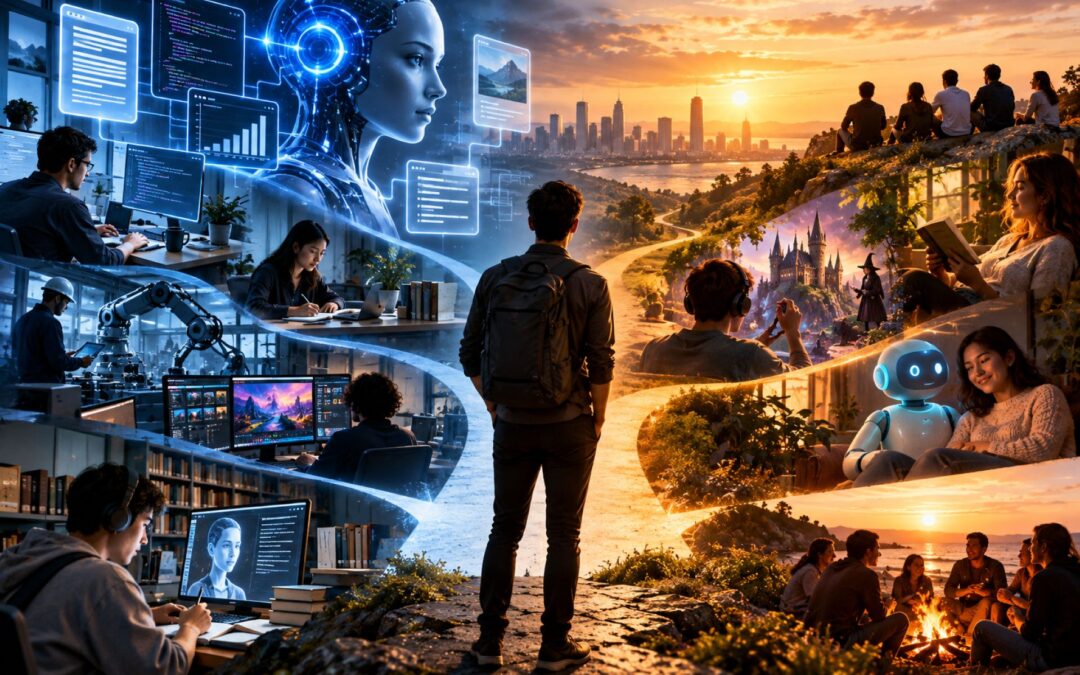
The most unsettling thing about artificial intelligence is not that it can write an essay, generate an image, or answer a difficult question. It is the realization that a growing number of activities we once considered uniquely valuable human contributions can now be performed, accelerated, or substantially assisted by software.
That realization can produce two contradictory reactions. One is excitement at the possibility of having an extraordinarily capable assistant available whenever we need it. The other is a much darker question: if machines can perform so many intellectual and creative tasks, what exactly will people be needed for?
The implications extend beyond employment. AI is changing how we search for information, learn new skills, experience stories, and interact with technologies designed to simulate companionship. It is also challenging assumptions about which abilities will remain valuable when producing information becomes easier and cheaper.
Understanding how AI is changing work requires looking beyond predictions of mass unemployment or unlimited prosperity. The more revealing question is how these technologies are redistributing tasks, capabilities, attention, and value—and what remains distinctly important when intelligent assistance becomes an ordinary part of life.
Why AI Suddenly Feels Different
When ChatGPT launched in November 2022, much of its appeal came from novelty. People asked it to write poems, imitate familiar styles, explain difficult concepts, and produce amusing responses to unusual questions. It offered a glimpse of what conversational AI might become, but its limitations made it easy to dismiss as an entertaining experiment.
The release of GPT-4 in March 2023 marked another stage in the technology’s development. More demanding writing, reasoning, and analytical tasks became increasingly practical, although errors and inconsistent results remained significant problems.
For many people, however, the decisive change was not a particular product announcement. It was a gradual shift in their own experience: tasks that once required substantial effort became easier with AI assistance, and eventually they began wondering why they were attempting certain activities without it.
Author Mark Manson described reaching this point after using AI more extensively in his professional life. Earlier tools had seemed useful for occasional brainstorming, but newer systems began feeling indispensable. Rather than treating AI as a distraction from his work, he increasingly regarded its absence as an unnecessary inconvenience.
This is an important distinction from earlier waves of consumer technology. Smartphones and social media became enormously influential, but using them often came with the feeling that attention was being diverted from something more important. Productive AI tools can create the opposite impression: the longer someone works with them, the more opportunities they may notice to use them again.
A person preparing a report might use AI to identify relevant questions, organize research, compare possible explanations, draft sections, and examine weaknesses in an argument. Someone learning a subject can ask follow-up questions until a confusing explanation makes sense. A small business owner can explore marketing ideas, analyze customer feedback, and develop operating procedures without starting every task from scratch.
These experiences do not establish that AI systems possess human-level general intelligence. Artificial general intelligence, or AGI, usually refers to a broader capacity to perform intellectual work across many domains, although its precise definition remains contested. Feeling astonished by an AI system’s capabilities is not evidence that such a threshold has been reached.
Nevertheless, the underlying technological change is measurable. Stanford University’s 2026 AI Index Report documents rapid advances in capabilities, investment, and adoption. Its economic analysis reports that 88% of surveyed organizations were using AI in at least one business function in 2025, while generative AI had also spread rapidly among consumers.
Those numbers do not mean that every organization has transformed its operations or that all AI deployments deliver meaningful benefits. There is a substantial difference between experimenting with a tool and successfully incorporating it into demanding, high-stakes work.
What makes the present moment unusual is the combination of improving capabilities, relatively accessible interfaces, and applications across numerous industries. Previous technologies generally required specialized knowledge or changed a limited collection of activities before expanding. Conversational AI allows people to describe a problem in ordinary language and receive something that resembles assistance with the underlying intellectual work.
As these systems improve, the central question becomes less about whether AI is impressive and more about which human activities will change because of it.
The Real Employment Question Is Which Tasks Change
Discussions about AI and employment frequently begin with the wrong unit of analysis. We ask whether artificial intelligence will replace writers, programmers, researchers, accountants, designers, or customer service representatives, as though each occupation consists of a single activity that can either be automated or preserved.
In reality, jobs are collections of tasks. A researcher might locate information, assess the reliability of sources, interpret findings, identify unanswered questions, and communicate conclusions. A software engineer might write code, investigate errors, clarify requirements, evaluate trade-offs, and coordinate with other people.
AI can affect these activities differently. It may accelerate routine tasks while leaving judgment, accountability, negotiation, and contextual understanding with the human worker. In some cases, it may eliminate enough work to reduce demand for certain roles; in others, it may allow people to undertake projects that would previously have been too expensive or time-consuming.
A joint study by the International Labour Organization and Poland’s National Research Institute, NASK, illustrates why this distinction matters. The ILO–NASK assessment of generative AI and occupational exposure, released in May 2025, estimated that about one-quarter of global employment was in occupations potentially exposed to generative AI.
Crucially, exposure does not mean that one-quarter of jobs will disappear. The researchers concluded that transformation of work was generally more likely than complete occupational replacement. They also found substantial variation between occupations and countries, reflecting differences in tasks and economic conditions.
Evidence from workplaces provides a more concrete picture. In the National Bureau of Economic Research study Generative AI at Work, researchers examined the introduction of an AI assistant among 5,179 customer support agents. Access to the tool increased productivity, measured by customer issues resolved per hour, by approximately 14% on average.
The benefits were not evenly distributed. Less experienced and lower-skilled workers saw particularly large improvements, while the effects for experienced, highly skilled employees were much smaller. The researchers suggested that AI assistance helped transmit practices associated with more capable workers to colleagues who had not yet developed the same experience.
This finding complicates the assumption that AI will simply reward the best performers and make everyone else redundant. In some settings, it can help less experienced workers close part of the gap. In others, employers may use efficiency gains to reduce staffing, raise expectations, or reorganize entire workflows.
The outcome depends on business decisions, market conditions, regulation, and the kinds of tasks being automated. Productivity gains do not automatically translate into higher wages, more employment, or greater leisure for workers.
Manson and his research assistant, Drew Birnie, encountered a vivid example of how these changes can feel at the individual level. Birnie had been hired years earlier partly for his ability to perform demanding research. During a later experiment with an AI research tool, they received a substantial research summary covering dozens of sources in a matter of minutes.
Manson compared the result with work that might previously have required days of dedicated effort. Their reaction combined admiration for the technology with an uncomfortable realization: an important component of a role that had once justified hiring a specialist could now be performed much more quickly with software assistance.
That does not establish that AI research is equivalent to expert research in every situation. A polished report can contain misread evidence, unreliable citations, missing context, or conclusions that require independent examination. Evaluating the quality of a research synthesis remains different from producing one that looks comprehensive.
Yet the economic question is unavoidable. If an organization can complete the same useful work with fewer hours, it must decide what to do with the capacity it has gained. It could expand its output, pursue previously unaffordable projects, improve quality, reduce costs, or employ fewer people.
AI also changes the economics of starting work. Someone who previously needed a team for preliminary research, administrative coordination, and basic content production may now be able to attempt a small project independently. Meanwhile, companies that already possess customers, data, capital, and distribution may be able to deploy the same technology at a much larger scale.
The financial stakes help explain the extraordinary investment in the sector, including the infrastructure commitments examined in OpenAI’s $1.4 Trillion AI Infrastructure Bet. Building and operating advanced AI systems requires substantial computing resources, and the companies financing that capacity are making consequential assumptions about future demand.
Employment therefore cannot be reduced to a contest between humans and machines. The practical questions concern which tasks become cheaper, which skills become more productive, how organizations respond to those changes, and who ultimately receives the benefits.
For an individual worker, the implication is equally significant. Understanding how to use AI may become an advantage, but knowing when not to trust it, how to recognize a poor result, and how to contribute beyond its output may matter just as much.
When Books and Stories Become Interactive
AI’s influence on creativity raises a different set of questions because it does not merely change how efficiently creative work can be produced. It may also change how people consume that work.
Consider nonfiction books. Traditionally, a reader interested in a particular subject must follow an author’s chosen sequence of explanations, examples, and arguments. The experience can be rewarding precisely because the author has spent time organizing a complex subject into a coherent intellectual journey.
But someone accustomed to conversational AI may begin finding that process unusually slow. If a reader wants to understand one particular concept, an AI assistant can attempt to explain it immediately, respond to objections, offer examples, and adjust its approach until the explanation becomes more useful.
Manson described noticing this impatience in himself. After using AI extensively, he found it harder to tolerate the pace of certain nonfiction books. He could read a couple of chapters and begin wishing that he could simply ask for the information he wanted rather than continue through an argument whose direction was controlled by somebody else.
For an author, this is an unsettling development. Books have historically offered an efficient means of transferring ideas from one person to many others. Conversational systems introduce an alternative in which information can be reorganized around an individual’s immediate interests.
Yet these experiences are not equivalent. An AI-generated explanation may be convenient without being accurate, insightful, or faithful to the original argument. A carefully written book offers a sustained perspective, deliberate evidence, and connections that readers may not know enough to request.
The more consequential shift is the arrival of another medium alongside conventional reading. Some people will continue to value a fixed, thoughtfully constructed argument, while others may prefer an interactive system that lets them control the pace and direction of learning.
Fiction presents an even more unusual possibility.
Services such as Character.AI have experimented with conversations involving fictional personalities and interactive storytelling. Manson described encountering a scenario in which the user becomes a new student at Hogwarts, the fictional school from the Harry Potter universe.
Rather than following a predetermined novel, the participant can respond to events, interact with characters, and influence the direction of the story. The AI then attempts to continue the fictional world in response to those choices.
Traditional choose-your-own-adventure books already offered branching narratives, but their possibilities were limited by the paths their creators had written. Generative systems can produce additional scenes and dialogue dynamically, creating the impression of a story that changes around the participant.
Two people entering a similar scenario might end up experiencing substantially different adventures. One might explore a particular relationship or mystery, while another pursues an entirely different sequence of decisions. The attraction lies not simply in reading a story but in participating in its unfolding.
This suggests that interactive AI fiction may become a distinct form of entertainment rather than merely a replacement for books or movies. Its strengths include personalization, improvisation, and responsiveness, while its weaknesses may include inconsistent characters, repetitive plots, weak long-term structure, and the absence of a deliberate artistic vision.
The same technology also blurs the boundary between storytelling and companionship. An AI character can entertain someone through fictional conversation, but it can also begin to feel like a social presence, particularly when interactions become frequent and emotionally personal.
The scale of this behavior is already significant. In its 2025 report Talk, Trust, and Trade-Offs: How and Why Teens Use AI Companions, Common Sense Media reported that nearly three in four surveyed American teenagers had used AI companions, and about half used them regularly.
Entertainment and curiosity were important motivations, but social and emotional uses were also evident. The research found that approximately one-third of teenagers had chosen an AI companion over a person for a serious conversation, while about one-quarter had shared personal information with such systems.
These findings should not be interpreted as proof that teenagers are abandoning real relationships. Using an AI companion for entertainment, practicing a conversation, and replacing meaningful social support are different behaviors, even when they take place through the same interface.
Nevertheless, the technology creates genuine concerns about privacy, emotional dependence, manipulation, and the influence of systems designed to sustain engagement. Those concerns become particularly important when users are young or emotionally vulnerable.
There is also a broader question about attention. If a digital experience can continually adjust itself to what someone wants, it may become difficult for less personalized activities to compete. This connects with the mechanisms explored in Why You Can’t Stop Scrolling and How to Reclaim Your Attention, although interactive AI adds conversation and adaptation to the familiar dynamics of digital engagement.
The central creative challenge is therefore not whether AI can produce words, images, or imaginary characters. It is how these capabilities change the relationship between creators, their work, and the people experiencing it.
A compelling novel and an engaging AI-generated adventure can both be valuable without offering the same experience. The development of one does not prove the extinction of the other, but it may change what audiences expect from entertainment.
The New Scarcity: Human Presence and Trust
Technological progress often makes previously expensive activities more accessible. Photography reduced the difficulty of capturing images, digital publishing lowered the cost of distributing written work, and the internet made enormous quantities of information available almost instantly.
Generative AI extends that pattern by reducing the effort required to produce many kinds of text, imagery, analysis, and software. As such outputs become easier to generate, their availability may cease to be the principal reason people value them.
Manson proposes thinking about this development as a movement of scarcity. When a technology makes something abundant, demand and economic value may shift toward qualities that remain difficult to reproduce.
Applied to AI, his argument is that information and digital content could become increasingly inexpensive, while authentic human connection may acquire greater importance. If almost anyone can obtain a personalized explanation, a plausible illustration, or an endless fictional conversation, being physically present with another person remains a different experience.
Consider a live concert. A recording can preserve the music, and AI may eventually allow listeners to generate extraordinarily personalized performances. But neither automatically reproduces the experience of occupying a room with other people, responding to performers in real time, and participating in a shared event.
The same distinction applies to a dance class, community gathering, sporting event, or conversation with a close friend. The value often lies partly in the physical and social experience rather than in the transfer of information.
This creates an intriguing possibility for businesses and communities. As digital services become more capable, activities that bring people together in meaningful ways may attract greater interest. Personal attention, shared experiences, local relationships, and trustworthy social environments could become increasingly valuable.
However, this remains a hypothesis about future preferences and markets, not an established economic law. Technology does not invariably transfer value to human interaction, and the availability of personalized digital alternatives might reduce demand for some in-person experiences rather than increase it.
Human connection also exists online. Friendships, communities, and professional relationships can be meaningful without requiring people to occupy the same physical space. The more defensible distinction is between experiences that can be convincingly automated and relationships grounded in genuine reciprocity, shared responsibility, and human agency.
Trust may become another important form of scarcity.
When producing plausible information is inexpensive, deciding which information deserves confidence becomes more difficult. An AI-generated report may look professional while relying on weak evidence. A convincing voice, image, or conversation may not provide reliable proof of the identity or intentions behind it.
Under these conditions, the ability to establish credibility through a record of sound judgment, transparent methods, accountability, and consistent behavior may become more valuable. A trusted professional contributes more than an answer; they also accept responsibility for the quality and consequences of their decisions.
The same principle complicates debates about creativity. It is tempting to dismiss AI-generated art as nothing more than rearranged human material, but human creative work also develops through influence, reference, imitation, and transformation. The relationship between learned patterns and genuine originality is more complicated than a simple division between humans who create and machines that copy.
What remains meaningful is not necessarily an exclusive human ability to generate something new. It may be the presence of intention, experience, taste, commitment, and responsibility behind a particular work. Audiences can care about who made something, why they made it, and what it communicates about a lived human perspective.
These qualities do not guarantee that human-created work will always command a premium. They do suggest that abundance in generated content could make origin, authenticity, and trust increasingly relevant to how people evaluate it.
If AI makes producing answers easier, people may place greater value on knowing which answers matter, whom to trust, and with whom they want to share their lives.
How to Become More Capable with AI
For someone concerned about the future of their career, the most useful response is neither to ignore AI nor to assume that mastery of a particular chatbot guarantees employment. It is to understand what the technology can do, investigate its limitations, and learn how to incorporate it into meaningful work.
That process requires experimentation. Reading about AI capabilities may provide useful background, but practical experience reveals the difference between an impressive demonstration and a tool that actually improves a task you perform.
Manson recommends setting aside a sustained period to experiment rather than treating AI as something to consult occasionally for amusing questions. The objective is to identify a real problem or activity that matters to you and investigate whether the technology can help.
A person trying to improve their fitness, for example, might initially ask an AI assistant to create a workout routine. With so little context, the resulting advice is likely to be generic because the system does not know the person’s experience, preferences, constraints, or goals.
The interaction becomes more useful when the user explains their training history, available equipment, weekly schedule, objectives, and relevant limitations. They can then ask why certain exercises were recommended, request alternatives, and identify assumptions that need correction.
Even a detailed AI-generated training plan requires appropriate scrutiny, particularly when injuries or medical concerns are involved. The broader lesson is that context and iterative feedback can improve the usefulness of an answer without making it automatically reliable.
Manson describes a similar experience while exploring social media strategy. His initial questions produced ordinary advice that could have appeared in almost any introductory discussion of marketing. Instead of accepting the result, he asked what information the AI needed to provide a more useful answer.
The system prompted him to clarify his audience, platforms, goals, and the outcomes he wanted to achieve. Those questions helped transform an underspecified request into a more focused discussion.
This is an important practical skill: understanding that a poor output may reflect missing context, an unclear objective, limitations in the system, or some combination of all three.
Effective use often begins by describing the problem more carefully. What outcome are you trying to achieve? Who is the intended audience? What constraints matter? Which examples illustrate success or failure? What information should the tool avoid assuming?
From there, the interaction can become iterative. Instead of asking for a completed answer once, you can request an initial approach, inspect its weaknesses, supply corrections, explore alternatives, and revise the result.
AI can also help clarify the question itself. Someone who does not know how to begin a project might ask which considerations a competent professional would examine before making a recommendation. The resulting questions can expose gaps in the user’s understanding and suggest what further information is needed.
These techniques are useful across activities such as learning, writing, programming, planning, and research, but their effectiveness varies. A detailed prompt cannot compensate for information the system does not possess, a capability it lacks, or a false assumption embedded in the request.
There is also a difference between using AI to increase your capabilities and allowing it to replace the development of those capabilities entirely.
If a student uses AI to explain difficult material, test understanding, and examine errors, the interaction may support learning. If the student simply copies answers without understanding them, the same technology may conceal gaps that become important later.
Professionals face a similar trade-off. Delegating preliminary work can free time for more consequential decisions, but excessive dependence may weaken the very expertise needed to evaluate the outputs. Someone who never develops judgment in a field may struggle to recognize when AI provides a convincing but incorrect answer.
The most durable approach combines technical familiarity with domain knowledge. People who understand their work can identify which tasks are suitable for assistance, what a good result looks like, and where independent verification is essential.
Practical adaptation also requires judgment about privacy and responsibility. Confidential business information, personal records, and other sensitive material should not be entered into systems without appropriate safeguards. Decisions involving health, law, finance, or safety require standards of evidence and accountability that a fluent AI response cannot satisfy by itself.
The objective is not to use AI constantly. It is to become better at identifying when it can produce a worthwhile improvement and when human attention, expertise, or interaction is more appropriate.
That distinction may prove more valuable than familiarity with any particular product. Interfaces, models, and capabilities will continue to change, but the ability to define problems clearly, assess evidence, make decisions, and learn unfamiliar tools remains broadly useful.
Neither Utopia Nor Doom Is a Forecast
The public debate about AI frequently swings between two extraordinary predictions. In one version, increasingly capable systems eliminate drudgery, solve difficult problems, and make material abundance widely available. In the other, they destroy employment, undermine social relationships, and eventually threaten humanity itself.
Both narratives tend to compress a complicated technological and social process into a single inevitable outcome.
Optimistic scenarios are not entirely baseless. AI can reduce the time required for certain tasks, expand access to useful capabilities, assist scientific and technical work, and allow individuals to attempt projects that once required considerably greater resources.
But the existence of a capability does not ensure that its benefits will be distributed fairly or used wisely. A company may improve productivity without increasing wages. An inexpensive creative tool may expand participation while making paid creative work more difficult to sustain. A companion system may reduce loneliness for some users while encouraging unhealthy dependence in others.
Pessimistic predictions face a different problem. The fact that AI can perform an expanding range of tasks does not reveal exactly how organizations, governments, consumers, and workers will respond. Technological substitution can eliminate particular roles, but it can also create new demands, change existing occupations, and alter the kinds of work people consider valuable.
Historical comparisons offer perspective without supplying a reliable forecast. Previous technological changes have produced substantial economic benefits alongside displacement, inequality, and difficult transitions. There is no guarantee that the current transformation will follow the same pattern, especially because generative AI can affect intellectual tasks across numerous sectors simultaneously.
Nor should rapid progress be mistaken for evidence that every technical limitation is about to disappear. AI systems can still make factual mistakes, misunderstand context, generate unreliable explanations, and fail in situations where correctness is essential. Capabilities demonstrated in controlled evaluations do not automatically translate into reliable performance across all real-world circumstances.
The consequences will also depend on decisions made outside AI laboratories. Employers determine how tools are introduced into workplaces. Educators decide which abilities students should develop. Policymakers influence competition, safety, privacy, and accountability. Individuals decide how extensively they want AI incorporated into their work and personal relationships.
Manson’s observation that people remain capable of dissatisfaction even when their circumstances improve offers a useful psychological qualification to technological optimism. Greater convenience does not automatically produce greater fulfillment, because people continue developing new expectations, ambitions, and sources of frustration.
If AI makes information easier to obtain, we may become less tolerant of slow explanations. If it makes creative production easier, we may become more demanding about originality and quality. If it provides responsive entertainment whenever we want it, we may find ourselves confronting new questions about attention, connection, and the kinds of experiences we genuinely value.
Technology changes what is possible, but it does not settle what people ought to want.
The most constructive response to artificial intelligence is therefore neither unconditional enthusiasm nor resignation. Individuals need opportunities to develop useful skills and understand the systems influencing their lives. Organizations need to consider how productivity gains affect workers and customers. Society needs ways to evaluate risks and assign responsibility when increasingly capable systems produce harmful outcomes.
AI is already changing how people work, create, learn, and interact, but the direction of that change remains open. It can make certain human abilities more productive while reducing demand for others, offer new forms of expression while challenging established creative industries, and expand access to interaction without reproducing every quality of human relationships.
The question is not simply whether machines will become capable of doing more of what humans do. It is how people will reorganize their work, relationships, expectations, and institutions around those capabilities.
Our future usefulness will not be determined solely by which tasks machines can perform. It will also depend on the problems we choose to solve, the standards we apply to the results, the relationships we build, and the responsibility we are willing to retain for decisions that matter.
Artificial intelligence may change the value of many familiar skills. It does not, by itself, decide what makes a life meaningful or a society worth living in.
Last Updated on October 22, 2026 by Aseem Gupta