
Canada Lost More Than A Hockey Game
The moment was almost too perfect in its cruelty.
February 22, 2026. Italy. Olympic gold medal game. Canada versus the United States. Hockey’s oldest continental rivalry on the biggest winter-sport stage in the world.
After three periods, the game was tied 1–1. Then, 1 minute and 41 seconds into overtime, Jack Hughes scored. The United States won gold. Canada took silver.
Three days earlier, Canada’s women’s team had suffered the same fate: a 2–1 overtime loss to the Americans.
For a country that still treats hockey as part sport, part mythology, part birthright, it hurt. But the hockey losses were only the most visible wound.
Canada finished the 2026 Winter Olympics with 21 medals and only five golds, its weakest gold-medal showing since 2002, according to Sportsnet. Norway, a country of around 5.6 million people, finished with 41 medals and 18 golds, topping the medal table once again, as reported by The Guardian.
That contrast is uncomfortable.
Canada is supposed to be a winter-sport country. It is supposed to be the country of frozen ponds, community rinks, hockey bags in the back of minivans, early-morning practices, and children learning to skate before they can spell properly.
But the results suggested something else.
Canada did not simply lose a hockey game. It received a warning about the system underneath the game.
The problem is not that Canadians suddenly stopped loving hockey. The problem is that hockey is becoming harder for ordinary Canadian families to afford, harder for newcomer families to enter, and harder for the country to honestly call its national game.
A sport can remain emotionally important long after it stops being broadly accessible.
That is the danger Canada now faces.
The Sport Canada Still Loves Is Becoming Harder To Play
Hockey’s place in Canadian culture is difficult to exaggerate.
The modern organized game traces much of its history to Montreal in the 19th century. For generations, hockey was more than entertainment. It was one of the few national rituals that could connect a child in Toronto, a family in rural Saskatchewan, a French-speaking fan in Quebec, and a community rink in northern Alberta.
The emotional infrastructure was everywhere.
There was Hockey Night in Canada, which has been on the air in some form since 1931. There were winter mornings built around practice schedules. There were backyard rinks, frozen lakes, local tournaments, and the dream that if a kid worked hard enough, the game was open to them.
The 2010 Vancouver Olympics captured that mythology at full force. When Sidney Crosby scored the golden goal against the United States, the game became one of the most watched broadcasts in Canadian history. Hockey was not just something Canada played. It was something Canada used to recognize itself.
But cultural memory can lag behind reality.
Youth hockey participation has been falling from earlier highs. The Associated Press reported that Hockey Canada’s youth participation declined from 523,785 players 13 years earlier to 411,818 in 2022, before partially rebounding to 436,895 in 2023. That is not a disappearance. But it is a serious decline, especially in a country whose population has grown over the same period.
The sport is still loved.
It is just no longer as easy to enter.
That distinction matters. If children are leaving hockey because they hate it, that is a cultural change. If they are leaving because their families cannot afford it, that is something else entirely.
It is exclusion dressed up as evolution.
The Real Barrier Is Not Interest. It Is Cost.
Hockey has always required more than a ball and open space.
You need skates. A helmet. Gloves. Pads. Sticks. Ice time. Registration. Travel. Tournaments. Coaching. Sometimes summer camps. Sometimes private lessons. Sometimes specialized off-ice training.
Every layer adds cost.
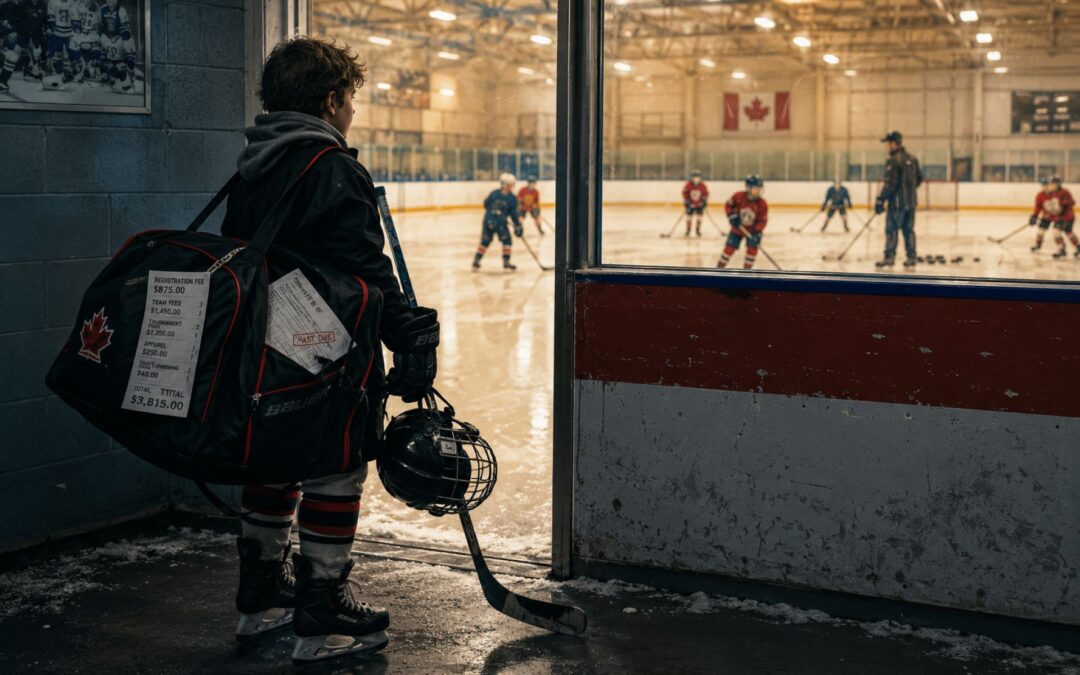
According to an RBC estimate, Canadian parents can spend around $4,478 a year on youth hockey. By age 16, the total can reach more than $53,000.
And that is not the extreme version.
For families chasing elite development, the costs can climb much higher. Travel tournaments, private coaching, spring teams, summer camps, higher-end equipment, and academy-style programs can push the annual bill into territory that looks less like a childhood activity and more like a private-school investment.
Compare that with soccer or basketball.
A child can play soccer with cleats, shin guards, a ball, and field access. Basketball needs even less. A hoop, a pair of shoes, and a court can be enough to begin. Those sports can become expensive at elite levels too, but the entry point is dramatically lower.
Hockey’s entry point is the problem.
A child cannot simply decide to play hockey in the same way they can decide to shoot hoops after school. The game requires infrastructure. It requires equipment. It requires a parent who can pay, drive, schedule, and absorb the endless extras.
That changes who gets to participate.
It does not just filter for talent.
It filters for household income.
Pay-To-Play Filters Talent By Family Income
The cruel thing about expensive youth sports is that the exclusion often happens before anyone knows who is talented.
A child who never gets on the ice cannot become a late bloomer. A family that cannot afford travel teams cannot discover whether their kid thrives against stronger competition. A teenager who skips elite development because the cost is impossible may not be less gifted than the kid who goes.
They may simply be less funded.
This is where pay-to-play systems become dangerous. They do not announce themselves as exclusionary. They present themselves as professional, competitive, and high-performance. Better coaching. Better facilities. Better schedules. Better tournaments. Better exposure.
But the hidden question underneath is always the same:
Can your family afford the pathway?
If the answer is no, the door begins to close.
That is bad for fairness, but it is also bad for the sport. A national talent pool should be wide at the bottom. It should allow as many children as possible to try, fail, improve, and mature at different speeds. The wider the base, the better the chance of finding unusual talent.
Pay-to-play reverses that logic.
It narrows the base early, then mistakes the survivors for the best athletes.
Some of them will be. Many wealthy kids are talented, disciplined, and hard-working. The problem is not that rich children play hockey. The problem is that too many other children are priced out before the sport can find out what they might have become.
That weakens the game from below.
And over time, it changes the meaning of hockey itself.
A sport that once imagined itself as a community ladder starts to resemble a gated track.
The Community Rink Became A Scarce Resource
Hockey’s cost problem is not only about equipment.
It is also about ice.
Unlike soccer, basketball, cricket, or running, hockey depends on specialized public infrastructure. You need rinks. Rinks are expensive to build, expensive to maintain, and expensive to operate. Ice must be refrigerated. Facilities must be staffed. Aging buildings need repairs. Municipal budgets are limited.
Historically, the community rink was one of Canadian hockey’s great equalizers. It was not perfect, but it helped make the sport feel local. Children could play near home. Families could gather. The rink functioned almost like a civic institution.
But when public infrastructure becomes strained, access becomes scarce. When access becomes scarce, ice time becomes more valuable. When ice time becomes more valuable, the groups that can pay more get more of it.
This is one of the quiet ways a community sport becomes a market sport.
A local recreational team and a high-fee development program may both want the same evening ice slot. One is built around broad participation. The other can charge parents thousands of dollars and pay more for guaranteed access.
The rink does not need to become hostile to community hockey for community hockey to lose.
It only needs to become expensive enough that the economics start favoring the highest bidder.
That is a profound shift. The rink is no longer just where the community gathers. It becomes a scarce asset inside a competitive development economy.
For families, the result is simple: less accessible ice, higher fees, longer drives, more pressure to join expensive programs, and a growing feeling that casual participation is no longer enough.
The old hockey ladder depended on public access.
The new one increasingly depends on private purchasing power.
The Academy System Changed The Meaning Of Development
The academy model did not emerge from nowhere.
It grew because ambitious families wanted more ice time, better coaching, stronger competition, and a clearer route into junior hockey, college hockey, or professional scouting. In a high-pressure sports culture, that demand is easy to understand.
Every parent wants to give their child a chance.
But when enough families buy extra chances, the baseline changes for everyone.
What used to be optional becomes expected. What used to be elite becomes normal. What used to be a community sport becomes a year-round development project.
That shift has consequences.
First, it pushes children toward early specialization. Instead of playing multiple sports, developing broad athletic skills, and growing into the game at different speeds, young players are encouraged to commit earlier and train harder. But youth-sport research has often questioned whether early specialization is the best pathway for long-term athletic development, especially in complex sports that reward adaptability, coordination, and late physical growth.
Second, it raises the cost of seriousness. A child may still be able to play recreational hockey, but the moment they want to be considered “serious,” the spending begins. Extra teams. Extra ice. Extra travel. Extra coaching. Extra exposure.
Third, it changes the culture of childhood sport. The game becomes less about local belonging and more about advancement. More résumé than ritual. More pipeline than playground.
That does not mean every academy is harmful or every elite program is exploitative. Many provide excellent coaching and structure. Some young athletes thrive in them.
But at the system level, the question is not whether academies help the families who can afford them.
The question is what happens to everyone else.
If the route to high-level hockey increasingly runs through expensive private development, then Canada’s national sport is no longer selecting from Canada’s full talent pool.
It is selecting from the families who can pay to remain visible.
Canada Changed, But Hockey Did Not Become Easier To Enter
Canada is not the same country it was when hockey became its central national myth.
That is not a problem. It is reality.
Canada has become more urban, more diverse, and more shaped by immigration. According to Statistics Canada, Canadian-born people are more likely than immigrants to participate in winter sports such as ice hockey, skating, skiing, and snowboarding. Immigrants are more likely to participate in sports such as soccer, basketball, and tennis.
That makes sense.
Many newcomer families arrive from countries without a hockey tradition. They may not have parents who played the sport, relatives who understand the system, or communities built around rink life. The rules, costs, schedules, equipment, and development pathways can all feel unfamiliar.
But unfamiliarity is only part of the story.
The bigger issue is that hockey has not made itself easy to enter.
If a sport is affordable, visible, and welcoming, children can adopt it even when their parents did not grow up with it. That is how cultural integration often works. The second generation discovers the games of the country around them. Friends invite friends. Schools and community leagues create bridges. A sport becomes shared.
But if the sport costs thousands of dollars a year, requires specialized equipment, depends on scarce ice time, and quickly pushes families toward elite development costs, then the bridge becomes narrow.
This is where the identity question becomes serious.
Canada’s population is changing. The children who will define Canada’s future increasingly come from families with roots in India, China, the Philippines, Africa, the Middle East, the Caribbean, and many other places. If hockey wants to remain Canada’s game, it has to become playable for those Canadians too.
Not just watchable.
Playable.
That is the difference between a national sport and a nostalgic brand.
A national sport invites people in. A nostalgic brand asks people to admire something from outside.
Basketball And Soccer Show What Accessible Sports Can Do
The rise of basketball and soccer in Canada is not mysterious.
They are easier to start.
They are cheaper to enter.
They fit urban spaces better.
They travel across immigrant communities more easily.
They are visible through global stars, local courts, school programs, and international tournaments. A child does not need a family hockey history to understand basketball. They can watch the NBA, follow Canadian players, shoot with friends, and begin.
Basketball’s rise in Canada has been especially striking. The Toronto Raptors’ 2019 NBA championship helped turn a growing sport into a national moment. Canadian players such as Shai Gilgeous-Alexander, Jamal Murray, RJ Barrett, and others have made it easier for young fans to see a pathway from Canadian courts to the highest levels of the game.
Soccer has a different but equally powerful advantage. It is already the world’s most familiar sport. For many immigrant families, soccer is not a new cultural language. It is a continuation of one they already speak.
That does not mean hockey is doomed.
It means hockey is competing in a different cultural marketplace than before.
For much of Canada’s history, hockey benefited from being the obvious winter sport, the community sport, the TV sport, the family sport, and the national sport all at once. Today, children have more options, families have different cultural starting points, and household budgets are under more pressure.
In that world, accessibility matters more, not less.
If hockey is expensive and complicated while basketball and soccer are cheap and familiar, the outcome should not surprise anyone.
Children go where the door is open.
Norway Built The System Canada Forgot
Norway is useful here because it removes one of Canada’s favorite excuses.
Winter sports do not have to become narrow, expensive, elite pipelines. A cold-weather country can make a different choice.
Norway has built one of the most successful winter-sport systems in the world by treating broad participation as the foundation of elite performance. Its model emphasizes children’s enjoyment, delayed competitive pressure, multi-sport participation, and access before specialization. As Reuters reported during the 2026 Winter Olympics, Norway’s philosophy is not to squeeze children into elite pathways as early as possible, but to protect the joy and breadth of youth sport.
That sounds soft until you look at the medal table.
Norway keeps winning.
Part of the reason is cultural. Outdoor life is deeply embedded in Norwegian society. Children grow up skiing, hiking, moving, and playing outside. Physical activity is not treated only as organized competition. It is part of everyday life.
But culture is not the whole explanation. Norway also funds sport differently. The Norwegian government states that 64% of the profits from Norsk Tipping, the state-owned gaming company, are distributed to sporting activities. That money helps support facilities, clubs, grassroots programs, and the broad base underneath elite sport.
The lesson is not that Canada can copy Norway perfectly.
Canada is bigger, more diverse, more geographically complex, and institutionally different. Hockey is also more expensive than many Norwegian winter activities at the entry level.
But Norway proves an important point: elite success does not have to come from narrowing access. It can come from widening it.
That is the counterintuitive truth Canada seems to have forgotten.
If you want great athletes at the top, you need many children at the bottom. Not just the children of families who can afford the best pathway. Not just the early developers. Not just the ones whose parents know how the system works.
Many children.
Different children.
Late bloomers. Newcomers. Rural kids. Urban kids. Middle-class kids. Working-class kids. Children who do not know yet whether they are good.
That is how a national sport renews itself.
Canada Does Not Have A Talent Problem. It Has An Access Problem.
It is tempting to treat Canada’s hockey anxiety as a performance issue.
Did the national teams underperform? Is player development falling behind? Are other countries catching up? Is the United States now producing better players? Why did Norway dominate the Winter Olympics while Canada slipped?
Those are valid questions.
But they are not the deepest ones.
The deeper question is whether Canada is still building the broad base that winter-sport success requires.
No country can rely forever on mythology. The frozen-pond story is powerful, but it cannot replace affordable registration. Hockey Night in Canada can preserve memory, but it cannot lower equipment costs. Olympic nostalgia can inspire children, but it cannot buy ice time.
Systems produce outcomes.
If a country lets its national sport become expensive, specialized, privatized, and difficult to enter, the results will eventually show up. Maybe not immediately. Maybe not in one tournament. Maybe not in one generation of NHL stars.
But eventually, the pool narrows.
The sport becomes less representative of the country. The children who make it are still talented, but they come from a smaller slice of society. The children who might have made it disappear before anyone learns their names.
That is what makes the hockey problem larger than hockey.
It is a story about what happens when a shared cultural institution becomes a private family expense.
It is a story about a country changing faster than its old systems can adapt.
It is a story about national identity becoming more expensive than national identity should be.
Canada does not lack children who could love hockey.
It lacks a hockey system that makes enough room for them.
The Game Can Still Be Canada’s — But Only If Canada Lets More Kids Play
Hockey is not dead in Canada.
That would be too easy and too false. The sport still matters. Millions still watch it, argue about it, celebrate it, and pass it down. Canadian players still shape the NHL. Canadian fans still feel Olympic losses like personal insults.
The emotional bond is real.
But love alone does not keep a sport national.
A national game has to be reachable. It has to belong to more than the families who can afford elite development, private coaching, fresh equipment, and endless travel. It has to make space for the child whose parents did not grow up around rinks. For the family that can manage one registration fee but not five hidden costs. For the late bloomer. For the newcomer. For the kid who simply wants to play.
That is the choice facing Canada.
It can keep treating hockey as a symbol while allowing the actual game to become less accessible. Or it can rebuild the conditions that made hockey feel national in the first place: community access, public investment, affordable entry points, local rinks, broad participation, and a development culture that does not confuse family income with potential.
The overtime losses hurt.
The medal table hurt.
But those were symptoms.
The real danger is quieter: a country waking up one day to discover that the game it calls its own is no longer available to enough of its people.
If hockey is still supposed to be Canada’s game, Canada has to prove it.
Not by winning one more gold medal.
By letting more children play.
Last Updated on June 10, 2026 by Aseem Gupta