

Social skill is easy to describe in abstractions. Be confident. Listen carefully. Show interest. Make people comfortable. Speak clearly. The difficulty begins when someone who genuinely wants to improve asks the obvious next question: what, exactly, should I do differently when I walk into a room, meet a stranger, make conversation, ask for something, handle an awkward moment, or try to repair a mistake?
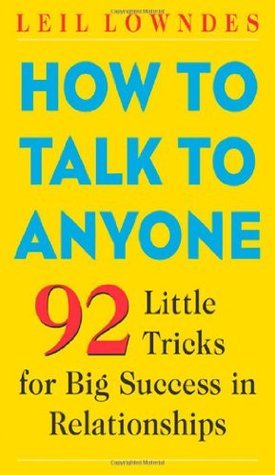
That practical gap is the territory Leil Lowndes tries to occupy in How to Talk to Anyone: 92 Little Tricks for Big Success in Relationships. Instead of presenting charisma as a personality trait that some people possess and others do not, she breaks social interaction into dozens of small, observable behaviors. A smile can arrive too quickly or feel personally directed. An introduction can end a conversation or give it somewhere to go. A compliment can sound like flattery or like genuine recognition. A difficult conversation can become a struggle over facts or an opportunity to show that another person’s emotional experience has actually registered.
That specificity is the book’s greatest strength, but it also creates its central problem. Lowndes often moves from a useful behavioral suggestion to a much stronger claim about what another person will think, feel, infer, or do in response. Some of those claims have reasonable psychological analogues; others rest mostly on anecdotes, dated assumptions about status and gender, questionable body-language interpretations, or theories that have not held up well.
The fairest way to read the book, then, is neither as a collection of ninety-two scientifically proven buttons that control human beings nor as empty manipulation disguised as communication advice. Its practical toolkit is often better than the theory Lowndes uses to justify it. The durable value lies in learning to notice more, make interaction easier, adapt intelligently, respect timing, communicate recognition, and protect other people’s dignity without assuming that every gesture reveals a hidden truth.
What How to Talk to Anyone Is Trying to Do
Lowndes begins from a familiar observation: people who succeed socially or professionally are not necessarily smarter, more educated, more attractive, or more talented than everyone around them. What distinguishes many of them, she argues, is their ability to deal skillfully with other human beings. Careers, friendships, romance, sales, networking, and leadership all depend partly on how other people experience interacting with you, so communication becomes a practical form of leverage.
Her stated ambition is to go beyond the kind of broad interpersonal advice associated with Dale Carnegie. Lowndes does not reject Carnegie’s emphasis on smiling, showing interest, and making others feel important; she argues that these principles are too general for readers who need to know how to perform them convincingly. The promise of the book is therefore operational: instead of merely saying “show interest,” she offers an eye-contact technique; instead of saying “make conversation,” she provides ways to find topics; instead of saying “compliment sincerely,” she distinguishes several kinds of praise and the situations in which each might feel most credible.
That purpose also explains the book’s unusual architecture. The McGraw-Hill second-edition listing identifies the edition commonly encountered today, while Lowndes’s own description of the book continues to present it as a broad communication manual spanning social life, business, networking, and relationships. The book does not build one formal theory and then derive techniques from it. Instead, it presents ninety-two short chapters, each usually centered on an anecdote, an observation, a psychological claim, and a memorable label for the resulting behavior.
The recurring language of “big winners,” “big cats,” VIPs, powerful professionals, celebrities, and socially successful people matters because it shapes what Lowndes considers evidence. She frequently treats accomplished, admired, wealthy, or influential people as models from whom communication habits can be reverse-engineered. Sometimes that produces useful observations about composure, timing, preparation, or respect for others. At other moments, it risks confusing elite social conventions with universal rules of good human interaction.
The nine parts nevertheless have a meaningful progression. Lowndes begins with what happens before a word is spoken, moves into small talk and conversation, then addresses verbal poise, insider knowledge, similarity, praise, telephone communication, networking, and finally the much harder territory of favors, embarrassment, anger, mistakes, and interpersonal judgment. The book therefore becomes more interesting as it proceeds. What starts as a guide to making a favorable impression gradually becomes a book about how another person feels in your presence, especially when something goes wrong.
The Complete 92-Technique System
Although the subtitle advertises “92 little tricks,” the book works best when those techniques are understood as clusters rather than as ninety-two unrelated tricks to memorize. Each part addresses a different stage or context of interaction, and later chapters frequently build on habits introduced earlier. The complete system moves from visible warmth and conversational ease toward adaptability, recognition, timing, emotional intelligence, and social repair.
Part One: First Impressions Before You Speak
Lowndes opens with the claim that people begin forming impressions before conversation starts. Technique 1, The Flooding Smile, asks readers not to flash the same immediate grin at everyone. Instead, look at the person briefly, allow recognition to register, and then let the smile develop across the face. The idea comes from Lowndes’s friend Missy—who adopts the more formal “Melissa” as she assumes leadership of a family business—and the observation that her slower smile makes her appear more deliberate, sincere, and professionally credible.
Technique 2, Sticky Eyes, extends the same personalization into eye contact. Lowndes recommends maintaining gaze a little longer than ordinary habit might dictate and allowing it to break gradually, as though the eyes were reluctantly pulling away. She describes a hearing-impaired woman who stared intently at her during a seminar because she was lip-reading; Lowndes initially mistakes the gaze for extraordinary fascination and discovers how powerfully sustained attention can affect the person receiving it. She also acknowledges that eye contact is culturally variable and that excessive staring can feel intrusive or threatening.
Technique 3, Epoxy Eyes, intensifies the idea. In a group, rather than always looking at whoever is speaking, Lowndes suggests sometimes watching the person whose reaction matters to you. The technique can communicate unusual interest and is presented as useful in professional evaluation, persuasion, and romance, although Lowndes herself warns that it can become uncomfortable or obnoxious when interest is not reciprocated. Her more overtly romantic use of communication techniques is developed much further in How to Make Anyone Fall in Love with You.
Technique 4, Hang by Your Teeth, shifts from the face to posture. Lowndes asks readers to imagine a circus apparatus above each doorway pulling the head upward and aligning the body as they pass through. The image is intentionally exaggerated, but its purpose is practical: posture is difficult to monitor continuously, so a vivid trigger attached to a common event such as walking through a doorway can help turn an instruction like “stand up straight” into a habit.
Techniques 5 and 6 focus on giving another person unmistakable signs of welcome. The Big-Baby Pivot means turning the whole body toward a new acquaintance and responding with the kind of full attention adults instinctively give a small child who seeks acknowledgment. Hello Old Friend asks the reader to imagine that the stranger is actually a beloved friend unexpectedly rediscovered after many years. Lowndes’s logic is that an internal emotional frame can coordinate the eyebrows, eyes, smile, stance, hands, and orientation more naturally than trying to control each gesture separately.
Technique 7, Limit the Fidget, is more problematic. Lowndes recounts a headhunter noticing changes in an applicant’s gaze, leg position, and self-touching while the applicant discusses a previous job, and she links fidgeting with the kinds of cues people often interpret as evidence of unease or deception. Her practical recommendation is to reduce unnecessary movement when credibility matters because listeners may misread nervousness, discomfort, heat, or habit as dishonesty. The useful part of the advice is awareness of how visible nervous behavior can affect impressions; the weak part is the implication that particular movements reliably reveal whether someone is lying.
Technique 8, Hans’s Horse Sense, comes from the famous story of Clever Hans, a horse believed to perform arithmetic until investigators realized that he was responding to tiny changes in the posture and tension of people who already knew the answer. Lowndes converts the story into a dual-attention principle: while speaking, keep enough awareness available to notice whether the listener appears engaged, confused, resistant, eager, or ready to leave. The chapter’s strongest lesson is responsiveness, not mind reading. Observing reactions can help a communicator adjust, but the meaning of any single frown, shift, glance, or folded arm remains ambiguous.
Technique 9, Watch the Scene Before You Make the Scene, closes Part One with visualization. Drawing on athletic mental rehearsal and a story about an injured marathon runner who imagines the course while confined to bed, Lowndes advises readers to rehearse important interactions mentally before entering them. Rather than improvising posture, smiles, greetings, and eye contact under stress, the reader imagines performing them calmly in advance. Part One therefore ends by transforming first-impression behavior from a set of isolated tricks into something that can be rehearsed until it becomes easier to execute without constant conscious control.
Part Two: Getting from Hello to a Real Conversation
Part Two begins where many socially anxious readers encounter the real difficulty: not walking into the room, but what happens after the introduction. Technique 10, Make a Mood Match, advises taking a quick emotional “sample” of the other person before launching into conversation. Lowndes’s Mensa-elevator story illustrates the problem: intelligent people respond to her casual remark about a slow elevator with intense technical explanations, and the mismatch between their enthusiasm and her tired state makes them feel overwhelming rather than impressive. Her principle is that conversational connection often begins by matching pace and energy before trying to change them.
Technique 11, Prosaic with Passion, rejects the fantasy that every opening line must be clever. Ordinary remarks can work if the speaker sounds interested, warm, and emotionally compatible with the situation. Lowndes uses the linguist S. I. Hayakawa’s account of being viewed suspiciously at a Wisconsin railway station during World War II; familiar, unthreatening conversation about the train, weather, travel, and family gradually turns strangers’ suspicion into sympathy. The larger point is that the emotional function of small talk is often more important than its informational originality.
Technique 12, Always Wear a Whatzit, makes approachability literal. Carry or wear something unusual enough to invite a question—a distinctive pin, piece of jewelry, accessory, object, or other curiosity. Lowndes’s antique lorgnette serves as her own example. A Whatzit does not create a meaningful conversation by itself, but it solves the awkward first problem for someone who wants to approach: it gives them something safe to ask.
Technique 13, Whoozat, uses a third person instead of an object. If there is someone at a gathering you want to meet, Lowndes recommends asking the host for an introduction or, if that is inconvenient, asking for enough information to create a natural opening. Technique 14, Eavesdrop In, is the more aggressive alternative: stand near a group, listen for something relevant, and enter with a remark connected to what they are discussing. Both techniques reflect Lowndes’s assumption that waiting passively is often less effective than creating a socially plausible route into the interaction.
Techniques 15 and 16 introduce one of the book’s strongest recurring principles: do not give answers that force the other person to do all the conversational work. Never the Naked City means that when someone asks where you are from, you should offer a fact, observation, story, or association that gives them something to respond to. Lowndes uses Columbus, Ohio, to demonstrate how the same hometown can generate different conversational openings depending on whether the listener cares about business, history, ancestry, travel, art, or local culture.
Never the Naked Job, Technique 16, applies the same rule to occupation. “I’m an attorney,” “I’m an engineer,” or “I’m an accountant” may be accurate but conversationally sterile to someone outside that profession. Lowndes recommends adding a concrete problem, current case, client type, practical responsibility, or story that allows the listener to understand what the work looks like. The technique is less about self-promotion than about translating a job title into material another person can use.
Technique 17, Never the Naked Introduction, turns that responsibility outward. When introducing two people, do not simply exchange their names and leave them to invent a topic. Add a useful piece of information about each person—a hobby, project, interest, trip, accomplishment, or shared subject—so the conversation has immediate traction. The advice captures a broader distinction between someone who merely participates in a social environment and someone who actively makes the environment easier for others.
Technique 18, Be a Word Detective, deepens listening. Lowndes tells the story of Mrs. Otis, an elderly woman who seems unresponsive until she casually mentions that rain is good for plants. When a caregiver follows that clue, she discovers that Mrs. Otis had been married to a gardener and has a rich reservoir of memories attached to the subject. The technique is to notice unusual words, digressions, references, and details because people often reveal their preferred topics indirectly before they explicitly say what they want to discuss.
Technique 19, The Swiveling Spotlight, asks the reader to imagine that attention is a spotlight moving between the two speakers. Lowndes describes a friend who leaves a party convinced that a man named Dan is fascinating despite knowing almost nothing about his remarkable life, because Dan kept asking about her. The chapter does not mean that one should become an interrogator or refuse to disclose anything; its point is that people often experience a conversation as enjoyable when they are given room to discuss experiences and interests that matter to them.
Technique 20, Parroting, offers a rescue when the conversational mind goes blank. Repeat the final few meaningful words the other person used, with a questioning tone, and allow them to continue. Lowndes demonstrates the technique during a tired car ride when she repeatedly echoes her friend’s references to a theatrical performance, and again through a car salesman who discovers a customer’s desire for something sportier by reflecting the customer’s words instead of prematurely offering another vehicle. The technique resembles very simple reflective listening: rather than manufacturing a fresh topic, signal that the previous one has room to develop.
Technique 21, Encore!, works in groups. If someone has told a story well before, invite them to tell it again when the subject arises with new people. Lowndes develops the technique from her experience as a cruise director, where reluctant officers become much more conversational when asked to recount a dramatic rescue at sea. An Encore also communicates that the earlier story was memorable enough to deserve another audience, although Lowndes cautions that the requested story should be one in which the teller appears competent, interesting, funny, or admirable rather than embarrassed.
Technique 22, Ac-cen-tu-ate the Pos-i-tive, concerns disclosure. Lowndes argues that people sometimes mistake immediate vulnerability for intimacy and reveal weaknesses before the relationship contains enough positive information to interpret them generously. A flaw can humanize someone already respected, she suggests, but can dominate the impression of someone barely known. The chapter therefore advises delaying negative self-revelation rather than pretending flaws do not exist.
Technique 23, The Latest News…Don’t Leave Home Without It, ends Part Two with preparation. Lowndes recommends learning enough about current events to have topical material available before entering a social setting. The specific media environment has changed dramatically since the book was written, but the principle remains recognizable: conversational ease can be prepared for, and people who seem naturally ready with a topic may simply have done some homework.
Part Three: Speaking with Tact, Confidence, and Social Poise
Part Three is framed as learning to “talk like a VIP,” but much of its practical advice concerns tact, audience awareness, boundaries, and avoiding conversational habits that make other people uncomfortable. Technique 24, What Do You Do—NOT!, challenges the reflex to ask every new acquaintance about occupation. Lowndes argues that the question can sound like status screening and becomes awkward for people who are unemployed, retired, financially independent, between careers, or simply uninterested in defining themselves through work.
Technique 25, The Nutshell Résumé, concerns the opposite situation: what to say when someone asks about your work. Lowndes recommends preparing several truthful versions of the answer for different listeners rather than reciting one fixed professional description. Her example of Roberto shows how the same background can be framed differently depending on whether the listener cares about management, sales, technical competence, or another aspect of his experience. The key is relevance, not fabrication.
Technique 26, Your Personal Thesaurus, advises upgrading a small number of overused words with more precise alternatives. Lowndes sometimes overstates the degree to which vocabulary signals intelligence, but the practical principle is sound: repeated generic words such as “great,” “nice,” or “good” convey less information than language chosen for the actual situation. Her emphasis is not on sounding grandiose but on expanding the expressive range available in ordinary conversation.
Technique 27, Kill the Quick “Me, Too!”, addresses the excitement of discovering common ground. Instead of interrupting immediately when someone mentions a shared school, hobby, hometown, experience, or preference, let them finish and reveal the similarity afterward. Lowndes believes delayed disclosure feels more relaxed and less like an anxious attempt to manufacture closeness. It also protects the speaker from having their story prematurely redirected into yours.
Technique 28, Comm-YOU-nication, asks readers to phrase requests and proposals from the listener’s perspective. Rather than concentrating on what “I” want to do, emphasize what “you” will experience, receive, avoid, or gain. The technique appears repeatedly in sales and social examples, but its deeper logic is linguistic perspective-taking. Communication becomes more persuasive and more considerate when the speaker asks what the message looks like from the receiving side.
Technique 29, The Exclusive Smile, revisits the personalized recognition of Part One. Lowndes argues that giving everyone an identical smile can make friendliness feel automatic, while subtly varying warmth and timing can make each person feel noticed as an individual. The advice overlaps with The Flooding Smile and therefore demonstrates one of the book’s recurring weaknesses: some of the ninety-two techniques are refinements of one another rather than independent discoveries.
Technique 30, Don’t Touch a Cliché with a Ten-Foot Pole, urges avoidance of worn phrases that make speech feel automatic. Technique 31, Use Jawsmith’s Jive, recommends studying accomplished speakers for pacing, gesture, pause, vocal emphasis, and phrasing that can be adapted to ordinary conversation. Together they reveal Lowndes’s strong performance orientation: speaking well is not merely having thoughts but learning how delivery affects whether those thoughts register.
Technique 32, Call a Spade a Spade, associates confident speech with concrete, direct language rather than unnecessary euphemism. Lowndes sometimes romanticizes “big shots” as unusually plainspoken, but the useful lesson is that elaborate verbal cushioning can make communication evasive. Directness, however, is context-dependent; saying something clearly is not the same as saying it without tact.
Technique 33, Trash the Teasing, warns against making humor from another person’s weakness or embarrassment. What the teaser experiences as harmless affection may be experienced by the target as exposure, especially in front of other people. This chapter marks an important shift in the book because Lowndes begins treating communication not merely as a way to impress others but as a responsibility to protect their social dignity.
Technique 34, It’s the Receiver’s Ball, extends that sensitivity to bad news. When delivering information, Lowndes recommends matching the emotional meaning it has for the receiver rather than reacting from your own position. If someone has lost an opportunity, suffered a disappointment, or received unwelcome news, cheerful efficiency can feel cruel even when the messenger is not responsible for what happened. Emotional congruence becomes part of competent delivery.
Technique 35, The Broken Record, is a boundary-setting strategy. When someone asks an intrusive question, provide a concise response and repeat it calmly if they continue probing rather than offering increasingly detailed explanations. New explanations create new openings for challenge, while repetition signals that the subject is closed without requiring an argument. It is one of the book’s clearest examples of communication skill serving self-protection rather than influence.
Technique 36, Big Shots Don’t Slobber, advises composure around celebrities or highly accomplished people. Lowndes discourages extravagant praise and suggests discussing how someone’s work affected you rather than acting as though you are in a position to certify their greatness. The chapter is saturated with the book’s status language, yet beneath it lies a useful social principle: admiration does not require self-diminishment.
Technique 37, Never the Naked Thank You, ends the part with a small but powerful habit. Do not merely say “thank you”; say what you are thanking the person for. Specific gratitude communicates that the action registered, whereas generic gratitude can sound automatic. Like several of Lowndes’s best techniques, the advice is useful precisely because it does not require belief in any grand psychological theory.
Part Four: Learning the Language of Other People’s Worlds
Part Four broadens communication beyond behavior during the interaction itself. Technique 38, Scramble Therapy, asks readers to periodically enter an unfamiliar activity, environment, sport, hobby, event, or professional world. The goal is not expertise but enough firsthand exposure to understand what other people find interesting and to become less socially dependent on one narrow range of topics.
Technique 39, Learn a Little Jobbledygook, applies that curiosity to specialized vocabulary. Lowndes recommends learning enough of another profession’s terms to follow a basic conversation and ask intelligent questions without pretending to be an insider. The principle is especially useful because specialist language often determines whether an outsider can even recognize what matters in a conversation.
Technique 40, Baring Their Hot Button, goes further than vocabulary. Before meeting someone from a particular profession or interest group, find out what problems, debates, pressures, or developments people in that world currently care about. Knowing that accountants use certain terms is less useful than understanding what accountants are worried about this year, just as knowing the vocabulary of medicine is different from knowing what issue is occupying a particular physician.
Technique 41, Read Their Rags, recommends reading specialist and trade publications to learn how different professional communities think and talk. The phrase is dated, but the underlying idea remains strong: general news rarely reveals the same priorities as insider publications. Lowndes treats social range as something that can be cultivated through deliberate curiosity rather than inherited from one’s education or social class.
Technique 42, Clear “Customs”, turns to cross-cultural interaction. Lowndes emphasizes that mastering vocabulary is not enough if one ignores etiquette, gift customs, body language, greetings, business-card rituals, and other social conventions. Her examples, including business mistakes in Japan, come from an era when intercultural guides often presented national behavior more uniformly than contemporary scholarship would encourage, so the modern lesson is best stated cautiously: cultural preparation matters, but individuals within a culture vary enormously.
Technique 43, Bluffing for Bargains, uses insider knowledge more strategically. Before an expensive purchase, Lowndes recommends learning the seller’s vocabulary, pricing structure, and trade practices so that you do not appear completely uninformed. Preparation is sensible; the “bluffing” frame becomes ethically shakier when knowledge is used to imply experience or expertise one does not actually possess. That tension between informed adaptation and manufactured impression will recur throughout the book.
Part Five: Creating Similarity and Rapport
Part Five attempts to explain why some interactions quickly produce a sense that two people are “on the same wavelength.” Technique 44, Be a Copyclass, tells readers to notice the other person’s movement, tempo, gesture size, posture, and general physical style and subtly adjust toward it. Lowndes sometimes links these movement styles to class and wealth in ways that are speculative and dated, but the underlying mechanism resembles the broader interpersonal phenomenon of behavioral accommodation.
Technique 45, Echoing, moves the matching process into vocabulary. If another person consistently uses a particular word for an object, situation, process, or feeling, Lowndes suggests occasionally using the same language instead of insisting on your preferred terminology. People often experience familiar language as evidence of shared understanding, although excessive imitation can sound artificial.
Technique 46, Potent Imaging, is more sophisticated. When explaining something, choose metaphors and examples from the listener’s world rather than your own. A gardener may understand a process through cultivation imagery, a sailor through navigation, a financier through investment, and an athlete through training. The technique is less about manipulation than translation: an idea becomes easier to grasp when it is connected with a domain the listener already knows.
Technique 47, Employ Empathizers, asks readers to replace automatic listening noises with short verbal responses that demonstrate comprehension. “I see what you mean,” “that sounds frustrating,” or “that must have been satisfying” communicates more than a stream of vague “uh-huh” signals because the response contains information about what the listener understood. Lowndes’s broader principle is that attention should be perceptible.
Technique 48, Anatomically Correct Empathizers, is considerably weaker. Lowndes draws on the neurolinguistic programming idea that people possess preferred visual, auditory, or kinesthetic representational systems that can be detected through sensory language and matched by the listener. She therefore encourages responding to a “visual” person with seeing language, an “auditory” person with hearing language, and a “kinesthetic” person with feeling language. The empirical basis of that specific typology is poor, and the claim needs to be separated from the much more defensible advice to adopt words that genuinely fit the other person’s way of describing an experience.
Technique 49, The Premature WE, attempts to accelerate closeness through pronouns. Lowndes argues that conversation often moves from “you and I” toward “we” as intimacy grows, and she suggests introducing shared language earlier to create a sense of partnership. Used naturally, this can simply acknowledge a real shared task or situation; used deliberately where no meaningful bond yet exists, it can become manufactured intimacy.
Technique 50, Instant History, creates a small shared past. Take an amusing phrase, minor mishap, memorable event, or distinctive moment from an early interaction and refer to it again later. Private references and recurring jokes can create the feeling that a relationship contains history because they turn an otherwise disposable interaction into something only the participants fully understand.
Part Six: Praise, Recognition, and the Difference from Flattery
Part Six asks why some compliments feel deeply meaningful while others immediately trigger suspicion. Technique 51, Grapevine Glory, recommends praising someone to a third person when there is a reasonable chance the compliment will eventually travel back to the subject. Because the praise was not delivered directly to obtain an immediate favorable response, Lowndes believes it carries greater credibility.
Technique 52, Carrier Pigeon Kudos, makes the receiver of praise an active messenger. If someone sincerely says something good about another person, pass it along instead of keeping it to yourself. The technique is simple, but it changes the social role of the communicator: rather than creating praise from nothing, you become the person who ensures that appreciation reaches its destination.
Technique 53, Implied Magnificence, uses indirect praise. Instead of declaring that someone possesses a desirable quality, Lowndes recommends constructing a comment that takes the quality for granted. Technique 54, Accidental Adulation, makes the compliment appear even more incidental by placing it inside another observation. Her example involving someone appearing too young to remember the moon landing illustrates the method: the compliment is not the grammatical point of the sentence, which makes it feel less like deliberate flattery.
Technique 55, Killer Compliment, is the direct alternative and one of the stronger chapters in this part. Notice a quality that is specific to the person rather than offering a generic compliment that could apply to almost anyone. The more carefully observed the trait, the more the praise communicates not only approval but attention. Lowndes recommends restraint because a “killer” compliment stops feeling special if delivered constantly.
Technique 56, Little Strokes, emphasizes everyday recognition. People should not have to accomplish something extraordinary before they receive acknowledgment from colleagues, partners, friends, or family members. Tiny expressions of appreciation maintain relationships partly because they show that routine effort has not become invisible.
Technique 57, Knee-Jerk “Wow!”, concerns timing. Praise delivered immediately after an achievement feels different from praise that arrives only after an uncomfortable silence. Lowndes’s point is that people often look to others for an instant indication of how something landed, so delayed enthusiasm may be interpreted as indifference even if the eventual words are positive.
Technique 58, Boomeranging, addresses receiving compliments. Instead of rejecting praise reflexively—“No, it was nothing,” “I look terrible,” “I was just lucky”—accept the compliment and return some warmth to the giver. Arguing with someone who compliments you forces them to defend their own positive judgment, whereas receiving it gracefully allows the exchange to remain pleasant.
Technique 59, The Tombstone Game, ends Part Six at the level of identity rather than performance. Ask, directly or indirectly, what quality a person would most want to be remembered for, and later recognize that quality when it genuinely appears. The device can feel engineered, but it reveals a useful insight: praise matters most when it touches the identity a person values, not merely the surface result they produced.
Part Seven: Telephone Presence, Timing, and Gatekeepers
Part Seven is the most technologically dated portion of the book because it assumes a world of landlines, traditional voicemail, receptionists, executive assistants, and telephone gatekeeping. Yet many of the interpersonal problems beneath those details survive in voice calls, asynchronous messages, videoconferencing, professional messaging, and modern customer-service systems. Technique 60, Talking Gestures, starts from the absence of visual cues and encourages speakers to put more facial and bodily expressiveness into the voice.
Technique 61, Name Shower, suggests using the other person’s name somewhat more frequently on the telephone because eye contact and visible orientation are unavailable. Technique 62, “Oh Wow, It’s You!”, tells readers to let audible warmth rise after discovering who is calling rather than answering every call with identical enthusiasm. Both techniques are extensions of the book’s central obsession with personalized recognition: the other person should feel that the positive reaction belongs specifically to them.
Technique 63, Sneaky Screen, deals with call screening. Lowndes recommends having an assistant obtain a caller’s identity in a way that does not immediately make the person feel they are being judged worthy or unworthy of access. The chapter’s concern for the caller’s dignity is sensible, but deliberately making someone believe connection is more likely than it really is can become misleading.
Technique 64, Salute the Spouse, broadens the principle to anyone surrounding a powerful person. Receptionists, spouses, assistants, secretaries, and other intermediaries should be treated as people rather than obstacles. Lowndes often frames this strategically—mistreat the gatekeeper and access may disappear—but the stronger interpretation is ethical as well as practical: respect should not suddenly decline when the person in front of you possesses less formal power than the person you want to reach.
Technique 65, What Color Is Your Time?, may be the most durable recommendation in the entire telephone section. Before launching into a complicated conversation, ask whether the moment is convenient. A brilliant pitch, emotional disclosure, or important question can fail simply because the listener is rushing into a meeting, caring for a child, driving, exhausted, distracted, or dealing with another crisis. Timing is not an ornament attached to a message; it is part of the conditions that determine whether the message can be received.
Technique 66, Constantly Changing Outgoing Message, recommends keeping a voicemail greeting current rather than stale, cute, or obviously neglected. Technique 67, Your Ten-Second Audition, treats a voicemail message as a miniature performance requiring a clear identity, useful reason for calling, credible tone, and reason to respond. The exact technologies have changed, but modern equivalents are obvious: an asynchronous message works better when it is concise, contextualized, easy to understand, and clear about what happens next.
Technique 68, Ho-Hum Caper, is more troubling. Lowndes recommends using casual familiarity with a VIP’s name or situation to imply closeness to a gatekeeper. Unlike audience adaptation, this technique can depend on allowing someone to infer a relationship stronger than the one that actually exists. It is a clear example of the book crossing from social fluency into impression management that may become deceptive.
Technique 69, “I Hear Your Other Line,” encourages noticing competing demands the caller may be handling. If another line is ringing, someone is speaking in the background, or some interruption is obvious, acknowledge it rather than pretending you possess the listener’s full attention. The broader lesson is sensitivity to context you cannot see.
Technique 70, Instant Replay, closes the section by recommending reviewing consequential calls afterward, including recorded calls where appropriate, to hear tones, hesitations, or details missed in the moment. The reflective idea is useful, but the recording advice cannot be transferred casually into the present because consent and legality vary by jurisdiction and context. Modern readers can preserve the learning principle without adopting the recording method: take notes after important conversations, reconstruct what happened, and notice what you missed.
Part Eight: Networking and Working a Room
Part Eight assembles many earlier techniques into a deliberate approach to gatherings. Technique 71, Munching or Mingling, advises deciding whether the primary purpose of an event is eating or meeting people. Plates, drinks, chewing, and full hands make spontaneous conversation more cumbersome, so Lowndes recommends arriving fed when networking matters.
Technique 72, Rubberneck the Room, asks readers to pause upon entering and survey the environment instead of rushing toward the nearest familiar face. Look for people, clusters, movement, and potential openings before deciding where to go. The pause also creates the outward appearance of composure, but its more practical function is information gathering.
Technique 73, Be the Chooser, Not the Choosee, encourages deliberate selection rather than passively waiting for whoever approaches. Lowndes’s language can sound transactional because she often imagines gatherings in terms of desirable contacts, prospects, and opportunities. Still, the underlying lesson is useful for shy readers: initiative matters, and an event changes when you stop treating yourself as someone who can only be selected by others.
Technique 74, Come-Hither Hands, shifts attention back to nonverbal approachability. Keep the hands visible, avoid closed barriers, and do not position objects so that they shield the body from interaction. The precise interpretation of individual gestures should not be treated as universal psychology, but a person physically occupied with crossed arms, a phone, a large plate, or an object can indeed become harder to approach.
Technique 75, Tracking, is one of Lowndes’s best suggestions. Remember something important from a previous conversation—a trip, relative, project, health concern, hobby, application, performance, or decision—and ask about it when you meet again. The power comes not from the question itself but from what memory communicates: what the person told you was significant enough to survive beyond the original conversation.
Technique 76, Business Card Dossier, provides the memory system. Lowndes recommends noting personal and contextual details on the back of business cards so that future encounters do not begin from zero. Physical business cards have become less central for many people, but the principle easily survives as responsible note-taking in a contact system: memory can be supported by tools as long as the information is handled respectfully.
Technique 77, Eyeball Selling, returns to Hans’s Horse Sense. During a sales conversation, do not deliver the same script regardless of the listener’s reaction. Watch for signs of interest, confusion, hesitation, or impatience and adjust pace and explanation accordingly. The useful skill is responsive selling; the danger is believing that one can decode precise objections from one movement or expression without asking.
Part Nine: Favors, Embarrassment, Conflict, and Social Judgment
Part Nine is the longest and, in many ways, the most mature part of the book. Technique 78, See No Bloopers, Hear No Bloopers, tells readers not to magnify another person’s harmless public mistake. If someone drops something, spills, trips, mispronounces a word, loses their place, or makes another minor error, staring and commenting can convert a brief mishap into a social event.
Technique 79, Lend a Helping Tongue, applies the same protection to interrupted speech. When somebody’s story is derailed by an interruption, remember where they stopped and later invite them to continue. The technique seems small, but it demonstrates unusually high-quality listening because the listener has preserved not merely the subject but the speaker’s unfinished conversational claim.
Technique 80, Bare the Buried WIIFM and WIIFY, addresses motives. When asking someone to participate in a project, favor, introduction, deal, or arrangement, Lowndes recommends acknowledging both what is in it for you and what is in it for them instead of disguising the incentive structure. This chapter is a useful counterweight to the book’s more manipulative passages because it recognizes that transparent self-interest can be more trustworthy than hidden self-interest.
Technique 81, Let ’Em Savor the Favor, concerns what happens immediately after someone agrees to help. Do not instantly transform generosity into a list of logistics, deadlines, and demands. Allow the positive emotional moment of choosing to help to exist before moving into execution. Lowndes treats favors as relational events, not merely transactions.
Technique 82, Tit for (Wait…Wait) Tat, extends that logic to reciprocity. If you perform a favor and immediately request one in return, the first action may be retroactively interpreted as a calculated investment rather than generosity. Waiting protects the original gesture from appearing transactional, although the book’s later “scorecard” metaphor reveals that Lowndes never completely escapes the logic of reciprocal accounting.
Techniques 83, 84, and 85 all concern context. Parties Are for Pratter warns against cornering someone at a social event with a serious complaint, negotiation, or demand merely because access is convenient. Dinner’s for Dining cautions against diving into hard business before the meal has created enough rapport and the moment is appropriate. Chance Encounters Are for Chitchat advises against ambushing someone with a difficult request because you happen to see them unexpectedly in a hallway, elevator, restaurant, or public place.
These chapters collectively express a principle larger than etiquette: the opportunity to speak is not automatically permission to impose. A message can be legitimate and still be delivered at the wrong moment. Lowndes repeatedly returns to the idea that effective communicators notice not only what they want to say but the conditions under which the other person is being asked to receive it.
Technique 86, Empty Their Tanks, addresses upset people. When someone is angry, distressed, or carrying a complicated complaint, Lowndes recommends allowing them to tell the full story before interrogating, correcting, defending, or solving. Interruptions intended to accelerate the conversation often prolong it because the person remains psychologically occupied with what they have not yet been allowed to say.
Technique 87, Echo the Emo, takes the next step. Before offering facts, acknowledge the emotional intensity of what the person is experiencing. If someone is furious, responding in a flat bureaucratic tone can communicate that the magnitude of their experience has not registered. Matching emotion does not require agreeing with every accusation; it means showing that the seriousness, frustration, fear, disappointment, or urgency has been heard.
Technique 88, My Goof, Your Gain, moves from communication to accountability. When your mistake causes another person inconvenience or loss, do not merely restore them to the position they should have occupied anyway. Make the repair generous enough that they do not end up paying for your error. This is one of the book’s strongest chapters because it rejects the idea that a clever phrase can substitute for corrective action.
Technique 89, Leave an Escape Hatch, concerns wrongdoing by someone else. When a person has made an embarrassing mistake or committed a relatively contained offense and public exposure is unnecessary, Lowndes recommends creating a route that allows them to correct the situation without humiliation. The principle is powerful but context-sensitive: serious misconduct, abuse, fraud, or situations involving danger cannot always be handled through private face-saving.
Technique 90, Buttercups for Their Boss, turns appreciation into something consequential. If an employee, server, representative, assistant, or other service worker has been especially helpful, tell the supervisor. Private gratitude feels good, but praise that reaches someone with authority may affect recognition, evaluation, or opportunity. The technique also reverses the book’s recurring fascination with “big shots” by using access to authority for someone else’s benefit.
Technique 91, Lead the Listeners, asks readers not to wait for social permission before expressing an appropriate positive response. If a speaker deserves applause, a performer deserves appreciation, or a group is waiting for someone to establish the reaction, be willing to begin. Lowndes interprets this readiness as a small form of leadership because followers often look sideways before deciding how safe it is to respond.
Technique 92, The Great Scorecard in the Sky, closes the entire book. Lowndes imagines relationships as containing accumulated balances of favors, status, obligations, disappointments, gestures, and goodwill. Yet she also insists that no single technique creates a successful relationship and that the deeper goal is repetition: individual moves become habits, habits become character, and character shapes the social life a person eventually inhabits.
What the Ending Means: From Small Moves to Habit and Character
Chapter 92 changes how the preceding ninety-one chapters should be understood. If the book ended merely with another trick, the entire project would remain a catalogue of interpersonal maneuvers. Instead, Lowndes argues that repeated behavior eventually stops being performance. Someone who repeatedly remembers details, gives specific thanks, respects timing, protects embarrassment, listens before solving, and repairs mistakes generously may begin by following a technique but eventually becomes a person for whom those responses are habitual.
That conclusion helps reconcile the book’s artificiality with its practical ambition. Many of the techniques feel awkward precisely because Lowndes names behaviors that socially fluent people may perform without thinking. Conscious rehearsal is therefore presented as a temporary scaffold. The aim is not to spend every interaction remembering ninety-two labels but to practice particular behaviors until they no longer consume attention.
The scorecard metaphor, however, creates an unresolved tension. Lowndes repeatedly warns readers not to make favors look transactional, not to praise merely for gain, and not to reduce relationships to obvious exchanges. Yet the final image of accumulated credits and debits invites precisely the accounting mentality the book sometimes tries to transcend. The best interpretation is not that every relationship contains a literal ledger but that social history matters: people remember patterns even when they forget individual events.
The ending therefore reveals the strongest version of Lowndes’s project. Communication is not one brilliant performance delivered at the right party or meeting. It is a pattern of small choices that teaches other people what interacting with you is likely to feel like. The more consistent the pattern becomes, the less useful the word “trick” is for describing it.
The Deeper Framework Beneath the 92 Tricks
Lowndes never presents a formal master framework beneath the ninety-two labels, and it would misrepresent the book to pretend she does. Still, several recurring mechanisms become visible once the complete sequence is examined. These mechanisms explain why apparently unrelated techniques—from eye contact to job descriptions to anger management—often solve variations of the same underlying interpersonal problem.
Attention Has to Become Visible
One of Lowndes’s most persistent ideas is that privately feeling interest does not guarantee that the other person experiences you as interested. The Flooding Smile, Sticky Eyes, the Big-Baby Pivot, verbal empathizers, Name Shower, Tracking, specific gratitude, and several praise techniques all convert internal regard into something perceptible. The emphasis is not merely “care about people,” but “communicate care in a form they can actually receive.”
That distinction explains why small behaviors can matter disproportionately. Someone may genuinely value a colleague but never ask how an important project turned out. A partner may feel grateful but communicate it only through habitual “thanks.” A listener may understand a story while offering so little visible response that the speaker assumes they are bored. Lowndes continually tries to close the gap between internal intention and external signal.
Her strongest techniques therefore require little manipulation. Remembering a detail, turning fully toward a speaker, thanking someone for a specific action, or inviting an interrupted person to finish does not manufacture admiration; it makes attention concrete. Even readers who reject the more theatrical tricks can extract a durable rule from the book: do not assume other people can infer the warmth, interest, appreciation, or respect that remains unexpressed inside your own head.
Good Conversation Reduces Friction and Increases Relevance
Many of the conversation chapters are best understood as friction-reduction devices. Never the Naked City, Never the Naked Job, and Never the Naked Introduction give other people usable material. Be a Word Detective identifies topics that already contain emotional energy. Parroting keeps a speaker moving without requiring a dazzling new subject, while Potent Imaging translates an idea into imagery the listener already understands.
This is why some of Lowndes’s advice works without requiring any mysterious psychological mechanism. A conversation becomes difficult when each participant must continually invent the next move from nothing. Supplying context, asking about an emotionally loaded detail, translating jargon, or connecting information with the listener’s world simply makes the interaction easier to continue.
The same principle applies outside conversation. What Color Is Your Time reduces the friction created by bad timing. The Nutshell Résumé reduces the friction created by an irrelevant professional explanation. Jobbledygook reduces the friction of speaking across professional boundaries. Good communication, in Lowndes’s practical universe, often consists of removing avoidable work from the other person’s side of the exchange.
Rapport Depends on Adaptation, Not Just Self-Expression
Lowndes is skeptical of the idea that good communication means expressing yourself identically to everyone. Make a Mood Match changes emotional intensity. Comm-YOU-nication changes perspective. Echoing adjusts vocabulary. Copyclass adjusts nonverbal style. Clear “Customs” changes behavior across cultural settings, while Potent Imaging changes examples according to the listener’s background.
The underlying point is important: communication is not a performance that can be perfected in isolation and then delivered unchanged to every audience. Meaning emerges between people, so the effective communicator must notice how the other person speaks, what they know, what they care about, what conditions they are in, and what kind of response they are giving.
Adaptation does not require abandoning authenticity. A doctor explains the same diagnosis differently to a specialist colleague and to a frightened patient; a manager discusses the same project differently with an executive and a new employee; a friend speaks differently at a celebration than during bereavement. The ethical difficulty begins when adaptation stops making genuine meaning clearer and starts manufacturing a false impression.
The Book Gradually Moves from Charm to Dignity
The first chapters are heavily concerned with appearing confident, attractive, important, and interesting. By Part Nine, however, the most valuable techniques involve what happens when there is little glamour available: someone embarrasses themselves, loses their place, becomes angry, asks for help, makes a mistake, catches someone else doing wrong, or suffers because of your error.
Trash the Teasing, It’s the Receiver’s Ball, See No Bloopers, Lend a Helping Tongue, Empty Their Tanks, Echo the Emo, My Goof Your Gain, and Leave an Escape Hatch all revolve around preserving another person’s dignity. Social intelligence here becomes less about getting people to like you and more about refusing to make a difficult moment worse merely because you possess the opportunity.
That late development strengthens the whole book. Lowndes’s marketing language promises success, access, affection, deals, and influence, but her best material ultimately describes consideration. A person who can make a dazzling entrance yet humiliates others when they stumble has not mastered the kind of communication the final chapters imply.
What the Psychology Supports—and Where the Book Overreaches
Lowndes frequently cites studies, researchers, experts, and observations, but How to Talk to Anyone is not a research synthesis. Its evidential structure is mixed: peer-reviewed findings appear beside popular psychology, professional anecdotes, seminar experiences, personal stories, and confident extrapolation. A responsible modern reading therefore needs to distinguish between a useful behavior, a plausible explanation, and a claim that has actually been demonstrated.
Rapid First Impressions and Nonverbal Behavior
The book’s opening claim that people form impressions very quickly is broadly compatible with later research. In a well-known study, Janine Willis and Alexander Todorov found that participants could form trait judgments from faces after extremely brief exposure, with longer exposure often increasing confidence more than dramatically changing the judgment. That research on rapidly formed first impressions supports Lowndes’s intuition that early visual information matters.
What it does not establish is that these impressions accurately reveal a person’s character. A judgment can be fast, consistent, and psychologically consequential while still being biased or wrong. Lowndes repeatedly slides between “people infer something from your appearance” and “your appearance reveals what you really are,” and those are different propositions.
The practical implication is therefore narrower than Lowndes sometimes suggests. Posture, expression, orientation, and gaze influence how someone may experience an encounter, so becoming aware of them can be useful. They should not be treated as transparent windows into intelligence, honesty, confidence, social class, or moral character.
Mimicry, Self-Disclosure, and Rapport
Part Five’s emphasis on subtle matching has more empirical plausibility than its language sometimes suggests. Tanya Chartrand and John Bargh’s influential chameleon-effect research examined nonconscious behavioral mimicry and its relationship to social interaction and liking. That gives Lowndes’s intuition about accommodation a legitimate psychological analogue: people do sometimes mirror one another, and subtle mimicry can affect interpersonal experience.
The research is much narrower, however, than the book’s advice to infer “class” or social category from movement and then copy it. Deliberate mimicry can also become conspicuous, especially when a nervous reader tries to reproduce gestures mechanically. The useful lesson is to become responsive to tempo, vocabulary, and interaction style, not to perform a physical imitation routine.
The Swiveling Spotlight also has a plausible psychological foundation. Research by Diana Tamir and Jason Mitchell found that self-disclosure can itself be rewarding, which helps explain why people may enjoy conversations in which they have meaningful opportunities to talk about their own experiences. That does not prove Lowndes’s stronger suggestion that keeping the conversational spotlight on someone will reliably make them fascinated by you, but it supports the more modest idea that listening gives people access to something they often enjoy doing.
Body Language Is Not Mind Reading
The weakest body-language passages occur when Lowndes moves from “notice behavior” to “infer hidden truth.” Limit the Fidget warns that nervous movement can damage credibility, which is reasonable as an impression-management point. The trouble begins when fidgeting, gaze shifts, face touching, or posture changes are treated as though they provide reliable evidence of deception.
A major meta-analysis of deception judgments by Charles Bond and Bella DePaulo found that people’s ability to distinguish lies from truth is limited, which is a strong corrective to the popular idea that ordinary observers can reliably spot dishonesty through a few nonverbal cues. Someone may avert their eyes because they are anxious, culturally uncomfortable with sustained gaze, trying to remember something, distracted, ashamed, neurodivergent, intimidated, or simply tired.
Hans’s Horse Sense and Eyeball Selling therefore need a different interpretation from the one a literal-minded reader might take. Observe reactions, certainly, but use them as prompts for curiosity rather than as verdicts. If a customer appears hesitant, ask what concerns them; if a listener looks confused, check whether the explanation makes sense. Observation becomes valuable when it produces better questions, not when it produces unjustified certainty.
The NLP Problem in Chapter 48
Chapter 48 is the clearest case in which the book relies on a framework that should not be presented today as established psychological fact. The idea behind Anatomically Correct Empathizers is that people possess preferred visual, auditory, or kinesthetic representational systems and that their language can be used to identify those systems. Lowndes then recommends matching the sensory mode.
The specific preferred-representational-system model is weakly supported. A review of the relevant literature on NLP’s preferred-representational-system research found little evidence for the claims typically made about predicate matching and stable sensory preferences. Modern readers should therefore reject the diagnostic layer: someone saying “I see what you mean” has not thereby revealed a hidden visual processing type.
A narrower version of the advice remains useful. If someone repeatedly describes an experience through a particular metaphor, vocabulary, or sensory detail, responding in language that fits what they have actually said can demonstrate attention. That does not require sorting human beings into NLP categories; it requires listening carefully to the person in front of you.
Influence or Manipulation? The Ethics of the “Trick”
The word “trick” is central to the book’s appeal because it promises something concrete, memorable, and immediately usable. It also creates an ethical problem. If communication becomes a collection of techniques for producing desired reactions, the other person can begin to look less like a participant in a relationship and more like a system to be operated.
Not all deliberate communication is manipulative. Choosing a clear example, checking whether the timing is convenient, remembering a previous conversation, turning toward someone when they speak, or delivering bad news with emotional sensitivity are forms of consideration. The behavior is intentional, but its purpose is to make shared understanding easier or to reduce unnecessary discomfort.
A second category is adaptation. Mood matching, adjusting vocabulary, choosing relevant examples, or tailoring a professional introduction to the listener does not necessarily misrepresent anything. Competent teachers, doctors, managers, negotiators, writers, and friends do this constantly because identical language does not work equally well for every person.
Impression management occupies a more ambiguous middle ground. The Flooding Smile deliberately changes the timing of a genuine smile to make it feel more personal. The Nutshell Résumé highlights the parts of a truthful background most relevant to the audience. Accidental Adulation carefully packages a real compliment so that it sounds less deliberate. These techniques shape perception, but they need not be dishonest if the underlying message is true.
The problem becomes sharper with techniques such as the Ho-Hum Caper or certain uses of Bluffing for Bargains, where success can depend on encouraging another person to infer expertise, intimacy, or status that may not exist. Premature WE can similarly create a feeling of shared identity before the relationship has earned it. At that point, social skill risks becoming deception through implication.
The book rarely provides a clear ethical boundary because its recurring goal is often stated as getting what you want from other people. A better boundary can be drawn around truth and autonomy: adaptation is defensible when it helps another person understand you, preserves dignity, or makes interaction easier without concealing information they would reasonably need. Manipulation begins when the technique depends on a false belief, manufactured vulnerability, covert pressure, or the exploitation of a reaction the other person would resist if the mechanism were transparent.
Interestingly, some late techniques move toward that more ethical standard. Bare the Buried WIIFM and WIIFY asks readers to acknowledge motives rather than disguise them. My Goof Your Gain requires action, not merely persuasive apology. Empty Their Tanks and Echo the Emo prioritize the other person’s experience before the speaker’s preferred solution. These chapters suggest that Lowndes’s own system is strongest when influence becomes a by-product of considerate behavior rather than the immediate objective.
Status, Gender, Culture, and Technology: What Has Aged
A book written around turn-of-the-century business and social conventions inevitably contains advice whose assumptions feel different decades later. The important distinction is between implementation and principle. Some specific practices have become dated while the underlying interpersonal problem remains; other passages depend on social categories that deserve more fundamental criticism.
The “Big Winner” Hierarchy
Lowndes repeatedly divides the social world into winners and lesser players. CEOs, celebrities, powerful executives, successful salespeople, politicians, wealthy people, and other “big cats” become sources of authority because she assumes their social success demonstrates superior communication. The framing is memorable, but it can become exhausting and occasionally circular: successful people communicate like successful people, therefore copying how successful people communicate will make you successful.
There is still value in observing people who repeatedly handle high-stakes interactions. Senior diplomats, experienced salespeople, skilled public speakers, effective executives, and good hosts often develop habits worth studying because their roles give them enormous practice. What does not follow is that wealth, status, fame, or corporate rank makes someone a better model of humane communication.
The status framing also shapes some of the book’s moral blind spots. Gatekeepers matter partly because they control access to powerful people. Service personnel matter partly because their bosses can be told about them. A more durable interpretation removes the hierarchy: assistants, servers, receptionists, junior employees, spouses, executives, and strangers deserve attentive communication because they are people, not because treating them well may eventually produce leverage.
Gender, Culture, and Individual Variation
The book contains numerous broad statements about men, women, heterosexual attraction, social class, and cultural behavior. Lowndes occasionally recognizes variation—especially when discussing eye contact across cultures—but elsewhere she generalizes from anecdotes or limited research more confidently than a contemporary communication guide should.
Eye contact is a good example. Sustained gaze can communicate engagement in some contexts, but the comfortable amount varies by culture, relationship, power difference, personality, neurotype, and situation. Advice to increase eye contact may help one reader appear more attentive while making another interaction feel intrusive.
The same caution applies to physical mirroring, expressive style, smiling, disclosure, and conversational pace. People differ in temperament and social processing, and a behavior that looks “confident” in one setting may look cold, aggressive, overfamiliar, or theatrical in another. Lowndes’s deepest valid principle is therefore adaptation, not the specific categories she sometimes uses to explain it.
Clear “Customs” survives better because the chapter explicitly warns against assuming that one’s own etiquette is universal. Yet even here, modern readers should avoid replacing one stereotype with another by memorizing rigid claims about what “Japanese people,” “Americans,” “Europeans,” or any other large group supposedly does. Cultural preparation should create humility and questions, not certainty about individuals.
From Gatekeepers and Voicemail to Modern Communication
The technological world of Part Seven includes landlines, answering machines, conventional voicemail, secretaries screening calls, and business cards functioning as central networking tools. Many readers now communicate through email, messaging apps, video calls, social platforms, calendar links, shared workspaces, and asynchronous voice messages. Some original tactics therefore feel like artifacts of a specific professional era.
The principles underneath them remain surprisingly portable. What Color Is Your Time becomes a reminder not to assume immediate availability simply because modern technology makes instant contact possible. Your Ten-Second Audition becomes a lesson in writing concise messages that explain identity, context, purpose, and next action. Business Card Dossier becomes thoughtful contact notes. Talking Gestures becomes awareness that voice-only communication requires different expressive cues from face-to-face conversation.
Other tactics should be left behind rather than modernized. Deliberately implying a closer relationship with a senior person to bypass a gatekeeper is not improved by moving the same deception into email or messaging. Recording important conversations also requires legal, ethical, organizational, and consent considerations that cannot be resolved by the book’s original advice. The right way to update Lowndes is not to preserve every maneuver in new technology but to preserve only the interpersonal principle that remains defensible.
How Lowndes Writes: Anecdote, Mnemonic, and Performance
Lowndes writes like a communication seminar turned into a book. Nearly every chapter begins with a story: an awkward encounter, a dinner party, a professional colleague, a cruise-ship incident, a salesperson, an executive, a celebrity, a family interaction, or some personal embarrassment. She then identifies a lesson and gives it an exaggerated, memorable name.
This style is a major reason the book remains usable. “Never the Naked Job” is easier to remember before a networking event than a paragraph about providing conversational affordances. “Empty Their Tanks” is easier to retrieve during a customer complaint than an abstract lecture about emotional ventilation. “Lend a Helping Tongue” creates a mental cue for remembering where someone was interrupted.
The technique names therefore function as cognitive compression. A short phrase stores a more complicated behavior and the story attached to it, making retrieval possible under social pressure. That is a genuine design achievement because advice that cannot be remembered at the moment of need has limited practical value.
The same style also creates an illusion of precision. A behavior receives a catchy label, an anecdote appears to demonstrate it, and the chapter often proceeds as though the causal mechanism has been established. Stories are excellent illustrations but weak evidence of general effectiveness, especially when the storyteller already knows the outcome.
Lowndes’s prose also contains enormous amounts of status language, playful exaggeration, dated gender humor, and theatrical metaphors. Readers who enjoy seminar-style self-help may find this energetic and memorable; readers looking for understated analysis may find it exhausting. The book is rarely boring, but it is often more confident than its evidence warrants.
Repetition is another structural cost of having ninety-two techniques. The Flooding Smile and Exclusive Smile overlap. Hans’s Horse Sense and Eyeball Selling share the same observational logic. Several praise chapters differ more in delivery than in principle. The repetition helps memory but also reveals that the underlying system is smaller than the subtitle suggests.
How to Use the Book Without Turning Conversation into a Checklist
The worst way to apply How to Talk to Anyone is to enter an interaction mentally reciting ninety-two techniques. Constantly measuring your smile, hands, eyes, pronouns, vocabulary, posture, emotional tone, mirroring, compliment timing, and conversational spotlight would consume the attention that should be directed toward the actual person.
A better approach is diagnostic. Identify the part of communication that repeatedly creates trouble. Someone who freezes when meeting strangers may benefit from a few Part One and Part Two techniques. Someone who talks too much may practice the Swiveling Spotlight, Word Detective, and Parroting. Someone who struggles in professional settings may gain more from Never the Naked Job, the Nutshell Résumé, Potent Imaging, and What Color Is Your Time than from any body-language trick.
Readers who are already comfortable socially may find the later chapters more valuable. Tracking improves continuity between meetings. Never the Naked Thank You sharpens gratitude. Lend a Helping Tongue improves group conversation. Empty Their Tanks and Echo the Emo can change difficult interactions, while My Goof Your Gain provides a standard for repairing mistakes that goes beyond polished wording.
The right amount of practice is small enough to remain conscious without becoming distracting. Choose one or two behaviors, use them repeatedly, notice whether they make interaction easier, and keep what becomes natural. Some techniques will feel immediately congruent with your personality; others will feel theatrical even after practice and can be discarded.
It is also useful to distinguish principles from scripts. “Make it easy for the other person to respond” is a principle; Never the Naked City is one script for applying it. “Show that you remember what matters to someone” is a principle; Tracking is one implementation. Principles travel across cultures, technologies, and personalities more easily than rigid behaviors.
Finally, any technique should be abandoned if it reduces curiosity. The moment you become more interested in whether someone’s feet point toward the door than in asking whether they need to leave, the method has replaced communication rather than improved it. Lowndes is most useful as a source of experiments, not as a decoding manual for human beings.
Critical Review: How Good Is How to Talk to Anyone?
Judged on its own terms, How to Talk to Anyone is an unusually ambitious practical communication book. It tries to cover first impressions, conversation, professional self-presentation, cultural fluency, rapport, praise, telephone communication, networking, favors, anger, mistakes, and social recovery in one system. That breadth is both its appeal and its source of unevenness.
What the Book Does Exceptionally Well
The book’s greatest achievement is behavioral specificity. Many communication guides tell readers to listen, empathize, be confident, show interest, prepare, or appreciate other people. Lowndes repeatedly asks what those instructions look like when converted into something observable enough to practice.
Never the Naked Introduction is a good example. “Help people feel comfortable” is admirable but vague; adding a shared interest when introducing two strangers is concrete. Tracking likewise converts “remember people” into a behavioral test: can you recall something from the last conversation and ask about its outcome? Never the Naked Thank You transforms generic gratitude into recognition of a specific act.
The book is also excellent at identifying small sources of conversational friction that socially fluent people may not consciously notice. A bare job title gives the listener nowhere to go. An intrusive question becomes harder to resist when each defensive explanation creates another opening. A badly timed serious request feels aggressive even when its content is reasonable. A person who has been interrupted can feel forgotten when nobody remembers that they were speaking.
Lowndes also deserves credit for treating social competence as learnable. Readers who believe charisma is something one either possesses or lacks can experiment with a discrete behavior without having to reinvent their personality. Visualization, prepared job descriptions, conversational material, domain research, and contact notes all reinforce the idea that preparation can compensate for spontaneous social ease.
The late chapters are stronger than the book’s reputation for “tricks” might suggest. Protecting another person from embarrassment, listening before problem-solving, matching the emotional seriousness of bad news, repairing one’s own error generously, and creating a face-saving route after a mistake are not merely techniques for charming people. They are behaviors associated with consideration and maturity.
Where Its Method Breaks Down
The central weakness is evidential overreach. Lowndes routinely moves from anecdote to causal certainty too quickly. A story in which a slower smile seems to improve professional credibility illustrates a possibility; it does not prove that a delayed smile will reliably produce that impression across people and contexts.
The body-language chapters are especially vulnerable. Watching reactions is useful, but interpreting gaze, touching, posture, fidgeting, or movement as though they reliably reveal hidden attitudes encourages overconfidence. Communication can improve when observation leads to better questions; it deteriorates when observation is mistaken for diagnosis.
The NLP material in Chapter 48 is the clearest example of a theory that has aged poorly, but it is not the only one. Claims about gender differences, social class, elite behavior, attraction, and universal status signals often exceed what the book establishes. Readers should be particularly cautious whenever the prose shifts from “try this because it may help” to “this makes them think or feel X.”
A second weakness is ethical inconsistency. Much of the advice promotes genuine attentiveness, yet some techniques encourage manufactured impressions of intimacy, status, familiarity, or spontaneity. A book about respecting other people should draw a clearer line between presenting yourself effectively and causing someone to believe something false.
The ninety-two-technique format also produces repetition. The book’s real conceptual core probably consists of a much smaller set of ideas: visible attention, relevance, adaptation, preparation, recognition, timing, similarity, emotional validation, face-saving, reciprocity, and repair. Splitting these into dozens of branded techniques increases memorability but sometimes inflates the sense that each chapter contains a distinct discovery.
Finally, parts of the book are socially and technologically dated. Traditional gatekeepers, answering-machine etiquette, some business-card practices, and specific assumptions about professional networking belong to another communication environment. The strongest principles survive the technological changes, but modern readers must separate them from obsolete implementation.
Who Will Get the Most from It
The ideal reader is not necessarily someone who knows nothing about communication. It is someone who understands desirable outcomes but struggles to translate them into behavior. “Be more interested in people” may feel uselessly abstract; “when you meet again, ask about the thing they told you last time” is actionable.
People who frequently enter brief professional interactions may also gain a great deal from the book. Networking, interviewing, sales, client work, events, public-facing jobs, management, hospitality, and other settings repeatedly create the kinds of small interpersonal moments Lowndes studies. The book offers a large vocabulary for noticing what happens inside those moments.
Socially anxious readers may appreciate having concrete options, but they should resist turning the techniques into performance obligations. Too much self-monitoring can intensify anxiety. The best use is selective practice until a behavior becomes ordinary enough to disappear from conscious attention.
Readers seeking a rigorous scientific account of communication will be disappointed. This is not a modern social-psychology textbook, and it should not be treated as one. Readers seeking a deep theory of intimacy, friendship, attachment, or long-term relationships will also find the book narrower than its subtitle suggests, because much of its attention is directed toward first impressions, professional interaction, and socially strategic encounters.
Is How to Talk to Anyone Still Worth Reading?
Yes, but the book is most valuable when read with a filter.
The wrong way to read How to Talk to Anyone is as a handbook of ninety-two psychological laws. Human beings are not so predictable, body language is not a secret code, similarity does not guarantee rapport, eye contact does not reveal character, and no clever conversational technique can reliably manufacture affection, trust, or agreement. The chapters that imply otherwise deserve skepticism.
The better way to read it is as an unusually large collection of behavioral prompts. Look at the person before smiling automatically. Give people enough information to continue a conversation. Listen for the detail that matters to them. Do not interrupt their discovery of common ground. Translate your explanation into their world. Ask whether the timing is good. Remember what they told you. Give praise specifically. Let an upset person finish. Protect someone who makes a harmless mistake. When your own mistake causes harm, repair more than your reputation.
Those lessons survive because they are not really tricks. They are ways of making attention, preparation, respect, and empathy visible.
Lowndes’s strongest contribution is therefore not a secret formula for getting whatever you want from anybody. It is her insistence that apparently intangible social qualities can often be decomposed into behavior. A person who seems “warm” may be doing dozens of small things that make others feel seen. A person who seems “easy to talk to” may simply be supplying conversational openings, asking usable questions, remembering context, and listening without competing for the spotlight.
Her biggest limitation is the opposite tendency: because behavior can be made concrete, she sometimes assumes human response can be made equally predictable. It cannot. People carry different histories, preferences, cultures, temperaments, insecurities, expectations, and boundaries into every encounter. Communication skill improves the odds of understanding one another; it does not give one person control over the other.
Read that way, How to Talk to Anyone remains useful. Ignore the fantasy of becoming a “Super Somebody,” treat the unsupported psychological claims cautiously, discard the tactics that depend on deception, and keep the behaviors that make interaction clearer, kinder, more responsive, and easier for both people. What remains is smaller than ninety-two magic tricks, but considerably more valuable.
Last Updated on August 11, 2026 by Aseem Gupta