
Reading Time: 23 Minutes
Eight arcminutes. That was the difference between where Johannes Kepler’s calculations placed Mars and where years of careful observations showed it to be. On the scale of the sky, eight arcminutes is a tiny angle, a little less than one-quarter the apparent width of the full Moon. But for Kepler, it was too large to ignore.
He could have blamed the instruments, adjusted his calculations or accepted a model that worked almost all the time. Astronomers had spent centuries fitting planetary motions into combinations of circles. Kepler knew the measurements of his colleague Tycho Brahe were unusually reliable, and he chose to trust the observations instead of the shape he expected nature to follow.
That decision helped overturn a conviction stretching back to antiquity: that heavenly bodies must travel in perfect circles. Kepler eventually demonstrated that planets move in ellipses and discovered mathematical relationships governing their speed and periods. Yet the man behind those laws was also a Lutheran scholar fascinated by geometry and music, an imperial mathematician perpetually pursuing unpaid wages, and a son who spent years defending his mother against accusations of witchcraft. His life reveals how the search for cosmic harmony became a revolution in scientific reasoning.
From Comets to Copernicus
Johannes Kepler was born on 27 December 1571 in Weil der Stadt, a small town in Württemberg in the Holy Roman Empire. His family was neither wealthy nor especially stable. His father, Heinrich, served as a soldier and was frequently absent, eventually disappearing from family life. His mother, Katharina, came from an innkeeper’s family and had knowledge of herbal remedies, a detail that would acquire a more sinister meaning many years later.
Two childhood experiences left memorable impressions on Kepler. In 1577, when a spectacular comet appeared over Europe, his mother took him to a place where he could see it clearly. In 1580, he also observed a lunar eclipse. Neither event taught him the mechanics of astronomy, but both showed him a sky capable of change. Comets and eclipses were also subjects of widespread speculation, interpreted as warnings or portents by people who had no precise account of their causes.
Kepler’s route into scholarship was shaped by the educational system of Protestant Württemberg. He attended schools that prepared promising boys for the clergy and eventually reached the University of Tübingen. He initially expected to become a Lutheran minister. Theology remained central to his understanding of the world, even as mathematics began to claim more of his attention.
During his university studies at Tübingen, Michael Maestlin introduced Kepler to the heliocentric system of Nicolaus Copernicus. Most students still learned astronomy through a framework that placed Earth near the centre of the universe. Copernicus instead treated Earth as a moving planet orbiting the Sun, making the apparent backward motion of planets easier to understand. When Earth overtakes a more distant planet, the direction from which that planet is seen changes, rather as a slower vehicle seems to move backward against the roadside when viewed from a passing car.
Copernicus had not abandoned the circle. His system still relied on circular motions and complex combinations of them to calculate planetary positions. Nevertheless, it offered Kepler a promising physical picture: the Sun might be more than a convenient reference point. It might have a genuine organising role in the planetary system.
In 1594, before completing his theological studies, Kepler accepted a mathematics teaching position at Graz, in Styria, now part of Austria. The job involved more than classroom mathematics. He prepared calendars, astrological forecasts and other calculations for people who wanted to know what the heavens might portend. Astronomy and astrology were intertwined professionally, even when their claims differed in credibility.
Kepler did not dismiss astrology in its entirety, nor did he accept every horoscope as reliable knowledge. He criticised extravagant predictions while speculating that celestial configurations might exert physical influences on earthly life. His surviving work shows a mind situated between older traditions and the more demanding mathematical investigation he helped develop. That combination is easier to understand when we remember that his profession required him to earn a living from calculations as well as ideas.
Kepler’s religious convictions also gave his scientific work a particular urgency. He believed the universe reflected a rational divine design. Mathematics, in his view, could reveal traces of that design more reliably than unsupported speculation. The question that obsessed him was not simply where the planets would appear tomorrow, but why the solar system had the arrangement it did.
The Five Solids and Kepler’s First Model of the Universe
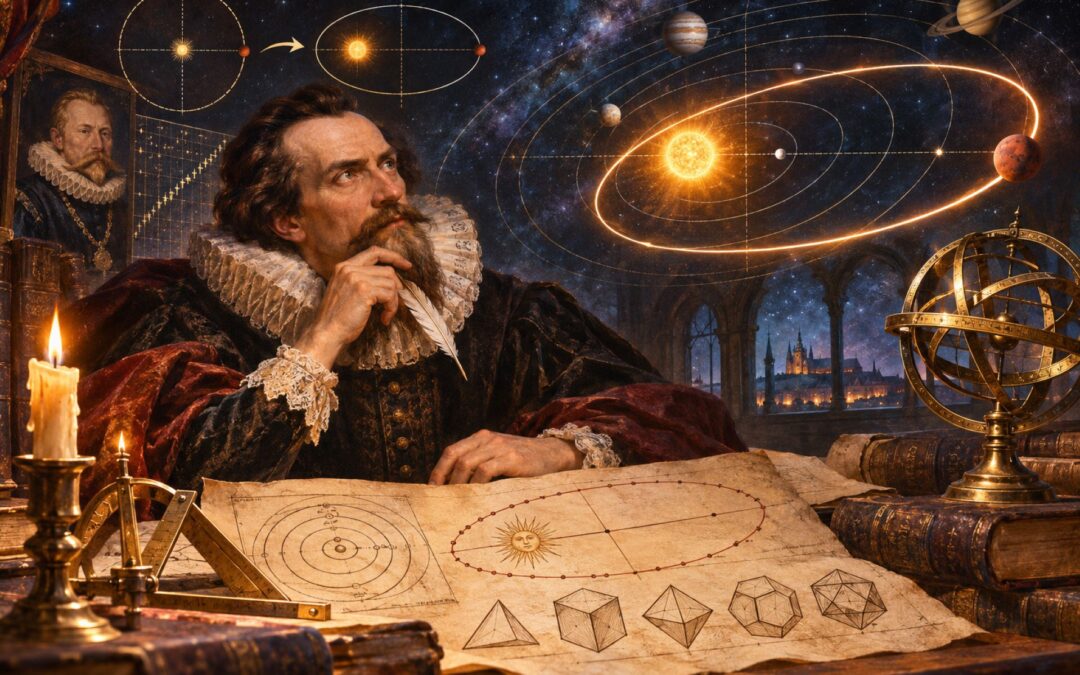
At the end of the sixteenth century, astronomers recognised six planets in the Copernican system: Mercury, Venus, Earth, Mars, Jupiter and Saturn. Kepler wondered why there were exactly six and why their distances from the Sun seemed to follow a particular pattern. His answer came from an unlikely place: the geometry of three-dimensional objects.
There are exactly five regular convex polyhedra, often called the Platonic solids. Each has identical regular polygonal faces and the same arrangement at every corner. They are the tetrahedron, cube, octahedron, dodecahedron and icosahedron. The five shapes were mathematically special because no sixth regular solid of the same kind could be constructed.
Kepler imagined six spherical shells representing the known planetary orbits, with the five solids fitted between them. Each solid could be enclosed within a sphere while enclosing another sphere inside itself. By nesting the shapes in a particular order, he could produce five gaps between six planetary spheres. The correspondence between five unique solids and five intervals among the six planets seemed too elegant to be accidental.
His design appeared in Mysterium Cosmographicum, or The Cosmographic Mystery, published in 1596. It was a striking expression of how he thought: the architecture of the heavens should answer to geometry, and the Sun should occupy the central position. The work attracted attention beyond Graz because Kepler was proposing an explanation for the arrangement of the planetary system, not merely another set of astronomical tables.
Yet the model did not fit the inferred planetary distances exactly. The observations themselves were imperfect, and determining distances was harder than measuring directions across the sky. Kepler had a choice: declare the differences unimportant or find better data. He chose the second course, even though more accurate measurements might undermine the mathematical pattern he admired.
The nested-solids theory ultimately proved wrong. There are more planets than the six known in Kepler’s time, and their orbits do not owe their spacing to the five regular solids. But the episode mattered for more than its failure. It drew Kepler toward careful comparison between an ambitious explanatory theory and the measurements available to test it.
His interest in cosmic harmony was never merely a youthful embarrassment that he discarded. He continued looking for significant geometric and musical relationships long after his first model failed. What changed was the kind of relationship he would eventually accept: instead of demanding that the planets conform to a beautiful arrangement, he learned to ask whether an arrangement survived exact calculation. The next person he needed was someone who had spent a lifetime making those calculations possible.
Tycho Brahe and the Eight-Arcminute Problem
The Danish astronomer Tycho Brahe offered something Kepler’s geometric imagination could not supply: measurements of extraordinary precision. Decades before telescopes entered routine astronomical use, Brahe constructed large instruments with carefully divided scales. He trained assistants, repeated observations and recorded planetary positions with an accuracy that earlier observers rarely approached. A small error that would have vanished in older data might stand out plainly in his records.
Brahe was also Kepler’s intellectual opposite in one important respect. He rejected both the traditional Earth-centred arrangement in its simplest form and the fully Copernican picture. In his own system, Earth remained stationary, the Sun orbited Earth, and the other planets circled the Sun. Such a configuration could account for many observed relative positions without accepting a moving Earth. Precise measurements alone did not instantly settle every argument about how the universe was arranged.
Kepler began corresponding with Brahe while his situation in Graz was deteriorating. He had married Barbara Müller in 1597, and religious policy was making life increasingly precarious for Protestants in Styria. Under the Counter-Reformation measures imposed by the region’s Catholic ruler, Kepler faced pressure he could not reconcile with his Lutheran faith. Astronomy offered a possible livelihood elsewhere, but the change was also forced by circumstances beyond his control.
In 1600 he visited Brahe, who had entered the service of Emperor Rudolf II near Prague. Their collaboration was uneasy. Brahe had good reason to protect observations that represented years of work and enormous expense, while Kepler wanted sufficient access to test his ideas independently. Both men could see the other’s value, yet neither accepted the other’s picture of the cosmos. Disagreements over data, authority and practical arrangements interrupted their working relationship.
Mars became Kepler’s assignment. This was a fortunate choice for a mathematician willing to question inherited assumptions. Mars’s path differs more noticeably from a circle than the orbits of some other visible planets. Its apparent motion also includes periods of retrograde movement, when it seems temporarily to reverse direction against the distant stars. The reversal is an effect of changing lines of sight between Earth and Mars as both travel around the Sun, not a sudden reversal of Mars’s actual orbital direction.
Kepler was therefore solving two connected problems. He needed to calculate Earth’s changing position to know from where Mars was being observed. But he also needed a credible path for Mars to test his reconstruction of Earth’s motion. It was like trying to determine a second ship’s course from compass bearings taken aboard a first ship that was itself moving. An error in either vessel’s assumed position could distort the apparent course of the other.
One method exploited observations separated by roughly a Martian orbital period, about 687 Earth days. At those intervals Mars would return close to a previous position relative to the Sun while Earth occupied a different location. Comparing the resulting angles helped Kepler reconstruct the geometry of Earth’s orbit and refine the positions from which Mars was being seen. It was a laborious way of turning changing perspectives into evidence.
Brahe died in October 1601, and Kepler succeeded him as imperial mathematician. The position gave him access to the observational legacy he needed, although arrangements with Brahe’s heirs remained difficult. He also inherited responsibilities for astronomical tables that would follow him for decades. His imperial salary was frequently delayed or unpaid, so the prestige of his appointment did not guarantee financial security.
At first Kepler tried hard to preserve circular motion. He devised a sophisticated arrangement in which Mars travelled around a displaced centre and its apparent speed could be described by reference to another point. Such devices were not meaningless tricks; they allowed astronomers to reproduce a great many planetary positions. His so-called vicarious hypothesis was astonishingly successful within the kinds of checks used to construct it.
Then the remaining observations refused to agree. Kepler compared different measurements and aspects of the orbital geometry, including the planet’s latitude relative to the plane of the ecliptic. The circular construction that performed well in one test produced a discrepancy of about eight arcminutes in another. Brahe’s instruments were accurate enough that Kepler could not reasonably attribute the whole difference to ordinary observational uncertainty.
Eight arcminutes represented less than a quarter of the Moon’s apparent width, but it was several times the error Kepler considered tolerable in the best observations. Had Brahe’s records been markedly less accurate, the same flawed construction might have survived unquestioned. Instead, a nearly successful theory became a problem demanding a different answer.
Kepler later treated those eight arcminutes as the opening through which a new astronomy became possible. The larger significance lies in his response: he did not merely search for a more complicated way to save the circle. He asked what would happen if the circle itself was wrong.
Why Mars Moved in an Ellipse
Giving up the circle was not a simple step for someone who believed geometry expressed divine order. Greek astronomy had long associated celestial perfection with uniform circular motion. Copernicus had changed the centre of the planetary system while largely retaining circles as its basic mathematical language. Kepler now had to question an assumption shared by thinkers whose work he admired.
His first alternative was not immediately the ellipse. He tested slightly flattened curves, ovals and other constructions, comparing their predictions with Brahe’s measurements at different points in Mars’s path. Two curves might look indistinguishable on a page and yet yield measurably different positions in the sky. The pattern of their errors, not their visual elegance, told him which possibilities remained viable.
To understand the solution, imagine drawing an ordinary circle around a central point. Every point on its edge is the same distance from the centre. Stretch the figure along one axis, while keeping it symmetrical, and the resulting ellipse has two special internal points called foci. A defining property is that the sum of the distances from any point on the ellipse to the two foci remains constant.
For a planetary orbit, the Sun occupies one focus rather than the geometric centre. The planet is therefore nearer the Sun at one part of its journey, called perihelion, and farther away at another, called aphelion. An ellipse need not look dramatically elongated. Mars’s orbit is only moderately eccentric, and Earth’s is closer to circular still. Diagrams often exaggerate the elongation to make the distinction visible.
Finding the right shape was only half the problem. Kepler also wanted to explain when Mars would reach each point along its orbit. A planet does not travel equal distances in equal times. Near perihelion it moves faster; near aphelion it moves more slowly. Astronomers had long described irregular apparent speeds mathematically, but Kepler wanted a relationship connecting the change with the Sun’s influence.
He experimented with ways of calculating the time spent moving through successive portions of the orbit. One approach involved summing quantities related to a planet’s changing distance from the Sun. The arithmetic was forbidding, and early approximations were not identical to the rule he finally established. Eventually a geometrical description captured the relationship more cleanly.
Picture an imaginary line drawn from the Sun to Mars. As the planet moves, the line sweeps over a region shaped like a narrow slice of a pie. Kepler found that equal intervals of time correspond to equal swept areas. In other words, the line covering one section of the orbit during a given number of days sweeps out the same area as it does during the same number of days elsewhere on the orbit.
Why can the speed change while the area stays the same? Near the Sun, the connecting line is shorter, so Mars must move farther along its path to sweep out a given area. Farther from the Sun, the line is longer, so a shorter stretch of orbital travel can account for an equal area. The relationship describes changing speed without requiring a planet to maintain a uniform pace.
Together, the two discoveries became Kepler’s laws of planetary motion: planets follow elliptical paths with the Sun at one focus, and the line connecting a planet to the Sun sweeps equal areas in equal times. Kepler published the results in Astronomia Nova, or New Astronomy, in 1609. The book’s extended account of false starts, calculations and revisions makes it remarkably revealing as a record of scientific work.
These results did not mean that Kepler possessed a modern theory of gravity. He imagined the Sun exerting a motive influence that weakened with distance, and he considered analogies with magnetism. His physical ideas were partly mistaken, and he did not derive planetary orbits from Newton’s later laws of motion. Still, his insistence on asking what caused the movement was consequential. Astronomy was no longer solely the art of fitting geometric paths to observations; it was becoming an investigation of physical processes.
The distinction also clarifies why Kepler’s achievement was larger than replacing one curve with another. The ellipse described the geometry; the area law described the timing. Both could be tested against observed planetary positions and used to predict where a planet should appear in the future. They linked a coherent mathematical picture to the sky visible from Earth.
Kepler continued to seek deeper reasons for the patterns. He believed there must be an intelligible relationship between the Sun’s role, planetary distances and orbital periods. The solution to that larger question would take another decade, during which his interests and personal troubles reached well beyond the orbit of Mars.
Light, Lenses and the Search for Physical Causes
Kepler’s determination to understand the heavens extended to the instrument through which every observation passed: the human eye. If an astronomer used the appearance of a planet as evidence, it mattered how light travelled and how an image was formed. An apparent feature might belong to the object, the atmosphere, the eye or an instrument placed between them. Sorting out those possibilities was part of making observation trustworthy.
In 1604 he published Astronomiae Pars Optica, an ambitious study of optical phenomena. He investigated reflection, refraction, visual perception and the geometry of light rays. Among his significant insights was his explanation of how the eye forms an image on the retina. The image is inverted, and perception cannot simply be equated with a tiny upright picture projected inside the eye. The account helped give optics a more rigorous mathematical foundation.
That same year a brilliant new star appeared in the constellation Ophiuchus. Kepler did not discover it first, but he observed it and later published an extended study of the phenomenon. We now recognise the event as a supernova. To scholars accustomed to thinking of the heavens as unchanging, such appearances raised questions about whether the sky beyond the Moon could undergo real physical alteration. Kepler’s attention to it reflected the same desire to examine received assumptions against what was actually seen.
The telescope introduced another transformation. In 1610, Galileo Galilei announced observations of mountains and valleys on the Moon and four small bodies moving around Jupiter. The Jupiter discoveries were especially provocative: they revealed moons revolving around a planet that itself moved against the background stars. Such a system challenged the assumption that every celestial body needed to circle Earth directly.
Kepler quickly published a supportive response to Galileo’s observations, although support did not mean that the two thinkers agreed about every optical or physical question. Kepler initially lacked a suitable telescope of his own and eventually confirmed Jupiter’s moons when he gained access to one. Their exchange illustrates a scientific community learning to combine new instruments with existing mathematical problems. Galileo enlarged the visible universe; Kepler sought the principles by which its moving parts could be understood.
In 1611 Kepler published Dioptrice, explaining how lenses produce images and describing a telescope using two convex lenses. Unlike the familiar Galilean arrangement, this design produces an inverted image. For astronomy, an upside-down view is often an acceptable compromise, especially because the arrangement offers practical advantages for magnification and optical configuration. The Keplerian telescope became an important foundation for later refracting instruments.
These studies were not distractions from Mars. Light, motion and physical causation were connected concerns in Kepler’s mind. The reliability of an observation depended on understanding vision; the reliability of a planetary model depended on testing predictions; and any mathematical pattern invited the further question of what produced it. He did not possess all the correct physical answers, but he helped make those questions unavoidable.
The Harmony of the World and Kepler’s Third Law
The triumph of New Astronomy did not bring a peaceful decade. In 1611 Kepler’s young son Friedrich died, followed later that year by his wife Barbara. Changes at the imperial court compounded the disruption: Rudolf II lost power in Bohemia and died in 1612. Kepler moved to Linz, where he served as mathematician to the estates of Upper Austria. In 1613 he married Susanna Reuttinger, beginning another family life while carrying unfinished scholarly and imperial obligations.
His intellectual curiosity remained restless. A merchant’s method of measuring a wine barrel drew his attention to the relationship between shape and capacity. By inserting a rod into a barrel, a seller could obtain a convenient measurement, but barrels with different proportions could give similar readings while holding different quantities. Kepler set out to calculate how volumes varied with shape rather than assuming a customary rule would always suffice.
The resulting work, published in 1615, examined the volumes of numerous solid figures. Kepler imagined breaking curved objects into many thin portions whose volumes could be estimated and then added together. The method did not amount to a completed modern integral calculus, but it anticipated important ideas later developed systematically by mathematicians. A practical question about pricing wine had led him back to the geometry of continuous quantities.
Meanwhile, he pursued a larger question that had animated The Cosmographic Mystery: did one mathematical relationship govern the entire planetary system? His original nested solids offered an explanation built from the number and spacing of the six known planets. Now he had more accurate orbital models, and he could compare their sizes with the time each planet took to go around the Sun. Rather than merely fitting each orbit separately, he wanted a rule shared by all of them.
Kepler was fascinated by musical harmony. Strings whose lengths stand in simple proportions produce recognisable intervals when other relevant conditions are held equal. To him, mathematical ratios in music suggested that natural phenomena might exhibit an intelligible order. He investigated relationships between the fastest and slowest angular motions of planets and interpreted some of their proportions through musical intervals. Those musical constructions are not accepted today as a physical explanation of planetary motion, but they formed part of his path toward a more enduring discovery.
In 1618, Kepler established the relationship now called his third law. The square of a planet’s orbital period is proportional to the cube of the orbit’s semi-major axis, or half the length of its longest diameter. In symbols, T² ∝ a³ for planets orbiting the same central body. He published the law in Harmonices Mundi, The Harmony of the World, in 1619.
An example makes the result easier to grasp. Imagine one planet orbiting the same star at a semi-major axis four times as large as another planet’s. Four cubed is sixty-four, and the square root of sixty-four is eight. The more distant planet takes eight times as long to complete an orbit. It has a longer path to travel and, under comparable circumstances, moves more slowly along it.
What distinguished this discovery from the nested-solids theory was its reach. The old theory assigned different geometric objects to different gaps between planets; the new relationship worked across the known planetary system. If an astronomer knew the periods of two planets, their relative orbital sizes could be calculated. Kepler had finally found a common proportional rule that survived the observational tests his youthful geometric construction had failed.
His broader presentation of Copernican astronomy continued in the Epitome of Copernican Astronomy, published in parts between 1618 and 1621. It brought together his own discoveries and his heliocentric interpretation in a more systematic account. Yet even as he was refining the mathematical order of the heavens, he was drawn into a dangerous dispute in which testimony, suspicion and the interpretation of evidence mattered for a different reason.
Defending His Mother Against Witchcraft
In 1615, accusations of witchcraft began to gather around Kepler’s mother, Katharina, in Württemberg. She was an older widow with a contentious reputation, and local quarrels became the basis for increasingly serious allegations. One woman claimed that she had become ill after Katharina gave her a drink. Other neighbours connected illnesses, misfortunes or previous disputes with the possibility that Katharina had exercised supernatural power.
Such claims can sound extraordinary today, but they operated within a legal and religious culture that treated witchcraft as a prosecutable offence. A quarrel followed by sickness might be presented as evidence of harmful magic. As accounts circulated, people could reinterpret ambiguous experiences in light of existing suspicions, giving the accusations an appearance of cumulative force. A collection of frightening stories could become the foundation of a criminal case.
The woman at the centre of the proceedings was not merely a figure in her son’s biography. She faced the loss of her liberty and potentially her life. Katharina’s use of ordinary household remedies did not establish wrongdoing, but it made the accusations easier for neighbours to frame in familiar terms. The burden of rebutting a network of remembered grievances could be enormous, especially when the alleged cause was something no direct observation could verify.
Kepler became deeply involved in her defence while working in Linz. The proceedings lasted several years, consuming time and resources he could scarcely spare. His intervention was not an astronomical experiment transferred wholesale into a courtroom. It involved understanding legal procedure, examining statements and preparing arguments against the conclusions authorities were being urged to draw.
In August 1620 Katharina was arrested and held in custody. Kepler travelled to Württemberg and worked closely on her case. He examined inconsistencies among witnesses, challenged the links drawn between events and supposed magical causes, and offered ordinary explanations for illnesses or conflicts. A witness might truly remember falling ill after an encounter; the memory alone did not prove that the encounter caused the illness or that supernatural forces were involved.
The distinction between an event and an interpretation of that event was familiar from Kepler’s scientific work, though the stakes here were profoundly personal. An astronomer could measure the position of Mars accurately and still misread the geometry that produced it. A neighbour could describe a genuine sickness and still offer a baseless explanation of its origin. In both cases, the difficulty lay in deciding what the evidence actually established, not merely collecting assertions.
Katharina’s danger remained acute. Officials threatened her with torture as a means of obtaining a confession; historical accounts distinguish that threat from an actual application of torture. She maintained her innocence and was eventually released in October 1621 after more than a year in custody. She died in 1622, leaving Kepler to continue a career already marked by political instability and financial strain.
Kepler had also written Somnium, a fictional account involving a journey to the Moon, begun years earlier and published only after his death. Scholars have discussed whether the work’s fictional mother figure and references to magic contributed to suspicions around Katharina, but a direct causal connection is not securely established. The important documented fact is the long defence itself and the intellectual labour Kepler devoted to her survival.
The case against Katharina Kepler offers an unsettling counterpoint to the apparent order of planetary mathematics. Kepler lived in a world where exceptionally precise calculations coexisted with accusations grounded in fear and inherited assumptions. His defence could not make that world suddenly rational. It could, however, insist that people entrusted with a life distinguish between testimony, inference and proof.
The Rudolphine Tables and Kepler’s Final Years
As Kepler’s scientific work accumulated, the political world around him became more dangerous. The Thirty Years’ War began in 1618, bringing religious conflict and military devastation to large parts of central Europe. Linz, where he had worked for years, was disrupted by a peasant uprising and siege in 1626. Religious division and war made it difficult to sustain a household, maintain scholarly correspondence and find the stability required for major publications.
One obligation continued to follow him: the astronomical tables originally commissioned under Emperor Rudolf II. Kepler had inherited the project after Tycho Brahe’s death, and it required him to combine Brahe’s painstaking observational records with improved planetary calculations. Producing accurate tables meant more than presenting a theory. He needed numerical instructions that other people could use to determine where planets and stars would appear on specified dates.
This was an enormous practical undertaking. Each planetary position depended on sequences of arithmetic operations and carefully prepared entries. Errors in calculation could spread through later predictions, while a printer’s mistake in a column of figures could spoil an otherwise sound result. Kepler also made use of logarithms, which allowed certain difficult multiplications and divisions to be handled more conveniently through addition and subtraction.
He eventually arranged for the work to be printed in Ulm. The Rudolphine Tables appeared in 1627, named for the emperor who had originally supported the project. They included an extensive catalogue of stars and computational material for calculating celestial positions. Brahe’s observations remained fundamental to the finished work, even though the geometry used to interpret them had changed through Kepler’s investigations.
The tables gave astronomy a demanding public test. It was one thing to show that a curve fitted measurements already taken; it was another to publish calculations from which a stranger could predict a future celestial event. Readers who followed the steps correctly could compare the resulting position with the sky. If those predictions failed systematically, astronomers would have reason to question the framework or the tables built upon it.
Kepler recognised that the improved predictions made it possible to anticipate unusual alignments. Mercury and Venus sometimes pass between Earth and the Sun, but their orbital planes are inclined, so most such passages do not carry the planet across the Sun’s visible disc. A transit requires the timing and geometry to align closely. Predicting one therefore tests the motions of Earth and the inner planet together.
Kepler calculated that transits would occur in 1631. He would not live to see whether his predictions helped observers witness them. By then he had entered the service of the military leader Albrecht von Wallenstein and moved to Sagan in Silesia in 1628, hoping to secure a more dependable livelihood. Payments continued to trouble him, and he travelled to Regensburg in 1630 while seeking money owed for his work.
He fell ill there and died on 15 November 1630, aged fifty-eight. He left books on planetary motion, optics, geometry and cosmic harmony, along with unfinished projects and a family that had repeatedly endured instability. His career had been shaped as much by negotiations with patrons, printers and authorities as by solitary calculation. The real measure of the Rudolphine Tables, however, was about to appear in the sky.
How Kepler Changed Astronomy After His Death
On 7 November 1631, the French astronomer Pierre Gassendi observed Mercury crossing the face of the Sun. He projected the Sun’s image rather than looking directly at it and saw a remarkably small dark point moving across the bright disc. The observation became the first reliably recorded transit of Mercury. Its timing was not perfectly identical to every prediction, but it powerfully demonstrated that the new planetary calculations could guide an observer to an event difficult to anticipate by eye alone.
The achievement showed the practical value of Kepler’s method. Brahe’s observations had permitted a precise test of older geometric assumptions; Kepler’s revised laws now permitted new observations to be planned in advance. His work linked the past record of the sky with predictions about what the sky would do next. Mathematical astronomy could succeed or fail through tests independent of the person who had devised the theory.
A deeper explanation came from Isaac Newton. In the Principia of 1687, Newton described the laws of motion and universal gravitation, including an attraction that decreases with the square of the distance between two bodies. Using this framework, he showed why planetary paths could be elliptical, why equal areas are swept out in equal times and why orbital periods are connected with orbital size. The laws Kepler had discovered from observation became results that a more general theory could explain.
Kepler’s formulas are not the whole story of every real orbit. Planets tug on one another, and the Sun itself moves in response to their gravity. For complicated systems, astronomers calculate perturbations and use more complete dynamical models. Nevertheless, the Keplerian orbit remains a foundational approximation and an indispensable starting point for understanding satellites, planets and many other orbiting bodies.
In 2009 NASA launched the Kepler space telescope to search for planets around other stars. Its method was different from Brahe’s angular measurements: it looked for tiny, repeated decreases in a star’s brightness when a planet passed in front of it. The repetition of those dips could reveal a planet’s orbital period, while further analysis helped distinguish planetary transits from other causes of changing light. The mission discovered thousands of planets and transformed the study of planetary systems beyond our own, while Kepler’s laws remained a basic framework for interpreting the orbits.
The name was fitting. Kepler had begun with a question about why the known planets occupied particular places in the solar system. His namesake spacecraft helped reveal that other stars also have planetary systems, many unlike the neat geometric architecture he once imagined. His first model did not survive, but the expectation that the universe could be investigated through precise and testable relationships did.
Return to the eight arcminutes. Kepler’s circular construction could reproduce much of the evidence, and its failure was easy to overlook in the immense scale of the heavens. He chose instead to take the small discrepancy seriously because he trusted the quality of the observations. That choice opened the way to laws that describe not only where a planet travels, but how it moves and how long its journey takes.
His greatest achievement was not discovering that the universe was perfectly harmonious in the way he first expected. It was allowing the evidence to change what harmony meant. By replacing a beautiful but inadequate circle with a less familiar, more accurate ellipse, Kepler helped make the motion of the heavens something people could calculate, explain and test.
Last Updated on November 25, 2026 by Aseem Gupta