
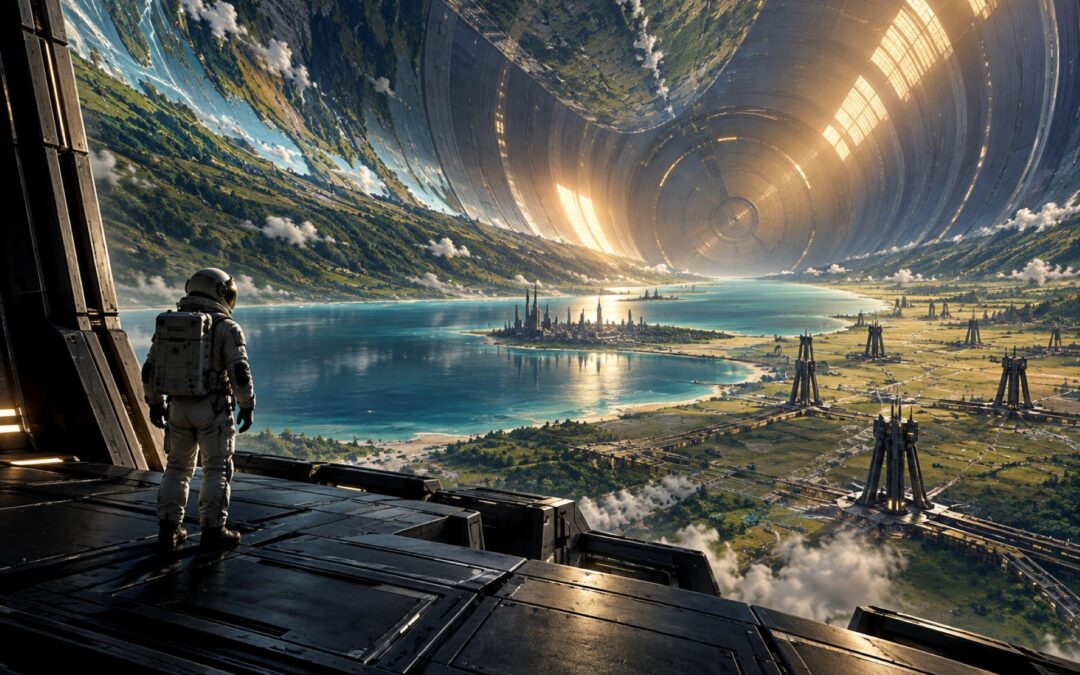
Arthur C. Clarke’s Rendezvous with Rama follows humanity’s first encounter with an extraterrestrial spacecraft: a vast, apparently deserted cylinder passing through the Solar System. When a human expedition enters the object, its crew discovers an artificial world containing seas, cities, mysterious machines, and technologies far beyond anything human civilization has developed. Yet the more they learn about this extraordinary construction, the less certain they become about the beings responsible for it.
First published in 1973, the novel won the 1973 Nebula Award for Best Novel and the 1974 Hugo Award for Best Novel. Its distinctive achievement lies in making the investigation itself the principal drama. Rather than introducing recognizable aliens and building toward communication or conflict, Clarke concentrates on the physical evidence of an unfamiliar intelligence and the difficulty of interpreting that evidence.
The resulting story combines scientific speculation, exploration, political tension, and philosophical uncertainty. Its enormous alien environment remains one of science fiction’s most memorable creations, although its treatment of human characters is less consistently successful.
Spoiler warning: This article explains the complete novel, including all major discoveries, character developments, and the ending.
The Meteor Threat and the Discovery of Rama
The novel begins with a disaster that takes place decades before the main story. On September 11, 2077, a massive meteorite strikes northern Italy, destroying Padua and Verona and devastating Venice. Approximately 600,000 people die, while irreplaceable works of art and centuries of cultural history disappear almost instantly.
The catastrophe demonstrates that humanity remains vulnerable to forces operating beyond its immediate control. Earlier asteroid impacts had occurred in relatively uninhabited regions, but the expanding human population has made another such fortunate escape increasingly unlikely. In response, the world’s governments establish Project SPACEGUARD, an extensive system designed to detect dangerous celestial bodies before they can threaten Earth.
By 2130, SPACEGUARD’s instruments are discovering asteroids routinely, and computers calculate the paths of thousands of objects. Most attract little attention because their behavior follows predictable patterns. One newly discovered body, initially designated 31/439, proves different.
Its trajectory indicates that it has entered the Solar System from interstellar space. Unlike ordinary asteroids, whose irregular shapes cause their apparent brightness to fluctuate as they rotate, this object maintains a remarkably steady appearance. Further observations suggest an unusual combination of shape, mass, and rotational behavior.
Scientists initially consider several explanations, including improbable natural possibilities. Gradually, however, the evidence points toward something no one has previously encountered: an object that may have been manufactured by an extraterrestrial civilization.
The discovery creates an immediate practical problem. The mysterious visitor is moving rapidly, and its passage through the Solar System offers only a limited opportunity for investigation. Humanity cannot simply observe it indefinitely or assume that another comparable object will eventually appear.
The Space Advisory Council debates whether the potential scientific reward justifies the expense and risk of sending a probe. Professor Olaf Davidson and other officials initially display considerable skepticism, reflecting Clarke’s interest in the institutional resistance that can accompany extraordinary discoveries. Nevertheless, the possibility of identifying the first artificial extraterrestrial object is too important to ignore.
A reconnaissance probe named Sita is dispatched from Phobos, the Martian moon. Its images transform the situation.
Instead of an irregular celestial body, the cameras reveal an immense, geometrically perfect cylinder with flat ends and a featureless exterior. Approximately fifty kilometers long and twenty kilometers in diameter, it resembles a gigantic manufactured container. Measurements of its mass indicate that it cannot be solid; most of its interior must be hollow.
The object receives the name Rama, drawn from Hindu mythology.
For the first time, humanity possesses convincing evidence that another technological civilization exists. But nothing about the object’s exterior reveals its age, occupants, destination, or purpose.
The survey ship Endeavour, commanded by William Norton, becomes humanity’s best opportunity to investigate. Although the vessel was not originally designed for this unprecedented mission, its position makes interception possible before Rama approaches the Sun too closely.
As Endeavour draws near, Norton discovers that photographs have not adequately prepared him for the scale of the artifact. A natural moon of comparable size would seem unremarkable to an experienced astronaut, but Rama is an engineered object incomparably larger than anything humans have constructed.
The crew matches Rama’s trajectory and lands near the center of one of its circular ends, where the rotation produces manageable conditions. This is a carefully calculated maneuver rather than a simple landing on a stationary surface.
Norton also recognizes the expedition’s vulnerability. Reaching Rama has consumed substantial fuel, the spacecraft’s future rescue and refueling arrangements remain uncertain, and the approaching solar encounter places a limit on exploration.
The mission begins, therefore, with an extraordinary scientific opportunity and the possibility that the desire to understand Rama may demand risks far beyond those originally anticipated.
Endeavour Enters the Silent Cylinder
Norton’s first examination of Rama reveals an apparently lifeless machine. The cylinder emits no recognizable radio transmissions or other obvious signals. Nothing on its exterior indicates that its builders are aware of the human spacecraft, and its enormous metal surface provides few clues about what lies beneath.
The first problem is finding a way inside.
Near the axis of the northern face, Norton discovers structures that appear to form an entrance complex. Through examination and experimentation, the crew succeeds in operating a system of doors and airlocks. The mechanisms function despite Rama’s apparent age, suggesting either extraordinary durability or some form of long-term preservation.
The opening of the entrance produces an important change in the mission. Humanity is no longer restricted to observing an alien artifact from outside; for the first time, explorers can physically enter a manufactured environment created by another intelligence.
Norton approaches this moment with a mixture of professional discipline and historical imagination. He compares the expedition to archaeological discoveries, especially Howard Carter’s entry into the tomb of Tutankhamun. The analogy is appropriate because Rama initially resembles an enormous sealed monument whose makers may have disappeared long ago.
Inside, the explorers pass through a complicated arrangement of chambers and passages before reaching the central hub. From this vantage point, Norton illuminates the darkness with flares and powerful lamps.
The interior exceeds even his expectations.
Rama contains an enormous cylindrical landscape extending approximately fifty kilometers from end to end. The habitable surface curves upward around the axis, creating the disorienting possibility that an observer standing on one side could look across the interior toward land that appears overhead.
The cavity is roughly sixteen kilometers in diameter. Its ends are shaped into elaborate bowl-like structures, while the central portion forms what the explorers call the Central Plain.
There are immense constructions scattered across the plain, including clusters of buildings, towers, and other formations whose purposes cannot be identified. The crew assigns familiar names such as London, Paris, Moscow, and Rome to some of these groups, although the names describe their locations rather than establishing that they are genuine cities.
Perhaps the most remarkable visible feature is a broad band encircling the cylinder near its middle. It appears to be a frozen body of water, and the explorers name it the Cylindrical Sea.
An island covered with elaborate structures lies within this sea. Because its outline evokes Manhattan, the humans call it New York.
The geographical naming system makes Rama easier to discuss, but it also reveals the explorers’ dependence on human categories. They repeatedly encounter things that resemble familiar landscapes or buildings while remaining unable to establish what those structures actually do.
Reaching the Central Plain presents another challenge. Rama rotates around its long axis, producing an apparent gravitational force that increases with distance from the center. Near the hub, objects are almost weightless. On the inner surface of the cylinder, the rotational effect creates conditions in which people can walk, run, and carry equipment.
Three enormous stairways, designated Alpha, Beta, and Gamma, descend from the northern polar region toward the plain. They are separated by circular terraces and involve tens of thousands of steps.
The dimensions make an ordinary descent into a considerable expedition.
Norton initially assigns the task to Karl Mercer, his dependable second officer and life-support specialist. Mercer is particularly suited to dangerous experimental work because he remains calm, methodical, and reluctant to take unnecessary risks.
He is accompanied by navigator Joe Calvert and engineer Willard Myron. Their party tests the changing gravitational conditions, equipment requirements, and physical difficulties of movement through Rama.
As they descend, their weight gradually increases. What begins as a relatively effortless movement through weak gravity becomes strenuous climbing and walking. The explorers must also consider the return journey, when exhaustion could make ascending the immense stairway dangerous.
The atmosphere creates additional uncertainty. Measurements suggest that it is possible to move through some regions without the same equipment necessary on an airless moon, but its composition, temperature, and biological safety are incompletely understood.
Even apparently favorable findings require caution. A breathable atmosphere does not guarantee that the environment is harmless.
The crew’s confidence is further complicated by Rama’s silence. There are no identifiable inhabitants, no recognizable signs of daily activity, and no obvious explanation for the vast structures. The enormous space seems simultaneously engineered and abandoned.
Back aboard Endeavour, Norton supervises exploration while remaining responsible for the ship and its remaining personnel. His communications with his families on Earth and Mars provide glimpses of the wider society in which he lives. Interplanetary travel has produced unusual domestic arrangements, and Norton maintains two marriages in different parts of the Solar System.
Other details similarly establish how ordinary human life has adapted to space. The crew includes highly specialized professionals, and the ship makes use of modified chimpanzees, known as simps, for routine work.
These human concerns seem small beside Rama’s dimensions, but they also keep the expedition grounded in practical reality. The astronauts are not legendary heroes acting outside social obligations. They are working professionals whose responsibilities continue even during the most extraordinary discovery in human history.
When Norton eventually joins the descent toward the Central Plain, he discovers how psychologically difficult Rama can be. The view offers little familiar sense of distance or orientation. The landscape extends upward in directions that the human mind instinctively regards as impossible.
He must overcome fatigue, uncertainty, and the oppressive scale of the environment while making decisions for the entire expedition.
The first major stage of exploration ends with the astronauts beginning to investigate the plain itself. They have established that Rama is accessible and contains the infrastructure of an artificial world, but they still know almost nothing about the civilization responsible for it.
The Sea Thaws and Rama Awakens
Once the explorers reach the Central Plain, the expedition begins examining the strange formations scattered across its surface.
The ground initially appears almost featureless, and the silence contributes to an unsettling impression of abandonment. Familiar sensory expectations fail. Footsteps and voices seem insignificant in the immense enclosure, and the curvature of the cylinder remains difficult to reconcile with ordinary ideas of landscape.
Norton investigates a mysterious trench that briefly produces a strong emotional reaction. Its shape reminds him of a railway cutting from his childhood, revealing how readily the human mind searches for familiar associations in an unfamiliar environment.
The recognition helps restore his composure. Rama’s architecture may be strange, but its structures can still be examined through observation and reasoning.
The expedition continues toward one of the formations designated as a city. These structures appear carefully planned, with regular geometries suggesting enormous engineering sophistication. Yet they lack many recognizable features associated with ordinary human habitation.
There are no readily identifiable streets full of movement, no open doorways, and no visible inhabitants. Their apparent familiarity becomes increasingly deceptive.
Another exploration party approaches the Cylindrical Sea.
The band of water is confined between steep walls and stretches around the entire inner circumference of Rama. At this stage it remains largely frozen, presenting a broad, smooth barrier between the northern and southern portions of the Central Plain.
Laura Ernst, the expedition’s medical and scientific specialist, examines its edge and collects samples. The sea’s composition and the possibility of biological activity may provide clues that the silent buildings cannot.
Across the frozen expanse, New York remains inaccessible. Its towers and complex formations suggest a concentration of machinery, although no one can determine whether the structures are factories, storage installations, or something entirely different.
The first decisive change comes through a warning from Carlisle Perera, a scientist working with the Rama Committee.
Perera realizes that the object cannot remain thermally isolated as it approaches the Sun. Solar radiation has been warming Rama’s exterior, and the accumulated heat must eventually penetrate its structure. Although the internal environment has remained cold, that condition is unlikely to last.
His calculations predict a sharp increase in temperature, the thawing of the sea, and significant atmospheric disturbances.
The implications are serious because Rama is a rotating artificial world. Its atmospheric circulation will not necessarily behave like weather on Earth, and warming could produce exceptionally powerful winds.
Perera warns that the change may occur suddenly. Norton understands the danger but is reluctant to abandon an exploration that has barely begun. He balances the warning against existing measurements and the scientific importance of continuing the mission.
The sea soon begins to thaw.
Unlike a familiar terrestrial spring, the process occurs within a sealed environment whose thermal properties were engineered by an unknown civilization. Ice shifts and breaks, the atmosphere changes, and the previously motionless landscape begins to show signs of activity.
Norton’s party is ordered back toward safety.
During the arduous return up the stairway, the interior suddenly floods with light.
Rama’s artificial illumination has activated.
The effect overwhelms Norton. Although he has studied maps and photographs, seeing the entire cylindrical world illuminated exceeds anything those measurements suggested. He is briefly unable to control his physical reaction and must steady himself before continuing.
The view reveals the Central Plain, the sea, the southern structures, and the entire enormous curvature of the landscape. Features previously concealed in darkness become visible as elements of a single engineered environment.
It is one of the novel’s defining scenes because a place the explorers believed they had begun to understand is transformed without changing its underlying geometry.
The sudden illumination also overturns an important assumption. Rama may have seemed dead, but its systems are clearly capable of restarting. Its earlier condition may have been dormancy rather than abandonment.
As the atmosphere warms, the predicted meteorological changes intensify. Mist rises from the sea and powerful winds develop. Norton withdraws the exploration team while instruments continue monitoring the environment.
For two days, the crew waits aboard Endeavour. Nothing immediately catastrophic occurs, but the uncertainty prevents them from returning until conditions stabilize.
When the explorers finally reenter Rama, they discover a substantially altered world.
The interior is warmer and more humid. The sea is liquid and has acquired a greenish coloration. More importantly, measurements indicate increasing oxygen and the emergence of microscopic biological activity.
The sea appears to contain microorganisms capable of participating in an artificial ecological cycle. What took enormous spans of geological time on Earth seems to have developed within Rama in a matter of days.
The rapid changes suggest that Rama possesses an engineered system for generating or restoring conditions suitable for life.
The explorers cannot yet know whether this process is intended to support passengers, maintain machinery, replenish resources, or serve some other purpose. Nevertheless, the discovery dramatically changes the nature of the expedition.
Rama is no longer simply an enormous container filled with unexplained constructions. It is an active environment whose systems respond to changing conditions, and the approaching Sun appears to be involved in its reactivation.
Meanwhile, the political authorities following the mission grow increasingly anxious.
Mercury’s representative warns that Rama’s awakening might indicate preparations for an unknown and potentially dangerous operation. Its extraordinary capabilities make assumptions of harmlessness difficult to defend.
Boris Rodrigo, one of Norton’s officers and a member of the religious Cosmo Christers, offers another interpretation. He suggests that Rama might have arrived for a purpose connected to divine intervention or the rescue of humanity.
Norton does not share Rodrigo’s faith, but he recognizes that the theory attempts to explain the same troubling facts that occupy scientists and politicians.
The competing explanations illustrate humanity’s position. Everyone is observing the same object, but its behavior can support very different expectations when its ultimate purpose remains unknown.
Across the Sea and into the Southern Hemisphere
Rama’s transformed environment makes further exploration possible, but the Cylindrical Sea continues to divide the interior.
New York, the artificial island surrounded by water, has become one of the expedition’s most attractive destinations. Its dense concentration of structures suggests that it might contain machinery essential to understanding the entire cylinder.
The crew constructs a small raft from available storage drums and a lightweight frame. The improvised vessel, named Resolution after one of Captain James Cook’s ships, represents a characteristic feature of the expedition: enormously sophisticated astronauts must repeatedly solve unfamiliar problems with straightforward practical engineering.
The team transports the raft across the plain and launches it into the sea.
Scientific observations reveal that the water is now biologically active. Samples contain vast numbers of microscopic organisms, although their structure differs from familiar terrestrial life.
The explorers are witnessing an ecosystem whose chemistry and development cannot be explained simply by assuming that Rama follows Earth’s evolutionary history.
The crossing also demonstrates the unusual properties of the cylindrical environment. Water surrounds the inner wall of the rotating vessel, and the sea’s apparent horizon differs from an ordinary ocean. The explorers must understand the behavior of their improvised craft under conditions that combine familiar fluid mechanics with unfamiliar geometry.
When Norton reaches New York, he discovers that the structures are even more mysterious at close range.
The island appears to contain a highly organized complex of towers, pipes, geometric formations, and enclosed constructions. Yet the explorers find no recognizable accommodations, public spaces, or ordinary entrances.
Norton increasingly doubts that New York is a city in the human sense. Its arrangement suggests a giant machine or industrial installation whose components have specific functions that remain concealed.
He considers whether to force entry into one of its structures.
The decision is complicated by both ethical and practical concerns. The explorers are visitors inside a technological artifact belonging to another civilization. Damaging it simply because they cannot understand it might be unjustifiable, and the consequences of interfering with its machinery are unknown.
Norton initially refuses to use destructive methods.
With New York offering few immediate answers, attention shifts toward the southern half of Rama. The region contains enormous structures unlike anything near the northern entrance, but reaching it by conventional means would be difficult.
Jimmy Pak, Endeavour’s youngest officer, proposes an unconventional solution.
Before joining the expedition, Pak had participated in the developing sport of low-gravity sky-biking. He has secretly brought aboard a lightweight human-powered flying machine named Dragonfly, hoping to demonstrate its capabilities under suitable conditions.
The decision violates regulations, and Pak knows that revealing the equipment could damage his career. Nevertheless, Rama provides a remarkable opportunity.
Because apparent gravity becomes weaker closer to the rotation axis, a sufficiently light aircraft may be able to travel through the interior with relatively little power. Pak proposes flying across the sea to investigate the southern structures.
Norton is amused and irritated by the unauthorized equipment, but he recognizes its practical value. After considering the risks and arranging tests, he permits the flight.
Dragonfly’s first operations reveal the complexity of flight inside Rama. The aircraft must contend with the rotating environment, changing gravitational effects, and the limitations of its delicate construction.
Once these problems appear manageable, Pak embarks on the most ambitious individual journey of the expedition.
Flying over the Cylindrical Sea, he reaches the southern region and examines formations that the crew has previously observed only from a distance.
Dominating the area is an immense structure called Big Horn, surrounded by six smaller projections called Little Horns. Their arrangement is geometrically precise, and their scale suggests that they belong to some extraordinarily powerful system.
Pak also encounters evidence of unfamiliar electrical activity.
An eerie sound associated with the machinery gives the region its unsettling character. What seems at first like an architectural mystery gradually becomes an active technological hazard.
Pak begins his return flight, but the electrical disturbances intensify. Powerful discharges appear between the great structures, producing conditions that his lightweight aircraft was never designed to survive.
Dragonfly suffers catastrophic damage.
The delicate wings fail, and Pak loses the ability to maintain ordinary powered flight. He must use his remaining control, knowledge of the environment, and experience as a pilot to avoid immediate death.
The episode recalls the classical story of Icarus, although Pak’s problem is the actual engineering of his aircraft rather than a simple moral punishment for ambition.
He eventually crashes on the southern plain.
When Pak regains consciousness, he is injured but alive. His aircraft has been wrecked, and he is stranded far from the northern expedition.
His situation is particularly difficult because the southern region is separated from the sea by a high, smooth cliff. Even if he can reach the shoreline, climbing down to the water appears impossible with the equipment available.
While the crew searches for a rescue method, Pak continues exploring.
His first extraordinary encounter occurs when he discovers a crablike creature dismantling the wreckage of Dragonfly.
The entity does not behave like an ordinary animal. It appears interested in the mechanical debris rather than in the nearby human being, and it conducts its work with remarkable efficiency.
Pak cannot tell whether it is an alien organism, an autonomous machine, or something combining qualities of both.
The encounter is significant because the expedition has finally discovered a moving, active entity within Rama. But it provides no recognizable opportunity for conversation.
The creature’s indifference suggests that whatever it is doing has little to do with human expectations of first contact.
Pak also investigates strange installations and observes activity around a mysterious well-like structure. The terrain contains carefully arranged surfaces, crystalline formations, geometric patterns, and mechanical components whose relationships remain obscure.
During these explorations, he discovers an extraordinary flowerlike organism.
The plant is enclosed within a complicated structure, and its appearance differs from the functional machinery surrounding it. To Pak, it represents something unexpectedly beautiful and familiar in an otherwise alien landscape.
He decides to collect it.
Obtaining the specimen requires entering a narrow framework, and the effort is physically difficult. When he removes the flower, the remaining plant begins to withdraw and collapse.
Pak suddenly recognizes the possibility that he has destroyed a unique living thing.
The incident complicates the expedition’s scientific purpose. Collecting an extraordinary specimen would unquestionably benefit human knowledge, but the act may also damage something that cannot be replaced.
Pak briefly experiences the moral problem that Norton has encountered in a different form at New York: the desire to understand an unfamiliar environment can conflict with the responsibility not to harm it.
Meanwhile, Norton works urgently on a rescue plan.
Conventional solutions seem impractical. The smooth cliff cannot easily be climbed, the available propulsion equipment is unsuitable for lifting a person against Rama’s gravity, and manufacturing new rescue devices would take too long.
Perera eventually identifies a simpler possibility based on the atmosphere and apparent gravity.
Pak can jump from the cliff into the Cylindrical Sea.
Although the drop is approximately half a kilometer, air resistance will limit his falling speed. Calculations indicate that he can survive the descent if he enters the water correctly.
The proposal is frightening precisely because it sounds so simple. Pak must deliberately step off an enormous cliff and trust the physics of an environment he has only recently entered.
After receiving Norton’s instructions, he commits himself to the jump. The boat crew waits below, and Pak successfully plunges into the water.
His recovery briefly seems to conclude the adventure. The expedition has obtained unprecedented information about Rama’s southern region and saved the stranded officer without a fatality.
But the machinery near the South Pole begins another spectacular electrical display.
An enormous disturbance travels through Rama, and a wave forms in the Cylindrical Sea.
Norton and the crew aboard Resolution suddenly face a new danger. The wave advances around the cylindrical world, its motion affected by the varying depth of the water near the shores.
Sergeant Ruby Barnes, responsible for handling the craft, must use her understanding of the wave’s behavior to keep the vessel out of the most dangerous region.
The crew survives, but the incident reveals that even changes originating far away can have immediate consequences throughout Rama’s connected environment.
Another discovery follows when a strange many-armed aquatic machine appears near the sea. Other creatures interact with it and begin dismantling its components.
The process suggests a systematic method of reclaiming materials.
Soon the explorers encounter spiderlike machines moving across the plain. Some inspect human equipment or approach the expedition’s installations, but they show no unmistakable hostility.
Norton introduces stricter precautions, requiring personnel to remain alert and avoiding unnecessary confrontation.
One spiderlike entity becomes incapacitated, allowing the scientists to examine it more closely.
Laura Ernst is particularly interested in understanding its anatomy. The opportunity to dissect a specimen promises direct evidence about the nature of the creatures, although Norton remains concerned about the ethical implications of treating apparently living entities as disposable scientific material.
By this point, the expedition has found enough evidence to challenge its original understanding of Rama completely.
The cylinder contains mobile organisms or organism-like machines, an active ecology, extraordinary electrical installations, recycling systems, and technological processes that appear to operate without visible supervision.
Yet the humans remain no closer to meeting the beings who designed them.
Biots, Mercury’s Missile, and Norton’s Decision
The strange creatures prompt increasingly detailed scientific discussion.
Laura Ernst’s examinations suggest that the spiderlike entities possess anatomical structures associated with living organisms, but their overall design differs substantially from familiar animals.
The creatures appear unusually specialized. Their forms and behavior correspond closely to particular tasks, and they do not display the flexibility, curiosity, or self-preserving responses that the explorers might expect from independent animals.
Perera and other scientists begin treating them as biological machines.
The name biots captures the combination: entities constructed from biological materials but apparently designed to perform mechanical or operational functions.
The crab dismantling Dragonfly, the spiders inspecting equipment, and the aquatic machines participating in recycling all fit this interpretation. Rather than forming a recognizable animal community, they seem to constitute a distributed maintenance system.
Their existence raises further questions. If the biots are machines, where are they manufactured? Who directs them? Are they controlled by a central intelligence, or do they operate through fixed instructions?
The island called New York becomes a plausible candidate for some kind of manufacturing or processing complex, although its internal function remains unverified.
The Rama Committee considers the implications. Scientists increasingly accept that the artifact is operational, but an active ship does not necessarily imply that conscious beings are aboard.
This uncertainty becomes urgent when an unexpected development occurs outside Rama.
Norton receives a confidential warning that Mercury has launched an unauthorized object toward the alien cylinder. Its trajectory and the extraordinary secrecy surrounding the operation strongly suggest that it is a weapon.
The object is a nuclear missile.
Mercury’s leaders have concluded that Rama represents an unacceptable threat to the Solar System. Its enormous mass, extraordinary construction, and apparently limitless technological capabilities make it difficult to imagine how humanity could defend itself if the artifact behaved aggressively.
From Mercury’s perspective, the fact that Rama has shown no hostility is insufficient reassurance.
The Hermians, as Mercury’s inhabitants are called, possess substantial technological resources and have particular concerns about events near the Sun. Their civilization depends upon environments and energy systems very different from those familiar to most humans.
They therefore interpret Rama’s approach and reactivation through their own strategic interests.
The wider United Planets must decide whether Mercury’s intervention is justified.
During an emergency session of the General Assembly, the Hermian representative presents a case for destroying Rama before it can act against humanity.
The argument rests partly on uncertainty. Because the builders’ intentions are unknown, the possibility of catastrophic danger cannot be excluded. Waiting until Rama’s capabilities become fully apparent might leave humanity powerless to respond.
Opponents recognize the weakness of that reasoning.
Destroying Rama would eliminate the greatest scientific discovery in human history without establishing that the artifact intended any harm. It might also represent an act of aggression against a civilization that has given no indication of hostility.
The political debate has no easy resolution because neither side possesses reliable information about Raman motives.
Meanwhile, Norton must confront the danger directly.
The approaching missile threatens Rama, but it also threatens Endeavour and the expedition. A nuclear explosion could produce radiation, debris, and other effects dangerous to the human spacecraft.
Norton must consider whether to evacuate immediately, obey instructions from higher authorities, or attempt an intervention.
Rodrigo proposes a way to disable the weapon.
The plan is technically simple but personally dangerous. Using a small spacecraft equipped for external operations, Rodrigo can approach the missile, interfere with its guidance systems, and prevent it from reaching Rama.
Communication delays mean that Mercury cannot necessarily react in time to stop him.
Norton initially hesitates.
Disabling the missile would mean directly interfering with a sovereign government’s military operation. If Mercury’s worst fears prove justified, the decision might expose humanity to an existential danger.
But allowing the weapon to destroy Rama would also be irreversible.
Norton reflects on historical encounters between civilizations of unequal technological development. The expedition’s references to Captain James Cook become especially relevant. Human history contains examples of exploration, misunderstanding, conquest, and disastrous attempts to impose one society’s assumptions upon another.
Norton cannot know whether the Ramans would regard humanity as a curiosity, an inconvenience, or something beneath their notice. He does know that the missile represents a decision to destroy rather than understand.
He authorizes Rodrigo’s mission.
Before Rodrigo approaches the weapon, Endeavour maneuvers into a position that protects the spacecraft from the missile’s observation systems.
Rodrigo then pilots a stripped-down scooter toward the object, using its propulsion system to complete the journey as quickly as possible.
The operation depends upon precise timing. He must reach the missile, disable its essential controls, and withdraw before Mercury can respond.
Rodrigo uses tools to interrupt the weapon’s guidance and communications. He remains composed even when the missile’s own systems begin operating unexpectedly.
Having disabled the controls, he also uses his scooter to alter the missile’s trajectory.
The adjustment is sufficient to make the weapon miss Rama.
His intervention succeeds, and the alien vessel survives the immediate threat.
The episode becomes the novel’s most consequential human moral decision. Scientists have measured Rama, explored its interior, and collected evidence of its technological power, but Norton and Rodrigo must act despite their continuing ignorance.
Their decision is not based on certainty that the Ramans are benevolent. It is based on the conviction that uncertainty alone does not justify destroying an unfamiliar civilization’s creation.
The crisis costs the expedition valuable time, however, and Rama continues approaching the Sun.
Norton knows that the remaining opportunity for exploration is rapidly disappearing. The crew prepares for one final attempt to understand the structures whose interiors have remained inaccessible.
The Temple of Glass and the Last Descent
During most of the expedition, Norton has refused to damage Rama’s structures merely to satisfy human curiosity. He has treated the cylinder as an inhabited world or valuable archaeological site whose mechanisms might react unpredictably to interference.
With the mission nearing its end, he revises that decision.
The crew will soon have to leave, and the scientific opportunity may never recur. Norton authorizes an attempt to cut into one of the sealed buildings in the complex named London.
The operation still involves considerable uncertainty. The biots have not behaved aggressively toward the humans, but breaking into an unfamiliar installation could produce an entirely different response.
The explorers use a laser to penetrate the structure.
Inside, they discover an extraordinary arrangement of transparent crystalline pillars. These objects appear to contain three-dimensional images of various tools, devices, and manufactured objects.
Their purpose is not immediately obvious.
The installation might be a museum, a catalog, a storage system, or some other technology whose function has no exact human equivalent. The explorers can summon or examine representations of objects, but they cannot confidently establish why those representations exist.
The discovery is nevertheless immensely valuable.
For the first time, the expedition obtains apparent evidence about objects used by the Ramans themselves rather than simply observing the architecture of their enormous vessel.
Some devices resemble human tools or domestic equipment in broad functional terms. Others are almost impossible to interpret.
Their dimensions are especially revealing.
Certain objects appear suited to beings much larger than human beings, with body structures that do not correspond neatly to ordinary human anatomy. One apparent piece of equipment suggests an individual with three upper limbs.
This does not establish what the Ramans looked like. A device designed for a three-limbed creature might represent an actual body shape, protective clothing, specialized machinery, or equipment intended for an artificial worker.
Still, the evidence points toward a nonhuman physical organization consistent with other patterns the explorers have observed.
The crew continues examining the images, hoping that the installation may finally provide a meaningful clue to the civilization behind Rama.
Then an urgent warning arrives.
Rama’s illumination is fading.
At first, the change is so gradual that the explorers doubt the report. Instruments, however, confirm that the light level is decreasing.
The ship appears to be entering another phase of operation.
Across the southern landscape, biots begin moving urgently toward the Cylindrical Sea. Some enter the water, where they are broken apart or recycled by other machines.
The phenomenon suggests a large-scale shutdown or reorganization of Rama’s internal systems.
Norton orders an immediate withdrawal.
The final journey up the enormous stairway is physically punishing. The expedition’s remaining time is extremely limited, and the atmosphere and lighting are changing as the crew climbs.
Norton is exhausted by the time he reaches the hub. His companions help him through the airlocks and back toward safety.
He knows he is leaving behind a world that humanity has barely begun to explore.
Although the expedition has achieved much more than anyone expected, its greatest mysteries remain. The apparent cities, the biots, the optical images, and the southern machinery have revealed different aspects of Rama without explaining its ultimate mission.
As the entrance closes behind him, Norton realizes that darkness is returning precisely when the vessel is approaching its closest encounter with the Sun.
The contradiction suggests that Rama’s internal systems are preparing for something entirely different from ordinary habitation.
Rama’s Escape and Humanity’s Unanswered Questions
After withdrawing from the cylinder, Endeavour moves to a safer distance and begins observing Rama’s behavior from outside.
Norton and his crew have expected that the alien vessel might slow down as it approaches the Sun, perhaps becoming trapped in the Solar System or entering a stable orbit.
Instead, Rama begins maneuvering in ways that human technology cannot explain.
The first indication involves an unexpected change in orientation. The surrounding stars seem to move, revealing that Endeavour is being affected by Rama’s extraordinary propulsion system.
The alien craft appears capable of producing gravitational or inertial effects far beyond anything humanity can generate.
Calculations then show that Rama is accelerating.
More alarmingly, it is accelerating toward the Sun.
The predicted trajectory appears suicidal. Rama is moving toward a region where the intense heat should destroy ordinary materials long before the vessel reaches its closest approach.
For a time, the observers consider the possibility that something has gone wrong. After surviving an interstellar journey of unimaginable length, Rama might be destroyed by a malfunction during its final approach.
The explanation proves incorrect.
As Rama nears the Sun, it becomes surrounded by an enormous reflective sphere.
This protective structure shields the cylinder from the surrounding radiation and heat. To distant observers, the great spacecraft seems to disappear inside a brilliant, mirrorlike envelope.
The sphere gradually changes shape, becoming elongated along Rama’s direction of travel.
Instruments monitoring the Sun then detect disturbances in its magnetic field.
Rama appears to be manipulating the surrounding plasma and magnetic forces, producing a vast structure that extends through the solar corona.
The spacecraft accelerates to extraordinary speeds while passing close to the Sun.
The human observers finally recognize that the approach is deliberate. Rama has not fallen into a fatal trajectory through malfunction; it is using the Sun as part of an immense propulsion and replenishment operation.
The evidence also suggests that matter may be flowing from the Sun toward the craft, potentially replacing materials lost during its long interstellar journey.
The exact engineering remains incomprehensible.
Nevertheless, the larger operation becomes clear enough. Rama has entered the Solar System to obtain resources and energy before continuing toward an unknown destination.
The ship swings around the Sun and departs at immense speed.
Its new path carries it away from the plane of the planets and toward the distant region of the Greater Magellanic Cloud, although the observers cannot know whether that direction represents its final destination.
Rama has used humanity’s planetary system without showing any identifiable interest in its inhabitants.
The expedition’s discovery is extraordinary, but the final result is also deeply frustrating. The humans have observed a machine of almost unimaginable sophistication and watched it perform an operation they could never reproduce, yet they have not communicated with its makers.
The last chapter returns to Norton aboard Endeavour.
His mission has ended successfully in several important respects. The crew has survived, the expedition has collected an immense quantity of scientific information, and the spacecraft has escaped destruction.
Norton also receives personal news from Laura Ernst: permission has been granted for the conception of another son using genetic material he preserved before his long career in space. The detail reconnects him with the ordinary human future waiting beyond the expedition.
The medical procedures involved reflect the realities of Clarke’s imagined astronautical society, where long-term radiation exposure makes ordinary reproduction difficult for career space travelers.
Norton and Ernst resume their personal relationship as the crew begins recovering from the mission.
Yet Norton feels a profound sense of loss.
He has experienced something that may never happen again in his lifetime. The extraordinary landscape of Rama has become more compelling to him than any anticipated honor or professional advancement.
He recognizes that the expedition succeeded in exploring an alien artifact but failed to discover what its makers intended.
His disappointment centers on the possibility that the Ramans never even noticed the humans investigating their ship.
From a human perspective, such apparent indifference is difficult to accept. Humanity has experienced its greatest scientific revelation, while the civilization responsible may regard the encounter as entirely insignificant.
The novel closes with Carlisle Perera awakening from troubled sleep after recognizing a pattern that has appeared repeatedly throughout Rama.
Its architecture, machinery, and apparent biological forms show a striking preference for threefold arrangements.
Perera’s realization suggests that humanity may have overlooked a fundamental clue about the Ramans and possibly about what could happen next.
But Clarke does not provide a definitive explanation.
Rama is gone, and the novel ends with the expectation that the mystery may be larger than anyone has understood.
How Rama’s World Works
The most impressive achievement of Rendezvous with Rama is the physical coherence of its alien environment. Clarke creates a structure of extraordinary proportions and then explores the consequences of its design with a sustained interest in geometry, mechanics, and engineering.
Rama is approximately fifty kilometers long and twenty kilometers across externally. Its interior cavity is narrower, with an enormous cylindrical surface running between two differently structured polar regions.
The artificial world’s apparent gravity results from its rotation.
An object inside a rotating cylinder tends to move outward relative to the rotating frame, and a person standing against the inner surface experiences this as a downward force. The farther that person is from the central axis, the stronger the apparent gravitational effect becomes.
This explains why the explorers experience near weightlessness in the hub but substantial apparent gravity on the Central Plain.
It also explains why Rama can support an extensive internal landscape without behaving like an ordinary planet. Its gravity-like conditions are generated by engineering rather than by possessing planetary mass.
The changing force complicates movement.
An astronaut descending from the hub gradually becomes heavier, making the return climb increasingly difficult. Pak’s aircraft can exploit the weaker apparent gravity at higher altitudes, but its flight still requires careful handling because the environment is rotating.
Coriolis effects further complicate trajectories. Motion within a rotating reference frame does not always behave as terrestrial intuition suggests, particularly when an object changes its distance from the rotation axis.
These effects matter directly to the story. Pak’s flight, his crash, the cliff rescue, and the expedition’s movement through Rama all depend on the physical rules of the environment.
The Cylindrical Sea provides another example.
On Earth, oceans lie on the exterior of a roughly spherical planet. In Rama, the water occupies a band around the inside of a rotating cylinder, held against the inner surface by the same artificial gravitational effect that permits the astronauts to walk.
The water’s boundaries, depth, and motion therefore create unfamiliar but physically meaningful conditions.
The tidal wave generated by Rama’s machinery demonstrates the practical consequences. Its behavior depends partly on the sea’s varying depth, and the crew survives because Barnes understands how those variations affect the advancing disturbance.
Clarke’s engineering is particularly effective because it continually produces new problems rather than existing as decorative background.
The artificial climate operates in a similar way.
Rama initially contains a cold, apparently dormant environment. As solar heat reaches the interior, the frozen sea thaws and the atmosphere changes. The resulting winds, humidity, and biological activity suggest that the entire vessel can shift between different operational conditions.
The rapid emergence of microorganisms makes the sea especially important. It appears to function as part of a controlled ecological process rather than simply as an ornamental body of water.
The artificial lighting likewise suggests an environment designed to support specific conditions. Its activation reveals the interior and accompanies the return of biological activity, while its later shutdown signals another operational transition.
The southern electrical machinery expands the sense of scale.
Big Horn and its surrounding structures appear to handle immense quantities of energy. Their discharges threaten Pak’s aircraft and later accompany changes affecting Rama’s entire environment.
Yet the final propulsion system is far beyond the explanatory reach of the expedition.
Clarke gives readers enough observations to understand that Rama is accelerating and manipulating powerful forces, but not enough to reconstruct the mechanism. The distinction between explained rotational mechanics and unexplained propulsion preserves a hierarchy of technological knowledge.
That hierarchy also helps establish the Ramans’ superiority without requiring them to appear.
The scientific plausibility is not beyond criticism. As a retrospective discussion in The Guardian observes, the novel’s painstaking attention to technological detail does not eliminate every question about its physical assumptions.
The construction of a sealed world on Rama’s scale, its extraordinary materials, and its biological and energy systems require speculative advances far beyond the engineering explained in the text.
Nevertheless, the novel’s main success is not that every mechanism can be independently verified. Clarke establishes a comprehensible physical framework within which most of the expedition’s problems develop logically, while reserving the most astonishing capabilities for a civilization much more advanced than humanity.
Biots, Life, and Machine Intelligence
The creatures inside Rama create one of the novel’s most interesting conceptual problems because they resist the familiar distinction between organisms and machines.
Human explorers initially expect any active alien creature to provide evidence about the civilization they have encountered. A moving organism might be an inhabitant, an animal associated with the inhabitants, or even a potential means of communication.
Instead, Rama’s biots perform specialized tasks while apparently disregarding the humans observing them.
The crablike machine dismantling Dragonfly offers the first clear example. It treats the wreckage as material to be processed and gives little indication that the nearby astronaut is relevant to its work.
Other creatures behave similarly.
Spiderlike entities inspect structures and equipment. Aquatic machines participate in maintenance or recycling. Larger mechanisms appear capable of performing work equivalent to that of cranes, scavengers, or other industrial equipment.
Their forms are unusual but generally correspond to their functions.
Perera’s interpretation is that the creatures are biological robots. They possess structures associated with living organisms while functioning as designed machines.
This is conceptually different from imagining ordinary metal robots with limbs and electronic components.
Biological materials can potentially offer advantages of flexibility, repair, growth, and complex movement. Rama’s machines may exploit those characteristics while lacking the independent evolutionary history that terrestrial animals possess.
The novel therefore challenges the assumption that biology necessarily implies natural evolution or autonomous life.
It also challenges the reverse assumption that a machine must be constructed from familiar mechanical substances.
The distinction becomes particularly important in the scenes involving Laura Ernst’s examination of the spiderlike organism.
Its anatomical complexity does not automatically establish consciousness, just as its apparent lack of interest in humans does not prove that it possesses none.
The expedition has evidence about structure and behavior but very little reliable information about subjective experience.
This uncertainty affects the ethical questions surrounding scientific experimentation.
Norton worries that capturing or dissecting unfamiliar creatures could become an unjustifiable intrusion. If an alien expedition landed on Earth and treated humans as biological specimens, the resulting encounter would be disastrous.
But the creatures may actually be specialized equipment rather than independent organisms. Their mechanical behavior and systematic recycling support that possibility.
Clarke does not provide enough information to settle every moral distinction.
The biots also suggest that Rama’s maintenance systems are largely autonomous.
They can inspect damaged equipment, remove debris, and participate in recycling processes without obvious commands from a visible crew. Their activities make it plausible that Rama could remain operational for extremely long periods with minimal direct supervision.
That possibility matters because the absence of recognizable occupants is one of the expedition’s central mysteries.
A ship maintained by autonomous biological machines does not necessarily require conscious passengers to remain physically present at every stage of its journey.
Yet the novel never proves that its makers are absent or that all active entities are merely unconscious servants.
The Ramans themselves remain beyond observation.
The most interesting result is therefore a separation between several concepts that humans commonly associate: biological life, intelligent behavior, consciousness, mechanical design, and technological civilization.
Rama demonstrates that these categories may overlap in unfamiliar ways without becoming identical.
The Explorers and Their Competing Loyalties
Although Rama dominates the novel, its human characters matter because they determine how scientific curiosity is translated into action. The expedition involves people with different skills, beliefs, ambitions, and responsibilities, and Clarke frequently uses those differences to produce both practical solutions and moral conflict.
The characterization is uneven. Some figures possess distinct personalities and meaningful choices, while others primarily represent professional competence or a particular interpretation of Rama. The strongest characters are those whose decisions force them to act beyond the routine expectations of their assigned roles.
Bill Norton and the Burden of Command
Commander Bill Norton is the novel’s central human figure and its most important moral agent.
He begins as an experienced professional whose principal responsibility is the safety of Endeavour and its crew. His decisions are shaped by practical considerations: fuel, equipment, physical limits, communication delays, and the risks of exploring an environment that cannot be fully understood.
His caution is especially visible during the initial descent and the exploration of New York. He refuses to treat Rama as an abandoned warehouse from which humans may take whatever they desire.
This restraint is partly ethical and partly pragmatic. Norton does not know what defensive measures the Ramans may have installed, and he understands that unauthorized interference could have consequences much larger than the immediate scientific benefit.
Yet his caution is not absolute.
He permits Jimmy Pak’s dangerous flight because its potential value is considerable and the risks appear manageable. Later, he authorizes destructive access to the structures in London because the expedition is nearly over and the remaining opportunity is limited.
These decisions demonstrate that his judgment changes with circumstances rather than following a rigid rule.
Norton’s most significant moment comes during the missile crisis. He must decide whether to obey the broader political machinery surrounding the expedition or act according to his own understanding of humanity’s obligations.
By authorizing Rodrigo to disable the weapon, he accepts personal and institutional consequences that cannot be reduced to ordinary command decisions.
His private life adds another dimension.
Norton maintains families on Earth and Mars, communicating with both while undertaking dangerous work far from home. His relationships are handled matter-of-factly within Clarke’s imagined future, but they also reveal the compromises involved in a career that separates him from domestic life for long periods.
The final chapter gives him his most psychologically revealing moment.
Despite the mission’s extraordinary success, he feels disappointed because the encounter has not produced understanding of the Ramans themselves.
His response is partly personal ambition, partly scientific curiosity, and partly the shock of discovering that humanity may be insignificant to another civilization.
Norton is most convincing when these different loyalties intersect. He is less compelling as a richly individualized psychological protagonist than as a capable commander gradually forced to recognize the limits of his authority and knowledge.
Jimmy Pak and Boris Rodrigo: Different Kinds of Courage
Jimmy Pak and Boris Rodrigo provide contrasting examples of individuals who take extraordinary risks.
Pak’s defining qualities are ingenuity, ambition, and confidence in his own physical abilities. His unauthorized Dragonfly demonstrates an appetite for experimentation that sometimes exceeds his respect for regulations.
He is also a skilled and resourceful explorer.
When he crosses Rama’s interior, his knowledge of low-gravity flight allows the expedition to investigate areas that would otherwise remain inaccessible. After his crash, he continues collecting observations despite his isolation and uncertain chances of survival.
His discovery of the flower reveals a less calculating side of his character.
Pak recognizes the specimen’s beauty and uniqueness, but his decision to remove it raises the possibility that his desire to possess an extraordinary discovery has damaged something irreplaceable.
He is neither presented as a purely heroic scientist nor condemned for his ambition. His achievements depend on the same boldness that exposes him to unnecessary danger.
Rodrigo’s motivations are substantially different.
His religious beliefs initially make him appear eccentric beside the expedition’s scientifically minded personnel. He interprets Rama through the expectations of the Cosmo Christers, imagining that the vessel may have a divine or salvational purpose.
Norton does not share those beliefs, but Rodrigo proves professionally competent and morally serious.
When Mercury threatens Rama, Rodrigo does not respond with passive faith. He devises a technically practical plan and volunteers to undertake it himself.
His religious convictions become a source of decisive action rather than a substitute for engineering knowledge.
The comparison is revealing.
Pak takes risks partly because he wants to accomplish something exceptional; Rodrigo risks himself because he believes that preventing destruction is a moral duty.
Both men extend the expedition’s possibilities beyond what ordinary procedure would permit, although the consequences and motives of their actions differ.
Laura Ernst and the Supporting Crew
Laura Ernst contributes significantly to the investigation as a medical officer and scientific specialist.
Her work includes monitoring the crew’s physical condition, examining Rama’s environment, and investigating the strange organisms encountered during exploration. Her interest in the spiderlike biot helps turn the expedition’s observations into a more systematic biological interpretation.
At the same time, Clarke frequently presents Ernst through her relationship with Norton and through gendered descriptions that can distract from her professional importance.
The tension is characteristic of the novel’s treatment of women. Female characters possess technical competence and responsibility, but the narration sometimes places disproportionate attention on their physical appearance or sexual availability.
Other supporting characters strengthen the expedition’s procedural credibility.
Karl Mercer is methodical and exceptionally calm, making him well suited to the earliest dangerous explorations. Joe Calvert contributes navigational skill and a more playful personality, while engineer Willard Myron provides practical solutions to unfamiliar mechanical problems.
Ruby Barnes demonstrates her competence during the dangerous voyage across the sea, and Pieter Rousseau’s patient observations of the biots contribute important evidence about Rama’s operation.
Carlisle Perera, although not physically present on the expedition, is particularly significant. His scientific predictions repeatedly identify dangers or explanations that the explorers themselves have not yet recognized.
Together, these characters make the mission feel like the work of a professional organization rather than the adventure of a solitary genius.
Their collective competence is one of the novel’s strengths, even where their individual personalities remain relatively lightly developed.
Solar Politics and the Ethics of First Contact
The human civilization of Rendezvous with Rama has expanded throughout the Solar System, but technological progress has not eliminated political rivalry.
Earth remains the principal population center and an immense cultural and economic influence. Other inhabited worlds and satellites possess distinct societies, institutions, and interests.
The United Planets provides a framework for cooperation, yet its member governments do not necessarily interpret major events in the same way.
Rama exposes these divisions immediately.
For Earth and much of the scientific establishment, the alien vessel represents an unparalleled opportunity for discovery. Its existence answers a fundamental question about extraterrestrial intelligence and offers access to technologies that could transform human knowledge.
Mercury’s government emphasizes a different concern.
The Hermians inhabit a world closely associated with the Sun and possess technological capabilities shaped by that environment. Their political outlook is strongly influenced by security, engineering, and the need to control potentially dangerous conditions.
Rama’s approach therefore appears threatening.
The vessel is enormously massive, operates through unknown mechanisms, and may possess the ability to interfere with planetary systems. If such technology were used aggressively, humanity might have no effective means of resistance.
Mercury’s argument for preemptive destruction is not entirely irrational.
The absence of an attack does not conclusively establish that an unfamiliar object is harmless, particularly when its capacities and intentions are unknown.
But the proposal contains a serious weakness.
The Hermians move from identifying a possible danger to assuming that destroying Rama is an acceptable response. They lack specific evidence of hostile intention, and their action would eliminate an irreplaceable scientific opportunity while potentially constituting aggression against another civilization.
The controversy illustrates the difference between prudence and fear-driven overreaction.
It also raises a problem familiar from human history: civilizations encountering technologically unfamiliar societies have repeatedly interpreted difference through their own interests and anxieties.
Norton’s references to Captain James Cook give this issue a historical dimension.
Cook’s voyages involved extraordinary navigational and scientific achievements, but encounters between European expeditions and Indigenous peoples frequently carried consequences that the participants could neither predict nor control.
Clarke uses this history cautiously rather than presenting it as an exact analogy.
Human explorers aboard Rama are technologically inferior to the civilization that built it, yet Mercury behaves as though humanity has the authority to decide whether that civilization’s vessel should exist.
This reversal of historical power relationships is significant.
Humanity has often imagined itself as the superior party in encounters with less technologically developed societies. Rama places it in the position of a comparatively primitive civilization facing capabilities that exceed its understanding.
Norton’s decision to protect Rama grows out of this asymmetry.
He cannot guarantee that the vessel is safe, and he cannot establish that its makers are peaceful. But he recognizes that acting destructively on the basis of ignorance would create its own moral and practical danger.
Rodrigo’s successful sabotage prevents the immediate destruction of the artifact, although it does not solve the larger political problem.
The United Planets has demonstrated that humanity can disagree profoundly about how to respond to first contact.
Clarke’s political institutions are sometimes sketched more broadly than his engineering systems, and the Mercury crisis carries a degree of dramatic convenience. Nevertheless, the subplot provides the story’s clearest ethical conflict.
It forces human beings to decide what they should do when evidence is incomplete, the consequences may be immense, and waiting for certainty is impossible.
Alien Indifference, Knowledge, and Uncertainty
The explorers’ greatest difficulty is not a lack of information. Rama provides an extraordinary quantity of observable evidence, but almost none of it reveals the purposes that produced the vessel.
This distinction between observation and interpretation governs the novel.
The crew can measure Rama’s dimensions, calculate its rotation, describe its structures, and analyze its atmospheric changes. Such findings are legitimate scientific achievements.
But understanding how something behaves does not automatically establish why it exists.
The apparent cities demonstrate the problem.
Human observers initially assign familiar urban names to groups of constructions because their geometry resembles organized settlements. Close examination reveals that these structures lack many features associated with habitation.
New York looks more like an enormous machine than a recognizable city.
The explorers have successfully mapped the structures but have not understood their function.
The same pattern appears in the interpretation of Rama’s original condition.
At first, the vessel seems dead. Its silence and darkness suggest abandonment or the disappearance of its builders.
The solar approach then activates lighting, atmospheric processes, and ecological systems, revealing that apparent inactivity was not equivalent to permanent failure.
The scientific interpretation must change.
The biots introduce another revision.
Their forms suggest living creatures, yet their behavior indicates specialized mechanical functions. The explorers must reconsider the assumptions that normally connect biological structure with intelligence or animal behavior.
Even the Temple of Glass provides ambiguous evidence.
Its images suggest unfamiliar tools and possible nonhuman anatomy, but they cannot establish that the represented objects belong to conscious Raman individuals rather than machines or specialized workers.
The expedition continually learns more while discovering how much of its earlier interpretation depended on assumptions.
Rodrigo’s religious explanation illustrates the same difficulty from another perspective.
He takes Rama’s arrival as potentially meaningful within a theological framework. The interpretation is sincere and attempts to make sense of the same evidence that scientists examine.
Yet the facts available to the crew do not establish a divine purpose any more than they establish a hostile one.
Clarke does not suggest that all interpretations are equally persuasive. Scientific predictions can be tested against observed conditions, as Perera repeatedly demonstrates.
But scientific success at explaining local mechanisms does not provide immediate access to the intentions of an entirely unfamiliar intelligence.
The ending intensifies this distinction.
Rama uses the Sun and departs. Its behavior demonstrates purposeful operation and technological control, but its larger mission remains unknown.
Norton interprets the event as evidence that humanity has been ignored.
That reaction is psychologically understandable. The expedition has devoted extraordinary resources and taken considerable risks to investigate Rama, while the vessel has continued its journey without acknowledging its visitors.
Nevertheless, the novel does not establish that the Ramans deliberately dismissed humanity.
They may not have detected the expedition, may have considered it irrelevant, or may possess forms of awareness and communication that humans cannot recognize.
The difference matters because the appearance of indifference is itself an interpretation.
The novel’s deeper intellectual achievement lies in making readers confront the possibility that another intelligence might be so unfamiliar that even its ordinary operations resist human categories.
Contact with such a civilization would not necessarily resemble diplomacy, conversation, warfare, or cultural exchange.
It might begin and end with observation, leaving humanity to construct provisional explanations from evidence that was never intended for human understanding.
The Cylindrical Sea and the Pattern of Three
Several recurring images give Rama’s artificial world coherence beyond its mechanical construction.
The Cylindrical Sea is particularly important because its role changes repeatedly throughout the expedition.
Initially, the sea is a frozen barrier that separates accessible terrain from the mysterious southern region. Its physical existence helps establish Rama as an enclosed world with geography that explorers must navigate rather than simply observe.
When the interior warms, the sea becomes evidence of Rama’s ecological reactivation.
Its changing color and emerging microorganisms suggest processes more complicated than a dormant vessel passively absorbing sunlight.
Later, the sea becomes a route of exploration.
The voyage to New York permits the expedition to investigate structures that had previously been inaccessible. The improvised raft turns a geographical obstacle into a means of discovery.
The water also becomes essential to Pak’s survival.
Its presence below the southern cliff makes his rescue possible, while the later wave transforms the same environment into a source of immediate danger.
Finally, the activity of aquatic biots suggests that the sea may participate in Rama’s industrial and ecological recycling systems.
The result is an environment whose components serve multiple narrative and functional purposes.
Darkness and illumination follow a related progression.
Rama first appears as a silent world concealed in darkness. The sudden artificial dawn reveals its scale and announces the renewal of its systems. Its later fading light accompanies preparations for departure and the end of human exploration.
These changes function as observable operations within the vessel while also shaping the story’s emotional movement.
The recurring preference for threefold arrangements is more enigmatic.
Three great stairways descend from the northern hub. Other structures display triangular or repeated three-part organization, and some apparent Raman equipment suggests beings with three limbs.
These patterns may reflect the body plan of Rama’s designers, their engineering preferences, or some principle of organization shared by their technology.
The novel does not provide a complete explanation.
Perera’s final realization gives the pattern special importance because it suggests that the repetition is systematic rather than accidental.
It also introduces the possibility that the human expedition has misunderstood the significance of Rama’s visit.
The symbol works effectively because it grows out of observed details rather than appearing as an abstract message imposed upon the narrative.
The number three is simultaneously a practical architectural feature, a possible biological clue, and a final source of speculation.
Clarke’s Scientific Prose and Discovery-Driven Structure
Clarke organizes Rendezvous with Rama around the progressive examination of an extraordinary environment.
The narrative does not depend primarily on conventional interpersonal conflict. Instead, tension emerges from incomplete information, technological limitations, changing conditions, and the possibility that the explorers have misunderstood what they are observing.
The structure allows each discovery to revise the significance of earlier events.
Rama’s silence initially suggests abandonment. Its artificial dawn reveals an active system. The biots complicate the distinction between living occupants and maintenance machinery. The Temple of Glass offers clues about the builders, while the final solar maneuver demonstrates capabilities beyond anything previously observed.
This accumulation gives the story a clear intellectual progression.
Clarke frequently explains technical problems in considerable detail.
The reader learns why apparent gravity changes within the cylinder, how the stairways complicate exploration, why Pak’s flight is possible, and how the atmosphere makes his rescue survivable.
Such explanations can interrupt the immediate pace of the action, but they also make later events more convincing.
The danger feels meaningful because the reader understands the mechanisms involved.
The novel alternates between the explorers aboard Rama and the committees and politicians observing from elsewhere in the Solar System.
This creates two different forms of uncertainty.
The astronauts face practical questions about physical survival and scientific interpretation. Political authorities must make decisions using delayed, incomplete reports from a situation they cannot directly control.
Neither perspective possesses a complete understanding.
The relatively short chapters help sustain momentum across this alternation. A scientific revelation may be followed by a political debate, a dangerous expedition, or a new problem arising from Rama’s machinery.
Clarke’s third-person narration remains generally controlled and explanatory, giving readers access to important characters’ thoughts without developing extensive psychological interiority.
That approach suits the novel’s emphasis on observation.
It can also produce emotional distance. Characters sometimes appear less like fully realized individuals than representatives of scientific disciplines, attitudes, or professional responsibilities.
The dialogue occasionally serves the exposition more visibly than it reveals personality.
A retrospective appreciation published by Hachette’s SFX Book Club places this emphasis on discovery and cosmic wonder within Clarke’s distinctive achievement as a science fiction writer.
The important point is that the method has both benefits and costs.
Clarke’s restraint makes Rama feel genuinely alien because the story does not continually translate its mysteries into familiar human emotions. But the same restraint limits the depth of some relationships and reduces the complexity of the human drama.
The novel is most successful when its technical detail creates a precise experience of being somewhere unfamiliar.
The first revelation of the illuminated interior, Pak’s flight, the rescue from the cliff, and Rama’s final solar maneuver all demonstrate how scientific explanation and imaginative spectacle can reinforce each other.
What the Ending Reveals—and Conceals
The ending of Rendezvous with Rama is deliberately incomplete as an explanation of extraterrestrial intelligence, but it resolves several important questions about the vessel itself.
The human expedition initially entertains the possibility that Rama has entered the Solar System to settle, investigate its planets, or establish contact with humanity.
Other explanations suggest danger, mechanical failure, religious intervention, or the remnants of an extinct civilization.
Rama’s final maneuver significantly narrows these possibilities.
Its approach to the Sun is controlled, and the surrounding reflective structure protects it from an environment that would destroy ordinary spacecraft.
The observed interaction with the solar magnetic field and plasma indicates an energy-gathering or propulsion process.
The apparent transfer of matter suggests that Rama may also be replenishing resources depleted during its interstellar journey.
These observations support the conclusion that the Solar System is functioning as a kind of refueling or acceleration station.
Rama’s passage is therefore purposeful rather than accidental.
Its continued departure also demonstrates that the artifact was not simply an abandoned world waiting to be discovered.
It remains capable of following a mission that extends beyond the region humanity inhabits.
Yet this operational explanation leaves the largest questions unresolved.
The explorers never establish who built Rama, where its makers currently exist, whether conscious beings are aboard, or what destination the vessel is ultimately pursuing.
They also fail to learn whether the Ramans know that humans entered the cylinder.
The absence of communication is especially important.
Conventional first-contact stories often culminate in an exchange that clarifies the aliens’ intentions. Even hostile encounters provide evidence that both civilizations recognize each other’s existence.
Clarke withholds that reassurance.
Rama’s departure suggests that humanity may have witnessed an ordinary event in the operations of a vastly more advanced civilization.
Norton’s disappointment follows naturally from this possibility.
His crew has accomplished an extraordinary feat, but the central mystery remains inaccessible. Scientific achievement does not produce the emotional satisfaction of being acknowledged by the intelligence responsible.
His reaction also complicates the idea of humanity’s insignificance.
The Ramans’ apparent indifference is not established as a deliberate judgment of human worth. It may simply reflect different priorities, scales of time, or forms of awareness.
From Norton’s perspective, however, the practical result feels the same.
He has participated in an encounter that changes humanity’s understanding of the universe without providing any guarantee that humanity matters to the civilization it has encountered.
Perera’s final realization about the number three introduces another uncertainty.
The recurring pattern may imply something about Raman biology, technology, or operational habits. It could also suggest that the single vessel has been misunderstood within a larger system of activity.
But the original novel does not confirm the arrival of additional spacecraft or explain precisely what the pattern predicts.
The ending leaves readers with a clue rather than an answer.
Although later novels expanded the Rama universe, beginning with Rama II in 1989 and continuing through the collaborative work associated with Gentry Lee, their revelations should not be treated as part of the original novel’s established explanation. The later Rama series and its collaboration history belong to a subsequent stage of the fictional universe.
Read independently, Rendezvous with Rama reaches a coherent conclusion.
The expedition survives, the political attempt to destroy the artifact fails, Rama completes its solar operation, and humanity obtains enough evidence to establish the existence of extraordinary extraterrestrial technology.
The larger mystery remains unresolved because the novel treats that incompleteness as an essential characteristic of encountering a genuinely unfamiliar civilization.
Whether the result is satisfying depends partly on what readers expect from a first-contact story.
Those seeking an explanation of alien motives may find the ending frustrating. Readers interested in the boundaries of human knowledge may regard its restraint as the novel’s most appropriate final choice.
What the Novel Gets Right and Where It Ages Poorly
Rendezvous with Rama remains an important science fiction novel because Clarke constructs an extraordinary setting and makes its investigation intellectually convincing.
The book’s most distinctive accomplishment is the relationship between imagination and engineering.
Rama possesses a clear physical identity. Its dimensions, rotation, polar geography, artificial climate, and internal structures are sufficiently developed that readers can understand many of the practical difficulties involved in exploring it.
The cylinder feels like a location with its own rules rather than a loosely described backdrop for adventure.
This gives the novel a durability that depends less on predicting future technology accurately than on demonstrating how speculative engineering can produce compelling fiction.
The rotating environment shapes almost every significant expedition.
The long stairways make the initial descent difficult, the unusual apparent gravity permits Pak’s flight, the atmosphere allows his dangerous rescue, and the Cylindrical Sea creates both geographical obstacles and opportunities.
The setting generates the plot rather than simply accommodating it.
Clarke is also exceptionally effective at controlling the sequence of revelations.
The first inspection of Rama’s exterior establishes its scale without revealing its contents. The initial entry introduces a vast world hidden in darkness. The artificial dawn transforms the explorers’ understanding. The biological machines suggest unfamiliar forms of organization, and the final solar maneuver reveals that Rama’s most impressive technologies lie beyond anything previously observed.
Each stage expands the reader’s understanding while preserving uncertainty.
The effect is particularly successful because the discoveries arise from practical exploration.
The crew measures, photographs, samples, calculates, and tests hypotheses. When those hypotheses fail, the investigators revise them.
This provides a convincing portrayal of scientific inquiry as an ongoing process rather than a sequence of brilliant guesses that happen to be correct.
The professional cooperation among the expedition’s members is another strength.
Mercer’s calm judgment, Perera’s scientific predictions, Pak’s flying skill, Barnes’s handling of the raft, Rodrigo’s technical ingenuity, and Norton’s leadership all contribute to the mission’s success.
No single individual possesses every necessary ability.
The story benefits from this collective competence, particularly because the explorers repeatedly confront situations beyond the capabilities of their available equipment.
Clarke also avoids the temptation to make the Ramans recognizably human.
Their apparent cities do not function like human cities. Their biological machines do not behave like familiar animals. Their spacecraft seems to possess purposes unrelated to establishing contact with the Solar System’s inhabitants.
The resulting sense of alienness is more convincing than it would be if the expedition immediately encountered creatures with familiar personalities and political objectives.
The novel’s early reputation reflected the force of these achievements. A contemporary review from Kirkus Reviews praised the imaginative power of Clarke’s conception, and the major awards it received established its importance within science fiction almost immediately.
Nevertheless, the book has substantial weaknesses.
The most obvious is its characterization.
Norton is credible as a commanding officer and becomes more interesting when required to make difficult decisions. Pak and Rodrigo possess distinguishable motivations and memorable individual adventures.
Most other characters, however, remain relatively limited.
Their professional abilities are often clearer than their personalities. Clarke offers comparatively little sustained exploration of their fears, private contradictions, emotional histories, or changing relationships.
This limitation matters because a story about confronting an entirely unfamiliar intelligence has considerable potential for psychological drama.
Different individuals might respond to such an encounter through wonder, terror, skepticism, obsession, religious conviction, or personal crisis.
Clarke includes some of these reactions, but he rarely develops them as extensively as he develops the physical environment.
Norton’s experience of overwhelming awe during Rama’s artificial dawn is memorable partly because such intense emotional exposure is comparatively rare.
The novel’s treatment of women has also aged poorly.
Laura Ernst is professionally capable and contributes meaningful scientific work, yet the narration repeatedly emphasizes her sexuality and relationship with Norton. Elsewhere, descriptions of female characters sometimes rely on assumptions about appearance and male attention that feel unnecessarily restrictive.
The opening of the chapter concerning men, women, and monkeys is a particularly conspicuous example of this attitude.
Clarke’s future society allows unconventional relationships and domestic arrangements, including Norton’s two families and the relationship between Mercer and Calvert. This suggests a willingness to imagine social structures beyond familiar twentieth-century conventions.
Yet sexual and professional equality are not handled with comparable consistency.
Women may occupy positions of responsibility, but the narrative frequently observes them through an overtly male perspective.
The resulting tension is more interesting than a simple claim that the novel is entirely progressive or entirely conservative.
Clarke imagines some unusual freedoms while reproducing attitudes that limit the independence with which certain characters are represented.
The political material is another mixed achievement.
Mercury’s attempt to destroy Rama creates a clear moral conflict and gives Norton an important opportunity to act upon his convictions. The danger also prevents the expedition from becoming a completely unopposed scientific survey.
But the Hermians sometimes function too conveniently as an antagonistic faction.
Their security concerns are understandable, yet the decision to launch a nuclear missile introduces a level of recklessness that makes Norton’s position appear comparatively straightforward.
The debate could have been more complex if Mercury’s fears had developed through stronger evidence or if the human authorities had faced more credible alternatives.
The religious subplot involving Rodrigo is more successful.
His beliefs initially appear speculative and unusual, but he becomes one of the most practically effective members of the expedition. Clarke allows him to combine religious conviction with professional competence rather than treating faith as an automatic sign of irrationality.
This does not make Rodrigo’s explanation of Rama correct. It makes him a more interesting character than a conventional opposition between science and religion would permit.
The novel’s scientific exposition can also become demanding.
Some passages devote considerable attention to calculations, physical explanations, or technical arrangements whose immediate dramatic importance is limited.
Readers who enjoy engineering problems may find these sections among the book’s pleasures. Those expecting rapid action or sustained interpersonal suspense may regard them as interruptions.
The uneven pacing is therefore partly a consequence of the novel’s chosen form.
Clarke is writing about investigation, and investigation necessarily involves preparation, measurement, repetition, and unsuccessful attempts to understand evidence.
The question is not whether the technical material should exist, but whether every explanation contributes enough to justify its place.
For the most part, it does. The physical details of Rama are necessary to the imaginative achievement. Some individual passages, however, explain more than readers need for the surrounding action.
The final revelation introduces another difficulty.
Rama’s use of the Sun is an extraordinary climax, and the refusal to explain its ultimate mission preserves the otherness of its builders.
Yet the novel’s unresolved questions can also leave readers feeling that they have been promised a revelation that never arrives.
The distinction between deliberate mystery and incomplete payoff is not always comfortable.
Clarke provides a coherent answer to what Rama is doing during its immediate solar passage, but he leaves its origins and larger purpose unknown.
That is defensible within the novel’s philosophical design. It also means that the book’s emotional conclusion depends heavily on readers accepting discovery without comprehensive explanation as a sufficient reward.
The final observation about the number three is particularly ambiguous.
As a recurring motif, it gives the ending a memorable sense of possibility. As a piece of narrative information, however, it offers relatively little clarification.
Its effectiveness depends on whether the reader experiences it as an exciting continuation of the mystery or a final tease after many unanswered questions.
The book’s historical significance should therefore be understood in relation to what it does exceptionally well.
It is not one of the most psychologically intricate works of science fiction, nor does it offer the most sophisticated social portrait of a future civilization.
Its greatness lies in presenting a technologically coherent alien world and allowing readers to experience its gradual discovery through scientific observation.
That achievement remains impressive even when the book’s limitations are acknowledged.
Rendezvous with Rama also retains unusual relevance because its treatment of scientific uncertainty has not become obsolete.
The astronauts possess sophisticated instruments and considerable expertise, yet they continually discover that accurate measurements do not guarantee correct interpretations.
Clarke’s story is most persuasive when it distinguishes what the explorers know from what they hope, fear, or assume.
The Ramans’ apparent indifference adds another dimension. Humanity’s enormous investment in the encounter does not oblige the alien civilization to respond in recognizable human terms.
The book resists the comforting assumption that the universe’s most important discoveries must eventually confirm humanity’s importance.
Its fairest overall evaluation is therefore strongly positive but qualified.
The novel’s technical imagination, atmospheric power, and conception of first contact outweigh its uneven characterization and dated social assumptions. Its greatest scenes remain compelling because they are rooted in a carefully imagined environment that continues to produce unexpected consequences.
The book succeeds most completely when the reader’s attention is directed toward Rama itself.
Who Should Read Rendezvous with Rama?
Rendezvous with Rama is especially rewarding for readers who enjoy hard science fiction, space exploration, engineering problems, and mysteries developed through observation rather than conventional confrontation.
Its appeal lies in discovering an unfamiliar environment one step at a time. Readers interested in artificial habitats, rotating spacecraft, speculative biology, extraterrestrial technology, and the philosophical difficulties of first contact will find substantial material to consider.
Those who prefer psychologically complex protagonists, emotionally intense relationships, or detailed revelations about an alien civilization may be less satisfied. Clarke devotes far more attention to Rama’s physical and technological mysteries than to the inner lives of most of its human characters, and the ending deliberately withholds answers to the largest questions.
The novel is also worth approaching independently of its sequels. Its original story has a coherent beginning, development, and conclusion, even though its ultimate extraterrestrial mystery remains open.
What makes it enduring is the credibility of the exploratory experience. The crew learns an extraordinary amount about Rama, but each discovery reveals new limits to human understanding.
Clarke’s achievement is to make that incomplete knowledge feel like an authentic encounter with something genuinely alien. The expedition ends without communication, conquest, or a comprehensive explanation, yet humanity’s understanding of its place in the universe has changed permanently.
For readers willing to accept mystery as part of the encounter rather than a problem that must be solved, Rendezvous with Rama remains one of the most distinctive and worthwhile works of classic science fiction.
Last Updated on October 10, 2026 by Aseem Gupta