
Reading Time: 24 Minutes
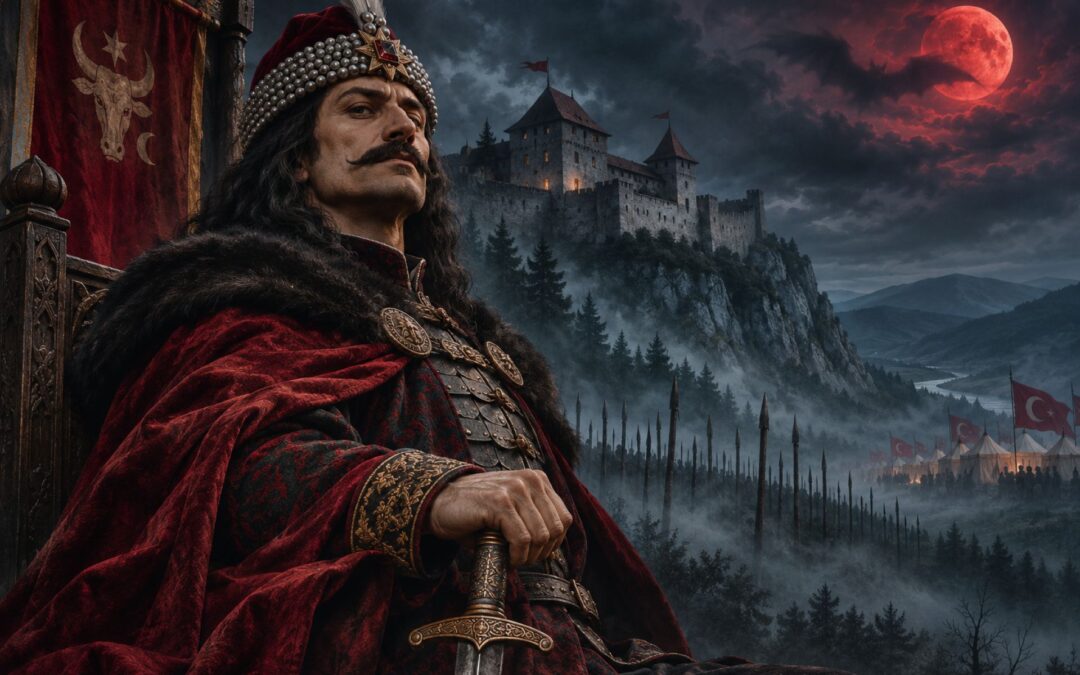
Long before Dracula became the world’s most recognizable vampire, the name belonged to a ruler whose actual life was violent enough without supernatural embellishment. Vlad III governed Wallachia, a principality in what is now southern Romania, during a period when the Ottoman Empire and the Kingdom of Hungary competed for influence across southeastern Europe. He fought both foreign enemies and domestic rivals, sometimes with unusual military skill and often with extraordinary cruelty.
To some contemporaries, Vlad was a dangerous tyrant who tortured merchants and noblemen. To others, he was an effective prince who resisted a vastly more powerful empire. Centuries later, his name became attached to Bram Stoker’s fictional Count Dracula, although the connection between the two is far thinner than popular accounts suggest.
Understanding Vlad the Impaler means following the unstable politics that produced him while asking a second question throughout: which stories about him come from historical evidence, and which were enlarged by political enemies, storytellers and modern imagination?
Wallachia, the Order of the Dragon, and Vlad’s Family
Wallachia occupied the territory south of the Carpathian Mountains and north of the Danube. Across the river lay lands increasingly controlled by the Ottomans; to the north and west, Hungary sought to keep the mountain passes and frontier approaches out of Ottoman hands. Wallachia was neither a modern nation-state nor simply a helpless strip of land waiting to be conquered. It had its own ruling dynasty, noble families, economic interests and capacity to negotiate, resist or change sides.
The expansion of the Ottoman Empire across the Balkans presented Wallachian rulers with a choice that was rarely permanent: pay tribute and accept an uneasy relationship with the sultan, or align with Hungary and risk Ottoman intervention. An alliance that sustained one prince might destroy his successor.
Wallachia’s succession rules created additional instability. Membership in the ruling House of Basarab gave several men plausible claims to the throne, and power was contested between rival branches, particularly the Drăculești and Dănești. The boyars, Wallachia’s landed aristocracy, could lend money, soldiers and political legitimacy to a candidate, but they could also withdraw their support. A ruler needed these elites even while fearing that they might replace him.
Vlad III’s father, Vlad II, had spent formative years under the protection and influence of Sigismund of Luxembourg, king of Hungary and later Holy Roman emperor. In 1431, Sigismund admitted him to the Order of the Dragon, a chivalric association created in 1408 to defend its members’ dynastic interests and the Christian faith, particularly against Ottoman expansion. The dragon became part of Vlad II’s political identity, giving him the name Dracul. His son used Drăculea, usually understood as “son of Dracul” or “son of the dragon.” Because the Romanian word drac later carried the sense of “devil,” the name acquired a darker resonance that its original dynastic use did not require.
Vlad III is traditionally said to have been born around 1431 in the Transylvanian town of Sighișoara, where his father was based while pursuing the Wallachian throne. His exact birth date, the identity of his mother and even some details of his earliest years remain uncertain. His known family circle included an older brother, Mircea, and a younger brother, Radu, who would eventually become a formidable political rival.
Vlad II secured the Wallachian throne in 1436 and moved his family to Târgoviște. The young Vlad would have learned court politics, riding, weapons and languages in a region where rulers negotiated across several worlds. That education was soon interrupted.
Two Brothers Held Hostage by the Ottomans
By the early 1440s, Vlad II’s attempt to navigate between Hungary and the Ottoman Empire had made him suspect to both. The Hungarian commander John Hunyadi was fighting Ottoman forces in Transylvania, while Sultan Murad II expected Wallachia to honour its obligations. In 1442, Vlad II was summoned into Ottoman territory and detained. He recovered his freedom through an agreement that left his two younger sons, Vlad and Radu, as hostages guaranteeing his future cooperation.
Vlad was probably around eleven years old and Radu several years younger. Hostage-taking sounds like an extraordinary act of parental betrayal, but it was an established instrument of medieval diplomacy. An overlord could secure a subordinate ruler’s loyalty by keeping a son at court, where the child served simultaneously as political leverage, honoured guest and potential future ally. His safety depended on choices made elsewhere.
The boys’ lives were not necessarily those of prisoners chained in a dungeon. Accounts place them within the Ottoman court’s system of princely supervision and education, associated at times with the fortress of Eğrigöz in Anatolia. They encountered Turkish and Persian court culture, religious instruction, logic, languages, horsemanship and military training. Such education was itself political: a prince who acquired Ottoman habits and relationships might eventually be a more dependable ruler of Wallachia than one raised entirely among its hostile factions.
Their reactions have often been described as perfect opposites. Radu adapted to the court, converted to Islam and developed a close relationship with the future sultan Mehmed II. He became known as Radu the Handsome and ultimately chose an Ottoman-backed path to the Wallachian throne. Vlad resisted Ottoman influence more openly and, according to later accounts, suffered punishments for insubordination. His later enemies would portray his violence as the natural result of his childhood, while sympathetic narrators would describe a boy learning the methods of his captors.
Both explanations exceed what the surviving evidence securely establishes. Scenes of Vlad studying impalements or promising revenge are storytelling devices, not recorded testimony. Ottoman authorities used harsh punishments, as did other states, but no particular witnessed execution can be proven to have caused Vlad’s later cruelty. Radu’s choice to stay does not establish cowardice either.
The pressure on the hostages increased as their father’s allegiances shifted. Wallachian forces became entangled in crusading campaigns against Murad, including the failed Christian offensive that ended at Varna in 1444. The boys’ presence at court made every reversal more dangerous, though neither was executed. Murad had reason to preserve both as useful claimants in Wallachia’s unpredictable succession struggles.
The decisive rupture came in 1447. Hunyadi backed a rival Wallachian claimant, Vladislav II, and Vlad II was killed amid the resulting political upheaval. Vlad’s older brother Mircea was captured by hostile boyars; accounts describe him being blinded and buried alive. The precise responsibility for every killing remains contested, but the destruction of the family government’s position is clear. Vlad, still a teenager, had lost the father whose loyalty his captivity was meant to guarantee and the brother who might otherwise have succeeded him.
Yet the Ottomans did not simply discard him. With Vladislav aligned with Hungarian interests, Murad could now support Vlad III as a rival prince. The hostage was becoming a candidate for the throne, aided initially by the same power he would later fight.
Exile and the Fight for the Wallachian Throne
Vlad’s first reign began in 1448, not 1456. While Hunyadi and Vladislav II were engaged in a campaign against the Ottomans, Vlad entered Wallachia with Ottoman backing and seized power. It exploited a moment of military distraction rather than a wave of national unity.
Vladislav survived and returned, forcing Vlad out after roughly two months. In exile, the young claimant faced a familiar problem: ancestry meant less than troops, money and diplomatic recognition. His Dănești rival held the throne while Vlad searched for a stronger patron.
He found temporary refuge in Moldavia, where he became associated with the household of Bogdan II and Bogdan’s son Stephen, later celebrated as Stephen the Great. Their connection was important but should not be romanticised into an unbroken lifelong alliance. Both were princes whose prospects depended on shifting regional politics, and each would later pursue interests that could conflict with the other’s. When Bogdan was murdered in 1451, their vulnerability became unmistakable once again.
Vlad moved through Transylvania, sometimes protected and sometimes threatened by the same networks of nobles and frontier commanders. His relationship with Hunyadi, the man associated with his father’s overthrow, eventually changed. Hunyadi needed an alternative to Vladislav, who was becoming too accommodating toward the Ottomans; Vlad needed Hungarian recognition and armed support. They could cooperate without forgetting the violence that had brought them into conflict.
The wider geopolitical stakes were rising. Mehmed II, who had become sultan in 1451, conquered Constantinople in 1453. The city’s fall ended the Byzantine Empire as a surviving state and gave the Ottoman dynasty an extraordinary imperial capital. As the history of Constantinople and its transformation into Ottoman Istanbul shows, the conquest was much more than a dramatic siege: it altered routes of trade, political legitimacy and the calculations of rulers across Europe. Hungary and its smaller neighbours had to confront an expanding empire with increased confidence and resources.
Hunyadi responded by strengthening Hungary’s southern defences. In 1456, Mehmed attacked Belgrade, a strategic fortress where the Sava joins the Danube. Hunyadi’s forces broke the siege in July, a major victory whose importance lay in preserving a crucial defensive position rather than permanently defeating Ottoman expansion. The campaigns of John Hunyadi on the Ottoman frontier also illustrate how difficult it was to hold together coalitions whose participants had different interests.
During this crisis Vlad moved against Vladislav II. Accounts differ about the precise circumstances of their confrontation, including later tales of single combat, but Vladislav was killed and Vlad secured the Wallachian throne in 1456. This second reign would last substantially longer than his first and provide the main foundation of his historical reputation.
Vlad’s return to power also changed the prospects of his former companion Stephen, who was seeking to recover his father’s Moldavian throne from Petru Aron. In 1457, Stephen advanced into Moldavia with support associated with Vlad’s position in Wallachia and defeated the forces opposing his claim. Stephen’s accession is conventionally dated to 12 April 1457, less than a year after Vlad had secured his own principality. Their shared experience of displacement had produced a politically useful partnership, and a friendly ruler in Moldavia offered Vlad the possibility of a more secure northeastern frontier. Yet this cooperation did not guarantee that either prince would sacrifice his territorial or diplomatic interests for the other.
What Vlad inherited, however, was not a quiet kingdom united behind a victorious heir. The boyars remained capable of supporting new claimants, foreign merchants defended privileges across the frontier, and both the Ottomans and Hungarians expected Wallachia to serve their strategic needs. Vlad had won the throne; holding it would require a different kind of struggle.
How Vlad Ruled Through Fear
For Vlad, a strong prince could not tolerate powerful nobles who treated succession as an opportunity to bargain for privileges. His father’s violent removal had demonstrated how quickly boyar factions could destroy a dynasty. Once in power, he tried to reduce their ability to control appointments, raise independent support for rivals or make foreign alliances without his consent.
His approach combined ordinary instruments of medieval rule with unusually visible coercion. Lands and offices could be transferred from opponents to supporters; fortifications could secure strategic routes; taxation and customs dues could strengthen princely revenue. He cultivated men who owed their advancement to him rather than to established aristocratic families. These policies were not modern egalitarian reforms. Replacing a privileged elite with dependants of the ruler served to concentrate power, not to abolish hierarchy.
The most famous account of this struggle describes an Easter feast in Târgoviște. Vlad allegedly invited boyars and their families, challenged them about the many rulers they had survived, then ordered the older guests impaled while younger captives were marched away to rebuild the fortress at Poenari. In popular versions, five hundred nobles are arrested in a single afternoon, with the surviving prisoners dying as forced labourers. The tale conveys genuine tensions between Vlad and his nobility, but its detailed staging and enormous numbers cannot be accepted without qualification.
Some retellings place the feast in 1457, while a hostile German narrative associates it with Easter 1459. Surviving documentation suggests a serious disruption among Vlad’s councillors, and historians have connected the story with the removal of opposition to his rule. Yet the banquet’s size is especially doubtful. The physical dimensions of the court setting and analysis of the narratives point to far smaller numbers than the famous five hundred; a reconstruction discussed by historian Dénes Harai suggests roughly forty to fifty impalements may be plausible for the episode. That remains an assessment of incomplete evidence, not a surviving list of victims.
Poenari, a fortress above the Argeș valley, became closely associated with Vlad’s efforts to strengthen defensible positions. The story of boyars being forced to build it belongs to the same tradition as the feast, and it is possible to explain the fortress’s military importance without accepting every detail of the prisoners’ supposed march. The distinction matters because a convincing narrative does not automatically become a contemporary record.
His conflict with Saxon towns and merchants offers firmer evidence of brutality. Brașov and other Transylvanian centres had commercial privileges and connections to Wallachian rival claimants. Vlad sought to control trade, punish those supporting his enemies and enforce his authority across disputed frontier territories. These struggles produced raids, executions and an increasingly hostile response among German-speaking merchants, some of whom would later help spread stories about his cruelty.
The evidence is disturbing enough without inflating it. In Harai’s reassessment of Vlad’s collective impalements, a documented episode from 1459 involves forty-one merchants from Brașov and Burzenland being impaled. That is different from later printed claims of hundreds or thousands killed in a single spectacle. The smaller number is not a defence of Vlad; it is the difference between evidence and sensational multiplication.
His name also became attached to tales of moral discipline. In one, thieves fear punishment so greatly that a valuable golden cup can be left at a public fountain untouched. In another, he invites beggars and the destitute to a feast, locks the doors and burns the building, supposedly eliminating poverty by murdering the poor. Other anecdotes describe punishments for dishonesty or sexual misconduct. Such stories reveal the image of a ruler whose justice was swift, theatrical and terrifying, but they are not equally reliable descriptions of events that can be dated and verified.
What emerges is not a sensible reformer whose severity happened to be misunderstood, nor a figure whose every attributed atrocity must be factual. Vlad used violence as an instrument of power, and impalement made that power visible. At the same time, political opponents had incentives to portray every act as more numerous and more grotesque than it was. Separating the two does not make his rule less troubling; it makes its actual workings more intelligible.
The War Vlad Provoked on the Danube
Wallachia’s relationship with the Ottoman Empire could not be settled by domestic terror alone. A ruler might accept tribute obligations when he needed peace and reject them when circumstances seemed favourable, but Mehmed II could not indefinitely overlook a frontier prince who challenged Ottoman authority. By the late 1450s and early 1460s, Vlad was moving toward open confrontation with the empire that had once supported his claim.
The precise sequence of missed tribute, diplomatic demands and armed incidents is complicated by conflicting accounts. A famous tale claims that Vlad had Ottoman envoys’ turbans nailed to their heads after they refused to remove them in his court. It captures the provocative image that circulated in later literature, but it should not be treated as a verbatim diplomatic record. What is clear is that tribute arrangements and the question of Ottoman influence over Wallachia had become increasingly contentious.
The confrontation sharpened around the Danube. Ottoman positions on its southern bank and fortified crossing points could support raids into Wallachia, while towns, river transport and agricultural supplies sustained military operations. Vlad understood that he could not win simply by waiting for an Ottoman invasion to develop. He needed to disrupt the infrastructure through which a much larger army could cross, concentrate and provision itself.
Accounts describe his ambush of an Ottoman party associated with Hamza Pasha and the use of deception to secure access to a fortified position around Giurgiu. His knowledge of Turkish language and Ottoman military habits was a valuable advantage. A commander who could understand orders, customs and the routines of an enemy garrison might achieve results that sheer force could not. Some versions embellish the deception into a perfectly scripted encounter, so the larger tactical principle is more secure than every detail of the performance.
During the winter of 1461–1462, Vlad’s forces raided along the Ottoman side of the Danube. They attacked settlements and fortified points, destroyed stores and transport capacity, and killed soldiers as well as civilians. The raids threatened Ottoman control while giving Vlad material he could present to Christian rulers as evidence of his commitment to resisting the sultan. They were also devastating to communities that happened to lie across the frontier, including people whose religion or political allegiance made them targets.
Vlad’s own letter to Matthias Corvinus in February 1462 offers unusually valuable evidence because it makes a claim from the campaign itself rather than from a much later legend. In surviving versions he boasts of more than twenty thousand people killed, including a familiar total of 23,884. That number cannot be quoted as an audited casualty count. Versions of the letter differ, and the subtotals within them do not even add up consistently. What the letter demonstrates securely is that Vlad wanted his campaign understood as extensive, deliberate and deserving of support.
The form of violence also matters. Those counted as killed in raids were not necessarily impaled, and the dead included noncombatants as well as Ottoman troops. Later retellings sometimes merge these categories into one tremendous number of men suspended on stakes. That creates an image more spectacular than the source itself and hides the different ways in which people died. A careful account must keep military deaths, civilian slaughter and exemplary executions distinct.
Mehmed faced pressures beyond personal revenge. A rebellious Wallachia could threaten Ottoman crossings and encourage resistance elsewhere in the Balkans; a successful punishment could warn neighbouring rulers against following Vlad’s example. Hungary’s intentions were uncertain, and western plans for a crusade raised the possibility, however remote, of a wider coalition. An Ottoman invasion could therefore reaffirm political authority even if Vlad’s small realm offered no great prize in itself.
Mehmed’s army size remains disputed: contemporary narratives often report immense forces, whereas modern estimates are more cautious. The imbalance in organised resources was nevertheless substantial. Vlad commanded local levies and experienced mounted troops, but an open battle risked annihilation. His response was to make the invading army pay for every mile.
The Night Attack and the Forest of the Impaled
Mehmed led his forces north toward Wallachia in 1462, supported by movement along the Danube and an Ottoman fleet. Vlad contested river crossings and tried to slow the advance, but he could not permanently keep the invaders south of the river. Once Ottoman units established themselves on Wallachian territory, the struggle became one of mobility, supplies and morale rather than a contest for a single fortified crossing.
Vlad’s forces evacuated people and animals from threatened settlements, destroyed or removed food supplies and sought to deny usable resources to the advancing army. The strategy is often called scorched earth, though the available accounts do not justify imagining that every farm, well and village in Wallachia was systematically destroyed. Even partial denial of provisions could place heavy burdens on an army whose horses needed fodder and whose soldiers needed food, clean water and rest.
Wallachia’s woods, marshes and difficult roads offered opportunities for small forces to harass a larger enemy. Mounted detachments struck patrols and columns, then withdrew before the Ottomans could turn superior numbers into decisive advantage. The resulting delay made orderly encampment and protection of supply lines essential for Mehmed. Such warfare imposed suffering on Wallachian civilians too: moving whole communities from their homes and destroying their stores could be militarily useful without being humane.
Some popular histories add a campaign of biological warfare in which Vlad supposedly sent plague victims into Ottoman camps and triggered mass deaths. The evidence does not sustain the detailed operation or its reported results as established history. Disease was a real threat in medieval armies, especially when heat, overcrowding and contaminated water strained their health, but a general disease risk should not be transformed into an authenticated, precisely planned plague attack.
Vlad’s most celebrated military operation was a night assault on the Ottoman camp, traditionally dated to the night of 16–17 June 1462. The attempted target was Mehmed himself. If the sultan could be killed amid confusion, the immense invading army might lose direction or break into disorder. Rather than defeat an empire’s soldiers individually, Vlad hoped to strike at the command that held them together.
Accounts suggest that Vlad’s familiarity with Ottoman language and procedure helped him understand the enemy camp. Stories of disguises, reconnaissance and troops moving through the darkness may preserve genuine aspects of surprise warfare, although their vivid details vary among narrators. The Wallachian assault caused confusion and casualties; some Ottoman soldiers may have attacked one another in the darkness. But the attempt to reach or kill Mehmed failed, and Vlad withdrew with the larger Ottoman force still in the field.
Even the date deserves care. The June 16–17 account is deeply embedded in popular history, but historians have challenged the chronology of the campaign. Sergiu Iosipescu’s study of the 1462 campaign proposes a different reconstruction of the night attack and places greater emphasis on subsequent fighting and the strategic importance of Chilia near the Danube’s mouth. This is a competing interpretation, not grounds for confidently substituting another precise date without explaining the disagreement.
The operation showed what made Vlad dangerous: knowledge of terrain, surprise, language and psychological pressure could briefly offset inferior numbers. By attacking the enemy’s command rather than seeking an open battlefield victory, he exploited vulnerabilities in an otherwise stronger army. The attack failed in its main purpose but became central to his reputation.
The most infamous spectacle followed as Ottoman forces approached Târgoviște. Instead of meeting a defending army drawn up for battle, they encountered a display of impaled corpses near the Wallachian capital. The sight entered Ottoman, Byzantine and later European narratives as evidence of Vlad’s ability to make enemies confront the visible consequences of opposing him. The scene was horrifying even to observers familiar with the violence of fifteenth-century war.
The number of bodies has become almost as famous as the display itself. The Byzantine historian Laonikos Chalkokondyles reported an extraordinary figure of around twenty thousand, which passed into countless retellings as a simple fact. But no surviving list of victims or independently counted set of stakes verifies that number. Many popular accounts also assume that all those displayed had been newly killed during the Ottoman advance, when a spectacle could include victims from earlier clashes and executions.
Harai’s 2025 study offers a substantially different estimate. Comparing exaggeration in specific narratives with cases for which smaller numbers can be reconstructed, he applies an estimated plausibility rate to the traditional total and proposes that roughly 1,600–1,700 people may have been impaled at Târgoviște. About a thousand to eleven hundred of those, in his reconstruction, can be connected to identifiable events in the historical record. This is a model-based estimate, not a newly discovered Ottoman census, and other scholars may question the assumptions used to derive it.
The revision does not turn the forest into an invention. An execution site with even a fraction of the legendary total would have constituted a shocking display of mass violence. Nor does it establish that Vlad killed only that number of people during his reign: victims of other punishments, warfare and raids belong to different evidentiary categories. What changes is our ability to distinguish the scale of one particular spectacle from a tradition that multiplied numbers to communicate terror.
Mehmed did not achieve the simple destruction of Vlad’s mobile forces that a conventional victory might have delivered. Nevertheless, describing the entire campaign as a decisive Wallachian triumph obscures what followed. Ottoman pressure survived the retreat of the sultan’s main force, and the invaders had a politically valuable alternative to Vlad waiting for his chance: his younger brother Radu.
Radu’s Victory and Vlad’s Arrest in Hungary
Radu had spent much of his life working within Ottoman political networks. By 1462, that experience made him a plausible alternative ruler of Wallachia, particularly for boyars who wanted to end the disruption associated with Vlad’s policies. Mehmed did not need to capture every Wallachian fortress himself if a rival claimant could win enough local support to make Vlad’s position untenable.
Radu’s claim offered continuity with the Drăculești family while promising a less confrontational relationship with the empire. For nobles frightened by confiscations, executions and military devastation, the advantages were immediate. Vlad’s coercive system had helped him suppress opponents, but it had also given those opponents reason to welcome a prince protected by Ottoman power. The contest was therefore a civil struggle over political survival, not just two brothers acting out incompatible personalities.
At the same time, Moldavian politics complicated any neat division between loyal Christian allies and Ottoman collaborators. Stephen the Great had benefited from earlier connections with Vlad, yet the two rulers disagreed over Chilia, the valuable fortified position near the Danube’s outlet to the Black Sea. During Vlad’s confrontation with Mehmed, Stephen attacked Chilia in 1462. How far his operations should be understood as cooperation with the Ottomans, fulfilment of other obligations or pursuit of Moldavian interests remains debated. The struggle for Moldavia under Stephen the Great explains why controlling Chilia mattered enough to override an otherwise useful political relationship.
By the latter part of 1462, Vlad was losing support in Wallachia. Radu’s growing following, reinforced by Ottoman power, threatened the alliances Vlad needed to govern. His night raids had made an invasion costly, but they could not force noble families to remain loyal once a viable successor was available. Tactical effectiveness and political durability were proving to be different achievements.
Vlad moved toward Hungary expecting assistance from King Matthias Corvinus, Hunyadi’s son. The king had received encouragement and resources for resistance to Ottoman expansion, and Vlad could present his own campaigns as evidence that the Christian frontier was still fighting. Yet Matthias arrested him in late 1462 instead of restoring him immediately to the Wallachian throne. Vlad then spent many years in Hungarian custody, including periods of relatively comfortable confinement.
Why Matthias chose arrest remains contested. Claims that Vlad had offered to betray Christian interests to the sultan circulated in incriminating letters, while later interpreters have argued that forged or politically manipulated correspondence helped Matthias justify his failure to undertake the anticipated campaign. The king also faced financial constraints and competing priorities in Central Europe. These explanations are not mutually exclusive, and the surviving evidence does not permit every accusation of forgery or every claim about the king’s intentions to be treated as proven.
The broader career of Matthias Corvinus shows the limits of reducing a Renaissance monarch’s diplomacy to either devotion or treachery. He was managing Hungary’s frontier, nobility, resources and ambitions at once. Vlad was valuable as an anti-Ottoman commander at some moments and politically inconvenient at others. His imprisonment completed the immediate reversal of fortune: the ruler who had defied Mehmed was now dependent on another king’s decisions.
Vlad’s Final Return and Uncertain Death
Vlad’s captivity in Hungary lasted for more than a decade, but it was not uniform. Accounts place him in or near royal centres including Visegrád and Buda, and his circumstances appear to have eased as the political situation changed. He entered Hungarian court society, converted to Catholicism according to the usual reconstruction and married into a family connected with Matthias. The image of a man chained continuously in a dark cell is as misleading as the notion that he remained a free royal guest throughout.
Events eventually made Vlad useful again. Radu died in the mid-1470s, while struggles among rival claimants and renewed Ottoman pressure kept Wallachia unstable. Stephen the Great, who had previously clashed with Vlad over Chilia, increasingly needed a Wallachian ruler willing to resist Ottoman influence along Moldavia’s southern frontier. Matthias Corvinus likewise had reasons to seek a dependable partner along the Danube. Their interests converged around restoring a prince who had once been both an ally and an inconvenient prisoner.
The restoration emerged from a wider campaign in 1476. During the summer, Matthias sent the Hungarian commander Stephen Báthory into Moldavia, where Stephen the Great was confronting an invasion led by Mehmed II. The Moldavians suffered a major battlefield defeat at Valea Albă, but the Ottoman campaign failed to remove Stephen from power. Hungarian–Moldavian military cooperation subsequently extended into Wallachia, where the allies sought to replace Ottoman-aligned rulers with Vlad.
Historian Liviu Cîmpeanu’s study of Stephen Báthory’s campaigns in Moldavia and Wallachia reconstructs this sequence of military operations. Rather than treating Vlad’s restoration as a sudden reversal of fortune, it places his return within a coordinated effort involving Matthias’s captain and Stephen’s Moldavian forces. The allied armies succeeded in restoring Vlad to the Wallachian throne late in 1476, fourteen years after he had lost it.
It was Vlad’s third reign, but victory in a military expedition did not establish lasting political security. His prolonged absence had weakened his local following, and Wallachian boyars had developed competing loyalties and interests under successive princes. Some preferred arrangements that offered protection through accommodation with the Ottoman court, while others had reason to fear Vlad’s return to the methods of his earlier government. Accounts also describe Moldavian soldiers remaining to support his position, although their precise number is uncertain. The Hungarian and Moldavian forces that helped install him could not permanently guarantee his authority.
He was killed soon afterward, probably in fighting around the turn of 1476–1477 against forces associated with an Ottoman-backed rival. Accounts differ about the exact place, date and circumstances. Some describe death in battle, others suggest assassination or confusion among his own men, and reports that his head was sent to the sultan are difficult to disentangle from later retelling. He was not a ruler whose end can be reconstructed minute by minute.
The burial site is equally uncertain. Snagov Monastery became associated with his tomb, and stories about an empty grave encouraged a satisfying connection with the vampire legend. Other locations, including Comana, have also been proposed. Neither an empty-tomb anecdote nor an attractive tourist tradition establishes that his body mysteriously disappeared. The prince’s political career ended in the ordinary, brutal uncertainty of medieval succession warfare; the stories surrounding his remains endured much longer.
How a Wallachian Prince Became Dracula
Vlad’s reputation began to separate from his life while he was still alive. German-speaking communities affected by his policies had strong reasons to condemn him, and stories of shocking punishments travelled through the same commercial and diplomatic networks that carried political news. Their audiences were not reading modern investigative histories. They encountered chronicles, poems, manuscript tales and, increasingly, printed works designed to persuade, entertain and display the extraordinary.
Printing helped make Vlad recognizable beyond Wallachia. German narratives described impalements, burnings and meals taken among corpses. Some incidents may be real; others repeat literary patterns in which a cruel ruler proves his character through an ingenious atrocity. These texts record Vlad’s growing reputation, but do not always establish the events they describe.
The relationship between these stories and Matthias’s political interests is particularly important. The king had imprisoned a commander whom supporters of anti-Ottoman action might have expected him to help. Describing Vlad as a monstrous tyrant or potential traitor could make his detention seem justified. That does not prove Matthias personally invented every lurid tale; hostile accounts circulated in multiple settings and some may predate the arrest. It does explain why political circumstances could encourage their transmission.
The stories were not uniform across Europe. German material often emphasised horrifying cruelty, whereas Russian traditions could portray Vlad as a severe ruler imposing order through terrifying but purposeful punishment. Neither body of writing is a transparent window into the prince’s court. As scholarship on the earliest Dracula tales and their competing portraits shows, medieval humour, political ideals and inherited storytelling conventions shaped the way cruelty was represented. The same ruler could function as a warning against tyranny or as an extreme example of firm government.
In Romania, Vlad has often been remembered as a defender against Ottoman domination, although this can obscure the suffering of his own subjects and frontier civilians. Western popular culture instead tends to reduce him to a sadist. Neither image fully explains a prince who resisted an empire while terrorising those whose support he needed.
The most consequential transformation came in 1897, when Irish author Bram Stoker published Dracula. His Count is an aristocratic vampire who leaves his Transylvanian castle to threaten Victorian Britain. The novel draws on Gothic fiction, folklore, anxiety about disease and invasion, and the author’s fascination with a world that seemed both old and unsettlingly modern. Yet the villain’s name was not invented from nothing.
During his research, Stoker read William Wilkinson’s An Account of the Principalities of Wallachia and Moldavia, published in 1820. Wilkinson supplied the name Dracula and the association with the word “devil.” Stoker incorporated the name into a novel whose character had already been developing through drafts, reading and imaginative work. He did not travel to Transylvania; his descriptions relied on travel books, maps and accounts of local beliefs.
Crucially, borrowing a name is not the same as adapting a life. The surviving notes do not show that Stoker constructed the Count’s personality or vampire habits around Vlad’s career of impalement. The Bram Stoker Estate’s examination of the sources behind the novel distinguishes what can be traced to Wilkinson and other reading from much later claims of a complete historical model. The close identification of the fictional Count with Vlad III was strongly popularised in the twentieth century, especially through accounts that treated a suggestive resemblance as definitive inspiration.
Even the castle illustrates the problem. Bran Castle, promoted widely through Dracula tourism, is not demonstrably the model for Stoker’s fictional stronghold or Vlad’s principal residence. Poenari has a more direct association with the Wallachian ruler, while Stoker’s castle belongs to a literary landscape assembled from different sources. A physical place can matter to modern memory without having the historical connection visitors expect.
Vlad used dynastic symbolism and terrifying punishment in a contest for power. Contemporaries turned those actions into stories serving different political interests. Stoker borrowed the name for a supernatural figure, and modern culture merged the prince, the vampire and Romanian landmarks into one image.
The real Vlad the Impaler was neither a fictional immortal nor a simple hero misunderstood by his enemies. He was a ruler who understood the vulnerabilities of a small state between powerful neighbours, won battles through opportunism and surprise, and tried to secure his throne through coercion that inflicted real suffering. His reputation grew from those actions but did not preserve them unchanged. Separating the man from the stories does not diminish the horror of his reign; it shows how power, propaganda and fiction can make one historical name carry several very different lives.
Last Updated on November 7, 2026 by Aseem Gupta