

Robin Sharma’s The 5 AM Club: Own Your Morning. Elevate Your Life. sounds, from its title, like a book built around one unusually specific recommendation: wake up at five in the morning. That recommendation is certainly real, and HarperCollins presents the book around the idea that early rising can improve productivity, prosperity, health, and serenity. Yet the book itself is considerably more ambitious. Sharma uses 5:00 a.m. as the entry point into a much larger philosophy about attention, discipline, craftsmanship, physical health, emotional healing, learning, recovery, love, character, service, and the finite nature of life.
It is also not written like a conventional productivity manual. Sharma delivers almost the entire system through a motivational fable about two struggling people who meet an eccentric billionaire and travel around the world learning his methods. That choice makes the book memorable and gives abstract ideas an emotional setting, but it also produces many of its weaknesses: exaggerated dialogue, implausible events, repeated slogans, archetypal characters, and a tendency to attach scientific or spiritual certainty to ideas that are often more useful as practical heuristics than as universal truths.
The central insight survives those excesses. The 5 AM Club works best when its title is interpreted less as a biological law and more as a symbol of deliberately protected time. Sharma’s strongest argument is that if people begin each day by strengthening their body, directing their attention, reflecting on their lives, and developing their abilities before reactive demands take over, they can gradually change both their performance and the kind of person they become.
Spoiler and content warning: This article discusses the entire book, including its ending. It also covers suicidal ideation, the suicide of a parent, physical threats and violence, serious illness, bereavement, and the death of a major character.
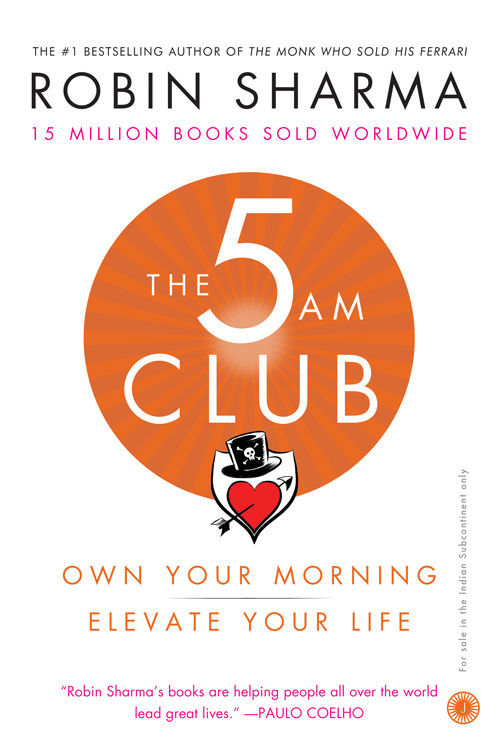
The 5 AM Club: Complete Story and Chapter-by-Chapter Summary
The story begins in crisis and gradually turns into an international apprenticeship. Sharma uses the entrepreneur, the artist, Stone Riley, and the Spellbinder as embodiments of different problems: achievement without inner stability, talent without discipline, success shaped by suffering, and wisdom transmitted through mentorship. The practical frameworks arrive piece by piece as those relationships develop, so understanding the complete book requires following both the story and the system it carries.
Chapters 1–4: Crisis, the Spellbinder, and the Mysterious Stranger
The first character readers meet is an unnamed technology entrepreneur in her late thirties. She has built an important company and achieved the kind of external success that usually anchors a self-help success story, but that identity is collapsing. Executives and investors she trusted are attempting to take control of the company, and the betrayal has destabilized her so severely that the book opens with her considering suicide.
The crisis is not merely financial or professional. The entrepreneur’s father had also died by suicide after losing his business, and the attempt to seize her company reactivates the fear, abandonment, shame, and instability associated with that earlier trauma. Sharma therefore begins by separating visible success from inner security. A person can be accomplished, wealthy, respected, and still psychologically unprepared for a severe rupture.
Instead of acting on her suicidal thoughts, the entrepreneur uses a ticket her mother has given her to attend a personal-optimization seminar. The speaker is an elderly teacher known as the Spellbinder, whose theatrical style immediately establishes the tone of the book. He speaks in sweeping declarations about unrealized potential, mediocrity, mastery, service, courage, distraction, discipline, and the tendency to settle for a diminished life.
The Spellbinder argues that many people possess abilities they never fully develop because they allow comfort, social conformity, fear, technology, shallow habits, and ordinary standards to determine their days. Greatness, in his vocabulary, is less a matter of inherited talent than of training oneself to express more of what one already possesses. The seminar functions as the philosophical overture for everything that follows.
The Spellbinder then collapses onstage, creating uncertainty about his condition and preventing the seminar from ending in the usual motivational-speaker manner. Afterward, the entrepreneur encounters another attendee, an unnamed artist. His problem differs from hers. He has real creative ambition and ability, but he has not converted his potential into disciplined, consistent production.
Where the entrepreneur has achieved extensively and lost her emotional center, the artist has failed to organize himself strongly enough to achieve what he believes he could. Their contrast allows Sharma to apply the same philosophy to two very different forms of dissatisfaction.
A third person soon joins them. He appears homeless: dishevelled, eccentric, poorly dressed, and physically unimpressive. Yet his language is strange for someone who appears destitute. He speaks comfortably about money, leadership, entrepreneurship, performance, and the Spellbinder, and he seems to know far more than either student expects.
The apparent contradiction between his appearance and knowledge becomes a test of perception. The entrepreneur and artist initially assess him through surface signals, while the stranger repeatedly pushes them toward ideas about depth, quality, humility, and mastery.
As these conversations continue, Sharma gives the entrepreneur more psychological dimension. The loss of her father, her fear of abandonment, her corporate betrayal, and the gap between her formidable public persona and private insecurity begin to form a coherent pattern. She has learned to build, defend, and achieve, but not necessarily to process pain.
The stranger also becomes less comic and more emotionally complex. His insistence on excellence sits beside ideas about generosity, service, loss, humility, and humanity. He is clearly not simply a motivational eccentric, and the story prepares the reader for the revelation that follows.
Chapters 5–7: Stone Riley, Mauritius, and the Apprenticeship Begins
The mysterious stranger makes the entrepreneur and artist an improbable offer. If they trust him, he will take them to his oceanfront home and teach them the morning practice that he credits with transforming his life. Their travel will be paid for, and the instruction will come directly from him.
Their hesitation is reasonable. They barely know him, his behavior is bizarre, and his outward appearance gives them little reason to believe he has the means to fulfill his promises. Nevertheless, both are dissatisfied enough with their current lives to accept the risk.
When they arrive before dawn for departure, the stranger’s real identity is revealed. A Rolls-Royce and private aircraft make clear that he is not homeless at all. He is Stone Riley, an enormously wealthy entrepreneur and one of the Spellbinder’s former students.
The contrast is deliberate. Riley explains that his neglected appearance was partly a way of preventing wealth from controlling his identity. Sharma wants him to embody a fantasy of integrated success: rich but supposedly unattached to riches, disciplined but playful, powerful but generous, physically vigorous, adventurous, widely traveled, curious, and free.
That fantasy will later create an important limitation in the book’s advice. Riley has a private aircraft, residences around the world, assistants, extensive control over his schedule, access to massages and coaches, and the ability to delegate at a level ordinary readers cannot reproduce. Nevertheless, inside the fable he serves as the proof that Sharma’s system can supposedly produce an extraordinary life.
Riley takes the entrepreneur and artist to Mauritius, where he owns an oceanside compound. There they discover that the Spellbinder survived his collapse and is Riley’s longtime mentor. The teacher explains that he began guiding Riley when Riley was thirty-three and helped him build not merely his business success but a broader philosophy of personal mastery.
One of the first frameworks introduced is the 2 × 3 × Mindset. Sharma’s formula is that people who want to double their income and impact should triple their investment in two areas: personal mastery and professional capability. The wording is characteristically exact, even though the numbers function more as rhetorical emphasis than empirical ratios.
The deeper logic is sounder than the equation suggests. Sharma is arguing that better outcomes require both a better-developed person and better-developed skills. Inner work without competence cannot produce world-class performance, while competence without emotional, physical, or ethical development creates a different kind of imbalance.
Health also enters the discussion. Riley refers to his experience with cancer and stresses the absurdity of accumulating wealth while neglecting the body required to enjoy or use it. This begins the book’s recurring correction of narrow ambition: achievement matters, but only within a larger life.
The entrepreneur also reveals more about the attempted corporate takeover and what it has done to her sense of identity. By this point, the apprenticeship has formally begun. Riley and the Spellbinder are no longer simply speaking in generalities; they are preparing the two students to adopt a specific system.
Chapters 8–10: The 5 AM Method, Granularity, and the Four Focuses
The formal morning training begins in Mauritius. Riley now appears transformed from the shabby man at the seminar. He is groomed, athletic, alert, and energized before sunrise, reinforcing the idea that his earlier appearance was a chosen disguise rather than evidence of disorganization.
His central recommendation is to treat 5:00–6:00 a.m. as the Victory Hour. This hour should be protected from messages, news, social media, workplace demands, and the expectations of other people. Its purpose is not to begin ordinary work earlier but to develop the person who will do that work later.
The artist describes a vivid dream about childhood creativity and the expansive possibilities he felt before adulthood narrowed his imagination. Sharma uses the dream to reinforce one of the book’s recurring ideas: much of what people call realism is learned limitation. The adult artist has not lost his creativity so much as buried it beneath insecurity, distraction, and inconsistent practice.
At the same time, the relationship between the artist and entrepreneur is changing. Their initial companionship develops into romantic attraction, and the emotional storyline becomes increasingly important as Sharma broadens success beyond professional achievement.
Riley next introduces the 3 Step Success Formula:
Better daily awareness → better daily choices → better daily results.
The important concept here is granularity. Elite practitioners, Sharma argues, notice details that average practitioners overlook. They understand their craft at a finer resolution, make more precise distinctions, and therefore improve things that others do not even perceive.
This attention to small distinctions creates what Riley calls a Gargantuan Competitive Advantage. The label is exaggerated, but the principle is straightforward: when superficial work becomes common, depth itself becomes differentiating. Great chefs, artists, entrepreneurs, athletes, and craftspeople often become exceptional not because they know one magical secret but because they repeatedly notice and improve details that others accept.
Chapter 10 then introduces one of the book’s most important frameworks: the 4 Focuses of History-Makers.
The first is Capitalization IQ. Sharma distinguishes natural potential from the ability to develop and express that potential. A talented person who never trains can be overtaken by someone with less obvious initial ability but greater discipline, coaching, practice, and consistency.
The second focus is Freedom from Distraction. Riley attacks the contemporary habit of allowing phones, notifications, social media, shallow browsing, constant news, and low-value communication to fracture attention. The problem is not merely wasted minutes. Repeated interruption changes the quality of thinking available for difficult work.
The third focus is Personal Mastery Practice, built around the Four Interior Empires: Mindset, Heartset, Healthset, and Soulset. Mindset concerns beliefs and habitual thought. Heartset concerns emotion, pain, wounds, and the feelings that rational thinking alone does not erase. Healthset concerns physical energy and the body. Soulset concerns meaning, values, character, spirituality, and connection beyond ego.
This is one of Sharma’s more useful distinctions because it explicitly rejects the idea that positive thinking alone solves human problems. Someone can intellectually understand a better way to live while remaining trapped by unresolved emotional pain, poor physical condition, or a lack of meaning.
The fourth focus is Day Stacking. A good life, Riley argues, is built through individual days rather than abstract intentions. Small daily improvements accumulate, and tiny degradations do the same. The idea brings the book back to its central interest in routine: transformation is presented not as one giant decision but as the repeated architecture of ordinary days.
Sharma also introduces neurological language to explain why the early morning supposedly provides unusual creative power. He invokes reduced activity in parts of the prefrontal cortex, flow, neurotransmitters, and transient hypofrontality. Those claims matter because they move the book from motivational prescription into scientific explanation, and they require more careful evaluation later than Riley gives them in the story.
Chapters 11–13: Love, Habit Formation, and the 20/20/20 Formula
After several chapters of structured teaching, Chapter 11 slows the instruction and shifts attention toward experience. The entrepreneur and artist sail together, and the entrepreneur reconnects with forms of aliveness that disappeared while she was building and defending her company.
The chapter matters because it challenges the simplistic idea that productivity is the book’s ultimate goal. The entrepreneur begins to see how achievement had become both identity and refuge. Success gave her status, but it also allowed her to avoid parts of herself that were more vulnerable.
Her relationship with the artist deepens, and the corporate betrayal starts to lose its ability to define her entire emotional world. She still needs to respond to the people trying to take her company, but revenge is no longer the only imaginable response. She begins considering what adversity should make of her rather than only what it has taken from her.
The teaching then moves to India, where the Taj Mahal becomes a symbol of sustained effort, craftsmanship, devotion, and the long time horizon required for significant work.
Here Riley introduces the 5-3-1 Creed of the Willpower Warrior. It consists of five supposed scientific truths, three values, and one general theory.
The five truths are that willpower can be trained; discipline behaves somewhat like a muscle; willpower can fatigue and therefore needs recovery; habits become automated through a repeated sequence; and improvement in self-control can spill into other areas of life. The book presents these claims with considerable confidence, although the scientific strength of each one is not equal.
The three values are more behavioral than scientific. Sharma argues that victory requires consistency and persistence, that doing what one says one will do increases self-respect, and that private practice predicts public performance. In other words, identity is built partly through repeated evidence that a person can trust themselves.
The single theory is that deliberately doing difficult but important things strengthens discipline. Riley recommends Strengthening Scenarios such as cold showers and other forms of voluntary discomfort. The purpose is not suffering for its own sake but practicing action when immediate comfort points in the opposite direction.
The book then introduces the Lifetime Habit Arc:
Trigger → Ritual → Reward → Repetition.
A cue initiates behavior, the behavior itself becomes the ritual, a reward reinforces it, and repetition gradually makes the pattern more automatic. Sharma’s emphasis is that installing a habit requires designing the full loop, not simply announcing an intention.
The more famous framework is the Habit Installation Protocol, divided into three 22-day stages. Days 1–22 are Destruction, when the old pattern resists being displaced. Days 23–44 are Installation, when the new behavior remains effortful and unstable. Days 45–66 are Integration, when the behavior supposedly becomes increasingly automatic.
Around Day 66 comes what Sharma calls the Automaticity Point. This figure has a real research origin, but the book presents it too rigidly. The study that popularized the 66-day number found an average-like central tendency within a much wider range rather than a universal deadline, a point that becomes important when evaluating the system.
The journey then moves to Rome, where Riley finally reveals the practical method at the center of the title: the 20/20/20 Formula.
From 5:00 to 5:20, the reader should Move. Sharma recommends vigorous exercise that raises the heart rate and produces sweat. The goal is to wake the body, increase energy, reduce stress, and begin the day in a physically activated state.
From 5:20 to 5:40, the reader should Reflect. Possible activities include journaling, meditation, prayer, gratitude, planning, contemplation, and quiet thinking. This pocket is designed to prevent the day from beginning in pure reaction.
From 5:40 to 6:00, the reader should Grow. The reader studies, reads, reviews goals, listens to educational material, or develops knowledge and capability. Sharma’s principle is that daily learning compounds in the same way daily neglect does.
His own explanation of the 20/20/20 Formula presents Move, Reflect, and Grow as mutually reinforcing parts of the morning rather than three unrelated habits.
The chapter also develops a Journaling Habit Deconstruction. Sharma uses journaling for several purposes: increasing self-awareness, recording gratitude, capturing lessons, tracking progress, processing painful emotions, clarifying confusion, planning goals, preserving meaningful experiences, revisiting happy moments, and generating creative insight.
Riley becomes more emotionally exposed here as well. He speaks about his late wife, Vanessa, whose death continues to shape him. His extreme work ethic and elaborate lifestyle are revealed partly as attempts to live around grief that he has never fully escaped.
His health is also deteriorating. The mentor who presents himself as a model of vitality is visibly becoming sick, creating a tension the final chapters will resolve. Sharma is gradually shifting the story away from the fantasy that discipline defeats mortality and toward the harder question of what discipline is for when mortality cannot be defeated.
Chapters 14–16: Sleep, Lifelong Genius, Recovery, and Joy
Chapter 14 corrects one of the most dangerous possible readings of the title. Sharma does not recommend waking at five by simply sleeping less. Instead, he argues that early rising requires a deliberately designed evening.
The Pre-Sleep Ritual of Iconic Producers begins around 7:00–8:00 p.m., with the last meal and a reduction in digital stimulation. From roughly 8:00–9:00 p.m., Sharma recommends meaningful conversation, reading, meditation, educational listening, recreation, or other calming activities. The final hour before sleep should prepare the environment for rest: a dark, cool bedroom, minimal technology, preparation of morning exercise clothes, and gratitude.
The exact clock times should not be confused with medical law. What matters inside Sharma’s system is that waking early is paired with sleeping early enough to preserve recovery.
The same chapter introduces the Amazing Day Deconstruction, which demonstrates just how far the book has expanded beyond its title. The ideal day begins with the 20/20/20 Victory Hour, includes family or personal time before exposure to news and social media, reserves prime mental energy for high-value work, pushes lower-value administrative activity later, includes another physical or recovery period, uses travel for learning, and protects the evening for relationships, reflection, and sleep.
The morning routine is therefore only the opening move in a full-day design. Sharma wants attention, work, exercise, learning, recovery, and relationships to occupy deliberate places rather than competing randomly.
Chapter 15 moves the narrative to São Paulo. By now, the entrepreneur and artist intend to marry, and Brazil matters personally because of the entrepreneur’s connection with her father.
The corporate conflict also becomes much more melodramatic. The couple face direct threats and violence connected to the effort to remove the entrepreneur from her company. The sequence demonstrates her increased courage, but it also exposes the limitations of Sharma’s fable style. What began as a plausible professional betrayal becomes an international danger plot in which Riley’s wealth, contacts, and influence can help solve problems far beyond the reach of ordinary self-management.
Riley then introduces the 10 Tactics of Lifelong Genius, extending the morning philosophy into an operating system for the workday.
The first is The Tight Bubble of Total Focus: protect attention aggressively from distractions, low-value meetings, shallow digital activity, and unnecessary accessibility.
The second is The 90/90/1 Rule: for ninety days, devote the first ninety minutes of the workday to the single project with the greatest potential value. The goal is to ensure that the most important work receives the best mental energy rather than whatever remains after email and administration.
The third is The 60/10 Method: perform focused work for approximately sixty minutes, then recover for roughly ten. Sharma wants oscillation between intensity and renewal rather than hours of deteriorating concentration.
The fourth is The Daily 5 Concept: identify and complete five meaningful accomplishments each day. The arithmetic matters less than the practice of converting long-term ambition into specific daily wins.
The fifth is The 2nd Wind Workout: add another exercise or movement session later in the day. The book treats physical activity not only as a health practice but as a way of restoring mental energy.
The sixth is The 2 Massage Protocol: receive two massages per week. This is one of the clearest examples of Riley’s billionaire lifestyle being translated too directly into general advice. Recovery matters, but the prescription is expensive and accompanied by biochemical claims more precise than the evidence presented in the book can justify.
The seventh is Traffic University: use commuting or travel time for education through audiobooks, lectures, or other learning materials. This can transform unavoidable time into development, although applied rigidly it also risks turning every unstructured moment into another productivity project.
The eighth is The Dream Team Technique: delegate or outsource tasks that do not require one’s distinctive abilities. The core principle is sensible for leaders, but the degree to which it can be applied depends heavily on money, authority, and organizational support.
The ninth is The Weekly Design System: use a weekly planning ritual, ideally on Sunday, to design the coming week rather than entering it reactively. Sharma calls this creating a “Blueprint for a Beautiful Week.”
The tenth is The 60 Minute Student: devote approximately an hour each day to deliberate learning. This continues the Grow pocket beyond the Victory Hour and makes lifelong education a permanent part of the system.
The artist also expresses his love for the entrepreneur through his poem “May We Never Say Goodbye.” Their relationship has now become an important counterweight to the achievement story. They are not simply becoming more productive; they are constructing a shared life.
In Chapter 16, now in Franschhoek, South Africa, Riley introduces the Five Assets of Genius: mental focus, physical energy, personal willpower, original talent, and daily time. Each is limited, can be squandered, and must be protected.
He then presents the Twin Cycles of Elite Performance. The High Excellence Cycle is the period of deep effort, creation, training, and output. The Deep Refueling Cycle is the period of substantial recovery. Elite performance, Sharma argues, requires oscillation between the two.
This is a major development in the philosophy because it prevents The 5 AM Club from being reducible to “work harder.” Riley’s system ultimately says that periods of disciplined intensity require equally deliberate recovery.
The idea resembles athletic periodization and supercompensation: stress creates adaptation only when followed by enough recovery. Sharma extends the analogy into creative and professional life, arguing that endless pressure eventually destroys the very capacities on which excellent work depends.
Riley also introduces Joy as a GPS. Instead of treating life only as a sequence of performance metrics, readers should notice which people, places, activities, and forms of work make them feel vividly alive. Joy becomes information about how a life should be designed, even though Sharma sometimes pushes the idea further into spiritual claims about intuition and destiny.
The chapter concludes with the 11 Billionaire’s Maxims, which summarize Riley’s broader worldview. The first says that creating extraordinary things in the world requires cultivating one’s inner life. The second recommends collecting meaningful experiences rather than treating material possession as the ultimate measure of success.
The third argues that failure can increase fearlessness by proving that survival is possible after setbacks. The fourth says that properly using one’s internal power can transform lived reality. The fifth advises readers to avoid people whose negativity, dishonesty, or destructive behavior consistently degrades them.
The sixth claims that money is the fruit of generosity rather than scarcity. At its most useful, this can be read as a warning against living from fear and hoarding every resource; taken literally as an explanation of wealth and poverty, it becomes an unjustifiably individualistic economic and moral claim.
The seventh maxim emphasizes health as a prerequisite for using one’s abilities. The eighth urges continually raising personal standards toward world-class performance. The ninth treats deep love as a major source of joy.
The tenth says that “heaven on earth” is a state rather than a place, shifting decisively into spiritual philosophy. The eleventh argues that tomorrow is a bonus rather than a right, preparing the story for Riley’s approaching death.
His physical deterioration is now impossible to ignore. He coughs blood, and the reader understands that the mentor who has spent the book discussing vitality, mastery, and longevity is not going to escape mortality.
Chapter 17 and Epilogue: Robben Island, Heroism, Legacy, and Stone Riley’s Death
The final teaching takes the group to Robben Island, the prison where Nelson Mandela spent many years during apartheid. Sharma uses Mandela as the moral centerpiece of the conclusion: a person subjected to profound injustice can allow suffering to harden into bitterness or transform it into character, forgiveness, endurance, and service.
The Spellbinder returns and presents the Heroic Human Circle, organized around seven virtues: bravery, forgiveness, integrity, understanding, sincerity, politeness, and humility. The system that began with a morning routine is now explicitly ethical.
The students’ next destination, the Spellbinder explains, is not another geographic location. It is the Territory of Legacy. The question is no longer how to wake up earlier, perform better, or make more money. It is what kind of human being those practices create and what that human being contributes.
Leadership becomes less about status and more about example. Success becomes less about possession and more about usefulness. Discipline becomes valuable not simply because it produces output but because it can make someone more capable of serving people and remaining principled under difficulty.
The book closes its formal teaching by returning to the refrain that has accompanied the journey: own the morning and elevate life. By this point, the phrase has acquired a meaning much broader than time management.
The epilogue jumps five years forward and reveals the final outcome of Riley’s illness. A few months after the Robben Island lesson, Stone Riley dies peacefully in his sleep in a small apartment in Rome. His daughter and the Spellbinder are with him.
Riley had been suffering from a rare incurable disease that he disclosed only to the Spellbinder. The secrecy explains his deteriorating health and gives retrospective meaning to his increasingly urgent discussions of joy, recovery, love, mortality, and legacy.
Before dying, he liquidates his business interests and gives the proceeds to charity. The billionaire who spends much of the book teaching achievement ultimately refuses to make accumulated wealth his final monument.
He leaves his Mauritius property to the entrepreneur and artist. The estate matters, but the more important inheritance is the system itself. They have become the next generation of teachers.
Five years later, the entrepreneur has transformed her company into an iconic business and remains successful without allowing it to consume her identity. She runs marathons, gardens, and volunteers at a homeless shelter. Sharma presents her final life as an integration of performance, health, service, and emotional stability.
The artist has overcome the inconsistency that once kept his ability unrealized. He has become a celebrated painter, also runs marathons, and retains the eccentricity that distinguished him from the entrepreneur.
They have a son named Stone, making Riley’s influence literal within the family. The name symbolizes the continuation of mentorship across generations.
The couple still practice the 5 AM method and pass its principles to others. The Spellbinder remains alive and teaching, so the mentor lineage continues even after Riley’s death.
The ending therefore completes a movement that the title alone cannot communicate. The book begins with one person contemplating death because her external identity is collapsing. It ends with another person actually dying after giving away his wealth, having taught his students to construct lives that are fuller than achievement alone.
How the 5 AM System Actually Works
Once the fable is stripped away, Sharma’s system is easier to understand. The morning routine is the foundation, but it depends on several surrounding ideas: deliberate habit installation, control of attention, continual skill development, emotional and physical maintenance, and the compounding effect of repeated days. The practical value of the book lies less in any one slogan than in how these elements reinforce one another.
The Victory Hour and the 20/20/20 Formula
The Victory Hour is Sharma’s answer to reactive living. Instead of beginning the day by receiving information, responding to other people, or immediately entering work demands, the reader begins by investing in personal capacity.
The Move pocket uses physical exercise to create alertness and energy. The Reflect pocket makes space for thought before the day becomes noisy. The Grow pocket ensures that learning and deliberate improvement occur every day rather than being postponed indefinitely.
The sequence is important. Sharma does not tell readers to wake at five and immediately open a laptop. He wants the first hour devoted to the person who will later perform the work.
That gives the formula broader relevance than its clock time suggests. Someone who cannot sustainably wake at 5:00 a.m. can still preserve the architecture: begin a protected period with movement, reflection, and learning before entering the most reactive portion of the day.
The formula is also designed around different dimensions of development. Move primarily targets the body; Reflect targets attention, emotion, and intention; Grow targets knowledge and skill. In that sense, it is a compressed daily version of the book’s larger philosophy.
Habit Installation: Trigger, Ritual, Reward, Repetition, and the 66-Day Protocol
Sharma recognizes that enthusiasm is not the main obstacle to change. People often begin new routines intensely and then abandon them when novelty disappears. The Habit Installation Protocol attempts to prepare readers for that predictable decline in motivation.
The Trigger → Ritual → Reward → Repetition sequence explains habit development as a loop. A cue initiates behavior, a ritual follows, some form of reward reinforces it, and repetition increases the likelihood that the sequence will recur with less conscious effort.
The three 22-day phases are meant to normalize difficulty. During Destruction, the old routine pushes back. During Installation, the new routine is becoming more familiar but remains effortful. During Integration, the reader increasingly experiences the behavior as part of normal identity.
This model is motivationally useful because it tells readers not to interpret early discomfort as evidence that the routine is wrong. Its scientific precision is another matter.
The habit-formation study associated with the widely repeated 66-day figure found that automaticity developed at very different rates depending on the person and behavior. The often-cited 66 days was not a universal minimum, and observed times varied dramatically. Sharma’s three equal 22-day phases are therefore best understood as a coaching structure, not established stages of habit formation.
The same distinction matters for the 5-3-1 Creed of the Willpower Warrior. Practicing difficult behavior can certainly build confidence, competence, and tolerance for discomfort. Yet Sharma’s description of willpower as a muscle draws on a classic self-control model whose strongest version has faced substantial empirical problems.
A large preregistered multi-laboratory replication of ego depletion found a very small pooled effect with uncertainty spanning essentially no effect. That does not mean self-control is imaginary or that routines do not help. It means the metaphor of a finite willpower resource that predictably depletes like a muscle is much less settled than the book suggests.
The most defensible part of Sharma’s habit system is behavioral rather than neurological. Decide what behavior matters, create a reliable trigger, make repetition easy to recognize, expect resistance, continue long enough for the routine to become familiar, and build self-trust by doing what you said you would do.
Granularity, Capitalization IQ, and the Four Focuses of History-Makers
The concept of granularity is one of the book’s strongest contributions because it explains why disciplined time alone is insufficient. Someone can work many hours while remaining mediocre if they never learn to perceive their craft at a finer level.
Granularity means noticing distinctions other people do not notice. A painter sees subtleties of composition and color. A writer notices rhythm, structure, argument, and diction. A leader notices patterns in incentives, talent, execution, and communication. Expertise often consists partly of this increasingly detailed perception.
The 3 Step Success Formula follows naturally. Greater awareness creates the possibility of better choices, and repeated better choices can produce better results. The formula is simplistic if treated as a complete theory of success, but it works as a model of skill improvement.
Capitalization IQ adds another layer. Sharma repeatedly distinguishes what a person could become from what they actually develop. Potential has no automatic value. It becomes meaningful only through practice, learning, coaching, execution, and sustained effort.
Freedom from Distraction protects the conditions needed for that development. Constant switching may feel like busyness, but it makes high-resolution thinking difficult. The Tight Bubble of Total Focus and 90/90/1 Rule later operationalize the same idea.
Personal Mastery Practice then broadens performance beyond cognition. The person doing the work brings emotional history, physical condition, beliefs, and values into that work. Sharma’s Four Interior Empires provide a language for developing those dimensions separately.
Finally, Day Stacking explains the time scale. Exceptional work and healthier lives rarely emerge from one dramatic week. They arise from repeated days in which attention, practice, recovery, and choices become slightly more aligned.
The Four Interior Empires and the 2 × 3 × Mindset
The Four Interior Empires correct one of the most common weaknesses in motivational thinking: the assumption that changing thoughts is enough.
Mindset involves beliefs, interpretations, and habitual cognitive patterns. It matters because what people expect and believe influences what they attempt, tolerate, and notice.
Heartset addresses emotion. Someone can intellectually believe that they are competent while still reacting from shame, grief, resentment, or fear. The entrepreneur is Sharma’s clearest example: she is objectively successful but emotionally destabilized by unresolved trauma.
Healthset concerns physical capacity. Energy, sleep, fitness, nutrition, and recovery affect the ability to think, regulate emotion, and perform.
Soulset is Sharma’s broadest and least empirically defined category. It includes values, moral character, meaning, spirituality, connection, and a sense of living for something larger than ego.
The 2 × 3 × Mindset links inner work to external competence. A person who wants greater impact should invest more deeply in personal mastery while also becoming better at the actual craft. The formulation is useful precisely because it refuses the idea that psychological development can substitute for skill or that professional skill can substitute for a functioning human being.
The 10 Tactics of Lifelong Genius and the Full-Day Productivity System
The 10 Tactics matter because they reveal that Sharma is not primarily prescribing an alarm time. He is designing a full attention economy around high-value work, learning, exercise, planning, delegation, and recovery. Some tactics are broadly accessible, while others assume significant control over time and money.
The Tight Bubble of Total Focus is the foundation. Sharma recommends deliberately limiting interruption, low-value communication, digital noise, and unnecessary accessibility. In a culture where immediate responsiveness is often confused with usefulness, this principle remains powerful.
The 90/90/1 Rule directs the first ninety minutes of the workday, for ninety consecutive days, toward the single most important project. The exact ninety-day period is arbitrary as a universal rule, but the logic is strong: strategic work should receive prime cognitive energy before inboxes and meetings consume it.
The 60/10 Method adds recovery within the workday. Intense concentration is followed by a brief break rather than being stretched until quality collapses. The principle anticipates the larger Twin Cycles framework: excellence depends not only on pressure but on alternating pressure with renewal.
The Daily 5 Concept translates ambition into manageable units. Five meaningful daily wins create a tangible definition of progress. The number itself is less important than the practice of identifying what successful completion of a day actually means.
The 2nd Wind Workout uses another period of movement to restore physical and mental energy. For some people this may mean a genuine workout; for others a walk or mobility session will be more realistic.
The 2 Massage Protocol is much harder to universalize. Regular massage may be enjoyable and useful for recovery, but two professional massages every week require money and time that many readers do not possess. The tactic illustrates a broader flaw in Riley’s teaching: practices from a billionaire’s lifestyle are sometimes presented as if the only obstacle to adopting them were commitment.
Traffic University encourages turning commuting or travel into learning time. Used selectively, this is practical. Used dogmatically, it risks eliminating the unstructured mental space in which people rest, observe, daydream, or simply stop optimizing themselves.
The Dream Team Technique recommends outsourcing or delegating low-value activities so that more attention can go to distinctive work. The underlying idea is economically rational, but its applicability varies dramatically. A senior executive may delegate administration; a junior employee, parent, student, or low-income worker may have far fewer choices.
The Weekly Design System is one of the most adaptable tactics. Reviewing obligations, goals, relationships, exercise, important projects, and recovery before the week begins reduces the number of decisions made reactively.
Finally, The 60 Minute Student institutionalizes lifelong learning. Sharma wants education to continue after formal schooling and to become a daily discipline. An hour may be unrealistic for everyone, but the principle that skill development should have protected recurring time is consistent with the book’s broader argument.
Taken together, these tactics create a hierarchy. Protect attention first, give the best hours to the most valuable work, define concrete daily wins, maintain energy, continue learning, delegate where possible, and design the week intentionally. The system becomes much more useful when the exact numbers are treated as templates rather than laws.
Sleep, Recovery, and the Twin Cycles of Elite Performance
A common criticism of early-rising culture is that it glorifies waking early without asking when people go to bed. Sharma avoids the worst version of that mistake by giving sleep and recovery substantial attention. His solution is prescriptive in its timing, but the broader principle is essential: waking earlier is beneficial only if it does not become chronic sleep deprivation.
The Pre-Sleep Ritual and the Amazing Day
The Pre-Sleep Ritual treats the evening as preparation for the morning. Meals, digital stimulation, conversation, reading, relaxation, environment, and bedtime are deliberately structured so that the next day begins from recovery rather than exhaustion.
This part of the book aligns with a much firmer evidence base than the claim that exactly 5:00 a.m. is uniquely powerful. A professional consensus recommendation on adult sleep emphasizes the importance of obtaining adequate sleep regularly for health and functioning.
Sharma’s concern about bright digital devices near bedtime also has support. In a controlled crossover study of evening light-emitting e-reader use, participants exposed to the devices experienced delayed circadian timing, suppressed melatonin, longer sleep latency, and reduced next-morning alertness compared with reading printed material.
That does not validate every exact hour in Sharma’s schedule. It supports the more general advice to protect evening conditions that facilitate sleep.
The Amazing Day Deconstruction then places the Victory Hour within a much larger architecture. Morning self-development leads into family or personal time, concentrated work, administrative work, physical renewal, learning, evening relationships, digital reduction, and early sleep.
The most revealing point is that Sharma’s ideal day is not dominated entirely by work. The finished system allocates substantial space to physical health, family, learning, rest, and reflection. Its ambition is lifestyle design rather than maximal labor.
The Five Assets of Genius and High Excellence/Deep Refueling Cycles
The Five Assets of Genius are mental focus, physical energy, personal willpower, original talent, and daily time. Sharma treats them as finite resources that can be invested intelligently or dissipated on low-value demands.
The idea is strongest when applied to attention and time. A person does not possess unlimited high-quality concentration. Using the clearest hours on low-value communication has an opportunity cost even if the total hours worked remain the same.
The High Excellence Cycle describes periods of intense creation, execution, training, and output. The Deep Refueling Cycle describes periods of restoration. Sharma’s point is that one cannot be sustained without the other.
This is a significant correction to the productivity genre’s temptation toward endless escalation. The book repeatedly praises extreme standards, yet its mature system says that sustainable excellence requires leaving the performance mode completely enough to restore the capacities on which performance depends.
The athletic analogy of training followed by recovery is persuasive as an organizing metaphor, though it should not be mistaken for evidence that all cognitive work responds to precisely the same physiological mechanism. The practical insight remains strong without that overextension.
Joy as a GPS and the 11 Billionaire’s Maxims
Joy as a GPS marks another change in the book’s definition of achievement. Earlier chapters often sound as though greatness means relentless practice. By Chapter 16, Riley is asking a different question: what forms of life actually make a person feel alive?
That shift matters because the entrepreneur’s original problem was not lack of accomplishment. She already had enormous accomplishment. Her crisis exposed the inadequacy of a life in which achievement had become the dominant source of identity.
The 11 Billionaire’s Maxims summarize the final Riley philosophy. Cultivate inner character before trying to create extraordinary external results. Prefer transformative experiences to endless accumulation. Let failure increase courage rather than become proof of inadequacy. Use personal agency instead of surrendering automatically to circumstances.
Avoid chronically destructive people. Treat generosity rather than fear as a healthier orientation toward money. Protect health because accomplishment has little value when the body collapses. Continue raising standards where mastery genuinely matters.
Prioritize deep love. Understand fulfillment as an internal condition rather than something guaranteed by geography or possession. Remember that another day is never promised.
Several of these are psychologically or ethically useful. Others become questionable when Riley moves from metaphor to causation. The claim that money follows generosity rather than scarcity, for example, can encourage a healthy non-hoarding mentality, but it becomes misleading if used to explain structural poverty, inequality, discrimination, market conditions, illness, family obligations, or simple economic bad luck.
Similarly, “Joy as a GPS” is helpful when it means paying attention to what produces genuine vitality and meaning. It becomes less defensible when intuition is treated as inherently superior to careful reasoning or as evidence that the universe is arranging outcomes.
The later chapters are therefore where the book’s greatest maturity and greatest overreach coexist. Sharma expands productivity into joy, love, mortality, and service, but he also increasingly blends behavioral advice with metaphysical certainty.
Characters, Relationships, and the Motivational Fable
The characters in The 5 AM Club are not designed with the psychological subtlety expected from a literary novel. They are archetypes built to carry different aspects of Sharma’s teaching. Even so, their relationships matter because the fable’s final argument depends on showing that achievement without emotional connection, health, and character is incomplete.
The Entrepreneur and the Artist
The entrepreneur begins as the most psychologically grounded character. Her corporate crisis is tied to an earlier family trauma, and her external competence coexists with a fragile internal sense of security.
Her arc is not simply from “unproductive” to “productive.” She was already productive. Her transformation involves learning to separate identity from the company, process pain more directly, regain physical and emotional vitality, trust another person, and define success more broadly.
The artist begins from the opposite problem. He possesses creative aspiration but lacks consistency. He is imaginative, emotionally expressive, unconventional, and talented, yet he has not built enough structure around his talent to make it dependable.
For him, Sharma’s message is almost textbook Capitalization IQ. Talent without disciplined repetition remains unrealized potential. By the epilogue, he has converted ability into sustained professional output.
Their romance also serves a thematic purpose. The entrepreneur’s movement toward intimacy demonstrates that healing cannot be reduced to better work habits. The artist’s development shows that discipline does not have to destroy spontaneity; ideally it creates a structure in which creativity can become more productive.
The relationship sometimes feels idealized, and the speed with which their shared adventure becomes lifelong partnership reflects the fable’s compressed emotional logic. Still, the pairing allows Sharma to make love part of the success system rather than treating relationships as obstacles to individual achievement.
Stone Riley, the Spellbinder, and Vanessa
Stone Riley is simultaneously mentor, fantasy, contradiction, and warning. He has enormous wealth, physical vitality, freedom, influence, and access to almost any experience, but he is also shaped by grief and approaching death.
His billionaire status allows Sharma to dramatize the rewards of disciplined living, yet it also distorts the practical advice. Riley can arrange his day around massages, travel, training, study, assistants, private transportation, and extended recovery because he possesses resources that most readers do not.
His value as a character emerges more strongly when the fantasy begins to crack. The death of Vanessa exposes grief beneath his exuberance. His illness exposes mortality beneath his philosophy of optimization.
Riley’s final decision to give away his fortune changes how the reader should interpret his wealth. If money were the true endpoint of the system, his death would make the entire journey strangely hollow. Instead, Sharma makes wealth provisional and legacy relational.
The Spellbinder occupies a more symbolic role. He is less psychologically developed than Riley and functions primarily as the source of the worldview behind the system. He appears at turning points, establishes moral scale, and ultimately moves the students from mastery into the Territory of Legacy.
Vanessa never becomes a developed independent character, but her absence shapes Riley profoundly. She is one of several examples in the book of how loss reorganizes identity. Riley’s productivity cannot protect him from grief any more than the entrepreneur’s business achievement could protect her from trauma.
How the Mentor-Quest Structure Shapes the Book
Sharma could have presented the entire method in a relatively short conventional manual. Instead, he uses a global mentor quest.
Mauritius represents the beginning of transformation and the discovery of Riley’s world. India and the Taj Mahal provide a setting for persistence and habit formation. Rome becomes associated with the 20/20/20 Formula, grief, and later sleep.
São Paulo combines romance, danger, and the expansion of the system into full-day tactics. Franschhoek provides the setting for recovery, joy, and Riley’s approaching death. Robben Island turns the final lesson toward suffering, character, forgiveness, and legacy.
These locations function almost like stations in an initiation ritual. The students leave ordinary life, enter the mentor’s world, receive increasingly advanced instruction, experience trials, and return transformed.
The method improves memorability because readers can associate frameworks with scenes and places. A concept introduced beside the Taj Mahal or during an international adventure is easier to remember than a concept introduced as Item 7 in a textbook chapter.
The cost is pacing. Sharma frequently delays ideas that could be explained directly, fills dialogue with quotations and slogans, and surrounds practical claims with dramatic events that can feel excessive.
The prose often sounds less like natural conversation than a motivational seminar distributed among fictional voices. Characters deliver polished declarations, historical quotations appear with great frequency, and almost every insight receives a branded name.
For readers who enjoy allegory and inspirational fiction, that style creates energy. For readers who want compressed, evidence-first advice, it can make a relatively simple system feel unnecessarily long.
The Book’s Deeper Themes and Recurring Symbols
The deeper coherence of The 5 AM Club emerges when its many frameworks are treated as variations on a smaller number of concerns. Sharma repeatedly asks who controls a person’s attention, what converts potential into practice, how external achievement relates to inner life, and what remains valuable when time is finite. The recurring images of dawn, travel, historical monuments, illness, and freedom turn those questions into a symbolic journey rather than a conventional productivity argument.
Attention, Distraction, and Personal Sovereignty
The Victory Hour, Tight Bubble of Total Focus, 90/90/1 Rule, device restrictions, and attacks on shallow digital behavior all develop the same theme: attention is a form of personal sovereignty.
If other people, algorithms, notifications, messages, and emergencies determine the first and best hours of every day, then a person may appear busy while having very little authorship over their life.
Sharma therefore treats concentration not merely as a productivity technique but as a defense of autonomy. The question is not only whether distraction lowers output. It is whether repeated distraction prevents a person from choosing what deserves their finite cognitive life.
That concern has become more relevant, not less, as digital systems have grown better at capturing habitual attention. The book occasionally moralizes ordinary technology use, but its central warning remains persuasive: an environment engineered for interruption should not be expected to produce deep work without deliberate boundaries.
Mastery, Discipline, Identity, and Compounding
The artist’s story, Capitalization IQ, granularity, Day Stacking, the Habit Installation Protocol, and the 10 Tactics all support another theme: identity is built through repeated practice.
Sharma does not trust inspiration by itself. The artist has inspiration but lacks structure. The entrepreneur has structure but needs to rebuild the person operating within it.
Discipline matters because it converts intention into evidence. Every repeated action tells the individual something about what kind of person they are becoming. This is why Sharma connects following through on commitments with self-respect.
Compounding then explains why apparently small actions matter. Reading for a day has little effect. Reading regularly for years can transform expertise. One distracted morning is trivial; a life organized around chronic distraction is not.
The danger is that Sharma occasionally turns this valid insight into excessive individualism. Repeated actions matter enormously, but not every life outcome is a direct reflection of personal discipline. Health, class, discrimination, caregiving, economic shocks, geography, luck, disability, and institutional conditions also shape what people can do.
Love, Joy, Mortality, Service, and Legacy
The book becomes substantially more interesting when it moves beyond mastery. The entrepreneur already demonstrates that professional success can coexist with profound distress. Riley demonstrates that wealth cannot eliminate bereavement or death.
Love therefore becomes corrective rather than decorative. The entrepreneur’s relationship with the artist helps her recover parts of herself that achievement could not repair. Riley’s memories of Vanessa reveal that even the mentor’s carefully optimized life contains wounds that systems cannot erase.
Joy as a GPS continues the correction. Sharma eventually asks not only whether a life is productive but whether it feels meaningfully alive.
Mortality then changes the scale of the argument. Riley’s illness makes every productivity recommendation provisional. If life were unlimited, optimization could become an endless project. Because it is not, choices about work, health, relationships, generosity, and attention become ethical decisions about what deserves limited time.
The final turn toward service and legacy prevents the system from ending in self-improvement for its own sake. The entrepreneur volunteers. Riley gives away his fortune. The students become teachers.
Sharma’s ultimate ideal is therefore not simply the disciplined achiever. It is the disciplined person who uses developed capacity for something beyond ego.
Dawn, Journeys, Monuments, Illness, and Freedom
Dawn is the book’s central symbol because it combines literal time with rebirth. Each morning becomes an opportunity to begin before yesterday’s distractions have reasserted themselves.
Travel functions as transformation. The entrepreneur and artist physically leave the environments in which their old identities formed, allowing Sharma to externalize the process of psychological change.
Historical monuments serve as embodiments of durability. The Taj Mahal becomes a symbol of patient craftsmanship and devotion. Robben Island becomes a symbol of confinement transformed into moral authority.
Riley’s illness is the most important recurring counter-symbol. The mentor who teaches control is losing control over his own body. His coughing and bleeding undermine any fantasy that discipline produces invulnerability.
Robben Island also gives the theme of freedom a more complex meaning. A person can be physically constrained yet preserve aspects of moral agency, while someone living with abundant material freedom can remain controlled by fear, distraction, ego, or unresolved pain.
The Territory of Legacy completes the symbolic geography. After traveling to actual places around the world, the final destination is a way of living.
The Ending Explained: From Personal Mastery to Legacy
The epilogue resolves both the story and the philosophical tension running through it. Riley dies despite wealth, discipline, exercise, learning, morning routines, and access to exceptional resources. Sharma does not allow the system to become a fantasy of escaping mortality.
Riley’s death therefore changes the meaning of everything that came before. The purpose of mastery is not to make life endless. It is to use limited life more consciously.
His decision to liquidate his holdings and give the proceeds to charity is equally important. The billionaire mentor’s final action rejects the idea that his greatest achievement is the fortune itself.
The Mauritius property given to the entrepreneur and artist symbolizes continuity, but their son named Stone makes the inheritance even more personal. Riley survives through memory, transformed lives, and values carried forward.
The students also become teachers. This completes the traditional mentor narrative: instruction is successful when the students no longer require permanent dependence on the mentor.
The Spellbinder remains alive, preserving the lineage, but the entrepreneur and artist have reached the point where the philosophy belongs to them rather than simply being something they heard.
The final transformation of the entrepreneur is especially significant. She begins the book believing that losing control of her company may make life not worth living. She ends with professional success restored but no longer treated as the entire basis of identity.
That is why the ending matters more than the 5 AM slogan. Sharma ultimately argues that disciplined mornings should lead to a life in which work, health, love, character, joy, generosity, and mortality are held together.
Does the Science Support The 5 AM Club?
Sharma repeatedly uses scientific language to support his prescriptions, and some of the behaviors he recommends are compatible with established research. The important distinction is between a useful practice and a fully validated explanation for why that practice works. Exercise can be beneficial even if every neurotransmitter claim attached to it is not established; a protected morning can be useful even if exactly 5:00 a.m. has no universal neurological advantage.
The 5 AM Claim, Chronotype, and Sleep
The book’s strongest evidence problem is built into its title. There is no convincing basis for treating 5:00 a.m. as the universally optimal hour for human performance.
People differ in circadian timing. Research on circadian phenotype and time-of-day performance has shown that peak functioning can depend significantly on chronotype and time since habitual awakening.
That does not mean morning routines are useless. It means the relevant variables are more complicated than the clock displaying 5:00.
A natural early riser who sleeps adequately may thrive on Sharma’s schedule. A night-shift worker, caregiver, teenager, late chronotype, or person who cannot go to bed early enough may make health and cognition worse by forcing the same alarm.
This makes sleep the priority constraint. The American Academy of Sleep Medicine and Sleep Research Society consensus supports regular adequate sleep for adult health. A five o’clock wake-up achieved by cutting necessary sleep directly undermines Sharma’s own goals of cognitive performance, energy, emotional regulation, and physical health.
The most evidence-compatible interpretation is therefore not “everyone should wake at five.” It is “protect a consistent, distraction-resistant period for development without sacrificing necessary sleep.”
The 66-Day Habit Claim and the Willpower “Muscle”
The 66-day figure is often repeated as though science discovered a universal law. The underlying research is more nuanced.
In the real-world habit-formation study by Phillippa Lally and colleagues, the time required to approach automaticity varied substantially. The 66-day figure represents a central estimate within highly variable individual trajectories rather than a mandatory threshold.
Sharma’s three phases of exactly 22 days each—Destruction, Installation, and Integration—are not demonstrated by that research. They are a coaching framework layered over the broader insight that habit formation usually takes sustained repetition.
That distinction matters psychologically. Someone who is still struggling on Day 67 has not failed scientifically. Someone whose simple behavior becomes easy much sooner has not somehow skipped a necessary biological stage.
The willpower model requires similar caution. Sharma draws heavily on the idea that self-control behaves like a muscle that tires with use and strengthens through training.
The strongest version of that classic ego-depletion theory has faced replication difficulties. A major preregistered multi-lab replication found a pooled effect that was very small and compatible with essentially no effect.
Again, that does not invalidate discipline. Practicing difficult behaviors can increase competence, confidence, tolerance for discomfort, and environmental consistency. The problem is presenting one contested psychological mechanism as settled fact.
Sharma’s practical recommendation survives better than his explanation. Build routines that reduce dependence on moment-to-moment motivation, prepare for resistance, and keep practicing long enough that the behavior becomes easier.
Exercise, BDNF, Evening Light, and Transient Hypofrontality
The Move pocket has legitimate support at the broad level. Acute physical exercise can influence mood, arousal, cognition, and neurobiological processes.
For example, research on acute exercise and brain-derived neurotrophic factor found increases in serum BDNF associated with exercise intensity. This makes Sharma’s interest in BDNF less arbitrary than some of his other biological claims.
What the study does not establish is every consequence Sharma attaches to a twenty-minute early-morning workout. The jump from “exercise can increase circulating BDNF” to sweeping claims about repairing stress damage, producing neurogenesis, optimizing every relevant neurotransmitter, and transforming cognition is much larger than the evidence supports.
The book’s evening technology advice is on stronger ground when kept general. The experimental research on evening light-emitting e-readers provides evidence that certain forms of evening screen exposure can affect circadian timing, melatonin, sleep onset, and next-day alertness.
Even here, nuance matters. Device brightness, content, duration, ambient light, individual sensitivity, and the kind of screen all affect real-world outcomes. The evidence supports thoughtful evening light management more clearly than an inflexible universal device curfew.
Sharma’s use of transient hypofrontality is more speculative. The idea that temporary reductions in aspects of prefrontal processing may relate to altered states of consciousness and flow has been proposed in the neuroscience literature, but that does not demonstrate that 5:00–6:00 a.m. uniquely creates this state.
The mistake is common throughout the book. A real scientific concept appears, then Sharma stretches it until it seems to prove the entire routine.
Where the Book Turns Evidence Into False Precision
Sharma’s most persistent scientific weakness is not that every claim is false. It is the confidence and precision with which uncertain mechanisms are often presented.
Exact neurotransmitter changes, rigid time windows, highly specific percentages attached to massage, universal habit periods, and strong statements about brain states give the advice an aura of laboratory certainty that the book does not earn.
This is unnecessary because many recommendations do not need elaborate biochemical justification. Exercise can be worthwhile because it improves health and often increases alertness. Journaling can be worthwhile because it creates reflection and records patterns. Focused work can be worthwhile because interruption makes difficult tasks harder.
The false precision can actually weaken good advice. When a reader discovers that one scientific explanation is exaggerated, they may become unnecessarily skeptical of the underlying behavior.
The book also moves beyond science entirely in its claims about intuition, universal laws, abundance, destiny, and money. Those ideas can be read as spiritual or philosophical beliefs, but they should not be presented as empirical findings.
A fair reading therefore separates three categories: behaviors with substantial practical and scientific support, plausible heuristics that require individual adaptation, and metaphysical assertions that depend on worldview rather than experimental evidence.
How to Apply The 5 AM Club Without Becoming Dogmatic About 5 AM
The most useful way to implement Sharma’s system is to preserve its architecture while relaxing its unnecessary rigidity.
Start with sleep. If waking at five means regularly sleeping too little, do not wake at five. Move the protected period to a time that preserves adequate rest.
Then create a recurring block before the day becomes maximally reactive. For an early riser this may genuinely be 5:00–6:00 a.m. For someone else it may be 6:30–7:30, or another period entirely.
Use Move–Reflect–Grow as a template rather than a sacred stopwatch. Some readers may prefer fifteen minutes of movement, thirty minutes of reflection, and fifteen minutes of study. Others may need a longer workout and shorter journal.
The important point is that the block serves multiple forms of development. Do something for the body, something that creates mental or emotional direction, and something that increases knowledge or skill.
Afterward, protect the most cognitively valuable period for meaningful work. Sharma’s 90/90/1 Rule can be simplified to one principle: do not donate your best attention automatically to inboxes, notifications, or other people’s priorities.
Identify the few outcomes that would make the day genuinely successful. The Daily 5 can help, but the number five is not magic. One difficult strategic task may matter more than five medium tasks.
Reduce friction around the desired routine. Prepare clothing, books, journals, water, or workspace in advance. Use consistent cues. Keep the first version of the habit simple enough to repeat.
Expect adaptation to take time. Do not turn Day 66 into an examination. Evaluate whether the routine is becoming more natural over weeks and months.
Schedule recovery deliberately. That may include walks, time away from screens, sufficient sleep, social connection, hobbies, unstructured thought, or periods when there is no performance objective at all.
Protect relationships from the optimization mindset. A conversation with a partner does not need to become a productivity tool. A commute does not always need to become Traffic University. Rest is not merely preparation for more work; it is also part of living.
Adapt the system to resources. A person does not need two professional massages per week, private travel, a personal team, or extensive outsourcing to use Sharma’s deeper principles. A walk, mobility work, an inexpensive exercise routine, simpler meals, protected reading, and realistic delegation may accomplish the intended function.
Caregivers, parents of young children, shift workers, people with sleep disorders, and those with demanding fixed schedules should be particularly cautious about the title’s absolutism. The best routine is one that fits the physiology and responsibilities of the person who has to sustain it.
Finally, judge the system by consequences rather than obedience. If the routine produces better energy, clearer priorities, more meaningful work, healthier relationships, and greater steadiness, it is doing what Sharma intends. If it produces chronic exhaustion, guilt, rigidity, or withdrawal from people, following the clock more faithfully will not fix the problem.
Critical Review: What The 5 AM Club Achieves—and Where It Falls Short
The 5 AM Club is easy to caricature because its title, billionaire mentor, international fantasy, relentless slogans, and scientific overstatement invite skepticism. Yet dismissing it entirely would miss why the book resonates with so many readers. Beneath the elaborate packaging is a coherent model of deliberate living built from several useful ideas that reinforce one another.
What the Book Does Well
The 20/20/20 Formula is memorable because it translates a broad philosophy into a simple daily structure. Move, Reflect, and Grow are easy to remember and collectively address physical condition, psychological direction, and learning.
The focus frameworks are similarly practical. The Tight Bubble of Total Focus, 90/90/1 Rule, Weekly Design System, Daily 5, and Day Stacking all attack the same common failure: allowing urgent low-value activity to crowd out important work.
Sharma also deserves credit for refusing to reduce self-development to positive thinking. The Four Interior Empires explicitly recognize that beliefs, emotions, physical health, and meaning require different kinds of attention.
The book improves substantially when it introduces sleep and the Twin Cycles of Elite Performance. Many productivity systems glorify output without adequately discussing recovery. Sharma eventually makes recovery structural rather than optional.
The narrative also gives the material emotional momentum. Readers may remember the Taj Mahal, Mauritius, Robben Island, Riley’s illness, and the entrepreneur’s transformation long after they would have forgotten an ordinary list of twenty productivity principles.
Its later emphasis on love, joy, health, service, and mortality gives the book more depth than its title suggests. By the end, Sharma is no longer arguing that productivity is the highest good. He is arguing that disciplined self-development should increase a person’s ability to live well and contribute.
Where It Overreaches
The most obvious problem is the universalization of 5:00 a.m. The book’s true philosophy does not require this rigidity, yet its branding repeatedly encourages readers to treat one clock time as special.
The scientific rhetoric is a more serious weakness. Sharma often takes a real concept and extends it beyond what the evidence can support. Habit automaticity becomes a rigid 66-day program. Exercise-related BDNF becomes a much larger neurological story. A proposed flow mechanism becomes part of a claim about special early-morning brain states.
The book would be stronger if it used less neuroscience, not more. Most of its best advice can be defended behaviorally without pretending every routine has a precise biochemical explanation.
Riley’s wealth also creates a structural applicability problem. Outsourcing, multiple weekly massages, constant international travel, specialized recovery, private transportation, and extreme schedule control are not ordinary tools.
The narrative sometimes disguises this resource gap by treating access as a mindset issue. Yet money, authority, employment status, caregiving responsibilities, health, and social conditions materially affect how much control people have over their time.
The money-and-abundance philosophy occasionally becomes especially troubling. Individual generosity and psychological abundance may affect behavior, relationships, and opportunity, but they cannot adequately explain why some people are poor or financially insecure.
The fable itself is also overextended. Characters frequently speak in polished motivational declarations rather than recognizable human conversation. Famous quotations appear constantly, and almost every principle receives branding.
The corporate danger plot is particularly excessive. It gives the story excitement but moves the book farther away from the everyday problems the reader is expected to solve.
Characterization is functional rather than subtle. The entrepreneur has the strongest psychological foundation because her trauma, ambition, and fear are connected. The artist remains more schematic, and the Spellbinder is primarily a philosophical device.
Riley is deliberately larger than life, which makes him memorable but also makes his example difficult to evaluate. He can appear to prove the philosophy largely because Sharma has constructed a fictional billionaire who possesses nearly every desirable outcome.
The sheer number of frameworks creates another problem. The Victory Hour, 20/20/20 Formula, Four Focuses, Four Interior Empires, 2 × 3 × Mindset, 3 Step Success Formula, Habit Installation Protocol, 5-3-1 Creed, 10 Tactics, Five Assets, Twin Cycles, 11 Maxims, and Seven Virtues compete for memory.
Paradoxically, the book about focus could itself be more focused.
Who Will Benefit Most—and Who May Not
The book is likely to work best for readers who respond strongly to motivational storytelling and need a forceful break from reactive routines. Entrepreneurs, creatives, professionals, and students who repeatedly lose their highest-quality hours to distraction may find several techniques immediately useful.
It can also help people who know what they want to do but have not created enough structure to do it consistently. The artist’s problem—ability without disciplined expression—is common, and Sharma’s emphasis on protected practice addresses it directly.
Readers looking for concise, evidence-first behavioral science may find the book frustrating. Much of the core method could be explained in a fraction of the space, and the scientific language often requires more qualification than the narrative provides.
People who dislike parables may also struggle with the fictional wrapper. The story is not incidental; it occupies enough of the book that readers must be willing to tolerate melodrama, eccentric mentors, extravagant settings, and motivational dialogue.
Anyone with significant sleep constraints should resist literal imitation. The book is worth reading only if “5 AM” does not become permission to neglect sleep.
The fairest judgment is that The 5 AM Club contains a better system than its most exaggerated claims suggest. Its practical architecture is often strong; its scientific discipline is inconsistent; its fictional delivery is memorable but bloated; and its mature philosophy is broader than productivity.
Its most important contribution is the idea of deliberately claiming a portion of the day before distraction claims you. Its most important limitation is insisting too often that Sharma’s preferred implementation has a universality and scientific precision it does not possess.
A reader does not need to believe that 5:00 a.m. is neurologically magical, that every habit requires exactly sixty-six days, or that Riley’s billionaire lifestyle is reproducible to benefit from the book. The durable lesson is simpler and more humane.
A finite life is shaped by what repeatedly receives attention. Protecting time for health, reflection, learning, meaningful work, relationships, recovery, and service can change the quality of that life, whether the alarm rings at five in the morning or not.
That is ultimately why The 5 AM Club remains worth reading for the right person. Beneath the extravagant fable and overconfident science is a serious question about personal agency: if the best parts of the day are continuously surrendered to distraction, urgency, and other people’s priorities, when will the work of becoming healthier, wiser, more skilled, and more intentional actually happen?
Sharma’s answer is the Victory Hour. The more durable answer is the principle underneath it: reserve part of your finite time for deliberately shaping the person who will live the rest of your life.
Last Updated on August 13, 2026 by Aseem Gupta