

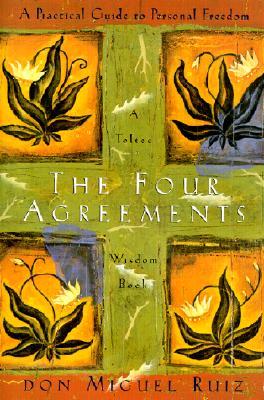
First published in 1997, don Miguel Ruiz’s The Four Agreements has become one of those self-help books whose central ideas are more famous than the book that contains them. “Be impeccable with your word,” “Don’t take anything personally,” “Don’t make assumptions,” and “Always do your best” circulate as quotations, posters, social-media advice, and shorthand for a certain kind of emotional independence. Read in isolation, they can sound like four sensible but fairly ordinary rules for living.
The actual book is more ambitious. Ruiz does not begin with the agreements at all. He begins with a spiritual story about human beings as manifestations of light, then constructs a theory of social conditioning in which children are “domesticated” into a collective Dream of the Planet. The four agreements appear only after he has explained how inherited beliefs become an internal Book of Law, Judge, and Victim. After presenting the agreements, he spends another substantial chapter explaining why simply understanding them is not enough, how old agreements must be broken, why forgiveness matters, and how awareness of death can loosen attachment to the identity we have constructed. The book then moves beyond behavioural advice into the “New Dream,” a vision of life governed by love rather than fear, before ending with explicitly devotional prayers.
That larger structure makes The Four Agreements more coherent than its reputation as four motivational slogans suggests. Its strongest achievement is giving readers memorable language for examining self-talk, approval, assumptions, perfectionism, resentment, and habitual interpretation. Its central weakness is equally important: Ruiz repeatedly turns useful practices into universal claims about suffering, causality, abuse, spirituality, and human freedom that are far harder to defend. The most rewarding way to read the book is therefore neither to dismiss its spirituality nor to accept every assertion literally, but to understand the complete system and then ask where its disciplines remain useful once its absolutes are qualified.
The Book’s Problem and Promise
Ruiz’s starting problem is not that people lack information. It is that they have already absorbed too much information without consciously choosing it. From infancy onward, people inherit language, expectations, moral judgments, ideas about success and failure, religious beliefs, family roles, standards of beauty, definitions of acceptable behaviour, and assumptions about what they must become to deserve love. These inherited beliefs form what Ruiz calls agreements because people eventually begin treating them as truths to which they have consented, even though most were accepted before meaningful consent was possible.
Personal freedom therefore requires more than adopting positive thoughts. Ruiz wants readers to examine the entire internal structure through which they interpret themselves and the world. In his model, fear-based agreements consume personal power because they require constant enforcement. People monitor themselves, compare themselves with an imagined ideal, punish themselves for mistakes, defend identities, seek approval, repeat old judgments, and recreate emotional pain long after the original event has ended.
The four agreements are Ruiz’s replacement code. Impeccable language changes what a person creates and transmits through words. Refusing to take everything personally changes what they absorb from other people. Refusing to treat assumptions as facts changes how they interpret incomplete information. Doing one’s best makes the other three agreements sustainable without turning them into a new perfectionist standard.
Even that is not the final promise. The later chapters make clear that Ruiz wants something more radical than improved communication or emotional composure. He wants the reader to withdraw attention and belief from what he calls the old dream and consciously create a new one. Personal freedom, in his vocabulary, ultimately means recovering a way of living in which fear, judgment, guilt, approval, and self-rejection no longer organise consciousness.
The Dream of the Planet: How Domestication Creates the Old Agreements
Ruiz cannot explain the four agreements without first explaining his theory of the mind. The book therefore begins by redefining ordinary reality as a kind of dream: not because the material world is simply imaginary, but because human beings continuously interpret what they perceive through beliefs, symbols, categories, memories, expectations, and language. Individual dreams then combine into families, cultures, institutions, religions, governments, and societies, producing the larger Dream of the Planet into which each new child is born.
This diagnosis is simultaneously psychological, social, and spiritual. Ruiz moves freely among these levels, sometimes describing recognisable processes of childhood conditioning and sometimes making metaphysical claims about the nature of consciousness. Understanding that mixture is essential because the practical advice later in the book depends on both.
The Smokey Mirror and Ruiz’s Spiritual Starting Point
The introduction, “The Smokey Mirror,” presents Ruiz’s worldview through a mythic story set three thousand years ago. A young man studying ancestral knowledge to become a medicine man feels that what he is learning is incomplete. While sleeping in a cave, he experiences a revelation in which he perceives himself, the stars, and ultimately all existence as manifestations of light.
His discovery is not merely that objects reflect light. He understands reality as one living unity in which light carries life and information, while apparent separation is partly an effect of perception. Ruiz introduces the language of tonal and nagual within this vision and treats matter as something like a mirror through which the underlying living reality becomes visible.
The seeker returns to other people transformed by what he has experienced. They sense something remarkable in him and begin treating him as though he is divine, but he rejects the idea that he possesses a uniquely divine nature. What he has recognised in himself, he believes, exists in everyone. The problem is not the absence of divinity or connection but the inability to perceive it.
That inability produces the title image. Every human being is a mirror, but smoke obscures the reflection. The smoke is the accumulation of beliefs, interpretations, fears, judgments, and stories through which people perceive themselves and one another. The seeker therefore calls himself the Smokey Mirror.
This opening matters because it changes the meaning of everything that follows. Ruiz is not fundamentally proposing that a defective self be improved into a better self. He believes an already valuable, connected, living self has become obscured by inherited agreements. Transformation is therefore presented as a process of clearing away distortion and remembering what was there before the conditioning became mistaken for identity.
Domestication, the Book of Law, the Judge, and the Victim
Chapter 1 moves from mythic cosmology to childhood. Before an individual is born, Ruiz argues, other human beings have already constructed the social dream. There is already a language to learn, a religion or worldview available, a family structure, a set of rules, ideas of good and bad, standards of achievement, and countless expectations about how a person should behave. A child does not choose this system after evaluating competing philosophies; the child enters it.
Adults capture the child’s attention and teach the existing dream through repetition. Names attach to objects. Judgments attach to behaviour. Approval signals what is desirable, while punishment signals what is forbidden. Ruiz deliberately calls this process “domestication,” comparing it to the way animals are trained by rewards and punishments.
The comparison is intentionally uncomfortable because Ruiz wants readers to notice how deeply the desire for approval enters identity. Children naturally want attention, affection, and belonging. When love or approval appears connected to obedience, success, politeness, appearance, achievement, or conformity, children learn to become versions of themselves that receive positive responses. They also learn what kinds of expression produce rejection or punishment.
Eventually the external system becomes internal. Ruiz calls this autodomestication. Parents, teachers, religious authorities, and other adults no longer need to supervise continuously because the person has learned to enforce the inherited rules from within.
Ruiz personifies this internal structure through three memorable figures. The Book of Law contains the beliefs and rules the person accepts as true. The Judge compares behaviour against those rules and declares whether the person is good, bad, successful, inadequate, worthy, or guilty. The Victim receives the sentence, experiencing shame, helplessness, self-pity, fear, and punishment.
One of Ruiz’s strongest observations concerns repeated punishment. In an external legal system, an offence may produce one sentence. Psychologically, however, a person can punish themselves for the same mistake hundreds of times by remembering it, condemning themselves again, and reopening the emotion associated with it. Partners and family members may participate by repeatedly invoking old failures during later conflicts.
This repeated judgment supports what Ruiz calls an image of perfection. People internalise an idea of what they are supposed to be: attractive enough, intelligent enough, disciplined enough, successful enough, generous enough, spiritual enough, productive enough, or lovable enough. Because no human being can continuously match an idealised image, the comparison almost guarantees failure.
The result is not simply a desire to improve. Ruiz sees it as a source of self-rejection. People hide traits that do not fit the approved image, perform identities designed to earn acceptance, and fear that intimacy will expose whatever they have learned to consider shameful. The person can become divided between the self actually experienced and the self believed necessary for love.
Ruiz calls the emotional world created by fear, guilt, resentment, jealousy, judgment, and self-hatred the dream of hell. Hell in this framework is not primarily a place after death. It is a way of experiencing the present in which the mind continuously produces punishment and conflict.
Mitote, the Dream of Hell, and Personal Power
Another important concept is mitote, which Ruiz uses for the noisy confusion of competing voices, beliefs, judgments, and assumptions within the mind. A person may want one thing and condemn themselves for wanting it, believe one standard and behave according to another, seek approval while resenting dependence on approval, or replay conflicting messages learned from different authorities. Consciousness becomes crowded with inherited voices that are difficult to distinguish from personal truth.
Ruiz connects this noise to emotional poison. Fear produces anger, jealousy, resentment, envy, shame, and other painful reactions, which are then communicated through words and behaviour. One person’s fear-based dream interacts with another’s, allowing conflict to reproduce itself socially. Gossip, accusation, humiliation, criticism, and retaliation become mechanisms through which the Dream of the Planet continually renews itself.
Maintaining this structure requires what Ruiz calls personal power. Every belief receives attention and faith. A person who has accepted thousands of limiting agreements must continually spend energy defending, obeying, fearing, or reacting to them. The accumulated system can become so powerful that a person experiences inherited beliefs as objective reality rather than as agreements that were once learned.
This is why Ruiz does not think freedom can be achieved merely by hearing better advice. The old agreements are supported by years of repetition, emotional investment, and social reinforcement. The four agreements matter because they offer alternative commitments, but the rest of the book repeatedly acknowledges that new commitments have to compete with an existing internal world.
The Four Agreements: Ruiz’s Method for Rewriting the Dream
The four agreements are designed to interrupt different stages of the process Ruiz has described. The first concerns what people create and transmit through language. The second concerns what they absorb from other people. The third concerns the stories they invent when information is missing. The fourth concerns the quality of effort through which the other three become habits rather than ideals.
Ruiz presents them sequentially rather than as four interchangeable tips. He explicitly describes the later agreements as emerging from the first, and the fourth exists largely to make practice of the first three sustainable.
The First Agreement: Be Impeccable with Your Word
Ruiz calls the first agreement both the most important and the most difficult. His concept of “the word” includes spoken language, writing, self-talk, interpretation, and the broader power of language to organise experience. He describes the word in explicitly spiritual terms as a creative force through which intention becomes manifest.
This is where Ruiz’s metaphysical language of magic becomes especially prominent. Words can act like spells because people may accept them as truths that continue shaping behaviour long after the original statement has been made. The effect does not require a supernatural mechanism to be psychologically recognisable: a judgment can become an identity if the recipient repeatedly agrees with it.
His most memorable example concerns a mother and daughter. The mother loves her daughter, but one day she is exhausted, suffering from a headache, and overwhelmed by the child’s repeated singing. In irritation, she tells the girl that her voice is ugly and that the singing is unbearable.
For the mother, the outburst expresses a temporary internal condition. For the daughter, it becomes information about who she is. She accepts the judgment, becomes ashamed of singing, and suppresses something she previously enjoyed. Ruiz’s point is that a passing sentence from one person can become a durable agreement in another.
He therefore defines impeccability not merely as factual honesty but as refusing to use the word against oneself. His spiritual explanation connects impeccability with being “without sin,” while redefining sin as acting against one’s own deepest nature. Language that humiliates others, spreads hatred, or seeks revenge is ultimately non-impeccable because it reinforces a world of emotional poison in which the speaker also lives.
Gossip becomes the clearest collective example. A person can hear something negative about a teacher, colleague, stranger, or friend before meeting them and then interpret everything that follows through that prior story. Ruiz compares this effect to a computer virus: once corrupted information enters the system, later inputs are processed through distorted instructions.
The metaphor captures something important about prejudice and expectation even though Ruiz sometimes gives language an almost mystical power. A negative story can indeed alter attention. People notice evidence consistent with what they have already heard, discount contradictory evidence, and respond to the person in ways shaped by the original narrative.
Impeccability also applies to self-talk. Statements such as “I am stupid,” “I am ugly,” “I always ruin things,” or “I could never do that” are not neutral descriptions in Ruiz’s framework. They reinforce agreements by repeatedly directing the word against the self.
The first agreement therefore asks for more than politeness. Ruiz wants readers to become aware of how language creates identities, relationships, expectations, conflicts, and emotional environments. If words helped establish the old dream, language can also become one of the tools for changing it.
The Second Agreement: Don’t Take Anything Personally
The second agreement begins from the claim that people act from within their own dreams. Every person brings a history of beliefs, fears, hopes, insecurities, habits, memories, and unresolved conflicts to an interaction. What they say and do therefore reveals something about their internal world, even when their behaviour is directed at someone else.
Ruiz connects taking things personally with what he calls personal importance. If someone insults you and you immediately treat the insult as authoritative information about yourself, you have entered the other person’s dream and agreed with it. Their emotional poison becomes yours because you accept the premise that their judgment defines you.
His example is intentionally simple: someone who barely knows you calls you stupid. The insult has power only if some part of you begins asking whether the speaker has discovered a truth. The external statement activates an internal agreement.
The same principle applies to praise, which makes the second agreement more interesting than a rule for ignoring criticism. If identity depends on other people declaring you intelligent, attractive, successful, admirable, or lovable, then identity remains dependent on their judgments. The person who can elevate you through approval also possesses the power to destabilise you through rejection.
Ruiz wants readers to separate self-worth from both extremes. Other people’s words may provide information, affection, hostility, criticism, or praise, but they do not automatically become definitions of the recipient.
Taking things personally often produces a predictable chain reaction. A person feels attacked, begins defending an identity or belief, tries to prove the other person wrong, and answers with more emotional poison. The original interaction expands because each participant becomes invested in defending a personal dream.
Ruiz also applies the agreement internally. The mind itself contains many voices, and these voices often contradict one another. A person can wake confident, become anxious an hour later, imagine catastrophe, remember an old insult, and then treat each passing thought as though it were a final verdict.
This returns to mitote. “Don’t take anything personally” can therefore apply even to some of one’s own mental chatter. A thought appearing in consciousness does not necessarily deserve agreement merely because it appeared there.
Ruiz imagines the result as greater emotional freedom. A person can express love without requiring control, accept another person’s departure without converting it into proof of worthlessness, and respond more honestly because every interaction is no longer an identity referendum.
The literal statement that nothing other people do is because of you is much harder to defend, because human beings plainly do affect one another. Ruiz’s most useful point is narrower: another person’s reaction can concern something you have done without becoming an objective measure of your value. That distinction becomes especially important when the book’s limitations are considered later.
The Third Agreement: Don’t Make Assumptions
The third agreement addresses what happens when the mind encounters incomplete information. Ruiz argues that people dislike uncertainty, so they generate explanations and then forget that those explanations were created rather than discovered.
An assumption may begin with something small: a facial expression, delayed reply, tone of voice, unexplained decision, brief conversation, or ambiguous social cue. The mind supplies an interpretation. Once the interpretation is accepted as fact, emotion follows as though the underlying story had been verified.
Ruiz gives a playful example involving attraction. A person notices someone in a public place, receives a smile or glance, and rapidly constructs an elaborate narrative about mutual interest. Very little has actually happened, yet the imagination can create an entire relationship before a conversation has even established what the other person intended.
The consequences become more serious in established relationships. Ruiz observes that partners often assume love should make communication unnecessary. “If you loved me, you would know what I need” sounds romantic, but it converts an unspoken expectation into an obligation the other person never consciously accepted.
Even apparently shared concepts can hide different assumptions. Two people may agree that they want marriage while carrying completely different ideas about money, fidelity, family obligations, domestic labour, privacy, children, independence, affection, or decision-making. The shared word conceals divergent internal definitions.
According to Ruiz, people sometimes avoid questions because childhood domestication taught them that asking was dangerous, embarrassing, or evidence of ignorance. Assumptions then become a substitute for clarification. It feels safer to invent certainty than to risk discovering an answer one may not like.
The third agreement also applies inward. People assume they are incapable of something without testing the belief, or assume they can handle circumstances they have never confronted. Both exaggerated confidence and unnecessary self-limitation can arise from treating an untested story as knowledge.
Romantic idealisation becomes another example. Ruiz criticises the habit of entering a relationship with someone while secretly expecting them to become a different person. The individual notices qualities they dislike but assumes love, time, commitment, or marriage will eventually produce transformation. The result is not acceptance of the person who exists but attachment to an imagined future version.
His remedy is direct communication. Ask questions, state what you want, clarify what another person means, and allow answers to be yes or no. This does not eliminate inference from human cognition, which would be impossible; it reduces the tendency to turn uncertain interpretations into unquestioned facts.
The Fourth Agreement: Always Do Your Best
The fourth agreement is the practical safeguard for the other three. Ruiz knows that readers will fail to speak impeccably, take something personally, or construct an assumption. If the first three become rigid standards of flawless performance, they simply recreate the Judge and image of perfection introduced in Chapter 1.
“Always do your best” prevents that by making effort relative to actual circumstances. Ruiz insists that your best is not a fixed quantity. It changes when you are rested or exhausted, healthy or sick, calm or angry, energised or depleted.
This immediately distinguishes the agreement from maximum effort. Doing more than your best can exhaust you and make sustained practice less likely. Doing substantially less can leave room for regret and self-judgment. The aim is honest engagement with the capacity available now.
Ruiz illustrates the point through a story about a student asking a Buddhist teacher how long enlightenment will take. When the student responds to the teacher’s estimate by proposing much longer daily meditation, the expected time becomes longer rather than shorter. The lesson is that spiritual urgency can become another form of self-violence: the student becomes so obsessed with reaching a future state that the practice stops being a way of living the present.
The chapter repeatedly contrasts action with reward. Ruiz describes people who endure their jobs entirely for payday, treating most of the week as something to survive so that compensation can eventually arrive. He prefers action that contains some value in the doing itself rather than deriving all meaning from the reward that follows.
His use of Forrest Gump makes the same point through a familiar cultural example. Ruiz is interested in a character who acts without constantly calculating status or proving an identity. The point is not that thoughtlessness is ideal but that life can become distorted when every action is subordinated to comparison, reward, or self-image.
He also refers to puja in India, focusing on the attitude of devotion behind ritual action. What matters is the intention with which ordinary acts are performed. Action can become an expression of reverence rather than merely a means to acquire something else.
The body receives similar treatment. Ruiz urges readers to stop treating the body as an enemy that must satisfy an image of perfection. Doing one’s best includes caring for the body available now rather than postponing acceptance until it meets an imagined standard.
Most importantly, practice is repetitive. A person may violate an agreement and begin again. Mastery does not arrive through one intellectual decision; old habits lose power because different choices are repeated often enough to become stronger agreements.
This prepares the reader for Chapter 6. The four agreements have supplied the replacement principles, but Ruiz now has to confront a harder problem: how does someone actually break beliefs that have been reinforced for decades?
The Toltec Path to Freedom: How Old Agreements Are Broken
Chapter 6 is where The Four Agreements becomes a theory of transformation rather than a collection of advice. Ruiz begins by asking what freedom really means and rejects a purely political definition. A person may live in a formally free society while remaining governed internally by fear, approval, inherited rules, resentment, and the Judge.
Young children become his model of relative freedom because they play, explore, express emotion, and inhabit the present before an elaborate system of self-judgment takes over. Ruiz does not simply blame parents for destroying this condition. Parents were themselves domesticated and generally passed on the dream they had inherited. The deeper antagonist is the self-reproducing system of fear-based agreements.
Ruiz combines the Book of Law, Judge, Victim, and emotional poison into the metaphor of a parasite. The parasite lives by consuming the person’s attention and emotional energy. The spiritual warrior’s battle is therefore not primarily against other people but against the internal machinery that keeps reproducing the old dream.
He identifies three masteries—Awareness, Transformation, and Intent—and develops three broad methods for confronting the parasite. A person can expose and replace individual agreements, stop feeding habitual emotional reactions, and embrace the symbolic initiation of death. Together they show that Ruiz understands change as cognitive, behavioural, emotional, and spiritual.
Awareness and the Dream of the Second Attention
Ruiz describes childhood domestication as the dream of the first attention. Attention was captured from the outside. Adults repeatedly directed the child toward particular names, judgments, expectations, and interpretations until those teachings formed the ordinary world.
The second attention reverses the direction. An adult deliberately turns attention back toward the beliefs already installed and begins examining them. Instead of assuming “this is simply who I am,” the person asks where the belief came from, whether it was consciously chosen, whether it is accurate, and what kind of life it produces.
Awareness therefore precedes transformation. A person cannot withdraw agreement from a belief that remains invisible. Ruiz asks readers to identify fear-based agreements almost as though taking an inventory of the internal Book of Law.
The earlier singing example returns here in a different role. A person who accepted the belief “I have an ugly voice” may eventually recognise that the belief originated in someone else’s temporary frustration rather than an objective verdict. Recognition alone does not erase the old reaction, but it makes a different experiment possible: sing despite the agreement, tolerate the discomfort, and invest attention in a new interpretation.
Ruiz compares the old belief system to a landscape whose roads have been created by repeated travel. The original agreements became powerful because they were rehearsed, emotionally reinforced, and socially confirmed for years. New agreements must acquire strength by repetition as well.
The second attention therefore does not promise instant transformation through insight. Ruiz may use dramatic spiritual language, but his practical mechanism here is gradual: notice an agreement, challenge its authority, practise an alternative, and continue until the alternative begins to feel more natural.
The Discipline of the Warrior, Emotional Wounds, and Forgiveness
Awareness is insufficient if emotional reactions continue consuming the same energy. Ruiz therefore introduces the discipline of the warrior, which focuses less on what a person believes intellectually and more on how they handle emotional activation.
He gives the example of someone beginning the morning in a good mood, arguing with a spouse over breakfast, and carrying the resulting anger for the rest of the day. The argument may last minutes, but the person continues reproducing it internally, replaying sentences, imagining responses, defending themselves, and poisoning later experiences. The original event ends; the reaction continues spending energy.
Ruiz expands this into one of his most vivid metaphors. Imagine that the emotional body is skin covered with infected wounds. People become extremely protective because even a small touch can cause pain. Ordinary interactions trigger disproportionate reactions because they contact older injuries.
In his model, fear is the underlying disease and emotional poison accumulates around the wounds. Truth, awareness, love, and forgiveness are presented as forms of healing.
Forgiveness becomes particularly important because resentment keeps past events alive in present consciousness. Ruiz eventually asks readers to forgive parents, siblings, friends, God, and themselves. His test is demanding: if encountering the person or memory still produces the old emotional wound, forgiveness is not yet complete.
That idea can be useful as a description of unfinished emotional activation, but it needs a boundary Ruiz does not always provide. Forgiveness need not mean reconciliation, restored trust, renewed contact, or access for someone who remains dangerous. A person can work toward freedom from consuming resentment while still maintaining firm boundaries.
Ruiz also distinguishes discipline from repression. The warrior does not pretend emotion is absent; the warrior develops enough awareness to avoid converting every feeling into immediate reaction. Repression hides and stores emotion. Discipline changes the relationship between feeling and action.
This distinction is among the more practical parts of the chapter. Ruiz is not asking readers to become emotionally numb. He is asking for a space in which anger, fear, hurt, or jealousy can be experienced without automatically dictating what happens next.
The Initiation of the Dead and the Angel of Death
The third strategy is more explicitly spiritual. Ruiz introduces the Angel of Death as a teacher of impermanence. Everything a person claims to own—a house, car, career, reputation, relationship, body, and eventually life itself—is temporary.
The point is not nihilism. Ruiz uses mortality to question the amount of energy spent defending identities, grudges, possessions, and dramas that cannot be retained indefinitely. If death will eventually take everything, he asks, why wait for biological death before loosening the grip of the old dream?
A thought experiment makes the argument concrete. Imagine being told that very little time remains. Would you spend those remaining days preserving resentment, defending old arguments, postponing affection, and rehearsing self-judgment, or would the scarcity of time reorganise what deserves attention?
The initiation of the dead is symbolic rather than physical. The old identity—the accumulated parasite, Book of Law, Judge, Victim, resentments, and rigid self-concepts—is allowed to die before the body does. What Ruiz imagines afterward resembles a resurrection into the freedom associated with childhood, but now accompanied by adult awareness.
The Angel of Death also takes every previous moment. Yesterday cannot be recovered and even the immediately preceding minute has already disappeared. Ruiz uses that fact to direct attention toward present life rather than endless punishment of the past.
Chapter 6 therefore completes a major gap in the popular understanding of the book. The four agreements tell readers what new commitments to practise. The Toltec Path to Freedom attempts to explain why old agreements resist those commitments and how awareness, repetition, emotional discipline, forgiveness, and mortality can weaken them.
The New Dream: Heaven on Earth and the Closing Prayers
Chapter 7 shifts from method to vision. Ruiz asks the reader to imagine seeing the world differently, as though the old interpretive structure had finally loosened. The chapter is deliberately experiential rather than argumentative, inviting the reader to perceive love in nature, light, other people, and the self.
The New Dream is characterised by freedom from the compulsions established earlier in the book. The person no longer needs continuous justification, no longer organises life around fear of judgment, no longer judges others with the same intensity, and no longer treats rejection as proof of inadequacy. Expression becomes easier because the image of perfection has lost authority.
Self-acceptance extends to the body. Instead of loving the body only after it reaches a preferred shape, health status, appearance, or level of performance, the New Dream asks for acceptance in the present. The same principle applies to emotional life: freedom comes from ceasing the war against oneself.
Ruiz calls this condition heaven on earth. As he did with hell, he relocates a religious image into lived experience. Heaven becomes a way of perceiving and participating in life rather than merely a destination after death.
He also draws broad comparisons among the Promised Land, Nirvana, Heaven, and the Toltec New Dream. These comparisons express Ruiz’s syncretic spirituality rather than a historically precise claim that different religious traditions mean exactly the same thing. His concern is the recurring possibility of liberation from fear, separation, and judgment.
The chapter also contains some of Ruiz’s most difficult absolutism. He treats suffering as something human beings choose through the dream they create. There is an important insight inside this claim—interpretation can magnify or prolong suffering—but the universal formulation ignores suffering imposed through illness, bereavement, poverty, violence, coercion, discrimination, trauma, and other circumstances that cannot honestly be reduced to voluntary belief.
The book then continues beyond Chapter 7 into its prayers, which are essential for understanding the destination Ruiz has in mind. A preparatory breathing meditation asks the reader to experience something as basic as air entering the lungs as a relationship of love and life.
The “Prayer for Freedom” addresses the Creator and asks for liberation from emotional poison, judgment, punishment, and fear. Self-acceptance and unconditional love are placed within a relationship with a divine reality, confirming that Ruiz’s final project is not simply secular emotional regulation.
The “Prayer for Love” becomes even more visionary. A teacher figure gives the seeker a symbolic flame of love. The flame enters the heart, moves through the body, expands into the surrounding world, and joins the seeker with plants, animals, earth, water, stars, and creation.
The imagery completes a circle that began with the Smokey Mirror. The book opens with light, unity, and the claim that smoke prevents human beings from recognising what they are. It ends with fire, light, love, gratitude, and restored communion. The four agreements therefore function as instruments within a much larger spiritual movement: they are meant to help clear the smoke so that the individual can experience the unity the opening story declared was present all along.
How the Four Agreements Work as One System
The four agreements become more interesting when treated as an interconnected system rather than four independent commandments. Ruiz’s order roughly follows the way interpersonal drama is created, absorbed, interpreted, and repeated.
The first agreement concerns creation and transmission. Words communicate beliefs, judgments, identities, expectations, affection, hostility, and stories. Language can reinforce the old dream in another person or in oneself.
The second concerns reception and internalisation. An insult, judgment, or piece of gossip cannot fully become part of another person’s identity unless it finds agreement there. Refusing automatic personalisation interrupts the movement from external word to internal self-definition.
The third concerns interpretation under uncertainty. When information is incomplete, the mind invents explanations. Those explanations can then be taken personally, producing emotional reactions to events that may never have occurred as imagined.
The fourth concerns sustainable practice. The person trying to apply the first three will inevitably fail. If failure activates the Judge and image of perfection, the new system reproduces the old one. “Do your best” prevents transformation from becoming another programme of self-punishment.
This creates a feedback loop. A person makes an assumption about another’s motives, takes the imagined motive personally, responds with a hostile or careless word, and gives the other person material for further personalisation and assumptions. An interaction that began with missing information becomes an escalating conflict.
The four agreements interrupt different points in that loop. Better language reduces the poison transmitted. Less personalisation reduces the poison absorbed. Fewer untested assumptions reduce the amount of drama invented. Flexible effort allows the practice to continue after inevitable mistakes.
Chapter 6 then addresses a different problem: what about agreements that already exist? A person may understand all four principles and still react according to beliefs learned decades earlier. That is why second attention, repetition, emotional discipline, forgiveness, and symbolic death are required within Ruiz’s model.
The New Dream supplies the destination. Without it, the agreements could be interpreted simply as interpersonal skills. Within the complete architecture, however, they are practices for weakening an entire identity organised around fear, approval, judgment, and separation.
This structural coherence is one of the book’s real achievements. It does not prove Ruiz’s metaphysics or justify every universal statement, but it explains why the book has more staying power than a random list of positive habits. Each agreement performs a distinct function inside a recognisable model of how distressing interpretations reproduce themselves.
Ruiz’s Spiritual Worldview: Dream, Light, Love, and “Toltec Wisdom”
A purely secular reading of The Four Agreements can extract useful communication advice, but it cannot fully represent the book Ruiz wrote. His practical system is embedded in a spiritual ontology involving light, God, Life, Intent, unity, dream, magic, heaven, hell, death, rebirth, and love as a fundamental property of existence.
That does not require a reader to accept the metaphysics. It does require separating two questions that are often blurred: what worldview gives Ruiz’s practices their meaning, and which parts of that worldview should be treated as established knowledge rather than spiritual belief?
The Metaphysical System Behind the Advice
The Smokey Mirror provides the foundation. Reality is fundamentally alive and unified; human beings participate in that reality but perceive separation because the smoke of beliefs and interpretation obstructs direct perception. Transformation therefore has a revelatory quality. The goal is not only better thinking but clearer seeing.
The recurring imagery of light and mirrors supports this idea. A mirror does not manufacture what it reflects; it reveals. Smoke does not destroy the underlying reality; it obscures it. Ruiz’s self-help method is therefore consistent with a spiritual belief that the deepest self is already whole and that suffering arises largely from agreements that conceal this condition.
The distinction between fear and love serves a similar function. Ruiz regularly treats them as the governing alternatives of human experience. Fear produces control, jealousy, judgment, possession, defensiveness, punishment, and emotional poison. Love produces acceptance, freedom, generosity, openness, and connection.
This binary has rhetorical power because it simplifies complicated motives into a memorable choice. It also oversimplifies. Human emotions and moral decisions are rarely reducible to one of two pure forces, and fear can sometimes serve legitimate protective functions. A person leaving danger, establishing a boundary, or responding cautiously to risk is not necessarily trapped in the old dream.
The word-as-magic idea also operates on two levels. As metaphor, it is persuasive: language can influence identity, attention, expectations, and relationships. Taken literally as a spiritual force capable of casting spells in a metaphysical sense, it becomes an article of belief rather than an empirically demonstrated mechanism.
The same distinction applies to heaven and hell. As descriptions of psychological states, Ruiz’s language is vivid and often useful. A life dominated by resentment, jealousy, guilt, and self-condemnation can certainly feel hellish. But Ruiz moves beyond metaphor when he presents love and divine unity as properties of reality itself.
The ending leaves little doubt about that spiritual commitment. The prayers do not simply ask readers to think more constructively. They invoke the Creator, communion, divine love, purification, and a universe experienced as spiritually unified.
The symbolism therefore forms a coherent network. The mirror represents the capacity to perceive truth; smoke represents inherited distortion; poison represents fear-based emotional transmission; the parasite represents the self-sustaining old belief system; the warrior represents disciplined awareness; death destroys attachment to the constructed identity; and fire returns the reader to the light with which the book began.
A reader can interpret these images symbolically and still benefit from them. What matters critically is recognising when Ruiz moves from metaphor into assertion. Spiritual propositions may provide meaning, but they should not be presented as though the book has empirically demonstrated them.
Historical Toltecs and the Modern Toltec Tradition
Ruiz introduces the book as “Toltec wisdom,” which raises a separate historical question. The Toltecs themselves are not imaginary. The Metropolitan Museum of Art’s account of the historical Toltec world describes Tula as a major centre that had become a powerful capital by around the tenth century, with artistic, commercial, and political influence extending across parts of Mesoamerica.
That historical fact does not automatically establish that Ruiz’s teachings are a direct transcription of ancient Toltec religious doctrine. The book does not provide the kind of archaeological, textual, linguistic, or historiographical evidence that would allow readers to trace each concept securely from historical Tula to the modern Four Agreements system.
Modern “Toltec” spirituality has its own intellectual history. Scholarship on Castaneda, tonal/nagual language, and modern Toltec spirituality by religious-studies scholar Zuzana Marie Kostićová examines the modern construction of these ideas and explicitly places Ruiz within a stream strongly shaped by Carlos Castaneda’s influential twentieth-century writings.
That distinction matters because ancient provenance can function as rhetorical authority. A teaching described as wisdom preserved by an ancient tradition can feel more authoritative than an openly modern spiritual synthesis. Readers should therefore avoid treating “Toltec” as automatic historical certification.
At the same time, questionable or complicated provenance does not logically make a practical idea useless. “Don’t make assumptions” does not become bad advice merely because its historical genealogy is uncertain. The fairer judgment is that Ruiz’s system should succeed or fail on its conceptual, practical, ethical, and spiritual merits rather than being granted authority simply because it is presented as ancient Toltec wisdom.
Psychological Parallels and Practical Application
Some of the book’s strongest ideas resemble patterns discussed in modern psychology, which helps explain why they can feel immediately recognisable even to readers who do not share Ruiz’s spiritual worldview. That resemblance should be handled carefully, because similarity to psychological concepts is not the same as scientific validation of Ruiz’s entire system.
The most useful approach is to identify genuine parallels while preserving the differences. Ruiz is a spiritual teacher offering a prescriptive worldview, not a clinician presenting a tested therapeutic protocol.
Where Ruiz’s Ideas Overlap with Familiar Psychological Patterns
Modern psychological literature uses the term cognitive distortions for systematically biased patterns of interpretation, including forms of personalisation and mind-reading that resemble some of the tendencies Ruiz describes. The overlap is clearest when a person assumes knowledge of another’s thoughts, interprets an ambiguous event as a judgment of themselves, or treats a negative internal conclusion as settled fact.
Ruiz’s second agreement resembles an intervention against excessive personalisation. Someone does not reply to a message, seems distracted during a conversation, or speaks abruptly, and the recipient immediately concludes that they have done something wrong or are disliked. Ruiz’s instruction creates space for alternative explanations.
The third agreement resembles a challenge to mind-reading and unsupported inference. A person believes they know what a partner intended, what colleagues are saying, what a stranger’s expression means, or how an audience will judge them. The emotional reaction often arrives before the interpretation has been tested.
The first agreement overlaps with concerns about negative self-talk and internalised labels. Repeatedly describing oneself in global, degrading terms can narrow behaviour and reinforce avoidance. Ruiz’s magical language is not required to understand why replacing “I am a failure” with a more accurate description of a particular failure changes the psychological meaning of the event.
The Book of Law and image of perfection also resemble internalised standards and perfectionistic self-evaluation. People can live according to rules that are never consciously re-examined and condemn themselves for failing standards that may be unrealistic, contradictory, or inherited from environments they no longer inhabit.
These similarities help translate Ruiz into more familiar language, but they do not prove that the Four Agreements constitute an evidence-based treatment. Ruiz does not test hypotheses, report controlled studies, specify diagnostic populations, or distinguish systematically among different psychological conditions. His evidence is largely introspection, observation, anecdote, metaphor, and spiritual teaching.
How to Use the Agreements Without Turning Them into Absolutes
The first agreement becomes most practical when “impeccable” means accurate and non-degrading language rather than perfect speech. Instead of turning an event into an identity—“I failed, therefore I am a failure”—the reader can describe what actually happened, what can be learned, and what remains uncertain.
The same principle applies to speaking about others. Calling someone lazy, selfish, stupid, toxic, or hopeless converts a pattern or incident into a totalising identity. Sometimes strong judgments are warranted, but Ruiz’s principle encourages greater precision: describe behaviour before declaring essence.
The second agreement becomes useful when it separates feedback from identity. A manager may criticise your work because the work actually needs improvement. A partner may be upset because your behaviour hurt them. “Don’t take it personally” should not mean ignoring these facts; it means evaluating the information without making the other person’s reaction a complete verdict on your worth.
This distinction preserves accountability. You can apologise, change behaviour, repair harm, or learn from criticism without concluding that you are fundamentally defective. You can also reject criticism that is manipulative, inaccurate, or abusive without spending days trying to win approval from the critic.
The third agreement works best when assumptions are treated as hypotheses rather than facts. Human beings cannot stop making inferences; ordinary perception and decision-making depend on them. The practical discipline is to notice when uncertainty has silently hardened into certainty.
Consequential assumptions deserve testing. Ask what a person meant. Clarify expectations before resentment accumulates. Distinguish observable facts from the story added to those facts. Recognise that “I do not know yet” is sometimes more accurate than the explanation the mind produces automatically.
The fourth agreement becomes a corrective to perfectionism when “best” is interpreted dynamically. Capacity changes with illness, sleep, stress, disability, caregiving obligations, grief, resources, and competing responsibilities. The principle asks for honest participation within current reality rather than constant maximum output.
Chapter 6 adds a deeper practice. Second attention can be understood as reviewing inherited beliefs that continue governing life after their original context has disappeared. A person might ask why achievement feels necessary for love, why disagreement feels dangerous, why rest creates guilt, or why a particular family role still seems mandatory.
Forgiveness likewise becomes safer when separated from reconciliation. Releasing the desire to spend one’s life emotionally organised around an old injury can be valuable, but it does not require trusting someone who remains harmful. Forgiveness can coexist with distance, boundaries, legal consequences, or permanent separation.
Finally, the Angel of Death can function as a priority filter even for readers who reject Ruiz’s metaphysics. Mortality clarifies that time is limited. The question is not whether death proves a spiritual doctrine but whether awareness of impermanence helps distinguish relationships and commitments worth preserving from dramas maintained mainly through habit.
The Book’s Biggest Limitations and Ethical Risks
The danger in The Four Agreements does not usually come from its basic disciplines. Speaking more carefully, questioning assumptions, loosening dependence on approval, and adapting effort to capacity are broadly defensible practices. The problems arise when Ruiz turns these practices into total explanations of why events happen and why people suffer.
His memorable absolutism gives the book rhetorical force. It also creates situations in which a principle that is helpful for ordinary interpersonal friction becomes misleading or harmful when applied to abuse, trauma, coercion, discrimination, illness, or structural hardship.
Personal Responsibility Is Not the Same as Blame
The second agreement illustrates the problem. Ruiz says that nothing other people do is because of you. As a strategy for resisting compulsive personalisation, this can be liberating. As a literal statement about interpersonal causality, it is false.
Human beings respond to one another. A friend may be angry because you betrayed confidence. A customer may complain because a service failed. A colleague may trust you because you repeatedly acted reliably. A partner may leave because of something you did.
The useful distinction is between being relevant to another person’s reaction and allowing that reaction to define your identity. You can be causally involved in an event without accepting every judgment the other person attaches to it.
This is also why responsibility must be distinguished from blame. A person may not have caused a difficult circumstance but may still retain meaningful choices about what happens next. That distinction appears in a different form in the discussion of responsibility without blame in Unfu*k Yourself: agency over one’s response does not require pretending one caused every condition that requires a response.
Ruiz is strongest when he encourages this kind of agency. He is weakest when his language makes agency sound like total control over causality.
Abuse, Trauma, Structural Conditions, and the Limits of “Chosen” Suffering
The most serious problem appears when Ruiz discusses abuse and suffering. His claim that people abuse themselves more than anyone else does, combined with his suggestion that the amount of mistreatment a person tolerates corresponds to their level of self-abuse, can slide dangerously toward victim-blaming.
Contemporary domestic-violence guidance is much clearer about responsibility. The National Network to End Domestic Violence explains that abuse is the responsibility of the person choosing abusive behaviour, while survivors may face complicated barriers involving safety, finances, children, housing, threats, isolation, and coercive control. Remaining in a dangerous situation does not prove that someone inwardly agrees with or deserves the abuse.
Ruiz’s framework can still offer something after that boundary is established. People who have been harmed may carry internalised shame, self-blame, fear, or beliefs implanted by an abuser. Challenging those beliefs can be valuable precisely because the harmful messages were not deserved truths.
But that is very different from saying the person created or chose the original harm. The first interpretation can support recovery; the second can deepen shame.
Trauma also complicates Ruiz’s treatment of forgiveness. He often writes as though awareness and intention should eventually make it possible to release old wounds. In reality, trauma can involve persistent physiological, emotional, and cognitive responses that cannot simply be switched off through a new agreement.
A reader should therefore resist turning forgiveness into another image of perfection. Someone who remains affected by harm has not necessarily failed spiritually. Healing can be uneven, and safety may require anger, grief, distance, professional support, legal action, or boundaries before forgiveness is relevant at all.
Chapter 7’s claim that suffering is chosen poses a similar problem. Some suffering is clearly amplified by rumination, catastrophic interpretation, resentment, self-condemnation, and imagined certainty. Ruiz is persuasive when he targets that added layer.
He becomes reductive when the same explanation is applied to every form of suffering. Pain from illness, bereavement, hunger, violence, coercion, discrimination, disability, war, exploitation, or loss cannot honestly be explained merely as a dream someone elected to create.
The strongest modern reading therefore narrows Ruiz’s claim: people often have more influence over the meaning, continuation, and amplification of suffering than they initially realise, but they do not control every condition that produces pain.
Evidence, Universal Claims, and Metaphor Presented as Fact
A broader limitation is the book’s weak boundary between metaphor, observation, and factual claim. Ruiz can move from an intuitively compelling metaphor to a universal assertion without providing an argument strong enough to support the transition.
The word as “magic” is a good example. As a metaphor for language shaping attention, behaviour, and identity, it is powerful. As a literal explanation of how reality operates, it depends on Ruiz’s metaphysics.
The parasite works similarly. Readers can understand the Judge, Victim, and internalised beliefs as a self-sustaining psychological system without believing an actual parasitic entity exists. The metaphor clarifies the feeling of being controlled by one’s own conditioning.
“Dream” is perhaps the book’s most productive metaphor because it captures the constructed quality of interpretation. Yet even here Ruiz sometimes slides from “human beings interpret reality through beliefs” into claims suggesting that individuals can simply recreate reality by changing perception.
The book does not offer systematic evidence for these larger assertions. Its method is experiential: Ruiz asks readers to recognise themselves in the examples and test the practices in life. That can be legitimate within spiritual and prescriptive nonfiction, but it places a limit on what the book can responsibly claim.
Its universal language should therefore be read rhetorically rather than scientifically. Statements such as “nothing anyone does is because of you,” “all suffering is chosen,” or words functioning as magical spells are most useful when translated into narrower practices. Taken literally, they outrun the evidence the book supplies.
Style, Structure, and Why the Book Is So Memorable
Much of The Four Agreements’ success comes from how Ruiz packages complicated inner processes into memorable language. “Book of Law,” “Judge,” “Victim,” “mitote,” “parasite,” “warrior,” “Smokey Mirror,” “dream of hell,” and “Angel of Death” are not neutral technical terms. They turn abstractions into characters, objects, places, and conflicts the reader can picture.
This compression is particularly effective for self-help. Saying “your internalised normative standards trigger recurrent self-critical cognition” may be more clinical, but “the Judge is using the Book of Law to punish the Victim” is far easier to remember at the moment the pattern is actually happening.
Ruiz also writes directly to the reader. The second-person voice creates intimacy and urgency, making the book feel less like an abstract philosophical treatise than an oral teaching delivered personally. Stories and thought experiments interrupt conceptual explanation before it becomes too dense.
Repetition performs another practical function. The four agreements recur across later chapters because Ruiz wants them rehearsed, not merely understood. Concepts introduced early—dream, poison, personal power, image of perfection—are repeatedly connected to later practices.
The disadvantage is that repetition sometimes substitutes for demonstration. A claim stated with spiritual certainty several times can begin feeling established even when the supporting evidence remains anecdotal or metaphorical.
The book’s structure nevertheless shows real craft. It begins with a cosmic story, narrows into childhood conditioning, offers four behavioural commitments, expands into a theory of transformation, and finally returns to cosmic unity through prayer. The movement is from metaphysics to psychology to practice and back to metaphysics.
That circularity explains why the ending matters so much. The Smokey Mirror sees divine light obscured by smoke; the final prayer imagines a flame of love moving through the body and reconnecting the individual with creation. The practical middle of the book functions as the bridge between those two visions.
The same stylistic choice that makes the book memorable also creates its central weakness. Ruiz prefers clean oppositions—fear or love, heaven or hell, truth or poison, freedom or domestication. These distinctions give the reader something usable, but lived experience is messier than the language allows.
Critical Review: What The Four Agreements Gets Right—and Where It Overreaches
Judged as prescriptive spiritual nonfiction, The Four Agreements does several things exceptionally well. Its first achievement is compression. Ruiz takes recurring problems—careless language, dependence on approval, mind-reading, perfectionism, rumination, inherited beliefs—and gives readers a small vocabulary capable of organising them.
That matters because advice is useful only when it can be remembered during the moment of difficulty. “Don’t make assumptions” is not a complete theory of interpersonal cognition, but it is easy to recall when a delayed reply begins turning into an elaborate story. “Don’t take anything personally” can create a useful pause when criticism instantly becomes shame.
The first agreement is especially strong because it expands ordinary communication advice into a question of identity. Words do not merely transmit information; repeated labels influence what people notice and attempt. Ruiz’s story of the singing daughter illustrates how quickly situational criticism can become a durable self-concept.
The fourth agreement may be the book’s most important safeguard. Without it, the first three could easily become another impossible standard enforced by the Judge. By insisting that one’s best changes with circumstances, Ruiz gives the system permission to remain imperfect.
Chapter 6 is another major strength and deserves more attention than it usually receives. Ruiz recognises that understanding a principle does not automatically change behaviour. His emphasis on awareness, repetition, emotional discipline, and the accumulated power of old agreements makes the book’s model of change more realistic than the four slogans alone suggest.
The second attention is particularly useful. Many adults continue organising their lives around inherited rules long after forgetting where those rules came from. Bringing deliberate attention to assumptions about love, achievement, rest, status, attractiveness, obedience, masculinity, femininity, success, failure, family loyalty, or money can reveal how much supposedly personal identity was socially inherited.
The book’s spiritual dimensions will divide readers. For those receptive to mystical or devotional language, the movement from the Smokey Mirror to the final prayers gives the practices emotional and philosophical depth. The agreements become part of a larger account of what human beings are and what freedom means.
Readers seeking empirically grounded psychology may experience the same material as overreach. Ruiz offers no systematic evidence for his metaphysical claims, and his psychological assertions frequently exceed what anecdotes can establish.
The “Toltec” framing creates another difficulty. Ruiz’s spiritual synthesis can be meaningful without being a historically demonstrable reconstruction of ancient Toltec religion. Treating the historical label too casually risks granting the system an authority that should instead be earned by the quality of its ideas.
The largest weakness, however, is absolutism. “Nothing other people do is because of you” is memorable because it is extreme. “Don’t make assumptions” is memorable because it sounds total. The claim that people choose suffering is memorable for the same reason.
But absolutes often become weaker precisely where life becomes more serious. Relationships involve genuine mutual causality. Cognition requires inference. Trauma is not merely an agreement. Abuse is the responsibility of the abuser. Material and institutional conditions sometimes constrain freedom regardless of how wisely a person interprets them.
Ruiz’s principles survive these objections when they are treated as disciplines rather than laws. “Don’t take anything personally” becomes “do not automatically let another person’s reaction define your worth.” “Don’t make assumptions” becomes “recognise important assumptions and test them before treating them as fact.” “Choose a new dream” becomes “notice where interpretation is adding avoidable suffering to circumstances you may not control.”
That qualified version may sound less mystical, but it is also more robust.
The book is not radically original in every component. Advice about speech, nonattachment to judgment, checking assumptions, effort, forgiveness, present awareness, and mortality appears across philosophical, spiritual, and psychological traditions. Ruiz’s originality lies more in the synthesis, naming, sequence, and accessibility of the system.
Those qualities help explain its extraordinary durability. Years after publication, the book continued receiving major bursts of attention; Publishers Weekly documented a renewed sales surge after Oprah Winfrey featured Ruiz on Super Soul Sunday. Its longevity is understandable because the agreements address recurring human problems in language simple enough to travel across generations and contexts.
The fairest judgment is therefore neither that The Four Agreements contains timeless truths that solve human suffering nor that it is merely shallow motivational spirituality. It is a remarkably effective practical framework wrapped in a much more contestable metaphysical and historical system.
Its strongest contribution is the gap it opens between event and agreement. A person says something; you do not have to make it your identity. The mind invents an explanation; you do not have to mistake it for knowledge. An inherited rule appears; you do not have to keep obeying it forever. You fail at all of this; failure does not have to become another reason for self-punishment.
Its most serious limitation is the temptation to expand that insight into a total theory of causality. Interpretation matters enormously, but interpretation is not everything.
Is The Four Agreements Still Worth Reading?
Yes, with the right expectations. The Four Agreements remains particularly valuable for readers who struggle with harsh self-talk, excessive approval-seeking, interpersonal overinterpretation, unspoken expectations, perfectionism, and the tendency to replay judgments long after an event has ended. Its concepts are memorable enough to become practical prompts rather than ideas that disappear as soon as the book is closed.
It is less sufficient for readers who need a serious framework for trauma, abuse, mental illness, coercive relationships, or structural hardship. In those contexts, Ruiz’s language about choosing suffering and tolerating mistreatment requires substantial correction rather than literal application. The book can complement more appropriate psychological, medical, social, or legal resources, but it should not replace them.
Readers who are uncomfortable with spiritual metaphysics can still extract substantial value by treating dream, smoke, poison, parasite, warrior, and resurrection as metaphors. Readers who are receptive to Ruiz’s spirituality will find that the book’s deepest purpose only becomes visible when those metaphors are allowed to retain their religious and mystical meaning.
What has aged best is the practical architecture. Language matters. Other people’s reactions need not become identities. Assumptions should be tested. Effort must remain compatible with actual capacity. Inherited beliefs can be examined rather than obeyed forever.
What has aged poorly is the confidence with which Ruiz universalises these ideas. Suffering has causes beyond interpretation. Other people sometimes act because of what we do. Trauma does not disappear because a better agreement has been intellectually accepted. Ancient authority should not be assumed merely from spiritual lineage claims.
Read with those limits in view, The Four Agreements still earns its place as an unusually durable work of spiritual self-help. Its most valuable insight is not that circumstances are unreal or that people can choose away every form of pain. It is that between what happens and what we make it mean, there is often more room than we notice—and some of that room can be reclaimed.
Last Updated on August 14, 2026 by Aseem Gupta