
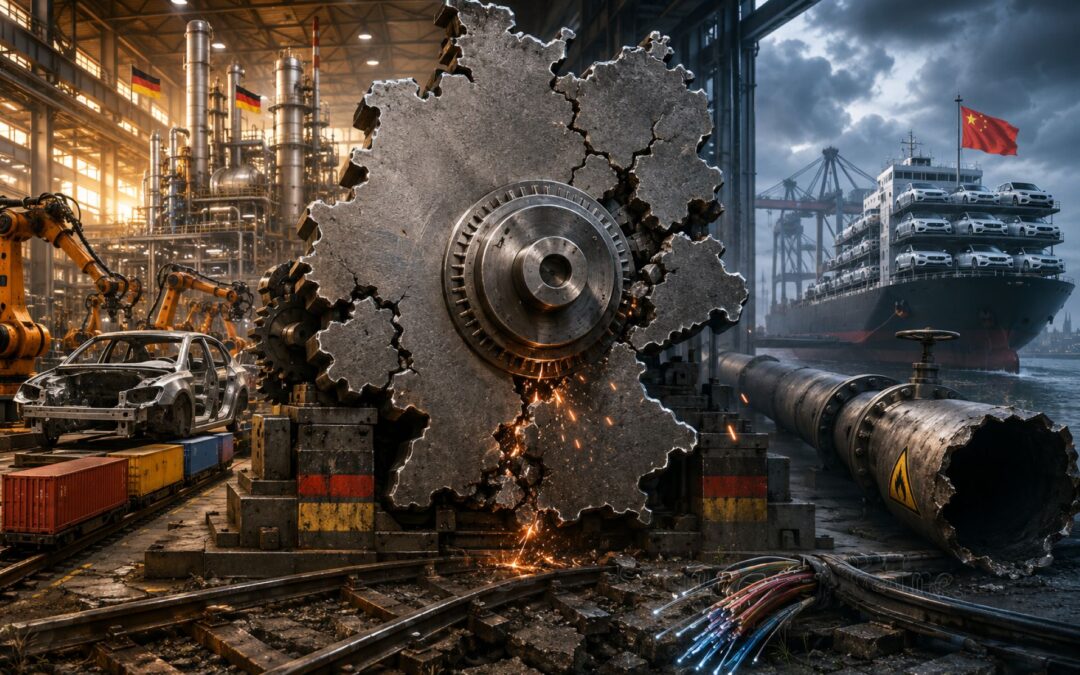
In November 2024, Germany’s three-party coalition collapsed after months of conflict over spending, taxation and how to revive an economy that had barely grown for years. A few months later, the Alternative für Deutschland finished second in Germany’s February 2025 federal election, converting economic frustration, anxiety over immigration and distrust of the political establishment into its strongest national result.
The economic picture was bleak, but not quite as simple as an uninterrupted collapse. Germany’s economy shrank in both 2023 and 2024 before returning to marginal growth in 2025. That improvement did not amount to a meaningful recovery. Manufacturing declined for a third consecutive year, exports remained under pressure and business investment stayed weak.
Germany was no longer merely suffering from a temporary downturn. The country was confronting a more difficult problem: the economic model that had made it Europe’s industrial powerhouse was no longer working as reliably as it once had.
For decades, Germany prospered by producing high-value manufactured goods for the world. It sold machinery and chemicals to industrialising countries, luxury cars to an expanding Chinese middle class and specialised equipment to companies that could not easily buy the same quality elsewhere. Cheap Russian gas supported energy-intensive factories, while restrained public borrowing helped preserve confidence in German finances.
Each element appeared sensible on its own. Together, however, they created a system that depended on external conditions Germany could not control.
China became a competitor as well as a customer. Russian gas stopped flowing. Energy costs rose. Germany’s population aged. Infrastructure deteriorated. Regulation slowed investment. Fiscal restraint limited the government’s ability to respond quickly.
Germany’s crisis is therefore not the story of one disastrous decision. It is the story of a highly successful economic model becoming poorly suited to a different world.
How Germany Built an Economy Around Industrial Exports
Germany emerged from the Second World War with ruined cities, damaged infrastructure, displaced populations and a discredited political system. Yet within little more than a decade, West Germany had become one of the world’s most dynamic economies.
The transformation was driven by several forces working together. Currency reform replaced the unstable Reichsmark with the Deutsche Mark. Price controls were relaxed. The Marshall Plan provided financial assistance and helped reconnect West Germany to the emerging Western economic order. Ludwig Erhard’s social-market economy combined competitive markets with labour protections and a substantial welfare state.
Germany also retained something less visible but equally important: industrial knowledge.
Its engineers, technicians, managers and skilled workers could still manufacture sophisticated goods. The country rebuilt not by competing primarily on low wages or abundant natural resources, but by producing items for which quality, precision and reliability mattered.
German firms became world leaders in automobiles, machine tools, industrial chemicals, electrical equipment and specialist engineering. Many of these companies occupied narrow but highly profitable markets. The Mittelstand—Germany’s network of small and medium-sized manufacturers—became especially effective at producing components, machinery and industrial systems that were difficult to replace.
This system developed its own reinforcing logic. Export success financed investment. Investment improved quality. High quality protected margins. Strong industrial unions negotiated wages without completely undermining competitiveness. Vocational education supplied technically trained workers. Regional banks maintained long-term relationships with local businesses.
Over time, exports became unusually important to national prosperity. Germany’s unusually export-dependent economy came to rely far more heavily on international demand than other large advanced economies such as the United States or France.
That dependence was not inherently irrational. Germany was specialising in areas where it possessed genuine advantages. A country did not need to produce every product domestically if it could sell advanced machinery, cars and chemicals to the rest of the world.
The weakness appeared later.
An export-led model is most successful when international trade expands, foreign customers grow richer and domestic producers retain a technological lead. Germany benefited from all three conditions for decades. It became vulnerable when all three began to weaken at the same time.
China Went From Growth Engine to Industrial Rival
China initially seemed almost perfectly designed to extend Germany’s economic success.
As China urbanised and built factories, roads, ports and power systems, it needed the machinery, chemicals and industrial expertise that German companies supplied. German manufacturers sold equipment to Chinese producers that were still developing their own capabilities.
As Chinese households grew wealthier, they also bought German consumer goods. Volkswagen, BMW and Mercedes-Benz gained access to the world’s largest automotive market. China became one of the most important sources of profit for German carmakers, which often manufactured vehicles through local joint ventures.
The relationship benefited both countries. China obtained advanced technology and industrial capacity. Germany gained a vast new market without having to generate equivalent demand at home.
But the structure of that relationship changed.
China did not remain a lower-cost manufacturer that merely assembled goods designed elsewhere. It invested in research, automation, supply chains, batteries, renewable energy, electronics and advanced manufacturing. Chinese firms began entering industries that German companies had long considered their own territory.
The automobile industry made this transition impossible to ignore.
German carmakers had built their global reputations around combustion engines, mechanical engineering and premium manufacturing. The transition to electric vehicles changed the basis of competition. Batteries, software, digital interfaces and electronics became more important, while some of Germany’s traditional mechanical advantages became less decisive.
Chinese companies moved aggressively into this new market. They benefited from large-scale domestic production, dense battery supply chains, government support and a rapidly developing consumer market. The result was not simply that Chinese companies sold more vehicles at home. They also became exporters.
The changing balance of the global car industry is visible in both directions. European manufacturers have been selling fewer vehicles into China, while Chinese-made vehicles have taken a growing share of the European market.
This does not mean German carmakers have suddenly become irrelevant. Volkswagen, BMW and Mercedes-Benz remain major global companies with valuable brands, engineering expertise and enormous production networks. Germany remains one of the world’s leading automobile producers.
The problem is that the economic assumptions supporting those companies have changed. China is no longer simply a growth market where German manufacturers enjoy a durable technological advantage. It is simultaneously a customer, production base, supply-chain partner and direct competitor.
Volkswagen became the clearest symbol of that pressure.
In 2024, the company warned that its German operations had far more production capacity than demand could justify. Volkswagen considered plant closures that would have been unprecedented in its domestic operations, triggering strikes and a confrontation with one of Europe’s most powerful industrial workforces.
The final outcome was serious, though less dramatic than the initial warnings. Volkswagen’s December 2024 labour agreement avoided immediate factory closures and compulsory redundancies. It nevertheless provided for more than 35,000 job reductions by 2030, lower production capacity and billions of euros in cost savings.
Volkswagen’s problem was not merely that Germans had stopped buying cars. The company was adjusting to slower European demand, rising Chinese competition, high domestic costs and a technological transition in which its earlier strengths did not guarantee leadership.
Similar pressures affect other German industries. Chinese manufacturers increasingly compete in machinery, renewable-energy equipment, chemicals and industrial components. Some German businesses continue to sell successfully in China, but they must now compete against Chinese firms that have become more technologically capable and internationally ambitious.
COVID-era supply disruptions exposed another weakness. German manufacturers were deeply integrated into international supply chains and often dependent on Asian inputs. When factories, ports and shipping routes were disrupted, production in Germany slowed even when local facilities remained capable of operating.
China did not single-handedly destroy German industry. It exposed the danger of assuming that a rapidly growing customer would never become an equally capable rival.
The Energy Shock Broke Germany’s Cost Advantage
Germany’s dependence on China was matched by a different dependence closer to home.
For years, German industry benefited from large volumes of relatively cheap Russian natural gas. Pipelines delivered gas directly into Europe, giving German manufacturers access to energy at prices that supported chemicals, metals, glass, fertilisers and other energy-intensive industries.
By 2021, Russia supplied more than half of Germany’s imported gas. This was not merely a matter of heating homes or generating electricity. Natural gas was also used directly in industrial processes and as a chemical feedstock.
The chemical industry was particularly exposed. For companies such as BASF, gas was not simply a utility bill. It was part of the production system itself.
Germany’s broader energy strategy increased the importance of this dependence.
After the Fukushima disaster in 2011, Angela Merkel’s government accelerated the phase-out of nuclear power. Germany also planned to reduce its reliance on coal while expanding wind and solar generation.
Each element had a political and environmental rationale. Nuclear power faced deep public opposition. Coal was incompatible with Germany’s climate commitments. Renewable energy promised a lower-carbon system.
The difficulty was the transition between them.
Wind and solar capacity expanded, but grids, storage, backup generation and transmission infrastructure did not always develop at the same speed. Gas became an important balancing fuel and a bridge for industry. Germany was therefore reducing domestic nuclear generation while relying heavily on imported Russian gas.
That arrangement appeared manageable while relations with Moscow remained stable and pipeline supplies remained inexpensive.
Russia’s invasion of Ukraine destroyed the assumption.
Gas deliveries had already been falling before the Nord Stream explosions in September 2022. Russia reduced pipeline flows, and deliveries through Nord Stream 1 stopped entirely in early September. The official review of Germany’s 2022 gas supply shows both the scale of the earlier Russian dependence and the speed with which the country had to find alternatives.
Germany avoided the worst-case scenario of physical gas shortages. It secured liquefied natural gas, reduced consumption, filled storage facilities and benefited from lower demand. The feared collapse of the energy system never occurred.
But the industrial damage was still substantial.
European gas prices surged far above pre-crisis levels. Energy-intensive factories reduced production because operating at previous levels was no longer commercially viable. Some plants temporarily shut down. Others reconsidered whether future investment should take place in Germany.
BASF illustrated the problem more clearly than almost any other company. The chemical group faced billions of euros in additional energy costs during the crisis. It reduced production and announced cost-cutting measures at its vast Ludwigshafen complex, one of the most important industrial sites in Europe.
At the same time, BASF was building a major new integrated chemical complex in Zhanjiang, China. The contrast appeared to capture Germany’s predicament: investment was expanding in China while production was being reduced at home.
The chronology, however, matters. BASF’s Zhanjiang investment was announced before the energy crisis, with the project originating in 2018 and construction beginning in 2019. It was not a decision suddenly made because Russian gas disappeared in 2022.
The project was designed partly to place production closer to Chinese customers. It reflected BASF’s long-term strategy in the world’s largest chemicals market.
That does not make Germany’s energy problem irrelevant. High costs can influence where later stages of investment occur, which plants are expanded and which facilities are reduced. The energy crisis strengthened concerns about Germany’s attractiveness as an industrial location even when it did not cause every foreign investment decision attributed to it.
The same qualification applies to nuclear power.
Keeping reactors open for longer might have reduced some pressure on the electricity system and preserved additional dependable low-carbon generation. It would not, by itself, have replaced all the Russian gas used in industrial processes. Nor would it have solved grid bottlenecks, slow permitting, labour shortages or Chinese competition.
Germany’s energy crisis was produced by the interaction of several choices: dependence on one supplier, an incomplete transition away from nuclear and coal, slow infrastructure development and the exposure of energy-intensive industries to global gas prices.
The old system offered German manufacturers a cost advantage. The new system often asks them to absorb higher prices while simultaneously financing a technological transition.
Demographics Are Shrinking the Skilled Workforce
Germany’s external dependencies might have been easier to manage if the country possessed a rapidly growing labour force.
It does not.
Germany has one of the oldest populations in Europe. Large generations born during the postwar period are reaching retirement age, while smaller generations are entering employment. The result is not simply a higher number of pensioners. It is a reduction in the pool of workers available to operate factories, design products, build infrastructure, provide healthcare and finance the welfare state.
The problem is especially serious for an industrial economy.
Manufacturing depends on specialised skills that cannot always be replaced quickly. German companies need engineers, technicians, machinists, electricians, software developers and workers trained through the country’s vocational system. When experienced employees retire, businesses do not merely lose labour hours. They lose accumulated knowledge.
Germany’s official population projections show how heavily the outcome depends on migration. Without net immigration, the working-age population could fall by roughly 6.2 million by 2035. Even with annual net migration of 350,000 people, the projected decline remains around 3.2 million.
This makes immigration part of the economic solution, not merely an additional public expense.
Germany cannot realistically stabilise its workforce through higher birth rates in the near term. Children born today will not enter full-time skilled employment for roughly two decades. The country therefore needs some combination of skilled immigration, higher participation among women and older workers, later retirement, automation and productivity growth.
Immigration does not solve the problem automatically.
New arrivals need housing, language training, recognised qualifications, schools, healthcare and access to functioning local administrations. Refugees may require years of support before entering stable employment. Skilled migrants may choose other countries when German bureaucracy delays visas or prevents qualifications from being recognised.
Germany therefore faces two truths at once. Large-scale migration can create genuine fiscal and social pressures when integration systems are weak. Yet without migration, the country’s labour-force decline would be considerably more severe.
The relevant economic question is not whether Germany should have workers from abroad. It is whether the state can attract, train and integrate enough people to fill essential roles without creating avoidable bottlenecks.
Demography also raises the stakes of every other reform. A shrinking workforce means Germany cannot rely on adding more labour to produce more output. It must make each worker more productive.
That requires better infrastructure, digital public services, modern machinery, faster business formation and more efficient use of existing skills—the very areas in which the country has often struggled to invest.
Weak Domestic Demand Left Germany Exposed
Germany’s export dependence might also have been less dangerous if strong household consumption could replace lost foreign demand.
Historically, however, German economic policy placed greater emphasis on competitiveness, saving and wage restraint than on consumption-led growth.
German households tend to save a relatively high share of their income. That behaviour reflects caution, demographic concerns and the structure of the financial system. It is not inherently harmful. Saving can finance investment and provide households with security.
At the national level, though, persistent high saving becomes a weakness when domestic investment is also low. Income is not fully recycled into new factories, infrastructure, housing or household consumption. Growth becomes more dependent on selling goods abroad.
For years, Germany could sustain this imbalance because external demand was strong. Chinese industry bought German machinery. European consumers bought German vehicles. Global trade expanded.
Once exports weakened, the limitations of domestic demand became more visible.
The inflation shock after 2021 made the problem worse. Energy and food prices rose rapidly, reducing the purchasing power of wages. Households became more cautious and delayed spending. Businesses facing uncertain demand postponed investment.
Real wages later began to recover, and household consumption contributed to growth in 2025. Yet the recovery did not erase the longer-standing weakness. Germany still lacked the kind of consumption engine that could easily compensate for a sustained industrial-export slowdown.
The tax system also affects this dynamic.
The transcript’s description of an “employment tax wage” is better understood as the labour-tax wedge: the difference between what an employer pays for a worker and what that worker ultimately receives after income tax and social-security contributions.
Germany has one of the OECD’s highest labour-tax burdens. For a single worker earning the average wage, the tax wedge was 47.9% in 2024, compared with an OECD average of 34.9%.
That burden finances pensions, healthcare, unemployment insurance and other public benefits. It cannot simply be eliminated without replacing revenue or reducing services.
Nevertheless, high taxes on labour can discourage employment, reduce take-home pay and make it harder for companies to attract skilled workers. They also amplify the demographic problem: as the ratio of workers to retirees falls, each worker may be asked to finance a larger share of social spending.
Germany’s consumption weakness therefore cannot be solved through a one-time stimulus cheque or a simple demand for lower saving. It is connected to wages, taxation, demographics, housing, energy costs and public confidence.
The broader lesson is that an economy dependent on exports needs a stronger domestic foundation when the external environment becomes less favourable. Germany allowed that foundation to remain too weak for too long.
The Debt Brake Turned Prudence Into Underinvestment
Germany’s commitment to fiscal discipline emerged from understandable historical and political concerns.
The country’s economic culture places exceptional value on monetary stability, controlled borrowing and protection against inflation. After the global financial crisis, Germany amended its constitution to create the debt brake, limiting the federal government’s structural deficit to 0.35% of gross domestic product under normal conditions.
The rule protected Germany from the very high debt levels accumulated elsewhere. It helped preserve fiscal credibility and left the country with greater borrowing capacity when major emergencies arrived.
But the debt brake also encouraged governments to treat borrowing itself as the problem, even when debt financed long-term productive investment.
Germany’s infrastructure gradually deteriorated. Bridges required urgent repairs. Rail reliability weakened. School buildings aged. Broadband networks lagged. Public administrations remained dependent on paper forms, fax machines and fragmented computer systems.
These weaknesses imposed real economic costs. Freight delays affected supply chains. Slow internet reduced productivity. Housing shortages made it harder for workers to move to productive cities. Municipalities lacked the staff required to plan and deliver new projects.
An export economy requires more than excellent private factories. It also requires ports, railways, roads, power grids, digital networks and efficient local administrations.
Germany failed to invest enough in those systems during years when borrowing costs were extremely low.
The debt brake was not the only reason. Political priorities, shortages of planners and slow permitting also restricted investment. Germany sometimes failed to spend funds that had already been allocated.
Even so, the constitutional borrowing limit made adjustment harder. Governments repeatedly relied on special funds and accounting structures to finance investment without openly changing the rule. In November 2023, Germany’s Constitutional Court invalidated the transfer of unused pandemic borrowing authority into a climate and transformation fund, creating a major budget crisis.
That ruling intensified the conflict that eventually brought down the coalition government.
By 2025, Germany’s political system had accepted that the fiscal framework required substantial modification. Germany’s 2025 fiscal-framework reform created a €500 billion infrastructure and climate fund outside the normal debt-brake calculation. It also allowed Germany’s states limited structural borrowing and exempted qualifying defence and security expenditure above a specified threshold.
The ordinary federal structural-deficit limit was not abolished. But the reform created far more space for investment than the original framework allowed.
In other words, one of the transcript’s main proposed solutions has already been partly implemented.
The challenge has shifted. Germany no longer needs only to decide whether it should borrow more. It must prove that additional borrowing can be converted into productive assets.
A large investment fund can support railways, grids, schools, digital infrastructure and defence. It can also be wasted through poorly selected projects, delayed approvals, cost overruns or spending that merely replaces investment previously financed from the ordinary budget.
Fiscal capacity is valuable only when the state can deploy it.
Bureaucracy Made a Difficult Transition Even Slower
Germany’s administrative system is often frustrating for the same reason it is dependable.
Rules are detailed. Legal responsibilities are clearly defined. Courts are independent. Property rights are secure. Officials are reluctant to make discretionary decisions that could appear arbitrary.
These characteristics helped make Germany stable, predictable and attractive to long-term industrial investment.
Over time, however, a system designed to prevent mistakes became increasingly poor at permitting experimentation.
A business may face federal rules, state regulations, municipal procedures, environmental assessments, sector-specific licences and data-protection requirements. Each rule may have a legitimate purpose. Together, they create delays that become economically significant.
The cost is not always visible in a single dramatic failure. It appears through thousands of postponed decisions.
A company delays expanding a factory. A renewable-energy project waits years for approval. A municipality struggles to hire planners. A foreign professional spends months obtaining recognition for a qualification. A start-up incorporates elsewhere because German procedures are slower and less digital.
The OECD’s assessment of Germany’s business dynamism identifies weak firm entry, administrative complexity, barriers to competition and low productivity growth as major structural problems.
These weaknesses matter because Germany is not attempting a minor adjustment. It must rebuild its energy system, modernise transport, digitalise government, expand housing, adapt factories and attract skilled workers at the same time.
A slow state can preserve an established industrial model. It is much less effective when that model must change quickly.
Bureaucracy also interacts with fiscal policy. Germany may authorise billions of euros for infrastructure, but money cannot build a railway or power line until projects are designed, approved, contracted and constructed. If planning offices lack employees or approval procedures remain excessively complex, fiscal expansion may produce inflation and delay rather than useful capacity.
The same institutional problem affects innovation.
Germany produces excellent research and remains strong in engineering, but it has been less successful at creating and scaling new technology companies. Regulation is only one reason. Europe’s fragmented capital markets, limited late-stage investment and smaller digital market also matter. Yet administrative complexity contributes to Europe’s difficulty turning innovation into globally scaled companies.
The answer is not to remove every safeguard.
Germany’s environmental protections, labour standards and legal institutions are valuable. A political system that responds to economic pressure by abandoning due process would create different and potentially greater risks.
The task is to distinguish between protections that achieve clear public goals and procedures that survive mainly because no institution has the authority or incentive to simplify them.
Germany needs a state that remains lawful without being paralysed, cautious without being immobilised and predictable without being incapable of adaptation.
Germany Has Fiscal Space—but Reform Must Be Executed
Germany is not a poor country that has exhausted every option.
It retains many of the assets that created its earlier success: advanced manufacturers, skilled workers, respected universities, research institutions, strong corporate brands, reliable courts and substantial fiscal capacity. Its public debt remains manageable compared with many other advanced economies.
The question is whether Germany can use those assets to build a new model rather than attempting to recreate the old one.
Cheap Russian pipeline gas will not return as a dependable foundation for industrial policy. China will not revert to being merely a buyer of German machinery and vehicles. The working-age population will not begin growing rapidly without sustained immigration. The combustion engine will not regain its earlier position in the automobile industry.
Germany must adapt to those realities.
Energy is the first requirement. The country needs a system that is low-carbon, reliable and competitive enough to support industry. That means faster electricity-grid expansion, more renewable generation, sufficient storage and backup capacity, better connections across Europe and clearer long-term pricing conditions for energy-intensive companies.
The goal should not be to preserve every factory regardless of cost. Some energy-intensive production may relocate when other countries possess permanently cheaper energy. But Germany should avoid losing viable industries simply because grids, approvals or transition policies remain unnecessarily dysfunctional.
Infrastructure is equally important. The €500 billion fund can improve railways, bridges, schools, housing, digital networks and power systems. Yet projects must be selected for their long-term economic value rather than political visibility.
Tax reform also matters, especially on labour. Germany cannot eliminate the social-insurance system that taxes support, but it can reconsider how heavily the burden falls on employment. Greater workforce participation, more efficient public spending and broader sources of revenue could help reduce the cost of hiring.
Demographic policy must become economic policy. Germany needs faster recognition of foreign qualifications, better language training, more housing in productive regions and a migration system designed to connect workers with actual shortages. It also needs childcare, flexible retirement and workplace policies that allow more residents to participate fully.
Industrial policy should focus on adaptation rather than nostalgia. Permanent subsidies cannot make every established business competitive. Support is more defensible when it helps create new capabilities in batteries, semiconductors, industrial software, green chemicals, advanced machinery and clean-energy systems.
China will remain economically important, but German companies need a less concentrated risk structure. Diversifying suppliers and export markets may be more expensive in the short term. It makes the economy more resilient when political or logistical shocks occur.
Administrative reform connects all these priorities. Without faster planning, digital government and clearer lines of authority, new borrowing will not produce the transformation its supporters expect.
Germany’s problem is therefore no longer a simple shortage of money. It is the capacity to turn money into completed projects, productive investment and higher output.
That distinction is central to the IMF’s latest assessment of Germany. Greater public investment can support recovery, but lasting growth also requires productivity reform, a larger effective workforce and a business environment capable of responding to technological change.
Germany’s economic crisis is real. Industrial production has weakened. External demand is less dependable. Energy remains costly. The workforce is ageing. Political frustration has intensified.
But decline is not predetermined.
Germany’s current weakness is partly the consequence of strengths that became overextended: export specialisation, fiscal caution, legal stability and industrial concentration. The country does not need to abandon those strengths. It needs to stop treating their most rigid forms as permanent virtues.
The old German model prospered because it matched the world around it. A new model will have to succeed in a world of expensive energy, strategic competition, slower trade growth, demographic pressure and rapid technological change.
Germany has the capital, institutions and industrial knowledge required to make that transition. What it has not yet demonstrated is the speed and political discipline to complete it.
That—not whether Germany can recreate its past—is the real question facing Europe’s largest economy.
Last Updated on July 21, 2026 by Aseem Gupta