
Reading Time: 19 Minutes
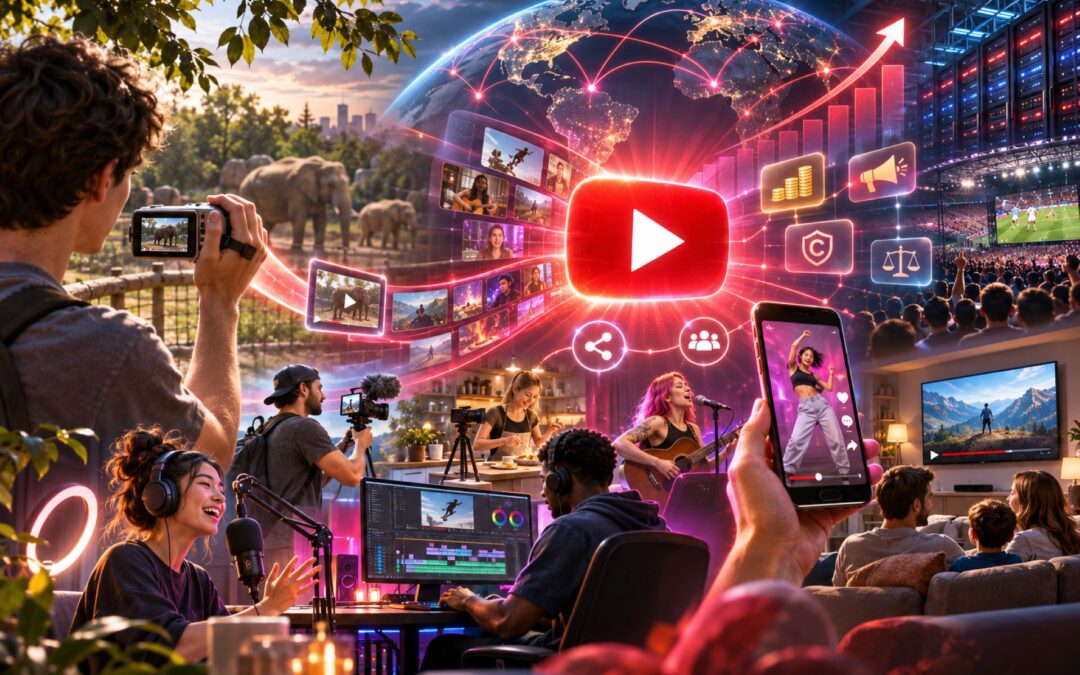
On 23 April 2005, Jawed Karim visited the San Diego Zoo and stood in front of two elephants. A camera recorded him making a brief observation about their unusually long trunks. The clip, titled Me at the Zoo, lasted just 19 seconds. There was no elaborate production.
It was nevertheless the first video uploaded to YouTube. The casual recording embodied a proposition that traditional television rarely offered: an ordinary person could make something, put it online, and allow strangers to decide whether it was worth watching. Twenty-one years later, the company built around that possibility was distributing entertainment, education, music, news, podcasts, and live sports to audiences around the world.
YouTube’s rise was anything but inevitable. Its early popularity generated enormous expenses, major copyright owners threatened its survival, and advertisers repeatedly questioned whether they could trust it. It is the story of how an unlikely startup learned to make widespread participation commercially sustainable, then repeatedly changed its business without losing the audience that made it valuable.
The Internet Before YouTube
Videos were available on the internet in the early 2000s, but watching them could require patience and technical knowledge. One file needed QuickTime, another Windows Media Player, and a third a codec that the viewer had never heard of. Slow connections made waiting almost as important as watching.
Sharing was harder still. A person who recorded an amusing moment on a digital camera could try attaching the file to an email, only to discover that it exceeded the recipient’s attachment limit. Hosting the clip on a personal website meant managing storage, file transfers, and the possibility of unexpected traffic. A homemade video was much harder to distribute reliably.
At the same time, internet behavior was changing. Blogging gave individuals an audience without a newspaper publisher, and Flickr helped make photographs easy to organize and share. Broadband connections were becoming more common, while cameras and mobile phones were putting recording equipment into more hands. But simple, reliable video sharing remained elusive.
Chad Hurley, Steve Chen, and Jawed Karim had worked at PayPal, the payments company acquired by eBay in 2002 for approximately $1.5 billion. They had seen how a useful internet product could grow when it removed friction from an everyday activity. Hurley brought design experience, Chen engineering expertise, and Karim a strong interest in what the web could become. They needed to make publishing a recording feel almost as effortless as viewing a photograph.
The Dating-Site Experiment and the First Video
Karim has connected the idea for an easier video service to two events that exposed the limitations of the existing web. After the devastating Indian Ocean tsunami of December 2004, footage captured by ordinary witnesses was difficult to find and play. He has also spoken about struggling to locate the widely discussed clip from the 2004 Super Bowl halftime show. Finding and playing the recordings was the problem.
The founders’ first commercial idea was narrower than the universal video library that eventually emerged. They experimented with video dating, drawing on the popularity of sites where people rated one another’s photographs. Instead of presenting a written profile and a still image, a person might upload a video and receive attention from prospective matches. The remembered slogan was “Tune In, Hook Up.”
The domain YouTube.com was registered on Valentine’s Day, 14 February 2005, but that did not mean a fully functioning, popular service opened that morning. Accounts of the pivot differ in emphasis and timing. In recollections collected by Sequoia Capital, Chen and Karim described a video-dating experiment that attracted virtually no uploads and a subsequent decision to let people share any kind of recording. Karim’s first zoo clip, already uploaded in April, shows why the earliest development cannot be reduced to one perfectly tidy sequence of launch, failure, and reinvention.
Even after broadening the concept, growth was painfully slow. Karim recalled watching access logs and sometimes finding that an entire day had passed without a visitor. Without uploads there was little to watch, and without viewers there was little reason to upload.
The product addressed another part of the problem with unusual care. People could send a file to YouTube and let the site handle much of the conversion and playback work. Its use of Flash video took advantage of software already widely installed in web browsers; Flash was itself a plugin, but most users no longer had to hunt down different players for different recordings. Tags, links, and straightforward playback made videos discoverable.
Working from modest premises, including an office space above a pizza restaurant in San Mateo, the young team concentrated on a product that someone without technical expertise could use. The idea was sometimes explained in terms of making uploading easy enough for a grandmother, although the interface still demanded constant experimentation. The service was built to make technical decisions disappear from the viewer’s experience.
How YouTube’s Videos Spread Across the Internet
Solving the playback problem did not guarantee an audience. YouTube’s other critical innovation was allowing its videos to travel far beyond YouTube.com. A user could copy a small piece of HTML and place a playable video inside a blog post, personal website, or MySpace profile. Someone who encountered the clip did not have to visit the original site first. The YouTube player, its logo, and the possibility of watching another video came along for the ride.
This mattered particularly on MySpace, where users assembled highly personalized profiles. Music, photographs, messages, and decorative elements already helped people express their identities there. Embedded video gave them another way to entertain friends or show what they found interesting. A visitor might see a clip on one profile, notice another on a friend’s page, and eventually visit YouTube itself. Users did the distribution work voluntarily.
YouTube’s founders also experimented with the social possibilities of video. There were features for responding to someone else’s upload with another recording, creating something like a conversation conducted through clips. Embeds could appear wherever a site permitted suitable HTML, including listings or personal pages elsewhere on the web.
The culture that emerged was far less predictable than a television schedule. A Nike advertisement featuring Brazilian footballer Ronaldinho drew extraordinary attention as viewers shared his display of skill. The video showed that an advertisement could become entertainment people actively sought out, although stories about its precise early view milestones require caution because measurement was still evolving. Homemade stunts and odd discoveries circulated beside professional productions, sometimes without any clear distinction in how audiences found them.
In December 2005, a Saturday Night Live digital short, Lazy Sunday, became one of the early site’s defining viral events. The comedic rap, performed by Andy Samberg and Chris Parnell, circulated well beyond its original television broadcast. Millions of online views demonstrated the reach of the new distribution system, but the clip also highlighted a problem: viewers were sharing copyrighted network programming, and NBC sought its removal. The same behavior that made YouTube a powerful promotional channel could bring it into conflict with the companies that owned the footage.
Then came lonelygirl15, a teenager apparently sharing intimate details of her everyday life through webcam-style videos. Viewers debated clues about her identity and authenticity until the supposedly spontaneous diary was exposed in 2006 as a scripted production performed by actress Jessica Rose. The episode showed that online video could create sustained characters, mysteries, and communities around a person who had never appeared on conventional television. YouTube was becoming both a distribution tool and a new stage for storytelling.
The Bandwidth Crisis and Google’s $1.65 Billion Acquisition
When someone read a blog post, the server delivered comparatively little data. A video demanded much more, and popular clips had to be delivered repeatedly to viewers using different connections across the world. Each new audience meant more bandwidth, more computing capacity, more storage, and more expense.
In November 2005, YouTube announced a $3.5 million investment from Sequoia Capital. Its release disclosed that the service was already transferring around eight terabytes of data daily. Sequoia, where former PayPal finance executive Roelof Botha had become a partner, backed the founders’ ability to make online video mainstream.
A further $8 million investment followed in 2006, but investment capital could not permanently substitute for a business model. More viewers meant more exposure for YouTube, yet each additional play could arrive before there was an effective advertisement to finance it. Unlike a retailer, the company could not simply charge every visitor a price that covered delivery costs without undermining the effortless sharing that brought those visitors in.
The technical challenge also moved beyond simply renting space on someone else’s servers. Early hosting arrangements helped the startup grow quickly, but operating at enormous scale meant negotiating network capacity, securing data-center space, and buying equipment. Accounts from the early team describe staff handling physical servers and cables themselves.
The other looming bill came from lawyers. Users could upload television excerpts, music videos, or sports footage without obtaining permission. Rights holders saw their expensive programming circulating across a service that did not own it. The legal limits of a hosting platform’s responsibility were still being tested, and even a successful defense against a large lawsuit could consume resources that a young company lacked. YouTube needed enough money not only to grow but to survive a prolonged fight.
Google already operated Google Video, yet its own attempt had not captured the enthusiasm surrounding YouTube. Other large technology companies were reportedly interested in the opportunity, but Google possessed an especially potent combination of infrastructure, advertising expertise, and financial resources. Its management also recognized that people were increasingly discovering media through communities rather than through traditional publishers or centrally organized catalogues.
On 9 October 2006, Google announced an agreement to acquire YouTube for $1.65 billion in stock. The official announcement described more than 100 million daily video views and about 65,000 new uploads each day. It closed on 13 November. YouTube was not yet two years old, had no established record of profits, and faced costly legal uncertainty.
But Google was buying more than a website. It was acquiring an audience that returned voluntarily, a brand associated with an entirely new kind of video culture, and a distribution system that grew through its own users. Google could afford to postpone short-term profits while building advertising infrastructure around that attention. The purchase did not eliminate copyright disputes or guarantee eventual success; it gave YouTube room to confront problems that might otherwise have overwhelmed it.
Copyright, Content ID, and the Viacom Lawsuit
The most difficult contradiction in YouTube’s early business was that it encouraged people to upload almost anything while much of what they wanted to share belonged to someone else. A television clip might attract millions of viewers and increase the platform’s value, but the broadcaster that paid to produce it might receive nothing. A recording could also contain copyrighted music even when the person filming it owned the camera and the visual footage.
In March 2007, media company Viacom sued YouTube and Google, seeking more than $1 billion in damages over alleged unauthorized uploads of its programming. The case raised questions about how copyright law applied to hosting services receiving immense quantities of material from users. Human review of every upload was impractical, but rights owners wanted protection. The legal dispute concerned what YouTube knew, what it did when notified, and the protections available under US copyright law.
Google responded in part through technical systems for identifying copyrighted material. In October 2007, it launched a beta version of YouTube Video Identification, an important precursor to what became Content ID. Rights holders could supply reference material against which uploads were checked. If the system found a match, the owner could choose among responses such as blocking a video, monitoring its use, or allowing it to remain available under monetization arrangements.
This shifted a task that might have required searching for infringements individually toward systematic matching against a library of registered works. It also created a new kind of negotiation: permission could be accompanied by a business arrangement instead of being limited to a removal request.
This changed the commercial possibilities of unauthorized uploads. A music company could regard a fan’s video as a threat and demand removal, or it could permit the upload and earn revenue from advertising around it. It meant the platform could offer more than a simple choice between ignoring infringement and deleting everything suspected of containing copyrighted material.
The technology also had limits. Automated matching can identify portions of existing recordings, but it cannot always determine whether a particular use is legally permitted as commentary, criticism, parody, or another exception. Disputes over wrongful claims and monetization remain part of the creator experience. Content ID cannot resolve every licensing or ownership question.
The Viacom case continued through years of litigation, including significant arguments over the legal protections afforded to online service providers. On 18 March 2014, Viacom and Google announced that the lawsuit had been resolved; the settlement terms were not disclosed. It would therefore be inaccurate to say that Content ID alone ended the case. Copyright management succeeded as part of a wider strategy involving legal defenses, licensing relationships, and new ways for rights owners to earn from material people were already sharing.
The Partner Program and the Birth of the Creator Economy
Resolving part of the copyright problem did not answer another question: why would talented people keep making videos for YouTube if all the commercial benefits flowed to the platform? Ambitious productions eventually required time, equipment, and income.
In 2007, YouTube introduced the Partner Program, initially as a limited scheme for selected creators. By December, it was expanding applications to eligible creators in the United States and Canada. Participants could earn a portion of advertising revenue associated with their videos. What began as an activity often undertaken without financial expectations now offered the possibility of paid work, even if earning enough to live on remained difficult for most participants.
The standard arrangement for qualifying advertisements on long-form videos eventually became a 55% share of net ad revenue for creators, with YouTube retaining 45%. The exact payment received depends on eligibility, advertiser demand, geography, viewing behavior, content type, and other conditions. A video with a million views does not automatically earn the same amount as another with the same audience size. The important structural change was that YouTube could benefit financially when a creator succeeded, while the creator could share directly in that success.
That arrangement supported a powerful reinforcing cycle. More creators produced a wider range of videos, which gave viewers more reasons to visit. Greater viewing attracted advertisers, whose spending created earnings that could support better production and more frequent uploads. New audiences could then discover creators through recommendations and subscriptions, creating additional reasons for people to invest in the platform. Unlike a television network commissioning a fixed slate of programs, YouTube could draw from an enormous variety of independent experiments.
Consider the difference between a creator filming a hobby on weekends and a channel employing editors, researchers, camera operators, and business managers. The first could begin with equipment already at home; the second could grow into a professional operation if audience demand and revenue justified it. Video tutorials, comedy, gaming, beauty content, educational explainers, and reviews were not competing for the same few television time slots.
YouTube’s recommendations and policies shaped who received attention, and a change in advertiser demand could sharply affect income. Most channels never developed substantial earnings. Creators also depended on a platform whose rules they did not control, and whose algorithms could alter the relationship between effort and reach. Revenue sharing made the opportunity real, but it did not turn every uploader into an employee with wages, benefits, or predictable working hours.
YouTube itself was not free of content costs. It licensed professional music, entered agreements with media companies, and later paid for premium rights and programming. Yet its most important economic innovation was to combine licensed offerings with a vast body of videos created by people who independently chose what to make. Instead of carrying every production decision and its costs, the platform supplied distribution, discovery, infrastructure, and monetization. That allocation of responsibilities helped it expand into subjects no central programming department could have anticipated.
Viral Stardom, Advertiser Backlash, and Regulation
As the Partner Program matured, YouTube’s cultural influence became impossible to dismiss as a collection of amateur clips. In December 2012, South Korean artist Psy’s Gangnam Style became the first YouTube video to reach one billion views. Its distinctive dance and comic presentation crossed language barriers through repeated sharing, imitation, and public discussion. The milestone showed how a recording could become a global event without relying on every country’s television networks to schedule it.
There is a qualification to that story: Psy was already an established musician, not an unknown performer discovered entirely outside the industry. YouTube amplified his reach across borders, but the success still involved an artist with professional experience and an existing musical career. The important change was that an online platform could connect established acts and new creators alike with enormous international audiences through the same basic mechanisms.
Susan Wojcicki became YouTube’s chief executive in 2014 after having advocated for Google’s acquisition years earlier. During her tenure, the company expanded beyond straightforward video advertising, developing paid subscriptions, music offerings, new creator tools, and more formal relationships with professional media businesses. Growth also made it harder to manage what appeared on the platform. A service hosting an immense variety of political speech, entertainment, commentary, and personal expression would inevitably contain material that brands found objectionable.
The tension erupted into public view in 2017. Advertisers discovered that some of their campaigns could appear alongside extremist or hateful videos, prompting major companies including AT&T and Verizon to withdraw advertising. For advertisers, placement mattered as much as audience reach: a brand did not want to be associated with material that violated its values or threatened its reputation. YouTube’s automated advertising system, designed to operate at massive scale, now looked insufficiently selective.
Creators experienced the crisis differently. As YouTube restricted ad eligibility and introduced tighter brand-safety standards, some channels saw revenue collapse or fluctuate sharply. Material that was controversial, sensitive, or simply unattractive to advertisers could become difficult to monetize even when it was not unlawful. The term adpocalypse captured the feeling that a platform capable of creating independent careers could also threaten them through policy changes and advertiser decisions outside creators’ control.
YouTube responded with more intensive review, stricter monetization requirements, advertiser controls, and additional sources of creator income. Super Chat allowed viewers to pay to highlight messages during live streams; channel memberships offered recurring support; merchandising and subscription-related revenue could reduce some dependence on ordinary video ads. These systems did not eliminate disputes over moderation or financial fairness, but they recognized that a creator business built entirely on volatile advertising was vulnerable.
Children’s privacy produced a separate reckoning. In 2019, the Federal Trade Commission announced a $170 million settlement with Google and YouTube concerning alleged violations of the Children’s Online Privacy Protection Act. Regulators said personal information had been collected from children without appropriate parental consent. The settlement led to important changes around identifying content made for children and limiting certain data-driven advertising and engagement features on such videos.
These controversies exposed a basic tension in YouTube’s business. The platform benefited when nearly anyone could publish, but advertisers, children, copyright owners, and viewers all expected it to exercise judgment over what it hosted and how it used information. Policies designed to protect one group could disappoint another. YouTube’s challenge was no longer merely convincing people to watch videos; it was maintaining enough trust among parties whose interests could never be perfectly aligned.
How YouTube Responded to TikTok with Shorts
YouTube had helped establish online video as a mainstream activity, but it did not have a monopoly on what video should look like. Smartphones made vertical recording effortless, and TikTok developed an exceptionally effective system for presenting short clips one after another. Its emphasis on rapid discovery and a personalized feed challenged the assumption that viewers would always begin with a familiar channel, search term, or longer video.
The competitive threat was particularly visible among younger audiences, but the format’s appeal was broader. A quick joke, dance, recipe technique, or surprising observation did not require a ten-minute production. Creators could experiment more frequently, while viewers could sample many pieces of content in a brief session. The economics and viewing habits of this format differed sharply from the long-form videos around which much of YouTube’s established monetization system had developed.
YouTube introduced Shorts in India in September 2020, shortly after India banned TikTok, and then expanded the feature internationally in 2021. Its own account of Shorts’ first year emphasized experimentation, creator tools, and discovery. Shorts allowed people to produce and consume vertical videos within an app already used for music, tutorials, documentaries, gaming, and countless other interests.
The strategy had a clear advantage. Someone discovered through a short clip could also have a library of longer videos, live broadcasts, and community interactions on the same platform. YouTube could encourage movement between formats instead of requiring a creator to build an entirely separate audience. The importance of retaining creators was familiar from the collapse of Vine’s short-video ecosystem, where popularity alone had not become a sufficiently durable creator business.
Shorts nevertheless required a different advertising model. Qualifying creators receive 45% of the revenue allocated to them from a pooled Shorts advertising system, rather than the usual long-form percentage applied to eligible watch-page advertising. Music licensing and the distribution of revenue across participating creators complicate direct comparisons. A short-form view frequently earns much less than a long-form view, although earnings vary substantially. Shorts can help attract attention, while longer videos, live formats, memberships, or outside businesses may provide additional earning possibilities.
By 2026, YouTube reported more than 200 billion daily Shorts views. It counts views, not unique viewers or sustained attention. YouTube’s response to TikTok was therefore not simply to copy a format. It was to absorb a new pattern of consumption into an existing system of creator relationships, advertising, recommendations, and varied video lengths.
YouTube Becomes the New Television
While short clips captured attention on phones, another transformation was unfolding on much larger screens. Faster broadband, connected televisions, and streaming devices made it natural to open YouTube from a living-room sofa. Viewers began watching lengthy interviews, documentaries, podcasts, comedy, educational programs, and live broadcasts on the same screen once dominated by scheduled television channels.
The company had also expanded its relationship with paid media. YouTube Music and Premium offered subscription options, while YouTube TV provided a bundle of live television channels in the United States. In December 2022, YouTube announced a deal to distribute NFL Sunday Ticket beginning with the 2023 season. That package brought premium American football coverage to YouTube TV and YouTube Primetime Channels, demonstrating a willingness to pay for major sports rights as well as distribute user-generated material.
In 2023, Susan Wojcicki stepped down as chief executive and was succeeded by longtime executive Neal Mohan. Under Mohan, the company continued treating subscriptions, creators, television, and new viewing formats as connected parts of the same business. In its 2025 account of its strategic priorities, YouTube said television had overtaken mobile as the principal device for YouTube viewing time in the United States, according to its measured watch time. That did not mean phones had become unimportant globally; it showed how far the platform had moved beyond its desktop-web origins.
The financial scale was equally striking. Alphabet’s 2025 annual filing reported $40.367 billion in YouTube advertising revenue for that year, before counting subscription revenue. YouTube also reported more than $60 billion across advertising and subscriptions. These figures are revenue, not a disclosed standalone operating profit.
In his 2026 letter on YouTube’s future, Mohan said the company had paid more than $100 billion to creators, artists, and media companies over the preceding four years. That sum includes several kinds of recipients and commercial arrangements; it should not be mistaken for earnings received exclusively by independent video creators. Still, alongside advertising and subscriptions, it gives a sense of the economic activity now organized around a platform that began with an elephant video.
YouTube is not simply replacing television, because professional television companies, sports leagues, musicians, and independent creators increasingly operate alongside one another within it. A broadcaster can use YouTube to reach people beyond its traditional channel, while an individual creator can assemble a production team and build an audience without becoming a broadcaster. The distinction between established media and internet-native media has grown less useful than the question of who controls distribution, attention, and the relationship with viewers.
The Business Model That Made YouTube So Difficult to Challenge
The original breakthrough was deceptively modest: YouTube made uploading and watching online videos substantially easier. But technical convenience alone would not have created a durable media business. A perfectly designed player without interesting content has little value; a huge library without reliable playback frustrates viewers. YouTube succeeded by joining technical accessibility to the social desire to make things and share them with other people.
Embedding turned viewers into distributors. A clip placed on a personal profile promoted both the recording and the service that hosted it, allowing YouTube to grow through places it did not own. As its audience expanded, the growing library became an attraction in itself. People arrived for a particular joke or song, discovered another video, and developed habits around the platform rather than merely around individual uploads. That made the service increasingly useful to creators searching for viewers and to advertisers searching for audiences.
Revenue sharing then strengthened a relationship that pure popularity could not guarantee. The Partner Program encouraged people to put more effort into their work and, in some cases, build entire businesses around it. YouTube was no longer only competing to host clips; it was competing to be the place where creators could find audiences and make a living. The platform did not employ most of these people, but its economic future became intertwined with theirs.
Google’s acquisition supplied a different kind of advantage. Infrastructure investment, advertising systems, legal capacity, and years of patience were easier for YouTube to obtain inside a much larger company than as an independent startup. The same corporate relationship brought strategic resources that a fast-growing rival might struggle to match. Yet corporate ownership is no guarantee of success: technology history contains plenty of acquisitions that lost their users or neglected the products that initially made them attractive.
Copyright management addressed another essential weakness. The combination of legal frameworks, licensing, and Content ID made it possible for many rights holders to participate commercially rather than responding only through takedown demands. It was not a perfect settlement between creators and owners, but it made the platform more workable for an entertainment industry that could neither ignore its audiences nor simply surrender control over valuable recordings.
Adaptation has been equally important. When advertisers demanded stronger controls, YouTube changed its policies. When TikTok shifted viewing habits, it developed Shorts. When connected televisions became an important screen, it expanded its television products and professional relationships. Each response involved trade-offs, and each created fresh disputes about power, fairness, or creator income. The achievement was not avoiding those problems; it was continuing to attract users while negotiating them.
None of this means YouTube is literally unbeatable. Audiences can migrate, regulators can impose new duties, creators can lose faith in platform rules, and advertisers can shift budgets. Its recommendations and moderation also influence what audiences see. The platform’s size is both a competitive advantage and a source of responsibilities that grow with every new use of it.
Return to Karim at the zoo. The scene was ordinary precisely because it did not need to pass through a commissioning editor, a studio executive, or a television schedule. The long-term significance of that upload was not the elephants themselves but the possibility that any recording could enter a public conversation. YouTube’s founders made that possibility practical; successive decisions about distribution, rights, money, and trust turned it into an industry. The result was a media system in which the distance between making a video and reaching an audience became dramatically shorter, even as the business behind that connection grew extraordinarily complex.
Last Updated on November 14, 2026 by Aseem Gupta