
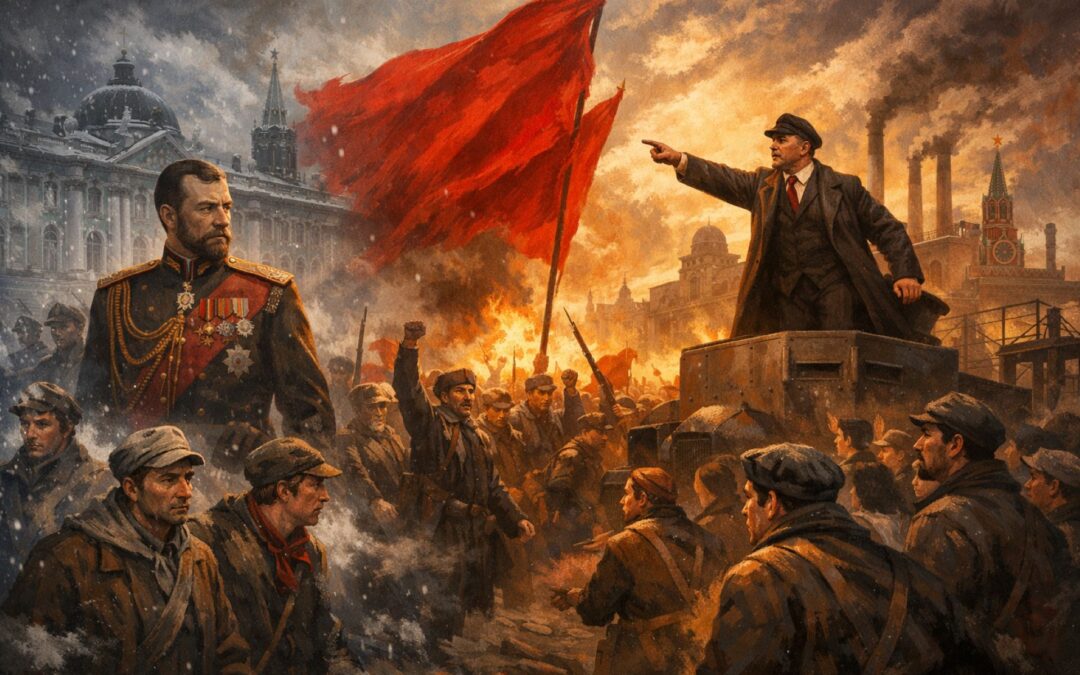
The Russian Revolution was one of the most dramatic political upheavals in modern history. In the span of just a few years, a centuries-old monarchy collapsed, a fragile democratic experiment briefly emerged, and a radical socialist movement seized power, transforming the largest empire on Earth into the world’s first communist state. Few events reshaped global politics as profoundly as the Russian Revolution, whose consequences would echo throughout the twentieth century—from the rise of the Soviet Union to the Cold War and beyond.
Yet the revolution did not erupt suddenly in 1917. It was the culmination of decades of social tension, economic hardship, political repression, and ideological conflict within the Russian Empire. By the late nineteenth century, Russia lagged far behind the industrializing nations of Western Europe. While countries like Britain, France, and Germany experimented with constitutional government and expanding civil rights, Russia remained an autocratic empire ruled by a powerful tsar who claimed absolute authority. Beneath this rigid political structure lay a society strained by poverty, inequality, and growing demands for change.
Attempts at reform only partially addressed these problems and often produced new frustrations. Industrialization created an urban working class living in harsh conditions, while peasants—recently freed from centuries of serfdom—remained trapped in debt and poverty. Intellectuals and political activists began to embrace revolutionary ideologies, particularly socialism and Marxism, arguing that the entire system of autocratic rule had to be replaced.
The early twentieth century pushed these tensions to the breaking point. Military defeat, economic crises, and political mismanagement steadily eroded the authority of the tsarist regime. The failed revolution of 1905 exposed the fragility of the monarchy but did not destroy it. Instead, it temporarily stabilized the empire while deeper structural problems continued to grow beneath the surface.
Then came the catastrophe of World War I. The strain of total war devastated Russia’s economy, shattered public confidence in the government, and intensified social unrest across the empire. Within a few chaotic months in 1917, the Romanov dynasty—after ruling Russia for more than three centuries—collapsed completely. But the fall of the monarchy did not bring stability. Instead, a fierce struggle for power emerged between competing political forces, culminating in the Bolshevik Revolution and the creation of a new revolutionary state.
The Russian Revolution was therefore not a single event but a chain of crises and transformations that unfolded over many years. It involved reformers, revolutionaries, soldiers, workers, peasants, intellectuals, and political leaders whose actions reshaped Russia and influenced the course of world history. Understanding how this complex upheaval unfolded requires tracing the deeper roots of the revolution—beginning with the conditions of the Russian Empire in the nineteenth century.
Russia in the Nineteenth Century: An Empire Stuck in the Past
Feudal Backwardness and Social Inequality
In the nineteenth century, the Russian Empire was one of the largest political entities on Earth, stretching across vast territories from Eastern Europe to the Pacific Ocean. Despite its enormous size and military strength, Russia lagged far behind the major powers of Western Europe in terms of economic development, political reform, and social modernization. While countries like Britain, France, and Germany were undergoing rapid industrialization and experimenting with new forms of government, Russia remained largely rural, deeply hierarchical, and governed by an absolute monarchy.
At the top of this system stood the Tsar, who ruled with near-total authority. Unlike constitutional monarchs in Western Europe, Russian tsars were autocrats who believed their power came directly from God. The state did not operate through democratic institutions or representative government. Instead, political authority flowed downward from the tsar through a rigid bureaucracy and a powerful aristocracy that dominated the empire’s political and economic life.
Beneath this ruling elite existed a massive population of peasants who made up the overwhelming majority of Russian society. Most of these peasants lived in small agricultural villages scattered across the countryside and relied on traditional farming techniques that had changed little for centuries. Poverty was widespread, literacy rates were extremely low, and opportunities for social mobility were almost nonexistent.
This enormous gap between the ruling elite and the rural population created a deeply unequal society. While aristocrats lived in luxury and wielded enormous influence, millions of ordinary Russians struggled simply to survive. These conditions created long-term tensions that would eventually contribute to the revolutionary movements of the early twentieth century.
Serfdom, Poverty, and the Limits of Tsarist Power
One of the defining features of Russian society during this period was the institution of serfdom. Serfs were peasants who were legally bound to the land they worked and were effectively controlled by the landowning nobility. Although they were not technically slaves, serfs had very limited rights and could be bought, sold, or transferred along with the estates on which they lived.
Serfdom shaped the economic and social structure of the Russian Empire for centuries. Landowners depended heavily on serf labor to maintain their estates, while peasants had little control over their own lives. They owed labor, taxes, and various obligations to their landlords, leaving many trapped in cycles of poverty and dependence.
By the nineteenth century, however, it had become increasingly clear that serfdom was holding Russia back. Agricultural productivity remained low, economic growth was slow, and the empire struggled to compete with the rapidly industrializing economies of Western Europe. Many Russian officials began to recognize that the country’s outdated social structure was preventing modernization.
At the same time, serfdom also limited the power of the tsarist state itself. Because much of Russia’s economy and social order depended on the aristocracy, the government had to balance its authority with the interests of powerful landowners. Any attempt to reform the system risked provoking resistance from the nobility, making meaningful change politically difficult.
Why Russia Fell Behind Western Europe
While Russia remained tied to traditional agricultural structures, Western Europe was undergoing profound transformations. The Industrial Revolution was reshaping economies, cities were expanding, and new political ideas about citizenship, rights, and representation were spreading across the continent.
Countries like Britain and France gradually introduced reforms that expanded political participation and modernized their economies. Even monarchies that remained powerful were increasingly forced to share authority with elected parliaments and legal institutions.
Russia, however, followed a different path. The tsars resisted political reform and maintained strict control over the press, education, and public discourse. Political opposition was often suppressed, and secret police organizations monitored revolutionary activity. The state’s priority was stability and control rather than modernization and liberalization.
This resistance to change created a growing sense that Russia was falling behind the rest of Europe. Military defeats and economic struggles periodically exposed the weaknesses of the system, forcing the government to confront the need for reform. Yet every attempt at modernization risked destabilizing the very structures that kept the tsarist regime in power.
By the middle of the nineteenth century, these contradictions had become impossible to ignore. Russia faced mounting pressure to modernize its economy, restructure its social system, and adapt to a rapidly changing world. The first major attempt to address these challenges would come from a tsar who believed that reform was necessary to preserve the empire itself.
Alexander II and the Limits of Reform
The Emancipation of the Serfs
By the middle of the nineteenth century, it had become increasingly clear that Russia’s outdated social and economic structure was unsustainable. The empire’s crushing defeat in the Crimean War (1853–1856) exposed just how far Russia had fallen behind the industrial and military powers of Western Europe. Poor infrastructure, weak industry, and an inefficient agricultural system all contributed to the empire’s humiliating performance on the battlefield.
When Tsar Alexander II came to the throne in 1855, many within the Russian government understood that reforms were unavoidable. The tsar himself famously acknowledged that serfdom had become a dangerous liability for the state. If the government did not abolish the institution from above, he warned, it might eventually be destroyed by a violent uprising from below.
In 1861, Alexander II introduced one of the most significant reforms in Russian history: the emancipation of the serfs. More than 20 million peasants were legally freed from their obligations to the landowning nobility. For the first time in centuries, they were granted the status of free citizens who could marry without permission, own property, and conduct business.
The announcement was celebrated as a monumental step toward modernization. Many believed that freeing the serfs would transform Russia into a more dynamic and productive society, similar to the rapidly industrializing nations of Western Europe. Yet the reform was far more complicated than it initially appeared.
Why Freedom Did Not End Peasant Hardship
Although the emancipation technically freed the serfs, it did not solve the deeper problems facing Russia’s rural population. The reform was designed as a compromise between the interests of the peasants and the powerful landowning aristocracy, and in practice it often favored the latter.
Under the emancipation settlement, peasants were allowed to acquire land from their former landlords, but they had to pay for it through long-term “redemption payments” that could last up to forty-nine years. These payments were extremely burdensome and often exceeded the actual value of the land itself.
Even worse, the land allocated to peasants was frequently insufficient for their needs. Many villages received smaller or less fertile plots than they had previously worked as serfs. As a result, millions of peasants remained trapped in poverty despite their newfound legal freedom.
The structure of village life also limited individual mobility. Land was typically owned collectively by peasant communities known as mirs, which redistributed farmland among households. While this system provided some social stability, it also made it difficult for ambitious peasants to leave the village or accumulate wealth.
For many rural Russians, daily life changed very little after emancipation. They were no longer legally tied to a landlord, but they still faced heavy debts, poor harvests, and widespread poverty. Over time, frustration grew as peasants realized that the promises of reform had not delivered meaningful improvement.
Reform, Disillusionment, and Revolutionary Anger
Alexander II did not stop with the emancipation of the serfs. During his reign, he introduced a series of additional reforms aimed at modernizing the Russian state. These included changes to the judicial system, local government reforms that created elected councils known as zemstvos, and improvements in education and military organization.
Taken together, these reforms represented one of the most ambitious attempts to modernize the Russian Empire. However, they also produced unintended consequences. By loosening some of the rigid structures of the old system, the reforms created space for new political ideas and movements to emerge.
Educated Russians began debating issues such as democracy, socialism, and constitutional government. Intellectuals and activists grew increasingly frustrated with the slow pace of reform and the continued dominance of autocratic rule. Many came to believe that meaningful change could not be achieved through gradual reform alone.
Among the most radical groups were revolutionary organizations that believed violence was justified if it could bring down the autocratic system. These movements gradually gained support among students, intellectuals, and sections of the urban population.
Their anger ultimately turned toward the tsar himself. Despite introducing significant reforms, Alexander II became a target for those who believed the entire political system needed to be destroyed. In 1881, members of a revolutionary organization successfully assassinated him in a bomb attack on the streets of St. Petersburg.
The killing of the “Tsar Liberator” shocked the empire and had far-reaching consequences. Instead of encouraging further reform, the assassination convinced many within the Russian government that political liberalization had gone too far. The next ruler would take a very different approach—one defined not by reform, but by repression.
Reaction and Repression Under Alexander III
The Return to Autocracy
The assassination of Alexander II in 1881 marked a turning point in Russian politics. The reformist momentum that had characterized much of his reign came to an abrupt halt. Instead of continuing the path toward gradual modernization and political openness, the new tsar, Alexander III, concluded that reform itself had endangered the stability of the empire.
The murder of his father convinced Alexander III that liberal ideas, political activism, and revolutionary movements were direct threats to the survival of the monarchy. In response, he rejected many of the reformist impulses of the previous era and embraced a far more conservative vision of government. The guiding principle of his rule became the preservation of autocracy.
Alexander III believed firmly in the traditional doctrine of absolute monarchy. In his view, the tsar was the unquestioned ruler of the Russian Empire, chosen by divine authority and responsible only to God. Any system that limited the power of the monarch—such as constitutional government or representative institutions—was seen as dangerous and destabilizing.
As a result, the government tightened its control over political life. Reform efforts were halted or reversed, censorship increased, and political dissent was treated as a serious threat to national security. Rather than opening the political system, the regime focused on strengthening state authority and suppressing opposition.
This return to strict autocratic rule temporarily restored stability to the empire, but it also deepened the resentment that had been growing among many groups within Russian society.
Russification and the Suppression of Minorities
The Russian Empire was extraordinarily diverse, containing dozens of ethnic groups, languages, and religious traditions across its vast territory. Many of these populations had their own cultural identities and historical traditions that differed significantly from those of ethnic Russians.
Alexander III viewed this diversity as a potential source of disloyalty. If people within the empire identified more strongly with their own cultures than with the Russian state, he feared they might resist imperial authority or support separatist movements.
To address this concern, the government pursued a policy known as Russification. The goal of Russification was to strengthen the cultural and political dominance of ethnic Russians throughout the empire. Authorities encouraged or forced minority populations to adopt Russian language, culture, and administrative systems.
These policies affected many regions of the empire, including Poland, the Baltic provinces, Ukraine, and parts of the Caucasus. Local languages were often discouraged in schools and government institutions, while Russian was promoted as the official language of administration and education.
Religious minorities also faced increased restrictions. Groups such as Jews experienced particularly harsh treatment, including legal discrimination and periodic outbreaks of violence known as pogroms. Instead of integrating minority populations into the empire, these policies often intensified resentment and strengthened nationalist movements.
The effort to impose cultural uniformity on such a vast and diverse empire ultimately created new tensions rather than resolving existing ones.
The Expansion of Secret Police Power
Perhaps the most significant tool used by Alexander III to maintain order was the expansion of the empire’s security apparatus. The government strengthened the Okhrana, a secret police organization responsible for monitoring political activity and suppressing revolutionary movements.
The Okhrana operated as an intelligence and surveillance network designed to identify potential threats to the regime. Agents infiltrated political groups, monitored dissident organizations, and tracked individuals suspected of revolutionary activity. Anyone considered a danger to the state could be arrested, imprisoned, or exiled without trial.
Exile to Siberia became one of the most common punishments for political dissent. Siberia’s remote and harsh environment made it an ideal location for isolating individuals whom the government viewed as subversive. Many future revolutionary leaders—including figures who would later play key roles in the Russian Revolution—spent years in exile under these policies.
The combination of censorship, surveillance, and repression allowed Alexander III to maintain firm control over the empire during his reign. Political opposition remained fragmented and heavily constrained, while the government projected an image of strength and stability.
However, this stability was somewhat deceptive. The policies of repression prevented open political conflict, but they did not eliminate the underlying social and economic problems facing the empire. Industrialization was slowly transforming Russian society, new political ideologies were spreading among intellectuals and workers, and dissatisfaction continued to simmer beneath the surface.
When Alexander III died in 1894, the empire appeared outwardly stable. Yet the next ruler—his son Nicholas II—would soon inherit a political system burdened by unresolved tensions, mounting social pressures, and a growing demand for change.
Nicholas II and the Crisis of Tsarism
An Unprepared Ruler on the Throne
When Alexander III died in 1894, his son Nicholas II inherited the throne of the Russian Empire. At just twenty-six years old, Nicholas suddenly found himself responsible for governing one of the largest and most complex states in the world. Unfortunately for the empire, he was deeply unprepared for the task.
Unlike some earlier rulers who had been trained extensively in statecraft, Nicholas had received little meaningful preparation for leadership. His father had dominated political life during his reign and had not fully involved his son in the practical responsibilities of governing. As a result, Nicholas ascended to power with limited experience and little understanding of how to manage the empire’s vast bureaucracy, military, and political challenges.
Nicholas himself was aware of his shortcomings. Shortly after becoming tsar, he privately admitted that he did not feel ready to rule and that he lacked knowledge about the responsibilities of government. However, despite these doubts, he remained firmly committed to the principle of autocracy. Like his father and grandfather, he believed that the tsar was appointed by God and therefore had a sacred duty to preserve absolute authority.
This belief would shape his entire reign. Even as Russia faced growing political and social pressure for reform, Nicholas consistently resisted any proposal that might limit his power or introduce meaningful political participation.
Coronation Tragedy and a Damaged Reputation
Nicholas’s reign began with an event that would permanently damage his reputation among many Russians. In 1896, elaborate celebrations were planned in Moscow to mark his coronation. As part of the festivities, large crowds of ordinary citizens were invited to attend a public gathering where free food, drinks, and commemorative gifts would be distributed.
For many poor peasants and workers, the opportunity to receive free provisions was extremely attractive. On the day of the event, enormous crowds gathered at Khodynka Field in anticipation of the celebrations. However, poor planning and inadequate crowd control quickly turned the event into a disaster.
Rumors began spreading that supplies were running out, causing thousands of people to rush forward in a desperate attempt to claim the promised gifts. In the chaos that followed, the massive crowd turned into a deadly stampede. More than a thousand people were crushed to death, and many others were injured.
The tragedy shocked the country and cast a dark shadow over the new tsar’s reign. What made matters worse was Nicholas’s response to the disaster. Although the scale of the tragedy was widely known, he continued with a scheduled diplomatic celebration that evening at the French embassy rather than canceling the event.
To many observers, this decision appeared callous and insensitive. Critics began referring to him as “Nicholas the Bloody,” a nickname that would resurface repeatedly during later crises. Although the tsar may not have intended to appear indifferent, the coronation disaster reinforced the growing perception that he was detached from the struggles of ordinary Russians.
Why Nicholas II Failed to Modernize the Empire
During Nicholas II’s reign, Russia faced mounting pressure to modernize its economy and political institutions. Industrialization was accelerating, cities were expanding, and new social classes—particularly industrial workers and an educated middle class—were beginning to demand greater political representation.
In theory, Nicholas had an opportunity to guide Russia through a gradual transition toward a more modern political system. Several advisors within the government recognized the need for reform and attempted to push the empire in that direction. However, Nicholas remained deeply suspicious of any changes that might weaken the authority of the monarchy.
This reluctance to reform placed the regime in an increasingly difficult position. On one hand, Russia needed modernization to compete economically and militarily with other European powers. On the other hand, modernization inevitably produced social and political pressures that challenged the existing autocratic system.
Industrial growth brought thousands of workers into factories where conditions were often harsh and dangerous. These workers began organizing strikes and protests to demand better wages and working conditions. Meanwhile, intellectuals and political activists debated new political ideologies, including socialism, liberalism, and revolutionary nationalism.
Instead of adapting to these changing circumstances, the tsarist government frequently responded with repression. Political dissent was monitored by the secret police, censorship remained strict, and attempts to organize political movements were often suppressed.
As the new century approached, Russia found itself caught between two competing forces: the pressures of modernization and the rigid structure of autocratic rule. Nicholas II’s inability to reconcile these forces would gradually erode the legitimacy of the monarchy and push the empire toward a series of crises that would ultimately culminate in revolution.
The Rise of Revolutionary Ideologies
Liberal Reformers and Constitutional Hopes
By the late nineteenth and early twentieth centuries, growing numbers of Russians believed that the country’s political system had to change. The rigid structure of tsarist autocracy increasingly appeared outdated compared to the constitutional governments that had emerged in much of Western Europe.
Among the first to push for reform were liberals drawn largely from the educated middle class—lawyers, professors, civil servants, and members of the professional elite. These reformers did not necessarily want to abolish the monarchy entirely. Instead, they hoped to transform Russia into a constitutional monarchy similar to Britain, where the power of the ruler would be balanced by a representative parliament and legal protections for citizens.
Liberals advocated a number of political reforms, including freedom of speech, freedom of the press, the rule of law, and elected legislative institutions. Many also believed that Russia needed broader economic modernization, better education systems, and greater local self-government.
Although these ideas were relatively moderate compared to later revolutionary movements, they still posed a challenge to the autocratic system. Tsarist authorities viewed any attempt to limit the power of the monarch as a dangerous step toward instability. As a result, liberal political organizations often struggled to operate openly and faced significant restrictions.
Despite these obstacles, liberal ideas continued to spread among educated Russians, especially in universities and urban intellectual circles. Over time, these reformers would become an important part of the broader opposition to tsarist rule.
Marxism Enters Russia
While liberals focused on constitutional reform, a more radical ideology was also gaining influence within Russian political thought: Marxism. Developed by the German philosopher Karl Marx and his collaborator Friedrich Engels, Marxism offered a revolutionary interpretation of history and society.
According to Marxist theory, human history was shaped by conflict between social classes. In industrial societies, the central conflict was between the bourgeoisie—the owners of factories and capital—and the proletariat, the working class who sold their labor. Marx argued that capitalism inevitably exploited workers and would eventually collapse under the pressure of class struggle.
The solution, according to Marxists, was a revolutionary overthrow of the capitalist system. Workers would seize control of political power, abolish private ownership of major industries, and establish a socialist society in which economic resources were collectively owned.
Although Russia was still largely agricultural, Marxist ideas began spreading among students, intellectuals, and political activists in the late nineteenth century. Many Russian revolutionaries believed that Marxism provided a scientific explanation for the injustices they saw in society.
For activists frustrated with the slow pace of reform, Marxism offered something powerful: a clear revolutionary strategy and a vision of a radically different future.
Lenin’s Early Radicalization
One of the most influential figures to embrace Marxism in Russia was Vladimir Lenin. Born into a middle-class family in 1870, Lenin initially followed a relatively conventional educational path. However, his political outlook changed dramatically after a personal tragedy shaped his early life.
In 1887, Lenin’s older brother, Alexander Ulyanov, was executed for participating in a plot to assassinate Tsar Alexander III. The execution deeply affected Lenin and played a significant role in pushing him toward radical political beliefs.
While studying law and political theory, Lenin became increasingly interested in Marxist ideas. He concluded that the tsarist system could not be reformed gradually and would have to be overthrown through revolutionary action. His involvement in political activism eventually led to his arrest and exile to Siberia.
Rather than ending his political career, exile gave Lenin time to refine his ideas and build connections with other revolutionary thinkers. After his release, he spent many years living in exile across Europe, writing political works and organizing networks of Russian Marxists.
During this time, Lenin developed a distinctive interpretation of Marxism. He argued that revolution in Russia would require a highly disciplined political party composed of dedicated professional revolutionaries. This organization would guide the working class and ensure that revolutionary movements remained focused and effective.
Lenin’s uncompromising personality and strong leadership style quickly made him one of the most prominent figures in the Russian socialist movement.
The Split Between Bolsheviks and Mensheviks
Despite their shared commitment to Marxist ideas, Russian socialists did not always agree on strategy. In 1903, tensions within the Russian Social Democratic Labor Party erupted into a major internal division.
At the center of the dispute was Lenin’s vision for how the revolutionary movement should be organized. Lenin argued that the socialist party should consist of a small, tightly organized group of committed revolutionaries who would maintain strict discipline and centralized leadership.
Other members of the movement disagreed with this approach. They believed that the party should be broader and more democratic, allowing a wider range of supporters to participate in political activity.
The disagreement eventually led to a split within the party. Lenin’s faction became known as the Bolsheviks, a word meaning “majority,” while their rivals were called the Mensheviks, meaning “minority.” Ironically, the names did not always reflect their actual numbers, but they remained attached to the two groups.
The Bolsheviks favored a more aggressive revolutionary strategy and strong centralized leadership. The Mensheviks, by contrast, tended to support gradual political change and cooperation with other reform movements.
This division would shape the future of the Russian revolutionary movement. Over time, the Bolsheviks under Lenin’s leadership would become the most radical and disciplined faction within Russian socialism—one that was prepared to seize power when the opportunity finally arose.
Industrialization and the Growth of Social Unrest
Sergei Witte and State-Led Modernization
By the late nineteenth century, Russian leaders increasingly recognized that the empire could not remain a purely agrarian society if it hoped to compete with the industrial powers of Europe. Economic modernization was becoming essential for military strength, technological advancement, and national prestige.
One of the key figures behind Russia’s push toward industrialization was Sergei Witte, an influential government minister who served as Minister of Finance in the 1890s. Witte believed that Russia needed rapid industrial growth to strengthen the state and reduce the gap between Russia and the more advanced economies of Western Europe.
Under Witte’s leadership, the Russian government pursued a strategy of state-led industrialization. The government invested heavily in infrastructure projects, encouraged foreign investment, and supported the expansion of key industries such as steel, coal, and textiles. One of the most famous projects of this period was the construction of the Trans-Siberian Railway, an enormous railway network designed to connect European Russia with its eastern territories.
These policies did succeed in accelerating economic growth. Factories multiplied in major cities such as St. Petersburg, Moscow, and other industrial centers. Industrial output increased significantly, and Russia began developing the industrial capacity needed to compete on the international stage.
However, this rapid industrialization also produced profound social changes that the tsarist government was not fully prepared to manage.
Factory Conditions and the New Working Class
Industrial expansion brought large numbers of peasants into cities in search of work. Over time, this migration created a new social group within Russian society: the industrial working class.
Factory workers faced extremely harsh conditions. Many worked long hours—often twelve hours or more per day—for very low wages. Factories were frequently overcrowded, poorly ventilated, and dangerous. Industrial accidents were common, and workers who were injured on the job often had little protection or compensation.
Living conditions were equally difficult. Workers frequently lived in cramped dormitories or overcrowded urban neighborhoods where sanitation was poor and disease spread easily. Entire families might share a single room, and basic necessities such as clean water or reliable food supplies were often limited.
Despite these hardships, industrial workers had something that earlier generations of peasants lacked: proximity to one another. In factories and crowded urban districts, workers interacted daily, discussed their grievances, and began organizing collectively.
This environment proved fertile ground for political activism. Socialist organizers and revolutionary activists found that factory workers were often receptive to ideas about workers’ rights, economic justice, and political change.
Strikes, Political Anger, and the Expanding Crisis
As workers became more organized, labor unrest began to grow across the empire. Strikes became increasingly common as workers demanded higher wages, shorter working hours, and safer working conditions.
These strikes were not always purely economic in nature. Many workers also began demanding political reforms such as freedom of speech, the right to organize unions, and the establishment of representative government.
The tsarist government responded to these developments with a mixture of limited concessions and repression. In some cases, minor labor regulations were introduced to improve factory conditions. But when strikes spread or became politically charged, authorities often relied on police and military force to restore order.
Each confrontation between workers and the state further eroded trust in the government. Workers who had initially sought modest improvements increasingly came to believe that deeper political change was necessary.
Industrialization had strengthened Russia economically, but it had also created a new class of politically conscious workers who were capable of organizing mass protests. Combined with the ongoing frustrations of peasants and the growing influence of revolutionary ideologies, this emerging social force added yet another layer of instability to the Russian Empire.
By the early twentieth century, tensions across Russian society were steadily rising. Economic inequality, political repression, and the spread of radical ideas were pushing the empire toward a major confrontation. The spark that would ignite the next phase of crisis would come from an unexpected source: a disastrous war thousands of miles away from Russia’s major cities.
The Russo-Japanese War and the Shattering of Tsarist Prestige
Russia’s Imperial Ambitions in East Asia
At the turn of the twentieth century, the Russian Empire was not only struggling with internal pressures but was also pursuing expansion abroad. Like many European powers of the era, Russia sought to extend its influence into strategically important regions. One of the areas that attracted particular attention was East Asia.
Russia had long been interested in expanding its presence in northern China and gaining access to warm-water ports in the Pacific. The region of Manchuria offered economic opportunities and strategic advantages, while the nearby Korean Peninsula was also viewed as a valuable sphere of influence. Control of these areas would strengthen Russia’s position as a global power and enhance its ability to project military and commercial influence in Asia.
However, Russia was not the only country with ambitions in the region. Japan, which had undergone rapid modernization during the late nineteenth century, was emerging as a powerful and confident state. Having transformed itself into an industrial and military power, Japan was determined to assert its own influence over Korea and nearby territories.
As Russian and Japanese interests increasingly overlapped, tensions between the two nations began to escalate. Diplomatic negotiations attempted to settle the dispute, but mutual suspicion and competing ambitions made compromise difficult.
Miscalculation, Defeat, and National Humiliation
The Russian leadership believed that Japan would ultimately back down if confronted with Russian power. Many officials in St. Petersburg assumed that a European empire like Russia would easily dominate a relatively small Asian nation.
This assumption proved to be a serious miscalculation.
In 1904, Japan launched a surprise attack on the Russian fleet stationed at Port Arthur, marking the beginning of the Russo-Japanese War. The attack shocked Russian officials and immediately revealed that Japan was prepared to challenge Russia militarily.
Over the following months, Japanese forces achieved a series of decisive victories both on land and at sea. Russian troops struggled with poor logistics, weak leadership, and long supply lines stretching across thousands of kilometers. Meanwhile, Japan’s well-organized and modernized military consistently outperformed its Russian counterpart.
One of the most dramatic moments of the war came in 1905 at the Battle of Tsushima, where the Japanese navy destroyed a large portion of Russia’s Baltic Fleet after it had traveled halfway around the world to reinforce Russian forces in the Pacific.
The defeat was devastating for Russia’s prestige. For the first time in modern history, a European great power had been defeated by an Asian nation. The war exposed serious weaknesses in Russia’s military, government administration, and industrial capacity.
How Military Failure Deepened Domestic Instability
The consequences of the war extended far beyond the battlefield. News of Russia’s defeats quickly spread throughout the empire, intensifying public dissatisfaction with the government.
Many Russians had initially supported the war, believing it would strengthen national pride and demonstrate the empire’s power. Instead, the conflict produced humiliation and anger. The government appeared incompetent, the military seemed poorly organized, and the sacrifices demanded from ordinary soldiers and citizens seemed increasingly pointless.
Economic conditions also deteriorated as the war placed additional strain on Russia’s already fragile economy. Resources were diverted toward the military effort, while inflation and shortages began to affect everyday life.
For a government already struggling with social unrest and political dissatisfaction, the defeat in the Russo-Japanese War was a major blow. Confidence in the tsarist regime declined sharply, and frustration among workers, peasants, and political activists intensified.
The war had not only damaged Russia’s international standing; it had also weakened the authority of the monarchy at home. Within months, this rising anger would erupt into a wave of protests and uprisings across the empire.
The spark that ignited this nationwide unrest came in January 1905, when a peaceful demonstration in the capital city ended in violence and tragedy. The event would become known as Bloody Sunday—and it would push Russia into its first full-scale revolutionary crisis.
Bloody Sunday and the Revolution of 1905
Father Gapon and the Peaceful Petition
By early 1905, Russia was already in a fragile state. The humiliating defeats in the Russo-Japanese War had undermined public confidence in the government, and economic conditions were deteriorating. Workers faced low wages and poor factory conditions, peasants remained trapped in poverty, and political reform seemed increasingly distant.
Amid this rising frustration, a movement began to form among industrial workers in the capital city of St. Petersburg. One of the leaders involved in organizing workers was an Orthodox priest named Father Georgy Gapon. Gapon had become popular among workers for his advocacy on their behalf and his ability to articulate their grievances.
In January 1905, Gapon helped organize a large march to the Winter Palace, the residence of Tsar Nicholas II. The goal of the demonstration was not revolution but petition. The protesters hoped to present the tsar with a document outlining their demands for reforms.
The petition called for improvements in working conditions, higher wages, and shorter hours. It also included broader political demands such as civil liberties, universal suffrage, and the establishment of a representative assembly. Importantly, many of the protesters still believed that the tsar himself was sympathetic to their struggles and simply unaware of the hardships they faced.
Participants carried religious icons and portraits of the tsar, hoping to appeal to him as a paternal figure who would listen to the needs of his people.
The Massacre at the Winter Palace
On January 22, 1905, thousands of workers and their families marched peacefully through the streets of St. Petersburg toward the Winter Palace. They expected to deliver their petition directly to the tsar.
However, Nicholas II was not present in the city at the time. Instead, government authorities had deployed troops throughout the capital with orders to prevent the demonstrators from reaching the palace.
As the crowd approached the palace grounds, soldiers confronted the protesters. What followed remains one of the most tragic moments in Russian history. Imperial troops opened fire on the unarmed crowd.
Panic spread as people tried to escape the gunfire. Hundreds of demonstrators were killed or wounded as the soldiers continued firing into the masses. Exact numbers vary, but the event left a deep scar on the national consciousness.
The massacre quickly became known as Bloody Sunday.
For many Russians, the event shattered the long-held belief that the tsar was a benevolent protector of the people. Instead, the monarchy appeared willing to use deadly force against peaceful citizens seeking basic reforms.
Strikes, Soviets, and the Spread of Revolt
The shock of Bloody Sunday triggered an enormous wave of unrest across the Russian Empire. Workers in cities across the country launched strikes in solidarity with the protesters in St. Petersburg. Factories shut down as laborers demanded better conditions and political reforms.
The unrest spread beyond industrial workers. Peasants in rural areas began attacking the estates of landowners, seizing land, and destroying property associated with the aristocracy. Students organized demonstrations, and many intellectuals joined the growing movement for reform.
One of the most significant developments during this period was the emergence of workers’ councils known as soviets. These councils were formed by representatives of workers in various factories and districts. The most famous of these was the St. Petersburg Soviet, which helped coordinate strikes and political activity within the city.
Although the soviets initially emerged as practical organizations to manage protests and strikes, they would later play a crucial role in the revolutionary movements of 1917.
As the crisis intensified, the authority of the tsarist government appeared increasingly fragile. Strikes paralyzed major industries, unrest spread through the countryside, and even segments of the military began showing signs of discontent.
The October Manifesto and the Survival of the Tsar
Faced with growing chaos, the government realized that some form of concession might be necessary to restore stability. Nicholas II reluctantly agreed to issue a document known as the October Manifesto.
The manifesto promised several major reforms. It guaranteed basic civil liberties such as freedom of speech, assembly, and association. It also created an elected legislative assembly called the Duma, which would have the authority to participate in the lawmaking process.
For many liberals and moderate reformers, the October Manifesto represented a significant step forward. Some believed that Russia might now begin transitioning toward a constitutional system similar to those found in Western Europe.
However, the reforms did not satisfy everyone. Radical groups such as the Bolsheviks and other revolutionary factions believed the concessions were insufficient and continued to push for deeper changes.
Even so, the manifesto succeeded in dividing the opposition. Some groups were willing to work within the new political framework, while others remained committed to revolutionary struggle.
This division gave the tsarist regime an opportunity to regain control. Once the immediate crisis subsided, the government began using military force and political repression to crush remaining uprisings.
The Revolution of 1905 had shaken the empire and forced Nicholas II to make concessions, but it had not destroyed the autocratic system. For the moment, the monarchy had survived.
Yet the events of 1905 had permanently changed Russian politics. The myth of the benevolent tsar had been shattered, revolutionary movements had gained experience and organization, and the empire’s deep structural problems remained unresolved.
The next decade would see a temporary period of stabilization, but the tensions that had produced the revolution were far from gone.
The Aftermath of 1905: Reform, Repression, and Fragile Recovery
Stolypin’s Agricultural Reforms
In the wake of the 1905 Revolution, the tsarist government faced a difficult challenge. The empire had narrowly avoided collapse, but the underlying causes of unrest—poverty, political dissatisfaction, and social inequality—remained unresolved. To restore stability, the regime needed to pursue reforms while also maintaining control.
One of the most important figures during this period was Pyotr Stolypin, who became Prime Minister in 1906. Stolypin believed that the key to stabilizing Russia lay in transforming its rural economy. Since peasants made up the vast majority of the population, improving their living conditions could reduce support for revolutionary movements.
Stolypin’s reforms focused primarily on agriculture. He sought to break up the traditional communal landholding system of the peasant villages and encourage individual land ownership. The goal was to create a class of independent, prosperous farmers who would have a stake in preserving the existing political system.
Under these reforms, peasants were given the opportunity to leave the communal mir system and establish private farms. The government also offered loans through the Peasant Land Bank to help farmers purchase land and improve agricultural productivity.
For some peasants, these reforms offered real opportunities. A number of families were able to expand their farms and improve their economic position. Stolypin hoped that over time, these successful farmers would form a loyal rural middle class that supported stability and gradual modernization.
Executions, Crackdowns, and “Stolypin’s Necktie”
While Stolypin pursued economic reforms, he also adopted a much harsher approach toward political opposition. The revolutionary unrest of 1905 had convinced the government that radical movements posed a serious threat to the survival of the state.
To suppress these movements, Stolypin introduced a series of emergency measures designed to restore order. Special military courts were established to try individuals accused of revolutionary activity, often with very limited legal protections. Trials were conducted quickly, and many defendants were sentenced to death.
The large number of executions carried out during this period led to a grim nickname among the public. The hangman’s noose became known as “Stolypin’s necktie,” symbolizing the harsh repression used to eliminate political dissent.
Thousands of suspected revolutionaries were arrested, imprisoned, or exiled to remote regions such as Siberia. The government hoped that these measures would destroy revolutionary networks and discourage future uprisings.
Although these policies did reduce the level of open rebellion for a time, they also reinforced the perception that the tsarist regime relied heavily on violence and coercion to maintain power.
Why the Tsarist System Still Remained Vulnerable
During the years following the 1905 Revolution, Russia experienced a period of relative stabilization. Industrial production increased, agricultural output improved in some regions, and the political situation appeared calmer than it had been during the height of the revolutionary crisis.
However, this stability was fragile.
Stolypin’s reforms had not fully solved the problems facing the countryside. Many peasants remained poor, and land shortages continued to cause resentment in rural communities. Meanwhile, the urban working class continued to grow as industrialization expanded, bringing new waves of workers into cities where labor conditions remained difficult.
Politically, the creation of the Duma had introduced a limited form of representation, but the tsar retained the power to dissolve the assembly whenever it challenged his authority. In practice, the Duma often found itself constrained by the monarchy and unable to implement major reforms.
Even within the government, tensions remained. Some officials supported gradual reform, while others favored strict authoritarian control. The political system lacked a clear path forward that could reconcile the demands of reformers with the determination of the monarchy to preserve autocratic rule.
The death of Stolypin in 1911—after he was assassinated by a revolutionary—removed one of the few leaders capable of balancing reform with state authority. Without his leadership, the regime increasingly drifted without a coherent strategy for addressing the empire’s problems.
For the moment, Russia seemed to have avoided another revolutionary crisis. But the social, economic, and political pressures that had produced the events of 1905 had not disappeared. Beneath the surface, discontent continued to simmer.
Within just a few years, an even greater catastrophe would arrive—one that would push the Russian Empire toward complete collapse.
Lenin, Stalin, and the Bolshevik Underground
Lenin in Exile and the Strategy of Revolution
While the Russian Empire struggled to stabilize itself after the Revolution of 1905, many revolutionary leaders remained outside the country. Years of arrests, censorship, and exile had pushed much of the radical socialist movement underground or abroad. Among those living in exile was Vladimir Lenin, who spent much of the early twentieth century moving between cities such as Geneva, London, and Paris.
Although physically distant from Russia, Lenin remained deeply involved in revolutionary politics. From exile, he wrote articles, organized meetings, and directed the activities of socialist networks operating both inside and outside the empire. One of his most important tools was the underground press. Lenin and his allies published revolutionary newspapers and pamphlets that were secretly smuggled into Russia to spread Marxist ideas among workers and activists.
Lenin believed that Russia remained ripe for revolution despite the temporary stabilization of the tsarist regime. However, he was convinced that the working class alone could not spontaneously overthrow the system. Instead, he argued that a disciplined revolutionary party was necessary to guide the struggle.
This idea became central to Bolshevik strategy. Lenin envisioned a tightly organized political organization composed of professional revolutionaries who would dedicate their lives to overthrowing the autocracy. The party would provide leadership, coordinate revolutionary activity, and ensure that the movement remained focused on achieving political power.
Although this strategy made the Bolsheviks more centralized and disciplined than other socialist groups, it also made Lenin a controversial figure among fellow revolutionaries. Many critics worried that such a rigid structure concentrated too much authority in the hands of a small leadership group.
Bolshevik Fundraising, Organization, and Internal Discipline
Operating as an underground revolutionary movement required resources, organization, and secrecy. Bolshevik activists had to maintain networks of supporters, distribute propaganda, organize strikes, and avoid constant surveillance by the tsarist secret police.
Financing these activities was often difficult. Some funds came from donations by sympathizers or contributions from workers who supported the socialist cause. However, revolutionary groups sometimes turned to more extreme methods to secure money for their operations.
Certain Bolshevik factions organized what they referred to as “expropriations”—armed robberies and other illegal activities designed to obtain funds for the revolutionary movement. These operations were controversial even within socialist circles, as many activists believed that criminal tactics could damage the credibility of the movement.
Despite these disagreements, the Bolsheviks maintained a reputation for strong organization and strict discipline. Members were expected to follow party directives and demonstrate loyalty to the revolutionary cause. This culture of discipline would later become one of the movement’s greatest strengths during moments of political crisis.
While the Bolsheviks operated underground, the broader socialist movement in Russia remained divided between different factions. The Mensheviks generally favored cooperation with other political groups and believed that Russia needed to experience a period of democratic development before a socialist revolution could occur.
Lenin and the Bolsheviks rejected this approach. They argued that revolutionary opportunities could arise unexpectedly and that the movement needed to be prepared to seize power when the moment came.
Stalin’s Early Rise Within the Movement
During this period, another figure who would later play a major role in Russian history began to rise within the Bolshevik movement: Joseph Stalin.
Born in Georgia in 1878, Stalin came from a modest background and initially trained for the priesthood before becoming involved in revolutionary politics. Unlike many socialist intellectuals who came from educated urban environments, Stalin’s early experiences were shaped by the harsher realities of life in the empire’s peripheral regions.
Stalin quickly developed a reputation as a committed and effective organizer within the Bolshevik movement. He worked to build party networks, distribute propaganda, and coordinate revolutionary activities. His willingness to engage in dangerous and sometimes illegal operations made him particularly valuable to the underground organization.
Several of Stalin’s activities involved fundraising operations and organizational work that helped sustain the Bolshevik movement during difficult periods. Although he was not yet a prominent ideological leader like Lenin, his reliability and determination earned him respect within the party.
However, Stalin’s revolutionary career was frequently interrupted by arrests and exile. Like many other activists, he was repeatedly detained by the tsarist authorities and sent to remote regions of Siberia. Yet he consistently managed to escape or return to political activity after serving his sentences.
By the years leading up to the First World War, the Bolshevik movement remained relatively small compared to other political groups in Russia. Lenin and his followers were still waiting for the right historical moment that might allow their revolutionary strategy to succeed.
At the same time, events within Russia were taking an unexpected turn. While revolutionary groups operated in exile and underground networks, the tsarist monarchy was becoming entangled in a scandal that would severely damage its credibility.
At the center of this controversy stood a mysterious figure whose influence over the royal family shocked Russian society and further undermined public confidence in the monarchy.
Rasputin and the Collapse of Monarchical Credibility
The Romanov Family’s Search for a Healer
By the early twentieth century, the Russian monarchy was already struggling with declining public confidence. Political unrest, economic hardship, and dissatisfaction with autocratic rule had eroded the prestige of the Romanov dynasty. Yet one of the most damaging blows to the monarchy’s reputation came from a deeply personal problem within the royal family itself.
Tsar Nicholas II and his wife, Tsarina Alexandra, had long hoped for a male heir to secure the future of the dynasty. When their son Alexei was born in 1904, the imperial family celebrated the arrival of the long-awaited successor to the throne. However, their joy soon turned to fear when it became clear that the young prince suffered from hemophilia, a genetic disease that prevents blood from clotting properly.
For Alexei, even minor injuries could become life-threatening. A simple fall or bruise could cause severe internal bleeding, leaving the royal family in constant anxiety over the boy’s health. Doctors were often unable to provide effective treatment, and the tsarina became increasingly desperate to find someone who could help her son.
It was during this time that the royal family was introduced to Grigori Rasputin, a wandering religious mystic from Siberia who had gained a reputation as a holy man with healing abilities. Rasputin claimed to possess spiritual powers and presented himself as a devout figure capable of performing miraculous cures.
When Rasputin appeared to ease Alexei’s suffering during one of the boy’s medical crises, Alexandra became convinced that he possessed a unique ability to help her son. From that moment forward, Rasputin gained extraordinary access to the royal family.
Rasputin’s Influence and Public Scandal
Although Rasputin’s role within the royal household began as that of a spiritual advisor, his influence soon expanded far beyond private religious guidance. Because the tsarina trusted him deeply, Rasputin gained a position of unusual authority within the imperial court.
Members of the Russian aristocracy and political establishment were shocked to see an uneducated mystic from the countryside enjoying such close access to the royal family. Rumors quickly began circulating that Rasputin was influencing government decisions and manipulating the tsarina.
These rumors were intensified by Rasputin’s personal behavior. He developed a reputation for heavy drinking, crude manners, and scandalous relationships with members of high society. Stories about his excesses spread rapidly through the press and political circles, further damaging the credibility of the monarchy.
Although many of the rumors about Rasputin were exaggerated or fabricated, the perception that he wielded hidden influence over the government became widespread. Critics portrayed him as a corrupt figure who had somehow gained control over the imperial family.
For a monarchy already struggling to maintain authority, the Rasputin scandal became a powerful symbol of political decay.
Why the Monarchy Began to Look Irredeemably Corrupt
The damage caused by Rasputin’s presence at court extended far beyond gossip and scandal. At a time when the Russian government needed to demonstrate competence and stability, the association with Rasputin made the regime appear increasingly weak and irrational.
Many members of the Russian elite began to believe that the monarchy was losing control. Politicians, military leaders, and aristocrats worried that the tsar’s reliance on Rasputin undermined the government’s ability to function effectively.
Public confidence continued to decline as stories about Rasputin circulated throughout Russian society. Newspapers, political pamphlets, and private conversations portrayed the royal court as corrupt, incompetent, and disconnected from the realities faced by ordinary people.
By the mid-1910s, Rasputin had become one of the most controversial figures in the Russian Empire. Even individuals who had previously supported the monarchy began to question whether the regime could survive the growing political crisis.
In 1916, a group of aristocrats decided that Rasputin’s influence had become too dangerous to tolerate. Convinced that removing him might restore the monarchy’s credibility, they plotted his assassination.
Rasputin was eventually murdered in a dramatic and mysterious attack, but by that time the damage had already been done. His presence at court had severely weakened the reputation of the tsarist regime.
More importantly, Russia was about to face an even greater challenge—one that would push the empire beyond the limits of political stability. In 1914, a conflict erupted in Europe that would draw Russia into one of the most destructive wars in history.
The First World War would place enormous strain on the Russian state, economy, and military. Within just a few years, the pressures of total war would push the empire toward collapse.
World War I and the Destruction of the Old Regime
Patriotism at the Outbreak of War
In the summer of 1914, Europe descended into one of the most devastating conflicts the world had ever seen. The assassination of Archduke Franz Ferdinand of Austria-Hungary triggered a chain reaction of alliances and declarations of war that quickly engulfed much of the continent. Russia, bound by its alliance with Serbia and eager to assert its influence in Eastern Europe, soon found itself at war with the Central Powers, primarily Germany and Austria-Hungary.
At the outbreak of the war, a wave of patriotic enthusiasm swept across Russia. Like many countries entering the conflict, large portions of the population initially rallied behind the government. Demonstrations of national unity filled the streets of major cities, and many Russians believed the war would strengthen the nation and reinforce the legitimacy of the monarchy.
Even some revolutionary groups temporarily set aside their opposition to the tsarist government. Many believed that defending Russia from foreign enemies took priority over internal political struggles.
However, this early enthusiasm would not last long.
Military Failure, Economic Breakdown, and Hunger
Russia entered the war with enormous manpower but lacked the industrial capacity and logistical organization needed to sustain a prolonged modern conflict. The empire’s military infrastructure was poorly prepared for the scale and intensity of World War I.
Russian soldiers were often sent into battle with inadequate equipment. In some cases, troops lacked sufficient rifles and ammunition, forcing soldiers to wait until a fallen comrade’s weapon could be retrieved before they could properly fight. Supply shortages plagued the army throughout the war.
The Russian military also suffered from weak leadership and poor coordination. Early offensives against Germany and Austria-Hungary resulted in catastrophic losses. Battles such as Tannenberg in 1914 demonstrated the severe weaknesses within the Russian command structure.
As the war dragged on, the human cost became staggering. Millions of Russian soldiers were killed, wounded, or captured. Entire communities across the empire felt the impact of these losses.
At the same time, the war placed enormous strain on the Russian economy. Transportation networks struggled to deliver supplies to both the front lines and major cities. Agricultural production declined as millions of peasants were drafted into the army, leaving farms understaffed.
Food shortages soon began affecting urban populations. Long lines formed outside bakeries as people waited for basic necessities. Inflation eroded wages, and living conditions for workers and their families deteriorated rapidly.
The longer the war continued, the more the initial patriotic enthusiasm faded. In its place came frustration, anger, and despair.
Nicholas II Takes Command
In 1915, Tsar Nicholas II made a decision that would prove disastrous for his regime. Hoping to restore confidence in the war effort, he chose to personally assume command of the Russian army as its supreme leader.
From a political perspective, this decision was extremely risky. By placing himself at the head of the military, Nicholas effectively tied his personal reputation to the success or failure of the war. Any future defeats would now reflect directly on him.
Nicholas left the capital and traveled to military headquarters at the front, where he attempted to oversee military operations. However, he had little experience in strategic warfare, and his presence did little to improve the army’s overall performance.
Meanwhile, his absence from the capital created new political problems.
Alexandra, Rasputin, and the Crisis of Confidence
While Nicholas was away commanding the army, the administration of the government increasingly fell into the hands of his wife, Tsarina Alexandra. Alexandra was deeply unpopular among many Russians, partly because of her German heritage during a war against Germany.
Her close association with Rasputin further intensified public suspicion. Although Rasputin had already gained notoriety before the war, his perceived influence over government appointments and political decisions became an even greater scandal during this period.
Government leadership became unstable as ministers were frequently dismissed and replaced. Political opponents accused the royal court of incompetence and corruption, while rumors spread that Rasputin was secretly controlling the government behind the scenes.
In reality, Rasputin’s direct political influence was probably more limited than many believed. Nevertheless, the perception of chaos and mismanagement at the top of the government severely damaged public confidence in the monarchy.
By the final years of the war, Russia faced a combination of crises: military defeat, economic collapse, food shortages, and political disillusionment. The authority of the tsarist regime was rapidly eroding.
In 1916, desperate members of the Russian aristocracy assassinated Rasputin in the hope that removing him might restore stability to the monarchy. But the crisis had already progressed too far.
Within months, the Russian Empire would be pushed into another revolutionary upheaval—one that would bring an end to more than three centuries of Romanov rule.
The February Revolution of 1917
Bread Riots and Women’s Protests in Petrograd
By the beginning of 1917, Russia was exhausted. Three years of total war had devastated the country’s economy and placed unbearable strain on its people. Food shortages had become severe, inflation had eroded wages, and transportation networks were collapsing under the pressure of supplying both the army and the cities.
The situation was particularly dire in Petrograd, the capital of the Russian Empire. Long lines formed outside bakeries each day as citizens waited for bread that often never arrived. Workers spent hours in freezing conditions hoping to secure basic food supplies for their families.
On March 8, 1917 (February 23 in the Russian calendar), protests erupted across the city. The demonstrations began on International Women’s Day, when thousands of women—many of them factory workers and wives of soldiers—took to the streets demanding bread and an end to the war.
Their anger quickly attracted others. Male workers joined the protests, and strikes spread across factories throughout Petrograd. Within days, hundreds of thousands of people were participating in demonstrations that paralyzed the capital.
What had begun as protests over food shortages rapidly evolved into a broader political uprising.
Mutiny in the Capital
Initially, the government attempted to restore order by deploying troops to suppress the demonstrations. In the past, the tsarist regime had relied on the military to crush unrest, and authorities expected the same approach to succeed again.
However, the circumstances in 1917 were very different.
Many soldiers stationed in Petrograd had themselves grown disillusioned with the war and with the government. Like the civilian population, they faced shortages, exhaustion, and frustration with the failing leadership of the regime.
When troops were ordered to fire on the protesters, some initially obeyed. But the violence only intensified the crisis. Soon entire regiments began refusing orders. Instead of suppressing the demonstrations, many soldiers joined the crowds in the streets.
Mutiny spread rapidly through the garrison. Armed soldiers marched alongside workers, seized weapons depots, and attacked symbols of the tsarist state. Police stations were overrun, prisons were opened, and revolutionary committees began forming throughout the city.
Within a matter of days, the tsarist government had effectively lost control of the capital.
The Collapse of Tsarist Authority
As Petrograd descended into chaos, political leaders attempted to find a way to restore order. Members of the State Duma, Russia’s legislative assembly, began meeting to discuss how to manage the crisis.
Although Nicholas II had previously dissolved the Duma during moments of political conflict, many of its members now believed that the monarchy itself had become the main obstacle to stability.
At the same time, workers and soldiers established their own political organization known as the Petrograd Soviet. This council represented the interests of the revolutionary crowds and quickly became a powerful force in the capital.
The existence of both the Duma leadership and the Petrograd Soviet created a new and unstable political situation. Power in the capital was no longer controlled by the tsarist government but was instead shared between competing political bodies.
Meanwhile, Nicholas II attempted to return to Petrograd from military headquarters, hoping to regain control of the situation. However, the railways were disrupted, and his train was eventually stopped before reaching the capital.
Without reliable support from the army and with the capital effectively under revolutionary control, the tsar’s position became increasingly untenable.
The Abdication of Nicholas II and the End of Romanov Rule
By mid-March 1917, the collapse of tsarist authority had become impossible to reverse. Military leaders and political figures advised Nicholas II that the only way to restore stability was for him to abdicate the throne.
Facing pressure from generals, politicians, and the rapidly deteriorating situation in the capital, Nicholas finally agreed.
On March 15, 1917, he formally abdicated the throne, bringing an end to more than three centuries of Romanov rule over Russia. Initially, Nicholas considered transferring the crown to his young son Alexei, but the boy’s fragile health made this impossible. He then offered the throne to his brother, Grand Duke Michael.
Michael, however, declined to accept the crown unless it was approved by a future democratic assembly. In effect, the monarchy ceased to exist.
The fall of the Romanov dynasty marked one of the most dramatic political transformations in Russian history. For the first time in centuries, the empire was no longer ruled by a tsar.
Yet the end of the monarchy did not bring immediate stability. Instead, Russia entered a new and uncertain phase of political struggle.
A temporary government composed mainly of liberal politicians assumed formal authority. At the same time, workers’ and soldiers’ councils continued to wield enormous influence in the streets.
This uneasy arrangement would soon become known as dual power, and it would define the next stage of the Russian Revolution.
Dual Power: The Provisional Government and the Soviets
Why No Single Force Controlled Russia
After the abdication of Tsar Nicholas II in March 1917, Russia suddenly found itself without a clear political authority. The centuries-old monarchy had collapsed almost overnight, but no single group had enough power to fully replace it.
Instead, two competing political structures emerged in Petrograd and across the country. On one side stood the Provisional Government, formed mainly by liberal politicians and members of the former State Duma. On the other side were the soviets, councils of workers and soldiers that had formed spontaneously during the revolution.
This unusual arrangement created what historians call “dual power.” Both institutions claimed legitimacy and influence, but they represented different political visions and social groups.
The Provisional Government was recognized as the official governing authority. It attempted to administer the state, maintain the war effort, and manage Russia’s complex political situation. However, the soviets held enormous practical influence because they represented workers, soldiers, and revolutionary activists who had brought down the tsar.
In many cases, orders from the Provisional Government could not be implemented without the approval or cooperation of the soviets. This fragile balance created an unstable political environment in which authority was constantly contested.
Liberal Reform and Its Early Promise
Initially, many Russians welcomed the Provisional Government with optimism. The fall of the autocracy opened the possibility of building a more democratic political system.
The new government introduced several reforms designed to demonstrate its commitment to political freedom. Censorship was abolished, allowing newspapers and political groups to operate openly for the first time in decades. Political prisoners were released from jail, and the secret police organizations associated with the old regime were dismantled.
The government also promised that Russia would eventually hold elections for a Constituent Assembly, which would draft a new constitution and determine the future structure of the state. For many Russians, this represented the first genuine opportunity to participate in shaping their country’s political system.
These early reforms generated enthusiasm among liberals and moderate socialists who believed Russia might successfully transition into a democratic society.
However, the Provisional Government faced enormous challenges that quickly undermined its ability to govern effectively.
The Continuing Burdens of War, Land, and Food Shortages
Despite the political changes in Petrograd, Russia’s most urgent problems remained unresolved. The country was still deeply involved in World War I, and the war continued to consume resources, manpower, and public patience.
Many soldiers and civilians expected the new government to withdraw Russia from the conflict. Instead, the Provisional Government chose to continue fighting alongside its allies. Leaders feared that abandoning the war might weaken Russia internationally and damage relations with Britain and France.
This decision proved deeply unpopular. Soldiers at the front were exhausted after years of brutal combat, while civilians at home faced worsening shortages of food and fuel. The continuation of the war eroded the government’s credibility and fueled public anger.
Another major issue involved land ownership. Millions of peasants hoped the revolution would lead to the redistribution of land from large estates to rural communities. However, the Provisional Government delayed addressing this issue, arguing that land reform should be decided by the future Constituent Assembly.
For peasants struggling to survive, this delay was unacceptable. Across the countryside, villagers began seizing land from landowners on their own initiative.
Meanwhile, urban workers continued demanding higher wages, better working conditions, and political influence. Strikes and demonstrations remained common in major cities.
The Weaknesses Built Into Dual Power
The structure of dual power made it extremely difficult to respond effectively to these crises. The Provisional Government and the soviets often disagreed about how Russia should be governed and what policies should be implemented.
Many soviet leaders—particularly those aligned with the Mensheviks and Socialist Revolutionaries—believed the revolution should remain moderate and democratic. They supported cooperation with the Provisional Government while pushing for gradual reforms.
However, the arrangement created confusion about who actually held authority. Orders from the government could be ignored if the soviets disagreed with them. Soldiers and workers often looked to their soviets rather than to official state institutions for guidance.
One particularly important example was Order No. 1, issued by the Petrograd Soviet. This directive instructed soldiers to obey military officers only if their orders did not contradict the decisions of the soviet. The order significantly weakened military discipline and further undermined the authority of the government.
As the months passed, the instability created by dual power became increasingly obvious. The government struggled to solve the country’s most urgent problems, while radical political movements began gaining support among frustrated workers and soldiers.
Among the most determined critics of the new political order was a revolutionary leader who had spent years in exile waiting for exactly this kind of opportunity.
His name was Vladimir Lenin, and he was about to return to Russia with a plan to overthrow the existing system entirely.
Lenin’s Return and the Bolshevik Revival
Germany’s Role in Lenin’s Journey Home
When the February Revolution overthrew Tsar Nicholas II, many revolutionary leaders were still living outside Russia. Among them was Vladimir Lenin, who had spent years in exile across Europe organizing Marxist networks and waiting for an opportunity to overthrow the tsarist system.
The collapse of the monarchy in 1917 presented exactly the kind of revolutionary opening Lenin had long anticipated. However, there was one major obstacle: Russia was still at war with Germany, and Lenin was living in Switzerland. Traveling through enemy territory during wartime seemed nearly impossible.
The German government, however, saw a strategic opportunity. German leaders believed that if Lenin returned to Russia, he might destabilize the new government and push the country toward withdrawing from the war. Removing Russia from the conflict would allow Germany to concentrate its forces on the Western Front against Britain and France.
As a result, the Germans agreed to allow Lenin and several other Russian revolutionaries to travel through German territory in a sealed train. In April 1917, Lenin arrived in Petrograd after years of exile, ready to intervene in the rapidly evolving political situation.
The April Theses and Lenin’s Rejection of Compromise
Upon returning to Russia, Lenin was deeply critical of the political developments that had occurred since the February Revolution. Many socialist leaders—including the Mensheviks and Socialist Revolutionaries—were cooperating with the Provisional Government and supporting the continuation of the war.
Lenin believed this approach was fundamentally misguided.
Shortly after arriving in Petrograd, he presented a set of proposals known as the April Theses. In these statements, Lenin argued that the revolution was far from complete and that the Provisional Government represented the interests of the bourgeoisie rather than the working class.
He rejected any cooperation with the existing government and called for a second revolution that would transfer power directly to the soviets—councils of workers and soldiers. Lenin insisted that Russia should immediately withdraw from World War I, redistribute land to the peasants, and place political authority in the hands of revolutionary councils.
Many socialist leaders initially considered Lenin’s ideas too radical. Even some members of the Bolshevik Party were surprised by the boldness of his proposals. However, Lenin’s arguments resonated with growing numbers of workers and soldiers who were increasingly frustrated with the failures of the Provisional Government.
“Peace, Land, and Bread” and the Growth of Bolshevik Support
To mobilize support among the population, the Bolsheviks promoted a powerful and simple set of slogans that addressed the most pressing concerns of Russian society.
Their most famous message was “Peace, Land, and Bread.”
“Peace” appealed to soldiers and civilians who desperately wanted an end to the war that had brought devastation to the country.
“Land” addressed the demands of peasants who hoped to seize and redistribute the estates of the aristocracy.
“Bread” spoke directly to urban workers and their families who faced constant food shortages and rising prices.
Another key slogan, “All Power to the Soviets,” reflected the Bolshevik belief that the revolutionary councils—not the Provisional Government—should hold political authority.
These messages proved extremely effective. As the Provisional Government struggled to solve the country’s problems, the Bolsheviks increasingly presented themselves as the only political force willing to implement decisive change.
Support for the Bolsheviks began to grow steadily among workers, soldiers, and radical activists. Their influence expanded within the soviets, particularly in major cities such as Petrograd and Moscow.
Although the Bolsheviks were still far from controlling the government, Lenin believed that Russia was moving toward another revolutionary crisis. The weaknesses of the Provisional Government, combined with the deep frustrations of the population, were creating conditions that could allow a determined political movement to seize power.
Yet before the Bolsheviks could achieve their ambitions, the Provisional Government would face a series of escalating crises that threatened to destroy its fragile authority.
The Provisional Government in Crisis
Kerensky and the Failure to End the War
Despite the optimism that followed the February Revolution, the Provisional Government quickly found itself trapped in a series of crises it struggled to manage. The most damaging of these was its decision to continue Russia’s participation in World War I.
Many Russians had expected the fall of the tsar to bring an immediate end to the war. Soldiers at the front were exhausted after years of brutal fighting, and civilians at home were suffering from food shortages and economic collapse. Yet the leaders of the Provisional Government believed withdrawing from the conflict would have serious consequences.
Russia was part of an alliance with Britain and France, and abandoning the war could damage relations with these powerful allies. Moreover, many officials feared that a humiliating peace settlement with Germany might further destabilize the country.
Alexander Kerensky, who eventually became the most prominent leader of the Provisional Government, strongly supported continuing the war effort. In 1917 he launched a major military offensive against the Central Powers, hoping that a successful campaign might restore national morale and strengthen the government’s legitimacy.
Instead, the offensive ended in disaster.
Russian troops, demoralized and poorly supplied, were unwilling to continue fighting. The offensive quickly collapsed, and many soldiers deserted their units. The failure deepened public anger and further undermined confidence in the government.
The July Days and the Crackdown on the Bolsheviks
As dissatisfaction grew, tensions in Petrograd reached a breaking point during the summer of 1917. In early July, large demonstrations erupted in the capital as workers, soldiers, and radical activists took to the streets demanding major political change.
Many protesters supported the Bolshevik slogan “All Power to the Soviets,” believing that the revolutionary councils should replace the Provisional Government entirely. Armed crowds marched through the city calling for an end to the war and greater political authority for workers and soldiers.
Although the Bolsheviks sympathized with the demonstrators’ demands, the party leadership was uncertain about how to respond. Lenin and other leaders worried that the movement might be premature and feared provoking a violent confrontation before the Bolsheviks were strong enough to seize power.
Nevertheless, the demonstrations escalated into chaotic clashes between protesters and government forces. In response, the Provisional Government decided to suppress the unrest and reassert control over the capital.
Authorities blamed the Bolsheviks for inciting the violence and launched a crackdown against the party. Several Bolshevik leaders were arrested, and Lenin himself was accused of acting as a German agent seeking to undermine Russia’s war effort.
To avoid capture, Lenin fled Petrograd and went into hiding in Finland.
Lenin in Hiding and the Temporary Setback
For a moment, it appeared that the Bolshevik movement had suffered a major setback. With its leaders arrested or in hiding and public opinion temporarily turning against them, the party seemed politically weakened.
The Provisional Government hoped that suppressing the July demonstrations would restore order and reinforce its authority. However, the underlying problems that had produced the unrest—war fatigue, economic hardship, and political instability—remained unresolved.
Meanwhile, the government continued to struggle with internal divisions and growing distrust from both the political left and the conservative right. Liberals worried about the rising influence of socialist movements, while radical groups accused the government of betraying the goals of the revolution.
Within a few months, the fragile political balance in Russia would be shaken once again—this time by an unexpected threat from within the military itself.
Ironically, the crisis that followed would ultimately strengthen the Bolsheviks rather than destroy them.
The Kornilov Affair and the Bolshevik Breakthrough
Why Kerensky Turned to the Military
By late summer 1917, the Provisional Government was facing threats from all directions. The economy continued to deteriorate, the war remained deeply unpopular, and political authority was increasingly fragmented. Radical socialist movements were gaining support among workers and soldiers, while conservative elements within Russian society feared that the revolution was spiraling out of control.
Many members of the military and political elite believed that the country needed a strong authority capable of restoring order. They worried that continued instability might lead to a socialist takeover or even the complete collapse of the state.
In this tense environment, Alexander Kerensky sought to strengthen the government by relying on the army. He promoted General Lavr Kornilov, a respected military commander known for his strict discipline and strong anti-socialist views, to the position of Supreme Commander of the Russian armed forces.
Kerensky hoped that Kornilov would restore discipline within the military and help stabilize the political situation. However, the relationship between the two men quickly deteriorated as their visions for Russia’s future diverged.
Kornilov’s Attempted March on Petrograd
General Kornilov believed that the revolution had weakened the army and undermined Russia’s ability to continue fighting the war. In his view, the country needed strong leadership and the restoration of military authority.
Fearing that socialist movements—particularly the Bolsheviks—were preparing to seize power, Kornilov decided to take drastic action. In September 1917, he ordered troops to march toward Petrograd with the apparent intention of restoring order and establishing a more authoritarian government.
Many observers interpreted Kornilov’s move as an attempted military coup against the Provisional Government. Whether Kornilov intended to overthrow Kerensky directly or simply impose military control remains debated by historians, but the situation quickly escalated into a major political crisis.
Kerensky reacted by denouncing Kornilov as a traitor and calling on all forces loyal to the revolution to defend Petrograd.
How the Bolsheviks Benefited From Defending the Revolution
Faced with the threat of a military takeover, the Provisional Government found itself in a desperate position. The army units available in Petrograd were unreliable, and the government lacked the resources to stop Kornilov’s advancing forces on its own.
In an ironic twist, Kerensky turned to the very groups he had recently tried to suppress—the Bolsheviks and the soviets—for help.
Bolshevik activists quickly mobilized workers and soldiers to defend the capital. Revolutionary committees organized armed militias, distributed weapons, and coordinated efforts to block Kornilov’s advance.
Railway workers played a crucial role by disrupting troop movements and diverting trains carrying Kornilov’s forces. Bolshevik organizers also sent agitators to speak with soldiers in Kornilov’s units, persuading many of them to abandon the march.
As confusion spread through the advancing troops, the attempted coup gradually collapsed. Kornilov was arrested, and his effort to seize power came to an end without a major battle.
Although the Provisional Government had survived the crisis, the political consequences were profound. The government’s authority had been weakened, while the Bolsheviks emerged from the episode with increased credibility and influence.
By helping defend the revolution against a perceived military dictatorship, the Bolsheviks were able to present themselves as protectors of the revolutionary cause. Their popularity grew rapidly among workers, soldiers, and members of the soviets.
Within a short time, Bolshevik candidates began winning majorities in key soviets, including those in Petrograd and Moscow. Leon Trotsky, one of the movement’s most talented leaders, became chairman of the Petrograd Soviet.
The balance of power in Russia was shifting dramatically. What had once been a relatively small revolutionary faction was now becoming one of the most powerful political forces in the country.
Lenin, still in hiding, believed that the moment he had been waiting for had finally arrived. The Bolsheviks were now strong enough to attempt something far more ambitious than political agitation.
They were preparing to seize power.
The October Revolution
Trotsky, the Military Revolutionary Committee, and the Seizure of Power
By the autumn of 1917, the Bolsheviks had become one of the most influential political forces in Russia. Their support had grown rapidly after the Kornilov Affair, particularly among workers, soldiers, and members of the soviets. Within the Petrograd Soviet, Bolshevik leaders now held key positions, allowing them to influence decisions across the capital.
One of the most important figures in this phase was Leon Trotsky, a brilliant organizer and revolutionary leader who had recently joined the Bolsheviks. As chairman of the Petrograd Soviet, Trotsky was responsible for coordinating the political and military activities of the revolutionary movement in the city.
To prepare for a possible uprising, the Bolsheviks created the Military Revolutionary Committee (MRC). Officially, the committee was established to defend Petrograd against potential threats, but in reality it served as the organizational center for planning the overthrow of the Provisional Government.
Through the MRC, the Bolsheviks gradually placed loyal soldiers and sailors in strategic positions around the capital. They gained control over key military units and coordinated with workers’ militias known as the Red Guards.
By late October, the Bolsheviks were ready to act.
The Capture of Petrograd
On the night of October 24–25, 1917 (November 6–7 in the modern calendar), Bolshevik forces began moving through Petrograd to take control of the city’s most important institutions.
Units loyal to the Military Revolutionary Committee quietly occupied bridges, railway stations, telegraph offices, and government buildings. These locations were essential for controlling transportation, communication, and administrative authority within the capital.
Remarkably, much of this operation occurred with little resistance. The Provisional Government was politically isolated and lacked reliable military support. Many soldiers either sympathized with the Bolsheviks or refused to defend the government.
As Bolshevik forces secured key locations throughout the city, Petrograd gradually fell under their control.
The Fall of the Winter Palace
The final step in the uprising involved the capture of the Winter Palace, where members of the Provisional Government had taken refuge. The palace was defended by a small group of soldiers, cadets, and volunteers, but their numbers were limited and their resolve uncertain.
Bolshevik forces surrounded the palace and began preparing for an assault. In popular imagination—particularly in later Soviet propaganda—the storming of the Winter Palace became a dramatic and heroic battle.
In reality, the event was far less spectacular.
After several hours of tension and scattered fighting, Bolshevik soldiers and Red Guards entered the palace during the night. Resistance collapsed quickly, and the members of the Provisional Government were arrested.
By the early hours of October 26, the Bolsheviks effectively controlled Petrograd.
Why the Bolshevik Takeover Was Less Dramatic Than Its Myth
Although the October Revolution marked a decisive turning point in Russian history, the actual seizure of power was relatively swift and limited in violence. Unlike earlier revolutionary uprisings, there were no massive street battles or prolonged military confrontations in the capital.
Several factors contributed to the Bolsheviks’ success. The Provisional Government had lost much of its public support due to its inability to end the war or solve the country’s economic problems. Meanwhile, the Bolsheviks had spent months building influence among workers and soldiers, allowing them to mobilize key forces at the critical moment.
Equally important was the organizational skill of leaders like Trotsky, who ensured that the uprising was carefully coordinated and strategically executed.
Soon after the takeover, Lenin emerged from hiding and announced the formation of a new government controlled by the Bolsheviks. The Council of People’s Commissars, headed by Lenin, would now govern Russia in the name of the revolutionary working class.
However, seizing power in Petrograd did not automatically mean the Bolsheviks controlled the entire country. Many political groups rejected their authority, and large regions of Russia remained outside Bolshevik influence.
The October Revolution had overthrown the Provisional Government, but it had also triggered the beginning of a far larger and more violent struggle for control of the former Russian Empire.
Lenin in Power: Revolution or Dictatorship
The Formation of the New Soviet Government
After the Bolsheviks seized power in Petrograd during the October Revolution, Vladimir Lenin quickly moved to establish a new government. The Bolsheviks claimed that their revolution represented the will of workers and soldiers, and they presented themselves as the legitimate representatives of the soviets.
The new governing body was called the Council of People’s Commissars, or Sovnarkom. Lenin served as its chairman, effectively becoming the head of the new revolutionary state. Other key positions were given to leading Bolsheviks, including Leon Trotsky, who was appointed Commissar for Foreign Affairs.
The new government immediately issued several major decrees designed to fulfill the promises the Bolsheviks had made to the population. One of the first was the Decree on Peace, which called for an immediate end to Russia’s participation in World War I. Another was the Decree on Land, which legalized the redistribution of land from large estates to peasants who had already begun seizing property during the revolution.
These policies were intended to consolidate support among soldiers and peasants while reinforcing the Bolsheviks’ image as a government committed to radical social change.
However, the new regime faced a fundamental challenge: although the Bolsheviks had seized power in Petrograd, they did not yet have broad political legitimacy across the entire country.
The Constituent Assembly and the End of Democratic Possibility
Before the October Revolution, the Provisional Government had promised that Russia would hold elections for a Constituent Assembly. This assembly would represent the Russian people and determine the country’s future political system.
Despite their revolutionary victory, the Bolsheviks decided to allow the elections to proceed in late 1917. However, the results were not what Lenin had hoped for.
The Bolsheviks performed poorly compared to other political groups, particularly the Socialist Revolutionaries, who enjoyed strong support among peasants. When the newly elected Constituent Assembly convened in January 1918, it became clear that the Bolsheviks did not control the majority of seats.
For Lenin, this outcome posed a serious problem. If the assembly exercised its authority, it could challenge Bolshevik rule and potentially dismantle the revolutionary government.
Rather than accept this possibility, Lenin declared that the Constituent Assembly did not represent the true interests of the revolutionary working class. After only one day of meetings, Bolshevik forces dissolved the assembly by force.
This decision effectively ended Russia’s brief experiment with democratic governance and established Bolshevik rule as the dominant political authority.
The Creation of the Secret Police
To protect the revolution from its enemies, the Bolsheviks created a powerful security organization known as the Cheka. This agency was responsible for identifying and eliminating individuals suspected of opposing the new government.
The Cheka had broad powers to arrest, imprison, and execute individuals considered counterrevolutionaries. Its agents targeted former aristocrats, political opponents, suspected conspirators, and anyone believed to threaten the stability of the Bolshevik regime.
Although the Bolsheviks justified these actions as necessary to defend the revolution, the creation of the Cheka marked the beginning of a system of political repression that would become a defining feature of the new Soviet state.
The Suppression of Opposition
The Bolshevik government faced opposition from many different groups within Russian society. Liberals who had supported the Provisional Government opposed the new regime, while moderate socialist parties criticized the Bolsheviks for abandoning democratic principles.
Nationalist movements in various regions of the former empire also resisted Bolshevik authority, seeking independence or autonomy from the new central government.
In response, Lenin and the Bolsheviks increasingly relied on coercion to maintain control. Newspapers critical of the government were shut down, political organizations were banned, and rival parties were marginalized or suppressed.
Although the Bolsheviks had originally claimed to represent the will of the soviets, political power gradually became concentrated within the Bolshevik Party itself.
The revolution that had promised liberation and equality was quickly evolving into a highly centralized political system dominated by a single party.
Meanwhile, another major challenge still remained unresolved. Even after the October Revolution, Russia was still officially at war with Germany and the Central Powers. Ending that war would require negotiations that could have enormous consequences for the new government and the future of the country.
Peace at a Terrible Price: Brest-Litovsk
Trotsky’s Negotiation Strategy
One of the Bolsheviks’ central promises during the revolution had been to end Russia’s participation in World War I. The war had devastated the country, drained its economy, and fueled enormous public dissatisfaction. Lenin knew that delivering peace was essential for maintaining support among soldiers and civilians alike.
However, ending the war proved far more complicated than simply declaring peace.
Germany and its allies were still occupying large portions of Russian territory and held a strong military advantage. When negotiations began in the town of Brest-Litovsk in late 1917, German representatives made it clear that peace would come only on extremely harsh terms.
Leon Trotsky, who served as the Bolshevik Commissar for Foreign Affairs, led the Russian delegation in the negotiations. Trotsky faced a difficult dilemma. Accepting the German demands would require surrendering vast territories and resources, which could severely weaken the new Soviet state. Yet continuing the war was nearly impossible, given the exhaustion and disorganization of the Russian army.
Trotsky attempted to resolve this problem with an unusual strategy that he described as “no war, no peace.” Under this approach, Russia would stop fighting and demobilize its forces but refuse to formally sign a treaty accepting the German demands.
Trotsky hoped that revolutionary movements might soon erupt in Germany and other European countries, forcing the Central Powers to abandon their harsh terms.
The Failure of “No War, No Peace”
The gamble did not succeed.
When Russian negotiators refused to accept the German conditions, Germany responded decisively. In early 1918, German forces launched a major offensive across the Eastern Front. With the Russian army collapsing and unable to resist effectively, German troops advanced rapidly into Russian territory.
The offensive exposed just how vulnerable the new Bolshevik government was. Russia lacked a functioning military capable of defending the country, and continuing the war risked catastrophic losses.
Faced with this reality, Lenin concluded that the Bolsheviks had no choice but to accept Germany’s terms. Although many members of the Bolshevik leadership strongly opposed the idea, Lenin argued that preserving the revolution was more important than holding onto territory.
Russia’s Territorial Losses and National Humiliation
In March 1918, the Bolshevik government signed the Treaty of Brest-Litovsk, formally ending Russia’s participation in World War I.
The treaty imposed extremely severe conditions on Russia. The country was forced to surrender enormous territories in Eastern Europe, including regions that are today part of Poland, Ukraine, the Baltic states, and Finland. These areas contained a large share of Russia’s population, agricultural production, and industrial capacity.
The treaty represented a humiliating loss for the former Russian Empire. Millions of people were suddenly outside the borders of the new Soviet state, and the country lost valuable economic resources at a time when its economy was already struggling.
The decision also intensified opposition to the Bolsheviks within Russia. Many political groups and former military leaders believed that Lenin had betrayed the nation by surrendering such vast territories.
For the Bolshevik government, however, the treaty provided something they considered even more important: time. By ending the war with Germany, the new regime could focus on consolidating its power within Russia itself.
Yet peace with Germany did not bring stability to the country. Instead, it triggered a new and even more destructive conflict.
Across the former Russian Empire, political factions, nationalist movements, and foreign powers began organizing armed resistance against the Bolshevik government.
Russia was about to descend into a brutal and complex struggle that would determine the fate of the revolution itself: the Russian Civil War.
The Russian Civil War
Who Fought Against the Bolsheviks
The Bolsheviks’ seizure of power in 1917 and the signing of the Treaty of Brest-Litovsk in 1918 created powerful enemies both inside and outside Russia. Many groups rejected the legitimacy of the new Soviet government and began organizing armed resistance against it.
These anti-Bolshevik forces were collectively known as the White movement, though they were far from unified. The Whites included former imperial officers, monarchists who wanted to restore the tsar, liberals who favored democratic government, and moderate socialists who opposed Bolshevik dictatorship. While these groups shared a desire to overthrow the Bolsheviks, they disagreed strongly about what kind of political system should replace them.
In addition to the White armies, several nationalist movements across the former Russian Empire fought for independence. Regions such as Poland, Finland, Ukraine, and the Baltic states sought to break away from Russian control entirely. At the same time, various local warlords and peasant militias pursued their own agendas, further fragmenting the political landscape.
Foreign powers also became involved in the conflict. Britain, France, the United States, and Japan sent troops and supplies to support anti-Bolshevik forces, hoping to prevent the spread of communism and reopen the Eastern Front against Germany.
As a result, the Russian Civil War quickly became an extraordinarily complex and chaotic conflict involving numerous factions, competing ideologies, and shifting alliances.
The Strengths of the Red Army
Despite facing enemies on multiple fronts, the Bolsheviks possessed several advantages that helped them survive the early stages of the civil war.
First, they controlled the most industrialized and densely populated regions of Russia, including major cities such as Moscow and Petrograd. These areas contained factories, railways, and communication networks that were essential for supplying and coordinating military operations.
Second, the Bolsheviks benefited from the organizational skills of Leon Trotsky, who was appointed Commissar for War. Trotsky played a crucial role in building the Red Army, transforming it into a disciplined and effective fighting force.
Trotsky traveled constantly along the front lines in an armored train, organizing troops, delivering speeches to boost morale, and enforcing strict discipline among soldiers. Although the Bolsheviks had originally opposed many elements of the old imperial army, Trotsky recognized the need for experienced leadership. As a result, many former tsarist officers were recruited to serve in the Red Army under close political supervision.
The Bolsheviks also maintained a clear central leadership structure. While internal disagreements existed, the party leadership remained relatively unified in its determination to preserve the revolution.
White Weaknesses and Internal Divisions
In contrast, the White forces suffered from deep internal divisions that weakened their ability to coordinate effectively.
Different White leaders had conflicting political goals. Some wanted to restore the monarchy, while others supported democratic republics or military dictatorships. These disagreements made it difficult to develop a coherent political program capable of attracting broad public support.
Many peasants also distrusted the White movement because it was closely associated with the former aristocracy and landowning elites. Since the Bolsheviks had already redistributed land to peasants, many rural communities feared that a White victory might restore the old system of land ownership.
Geography also played an important role in shaping the conflict. White forces often controlled vast but sparsely populated territories, making it difficult to maintain supply lines and coordinate military operations across great distances.
Meanwhile, the Bolsheviks held the central regions of the country, allowing them to move troops more efficiently along key railway networks.
Violence, Terror, and the Brutality of the Conflict
The Russian Civil War was one of the most brutal conflicts of the early twentieth century. Both sides employed harsh tactics against their enemies and often targeted civilians suspected of supporting opposing factions.
The Bolsheviks launched a campaign known as the Red Terror, in which the Cheka arrested and executed thousands of individuals accused of counterrevolutionary activity. Political opponents, former aristocrats, and suspected conspirators were frequently imprisoned or killed.
At the same time, White forces carried out their own campaigns of violence against suspected Bolshevik supporters. Mass executions, reprisals, and atrocities occurred throughout the territories controlled by both sides.
The war devastated much of the country’s infrastructure and economy. Railways were destroyed, factories ceased production, and agricultural output declined sharply. Combined with the chaos of the conflict, these disruptions contributed to widespread famine and disease.
By the early 1920s, millions of people had died as a result of combat, starvation, and epidemics linked to the civil war.
Despite these enormous costs, the Bolsheviks gradually gained the upper hand. The Red Army’s superior organization and control of central Russia allowed it to defeat one White army after another.
However, even as the Bolsheviks fought to secure their hold on power, another dramatic and symbolic event was unfolding.
The fate of the former tsar and his family had not yet been decided—and their ultimate end would mark one of the most shocking episodes of the entire revolution.
The Murder of the Romanovs
House Arrest and Revolutionary Uncertainty
After Tsar Nicholas II abdicated the throne in March 1917, he and his family were placed under house arrest by the new authorities. At first, their situation was relatively comfortable. The Provisional Government hoped to keep the former imperial family safe while deciding what should be done with them politically.
Nicholas, his wife Alexandra, their five children, and a small group of loyal servants were initially held at the Alexander Palace near Petrograd. Later, as political instability increased and fears grew that monarchist supporters might attempt to rescue them, the family was moved deeper into Russia.
Following the Bolshevik seizure of power in October 1917, the Romanovs were transferred again—this time to the city of Yekaterinburg in the Ural Mountains. There they were placed under the control of local Bolshevik authorities and confined in a house known as the Ipatiev House.
Conditions gradually worsened. Guards monitored the family closely, communication with the outside world was restricted, and the former rulers of the vast Russian Empire were reduced to living as prisoners under constant supervision.
Meanwhile, the Russian Civil War was intensifying. Anti-Bolshevik White forces were advancing toward the region where the Romanovs were being held, raising fears among local Bolsheviks that the imperial family might be liberated and used as a rallying symbol for counterrevolutionary forces.
The Decision to Kill the Imperial Family
As the White armies approached Yekaterinburg in the summer of 1918, the Bolshevik leadership faced a difficult decision. Allowing the Romanovs to fall into enemy hands could potentially strengthen the anti-Bolshevik movement.
If the Whites rescued Nicholas and his family, they might restore the monarchy or at least use the former tsar as a political symbol against the revolution. For the Bolsheviks, who had already abolished the monarchy and were fighting a civil war for survival, this possibility was unacceptable.
It remains unclear whether the order to execute the Romanovs came directly from Lenin and the central Bolshevik leadership or from local officials acting on their own initiative. However, the decision was ultimately made to eliminate the entire family before the White forces could reach the city.
The Symbolic End of the Old Order
In the early hours of July 17, 1918, Nicholas II, Alexandra, their children, and several servants were awakened and told to gather in the basement of the house where they were being held. They were informed that they were being moved for their own safety.
Instead, a group of armed Bolshevik guards entered the room and carried out the execution.
The entire family was killed in the attack. Their bodies were later hidden and secretly buried in an attempt to conceal the details of the event.
The execution of the Romanovs marked the definitive end of the Russian monarchy. After more than three centuries of Romanov rule, the dynasty that had once governed one of the largest empires in the world had been violently extinguished.
For the Bolsheviks, the elimination of the imperial family removed any remaining possibility that the monarchy might be restored. Yet the civil war continued for several more years, and the struggle for control of Russia was far from over.
Even after the Red Army began securing victory over its opponents, the country remained devastated by war, famine, and economic collapse. The Bolshevik leadership now faced the enormous challenge of rebuilding a shattered nation while trying to implement their revolutionary vision for the future.
War Communism, Famine, and Social Collapse
Economic Breakdown Under Bolshevik Rule
By the end of the Russian Civil War, the Bolsheviks had managed to defeat most of their opponents and consolidate control over much of the former Russian Empire. Yet victory came at an extraordinary cost. Years of war—first against Germany and then in the brutal civil conflict—had left the country economically devastated.
To maintain control during the civil war, the Bolsheviks implemented an emergency economic system known as War Communism. This system was designed to ensure that the Red Army and urban populations received the supplies necessary to continue fighting.
Under War Communism, the government nationalized major industries and placed factories under centralized state control. Private trade was largely banned, and the state attempted to manage production and distribution of goods across the country. The Bolsheviks also introduced strict rationing systems in major cities to allocate food and essential supplies.
One of the most controversial policies was grain requisitioning. Government officials and armed detachments were sent into rural areas to seize grain from peasants in order to feed the cities and the army. While the policy helped sustain the war effort, it generated enormous resentment among rural communities.
These measures reflected the Bolsheviks’ belief that centralized economic control was necessary during the revolutionary struggle. However, they also disrupted agricultural production and undermined incentives for farmers to grow surplus crops.
Hunger, Disease, and Human Devastation
The consequences of these policies—combined with the destruction caused by years of warfare—were catastrophic. Industrial production collapsed as factories shut down or struggled to obtain raw materials. Transportation networks were damaged, making it difficult to move goods and supplies across the country.
Agricultural output declined dramatically. Many peasants reduced production because grain requisitioning left them with little reward for growing more food than their families needed. At the same time, the disruption of rural life during the civil war further reduced harvests.
By 1921, Russia was experiencing one of the worst famines in its history. Crop failures, economic disorganization, and the effects of war created widespread food shortages across large regions of the country.
Millions of people faced starvation. Entire villages were devastated, and desperate families often abandoned their homes in search of food. Disease spread rapidly through weakened populations, and epidemics of typhus and other illnesses claimed additional lives.
Historians estimate that several million people died during the famine and related crises of the early 1920s.
Why Victory Did Not Bring Stability
Although the Bolsheviks had succeeded in defeating their enemies during the civil war, the country they controlled was in ruins. Cities had lost large portions of their populations as workers fled to the countryside in search of food. Industrial production had fallen dramatically compared to prewar levels.
Public dissatisfaction was growing once again. Workers protested against food shortages and harsh economic conditions, while peasants resisted grain requisitioning and other government policies.
Even groups that had once supported the Bolsheviks began turning against them. One of the most alarming events for the new regime occurred in 1921 when sailors at the Kronstadt naval base, who had previously been strong supporters of the revolution, launched a rebellion demanding political reforms and greater freedoms.
The Bolshevik leadership suppressed the uprising with military force, but the event revealed how fragile the regime’s position had become.
Recognizing that the existing economic system was unsustainable, Lenin eventually introduced a major policy shift known as the New Economic Policy (NEP). This policy partially restored elements of market activity and allowed limited private trade in order to revive the economy.
Although the NEP helped stabilize the country somewhat, Russia remained deeply scarred by years of conflict, famine, and political violence.
At the same time, Lenin himself was beginning to face serious health problems that would soon raise a critical question for the future of the Soviet state: who would succeed him as leader of the revolution?
Lenin’s Final Years and the Succession Struggle
Assassination Attempt, Illness, and Declining Health
By the early 1920s, the Bolsheviks had largely secured their victory in the Russian Civil War. Yet the strain of years of conflict, political turmoil, and economic crisis had taken a heavy toll on the country—and on its leader.
In August 1918, Lenin survived a serious assassination attempt when a political opponent shot him after a public speech. Although he recovered, the injuries contributed to long-term health problems that would worsen in the years that followed.
Leading the revolutionary government during this period was extraordinarily demanding. Lenin faced the challenges of rebuilding a devastated economy, managing political opposition, responding to rebellions, and navigating the aftermath of the civil war. The pressure of these responsibilities, combined with the physical effects of the earlier attack, gradually undermined his health.
Beginning in 1922, Lenin suffered a series of strokes that severely limited his ability to work. These strokes affected his speech, mobility, and cognitive abilities, forcing him to withdraw from many of his leadership responsibilities.
Although he remained formally involved in government decisions for a time, Lenin’s influence over daily political affairs steadily declined.
The Creation of the Soviet Union
During this same period, the Bolsheviks took an important step in reorganizing the former Russian Empire into a new political structure. In 1922, several Soviet republics—including Russia, Ukraine, Belarus, and the Transcaucasian republics—were formally united to create the Union of Soviet Socialist Republics (USSR).
The new state was designed as a federation of socialist republics governed by the Communist Party. In theory, the union allowed different national groups within the former empire a degree of autonomy. In practice, however, political authority remained highly centralized within the Bolshevik leadership in Moscow.
The creation of the Soviet Union marked the institutional consolidation of the revolutionary regime that had emerged from the chaos of the civil war.
Yet even as the new state was being formed, the question of leadership was becoming increasingly urgent.
Trotsky’s Prestige and Stalin’s Quiet Rise
Among the Bolshevik leaders, several figures appeared capable of succeeding Lenin. The most prominent was Leon Trotsky, whose role in organizing the Red Army and winning the civil war had made him one of the most respected revolutionary leaders in the country.
Trotsky was widely admired for his intelligence, powerful oratory, and revolutionary credentials. Many observers assumed that he would naturally become Lenin’s successor.
However, another figure within the Communist Party was quietly accumulating influence: Joseph Stalin.
Unlike Trotsky, Stalin did not possess a reputation as a brilliant theorist or charismatic public speaker. Instead, he built power through his role within the party’s organizational structure. In 1922, Stalin was appointed General Secretary of the Communist Party, a position that initially appeared relatively administrative.
Yet this role gave Stalin control over party appointments and internal administration. By placing loyal supporters in key positions throughout the party bureaucracy, Stalin gradually expanded his political network and strengthened his influence behind the scenes.
While Trotsky remained focused on ideological debates and public leadership, Stalin was building a powerful base of support within the party apparatus.
Lenin’s Warnings and Why They Failed
During the final months of his life, Lenin became increasingly concerned about Stalin’s growing influence. In a series of notes and letters—often referred to as Lenin’s Testament—he criticized several leading members of the Communist Party and warned that Stalin had accumulated too much power.
Lenin described Stalin as overly harsh and suggested that he might not be suitable for the position of General Secretary. He even proposed that Stalin be removed from the role.
However, Lenin’s declining health limited his ability to intervene directly in party politics. By the time these warnings became known within the leadership, Stalin had already established strong alliances with other influential figures.
After Lenin died in January 1924, Stalin and his allies were able to prevent the widespread publication of Lenin’s criticisms. Without Lenin’s authority to challenge him directly, Stalin’s position within the party remained secure.
The struggle for power within the Communist leadership would continue for several years, but the balance was already shifting.
In the political battles that followed, Stalin would gradually outmaneuver his rivals and emerge as the dominant leader of the Soviet Union—shaping the future of the revolutionary state in ways that even Lenin had not anticipated.
How Stalin Emerged Victorious
The Power of the General Secretary
After Lenin’s death in 1924, the Soviet Union entered a period of intense political maneuvering within the Communist Party. Several prominent Bolshevik leaders believed they had legitimate claims to guide the future of the revolutionary state. Figures such as Leon Trotsky, Grigory Zinoviev, Lev Kamenev, and Nikolai Bukharin all possessed significant revolutionary credentials and political influence.
At first glance, Joseph Stalin did not appear to be the strongest contender among them. Unlike Trotsky, he was not widely admired for intellectual brilliance or revolutionary charisma. Stalin rarely delivered dramatic speeches and generally avoided the spotlight in ideological debates.
However, Stalin held a position that proved far more powerful than it initially appeared.
In 1922 he had been appointed General Secretary of the Communist Party. The role seemed administrative, responsible for managing internal party affairs and overseeing bureaucratic functions. Yet the position gave Stalin control over a crucial aspect of political power: party appointments.
As General Secretary, Stalin could influence who received positions throughout the Communist Party’s growing administrative structure. Since the party controlled the government, these appointments extended across the Soviet political system.
Gradually, Stalin used this authority to place loyal supporters in key roles. Officials who owed their careers to Stalin were far more likely to support him in internal party debates. Over time, this network of loyal administrators gave him immense influence behind the scenes.
While other revolutionary leaders focused on ideology or public reputation, Stalin was quietly building control over the machinery of the party itself.
Patronage, Party Control, and Political Elimination
The struggle for power after Lenin’s death unfolded through a series of shifting alliances within the Communist Party leadership. Stalin initially worked with other prominent figures to isolate political rivals and strengthen his position.
One of the earliest targets of this strategy was Leon Trotsky. Although Trotsky was widely respected for organizing the Red Army and leading the Bolshevik victory during the civil war, he lacked strong support within the party bureaucracy.
Stalin and his allies criticized Trotsky’s ideas and political style, portraying him as arrogant and disconnected from the party’s grassroots membership. Through party congresses and internal debates, Trotsky’s influence was gradually reduced.
Once Trotsky was politically weakened, Stalin turned against his former allies as well. Zinoviev and Kamenev—who had once cooperated with Stalin to oppose Trotsky—soon found themselves sidelined as Stalin consolidated his authority.
By carefully navigating internal party conflicts, Stalin was able to eliminate or marginalize each of his rivals in succession. His growing network of loyal supporters ensured that key decisions within the party increasingly aligned with his interests.
Trotsky’s Exile and the End of the Revolutionary Generation
The final defeat of Stalin’s most prominent opponent came when Leon Trotsky was expelled from the Communist Party and eventually forced into exile. In 1929, Trotsky was deported from the Soviet Union entirely.
From abroad, Trotsky continued criticizing Stalin’s leadership and warning that the Soviet government was abandoning the revolutionary ideals of socialism. However, his ability to influence events inside the Soviet Union had effectively disappeared.
Meanwhile, Stalin continued strengthening his control over the Communist Party and the state. Many of the leading figures from the early Bolshevik movement were gradually removed from positions of power. Over time, the revolutionary generation that had led the events of 1917 was replaced by officials whose careers depended directly on Stalin’s authority.
By the end of the 1920s, Stalin had effectively emerged as the dominant leader of the Soviet Union. His rise marked the final stage of the revolutionary transformation that had begun with the collapse of the Russian Empire.
The Bolsheviks had seized power promising a new political order built on socialist ideals and workers’ rule. Yet the struggle for power after Lenin’s death revealed how the revolutionary state was evolving into a highly centralized system under a single leader whose influence would soon shape the future of the Soviet Union.
Conclusion
The Russian Revolution was not a single dramatic moment but a long and turbulent transformation that unfolded over decades. It began with deep structural problems inside the Russian Empire—economic backwardness, political repression, social inequality, and a rigid autocratic system that struggled to adapt to a rapidly changing world. Attempts at reform failed to resolve these tensions, and the pressures of industrialization, political activism, and war gradually pushed the empire toward collapse.
The revolutions of 1917 marked the decisive turning point. The February Revolution swept away the Romanov dynasty and ended centuries of tsarist rule, but it did not immediately bring stability. Instead, Russia entered a period of political experimentation and uncertainty, as the Provisional Government struggled to govern a country exhausted by war, hunger, and economic breakdown. In that unstable environment, the Bolsheviks under Vladimir Lenin were able to mobilize popular frustration and seize power during the October Revolution.
Yet the Bolshevik victory did not bring immediate peace or prosperity. Russia plunged into a brutal civil war that devastated the economy, destroyed infrastructure, and caused millions of deaths through violence, famine, and disease. The revolutionary government survived the conflict and eventually established the Soviet Union, but the state that emerged was far different from the democratic aspirations many revolutionaries had once imagined.
By the time Lenin died in 1924, the foundations of a new political system had already taken shape—one dominated by a single party that controlled both the state and society. The power struggle that followed eventually brought Joseph Stalin to the top of the Soviet leadership, marking the beginning of a new era that would define the country for decades.
The Russian Revolution reshaped not only Russia but the entire twentieth century. It produced the first large communist state, inspired revolutionary movements around the world, and set the stage for geopolitical conflicts that would dominate global politics for generations. Its legacy remains complex and controversial, embodying both the hopes of radical social transformation and the harsh realities of revolutionary power.