
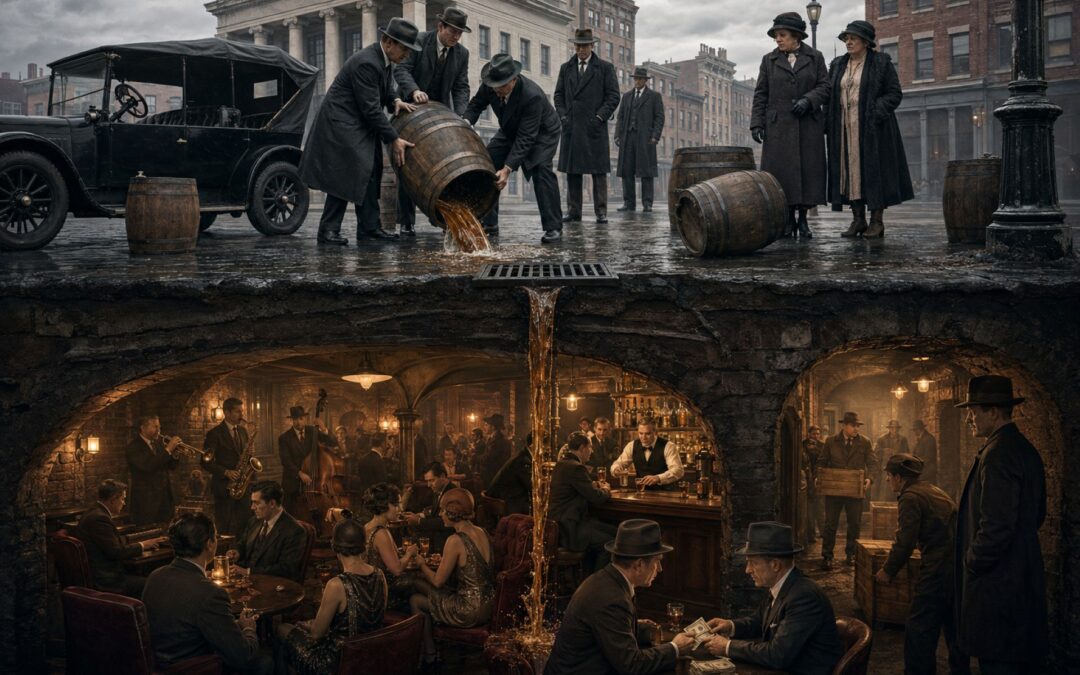
On January 17, 1920, the United States began enforcing one of the most ambitious social experiments in its history.
Less than an hour after the national ban on the alcohol trade took effect, armed men reportedly robbed a Chicago freight train and escaped with thousands of dollars’ worth of whiskey. It was an early warning that Prohibition would not unfold as its supporters expected.
The Eighteenth Amendment was supposed to weaken crime, reduce poverty, protect families, improve public health, increase productivity, and close the saloons that many Americans associated with violence and political corruption.
Instead, it produced a strange contradiction.
Alcohol consumption initially fell. Some alcohol-related health problems declined. The old male-dominated saloon largely disappeared. In those respects, Prohibition accomplished more than its reputation suggests.
But it also encouraged bootlegging, overwhelmed courts, corrupted law enforcement, enriched criminal organizations, exposed drinkers to poisonous alcohol, and turned millions of otherwise law-abiding citizens into routine lawbreakers.
By 1933, the United States had become the first—and so far only—country to repeal one of its own constitutional amendments.
Prohibition is therefore not simply a story about moral reformers foolishly trying to stop Americans from drinking. It is a story about how a legitimate social problem produced an extraordinarily blunt solution—and how a policy can achieve some of its immediate goals while still failing politically, institutionally, and socially.
America Before Prohibition: A Nation Soaked in Alcohol
Prohibition appears especially surprising because alcohol was present almost everywhere in early American life.
Colonists drank beer, cider, rum, wine, brandy, and other spirits. Alcohol lasted longer than many perishable beverages, could be transported and stored relatively easily, and was sometimes considered safer than water from contaminated local sources.
It was also treated as medicine. Physicians prescribed alcohol for pain, fatigue, fever, digestive complaints, anxiety, and numerous other conditions. Soldiers received liquor rations. Workers drank during breaks. Farmers shared alcohol during harvests and barn raisings. Taverns served as restaurants, hotels, business centres, political meeting places, and sources of news.
Drinking was not confined to evenings or celebrations. Many Americans began the day with alcohol, continued drinking while working, and finished with a nightcap.
The quantities involved were remarkable.
According to the National Archives’ history of alcohol in the United States, annual consumption reached approximately 7.1 gallons of absolute alcohol for every drinking-age person in 1830. The comparable modern figure used by the archive was about 2.3 gallons.
That did not mean every American drank equally. Men generally consumed much more than women, while religious, regional, class, and cultural differences affected drinking habits. But it still represented a level of consumption that would be difficult to imagine today.
Alcohol accompanied politics as naturally as it accompanied labour. Candidates distributed drinks to voters. Andrew Jackson’s 1829 inauguration produced such a disorderly White House celebration that refreshments reportedly had to be moved outside to draw the crowd away.
The culture had practical explanations, but it also had devastating consequences.
A labourer who spent much of his pay in a saloon might leave his family without food or rent. Intoxicated workers operating machinery endangered themselves and others. Heavy drinking contributed to public disorder, illness, neglect, and violence inside the home.
Women and children were particularly vulnerable. A married woman possessed limited legal and economic independence. Divorce could be difficult, property rights were restricted, and there was little institutional protection from an abusive husband. If he drank away the family’s income or returned home violent, his wife might have few realistic ways to escape.
By the early nineteenth century, a growing number of Americans had concluded that the country’s relationship with alcohol was not merely excessive.
It was destructive.
Temperance, Women, and the Fight Against the Saloon
The earliest temperance organizations did not necessarily demand complete abstinence.
Many reformers initially encouraged moderation or asked Americans to avoid distilled spirits while continuing to drink beer or wine. Over time, however, temperance increasingly came to mean abstaining from alcohol altogether.
The movement grew alongside other nineteenth-century reform campaigns. Religious revivalism encouraged the belief that individuals and societies could be morally transformed. Temperance overlapped with campaigns concerning slavery, women’s rights, child welfare, education, public health, and labour conditions.
The Library of Congress describes temperance as an influential movement from at least the 1830s. Its supporters linked drinking to poverty, insanity, crime, family breakdown, and political corruption.
But the saloon became more than a place where alcohol was sold.
In working-class and immigrant neighbourhoods, saloons provided companionship, employment contacts, entertainment, political organization, and sometimes basic financial services. German, Irish, Italian, and other immigrant communities developed distinctive drinking cultures around them.
That made the campaign against the saloon complicated.
Some reformers sincerely wanted to protect families and improve public health. Others regarded urban immigrants, Catholics, labour organizers, and ethnic drinking traditions as threats to Protestant America. Temperance could be compassionate and coercive, progressive and prejudiced, sometimes at the same time.
Women brought enormous moral force to the movement.
During the Woman’s Crusade of 1873–1874, groups gathered outside saloons, sang hymns, prayed, petitioned proprietors, and asked them to close their businesses. Beginning in Ohio, the campaign spread across hundreds of communities.
These actions were remarkable because women lacked direct political power. They could not vote in national elections, had limited influence over legislation, and were expected to remain within the domestic sphere. Prayer vigils and public demonstrations were among the few tools available to them.
As Ohio State University’s archive of the Woman’s Crusade explains, the campaign asked saloonkeepers to destroy their liquor, close their doors, and enter other lines of business.
The crusade helped inspire the Woman’s Christian Temperance Union in 1874. Under leaders such as Frances Willard, the WCTU became one of the most influential women’s organizations in the country.
Its programme extended far beyond alcohol. Willard’s “Do Everything” philosophy connected temperance to women’s suffrage, labour reform, public health, education, child protection, and other social causes. The WCTU established services for women, promoted non-alcoholic public drinking fountains, distributed literature, and pushed temperance instruction into schools.
Its educational campaigns also spread exaggeration and pseudoscience. Some temperance materials portrayed even a small amount of alcohol as inevitably leading to insanity, crime, disease, or death. Moral persuasion regularly slipped into fearmongering.
The movement’s most spectacular figure was Carry Nation.
Kansas had adopted state prohibition, but illegal saloons continued operating with the knowledge of local authorities. Frustrated by prayer and petition, Nation began entering saloons and destroying bottles, mirrors, furniture, and bar fixtures.
At first, she used bricks and stones wrapped in paper, which she called “smashers.” She later became famous for carrying a hatchet.
Nation’s “hatchetations” made her a national celebrity. She was arrested repeatedly, financed her activities through lectures and souvenir sales, and used the press with an instinct that would be familiar to modern political activists.
Her methods divided temperance supporters. Some admired her refusal to tolerate authorities who ignored their own laws. Others feared that she made the movement appear fanatical.
Nation supplied drama, but smashed bottles alone could not create national Prohibition.
For that, the movement needed political machinery.
Wayne Wheeler and the Anti-Saloon League’s Political Machine
Wayne Wheeler rarely receives the same popular attention as Carry Nation or Al Capone, yet no individual was more important to the political success of Prohibition.
The Anti-Saloon League began in Ohio in 1893. Unlike the WCTU, it did not attempt to reform every area of society. It concentrated its resources on a single objective: destroying the legal alcohol trade.
Wheeler turned that narrow focus into extraordinary political power.
The League did not primarily try to replace the Democratic and Republican parties with a separate Prohibition Party. Instead, it pressured candidates within both major parties. A politician’s position on other issues mattered less than whether he was “dry” or “wet.”
The League monitored voting records, mobilized churches, distributed campaign literature, endorsed dry candidates, and organized opposition to politicians who resisted it. A legislator did not need to believe that Prohibition was wise. He only needed to fear that opposing it would cost him his seat.
Wheeler demonstrated the effectiveness of this strategy in Ohio, where the League helped defeat prominent politicians considered insufficiently committed to temperance. Similar methods were then applied nationally.
This form of single-issue pressure politics became so closely associated with him that it was sometimes called “Wheelerism.”
The League also learned to describe alcohol differently to different audiences.
Religious conservatives heard that saloons encouraged sin and undermined Christian families. Progressives heard that alcohol caused poverty, disease, and political corruption. Employers were warned that drinking reduced productivity and workplace discipline. Workers were told that liquor interests profited by keeping them poor and powerless.
Black temperance advocates sometimes presented abstinence as protection against racist stereotypes and as part of racial advancement. At the same time, white supremacists claimed alcohol made Black men dangerous and used temperance rhetoric to justify greater control over Black communities.
Nativists associated beer with German immigrants and whiskey with Irish Catholics. Suffragists and temperance campaigners supported one another because many believed female voters would favour alcohol restrictions.
These groups did not suddenly agree on religion, race, immigration, labour, or women’s rights.
They agreed that alcohol—or at least the saloon—could be treated as the common enemy.
The Anti-Saloon League amplified that coalition through an immense publishing operation. It produced newspapers, pamphlets, posters, statistics, sermons, and political attacks. Much of its material blended legitimate social concerns with sensationalism, selective evidence, and ethnic prejudice.
Wheeler’s influence eventually extended into the drafting of national legislation. The Westerville History Museum’s account of his career credits him with a major role in shaping both the Eighteenth Amendment and the Volstead Act that enforced it.
By the 1910s, the dry movement had developed organization, money, discipline, and a national network.
It was still missing the final political opportunity.
World War I provided it.
World War I, Income Tax, and the Road to the Eighteenth Amendment
For much of American history, the federal government depended heavily on customs duties and excise taxes. Taxes on beer, wine, and distilled spirits were particularly valuable.
By the early twentieth century, alcohol reportedly supplied approximately 30–40% of federal revenue. That created an obvious obstacle to national Prohibition.
However immoral reformers considered the liquor trade, abolishing it would leave an enormous hole in the federal budget.
The Sixteenth Amendment changed the calculation. Ratified in 1913, it established Congress’s authority to collect a federal income tax. It did not cause Prohibition, but it gave the government an alternative source of money and removed one of the strongest practical arguments against a national ban.
That same year, a Prohibition amendment was introduced in the Senate. The idea was gaining ground, but it still faced powerful brewers, divided public opinion, and the political influence of millions of Americans who considered drinking part of ordinary life.
Then the United States entered World War I in April 1917.
Prohibitionists argued that grain used to produce alcohol should instead feed soldiers and civilians. A sober workforce, they claimed, would be more disciplined and productive. Restricting alcohol could therefore be presented as a patriotic wartime sacrifice.
The war also unleashed intense anti-German sentiment.
German Americans owned or operated many of the country’s largest breweries. Companies such as Anheuser-Busch, Pabst, Schlitz, and others had helped make beer a major national industry. Their German associations now became a political liability.
Prohibitionists portrayed the brewing industry as foreign, disloyal, and potentially sympathetic to the enemy. Drinking German-American beer could be framed not merely as a moral weakness but as a betrayal of the war effort.
This attack weakened one of the best-organized opponents of Prohibition at precisely the moment when wartime regulations were expanding federal authority over production, food, and personal behaviour.
Congress proposed the Eighteenth Amendment in December 1917. The necessary thirty-sixth state ratified it on January 16, 1919, and it took effect one year later.
The speed of ratification may make Prohibition appear like a product of temporary wartime hysteria. But the war supplied the final acceleration, not the original movement. Temperance activists had spent nearly a century changing drinking habits, passing local restrictions, creating dry states, organizing women, lobbying churches, and punishing wet politicians.
War made national Prohibition possible because the political foundation had already been built.
Congress still needed legislation to define and enforce the amendment. The result was the National Prohibition Act, better known as the Volstead Act.
President Woodrow Wilson vetoed it, partly because it also extended wartime restrictions after the war. Congress quickly overrode him. On October 28, 1919, the Senate voted 65–20 to override the veto.
The country was about to go dry.
But many Americans had not yet understood exactly how dry.
What Prohibition Actually Banned
The Eighteenth Amendment is often described as having made drinking illegal.
It did not.
The amendment prohibited the manufacture, sale, transportation, importation, and exportation of intoxicating liquor for beverage purposes. It did not explicitly prohibit drinking alcohol, nor did it automatically criminalize possessing alcohol already legally acquired.
That distinction created some of Prohibition’s first inequalities.
Wealthy individuals and private clubs could purchase large stocks before the law took effect and continue consuming them afterwards. A person with a well-supplied cellar might drink legally for years. Someone without the money or warning to stockpile alcohol had far fewer options.
The amendment also did not define “intoxicating liquor.” That task fell to the Volstead Act, which set the threshold at more than 0.5% alcohol.
This definition was much stricter than some supporters had expected. Americans who wanted to eliminate whiskey but preserve ordinary beer discovered that nearly every alcoholic beverage had been prohibited.
The Act contained exceptions.
Alcohol could still be produced for industrial, scientific, medicinal, and religious purposes. Physicians could prescribe liquor. Churches and synagogues could obtain sacramental wine. Industrial companies could manufacture alcohol for products ranging from solvents and fuels to cosmetics and medicines.
Private possession and consumption of legally obtained pre-Prohibition stocks also remained permitted. The constitutional history of the Volstead Act confirms that alcohol acquired before the law took effect could be kept and consumed in a private dwelling by its owner, family, and genuine guests.
Responsibility for enforcement was shared by the federal government and the states. On paper, this offered a powerful combination of national authority and local policing.
In practice, it created confusion and evasion.
Some states enthusiastically enforced Prohibition. Others supplied little money or cooperation. Large cities with strong drinking cultures, immigrant populations, and wet political machines often had little interest in enforcing a law many residents opposed.
Prohibition had been written into the Constitution, but the Constitution could not make every police officer, judge, mayor, doctor, pharmacist, priest, politician, and citizen want to enforce it.
That gap between law and consent became the central problem of the entire experiment.
Loopholes, Weak Enforcement, and a Nation of Scofflaws
Americans began testing the law almost immediately.
The medical exemption became one of the most widely used loopholes. Doctors could prescribe whiskey for certain conditions, and pharmacies could dispense it. The number of prescriptions rose dramatically as patients discovered a medical route to the liquor cabinet.
Religious demand also expanded. Orders for sacramental wine increased, and the legal supply created opportunities for diversion into the black market.
Home production offered another path.
Companies sold grape concentrates that were perfectly legal until customers turned them into wine. Some products carried remarkably detailed warnings explaining the precise steps consumers should avoid if they did not want fermentation to occur.
The law had unintentionally created instructional labels for home winemaking.
These loopholes were not the only problem. Prohibition was extraordinarily expensive and difficult to enforce.
The United States had thousands of miles of coastline, long borders with Canada and Mexico, major international ports, extensive rail networks, millions of farms and homes, and countless industrial facilities that legitimately used alcohol.
Yet the federal enforcement force was comparatively small, poorly paid, unevenly trained, and vulnerable to political appointments and bribery. State and municipal authorities were expected to carry much of the burden, but their commitment varied dramatically.
In sympathetic rural communities, enforcement could be strict. In wet cities, it could be performative or openly corrupt.
New York repealed its state enforcement law in 1923, leaving federal agents to pursue violations without meaningful state assistance. Other jurisdictions continued passing increasingly severe penalties even as public cooperation weakened.
The result was a country in which the same behaviour could be punished harshly in one place and ignored in another.
Ordinary citizens learned that obtaining alcohol did not necessarily require entering a criminal underworld. It might involve asking a doctor, visiting a compliant pharmacist, joining a private club, buying from a familiar neighbour, or speaking to a police officer who knew exactly which speakeasy to recommend.
When violation becomes normal, the meaning of law begins to change.
A statute may still exist on paper, but enforcement becomes selective. The unlucky, poor, politically unconnected, or socially marginalized face punishment, while wealthier citizens buy privacy and protection.
Prohibition did not simply fail to stop every drink.
It taught millions of Americans that an amendment to the Constitution could be treated as an inconvenience.
Bootlegging, Rum-Running, Speakeasies, and Corruption
The illegal alcohol economy developed with extraordinary speed because demand never disappeared.
Some Americans produced liquor themselves. Illegal stills appeared on farms, in forests, inside city buildings, and in private homes. The quality varied from carefully distilled spirits to dangerous mixtures made by people with little knowledge of chemistry.
Others smuggled alcohol from abroad.
Canadian distilleries supplied enormous quantities of liquor to American bootleggers. Smuggling flourished across the Great Lakes and the Detroit River. Ships carrying alcohol gathered beyond American territorial waters along the Atlantic coast, creating floating supply zones collectively known as Rum Row.
Small, fast boats travelled out to collect cargo and return it to shore. Smugglers used false compartments, altered vehicles, bribed customs officers, and constantly adjusted their routes to avoid patrols.
The illegal market could make successful bootleggers extremely rich.
Roy Olmstead, a former Seattle police officer, built one of the largest smuggling operations in the Pacific Northwest. His prosecution eventually produced a major Supreme Court case concerning warrantless wiretapping and privacy.
George Remus found a different opportunity.
A lawyer and trained pharmacist, Remus studied the Volstead Act and recognized that pre-Prohibition liquor stored in bonded warehouses could still be withdrawn for medicinal purposes. He purchased distilleries, pharmacies, and transportation businesses, legally acquired the whiskey, and arranged for shipments to be “stolen” before selling the alcohol illegally.
His organization became so extensive that he was known as the King of the Bootleggers.
Most consumers did not purchase alcohol directly from figures such as Remus or Olmstead. They encountered the illicit trade through speakeasies.
These establishments ranged from small backroom bars to glamorous nightclubs featuring jazz, dancing, elaborate cocktails, and wealthy patrons. Some required passwords or introductions. Others operated so openly that their supposed secrecy became a joke.
Speakeasies also changed drinking culture.
Before Prohibition, the stereotypical saloon was predominantly male. During the 1920s, women entered many urban drinking spaces more openly. Cocktails grew in popularity, partly because mixers helped disguise the taste of poor-quality liquor.
Some venues allowed forms of social interaction across gender, class, and racial boundaries that had been unusual in older saloons, although segregation and discrimination remained widespread. Black musicians might perform for white audiences in clubs that still refused to treat them as equal guests.
The illegal nature of the industry weakened ordinary regulation.
There was no reliable licensing system, quality control, legal drinking age, or enforceable closing time inside a criminal market. Customers could not complain to regulators about dangerous alcohol. Disputes could not be settled through legitimate contracts and courts.
Protection came from bribes or violence.
Police officers, judges, mayors, federal agents, and politicians were offered a share of the profits. A single payment could protect a shipment, warn of a raid, make evidence disappear, or keep a speakeasy operating.
Officials who resisted corruption faced an industry with enough money to intimidate witnesses, hire skilled lawyers, and replace every seized shipment.
The consequences reached the federal courts. The Federal Judicial Center’s Prohibition timeline documents how alcohol cases strained judicial resources, encouraged assembly-line plea bargains, and filled court dockets with offences that many citizens did not regard as serious crimes.
Prohibition had attempted to eliminate a market.
Instead, it transferred that market from regulated businesses to entrepreneurs who were rewarded for corrupting the state.
Poisoned Alcohol and the Human Cost of Enforcement
Not all illegal alcohol was produced in secret stills or smuggled from Canada.
A substantial amount came from industrial alcohol.
Factories legally required alcohol for fuels, solvents, chemicals, cosmetics, cleaning products, and other non-beverage purposes. To prevent people from drinking it, manufacturers added substances that made it foul-tasting, difficult to purify, or poisonous.
The practice of denaturing industrial alcohol predated national Prohibition. But as bootleggers learned to steal and redistill it, the federal government intensified the formulas.
In 1926, officials required more aggressive denaturing. Additives could include methanol and other dangerous chemicals. The government knew that criminal organizations would continue attempting to convert this industrial supply into drinkable liquor—and that some of the resulting products would reach consumers.
The consequences were deadly.
Poorer drinkers were especially vulnerable because they could not afford imported liquor or carefully produced spirits. They were more likely to consume cheap alcohol assembled from industrial sources, patent medicines, hair tonics, or questionable homemade mixtures.
New York City’s chief medical examiner, Charles Norris, publicly condemned the policy after a wave of deaths. He argued that the government was knowingly increasing the danger to citizens in an attempt to frighten them into obeying the law.
Exact death estimates remain disputed, but thousands of people died from poisoned or contaminated alcohol during the Prohibition era. A historical review available through the National Institutes of Health describes the 1926 decision to require poisons, including methanol, in industrial alcohol.
The policy presented a grim ethical question.
The government had not poured poisoned drinks into glasses. Bootleggers stole or diverted industrial alcohol, illegally attempted to purify it, and sold it without revealing the danger.
But officials also understood that people would drink it.
Prohibition had created a system in which the government made a legal industrial product more dangerous because criminals were converting it into an illegal consumer product. The policy did not stop the trade. It transferred part of its cost onto people who often knew the least about what they were consuming.
This was one of the darkest expressions of Prohibition’s central problem.
The more aggressively the government tried to suppress the market, the more dangerous the market could become.
How Prohibition Supercharged Organized Crime
Organized crime did not begin with Prohibition.
American cities already contained gambling syndicates, protection rackets, brothels, thieves, political machines, and gangs. Criminal organizations did not need the Eighteenth Amendment to discover bribery or violence.
What Prohibition gave them was an enormous national commodity market.
Millions of customers wanted a product that legitimate companies could no longer supply. The organizations capable of producing, importing, transporting, protecting, and distributing that product could earn extraordinary profits.
Those profits changed the scale of organized crime.
Gangs purchased weapons, vehicles, warehouses, boats, and political protection. They employed drivers, guards, accountants, lawyers, bartenders, and corrupt officials. Local groups developed larger supply networks, while territorial disputes became battles over valuable routes and neighbourhoods.
No city became more closely associated with this violence than Chicago.
The city’s criminal factions initially divided parts of the alcohol trade by territory and ethnicity. Those arrangements did not last. Hijackings, bombings, assassinations, and retaliatory attacks became part of the struggle for control.
Al Capone emerged from this environment.
After Johnny Torrio withdrew from active leadership, Capone became the dominant figure in the Chicago Outfit. He combined violence with an unusually public personality. Rather than hiding completely from attention, he spoke to reporters, cultivated celebrity, and presented himself as a businessman providing customers with something they clearly wanted.
That image obscured the coercion behind his operation.
Bootlegging profits supported bribery, intimidation, and attacks on rivals. Capone became widely associated with the St. Valentine’s Day Massacre of 1929, when seven members and associates of a rival gang were murdered in a Chicago garage. He was never convicted for ordering the attack, but the massacre strengthened public demands for action.
The federal government faced a jurisdictional problem.
The Bureau of Investigation—later renamed the FBI—did not have general authority to investigate Prohibition offences. As the FBI’s own account of the Capone case explains, those violations belonged to the Bureau of Prohibition, while the Chicago murders were not federal crimes.
The government eventually attacked Capone through his finances.
Investigators from the Treasury and the Bureau of Internal Revenue developed evidence that he had failed to pay taxes on his income. In 1931, Capone was convicted of tax evasion and sentenced to eleven years in federal prison. The IRS still records the case as one of the defining achievements of its Intelligence Unit.
Capone’s conviction was important, but it did not dismantle organized crime.
The criminal organizations strengthened by bootlegging had accumulated money, political connections, operational experience, and networks that could be redirected into gambling, extortion, labour racketeering, narcotics, and other illegal enterprises.
Repeal would remove their exclusive hold over the alcohol market.
It would not make them disappear.
Did Prohibition Actually Work?
The conventional answer is simple.
Prohibition failed because Americans continued drinking, gangsters became rich, and the amendment was eventually repealed.
The historical answer is more complicated.
Alcohol consumption fell sharply when Prohibition began. One influential National Bureau of Economic Research study estimated that consumption initially dropped to approximately 30% of its pre-Prohibition level.
It did not remain that low. As illegal supply networks improved and consumers learned how to evade the law, consumption recovered to roughly 60–70% of the earlier level.
That still meant Americans were drinking less than before Prohibition.
Rates of liver cirrhosis and alcoholic psychosis declined, although some improvements had begun during earlier wartime restrictions. The destruction of the old saloon system also changed the environment in which drinking occurred. Prohibition made alcohol more expensive and difficult to obtain, particularly for people without wealth or criminal connections.
Historian Jack Blocker has argued that the popular image of complete failure rests on a weak foundation. His public-health reassessment of Prohibition concludes that the policy reduced consumption and maintained more political support than later cultural memory suggests.
But lower consumption alone cannot settle the question.
Prohibition imposed costs that its supporters had either underestimated or dismissed. Enforcement consumed public resources, overwhelmed courts, encouraged corruption, and operated unevenly across regions and social classes.
The wealthy could rely on private stocks, doctors, clubs, or imported liquor. Poorer drinkers were more exposed to unsafe products and police intervention. Immigrant, Black, and working-class communities often experienced enforcement more aggressively than affluent Americans committing similar violations in private.
Homicide and gang violence became closely associated with the illegal alcohol economy, although national crime data from the period are incomplete and do not allow every increase in violence to be attributed to Prohibition alone.
The law also damaged respect for government.
Citizens watched politicians publicly defend Prohibition while drinking privately. They saw police officers protect speakeasies, federal agents accept bribes, and wealthy offenders avoid penalties that could destroy a poorer defendant’s life.
Prohibition therefore worked in one limited but important sense: it reduced the legal availability and overall consumption of alcohol.
It failed in a broader sense because the political system could not enforce it consistently, fairly, safely, or with sufficient public consent.
Those two conclusions are not contradictory.
A policy can change behaviour and still produce consequences serious enough to make it unsustainable.
Pauline Sabin, the Great Depression, and the Repeal Movement
By the late 1920s, organized opposition to Prohibition was expanding.
One of its most effective leaders came from a group that the temperance movement had long claimed to represent: women.
Pauline Sabin was wealthy, politically connected, and deeply involved in Republican Party fundraising. She had initially supported Prohibition, partly because she believed it would protect families.
Experience changed her mind.
Sabin saw a law that was routinely violated, inconsistently enforced, and surrounded by hypocrisy. She became particularly disturbed by the assumption that the WCTU spoke for all American women.
In 1929, she founded the Women’s Organization for National Prohibition Reform. The organization argued that Prohibition had not protected the home. It had brought illegal liquor, criminal influence, and contempt for law closer to children and families.
Sabin’s social position gave the repeal movement respectability. Opposition to Prohibition could no longer be dismissed as the self-interest of brewers, saloonkeepers, gangsters, and habitual drinkers.
The organization expanded rapidly, eventually claiming approximately 1.5 million members. The Museum of the City of New York’s history of these campaigners shows how women used meetings, pamphlets, speeches, political networks, and consumer imagery to demand repeal and regulation.
Pressure also grew inside government.
President Herbert Hoover created the National Commission on Law Observance and Enforcement, commonly known as the Wickersham Commission, to investigate Prohibition and the wider criminal justice system. Its report documented corruption, inadequate enforcement, public resistance, and structural weakness.
But it stopped short of recommending immediate repeal. Hoover continued defending Prohibition, even as the evidence exposed how badly the system was functioning.
Then the economy collapsed.
The onset of the Great Depression transformed the political debate. Banks failed, businesses closed, families lost their savings, and millions of workers became unemployed.
Under those conditions, spending money to enforce an unpopular alcohol ban became harder to justify. Repeal offered the possibility of reopening breweries and distilleries, restoring jobs, and collecting taxes from an industry that had continued operating illegally anyway.
The economic crisis did not create opposition to Prohibition. The backlash had been growing throughout the 1920s.
The Depression made repeal urgent.
Franklin D. Roosevelt embraced the issue during the 1932 presidential campaign. Sabin, despite her long association with the Republican Party, supported him. The Democratic platform called for repeal, and voters gave Roosevelt a landslide victory over Hoover.
Prohibition had lost its moral coalition, its political enforcer, and its economic justification.
Its constitutional foundation was about to fall.
How the Twenty-First Amendment Ended National Prohibition
Congress formally proposed the Twenty-First Amendment on February 20, 1933, before Roosevelt took office.
The amendment’s first section was direct: the Eighteenth Amendment would be repealed.
Its ratification process was unusual. Instead of asking state legislatures to vote, Congress required special state conventions. Supporters of repeal feared that rural dry interests and Anti-Saloon League pressure remained too powerful inside many legislatures. Conventions would function more like direct public judgements on Prohibition.
Roosevelt was inaugurated on March 4, 1933.
Later that month, he signed the Cullen–Harrison Act, permitting the production and sale of lower-alcohol beer and wine while the country waited for full repeal. When legal beer returned in April, breweries resumed production, workers returned to jobs, and governments began collecting revenue.
The United States Senate’s account of the legislation records that Congress legalized beer containing no more than 3.2% alcohol by weight on March 22.
State conventions then considered the Twenty-First Amendment.
On December 5, 1933, Utah became the thirty-sixth state to ratify it, providing the required three-fourths majority. National Prohibition ended after nearly fourteen years.
The repeal did not force every state or county to permit alcohol.
Section Two of the Twenty-First Amendment preserved extensive state authority over the importation and distribution of liquor. States developed different systems involving licences, government-controlled stores, restrictions on sales, and local dry areas.
Some states retained statewide Prohibition for decades. Oklahoma did not repeal its state ban until 1959, while Mississippi remained officially dry until 1966. Even today, counties and municipalities in parts of the United States maintain substantial alcohol restrictions.
Repeal therefore did not return the country to the lightly regulated drinking culture that had existed before 1920.
It replaced an absolute national ban with a complex system of state regulation.
The United States had abandoned Prohibition.
It had not abandoned alcohol control.
The Lasting Legacy of Prohibition
Prohibition changed more than drinking laws.
It expanded the federal government’s involvement in policing conduct that had previously been handled largely by states and municipalities. Enforcement required surveillance, border patrols, raids, informants, wiretaps, criminal prosecutions, and cooperation among multiple agencies.
Historian Lisa McGirr argues that this “war on alcohol” helped construct parts of the modern American penal state. Her research on Prohibition and the rise of federal power emphasizes that enforcement fell disproportionately on poor, immigrant, and Black communities.
The techniques and assumptions did not disappear with repeal. Federal officials carried institutional experience from alcohol enforcement into later campaigns against drugs and organized crime.
Prohibition also left organized crime wealthier and more sophisticated. The illegal alcohol trade had provided money, distribution networks, political contacts, and experience in managing large underground businesses. Repeal removed the most profitable commodity from criminal control, but organizations adapted.
American drinking culture changed as well.
The traditional saloon never fully recovered its old position. Licensed bars, cocktail lounges, restaurants, nightclubs, and home drinking occupied more of the social landscape. Men and women increasingly drank in the same public venues.
Cocktails, which helped conceal poor-quality spirits during Prohibition, became permanent features of American drinking. Some major breweries survived by producing legal substitutes, food products, soft drinks, or industrial goods, while many smaller breweries disappeared permanently.
The relationship between taxation and alcohol also changed. Before Prohibition, dependence on liquor taxes had made a national ban financially difficult. The federal income tax helped make the ban possible. During the Great Depression, the desire to restore alcohol-tax revenue helped make repeal attractive.
Politically, the Anti-Saloon League demonstrated the power of disciplined single-issue lobbying. Wayne Wheeler showed that a relatively narrow organization could influence both major parties by concentrating voters, monitoring politicians, and punishing dissent.
The constitutional legacy is even more striking.
The Eighteenth Amendment remains the only amendment to the United States Constitution that has been repealed. That history demonstrates both the power and danger of constitutionalizing a detailed social policy. Ordinary legislation can be amended as conditions change. A constitutional amendment is designed to resist political fluctuation.
Prohibition’s supporters believed that permanence was its strength.
When the policy began failing, that permanence became a trap.
The era is frequently used as an analogy for modern drug laws, gambling restrictions, abortion, firearms, and other attempts to regulate contested behaviour. Such comparisons can be useful, but they should not be automatic. Different substances and activities produce different harms, markets, and enforcement challenges.
The most valuable lesson is broader.
Laws do not operate through moral certainty alone. They require legitimacy, administrative capacity, realistic objectives, proportionate enforcement, and enough public cooperation to prevent violation from becoming normal.
Prohibition had constitutional authority.
What it gradually lost was consent.
Conclusion: A Policy Can Partly Work and Still Fail
Prohibition began with a problem that was real.
Americans had consumed extraordinary amounts of alcohol. Heavy drinking damaged health, absorbed wages, endangered workers, intensified violence, and left women and children vulnerable inside a legal system that offered them little protection.
Temperance reformers did not invent those harms.
But recognizing a genuine problem does not guarantee that the proposed solution will work as intended.
Prohibition reduced alcohol consumption and weakened the old saloon culture. It probably improved certain public-health outcomes. It demonstrated that government restrictions can change behaviour even when they cannot eliminate it.
Yet the attempt to impose an almost absolute national ban created a profitable criminal market, encouraged official corruption, exposed people to unsafe alcohol, strained courts, and made selective enforcement unavoidable.
Its greatest failure was not that every American continued drinking.
They did not.
Its greatest failure was that the country could not enforce the policy without producing costs that eventually overwhelmed its benefits.
When armed men stole whiskey less than an hour after Prohibition began, they revealed the contradiction that would define the next thirteen years. The government could close breweries, outlaw transportation, raid speakeasies, and write abstinence into the Constitution.
What it could not do was make demand disappear by command.
Prohibition changed what Americans drank, where they drank, who drank together, how alcohol was regulated, and how the federal government policed private behaviour.
It changed America.
It simply could not make America dry.
Last Updated on July 10, 2026 by Aseem Gupta