
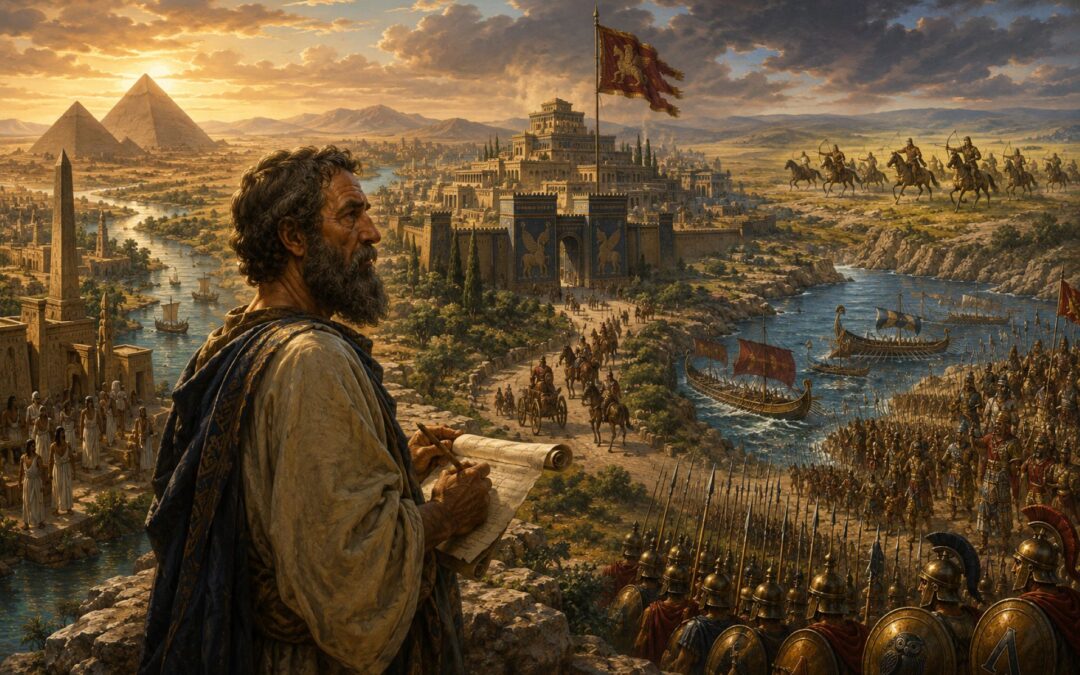
Herodotus was born around 484 BCE in Halicarnassus, a Greek-speaking city ruled by the Persian Empire. That position placed him between worlds. He belonged to Greek culture, yet he grew up inside the political order that Greece would later remember as its great foreign enemy.
The wars between Persia and the Greek city-states had ended when Herodotus was still a child. He inherited a world filled with memories of Marathon, Thermopylae, Salamis, and Plataea, but victory alone did not satisfy him. He wanted to know how the conflict had begun, why a vast empire had crossed into Greece, how different peoples understood the struggle, and which decisions had brought two political worlds into collision.
The result was The Histories, a work that begins with stories of abducted women and ends with the defeat of the Persian invasion. Between those points, it travels through Lydia, Persia, Babylon, Egypt, Ethiopia, India, Arabia, Libya, and Scythia. It introduces kings, priests, rebels, merchants, soldiers, nomads, tyrants, advisers, and ordinary people. It records monuments, rivers, religious practices, political institutions, military strategies, rumours, legends, and competing explanations.
Yet The Histories is not simply a record of Herodotus’s journeys. Nor is it merely a chronicle of the Persian Wars. It is an investigation into power: how it is gained, how it expands, how rulers misunderstand it, and how apparently invincible empires encounter limits.
Herodotus did not always separate fact from folklore as a modern historian would. He repeated extraordinary stories, accepted questionable measurements, and sometimes relied on informants whose claims cannot be verified. But he also preserved disagreements, identified hearsay, compared customs, questioned explanations, and tried to understand why people acted as they did.
His world was full of uncertainty. Instead of concealing that uncertainty, he made it part of the story.
Herodotus and the Invention of Historical Inquiry
The Greek word historia originally meant inquiry or investigation. Herodotus’s achievement was not simply that he wrote about events from the past. Kings, priests, poets, and chroniclers had done that long before him. What distinguished him was his attempt to gather different kinds of evidence and arrange them around a question of causation.
At the beginning of Herodotus’s complete Histories, he states that he wants to preserve the great deeds of both Greeks and non-Greeks and explain why they went to war. The formulation matters. He does not promise to celebrate Greece alone. Persians, Egyptians, Babylonians, Scythians, and others occupy enormous portions of the work, often appearing as sophisticated societies with customs as coherent to them as Greek customs were to Greeks.
Herodotus’s biography is difficult to reconstruct. Later traditions connect him with political turmoil in Halicarnassus, exile, public recitations, Athens, and the Greek colony of Thurii in southern Italy. Some of these traditions may preserve genuine memories, but they cannot be treated as a complete, securely dated life story.
The same caution applies to his travels. Herodotus appears to have visited Egypt, parts of the Black Sea region, Asia Minor, the Levant, and other areas around the eastern Mediterranean. However, there is no reliable evidence for a single continuous eight-year expedition, and the chronology of Herodotus’s travels remains uncertain. Describing a region did not necessarily mean he had personally visited it. He gathered information from sailors, traders, priests, local guides, soldiers, administrators, and stories circulating across the Persian Empire.
That combination of observation and testimony gave his work both its extraordinary reach and its obvious weaknesses.
Herodotus sometimes tells the reader that he personally saw a monument or custom. Elsewhere, he reports what Egyptians, Persians, Phoenicians, Scythians, or Greeks told him. At times he openly doubts a story while preserving it. At others, he offers multiple explanations and refuses to decide between them.
The opening stories of conflict demonstrate this method. Persian informants traced Greek-Persian hostility back to a chain of abductions. Phoenicians supposedly kidnapped Io from Argos. Greeks retaliated by taking Europa and later Medea. Paris then carried Helen away from Greece, and the Greeks answered by destroying Troy.
The Phoenicians, Herodotus says, disputed the first accusation. In their version, Io had willingly left with a Phoenician captain after becoming pregnant. Herodotus records both explanations but does not accept mythical abductions as a sufficient cause of the historical conflict he wants to explain.
He moves instead toward a more recent and politically meaningful beginning: Croesus of Lydia, the first ruler in his account to subjugate Greek communities in Asia Minor.
This movement from legend to recent memory reveals how Herodotus works. He does not erase stories merely because they are doubtful. He preserves them as evidence of how different peoples understood their past. Modern retellings often emphasise the spectacular range of these narratives, as seen in this documentary journey through Herodotus’s ancient world, but their deeper importance lies in the relationships Herodotus constructs between memory, explanation, and power.
He was not a modern historian. He did, however, create a form in which disagreement itself could become historical evidence.
Croesus: Fortune, Power, and the First Warning
Before Persia became the dominant power in western Asia, Lydia ruled much of the eastern Aegean coast. Herodotus begins its dynastic history with a private crime that becomes a political revolution.
Candaules, the last king of the Heraclid dynasty, was obsessed with the beauty of his wife. He praised her so relentlessly to his trusted guard, Gyges, that he eventually ordered Gyges to hide inside the royal bedroom and see the queen naked.
Gyges resisted. The act violated both loyalty and accepted standards of modesty. Candaules nevertheless insisted, and Gyges obeyed.
The queen noticed him.
Rather than confronting Candaules immediately, she summoned Gyges the following day and offered him a brutal choice. He could kill the king, marry her, and take the kingdom, or he could die for having seen what he had no right to see. Gyges chose survival, murdered Candaules, and founded a new dynasty.
Herodotus’s story resembles tragedy more than archival history. Its importance lies in the pattern it establishes. Candaules misuses royal power, Gyges acquires the throne through bloodshed, and an oracle warns that vengeance will eventually fall upon one of his descendants.
That descendant is Croesus.
Under Croesus, Lydia became the dominant kingdom of western Anatolia. He subdued the Ionian and Aeolian Greek cities along the coast and compelled them to pay tribute. Sardis, his capital, became famous for royal wealth. Greek lawgivers, thinkers, and travellers were said to have visited his court.
Among them, according to Herodotus, was Solon of Athens.
Croesus showed Solon his treasures and then asked whom he considered the happiest person he had ever known. The king expected his own name. Instead, Solon chose an obscure Athenian named Tellus, who had lived in a prosperous community, raised a successful family, and died honourably while defending his city.
When Croesus asked for the second happiest, Solon named Kleobis and Biton, two brothers from Argos. During a religious festival, they pulled their mother’s cart to a sanctuary when the oxen failed to arrive. Their mother prayed that the goddess would give them the best gift a human being could receive. That night, both brothers died peacefully in the temple.
Croesus was offended. He possessed more wealth and power than any of the men Solon praised. Solon’s answer, however, was not a denial of Croesus’s present prosperity. It was a warning against judging a life before its conclusion.
Fortune could change.
Herodotus soon demonstrates how quickly.
Croesus dreamed that his son Atys would die from an iron weapon. Terrified, he removed Atys from military service, arranged his marriage, and ordered weapons taken away from the young man’s surroundings.
At roughly the same time, a Phrygian nobleman named Adrastus arrived in Sardis seeking purification after accidentally killing a relative. Croesus received him generously and gave him protection.
When a destructive boar began ravaging the countryside, local people asked Croesus to send hunters. Atys begged to join them. He reasoned that the dream had foretold his death by an iron weapon, not by the tusk of an animal.
Croesus reluctantly agreed and instructed Adrastus to protect him.
During the hunt, Adrastus threw a spear at the boar, missed, and killed Atys. The precautions intended to defeat the prophecy had helped create the circumstances of its fulfilment. Croesus forgave Adrastus, recognising that the death had been accidental, but Adrastus killed himself from grief.
For two years, Croesus withdrew into mourning. Then a new danger emerged from the east.
Cyrus of Persia had overthrown the Median king Astyages and begun constructing a new empire. Croesus feared that Persia would eventually threaten Lydia, so he consulted the oracle at Delphi. The response appeared favourable: if he crossed into Persian territory, he would destroy a great empire.
He assumed the empire would be Cyrus’s.
It was his own.
The Achaemenid Empire’s expansion across western Asia brought Cyrus into direct conflict with Lydia. Croesus invaded Persian-held territory, but after an inconclusive battle he withdrew to Sardis and dismissed many of his allied forces for the winter. Cyrus pursued him before the Lydian army could fully regroup.
The Persians defeated Croesus outside Sardis and captured the city.
Herodotus then returns to Solon’s warning. Croesus is placed on a pyre and remembers that no living person can be declared fortunate until the end is known. Cyrus hears him call Solon’s name, asks for an explanation, and is moved by the story.
In Herodotus’s version, Cyrus orders the fire extinguished. When the flames cannot be controlled, Croesus prays to Apollo, and sudden rain saves him. Other ancient traditions differ, and the episode cannot be independently verified.
Its literary purpose is unmistakable.
Croesus had mistaken present power for permanent security. He had heard what he wanted in the oracle, treated wealth as evidence of happiness, and imagined that the future could be mastered through precautions. His fall becomes the first great warning of The Histories: success encourages certainty, certainty encourages misjudgement, and misjudgement opens the way to reversal.
The lesson will return with every Persian king who follows.
Cyrus the Great and the Rise of the Persian Empire
Cyrus enters Herodotus’s story as the ruler who destroys Croesus’s kingdom, but Lydia is only one part of his expansion.
He had already displaced the Median dynasty and united Persian and Median power. After conquering Lydia, he controlled much of Anatolia and inherited authority over the Greek cities that Croesus had previously subdued. From there, Persian power spread across western and central Asia.
The empire Cyrus created was not simply a larger version of Lydia. It ruled numerous languages, religions, political traditions, and economic regions. Its strength came partly from military conquest and partly from its ability to absorb existing administrative systems.
Babylon was among its greatest prizes.
Herodotus describes the city as almost unimaginably large, protected by enormous walls and divided by the Euphrates. The Babylonians, confident in their fortifications and food supplies, prepared to withstand a long siege.
Before reaching the city, Cyrus encountered the Gyndes River. One of his sacred white horses entered the water and drowned. Enraged, Cyrus supposedly halted the campaign and ordered his men to divide the river into hundreds of channels until it became shallow enough to cross easily.
The story portrays Cyrus punishing nature as though a river were a rebellious subject. Whether literal or symbolic, it reinforces a pattern in Herodotus: powerful rulers increasingly believe that no barrier should resist their will.
At Babylon, direct assault failed. Herodotus says Cyrus diverted the Euphrates into a basin, lowering the river until Persian soldiers could enter beneath the walls through the exposed riverbed.
Other surviving evidence gives a more complicated picture. A comparison of Herodotus’s story with Babylonian accounts of the conquest suggests that the city fell rapidly and that Cyrus presented himself as a legitimate ruler rather than merely as a destroyer. Herodotus may preserve one version of the operation, but his dramatic river diversion cannot be accepted without qualification.
Whatever the exact military sequence, Babylon’s capture transformed Cyrus into the ruler of a vast imperial system stretching from Anatolia and Mesopotamia deep into Asia.
Still, expansion did not stop.
Cyrus turned north-east toward the Massagetae, a confederation of peoples living beyond the settled centres of the empire. They were ruled, in Herodotus’s account, by Queen Tomyris.
Cyrus first proposed marriage. Tomyris interpreted the offer as an attempt to obtain her kingdom without war and refused. The Persians then invaded.
Croesus, now serving as Cyrus’s adviser, recommended using food and wine as a trap. The Persians left a vulnerable camp stocked with provisions. A Massagetae force led by Tomyris’s son Spargapises attacked, defeated the soldiers who had remained behind, and began feasting. Unaccustomed to wine, they became intoxicated.
Cyrus returned with the main army, killed many of them, and captured Spargapises. When the prince recovered and understood what had happened, he persuaded Cyrus to release his restraints and then killed himself.
Tomyris demanded revenge. In the battle that followed, the Massagetae defeated the Persians and Cyrus was killed. Herodotus says Tomyris placed his severed head in a container of blood, fulfilling her threat to satisfy his appetite for conquest.
This is one ancient account of Cyrus’s death, not an established reconstruction. Yet its position within The Histories is significant. Cyrus had risen through victories over rulers who misjudged him. At the edge of his empire, he made the same mistake.
He encountered a society he could not easily absorb, underestimated its ruler, and relied on deception where direct conquest remained uncertain. The king who had overturned the fortunes of Astyages and Croesus finally experienced his own reversal.
The empire survived him. The illusion of limitless conquest did not.
Persia and Babylon Through Herodotus’s Eyes
As Persian rule expands, The Histories repeatedly pauses to examine the people living within or beyond the empire. These passages can appear to interrupt the political narrative, but they serve an important purpose.
Herodotus wants Greek readers to see that customs are not universal.
Practices that appeared natural in Greece could seem strange elsewhere. Practices Greeks considered unusual often followed a recognisable social or religious logic within the communities that observed them.
Herodotus reports that Persians did not build anthropomorphic statues or enclosed temples in the Greek manner. They performed sacrifices in open spaces, often on elevated ground, and worshipped natural forces alongside deities whom Herodotus identified using Greek names.
He describes birthdays as occasions for elaborate celebration and says Persians valued wine, sometimes discussing important decisions both while sober and while intoxicated. If the same conclusion appeared persuasive in both conditions, it could be accepted.
Social rank, he claims, was visible in greetings. Equals might kiss on the mouth, people of slightly different rank on the cheek, and those of much lower status might prostrate themselves.
He also admired what he understood to be certain Persian legal principles. According to his account, a person should not receive an irreversible punishment for a single offence without consideration of previous service or conduct. At the same time, Persian society strongly condemned lying and debt, partly because debt was thought to encourage dishonesty.
Some of these descriptions may preserve genuine observations. Others may generalise elite practices across a diverse empire. Herodotus often writes about “the Persians” as though they formed a culturally uniform population, even though the empire contained major differences of region, class, and period.
His treatment of Babylon is equally complex.
Herodotus marvels at its scale, walls, streets, houses, river, temples, and wealth. Yet the city he describes does not always correspond neatly with archaeological evidence. This discrepancy has contributed to doubts about whether he personally visited Babylon at all.
He also records customs that cannot be confirmed independently.
One concerns medicine. Herodotus says the Babylonians had no professional physicians and instead placed sick people in public spaces. Passers-by who recognised an illness were expected to describe treatments that had helped them or someone they knew.
Another concerns marriage. In his account, unmarried women were assembled and allocated through a public auction. Wealthy men paid for women considered attractive, while money collected from those transactions supposedly provided dowries for women who attracted fewer bidders.
Herodotus considered the system admirable because, in theory, it ensured marriages for everyone. He then claims that economic decline caused the practice to disappear.
Modern readers should resist two opposite errors. The first is to accept the story as a complete and verified description of Babylonian marriage. The second is to dismiss it as meaningless invention.
Even when a custom cannot be substantiated, it reveals something about the questions Herodotus asked and the contrasts he wanted to construct. He examines how societies organise marriage, illness, authority, religion, death, and social rank. By placing foreign practices beside Greek assumptions, he makes every culture—including Greek culture—available for comparison.
The result is not modern anthropology. It is, however, an early recognition that human behaviour is shaped by convention.
What one society calls natural, another may find incomprehensible.
Egypt: The Civilization That Reversed the Greek World
No foreign society receives more sustained attention in The Histories than Egypt.
For Herodotus, Egypt was ancient, sacred, geographically unusual, and culturally distinct. Its people seemed to reverse familiar Greek practices. Its monuments exceeded the scale of Greek architecture. Its priests claimed access to a past far older than the genealogies preserved in Greek tradition.
Herodotus reports a story about the pharaoh Psammetichus, who wanted to determine which people were the oldest in the world. Two infants were supposedly raised without hearing human speech. Their first repeated word resembled the Phrygian word for bread, leading the Egyptians to concede that the Phrygians were older.
The experiment has no value as modern linguistics, but it demonstrates Herodotus’s fascination with attempts to test inherited claims.
He then describes Egyptian life through a series of inversions. Women, he says, traded in marketplaces while men remained at home weaving. Men carried burdens on their heads and women on their shoulders. Priests shaved their bodies rather than growing their hair. During mourning, ordinary grooming practices were reversed.
Not every claim should be treated as universal across thousands of years of Egyptian history. Herodotus was observing, hearing about, or imagining particular practices during a specific period. Even so, the repeated inversions allow him to make a broader point: customs that Greeks regarded as obvious were not obvious everywhere.
Religion occupied the centre of Egyptian society as he understood it.
Priests followed strict routines of washing, shaving, diet, and clothing. Certain animals were treated as sacred in particular regions. Cats, dogs, crocodiles, hawks, ibises, and other creatures could receive ritual care or mummification.
Herodotus says that when a household cat died, family members shaved their eyebrows. Dogs, too, were mourned and buried. Professional embalmers offered different levels of mummification according to what a family could afford.
His detailed description of the most expensive process includes the removal of the brain through the nostrils, the extraction and cleaning of internal organs, the treatment of the body with natron, and its wrapping in linen after a period of drying.
The description is one of the most famous examples of Herodotus preserving technical information that broadly corresponds with known Egyptian practice, even if individual details remain debated.
He was equally fascinated by the Nile.
Greek agriculture depended heavily on rainfall. Egyptian agriculture depended on the annual river flood. Herodotus understood that Egyptian civilisation existed because the Nile created fertile land within an otherwise arid environment.
He rejected several Greek explanations for the flood, including the idea that melting snow contributed to the river’s rise. Because he associated southern lands with extreme heat, he could not imagine snow falling in the regions from which the Nile flowed.
In this case, his scepticism moved him away from a partially correct answer.
He proposed alternative theories involving winds and the movement of the sun. He also repeated an Egyptian claim that the Nile emerged from an immeasurable source near Elephantine. His explanations were wrong, but his questions were important. He wanted natural phenomena to be explained through causes rather than merely attributed to divine will.
The same mixture of inquiry, observation, hearsay, and wonder appears in his accounts of Egyptian kings.
He tells a long story about Rhampsinitus and a clever thief who repeatedly enters the royal treasury through a secret passage. When the thief’s brother is trapped, he decapitates him to prevent identification. Later, he tricks guards into becoming drunk and retrieves the body. He eventually outwits the king’s daughter as well and is rewarded rather than punished.
The story is closer to folklore than political history. It survives because Herodotus believed traditional tales could reveal how a people imagined intelligence, justice, and kingship.
His account of Khufu and the Great Pyramid is more directly historical but includes major inaccuracies.
Herodotus portrays Khufu as a hated ruler who closed temples and forced enormous numbers of Egyptians into labour. He gives exaggerated dimensions and reports that 100,000 men worked in rotating groups.
Modern archaeology presents a different picture. Evidence from workers’ settlements, tombs, and administrative remains indicates an organised labour force composed of skilled workers and rotating crews rather than the vast slave army imagined in later popular culture. Archaeological research from the Giza Plateau also places the Great Pyramid’s original height at roughly 481 feet, far below Herodotus’s estimate.
This does not make his pyramid account worthless. It preserves traditions circulating in Egypt centuries after Khufu’s reign and conveys the overwhelming impression the monument made on a Greek visitor. But the traditions cannot replace contemporary archaeological evidence.
Herodotus also praises a vast Egyptian labyrinth associated with the region of Lake Moeris. He claims it contained thousands of chambers and surpassed even major Greek temples. His measurements of the lake and nearby structures are unreliable, yet his admiration shows how Egypt altered his sense of civilisational scale.
Egypt is therefore more than a long digression.
It is the place where Herodotus’s method becomes most visible. He observes carefully, asks ambitious questions, listens to priestly authorities, compares foreign customs with Greek ones, records stories that resist verification, and reaches conclusions that range from remarkably perceptive to completely wrong.
He does not offer modern Egyptology.
He offers the record of a Greek mind learning that the world was older, larger, and less culturally uniform than Greek tradition alone could explain.
Cambyses and Darius: Conquest, Crisis, and Imperial Rule
After Cyrus’s death, his son Cambyses inherited the Persian Empire and turned toward Egypt.
Herodotus explains the invasion through a chain of personal insults, defections, and strategic calculations. An Egyptian physician serving at the Persian court supposedly encouraged Cambyses to request a daughter of Pharaoh Amasis in marriage, knowing the Egyptian ruler would resent sending her.
Amasis attempted to deceive Cambyses by sending another royal woman in place of his own daughter. When she revealed the substitution, Cambyses gained a personal motive for war.
Herodotus also introduces Phanes, a Greek mercenary from Halicarnassus who had served Amasis before defecting to Persia. Phanes advised Cambyses on the route across the desert toward Egypt and helped secure cooperation from Arab leaders who could supply water.
Amasis died before the invasion. His successor, Psammenitus, inherited both the throne and the conflict.
The Persian army defeated the Egyptians near Pelusium and advanced toward Memphis. Herodotus describes brutal acts by both sides, including the killing of a Persian diplomatic party and retaliatory executions after the city fell.
Cambyses then attempted to expand farther south toward Ethiopia. Before invading, he sent spies disguised as envoys. They carried gifts but were recognised by the Ethiopian king, who returned an enormous bow with a warning: Persia should attack only when its warriors could draw such a weapon as easily as he could.
Cambyses marched anyway.
The expedition failed because the army had not prepared adequate supplies for the distance. Herodotus says the troops consumed their pack animals and eventually resorted to cannibalism before Cambyses abandoned the campaign.
The failed expedition marks a turning point in Herodotus’s portrayal. Cambyses becomes increasingly violent, irrational, and sacrilegious.
On returning to Memphis, he found the Egyptians celebrating the appearance of the sacred Apis bull. Believing they were mocking his failure, he supposedly wounded the animal and punished its priests. Herodotus links this act with a broader collapse of restraint.
Cambyses orders the death of his brother Smerdis, also known as Bardiya, after dreaming that he will take the throne. He marries within his own family, kills one of his wives, and shoots the son of a trusted courtier to demonstrate that his aim remains steady.
This portrait must be read cautiously.
Herodotus relied heavily on Egyptian traditions shaped by resentment of foreign conquest. Contemporary Egyptian evidence complicates the image of Cambyses as a ruler interested only in destroying local religion. Persian kings could be both conquerors and participants in Egyptian forms of kingship. The story of the Apis bull, in particular, cannot simply be repeated as unquestioned fact.
Herodotus’s Cambyses is nevertheless important as a literary figure. Like Croesus and Cyrus, he violates boundaries because imperial power convinces him that ordinary limits no longer apply. Unlike his predecessors, his collapse occurs not in a single final battle but through the disintegration of judgement itself.
While Cambyses remained in Egypt, two Magian brothers seized power in Persia. One allegedly resembled the murdered Bardiya and claimed to be Cyrus’s surviving son.
When Cambyses heard that “Bardiya” had taken the throne, he realised that his dream had not necessarily referred to his brother. It may have warned him about the impostor who shared his name.
As Cambyses prepared to return, he accidentally wounded himself in the thigh. Herodotus deliberately connects the injury to the wound he had inflicted on the Apis bull. Cambyses died without an heir.
The supposed Bardiya ruled for several months. Herodotus says a Persian nobleman named Otanes became suspicious because the new king avoided appearing publicly. Otanes’s daughter Phaidyme, who had been married into the royal household, discovered that the ruler lacked ears—an identifying feature of the Magian impostor.
Otanes then joined with other nobles, including Darius, to overthrow him.
Herodotus presents the conspirators debating whether Persia should adopt democracy, oligarchy, or monarchy. The discussion is one of the most striking political passages in the work, although it is unlikely to preserve a literal transcript of a secret Persian meeting.
Darius emerged as king.
His own account survives in the Behistun inscriptions. There, the usurper is named Gaumata. Darius claims that the real Bardiya had been killed by Cambyses, that Gaumata deceived the empire, and that Darius restored legitimate rule with divine support.
The inscription confirms that rebellion and contested succession followed Cambyses’s death. It does not eliminate uncertainty. Behistun is a royal declaration produced by the victorious ruler. Herodotus’s narrative and Darius’s monument both explain why Darius deserved the throne; neither is politically neutral.
Once established, Darius reorganised imperial administration, divided territories into tax-paying districts, and confronted revolts across the empire.
Herodotus preserves stories that reveal the dangers surrounding his new kingship. Intaphernes, one of the nobles involved in the conspiracy, violently attacked royal guards after being denied access to Darius. The king feared another plot and executed Intaphernes with several male relatives.
When Intaphernes’s wife was permitted to save one person, she chose her brother rather than her husband or sons. She reasoned that she could marry again and have more children, but because her parents were dead she could never obtain another brother. Darius admired the logic and spared both the brother and her eldest son.
A more serious challenge came from Babylon.
The city rebelled and endured a long siege. Herodotus says a Persian named Zopyrus mutilated his own face, pretended Darius had punished him, and gained the Babylonians’ trust. After commanding successful attacks against Persian units deliberately sacrificed for the deception, he was given control of Babylonian forces and eventually opened the gates to Darius.
Like many of Herodotus’s most memorable narratives, the story explains imperial success through personal cunning, sacrifice, and loyalty. It may preserve historical elements, but its speeches and precise plot belong to the crafted world of The Histories.
Under Darius, Persian rule became more administratively organised than it had been under Cyrus. It also continued to push against the edges of the known world.
Those edges would prove difficult to control.
At the Edges of the Known World: Ethiopia, India, Arabia, and Libya
Herodotus’s geographical imagination becomes increasingly uncertain as he moves away from regions familiar to Greek travellers.
Distant lands appear as places of abundance, physical extremity, unusual animals, rare substances, and customs that reverse ordinary expectations. These accounts should not be read as accurate descriptions of modern countries. Names such as Ethiopia, India, Arabia, and Libya referred to broad and shifting geographical zones in Greek thought.
They also contained many peoples whom Herodotus did not treat as culturally identical.
His Ethiopians live beyond Egypt at the edge of the inhabited world. They are exceptionally tall, beautiful, healthy, and long-lived. Gold is supposedly so common that it is used for prisoners’ chains. The Ethiopian king treats Persian luxury goods with suspicion but values wine.
When Cambyses’s envoys present him with gifts, the king recognises them as spies. Instead of imprisoning them, he shows them his realm and sends the enormous bow back to Persia.
The story does more than describe a remote kingdom. It reverses imperial perspective. To Cambyses, Ethiopia is a territory waiting to be conquered. To the Ethiopian king, Persia is the distant and irrational society whose ruler cannot recognise the limits of his reach.
Herodotus’s India is even more varied.
He describes different communities with different diets, settlements, languages, and funerary practices. Some accounts involve people who consume the bodies of sick or elderly relatives. Others concern communities that refuse to kill animals or cultivate crops.
Such stories cannot be accepted as representative descriptions of Indian society. They belong to a Greek tradition that populated distant regions with extreme forms of human behaviour.
The most famous Indian story concerns gold.
Herodotus reports that people living near a desert collected gold-rich sand thrown up by ants larger than foxes. They travelled during the hottest part of the day, when the creatures were underground, loaded the sand onto camels, and fled before the ants returned.
Later writers have proposed that the story may have developed from misunderstood reports about Himalayan marmots bringing gold-bearing soil to the surface. The identification remains hypothetical. What can be said with greater confidence is that Herodotus was trying to explain how gold reached the Persian tribute system from territories far beyond his personal experience.
Arabia occupies a similar place in his geography.
It is the source of frankincense, myrrh, cassia, cinnamon, and aromatic resins. Because these substances were rare and valuable in the Mediterranean, stories about their collection emphasised danger.
Frankincense trees were guarded by winged snakes. Cassia grew near aggressive flying creatures. Cinnamon was carried by enormous birds to inaccessible nests. Arabian collectors supposedly used pieces of meat to overload and collapse the nests so the spice could be recovered.
These accounts are not botanical reports. They are explanations constructed around commercial mystery. Traders had incentives to conceal the origins of valuable goods, and distant supply chains allowed imagination to fill gaps in knowledge.
Libya, in Greek geography, referred broadly to Africa west of Egypt. Herodotus describes numerous communities around the Mediterranean coast and farther inland. Some cultivated land and built houses. Others moved with herds. Their hairstyles, marriage practices, religious ceremonies, and forms of descent differed.
He also repeats reports of enormous snakes, strange animals, headless people, and creatures with faces in their chests.
The farther the narrative travels from places connected to regular Greek observation, the more the distinction between geography and marvel begins to dissolve.
Yet dismissing the entire section would miss its historical value. Herodotus preserves the shape of ancient information networks: what Mediterranean peoples believed about distant trade, how imperial administrators imagined their frontiers, which rumours travelled with caravans, and how Greeks organised the unknown.
These regions also contribute to the central argument of The Histories. Persian kings repeatedly imagine that the world can be converted into tribute-paying territory. Herodotus’s distant peoples remind the reader that imperial maps contain spaces rulers barely understand.
Knowledge becomes weakest precisely where ambition reaches furthest.
Scythia and the Limits of Conquest
The Scythians presented Darius with a problem that could not be solved through ordinary imperial warfare.
They occupied the vast steppe north of the Black Sea. Herodotus portrays them as mobile pastoralists without the large permanent cities, palaces, temples, and agricultural centres that Persian armies were accustomed to seizing.
His account of Scythian life contains some of the most violent customs in The Histories.
He says warriors drank the blood of the first enemy they killed, removed scalps from defeated opponents, and sometimes used skulls as drinking vessels. Prisoners were sacrificed to a sword representing the god of war. Royal funerals involved elaborate mourning, sacrificed horses, servants, and members of the royal household.
Some archaeological discoveries from Scythian burial mounds support the broader picture of a highly mobile warrior society with rich funerary traditions. They do not prove that every custom Herodotus records was universal or practised exactly as he describes.
The strategic value of his account is more important than its catalogue of violence.
Darius invaded Scythian territory after crossing the Danube on a bridge constructed by Ionian Greeks. He expected either a decisive battle or a submission expressed through the symbolic gifts of earth and water.
The Scythians offered neither.
Instead, they withdrew deeper into the steppe, destroyed resources the Persians might use, and refused to defend territory on Persian terms. When the imperial army approached, they moved away. When the Persians changed direction, the Scythians changed direction as well.
Darius could not capture a capital because there was no capital. He could not destroy a palace, seize stored grain, or force the Scythian ruler to defend a fixed economic centre.
He sent a message demanding to know why the Scythians continued to flee. If they believed themselves strong enough, they should stop and fight. If they recognised Persian superiority, they should surrender.
The Scythian king Idanthyrsus replied that the Persians misunderstood the situation. The Scythians were not fleeing from fear. They simply had nothing Darius could compel them to defend. If the Persians found and threatened the graves of their ancestors, they would discover whether the Scythians were willing to fight.
Until then, they would determine the shape of the campaign.
The exchange reveals a deep conflict between two forms of power. Persian military strength depended on roads, supply systems, tribute, administration, and the seizure of strategic centres. Scythian resistance depended on movement and the absence of those centres.
Darius’s army became increasingly vulnerable as it advanced without securing a decisive battle.
Meanwhile, the Scythians reached the Danube bridge and attempted to persuade the Ionian Greeks guarding it to destroy the crossing. By doing so, the Greeks could trap Darius and free themselves from Persian rule.
The Ionians appeared to dismantle part of the bridge but ultimately preserved the route. When Darius returned, they helped the Persian army cross to safety.
Herodotus uses the decision to expose the political dependence of Greek tyrants under Persian rule. Their positions existed because Persia supported them. Destroying Darius might liberate their cities, but it would also endanger their own authority.
The Scythian campaign therefore ends without a conventional final battle. Darius survives, but he does not conquer the people he set out to subdue.
The episode is one of the clearest expressions of Herodotus’s central thesis. Imperial strength is not absolute. It depends on the enemy, the geography, the available supplies, and the assumptions through which rulers define victory.
The Scythians defeat Persia by refusing to become the kind of opponent Persia knows how to defeat.
From the Ionian Revolt to the Persian Wars
The final conflict between Persia and the Greek mainland did not emerge from an eternal hostility between two civilisations. It developed through Persian expansion into the Aegean, the ambitions of local rulers, a failed attack on an island, the political dependence of Ionian tyrants, intervention by Athens, and the destruction of Sardis.
Each decision enlarged the consequences of the one before it.
The Ionian Revolt and Marathon
After the Scythian campaign, Persian authority continued expanding through Thrace and toward Macedonia. Greek communities along the coast of Asia Minor had already lived under Lydian rule and then Persian rule, often through local tyrants supported by the empire.
One of those rulers was Aristagoras of Miletus.
Aristagoras became involved in an attempt to restore exiles to the island of Naxos. He persuaded the Persian satrap Artaphernes to support an expedition, presenting the island’s conquest as an opportunity for further expansion in the Aegean.
The campaign failed.
Fearing punishment and the collapse of his position, Aristagoras turned against Persia and encouraged the Ionian cities to revolt. Herodotus also preserves a story that Histiaeus, the former ruler of Miletus who was being kept near Darius’s court, secretly encouraged the rebellion by tattooing a message onto the shaved head of an enslaved messenger and waiting for the hair to grow back.
Whether or not that story is true, the revolt emerged from a mixture of local resentment and personal ambition.
Aristagoras first sought support from Sparta. He described the wealth of the Persian Empire and tried to persuade King Cleomenes that conquest would be profitable. Cleomenes asked how far the Persian capital lay from the sea. When Aristagoras admitted that the journey would take months, the Spartan king rejected the proposal.
Athens proved more receptive.
The Athenians and Eretrians sent ships to support the revolt. In 498 BCE, rebel forces advanced on Sardis. They captured much of the city but failed to take its citadel. A fire spread and destroyed large areas, including a sanctuary associated with the local goddess whom Greeks identified with Cybele.
The rebels withdrew, and Persian forces eventually crushed the uprising.
In Herodotus’s Greek-centred narrative, the burning of Sardis becomes the act that fixes Darius’s attention on Athens. Yet the event can also be viewed through Persian ideas of order, loyalty, and sacrilege. A Persian interpretation of the “beginning of evils” places greater emphasis on rebellion against legitimate authority and the burning of a sacred city than on a timeless conflict between liberty and despotism.
Darius’s first large campaign toward mainland Greece, led by Mardonius, was disrupted when a storm destroyed much of the fleet near Mount Athos.
A later Persian force crossed the Aegean and landed at Marathon in 490 BCE.
The Athenians faced the invasion with support from Plataea. Herodotus gives Miltiades a central role in urging immediate battle. The Greek hoplites advanced against the Persian line, with stronger wings and a deliberately thinner centre.
The Persians broke through the centre but were defeated on the flanks. The Greek wings then turned inward, surrounding part of the Persian force. The surviving Persians withdrew to their ships.
Herodotus reports 6,400 Persian dead and 192 Athenian dead. These figures are ancient claims, not modern audited statistics, but they reflect how extraordinary the victory appeared to Greek memory.
Marathon did not destroy the Persian Empire. It defeated a particular expedition.
Its psychological importance was much greater. Athens had faced an imperial army and survived. The battle created a model of collective resistance that later generations would magnify, reinterpret, and turn into a foundational story.
Darius began preparing another invasion but died before launching it.
The task passed to Xerxes.
Thermopylae and Salamis
Xerxes inherited an empire facing unrest in Egypt and unfinished war in the Aegean. Herodotus portrays him as initially uncertain about invading Greece, then persuaded by Mardonius and visions that made withdrawal impossible.
The invasion required enormous preparation. Roads, bridges, depots, canals, ships, and supply networks had to support an army moving from Asia into Europe.
Greek cities responded unevenly. Some offered submission. Others formed an alliance led primarily by Sparta on land and Athens at sea.
Their first major attempt to block the Persian advance took place at Thermopylae, a narrow passage between mountain and sea.
King Leonidas of Sparta commanded the defending force. The famous 300 Spartans formed only one part of a coalition numbering several thousand, including contingents from Thespiae, Thebes, Phocis, Corinthian communities, and other Greek states.
For two days, the narrow terrain limited Persia’s numerical advantage. Greek hoplites fought in disciplined formations with long spears and heavy shields. Persian units could not easily surround them or deploy their full strength.
The position failed because Ephialtes, a local Greek, revealed a mountain path around the pass.
When Leonidas learned that Persian troops were approaching from behind, he dismissed much of the allied army. The Spartans remained, along with Thespians who chose to stay and Thebans whose precise status remains disputed.
The final defence ended with Leonidas and the remaining Greeks killed.
Thermopylae was a Persian victory. Its later reputation came from the willingness of the defenders to remain after the position had become impossible.
At roughly the same stage of the campaign, Greek and Persian fleets fought near Artemisium. Storms damaged the much larger Persian fleet, but the naval battle remained indecisive. When news arrived that Thermopylae had fallen, the Greeks withdrew.
The road to central Greece was open.
Themistocles had long argued that Athens needed a powerful navy. Now he persuaded the Athenians to abandon their city and move the population to Salamis, Troezen, and other places of safety.
The decision was politically and emotionally devastating. Athens was occupied and burned. Yet evacuation freed the fleet from the need to defend families trapped inside the city.
The Greek allies then debated where to confront Persia. Some Peloponnesian leaders preferred to withdraw south and defend the Isthmus of Corinth. Themistocles insisted on fighting in the narrow waters around Salamis.
The geography favoured the smaller Greek fleet.
Persia’s greater numbers became difficult to coordinate inside the straits. Greek ships operated closer to familiar shores and could exploit the confusion of a compressed enemy formation.
Herodotus tells a dramatic story in which Themistocles secretly sent a message to Xerxes claiming that the Greeks planned to escape. The Persian king responded by moving his fleet into position to block them, exactly as Themistocles intended.
When battle began, Persian ships entered constricted waters where their numerical advantage became an obstacle. Vessels collided, formations broke, and Greek triremes attacked from more favourable positions.
Xerxes watched the defeat from the shore.
Salamis did not end Persian military power in Greece immediately, but it changed the strategic situation. Without secure naval support, maintaining the entire invasion force became more difficult. Xerxes returned to Asia, leaving Mardonius with a large army to continue the campaign.
As in Scythia, geography had transformed the meaning of strength. A fleet built to dominate open water became vulnerable in a narrow channel chosen by its enemy.
Plataea and Mycale
Mardonius attempted to separate Athens from the Greek alliance. He offered favourable terms, including the rebuilding of the city, if the Athenians abandoned the coalition.
They refused.
The Persian army again occupied Athens, while the allied Greek forces assembled under the Spartan commander Pausanias. The two armies eventually confronted one another near Plataea in 479 BCE.
The Greek position benefited from defensible terrain and access to water, but Persian cavalry attacks disrupted supplies and damaged confidence. After a period of manoeuvring, the Greeks attempted a night withdrawal to a more secure position.
The movement became disorganised. Mardonius interpreted it as a retreat and ordered an attack.
The battle that followed was not a perfectly coordinated Greek operation. Different contingents fought in separate areas, and the Persian cavalry did not dominate as effectively as it had during the earlier standoff.
The Persians relied partly on archery and defensive barriers of wicker shields. Once Greek hoplites reached close combat, their heavier armour and longer spears gave them an advantage.
Mardonius was killed, and Persian resistance began to collapse.
The Greek victory at Plataea destroyed the main Persian field army remaining in Greece. Thebes, which had supported Persia, was punished after the battle.
On approximately the same day according to Greek tradition, the allied fleet confronted Persian forces at Mycale on the coast of Asia Minor.
The naval coalition was commanded by the Spartan king Leotychidas, not Pausanias. The Persians had drawn many of their ships ashore and constructed a defensive enclosure. Greek forces landed, attacked the position, and defeated them with support from revolting Ionian contingents.
Mycale weakened Persian control in the Aegean and encouraged further revolts among Greek communities in Asia Minor.
The empire itself survived for generations. The victories at Plataea and Mycale did not destroy Persia or end all fighting between Persians and Greeks. They ended Xerxes’s attempt to bring mainland Greece under imperial rule.
Herodotus’s narrative has therefore travelled from Croesus’s attack on the Greek cities of Asia Minor to a point where those same communities began challenging Persian power.
The reversal is political, military, and moral.
Again and again, rulers in The Histories believe their present success guarantees future obedience. Croesus misreads the oracle. Cyrus advances beyond the core of his strength. Cambyses attempts to conquer a distant Ethiopia without adequate supplies. Darius cannot force the Scythians into battle. Xerxes possesses an immense army and fleet but discovers that numbers do not erase geography, logistics, political loyalty, or human error.
Persia’s defeat is not presented as the inevitable triumph of a superior civilisation.
It is the result of decisions.
Why Herodotus Still Matters
Herodotus did not give the world a perfect record of the ancient past.
He gave it something more complicated and, in many ways, more enduring: an inquiry into how the past can be reconstructed when witnesses disagree, rulers control official narratives, communities preserve legends, and the meaning of an event changes according to who remembers it.
Many of his claims are wrong. The Nile does not behave as he supposed. His pyramid measurements are inaccurate. His distant peoples sometimes belong more to Greek imagination than reliable geography. His casualty totals and army sizes cannot be treated as exact statistics. His royal speeches are literary constructions, not transcripts.
Yet he often signals the problem himself. He tells the reader when he has heard something rather than seen it. He preserves accounts he doubts. He records what Persians say about Greeks and what Phoenicians say about Persians. He places Egyptian customs beside Greek customs without assuming that Greece must always provide the standard.
As one discussion of Herodotus’s attempts to compare and test competing accounts observes, his importance lies partly in the habit of inquiry he brought to storytelling. He did not merely inherit the past. He questioned it.
His greatest subject was power.
Croesus shows that wealth cannot guarantee a fortunate ending. Cyrus shows that extraordinary success can create an appetite no victory satisfies. Cambyses shows how conquest can become a story of moral and political transgression. Darius shows the ingenuity and violence required to hold a diverse empire together. Xerxes shows that immense resources cannot compensate for every error of strategy and judgement.
The peoples at the margins of empire are equally important. Egyptians force Greek readers to confront a civilisation older and monumentally larger than their own. Ethiopians expose Cambyses’s arrogance. Scythians demonstrate that an empire cannot easily conquer an enemy who refuses to defend fixed territory. Babylonians, Persians, Indians, Arabians, and Libyans reveal a world whose customs cannot be reduced to one human norm.
Herodotus is often called the father of history. The title can make him sound more modern than he was. He did not separate myth, oral tradition, ethnography, geography, political analysis, and moral storytelling into distinct disciplines.
That mixture is precisely what makes The Histories so compelling.
The work preserves not only events but the uncertainty surrounding them. It shows people interpreting dreams, rumours, prophecies, customs, defeats, and victories. It records how rulers understood themselves and how their enemies remembered them. It asks not only what happened, but why people believed it had happened.
Herodotus’s answers are not always convincing.
His questions still are.
Last Updated on July 22, 2026 by Aseem Gupta