
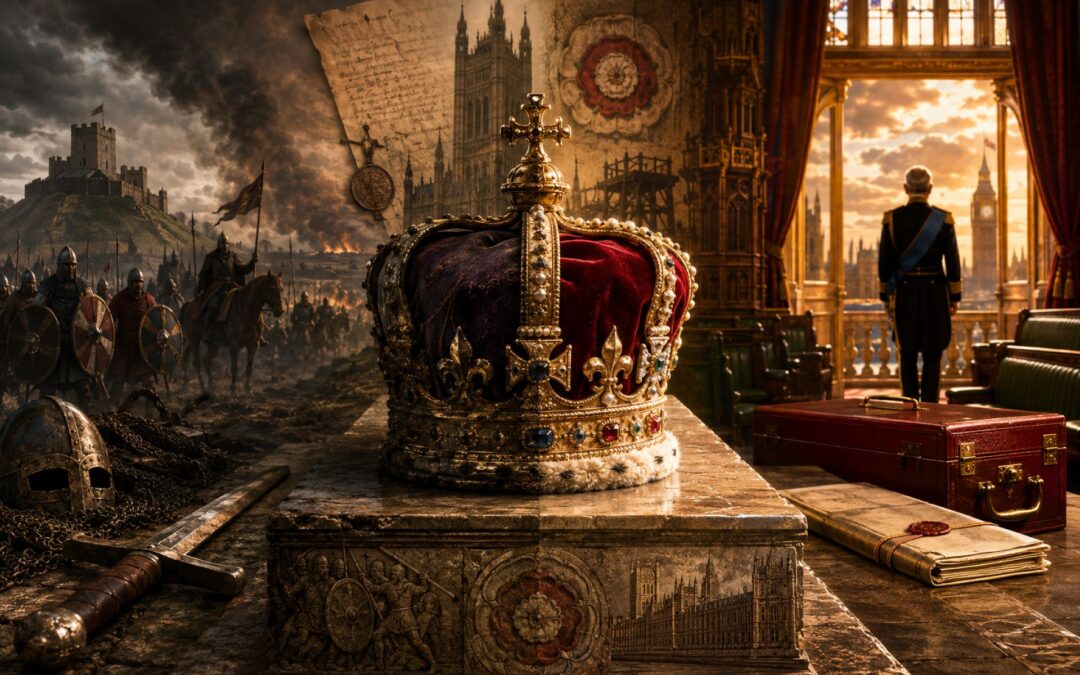
Britain still has a king, but not a ruler in the medieval sense.
King Charles III opens Parliament, receives ambassadors, appoints a prime minister, grants Royal Assent to legislation and performs ceremonies saturated with ancient symbolism. Yet he does not decide tax rates, choose government policy, command troops according to his personal wishes or dismiss ministers simply because he dislikes them.
That contrast is the central puzzle of the British monarchy.
The institution is more than a thousand years old. Its history contains conquest, civil war, religious revolution, imperial expansion, parliamentary rebellion, regicide, restoration, abdication and decolonization. The sweeping chronology of the British monarchy is crowded with famous personalities, but the deeper story is not simply who inherited the throne after whom.
It is the story of what the throne meant.
The kings of early England led armies, dispensed justice, raised revenue and treated government as an extension of their households. Modern monarchs occupy an office embedded within law, Parliament, ministerial responsibility and constitutional convention. The legal Crown remains woven through the machinery of the state, but most of its functions are exercised by elected ministers.
This change did not happen on one date. Magna Carta did not instantly create constitutional government. The execution of Charles I did not permanently abolish monarchy. The Revolution of 1688 did not complete democracy. Nor did the arrival of prime ministers immediately make kings politically irrelevant.
Royal power moved gradually into courts, councils, statutes, parliaments, cabinets, political parties and elections. The House of Commons Library’s constitutional history of the Crown describes a centuries-long decline in the monarch’s direct exercise of executive, legislative and judicial authority.
The monarchy survived that decline because it adapted to it.
This history begins before Britain existed as a state. It begins with separate kingdoms, contested borders and a form of kingship whose survival depended on the ability to fight.
Before England: Wessex, Vikings, and the Making of the Crown
In the early ninth century, there was no unified Kingdom of England.
The southern and eastern parts of Britain were divided among Anglo-Saxon kingdoms including Wessex, Mercia, Northumbria and East Anglia. Wales contained several independent kingdoms, while the lands that would become Scotland followed their own political development. Kingship was local, personal and intensely competitive.
Ecgberht of Wessex, who began ruling in 802, was an important figure in the rise of Wessex. Through warfare and shifting alliances, he broke Mercian dominance in southern England and extended his influence across several neighbouring kingdoms. Later chroniclers included him among the rulers sometimes described by the term bretwalda, suggesting unusually wide authority.
That did not make him the first king of England.
His power was neither uniformly administered nor permanently secure. Medieval overlordship often meant that weaker rulers acknowledged a stronger king without surrendering all local autonomy. Ecgberht’s significance lay less in creating a finished country than in establishing Wessex as the dynasty most capable of creating one.
His descendants soon faced a threat that transformed the politics of the island.
Scandinavian raiders had attacked Britain since the late eighth century, but raids gradually gave way to conquest and settlement. In the 860s, the force remembered as the Great Heathen Army invaded the Anglo-Saxon kingdoms. Northumbria and East Anglia fell. Mercia was divided and weakened. Wessex remained the principal surviving centre of independent Anglo-Saxon resistance.
Alfred became king of Wessex in 871, inheriting a realm under relentless pressure. His early campaigns were mixed, and in 878 he was driven into the Somerset marshes while the Danish king Guthrum appeared close to destroying Wessex.
Alfred recovered.
He gathered a new army and defeated Guthrum at Edington. The settlement that followed included Guthrum’s baptism and the recognition of political boundaries between Alfred’s kingdom and Scandinavian-controlled territory. The region later called the Danelaw lay principally across northern and eastern England, where Scandinavian settlement shaped law, language, trade and local identity.
Alfred did not conquer all England, nor did he single-handedly create the Danelaw. His achievement was survival combined with reconstruction.
He fortified towns, reorganized military service, encouraged learning and strengthened administration. He presented himself not merely as the ruler of Wessex but as the defender of the English who remained outside Scandinavian control. Kingship was beginning to acquire a wider territorial and cultural purpose.
The expansion continued under his children.
Edward the Elder pushed into territories held by Scandinavian rulers, while his sister Æthelflæd governed Mercia and led campaigns that brought strategically important towns under Anglo-Saxon control. Their efforts turned Alfred’s defensive kingdom into an expanding political system.
Edward’s son Æthelstan completed the decisive stage. After taking York in 927, he ruled a kingdom extending across most of what could now meaningfully be called England. He defeated a coalition of Scots, Britons and Vikings at the Battle of Brunanburh in 937 and used titles that expressed authority over the English as a people.
For that reason, Æthelstan is generally recognised as the first king of a unified England. The history of Viking England presented by English Heritage shows that this unification emerged from generations of resistance, conquest, settlement and incorporation rather than from the actions of one founder.
The new kingdom remained vulnerable.
Later kings struggled against renewed Scandinavian attacks. Æthelred II, remembered as “the Unready” from an Old English word suggesting poor counsel rather than lack of preparation, attempted both military resistance and large payments to invading armies. His order for the killing of Danes in the St Brice’s Day massacre of 1002 helped intensify the conflict with the Danish royal house.
In 1013, Sweyn Forkbeard forced Æthelred into exile. Sweyn died soon after, but his son Cnut returned and defeated Æthelred’s son Edmund Ironside. When Edmund died in 1016, Cnut became king of England.
Cnut ruled with unusual political intelligence. Rather than govern England as an occupied territory, he worked through English institutions, nobles and clergy. His later control of Denmark and Norway created what historians commonly call a North Sea empire. England briefly became part of a political world centred as much on Scandinavia as on western Europe.
That empire did not outlive his sons.
In 1042, the crown returned to the old English royal line under Edward the Confessor. Edward had spent much of his youth in Normandy and brought Norman connections into his court. He also oversaw the construction of Westminster Abbey, strengthening Westminster’s future importance as a royal and political centre.
But Edward had no child.
His death in January 1066 did more than create uncertainty over who should wear the crown. It exposed a deeper weakness in early medieval kingship: succession depended on blood, election, promises, elite support and military power, all at once.
Three men believed they could command enough of those things to become king.
Their struggle would transform England more radically than any succession before it.
1066 and the Norman Remaking of England
Harold Godwinson was crowned shortly after Edward the Confessor’s death.
He was the most powerful nobleman in England and the leading member of a family that dominated royal government. His accession was supported by the witan, the elite council whose acceptance helped establish a new king’s legitimacy.
Yet Harold’s claim was contested.
William, Duke of Normandy, maintained that Edward had promised him the throne and that Harold had sworn to support his succession. The evidence is disputed, and surviving accounts were shaped by the political needs of those who wrote them. William nevertheless presented his invasion as the enforcement of a lawful claim rather than a naked act of conquest.
A third claimant approached from the north. Harald Hardrada, king of Norway, invaded with the support of Harold Godwinson’s estranged brother Tostig.
Harold marched rapidly north and defeated them at Stamford Bridge on 25 September 1066. Both Hardrada and Tostig were killed. The victory ended the immediate Norwegian threat, but Harold’s exhausted army soon learned that William had landed in southern England.
The English king marched south again.
On 14 October, the two armies met near Hastings. Harold’s infantry formed a shield wall on high ground, while William deployed archers, infantry and cavalry. The battle lasted for much of the day. Norman forces eventually broke the English formation, and Harold was killed.
The exact manner of his death remains uncertain. The famous image of an arrow striking his eye may reflect later interpretation of the Bayeux Tapestry rather than a settled eyewitness account.
The consequence is not disputed.
William won the battle, secured the submission of London and was crowned at Westminster Abbey on Christmas Day. As the English Heritage history of the Norman Conquest makes clear, this was not merely the replacement of one king by another. It was the beginning of a far-reaching transformation in landholding, government, architecture, aristocratic culture and England’s relationship with continental Europe.
William ruled by conquest, and conquest had to be enforced.
Rebellions broke out across the country. Some involved surviving English nobles; others drew support from Wales, Scotland or Denmark. William answered them with castles, confiscations and the redistribution of land to Norman followers.
Motte-and-bailey fortifications appeared across England. They were military bases, administrative centres and physical declarations that the new ruling class intended to stay. Castles allowed relatively small groups of armed men to dominate strategic crossings, towns and unsettled regions.
Resistance in the north produced William’s most devastating response. During the Harrying of the North in 1069 and 1070, royal forces destroyed settlements, food stores and agricultural resources across parts of Yorkshire and neighbouring areas. Medieval accounts vary in detail, but the campaign was severe enough to leave a lasting memory of deliberate devastation.
By the end of William’s reign, the old English aristocracy had largely been displaced. Norman barons held the great estates. Norman bishops and abbots occupied senior church offices. French became the language of courtly and aristocratic life, while Latin remained central to religion and written administration.
English survived among the population and eventually absorbed enormous amounts of French vocabulary. The resulting linguistic hierarchy is explored more fully in how the Norman Conquest changed the English language.
The monarchy itself became more systematic.
William preserved many English institutions because they were useful. Shires, hundreds, sheriffs, royal writs and established systems of taxation gave the Norman king administrative tools that rulers elsewhere often lacked. He did not discard the machinery of the conquered kingdom. He placed it beneath a new elite and made it serve a more militarized crown.
The clearest expression of this administrative ambition was Domesday Book.
Commissioned in 1085 and completed the following year, Domesday was not a population census in the modern sense. It was a vast survey of landholding, resources, obligations, values and ownership. The National Archives guide to Domesday Book reveals the scale of the information collected and the royal government’s ability to investigate wealth throughout most of England.
Knowledge strengthened authority.
A king who knew who held the land, what it was worth and what obligations were attached to it possessed a formidable instrument of taxation and control.
William’s death in 1087 exposed the recurring danger of dividing dynastic possessions. Normandy went to his eldest son Robert, England to William Rufus, and money to Henry. William Rufus became deeply unpopular and died in a hunting accident in 1100. Henry moved quickly, took control of the treasury and had himself crowned before Robert could intervene.
Henry I proved an able administrator. He strengthened royal justice, relied on talented officials and developed financial procedures associated with the Exchequer. Yet his greatest political problem came from succession.
His only legitimate son, William Adelin, died in the White Ship disaster of 1120. Henry then required his barons to recognise his daughter Matilda as his heir.
They did not honour that promise after his death.
Henry’s nephew Stephen seized the crown in 1135, beginning the civil conflict known as the Anarchy. Matilda and her supporters fought to enforce her claim, while barons exploited the instability to strengthen local power and build unauthorized castles.
Neither side could secure a permanent victory.
The eventual settlement allowed Stephen to remain king while recognising Matilda’s son Henry as his successor. When Stephen died in 1154, Henry II inherited a crown weakened by civil war but supported by a growing tradition of centralized government.
The Normans had shown that a conqueror could use England’s institutions to create a stronger monarchy.
The Plantagenets would discover that the same institutions could also organize resistance to royal power.
The Plantagenets and the First Limits on Royal Power
Henry II inherited more than the Kingdom of England.
Through family inheritance and marriage to Eleanor of Aquitaine, he controlled territories stretching from the Scottish border deep into France. This collection of lands is often called the Angevin Empire, although it was not governed as a single unified state.
Henry’s most important work in England was administrative.
He restored royal control after the Anarchy, destroyed unauthorized castles and reclaimed rights lost under Stephen. He expanded the reach of royal justice by sending judges through the counties, developing standard legal procedures and encouraging litigants to seek remedies in the king’s courts.
This strengthened the crown, but it also helped create something larger than the king.
Common law emerged through the repeated decisions and procedures of royal judges. Justice became more regular, records more systematic and the authority of the central courts more extensive. The monarch remained the source of justice in theory, yet law was becoming an institution with its own procedures, officials and expectations.
Henry’s conflict with Thomas Becket revealed the limits of personal control.
Becket had served successfully as Henry’s chancellor before becoming Archbishop of Canterbury. Henry expected his former ally to help bring the Church under firmer royal authority. Instead, Becket defended ecclesiastical privileges, particularly the Church’s claim to discipline clergy through its own courts.
Their dispute became bitter and public.
In 1170, four knights who believed they were acting in the king’s interest murdered Becket in Canterbury Cathedral. Becket’s rapid transformation into a martyr turned the killing into a political disaster. Henry performed public penance, and the episode demonstrated that even a powerful monarch could not treat the Church as a simple department of royal government.
Henry’s sons repeatedly rebelled against him. Richard succeeded in 1189 and spent much of his reign campaigning abroad, particularly during the Third Crusade and in wars to defend his continental possessions.
Richard’s military reputation made him famous, but warfare was expensive. The kingdom was taxed to fund his campaigns and later to pay the ransom demanded after his capture on his return from crusade.
When Richard died in 1199, his brother John inherited a dangerous combination of debts, rival claims and continental enemies.
John lost Normandy and much of the Plantagenet inheritance in France. His attempts to finance recovery placed increasing pressure on English barons. He manipulated feudal obligations, demanded payments and administered justice in ways that appeared arbitrary to his opponents.
He also became embroiled in a dispute with Pope Innocent III over the appointment of the Archbishop of Canterbury. England was placed under interdict, John was excommunicated and the king eventually submitted to papal authority.
Military failure brought matters to a crisis.
After the collapse of John’s campaign in France in 1214, rebel barons occupied London and forced him to negotiate. At Runnymede in June 1215, the king accepted Magna Carta.
The charter was not a democratic constitution. It was created during an elite revolt and primarily protected the interests of barons, the Church, towns and other privileged groups. As the UK Parliament history of Magna Carta explains, it was a product of political crisis rather than a universal declaration of equality.
Its deeper importance lay in the principle it expressed: the king and his government were not entirely above law.
The original settlement quickly collapsed. John secured papal annulment, and civil war resumed. Yet John died in 1216, leaving the throne to his nine-year-old son Henry III. The young king’s guardians reissued revised versions of the charter to attract support away from the rebels.
Magna Carta survived because the monarchy found it useful.
By presenting the charter as a royal grant rather than a permanent humiliation, Henry’s government turned concession into legitimacy. Later kings repeatedly confirmed it. Over time, lawyers, parliamentarians and political reformers gave its clauses meanings far beyond the immediate intentions of the barons who first demanded them.
Henry III’s long reign brought new confrontations over money, foreign favourites and royal government.
The king’s costly ambitions in continental Europe and his reliance on unpopular advisers provoked demands for reform. In 1258, the Provisions of Oxford placed royal government under the supervision of a baronial council.
Conflict eventually developed into the Second Barons’ War, led by Simon de Montfort. Henry and his son Edward were captured at the Battle of Lewes in 1264. In January 1265, de Montfort summoned an assembly that included knights from the shires and representatives from selected towns alongside nobles and clergy.
This was not the first political council in English history, nor did it instantly establish modern representative democracy. It was, however, an important stage in the development of Parliament.
The institution grew out of the king’s need for advice, consent and taxation. Royal councils had long brought together leading nobles and churchmen. As government became more expensive and ambitious, monarchs increasingly summoned representatives who could speak for counties and towns.
Edward escaped captivity and defeated de Montfort at Evesham in 1265. When he succeeded as Edward I in 1272, he restored strong royal authority while continuing to use Parliament.
Edward was a formidable legislator and military ruler. His statutes clarified aspects of property, criminal law and administration. His conquest of Wales brought the principality under English domination and was reinforced by a network of castles.
His interventions in Scotland proved less permanent. After claiming feudal superiority and deposing John Balliol, Edward triggered resistance associated most famously with William Wallace and Robert Bruce.
War required money.
The need to fund campaigns encouraged broader assemblies in which representatives could consent to taxation. The Parliament of 1295, later called the Model Parliament, brought together clergy, nobles, knights and burgesses in a form that foreshadowed the later structure of Lords and Commons.
Parliament was still the king’s Parliament. It met when summoned, advised the monarch and responded to royal business. Yet taxation created leverage. A king who needed money had to hear grievances, negotiate and make concessions.
The long evolution of Parliament was therefore not simply a struggle between freedom and tyranny. Parliament developed inside monarchy before it became capable of restraining monarchy.
The Plantagenets had built stronger courts, more regular administration and a wider political community.
They had also created institutions through which resistance could become organized, recorded and legally expressed.
War, Plague, and the Crisis of Medieval Kingship
Edward II inherited a powerful monarchy in 1307, but he did not inherit his father’s authority over the political elite.
His intense attachment to favourites, first Piers Gaveston and later Hugh Despenser, alienated major nobles who believed that access to the king had been monopolized. Whether Edward’s relationships were romantic, sexual or primarily political remains debated. What mattered constitutionally was the distribution of patronage.
The king’s favourite received lands, offices and influence. Those excluded from favour saw their own power threatened.
Gaveston was exiled, recalled and eventually executed by a group of barons in 1312. Edward’s prestige suffered further after Robert Bruce destroyed the English army at Bannockburn in 1314, securing Scotland’s recovery from English domination.
Conflict with the nobility continued. Edward eventually defeated and executed Thomas of Lancaster, but dependence on the Despensers produced another coalition against him.
His wife Isabella, working with Roger Mortimer and supported by forces from the continent, invaded England in 1326. Edward’s regime collapsed with remarkable speed. Parliament formally accepted his removal, and his son became Edward III.
Deposition was no longer merely a military fact.
It was being expressed through political and legal arguments. A king could be removed because he had failed to fulfil the responsibilities of kingship.
Edward III restored the prestige of the crown through warfare.
His claim to the French throne helped begin the Hundred Years’ War in 1337. English victories at Crécy and Poitiers, aided by tactical discipline and the effective use of archers, made Edward’s armies feared across Europe.
War also transformed domestic government. Campaigns required taxation, and taxation required repeated consultation with Parliament. The Commons became increasingly important as representatives presented petitions and negotiated financial grants.
Then the Black Death reached England in 1348.
The epidemic killed an enormous proportion of the population. Exact numbers remain uncertain, but the demographic shock altered labour, landholding and social relations.
Workers became scarcer and could demand better wages. Landlords and government attempted to restrain those gains through measures such as the Ordinance and Statute of Labourers. The old assumptions of a society built around abundant dependent labour became harder to enforce.
The monarchy could legislate, but it could not restore the world that disease had destroyed.
Edward’s grandson Richard II inherited the crown in 1377 at the age of ten. Continued war with France and the need for revenue produced a series of poll taxes. The attempt to collect the tax of 1381 helped ignite the Peasants’ Revolt.
Rebels from southeastern England entered London, attacked symbols of royal and aristocratic government and demanded an end to serfdom and oppressive lordship. Richard met the rebels and helped persuade them to disperse, but the concessions offered during the crisis were withdrawn once royal authority recovered.
The revolt was crushed.
Its importance lay not in immediate victory but in what it revealed. The crown’s fiscal needs could provoke resistance far beyond the nobility. Political language was spreading through towns, villages, preaching networks and local communities.
Richard later attempted to rule with greater personal authority.
A group of nobles known as the Lords Appellant defeated his favourites and dominated the Merciless Parliament of 1388. Richard eventually recovered control and, from 1397, took revenge against his opponents. His later government used legal procedures, forced loans and loyalist assemblies to weaken opposition.
When John of Gaunt died in 1399, Richard confiscated the Lancastrian inheritance of Gaunt’s exiled son, Henry Bolingbroke.
That decision was fatal.
Henry returned while Richard was campaigning in Ireland. He initially presented himself as a man recovering his lawful inheritance, but support expanded rapidly. Richard was captured, compelled to renounce the throne and formally deposed.
Henry became Henry IV.
His hereditary claim was debatable, so he relied on conquest, parliamentary recognition and the argument that Richard had governed badly. The deposition again strengthened the idea that kingship involved obligations and that political institutions could declare those obligations broken.
Henry IV spent much of his reign suppressing rebellion. His son Henry V inherited a contested dynasty but united much of the political nation through military success.
The victory at Agincourt in 1415 gave Henry extraordinary prestige. The Treaty of Troyes later recognised him as heir to the French throne, apparently bringing the Lancastrian dream of a dual monarchy within reach.
Henry died in 1422.
His son Henry VI was only nine months old. He inherited the crowns of England and, by English claim, France, but government remained in the hands of senior nobles during his childhood. He was crowned king of England in 1429 and king of France in Paris in 1431.
The settlement did not last.
French resistance recovered, associated above all with Joan of Arc and the revival of Valois authority. England gradually lost almost all its French territories.
Henry VI lacked the political force required to manage competing aristocratic factions. Periods of serious mental incapacity made the problem worse, but his failures cannot be reduced to illness alone. The monarchy faced military defeat, financial weakness and noble families capable of maintaining armed followings.
In 1455, conflict between Lancastrian and Yorkist factions erupted into the series of wars later known as the Wars of the Roses.
The name suggests two neatly divided parties, but loyalties shifted repeatedly. The central question was who could control the king, and eventually who had the better right to replace him.
Edward of York became Edward IV after victory at Towton in 1461. Henry VI was deposed, briefly restored in 1470 and removed again after Edward returned from exile. Henry’s son died at Tewkesbury, and Henry himself died in the Tower of London shortly afterwards.
Edward IV restored a measure of stability, but his unexpected death in 1483 created another minority succession.
His son Edward V was placed under the protection of Edward IV’s brother Richard, Duke of Gloucester. The young king and his brother were lodged in the Tower of London. Their parents’ marriage was then declared invalid, making the boys legally illegitimate, and Richard was crowned Richard III.
The princes disappeared.
Richard’s responsibility for their fate has never been conclusively proved, but their disappearance damaged his legitimacy. Rebellion gathered around Henry Tudor, whose own hereditary claim was distant but whose supporters could present him as an alternative to a compromised king.
At Bosworth in 1485, Richard was killed and Henry took the crown.
Bosworth was the decisive dynastic turning point, although fighting connected with Yorkist resistance continued, most notably at Stoke in 1487. The deeper lesson of the later Middle Ages was already clear.
A king could possess sacred status, hereditary blood and formal coronation yet still be deposed if he lost control of the political nation.
Henry Tudor’s task was to prevent that from happening again.
The Tudors: Reformation, Dynasty, and the Strong Crown
Henry VII founded a new dynasty with a weak hereditary claim and a victory won on the battlefield.
He therefore devoted his reign to making Tudor rule appear lawful, stable and permanent. He dated his reign from the day before Bosworth, allowing him to treat those who had fought against him as traitors. He married Elizabeth of York, joining the rival dynastic traditions of Lancaster and York.
He also controlled the nobility carefully.
Rather than eliminate aristocratic power altogether, Henry limited the ability of magnates to maintain private armies and used bonds, recognizances and financial obligations to enforce loyalty. He improved royal revenue, cultivated trade and avoided expensive continental adventures when diplomacy could achieve his aims.
Pretenders still appeared.
Lambert Simnel was used by Yorkist supporters and was crowned in Ireland before his forces were defeated at Stoke. Perkin Warbeck later claimed to be Richard, Duke of York, one of the missing princes. Foreign rulers supported him at different times, but Henry eventually captured and executed him.
By the end of the reign, the crown was wealthier and the succession more secure.
Henry VIII inherited that stability in 1509. In his youth he appeared to embody Renaissance kingship: athletic, educated, musical, devout and magnificently visible.
He was also ambitious, extravagant and determined to secure a male heir.
His marriage to Catherine of Aragon produced one surviving child, Mary. By the 1520s, Henry feared that the absence of a son endangered the Tudor dynasty. He sought an annulment that would allow him to marry Anne Boleyn.
Pope Clement VII refused to grant the outcome Henry wanted. European power politics mattered: Catherine was the aunt of Emperor Charles V, whose armies had dominated Rome.
The king’s response transformed the constitution.
Henry’s break with Rome was driven by succession and personal authority, but it took place within the wider European Reformation. Criticism of clerical privilege, church wealth and papal authority was already spreading through print, scholarship and religious networks.
Crucially, Henry did not make the change through personal proclamation alone.
The Reformation Parliament passed a sequence of statutes restricting appeals to Rome, controlling church revenue and declaring the king supreme head of the Church of England. The parliamentary legislation behind the English Reformation simultaneously enlarged royal power and enlarged Parliament’s constitutional importance.
That was the great Tudor paradox.
Henry presented himself as an exceptionally powerful king, yet the religious revolution depended on statute. Crown and Parliament acted together to redefine the Church, succession and sovereignty.
Opposition was punished severely. Thomas More and John Fisher were executed for refusing to accept the royal supremacy. Monasteries were dissolved, their property transferred to the crown and much of it sold or granted to lay landowners.
This redistributed wealth and created a powerful class with a material interest in the new religious order.
Henry’s marriages followed the logic of succession. Anne Boleyn gave birth to Elizabeth but no surviving son and was executed after a politically managed trial. Jane Seymour gave birth to Edward and died soon afterwards. Later marriages reflected diplomacy, court faction and the continuing instability surrounding the dynasty.
When Henry died in 1547, the crown passed to Edward VI.
Edward was a committed Protestant, but he was only nine. Government was conducted through powerful councillors, first under the Duke of Somerset and later the Duke of Northumberland. Religious policy moved decisively away from Catholic doctrine through English services, new prayer books and attacks on traditional worship.
Edward’s early death in 1553 created another succession crisis.
Determined to preserve Protestantism, the regime attempted to exclude Edward’s Catholic half-sister Mary and place Lady Jane Grey on the throne. Jane possessed a dynastic connection through Henry VII but little broad political support.
Mary mobilized supporters and entered London as queen. Jane’s rule lasted only days. She was initially spared but was executed in 1554 after a rebellion made her continued existence politically dangerous.
Mary I restored papal authority and Catholic worship. Her persecution of Protestants, including the burning of hundreds for heresy, permanently shaped her later reputation. Yet her reign also demonstrated that a female monarch could exercise sovereign authority in her own right.
Her marriage to Philip of Spain raised fears that England would become subordinate to a foreign king. Parliament limited Philip’s position, and the marriage produced no heir.
When Mary died in 1558, Elizabeth succeeded.
Elizabeth I restored Protestant royal supremacy but avoided some of the most radical forms of reform. The Elizabethan religious settlement combined Protestant doctrine with an episcopal church and a liturgy that retained elements of older ceremony.
It did not end religious division. Catholics remained suspected of divided loyalty, especially after papal excommunication encouraged resistance to Elizabeth. Puritans believed the Church of England had not moved far enough from Rome.
Mary, Queen of Scots, became the focus of Catholic hopes. She was not held permanently in the Tower but moved among several guarded residences during years of English captivity. Evidence connecting her to plots against Elizabeth eventually led to her execution in 1587.
The following year, Philip II of Spain launched the Armada.
Religious rivalry mattered, but so did war in the Netherlands, English privateering and Elizabeth’s support for Spain’s enemies. The Armada failed through English resistance, logistical problems and severe weather. Victory strengthened Elizabeth’s image and the Protestant identity of the regime.
Her reign also saw cultural achievement, maritime expansion and the beginnings of English colonization. Yet the queen never married and produced no heir.
When she died in 1603, the crown passed to James VI of Scotland, the son of Mary, Queen of Scots.
The succession ended the Tudor dynasty and joined the English and Scottish crowns in the same person.
It did not yet create one British state.
The Stuarts and the Struggle Between King and Parliament
James VI of Scotland became James I of England in 1603.
He ruled both kingdoms, but England and Scotland retained separate parliaments, churches, laws and political institutions. This was a Union of the Crowns, not the political union later created in 1707.
James hoped to be recognised as king of a unified Great Britain, but political resistance prevented full integration. His reign nevertheless brought the crowns into a shared dynastic future.
Religion immediately complicated that future.
English Catholics hoped the new king would relax the restrictions imposed under Elizabeth. When those hopes faded, a small group of conspirators developed the Gunpowder Plot of 1605. Their plan to destroy the king and Parliament failed after the government received a warning and discovered Guy Fawkes guarding explosives beneath the Palace of Westminster.
The plot intensified anti-Catholic suspicion.
James also sponsored the translation published in 1611 as the King James Bible, one of the most influential works in the history of the English language.
His relationship with Parliament was uneasy but did not collapse into war. James believed kings received authority from God and resisted attempts to define the limits of royal prerogative. Parliament defended its privileges, especially over taxation and freedom of debate.
Compromise remained possible because both sides understood that government required cooperation.
That understanding broke down under Charles I.
Charles inherited the throne in 1625 and soon clashed with Parliament over war finance, taxation and the conduct of royal advisers. Parliament presented the Petition of Right in 1628, objecting to taxation without consent, arbitrary imprisonment, forced billeting and martial law.
Charles accepted the petition formally but resisted the constitutional interpretation Parliament placed upon it.
In 1629, he dissolved Parliament and began the period known as Personal Rule. For eleven years, he governed without summoning a new Parliament, relying on existing royal revenues and controversial fiscal devices.
Ship money became the most notorious. Traditionally associated with coastal defence, it was extended more widely and collected without parliamentary approval.
Religion deepened opposition.
Charles and Archbishop William Laud promoted ceremonial worship, episcopal authority and greater uniformity within the Church of England. To many Puritans, these policies looked like a return toward Catholicism.
The problem reached beyond England.
Attempts to impose a new prayer book in Scotland provoked resistance, leading to the Bishops’ Wars. Charles needed money to fight, and money required Parliament.
The Short Parliament of 1640 refused to grant supplies before addressing grievances and was quickly dissolved. Military failure forced Charles to summon another assembly. The Long Parliament attacked royal ministers, limited the king’s ability to dissolve Parliament and challenged the institutions of Personal Rule.
Neither side trusted the other.
The Irish Rebellion of 1641 intensified fear and raised the question of who should control the army. In January 1642, Charles entered the House of Commons to arrest five members. They had already escaped, but the episode made compromise far more difficult.
War began later that year.
The conflict cannot be reduced to a simple class struggle between aristocratic Cavaliers and middle-class Roundheads. Local loyalties, religious divisions, regional interests, constitutional principles and events in Scotland and Ireland all shaped allegiance. The constitutional and religious interpretations of the Civil Wars show why historians have described the upheaval as a rebellion, a revolution, a war of religion and part of the broader Wars of the Three Kingdoms.
The king possessed experienced officers and strong support in many areas. Parliament controlled London, important ports and substantial financial resources.
Early battles were inconclusive.
Parliament’s position strengthened through its alliance with the Scottish Covenanters and through military reorganization. The New Model Army, associated with Sir Thomas Fairfax and Oliver Cromwell, brought greater discipline and ideological commitment to the parliamentary cause.
Royalist defeat at Naseby in 1645 destroyed the king’s main field army.
Charles surrendered but continued negotiating with competing factions while seeking opportunities to restore his position. His secret dealings and the outbreak of a second civil war convinced army leaders that no stable settlement was possible while he remained king.
The army removed members of Parliament who favoured further negotiation. The remaining body created a special court and placed Charles on trial for treason.
Charles rejected its authority. He argued that no earthly court could judge a lawful king.
The court answered with a revolutionary principle: the king held office in trust for the people and could be held responsible for using power against them.
Charles I was executed outside the Banqueting House in Whitehall on 30 January 1649.
For the first time, the English monarchy was not merely limited or transferred to another dynasty.
It was abolished.
Republic, Restoration, and the Glorious Revolution
The execution of Charles I destroyed the person of the king, but it did not settle who should govern in his place.
The monarchy and House of Lords were abolished, and England was declared a Commonwealth. In theory, authority rested with the representatives remaining in the House of Commons. In practice, the army possessed decisive power.
The new regime also faced war across the three kingdoms.
Charles II, son of the executed king, was recognised in Scotland and attempted to recover his father’s crowns. Cromwell defeated royalist forces at Worcester in 1651, forcing Charles into exile.
Parliament then struggled to produce a lasting constitutional settlement.
Cromwell lost patience with the Rump Parliament and dissolved it by force in 1653. A written constitution, the Instrument of Government, created the Protectorate, with Cromwell as Lord Protector.
He was not formally king, but his office possessed many monarchical features. He headed the executive, worked with councils and parliaments, occupied former royal residences and was succeeded briefly by his son.
The Protectorate combined experiments in representative government with military authority and religious discipline. Some traditional celebrations and entertainments were restricted under Puritan influence, although the familiar claim that Cromwell personally “cancelled Christmas” oversimplifies legislation, local enforcement and the wider parliamentary regime.
The republic also pursued aggressive foreign and commercial policies.
Yet it could not solve the fundamental problem of legitimacy. Parliaments quarrelled with the Protector. Army officers distrusted civilian politicians. The regime depended heavily on Cromwell’s personal authority.
After his death in 1658, his son Richard could not maintain control.
In 1660, political and military leaders invited Charles II to return. The Restoration revived monarchy, the House of Lords and the established Church.
Charles understood that his father’s style of government could not simply be recreated.
He worked with Parliament more effectively, though conflicts remained over religion, finance and foreign policy. His court became associated with a rejection of Puritan austerity. Theatres reopened, cultural life flourished and royal ceremony returned.
The reign also endured disasters.
The Great Plague struck London in 1665, followed by the Great Fire in 1666. The fire destroyed much of the old city and enabled extensive rebuilding, but it did not end the plague simply by killing infected rats. The decline of the epidemic involved a more complex combination of disease patterns, human behaviour and environmental change.
Politics became more organized.
The Exclusion Crisis, driven by fears that Charles’s Catholic brother James would inherit the throne, helped shape the political groupings later known as Whigs and Tories. Charles defeated attempts to exclude James and ruled without Parliament during the final years of his reign.
When Charles died in 1685, James II succeeded peacefully.
James was openly Catholic in a country whose ruling institutions were overwhelmingly Protestant. Many politicians nevertheless accepted him because hereditary succession offered stability and his daughters Mary and Anne were Protestant.
The Monmouth Rebellion of 1685, led by an illegitimate son of Charles II, was defeated at Sedgemoor. The harsh punishments that followed in the Bloody Assizes damaged James’s reputation.
More serious opposition developed when the king attempted to suspend laws discriminating against Catholics and to place Catholic officers in institutions from which statute excluded them. Some of his policies could be defended as religious toleration, but his methods appeared to revive the claim that royal prerogative could override Parliament.
The birth of a son in 1688 changed the political calculation. A temporary Catholic reign might now become a Catholic dynasty.
A group of English political leaders invited William of Orange to intervene. William was a leading Protestant ruler, the husband of James’s daughter Mary and himself a grandson of Charles I.
William landed with a substantial army.
James’s support collapsed, and he fled to France. In England, the transfer of power involved relatively little fighting, which encouraged later descriptions of a bloodless Glorious Revolution. Across Scotland and Ireland, however, the struggle produced serious conflict.
Parliament declared that James had effectively abandoned the government. William and Mary accepted the crown under conditions that altered the constitutional balance.
The Bill of Rights of 1689 condemned suspending laws without parliamentary consent, taxation without parliamentary grant and the maintenance of a standing army in peacetime without approval. It affirmed parliamentary speech, petition and regular parliamentary institutions.
The settlement did not remove the monarch from politics. William remained deeply involved in foreign policy and war. The Crown still appointed ministers, influenced elections, distributed patronage and exercised extensive prerogative powers.
But monarchy was now unmistakably conditional.
The crown had been offered by Parliament, and succession was regulated by statute. The Act of Settlement later ensured a Protestant succession and strengthened judicial independence.
The seventeenth century had begun with kings who insisted that their authority came directly from God.
It ended with a monarchy whose title and powers had been defined by Parliament.
Great Britain, Cabinet Government, and the Hanoverian Crown
William III and Mary II had no surviving children. Mary died in 1694, leaving William to rule alone. After his death in 1702, the crown passed to Mary’s sister Anne.
Anne inherited separate English and Scottish states sharing one monarch. The arrangement had become unstable.
England feared that Scotland might choose a different successor. Scotland sought greater economic access and protection for its own institutions. Political bargaining, patronage and pressure produced the Acts of Union.
The legislation that united England and Scotland came into effect in 1707. The separate kingdoms became the Kingdom of Great Britain, governed through one Parliament at Westminster, while Scotland retained important features of its legal system, church and education.
This was a political union, unlike the personal union created in 1603.
Anne’s reign was also shaped by the War of the Spanish Succession. John Churchill, Duke of Marlborough, became one of Europe’s leading military commanders, winning major victories for the allied cause.
War encouraged the growth of public credit, financial institutions and party politics. Government depended increasingly on ministers capable of managing Parliament, taxation and national debt.
Anne endured numerous pregnancies but left no surviving heir.
Because the succession settlement excluded Catholics, the crown passed in 1714 to George, Elector of Hanover, a Protestant descendant of James I.
George I was not merely a foreign king who handed government to others because he could not speak English. He understood several languages and conducted political business through ministers. His limited popularity, continuing interests in Hanover and dependence on parliamentary majorities nevertheless accelerated existing changes.
The Jacobite rising of 1715 attempted to restore James Francis Edward Stuart, the Catholic son of James II. It failed, but Jacobitism remained a threat for another generation.
A financial crisis helped elevate Robert Walpole.
The South Sea Company had taken responsibility for part of the national debt and encouraged intense speculation in its shares. The bubble collapsed in 1720, damaging investors and political reputations.
Walpole helped stabilize the government and financial system. From 1721, he served as First Lord of the Treasury and Chancellor of the Exchequer, maintained support in the House of Commons and coordinated royal government through ministerial networks.
He is commonly called Britain’s first prime minister, although the office was not created by one statute or formally recognised in its modern form. Cabinet government developed through practice.
The monarch still mattered.
George I and George II chose ministers, managed patronage and influenced foreign policy. Yet a minister who could not maintain parliamentary support found governing increasingly difficult. Political authority was becoming triangular: monarch, ministers and Parliament.
George II’s reign saw the final major Jacobite challenge.
In 1745, Charles Edward Stuart landed in Scotland and gathered a Highland army. His forces advanced into England but received little of the expected support. They retreated and were defeated at Culloden in 1746.
The government responded with repression and measures designed to weaken the political and military structures that had supported the rising.
By the time George III inherited the throne in 1760, the Hanoverian dynasty was secure.
George III was born in Britain and wanted to recover greater personal influence over politics. He did not attempt to abolish Parliament, but he used patronage and ministerial appointments to shape government.
His reign coincided with immense imperial conflict.
Disputes over taxation, representation and sovereignty in the North American colonies developed into the constitutional crisis that became the American Revolution. Britain lost the thirteen colonies, but the defeat did not destroy either the empire or the monarchy.
The episode revealed how far government had moved beyond personal kingship. Colonial rebels attacked George III as a symbol of tyranny, yet many policies they resisted had been enacted through ministers and Parliament.
The king personified the state even when he did not independently control it.
George’s reign also witnessed the French Revolutionary and Napoleonic Wars. Britain faced invasion scares, financial pressure and political repression while fighting a conflict that eventually extended across Europe and the wider world. The complete military and geopolitical story belongs to the wider Napoleonic Wars, but their constitutional effect was also significant.
War strengthened the administrative state, expanded taxation and made ministers with parliamentary authority indispensable. Victory at Trafalgar secured naval dominance, while the final defeat of Napoleon at Waterloo helped establish Britain as the leading global power.
The kingdom itself changed again.
The Irish Rebellion of 1798 was suppressed, and the Acts of Union created the United Kingdom of Great Britain and Ireland in 1801.
George III also lived through the early Industrial Revolution. Mechanization, urbanization and new forms of work transformed British society. Protest emerged against both economic disruption and political exclusion.
The king’s recurring mental illness complicated government. Its medical cause remains disputed, and retrospective diagnoses should be treated cautiously. By 1811, his condition had become sufficiently severe for the Prince of Wales to govern as regent.
The prince became George IV in 1820.
His extravagance, marital scandal and political inconsistency damaged royal dignity. The monarchy remained influential, but ministers and Parliament increasingly determined policy. George reluctantly accepted Catholic emancipation in 1829 despite his personal opposition.
His brother William IV succeeded in 1830.
William involved himself in politics but could not reverse the direction of constitutional change. The crisis over parliamentary reform became the decisive issue of his reign.
Industrial cities such as Manchester and Birmingham had little direct representation, while tiny constituencies could still send members to Parliament. Reformers demanded a system better aligned with population and property.
The Reform Act of 1832 redistributed seats, abolished many small constituencies and expanded the electorate among the propertied middle class.
It was not universal democracy. Most working-class men and all women remained excluded.
Its constitutional significance lay in proving that the representative system could be changed under sustained public and political pressure. It also made it harder for the monarch or House of Lords to block a government supported by the Commons indefinitely.
William later dismissed Lord Melbourne and appointed Robert Peel, but Peel could not govern without a parliamentary majority. The king was compelled to recall Melbourne.
No subsequent British monarch would attempt to choose a government in open defiance of the elected House on comparable terms.
Royal power had not disappeared.
Its political freedom had narrowed dramatically.
Reform, Empire, and the Victorian Monarchy
Victoria became queen in 1837 at the age of eighteen.
She inherited a monarchy that still possessed influence but could no longer govern against Parliament for long. Her reign would demonstrate how royal authority could survive by changing form.
Victoria initially depended heavily on Lord Melbourne, her first prime minister. Her personal attachment to his Whig government contributed to the Bedchamber Crisis of 1839, when she resisted Robert Peel’s request to replace some ladies of the royal household connected with his political opponents.
The episode exposed the difficulty of separating the monarch’s private household from public politics.
Victoria gradually learned to operate more cautiously.
Her marriage to Prince Albert in 1840 gave the monarchy an energetic intellectual and organizational figure. Albert promoted science, education, design and industrial development. The Great Exhibition of 1851, housed in the Crystal Palace, presented Britain as the centre of a global industrial and imperial order.
The royal family also cultivated a new domestic image.
Victoria and Albert appeared not merely as rulers but as spouses and parents. Their family life was represented as a moral example for the expanding middle classes.
That image helped the monarchy adapt to a society transformed by industry, newspapers and public opinion.
Britain’s political system continued to democratize. The repeal of the Corn Laws in 1846 demonstrated the growing power of organized economic and political interests. Later reform acts expanded the male electorate, while movements such as Chartism pressed demands that had initially seemed radical.
The monarch retained the right to advise, encourage and warn ministers in private. Victoria corresponded extensively with political leaders and sometimes attempted to influence appointments and policy.
She did not merely “reign without influence.”
Yet influence was different from independent authority. Ministers required parliamentary support and bore public responsibility for government decisions. The queen could argue, delay and persuade, but she could not openly substitute her will for that of a durable parliamentary majority.
Her reign also became inseparable from empire.
British power expanded through trade, naval supremacy, settler colonization, conquest and commercial extraction. Victoria did not personally design every imperial policy, but the Crown supplied symbolism and legitimacy.
The Indian Rebellion of 1857 ended the East India Company’s direct rule. In 1858, authority transferred to the British government. Victoria later took the title Empress of India.
The royal proclamation associated with the transfer promised protection for religious practice and equal treatment under law, but imperial rule repeatedly failed to deliver equality. Colonial subjects invoked British promises while challenging discrimination, economic exploitation and political exclusion.
The monarchy therefore occupied a contradictory position.
It could present empire as a shared community under one sovereign while remaining the ceremonial summit of a deeply unequal system.
Britain’s greatest territorial extent came after Victoria’s death, but her reign established the monarchy’s enduring association with imperial expansion. Royal marriages and family connections also linked her to courts across Europe, earning her the description “Grandmother of Europe.”
Albert’s death in 1861 transformed Victoria’s public role.
She entered prolonged mourning and withdrew from many public appearances. Her seclusion provoked criticism at a time when republican ideas were gaining attention.
The monarchy’s survival could no longer be taken for granted merely because it was ancient.
Victoria eventually returned to greater public visibility. Jubilees, public ceremonies and imperial pageantry reconnected the Crown with popular life. Railways and mass newspapers allowed royal events to reach audiences on an unprecedented scale.
The monarchy was becoming theatrical in a constitutional sense.
Ceremony did not disguise the complete possession of power. It compensated for power that had moved elsewhere. The royal family represented historical continuity while elected politicians argued over policy.
Victoria died in 1901 after more than sixty-three years on the throne.
During her reign, Britain had industrialized, urbanized, expanded its electorate and become the centre of a global empire. The monarchy had ceased to be the government, yet it had become more visible as a national institution.
That transformation was not cosmetic.
It was a new basis for survival.
The House of Windsor Through War and Abdication
Edward VII succeeded his mother at the age of fifty-nine.
As Prince of Wales, he had spent decades carrying out ceremonial duties and cultivating social relationships across Europe. As king, he contributed to the developing practice of royal diplomacy, most famously through improved relations with France.
His reign also coincided with escalating political conflict at home.
The Liberal government’s People’s Budget proposed new taxation on wealth and land to finance social reforms. The House of Lords rejected it in 1909, provoking a constitutional crisis over the unelected chamber’s ability to block financial legislation supported by the Commons.
Edward died in 1910 before the crisis was resolved.
His son George V inherited the throne along with a rapidly changing political system. The Parliament Act of 1911 restricted the Lords’ veto and confirmed the primacy of the Commons in financial legislation.
Three years later, Europe went to war.
George V was related to several rulers on the opposing sides. Queen Victoria’s descendants occupied thrones across the continent, but family connections did not prevent national rivalry from producing catastrophe.
Britain entered the First World War in August 1914. Industrial warfare mobilized entire societies, and the monarchy had to demonstrate that it shared the nation’s burden.
George visited troops, hospitals, factories and military installations. The royal family reduced conspicuous displays of luxury and associated itself with service and sacrifice.
Its German dynastic identity became politically dangerous.
The royal house carried the name Saxe-Coburg and Gotha, inherited through Prince Albert. Anti-German feeling made that name untenable. In 1917, George renamed the dynasty the House of Windsor.
The creation of the House of Windsor was more than a rebranding exercise. It showed the monarchy abandoning a transnational dynastic identity in favour of a distinctly British national image.
Other European monarchies did not survive the war.
The German, Austro-Hungarian, Russian and Ottoman imperial systems collapsed. George’s cousin Nicholas II and the Russian imperial family were murdered after the Bolshevik Revolution.
Britain avoided comparable revolution partly because its monarchy was already constitutionally constrained. George did not stand above an absolutist state. He operated within parliamentary government and could engage with political forces that challenged the old social order.
The rise of the Labour Party tested that adaptability.
George worked with Labour ministers rather than treating socialism as inherently incompatible with monarchy. During the General Strike of 1926, he reportedly resisted language that reduced strikers to enemies of the state and encouraged a less confrontational tone.
The Statute of Westminster of 1931 recognised the legislative autonomy of dominions such as Canada and Australia. The Crown was becoming divisible: one monarch could occupy legally distinct roles in several self-governing states.
George’s death in 1936 brought a different kind of crisis.
Edward VIII was popular, glamorous and impatient with constitutional restraint. His determination to marry Wallis Simpson, an American whose second divorce was still proceeding, placed him in conflict with the government, the established Church and dominion ministers.
The issue was not simply social disapproval.
As king, Edward occupied a politically neutral constitutional office. If he rejected ministerial advice and attempted to impose his preferred marriage, the government could resign. The monarch would then be drawn directly into political conflict.
Edward chose abdication.
His reign lasted less than a year. In December 1936, Parliament enacted the abdication, and the crown passed to his brother Albert, who took the regnal name George VI.
The new king did not appear naturally suited to public performance. He suffered from a severe stammer and had not expected to inherit the throne. Yet those vulnerabilities eventually contributed to his public appeal.
George worked intensively with speech therapist Lionel Logue and gradually developed greater confidence. His role became indispensable as Europe moved toward another war.
He initially supported the government of Neville Chamberlain, as constitutional convention required. When Chamberlain resigned and Winston Churchill became prime minister in 1940, the king’s early doubts gave way to a close working relationship.
During the global conflict of World War II, George VI and Queen Elizabeth remained in Britain. Buckingham Palace was bombed, and the royal family accepted many of the restrictions imposed on the wider population.
The king visited military units, factories and bomb-damaged communities. These appearances were symbolic, but symbolism mattered during total war. The monarchy provided a visible language of endurance that stood apart from party politics.
Victory in 1945 brought celebration but not a restoration of Britain’s former power.
The country was financially exhausted. India and Pakistan became independent in 1947. Other colonies followed, and the British Empire was gradually transformed into a looser Commonwealth of independent states.
George adapted to the change by becoming Head of the Commonwealth.
His health deteriorated, and Princess Elizabeth increasingly carried out royal duties. He died on 6 February 1952.
The monarchy he left behind had survived dynastic reinvention, world war, abdication and the beginning of imperial retreat.
Its next challenge would be mass media.
Elizabeth II and the Reinvention of Royal Duty
Elizabeth II inherited the throne at the age of twenty-five.
Her accession came while she was visiting Kenya. Her coronation in June 1953 became the first British coronation broadcast fully on television, bringing an ancient religious ceremony into millions of homes.
The decision changed the relationship between monarchy and public.
Television allowed the royal family to appear immediate and intimate, but it also created expectations of access. The same medium that magnified ceremony could expose distance, error and family conflict.
Elizabeth began her reign with an extensive Commonwealth tour. She became the first reigning monarch to visit Australia and New Zealand and travelled more widely than any previous British sovereign.
These journeys reflected a changing institution.
The Commonwealth was not simply the British Empire under a more acceptable name. Its members were sovereign states with their own governments, interests and, in many cases, painful histories of colonial rule.
The monarch’s position also varied. Some states retained Elizabeth as head of state. Others became republics while remaining within the Commonwealth.
As Elizabeth II’s relationship with the changing Commonwealth developed, her role became primarily symbolic and diplomatic. She attended independence ceremonies, met political leaders and provided continuity within an organization whose membership expanded far beyond the old settler dominions.
Decolonization was not a royal gift.
It emerged from nationalist movements, anti-colonial struggle, changing international norms and Britain’s reduced capacity to maintain empire. Elizabeth’s contribution was to help the monarchy adjust to the disappearance of the imperial order from which much of its prestige had once come.
Her constitutional conduct at home was defined by restraint.
Early in the reign, the Conservative Party had no formal mechanism for electing a leader. When Anthony Eden resigned after the Suez Crisis, Elizabeth appointed Harold Macmillan after consulting senior political figures. When Macmillan retired, she appointed Alec Douglas-Home through a similarly opaque process.
The controversy encouraged the Conservative Party to adopt a formal leadership election system. The queen was removed from a decision that could compromise political neutrality.
This pattern characterized the modern monarchy.
When political actors developed procedures that reduced royal discretion, the Crown usually accepted them. The institution preserved authority by avoiding situations in which personal preference could be tested against democratic legitimacy.
Elizabeth retained constitutional rights and duties. She met prime ministers regularly, received government papers and offered private counsel. The content of those conversations remained confidential, allowing ministers to speak frankly without turning the monarch into a public political participant.
Her influence depended on privacy.
Publicly, she did not endorse parties, candidates or policies. That neutrality allowed governments of very different ideologies to serve in her name.
The monarchy’s international value also grew. State visits, ceremonial hospitality and long personal relationships with foreign leaders gave the queen a diplomatic role distinct from that of ministers whose tenure might be brief.
But greater visibility carried greater risk.
The royal family initially experimented with more informal media access, including televised family documentaries. Familiarity could humanize the monarchy, but it could also weaken the distance that protected its dignity.
The danger became unmistakable in the 1990s.
The marriages of several of the queen’s children broke down publicly. The separation of Charles and Diana attracted relentless tabloid attention. Competing interviews and biographies exposed allegations of infidelity, isolation and institutional coldness.
In 1992, Windsor Castle suffered a major fire, while family crises dominated the press. The queen called it her annus horribilis.
The greater crisis followed Diana’s death in Paris in 1997.
The queen remained at Balmoral with Princes William and Harry, attempting to protect the boys from public attention. Yet the silence from the royal family was interpreted by many as indifference.
Large crowds gathered in grief. Newspapers demanded a public response. The monarchy appeared unable to understand an emotional culture that had changed around it.
Elizabeth adapted.
She returned to London, addressed the country on television and paid public respect as Diana’s coffin passed Buckingham Palace. The episode demonstrated that constitutional correctness was no longer sufficient. The modern monarchy also had to respond to public emotion.
The institution continued to adjust.
Elizabeth opened the devolved Scottish Parliament and Welsh legislature, lending royal continuity to a changing territorial constitution. Royal communications moved from carefully controlled broadcasts to websites and social media. Ceremonies remained traditional, but the institution carrying them became more professionally managed and publicly accessible.
Jubilees revealed the depth of personal affection surrounding the queen. Her longevity connected generations who had experienced war, decolonization, economic transformation, European integration and withdrawal, and the digital revolution.
That affection was not identical to unconditional support for hereditary monarchy.
Elizabeth’s personal discipline helped contain arguments about the institution. She rarely gave interviews, avoided public political opinion and maintained an extraordinary consistency of conduct.
Her husband, Prince Philip, played a central supporting role for more than seven decades. His death in 2021 occurred during pandemic restrictions, and the image of the queen sitting alone at his funeral became one of the most powerful moments of her final years.
Elizabeth celebrated her Platinum Jubilee in 2022.
She died at Balmoral on 8 September that year, aged ninety-six.
Her reign did not restore political power to the crown. It accomplished something more useful to the institution: it made political restraint appear as duty rather than weakness.
Charles III and the Constitutional Crown Today
Charles III became king immediately upon the death of Elizabeth II.
His coronation took place at Westminster Abbey on 6 May 2023, preserving a ritual with medieval roots. Yet the office he occupies is governed less by ceremony than by constitutional limits accumulated across centuries.
The modern British monarch remains head of state.
The king appoints a prime minister, opens Parliament, grants Royal Assent, receives ambassadors, hosts state visits and performs duties connected with the armed forces and the established Church of England. He also serves as Head of the Commonwealth, a position distinct from the Crown and not automatically hereditary in law.
These functions sound powerful because they are expressed in the language of kingship.
In practice, most are exercised according to established convention and ministerial advice. The prime minister appointed is the person able to command the confidence of the House of Commons. Royal Assent is granted to legislation passed through the parliamentary process. Government decisions taken under prerogative authority are normally made by ministers who answer to Parliament.
The monarch possesses formal authority without independent political choice over its routine use.
The distinction is essential to understanding the modern constitutional role of the monarch. The king is not irrelevant, but neither is he a rival executive waiting to intervene when he dislikes an elected government.
He retains the right to be informed, to advise and to warn in private. Experience, access to official papers and regular audiences with the prime minister can give those conversations value.
Their legitimacy depends on confidentiality and neutrality.
Charles entered the throne with a long record of public advocacy on architecture, environmental protection, sustainable agriculture and interfaith relations. As Prince of Wales, he had greater freedom to promote causes and express views.
Kingship required a narrower public role.
The institution’s own description of the monarch’s constitutional and representational duties emphasizes service, continuity, diplomacy, recognition of achievement and support for voluntary organizations. These are not substitutes for government. They are the sphere in which a politically neutral crown can operate without competing with elected authority.
The monarchy also remains larger than one person.
It is a family, a household, a collection of public offices, a legal idea and a system of ceremony. Each dimension creates both resilience and risk. Family disputes can damage the institution. Questions about wealth, privilege, historical responsibility and public funding can become constitutional debates. Social attitudes toward deference and inheritance continue to change.
The monarchy cannot answer those pressures by recovering medieval power.
It can survive only through the strategy that preserved it after 1688, after parliamentary reform, after empire and after the transformation of mass media: accepting limits before conflict makes those limits unavoidable.
The British monarch once personally led armies, selected taxes, dispensed justice and treated political loyalty as obedience to an individual ruler. Over time, each of those powers moved into institutions capable of surviving the death, weakness or unpopularity of a king.
Courts claimed authority from law. Parliament claimed control over taxation and legislation. Ministers took responsibility for administration. Political parties organized government. Elections supplied democratic legitimacy. Conventions separated the monarch’s formal powers from personal preference.
No single settlement completed the process.
Magna Carta announced that kingship could be bounded by law, but medieval monarchs remained powerful. Parliament developed as an instrument of royal government before it became a check upon the crown. The execution of Charles I proved that a king could be held responsible, but the republic failed to establish lasting legitimacy. The Revolution of 1688 made monarchy conditional, but later sovereigns still exercised extensive political influence. Cabinet government reduced that influence, while electoral reform transferred legitimacy toward the Commons. Victoria showed that the loss of executive authority could be exchanged for public symbolism. The Windsors learned that symbolism itself had to adapt to war, nationalism, decolonization and media scrutiny.
The crown did not survive because it remained unchanged.
It survived because it repeatedly surrendered the forms of power that had become impossible to defend.
That surrender was neither smooth nor voluntary in every generation. It was extracted through rebellion, statute, military defeat, political embarrassment and public pressure. Yet the institution proved unusually capable of turning concession into continuity.
The British monarchy no longer governs the country.
Its historical achievement is that it learned how to remain part of the state after governing power had passed elsewhere.
Last Updated on July 23, 2026 by Aseem Gupta