
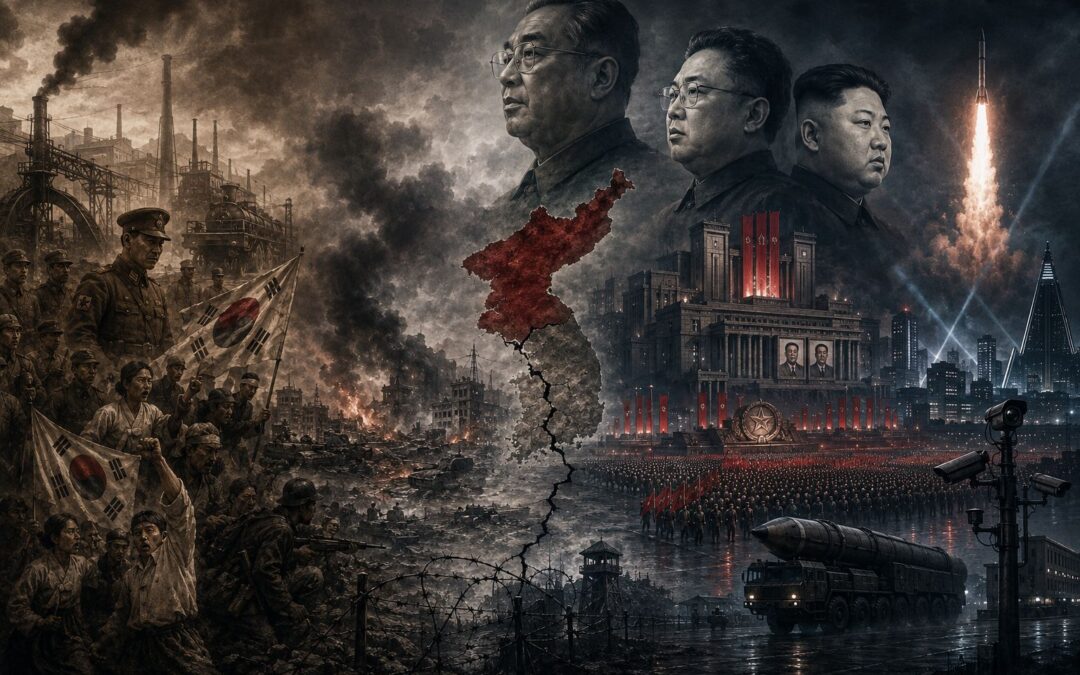
When Kim Jong Il died in December 2011, television footage from North Korea showed crowds collapsing in grief. Men and women sobbed in streets and public squares. Some clutched one another for support. Others beat the frozen ground with their hands as the funeral procession passed through Pyongyang.
To outside observers, the scenes raised an uncomfortable question. Were North Koreans genuinely mourning their leader, or were they performing grief because failing to do so might attract suspicion?
The most honest answer is that both were possible—and often inseparable.
Some people had spent their entire lives being taught that the Kim family had liberated Korea, protected it from foreign enemies and cared for every citizen as a parent would care for a child. Others knew that indifference could be dangerous. Many probably experienced a complicated mixture of fear, loyalty, habit, nationalism, social pressure and sincere emotion.
That ambiguity lies at the heart of North Korea.
The country is frequently described through its most visible absurdities: military parades, monumental statues, theatrical propaganda, nuclear threats and the almost sacred status of its rulers. Yet North Korea is not simply an irrational dictatorship frozen in another era. It is the product of Japanese colonialism, Korean nationalism, foreign occupation, civil war, economic planning, political purges, famine, market adaptation and a ruling family that learned how to change its methods without surrendering power.
The Kim dynasty did not preserve itself by relying on ideology alone. It fused ideology with coercion, class privilege, historical trauma, control over food and employment, foreign patronage, military brinkmanship and ultimately nuclear deterrence.
Its greatest achievement has not been prosperity, equality or self-reliance.
It has been survival.
From Japanese Occupation to the Division of Korea
North Korea’s history did not begin with communism, nor did Korea possess an ancient political division between north and south. The state emerged from a sequence of disruptions that began with Japanese colonial rule and culminated in the hurried partition of the peninsula after the Second World War.
The violence of occupation produced both Korean nationalism and revolutionary movements. The defeat of Japan then created a political vacuum that foreign powers filled before Koreans could agree on a government of their own.
Colonial Rule and Korean Resistance
Japan gradually established control over Korea after defeating China in 1895 and Russia in 1905. Korea became a Japanese protectorate and was formally annexed in 1910.
Colonial authorities presented Japanese rule as a programme of modernisation. Railways, mines, factories, schools and communications networks expanded. Industrial output increased, particularly in the northern half of the peninsula, where hydroelectric power and heavy industry developed.
But modernisation served an imperial order.
Japanese officials controlled political life, suppressed Korean organisations and discriminated against the colonised population. Land policies displaced many farmers. Industrial wealth flowed disproportionately towards Japanese companies and settlers. Korean language, identity and historical memory came under increasing pressure, especially during the later years of colonial rule.
Resistance never disappeared.
The March First Movement of 1919 brought mass demonstrations demanding independence. Japanese authorities suppressed the uprising violently, but the protests helped internationalise the Korean cause and encouraged the formation of exile organisations, nationalist groups and revolutionary movements.
Communism became one strand of that resistance. After the Russian Revolution, Marxism-Leninism appealed to anti-colonial activists because it promised not only national independence but the destruction of imperialism, landlordism and class hierarchy.
Kim Il Sung emerged from this revolutionary environment.
Born in 1912 near Pyongyang, he spent much of his youth in Manchuria, where his family had moved during the colonial period. He joined communist organisations and became involved in armed resistance against Japan. His later propaganda would turn him into the central hero of Korean liberation, exaggerating his victories and minimising the contributions of other resistance groups.
Even so, Kim was not an invented figure. He did command guerrilla units associated with Chinese communist forces and gained a genuine reputation through operations against Japanese targets. The 1937 raid on Pochonbo, though militarily small, became especially important to his political legend because it demonstrated that armed Korean resistance remained possible.
Japanese counter-insurgency campaigns eventually forced Kim and many surviving fighters across the Soviet border. He joined a Soviet military unit composed partly of Korean and Chinese guerrillas and spent much of the Second World War in the Soviet Far East.
This period gave him revolutionary credentials, military experience and a relationship with the power that would soon occupy northern Korea.
The 38th Parallel and Two Occupation Zones
Japan’s surrender in August 1945 ended thirty-five years of colonial rule, but liberation did not bring immediate Korean sovereignty.
Soviet forces entered Korea from the north while the United States prepared to accept the Japanese surrender in the south. American officials Dean Rusk and Charles Bonesteel were instructed to propose a dividing line that would prevent the Soviet Union from occupying the entire peninsula while keeping Seoul within the American zone.
They selected the 38th parallel.
The line had no established political or cultural significance. It cut through a country whose regional differences had never amounted to a modern north-south national division. Both occupation zones were initially presented as temporary arrangements pending the creation of a unified government.
Instead, the emerging rivalry between the Soviet Union and the United States turned the temporary boundary into a political frontier.
In the north, Soviet authorities worked with Korean communists, local people’s committees and returning exiles. In the south, the United States established a military government and relied heavily on existing administrative structures, including officials who had served under Japanese rule.
Political polarisation intensified. Left-wing groups were strong across the peninsula, but anti-communists, nationalists, conservatives and returning exile leaders also competed for authority. Each occupation power favoured organisations it considered reliable and suppressed groups it viewed as hostile.
The division of Korea thus became part of the wider struggle that would define the emerging Cold War. What began as an improvised military arrangement hardened into two rival state-building projects, each claiming the right to govern the entire peninsula.
Kim Il Sung and the Birth of the North Korean State
Kim Il Sung did not return to Korea as the country’s inevitable leader. He was one communist figure among several, and many of his rivals possessed stronger party organisations, deeper intellectual credentials or more extensive political networks.
His rise depended on Soviet support, but it also depended on his ability to present himself as a Korean revolutionary rather than merely a foreign-backed administrator.
Over the next several years, Kim assembled a coalition, adopted popular reforms, built military institutions and gradually positioned himself above rival communist factions.
Soviet Support and Kim’s Political Rise
Kim returned to northern Korea in 1945 under Soviet protection. At first, he was not widely known among the general population. Soviet officials promoted him publicly as a young anti-Japanese hero and helped him secure leading roles within the emerging communist establishment.
The relationship was decisive. Soviet forces controlled the occupation zone, supervised security institutions and supplied the political and military resources from which the new state developed. The Soviet political and military support behind North Korea’s formation gave Kim opportunities that would otherwise have been unavailable.
But the description of Kim as a simple Soviet puppet is inadequate.
He possessed his own guerrilla network and a recognisable nationalist biography. He also understood the factional landscape better than many outsiders. The Soviet Union could elevate him, but it could not automatically make every Korean communist accept his leadership.
The communist movement included several distinct groups. Kim’s own associates were former anti-Japanese guerrillas. The Soviet-Korean faction consisted of ethnic Koreans who had grown up or served in the Soviet Union. The Yan’an faction drew its strength from Koreans connected to the Chinese Communist Party. A fourth group consisted of communists from southern Korea, many organised around Pak Hon-yong.
These factions shared broad ideological commitments but disagreed over strategy, foreign alignment, personal power and the future structure of the Korean state.
Kim initially governed through compromise. He accepted powerful figures from rival groups into the party and cabinet while ensuring that the security services and military increasingly depended on men loyal to him.
Land Reform, Nationalisation, and Party Control
The northern government moved quickly to transform the economy and social order.
Land reform in March 1946 confiscated property from Japanese owners, collaborators and large landlords. Much of the land was redistributed to tenant farmers and poor peasants. The reform weakened the traditional landed elite and created a rural constituency with reasons to support the new system.
Banks, major industries, transport networks and communications infrastructure were nationalised. The government introduced economic planning and expanded state direction over production. Labour laws formalised the eight-hour working day and promised new protections. Legislation on gender equality improved women’s formal rights in marriage, inheritance, employment and political participation.
These changes were not merely propaganda. For many poor Koreans, especially those who had suffered under colonial landlords or Japanese industrial management, the new order offered real opportunities.
At the same time, reform strengthened the state.
Property redistribution eliminated independent centres of economic power. Nationalisation made employment and production increasingly dependent on public institutions. Political organisations were consolidated under communist leadership, while opponents fled, were marginalised or were arrested.
The Workers’ Party of North Korea emerged from the merger of communist organisations. Kim gradually placed trusted guerrilla associates in critical positions, particularly within the security services and the armed forces.
The Korean People’s Army was formally established in 1948, drawing on guerrilla veterans, Soviet-trained personnel and Koreans who had fought with Chinese communist forces. The Soviet Union supplied tanks, artillery, aircraft and training. By the end of the 1940s, the North possessed a much stronger conventional military than the South.
State-building and preparation for conflict were becoming inseparable.
The DPRK and the Road to War
Efforts to create a unified Korean government failed as Soviet-American relations deteriorated.
The United Nations supervised elections in the southern zone in 1948 after Soviet authorities refused to permit UN access to the north. The Republic of Korea was established in Seoul under President Syngman Rhee in August.
North Korea responded by proclaiming the Democratic People’s Republic of Korea on 9 September 1948, with Kim Il Sung as premier.
Both governments claimed sovereignty over the entire peninsula. Neither regarded the division as legitimate or permanent. Border clashes, raids and political violence became increasingly common.
Kim believed that reunification could be achieved through force. The North possessed a better-equipped army, while the South had no comparable armoured force and depended on a relatively weak security apparatus. Most American combat troops withdrew from South Korea in 1949.
Yet Kim could not launch a major invasion without foreign approval and assistance. He repeatedly pressed Joseph Stalin to support an attack. Stalin initially hesitated, fearing direct confrontation with the United States. His position shifted after the Soviet Union tested an atomic bomb, the Chinese Communists won their civil war and American signals appeared to place Korea outside Washington’s primary defensive perimeter.
Kim eventually secured Soviet approval. Mao Zedong also supported the effort, although both allies expected North Korea to win quickly.
That expectation would prove catastrophic.
The Korean War and the Creation of Permanent Siege
The Korean War was the defining event in North Korea’s history.
It destroyed the physical foundations of the new state, killed or displaced millions across the peninsula and transformed the division of Korea into a permanent military confrontation. It also created a reservoir of fear and memory that the North Korean regime would use for generations.
The state’s later insistence that the country remained surrounded by enemies was propaganda, but it was propaganda built on the experience of an actual war that had devastated nearly every community.
Invasion and International Intervention
On 25 June 1950, North Korean forces crossed the 38th parallel.
The invasion was not a spontaneous border escalation. It was a planned attempt to destroy the South Korean government and reunify the peninsula under Kim Il Sung’s rule.
The opening offensive was overwhelming. North Korea possessed Soviet tanks, artillery and aircraft that South Korean forces could not match. Seoul fell within days, and southern military units disintegrated or retreated towards the south-east.
The advance was accompanied by political violence. North Korean forces and local collaborators targeted officials, police officers, landowners, religious figures and anti-communist activists. The South Korean government also carried out mass killings of suspected leftists as it retreated.
The United Nations condemned the invasion and authorised military assistance to South Korea. The Soviet Union was boycotting the Security Council at the time and therefore did not use its veto. The United States supplied most of the forces and placed the coalition under General Douglas MacArthur.
By August, South Korean and UN forces had been pushed into a defensive perimeter around Busan. North Korea appeared close to victory.
The war changed direction in September when UN troops landed at Incheon, far behind North Korean lines. The operation cut supply routes and forced the Korean People’s Army into a rapid retreat.
Seoul was recaptured. UN forces then crossed the 38th parallel and advanced towards the Chinese border. Pyongyang fell, Kim’s government fled north and the North Korean army appeared to be collapsing.
A war that Kim had expected to finish quickly now threatened the destruction of his state.
Bombing, Chinese Intervention, and Stalemate
Air power became one of the most destructive features of the conflict.
After gaining control of the skies, the United States conducted an extensive bombing campaign against North Korean cities, transport links, factories, power facilities, dams and military positions. Urban centres were repeatedly attacked, and enormous damage was inflicted on civilian as well as military infrastructure.
Exact measurements vary. Estimates of the proportion of buildings destroyed, the tonnage of explosives dropped and the number of civilians killed depend on definitions and incomplete wartime records. What is not in dispute is the scale of devastation.
The bombing became central to North Korean historical memory. State propaganda would later manipulate and simplify that memory, but the trauma itself was real. For readers seeking the wider moral argument, the destruction forms part of the controversy surrounding the American bombing of North Korea.
The advance of UN forces towards the Yalu River brought China into the war. Beijing had warned that it would not accept hostile troops approaching its border. In October 1950, Chinese forces entered Korea in large numbers and launched surprise attacks.
The intervention drove UN forces south. Pyongyang was recaptured, and Seoul fell again before communist forces were pushed back. By the middle of 1951, the front had stabilised near the original dividing line.
The war then became a grinding contest of trenches, fortified hills, artillery and limited offensives. Neither side could achieve a decisive breakthrough without accepting the risk of wider escalation.
For Kim Il Sung, Chinese intervention saved North Korea but diminished his independence. Chinese troops bore much of the burden of continuing the war, while both Beijing and Moscow criticised North Korean military failures.
The experience reinforced several lessons that would shape the state: foreign allies were necessary but could not be trusted completely; military weakness invited destruction; and the survival of the regime required permanent preparation for war.
The Armistice That Never Became Peace
Negotiations began in 1951 but continued for two years, largely because of disputes over prisoners of war and the location of the ceasefire line.
On 27 July 1953, military commanders signed the agreement that stopped the fighting without ending the conflict.
The armistice established a ceasefire and created the Demilitarised Zone. It did not constitute a peace treaty, recognise a permanent political settlement or resolve which government represented Korea.
South Korean President Syngman Rhee refused to sign, although his government observed the ceasefire. North Korea, China and the United Nations Command became parties to the military arrangement.
The peninsula remained divided.
For North Korea, the war was simultaneously presented as a victory and remembered as a catastrophe. Propaganda claimed that Kim Il Sung had defeated American imperialism. In reality, the invasion had failed, the country had been physically shattered and reunification remained as distant as before.
Yet the unfinished war became politically useful.
The regime could portray every sacrifice as necessary because peace had never truly arrived. Military mobilisation, ideological discipline and the suppression of dissent could all be justified as responses to an enduring national emergency.
How Kim Il Sung Eliminated Every Alternative
The Korean War left Kim Il Sung politically vulnerable.
He had launched an invasion that failed to reunify Korea, underestimated South Korean resistance and required Chinese intervention to save his government. Rather than accept responsibility, Kim turned defeat into an opportunity to destroy his rivals.
The postwar years transformed North Korea from a factional communist state into a personal dictatorship.
Postwar Scapegoats and Political Purges
Kim blamed other communist factions for the failures of the war.
Pak Hon-yong became one of the most prominent targets. As leader of the southern communist faction, Pak had reportedly predicted that a North Korean invasion would inspire a mass uprising in the South. That uprising did not occur.
Pak was removed as foreign minister, arrested and accused of spying for the United States. After a show trial, he was executed. Other southern communists were imprisoned, purged or killed.
The Soviet-Korean faction also came under pressure. Ho Ka-i, an influential Soviet-Korean official, lost his positions and died in circumstances officially described as suicide.
These purges served several purposes. They redirected anger away from Kim, eliminated people who possessed independent political networks and opened senior positions for his guerrilla associates.
The process was gradual enough to avoid uniting every rival against him. Kim attacked factions selectively while maintaining temporary alliances with others.
By the middle of the 1950s, he was stronger than any individual opponent, but organised resistance had not yet disappeared.
The August Faction Incident
The death of Stalin in 1953 created an unexpected challenge for leader-centred dictatorships across the communist world.
In 1956, Soviet leader Nikita Khrushchev denounced Stalin’s personality cult and arbitrary violence. The speech encouraged criticism of similar practices in other socialist states.
While Kim Il Sung was travelling abroad, members of the Soviet-Korean and Yan’an factions prepared to challenge him at a Workers’ Party meeting. They criticised the personality cult, economic priorities, political repression and favouritism towards Kim’s guerrilla associates.
The challenge failed.
Kim’s opponents misjudged their support within the party. Their speeches were interrupted, and the leadership mobilised loyalists against them. Several critics fled to China; others were dismissed or arrested.
Moscow and Beijing attempted to intervene, urging Kim to reverse the expulsions and moderate the purges. Their efforts temporarily slowed the repression but could not restore the opposition’s power.
The archival record of the failed 1956 challenge to Kim Il Sung shows how close the Soviet Union and China came to restraining him—and how decisively they failed.
Kim subsequently dismantled the remaining factions. Officials associated with foreign communist movements were removed, imprisoned or executed. By the end of the decade, no organised group inside the party could challenge him.
The state still depended on Soviet and Chinese aid, but its internal politics no longer reflected meaningful power-sharing.
Kim had eliminated every alternative centre of authority.
Juche and the Leader-Centred State
Kim’s consolidation required more than repression. It required an ideology that could explain why his leadership was necessary and why North Korea should not be subordinated to Moscow or Beijing.
That ideology became known as Juche.
The term is often translated as self-reliance, but its meaning was broader and changed over time. It included political independence, ideological autonomy, economic development and military self-defence. It insisted that Korean conditions, rather than foreign formulas, should determine the country’s path.
In practice, North Korea never achieved economic self-sufficiency. It relied on Soviet and Chinese fuel, machinery, credit, technology and military equipment. The importance of North Korea’s model of economic and political self-reliance lay less in literal isolation than in its claim that the state should avoid dependence on any single external power.
Juche also served Kim personally.
If North Korea embodied an independent national revolution, and Kim embodied that revolution, loyalty to the country became inseparable from loyalty to him. Criticism of the leader could therefore be portrayed not as ordinary political disagreement but as betrayal of the nation.
The personality cult expanded through portraits, monuments, biographies, songs, films, schools and workplace rituals. Kim was no longer merely the head of government. He became the Great Leader, the source of political wisdom and the paternal protector of the Korean people.
Official history placed him at the centre of anti-Japanese resistance, liberation, state-building, wartime survival and reconstruction. Other revolutionaries were reduced to supporting figures or erased.
This leader-centred system eventually made hereditary succession possible. The dynasty did not arise despite Juche and communist ideology. It arose because the state had been taught to understand the revolution through one man and his family.
Social Control, Songbun, and the North Korean Citizen
Kim Il Sung’s dictatorship was not sustained only through speeches, executions or military power.
It was embedded in the structure of ordinary life.
The state classified families, assigned employment, controlled movement, monopolised legal political activity and maintained institutions capable of punishing not only individuals but their relatives. Education, propaganda and public rituals taught citizens how to behave, while surveillance encouraged them to monitor one another.
This did not produce a society in which everyone believed the same thing. It produced a society in which belief, compliance and survival were difficult to separate.
Songbun and Inherited Political Status
North Korea developed a system of political classification commonly known as songbun.
Citizens and families were assessed partly through their social background and presumed political loyalty. Revolutionary fighters, workers, poor peasants and families of soldiers could receive favourable classifications. Former landlords, religious figures, collaborators, people associated with the South and relatives of defectors could be treated as politically unreliable.
The categories were often described broadly as core, wavering and hostile, though their application changed over time and was never as mechanically uniform as the state suggested.
Songbun affected access to opportunity. A favourable background could help determine whether someone lived in Pyongyang, attended an elite university, joined the party, entered a prestigious profession or received better housing and food.
A poor classification could limit education, employment, residence and social advancement. Because political status was inherited, the alleged actions of parents or grandparents could shape a person’s future.
The system was not entirely fixed. Bribery, personal connections, military service, party loyalty and economic influence could alter outcomes. Markets later created forms of wealth that did not always correspond neatly with official political rank.
Even so, songbun turned political history into social structure. The state did not merely punish opponents; it attempted to prevent the emergence of future opposition by restricting entire family networks.
Surveillance, Prisons, and Collective Punishment
North Korea developed multiple forms of detention.
Ordinary criminal and re-education facilities subjected prisoners to forced labour, ideological instruction and severe discipline. Political prison camps isolated people accused of disloyalty, espionage, religious activity, attempted escape or association with condemned families.
The United Nations investigation into North Korea’s system of repression documented torture, starvation, sexual violence, forced labour, arbitrary detention, enforced disappearance and execution. It concluded that crimes against humanity had been committed through policies operating at the highest level of the state.
Collective punishment amplified fear. Relatives of an accused person could lose employment, housing or educational opportunities. In severe cases, family members could also be detained.
Neighbourhood units monitored households and organised meetings. Workplaces tracked attendance and ideological performance. Travel between regions required permission. Informal informant networks made private conversation dangerous.
The system never achieved perfect control. Black markets, bribery, smuggling and personal connections created spaces in which rules could be evaded.
But perfect control was unnecessary.
The regime needed citizens to believe that punishment was possible, that information could reach the authorities and that no reliable institution existed to protect them once accused.
Propaganda, Education, and Performed Loyalty
Education combined conventional subjects with ideological instruction.
North Korean children learned literacy, mathematics, science and practical skills, but they also studied revolutionary history and the achievements of the Kim family. The state framed the leader not merely as a politician but as the benevolent source of national security and social provision.
Portraits of Kim Il Sung and later Kim Jong Il became mandatory in homes and public buildings. Citizens participated in commemorations, study sessions, criticism meetings and carefully organised celebrations.
Propaganda claimed that North Korea had overcome the social problems of capitalist countries. Public life was expected to display unity, discipline and gratitude.
Reality was more complicated.
People could repeat official slogans without believing them. They could criticise local conditions while remaining loyal to the state. They could despise officials yet admire Kim Il Sung as a symbol of national liberation. They could feel genuine grief while understanding that grief was expected.
Public mourning therefore cannot be interpreted through a simple choice between sincerity and coercion.
In a society where political identity, family history, education, livelihood and national survival had been tied to the leader for decades, emotion itself became politically structured.
Reconstruction, Growth, and the Roots of Economic Decline
North Korea is often imagined as a country that has always been economically ruined.
That is inaccurate.
During the decades after the Korean War, the North rebuilt rapidly and for a time compared favourably with the South in industrial capacity, infrastructure and social provision. The state expanded education, healthcare, housing and urban employment while reconstructing factories and power systems destroyed during the conflict.
Those achievements were real.
So were the structural problems hidden beneath them.
Rebuilding After the War
The war left North Korea’s cities and industry devastated. Reconstruction required enormous investment, labour mobilisation and foreign assistance.
The Soviet Union, China and other socialist states provided machinery, fuel, credit, engineers and technical support. Central planning directed resources towards steel, coal, chemicals, electricity, transport and heavy manufacturing.
The government launched multi-year plans with ambitious production targets. Collective farms replaced most independent agriculture, and industry became almost entirely state-owned.
Reconstruction achieved visible results. Factories reopened. Housing expanded. Electricity and public services reached large parts of the population. Schools and universities grew, and the state promoted literacy and technical education. Public healthcare and vaccination programmes improved some health outcomes.
For citizens who remembered Japanese rule and wartime destruction, these improvements could strengthen genuine support for the government.
North Korea also inherited advantages. Much of colonial Korea’s heavy industry and hydroelectric capacity had been located in the north. The South remained poorer, more agricultural and politically unstable during the 1950s.
Early comparisons between the two Koreas are difficult because North Korean figures were opaque and later estimates rely on reconstruction. Nonetheless, the North was not obviously destined to become the poorer state.
Chollima and the Distortion of Central Planning
Kim Il Sung attempted to accelerate development through mass mobilisation.
The Chollima Movement, named after a mythical flying horse, encouraged workers and factories to exceed production targets. Propaganda celebrated heroic labour, competition between work teams and extraordinary feats of output.
Kim’s factory and farm visits became central to political culture. “On-the-spot guidance” portrayed the leader as someone whose personal insight could solve technical and administrative problems.
Mobilisation could generate short bursts of production, especially during reconstruction. It also created perverse incentives.
Officials were judged by whether they met targets. Failure could bring humiliation, dismissal or punishment. Managers therefore had strong reasons to exaggerate output, conceal shortages and transfer problems to the next stage of production.
Quantity was prioritised over quality. Factories could meet numerical targets by producing unusable goods. Agricultural reports could overstate harvests, leading the state to collect more grain than communities could afford to surrender.
Fear prevented accurate information from travelling upwards. By the time national leaders received economic reports, local distortions had often accumulated into a false picture of success.
The state responded to poor results by demanding greater ideological commitment rather than questioning the plan itself. Workers were blamed for insufficient enthusiasm. Managers were accused of laziness or sabotage.
Militarisation further strained the system. North Korea sought large armed forces and an extensive defence industry while continuing to invest in heavy manufacturing. Military development promised security, but it diverted resources from food, consumer goods and technological renewal.
The economy could produce impressive factories and weapons while ordinary families still lacked reliable housing, clothing or nutrition.
Debt, Stagnation, and Falling Behind the South
North Korea attempted to improve productivity by importing modern equipment from Japan and Western Europe.
The policy initially gave the country access to machinery superior to some Soviet alternatives. But many purchases were made on credit, and the new plants did not generate enough export revenue to repay the debts.
By the 1970s, North Korea began defaulting on foreign obligations. Access to further credit narrowed.
The global oil shocks increased the cost of imports, while the limitations of central planning became harder to conceal. Industrial equipment aged. Productivity slowed. Agricultural constraints persisted.
Prestige projects continued. Monumental architecture, ceremonial sites and ambitious construction demonstrated the regime’s priorities but could not compensate for technological stagnation.
Meanwhile, South Korea transformed.
Its authoritarian governments pursued export-oriented industrialisation, foreign investment, global trade and technological acquisition. By the 1970s and 1980s, the South was overtaking the North in income, manufacturing sophistication and international influence.
The widening gap posed an ideological problem for Pyongyang. The North had claimed that socialism would produce greater prosperity and national independence. Instead, the supposedly dependent South was becoming richer and more technologically advanced.
North Korea stopped publishing much of its detailed economic data. Propaganda preserved the image of success even as the country became increasingly dependent on Soviet fuel, trade and subsidies.
This dependence did not make North Korea a passive extension of Moscow. Kim continued balancing the Soviet Union and China, using their rivalry to preserve room for manoeuvre.
But the contradiction at the centre of Juche was becoming impossible to ignore: the state that celebrated self-reliance could not sustain its economic system without external support.
Provocation Abroad and Succession at Home
Economic stagnation did not make North Korea passive.
The regime repeatedly used limited military confrontation, infiltration, abduction and terrorism to intimidate its enemies, gather intelligence, disrupt South Korea and reinforce its revolutionary image.
At home, Kim Il Sung was preparing a different kind of political operation: the transformation of his personal dictatorship into a hereditary dynasty.
The Second Korean War
From 1966 to 1969, violence along the Demilitarised Zone increased sharply.
North Korean infiltrators crossed into the South, attacked patrols and attempted to build revolutionary networks. Kim appears to have believed that South Korean society remained vulnerable and that sustained pressure might encourage political upheaval.
The most dramatic operation was the 1968 Blue House raid, in which a North Korean commando unit attempted to assassinate South Korean President Park Chung Hee. The attackers reached Seoul before being intercepted near the presidential residence.
Days later, North Korea seized the American intelligence vessel USS Pueblo. One crew member was killed, and the surviving sailors were detained for almost a year.
These events created a genuine risk of wider war. The United States was already deeply committed in Vietnam and sought to avoid another major conflict in Asia. The Soviet Union and China also had reasons to restrain Pyongyang.
The archival history of the undeclared Second Korean War suggests that external aggression was connected to internal ideology and factional politics. Provocation allowed Kim to demonstrate militancy, justify mobilisation and position North Korea as the authentic revolutionary state on the peninsula.
The campaign failed to produce an uprising in the South. It did, however, establish a pattern that would recur: North Korea could create a crisis, inflict limited damage and then step back before provoking a war it could not win.
Later incidents followed the same logic.
In 1976, North Korean soldiers killed two American officers during a confrontation over a tree in the Joint Security Area. The United States responded with Operation Paul Bunyan, deploying an overwhelming force to protect another tree-cutting operation.
North Korea did not intervene.
The episode demonstrated both the danger and the limits of Pyongyang’s brinkmanship. The regime was willing to escalate symbolically, but it also understood when the balance of force required retreat.
Abduction and Terrorism Abroad
North Korea’s foreign operations extended beyond the Korean border.
Agents abducted Japanese citizens and other foreign nationals, some of whom were used to teach language, customs and identity to intelligence operatives. Pyongyang later admitted to a limited number of Japanese abductions, although families and investigators believe the true number may have been higher.
Kim Jong Il’s interest in film produced one of the regime’s most unusual operations. South Korean actress Choi Eun-hee and director Shin Sang-ok were abducted and taken to North Korea, where they were compelled to make films for the state before escaping during a trip to Europe.
Other operations were far deadlier.
In 1983, North Korean agents bombed a mausoleum in Rangoon during a visit by South Korean President Chun Doo-hwan. The president survived because his arrival was delayed, but senior South Korean officials and Burmese civilians were killed.
In 1987, Korean Air Flight 858 exploded over the Andaman Sea, killing all 115 people aboard. A captured North Korean operative, Kim Hyon-hui, confessed to participating in the bombing and described her training and indoctrination.
The operation demonstrated how the regime used terrorism to weaken South Korea and disrupt its international standing before the 1988 Seoul Olympics. The full personal and operational account belongs in the story of Kim Hyon-hui, rather than being repeated here.
Such attacks damaged North Korea diplomatically, but they also served internal purposes. They reinforced the image of an active revolutionary state, elevated intelligence institutions and demonstrated Kim Jong Il’s role in national security.
Turning Revolution Into a Dynasty
Kim Jong Il’s rise was gradual.
He entered the Workers’ Party apparatus in the 1960s and developed influence through propaganda, cultural administration and organisational work. His involvement in film was not merely a private interest. Cinema was one of the regime’s most important tools for teaching history, loyalty and revolutionary virtue.
By the 1970s, Kim Jong Il was being prepared as successor. He gained positions within the party, supervised ideological campaigns and accumulated relationships across the security and propaganda institutions.
Hereditary succession contradicted the formal egalitarian language of communism. North Korea resolved that contradiction by presenting the Kim family as uniquely connected to the revolution.
Kim Il Sung was the founding father. Kim Jong Il became the guardian who would preserve his father’s work. The leader’s bloodline was transformed into a source of political legitimacy.
By the 1980s, Kim Jong Il’s image appeared alongside his father’s. Citizens were taught that continuity of leadership was necessary to protect the country from foreign enemies and internal decay.
When Kim Il Sung died in July 1994, the scale of public mourning reflected the political world he had built. He had ruled for nearly half a century. For many citizens, the state, the revolution and the leader had never existed separately.
Kim was named Eternal President after his death. His embalmed body remained on display, and the political system continued to operate in his name.
Kim Jong Il inherited not only a country but a sacred family role.
He also inherited an approaching disaster.
Kim Jong Il, Famine, and the Rise of the Market
Kim Jong Il came to power as North Korea’s economic foundations were collapsing.
The Soviet Union had disappeared. Preferential trade and fuel supplies were ending. Industrial equipment was deteriorating, agriculture remained fragile and the state’s distribution system depended on resources it could no longer obtain.
Natural disasters intensified the crisis, but the famine of the 1990s was not simply the result of bad weather. It emerged from decades of structural weakness, political rigidity and the regime’s refusal to acknowledge failure.
North Korea survived, but its society changed permanently.
The Arduous March
The collapse of the Soviet bloc removed North Korea’s most important economic support.
Trade increasingly had to occur at world prices. Fuel imports fell, reducing electricity generation, transport and fertiliser production. Factories stopped operating, and machinery became difficult to maintain.
Agriculture was already vulnerable. Much of North Korea is mountainous, leaving limited land suitable for cultivation. Farming depended heavily on fertiliser, fuel, irrigation and machinery supplied through the state.
Flooding in the mid-1990s damaged crops and infrastructure. Drought followed. The public distribution system, which had allocated food through workplaces and residential units, began to fail.
People starved.
Families travelled illegally in search of food. Workers stopped reporting to factories that could no longer pay or feed them. Children were abandoned or orphaned. People sold possessions, foraged, stole, crossed into China and turned to unofficial trade.
The government called the period the Arduous March, invoking revolutionary hardship rather than admitting institutional collapse.
Reliable mortality figures do not exist. The state concealed information, and outside access was limited. Demographic research into the famine’s death toll has produced estimates ranging from several hundred thousand deaths to substantially higher figures, depending on assumptions and methodology.
The uncertainty should not obscure the central fact: the famine was a mass human catastrophe.
Natural disaster triggered the final crisis, but policy shaped its severity. The leadership maintained political restrictions, protected military priorities, delayed transparent cooperation and continued controlling movement while the distribution system collapsed.
International food aid eventually reduced the suffering, although monitoring remained difficult and access was restricted.
The famine damaged the regime’s promise that the state would provide for every citizen. Yet it did not destroy the political system.
Instead, North Koreans began building another economy beneath it.
Markets From Below
Unofficial trade had existed before the famine, but the crisis made it essential.
Families sold food, clothing, household goods and imported products in informal markets. Traders crossed regional boundaries and developed relationships with smugglers along the Chinese border.
Women became especially important to this economy. Men were often formally tied to state workplaces even when those workplaces produced little or no income. Women had greater room to trade, manage household survival and operate market stalls.
Over time, markets evolved from emergency exchange into a central feature of daily life.
The state’s position was contradictory. Officials condemned private trade as anti-socialist but depended on it to keep people alive. Local authorities collected fees and bribes. Party members, soldiers and security officials participated in market networks.
In 2002, the government announced economic measures that adjusted official prices and wages and gave some enterprises greater flexibility. Foreign observers initially interpreted the changes as the beginning of Chinese-style reform.
They were more limited than that. The measures acknowledged activities already occurring outside the plan but did not establish secure private property or independent economic rights.
The Kaesong Industrial Complex represented another controlled experiment. South Korean companies employed North Korean workers at a site north of the DMZ, providing Pyongyang with foreign currency while offering southern firms relatively inexpensive labour.
The regime remained suspicious of market influence.
Its most damaging intervention came in 2009, when the government revalued the won and restricted how much old currency people could exchange. The policy wiped out savings accumulated by traders and attempted to weaken the market class.
Instead, it produced inflation, shortages, anger and confusion. The government eventually retreated and blamed officials for the failure.
The episode revealed a limit on state power. Pyongyang could arrest traders, close markets or confiscate wealth, but it could no longer restore a fully planned economy without threatening the survival of the population and the stability of the regime itself.
Markets did not democratise North Korea.
They did create new inequalities, bribery networks and private fortunes. They also gave families sources of food and income not entirely dependent on official distribution.
The regime adapted by tolerating, regulating and exploiting activity it could not eliminate.
Songun and Nuclear Bargaining
Kim Jong Il placed the military at the centre of political life through Songun, or military-first politics.
The armed forces received priority in prestige, resources and propaganda. Soldiers were portrayed as the guardians of the revolution and the model for national discipline.
Songun helped Kim Jong Il consolidate authority because the military was one of the few institutions still capable of functioning during the famine. It also reinforced the argument that scarcity was the price of national defence.
Nuclear weapons became increasingly important to this strategy.
North Korea had pursued nuclear technology for decades. International concern intensified when inspectors identified inconsistencies in its declarations and Pyongyang threatened to withdraw from the Nuclear Non-Proliferation Treaty.
The resulting crisis produced the 1994 Agreed Framework, under which North Korea was to freeze important parts of its nuclear programme in exchange for energy assistance and alternative reactors.
The agreement weakened over time. Mutual distrust, implementation delays and disputes over undeclared activity undermined cooperation. The long sequence of nuclear agreements, inspections, withdrawals and tests shows that the programme developed through repeated cycles of negotiation and confrontation rather than one uninterrupted path.
North Korea conducted its first acknowledged nuclear test in 2006.
Negotiations resumed through the Six-Party Talks involving North Korea, South Korea, the United States, China, Japan and Russia. Pyongyang agreed to steps towards disabling facilities in exchange for aid and diplomatic concessions.
The process again collapsed.
For North Korea, the nuclear programme served several purposes. It provided bargaining leverage, raised the cost of foreign intervention, compensated for conventional military weakness and reinforced domestic claims that the leadership was defending the nation.
Nuclear development did not feed the population or repair the economy.
It did make the regime harder to threaten.
Kim Jong Un and the Modernisation of Dictatorship
Kim Jong Il died in December 2011 and was succeeded by his youngest son, Kim Jong Un.
The new leader was young, inexperienced and largely unknown to the public. Unlike his grandfather, he possessed no revolutionary biography. Unlike his father, he had not spent decades building relationships across the party and security apparatus.
His vulnerability made rapid consolidation essential.
Kim Jong Un responded by removing potential rivals, strengthening party institutions, continuing nuclear development and presenting himself as a more energetic, visible and modern leader.
A Young Leader Consolidates Power
Kim Jong Un had spent part of his childhood in Switzerland, where he encountered foreign culture and developed an interest in basketball. He returned to North Korea and studied at institutions connected to the political and military elite.
He was not initially the obvious successor. His older half-brother Kim Jong Nam had once been considered a possible heir but fell from favour.
After Kim Jong Il suffered a stroke in 2008, succession planning accelerated. Kim Jong Un received senior military titles and appeared beside his father at public events.
When power arrived, he acted decisively.
The party regained some institutional prominence after the military-centred years of Kim Jong Il. Senior officials were frequently promoted, demoted or removed, preventing the formation of secure independent networks.
Kim’s uncle Jang Song Thaek was the most important early casualty. Jang possessed decades of experience, relationships with China and influence over economic and security institutions.
In 2013, he was arrested during a party meeting, accused of treason and executed.
The purge demonstrated that family ties provided no protection against the supreme leader. It also allowed Kim to restructure elite networks and warn officials that their positions depended entirely on his approval.
In 2017, Kim Jong Nam was assassinated at Kuala Lumpur International Airport with VX nerve agent. Malaysian investigators concluded that North Korean operatives had recruited two women to carry out the attack under the pretence of participating in a prank.
Kim Jong Nam had lived largely outside the country and occasionally criticised hereditary succession. His killing demonstrated that the dynasty defended itself beyond North Korea’s borders.
By removing powerful relatives, rotating officials and controlling access to patronage, Kim Jong Un established himself as more than a symbolic heir.
He became the undisputed centre of the regime.
Controlled Consumerism and Cultural Repression
Kim Jong Un adopted a different public style from his father.
He appeared frequently with his wife, Ri Sol Ju. State media showed him visiting amusement parks, apartment developments, ski resorts, factories, farms and consumer facilities. Pyongyang acquired new towers, restaurants and leisure spaces intended to project modernity.
The regime tolerated a limited consumer culture for trusted urban groups. Mobile phone use expanded within a controlled domestic network. Markets continued operating, and wealthy traders and officials displayed levels of consumption unavailable to most citizens.
Kim’s interest in basketball produced the unusual spectacle of former NBA player Dennis Rodman visiting Pyongyang. Such events helped present the leader as confident and internationally recognisable.
Yet the cultural opening had strict boundaries.
North Koreans could consume selected modern products, but they could not freely access the ideas associated with them. Foreign films, South Korean television, K-pop, outside news and unrestricted internet access were treated as political threats.
The state developed a domestic intranet and limited telecommunications system while preserving control over external information. New laws targeted foreign media, South Korean expressions and cultural behaviour considered anti-socialist.
International reporting on the tightening of control over foreign information indicates that severe punishments continued under Kim Jong Un.
The logic was clear.
The regime understood that consumer goods could strengthen legitimacy if presented as achievements of the leader. Uncontrolled information was more dangerous because it allowed citizens to compare official claims with life elsewhere—especially in South Korea.
Kim Jong Un therefore modernised the appearance of the state while reinforcing its ideological boundaries.
Modernisation was not liberalisation.
Everyday Life, Inequality, and Food Insecurity
The daily life of a North Korean citizen cannot be reduced to political parades or prison camps.
People work, trade, study, marry, raise children, care for relatives and pursue friendships. They worry about food, housing, income, status and family obligations.
Politics is ever-present, but it is not necessarily the subject occupying every private moment.
Conditions vary enormously.
Pyongyang receives preferential investment and is home to many politically trusted families, officials, professionals and successful traders. Residents may have access to restaurants, department stores, mobile phones and improved housing.
Rural communities face greater hardship. Electricity, transport, medical supplies and running water remain unreliable in many areas. Agricultural work is physically demanding, and state procurement can leave farming communities vulnerable.
Markets provide food and income, but wealth increasingly determines access. Bribes can help people avoid punishment, travel, secure better work or obtain medical treatment. Those without money or political connections remain exposed.
The World Food Programme’s assessment of North Korea’s continuing food and nutrition crisis describes chronic undernourishment and child stunting, while the country’s limited transparency makes precise measurement difficult.
Tourism offered the regime a source of foreign currency and a controlled means of presenting the country. Visitors were accompanied by guides and shown approved sites. Their encounters revealed genuine curiosity and hospitality, but the experience was tightly managed.
The detention of American student Otto Warmbier demonstrated the risks. Accused of attempting to remove a propaganda poster, he was sentenced to fifteen years of hard labour. He returned to the United States in a severely neurologically impaired condition and died shortly afterwards.
For North Koreans, leaving the country was far more difficult.
The DMZ was heavily fortified, making direct escape to the South extremely dangerous. Many defectors crossed into China, where they faced repatriation if discovered. Those returned to North Korea risked imprisonment, forced labour and severe punishment.
COVID-19 enabled the government to impose even tighter border controls. Trade fell, travel was restricted and the already limited flow of information narrowed further.
The pandemic did not create North Korea’s isolation.
It allowed the state to deepen it.
Nuclear Power, Cyber Operations, and North Korea’s New Geopolitics
North Korea entered the twenty-first century with a weak economy, ageing conventional forces and few dependable partners.
It nevertheless developed tools capable of influencing countries far more powerful than itself.
Nuclear weapons increased the potential cost of military intervention. Ballistic missiles extended the range of deterrence. Cyber operations enabled intelligence collection, disruption and theft beyond physical borders.
The war in Ukraine then gave North Korea a new form of strategic value. Russia needed weapons, ammunition and manpower. Pyongyang could provide them in exchange for money, diplomatic support and possible technological assistance.
The regime was no longer merely surviving isolation.
It was learning to profit from a more divided world.
Nuclear Weapons as Regime Insurance
Under Kim Jong Un, nuclear weapons moved from experimental capability towards the centre of national strategy.
North Korea conducted additional nuclear tests and developed increasingly capable ballistic missiles. Satellite launches allowed it to test technologies related to long-range rocketry, while official statements presented nuclear weapons as permanent guarantees of sovereignty.
The regime’s strategic reasoning is not difficult to understand.
North Korean leaders observed the fate of governments in Iraq and Libya. Both had faced American hostility; neither possessed a reliable nuclear deterrent when foreign intervention destroyed the existing leadership.
From Pyongyang’s perspective, surrendering its nuclear programme without an enforceable security transformation could expose the dynasty to the same fate.
That does not make its threats harmless or its proliferation acceptable. Nuclear weapons allow the state to intimidate neighbours, raise regional tensions and conduct provocations beneath a protective shield.
Diplomacy briefly created hope for change.
In 2018, Kim Jong Un met South Korean President Moon Jae-in and later U.S. President Donald Trump. The Singapore summit produced broad commitments to a new relationship and denuclearisation of the Korean Peninsula.
The language concealed fundamental disagreement.
The United States expected substantial nuclear disarmament before lifting major sanctions. North Korea sought sanctions relief and security concessions while giving up its arsenal gradually, if at all.
A second summit in Hanoi ended without agreement. Subsequent negotiations collapsed.
North Korea resumed weapons development and increasingly described itself as an irreversible nuclear state.
Its arsenal does not solve food shortages, electricity problems or technological isolation.
It does something the regime values more urgently: it makes foreign-imposed leadership change extraordinarily dangerous.
Cybercrime and Asymmetric Power
Cyber operations give North Korea capabilities that geography and economic weakness would otherwise deny it.
The state trains technically talented students and places selected specialists inside military and intelligence organisations. Operatives can work from North Korea or from networks abroad, making attribution and enforcement difficult.
The Sony Pictures breach in 2014 brought global attention to the threat. Hackers stole emails, private data and unreleased films after the studio produced The Interview, a comedy about an assassination plot against Kim Jong Un.
North Korean-linked groups were also accused of involvement in the Bangladesh Bank theft and the WannaCry ransomware attack. The state-linked cyber operations associated with Sony, WannaCry and Bangladesh Bank illustrate the range of objectives involved.
Cyber activity can steal foreign currency, obtain military information, disrupt infrastructure and evade sanctions. Cryptocurrency theft has become especially valuable because digital assets can be moved and laundered across jurisdictions.
This strategy reflects a wider pattern.
North Korea cannot compete with the United States, South Korea or Japan across every domain. It therefore invests in areas where relatively limited resources can produce disproportionate effects: nuclear weapons, missiles, special operations and cyber capabilities.
These tools do not make North Korea economically strong.
They make it strategically difficult to ignore.
Russia, Two Hostile States, and the 2026 Order
Russia’s invasion of Ukraine transformed North Korea’s geopolitical position.
For years, Pyongyang had depended mainly on China for trade and diplomatic protection. Russia remained a useful partner but lacked the central role once played by the Soviet Union.
The war changed Moscow’s needs.
Russia required artillery ammunition, missiles, military supplies and eventually additional personnel. North Korea possessed large stockpiles, compatible weapons systems and a willingness to support a fellow opponent of the United States.
Kim Jong Un met Vladimir Putin in 2023, signalling the deepening relationship. In June 2024, the two governments signed the Comprehensive Strategic Partnership Treaty, which included a mutual-assistance commitment in the event of armed aggression.
The expanding military relationship between North Korea and Russia subsequently included large-scale transfers of munitions and missiles as well as the deployment of North Korean troops. Exact totals remain estimates and should be treated cautiously, but the strategic direction is clear.
Pyongyang provides Russia with military value. In return, North Korea gains revenue, diplomatic protection, battlefield experience and the possibility of assistance in areas such as satellites, missiles, air defence and other technologies.
The partnership remained active during strategic talks in July 2026.
This relationship does not eliminate North Korea’s dependence on China. It gives Kim greater room to manoeuvre by reducing the risk of relying on Beijing alone.
At the same time, North Korea has altered its position towards South Korea.
For decades, the regime claimed that north and south belonged to one Korean nation awaiting reunification. The claim served both nationalist and strategic purposes. North Korea could present itself as the legitimate government of all Koreans while denying the permanence of the Republic of Korea.
Kim Jong Un abandoned much of that framework.
The state removed traditional reunification language and increasingly defined South Korea as a separate hostile country rather than a temporarily occupied part of one nation. Specialist analysis of the removal of reunification from North Korea’s constitutional framework describes the emergence of something closer to hostile coexistence between two states.
The shift reflects reality.
South Korea is vastly wealthier, more technologically advanced and internationally connected. Peaceful integration would threaten the North Korean political system because ordinary citizens would inevitably compare the two societies.
Abandoning reunification allows the regime to treat the South not as an alternative Korean government but as a foreign enemy. It strengthens border control, justifies military preparation and reduces the ideological risk created by the South’s success.
The priorities set by North Korea’s 2026 Party Congress reinforced the regime’s familiar combination of nuclear development, economic ambition, self-reliance and political control.
North Korea remains poor. It remains sanctioned. Much of its population remains vulnerable to food shortages, repression and isolation.
Yet none of those conditions means the regime is close to disappearing.
The Kim dynasty destroyed organised political alternatives long ago. The elite depends on the system for status, wealth and personal safety. Surveillance and punishment make collective action dangerous. Markets provide enough flexibility to prevent complete economic paralysis. China and Russia have strong reasons to avoid sudden collapse. Nuclear weapons make foreign intervention potentially catastrophic.
Even North Korea’s weakness can protect it.
A collapse could produce uncontrolled weapons, mass migration, military confrontation and competition over the peninsula. Neighbouring governments may dislike the regime while fearing the consequences of its sudden disappearance.
This is why predictions of imminent collapse have repeatedly failed. Analysts often assume that economic dysfunction must eventually produce political overthrow. But suffering does not automatically create organisation, and frustration does not automatically create a viable alternative government.
When North Koreans mourned Kim Il Sung or Kim Jong Il, some were undoubtedly performing the emotion expected of them. Some were afraid. Some had internalised decades of propaganda. Some may have sincerely felt that the death of the leader threatened the only political and moral order they had ever known.
Most probably carried more than one of those feelings at the same time.
That is the system the Kim dynasty built: one in which nation, leadership, family history, livelihood, fear and identity became entangled so completely that belief and performance could no longer be separated cleanly.
North Korea is economically weak. Many of its citizens remain poor and constrained. Its institutions have produced famine, isolation and extraordinary human suffering.
But a weak economy is not the same as a weak coercive state.
The dynasty has failed to deliver the abundance promised by socialism. It has failed to achieve reunification. It has failed to become genuinely self-reliant.
It has succeeded at the objective that matters most to its rulers.
It has survived.
Last Updated on July 26, 2026 by Aseem Gupta