
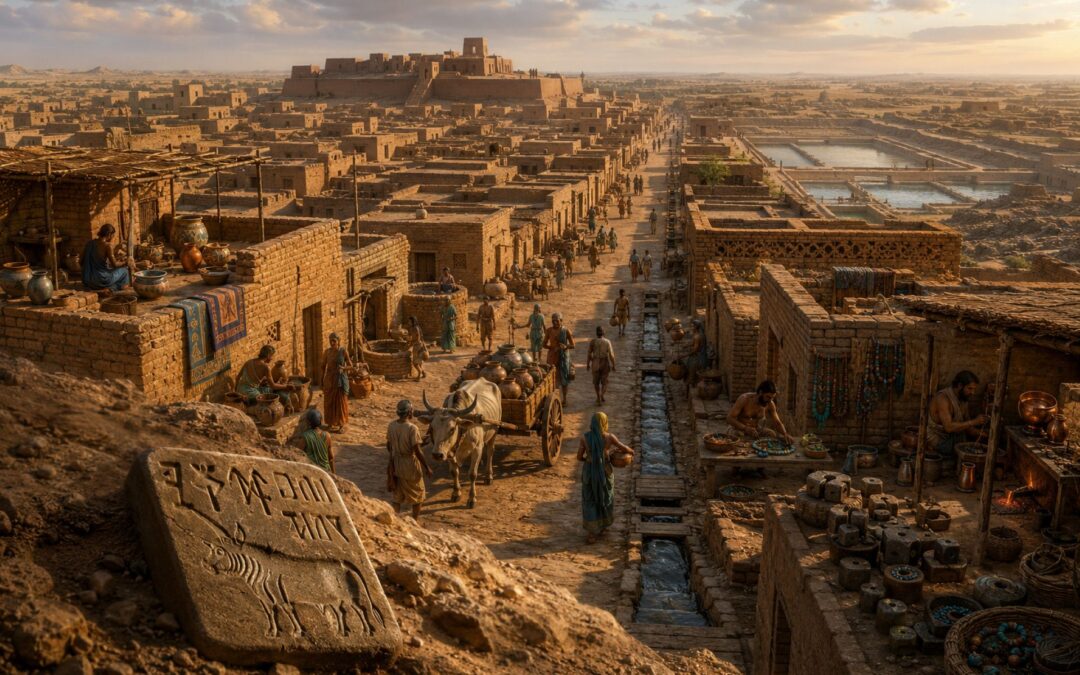
More than four thousand years ago, millions of people lived in cities and settlements spread across a vast part of northwestern South Asia. They built neighbourhoods with brick-lined drains, dug hundreds of wells, captured seasonal rainwater in enormous reservoirs, manufactured finely drilled stone beads, and traded across the Arabian Sea.
They also left behind thousands of inscriptions.
Yet not one of those inscriptions can be read with confidence today.
This creates one of history’s strangest imbalances. Archaeologists can measure the gradient of a drain in Mohenjo-daro, reconstruct the dimensions of a reservoir at Dholavira, and compare standardised stone weights found hundreds of kilometres apart. But they cannot tell us what the inhabitants called their cities, what laws they followed, which languages they spoke, or whether the figures on their seals represented gods, ancestors, rulers, stories, or something else entirely.
The civilisation is usually called the Indus Valley Civilization, although many scholars prefer Harappan Civilization because its settlements extended far beyond the Indus valley itself. At its height, roughly between 2600 and 1900 BCE, it covered parts of present-day Pakistan, northwest and western India, and neighbouring regions. It belonged to the same broad Bronze Age world as ancient Egypt and Mesopotamia, but it organised urban life in ways that looked strikingly different.
Its cities contained no unmistakable pyramids, royal tombs, colossal statues of kings, or long victory inscriptions. Instead, its most visible achievements were embedded in streets, houses, drains, workshops, reservoirs, weights, seals, and systems of exchange.
The civilisation was not erased in a single conquest, and its people did not simply vanish. Its great urban centres declined through a prolonged and uneven transformation involving environmental pressure, changes in rivers and rainfall, shifts in agriculture, weakening trade connections, population movement, and social stress.
What disappeared most completely was not the population but the civilisation’s readable voice.
How the Indus Civilization Was Lost and Rediscovered
The ruins of Harappa were never completely invisible. Large mounds, fragments of masonry, and unusually well-made bricks remained part of the landscape for centuries. Local communities knew that an old settlement had once stood there, but its true age and identity had been forgotten.
One of the earliest detailed European descriptions came from Charles Masson, the adopted name of James Lewis, a deserter from the East India Company who travelled through the region in the early nineteenth century. When he encountered the ruins of Harappa in the 1820s, he recognised that the mounds represented an ancient city, but he could not have known that it belonged to a civilisation older than the Mauryan Empire or the historical kingdoms then familiar to scholars.
Other antiquarians and colonial officials also examined the site. Alexander Cunningham, who later became the first director-general of the Archaeological Survey of India, recovered a small seal bearing an unfamiliar animal and unknown symbols. Yet he tried to interpret Harappa through the historical framework available to him, associating it with much later periods.
The physical remains were also being destroyed. During the construction of railway lines in the nineteenth century, contractors removed enormous quantities of ancient brick from Harappa’s mounds and used them as ballast. The bricks were prized because they were strong, uniform, and already fired. A substantial part of the site disappeared beneath colonial infrastructure before archaeologists understood what they were looking at.
Systematic investigation began to change the picture in the early twentieth century. Daya Ram Sahni led excavations at Harappa in 1921. Soon afterward, R. D. Banerji uncovered major remains at Mohenjo-daro in Sindh. The artefacts, bricks, seals, and urban structures from the two sites appeared closely related.
John Marshall, then director-general of the Archaeological Survey of India, announced the discovery of a previously unknown civilisation in 1924. The implications were immense. Urban civilisation in South Asia was no longer thought to begin with the first historically documented empires of the first millennium BCE. Harappa and Mohenjo-daro belonged to a much earlier Bronze Age world.
The discovery was not the achievement of one heroic archaeologist. It emerged through decades of observation, excavation, comparison, and institutional work involving Indian and British researchers. Nor did the announcement solve the civilisation’s mysteries. It merely revealed their scale.
Excavators had found planned streets, drains, wells, seals, jewellery, workshops, public structures, and an unknown script. They had uncovered the physical framework of an ancient society while lacking the written evidence needed to explain it.
That imbalance still shapes almost every debate about the Harappans.
From Mehrgarh to the First Harappan Cities
The Mature Harappan cities did not appear suddenly around 2600 BCE. They developed from much older patterns of settlement, agriculture, craft production, and exchange across Baluchistan and the northwestern subcontinent.
Mehrgarh, located near the Bolan Pass in present-day Pakistan, has long occupied a central place in this story. Archaeologists found evidence there for early farming, herding, mud-brick buildings, burials, ornaments, ceramics, and specialised crafts. For decades, the earliest settlement was generally dated to around the seventh millennium BCE, making it one of South Asia’s oldest known farming communities.
That chronology is now being reconsidered. In 2025, new radiocarbon dates from Mehrgarh, obtained from human tooth enamel, suggested that the excavated aceramic cemetery and the beginning of the site’s first major occupation phase may date closer to approximately 5200–4900 BCE. The study does not automatically invalidate every earlier estimate or settle the chronology of the whole region, but it represents an important challenge to the traditional timeline.
The significance of Mehrgarh does not depend entirely on whether its earliest occupation began in the seventh or sixth millennium BCE. Its deeper importance lies in the long development of settled life, food production, animal management, craftsmanship, and exchange in the regions west of the Indus plain.
Residents cultivated crops and kept domesticated animals. They worked stone, shell, bone, and eventually metal. Beads made from materials brought over long distances reveal connections extending toward the Iranian plateau, Central Asia, and coastal regions. Some human teeth show carefully drilled cavities, evidence that tools associated with bead production may also have been used for early dental intervention.
This was not a self-contained civilisation waiting to become Harappan. It was one part of a larger mosaic of communities that exchanged goods, techniques, crops, animals, and perhaps marriage partners across ecological zones.
Genetic evidence has made simple migration stories increasingly difficult to sustain. The first published genome from a Harappan individual, recovered at Rakhigarhi, contained ancestry related both to ancient Iranian-lineage populations and to South Asian hunter-gatherer groups. However, it lacked the specific ancestry associated with sampled Iranian agriculturalists, Anatolian farmers, and steppe pastoralists.
This means the rise of farming and urbanism in the Harappan world cannot be reduced to a straightforward replacement of local populations by a recognisable wave of farmers arriving from the Zagros Mountains at a particular moment. Populations related to those of ancient Iran and South Asia had interacted across very long periods, while communities within the subcontinent also developed their own agricultural and cultural trajectories.
By the fourth millennium BCE, settlements across the wider Indus region were becoming larger and more socially complex. Archaeologists refer to this broad developmental stage as the Early Harappan period. Different areas had their own pottery traditions, architectural practices, exchange networks, and settlement forms, but signs of increasing interaction appeared across them.
Harappa grew from a smaller settlement into a major centre. Kot Diji developed fortified and planned spaces. Dholavira emerged in the arid landscape of Kutch. Communities in Baluchistan, Sindh, Punjab, Haryana, Rajasthan, and Gujarat became connected through increasingly wide networks of exchange.
Around 2600 BCE, many regional traditions converged into the system recognised as the Mature Harappan Civilization. Standardised weights, seals, brick proportions, artefact styles, and planning principles appeared across an enormous territory.
This did not mean that every settlement became identical. Nor did it necessarily mean that one emperor or capital commanded the whole region. It meant that distant communities participated in a common economic and cultural order strong enough to maintain shared conventions over centuries.
The Urban World of the Mature Harappans
At its greatest extent, the Harappan world covered an area larger than either contemporary Egypt or Mesopotamia. Its settlements ranged from major urban centres to smaller towns, ports, villages, farming communities, and specialised production sites.
The largest cities included Harappa and Mohenjo-daro, while Dholavira, Ganweriwala, Rakhigarhi, and other centres occupied important positions in different regions. Lothal and coastal settlements connected inland production to maritime exchange. Smaller communities supplied food, livestock, raw materials, and specialised goods.
The civilisation’s urbanism is often described through the image of a perfect street grid. Some Harappan settlements did contain carefully aligned roads, lanes, blocks, and drainage channels, but no single blueprint was imposed everywhere. Cities developed over time, and their forms reflected local topography, building materials, water sources, and political histories.
Mohenjo-daro, whose archaeological remains reveal one of the most extensive Harappan cities, was built largely from baked and mud bricks. Its neighbourhoods included houses arranged around internal courtyards, narrow lanes, wells, bathing floors, drains, and larger streets. Some homes were modest, while others contained multiple rooms, upper storeys, private wells, and substantial internal spaces.
Many structures turned inward. Entrances often opened from side lanes rather than directly onto main roads, and courtyards provided light, ventilation, and areas for household work. This layout may have balanced privacy with dense urban living.
Water and waste management were integral to the built environment. Numerous houses contained plastered or brick-lined bathing areas from which water flowed into small drains. Some drains emptied into soakage jars or pits, while others connected to larger covered channels running along streets.
These systems were sophisticated, but they were not modern sewer networks in the contemporary sense. Not every household had identical access, and not every drain carried human waste. Possible latrines have been identified in some buildings, but the evidence does not justify the claim that every Harappan home possessed a flushing toilet connected to a citywide sewer.
The achievement remains impressive without exaggeration. Urban water disposal was treated as a regular architectural problem rather than an improvised afterthought.
Mohenjo-daro also contained hundreds of wells, many constructed from wedge-shaped bricks arranged in durable circular courses. Their distribution suggests that water access was often organised at household or neighbourhood level rather than being controlled exclusively by one monumental central facility.
The city’s most famous structure is the Great Bath, a large brick-lined tank sealed with bitumen and reached by stairways from both ends. Adjacent rooms and carefully controlled water access suggest that it had a special communal or ceremonial function. Bathing, purification, assembly, or elite ritual have all been proposed, but its exact purpose remains unknown.
Dholavira presents a dramatically different model. Located on an island in the Rann of Kutch, it depended on the careful capture and storage of scarce and highly seasonal water. Dholavira’s carefully engineered water system included channels, dams, and a series of large reservoirs integrated into the settlement’s architecture.
The city made extensive use of stone as well as mud brick. Its internal divisions, fortified enclosures, gateways, open spaces, and water structures differ markedly from Mohenjo-daro. These contrasts show that Harappan urbanism was not a rigid template but a family of solutions adapted to local conditions.
Lothal, in Gujarat, is associated with one of the most debated Harappan structures: a large brick-lined basin connected to an ancient channel system. It is often called the world’s earliest dockyard, and recent landscape research has strengthened the possibility that it served maritime or tidal functions. Other scholars have argued that it may have been used primarily as a reservoir or for irrigation.
The safest conclusion is that Lothal formed part of a landscape shaped by water management and coastal exchange, while the exact operation of the basin remains contested.
One of the most striking features across the civilisation was standardisation. Baked bricks often followed a 1:2:4 proportion in height, width, and length. Cubical stone weights were produced in regular sequences. Seal forms, pottery styles, measurement practices, and construction conventions circulated over great distances.
Such consistency required communication, training, and some mechanism for maintaining standards. Yet coordination does not automatically reveal the governing institution behind it. Rules may have been enforced by civic authorities, merchant communities, craft organisations, powerful households, regional councils, or combinations of these.
Harappan settlement patterns also complicate the traditional image of cities flourishing beside mighty permanent rivers. Research into the Ghaggar-Hakra palaeochannel found that the Sutlej had shifted away from that channel thousands of years before Mature Harappan urbanisation. Communities later settled along a landscape sustained by seasonal monsoon flows and accessible groundwater rather than a large active Himalayan river.
The finding matters because it replaces a simple rise-and-fall story with one based on adaptation. Harappan communities did not merely occupy naturally perfect floodplains. They developed different systems for wells, rainfall collection, reservoirs, drainage, seasonal agriculture, and flood management across highly varied environments.
Their cities were impressive not because they anticipated modern urban planning in every respect, but because they embedded collective coordination into ordinary infrastructure.
How the Indus Economy Connected a Vast Region
Harappan cities depended on agricultural systems extending far beyond their walls. Farmers cultivated wheat, barley, pulses, sesame, and other crops, while communities in different ecological regions adopted different combinations of plants and animals.
Agriculture was not uniform across the civilisation. Winter crops were important in some regions, while summer crops became more prominent elsewhere. Some communities practised cultivation across more than one season. Herders raised cattle, buffalo, sheep, goats, and other animals, integrating pastoral mobility with settled farming.
These varied food systems helped support dense settlements and people engaged in work other than farming. Harappan cities contained potters, builders, shell workers, bead makers, metalworkers, seal carvers, textile producers, traders, transporters, and administrators.
Craft production reached extraordinary levels of refinement. Carnelian beads could be heated to alter their colour, shaped with great precision, and drilled through their length using specialised tools. Shell from coastal waters was transformed into bangles and decorative objects at inland and coastal workshops. Faience, a glazed material produced from crushed quartz, appeared in beads, bangles, and small ornaments.
Copper was used for tools, vessels, mirrors, ornaments, and weapons. Bronze objects existed but were limited by access to tin, which had to be obtained through long-distance networks. Gold, silver, lapis lazuli, turquoise, agate, and other valued materials circulated between regions.
Cotton was cultivated and woven in the Harappan world at a very early date. Fragments of cloth rarely survive, but impressions, fibres, spindle whorls, tools, and representations on figurines indicate a developed textile economy.
A shared system of weights made exchange across distant settlements easier. Small cubical weights, often made from chert, followed regular numerical patterns. Their consistency suggests that quantities could be measured in mutually recognisable units, whether for commodities, workshop production, taxation, rations, or trade.
Seals may also have helped organise economic activity. Many were carved with animals, signs, and sometimes scenes. They could be pressed into clay placed over cords, containers, doors, or packages. A broken sealing might show that goods had been opened or tampered with.
But seals should not be described confidently as merchant-guild logos. They may have represented individuals, households, offices, institutions, professions, communities, ritual identities, or several of these at once. Without readable inscriptions, their precise function remains uncertain.
Harappan exchange networks extended north toward Afghanistan and Central Asia, west across Baluchistan and the Iranian plateau, south into Gujarat, and across the Arabian Sea.
Mesopotamian texts refer to lands called Dilmun, Magan, and Meluhha. Meluhha is widely associated with the Harappan sphere, although its exact geographic meaning may have varied. Mesopotamian records mention commodities linked to Meluhha, while Harappan seals, beads, weights, and pottery have been found in western Asia.
Trade probably moved through several stages. Goods could pass from inland producers to regional towns, then to coastal settlements and ships. Some travelled through intermediary centres in Bahrain or Oman rather than directly between the Indus and southern Mesopotamia.
Maritime exchange required knowledge of tides, currents, seasonal winds, estuaries, and coastal navigation. Harappan images show boats, while models and archaeological remains indicate both river transport and seagoing activity.
One of the strongest pieces of evidence for sustained contact is a seal identifying an interpreter of Meluhha. The cylinder seal belonged to Shu-ilishu, who is described in an Akkadian inscription as an interpreter of the Meluhhan language.
The object does not tell us what that language was. It does show that communication between Mesopotamians and people associated with Meluhha was important enough to require specialised linguistic mediation.
Harappan materials found abroad do not prove that large permanent colonies existed everywhere they appear. Traders, craftsmen, sailors, intermediaries, or families may have travelled and sometimes settled abroad, but each claim must be judged from its own evidence.
What is clear is that the Harappan economy was neither isolated nor dependent on one centre. It connected farming villages, workshops, cities, inland routes, ports, and foreign markets through shared practices that operated across a remarkable distance.
What Everyday Life Looked Like
Grand monuments often dominate popular accounts of ancient civilisations. The Harappan world is more intimate. Its most revealing remains are houses, courtyards, drains, cooking pots, ornaments, toys, tools, and small objects worn or handled by ordinary people.
A typical urban home was organised around domestic activity rather than public display. Courtyards provided light and air while creating space for cooking, craft work, storage, conversation, and household rituals. Rooms opened around these central spaces. Stairs in some houses indicate upper floors or accessible roofs.
The size of homes varied considerably. Some contained only a few rooms, while others occupied large plots and included several courtyards, bathing areas, storage spaces, and private wells. These differences suggest variation in wealth, household size, occupation, or status, even if they cannot be translated directly into a familiar class system.
Food preparation left behind grinding stones, hearths, ovens, storage jars, cooking vessels, animal bones, seeds, and residues. Diets differed by region and social setting. Wheat and barley were important, but people also consumed pulses, sesame, dates, millets, dairy products, meat, fish, and locally available plants.
Perforated vessels and residues may indicate brewing, straining, or fermentation. Alcoholic drinks may have existed, as they did in many ancient societies, but the available evidence does not demonstrate that Harappans invented distillation.
Clothing rarely survives in South Asia’s climate. Figurines and sculptures nevertheless show wrapped, draped, and belted garments. Cotton would have been suited to the heat, while wool and other fibres may also have been used.
It is tempting to identify these clothes as saris or dhotis, but familiar appearance is not proof of an unchanged garment tradition extending across four thousand years. The evidence supports draped textiles, not the direct naming of modern clothing forms.
Adornment was common. Men and women appear to have worn necklaces, bangles, rings, belts, pendants, earrings, and elaborate hairstyles. Jewellery was made from shell, stone, faience, terracotta, copper, silver, and gold.
The sheer number of bangles recovered from some sites points to extensive production and widespread use rather than rare royal luxury. Specialised workshops created ornaments for different levels of wealth, from simple terracotta pieces to carefully drilled carnelian beads and precious-metal objects.
Personal appearance mattered. Small mirrors, combs, cosmetic containers, hair ornaments, and decorated figurines suggest attention to grooming and style. These objects do not reveal fixed gender roles with certainty, but they show that identity was expressed through the body as well as through architecture and possessions.
Children are visible through terracotta animals, miniature carts, whistles, rattles, spinning toys, and figurines. Some objects may have had ritual meanings rather than being toys, but many bear signs of repeated handling and play.
Adults also played games. Cubical dice, counters, and marked boards have been recovered from several sites. Their existence demonstrates games of chance or strategy, but it cannot establish a direct line to the dice game described in the Mahabharata or to the later development of chess.
The daily life of a city also involved noise, labour, smell, crowding, and maintenance. Animals moved through streets and courtyards. Crafts produced smoke, waste, broken pottery, stone dust, and discarded material. Drains required cleaning. Wells required repair. Buildings were rebuilt over earlier walls, gradually raising street levels.
Harappan cities were not immaculate machines. They were inhabited places continually altered by generations of residents.
Their domestic remains are powerful precisely because they make the civilisation recognisable without making it identical to the present. People cooked, decorated themselves, raised children, worked with their hands, traded, played, and arranged their homes around privacy and community.
Yet the objects cannot tell us what those people called themselves or what stories they told while sitting in their courtyards. For that, historians would need their words.
What the Undeciphered Script Prevents Us from Knowing
The Indus script appears on seals, sealings, tablets, pottery, tools, ornaments, and other small objects. Several hundred distinct signs or sign variants have been identified, although the exact number depends on how researchers classify damaged, combined, or visually similar symbols.
Most inscriptions are extremely short. Many contain only a handful of signs, and even the longest known examples are brief compared with Egyptian, Mesopotamian, or later South Asian texts.
There is no known Harappan equivalent of the Rosetta Stone: no bilingual inscription presenting the same text in the Indus script and another readable language. Nor do scholars know with certainty which spoken language or languages the signs represented.
These limitations make decipherment exceptionally difficult.
Researchers have searched for repeated sequences, positional patterns, numerical structures, grammatical regularities, titles, names, and commodity signs. A statistical analysis of the Indus signs found that their order was not random. Certain signs regularly appeared at the beginning or end of inscriptions, while others occurred in predictable combinations.
This patterned structure supports the idea that the signs carried organised information. It does not identify the underlying language, prove a particular decipherment, or conclusively settle whether the system encoded full speech in the same manner as longer ancient scripts.
Proposed readings have linked the script to Dravidian languages, Indo-Aryan languages, Munda languages, lost language families, numerical notation, religious symbolism, and nonlinguistic administrative signs. None has achieved broad scholarly acceptance.
The absence of readable texts limits knowledge far beyond language itself.
Historians cannot identify a Harappan king from a royal inscription because no securely readable royal inscription exists. They cannot reconstruct laws, contracts, tax systems, political offices, prayers, myths, historical narratives, diplomatic correspondence, or lists of cities.
They do not know whether the civilisation had one formal language of administration or several. They cannot tell whether a seal gives a person’s name, profession, title, lineage, institution, commodity, or ritual phrase.
Textual silence has encouraged modern observers to name artefacts according to appearance.
The small bronze figure commonly called the “Dancing Girl” may represent a dancer, but the label originated from a modern interpretation of her pose and expression. She could have embodied a different social role or symbolic meaning.
The so-called “Priest-King” presents the same problem. The bearded stone figure wears a patterned garment and appears composed and authoritative. Yet no inscription identifies him as a priest, king, ruler, or even a real individual. The name reflects expectations formed by better-documented civilisations in which priests and kings commissioned elite sculpture.
Such labels are useful shorthand as long as they are not mistaken for discoveries.
The script’s silence is therefore not an empty space around the civilisation. It is an active force shaping modern interpretation. Archaeologists must infer institutions from streets, houses, workshops, burials, weights, injuries, and artefact distributions because the Harappans cannot explain those remains in their own words.
That is why questions about government, violence, and religion demand unusual caution.
Rethinking Power, Violence, and Religion
The Harappan world does not fit neatly into the political models derived from Egypt or Mesopotamia. It produced large cities, common standards, extensive trade, and monumental civic works without leaving obvious royal tombs, named dynasties, colossal ruler statues, or carved scenes of military conquest.
This difference once inspired the image of an unusually equal and peaceful civilisation governed without kings, armies, or coercion. Later interpretations swung toward the opposite extreme, imagining powerful merchant rulers, hidden palaces, fortified cities, and frequent conflict.
The available evidence supports neither simple picture.
Some form of authority clearly existed. Streets were aligned, drains maintained, building conventions reproduced, weights standardised, and large reservoirs constructed. Such activities required planning and cooperation. They may also have required taxation, labour obligations, regulation, and enforcement.
But authority need not have been concentrated in a single divine monarch. It could have been distributed among councils, elite families, landholders, merchants, ritual specialists, neighbourhood organisations, or regional institutions. Different cities may have been governed differently while participating in shared cultural and commercial systems.
Housing inequality offers one partial way of examining social structure. Larger homes, private wells, valuable goods, and access to particular areas suggest differences in resources. Yet the pattern may have changed over time.
A recent study of residential inequality at Mohenjo-daro concluded that measurable inequality in house sizes appears to have decreased as the city developed. That finding complicates the expectation that urban growth automatically produced ever-greater concentration of wealth.
House size cannot capture every form of status. Wealth could have been stored in livestock, trade goods, land, jewellery, kinship networks, or control over labour. Even so, the study reinforces the possibility that Harappan cities followed social trajectories unlike those of many other ancient urban societies.
The question of violence is equally difficult.
Harappan sites have produced axes, spearheads, arrowheads, blades, maces, and other objects capable of being used as weapons. Some imagery appears to depict conflict or violent restraint. Walls, gates, towers, and controlled entrances may have had defensive functions.
But tools can serve multiple purposes, and walls can protect against more than armies. They may regulate access, support elevated platforms, control floodwater, mark social divisions, display civic authority, or combine all these roles.
The evidence is sufficient to reject the fantasy of a civilisation entirely untouched by violence. It is not sufficient to reconstruct a continuous history of wars or conquests.
Human remains provide a more direct but still local perspective. Bioarchaeological evidence from late Harappa indicates increasing infection, social vulnerability, and interpersonal violence during later phases of settlement. Some groups were more exposed to disease and injury than others.
These findings suggest that urban stress was unevenly experienced. They do not prove that all Harappan cities descended into warfare, that a foreign army attacked, or that skeletons found at different levels represent a single massacre.
The old claim that invaders slaughtered Mohenjo-daro’s population was built from scattered human remains removed from their archaeological contexts and combined into a dramatic narrative. That interpretation is no longer credible.
Religion is even harder to reconstruct because almost every object can support multiple meanings.
The Great Bath may have been used for ceremonial bathing or purification, but it could also have served civic, social, or political purposes. Fire installations at sites such as Kalibangan have been interpreted as ritual altars, yet their precise use remains debated.
Figurines with prominent breasts or elaborate headdresses were once routinely labelled mother goddesses. Some may have been divine figures, but others may represent humans, ancestors, protective beings, toys, household objects, or identities no longer understood.
Trees, animals, composite creatures, and seated figures appear repeatedly in Harappan imagery. The most famous example is the so-called Pashupati seal, which shows a horned figure seated in an unusual posture and surrounded by animals.
Some scholars have interpreted the figure as a prototype of Shiva in his role as lord of animals. Others question whether the posture is truly yogic, whether the figure is divine, whether it is male, and whether a direct connection to a much later Hindu deity can be sustained.
The resemblance is historically interesting. It is not proof.
The same caution applies to water purification, fire rituals, swastika symbols, sacred trees, and animal imagery. Some elements may have been transmitted, reinterpreted, or absorbed into later South Asian traditions. Others may represent broad religious patterns found across many societies.
Continuity is not the same as unchanged survival.
The Harappans almost certainly possessed religious ideas, ritual authorities, sacred places, and stories. What remains unknown is how those elements were named, organised, and connected. Without readable texts, interpretation must remain proportional to the evidence.
Why the Indus Cities Declined—and What Survived
The end of the Mature Harappan urban system was once explained through a single dramatic event.
Early scholars proposed that Indo-Aryan invaders entered the subcontinent, destroyed the cities, massacred their inhabitants, and replaced the civilisation with a new culture. Scattered skeletons at Mohenjo-daro were presented as victims of conquest, while passages from the Rigveda were read as memories of Harappan cities being attacked.
That explanation has not survived archaeological scrutiny.
There is no civilisation-wide destruction layer marking a coordinated invasion. Harappan urban traditions did not end everywhere at the same moment. Material culture changed gradually and differently across regions. Many settlements continued to be occupied after 1900 BCE, even as standardisation weakened and large cities lost population.
The transformation had begun before the final abandonment of the largest urban centres.
Environmental change played a major role, but not as a single drought that instantly destroyed every settlement. Monsoon systems weakened and became more variable over long periods. Rivers shifted, flood patterns changed, and water availability declined in some areas while remaining more reliable in others.
A major study of recent research on the Harappan transformation linked repeated and prolonged river droughts to changes in settlement, farming, and migration. The authors described a metamorphosis rather than a sudden collapse: communities moved, altered crop choices, and adapted to new water conditions over generations.
This distinction matters. Climate does not act directly on a civilisation as if pressing a switch. Its effects are mediated through agriculture, institutions, inequality, infrastructure, trade, political decisions, and the ability of households to move or change their livelihoods.
A city dependent on maintaining wells, drains, streets, reservoirs, and large populations becomes vulnerable when food production becomes less predictable. Authorities or communities may struggle to organise repairs. Trade may contract. Skilled specialists may leave if markets disappear. Wealthier households may relocate before poorer residents can do so.
The Harappan response varied by region.
Some populations moved eastward toward areas receiving more reliable summer rainfall. Others dispersed into smaller settlements in Punjab, Haryana, Rajasthan, Gujarat, and beyond. Crop systems shifted, with greater emphasis in some regions on drought-resistant millets and summer cultivation.
Large cities became less central. Standardised weights, seals, and brick proportions declined in use. Long-distance commercial links with Mesopotamia weakened as political and economic systems there also changed. Craft production continued, but often on a smaller or more regional basis.
Urban decline could also deepen social stress. At late Harappa, evidence of disease and interpersonal injury suggests that some inhabitants experienced worsening conditions. Yet this evidence cannot be turned into a universal account of starving citizens fighting in every street.
Nor can trade disruption or climate alone explain every local outcome. The civilisation covered a vast area, and settlements relied on different rivers, rainfall regimes, crops, routes, and political arrangements. Its transformation was therefore a collection of related regional processes rather than one uniform collapse.
The decline of the cities must also be separated from the history of Indo-Aryan migration.
The old invasion theory was wrong to make conquering Aryans the destroyers of the Mature Harappan world around 1900 BCE. That does not mean that later migration into South Asia never occurred.
Ancient DNA research on South Asian population formation indicates that steppe-related ancestry entered the subcontinent after the Mature Harappan urban decline and became one component of later South Asian populations. Linguistic and archaeological evidence likewise supports movements and interactions connected to Indo-Aryan languages during the second millennium BCE.
The chronology is essential. Later migration and population mixture were real historical processes, but they were not a simple military event that destroyed Harappa and Mohenjo-daro at the height of their urban life.
Harappan ancestry also remained deeply important. The Rakhigarhi genome and later population studies show that groups related to the Harappan population contributed substantially to the ancestry of subsequent South Asians. New populations mixed with descendants of earlier communities; they did not replace an empty landscape.
Cultural survival is harder to trace than genetic continuity. Crops, craft techniques, settlement habits, symbols, and forms of ornament may have persisted or been reworked. Some traditions could have passed through families and regional communities even after the institutions that once connected the cities had disappeared.
But individual similarities should not be used to claim that a specific modern caste, ritual, garment, deity, or social institution descends unchanged from the Harappans. Four thousand years of migration, mixture, innovation, conflict, religious change, and political transformation separate the Mature Harappan world from the present.
By around 1900 BCE, the great urban phase was ending. By the middle of the second millennium BCE, the standardised civilisation that had linked cities across the northwest no longer existed in its earlier form.
Its people had not vanished. They had moved, mixed, adapted, and formed part of the later societies whose development belongs to the wider history of the Indian subcontinent.
What was lost was the system that had once connected them: the shared standards, large cities, trade networks, administrative practices, and writing tradition of the Mature Harappan world.
The Indus Valley Civilization survives in a peculiar state. Its streets remain visible, but their names are gone. Its seals survive, but their messages are silent. Its wells can still be counted, but the institutions that maintained them cannot be identified. Its ornaments can be held in a museum, but the identities they expressed are largely unknowable.
This does not make the civilisation empty or unknowable. Archaeology has reconstructed farming systems, craft industries, trade routes, neighbourhoods, water infrastructure, diet, disease, migration, and environmental adaptation with remarkable precision.
What it cannot yet reconstruct is the Harappans’ own explanation of their world.
Their urban civilisation did not end in one final battle, and their descendants did not disappear. The cities declined through a long transformation, while populations and practices continued in altered forms.
To call the Harappans “lost” is therefore only partly correct. Their political order was lost. Their script was lost. Their remembered name was lost.
The people were not.
Last Updated on July 27, 2026 by Aseem Gupta