
Reading Time: 36 Minutes
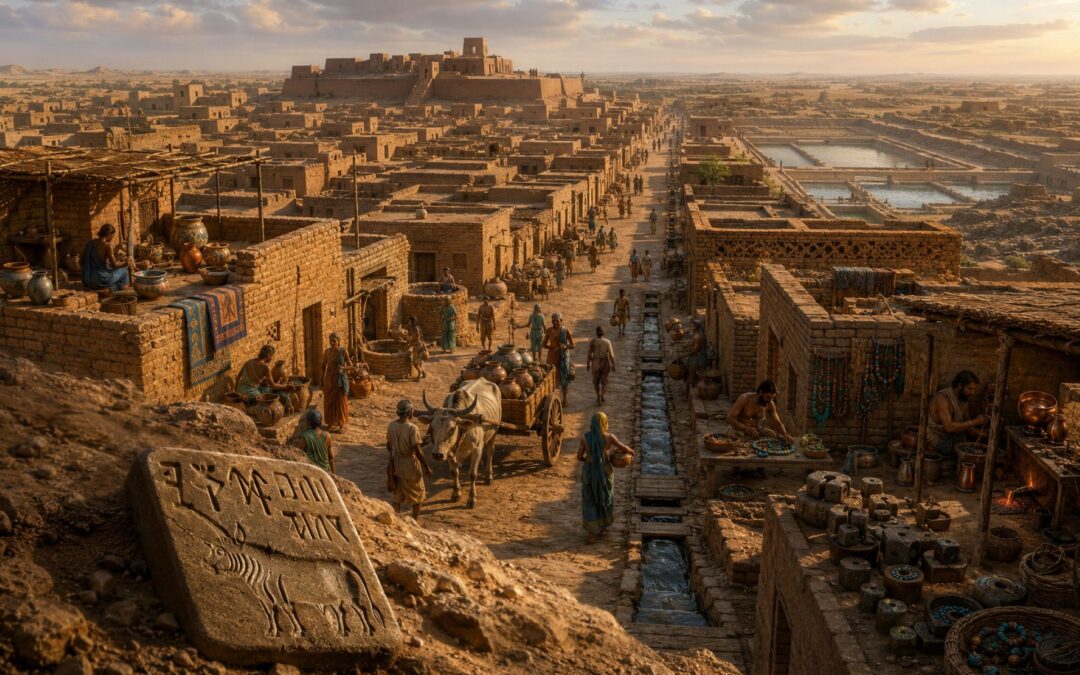
More than four thousand years ago, people living across northwestern South Asia built cities with carefully planned streets, brick-lined drains, hundreds of wells, enormous water reservoirs, and workshops producing goods for markets thousands of kilometres away. Archaeologists can reconstruct the dimensions of their buildings, measure the weights they used in trade, and identify materials brought from distant lands. Yet they cannot confidently read a single inscription left behind by the people who built those cities.
This is the central paradox of the Indus Valley Civilization. Its physical achievements are among the most remarkable of the Bronze Age, but much of its political, religious, and intellectual life remains inaccessible. We do not know what its inhabitants called their cities, who governed them, which languages they spoke, or whether the figures carved into their seals represented gods, rulers, ancestors, or stories.
The civilization, also known as the Harappan Civilization, reached its mature urban phase around 2600–1900 BCE. It extended across a vast region encompassing much of present-day Pakistan, northwestern and western India, and neighbouring territories. It was a contemporary of ancient Egypt and Mesopotamia, but instead of leaving unmistakable royal tombs, monumental portraits of kings, or lengthy accounts of military victories, its most recognisable achievements survive in houses, streets, water systems, seals, and everyday objects.
Its disappearance is equally intriguing. The great Harappan cities eventually declined, their common institutions weakened, and their writing system ceased to be used. But their inhabitants did not simply vanish in a catastrophic invasion. Their urban civilization underwent a prolonged transformation, while its populations and some of their practices continued into the societies that followed.
How the Lost Civilization Was Rediscovered
The ruins of Harappa were never completely hidden. For centuries, local communities in Punjab had known about the enormous earthen mounds, ancient masonry, and unusually well-made bricks scattered across the landscape. Some associated the ruins with stories about a long-forgotten king, but nobody recognised them as the remains of a civilization that had flourished thousands of years before the better-documented empires of ancient India.
One of the earliest European visitors to describe the site was Charles Masson, the assumed name of James Lewis, a deserter from the British East India Company’s army. Travelling through northwestern India during the nineteenth century, he encountered Harappa in the 1820s and recognised that its mounds concealed an ancient settlement. However, the historical framework available to him offered little reason to suspect that the ruins belonged to a civilization contemporary with Egypt’s pyramids.
Other antiquarians and colonial officials subsequently examined the site. Alexander Cunningham, who became the first director-general of the Archaeological Survey of India, recovered a small seal bearing an unfamiliar animal and mysterious symbols. He recognised the object’s unusual character but attempted to place Harappa within much later periods of Indian history. The possibility of an independent Bronze Age urban civilization remained largely unrecognised.
Meanwhile, the ruins were suffering substantial damage. During nineteenth-century railway construction, contractors removed enormous quantities of ancient bricks from Harappa and reused them as railway ballast. These bricks were attractive building materials because they were uniformly shaped, durable, and already fired. Ironically, the qualities that would eventually help archaeologists understand Harappan construction also contributed to the destruction of parts of the site before its significance was understood.
The breakthrough came in the early twentieth century. Daya Ram Sahni began systematic excavations at Harappa in 1921, while R. D. Banerji investigated the remarkable remains of Mohenjo-daro in Sindh. The two sites revealed closely related architecture, pottery, seals, weights, and other artefacts, suggesting that they belonged to a shared cultural world.
In 1924, John Marshall, then director-general of the Archaeological Survey of India, announced the discovery of a previously unknown ancient civilization. The revelation fundamentally changed the chronology of South Asian history. Urban civilization in the subcontinent could no longer be understood as beginning only with the historically documented kingdoms and empires of the first millennium BCE.
The discovery was the culmination of decades of work by Indian and British researchers rather than the achievement of a single archaeologist. It also marked the beginning of a much larger investigation. Excavators had uncovered streets, workshops, reservoirs, ornaments, sculptures, and inscriptions, but they still lacked the written testimony necessary to explain how the civilization’s institutions worked.
As excavations expanded beyond Harappa and Mohenjo-daro, archaeologists discovered that the civilization extended across an enormous territory. Hundreds of settlements, from major cities to villages and specialised manufacturing centres, demonstrated that the two famous sites were components of a much larger society.
From Mehrgarh to the Rise of the Harappan Cities
The Indus Valley Civilization did not suddenly emerge around 2600 BCE. Its cities developed from thousands of years of agricultural experimentation, settlement growth, technological innovation, and exchange among communities across northwestern South Asia. Understanding those earlier societies is essential because urban civilization depended on economic and social foundations that had developed long before the first great Harappan cities.
One of the most important early settlements was Mehrgarh, situated near the Bolan Pass in present-day Balochistan, Pakistan. Archaeological discoveries there include mud-brick buildings, farming equipment, domesticated animal remains, burials, ornaments, ceramics, and evidence of increasingly specialised craftsmanship. Mehrgarh has traditionally been regarded as one of the earliest farming communities in South Asia.
Its chronology, however, is undergoing revision. Earlier archaeological interpretations commonly placed Mehrgarh’s beginnings around 7000 BCE, but a 2025 study using new radiocarbon dates from human tooth enamel suggested that the excavated aceramic cemetery and the beginning of an important early occupation phase may instead date to approximately 5200–4900 BCE. This does not conclusively settle the chronology of every occupation phase or of early agriculture across the entire region, but it demonstrates that even foundational dates remain open to reassessment.
Whatever its precise beginning, Mehrgarh reveals a society gradually developing the capacities associated with settled life. Its inhabitants cultivated crops, kept domesticated animals, constructed permanent buildings, and produced increasingly sophisticated objects. Their agricultural practices could sustain larger and more settled populations than those dependent exclusively on hunting and gathering.
Mehrgarh was also connected to distant regions. Archaeologists have recovered ornaments made from turquoise, lapis lazuli, seashells, and other materials that indicate contact with communities across the Iranian plateau, Central Asia, and coastal areas. Craftspeople developed pottery, bead-making techniques, metalworking practices, and other specialised skills that required knowledge to be passed across generations.
One particularly remarkable discovery involves human teeth showing evidence of deliberate drilling. The holes suggest that tools associated with precision bead-making were also applied to teeth, providing early evidence of dental intervention. Whether every procedure was intended to treat pain or disease cannot be established, but the discovery demonstrates how sophisticated craftsmanship could be applied to the human body.
The populations of these early communities also had complex origins. Contact with regions west of the Indus probably involved exchanges of people as well as materials and techniques, but the development of Harappan civilization cannot be reduced to one migration of farmers from the Zagros Mountains.
An important breakthrough came with the first published ancient genome from a Harappan individual at Rakhigarhi. The individual carried ancestry related to ancient Iranian-lineage populations and South Asian hunter-gatherer groups, but lacked the specific ancestry associated with sampled Iranian agriculturalists, Anatolian farmers, and steppe pastoralists. Although one genome cannot represent the entire civilization, the findings challenge simplistic accounts in which a single incoming farming population replaced local communities.
The region instead appears to have developed through long-standing interaction among populations whose histories extended across South Asia and neighbouring territories. Agricultural techniques, animals, crops, and material culture spread through processes that could include exchange, movement, adaptation, and local innovation.
By the fourth millennium BCE, settlements across the wider Indus region were growing larger and more complex. Archaeologists identify this broad developmental stage as the Early Harappan period, during which different communities maintained distinctive pottery traditions, architectural styles, and exchange networks while developing increasingly visible similarities.
Harappa grew from a smaller settlement into an important centre. Kot Diji developed planned and fortified spaces, while communities around Nausharo, Dholavira, and other settlements created increasingly sophisticated systems of production and exchange. These developments unfolded across Balochistan, Sindh, Punjab, Haryana, Rajasthan, Gujarat, and adjoining areas rather than along one river alone.
River plains offered substantial agricultural opportunities. Seasonal flooding could replenish soil nutrients, support crop production, and create surpluses capable of sustaining larger populations. Those surpluses helped support specialists who could devote more time to building, metalworking, pottery, administration, or trade rather than producing their own food. Yet fertile floodplains were only part of the explanation; communities also had to manage seasonal water availability, unpredictable flooding, and differences between ecological regions.
These developments formed part of the broader transformation explored in the history of human civilization, in which agriculture, settled communities, technological specialisation, and increasingly extensive institutions created the conditions for urban life.
Around 2600 BCE, many regional traditions converged into the system archaeologists recognise as the Mature Harappan Civilization. Standardised weights, seals, brick proportions, pottery conventions, and planning practices appeared across an enormous geographic area. The result was one of the ancient world’s largest interconnected cultural and economic systems.
This convergence did not mean that every settlement became identical or that one emperor necessarily governed the entire region. Different communities retained local practices and adapted to their own environments. What they shared was a powerful system of conventions that made construction, production, measurement, and exchange recognisable across great distances.
Cities Built Around Water, Order, and Adaptation
The mature Indus civilization contained an extraordinary variety of settlements. Harappa and Mohenjo-daro were major urban centres, while Dholavira, Rakhigarhi, Ganweriwala, and other cities occupied important positions across the region. Coastal settlements such as Lothal connected inland production networks with maritime exchange, while smaller towns, farming villages, and specialised workshops supported the wider urban economy.
Harappan cities are frequently described as examples of remarkably advanced town planning. Streets often followed carefully organised alignments, houses were built with standardised materials, and drainage facilities formed an important part of urban infrastructure. However, the familiar image of every settlement following a perfect rectangular grid exaggerates the archaeological evidence.
Some cities contained broad streets intersecting at approximately right angles, while others had more complicated layouts influenced by terrain, local building traditions, and stages of expansion. Settlements developed over generations, and their neighbourhoods were repeatedly rebuilt. Urban design therefore reflected both shared planning principles and local adaptation.
Mohenjo-daro offers one of the most detailed pictures of Harappan urban life. Its buildings were constructed largely from baked and mud bricks, with neighbourhoods containing interconnected streets, narrow lanes, wells, courtyards, and bathing facilities. Several substantial buildings indicate upper storeys or accessible roofs, while houses of different sizes suggest considerable variation in domestic resources and household organisation.
Many homes were designed around internal courtyards. Rooms opening onto these spaces received light and ventilation, while the courtyard itself could accommodate household work, cooking, storage, and social interaction. Entrances often opened onto smaller lanes rather than major streets, possibly balancing privacy with the practical demands of dense urban living.
Water management was among the civilization’s most impressive achievements. Numerous houses contained plastered or brick-lined bathing floors from which water could flow through constructed drains. Some drains emptied into soakage jars or pits, while others connected to larger channels running alongside streets, many of which were covered with bricks or stone slabs.
These systems demonstrate unusually deliberate attention to wastewater disposal, but they should not be confused with modern underground sewer networks. Not every household possessed identical facilities, and not every drain was designed to carry human waste. Possible latrines have been identified in some buildings, yet the claim that every Harappan household had a flushing toilet connected to a citywide sewer is unsupported.
The achievement remains substantial without that exaggeration. Urban sanitation was treated as a recurring architectural and maintenance problem rather than being left entirely to individual households. Channels, drainage openings, collection points, and access for cleaning reveal efforts to manage the practical consequences of living in concentrated settlements.
Mohenjo-daro also contained hundreds of wells, many constructed from wedge-shaped bricks arranged in circular courses. Their distribution suggests that water was often accessible at household or neighbourhood level. This arrangement differs from systems in which nearly all urban water is supplied through a small number of monumental public facilities.
The city’s best-known building is the Great Bath, a large brick-lined tank reached by stairways at opposite ends. Its carefully fitted masonry and bitumen waterproofing helped prevent leakage, while surrounding rooms and controlled access indicate that it served some distinctive communal purpose. Ritual bathing and purification are frequently proposed explanations, but assembly, civic ceremony, or other specialised uses cannot be ruled out.
The archaeological remains of Mohenjo-daro recognised by UNESCO demonstrate how closely architecture, water access, and urban organisation were connected. Its infrastructure was not simply a collection of impressive engineering objects; it required continuing cooperation among the people who constructed, used, cleaned, and repaired it.
Dholavira, located in the arid landscape of Kutch, presents a markedly different approach to urban planning. Rather than relying on the same abundance of local wells as Mohenjo-daro, the settlement developed extensive facilities for capturing and storing scarce seasonal water. Channels, dams, and large reservoirs were incorporated into the city’s architectural organisation.
As UNESCO’s description of Dholavira demonstrates, the settlement contained carefully differentiated urban spaces, fortified enclosures, gateways, and an elaborate water-management system. It made extensive use of stone alongside mud brick and followed a spatial organisation distinct from the familiar division between raised and lower settlement areas found elsewhere.
Dholavira’s reservoirs reveal the importance of responding to local environmental constraints. In a region where rainfall was highly seasonal, securing water demanded a different engineering strategy from that used in cities with more accessible groundwater. The civilization’s sophistication lay partly in its ability to develop different solutions within a recognisably shared urban tradition.
Lothal, in Gujarat, illustrates another dimension of Harappan engineering. The settlement contained a large brick-lined basin associated with an ancient channel system, traditionally identified as one of the world’s earliest dockyards. If it served maritime traffic, it would represent an impressive attempt to manage water levels and access for boats using a substantial engineered structure.
However, the basin’s purpose remains debated. Some researchers have argued that it functioned primarily as a reservoir or irrigation facility rather than a dockyard. A 2024 study of Lothal’s ancient waterways strengthened the case for ancient hydrological connections that could have supported maritime activity, but it did not eliminate every uncertainty about the basin’s operation.
Across these settlements, standardisation is especially revealing. Baked bricks frequently followed a proportion of approximately 1:2:4 in height, width, and length. Comparable conventions appeared over enormous distances, alongside recurring forms of stone weights, seals, and other manufactured objects.
Such consistency required communication and the transmission of technical knowledge. Builders had to understand shared proportions, craftspeople needed dependable measurement practices, and communities had to maintain the infrastructure on which urban life depended. The precise institutions responsible for enforcing these conventions remain unknown, but the evidence establishes substantial coordination.
The relationship between Harappan settlement and rivers was also more complicated than the image of every great city thriving beside a permanently flowing river. Research into the Ghaggar-Hakra palaeochannel found that the Sutlej had shifted away from the channel thousands of years before mature Harappan urbanisation. Later communities occupied parts of this landscape using seasonal monsoon-fed water sources and accessible groundwater rather than depending on a continuously flowing Himalayan river.
This matters for understanding both the civilization’s rise and its eventual decline. Harappan communities did not simply settle beside ideal rivers and enjoy effortless agricultural abundance. They developed systems for managing groundwater, seasonal rainfall, floodwater, reservoirs, and agricultural uncertainty in different environments.
Their engineering achievements were therefore not evidence that every city anticipated modern urban planning in every respect. They demonstrated something more historically distinctive: a civilization capable of integrating everyday infrastructure, regional conditions, and shared construction standards into the organisation of urban society.
The Agriculture and Crafts That Sustained Urban Life
Harappan cities could not have flourished without a productive agricultural economy. Large urban populations required reliable food supplies, while workshops, trade networks, and infrastructure depended on people being able to specialise in activities beyond farming. The agricultural foundations of the civilization extended far beyond its city walls.
Farmers cultivated wheat, barley, pulses, sesame, and other crops, but agricultural practices differed considerably by region. Winter cultivation played an important role in some areas, while summer crops became more significant elsewhere. Seasonal rainfall, river conditions, soils, and access to water shaped what could be grown and when.
Some communities cultivated crops across more than one season, allowing them to take advantage of different climatic conditions. This should not be interpreted as proof that the Harappans invented double cropping for the entire world. Their achievement was the development of flexible farming systems capable of supporting settlements across diverse environments.
Animal husbandry complemented cultivation. Communities raised cattle, buffalo, sheep, goats, and other animals that supplied food, materials, and labour. Pastoral mobility and settled farming were not necessarily competing ways of life; they could form interconnected parts of a wider agricultural economy.
The extraordinary productive potential of the Indus region also helps explain why northwestern South Asia became an early centre of dense settlement. Its longer demographic importance forms part of the agricultural and geographic history explored in why India and China developed such large populations. Fertile land created opportunities for sustained settlement, although agriculture alone cannot explain later population growth without considering institutions, technology, and historical change.
Agricultural production supported a large population of specialised workers. Harappan settlements contained potters, builders, bead makers, shell workers, textile producers, metalworkers, seal carvers, traders, and people engaged in transporting goods. Workshops and tools reveal that many of these activities demanded considerable training and technical expertise.
Bead production was particularly sophisticated. Craftspeople working with carnelian could heat the stone to modify its appearance, shape it into carefully controlled forms, and drill precise holes through its length. Some beads required specialised drilling techniques that demonstrate both fine craftsmanship and advanced knowledge of materials.
The scale of this industry was substantial. Beads, ornaments, and other finished goods circulated across Harappan settlements and into foreign markets. The presence of specialised workshops suggests that craft production was not limited to individual households making objects for their own use.
Shell-working was another important industry. Shells obtained from coastal waters were transformed into bangles, ornaments, and other objects at workshops situated both near the coast and farther inland. The distribution of shell goods demonstrates how raw materials could move from one ecological region to another before being transformed into finished products.
Harappan craftspeople also produced faience, a glazed material made using crushed quartz and other ingredients. Faience beads, bangles, and decorative objects show an ability to manipulate the appearance and properties of manufactured materials. Such goods were part of an aesthetic economy that ranged from ordinary household ornaments to objects made from rare or valuable substances.
Metalworking reached a sophisticated level. Copper was used to manufacture tools, blades, mirrors, vessels, ornaments, and objects capable of serving as weapons. Bronze was also produced, but its manufacture required tin, which was more difficult to obtain and often depended on long-distance exchange.
Gold, silver, lapis lazuli, turquoise, agate, and other materials circulated through the wider Harappan world. Their distribution reflects both commercial connections and differences in access to valued goods. Some objects were widely available, while others required specialised resources and more elaborate production processes.
Textiles were another important component of the economy. Cotton was cultivated and woven in the Harappan world at a very early date, making the civilization significant in the long history of textile production. Although surviving fabric fragments are rare, spindle whorls, impressions, fibres, and artistic representations indicate a developed industry.
The hot climate made breathable cotton an attractive material, but clothing and textile production may also have involved wool and other fibres. The evidence demonstrates early textile expertise without proving that the Harappans were the first people anywhere to weave cotton.
The combination of farming, herding, craftsmanship, and specialised production made the Indus economy remarkably diverse. Its cities were sustained not simply by surplus grain, but by networks connecting agricultural communities, raw-material suppliers, manufacturers, merchants, and transporters across a huge region.
Trade Networks from the Indus to Mesopotamia
The economic integration of the Harappan world becomes especially visible in its system of weights and seals. Across distant settlements, archaeologists have recovered small cubical stone weights, frequently made from chert, that followed regular numerical sequences. Many smaller units formed doubling patterns, allowing quantities to be measured through combinations of standard weights.
This consistency made exchange easier across communities that might otherwise have followed different commercial conventions. A recognisable weight system could support the measurement of commodities, workshop materials, agricultural products, rations, and possibly obligations to governing institutions. However, the existence of standard weights does not tell us whether particular transactions involved private merchants, communal distribution, taxation, or some combination of these activities.
Seals provided another potentially important administrative tool. Many Harappan seals depict animals, including bulls, elephants, and the famous unicorn-like creature, accompanied by short sequences of signs. Seal impressions could be made in clay attached to containers, cords, doors, or packages, possibly helping identify goods or reveal whether a sealed object had been opened.
Their precise meaning remains uncertain. Seals could have identified individuals, households, institutions, occupations, ritual affiliations, or other social relationships. Describing them as proven merchant-guild logos would impose a modern commercial interpretation on evidence that has not been deciphered.
The wider exchange network extended northward toward Afghanistan and Central Asia, westward across Balochistan and the Iranian plateau, and southward toward Gujarat and the Arabian Sea. Goods moved through interconnected settlements, with inland producers supplying regional markets and coastal communities connecting those networks to overseas trade.
These routes linked the Harappans with societies across the Iranian plateau and the Persian Gulf. The Bronze Age communities of Elam and neighbouring regions, whose wider history belongs to the history of Persia, participated in commercial worlds connecting Mesopotamia, Iran, Arabia, Central Asia, and the Indus. These interactions predated the later Persian empires by many centuries.
Harappan traders and transporters used both overland routes and waterways. Archaeological images depict boats with distinctive hulls and covered structures, while models and other evidence indicate familiarity with riverine and maritime transport. Seagoing exchange would have required knowledge of currents, tides, coastal channels, seasonal winds, and suitable landing places.
Mesopotamian written records provide some of the clearest external evidence of this commercial world. They refer to regions known as Dilmun, Magan, and Meluhha, which were connected through trade in materials and manufactured goods. Dilmun is commonly associated with the Bahrain region, Magan with southeastern Arabia, and Meluhha with the Harappan sphere, although the geographical meanings of these names may have varied across periods and sources.
The identification of Meluhha with the Indus region is supported by the discovery of Harappan-style seals, beads, weights, pottery, and other objects in western Asia. Mesopotamian records also describe commodities connected with Meluhha. Together, the written and archaeological evidence demonstrates sustained contact between South Asia and the wider Bronze Age economy.
One particularly revealing object is the cylinder seal of Shu-ilishu preserved in the Louvre. Its Akkadian inscription identifies him as an interpreter of the Meluhhan language. The seal indicates that communication with people associated with Meluhha was sufficiently important to require a recognised linguistic specialist.
The object does not reveal what language the Meluhhans spoke, and it cannot establish that the Indus script represented one particular language family. It does, however, provide a rare glimpse of direct interaction between people connected with different linguistic worlds. Trade required more than goods and ships; it also depended on individuals capable of negotiating across cultural boundaries.
Connections with Arabia appear to have involved more than the occasional movement of imported luxury objects. Harappan-related artefacts have been recovered from coastal and inland sites in southeastern Arabia, including areas associated with the Umm an-Nar cultural horizon. Pottery, ornaments, weights, and other materials reveal sustained contact between local communities and people familiar with Indus traditions.
The possibility that Harappan craftspeople lived in Arabia is particularly interesting. Archaeometric research on Indus-trained potters at Salūt in central Oman has identified pottery-making practices consistent with knowledge originating in the Indus cultural world. Such evidence raises the possibility that some craftspeople travelled and worked abroad rather than merely exporting finished objects.
Other finds, including domestic pottery and objects associated with everyday activities, have encouraged interpretations involving longer-term residence or family movement. Nevertheless, imported objects alone cannot establish permanent settlements, and locally manufactured Harappan-style goods do not automatically prove the existence of large expatriate colonies.
The strongest conclusion is that interaction could take several forms. Some goods probably moved through intermediaries, some merchants and sailors travelled between ports, and some craftspeople may have settled for extended periods among foreign communities. The importance of these relationships must be reconstructed site by site rather than assuming that every Harappan object found abroad represents a resident Harappan merchant.
Trade also connected the Harappans to cultural ideas circulating outside South Asia. Certain artistic motifs invite comparison with imagery from Mesopotamia, including figures and creatures resembling those of wider Near Eastern traditions. These similarities may indicate artistic contact or shared symbolic conventions, although they cannot independently establish that specific Mesopotamian stories were adopted in the Indus cities.
The Harappan economy was therefore not an isolated agricultural system centred on a few impressive cities. It integrated inland farming communities, workshops, regional market centres, coastal settlements, transport routes, and overseas trading partners. The shared weights, manufacturing conventions, and material connections that made this exchange possible help explain how such a geographically extensive civilization could maintain recognisable common practices.
Everyday Life in Harappan Homes
The surviving remains of Harappan houses reveal a more intimate side of the civilization than its public buildings or commercial networks. Archaeologists have recovered cooking equipment, storage vessels, ornaments, toys, cosmetic objects, and countless ordinary items that offer glimpses of daily activities. These discoveries make the inhabitants recognisable as people with families, possessions, occupations, preferences, and routines.
Urban homes were often organised around courtyards that provided light, ventilation, and space for domestic work. Rooms opened onto these internal areas, allowing activities to be arranged around the household rather than exposed directly to the street. Some buildings contained stairways indicating upper floors or accessible roofs, while others were comparatively small and simple.
Household size and resources varied considerably. Larger residences could include multiple courtyards, bathing areas, storage spaces, and private wells, whereas more modest homes had fewer rooms and facilities. These differences may reflect variations in wealth, occupation, family organisation, or social status, although house size alone cannot establish a complete class hierarchy.
Food preparation left a substantial archaeological record. Grinding stones, hearths, ovens, cooking vessels, storage jars, seeds, animal bones, and other remains help researchers reconstruct aspects of the Harappan diet. Wheat, barley, pulses, sesame, dates, millets, dairy products, meat, fish, and locally available plants all contributed to diets that differed across regions.
These dietary differences are important because the civilization occupied landscapes with varying climates and food resources. The meals of a household near the Arabian Sea would not necessarily have resembled those of a farming family in Punjab or a resident of Dholavira. Trade and agricultural specialisation may have broadened access to some foods, but they did not produce one uniform Harappan cuisine.
Fermented beverages may also have formed part of daily or ceremonial consumption. Perforated pottery and traces associated with fermentation have prompted suggestions of brewing or straining activities. Such evidence is plausible in the context of other ancient societies, but it does not demonstrate that Harappans invented the distillation of alcohol or possessed every technique sometimes attributed to them.
Clothing is harder to reconstruct because fabrics rarely survive in the archaeological conditions of South Asia. Figurines, sculptures, textile impressions, and production tools nevertheless provide evidence for wrapped, draped, and belted garments. Cotton was especially suitable for the region’s climate, although wool and other fibres may also have been used.
Some representations resemble clothing forms familiar in modern South Asia, including garments that evoke saris or dhotis. However, resemblance does not prove that those named garments existed in exactly their modern forms or that a continuous clothing tradition survived unchanged across thousands of years.
Personal adornment was widespread. Harappan sites have yielded necklaces, bangles, earrings, rings, pendants, belts, and objects made from terracotta, shell, stone, faience, copper, silver, and gold. The enormous quantities of certain ornaments suggest that jewellery was not restricted to a tiny royal elite.
Different materials and production methods nevertheless indicate variation in value and access. A simple terracotta ornament would not have required the same resources or expertise as a carefully drilled carnelian necklace or an object made from precious metal. Specialised craft industries provided adornments that could express identity, preference, status, or social relationships.
Grooming also appears to have mattered. Archaeologists have discovered mirrors, combs, cosmetic containers, hair ornaments, and figurines displaying elaborate hairstyles. These objects suggest that physical appearance could carry personal and social significance, even though they cannot establish fixed gender roles or reveal exactly how individuals interpreted beauty.
Children are visible through the material record of play. Terracotta animals, miniature carts, rattles, whistles, spinning toys, and small figurines have been recovered from several sites. Some may have carried ritual meanings, but others appear well suited to repeated handling and recreation.
Adults also seem to have enjoyed games involving chance or strategy. Cubical dice, gaming counters, and marked boards suggest structured forms of play. It is tempting to connect them directly to the dice game in the Mahabharata or to later games such as chaturanga and chess, but the archaeological evidence cannot establish an uninterrupted historical line between them.
Daily urban life also involved considerable labour and inconvenience. Workshops produced smoke, stone dust, waste materials, broken pottery, and discarded objects, while animals moved through streets and courtyards. Drains needed cleaning, wells required repairs, and buildings were repeatedly reconstructed over older foundations, gradually altering neighbourhood layouts.
Harappan cities were not immaculate engineering models preserved in perfect order. They were inhabited places continually modified by generations of residents. Their domestic remains reveal a society concerned with work, family, comfort, appearance, play, and practical living, even when the beliefs and personal identities behind those activities remain inaccessible.
The Undeciphered Indus Script and Its Limits
The most consequential mystery of the Indus Valley Civilization is its writing system. Thousands of short inscriptions have been discovered on seals, tablets, pottery, tools, ornaments, and other objects, yet none has been deciphered in a way that commands broad scholarly agreement.
The script consists of several hundred identified signs or sign variants, although their exact number depends on how researchers classify damaged, combined, or visually similar symbols. Some signs resemble animals, plants, tools, or abstract geometric forms, while others have no immediately recognisable meaning.
Most inscriptions are extremely short, frequently containing only a handful of signs. Even the longest surviving examples are brief when compared with the lengthy inscriptions, contracts, administrative records, and historical narratives preserved from Egypt and Mesopotamia. This shortage of extended texts makes it difficult to test competing interpretations.
There is also no known Harappan equivalent of the Rosetta Stone. The decipherment of Egyptian hieroglyphs benefited enormously from inscriptions containing versions of the same text in different scripts, a breakthrough central to the history of ancient Egypt. No comparable bilingual key has yet been found for the Indus script.
Researchers also lack certainty about the spoken language or languages that the signs might represent. Without knowing the underlying linguistic system, it becomes exceptionally difficult to establish the meaning of individual signs, grammatical structures, names, or titles.
The inscriptions are not simply random collections of symbols. A statistical analysis of the Indus script identified patterns in sign order, including recurring positions and combinations. Some signs appear more frequently at the beginning or end of inscriptions, suggesting that the sequences followed identifiable conventions.
These regularities indicate structured information, but they do not reveal what that information meant. They also cannot by themselves establish that the system represented complete spoken language in the same manner as other ancient writing systems. The possibility of a specialised administrative or symbolic notation remains part of the scholarly debate.
Proposed interpretations have connected the script with Dravidian, Indo-Aryan, Munda, and otherwise unknown language families. Other scholars have emphasised numerical, commercial, religious, or nonlinguistic functions. None of these proposals has produced a decipherment accepted across the field.
The consequences extend far beyond the inability to translate a few mysterious seals. Archaeologists cannot confidently identify Harappan rulers, reconstruct their laws, determine their political offices, or read their diplomatic correspondence. They cannot recover the names of their gods, their prayers, their myths, or their own accounts of historical events.
Even ordinary inscriptions present problems. A seal might record someone’s name, profession, lineage, office, institutional affiliation, or ownership of a commodity. It might contain a ritual expression or represent a combination of administrative and symbolic information. Without decipherment, such interpretations remain hypotheses.
This uncertainty also affects how famous Harappan objects are understood. The small bronze sculpture popularly known as the Dancing Girl received its name because modern observers interpreted the figure’s posture and expression as those of a confident dancer. The label is memorable, but it does not prove that dancing was the figure’s occupation or intended meaning.
The so-called Priest-King presents an even clearer example. The bearded stone figure wears a decorated garment and has an imposing appearance, leading early interpreters to associate it with religious or political authority. Yet there is no readable inscription identifying the figure as a priest, king, ruler, or even a portrait of a particular individual.
These names are useful descriptions of objects, not confirmed discoveries about Harappan society. They reveal how expectations formed through better-documented civilizations can influence the interpretation of unfamiliar archaeological material.
The undeciphered script therefore shapes almost every major question about the Harappans. Their cities provide abundant evidence of planning, trade, craftsmanship, and social organisation, but the people who maintained those systems cannot explain them in their own words.
Who Governed the Indus Civilization?
The political organisation of the Harappan world remains one of its most difficult questions. Ancient Egypt and Mesopotamia left substantial evidence of kingship through royal inscriptions, monuments, tombs, and representations of political power. The Indus civilization, despite its large cities and extensive coordination, has not yielded an equivalent sequence of identifiable rulers.
This absence once encouraged the idea that Harappan society was unusually egalitarian, perhaps organised without powerful kings, entrenched elites, or coercive political institutions. Some interpretations portrayed it as a remarkably peaceful and collective society in which cooperation replaced the conspicuous authority visible in other ancient states.
That conclusion goes beyond the evidence. The absence of monumental royal tombs does not demonstrate the absence of hierarchy, and extensive urban coordination cannot automatically be explained through voluntary cooperation alone.
Harappan cities required arrangements for constructing and maintaining streets, drains, reservoirs, walls, and shared facilities. Standardised weights and building conventions persisted across enormous distances. Such activities demanded planning, communication, and some capacity to maintain common practices.
The institutions responsible might have involved civic authorities, influential households, merchant groups, craft organisations, ritual specialists, regional councils, or combinations of these. Different cities may have operated under different governing arrangements while sharing economic and cultural conventions. It is also possible that certain administrative buildings served functions that modern archaeologists do not readily recognise.
Some scholars have proposed that powerful merchant families or collective councils governed major centres. Others have considered forms of kingship that did not express authority through pyramids, colossal portraits, or elaborate royal burials. Neither interpretation has been demonstrated conclusively, and standardised measurements alone cannot identify a particular constitutional structure.
Housing differences provide one way to investigate social hierarchy. Some residences occupied large plots and contained multiple courtyards, private wells, and elaborate facilities, while others were much smaller. Unequal access to valuable goods and particular urban spaces also suggests differences in resources and possibly social status.
However, inequality need not have remained constant throughout the civilization’s history. A 2026 study of residential inequality at Mohenjo-daro found that measurable differences in house size appear to have decreased as the city developed. This challenges the assumption that urban growth necessarily produced ever-increasing concentrations of residential wealth.
House size is only one indicator of social inequality. Wealth might have been held in livestock, land, ornaments, trade goods, control over labour, or personal and kinship relationships that are difficult to reconstruct archaeologically. A reduction in residential inequality would not prove the absence of political elites or establish that every inhabitant enjoyed equal status.
The strongest conclusion is that Harappan society had organised institutions and meaningful social differences, but its political arrangements cannot be mapped confidently onto familiar models of divine kingship or modern egalitarian government. Its authority may have been more distributed, regionally varied, or expressed through less conspicuous forms than those of some contemporary civilizations.
Was the Indus Civilization Really Peaceful?
The Harappans are sometimes portrayed as a civilization that avoided warfare almost entirely. This interpretation draws support from the absence of obvious royal victory monuments, large depictions of military conquest, and clearly documented histories of battles. Some scholars have argued that extensive trade and relatively abundant resources encouraged cooperation rather than conflict.
However, the archaeological record does not support the claim that the Harappans lived for centuries without violence. Sites have produced axes, spearheads, arrowheads, daggers, blades, maces, and other objects capable of being used as weapons. Certain images also appear to represent violent encounters or armed figures.
The interpretation of these objects requires care. A blade might have served domestic, agricultural, craft, or military purposes, while some weapons could have been used for hunting or interpersonal conflict rather than organised warfare. The presence of potentially dangerous objects does not establish the existence of professional armies or repeated military campaigns.
Urban walls present a similar problem. Harappan settlements contained substantial enclosing structures, gateways, towers, and controlled entrances, some of which could have served defensive purposes. At the same time, walls might have helped control flooding, support elevated platforms, define districts, regulate movement, or express civic authority.
It would be unreasonable to assume that walls had no defensive role simply because military conquest is poorly documented. It would be equally unreasonable to interpret every thick wall as proof that a city faced frequent attacks. Large constructions could perform several functions simultaneously.
Human skeletons provide more direct evidence of injury and social conditions. Bioarchaeological research at Harappa has identified cranial trauma, infection, and differences in exposure to disease and violence. The findings suggest that some inhabitants experienced significant physical insecurity, particularly during later phases of settlement.
A study of infection, disease, and biosocial conditions at Harappa connected changing patterns of health and injury with broader social vulnerabilities. Such evidence is valuable because it reveals experiences that monumental architecture and luxury goods might otherwise conceal.
Nevertheless, these findings cannot establish that the entire civilization experienced constant warfare. Patterns observed in particular cemeteries or populations cannot automatically be extended across every Harappan city or every period of its history. Interpersonal violence, local disputes, raiding, and organised military conflict are different phenomena that may leave overlapping archaeological traces.
The famous claim that foreign invaders massacred the population of Mohenjo-daro is especially problematic. Earlier archaeologists interpreted scattered skeletons as the victims of a catastrophic conquest, but the remains came from different archaeological contexts and did not demonstrate one simultaneous massacre.
The Harappans were neither demonstrably pacifist nor identifiable as a civilization defined by continual conquest. Their society contained violence and institutions that may have included defensive functions, but the available evidence does not permit a detailed reconstruction of its wars, armies, or military ambitions.
What Did the Harappans Worship?
Religious life is particularly difficult to reconstruct without readable texts. Archaeologists have discovered structures, figurines, seals, symbols, and objects that may have served ritual purposes, but they cannot confidently identify Harappan gods, prayers, religious offices, or theological beliefs.
The Great Bath at Mohenjo-daro is frequently interpreted as a place of ceremonial bathing or purification. Its unusual construction, waterproofing, controlled access, and surrounding rooms suggest that it had a purpose beyond ordinary domestic washing. However, communal bathing, elite gatherings, civic ceremonies, and other specialised activities remain possible explanations.
Fire installations discovered at sites such as Kalibangan have likewise been interpreted as ritual altars. Their design and archaeological contexts make ceremonial use plausible, but the exact activities performed there remain uncertain. The presence of fire in a constructed installation does not by itself establish a particular religious tradition.
Numerous terracotta figurines have also encouraged religious interpretations. Female figures with prominent breasts or elaborate headdresses were once routinely described as mother goddesses associated with fertility. Some may indeed have represented divine or protective beings, but others could depict human figures, ancestors, household symbols, or objects used for purposes no longer understood.
Harappan seals frequently display animals, trees, composite creatures, and figures arranged in distinctive scenes. Bulls, elephants, tigers, and the enigmatic unicorn-like animal appear prominently in the civilization’s visual culture. These images may have carried religious, social, administrative, or symbolic significance, but their precise meanings remain unresolved.
The most famous religiously interpreted artefact is the so-called Pashupati seal. It depicts a horned figure in an unusual seated posture surrounded by animals. Some scholars, including Asko Parpola, have explored connections between this figure and later depictions of Shiva as a lord of animals.
Other researchers question whether the figure is intended to be divine, whether its posture represents yoga, whether it is male, or whether the proposed connection with Shiva can be sustained across such a long historical interval. The interpretation is historically interesting, but the object cannot be treated as definitive proof of Shiva worship in the Mature Harappan period.
Other possible continuities with later South Asian religious traditions include reverence for certain trees and animals, symbolic use of the swastika, ritual attention to fire, and practices involving water. Some elements may have survived, changed, or entered later traditions through complex cultural interactions.
Yet similar symbols and practices can arise in different societies without an unbroken institutional or theological connection. Water purification, sacred animals, fertility symbolism, and fire rituals are not unique to one religious tradition, and their presence in separate periods does not establish identical beliefs.
The absence of unmistakable monumental temples or a clearly identifiable priestly class has also encouraged speculation about decentralised ritual practices or forms of animism. However, religious authority need not have been expressed through the monumental architecture familiar from Egypt or Mesopotamia. Smaller sacred spaces, domestic rituals, and ceremonies associated with civic structures could have been important without leaving easily recognisable temples.
The Harappans almost certainly possessed beliefs about the world, the supernatural, life, death, and their relationships with other beings. Their artefacts offer valuable clues, but those clues cannot yet be assembled into a securely reconstructed religion. Understanding the distinction between possible continuity and proven identity is essential when connecting the Indus civilization with later South Asian traditions.
Why the Cities Declined but the People Survived
The decline of the Indus Valley Civilization was once explained through one dramatic event: an invasion by Indo-Aryan warriors who supposedly conquered the cities, massacred their inhabitants, and destroyed the existing society. This interpretation became influential in early twentieth-century scholarship, particularly through attempts to connect archaeological discoveries with passages from the Rigveda.
The theory fitted older assumptions that changes in language, culture, and political organisation must result from conquest and population replacement. Its racialised versions also reflected the intellectual and political prejudices of colonial-era scholarship. The image of a powerful invading population destroying a supposedly passive indigenous civilization became deeply embedded in popular historical accounts.
The archaeological evidence does not support this explanation. No civilization-wide destruction layer reveals a coordinated military campaign against the major Harappan cities. The settlements did not all decline simultaneously, and material culture changed gradually and differently across regions.
The supposed massacre victims at Mohenjo-daro did not belong to a securely established single episode of conquest. Their archaeological circumstances cannot support the dramatic interpretation once imposed upon them. The decline of the cities must instead be understood through processes unfolding over generations.
The mature urban phase began weakening around 1900 BCE, but the transformation was neither instantaneous nor geographically uniform. Some major cities lost population and ceased functioning as centres of extensive economic networks, while other settlements remained occupied or developed in different forms. Many communities continued producing pottery, cultivating crops, maintaining local exchange, and adapting older practices to new circumstances.
Environmental change was one of the most important pressures. Over long periods, monsoon patterns weakened or became more variable, while changes in river behaviour altered access to agricultural water. Some regions experienced more severe or prolonged shortages than others.
The role of rivers requires particular care. Earlier narratives sometimes imagined a single mighty river sustaining the Harappans before suddenly drying up and causing their disappearance. The Ghaggar-Hakra research demonstrates that parts of the river history were much older and more complicated than this explanation allows.
Communities along former river channels could flourish using seasonal rainfall, smaller streams, and groundwater even after a major Himalayan river had shifted away. The decline of the urban system therefore cannot be reduced to one river changing course at one precise date.
A 2025 study of prolonged river droughts and the Harappan transformation connected extended episodes of water stress with changing settlement patterns, agricultural practices, and population movement. Rather than describing the process as one sudden catastrophe, the research emphasised the civilization’s gradual metamorphosis.
This distinction is essential because environmental pressure does not automatically destroy a society. Its consequences depend on how communities obtain food, maintain infrastructure, organise labour, distribute resources, and respond to changing conditions. Different institutions and households can experience the same climatic pressures in very different ways.
A large city requires extensive support from the countryside. Farmers must produce enough food to sustain its residents, while trade networks provide raw materials and markets for specialised industries. Wells, reservoirs, drainage channels, streets, walls, and public facilities also require continued maintenance.
When agricultural productivity becomes less reliable, all these relationships become more difficult to sustain. Food supplies may become uncertain, infrastructure repairs more costly, and commercial exchange less dependable. Craftspeople and merchants may relocate when their markets contract, while households with different resources may have unequal capacities to adapt.
Harappan communities responded in several ways. Some populations moved eastward toward regions where summer rainfall was more reliable, while others dispersed into smaller settlements across Punjab, Haryana, Rajasthan, Gujarat, and neighbouring areas. Agricultural systems changed, with greater emphasis in some places on summer cultivation and drought-resistant crops such as millets.
These movements did not necessarily represent a desperate flight from completely abandoned cities. They could involve gradual relocation, changing economic opportunities, adjustments in farming practices, and the development of new regional settlement networks. Different communities followed different trajectories according to their environments and circumstances.
The contraction of long-distance trade added another pressure. The Harappan economy had been connected to commercial networks extending into Mesopotamia and Arabia, and changes affecting those regions could reduce the opportunities available to Indus merchants and specialised producers.
Mesopotamian political and economic systems also experienced disruption and transformation during the Bronze Age. As wider trading relationships changed, the markets that had supported certain Harappan crafts and long-distance exchanges became less dependable.
The effects would have extended beyond merchants themselves. Workshops producing specialised ornaments, seals, textiles, or other goods depended on access to materials and customers. When exchange networks contracted, some craftspeople could continue working for local markets, but the incentives and resources supporting large-scale specialised production may have weakened.
The material record reflects the gradual fragmentation of the shared urban system. Standardised weights, characteristic seals, and certain brick conventions became less widespread, while settlement patterns and craft traditions increasingly developed along regional lines. Some urban spaces were rebuilt in less regular forms, and the maintenance of older infrastructure appears to have become more difficult in particular places.
These changes should not be interpreted as proof that every Harappan settlement collapsed into disorder. They indicate that the large-scale institutions and conventions connecting the Mature Harappan world were losing their former reach. Local communities continued to build, farm, trade, and manufacture goods, even when the earlier urban organisation no longer existed.
Social stress may have accompanied this process. At late Harappa, skeletal evidence indicates that some groups experienced increased vulnerability to disease, infection, and interpersonal injury. Such patterns suggest that the burdens of environmental and economic change were not necessarily shared equally.
However, evidence of injury among particular populations does not justify imagining starving citizens fighting throughout every city or proving that invading hill communities destroyed the civilization. Local violence may have occurred alongside broader economic and environmental pressures, but the archaeological record does not establish a universal scenario of civil war.
By around 1900 BCE, the mature urban system was undergoing profound transformation. During the following centuries, major settlements became less central, older shared conventions weakened, and new regional cultural patterns developed. By the middle of the second millennium BCE, the integrated urban civilization that had connected distant settlements in the northwest no longer existed in its earlier form.
The fate of the Harappans must also be distinguished from later Indo-Aryan migrations. Rejecting the claim that an invading Aryan army destroyed Harappa does not mean that migration into South Asia never occurred.
Ancient DNA research on the formation of South and Central Asian populations indicates that ancestry related to steppe pastoralist populations entered South Asia after the mature Harappan urban decline and became one component of later populations. Linguistic and archaeological evidence also supports movements and interactions associated with the spread of Indo-Aryan languages during the second millennium BCE.
The timing matters. Later migrations and population mixing were genuine historical processes, but they cannot be treated as one military event that destroyed the Mature Harappan cities around 1900 BCE. Changes in language and ancestry unfolded within a much longer and more complicated history of interaction.
The inhabitants of the Harappan world also contributed substantially to later South Asian populations. Genetic evidence, including the Rakhigarhi genome and broader research on population formation, supports significant continuity through mixture and descent. New groups interacted with descendants of earlier communities rather than entering a landscape emptied of its previous inhabitants.
Cultural continuity is harder to establish with the same confidence. Farming practices, crop choices, craft techniques, settlement habits, ornament forms, and symbolic traditions may have survived in altered forms. Regional communities could inherit aspects of Harappan culture while transforming them to suit different environments, technologies, institutions, and beliefs.
Some practices may have continued through family traditions or local communities long after the great cities ceased to function. Others disappeared when their original economic or institutional purpose vanished. A smaller rural settlement, for example, would not necessarily require the elaborate drainage and water-management infrastructure of a densely populated Bronze Age city.
Nevertheless, archaeological resemblance should not be confused with proof of an uninterrupted tradition. The presence of similar ornaments, religious symbols, garments, or agricultural practices across different historical periods does not establish that a specific modern caste, community, ritual, or deity descended unchanged from Harappan society.
Thousands of years of migration, intermarriage, political transformation, religious development, economic change, and cultural innovation separate the Mature Harappan world from the present. The civilization’s contribution to later South Asian societies was substantial, but its precise cultural legacy must be evaluated through evidence rather than assumptions about an unchanging past.
The regional societies that emerged after the decline of Harappan urbanism belong to the much wider sequence explored in the history of India. The rise of later agricultural centres, kingdoms, religious traditions, and empires did not occur on an empty subcontinent. They developed among populations whose ancestors had participated in many earlier cultural worlds, including the civilization of the Indus.
What disappeared most decisively was the integrated urban system that had connected Harappan settlements across northwestern South Asia. Its shared standards weakened, major cities lost their former roles, extensive commercial relationships changed, and the writing tradition ceased to function as a living means of communication.
Its material remains nevertheless preserve an extraordinary amount of information. Archaeologists can reconstruct aspects of agricultural production, trade, craftsmanship, diet, disease, migration, household organisation, water infrastructure, and environmental adaptation. The civilization is far from unknowable, even if its written language remains unreadable.
What cannot yet be recovered is the Harappans’ own account of their lives. Their inscriptions survive without agreed meanings, their political institutions without identifiable rulers, and their religious symbols without securely translated explanations. Modern archaeology can describe many of the systems they created, but it cannot confidently tell us how they understood those systems themselves.
Calling the Indus Valley Civilization lost is therefore only partly accurate. Its great urban institutions disappeared, its script fell out of use, and much of its historical identity was forgotten. Yet the people who inhabited that world continued through migration, mixture, adaptation, and the development of new communities.
The Harappan cities did not require one final battle to bring their history to an end. Their transformation was slower and more complicated, reflecting the pressures and choices through which societies change over time. The civilization’s most enduring lesson lies in the distinction between the disappearance of a particular social order and the disappearance of the people who created it.
The Indus Valley Civilization ceased to exist in its ancient urban form, but its inhabitants remained part of South Asia’s continuing human history.
Last Updated on October 24, 2026 by Aseem Gupta