

Most books about thinking promise techniques for becoming smarter, more creative, or more productive. The 5 Elements of Effective Thinking begins from a more useful premise: the quality of thought depends less on occasional flashes of brilliance than on habits that can be practiced deliberately. Edward B. Burger and Michael Starbird argue that stronger thinkers repeatedly return to fundamentals, learn from mistakes, generate better questions, connect ideas across time, and remain willing to change themselves.
Published by Princeton University Press, the book grows directly from the authors’ experience as mathematics educators. Starbird’s career at the University of Texas at Austin has been closely associated with inquiry-based learning, while Burger’s academic work has similarly emphasized experimentation, reflection, and what his institutional biography describes as effective failure. That background matters because the book is strongest when it behaves less like conventional motivational literature and more like a teacher showing students how to approach difficult material.
The title’s five elements are Earth, Fire, Air, Water, and a deliberately surprising fifth element: Change. Earth represents deep understanding, Fire represents productive failure, Air represents questioning, Water represents the flow and development of ideas, and Change represents the willingness to turn all four practices into enduring habits. Their value lies not in the labels themselves but in the concrete intellectual behaviors that Burger and Starbird place underneath them.
The resulting book is short, accessible, and often deceptively simple. Many of its individual recommendations are familiar, yet taken together they form a coherent theory of how learning and creativity progress. Its strongest lessons remain highly useful, although modern research also shows why some of its broadest claims about failure, mindset, practice, and improvement need more qualification than the book itself provides.
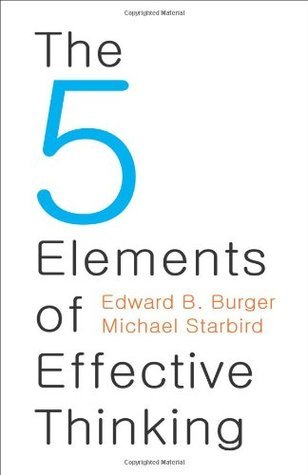
What the Book Means by Effective Thinking
Burger and Starbird begin by challenging one of the most persistent myths about intelligence: the idea that exceptional thinkers simply see answers that ordinary people cannot. Great ideas often look obvious after they have been discovered, while expert performances can appear effortless when the years of experimentation behind them are invisible. The authors want readers to replace this picture of mysterious brilliance with a developmental model in which expertise grows from repeated habits of attention, correction, inquiry, and revision.
The Preface therefore makes two large claims. First, the same broad habits of thinking can contribute to better performance in very different fields, from mathematics and science to business, art, education, relationships, and everyday decision-making. Second, those habits can be taught. Burger and Starbird do not present effective thinking as a rare personality trait available only to unusually gifted people; they present it as a collection of behaviors that ordinary people can practice more deliberately.
The Introduction illustrates this idea through Mark, a student whose mathematical ability changes after he changes how he studies. The important transformation is not that Mark suddenly gains more innate talent. Instead, he stops treating mathematics as a collection of procedures to remember and begins rebuilding his understanding from foundational ideas. Once he starts asking what concepts actually mean and identifying where his comprehension is incomplete, material that previously seemed difficult becomes more coherent.
This distinction between familiarity and understanding runs throughout the book. A student may recognize a formula, repeat a definition, or reproduce a technique without possessing a flexible grasp of the idea underneath it. Burger and Starbird therefore treat effective thinking as active reconstruction rather than passive recognition. If you cannot explain why something works, see how its pieces connect, or identify where your understanding stops, you probably know less than you think.
The five-element framework is introduced as a practical memory system for the habits that correct this problem. Earth means grounding yourself in fundamental ideas and understanding them deeply. Fire means using mistakes as information rather than treating them only as evidence of failure. Air means generating questions instead of merely responding to questions other people ask. Water means recognizing that ideas have histories and futures, so understanding where they came from can help you extend them. The fifth element, Change, asks whether you will actually incorporate these practices into your normal way of thinking.
The book is consequently meant to be used rather than merely consumed. Burger and Starbird suggest that an initial reading can establish the framework, while later readings should involve active experimentation with the exercises. The goal is eventually to make the techniques so ordinary that a reader does not need to consciously remember “Earth” or “Fire” before using them. The elemental language is scaffolding for habits that should ultimately become automatic.
The Complete Five-Element Method
The five elements are sometimes summarized in a single sentence each, but doing so misses most of the book. Every chapter contains several distinct techniques, and the sequence matters because later elements assume the kind of intellectual honesty developed earlier. Burger and Starbird move from understanding what is already present, through discovering what is wrong or missing, toward creating new questions and new ideas, before ending with the problem of making those behaviors habitual.
This progression also explains why the book is more useful as a method than as a collection of slogans. “Understand deeply,” “learn from failure,” and “ask questions” are easy phrases to agree with; the practical challenge is knowing what those instructions look like when confronting an exam, a difficult project, a weak draft, an organizational problem, or an idea that seems finished. The chapters attempt to make those abstractions concrete.
Earth: Understand Deeply
Earth represents the solid ground of effective thinking. Burger and Starbird’s argument is that people often try to become advanced by moving away from basic material as quickly as possible, when experts frequently distinguish themselves by understanding basic material more deeply than everyone else. Sophistication is therefore not the opposite of simplicity. It is often what results when simple ideas have been examined with unusual care.
An early example involves a student named Silas, who receives a score of 58 percent on an examination while believing he understood the material. The point is not the number itself but the mismatch between confidence and demonstrated understanding. Recognition can create an illusion of competence: a textbook page looks familiar, a lecture seems easy to follow, or a worked solution appears obvious when someone else performs it. None of those experiences proves that the learner can reconstruct the reasoning independently.
Burger and Starbird therefore recommend repeatedly asking what you genuinely know. One exercise asks the reader to take a subject and reproduce as much understanding as possible without external help before checking notes or references. The comparison between what seemed familiar and what can actually be reconstructed exposes the difference between passive familiarity and usable knowledge.
The same principle is illustrated through trumpeter Tony Plog. Advanced musicians may possess the technical ability to perform difficult passages, yet the quality of mastery becomes especially obvious when an expert performs something apparently elementary. A basic warm-up played by a great musician can reveal more control, precision, tone, and understanding than a superficially difficult performance by a weaker player. The lesson is that mastery does not leave fundamentals behind; it continually deepens them.
From this comes one of the chapter’s central exercises: master the basics. A learner should identify the foundational pieces beneath a larger skill and choose one for unusually careful attention. Someone studying mathematics might return to a definition normally taken for granted, while a writer might examine sentence structure, a musician might isolate tone production, and a manager might ask what fundamental objective a recurring process is meant to achieve.
Burger and Starbird extend the idea of fundamentals to large goals. The American Moon program becomes an example of how apparently impossible achievements can be decomposed into smaller problems. The Apollo landing did not emerge from a single gigantic leap of competence. Earlier missions solved narrower questions about navigation, communication, spacecraft control, lunar observation, and other prerequisites, with missions such as Ranger 7 forming part of the longer progression toward landing people on the Moon.
The lesson is to convert intimidating goals into controllable subproblems. Their exercise “sweat the small stuff” asks the reader to locate a small action that can be performed now instead of staring at an enormous desired outcome. A person who feels incapable of fixing an entire schedule might ask what can be accomplished during one protected period without distraction. Small problems are not necessarily trivial; they can be the actual structure out of which large achievements are built.
The chapter next turns from fundamentals to essentials. Deep understanding does not mean collecting every possible detail. It means learning which details carry the structure of the problem and which are incidental. Burger and Starbird use visual examples such as Where’s Waldo? to show how clutter can hide what matters. In real intellectual work, irrelevant information can be just as distracting.
The useful question becomes: what can be removed without destroying the essential mechanism? This approach can clarify technical subjects, but the authors also apply it to ordinary decisions. A parent overwhelmed by dozens of immediate behavioral questions, for example, might first identify one or two fundamental aims for the kind of person the child should become. Individual choices can then be evaluated in relation to those deeper aims.
Deep understanding also requires learning to see what is actually there, rather than what expectation says should be there. An art teacher’s observation that shadows can carry reflected colors from the sky illustrates how assumptions become perceptual filters. Someone who thinks “shadows are dark” may literally fail to notice blue or other colors present in them because the category substitutes for observation.
Burger and Starbird connect this problem to intellectual bias. People routinely replace evidence with what they expect the evidence to mean. The antidote is to separate observation from interpretation and to state as precisely as possible what the evidence itself establishes. In conversation, the same habit means distinguishing what another person literally said from the motives or implications we immediately assign to it.
Their historical discussion of Aristotle and Galileo serves a similar purpose. Traditional accounts often portray Galileo dramatically dropping objects from the Leaning Tower of Pisa to contradict Aristotelian physics, although the book acknowledges that the famous demonstration is historically uncertain. What matters to the authors is the epistemic lesson: inherited authority can become so powerful that people stop checking whether observation actually supports the inherited claim.
One of the most useful Earth exercises therefore asks readers to try on alternatives. Rather than instantly defending their current opinion, they should temporarily construct the strongest plausible version of an opposing view. The purpose is not forced neutrality. It is to prevent intellectual identity from becoming a substitute for examining evidence.
The final Earth technique is seeing what is missing. Familiar conditions often become invisible precisely because nobody imagines an alternative. Burger and Starbird suggest mentally adding adjectives to concepts usually treated as neutral. Once a photograph can be called a “black-and-white photograph,” for example, black-and-white stops being the default definition of photography and becomes one possible form among others.
The story of Sylvan Goldman and the shopping cart makes this practical. Shoppers once carried whatever they intended to buy, which created an unnoticed constraint: their purchases were limited by what their arms or baskets could hold. Goldman’s innovation emerged from noticing the invisible limitation. The useful question was not only “What are shoppers doing?” but “What are they prevented from doing because of the current arrangement?”
A student named Caroline applies the same logic to education by describing conventional schooling as “nonindividualized education.” Once the supposedly neutral system acquires an adjective, its structure becomes easier to question. The possibility of individualized alternatives becomes visible because the existing arrangement is no longer treated as inevitable.
Earth therefore contains much more than the familiar advice to “learn the basics.” Its four movements are to understand fundamentals deeply, separate essential structure from clutter, observe reality without allowing assumptions to substitute for it, and notice absent possibilities. Together they establish the intellectual honesty on which the other elements depend.
Fire: Fail to Succeed
Fire begins with a deliberate reversal of the normal emotional meaning of error. Most people are trained to treat mistakes as negative results that should be minimized, hidden, or forgotten. Burger and Starbird instead ask what information a mistake contains and how that information can be turned into the next attempt.
Their recommendation is more demanding than simply feeling good about failure. Failure is valuable only when examined. An incorrect answer can identify a false assumption, reveal a missing concept, expose a poorly framed question, or generate material for a better version. The mistake must therefore remain visible long enough to teach something.
An exercise called “fail nine times” is designed to loosen the fear that every attempt should succeed. By expecting a series of failures, the reader changes the psychological meaning of an unsuccessful attempt. Error becomes one stage in an iterative process rather than a verdict about ability.
The chapter’s central example is a student named Mary, who confronts a mathematical problem involving infinity. Her first attempt is incorrect, but the important event is what happens next. Instead of discarding the entire solution and starting from nothing, she asks which part fails, repairs that part, and examines the revised result. Each correction reveals something about the next weakness, gradually transforming an unsuccessful approach into a much stronger one.
That process captures the chapter’s deepest idea. A failed attempt often contains more useful information than no attempt at all. A person staring at a blank page has nothing concrete to diagnose, whereas a flawed paragraph can be cut, rearranged, expanded, or rewritten. Burger and Starbird therefore advise writers and creators not to wait for a perfect beginning. Produce something imperfect enough to examine.
They apply the same principle to their own book, which did not emerge fully formed. Revision is not evidence that the original effort was worthless; it is how the final form becomes possible. The point resembles philosopher Lester Reiss’s practice of assigning “My View of the World” more than once. When students revisit a broad question later, differences between their answers reveal intellectual development that a single submission could never show.
The educational implication is that mistakes can deserve more careful treatment than merely being marked wrong. If a teacher studies why an answer failed, the error becomes evidence about the learner’s conceptual model. Allowing students to demonstrate later understanding can likewise shift attention from whether they failed at one moment to whether their thinking improved.
Fire then expands beyond repairing the original mistake. Sometimes a wrong answer to one question is a useful answer to a different question. The classic business example is Spencer Silver’s adhesive at 3M. Silver developed an adhesive that was weaker than what he originally sought, which made it a failure relative to the initial objective. Arthur Fry later recognized that the apparently defective property made the adhesive useful for a removable bookmark, helping produce the Post-it Note.
The underlying question is powerful: If this does not solve the problem I intended to solve, what problem does it solve? That shift prevents a thinker from defining usefulness too narrowly. An unexpected result may reveal an application that would never have appeared if the failed original purpose had led directly to rejection.
The exercise “have a bad day” extends this attitude to ordinary experience. Instead of labeling an entire day a failure, the reader can identify exactly what went wrong, which decisions contributed, what conditions were outside control, and what information can be reused. The goal is not artificial positivity. It is to convert undifferentiated frustration into specific knowledge.
Burger and Starbird then go further by recommending intentional failure. A thinker can deliberately create exaggerated, unrealistic, or defective versions of a problem in order to reveal its hidden structure. One example involves imagining an educational experience with unlimited resources. The resulting fantasy may be impossible to implement, but individual features extracted from it—such as moving some learning outside the classroom—may be practical.
This resembles stress testing an idea by pushing it beyond ordinary limits. If an argument becomes absurd when one of its assumptions is exaggerated, the exaggeration may expose a weakness that ordinary cases conceal. The exercise “exaggerate to generate errors” therefore treats wrongness as an experimental tool.
Fire is consequently not an invitation to celebrate incompetence. Its method is iterative and diagnostic: produce an attempt, identify its weaknesses, salvage what works, discover what the failure reveals, and try again. The more informative the failure becomes, the less reason there is to fear it.
Air: Be Your Own Socrates
If Fire teaches readers how to respond when something goes wrong, Air teaches them how to create intellectual movement before anyone supplies a problem. Burger and Starbird argue that questions are not merely requests for missing information. Generating a good question is itself a form of thinking.
Many educational settings encourage the opposite habit. Students are given questions by teachers and rewarded for supplying answers. Once an answer has been produced, the intellectual task appears finished. Burger and Starbird want readers to reverse this relationship by learning to generate questions even when answers already exist.
Their most memorable illustration is Richard Feynman’s participation in the investigation of the Challenger disaster. Amid technical explanations about the shuttle, Feynman focused attention on how low temperature affected the rubber O-ring material and famously used ice water to make the issue tangible. The example demonstrates the power of a relatively simple question when complicated discussion has obscured the practical mechanism that matters.
This connects to the authors’ defense of seemingly basic questions. People often remain silent because they fear revealing ignorance, yet the supposedly embarrassing question may expose an assumption everyone else has accepted without examination. Effective questioning therefore requires intellectual courage as well as curiosity.
One of the chapter’s strongest exercises is teach to learn. A person who believes they understand a subject should try to explain it as though teaching someone else. Preparing a lesson forces the learner to confront definitions, motivations, examples, causal relationships, and missing steps that passive review can hide.
Mark reappears here after becoming a mathematics teacher. Teaching calculus makes him understand it in ways that merely taking calculus as a student did not. When another person’s understanding depends on your explanation, vague familiarity is no longer sufficient; you must know where the idea begins, why each step follows, and how to respond when the learner misunderstands.
Burger and Starbird reinforce the point with a comic reference to Seinfeld: receiving a piece of information is cognitively different from being required to generate an explanation. The person doing the explaining must organize knowledge rather than simply recognize it.
The book also uses questioning to examine education itself. If students complete homework slowly with access to notes and assistance but then take tightly timed examinations under entirely different conditions, what capability is actually being practiced? Whether or not one agrees with every implication of the example, it demonstrates the authors’ habit of asking whether an activity genuinely trains the performance it is supposed to prepare.
Question generation can also enliven passive experiences. Burger and Starbird recommend creating questions during lectures, meetings, reading, concerts, museum visits, or media consumption. A listener who is continuously asking “Why this?”, “What follows?”, “What assumption is being made?”, or “How could this be tested?” is participating intellectually rather than merely receiving information.
Teachers can encourage the same habit by requiring students to generate questions rather than ending a lecture with the often ineffective “Any questions?” Students may not know what they are confused about until they are forced to formulate an inquiry. Writing potential examination questions similarly requires them to decide which ideas are central and how those ideas could be tested.
Air becomes even more powerful when the authors turn from generating questions to improving them. Many questions are proxies for deeper objectives. Someone asking how to earn more money may really want greater security or autonomy. A student asking how to get a higher exam score may actually need to ask how to understand the material well enough that the score follows from competence.
The distinction matters because poorly framed questions produce narrow solutions. If the real goal is durable knowledge, strategies designed solely for short-term examination performance may be counterproductive. Burger and Starbird compare preparation with physical training: the decisive capability is developed before the moment of performance rather than improvised during it.
The traffic example makes the same idea practical. A commuter asking “How can I eliminate traffic?” may be asking a question over which they have little control. A better question might be “What useful purpose can I make of this commuting time?” Reformulating the problem does not remove congestion, but it converts an uncontrollable condition into an actionable decision.
The meta-question takes this one step further. Before solving a task, ask what the task is actually meant to accomplish. That move protects people from becoming extremely efficient at solving the wrong problem. A humorous story involving a bear reinforces the principle: the urgent practical objective may differ sharply from the abstract problem that initially seems to demand a solution.
Air therefore rejects the idea that good thinking consists primarily of supplying answers. Questions identify gaps, expose assumptions, direct attention, clarify goals, and generate new intellectual paths. The quality of inquiry becomes at least as important as the speed of response.
Water: Look Back, Look Forward
Water contains the book’s most developed account of creativity. Burger and Starbird argue that the common image of innovation as a glowing lightbulb can be misleading because it encourages people to imagine that important ideas appear suddenly and independently. In reality, most ideas emerge from earlier ideas and become foundations for later ones.
The authors therefore ask readers to see ideas as streams. Understanding an idea means knowing not only what it is now but also where it came from, what problem it answered, which earlier concepts made it possible, and what future possibilities it may create. This historical and prospective view changes learning from accumulation into connection.
Calculus provides one example. Experts do not understand a difficult subject by storing thousands of disconnected facts. They organize details around a smaller network of foundational principles, relationships, and conceptual developments. New information becomes easier to retain because it has somewhere to attach.
The exercise think back asks readers to reconstruct an idea’s ancestry. What earlier problem made this idea necessary? What previous version was incomplete? Which conceptual step transformed the old approach into the current one? This method turns intellectual history into a tool for present understanding rather than background trivia.
A student named Juan demonstrates the idea while reading a Cold War novel. Rather than treating the story’s characters and circumstances as appearing from nowhere, he imagines what earlier history could have produced them. Constructing a plausible “prequel” forces him to think about causes, motivations, and conditions implicit in the present narrative.
Burger and Starbird then reverse the direction. Once you understand an idea, guess what comes next. Prediction forces knowledge to become active. Even an incorrect prediction is useful because it reveals what relationships the learner thought were important.
Burger describes an art-history class in which students tried to predict the next subject or development in the course. The value did not depend primarily on guessing correctly. Students had to ask what logic connected one artistic movement with another and what tensions in the current material might generate the next stage.
The process also moves backward recursively. Advanced material can change how elementary material is understood. A learner who returns to fundamentals after mastering later ideas often sees relationships that were invisible the first time. This is one reason expertise remains deeply connected to Earth: Water continually sends the thinker back toward the foundations.
Burger and Starbird emphasize that major innovations usually emerge through small conceptual steps rather than complete discontinuities. Impressionism serves as an artistic example. What later becomes part of the accepted artistic landscape can initially look radical because viewers see the new work without seeing all the intermediate changes that made it possible.
This leads to the second major Water movement: creating new ideas from old ones. The thinker should not ask only “What does this mean?” but also “What can this become?” Existing ideas are raw material rather than finished monuments.
Thomas Edison is invoked to represent the principle of beginning where others stopped. The electric light did not end technological development; it created new systems, industries, infrastructures, and possibilities that later innovators extended. The telephone likewise changed through generations of development rather than existing in one final perfected form from the beginning.
The same approach applies outside technology. A business can extend an existing transaction mechanism into a new environment, as Pierre Omidyar did when the auction model became part of eBay. The novelty does not require inventing every underlying component from nothing. Creative work often comes from recombining familiar mechanisms under new conditions.
The corresponding exercise asks readers to extend ideas. Change one assumption, transfer the method into another domain, combine it with something else, or ask what limitation prevents the current version from doing more. Creativity becomes an activity that can be prompted rather than an event that must be awaited.
The chapter adds another principle that is easy to neglect once something works: the best can get better. Success often produces complacency because a functioning solution feels finished. Burger and Starbird instead treat successful solutions as particularly valuable starting points because their strongest features can be preserved while remaining limitations are improved.
Ransom Olds and early assembly-line production provide an industrial illustration of a successful method becoming material for further development. The same attitude applies personally. People often devote all improvement efforts to weaknesses, yet a strength can also be extended significantly.
Water finally asks readers to think farther into the future. What consequences might today’s practices create? What assumptions will future observers find strange? The exercise “What were they thinking?” asks readers to imagine which contemporary institutions might eventually seem misguided.
The example of making school failures part of a permanent record is deliberately speculative. Burger and Starbird do not claim certainty that future societies will reject such systems. The exercise is about loosening the assumption that current arrangements are permanent merely because they are familiar.
The chapter closes with the image of something permanently under construction. A building may be complete enough to use while still undergoing maintenance and improvement. People, relationships, careers, institutions, and ideas can be understood the same way. There is no reason to equate usefulness with finality.
Water therefore provides the conceptual bridge to the fifth element. If ideas are always capable of further development, then the thinker must also remain capable of becoming different from the person who produced the previous version.
The Quintessential Element: Transform Yourself
The fifth element is deliberately unlike the other four. Earth, Fire, Air, and Water already contain the book’s main cognitive techniques. Change asks whether those techniques will remain interesting concepts or actually alter behavior.
Burger and Starbird play with the historical notion of “quintessence,” once imagined as a fifth substance distinct from the four classical elements. Their version is ironic because the quintessential element is not an eternal unchanging substance but change itself. Effective thinking requires the willingness to revise strategies, assumptions, habits, and even aspects of identity.
This chapter confronts the gap between knowing and doing. A diet book can contain correct instructions while changing nothing if the reader never follows them. The same is true of a thinking book. Understanding why questions matter is not equivalent to asking better questions under pressure, and agreeing that mistakes are useful does not mean a person will examine rather than hide the next mistake.
The authors introduce the idea of expert change: superior performers often do not simply perform the same difficult task more forcefully than beginners. Their understanding transforms the task into something cognitively different. The difference between attempting to write with one’s eyes closed and with one’s eyes open offers a simple analogy. Better information can fundamentally change what the task requires.
Tennis provides another example. A novice may experience returning the ball as an unpredictable reaction problem, while a more skilled player tracks cues that make the ball’s movement more interpretable. The expert is not merely reacting faster; the expert has learned to see a different problem.
Burger and Starbird apply this to physics students who “plug and chug” formulas without knowing what the quantities mean. For such students, each exercise becomes a hunt for the right equation. A student who understands where the equation comes from and what relationships it expresses is solving a more structured problem.
History works similarly. A disconnected sequence of dates is difficult to remember because every fact competes as an independent item. Once events are embedded in geography, political objectives, alliances, causes, and consequences, a larger amount of information can become easier to retain because the details now belong to a coherent structure.
A skilled pianist likewise does not experience a piece of music as thousands of unrelated finger movements. The performer recognizes phrases, harmonic relationships, patterns, and musical intentions. Expertise reorganizes complexity.
The exercise “expert change” therefore asks what an expert knows or perceives that turns an apparently difficult task into a different task. Instead of asking only how to try harder, the learner asks how better understanding could change the representation of the problem.
The chapter then turns to ability. Burger and Starbird do not claim that every person has identical natural capacities, but they resist using limitations as an excuse for accepting one’s current level. Mary, whose iterative failure appeared earlier, returns as evidence that an improved strategy can make someone appear far more capable without any mystical change in innate intelligence.
The authors briefly invoke the popular 10,000-hour discussion of expertise, but their main interest is not the exact number. They ask readers to focus on what happens during the thousands of individual practice sessions. Hours become meaningful when the person uses them to understand fundamentals, diagnose errors, ask questions, connect ideas, and adjust strategy.
Albert Einstein becomes an example of flexibility when confronted with reasoning that undermines a chosen approach. The admired behavior is not stubborn defense of one’s earlier position but willingness to abandon a strategy when better reasons appear. Intellectual strength therefore includes changing one’s mind efficiently.
Burger and Starbird also connect change to education through inquiry-oriented mathematical teaching associated with R. L. Moore. The example of a student, Sam Y., struggling with a problem over a holiday illustrates a model of learning in which students are pushed toward independent construction rather than receiving every method ready-made. The difficult struggle matters because the student eventually owns the reasoning rather than merely repeating it.
The final behavioral illustration concerns the authors’ friend Lee and substantial weight loss achieved through sustained changes in habits. The point is not dieting itself. It is the difference between temporarily forcing a behavior and becoming a person for whom the new behavior has become normal.
The book ends by widening the importance of effective thinking beyond grades, careers, or productivity. Independent judgment affects how people assess claims, form values, and participate in society. Deep understanding, learning from mistakes, questioning assumptions, tracing the development of ideas, and remaining open to change are therefore presented not merely as achievement strategies but as habits of intellectual citizenship.
A Brief Review: Turning the Elements into Practice
After the five chapters, Burger and Starbird compress the framework into a practical review. This closing material matters because it reveals what the authors actually expect readers to do: the elemental names are memory devices, while the exercises are the behavioral content of the system. The book is meant to leave the reader with repeatable prompts rather than a set of ideas to admire.
Earth’s practices include mastering basics, identifying what you truly know, reducing a problem to smaller pieces, isolating essentials, describing what is actually present, trying on alternative perspectives, and looking for invisible limitations. Together these exercises train attention: the thinker repeatedly checks whether apparent understanding is genuine.
Fire’s exercises involve expecting failed attempts, producing imperfect drafts, extracting lessons from bad experiences, and deliberately exaggerating ideas to discover weaknesses. The recurring principle is that a concrete error is often more useful than an untouched possibility because it can be analyzed.
Air’s exercises ask readers to teach material, improve the questions they ask, and formulate meta-questions about what a task is actually meant to achieve. The goal is to prevent thinking from becoming purely reactive. Instead of waiting for the world to present the correct question, the reader learns to construct it.
Water asks readers to trace ideas backward, extend them forward, iterate existing solutions, improve successful approaches, and imagine how current assumptions may appear from the future. The exercises transform creativity from a demand to “be original” into a series of modifications that can be attempted deliberately.
The quintessential exercises then return to expert change and personal transformation. The reader is asked to identify how a more skilled person would represent the problem differently and to make the preceding habits part of ordinary behavior. The brief invitation to share personal stories reinforces the authors’ conviction that the framework should continue accumulating examples through use rather than remain closed within the book.
How the Five Elements Work as One System
The five elements are easiest to remember separately, but they become more interesting when treated as a cycle. Earth gives the thinker material worth working with; Fire exposes defects in that understanding; Air converts uncertainty into better questions; Water places answers in a larger stream of ideas and encourages extensions; Change makes the entire process repeat as a normal habit. Each element therefore solves a weakness that would arise if one of the others were practiced alone.
Earth without Fire can produce rigid expertise. A person may know fundamentals deeply yet become so attached to existing understanding that errors feel threatening. Fire prevents foundations from hardening into dogma by requiring the thinker to examine where current knowledge fails.
Fire without Earth, however, can degenerate into random trial and error. Mistakes become informative only when the thinker possesses enough understanding to interpret what went wrong. This is why the order matters conceptually even if readers do not always apply the elements in a fixed sequence.
Air gives the interaction direction. Once an error exposes a gap, the thinker needs a question that identifies what should be investigated. “Why did this fail?”, “Which assumption was false?”, and “What problem does this unexpected result solve?” convert a mistake into an inquiry.
Water then expands the inquiry beyond the immediate problem. A new answer can be traced backward to understand its origins or projected forward to imagine its implications. The same answer may become the starting point for another version, another application, or another question.
Change is the feedback mechanism that prevents the whole process from remaining theoretical. If the thinker refuses to abandon an old method, none of the other elements can function fully. Deep understanding may reveal a false assumption, failure may expose a defect, questions may identify a better path, and Water may generate an extension, but improvement still requires acting differently.
The model is therefore recursive rather than strictly linear. A Water-generated idea becomes new material requiring Earth-level understanding. Testing the new idea produces Fire. The resulting problems stimulate Air, whose questions generate further Water-like extensions. Change allows the loop to continue.
This recursive character is one of the book’s strongest features because it avoids presenting creativity as a final stage reached after learning. Learning and creation become versions of the same process. Understanding creates the conditions for experimentation, while experimentation creates new material requiring further understanding.
The elemental metaphors are not perfect theoretical categories. Some practices overlap heavily: seeing what is missing in Earth already resembles questioning, while intentionally exaggerating a problem in Fire can also generate Water-like innovation. The divisions work better as mnemonic emphasis than as a scientifically precise taxonomy.
That does not make them useless. Practical frameworks often succeed because they give people memorable prompts at moments when abstract theory would be forgotten. “Go back to Earth,” “use the Fire,” or “follow the Water” can function as compact reminders of a much richer set of behaviors.
The most important unifying insight is therefore not that human cognition literally consists of five elements. It is that stronger thinking repeatedly alternates between stability and revision. You need enough confidence to build knowledge carefully and enough humility to treat that knowledge as unfinished.
The Book’s Exercises, Examples, and Teaching Philosophy
Burger and Starbird teach primarily through concrete cases. Students misunderstand mathematics, teachers redesign assignments, historical figures pursue questions, businesses notice overlooked possibilities, and familiar activities become miniature experiments in perception. These examples give the book unusual practical energy, but they also reveal the distinction between its pedagogical strengths and its evidentiary limitations.
The authors’ educational backgrounds are especially important here. Their strongest examples involve situations where a learner believes something has been understood but has not yet developed an independent grasp of it. They repeatedly push readers toward reconstruction: explain the concept without notes, teach it to someone else, solve a problem without being given the procedure, analyze the failed attempt, or predict what should happen next.
That philosophy treats learning as something the student must actively produce. A teacher can provide information, but understanding is demonstrated only when the learner can use, reorganize, question, and extend that information. The book is therefore closely aligned with inquiry-oriented teaching even though it is written for a general readership rather than as an educational-theory text.
The exercises are also cleverly small. Burger and Starbird rarely demand a total reinvention of one’s life. They ask for one topic to understand more deeply, one opposing view to inhabit temporarily, one failed draft to diagnose, one question to improve, or one idea to extend. This makes the framework psychologically manageable.
Their examples are strongest when they clarify a mechanism. Mary shows how an incorrect solution can be iteratively repaired. Mark demonstrates why explaining knowledge can deepen it. Sylvan Goldman’s shopping cart illustrates invisible constraints. These stories help a reader understand what to do differently.
They are less persuasive when treated as evidence that the same method will produce large benefits in every domain. An anecdote can show that something happened and make a principle intelligible, but it cannot establish how frequently the result occurs, whether alternative explanations exist, or whether the method generalizes across populations.
That distinction matters because the book sometimes moves quickly from educational situations the authors know extremely well into business, career, personal-development, or social applications. A contemporary review in Foreword Reviews made a similar observation, praising the mnemonic framework while finding some business and everyday examples less convincing than the classroom material.
The best way to read those weaker examples is therefore illustrative rather than demonstrative. They show how a thinking habit might be applied without proving that it produces the promised outcome. When understood that way, the book remains useful without requiring every anecdote to bear more empirical weight than it can support.
The final practical review reinforces this interpretation. Burger and Starbird want readers to run repeated experiments on their own thinking. The exercises invite feedback: if teaching an idea exposes confusion, return to the fundamentals; if a failed attempt reveals nothing, change how the attempt is analyzed; if a question produces no useful direction, improve the question.
The resulting pedagogy is unusually compatible with the book’s own philosophy. Rather than asking readers to accept the framework because two successful professors endorse it, the exercises repeatedly create opportunities for readers to discover where their thinking changes. The most persuasive evidence for an individual reader is therefore partly experiential, although personal success still should not be confused with universal proof.
What Later Learning Research Supports—and Complicates
The book was written as a practical thinking guide rather than a systematic review of cognitive science, so it would be unfair to demand that every anecdote function like a controlled experiment. Still, its central promises are empirical enough to invite comparison with later educational research. That comparison is encouraging in several areas, but it also makes the necessary conditions behind some of the book’s slogans much clearer.
The most defensible conclusion is neither that research has “proven the five elements” nor that the framework is merely inspirational. Several practices Burger and Starbird recommend overlap with well-studied learning techniques, while others involve broad claims about transfer, mindset, or expertise that require more caution.
Critical Thinking Can Be Taught, but Context Matters
The Preface’s broadest proposition is that thinking can improve through instruction. That claim receives meaningful support from a large meta-analysis of critical-thinking instruction by Philip Abrami and colleagues, which synthesized hundreds of effects across educational interventions.
The overall picture was positive but heterogeneous. Instruction designed to develop critical thinking can help, yet outcomes vary substantially with the design of the intervention. Features such as dialogue, authentic or situated problems, and mentoring appear important, suggesting that “teach people to think better” is not a single standardized technique.
This fits the strongest parts of Burger and Starbird’s method. Their exercises rarely treat thinking as a detached list of abstract rules. They ask readers to work on actual material, explain reasoning, identify errors, and interact actively with problems.
At the same time, the research cautions against assuming automatic transfer. Learning to reason effectively in mathematics does not guarantee identical improvement in politics, business, interpersonal judgment, or every unfamiliar domain. Knowledge matters, and many critical-thinking skills remain partly dependent on the subject in which they are used.
The book’s claim that similar habits can help across domains is therefore plausible as a guiding principle, but the strongest version of universality goes beyond what the evidence establishes. Thinking habits may travel, yet they often need to be relearned or adapted when the content changes.
Productive Failure Is Conditional, Not Automatic
Fire is one of the book’s most distinctive and attractive ideas, and later research provides substantial support for a carefully defined version of it. Research on productive failure synthesized by Tanmay Sinha and Manu Kapur found that problem solving before explicit instruction can, under appropriate conditions, produce better learning than receiving instruction first.
The crucial phrase is under appropriate conditions. Productive Failure is not simply the experience of getting things wrong. Effective designs usually require learners to have enough prior knowledge to engage with the problem, generate meaningful solution attempts, compare or contrast those attempts, and subsequently receive instruction that helps organize what the struggle revealed.
This sharpens Burger and Starbird’s message rather than undermining it. Mary’s failed mathematical attempts are productive because she examines them and corrects specific weaknesses. A bad first draft becomes useful because it is revised. An exaggerated idea becomes valuable because its absurdity reveals a hidden assumption.
Failure without those later steps may be merely failure. Someone can repeatedly practice an ineffective method, become discouraged, or strengthen a misconception. The popular motivational slogan “fail more” therefore captures only the emotional permission to experiment, not the instructional mechanism that makes error useful.
This is also where Earth becomes necessary for Fire. A learner often needs sufficient foundational understanding to recognize why an approach failed. Productive struggle depends on a balance: the problem must be difficult enough to force active thinking but structured enough that the resulting errors can become interpretable.
Burger and Starbird’s strongest version of Fire already implies this diagnostic process. Modern research simply makes the conditions more explicit and cautions against treating all struggle as inherently beneficial.
Self-Explanation Supports Deeper Learning
Earth and Air repeatedly require readers to articulate what they know. The “What do you know?” exercise asks for independent reconstruction, while “teach to learn” forces the learner to create an explanation another person could follow. These practices overlap with research on self-explanation.
A meta-analysis of self-explanation by Kiran Bisra and colleagues found an overall learning benefit when learners were prompted to explain material to themselves. Such prompts can encourage people to connect new information with prior knowledge, identify missing steps, and make implicit relationships explicit.
This helps explain why Burger and Starbird’s advice often feels more powerful than simple rereading. Familiarity can survive without a coherent internal model, but explanation forces the learner to generate structure. If you cannot explain why the conclusion follows, the gap becomes visible.
Teaching someone else can intensify the same effect because the explanation must anticipate misunderstanding and provide examples. Mark’s experience with calculus fits this mechanism naturally: preparing to teach can reveal that knowing how to perform a procedure is not the same as understanding how to communicate why it works.
The evidence should nevertheless be connected carefully. Self-explanation research does not prove every Air exercise or every claim about questioning. The broader lesson is that active generation and articulation can deepen learning compared with purely passive exposure, which strongly supports the intellectual direction of Earth and Air.
Transformation, Mindset, and Practice Need More Caution
Chapter 5 contains some of the book’s most inspiring language and some of its most vulnerable generalizations. The claim that people can change their approach to learning is well supported at a practical level, but the transition from “strategies matter” to broad implications about achievement, talent, or transformation requires care.
One relevant comparison comes from research on growth-mindset interventions, although The 5 Elements of Effective Thinking is not itself a growth-mindset program. One 2023 meta-analysis by Brooke Macnamara and Alexander Burgoyne argued that academic-achievement effects become extremely small and statistically unreliable in the highest-quality evidence.
A competing 2023 meta-analysis by Jeni Burnette and colleagues reached a more qualified conclusion, emphasizing heterogeneity, intervention fidelity, and the possibility that effects are more meaningful for particular populations and contexts. The disagreement is itself instructive: believing that abilities can develop may matter, but broad motivational beliefs do not automatically translate into large measurable achievement gains.
Burger and Starbird’s method is richer than a simple mindset intervention because it gives readers actual behaviors to perform. Earth, Fire, Air, and Water are not merely beliefs about improvement; they are practices involving explanation, error analysis, question generation, and idea extension. That makes Chapter 5 more defensible when interpreted as “adopt better strategies consistently” than when interpreted as “believing in change will make you successful.”
The book’s brief use of the popular 10,000-hour idea similarly requires qualification. A major meta-analysis of deliberate practice found that practice is meaningfully related to performance but explains only part of the differences among individuals, with the proportion varying considerably by domain.
Burger and Starbird fortunately focus less on defending an exact hour threshold than on improving the quality of practice. That emphasis survives the criticism. If thousands of hours are going to be invested, understanding fundamentals, diagnosing errors, asking questions, and adjusting methods are more useful than merely accumulating time.
The fairest modern interpretation of Chapter 5 is therefore neither radical self-determinism nor fixed ability. Strategies, practice quality, feedback, prior knowledge, opportunities, individual differences, and environmental conditions all matter. The book is strongest when it teaches readers to improve the factors they can influence rather than implying those factors explain everything.
Style and Organization: Why the Element Metaphor Works
The five-element metaphor is the book’s most obvious stylistic invention. None of the individual principles requires Earth, Fire, Air, Water, or quintessence in order to make logical sense, yet the metaphor gives a diverse set of practices a memorable architecture. That mnemonic function is probably more important than conceptual precision.
Earth is the cleanest correspondence because foundations and solid ground fit naturally. Fire works because error can destroy an unsuccessful approach while producing insight from what remains. Air is more playful: questions appear “out of thin air,” emphasizing generation rather than response. Water represents the flow of ideas through past, present, and future, while the fifth element produces the book’s neatest conceptual joke by turning supposedly immutable quintessence into change.
The metaphors also help produce narrative movement. The reader begins by standing on solid ground, risks burning unsuccessful attempts, creates questions, follows intellectual currents, and eventually becomes someone capable of transformation. The sequence gives a short practical book more shape than a conventional list of techniques would have.
Burger and Starbird’s prose is conversational and highly accessible. They move rapidly between classroom examples, historical anecdotes, business stories, humor, personal experience, and short exercises. The tone rarely becomes technical even when the underlying example comes from mathematics.
This accessibility is particularly useful because the book deals with metacognition, a subject that can easily become abstract. Instead of repeatedly defining how people should think about their own thinking, the authors ask them to perform a concrete act: explain something without notes, write a deliberately imperfect version, ask what is missing, or reconstruct where an idea came from.
The frequent exercises also keep the book from becoming purely inspirational. Readers are not merely told that failure is useful; they are asked to produce something imperfect. They are not merely encouraged to be curious; they are asked to manufacture questions. They are not simply told to innovate; they are asked to modify something that already works.
Repetition is both a feature and a weakness. The same core principles reappear in several stories, and readers already persuaded by a technique may occasionally feel that the next anecdote adds little. The final review repeats much of the framework again, although its practical condensation is valuable.
The elemental architecture can also make familiar ideas appear more novel than they really are. A contemporary review recognized this tension: the book’s distinctive achievement lies largely in its accessible organization rather than in the unprecedented originality of every component principle.
That is not necessarily a serious flaw. Practical books are often valuable because they make good ideas memorable enough to use. A concept does not need to be unprecedented to improve someone’s behavior, and Burger and Starbird are generally more interested in application than in claiming ownership over entire traditions of educational thought.
The strongest stylistic choice is ultimately the movement from elemental metaphor to concrete exercise. Readers can remember the metaphor when they need a prompt, then translate it back into behavior. Earth becomes “What do I actually understand?”, Fire becomes “What does this failure reveal?”, Air becomes “What should I be asking?”, Water becomes “Where did this come from and what can it become?”, and Change becomes “What should I now do differently?”
Critical Review: How Effective Is The 5 Elements of Effective Thinking?
The 5 Elements of Effective Thinking should be judged as a concise practical guide rather than as a comprehensive scientific theory of cognition. On those terms, it succeeds remarkably well. Its best contribution is not the discovery of five entirely new principles but the conversion of familiar intellectual virtues into a compact system that readers can remember and apply.
That distinction also clarifies its limitations. The book is pedagogically sophisticated but empirically light, memorable but sometimes repetitive, and strongest in the educational environments the authors know personally. Its broader claims become more convincing when interpreted as practical heuristics than as universal laws of achievement.
The Book’s Strongest Achievement
The book’s greatest strength is that it makes metacognition concrete. “Think better” is useless advice because it does not specify what behavior should change. Burger and Starbird replace that vagueness with actions: rebuild the fundamentals, identify what is missing, analyze an error, generate a question, teach an idea, trace its origin, alter an assumption, and examine how an expert represents the problem.
Earth is particularly valuable because it attacks the illusion of knowledge that afflicts almost every learner. People often mistake recognition for mastery. The chapter repeatedly forces the reader to demonstrate understanding rather than experience familiarity, which makes the book useful far beyond mathematics.
Fire may be the most psychologically liberating element. Fear of error can prevent people from writing, experimenting, speaking, solving difficult problems, or testing uncertain ideas. By giving failure a diagnostic purpose, Burger and Starbird offer a practical alternative to both perfectionism and empty celebration of mistakes.
Air complements Fire by ensuring that confusion becomes directed inquiry. The advice to improve a question rather than merely answer the first version is especially transferable. Many ineffective efforts are not caused by laziness or lack of intelligence but by pursuing a poorly framed objective with great efficiency.
Water provides perhaps the book’s richest account of creativity. Instead of demanding originality from nothing, it shows how new ideas emerge through ancestry, recombination, extension, and incremental improvement. This makes innovation feel less mystical and more approachable without pretending creativity can be reduced to a formula.
Chapter 5 then recognizes an important problem that weaker self-improvement books ignore: knowing a method does not mean using it. Habitual behavior, identity, and willingness to revise one’s approach determine whether the framework survives outside the reading experience.
The book also benefits from brevity. Burger and Starbird could easily have expanded each element into a separate volume, but the compact structure supports the actual purpose. Readers are supposed to remember and reuse the system, not merely finish an impressive intellectual survey.
Its originality should therefore be described carefully. Individual principles such as mastering fundamentals, learning from error, questioning assumptions, and building on previous ideas have long histories. What Burger and Starbird contribute is a particularly elegant organization, a large collection of teaching-oriented illustrations, and a consistent insistence that readers turn each principle into an exercise.
Its Most Important Limitations
The largest limitation is the gap between illustration and evidence. The book contains many persuasive stories showing what a principle looks like, but relatively little systematic evidence about how strongly the principle works, for whom, under what conditions, or compared with alternatives. A memorable anecdote can clarify a mechanism without establishing a general causal claim.
This matters most in Fire. The advice to learn from mistakes is excellent when mistakes are followed by reflection, feedback, correction, and improved understanding. Without those conditions, repeated failure can simply reinforce confusion or discouragement. Modern productive-failure research makes this conditionality clearer than the book does.
The same issue appears in the book’s broad transfer across domains. Burger and Starbird move comfortably from mathematics to business, politics, art, parenting, careers, sports, and personal transformation. The underlying habits may indeed be useful across many of those areas, but applying a general thinking technique still requires domain knowledge.
A person cannot compensate for ignorance of medicine, law, engineering, or economics merely by asking clever questions. Earth itself implies this limitation because deep thinking depends on accurate foundations. General strategies and specific knowledge should therefore be understood as complementary rather than interchangeable.
Chapter 5 occasionally risks overstating personal agency. Strategy matters enormously, but outcomes also depend on aptitude, opportunity, resources, health, environment, quality of instruction, and other constraints. A framework intended to fight defeatism can easily sound as though inadequate progress results mainly from inadequate thinking.
The 10,000-hour discussion reflects the broader culture of performance writing that surrounded the book’s publication. The authors sensibly emphasize quality of practice rather than obsessing over an exact numerical threshold, but contemporary evidence makes it clear that accumulated practice is not a complete explanation for differences in expertise.
Some examples outside education are also less convincing than the classroom material. The authors have exceptional intuition about student learning because they have spent years observing how understanding develops. Business or lifestyle anecdotes sometimes serve more as analogies than as demonstrations of the same mechanism operating under equivalent conditions.
There is also some repetition. Once a reader grasps the central lesson of an element, later examples can feel like variations rather than substantial conceptual additions. The book’s brevity prevents this from becoming a serious problem, but a more rigorous treatment might have exchanged a few anecdotes for deeper discussion of limitations and counterexamples.
None of these weaknesses destroys the book’s central project. It was never intended to be a scholarly handbook of cognitive science. Its flaws mainly limit how literally readers should treat universal claims, not whether the exercises themselves are useful.
The fairest reading is to treat the book as an intelligently designed set of intellectual heuristics. Use the techniques, observe what they reveal, and remain willing—consistent with the fifth element—to modify them when context demands something different.
Who Should Read It—and Is It Still Worth Reading?
The book is especially useful for students who equate studying with rereading, because Earth and Air force them to produce rather than merely recognize understanding. Teachers can also benefit from its emphasis on inquiry, diagnostic mistakes, student-generated questions, and giving learners opportunities to reconstruct ideas independently.
It is equally well suited to people paralyzed by perfectionism. Fire offers a disciplined reason to begin badly: a failed attempt becomes useful when it gives you something concrete to improve. Writers, designers, entrepreneurs, researchers, and other creative professionals may find this reframing particularly valuable.
Readers who feel “uncreative” may benefit most from Water. Burger and Starbird’s model removes some of the pressure to generate unprecedented ideas from nothing. Creativity can begin by asking what an existing idea leaves unfinished, what assumption can be altered, what earlier development led here, or what improvement might follow.
The framework also works well for self-directed learners because its exercises do not require specialized equipment or formal instruction. A reader can test understanding, explain a concept, examine errors, generate questions, and trace ideas independently.
Readers already deeply familiar with learning science, metacognition, deliberate practice, inquiry learning, and creative problem solving will encounter relatively few revolutionary concepts. For them, the book’s value lies primarily in synthesis, pedagogy, and mnemonic design.
It is not the right book for someone seeking a comprehensive scientific account of intelligence or cognition. Nor should it be treated as evidence that five habits have been validated as one experimentally tested intervention. The elemental system is an educational framework, not a neuroscientific model.
Even with those qualifications, the book remains worth reading. Its best advice has aged well precisely because it concerns activities that remain central to serious learning: understand before memorizing, test what you think you know, make attempts visible enough to critique, ask better questions, connect present ideas with their histories, and remain willing to revise successful methods.
The most important achievement of The 5 Elements of Effective Thinking is therefore not convincing readers that they possess unlimited potential. It is more practical than that. Burger and Starbird show that when progress stalls, the next move does not have to be “try harder.” It can be to understand the foundations differently, examine a failure more closely, change the question, trace an idea backward, extend it forward, or alter the way the problem is represented.
That framework is modest enough to be credible and broad enough to remain useful. Its strongest claims survive because they do not require the reader to believe that talent is irrelevant or that every failure is secretly beneficial. They require only the recognition that thinking itself can become an object of practice.
A reader who remembers nothing except the five nouns may enjoy the metaphor but miss the book. The deeper lesson is that knowledge should never become passive possession. It should be tested, questioned, reconstructed, extended, and revised.
For students, teachers, professionals, and lifelong learners who want a compact method for doing that more deliberately, The 5 Elements of Effective Thinking remains an excellent practical guide. Its ideas are not all new, its evidence is not comprehensive, and some claims need modern qualification, but the framework turns durable intellectual habits into actions simple enough to practice and flexible enough to keep refining.
Last Updated on August 26, 2026 by Aseem Gupta