
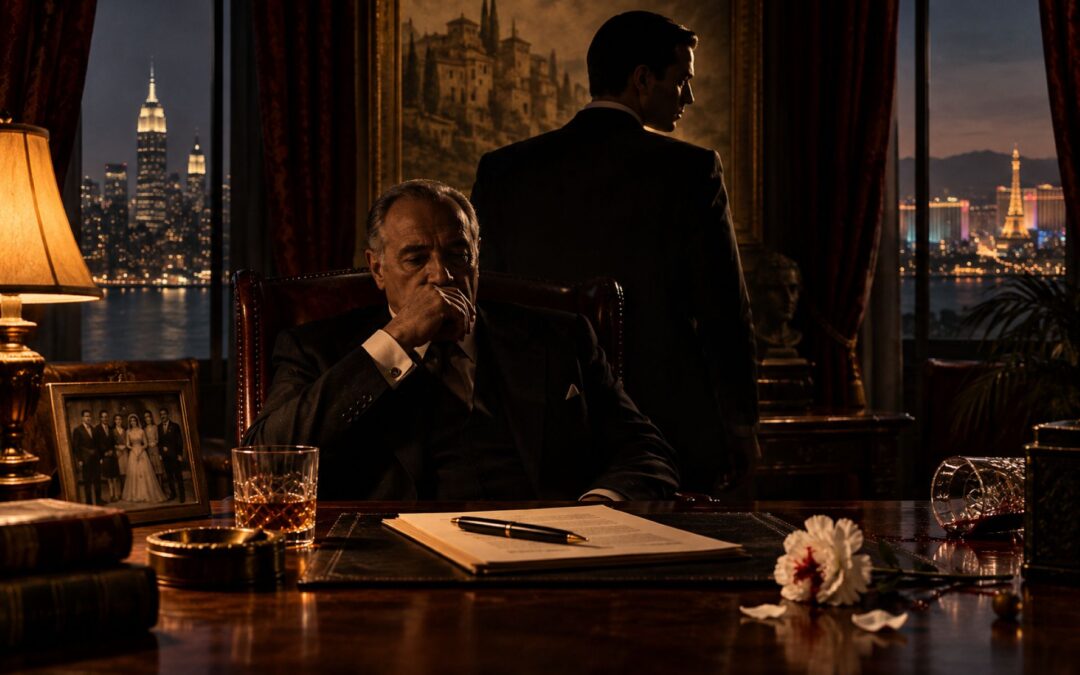
Mario Puzo’s The Godfather, originally published in 1969, is so thoroughly embedded in popular culture that the novel itself can be difficult to see clearly. Francis Ford Coppola’s films supplied some of cinema’s most recognizable performances and images, while phrases, character types, and ideas associated with the Corleones have become cultural shorthand for organized crime. Yet Puzo’s book is a substantially larger, stranger, more sprawling work than the story many readers think they already know. It moves from New York to Hollywood, Sicily, and Las Vegas; devotes long sections to characters barely present in the film; reconstructs Vito Corleone’s rise decades before Michael succeeds him; and ends not with a door closing on Kay, but with Kay attending Mass and praying for Michael’s soul.
At the center of this much larger novel is Michael Corleone’s transformation. When the story begins, Michael is the son who has deliberately defined himself against his father’s world. He has served in the American military, chosen a non-Italian girlfriend, ignored the career plans Vito once imagined for him, and tells Kay Adams stories about his family as though he were describing people to whom he belongs biologically but not morally. By the end, he has not merely joined that world. He has become extraordinarily good at running it, preserving its traditions while making it colder, more strategic, and more compatible with the appearance of legitimate American business.
That transformation matters because Puzo makes the Corleone organization emotionally and institutionally persuasive before exposing its cost. The novel repeatedly places official institutions beside the Don’s private system of authority: courts fail, police can be bought, politicians trade favors, Hollywood power is arbitrary, business operates through leverage, and supposedly legitimate men often prove as self-interested as criminals. Vito answers this imperfect America with another order based on loyalty, gratitude, patronage, family obligation, protection, and enforceable consequences. The attraction of The Godfather lies partly in how efficiently that order appears to work. Its danger lies in what must be done to sustain it.
Spoiler warning: this article covers the complete novel, including every major death, betrayal, murder, marriage, reversal, and the full ending.

The Godfather: Complete Plot Summary
Puzo divides the novel into nine Books containing thirty-two chapters. Rather than following only Michael’s rise, the structure repeatedly leaves the principal Corleone conflict to explore Hollywood, Las Vegas, medicine, romance, Vito’s youth, and the histories of secondary characters whose lives have become connected to the Family. Following that architecture is essential because the apparent digressions show how widely Corleone power extends and how Puzo’s idea of “family” expands far beyond blood relatives.
The novel begins in 1945 and moves principally through the following decade, although Vito Corleone’s earlier life is reconstructed in a long retrospective section. Its main line runs from the wedding of Connie Corleone through an attempted assassination, a gang war, Michael’s exile and return, Vito’s retirement and death, and Michael’s systematic destruction of everyone who threatens his control.
Book I — The Wedding, Sollozzo, and Michael’s First Killings
The novel opens not with Vito Corleone but with Amerigo Bonasera, an undertaker who has tried to live according to the rules of his adopted country. Bonasera believes in American law and has deliberately avoided the older Sicilian networks of personal obligation represented by Don Corleone. That faith collapses after two young men brutally attack his daughter and escape serious punishment. Feeling betrayed by the courts, he goes to Connie Corleone’s wedding and asks Vito to provide the justice America has denied him.
The request immediately establishes the Don’s way of thinking. Vito does not object to vengeance in principle, but he is offended that Bonasera ignored him while life was comfortable and now appears only because the legitimate system has failed. What Vito wants is not cash payment for violence but recognition of a relationship. Bonasera must come as a friend, acknowledge Vito’s authority, and accept that a favor granted creates an obligation that may someday be called upon. Vito then promises that the men who hurt Bonasera’s daughter will suffer, although he carefully limits the retaliation because the daughter was not killed.
Connie’s wedding functions as a panoramic introduction to the Corleone world. Vito is the head of both his biological family and a much larger criminal Family. His eldest son, Santino “Sonny” Corleone, is physically powerful, generous, impulsive, sexually reckless, and widely regarded as the likely heir despite doubts about his judgment. Fredo, the second son, is dutiful and affectionate but lacks the force required to command men. Tom Hagen, a German-Irish orphan effectively adopted into the household, serves as the Don’s lawyer and consigliere. The youngest son, Michael, sits physically apart from the central Corleone gathering with his girlfriend, Kay Adams, making his chosen distance visible.
Michael explains pieces of his family’s history to Kay, including stories about how Vito helped singer Johnny Fontane escape an exploitative contract. Michael relates the incident almost as family folklore and makes the crucial distinction that defines his starting position: his father behaves this way, but Michael does not consider himself the same kind of man. Kay is fascinated and uneasy, while Michael seems confident that he can love his family without inheriting its system.
Other petitions to Vito show the range of his power. Nazorine the baker fears that Enzo, the Italian prisoner of war who loves his daughter, will be forced to leave the United States. Vito arranges political and legal assistance. Johnny Fontane, the Don’s godson and a famous singer whose career and personal life are collapsing, arrives desperate for help obtaining an important film role that could restore him. Vito rebukes Johnny’s self-pity but promises to intervene.
The wedding also introduces smaller tensions that will later become deadly. Sonny begins an affair with Connie’s maid of honor, Lucy Mancini, despite being married with children. Connie’s new husband, Carlo Rizzi, appears attractive and charming but is kept at the edge of serious Corleone business. Vito does not trust him enough to bring him fully inside the organization, a humiliation Carlo will increasingly resent.
Tom Hagen travels to Hollywood to deal with studio chief Jack Woltz, who refuses to cast Johnny Fontane because Johnny seduced a young actress Woltz had been grooming. Hagen first offers a rational arrangement, but Woltz responds with contempt and insists that no amount of influence can change his decision. The Corleones then demonstrate what happens when negotiation fails. Woltz awakens to find the severed head of his prized racehorse Khartoum in his bed. His resistance collapses, and Johnny receives the role.
Puzo quickly establishes that Vito’s violence is not impulsive. Bonasera’s attackers are punished without being killed, and Woltz is coerced only after refusing a deal. The Don prefers leverage, obligation, and controlled intimidation to unnecessary bloodshed. This measured use of force makes the next crisis more significant because it confronts Vito with an opponent who believes the old system must adapt to a more lucrative and dangerous business.
Virgil Sollozzo, known as the Turk, requests a meeting. Backed by the Tattaglia Family, Sollozzo wants investment and political protection for a narcotics operation. The Corleones have enormous value to him not merely because of money but because Vito possesses judges, politicians, police relationships, and other influential connections that could protect the business from its worst legal consequences.
Vito refuses. He is not morally opposed to crime, but he understands that narcotics threaten the political foundation of his empire. Gambling and prostitution can be tolerated by officials who consider them manageable vices; drug trafficking, he believes, will make respectable allies unwilling to continue protecting him. His refusal is therefore strategic rather than ethical.
During the meeting, however, Sonny carelessly reveals interest in Sollozzo’s proposal. Vito immediately recognizes the danger. By allowing an outsider to see disagreement between father and son, Sonny has suggested that the Corleones might change course if Vito were removed. After Sollozzo leaves, Vito warns Sonny never again to reveal his thoughts to people outside the Family.
The Don then sends Luca Brasi, his most feared enforcer, to investigate Sollozzo and the Tattaglias. Luca is supposed to pretend that he is dissatisfied with the Corleones and interested in switching sides. His reputation, however, makes him impossible for Sollozzo to trust. Rather than recruit him, Sollozzo arranges his murder. Luca is immobilized and strangled before he can report back.
Sollozzo next strikes at Vito himself. The Don leaves his office with Fredo and stops at a fruit stand. Gunmen attack him in the street, hitting him with multiple bullets. Fredo is psychologically overwhelmed and unable to respond effectively, while Vito survives despite grave injuries.
Tom Hagen is kidnapped soon afterward. Sollozzo keeps him alive because the consigliere may be useful in convincing Sonny to accept the narcotics deal. Sollozzo assumes Vito will die and argues that war is unnecessary: Sonny appeared interested in the business, and Tom is rational enough to understand that the Family’s best option is to negotiate. Tom privately recognizes the force of the argument. Without Vito, the Corleones may indeed be strategically vulnerable.
Then Sollozzo learns that the Don has survived. The entire calculation changes. Vito is not merely the symbolic head of the organization; his personal relationships are a major part of its political protection. If he recovers, Sollozzo will face an enemy whose authority he tried and failed to destroy.
Michael returns to the Corleone compound at Long Beach after hearing of the shooting. He is still not formally involved in the organization, but he is drawn inside its emergency machinery. Sonny, Tom, Peter Clemenza, Salvatore Tessio, and other senior men evaluate information, organize protection, and search for betrayal. Suspicion falls on Paulie Gatto, one of Clemenza’s men, who had repeatedly called in sick and was conveniently absent when Vito became vulnerable.
Michael begins to understand the Family from inside rather than through stories told to Kay. Men who were merely names to him become participants in a system capable of surveillance, interrogation, negotiation, murder, and political pressure. He does not yet embrace that system, but his proximity to it is already changing.
Clemenza is ordered to eliminate Paulie once the betrayal is sufficiently clear. He brings Rocco Lampone into the operation, giving the younger man an opportunity to prove himself. What appears to Paulie to be an ordinary drive becomes an execution. Rocco kills him, and the successful assignment begins his rise within the organization.
The Family also receives confirmation of Luca Brasi’s death. His bulletproof vest arrives wrapped around a dead fish, a Sicilian message indicating that Luca has been killed and disposed of in water. The gesture turns violence into language. Within the Corleone world, objects, rituals, and coded acts often communicate more efficiently than explicit explanations.
Michael initially tries to preserve his separate life. He meets Kay in the city and remains uncomfortable about how much of the Family’s reality he has concealed from her. His father, however, is still in danger, and Michael visits the hospital.
There he discovers something terrifying: the men assigned to protect Vito have disappeared, and the police presence has been removed. Michael immediately understands that another assassination attempt is coming. He moves his father to another room and calls Sonny for reinforcements.
Enzo, the Italian baker whom Vito helped remain in America, unexpectedly arrives with flowers. Michael realizes that Enzo can be useful even though he is not a gangster. The two men stand outside the hospital entrance, hands in their coats, creating the appearance of armed guards. A suspicious car approaches but drives away.
The scene reveals a crucial difference between Michael and an ordinary civilian. Once the danger passes, Enzo’s hands shake uncontrollably. Michael notices that his own are steady. His calm is not bravado; he appears physiologically suited to the pressure that has defined his father’s life. When he goes back to Vito’s room, he tells his barely conscious father that he is with him now.
The police soon arrive under Captain Mark McCluskey. McCluskey is corrupt and is working with Sollozzo. When Michael challenges the removal of his father’s protection, McCluskey strikes him with such force that Michael’s jaw is badly broken. Tom Hagen eventually arrives with legal reinforcements, preventing the hospital confrontation from becoming another murder attempt, but Michael has now personally experienced how completely legitimate authority can be absorbed into the same corrupt system as organized crime.
Back at Long Beach, the Corleones learn that Sollozzo wants a meeting. Michael proposes that he should attend and kill both Sollozzo and McCluskey. Sonny initially treats the suggestion as absurd because Michael has never been part of the criminal business. Michael, however, explains precisely why that makes him useful. Sollozzo does not regard him as a professional threat, and the police captain’s involvement gives the Corleones a clear reason to make the confrontation look like more than gang rivalry.
Michael’s proposal is the decisive psychological turn. He is not ordered by Vito into crime, and he is not dragged helplessly into a murder. He thinks through the problem and volunteers. His father is endangered, lawful authority has revealed itself as corrupt, and Michael concludes that killing is the effective solution.
Clemenza prepares him. A gun will be hidden in the bathroom of the restaurant where the meeting occurs. Michael must retrieve it, shoot quickly, drop the weapon, and walk away without hesitation. The practical instructions strip murder of cinematic grandeur and treat it as a task that can be rehearsed.
At the restaurant, Sollozzo attempts to reason with Michael in Italian. He wants a settlement and insists that he does not want Vito killed if the Corleones will agree to new terms. Michael listens but no longer trusts any arrangement that leaves Sollozzo alive. He excuses himself, retrieves the planted weapon, returns to the table, and kills Sollozzo.
McCluskey is also shot. Michael leaves the gun behind and escapes. In a few seconds he crosses the line that once separated him from his father’s world.
The consequences are enormous. A police captain has been murdered alongside a major narcotics operator. The Corleones must expose McCluskey’s corruption to reduce public pressure, while Michael cannot remain in the United States. He is secretly sent to Sicily, and the war among the New York Families escalates. The son who began Connie’s wedding insisting that he was different from his family has become a killer in defense of it.
Book II — Johnny Fontane and Hollywood
Puzo abruptly leaves Michael and the New York gang war to return to Johnny Fontane. This change of focus can feel startling because Book I has created enormous momentum, but Johnny’s story enlarges the novel’s definition of power. Hollywood has its own hierarchies, gatekeepers, personal favors, exploitation, sexual politics, and systems of patronage, making it a parallel world rather than merely a celebrity subplot.
Johnny’s glamorous public identity hides a collapsing private life. His singing voice has deteriorated, his drinking is destructive, and he has lost emotional control over relationships. He remains attached to his first wife, Virginia, and to their children, even though his behavior helped destroy the marriage. His later romantic and sexual relationships provide pleasure without stability.
The film role Vito forced Woltz to give him offers a path back to prominence, but Johnny remains afraid that his primary talent is disappearing. Puzo emphasizes that the Godfather cannot simply manufacture artistic ability. Vito can create an opportunity, remove an obstacle, arrange a contract, or frighten an enemy, but Johnny must still perform when the opportunity arrives.
Tom Hagen travels through this world as a representative of Corleone influence. Johnny gradually understands that he should stop behaving like a helpless former star and begin acquiring power of his own. Rather than depend exclusively on singing and acting, he considers producing films, where money, relationships, and decision-making authority can give him a more durable career.
Nino Valenti, Johnny’s childhood friend, enters the Hollywood orbit as well. Nino is talented and naturally appealing but deeply self-destructive. Johnny tries to help him professionally, partly from genuine friendship and partly because he recognizes that the Corleone ethic expects successful men to lift people who were loyal before success arrived.
The two record together, drawing on songs associated with their Italian heritage. Johnny begins reconnecting with an artistic identity that predates his celebrity crisis, while Nino attracts attention and gains opportunities almost effortlessly. Yet their trajectories are already diverging. Johnny has known failure and is learning to turn vulnerability into discipline; Nino’s growing success gives him more access to the drinking habits that are destroying him.
Johnny also learns to work Hollywood politically. Awards, casting, publicity, friendships, and production decisions are all influenced by networks of obligation. Puzo’s entertainment industry is less violent than the underworld, but it is not portrayed as morally pure. People advance through favors, personal loyalties, manipulation, money, sexuality, reputation, and access.
The Johnny Fontane material therefore extends the Corleone model rather than simply interrupting it. Vito’s central lesson is that power should not depend entirely on another man’s goodwill. Johnny’s growth occurs when he stops waiting for studio executives or audiences to restore his old position and begins building an organization capable of sustaining him.
Book III — How Vito Corleone Became the Don
Book III moves backward in time to explain how Vito Corleone became the man who dominates the opening of the novel. Puzo identifies him as Vito Andolini, born in the Sicilian village of Corleone. His father is killed in a Mafia conflict, and the danger extends to the boy because revenge can pass through bloodlines. Vito is eventually sent to America.
In Puzo’s novel, Vito changes his own surname to Corleone as a link to his birthplace. This is one of several details that differs from later screen mythology, but the larger meaning is consistent with the novel’s interest in identity: America offers reinvention, yet Vito carries Sicily into that reinvention rather than severing himself from it.
He grows into a quiet, self-controlled young man. He marries, has children, and works honestly. His early ambition is not to become a criminal boss. The decisive pressure comes from Don Fanucci, a local Black Hand extortionist whose power depends largely on the community’s fear of him.
Fanucci uses influence to force Vito out of legitimate employment so that another man can be placed in his job. Vito does not react immediately with violence. He begins associating with Peter Clemenza and Salvatore Tessio and participates in illegal activities, but he also studies Fanucci. His greatest gift is not physical courage but his ability to observe where other people’s power actually comes from.
When Fanucci demands a share of their proceeds, Vito notices inconsistencies between the man’s reputation and his behavior. He concludes that Fanucci is less protected than everyone assumes. Instead of accepting permanent tribute, Vito decides to remove him.
During a neighborhood festival, Vito tracks Fanucci and murders him. The killing is not presented as an explosion of rage. It is the result of calculation. Once Fanucci disappears, Vito discovers that people who once feared the extortionist are prepared to treat Vito as a protector.
That transition is crucial. Vito does not merely take Fanucci’s place as another bully demanding money. He begins creating relationships by solving problems. Neighbors ask for help because official landlords, employers, police, courts, or politicians often have little reason to care about them. Vito discovers that a favor can create durable loyalty more effectively than an arbitrary threat.
His intervention for a widow threatened by her landlord illustrates the method. Vito approaches Signor Roberto courteously, asking him to reconsider. The landlord initially rejects the request, but after learning who Vito is, his attitude changes dramatically. Reputation has become a form of capital. Vito no longer has to spell out what will happen if he is refused because other people imagine the consequences for him.
At the same time, the Genco Pura Olive Oil Company grows into an important legitimate front and economic base. Genco Abbandando, Clemenza, and Tessio become central collaborators. Trucks, warehouses, employees, political connections, and illicit ventures are gradually integrated into a larger organization.
Prohibition creates opportunities. Gambling, protection, unions, liquor distribution, and other businesses increase the Corleones’ wealth. Vito builds a list of police officials, judges, and political figures who receive money or favors. His instinct is expansive: even a person who cannot help today may become useful later, so relationships should be cultivated before they are urgently needed.
As the organization grows, Vito divides responsibilities. Clemenza and Tessio command separate groups, allowing power to be decentralized while remaining loyal to the Don. The structure becomes more sophisticated than the neighborhood system from which it emerged.
Conflicts with other criminal powers eventually establish Vito as a major underworld figure. His struggle against Maranzano demonstrates the same method that governs his later career: gather information, form alliances, isolate an opponent, strike when the result can be decisive, and turn victory into stable political arrangements instead of endless revenge.
This background explains why Vito and Sonny are so different despite both being dangerous men. Sonny experiences violence as a natural extension of emotion. Vito experiences it as an instrument whose value depends on timing. His reputation rests partly on fear, but the fear works because it is attached to a system of memory, loyalty, and predictable consequences.
By the time the narrative returns to the postwar Corleones, Vito’s empire has become almost inseparable from his personality. That is both its strength and its succession problem. His political relationships, instinct for human motives, patience, and personal reputation cannot simply be transferred like property from one son to another.
Book IV — War, Connie and Carlo, and Sonny’s Death
While Michael remains hidden in Sicily, Kay Adams begins confronting what his disappearance means. Detectives visit her family home in New Hampshire and question her about him. Their suspicions make explicit what the Corleones have not told her: Michael is believed to have murdered Sollozzo and Captain McCluskey.
Kay’s parents understand more about the situation than she expects. The sheltered division she once maintained between respectable America and Michael’s strange family has become harder to preserve. She travels to Long Beach, hoping for information.
Mama Corleone receives her but offers little reassurance. Michael may be gone for years. More importantly, she warns Kay that the man who eventually returns may not be the same person she knew. Kay leaves a letter, maintaining her attachment even though she cannot communicate directly with him.
The novel then turns to Connie and Carlo Rizzi. Carlo entered the marriage expecting that becoming Vito Corleone’s son-in-law would give him wealth, influence, and a privileged place within the organization. Instead, Vito deliberately keeps him away from major Family business and gives him limited economic opportunities.
Carlo interprets this exclusion as humiliation. His frustration becomes cruelty toward Connie. He dominates her sexually and physically, insults her, cheats on her, and beats her. Puzo portrays their marriage within a patriarchal culture that regards a husband’s household as his domain, creating a serious contradiction in Vito’s family ethic. The Don who can intervene in the affairs of strangers refuses to simply take his daughter away from an abusive husband because doing so would violate another part of his traditional code.
Sonny cannot tolerate the abuse with Vito’s restraint. When he encounters Connie after Carlo has beaten her, he tracks Carlo down and attacks him in public. Sonny’s fury is ferocious. He humiliates Carlo physically and establishes that he is capable of killing him if the violence against Connie continues.
Emotionally, the retaliation feels like a defense of his sister. Strategically, it is another example of Sonny exposing himself. He acts visibly, personally, and predictably. Enemies now understand that hurting Connie can make him abandon caution.
Meanwhile, the war among the Families continues. Michael’s murder of Sollozzo and McCluskey has created police pressure and forced competing criminal organizations into a prolonged struggle. Sonny proves energetic and brave, but he cannot produce decisive political results.
He launches raids, disrupts rival operations, and inflicts casualties. The other Families retaliate against Corleone businesses and allies. Bookmakers, union connections, gambling interests, and other revenue sources become targets. The war turns into attrition.
Tom Hagen can analyze this deterioration, but he cannot replace Vito’s authority. As a consigliere he understands law, negotiation, and strategy, yet the older Sicilian power structure does not regard him exactly as it would a traditional wartime counselor. Sonny listens to him but remains ruled by his own temperament.
One of the novel’s most emotionally powerful scenes returns to Amerigo Bonasera. After Sonny is murdered, Bonasera receives a message from Don Corleone and becomes terrified that the favor from the opening chapter is finally being collected. He imagines being ordered to hide evidence of some terrible crime.
Instead, Vito brings him his son’s body. Sonny has been riddled with bullets, and Vito does not want his wife to see him so mutilated. He asks Bonasera to use his skill as an undertaker to make the body presentable.
The moment closes a structural circle. Bonasera came to Vito because his daughter’s injured face symbolized the failure of American justice. Now Vito comes to Bonasera because his own son’s destroyed body represents the failure of the Don’s power to protect his family. The favor is repaid not through murder but through care for the dead.
Sonny’s death is the product of Carlo’s betrayal. Carlo provokes another violent argument with Connie and beats her, knowing the news is likely to reach Sonny. It does. Sonny reacts exactly as expected.
Enraged, he drives toward his sister without waiting for adequate protection. At a tollbooth on the Jones Beach Causeway, gunmen ambush him. He is trapped and killed in a sustained burst of gunfire.
The assassination shatters the Family. Sonny was reckless, but he was also Vito’s son, Connie’s brother, and the most obvious successor. His death removes the person who had been acting as head during Vito’s recovery and leaves the organization in a dangerous position.
Tom Hagen fears what Vito will do when he hears. A conventional revenge cycle could destroy what remains of the Corleone empire. Instead, the recovering Don does something Sonny probably could not have done: he suppresses his personal desire for vengeance long enough to restore strategic control.
Vito orders the immediate bloodshed to stop. He will seek a general peace, even though his eldest son has just been murdered. The choice is not forgiveness. It is evidence that Vito understands revenge must be subordinated to survival.
Book V — Peace, Michael’s Return, and the Road to Las Vegas
Sonny’s death changes the balance of the New York underworld. The other Families expect Don Corleone to respond with overwhelming retaliation, especially now that he has recovered sufficiently to reassume command. Instead, Vito sends word that he wants peace.
The resulting conference is one of the novel’s clearest demonstrations that Puzo’s criminal world functions as a political system rather than a collection of independent gangsters. Representatives of powerful organizations from New York and elsewhere gather to negotiate markets, responsibilities, alliances, and the narcotics business.
Vito accepts that drugs cannot simply be excluded forever. Other Families see too much profit in them, and his refusal to provide political protection helped create the original crisis with Sollozzo. He agrees to make some of his influence available, although the discussion includes assumptions about where narcotics can be sold and which communities will bear the social consequences that are among the novel’s more revealingly ugly attitudes.
His essential demand concerns Michael. Vito will not continue the war if the other Families guarantee that his youngest son can return to the United States safely. He publicly promises that he will not avenge Sonny’s death and insists that he will accept even accidental misfortune involving Michael without retaliation, provided no enemy deliberately harms him.
The settlement appears to end the feud. Privately, however, Vito explains what he has learned. Philip Tattaglia was never the true strategic force behind the attack on the Corleones. Emilio Barzini, more intelligent and more powerful, was manipulating the conflict.
Vito therefore ends the war without misunderstanding it. Peace gives the Corleones time, protects Michael, and allows the organization to recover, but it does not erase the information he has acquired. The difference between vengeance and memory becomes important. Vito can postpone retaliation without forgetting who arranged his son’s death.
Bringing Michael home remains legally difficult. The murders of Sollozzo and McCluskey have not simply disappeared, and the Family needs a way to sever Michael from the official case. The solution comes through Felix Bocchicchio.
Felix belongs to a Sicilian clan known for rigid family solidarity. He has attempted to pursue an educated and respectable American life but becomes involved in financial wrongdoing and responds violently after being betrayed. Already facing execution, he possesses something valuable to the Corleones: a life the legal system is going to take regardless of whether another confession is added.
Vito arranges support for Felix’s wife and children, including money for the children’s education. In return, Felix confesses to murdering Sollozzo and McCluskey. Details are supplied to make the confession plausible, and a restaurant witness is pressured into identifying him.
Vito does not immediately bring Michael home. He waits until Felix is actually executed, ensuring that the false solution cannot later unravel through another trial or recantation. Only then is Michael permitted to return.
The novel simultaneously expands the Las Vegas storyline through Lucy Mancini, whose affair with Sonny began at Connie’s wedding. A year after Sonny’s death, Lucy continues to remember him intensely, especially through their sexual relationship. Her grief is physical as well as emotional.
In Nevada she becomes involved with Dr. Jules Segal. Jules is intelligent, irreverent, and professionally unconventional. His medical career has been damaged in part because he performs abortions and resists the moral and institutional expectations of the medical establishment.
Their relationship develops into genuine affection. Jules diagnoses a physical condition affecting Lucy’s sexual life and arranges corrective surgery. Puzo devotes an extraordinary amount of attention to the subject, treating Lucy’s anatomy and sexual experience in a way that will later become one of the most criticized aspects of the novel.
The plot nevertheless gives the Lucy-Jules material broader functions. Jules’s medical knowledge will become important to Johnny Fontane, while both characters are drawn into the Corleones’ emerging Nevada network. Las Vegas begins to appear not as a side business but as the future toward which Michael and Vito intend to move.
Book VI — Michael, Apollonia, and Betrayal in Sicily
Michael’s exile changes his understanding of his father more deeply than the murders in New York did. In Sicily he encounters a social world shaped by poverty, ancient grudges, distrust of outside authority, clan loyalty, violence, and historical experience with governments that seem distant from ordinary people.
Living under the protection of Don Tommasino, Michael begins to understand why Vito and men like Clemenza or Luca Brasi think as they do. Their contempt for institutions is not presented as a purely criminal invention. In the novel’s interpretation of Sicily, private family networks become meaningful partly because public authorities have often been unreliable, predatory, or irrelevant.
Michael travels with two bodyguards, Calo and Fabrizzio. His face remains visibly damaged from McCluskey’s attack because the jaw has healed badly. The wound becomes an outward mark of the moment when Michael crossed from his old life into his father’s conflict.
During a walk, Michael sees Apollonia Vitelli and is overwhelmed by what his companions describe as the Sicilian “thunderbolt,” an immediate and nearly incapacitating attraction. Instead of approaching her according to American dating customs, he formally contacts her family through her father.
The courtship forces Michael into a traditional social structure. Meetings are supervised, intentions are serious, and marriage rather than casual romance frames the relationship. Michael, who once chose Kay partly as an expression of his American independence, now enters a deeply Sicilian marriage.
Apollonia initially knows relatively little about the dangerous American life from which Michael has fled. Their relationship develops through formal courtship, marriage, physical intimacy, and the domestic routines of exile. Puzo gives her enough space to become more than a name associated with Michael’s trauma, although she remains presented largely through Michael’s desire and the novel’s idealized image of Sicilian femininity.
Michael teaches her to drive, an activity that symbolizes both intimacy and her movement toward a more modern independence. During this period Michael learns that Sonny has been killed. The news reminds him that the New York war continues to shape his life even at a distance.
The apparent refuge eventually collapses. Fabrizzio has betrayed Michael. A bomb is placed in Michael’s car as part of an assassination plan.
Apollonia enters the vehicle and triggers the explosion before Michael can stop her. She is killed, while Michael is injured. Fabrizzio disappears.
The loss intensifies Michael’s connection to the logic of vengeance. Sonny has been murdered in America, and now his wife has been killed in Sicily because enemies continued trying to eliminate him. When Michael recovers, he asks Don Tommasino to tell Vito that he wants to come home and, crucially, that he wishes to be his father’s son.
That formulation marks another stage in his transformation. Earlier Michael entered the conflict to protect Vito. Now he consciously accepts belonging.
Book VII — Kay, Las Vegas, and the Transfer of Power
Kay has continued with her life while Michael has been absent. She finishes college, becomes a schoolteacher in New Hampshire, and spends a long period with no reliable knowledge of what has happened to him. Her attachment persists, but she has acquired an independent adult existence outside the Corleones.
When Michael returns, he eventually reestablishes contact. He is different physically and emotionally. The broken jaw has altered his face, and his experience in Sicily has made the easy separation he once maintained between himself and his family impossible.
He asks Kay to marry him. This is not a return to the carefree relationship they had before Sollozzo. Michael now openly acknowledges that he is involved in his father’s organization, although he still sets limits on what Kay may know.
The central promise of their marriage is legitimacy. Michael tells Kay that the Corleone Family will become completely legitimate within a number of years. He presents criminal power as a temporary inheritance that he can convert into respectable business and civic influence.
Kay accepts both the proposal and, provisionally, the boundaries surrounding his work. They marry and have children. Michael’s life therefore contains an apparent contradiction: he is becoming more deeply embedded in organized crime while simultaneously building the outward form of a conventional American family.
The Hollywood and Las Vegas plots now converge more directly with the succession story. Johnny Fontane’s damaged voice is examined by Jules Segal, who helps identify a treatable medical problem. Johnny ultimately regains the ability to sing, though the restored voice is different from the youthful instrument that made him famous.
The recovery completes Johnny’s movement from despair toward maturity. He has developed interests in film production, built financial leverage, and no longer needs to depend entirely on the exact talent that once defined him. The Don’s philosophy has worked on him: vulnerability is reduced by acquiring multiple forms of power.
Nino Valenti moves in the opposite direction. His Hollywood success grows, but his drinking becomes increasingly dangerous. Jules recognizes the severity of his medical condition and warns Johnny that Nino may die unless he receives strict treatment.
Johnny wants to help but cannot exercise the kind of paternal authority Vito would. Nino retains the freedom to destroy himself. The subplot gives the novel a counterexample to the idea that success automatically solves weakness. Nino receives the opportunity Johnny once wanted and still cannot convert it into a stable life.
Michael travels to Las Vegas with Tom Hagen and Albert Neri. The western trip reveals the future he has planned. The Corleones intend to reduce their traditional New York exposure and become major figures in casinos, hotels, construction, entertainment, and other businesses that can increasingly be presented as legitimate.
Fredo is already in Las Vegas and initially seems happier there. He has found a place where his sociability and lack of command are less damaging. Yet Michael soon discovers that Fredo has become too accommodating to Moe Greene, the powerful casino operator with whom the Corleones are negotiating.
Michael wants Greene’s interest in the hotel. Greene refuses to sell and treats Michael as an inexperienced younger man. He also openly admits that he has physically humiliated Fredo.
Fredo makes the mistake of defending Greene in front of Michael. Michael later warns him never to take sides with anyone against the Family. The reprimand is important because it shows that Michael already thinks as the Don. A brother’s disagreement is no longer merely personal; public disunity can become a strategic vulnerability.
Michael also begins connecting Johnny’s entertainment influence and Jules’s medical ambitions to the western project. The Corleone empire is evolving away from the narrow image of bookmakers and gunmen. Hospitals, hotels, entertainers, lawyers, construction companies, political committees, and legitimate investment can all belong to the same network of influence.
The succession becomes formal. Vito announces his retirement and places Michael in active command. Clemenza and Tessio are unsettled by some of Michael’s decisions because rival Families are encroaching on their territory while Michael appears unwilling to respond.
Michael promises that once the move west is completed, Clemenza and Tessio will be allowed to establish independent Families. Tom Hagen is removed from the position of consigliere and assigned to legal responsibilities connected with Las Vegas. Carlo is given reason to believe that he too will receive a significant place in the new western operation.
These decisions appear to weaken Michael. In reality, many of them are camouflage. Vito has spent years preparing him, and Michael is deliberately allowing enemies to believe that the Corleones are vulnerable.
Vito gives Michael one final strategic warning. After Vito dies, Barzini will attempt to arrange a meeting at which Michael can be killed. The person inside the Corleone organization who approaches Michael to arrange that supposedly safe meeting will reveal himself as the traitor.
Michael already knows where Fabrizzio is. The former Sicilian bodyguard has established a new identity and a business in Buffalo. Michael has waited rather than acting immediately, absorbing Vito’s preference for revenge carried out only when it serves a larger plan.
Nino’s story reaches its end during this period. Despite warnings about his health, his habits continue, and he dies of a cerebral hemorrhage just as his career is becoming a major success. Johnny handles the funeral and is haunted by the belief that he should have done more.
Moe Greene is also killed before Michael’s final New York purge. The murder clears an obstacle to the Corleones’ western expansion and strongly signals the new organization’s willingness to use old methods while pursuing legitimate appearances.
Book VIII — Vito’s Death and Michael’s Reckoning
Michael plans carefully for the eventual confrontation with Barzini, expecting to have more time. Instead, the event that destabilizes his timetable is natural rather than violent. Vito Corleone dies in his garden.
The scene is quiet and domestic. Vito is tending his plants with his grandson nearby when he collapses. Michael is present during his final moments.
The manner of death matters. A man who has survived assassination attempts, gang wars, and decades of criminal conflict is not killed by an enemy. He dies as an aging father and grandfather in the private space he built for his family.
His funeral immediately becomes political. Rivals interpret the Don’s death as the removal of the final obstacle preventing them from destroying Michael. Clemenza and Tessio are also watching Michael closely, waiting to see whether he can respond to growing pressure.
Michael remains controlled. He does not launch an immediate attack. His apparent passivity encourages the belief that Barzini’s judgment has been correct: the youngest Corleone lacks Vito’s authority.
Then Vito’s prediction is fulfilled. Tessio approaches Michael with a proposal for a supposedly safe meeting with Barzini on Tessio’s territory. Michael immediately understands that Tessio is the traitor.
The betrayal is particularly painful because Tessio is not a minor opportunist. He is one of Vito’s oldest associates, a man who helped build the organization and is generally regarded as intelligent. His decision is rational from his own perspective: he believes Michael will lose, and he is positioning himself to survive the transition.
A family religious ceremony becomes part of Michael’s final preparation. Connie and Carlo’s eldest son is to receive Confirmation, and Kay asks Michael to serve as the boy’s godfather. Michael initially resists because he does not want to expose himself outside the secure Long Beach compound.
He eventually agrees on the condition that arrangements be made there. The important detail is that this is Confirmation, not the baptism ceremony associated with the first Coppola film. Michael stands as godfather to the son of the man he already intends to punish for Sonny’s murder.
The gesture reassures Carlo. Michael has gradually treated him as though his earlier failures have been forgiven and as though a western career awaits him. The Confirmation reinforces that illusion of family reconciliation.
Before the purge, Puzo pauses again for an extended secondary biography, this time of Albert Neri. Neri was a New York police officer with a severe personal code, physical courage, and a dangerous capacity for violence. His temperament eventually destroys his legitimate career after a fatal confrontation.
The official system cannot contain or use Neri safely. The Corleones can. Clemenza recruits him, and his qualities become assets within Michael’s organization.
Neri functions as Michael’s generational equivalent to Luca Brasi, although the comparison is not exact. Luca’s terror was almost primordial; Neri is disciplined, professional, and capable of using his former police identity as camouflage. His movement from law enforcement into the Family also embodies one of the novel’s recurring ironies: the line between legitimate and illegitimate violence is less stable than respectable society pretends.
Michael sends Kay and the children away while the operation begins. Multiple unresolved debts are settled in coordination.
Fabrizzio, the bodyguard who betrayed Michael in Sicily and caused Apollonia’s death, is located in Buffalo under his new identity. The Corleones identify him in part through a distinguishing mark and kill him, completing a revenge Michael has delayed for years.
Philip Tattaglia is murdered by Rocco Lampone. The Tattaglia Family had supplied Sollozzo with backing, but the deeper strategic target remains Barzini.
Albert Neri approaches Barzini dressed in his old police uniform. The disguise gives him the authority to control movement and proximity in public. He then kills Barzini and escapes.
Tessio prepares for the supposedly safe meeting he arranged. When he realizes Michael will not accompany him and that Corleone men are surrounding him, he understands immediately that his betrayal has been discovered. He asks Tom Hagen to intervene on his behalf because of their long history together.
Tom cannot save him. The request is painful precisely because Tessio is not treated as an abstract villain. He made a calculated choice against the Family, and within the Corleone code such treachery eliminates the possibility of forgiveness.
Michael then turns to Carlo. He confronts his brother-in-law directly and tells him that Barzini is dead. Michael already believes Carlo helped arrange Sonny’s murder by creating the domestic crisis that drew Sonny onto the causeway, but he wants a confession.
Carlo denies responsibility at first. Michael assures him that he will not make Connie a widow and says the punishment will be exclusion from the Family and relocation to Las Vegas. Under the pressure of Michael’s certainty and the news that Barzini can no longer protect him, Carlo admits his role.
The promise of mercy was a deception. Carlo is placed in a car, where Clemenza kills him by garroting him.
Connie reacts with horror and grief. She accuses Michael openly of murdering Carlo and destroying the enemies of the Family. Kay hears the accusations and asks Michael whether they are true.
Michael reminds her that she is not supposed to question him about business but offers a single exception. He looks at her directly and denies responsibility.
Kay believes him briefly because their marriage has been built on accumulated trust. Then Clemenza, Neri, Rocco Lampone, and other men enter and formally acknowledge Michael as Don. Watching the ritual of submission, Kay understands that Connie was telling the truth.
Michael has won. He has also used the intimacy of his marriage as another instrument of strategic deception.
Book IX — Kay’s Departure, Return, and Final Prayer
The final Book begins after the spectacular violence rather than ending at it. Puzo is interested not only in whether Michael can defeat Barzini but in what victory produces.
Over the following year, Michael consolidates his position through political maneuvering. The Corleone Family becomes dominant. Clemenza receives his own organization, Rocco Lampone becomes a senior figure in Michael’s structure, Albert Neri assumes major security responsibilities in Nevada, and Tom Hagen remains part of the western operation.
Michael completes the planned shift away from Long Beach. The property associated with the old New York Family is to be sold, while Las Vegas becomes the center of the new empire. The movement appears to fulfill part of Michael’s promise of legitimacy: hotels, construction, casinos, political committees, and respectable civic connections increasingly surround him.
Yet Kay has discovered the truth of what made that transition possible. After realizing that Michael lied about Carlo, she leaves him and takes their children to New Hampshire.
Tom Hagen visits her. Their conversation gives the Corleone worldview one of its most explicit defenses.
Kay sees the killings through ordinary moral categories. Carlo was family, Tessio had served the Corleones for years, and the gang war appeared to be over. Why could Michael not forgive them?
Tom explains that from Michael’s position forgiveness would be interpreted as weakness and might endanger Kay, the children, and everyone dependent on the Family. Tessio arranged for Michael to be murdered. Carlo helped arrange Sonny’s murder. Men who have betrayed once may remain dangerous because their own knowledge of the betrayal prevents trust from ever being restored.
Tom also makes the uncomfortable point that the Michael Kay originally loved might not have survived as Don. Michael’s capacity for ruthless action is the same capacity that prevented Barzini from killing him and possibly destroying the wider Corleone family.
The explanation does not make the murders morally innocent. It shows why the people inside the system can experience them as duties rather than merely crimes.
Kay ultimately returns to Michael. She does not return because she has discovered that Connie was wrong. She knows Michael ordered Carlo’s death.
The final transformation is religious. Kay converts to Catholicism, and her children are raised in that faith. Michael, interestingly, would have preferred them to be Protestant because he considers that more conventionally American, but Kay moves in the opposite direction, toward the faith of his mother.
On the Corleones’ last period at Long Beach before the permanent western move, Kay and Mama Corleone attend early Mass together. The routine has become habitual.
Kay receives Communion and prays for Michael’s soul. She has been doing so since Carlo’s murder.
The novel therefore closes not with Michael speaking, commanding, or killing, but with Kay attempting to reconcile love, knowledge, fear, marriage, morality, and faith. Vito’s wife spent years praying for her husband’s soul; Michael’s wife now does the same.
Michael has succeeded his father more completely than he realizes. Kay has, in her own way, succeeded his mother.
The Corleone World: Family, Mafia, Business, and Alternative Authority
Puzo’s most important achievement in The Godfather is the construction of an alternative institution. The Corleones are criminals, but they are not presented as men who simply commit isolated crimes for profit. Vito builds a parallel system containing hierarchy, taxation, dispute resolution, employment, political influence, business investment, security, welfare, patronage, diplomacy, succession rules, and punishments for treason.
The biological family and the criminal Family deliberately overlap. Vito is simultaneously husband, father, employer, judge, patron, political broker, and criminal leader. Sonny is both a son who loves Connie and a wartime commander whose emotional reaction to her abuse can expose the organization. Michael’s marriage to Kay is personal, but his refusal to tell her about “business” places an institutional boundary inside their home. Carlo’s betrayal is both an act against the organization and the act of a brother-in-law helping arrange a brother’s death.
That overlap explains why the language of “business” is so powerful in the novel. Violence is repeatedly depersonalized through professional vocabulary. Men are assigned jobs, accounts are settled, deals are proposed, interests are protected, and strategic decisions are discussed as though they belonged to a conventional corporation. The euphemisms do not eliminate emotion; they discipline it.
Vito’s organization depends on several levels of authority. Caporegimes such as Clemenza and Tessio command their own groups of soldiers while remaining loyal to the Don. Tom Hagen serves as consigliere, advising rather than commanding a military regime of his own. Men such as Luca Brasi or later Albert Neri can function as specialized instruments of personal enforcement. Political officials, judges, lawyers, businessmen, union figures, entertainers, and other people outside the formal hierarchy belong to the broader network because favors, money, fear, or friendship connect them to it.
This structure has obvious fictional stylization, and Puzo’s underworld should not be mistaken for documentary history. Basic elements correspond to real patterns in American organized crime: the FBI’s history of La Cosa Nostra describes geographically based Families, the New York Five Families, gambling, labor racketeering, political corruption, and mechanisms for resolving disputes among major organizations. Puzo turns such structures into a highly coherent fictional political order whose internal logic often feels cleaner than reality.
Long Beach is the physical center of the old Corleone system. The family houses are clustered inside a controlled environment where relatives, retainers, guards, and senior men can live near one another. During crises, the domestic compound becomes a military headquarters. The architecture itself expresses Vito’s fantasy: family life and organizational security occupying the same protected space.
Sicily supplies an imagined historical origin for that fantasy. Michael comes to understand private authority as a response to generations of weak or distrusted public government. Whether or not Puzo’s representation should be treated as complete social history, it gives Michael a conceptual explanation for his father. Vito’s contempt for depending on outsiders begins to look less like a gangster eccentricity and more like an inherited survival philosophy.
Hollywood extends the system into another industry. Jack Woltz appears legitimate, but he can destroy careers through private resentment. Awards are political, contracts can be coercive, sexuality and employment overlap, and reputation functions as power. Johnny learns that his vulnerability comes partly from allowing other men to control his opportunities.
Las Vegas is different again. It represents the possibility of converting criminal capital into enterprises increasingly compatible with legal capitalism. Casinos themselves remain connected to gambling and corruption, but hotels, construction companies, entertainment, hospitals, civic organizations, and political relationships create a more respectable surface.
The geographical movement from Sicily to New York and finally toward Nevada mirrors the Corleones’ broader historical movement. Vito builds power as an immigrant outsider in an ethnic urban community. Michael inherits that power and attempts to integrate it into mainstream American capitalism.
The tension is that legitimacy in The Godfather is never purely legal. Vito’s political influence makes illegal operations safer. Woltz’s legal corporate authority can be personally vindictive. McCluskey wears the badge of the state while selling protection to a criminal. Felix Bocchicchio’s false confession demonstrates that even a court record can be manufactured if enough institutions and witnesses are manipulated.
Puzo’s world is therefore not organized around a simple contrast between good government and bad criminals. It is organized around competing systems of power. The Corleones’ system is horrifying because it authorizes murder, but it is seductive because Puzo repeatedly shows it producing results where formal institutions do not.
That seduction is part of the novel’s moral problem and part of its enduring force. Readers are taught to admire Vito’s patience, memory, loyalty, strategic intelligence, and generosity long before they are asked to reckon fully with the violence that makes those qualities effective.
Character Analysis
The Corleone family is built around a succession problem long before anyone formally announces one. Vito has created an organization that appears almost natural while he controls it, but each potential successor possesses only part of what makes him effective. The novel’s principal character drama comes from watching those competing qualities sort themselves until Michael, the son who wanted least to inherit the system, proves uniquely capable of doing so.
Secondary characters deepen that process by revealing other ways of living within or around power. Some become clients, some employees, some traitors, some victims, and some family members whose private lives are shaped by rules they did not create.
Vito Corleone — Father, Patron, and Founder
Vito’s defining characteristic is not ruthlessness but control. He can be violent, yet Puzo repeatedly distinguishes him from men whose first response to frustration is aggression. His preferred sequence is observation, negotiation, obligation, leverage, and only then force.
That discipline explains why his early confrontation with Fanucci is foundational. Vito does not defeat the extortionist by being physically stronger. He realizes that everyone else has accepted Fanucci’s power without testing its actual foundations.
The same habit continues throughout his career. When Sollozzo proposes narcotics, Vito thinks about political consequences rather than immediate profit. When Sonny reveals interest, Vito notices the informational vulnerability immediately. After Sonny is murdered, he refuses the emotionally satisfying response of immediate retaliation because Michael’s safety and the Family’s survival matter more.
His patience should not be confused with mercy. Vito can wait years to settle a grievance. The moral distinction he makes is between purposeful and wasteful violence, not between violence and nonviolence.
He also understands power relationally. Bonasera initially assumes that the Don sells services. Vito instead wants friendship because friendship can outlast a transaction. The favor given today becomes social capital that may be redeemed years later in some unexpected form.
This makes his generosity simultaneously real and self-interested. Vito genuinely helps people. Nazorine wants Enzo to remain in America, and Vito solves the problem. A widow faces eviction, and he intervenes. Johnny Fontane is emotionally collapsing, and Vito both rebukes and supports him.
Yet every favor strengthens the system. The beneficiary learns that Vito can do what other institutions cannot, and gratitude increases his authority. Benevolence is not separate from power; it is one of the ways power reproduces itself.
As a father, Vito is more emotionally complex than his public image suggests. He is disappointed when Michael rejects the path he once imagined for him, but he does not simply force his youngest son into the criminal organization. Michael’s military service and independent choices offend Vito partly because he cannot protect or guide him there, yet he continues to recognize Michael’s exceptional qualities.
His relationships with his other sons expose his limitations as well. Sonny inherits courage and force without patience. Fredo receives affection but little confidence. Tom earns extraordinary trust yet remains partly marked as an adopted outsider in a tradition-conscious system.
Vito’s family ethic contains deep contradictions. He values loyalty, marriage, children, and paternal responsibility, but the patriarchal code he follows helps trap Connie with Carlo. He condemns unnecessary cruelty yet oversees an institution built on fear. He wants a better future for Michael while funding that future through crime.
His greatest strategic success may be recognizing that he cannot preserve the Family forever in its existing form. He prepares Michael for a different era and supports the move toward Nevada. Retirement becomes an act of succession management rather than weakness.
His death in the garden completes his characterization. Puzo denies enemies the satisfaction of killing him. Vito ends his life in domestic space, surrounded by what his power was supposedly designed to protect.
That peaceful death does not absolve him. It demonstrates the paradox of his life. Vito builds an empire of violence so that his immediate world can feel safe, orderly, and familial, and he becomes loved because many people experience the protection before they experience the cost.
Michael Corleone — From Outsider to Don
Michael’s transformation is sometimes oversimplified as the corruption of a good man. The novel makes the process more complicated. Michael begins outside the Family business, but Puzo quietly establishes that he already possesses many of Vito’s most important qualities: independence, calm under pressure, strategic intelligence, emotional self-command, and a willingness to make difficult decisions once he accepts responsibility.
His military service matters because it proves he can choose danger without his father’s permission. Michael is not protected from violence by innocence. He has already participated in war under the authority of the American state.
What he rejects at Connie’s wedding is not violence itself but his father’s system. His relationship with Kay, his education, his military identity, and his apparent career possibilities all represent an American life distinct from ethnic criminal patronage.
The hospital scene reveals the first major crack in that distinction. Michael discovers his father exposed because corrupt police have removed protection. He responds faster and more effectively than the civilians around him.
His steady hands show that he does not merely possess courage in the abstract. Under immediate threat, his mind becomes clearer. That trait is one reason he eventually surpasses Sonny.
The decision to kill Sollozzo and McCluskey is even more important because Michael proposes it himself. He is not obeying Vito. Indeed, Vito is incapacitated.
Michael’s motive initially feels personal: his father is being hunted, and McCluskey has broken his jaw while serving Sollozzo. Yet Michael frames the killing strategically. Sollozzo cannot be trusted to stop, and McCluskey’s corruption makes him part of the threat.
From that point, Michael’s principal defense against moral conflict is compartmentalization. He increasingly separates action from emotion and private affection from institutional duty. A person may be loved as a relative and killed as a traitor.
Sicily deepens rather than creates this mentality. Michael begins to understand the historical and cultural worldview that shaped Vito. He also experiences an alternative domestic life with Apollonia that might have led somewhere different had it survived.
Her murder eliminates that possibility. When Michael tells Tommasino that he wishes to return home and be his father’s son, he is no longer merely trapped by circumstances. He accepts inheritance.
His later marriage to Kay introduces another form of self-deception. Michael wants her, and there is no reason to assume his love is false. He also wants legitimacy.
The problem is that he treats legitimacy as a destination that can be reached without fully confronting the methods of travel. He imagines that enough time, money, political influence, and legal investment can convert the Corleone Family into an ordinary American dynasty.
That belief becomes the moral center of his marriage. Kay accepts secrecy because Michael promises that secrecy is temporary. Criminal power appears to be a transitional burden.
Michael’s behavior as Don shows how completely he has learned from Vito. He does not respond to Barzini’s pressure with Sonny’s raids. He allows enemies to believe he is weak, waits for the traitor to identify himself, and coordinates multiple killings only when the result can be decisive.
He also becomes colder than Vito in important ways. Vito’s authority is intensely personal; he cultivates affection and friendship. Michael can use the appearance of intimacy tactically.
Serving as godfather at Carlo’s son’s Confirmation helps lower Carlo’s fear. Offering Carlo a future in Las Vegas makes the trap more convincing. Telling Kay she may ask about his business one time transforms marital trust into cover for a lie.
Even when confronting Carlo, however, Michael wants a confession. Puzo suggests that some residual need for moral certainty remains. He already has enough evidence to order the killing, but he wants Carlo to acknowledge guilt before the sentence is carried out.
That detail prevents Michael from becoming simply inhuman. He still cares whether he is just. The horror lies in what his definition of justice now permits.
His final victory is almost total in practical terms. Barzini and Tattaglia are dead. Tessio and Carlo are eliminated. Fabrizzio is punished. The New York opposition collapses. Nevada opens a path toward respectable power.
Yet the novel’s final perspective moves away from him. Michael becomes increasingly opaque because that is what becoming the Don requires. Kay, not Michael, is given the final moral consciousness.
Michael’s transformation is therefore not simply a fall from innocence. It is a convergence between character and institution. He becomes the person most capable of surviving the Corleone world precisely because he learns to make its logic his own.
Sonny, Fredo, and Tom Hagen — Three Alternative Heirs
Sonny is the most obvious alternative to Michael because he initially appears destined to inherit Vito’s position. He has physical courage, charisma, loyalty, generosity, and the ability to command violence. Men follow him, and enemies take him seriously.
His fatal weakness is emotional predictability. Sonny acts before strategic calculation can control him. Sollozzo learns something merely from Sonny displaying interest in narcotics. Carlo can draw him into the open by hurting Connie because everyone knows Sonny will react.
His war leadership demonstrates the difference between inflicting damage and producing outcomes. Sonny can retaliate, raid enemy interests, and frighten people. He cannot end the war on favorable terms.
The same quality that makes him lovable makes him governable by enemies. He cannot stop caring immediately when someone he loves is hurt.
Fredo represents a different failure. He is loyal to Vito, affectionate, and not naturally treacherous in this novel, but he lacks force. During Vito’s shooting he collapses instead of responding effectively.
In Las Vegas, Fredo functions better socially, yet his need for approval makes him vulnerable to stronger personalities. Moe Greene can mistreat him while still retaining his loyalty. Fredo wants to belong somewhere that values him, which makes Michael’s reprimand especially painful.
Tom Hagen comes closer to possessing the necessary intelligence. He is disciplined, rational, educated, legally sophisticated, and deeply loyal. Vito trusts him with secrets and responsibilities that would never be given to an ordinary outsider.
Yet Tom is not Vito. His authority comes partly from the Don’s trust rather than from an independent power base. The old Sicilian criminal hierarchy also views his German-Irish background as a limitation, especially in wartime.
Tom’s greatest strength is analysis. He understands costs, legal exposure, negotiations, and institutional consequences. His weakness is that he can occasionally reason from available facts without the instinct Vito uses to read motives beneath them.
Michael’s removal of Tom as consigliere initially looks like rejection but is more complicated. Michael wants Tom uninvolved in the final violence and needs his legal ability in Nevada. The change also marks the transition from Vito’s organization to Michael’s.
Together, Sonny, Fredo, and Tom show that inheritance cannot be reduced to birth order. Vito’s successor needs Sonny’s nerve without his impulsiveness, Fredo’s family loyalty without his weakness, and Tom’s intelligence without dependence on another Don’s authority. Michael gradually becomes the only figure who can combine enough of these qualities to survive.
Kay, Connie, Apollonia, and Lucy — Women Inside and Outside the Family
Kay begins as the clearest outsider in the novel. She is American, Protestant, educated, and initially unfamiliar with the social codes governing the Corleones. At Connie’s wedding, Michael explains his family to her almost anthropologically.
Her relationship with Michael therefore measures his movement toward the Family. The more deeply he enters, the more information must be withheld from her.
Kay is not simply naïve. She repeatedly senses the danger surrounding Michael and chooses to remain connected. After the murders, she continues contacting Mama Corleone. When Michael returns, she accepts his proposal despite explicit warnings that his professional life will remain partly inaccessible.
Her crucial mistake is not believing Michael is completely innocent. It is believing his promise that the criminal world can be contained and eventually abandoned.
By the ending, Kay has learned enough to know that Michael ordered Carlo’s death. Her return therefore cannot be explained as ignorance. She consciously chooses marriage within a moral system she cannot fully accept.
Connie’s position is harsher because she is born inside that system without possessing authority within it. Her marriage to Carlo is celebrated as a grand family event, yet once he begins abusing her, the code of marriage limits the intervention available to her father.
Sonny responds because he cannot accept the restraint that Vito imposes. His defense of Connie is genuine, but it also reinforces another patriarchal structure: her protection depends on powerful men fighting over what happens to her.
Carlo eventually weaponizes her suffering. He abuses her partly to provoke Sonny, turning the violence inside a marriage into a strategic instrument of gang warfare.
After Carlo is killed, Connie initially understands more than Kay. Her accusation against Michael is emotionally chaotic but substantively correct. The system then absorbs her again. By the final Book she has reconciled with Michael and remarried into the broader Corleone environment.
Apollonia represents an alternative to Kay but should not be reduced to a symbol. Michael is genuinely captivated by her, and their courtship gives him a domestic life during exile. She learns to drive, develops sexual confidence within marriage, and becomes part of his imagined Sicilian future.
At the same time, Puzo presents her heavily through Michael’s desire and traditional gender expectations. Her death becomes more important to Michael’s development than her own independent interior life. That imbalance is one of the novel’s recurring tendencies with women.
Lucy Mancini receives far more narrative attention than many readers expect. Her affair with Sonny begins as a secret sexual encounter and becomes emotionally significant to her after his death.
Her later relationship with Jules Segal gives her a new life, but Puzo devotes extensive attention to her anatomy and sexual satisfaction. The storyline attempts to treat a woman’s sexual life as important, yet it does so through a conspicuously male gaze that often turns Lucy into a physiological problem to be solved.
Mama Corleone is quieter but structurally crucial. She survives by separating knowledge from explicit inquiry. Her Catholic faith offers a framework in which she can remain with Vito while praying for the salvation of a man whose sins she understands.
Kay eventually adopts the same practice. The parallel gives the women a kind of moral continuity while also exposing how little direct institutional power they possess.
Clemenza, Tessio, Carlo, Johnny, Neri, and the Men Around the Corleones
Peter Clemenza combines warmth, appetite, violence, and loyalty. He is capable of domestic normality and professional murder without experiencing the contradiction as Michael initially would. He teaches Michael how to perform the Sollozzo killing, supervises executions, and remains faithful through the succession crisis.
Salvatore Tessio is quieter and often considered the more intelligent of Vito’s two old caporegimes. That intelligence makes his betrayal more significant. He does not turn against Michael because of uncontrolled emotion; he concludes that Michael will lose and chooses what appears to be the winning side.
His mistake is underestimating the depth of Vito’s preparation and Michael’s capacity for patience. Tessio’s request for mercy through Tom Hagen humanizes him at the moment the Family treats him as irredeemable.
Carlo Rizzi enters the Corleone family without possessing the character required to survive its expectations. He wants the rewards of proximity to power but resents being denied serious responsibility.
His abuse of Connie exposes both personal cruelty and frustrated ambition. His eventual betrayal of Sonny converts resentment into treason.
Michael’s handling of Carlo shows the difference between impulsive revenge and strategic vengeance. Sonny beats him almost to death in anger. Michael spends years making him comfortable before obtaining a confession and having him killed.
Johnny Fontane is a softer variation on the dependence problem that drives the whole novel. He possesses fame but lacks durable power. When his voice and studio position collapse, celebrity proves insufficient.
Vito’s intervention restores opportunity, but Johnny’s genuine growth begins when he learns to become a producer and benefactor rather than merely a performer. He starts building the kind of institutional independence Vito values.
Nino Valenti is Johnny’s tragic counterpoint. He receives success, friendship, and professional opportunity but cannot control his self-destructive behavior. His death demonstrates that no network can save someone who will not cooperate with his own survival.
Luca Brasi embodies raw fear. His loyalty to Vito is absolute, and his reputation alone can influence behavior. Yet precisely because everyone knows how dangerous he is, his attempt to infiltrate Sollozzo’s side becomes nearly impossible.
Albert Neri belongs to Michael’s era. Like Luca, he offers personal enforcement, but his background in the police and his professional discipline make him a more modern instrument. He can pass between legitimate and criminal authority with chilling ease.
Sollozzo is the antagonist who forces the entire succession crisis. He is intelligent enough to recognize changing economic opportunities and perceptive enough to notice Sonny’s disagreement with Vito. His failure is not stupidity but an inability to finish the assassination that his plan requires.
Barzini is more dangerous because he remains partly hidden. Vito’s most important insight after the peace conference is recognizing Barzini as the real strategist. Michael’s final victory therefore depends on defeating the man who understands power most similarly to the Corleones.
Rocco Lampone represents the organization’s ability to produce new leadership beneath famous names. He proves himself during Paulie’s execution and rises steadily. His career helps show that the Family survives because it continually identifies and rewards competent men.
Relationships: Family, Patronage, Marriage, and Betrayal
The central relationship in The Godfather is between Vito and Michael, but its importance lies partly in how little explicit emotional conversation they need. Vito does not recruit Michael into crime. Michael’s entry occurs while Vito is incapacitated, which protects the father from the simplest version of responsibility.
Once Michael returns from Sicily, their relationship becomes a partnership. Vito teaches him without attempting to remain dominant. He provides information, experience, and protection while allowing Michael to make the final decisions.
Vito’s willingness to retire is one of the clearest signs of paternal love in the novel. A weaker founder might be unable to surrender power. Vito understands that Michael cannot become Don while remaining merely his subordinate.
Sonny’s relationship with Vito contains admiration and frustration. Sonny possesses many qualities that make a father proud, but Vito sees the flaw that will kill him. The older man repeatedly tries to teach discretion and restraint without extinguishing the energy that makes Sonny effective.
Tom’s relationship with Vito is based on chosen rather than biological family. The Don gives an abandoned boy a home, education, profession, and extraordinary trust. Tom returns that trust with nearly absolute loyalty.
Yet adoption does not eliminate every boundary. Tom can be loved as a son while still being perceived as culturally different by the criminal institution. The novel’s concept of family is therefore flexible but never completely free of inherited hierarchy.
Michael and Kay embody the book’s central struggle between private love and institutional secrecy. Their early relationship is built on Michael’s independence from his family. Their marriage is built on the hope that involvement with the Family can be temporary.
The tragedy is not that Michael stops caring for Kay. It is that his conception of protecting her becomes incompatible with treating her as an equal participant in his moral life. He provides security while withholding truth.
His relationship with Apollonia follows a different model. It is embedded in traditional Sicilian courtship from the beginning. The boundaries are explicit rather than negotiated.
Because Apollonia dies before Michael becomes Don, she never has to confront the problem that defines Kay’s marriage. Her relationship with Michael remains suspended as an unrealized alternative.
Connie and Carlo reveal the ugliest consequences of treating marriage primarily through patriarchal authority. Carlo assumes marriage to a Corleone daughter should grant status. When it does not, he turns domination inward against Connie.
Connie is therefore simultaneously protected by a powerful family and endangered by its codes. Her brothers can kill nearly anyone in New York, yet the conventions surrounding marriage initially prevent a straightforward solution to her abuse.
Michael and Fredo have a relationship shaped by hierarchy as much as brotherhood. Michael is younger, but once he becomes Don he expects Fredo to recognize organizational authority. The warning after Fredo sides with Moe Greene makes clear that family affection cannot excuse public disloyalty.
Johnny and Nino offer a less violent form of brotherhood. Johnny remembers the value of old friendship and tries to bring Nino into his success. Yet he cannot save Nino merely by opening doors.
Lucy and Jules provide one of the few relationships that gradually moves away from direct dependence on Corleone hierarchy. Their romance begins in the orbit of Vegas operations but develops into a partnership based more on compatibility than family obligation.
Across these relationships, patronage behaves almost like kinship. Johnny calls Vito his godfather. Bonasera becomes a “friend.” Enzo returns to the hospital because Vito helped him. Men who receive protection enter emotional relationships of debt.
Betrayal is therefore so serious because it breaks more than a business agreement. Tessio’s treason violates decades of shared history. Carlo’s betrayal converts marriage into a weapon. Fabrizzio betrays the man he was employed to protect.
The Family’s refusal to forgive treachery follows from this fusion. In an ordinary corporation, disloyalty can end employment. In the Corleone world, business, personal knowledge, violence, and kinship overlap so completely that a former insider remains permanently dangerous.
This is why Tom’s argument to Kay matters even when it fails as moral justification. He is explaining a system in which trust is part of physical security. Michael cannot simply tell himself that Carlo or Tessio has learned a lesson because their continued existence changes the strategic environment.
The novel’s most disturbing relational achievement is making that logic understandable without making it morally clean.
Power, Justice, Capitalism, and the American Dream
The first words of the novel announce faith in America through Bonasera, and the rest of The Godfather tests what that faith means when institutions disappoint the people who trusted them. Bonasera does everything respectable assimilation seems to demand. He works, obeys the law, raises his daughter as an American, and goes to court rather than seeking private revenge.
The legal outcome leaves him humiliated. He then turns to the very old-world authority he had tried to avoid.
This opening makes Vito’s power persuasive before the reader has seen much of its brutality. He can provide a form of justice because he is willing to impose consequences the court will not. The danger is obvious: once private men decide what justice requires, nothing outside their own judgment reliably limits punishment.
Puzo repeatedly returns to this contrast. McCluskey is a police captain but sells his protection. Politicians who publicly belong to legitimate government privately belong to networks of favors. Hollywood studio executives can exercise enormous arbitrary authority without committing crimes.
The Corleones therefore do not exist outside American power. They imitate and infiltrate it.
Thomas J. Ferraro’s scholarship on the family-and-market logic of Italian American literature helps illuminate why The Godfather is more than a crime story. Vito’s household, ethnic network, commercial organization, and criminal Family all overlap, making economic life inseparable from questions of kinship and assimilation.
Vito becomes wealthy through enterprises that combine legal and illegal activity. Genco Pura Olive Oil is legitimate, but its transportation network, reputation, and personnel exist alongside gambling, union influence, protection, political corruption, and earlier bootlegging. The division between lawful and unlawful capital becomes porous.
Michael’s dream of legitimacy extends that logic rather than rejecting it. He does not plan to give away Corleone wealth and begin again. He intends to move accumulated power into industries, institutions, and political relationships whose public status is respectable.
The question is therefore not whether the Corleones can stop being criminals in a purely personal sense. It is whether wealth produced by criminal coercion can become indistinguishable from ordinary inherited capital after enough time passes.
Puzo repeatedly encourages the comparison between Mafia organization and corporate America. Both have hierarchies, territorial interests, negotiations, mergers of influence, enforcement mechanisms, political relationships, and succession problems. The difference is not that one contains power and the other does not; it is that the Family acknowledges forms of violence respectable business usually hides behind law and institutional distance.
Chris Messenger’s study of The Godfather within American culture is useful precisely because the Corleones function as a national myth rather than only an ethnic crime family. Their story touches anxieties about work, family business, masculine authority, upward mobility, assimilation, and the legitimacy of American success.
Vito’s immigrant rise resembles the American Dream in distorted but recognizable form. He arrives poor, experiences economic insecurity, builds a business, creates employment, buys property, acquires political influence, and leaves a powerful inheritance to his children.
The distortion lies in the methods, but Puzo makes the underlying ambition familiar. Vito wants autonomy. He does not want employers, officials, landlords, or social elites to possess the power to destroy his family’s security.
His deepest principle is therefore not greed but independence from dependence. Money matters because it buys options. Friendship matters because it creates mutual obligation. Reputation matters because it makes other people calculate consequences before acting against him.
This helps explain why he distrusts institutions even when he controls people inside them. A judge can change. A politician can lose office. A business partner can become hostile. Vito seeks overlapping sources of security so that no single outside authority can dominate him.
The cost is a world in which almost every relationship becomes partly instrumental. Friends are remembered because they may be useful. Favors accumulate like assets. Marriage affects political alliances. Jobs create loyalty.
Puzo does not portray this as simple cynicism because the affection inside the relationships can be genuine. Vito loves Johnny while also expecting loyalty. Tom loves the Corleones while serving their institutional needs. Clemenza can enjoy food, family, and friendship while planning a killing.
That combination makes the Family more convincing than a purely transactional criminal gang. It also makes exploitation harder to recognize from inside.
The American Dream theme reaches its most ironic form with Michael. He begins more assimilated than his brothers. He serves in the U.S. military, attends college, dates Kay, and imagines an ordinary professional future.
By the end, he is simultaneously more American and more Corleone than Vito. He uses corporate structures, Nevada development, political committees, lawyers, and civic respectability while adopting the old Family rule that threats must be eliminated.
His transformation suggests that assimilation does not necessarily destroy the logic of the old institution. It can modernize it.
The question of “business versus personal” is therefore one of the novel’s most persistent moral evasions. Characters use professional language to imply that violence performed for organizational necessity is morally different from emotional revenge.
Sometimes that distinction is real. Vito’s refusal to retaliate immediately for Sonny’s death prevents a disastrous war. Michael’s patient planning succeeds where Sonny’s anger would fail.
But the distinction can also conceal responsibility. Carlo is killed partly because his continued existence is dangerous and partly because he helped murder Michael’s brother. Fabrizzio’s death is organizational vengeance and personal revenge simultaneously.
Puzo’s achievement is not proving that business and personal life can be separated. It is showing how useful the claim becomes to people whose power depends on pretending that they can.
The novel’s political imagination is similarly ambivalent. Vito is authoritarian, yet many people seek him voluntarily because he solves problems. His authority appears responsive in ways bureaucratic government sometimes does not.
But there is no meaningful appeal from the Don’s decisions. He is judge and interested party at once. A system built around the wisdom of a good patriarch has no reliable protection if the patriarch is mistaken, prejudiced, or cruel.
The Corleone order is therefore a fantasy of efficient personal government. Its attraction depends on believing that the right powerful man will remember favors, punish only when necessary, reward loyalty, protect families, and understand human nature better than impersonal institutions.
Its horror lies in the fact that no one beneath that powerful man can safely refuse his definition of necessity.
Masculinity, Women, Sexuality, and the Novel’s Moral Blind Spots
The Godfather constructs power primarily through men. Fathers, sons, caporegimes, businessmen, politicians, police officers, doctors, entertainers, and killers dominate the public world, while women are generally positioned in domestic, sexual, or relational roles. This is partly a depiction of the patriarchal cultures Puzo is writing about, but the narration itself often shares assumptions that modern readers are likely to find limiting.
Masculinity in the novel is strongly connected to control. Vito’s authority depends on emotional discipline. Michael’s emergence as Don is signaled by his ability to remain calm. Sonny’s failure is associated with appetite—anger, sex, and aggression exceeding strategic restraint.
Fredo’s weakness is also gendered. His sensitivity and lack of command are repeatedly treated as evidence that he is not suited to lead. The novel’s world leaves little room for a masculine identity that is gentle without being considered deficient.
Women occupy a contradictory place in the Corleone concept of family. They are described as central to the purpose of male power: the men accumulate money, kill enemies, and build security supposedly so wives and children can live safely.
Yet those women are excluded from the decisions that determine what safety means. Kay can benefit from Michael’s power without knowing what he does. Connie is expected to live within a marriage whose violence becomes a strategic concern only when male relatives intervene.
The treatment of Connie is one of the clearest examples of the code’s hypocrisy. Vito considers family sacred, but his traditional respect for a husband’s authority limits his willingness to rescue his own daughter directly from abuse.
Sonny’s reaction feels morally satisfying because he rejects that passivity, yet he does not create a system in which Connie gains agency. One man beats Carlo because another man has beaten her.
Carlo exploits that structure by turning Connie’s body into bait. He knows Sonny’s conception of masculinity will compel him to respond.
Kay possesses more independence than most women in the novel. She is educated, works as a teacher, comes from a Protestant New England background, and begins outside the ethnic network. That position allows her to recognize things the Corleone women have learned not to articulate.
Her marriage nevertheless moves toward the same pattern as Mama Corleone’s. Michael controls information. Kay controls domestic life and eventually religion.
The convergence is deliberate and unsettling. What looked at the beginning like a modern American marriage between equals gradually acquires the structure of Vito and Mama Corleone’s older arrangement.
Apollonia is presented through a much more traditional ideal. Her beauty, sexuality, family supervision, and innocence are filtered heavily through Michael’s perspective. She represents an intensely romanticized Sicilian femininity.
Her death gives Michael profound grief, but because the narrative does not grant her a comparably rich independent consciousness, her main structural function becomes the wound she leaves in him. That does not make the relationship meaningless; it reveals the limits of Puzo’s characterization.
Lucy Mancini is more complicated because the novel actually gives substantial space to a woman’s sexual dissatisfaction and desire. Her affair with Sonny is not portrayed solely through his pleasure. She remembers him because of what the relationship meant physically to her.
Yet Puzo’s attempt to center that experience becomes one of the novel’s most awkward digressions. The lengthy medical explanation involving her anatomy and corrective surgery turns Lucy’s sexuality into a problem narrated with conspicuous male fascination.
Jules Segal is sympathetic and progressive in some respects. He takes women’s medical needs seriously, performs abortions without the moral condemnation surrounding them in more conservative institutions, and treats sexual satisfaction as a legitimate part of health.
The narration surrounding him, however, often objectifies Lucy while congratulating itself for understanding her body. A modern reassessment of the novel’s treatment of women has reasonably identified both the misogyny and the Lucy medical subplot as material that has aged badly.
The sexual double standard extends across the novel. Sonny’s infidelity is treated as evidence of appetite and poor discipline but does not threaten his place within the family in the way sexual behavior can define the women around him. Johnny Fontane moves through relationships with far greater social freedom than his wives possess.
Women are also expected to accept male secrecy as part of marriage. Mama Corleone survives by not asking. Kay initially expects a different standard but eventually adopts a related form of accommodation.
Religion gives the women moral authority but not organizational authority. Mama Corleone cannot make Vito abandon crime, so she prays for him. Kay cannot reform Michael through argument, so she ultimately prays for him too.
The danger in reading this ending sentimentally is that prayer can become a substitute for equality. The women are granted spiritual responsibility for men whose worldly decisions they cannot control.
At the same time, Puzo does not present them as completely empty victims. Kay’s final religious life is a choice, however compromised. Connie adapts. Lucy builds a new relationship. Mama Corleone has constructed a durable internal framework for surviving a marriage to power.
The fairest criticism is therefore not that Puzo writes no memorable women. It is that he imagines male power with much greater complexity than female agency.
His men are allowed to build institutions, confront moral contradictions, fail strategically, succeed professionally, and transform themselves. His women are more often asked to endure the consequences.
Symbols and Motifs: Ritual, Debt, Blood, and Belonging
The Godfather is not a densely symbolic novel in the manner of highly allusive literary fiction, but Puzo uses recurring ceremonies, objects, bodily images, and social practices to reinforce the connection between private family life and organized power. The most important motifs are concrete rather than mysterious.
Family ceremonies are central. The novel begins with a wedding, later returns to funerals and Confirmation, and ends at Mass. These rituals are supposedly spaces where family, religion, and community exist apart from business, yet Corleone power repeatedly enters them.
Connie’s wedding is also a working day for Vito because Sicilian custom prevents him from refusing requests on his daughter’s wedding day. The celebration therefore generates political obligations while appearing purely domestic.
The Confirmation near the end is even more disturbing. Michael accepts a sacred role in Carlo’s son’s life while preparing to execute Carlo. Religious kinship becomes tactical camouflage.
The contrast reaches its culmination with Kay’s Communion. Violence and religion are not intercut as spectacle in the novel’s final pages; instead, the consequences of violence have become part of ordinary religious routine. Kay prays repeatedly because Michael’s sins are now a permanent feature of marriage.
Debt and reciprocity operate as another motif. Bonasera’s opening request establishes the principle, but the pattern appears everywhere. Enzo repays Vito by appearing at the hospital. Johnny receives help and is expected to help others. Felix Bocchicchio trades a false confession for his children’s future.
Gifts are rarely only gifts. They are evidence of memory and relationship. Vito’s genius lies in understanding that generosity can create stronger bonds than intimidation alone.
Blood has both literal and metaphorical meanings. The novel is full of damaged bodies, shootings, beatings, surgical problems, wounds, and corpses. At the same time, blood family is invoked as the ultimate reason for loyalty.
The tension is that biological blood is not sufficient. Tom Hagen becomes functionally a son without sharing it. Tessio shares decades of institutional history but is killed after betrayal. Carlo becomes kin through marriage and is executed when that kinship is judged subordinate to treason.
Physical wounds often mark transformations. Michael’s broken jaw records McCluskey’s abuse and becomes the visible scar of his entry into the conflict. Apollonia’s death violently destroys his Sicilian domestic future. Sonny’s ruined body makes the cost of war impossible for Vito to treat abstractly.
Food and domesticity repeatedly coexist with violence. Clemenza can discuss cooking and killing without perceiving a philosophical contradiction. Men gather around tables to eat, negotiate, plan murder, and reinforce family relationships.
This mixture is central to Puzo’s tone. Criminality is frightening partly because it is normalized inside routines of meals, weddings, children, homes, and friendship.
Sicily functions less as a single symbol than as a reservoir of historical identity. For Michael it explains aspects of Vito that American life had made difficult to understand. It represents kinship, memory, fatalism, beauty, poverty, violence, and a social order older than the institutions Michael initially trusted.
Legitimacy is another recurring idea that behaves almost symbolically. Businesses, marriages, churches, police badges, political offices, and legal documents all carry official legitimacy, yet Puzo repeatedly shows how appearances can conceal coercion.
McCluskey’s badge does not make him just. Felix’s official confession does not make it true. Michael’s future construction company does not erase the killings that helped finance his position.
The capital-F “Family” captures the novel’s deepest verbal motif. The ordinary word for kinship becomes an institutional title. The ambiguity allows characters to describe criminal duty as though it were indistinguishable from love.
That linguistic fusion is one reason betrayal becomes punishable by death. To betray the Family is rhetorically to betray family itself.
Style and Structure: How Puzo Builds a Popular Epic
Puzo’s prose is direct, highly readable, and designed for narrative momentum rather than stylistic austerity. He frequently tells readers what characters think, what motivates them, what their reputations mean, and what background they possess. The narrator moves easily between psychological explanation and institutional exposition.
This directness is one reason the novel remains easy to follow despite its large cast and sprawling geography. Readers rarely have to decode who controls which interest or why a character is acting. Puzo prioritizes clarity of motive.
The cost is that the prose can become blunt or repetitive. Characters are sometimes explained after their actions have already revealed them. Physical descriptions, sexual judgments, ethnic stereotypes, and statements about gender can be heavy-handed.
The nine-Book architecture gives Puzo unusual freedom. He can run Book I like a tightly accelerating crime thriller and then abruptly devote Book II to Johnny Fontane. Book III can step backward decades to explain Vito’s rise before Book IV returns to the gang war.
This structure is less elegant than the famous film adaptation, but it serves Puzo’s larger ambition. The Corleones are not merely protagonists in one revenge plot. They are the center of a social network extending through multiple industries and generations.
The long backstories are a characteristic technique. Vito’s history arrives after readers already know him as Don, forcing earlier judgments to be revised. Albert Neri receives a substantial history just before becoming crucial to the final assassinations.
Felix Bocchicchio is introduced because his family circumstances provide the solution to Michael’s legal problem. Puzo often refuses to let a functional character remain merely functional; he pauses to explain the human system that makes the function possible.
That habit can be illuminating and frustrating at the same time. The reader learns why the Corleone world feels populated rather than mechanically plotted, but suspense can stall while Puzo explores a secondary biography.
The Hollywood and Lucy-Jules sections are the clearest examples. They broaden the novel into an account of American power beyond organized crime, but their placement interrupts the Michael-Vito narrative at moments when the principal conflict is especially compelling.
Puzo’s use of omniscient narration allows these shifts. The novel does not restrict itself to Michael’s perspective. It enters Vito, Tom, Johnny, Lucy, Jules, Kay, Carlo, Neri, and many other characters as needed.
That flexibility gives Puzo enormous explanatory range. It also reduces ambiguity. Readers often know exactly why people act because the narrator simply tells them.
Suspense therefore comes less from unreliable perspective than from strategic information. Readers may know that a betrayal exists before knowing its consequences, or understand part of Michael’s plan without seeing every target.
Violence is usually prepared through procedural detail. Paulie’s execution, the restaurant killing, Sonny’s ambush, and Michael’s final purge all become effective because Puzo shows planning before impact. Murder belongs to systems of transportation, timing, weapons, loyalty, and information.
This procedural emphasis is one reason readers can become seduced by competence. Violence is not chaotic when the Corleones control it. It becomes an engineering problem.
Puzo also uses melodrama openly. Family betrayal, secret lovers, mutilated bodies, beautiful doomed brides, abusive husbands, corrupt police captains, Hollywood tyrants, and elaborate revenge plans all push the novel toward heightened popular storytelling.
The book would lose much of its energy if that melodrama were removed. Its power comes from combining recognizable family feeling with an exaggerated world in which emotional conflicts can produce life-and-death consequences.
Puzo himself did not disguise his commercial ambitions. In later comments about how he came to write the novel, he explained that his earlier, more literary novels had earned praise but little money, and that he consciously set out to write a successful book about the Mafia.
The Peter Bart afterword in the supplied edition reinforces this context. Bart recalls Puzo being remarkably candid about needing money while still speaking passionately about the themes and characters taking shape in the manuscript. The point is not that The Godfather should therefore be dismissed as cynical commercial product; Puzo’s financial motive coexisted with years of craft and genuine imaginative investment.
Robert J. Thompson’s introduction to the supplied edition similarly treats the novel as something larger than a gangster thriller. Its family saga, immigrant history, alternative government, and mythic treatment of America help explain why the book became culturally durable even after the films surpassed it in critical prestige.
Puzo later acknowledged that he wished he had written portions of the novel better while still recognizing its energy. That is a perceptive judgment of his own work. The book is rarely elegant in a polished literary sense, but it is remarkably forceful.
Its best scenes have extraordinary narrative efficiency. Bonasera’s opening petition establishes America, justice, obligation, and Vito’s authority within a few pages. The hospital sequence reveals Michael without requiring an essay on his psychology. Sonny’s death combines character flaw and enemy strategy so completely that the outcome feels shocking and inevitable.
The novel’s weaker sections usually fail not because Puzo lacks ideas but because he cannot resist explaining one more life, one more sexual detail, or one more institutional mechanism. The same abundance that creates the epic scale creates the bloat.
That tension is inseparable from the book’s identity. The Godfather is not a perfectly controlled tragedy. It is a large commercial novel whose excess allows the Corleone mythology to feel as though it extends far beyond the central plot.
The Ending Explained: Why Kay Prays for Michael
The ending of Puzo’s novel is easy to misunderstand because the film’s final image has become more famous than the book’s conclusion. In the novel, Kay does indeed discover Michael’s true position after he lies about Carlo, but her story continues beyond that discovery.
Michael has already achieved the practical objective toward which Vito prepared him. Barzini is dead. Tattaglia is dead. Tessio and Carlo have been removed. Fabrizzio has paid for Apollonia’s death. Rival organizations lose people and territory.
Over the following year, Michael converts military victory into political dominance. The move west continues, and the old Long Beach center can finally be abandoned. The Family appears to be becoming more respectable.
Kay, however, leaves when she understands that Michael deliberately deceived her. The lie matters beyond the fact of Carlo’s murder. Michael had constructed their marriage around a boundary: business could remain private because he would still preserve a meaningful personal truth between them.
When he looks directly at her and denies what he has done, that distinction collapses. Business has invaded the marriage itself.
Tom Hagen’s conversation with Kay is Puzo’s most serious attempt to explain Michael from inside the Family’s moral framework. Tom does not argue that killing is generally good. He argues that Michael inherited responsibilities ordinary people do not possess.
Tessio was trying to arrange Michael’s death. Carlo helped arrange Sonny’s. Forgiving either man would leave knowledgeable traitors alive within a world where enemies are constantly searching for weakness.
Tom’s argument becomes most powerful when he connects Michael’s ruthlessness to Kay’s own safety. The softer Michael she remembers might have been killed. If Barzini had won, Kay might be a widow and her children might have lost their father.
The argument is logically coherent inside the Corleone system. That does not make the system just.
Tom assumes that Michael’s duty is to preserve the Family organization rather than abandon it. Once that premise is accepted, ruthless action becomes easier to defend.
Kay’s return therefore remains morally ambiguous. She has not been persuaded that Carlo deserved death according to ordinary law. She has been persuaded that Michael exists inside a world whose rules he cannot violate without consequences.
Her conversion to Catholicism intensifies the ambiguity. At first glance, becoming more like Mama Corleone can look like complete surrender to the culture Michael represents.
Yet Michael himself prefers a more assimilated American identity for his children and is not especially enthusiastic about Kay’s religious seriousness. Her Catholicism is therefore not merely obedience to him.
It gives Kay an independent framework for acknowledging what Michael cannot acknowledge. She cannot force him to confess his crimes, but she can treat those crimes as sins.
Mama Corleone has lived this way for years. She loves Vito without pretending that his actions are morally clean. Prayer becomes the spiritual labor assigned to a wife who cannot alter the institutional power of her husband.
Kay’s final prayer repeats that pattern consciously. She knows why Carlo died. She knows Michael lied. She knows the man beside her is the Don.
Her prayer is therefore not based on innocence. She prays precisely because she believes his soul is endangered.
Whether this constitutes love, resignation, complicity, or hope cannot be reduced to a single answer. Love is present because she returns and continues caring about him. Resignation is present because she accepts that she cannot transform his public life through ordinary marital argument.
Complicity is present because returning to Michael means benefiting from the security and wealth his violence has created. Hope remains because prayer assumes he is not beyond salvation.
The final scene also completes the generational pattern. Michael has spent much of the novel becoming Vito. Kay has spent much of it becoming able to understand Mama Corleone.
That parallel makes the promised legitimacy especially ironic. Michael may move the Family to Nevada, join civic organizations, own construction businesses, and remove visible connections to New York gang warfare, but the moral structure of the Corleone marriage has reproduced itself almost exactly.
The ending therefore refuses the simplest interpretation of Michael’s victory. He has not “lost everything” in an obvious tragic sense. He has wealth, children, a wife who returns, enormous power, and a secure organization.
His tragedy is more disturbing because it looks so much like success.
He has become the man best equipped to protect his family by becoming the kind of man from whom his family must seek spiritual protection.
Critical Review: How Well Does The Godfather Hold Up?
More than half a century after publication, The Godfather remains an extraordinarily effective popular novel even though some of its weaknesses are now more obvious than its original reputation sometimes allowed. It is not a uniformly distinguished work of prose, and the celebrated films are in many respects more disciplined pieces of storytelling. Yet treating Puzo’s novel merely as raw material for Coppola misses what the book does on its own.
Its greatest strength is narrative authority. Puzo understands how to make readers feel that an enormous world exists behind every decision. A favor granted at a wedding can matter years later. A careless remark during a business meeting can help trigger an assassination attempt. Domestic abuse can become a mechanism in a gang-war strategy.
Cause and effect travel through personal relationships rather than remaining confined to plot machinery. This is why so many of the major turns feel satisfying despite the melodrama.
Michael’s transformation is the novel’s strongest long-form construction. The stages are clearly differentiated: separation, emergency participation, deliberate murder, exile, cultural identification, personal loss, return, apprenticeship, succession, strategic deception, victory.
Puzo avoids making the change depend on one magical moment. Even the restaurant murders are the beginning of a new identity rather than its completion.
Vito is equally successful as a creation. Puzo gives readers enough evidence of violence to understand what he is while surrounding that violence with patience, generosity, humor, family feeling, and political intelligence.
The result is precisely the moral seduction the novel requires. If Vito were merely sadistic, the Corleone system would not be interesting. He needs to seem like a better father, patron, negotiator, and judge than many legitimate authority figures for the book’s central tension to work.
A contemporary Kirkus review already registered the disturbing appeal of Puzo’s power ethic. The question of glamorization is therefore not something modern readers have imposed retroactively.
Puzo and later defenders could reasonably argue that the novel exposes brutality, corruption, grief, and moral compromise. Sonny is slaughtered. Apollonia dies. Connie is abused. Kay must pray for her husband’s soul.
Yet exposing consequences does not cancel attraction. Puzo plainly enjoys competence, vengeance, loyalty, male authority, luxury, and strategic domination.
The fairest reading is that The Godfather both criticizes and glamorizes its world because the glamorization is part of how the world becomes intelligible. Readers experience why people would choose a Don before being asked what that choice costs.
The world-building is another major strength. The hierarchy of the Families, political protection, gambling operations, union influence, legitimate businesses, Hollywood contacts, Nevada expansion, and personal favor networks create a system with enough internal coherence to support a saga.
Its realism should still be qualified. Puzo was a novelist working from research rather than a Mafia insider producing ethnography. The Corleone world is persuasive partly because it is cleaner, more centralized, and more dramatically meaningful than real criminal institutions usually are.
The secondary plots produce mixed results. Johnny Fontane’s story is genuinely valuable because it extends the book’s ideas about dependency and power into legitimate celebrity culture. His movement from vulnerable singer to producer parallels Michael’s broader lesson that survival requires control over institutions rather than dependence on individual talent.
Nino Valenti’s decline gives the Hollywood material emotional counterweight. Success cannot save him from himself, and Johnny’s inability to rescue his friend complicates the Corleone fantasy that a powerful patron can solve nearly any problem.
The Lucy Mancini and Jules Segal material is harder to defend at its full length. Their relationship is not irrelevant, and Jules becomes a useful bridge among medicine, Johnny, and Las Vegas. Puzo also deserves some credit for taking female sexual experience seriously enough to make it narratively significant.
The problem is the execution. The anatomical detail and sexual framing are disproportionate, dated, and frequently objectifying. The subplot often feels less like necessary characterization than authorial fascination.
Puzo’s treatment of women more broadly remains one of the novel’s major limitations. Kay is important, Connie drives several major events, Lucy receives extensive narrative space, Apollonia shapes Michael profoundly, and Mama Corleone anchors the ending.
Yet men are allowed much greater interior and institutional range. They build organizations, confront strategic problems, choose careers, accumulate power, and debate moral necessity. Women are much more often defined through marriage, sexuality, motherhood, endurance, or response to male action.
The patriarchal structure can partly be defended as deliberate representation of the culture, but that defense does not explain everything. The omniscient narration itself often reproduces the male assumptions it depicts.
The novel’s prose is similarly uneven. At its best, it is clear, energetic, concrete, and extraordinarily efficient. The opening pages, hospital scene, restaurant killing, Sonny’s death, peace conference, Vito’s final lessons, and Michael’s purge all demonstrate strong control of suspense.
At weaker moments, Puzo overexplains psychology or relies on broad generalizations. Sentimentality and stereotype can replace complexity.
The enormous advantage of his style is readability. Even when the book pauses for institutional explanation, readers almost always understand what matters and why. Puzo does not confuse opacity with seriousness.
Its structure is baggier than many readers expect, especially if they come from the film. Book II’s Hollywood focus and the long Lucy-Jules material disrupt the central momentum. Albert Neri’s late backstory arrives just when the final confrontation is approaching.
Yet these digressions are also part of what makes the novel distinct. Coppola’s adaptation could concentrate the material into a tragic family drama. Puzo’s book wants to show a society spreading outward from the Corleones.
The choice produces excess but also scale. By the end, the reader has encountered undertakers, bakers, singers, studio chiefs, police officers, surgeons, landlords, gamblers, union interests, politicians, Sicilian peasants, casino owners, lawyers, and multiple criminal Families.
The Corleones appear powerful because almost every profession can be connected to them.
The novel’s immigrant dimension has aged better than some of its ethnic stereotyping. Vito’s rise remains compelling as a dark American success story. Poverty, exclusion, community dependence, entrepreneurship, family ambition, and assimilation are all present without being reduced to a simple celebration of crime.
Michael’s trajectory makes that story more sophisticated. He is not less assimilated than Vito; in many ways he is more. He understands corporate legitimacy, civic respectability, western expansion, professional management, and the value of appearing mainstream.
The implication is that the old criminal structure does not necessarily disappear as an immigrant family becomes American. It can be translated into new institutions.
This is also why the novel remains useful for thinking about power. Puzo is exceptionally good at showing that authority rarely depends on force alone. Vito’s gunmen matter, but judges, memories, favors, gratitude, reputation, money, family relationships, and fear all reinforce one another.
A man becomes powerful when enough people believe that helping him will be rewarded and opposing him will have consequences. That insight is broader than the Mafia context.
Where the novel is less convincing is in its tendency to imagine wise paternal power as more coherent than institutional life. Vito’s judgments are often remarkably correct because Puzo needs him to be a great Don. Michael’s final plan succeeds with near-total precision.
Real power is usually messier. People miscalculate, information fails, subordinates pursue competing interests, and consequences escape control.
Puzo uses enough setbacks to create tension, but the Corleones’ competence can become a fantasy of perfect management. Michael’s purge is satisfying partly because almost every unresolved account can be closed at once.
The book’s moral world also depends heavily on the idea that treachery is uniquely unforgivable. Tom’s explanation to Kay makes strategic sense, but the system contains no meaningful path back once someone has crossed that line.
This absolutism creates narrative clarity. It also demonstrates how a culture organized around loyalty can justify killing almost automatically once a person has been classified as disloyal.
The novel’s religious ending provides some resistance to that moral closure. Michael may have the institutional right to punish Carlo and Tessio according to Family law, but Kay’s prayers imply that another standard still exists.
Her Catholicism does not overturn his power. It refuses to let power define innocence.
Puzo’s greatest contribution, then, is not the creation of a realistic Mafia manual or even the invention of memorable gangsters. It is the creation of a moral and emotional system in which criminal authority can feel like family responsibility, business competence, immigrant self-defense, political realism, and paternal love at the same time.
Its greatest limitation is related to that achievement. Because Puzo is so good at making the system attractive, some of the people most damaged by it—especially women—receive less imaginative freedom than the men who administer it.
The book has also been overshadowed by adaptations so artistically successful that readers may be surprised by how much stranger the source is. Anyone expecting the exact shape and restraint of Coppola’s first film will encounter long detours, more explicit sex, broader characterization, and material relocated or omitted in the screen versions.
That difference should not be treated as failure by definition. Novels and films need different structures, and Puzo is interested in a wider social map.
Readers interested primarily in elegant prose may find the book less impressive than its cultural reputation suggests. Readers uncomfortable with dated gender attitudes, stereotypes, and sexual material will encounter passages that are difficult to overlook.
Readers interested in crime fiction, family sagas, American power, immigrant narratives, succession stories, or the construction of cultural mythology will find much more than a familiar movie plot.
The strongest reason to read The Godfather today is precisely that the novel is not simply the film in prose. Vito’s complete rise, Michael’s longer exile, the Hollywood and Vegas networks, Johnny’s recovery, Nino’s decline, Lucy and Jules, Neri’s history, Fabrizzio’s fate, the Confirmation, and Kay’s final religious transformation produce a different understanding of the Corleone world.
Puzo’s novel is rougher, more excessive, more sensational, and often more morally revealing because it has fewer of the film’s aesthetic restraints. Its flaws are visible on the page, but so is the imaginative energy that made the story adaptable into something even greater.
The Godfather ultimately asks what people are willing to surrender in exchange for protection from uncertainty. Vito’s answer is to build enough personal power that his family will never have to depend entirely on strangers, courts, employers, politicians, or other institutions. The bargain works spectacularly in material terms, but it requires a permanent machinery of obligation and fear.
Michael inherits that machinery believing he can use it to reach a future where it is no longer necessary. His great success is mastering every rule required to preserve the Corleones. His great failure is that mastery itself makes the promised escape increasingly impossible.
That is why the final prayer matters more than any last gunshot. Michael has defeated his external enemies, moved toward legitimate business, protected his children, and secured his wife’s return. From the perspective of power, he has won almost everything.
Kay’s prayer introduces the one form of judgment his organization cannot control. She does not ask whether Michael is a successful Don. She acts on the belief that success and salvation are different questions.
For readers who know only the films, Puzo’s novel remains worth reading because its larger, less disciplined world changes the meaning of familiar characters. For readers approaching the Corleones for the first time, it remains a gripping family epic whose pleasures and moral problems are inseparable. The Godfather endures not because it proves that crime is admirable, but because it understands how easily power can become admirable when it arrives disguised as protection, loyalty, competence, and love.
Last Updated on September 8, 2026 by Aseem Gupta