
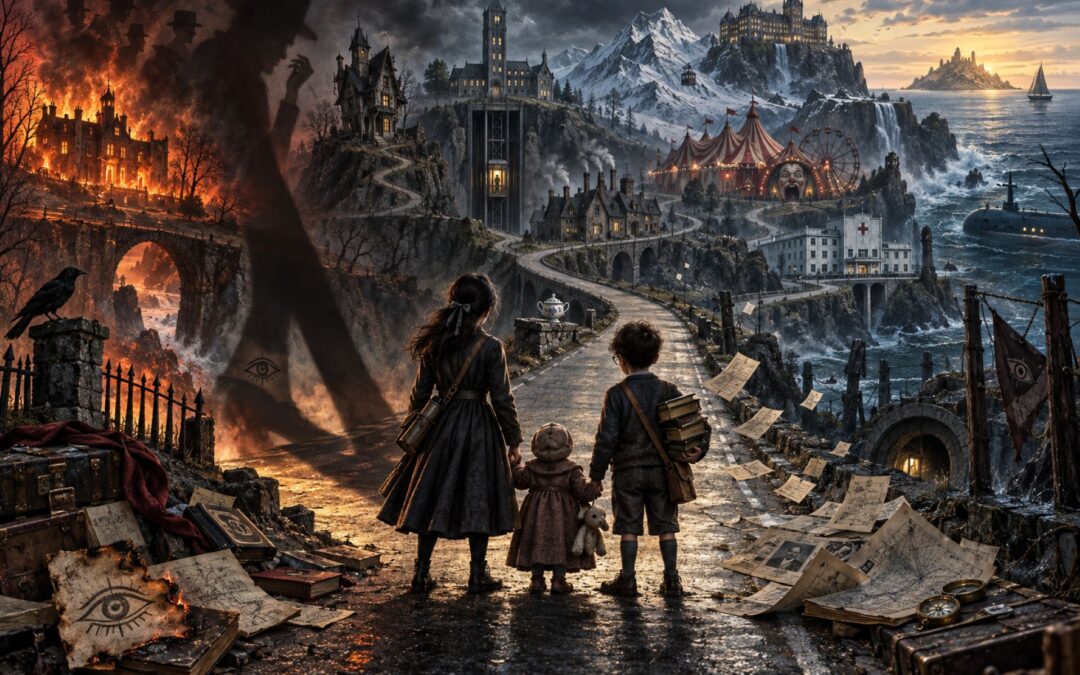
A Series of Unfortunate Events begins with a catastrophe so abrupt that it seems to establish the rules of the entire story. Violet, Klaus, and Sunny Baudelaire go to Briny Beach, learn that their parents have died in a fire that destroyed their home, and are placed in the care of Count Olaf, a distant relative who wants their fortune. For several books, the pattern appears almost reassuring in its predictability: Olaf returns in disguise, adults fail to recognize him, the children discover his plan, and escape arrives too late to provide lasting safety.
Yet Lemony Snicket’s thirteen-book series is not simply a long sequence of variations on the same joke. The apparent formula gradually breaks apart as the Baudelaires discover V.F.D., learn that their parents belonged to a secret organization divided by a schism, encounter other orphaned children whose families were destroyed by fire, and realize that Count Olaf is only one participant in a conflict much older than their own misfortunes. By the later books, the central question is no longer whether three intelligent children can expose an obvious villain. It is whether they can remain decent while surviving a world in which the categories of volunteer and villain, truth and rumor, justice and procedure, innocence and complicity have become increasingly difficult to separate.
The series therefore develops on two levels at once. Its plot expands from domestic persecution into conspiracy, pursuit, criminal accusation, espionage, and moral crisis, while its storytelling becomes progressively more self-conscious about the limits of knowledge. Lemony Snicket is not merely an invisible narrator but a grieving researcher reconstructing events he did not always witness and cannot always explain. The final volumes refuse to answer every mystery, and that refusal is central to the books’ meaning rather than an accidental incompleteness. Daniel Handler has discussed his preference for mysteries that retain unresolved threads, placing the series within traditions of gothic and noir storytelling in which not every secret eventually fits into a clean solution, as he explains in a discussion of mystery and unresolved narrative.
This article treats all thirteen books as one continuous story. It follows the Baudelaire children from Briny Beach to the island at the end of the series, explains the development of V.F.D. and the moral ambiguity surrounding it, examines the major characters and themes, and evaluates what the complete sequence achieves.
Spoiler warning: this article reveals the full plot of all thirteen books, including major deaths and the ending.

The Complete Story of the Baudelaire Orphans
The thirteen books form a much more continuous narrative than their early structure suggests. The first four operate largely through a cycle of new guardians and recurring attacks by Count Olaf, but the introduction of the Quagmires and the initials V.F.D. transforms the series into an extended mystery. From that point onward, the Baudelaires increasingly stop waiting for adults to rescue them and begin investigating the hidden world their parents inhabited, even as the methods they use to survive become morally harder to defend.
Orphans, Guardians and Count Olaf
The story begins at Briny Beach, where fourteen-year-old Violet Baudelaire, twelve-year-old Klaus, and infant Sunny are spending a gray day together. Violet is an inventor who ties her hair back whenever she needs to think through a mechanical problem. Klaus is an obsessive reader whose memory for books repeatedly becomes a survival tool. Sunny is still an infant whose principal skill is biting, although her apparently nonsensical speech is frequently interpreted by her siblings.
Their lives change when Mr. Poe, a banker who handles their family’s affairs, arrives with devastating news. A fire has destroyed the Baudelaire mansion and killed their parents. Because the Baudelaire fortune cannot be inherited until Violet comes of age, the children must live under the authority of a guardian.
Mr. Poe places them with Count Olaf, a distant relative who lives in a filthy house and immediately reveals himself to be cruel, neglectful, and obsessed with their money. He gives the children one inadequate bedroom, forces them to perform endless chores, strikes Klaus, and surrounds himself with a theatrical troupe of unpleasant associates. The adults responsible for the children’s welfare repeatedly treat Olaf’s behavior as a matter of personality rather than danger.
The Baudelaires find one source of refuge next door with Justice Strauss, a judge whose house contains a magnificent library. Olaf eventually announces that he is directing a play called The Marvelous Marriage, in which Violet will appear as a bride opposite him. Klaus researches marriage law and realizes that Olaf intends the stage ceremony to become a real legal marriage, which would allow him to gain control over Violet and therefore the Baudelaire fortune.
Olaf kidnaps Sunny and suspends her in a cage outside his tower room, using her life to force Violet into participating. Violet realizes that she cannot simply refuse, so she manipulates the legal technicality on which Olaf’s plan depends. During the performance, she signs the marriage document with her left hand, although she is right-handed. Justice Strauss determines that the marriage is invalid because Violet did not sign in her usual hand.
Olaf’s scheme fails, but he escapes before the authorities can arrest him. Justice Strauss offers to care for the children, yet Mr. Poe insists on following the parents’ instructions that their guardian should be a relative. The book ends by establishing what will become one of the series’ most painful patterns: the Baudelaires are clever enough to survive individual dangers but have almost no power over the system that keeps placing them in danger.
Their next guardian, Dr. Montgomery Montgomery, offers a dramatic contrast. Uncle Monty is an eccentric herpetologist with a vast Reptile Room full of snakes and other creatures. He is affectionate, energetic, and genuinely interested in the children. For the first time since their parents’ death, the Baudelaires begin to imagine that their lives might stabilize.
Monty plans to take them on an expedition to Peru, but Count Olaf soon arrives disguised as Stephano, supposedly Monty’s new assistant. The children immediately recognize him. Monty does not understand that Stephano is Olaf, but he correctly senses that his assistant is dangerous and believes he may be trying to steal scientific research.
Before Monty can remove the children from danger, he is murdered. Olaf attempts to disguise the killing as a fatal snakebite and presents himself as the obvious adult who should accompany the Baudelaires to Peru. The children investigate the body and the reptiles, eventually proving that Monty was not killed by one of his snakes and exposing Stephano’s identity.
Once again, however, Olaf escapes.
The emotional effect of Monty’s death is different from the misery of the first book. Olaf’s house was obviously unsafe, but Monty’s home represented a life that might have worked. His murder teaches the children that finding a good guardian will not be enough if the larger world remains unable to protect that guardian from Olaf.
Their third placement takes them to Aunt Josephine, a widow who lives in a house precariously positioned above Lake Lachrymose. Josephine once enjoyed a more adventurous life with her husband Ike, but his death has transformed her into a woman terrified of almost everything. She fears doorknobs, telephones, realtors, ovens, radiators, and many ordinary objects, yet she remains passionately devoted to grammar.
Olaf appears as Captain Sham, an absurd nautical character with a peg leg. Josephine is charmed by him despite the children’s warnings. Soon afterward, she apparently throws herself from a window, leaving behind a suicide note that gives Captain Sham custody of the children.
Klaus notices something immediately wrong with the note. Josephine, who is almost incapable of allowing a grammatical error to pass uncorrected, has filled it with mistakes. He discovers that the errors form a coded message pointing to Curdled Cave.
The Baudelaires steal a sailboat and cross Lake Lachrymose, eventually finding Josephine alive. She explains that Olaf forced her to write the note and disappear. Rather than confronting him, she hoped to surrender the children and save herself.
Their return journey becomes dangerous when Lachrymose Leeches attack the boat. Josephine had violated the lake’s safety rules by eating recently, attracting the creatures. The children survive long enough for Olaf to intercept them, but Josephine’s fate is far worse. She pleads with Olaf and attempts to bargain for her life. When she corrects his grammar, he abandons her to the leeches.
The Baudelaires once again expose Olaf’s disguise, and once again he escapes. Josephine’s death deepens the series’ portrait of failed guardianship because she is neither cruel nor indifferent. She is simply too frightened to act when action is required, and her fear ultimately becomes as dangerous as incompetence.
The fourth book moves the Baudelaires from private guardianship into institutional exploitation. They arrive at Lucky Smells Lumbermill, where the owner known only as Sir agrees to serve as guardian while forcing them to work alongside adult laborers under terrible conditions. Meals are inadequate, pay is essentially nonexistent, and the workers have been conditioned to accept misery as ordinary.
Klaus breaks his glasses and is sent to an optometrist, Dr. Georgina Orwell. Her receptionist is Count Olaf, disguised as a woman named Shirley. Orwell hypnotizes Klaus so that he can be controlled by a code word. Once returned to the mill, Klaus begins behaving strangely and is manipulated into dangerous industrial work.
Violet and Sunny eventually deduce how the hypnosis operates and break the conditioning. The confrontation ends with Dr. Orwell dying in a grotesque accident involving the mill machinery, while Olaf again escapes.
By this point, the series has expanded its critique beyond individual villains. Lucky Smells is a place in which exploitation has been normalized through bureaucracy, exhaustion, and dependency. Sir does not need to be as theatrical as Olaf because the mill itself already treats people as disposable. The Baudelaires have now been failed by family law, guardianship, cowardice, and labor institutions, and the possibility that some stable adult arrangement will solve their problem is beginning to disappear.
The Quagmires, V.F.D. and the End of Guardianship
The fifth book begins a transformation that changes the whole series. The Baudelaires are sent to Prufrock Preparatory School, where they live in a crude shack because they are orphans and are subjected to the ridiculous authority of Vice Principal Nero. They also meet Carmelita Spats, an aggressively unpleasant student who insults them constantly.
Yet Prufrock gives the Baudelaires something they have largely lacked since losing their parents: friends.
Duncan and Isadora Quagmire are two members of a set of triplets. Their parents were killed in a fire, and their brother Quigley is believed to have died with them. The parallels between the Quagmires and Baudelaires create an immediate bond. Duncan is a journalist who records information in notebooks, while Isadora writes poetry in the form of rhyming couplets.
Count Olaf arrives disguised as Coach Genghis, wearing a turban and claiming that he cannot remove it for religious reasons. He forces the Baudelaires to participate in exhausting nightly running exercises called S.O.R.E., depriving them of sleep until their academic performance collapses. Vice Principal Nero threatens expulsion.
The Quagmires help their friends by disguising themselves as the Baudelaires and running in their place while Violet, Klaus, and Sunny prepare for the school’s examinations. Their intervention works temporarily, but Olaf discovers the deception.
Before fleeing, he kidnaps Duncan and Isadora. As they are dragged away, the Quagmires shout fragments of information they have discovered, including three letters that become the central mystery of the series: V.F.D.
The sixth book follows the Baudelaires to 667 Dark Avenue, where they live with Jerome and Esmé Squalor. Jerome is kind, well-meaning, and eager to avoid disagreements. Esmé is obsessed with fashion and social status. She evaluates almost everything according to whether it is currently “in” or “out.”
The building’s fashions include darkness and the absence of working elevators. Olaf appears as Gunther, a foreign auctioneer whose ridiculous accent and monocle fail to deceive the children but impress the adults around them.
The Baudelaires investigate a seemingly unusable elevator shaft and discover that it contains a hidden route underground. At the bottom they find Duncan and Isadora imprisoned in a cage. The passage also leads toward the ruins of the Baudelaire mansion, strongly suggesting that the children’s family history is connected to the mystery the Quagmires uncovered.
They attempt to rescue their friends, but Olaf moves the Quagmires again and hides them inside an enormous red-herring statue scheduled to be sold at an auction. The children try to manipulate the auction and retrieve the correct lot.
During the confrontation, Esmé reveals that she has allied herself with Olaf. Her fascination with status and acquisition turns out to be compatible with his cruelty. She joins his troupe and becomes his girlfriend.
The Quagmires are carried away again, and Jerome is forced to choose between the danger of helping the Baudelaires continue the pursuit and the security of staying home. He offers the children a safe life if they abandon the search.
The Baudelaires refuse.
Jerome’s failure is important because he is not ignorant of the danger. He understands that the children are right. His weakness is his refusal to accept conflict, and the series treats that refusal as a moral failure. Kindness without courage proves unable to protect anyone.
The seventh book sends the children into an experimental guardianship program under which an entire village can assume responsibility for orphaned children. They choose the Village of Fowl Devotees because its initials are V.F.D., hoping the place will provide answers about the mysterious organization.
Instead, they find a community governed by thousands of arbitrary rules and the Council of Elders. Most of the rules exist simply because they have been inherited and enforced for years. The villagers treat obedience as morality.
The children’s principal ally is Hector, a handyman who secretly violates village rules and is building a self-sustaining hot-air mobile home. The Baudelaires also discover that the Quagmires are somewhere nearby and are leaving coded messages in the form of Isadora’s rhyming couplets.
A stranger named Jacques Snicket appears. Like Count Olaf, he has a distinctive eye tattoo associated with V.F.D. The children initially suspect that this makes Jacques a villain, but he insists that he knew their parents and appears ready to explain some of what is happening.
He never gets the chance.
Count Olaf, disguised as Detective Dupin, murders Jacques and frames the Baudelaire children for the crime. Esmé appears as Officer Luciana, helping manipulate the investigation.
The Baudelaires are arrested and sentenced to death by a council whose idea of justice depends more on rules and appearances than evidence. They escape from jail and eventually locate Duncan and Isadora.
Hector attempts to rescue everyone in his hot-air mobile home. The Quagmires successfully reach it, but the Baudelaires cannot. Esmé attacks the escaping craft, destroying most of the notebooks in which the Quagmires had recorded V.F.D. information.
Although the villagers begin to realize that Olaf is an impostor, they quickly turn their anger back toward the Baudelaire children. Mob behavior replaces reason almost immediately.
The siblings flee.
The ending marks one of the largest structural changes in the series. There will be no more guardians. The children are publicly accused criminals, and the adult world that was supposed to protect them now considers them dangerous.
Sunny also begins walking independently around this period, giving the transition a literal physical dimension. The Baudelaires have been forced to stand on their own.
Fugitives, Volunteers and Moral Compromise
As fugitives, the Baudelaires enter a much darker phase of the story. Earlier, their ethical position had been relatively simple. Count Olaf did terrible things, while the children used intelligence and cooperation to expose him. Beginning with The Hostile Hospital, survival increasingly requires them to lie, disguise themselves, steal, hide evidence, and take actions that could harm other people.
They first reach Heimlich Hospital, where they fall in with the Volunteers Fighting Disease, a cheerful but superficial group whose members sing songs to patients instead of providing medical care. The Baudelaires find work in the Library of Records under Hal, an elderly records keeper.
They hope the hospital’s archives will contain information about Jacques Snicket, the Baudelaire fire, and V.F.D. Their search produces the Snicket file, but most of it has already been removed. One surviving document includes a photograph of the Baudelaire parents and suggests that there may have been a survivor of one of the fires.
For the first time, the children begin to wonder whether one of their parents might still be alive.
Count Olaf infiltrates the hospital under the identity of Mattathias, supposedly its new head of human resources. Violet is captured and scheduled for a fraudulent cranioectomy, an operation intended to kill her while appearing medically legitimate.
Klaus and Sunny disguise themselves as doctors. The disguise works because the institution is already chaotic enough for authority to be accepted without verification. They locate Violet and save her.
During the escape, Heimlich Hospital catches fire. Whether every detail of the blaze can be attributed directly to the children or Olaf is less important than what the event represents. The line between the Baudelaires and the destructive world around them is becoming less clear.
They make a decisive choice at the end of the book. Instead of merely escaping from Count Olaf, they hide in the trunk of his car.
They are now following him.
The ninth book takes them to Caligari Carnival, where they disguise themselves as carnival freaks so that they can remain close to Olaf’s troupe. Violet and Klaus pretend to be a two-headed person named Beverly and Elliot, while Sunny adopts another disguise.
The carnival is run by Madame Lulu, who appears to possess mysterious clairvoyant abilities. She repeatedly provides Olaf with information about his enemies and the possibility that one Baudelaire parent survived the fire.
The Baudelaires investigate and discover that Lulu’s apparent magic is actually research. Beneath the carnival lies an archival library containing newspapers, documents, and other information. Her predictions come from collecting knowledge and presenting it theatrically.
This discovery is one of the series’ clearest statements about the difference between information and supernatural certainty. Madame Lulu knows things because she has sources, but even her library is incomplete.
Olaf plans a spectacle involving a pit of hungry lions. The carnival performers Hugo, Colette, and Kevin hope to win acceptance by joining his troupe. Their insecurity makes Olaf’s offer attractive because he promises belonging in exchange for complicity.
Madame Lulu dies during the chaos around the lion pit. The Baudelaires then take part in burning the carnival as they attempt to escape, destroying a repository of information that might have answered some of their own questions.
The act troubles them.
Until now, fires had belonged to the background of their suffering: their parents died in one, the Quagmires’ parents died in another, and V.F.D.’s history increasingly seems structured around arson. At Caligari Carnival, the Baudelaires themselves help create a fire.
The escape also separates them. Olaf discovers Sunny and captures her, while Violet and Klaus climb into a caravan connected to his vehicle. When Olaf orders his new recruits to cut the caravan loose, Violet and Klaus hurtle backward down the mountainside as Sunny continues upward with the villains.
The Slippery Slope divides its opening between the siblings. Violet and Klaus survive the runaway caravan and begin climbing the Mortmain Mountains. Sunny, meanwhile, is forced to work for Olaf’s troupe, performing domestic labor and cooking for them.
Her captivity reveals how much she has changed. Sunny is no longer merely the baby whose siblings carry her through danger. She studies the people around her, makes independent choices, uses culinary knowledge, and resists Olaf without needing Violet and Klaus to direct every action.
In the mountains, Violet and Klaus meet Quigley Quagmire, whom everyone believed dead. He survived the fire that killed his parents and has spent time investigating V.F.D.
Together they find the burned remains of V.F.D.’s headquarters. The organization that once seemed like a single mysterious entity now appears as the wreckage of a larger volunteer network divided by a schism.
The children learn more about secret codes, trained messengers, hidden headquarters, and the conflict between people who still describe themselves as volunteers and those associated with fire-starting and villainy. Yet every discovery produces additional uncertainty.
They also encounter a man with a beard but no hair and a woman with hair but no beard. These two figures are disturbing partly because Count Olaf himself fears them. The series thereby establishes that Olaf, for all his cruelty, is not the ultimate source of the world’s corruption.
The Snow Scouts arrive, including Carmelita Spats, and Olaf’s associates use trained eagles to attack. Carmelita eagerly gravitates toward Olaf and Esmé, eventually becoming a kind of adopted child to them.
The Baudelaires reunite with Sunny and escape down the Stricken Stream. Quigley joins them, but the current eventually separates him from the Baudelaires.
Before they part, they learn that surviving volunteers are expected to gather at what is called the last safe place: Hotel Denouement.
The eleventh book begins when the siblings are rescued by the submarine Queequeg, commanded by Captain Widdershins. On board are Fiona, his stepdaughter, and Phil, whom the children know from Lucky Smells Lumbermill.
They search for the Sugar Bowl, an object that increasingly appears to be one of the most important items in the V.F.D. conflict. What the bowl actually contains is never clearly established in the thirteen-book series, yet enormous effort has been devoted to finding it.
The search takes them into the Gorgonian Grotto. There they encounter the Medusoid Mycelium, a deadly fungus whose spores can infect a person almost instantly. Sunny becomes contaminated.
Violet and Klaus desperately search for an antidote. The cure eventually comes through the discovery that wasabi can function as a substitute for horseradish, whose chemical properties counteract the poison.
The children later encounter Count Olaf’s submarine and are captured. Fiona’s connection to Olaf’s hook-handed associate is revealed: Fernald is her brother.
This relationship deepens one of the series’ central ideas. Families can be divided by the schism, and people cannot be sorted neatly according to affiliation. Fernald has participated in terrible acts, yet Fiona still loves him. Fiona’s decision to leave with her brother does not simply prove that she is evil; it reveals the pressure family loyalty can place on moral judgment.
Captain Widdershins and Phil disappear, leaving their fates uncertain.
The Baudelaires eventually escape and return to Briny Beach, where the entire series began. Waiting there is Kit Snicket, sister of Jacques and Lemony.
She invites them into her taxi.
The circular return to Briny Beach is deliberate. The children who stand there now are profoundly different from the three orphans Mr. Poe collected at the beginning. They possess more knowledge but less certainty, more independence but more guilt, and far more experience of how easily people can rationalize harmful choices.
Hotel Denouement, the Island and the End
Kit takes the Baudelaires to Hotel Denouement, the last safe place for V.F.D. volunteers. The hotel is an enormous structure organized according to the Dewey Decimal System, turning one of the series’ recurring symbols—the library—into architecture.
The Baudelaires work as concierges and act as flâneurs, observing the guests and attempting to determine who belongs to which side of the schism.
The problem is that the hotel’s managers, Frank and Ernest Denouement, are identical twins supposedly aligned with opposite sides. The children cannot reliably tell which man is Frank and which is Ernest.
The joke becomes an ethical test. The Baudelaires want visible signs that will allow them to classify everyone as trustworthy or dangerous, but the hotel offers none. Behavior must be interpreted in incomplete circumstances.
Many figures from earlier books return, turning Hotel Denouement into a concentrated representation of the entire series. People who once seemed like isolated episodes are revealed as parts of one network of consequences.
The children eventually discover Dewey Denouement, the third triplet. Dewey has secretly constructed an enormous underwater catalogue containing information about V.F.D. and its history. His work represents the dream that has motivated Klaus in particular: somewhere there might exist an archive capable of putting all the fragments together.
That possibility collapses almost immediately.
A confrontation involving Count Olaf, the Sugar Bowl, and a harpoon gun ends with Dewey being fatally wounded. The Baudelaires are implicated in his death even though the situation is confused and their intention was not to kill him.
Justice Strauss reappears and attempts to organize a proper trial. Her return seems to offer a chance to correct the failure that began in the first book. Perhaps law can finally distinguish the innocent from the guilty and hold Olaf accountable.
Instead, the High Court itself has been infiltrated.
Procedure cannot save the children because the institution that administers justice has been corrupted from within.
The Baudelaires then make the most morally disturbing decision of their lives. They help Count Olaf escape and participate in setting Hotel Denouement on fire.
Their reasons are not identical to Olaf’s. They are frightened, trapped, and attempting to warn people and survive. Yet consequences do not vanish merely because motivations differ.
The children leave the burning hotel in a boat with the man who has pursued them since their parents died.
The image deliberately collapses the moral distance that once seemed absolute. The Baudelaires are not Count Olaf, but they can no longer reassure themselves that wicked people start fires while noble people prevent them.
The final book places the four survivors in a small boat at sea. They eventually wash ashore on an island whose inhabitants live according to an apparently peaceful communal philosophy.
The island is governed, unofficially but unmistakably, by Ishmael. He calls himself a facilitator and insists that he does not force people to do anything. In practice, he shapes nearly every decision through social pressure, ritual, suggestion, and control over information.
Island life initially appears attractive. There are no courts, no banks, no Count Olaf disguises, no urban institutions, and no obvious V.F.D. conflict. For children who have spent thirteen books searching for safety, isolation seems almost like paradise.
But the cost is ignorance and conformity.
Islanders routinely discard objects that might complicate their lives, sending them to an arboretum. Ishmael discourages the use of technology, the preservation of unwanted knowledge, and challenges to established custom.
The Baudelaires discover that the island has its own hidden history. Their parents once lived there. The arboretum contains records and objects that Ishmael has allowed the community to forget.
Count Olaf eventually reappears in another disguise, pretending to be Kit Snicket, but the islanders immediately recognize him. After twelve books of adults failing to see through transparent costumes, the reversal is comic and revealing. Olaf’s disguises were never literally magical. People saw what they wanted or expected to see.
Kit herself later washes ashore, badly injured and pregnant.
Olaf has brought the Medusoid Mycelium with him, and a confrontation with Ishmael releases the fungus across the island.
The colony faces extinction.
The Baudelaires discover that their parents had helped develop an antidote. The island’s apples contain horseradish-derived properties capable of counteracting the fungus.
The islanders eat the apples and survive. They then depart into a dangerous storm rather than remain under the old system.
Olaf has been mortally wounded. In one of the series’ most surprising final reversals, he helps carry Kit to safety.
The act does not erase his murders, abuse, greed, kidnapping, arson, and cruelty. It reveals only that human beings can contain contradictory capacities. Olaf can perform one compassionate act without becoming a good man.
Kit gives birth to a daughter.
Then Kit dies.
Count Olaf dies as well.
The Baudelaires are left with the newborn.
They name her Beatrice.
For the first time in the series, the children become guardians rather than wards. Their central problem has reversed. They are no longer asking which adult should be responsible for them; another human being now depends on their decisions.
They remain on the island for about a year and raise Beatrice together. They read the records left behind by their parents and learn more about the island’s history, but they still do not discover every answer to V.F.D., the schism, or their parents’ past.
The final chapter is called “Chapter Fourteen,” extending a series structured obsessively around thirteen beyond the number that seemed to govern it.
The Baudelaires could remain on the island indefinitely. They have food, shelter, memories of their parents, and relative safety.
They choose to leave.
Violet repairs a boat. Klaus and Sunny prepare for the journey. The three siblings sail away with Beatrice toward the world that has repeatedly hurt them.
The series ends not with certainty but movement.
The final word is “Beatrice.”
The Strange World Behind the Misfortunes
The world of A Series of Unfortunate Events resembles reality while refusing to settle into a precise historical period or geographical map. Telephones, telegrams, typewriters, automobiles, submarines, elevators, harpoon guns, theaters, hospitals, and newspapers coexist without forming a stable technological chronology. Cities, villages, mountains, lakes, islands, factories, schools, and seaside locations feel recognizable, yet their relationship to one another is often deliberately dreamlike.
This instability is not careless world-building. It allows the books to operate as satire without becoming attached to one specific country or decade. Lucky Smells Lumbermill can represent exploitative labor, Prufrock Preparatory School can parody authoritarian education, and the Village of Fowl Devotees can exaggerate the dangers of bureaucratic conformity without requiring the reader to treat any of them as realistic institutions in a sociological sense.
What is consistent is the unreliability of authority. Banks mismanage children. Schools privilege ridiculous rules. Hospitals confuse administration with medicine. Villages enforce custom instead of justice. Newspapers reproduce misleading accounts. Courts can be infiltrated. Adults frequently trust titles, uniforms, accents, and official language more than evidence.
V.F.D. adds a second layer beneath this visible world. Secret passages connect houses. Volunteers use coded phrases and disguises. Remote headquarters, submarines, hidden archives, mountain stations, secret libraries, trained animals, and safe locations form an underground infrastructure that appears to have existed for years.
Yet V.F.D. never becomes a fully explained fantasy system with clear rules. The more the Baudelaires learn about it, the more its boundaries blur. Volunteers become villains, families split, records disappear, headquarters burn, and people disagree about what the organization was supposed to represent.
This instability allows the setting to reflect the Baudelaires’ changing understanding of adulthood. When they are younger, the world appears divided between known institutions and obvious criminals. By the end, institutions can be criminal, volunteers can behave badly, villains can occasionally behave compassionately, and knowledge itself is scattered across unreliable records.
The world therefore becomes stranger as the children become more capable of understanding it.
Violet, Klaus and Sunny Baudelaire
Violet, Klaus, and Sunny begin with deliberately simple identifying traits: Violet invents, Klaus reads, and Sunny bites. Across thirteen books, however, those traits become less like gimmicks and more like ways of thinking. Each sibling develops a different relationship to action, knowledge, responsibility, and uncertainty, while their greatest strength remains the ability to combine their different forms of intelligence.
Their bond is not sentimentalized. They disagree, frighten one another, make mistakes together, and sometimes participate in questionable decisions because none of them can imagine abandoning the others. What distinguishes them from many of the adults they meet is not perfection but sustained mutual responsibility.
Violet Baudelaire: Invention and Responsibility
Violet begins the series as the sibling most obviously positioned to act like a substitute parent. She is the oldest, legally closest to controlling the Baudelaire fortune, and frequently responsible for creating the devices that allow the children to escape immediate physical danger.
Her inventions are rarely elaborate pieces of technology. They are improvised solutions made from whatever materials are available. That pattern matters because Violet’s defining quality is not simply engineering knowledge but the ability to perceive possibilities in ordinary objects.
In the early books, invention has an uncomplicated moral role. Violet builds tools to escape Olaf, save Sunny, navigate dangerous places, or expose deceit. Her practical intelligence is aligned with survival.
Later, the relationship becomes more difficult. The same capacity that allows her to build rescue devices can also help the Baudelaires break into places, disguise themselves, manipulate systems, and set fires. The question shifts from whether Violet can invent something to whether the thing she is inventing should be used.
Her position as eldest sibling intensifies that burden. Klaus often supplies information, while Sunny grows increasingly independent, but Violet feels responsible for deciding what the three of them should actually do.
Her connection with Quigley Quagmire also reveals a part of her identity that is not purely protective. Their relationship suggests affection and possible romance, giving Violet a future-oriented emotional life beyond functioning as Klaus and Sunny’s caretaker.
By the time she repairs the boat in Chapter Fourteen, her inventiveness has acquired a different meaning. She is not constructing a clever escape from a villain. She is choosing uncertainty over stagnation and taking responsibility for a child younger than Sunny was at the beginning.
Klaus Baudelaire: Knowledge Without Certainty
Klaus’s relationship with books is one of the series’ defining values. Again and again, survival depends on something he has read: law, reptiles, grammar, hypnosis, medicine, codes, fungi, geography, or some other piece of accumulated knowledge.
The early books sometimes make this relationship almost magical. A problem appears, Klaus remembers a relevant book, and information becomes the key that unlocks the solution.
V.F.D. complicates that model.
Once the children begin investigating the organization, Klaus encounters archives that are damaged, records that are missing, coded phrases that have multiple meanings, documents that contradict one another, and witnesses who die before explaining what they know.
He does not become less committed to reading. Instead, he learns the harder lesson that reading well means recognizing incompleteness.
The distinction is crucial. Ignorance is dangerous throughout the series, but information does not automatically produce certainty or virtue. Olaf sometimes possesses useful information. Madame Lulu’s knowledge gives her social power. V.F.D.’s members use records, codes, and libraries while still making disastrous choices.
Klaus therefore matures from a reader who believes the correct book will answer the question into a thinker who must interpret evidence while accepting that some answers may never become available.
The series continues to treat literacy as one of its most stable positive values. Scholarship on Snicket’s language has likewise noted how consistently the books associate reading, vocabulary, and literary awareness with forms of intellectual independence. Yet the later volumes deepen that value by showing that a well-read person must still decide what to do with incomplete knowledge.
Sunny Baudelaire: From Dependence to Independence
Sunny undergoes the most visible transformation because she begins as an infant.
Her early characterization is comic. She bites hard objects, speaks in words that only Violet and Klaus seem to understand, and is frequently carried from one dangerous location to another.
Her development gradually changes the balance of the sibling group.
Sunny learns to walk, speaks more comprehensibly, begins cooking, develops her own areas of expertise, and makes decisions without waiting for her siblings’ instructions. During her captivity in The Slippery Slope, she demonstrates that she can survive apart from Violet and Klaus.
Cooking becomes particularly important because it gives Sunny an ability not defined by destruction. Her early biting is physically forceful; her later culinary skill transforms materials into something that can sustain other people.
By the final book, Sunny participates in caring for Beatrice. The child who once required constant protection becomes someone capable of protecting another.
Her growth also provides one of the few reliable measures of time in a series whose chronology is otherwise deliberately vague. Institutions may remain absurd, V.F.D. may remain unresolved, and Olaf may repeat patterns, but Sunny changes.
That development prevents the series’ repetition from becoming complete stasis. The Baudelaires are growing even when the world around them appears trapped in the same mistakes.
Count Olaf and the People Around the Baudelaires
Count Olaf dominates the series so thoroughly that nearly every other relationship becomes defined partly by how a character responds to him. Yet the later books gradually reduce his status as the simple explanation for everything that has gone wrong. He belongs to a broader history of conflict, and several people around him reveal different ways that fear, selfishness, weakness, loyalty, and compromised ideals can become harmful.
The Baudelaires’ allies are equally varied. Some are courageous but unable to survive, some are kind but passive, and some move unpredictably between volunteer and villain. The result is a moral landscape in which good intentions remain meaningful but are never enough by themselves.
Count Olaf: Villain, Performer and Product of the Schism
Count Olaf begins as one of children’s literature’s most deliberately theatrical villains. He lives in a filthy mansion, commands a troupe of grotesque associates, abuses the Baudelaires almost immediately, and schemes to steal a fortune belonging to children whose parents have just died.
His disguises turn that cruelty into comedy. Stephano, Captain Sham, Shirley, Coach Genghis, Gunther, Detective Dupin, Mattathias, and other identities are often ridiculous enough that the reader recognizes him instantly.
The joke is rarely that Olaf is a brilliant impersonator.
The joke is that adults repeatedly prefer appearances to testimony.
Mr. Poe trusts documents and social roles. Josephine wants to believe Captain Sham is charming. Nero accepts Coach Genghis’s authority. Esmé values fashion. Institutions accept a costume because recognizing the truth would require independent judgment.
Olaf’s theatricality therefore fits the larger theme of interpretation. He performs identities, while the world rewards anyone who performs authority confidently enough.
He is also genuinely frightening. Olaf murders people, kidnaps children, threatens infants, manipulates vulnerable adults, commits arson, participates in conspiracies, and routinely treats human beings as instruments.
The later books do not revise these facts.
What they revise is the idea that his wickedness exists outside history.
Olaf has connections to V.F.D., the schism, the Snickets, and the Baudelaire parents. He knows information the children want. He fears figures who appear even more ruthless. His life has been shaped by the same hidden conflict that shaped the families of his victims.
Understanding that history is not equivalent to excusing it.
The distinction becomes important at the end. Olaf’s decision to help Kit does not constitute a conventional redemption. A final compassionate act cannot cancel thirteen books of deliberate cruelty.
What it does reveal is that moral categories describe patterns of behavior rather than supernatural essences. Olaf is capable of humanity because even a person who has chosen villainy repeatedly remains a person.
That insight matters more for the Baudelaires than for Olaf himself. If Olaf were evil in a completely different way from ordinary people, the children would never need to examine their own behavior. The later series becomes morally serious because it insists that harmful actions can emerge from fear, loyalty, desperation, resentment, cowardice, and rationalization—not only from cartoon wickedness.
The Quagmires and the Snickets
Duncan, Isadora, and Quigley Quagmire function as mirrors of the Baudelaire siblings. Their parents also die in a fire, they inherit a fortune, and they become entangled with V.F.D.
Duncan and Isadora are especially important because they give Violet, Klaus, and Sunny friends who understand what orphanhood has done to them. The relationship is based not merely on shared suffering but complementary skills: Duncan records information, Isadora encodes clues through verse, and the Baudelaires help convert those clues into action.
Their kidnapping changes the moral direction of the series. Before Prufrock, the Baudelaire siblings primarily act to protect themselves. Afterward, they willingly place themselves in danger to rescue friends.
Quigley’s appearance complicates the parallel further because his survival demonstrates that the children have been operating on incomplete assumptions. Someone believed dead can still be alive. The discovery helps make the possible survivor mentioned in the Snicket file emotionally plausible.
Violet’s connection with Quigley also introduces one of the series’ few suggestions of romantic attachment. It remains understated, but it shows Violet imagining emotional bonds outside the sibling unit.
The Snicket family connects the Baudelaires’ immediate story to the narrator’s supposedly separate life.
Jacques appears briefly but becomes enormously important because his death demonstrates how much knowledge can disappear with one person. He knows the Baudelaire parents and may have been able to explain V.F.D., yet Olaf kills him before that explanation can occur.
Kit survives long enough to guide the children toward Hotel Denouement and finally reaches the island pregnant. Her child becomes the person for whom the Baudelaires assume responsibility after Kit’s death.
Lemony himself is everywhere and nowhere. He knows the children’s story intimately while repeatedly admitting gaps in his evidence. His grief for Beatrice seems at first like an eccentric feature of the narration, but the final naming of Kit’s daughter brings the Beatrice motif into the emotional resolution of the Baudelaire story.
Guardians, Cowards, Volunteers and Villains
The series’ adult characters are most revealing when considered as a spectrum rather than as a division between good and bad.
Uncle Monty is genuinely kind, intelligent, and protective. His failure is not moral but circumstantial: he recognizes danger too late and is murdered before he can act.
Aunt Josephine is also sympathetic, but grief has transformed her fear into paralysis. She demonstrates that suffering does not automatically make someone compassionate or brave.
Jerome Squalor represents another kind of failure. He understands that the Baudelaires are telling the truth, yet his fear of conflict prevents him from acting decisively. He chooses peace in the narrow sense of avoiding confrontation even when that peace requires abandoning people who need help.
Hector is more courageous. He violates unjust village rules, assists the children, and creates an actual means of escape. His limitations are practical rather than ethical.
Justice Strauss remains one of the series’ clearest examples of benevolent adult authority. She believes in law and wants to protect the children. Yet her presence at the beginning and near the end exposes the limits of individual decency inside broken systems. A good judge cannot guarantee justice if the institution itself is compromised.
Mr. Poe is more frustrating because he appears so often. His loyalty is to procedure, paperwork, and his understanding of official responsibility. He is not consciously cruel, but his inability to imagine that rules might produce injustice repeatedly places the children in danger.
Esmé Squalor moves more willingly into villainy. Her obsession with what is fashionable makes morality subordinate to status. She joins Olaf not because she misunderstands him but because his world offers opportunities that appeal to her.
Fiona and Fernald occupy a more complicated position. Their sibling relationship reveals how family loyalty can complicate allegiance. Fiona’s affection for Fernald remains real even when she disapproves of his choices.
Dewey Denouement represents the noble ideal of preserving knowledge, but his secret catalogue also reflects the tragedy of V.F.D.: immense effort has been invested in archives and codes while the organization itself has become divided and violent.
Ishmael is perhaps the most sophisticated adult antagonist after Olaf because he does not present himself as cruel. He offers safety, social harmony, simplicity, and freedom from conflict.
The problem is that his peace depends on suppressing knowledge and discouraging disagreement.
Unlike Olaf’s obvious tyranny, Ishmael’s authority works because people voluntarily participate in it.
V.F.D., the Schism and the Mystery of the Sugar Bowl
V.F.D. is deliberately difficult to define because the Baudelaires never receive a single reliable account of its entire history. At various points the initials are associated with different phrases, codes, groups, locations, and jokes. That proliferation is partly comic, but it also trains the reader not to assume that recognizing the initials means understanding the organization.
What the books establish most clearly is that V.F.D. was once a broad volunteer network committed to various forms of public service, education, communication, fire-fighting, and preservation of knowledge. Its members used secret codes, trained one another in specialized skills, maintained safe locations, built concealed infrastructure, and gathered information.
At some point, a schism divided the organization.
The language used by surviving members often suggests a separation between volunteers and villains, but the novels continually complicate that terminology. Some people aligned with the volunteer side behave selfishly or irresponsibly. Some people associated with villainy retain family loyalties and moments of compassion.
The Baudelaires’ parents were involved with V.F.D., as were the Snickets and numerous other adults whose stories intersect with the children. Fires appear repeatedly in the histories of these families, but the series never supplies a single neat chronology that assigns every fire to one faction.
The eye symbol becomes one of V.F.D.’s most recognizable marks. Because Count Olaf bears the tattoo, the Baudelaires initially interpret the symbol as evidence of villainy. Jacques Snicket’s similar marking teaches them that the symbol indicates connection rather than moral identity.
The distinction is essential.
V.F.D. is not a magical badge that tells the children whom to trust. It is an inherited institution whose members have made different choices.
The Sugar Bowl intensifies that ambiguity. By the later books, multiple people are searching for it, hiding it, stealing it, discussing it, and treating it as strategically important.
The thirteen main novels never give the reader a definitive explanation of exactly what the Sugar Bowl contains.
That absence can be frustrating because so much of the plot revolves around it. Yet the bowl’s narrative function becomes more important than its literal contents.
Everyone believes that possessing it matters.
The Baudelaires, like the reader, are encouraged to imagine that discovering the object will reveal some final answer about V.F.D. The series refuses that expectation.
The Sugar Bowl therefore becomes a concentrated symbol of misplaced certainty. The characters organize violence, loyalty, secrecy, and pursuit around an object whose meaning remains partly inaccessible.
That pattern mirrors the series’ larger approach to knowledge. There are always documents not recovered, witnesses who die, archives destroyed, letters misunderstood, and histories reconstructed from incomplete evidence.
Daniel Handler’s comments about unresolved mystery clarify why the series ends this way. In his discussion of the gothic and noir traditions behind Snicket’s mysteries, he emphasizes the imaginative power of threads that do not fit together perfectly. The point is not that answers do not matter. The point is that demanding total explanation can become another form of fantasy.
V.F.D. finally matters less as a puzzle to solve than as an inherited moral world the Baudelaires must decide how to enter, reject, or transform.
What A Series of Unfortunate Events Is Really About
The series disguises many of its most serious concerns inside elaborate jokes. Definitions of vocabulary, exaggerated misery, absurd disguises, alliterative names, and intrusive narration make the books accessible as comic adventure, but the underlying questions become increasingly difficult. By the final volumes, Snicket is asking what knowledge can accomplish, whether institutions deserve obedience, how people remain moral under pressure, and whether a complete explanation of one’s life is even possible.
These ideas do not appear suddenly near the ending. They develop through repetition. Every failed guardian, mistaken adult, destroyed archive, burned building, disguise, rule, and incomplete document pushes the Baudelaires toward a more complicated understanding of how the world works.
Children and the Failure of Adult Authority
The adult world fails the Baudelaire children so consistently that the pattern becomes one of the series’ central jokes. Mr. Poe does not recognize Olaf. School officials accept absurd explanations. Village elders punish children while ignoring evidence. Medical institutions can be manipulated. Judges struggle to create justice. Newspapers spread misleading accounts.
Yet the series is not arguing that every adult is stupid.
Monty, Justice Strauss, Jacques, Kit, Dewey, and others demonstrate that adults can be intelligent and compassionate. The deeper criticism concerns authority without judgment.
Many adults believe that performing their official role correctly is equivalent to behaving morally. Mr. Poe follows procedures. The Council of Elders enforces rules. Heimlich Hospital follows administrative structures. The court at Hotel Denouement maintains the appearance of judicial process.
The Baudelaires repeatedly survive because they question these structures.
This gives the series an unusual respect for child readers. The books do not insist that adults secretly understand everything. Adults can be wrong, frightened, selfish, compromised, or trapped by their own institutions.
At the same time, the series avoids replacing adult authority with the fantasy that children are automatically wiser. The Baudelaires also make mistakes.
Their independence therefore becomes a responsibility rather than a reward.
Knowledge, Books and the Limits of Knowing
Few children’s series treat reading as practically valuable as often as A Series of Unfortunate Events. Justice Strauss’s library helps Klaus uncover Olaf’s marriage scheme. Research reveals the truth about Monty’s death. Grammar exposes Josephine’s coded message. Medical information saves Sunny from the Medusoid Mycelium.
Libraries appear repeatedly as places where survival becomes possible.
Madame Lulu’s supposed clairvoyance is exposed as archival research. Dewey Denouement attempts to catalogue the history of V.F.D. The island’s hidden records preserve information Ishmael would prefer the community to forget.
Reading is therefore associated with intellectual autonomy. Handler has also emphasized the role of irony in determining whether younger readers fully enter the Snicket mode of storytelling, describing appreciation of the books as connected less to a fixed age than to recognizing how irony works in a Guardian interview about children, reading, and Snicket’s humor.
Yet the later books reject the simple idea that knowledge guarantees safety.
Libraries burn.
Documents are incomplete.
The Snicket file is missing pages.
Dewey’s catalogue disappears almost as soon as the Baudelaires discover it.
People can know facts and still behave badly.
The mature principle of the series is therefore not “books contain the answer.” It is that people who read, investigate, remember, and compare evidence are better equipped to resist manipulation, even though they will never possess all the answers.
Family, Friendship and Grief
The Baudelaire siblings’ loyalty to one another provides the most stable emotional structure in the series.
Their parents’ deaths remove the conventional center of family life, but Violet, Klaus, and Sunny rebuild that center around one another. Each sibling’s specialty matters because none of them is sufficient alone.
The Quagmires widen the meaning of family by showing that shared understanding can produce chosen bonds. The Baudelaires risk themselves repeatedly to rescue Duncan and Isadora because their friendship has become morally important independent of blood relation.
Fiona and Fernald complicate the same idea. Family loyalty can motivate compassion, but it can also make moral judgment harder.
Grief operates differently. The books never suggest that loss disappears after enough adventures. The Baudelaires continue thinking about their parents, while subsequent deaths add new layers rather than replacing the first wound.
Lemony Snicket’s grief for Beatrice parallels this structure. His narration is an attempt to preserve people through storytelling even when he cannot restore them.
The final naming of Kit’s daughter therefore transforms grief into responsibility. Beatrice’s name carries memory forward, but the child is not merely a memorial object. She is a living person who requires care.
The Baudelaires do not recover the family they lost.
They create a new one.
Good People, Bad People and Moral Compromise
The early books encourage a simple moral classification. Count Olaf and his associates are wicked; the Baudelaires are good.
The later books deliberately destabilize that division.
The turning point is not that the Baudelaires become villains. They do not begin murdering people for profit or deliberately inflicting suffering for pleasure.
The change is that their survival increasingly depends on methods they once associated with Olaf.
They disguise themselves.
They lie.
They steal.
They trespass.
They help burn places.
They assist Olaf’s escape.
Dewey dies during a confrontation in which the children are involved.
The Baudelaires repeatedly ask themselves whether they are still noble people.
This question gives the later books much of their emotional power. Laurie Langbauer’s scholarly discussion of the ethics and generational uncertainty in Lemony Snicket’s series is useful precisely because the novels undermine the categories that once made moral judgment easy.
The series does not conclude that good and evil are meaningless.
Count Olaf’s behavior remains substantially worse than the Baudelaires’.
What changes is the standard by which goodness must be understood. A good person is not someone who has remained perfectly untouched by harmful choices. Goodness becomes a continuing practice of reflection, restraint, responsibility, and willingness to feel the moral weight of one’s actions.
Olaf rarely questions the harm he causes except when it affects him personally.
The Baudelaires do.
That difference is not everything, but it matters.
Conformity, Crowds and Independent Judgment
Many institutions in the series become dangerous because individuals surrender judgment to the group.
At Prufrock Prep, rules matter more than education. In the Village of Fowl Devotees, communal custom becomes an excuse for absurd punishment. At Caligari Carnival, spectators are prepared to enjoy cruelty as entertainment. On the island, Ishmael sustains control by making dissent seem socially unnecessary.
The recurring problem is not collective life itself.
The Baudelaire siblings survive through cooperation, and V.F.D. was created around forms of collective service.
The danger lies in allowing a group to replace personal responsibility.
Carmelita Spats is an extreme comic example. She eagerly conforms to whichever structure allows her to feel superior. Her cruelty becomes socially rewarded when she joins Olaf and Esmé.
The island offers the more sophisticated version. People willingly give up complexity because simplicity feels safe.
Ishmael’s community therefore resembles the fantasy the Baudelaires have pursued for much of the series: a place where no one needs to fight, investigate, or question.
Their decision to leave shows that safety purchased through intellectual surrender is not the ending they want.
Secrets, Uncertainty and Living Without Complete Answers
Mystery drives the second half of the series. The Baudelaires want to understand V.F.D., their parents, the schism, the fires, the survivor, the Sugar Bowl, and the relationship between all the people whose stories have intersected with theirs.
The structure encourages the reader to expect a final revelation.
Instead, the books repeatedly show how knowledge disappears.
People die.
Records burn.
Messages are interrupted.
Codes produce further codes.
Witnesses disagree.
Narrators have incomplete evidence.
The ending therefore turns uncertainty from a frustration into a condition of adulthood.
The Baudelaires do learn important truths. Their parents belonged to V.F.D. The organization suffered a schism. Many adults around them are connected through that history. Their parents once lived on the island. Olaf’s life intersects with the same network.
But the children never receive an omniscient explanation.
That incompleteness reflects ordinary moral life more closely than a detective-story solution would. People make decisions without knowing every motive, fact, or future consequence.
The final achievement of the Baudelaires is therefore not solving V.F.D.
It is choosing how to live without solving it.
Fire, Eyes, Books and Other Recurring Symbols
Fire is the series’ most obvious recurring image. It begins as the event that destroys the Baudelaire home and apparently kills their parents, making fire synonymous with loss.
As V.F.D. emerges, fire becomes more complicated. The schism appears deeply connected to people who fight fires and people who start them, but the categories are never perfectly stable.
The Baudelaires themselves eventually participate in burning the carnival and Hotel Denouement.
This development changes fire from a symbol of something villains do into a symbol of moral consequence. Destruction can arise from different motives while still producing destruction.
The eye symbol follows a similar trajectory.
Because Olaf carries an eye tattoo, the children initially treat the design as a marker of villainy. Jacques Snicket’s connection to the same imagery forces them to revise that assumption.
The eye therefore comes to represent seeing without necessarily understanding.
Characters are surrounded by clues, symbols, documents, and visual evidence, yet interpretation remains difficult. The recurring eye warns that perception is not the same as knowledge.
Books and libraries represent the opposite possibility: sustained attempts to understand.
Justice Strauss’s library helps save Violet. The Library of Records provides clues about the Baudelaire past. Madame Lulu builds her reputation through archives. V.F.D. headquarters contains accumulated information. Dewey Denouement dedicates himself to preserving a catalogue. The island’s arboretum contains suppressed history.
Yet libraries are also vulnerable.
The hospital burns.
The carnival archive burns.
Dewey’s catalogue does not survive as a convenient final encyclopedia.
Knowledge must constantly be recovered, protected, interpreted, and transmitted.
The Sugar Bowl is the series’ great object of unresolved meaning. Everyone behaves as if it possesses enormous importance, but the reader never receives the explanatory payoff that a conventional mystery would provide.
That absence allows the bowl to symbolize the human desire to believe that one missing object will make a chaotic story coherent.
V.F.D.’s acronyms and codes extend the same idea into language. The initials recur in an almost ridiculous variety of forms, sometimes providing real clues and sometimes leading nowhere.
Words can reveal meaning, but they can also distract, disguise, and multiply interpretations.
Water gradually becomes a counter-image to fire. Lake Lachrymose, Stricken Stream, the submarine journey, Hotel Denouement’s pond, the sea voyage, and the island all place important transitions near or within water.
Fire destroys fixed places.
Water carries people somewhere else.
Neither element is simply positive or negative. Both are dangerous, and both produce change.
Finally, the number thirteen creates a structural rhythm across the series. Thirteen books, recurring thirteen-chapter patterns, and the reputation of thirteen as unlucky all reinforce Snicket’s elaborate joke about misfortune.
Then the story continues into “Chapter Fourteen.”
The extension matters because it breaks the pattern at the moment the Baudelaires begin a life not defined entirely by the machinery of their misfortunes.
How Lemony Snicket Tells the Story
The most distinctive feature of A Series of Unfortunate Events is not its plot but its narrator.
Lemony Snicket repeatedly warns the reader to stop reading because the events ahead will be unpleasant. He defines words, digresses into examples, interrupts suspense, explains idioms literally, discusses literary references, comments on documents, and refers to his own research into the Baudelaire case.
This style creates a paradoxical relationship with the reader. Snicket insists that the books will cause misery while making the act of reading them intensely pleasurable.
His vocabulary explanations are central to that effect. Sometimes he defines a difficult word correctly. Sometimes the definition becomes a joke, anecdote, metaphor, or deliberate distortion.
The device teaches readers to pay attention to language rather than treating unfamiliar words as barriers.
The alliterative titles reinforce the linguistic play: The Bad Beginning, The Reptile Room, The Wide Window, The Miserable Mill, The Austere Academy, and so on. Names, places, organizations, and chapter structures often participate in the same exaggerated patterning.
Literary allusions are equally pervasive. Character names, locations, quotations, and jokes refer to authors, poets, historical figures, philosophers, and works of literature.
These references are rarely necessary for understanding the basic plot, which allows young readers to encounter them without being excluded. Older readers can recognize additional layers.
The books are also deeply metafictional.
Lemony does not pretend that narration is transparent. He discusses the difficulty of reconstructing events, admits when evidence is missing, and occasionally emphasizes that he can only report what his research supports.
Scholarly criticism has examined precisely this instability. Hyechung Han’s analysis of the metafictional boundaries in A Series of Unfortunate Events highlights the way the books blur distinctions between narrator, author, character, and reader while also destabilizing moral categories.
The relationship between Lemony Snicket and Daniel Handler adds another layer. “Lemony Snicket” appears on the cover as the author, exists inside the story as a character connected to V.F.D., and narrates the books as a researcher.
The reader therefore experiences multiple levels of authorship at once.
This structure becomes increasingly important because the narrator’s limitations mirror the Baudelaires’ own.
He does not know everything.
The storyteller cannot restore a perfect archive any more than Klaus can.
The early repetition also deserves attention. For several books, the formula is extremely rigid: new guardian, Olaf disguise, adults refuse to believe the children, scheme discovered, escape, guardian lost.
That repetition is partly comic but also strategically useful.
The reader learns the structure so thoroughly that its breakdown becomes meaningful.
When Olaf kidnaps the Quagmires, the pattern expands.
When the Baudelaires become fugitives, the guardian structure disappears.
When they begin using disguises themselves, the moral structure reverses.
When they help Olaf escape from Hotel Denouement, the original opposition has been transformed almost beyond recognition.
The series therefore uses formula in order to dismantle formula.
Its style performs the same intellectual movement as its themes: patterns help people understand the world, but eventually reality becomes too complicated for the pattern.
The Ending Explained
The final book is often frustrating to readers who expect The End to provide a final explanation of V.F.D. Instead, it resolves the Baudelaire siblings’ immediate emotional story while leaving much of the larger conspiracy incomplete.
Literally, the ending removes Count Olaf from the children’s future. He is injured, performs one final compassionate act by helping Kit, and dies.
Kit gives birth to a daughter and dies soon afterward.
The Baudelaires become responsible for the child.
This reversal completes the central guardianship structure. At the beginning of the series, Violet, Klaus, and Sunny are powerless because adults decide where they must live.
At the end, they are the adults in the most meaningful sense available to the story: people responsible for another person’s safety.
Naming the child Beatrice carries several histories at once. Lemony’s narration has been haunted by Beatrice from the beginning, while the Baudelaire family itself becomes connected to the name through the newborn.
The series refuses to turn this connection into a complete solution to every mystery surrounding Beatrice. Its importance is emotional rather than encyclopedic.
The island also resolves another major question.
For thirteen books, the Baudelaires have sought a safe place.
Ishmael’s island offers exactly that, provided they accept conformity and ignorance.
The children eventually reject the bargain.
Their departure shows that safety alone is not enough. A life without inquiry, risk, disagreement, or contact with the wider world would reproduce another version of the prison from which they have spent the series escaping.
“Chapter Fourteen” therefore matters enormously.
The number breaks the structural obsession with thirteen and extends the story beyond the sequence of misfortunes that has defined the Baudelaires’ lives.
They have survived Count Olaf.
They have learned some truths about their parents.
They have raised Beatrice for a year.
They could stay.
Instead, they sail away.
The decision is not optimistic in the conventional sense. The sea is dangerous, and the world beyond the island remains full of institutions and people capable of doing harm.
The Baudelaires choose it anyway.
Several major mysteries remain unresolved. The complete chronology of V.F.D.’s schism is not revealed. The precise histories of many volunteers and villains remain uncertain. The Sugar Bowl is never definitively explained. Numerous secondary characters disappear from the narrative without confirmed fates.
The books do not even provide a complete account of what happens to Violet, Klaus, Sunny, and Beatrice after they leave.
This incompleteness changes the meaning of the title The End.
The book ends.
Their lives do not.
Lemony’s investigation can only follow the evidence available to him, and no narrator can turn an entire human life into a perfectly closed system.
The final word, “Beatrice,” directs attention away from the unresolved machinery of V.F.D. and toward continuity. The future belongs to someone whose life cannot yet be summarized.
Critical Review: Does the Complete Series Work?
Taken as a complete thirteen-book sequence, A Series of Unfortunate Events is far more ambitious than its early formula suggests. What begins as a macabre children’s comedy gradually becomes a meditation on authority, knowledge, grief, moral compromise, and the impossibility of perfect narrative closure.
Its greatest strength is Lemony Snicket’s voice.
The combination of deadpan misery, elaborate definitions, literary allusions, warnings to stop reading, and self-conscious narration gives the series an identity almost impossible to confuse with another work. The humor respects young readers enough to assume that irony, ambiguity, and difficult vocabulary are pleasures rather than obstacles.
The sibling dynamic is equally successful.
Violet, Klaus, and Sunny do not possess highly elaborate psychological interior lives by the standards of adult literary fiction, but their consistency and development across thirteen books make them convincing as a unit. Their specialties create plot mechanics, while their mutual dependence supplies emotional coherence.
Sunny’s growth is particularly effective because it prevents the series from feeling temporally frozen.
Count Olaf is also remarkably durable as an antagonist.
His disguises are intentionally ridiculous, and the repeated failure of adults to recognize him sometimes strains credibility even within the books’ exaggerated world. Yet his theatricality fits the series so well that the implausibility becomes part of the joke.
More importantly, Handler knows when to change Olaf’s function. He begins as the central source of danger but gradually becomes one damaged participant in a larger conflict.
That transition allows the books to outgrow the limits of a single-villain narrative.
The handling of V.F.D. is more divisive.
At its best, the organization gives the series depth. It links apparently isolated episodes, turns the Baudelaire parents into morally complicated absent presences, introduces questions about inherited conflicts, and forces the children to confront the limitations of simple moral labels.
At its weakest, V.F.D. can feel like a mystery engine generating more clues than resolutions.
The Sugar Bowl is the clearest example. Its importance grows until the reader naturally expects a concrete explanation, yet the main series refuses to provide one.
Whether this is satisfying depends heavily on what the reader believes a mystery owes its audience.
One legitimate criticism is that thematic ambiguity does not automatically excuse every unresolved plot device. A reader can understand why the series rejects total explanation and still feel that individual mysteries were given more narrative emphasis than their eventual treatment supports.
That tension is part of the series’ long-term reputation. A retrospective such as the A.V. Club’s discussion of repetition and hidden messages across the books captures both the fascination of the expanding mythology and the frustration produced by the early formula and later unanswered questions.
The first half of the series is especially repetitive.
The guardian cycle produces several excellent individual books, but the pattern sometimes becomes so predictable that Count Olaf’s disguises stop creating suspense. Readers understand the joke long before most adults in the story do.
Yet the repetition gains retrospective value because the later books deliberately dismantle it.
The moment the Baudelaires become fugitives, the absence of a guardian produces genuine structural shock.
When they begin disguising themselves, their resemblance to Olaf becomes uncomfortable.
When they participate in burning Hotel Denouement, the moral architecture established in The Bad Beginning has been completely transformed.
The series therefore turns one of its weaknesses into part of its design, although that does not eliminate the experience of repetition while reading the early installments.
The world-building works according to similar principles.
Readers looking for rigorous geography, institutional logic, or technological consistency will not find them. The world operates like a literary nightmare in which bureaucracies become exaggerated versions of recognizable systems.
That looseness allows tremendous comic freedom but can also make consequences feel arbitrary.
Characterization beyond the central figures varies widely. Many adults are intentionally caricatures built around one trait: fear, fashion, cowardice, optimism, conformity, vanity, or bureaucracy.
That approach suits satire but sometimes reduces emotional complexity.
The later books improve the situation by placing those traits inside larger moral questions. Jerome’s conflict avoidance, Fiona’s divided loyalty, and Ishmael’s soft authoritarianism are more interesting than simple stupidity.
The series’ most impressive accomplishment is its ethical evolution.
Children’s stories often reassure readers by clarifying who deserves trust. Snicket does the opposite.
The Baudelaires become more capable while becoming less certain.
Their expanded knowledge does not reveal a perfectly ordered moral universe; it reveals compromise.
The books nevertheless avoid collapsing into nihilism.
Some actions remain better than others.
Care matters.
Reading matters.
Courage matters.
Loyalty matters.
Reflecting on one’s own behavior matters.
The fact that nobody is perfectly noble does not mean there is no difference between trying to protect someone and trying to exploit them.
This balance allows the ending to avoid both sentimental reassurance and despair.
Olaf is not redeemed.
The children’s suffering is not justified.
Their parents do not return.
V.F.D. is not repaired.
The world does not suddenly become safe.
What changes is the Baudelaires’ relationship to uncertainty.
They no longer require the promise that somewhere there is a perfect guardian, a complete archive, a flawless institution, or one hidden answer that will explain everything.
That is why the island works so well as the final setting. Its temptation is not adventure but withdrawal.
Remaining there would allow the Baudelaires to preserve themselves by refusing further complication.
Leaving means accepting that life cannot be made safe enough to eliminate moral risk.
The prose and narrative technique have also aged well because they reward rereading. Children may first encounter the books as macabre adventures filled with absurd vocabulary and ridiculous villains. Older readers can notice the institutional satire, literary references, narrator’s grief, ethical instability, and increasingly self-conscious treatment of storytelling.
That layered accessibility helps explain the continuing appeal of the original thirteen-book collection. The books do not require a reader to decode every allusion in order to enjoy them, but they continually reward readers who notice more.
The complete series is therefore stronger than the sum of several early volumes considered independently.
Not every installment is equally necessary to the larger mythology, and not every mystery receives proportionate resolution. The middle books occasionally stretch the premise, and some readers will reasonably prefer the cleaner comic construction of the early adventures or the denser moral complexity of the later ones.
Taken together, however, the thirteen books form a coherent progression.
The Baudelaires begin by believing that the most important problem is finding an adult who will protect them from Count Olaf.
They end by understanding that no person, institution, organization, or body of knowledge can remove the need to make difficult decisions themselves.
That movement gives the series its lasting value.
A Series of Unfortunate Events remains worth reading not because it eventually solves its mysteries, but because it changes what the reader expects a solution to accomplish. It begins with children who have lost their parents and want the world restored to order. After thirteen books, they know restoration is impossible. People they love are dead, institutions have failed, their parents’ history remains incomplete, and even their own actions cannot be divided neatly into innocence and guilt.
Yet the books never argue that uncertainty makes effort pointless. Violet continues inventing, Klaus continues reading, Sunny continues learning, and all three continue caring for one another. Their abilities do not save them from every misfortune, but they give them ways to respond intelligently rather than surrendering judgment to whoever claims authority.
That is also why the final departure is more satisfying than a conventional happy ending would have been. The island could preserve them, but only by encouraging the same refusal of difficult knowledge that has caused so much harm elsewhere. The Baudelaires choose the uncertain sea because living responsibly requires engagement with a world that cannot be completely controlled.
Readers who want every V.F.D. clue converted into a final explanatory chart may find the ending irritating, and that reaction is understandable. Readers who enjoy dark comedy, literary games, unusual narrative voices, morally complicated children’s fiction, and stories that become stranger and more serious as they unfold are likely to find the complete sequence far richer than its reputation as a tale of repeatedly unlucky orphans suggests.
The series finally leaves Violet, Klaus, Sunny, and Beatrice between the safety they have known and a future they cannot see. That uncertainty is not a missing final chapter. It is the point at which the story has taught them enough to continue without one.
Last Updated on September 10, 2026 by Aseem Gupta