
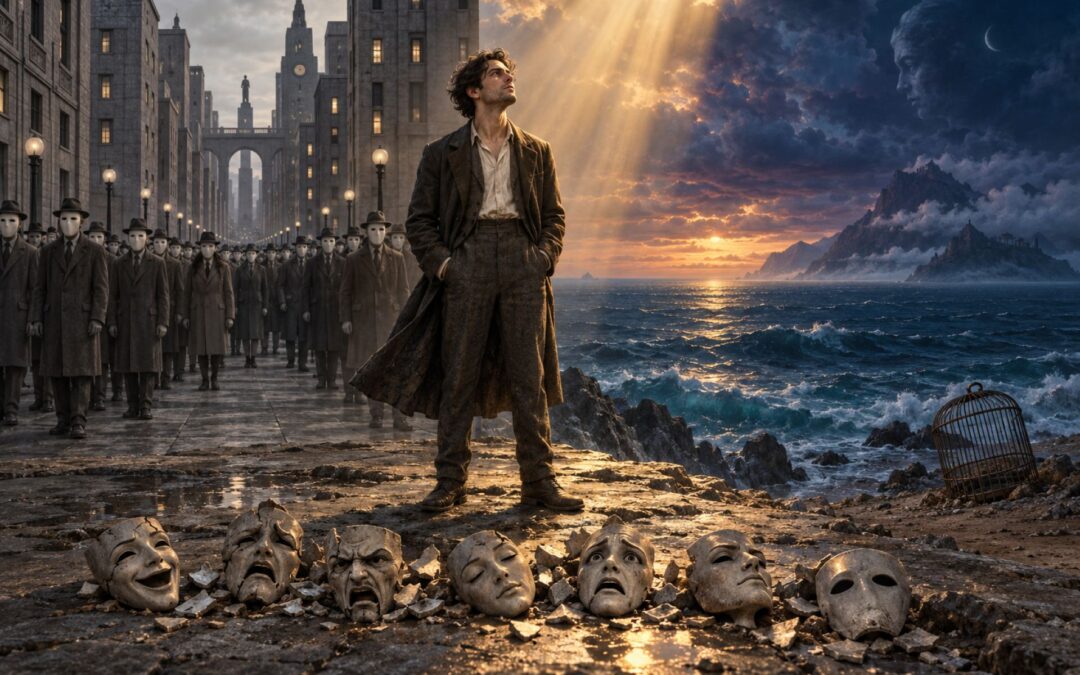
Kahlil Gibran’s The Madman: His Parables and Poems is a small book built to unsettle large certainties. First published by Alfred A. Knopf in 1918, as confirmed by the original 1918 edition, it was Gibran’s first book published in English. Its short parables, prose poems, fables, dialogues, and allegorical sketches repeatedly begin with something apparently familiar—a king, a hermit, a religious commandment, friendship, sorrow, success, sanity—and then turn it until the familiar category becomes questionable.
The title can easily mislead a modern reader. Gibran’s “madman” is not primarily a clinical portrait of mental illness but a literary outsider: someone whom society calls mad because he no longer fits comfortably within its shared definitions. The collection begins with the theft of the narrator’s masks and ends with his bewilderment at a perfectly regulated civilization. Between those two points, Gibran explores what happens when accepted distinctions between sanity and madness, virtue and sin, belief and unbelief, success and defeat, knowledge and ignorance, or perfection and incompleteness are exposed as less secure than they first appear.
The archival history of the book places its completion around 1917 and publication in 1918. Much of its material had roots in pieces Gibran composed in Arabic before rendering them into English, with Mary Haskell playing an important editorial role, though it would be inaccurate to claim that every piece followed exactly the same path. The result already contains many qualities later associated with Gibran—biblical cadence, mystical imagery, compressed philosophical storytelling—but The Madman is sharper, stranger, and often more hostile to respectable certainty than the serene image of Gibran created by his later fame.
This article discusses the complete collection and therefore reveals the endings and reversals of every parable and poem. That matters because many pieces derive their force from a final sentence that overturns everything preceding it, while the cumulative meaning of the book emerges only when those reversals are read together.

Detailed Summary of The Madman
The Madman does not tell one continuous story, but it does possess a meaningful sequence. Its thirty-five substantive pieces repeatedly return to the same questions from different directions, so the book gradually enlarges its original idea of madness: first as liberation from social masks, then as inward multiplicity, religious and moral dissent, resistance to collective judgment, epistemic humility, solitude, suffering, desire, and finally refusal of a world in which everything human has been perfectly classified.
The best way to understand the collection is therefore to follow it in order. The shorter fables are not merely detachable quotations or lessons; each adds a new variation to Gibran’s argument with convention.
Masks, God, Friendship, and the Seven Selves
“How I Became a Madman” gives the collection its governing image. The narrator wakes to discover that seven masks he has fashioned and worn across seven lives have been stolen. He rushes maskless into the streets, denouncing the thieves, while ordinary people laugh at him or retreat in fear. At the marketplace, a young man calls him a madman from a rooftop, but when the narrator looks upward, sunlight touches his uncovered face for the first time. What began as violation becomes release, and he blesses the thieves because he no longer wants the identities through which he once presented himself.
The liberation is immediately complicated. The narrator says madness has brought him the freedom of loneliness and protection from being understood, because understanding can become another form of possession: when someone claims to know us completely, that knowledge may confine us to an interpretation. Yet he checks his own triumph by observing that safety can itself resemble imprisonment. Even a thief in jail is safe from other thieves, which means isolation cannot automatically be equated with freedom. The collection thus establishes its characteristic method from the first page: a reversal is offered and then partly reversed again.
“God” takes the narrator through four encounters separated by immense stretches of time. At first he approaches God as a slave addressing a master and receives no answer. A thousand years later he returns as a creation speaking to its creator, and later as a son speaking to a father, but neither model produces communion. Each approach preserves a hierarchy in which God occupies one side and the human speaker the other.
Only the fourth formulation changes the relationship fundamentally. The narrator describes himself as God’s yesterday and God as his tomorrow, himself as the earthly root and God as the flower in the sky, both participating in one process of growth. God then embraces him, and when the narrator returns from the mountain, he finds the divine not only at the summit but also in valleys and plains. The parable therefore moves from separation toward participation and from remote transcendence toward an experience of divine presence within the world.
“My Friend” appears to contradict the opening almost immediately. The maskless madman tells his companion that what the friend sees is still only a garment. Beneath it lives an inward “I” in a house of silence, inaccessible even to apparent intimacy. The narrator adapts his words to his friend’s expectations, talking about the wind when his mind is really at sea and speaking of daylight while internally inhabiting night.
The division grows more severe as the piece continues. His friend loves Truth, Beauty, and Righteousness, and the narrator politely agrees while secretly laughing at that love; the friend imagines companionship, but the narrator insists their paths are not the same. Most strikingly, the man who celebrated losing his masks confesses that he still masks his madness. The contradiction is essential: Gibran does not replace falsity with total transparency. Losing socially imposed masks may create freedom, but some regions of the self remain private by desire rather than oppression.
“The Scarecrow” shifts from intimate confession to fable. The narrator asks a scarecrow whether it is tired of its lonely existence, but the scarecrow claims to enjoy frightening birds and remarks that only beings stuffed with straw can understand that pleasure. The narrator leaves unsure whether he has been complimented or mocked. A year later the scarecrow has supposedly become a philosopher, yet crows have built a nest beneath his hat, quietly demonstrating that an authority whose purpose is to inspire fear may become ridiculous once others cease believing in its power.
“The Sleep-Walkers” explores a different kind of mask. A mother and daughter meet while both are walking in their sleep. Freed from waking restraint, the mother accuses the daughter of ruining her youth, while the daughter condemns the mother as an obstacle between herself and freedom. Their buried resentment is violent enough that each wishes the other dead.
When a cock crows, both women wake and immediately revert to tenderness. The mother calls the daughter affectionately, and the daughter answers in the same tone, restoring the civilized relationship without resolving anything that surfaced in sleep. The piece does not simply declare the unconscious more truthful than waking life, but it suggests that harmonious social identities can coexist with emotions those identities are designed to suppress.
“The Wise Dog” turns the problem toward religion. A group of cats gathers in prayer around a grave and authoritative cat who promises that sufficiently faithful prayer will make it rain mice. A dog overhears them and dismisses their belief as absurd, because his own inherited wisdom assures him that prayer makes it rain bones.
The joke works because the dog never recognizes that his certainty has exactly the same structure as the cats’. Each species treats its own desire and tradition as universal truth. Gibran is not merely mocking religious belief from an external position; he is mocking the confidence with which communities assume that their own symbolic language must govern reality for everyone.
“The Two Hermits” begins with two men who worship God, love each other, and own almost nothing except one earthen bowl. When the older hermit decides they should separate, the younger willingly offers him the bowl because it cannot be divided usefully. The older refuses charity in the name of justice and insists on receiving only what is rightfully his.
The younger then proposes chance, but the older rejects that as an inadequate foundation for justice. Finally the younger agrees to break the bowl, whereupon the older accuses him of cowardice because he will not fight. An object that should be trivial becomes the basis of escalating conflict once possession, entitlement, and abstract justice enter the relationship. The satire is directed not at justice itself but at a mentality so attached to being just that it becomes incapable of generosity or practical reason.
“On Giving and Taking” compresses hypocrisy into an even shorter scene. A man possesses an entire valley full of needles when Mary, the mother of Jesus, asks him for one so she can mend her son’s garment before he goes to the temple. Instead of giving her the tiny object she needs, he offers a learned discourse about giving and taking.
The joke depends upon the disproportion between theory and action. The man has transformed generosity into something he can discuss precisely in order to avoid practicing it. By placing Mary and Jesus in the anecdote, Gibran also makes the satire religious: sophisticated moral discourse may become a substitute for performing the simplest act the discourse supposedly recommends.
“The Seven Selves” expands the book’s psychological complexity. During a silent hour of night, seven selves within the Madman begin speaking. The first is responsible for pain and sorrow, the second for joy, the third for passion and desire, the fourth for hatred and destructive loathing, the fifth for restless thought and inquiry, and the sixth for work—the shaping of formless material into lasting images. Each is exhausted by the role assigned to it and wants to rebel against serving the same human being.
The seventh self is different because it has no defined occupation. It exists in a kind of empty nowhere while the other six recreate the Madman’s life. When it asks which of them truly has the greater reason to rebel, the others fall silent, pity it, and eventually return contentedly to their established functions. The seventh remains awake, staring into the nothingness behind all things.
The piece echoes the seven masks of the opening while refusing to reduce the self to one authentic core hidden underneath them. The person who has lost seven masks also contains seven selves, and those selves disagree about what existence demands of them. Gibran’s freedom from fixed identity therefore does not culminate in the discovery of a simple “real me”; it opens into multiplicity, contradiction, and an unoccupied observing self whose freedom may resemble emptiness.
War, Perspective, Power, and the Other Language
The next group moves outward from inner multiplicity toward institutions, ambition, collective judgment, and the mechanisms by which people construct reality. Gibran repeatedly shows individuals or societies treating a limited perspective as absolute, then reveals the absurdity that follows when the rule is applied consistently.
“War” opens with an injured thief appearing before a prince. The thief explains that while trying to rob a money-changer in darkness, he accidentally entered a weaver’s workshop and lost an eye when he struck the loom. Instead of accepting responsibility for an injury suffered during his own crime, he demands justice against the weaver.
The prince agrees that someone’s eye should be removed in compensation. The weaver admits the decree is supposedly fair but explains that he requires two eyes to see both sides of the cloth he makes. He suggests his neighbor, a cobbler, whose work supposedly does not require both eyes. The cobbler is summoned, an innocent eye is removed, and “justice” is declared satisfied.
The story’s brutality lies in the transformation of justice into arithmetic. Once the institution decides that one lost eye must be balanced by another, responsibility and innocence become irrelevant. Gibran reduces a legal philosophy of equivalence to grotesque absurdity: procedure can satisfy itself while entirely abandoning the human purpose justice is meant to serve.
“The Fox” turns on literal perspective. At sunrise, a fox sees its elongated shadow and decides that an animal as impressive as itself deserves a camel for lunch. By noon the sun has shortened its shadow, and its ambition falls accordingly; now it thinks a mouse will be sufficient.
Nothing about the fox itself has changed. Its self-estimation is governed by an external image whose proportions it misunderstands. In miniature, the fable shows desire, ambition, and identity being shaped by appearances that feel objective only because the observer has forgotten the conditions producing them.
“The Wise King” provides one of the book’s most powerful investigations of collective sanity. In the city of Wirani, everyone depends upon a single well. One night a witch pours seven drops into it and declares that anyone who drinks will become mad. The next morning the population drinks, while the king and his lord chamberlain do not.
The transformed citizens soon conclude that the king and chamberlain have lost their reason. Because the rulers alone now differ from the population, their difference is interpreted as madness, and people begin discussing the king’s removal. Faced with political isolation, the king drinks from the same well and gives the water to his chamberlain.
The city celebrates because its rulers have supposedly regained their sanity. Gibran never supplies an external test that the characters themselves can use to distinguish madness from normality once the whole community has changed. The parable therefore makes consensus frighteningly powerful: what a society calls reason may sometimes mean nothing more than successful participation in its prevailing assumptions.
“Ambition” follows three craftsmen whose profits have all come from a death. A weaver has sold a shroud, a carpenter a coffin, and a ploughman has been paid to dig a grave. They celebrate at a tavern with wine, meat, and cakes, creating excellent business for their host.
The tavern keeper’s wife watches them leave and imagines how fortunate it would be if such customers appeared every day. With enough prosperity, she thinks, her son could escape tavern work, receive an education, and become a priest. The ending widens the satire: death has produced commerce, commerce produces social aspiration, and that aspiration culminates in religious respectability. Gibran links supposedly elevated ambition to a chain of ordinary appetites without needing to accuse any individual character of conscious corruption.
“The New Pleasure” is only a few lines long. The narrator invents a pleasure, whereupon an angel and a devil arrive and quarrel over whether it is a virtue or a sin. Neither first experiences the pleasure nor asks what it does; each immediately seeks to classify it.
The miniature concentrates a recurring Gibranian suspicion of moral labeling. Life produces an experience first, while inherited systems arrive afterward to assign it a category. The dispute also leaves open the possibility that rigid oppositions between virtue and vice reveal more about the classifiers than about the thing being classified.
“The Other Language” begins three days after the narrator’s birth. Lying in a cradle, he hears his mother and nurse agree that he is happy, although his own experience is miserable: the bed feels hard, the milk bitter, and the smell unpleasant. He protests, but the adults cannot understand him because he still speaks the language of the world from which he has come.
At his christening, a priest congratulates his mother because the child has been born a Christian. The infant objects that this logic would make the priest’s heavenly mother unhappy, since the priest himself was not born already belonging to that religion. Again nobody understands. Months later a soothsayer predicts that the child will become a statesman, while the child insists that he will be a musician.
Thirty-three years pass. The mother, nurse, and priest are dead, but the narrator meets the surviving soothsayer, who confidently claims that he had always predicted the narrator would become a great musician. By then the adult narrator believes him because he too has forgotten the other language he once possessed. Socialization is thus presented not merely as learning communication but as losing access to an earlier form of knowledge so thoroughly that even false memories supplied by authorities can become persuasive.
“The Pomegranate” relocates philosophical argument inside a fruit. Seeds debate what they are and what they will become. One anticipates growing into a magnificent tree, another dismisses such hopes as youthful fantasy, a third sees nothing in the present that promises greatness, and a fourth argues that life would be meaningless without a larger future.
Further voices question whether anyone can discuss the future without knowing the present self, whether identity simply continues unchanged, and whether knowledge may be too clear internally to express in words. Soon so many seeds are talking that no individual position can be distinguished. The narrator escapes to a quince because its seeds are fewer and quieter, turning metaphysical debate into a comedy about the point at which multiplicity of opinion ceases to clarify anything.
Captivity, Dogma, Defeat, and Night
The collection now darkens. Images of imprisonment, self-mutilation, burial, defeat, and night become more prominent, but Gibran uses them to question conventional judgments rather than simply to create despair. Captivity may reveal equality, death may mark renewal, and defeat may protect a person from a more dangerous kind of enslavement.
“The Two Cages” takes place in the narrator’s father’s garden. One cage holds a lion captured from the desert; another contains a songless sparrow. Every dawn the sparrow greets the lion as a brother prisoner.
The contrast in size, strength, and prestige disappears before the shared fact of confinement. A lion that would dominate the natural hierarchy outside the cage and a sparrow that would seem insignificant occupy the same existential position once liberty is removed. Gibran makes captivity more fundamental than rank.
“The Three Ants” again asks what creatures can know from within the limits of their own scale. Three ants meet on the nose of a sleeping man. Two describe the surface as barren land on which nothing grows, while the third announces that they are standing upon the Supreme Ant, an immeasurably vast being whose body they cannot perceive as a whole, whose shadow exceeds their ability to trace it, and whose voice is too immense to hear.
The first two ants laugh at the third’s theology. Before the dispute can be settled, the sleeping man scratches his nose and crushes all three. The parable refuses to make epistemic confidence safe on either side: the believers’ language is anthropomorphic, but the skeptics’ inability to perceive a larger order does not establish that no such order exists. Their shared limitation is more important than their disagreement.
“The Grave-Digger” shows the narrator burying one of his dead selves. The grave-digger says he prefers the narrator to everyone else who comes to the cemetery because ordinary mourners arrive crying and leave crying, while the narrator comes and goes laughing.
The image extends “The Seven Selves.” Death within the personality is not necessarily catastrophe because a self can outlive its usefulness and be buried while the larger person continues. The laughter does not make literal bereavement trivial; it belongs to a symbolic process in which shedding an obsolete self becomes another version of losing a mask.
“On the Steps of the Temple” is one of the collection’s most compressed and resistant pieces. The narrator sees a woman seated between two men; one side of her face is pale, while the other is blushing. Gibran gives no explanation, dialogue, or outcome, so any interpretation must remain cautious.
The image can suggest different selves presented to different observers, divided desire, shame and attraction, or the instability of a face as a transparent sign of inward reality. What matters with greater certainty is its placement within a book obsessed with faces, masks, partial perspectives, and relational identity. The miniature offers a visual contradiction rather than a solved allegory.
“The Blessed City” attacks literal religious obedience with unusual brutality. The narrator hears of a city whose inhabitants live completely according to Scripture and undertakes a long journey to see it. On arriving, he discovers that every adult possesses only one eye and one hand, while the citizens themselves are astonished that he still has two of each.
They lead him to a temple containing piles of withered hands and eyes. The people explain proudly that they have conquered the evil within themselves by obeying the command to remove an offending eye or hand. Only children remain physically whole because they are too young to read Scripture and understand the commandment.
The narrator leaves immediately, because he is old enough to read. The satire is not subtle, but its target is specific: words intended to direct moral transformation become instruments of mutilation when metaphor is converted into rigid literal law. The “blessed” society has achieved purity by destroying itself.
“The Good God and the Evil God” further destabilizes moral certainty. The two gods meet, and the Evil God complains that human beings continually mistake him for his opposite, worshiping or naming him as though he were good. The Good God admits that the same confusion happens to him in reverse.
The Evil God leaves cursing humanity’s stupidity. The joke is not that good and evil are necessarily identical; rather, human confidence in distinguishing them is far less reliable than moral language assumes. The miniature complements “The New Pleasure,” where angel and devil also rush to categorize an experience whose nature remains uncertain.
“Defeat” abandons fable for lyric address. The speaker personifies Defeat as an intimate companion and declares it dearer than triumph because it protects him from laurels, public approval, and the fixed identity produced by success. Defeat keeps him young, defiant, solitary, and difficult to possess.
The poem’s value reversal is more complex than the slogan that failure is good. The speaker fears what triumph can do to a person: enthronement may become enslavement, public understanding may flatten complexity, and complete ripeness may mean readiness to be consumed. Defeat preserves unfinished possibility because it prevents the world from successfully incorporating the speaker into one of its recognized forms.
By the end, Defeat becomes a companion in dangerous renewal. The speaker imagines laughing with storms, burying whatever dies within him, standing deliberately in sunlight, and remaining capable of threatening settled order. The poem returns to the book’s opening logic: social rejection can become freedom, but the emphasis is now more consciously defiant.
“Night and the Madman” tests that defiance rather than simply celebrating it. The Madman tells Night that he resembles her because he is dark, naked, silent, deep, terrible, joyful, passionate, and filled with cosmic forces. Night repeatedly rejects his claims. Each time, she identifies a residue of ordinary ego that prevents him from becoming as vast as he imagines.
He still looks backward to admire the size of his footprints. He still fears pain and the abyss. He remains attached to his “little-self,” still desires a sister-spirit, and has not fully exposed his heart. The dialogue therefore becomes a corrective to the Madman’s own grandiosity: escaping society does not automatically mean escaping vanity, fear, longing, or self-consciousness.
Gradually, however, the relationship changes. Night finally asks whether he can ride the tempest and grasp lightning, and the Madman answers with an image of a throne built over fallen gods. In the last exchange they become figurative twins, but with different revelations: Night reveals space, while the Madman reveals his soul. His kinship with cosmic darkness is therefore earned through confrontation rather than declared by self-flattery.
Faces, the Greater Sea, Crucifixion, and Longing
From “Faces” onward, the book increasingly links selfhood to perception and nakedness. The Madman seeks realities supposedly concealed beneath appearances, yet Gibran keeps asking whether any perceiver can remove every layer without creating another interpretation in its place.
“Faces” presents a series of paradoxical observations. The narrator has encountered a face containing many countenances and another seemingly frozen into only one; beautiful surfaces have concealed ugliness, while unattractive surfaces have hidden beauty. Wrinkled age may reveal emptiness, and smoothness may carry an entire history.
The closing idea is crucial because the narrator claims to know faces precisely by looking through a fabric woven by his own eye. He wants to see reality beneath appearance, yet he acknowledges that vision itself creates a veil. The seeker of hidden truths therefore cannot stand completely outside the problem he diagnoses in others.
“The Greater Sea” is one of the collection’s longest and richest parables. The narrator and his Soul go to the sea intending to bathe naked, but they want a hidden place where nobody will see them. As they travel along the shore, each potential location is occupied by a person whom the Soul identifies with a philosophical or moral disposition.
First they see a pessimist throwing salt into the sea, as though his small act could make an already salty immensity more bitter. Next comes an optimist throwing sugar into the water, equally convinced that his gesture can sweeten what dwarfs him. Their attitudes differ, but their relationship to reality is structurally similar: each projects a preferred quality onto something incomparably larger than himself.
The next figure is a philanthropist returning dead fish to the water. His tenderness does not restore the fish to life, so benevolent intention becomes futile action. Then appears a mystic repeatedly tracing his shadow in the sand while waves erase it, suggesting an obsession with recovering or preserving an image the larger sea continually dissolves.
An idealist collects sea foam in a beautiful vessel, isolating an attractive surface phenomenon from the immense force that produced it. The so-called realist turns his back on the actual sea while listening to its sound through a shell, reducing the whole to a fragment he can control. Finally the pair finds a puritan with his head buried in the sand, apparently incapable of seeing their nakedness.
The narrator thinks they have finally found privacy, but the Soul refuses. The puritan is the most dangerous observer precisely because his refusal to see does not make nakedness safe. Saddened, the Soul concludes that there is nowhere along this sea where she can expose herself without being subjected to someone’s limited worldview, so she and the narrator leave in search of a Greater Sea.
The story satirizes pessimism, optimism, philanthropy, mysticism, idealism, realism, and puritanism, but it also leaves an uncomfortable question behind. Every person by the water handles only some fragment of reality, yet the Soul’s insistence on a place free from all witnessing may itself be an impossible demand. The search for absolute nakedness can become another refusal to live among imperfect perspectives.
“Crucified” takes religious imagery into more dangerous territory. The Madman asks people to crucify him, and when they wonder why they should accept responsibility for his blood, he tells them that crucifying madmen is the means by which they themselves can be exalted. They comply, and as he hangs between earth and heaven, they finally raise their heads to look upward.
Observers try to explain the act using familiar categories. They ask what he is atoning for, what cause he is sacrificing himself to, whether he wants glory, and whether he forgives those inflicting pain. He rejects all of these interpretations. His crucifixion is neither conventional atonement nor heroic sacrifice nor a transaction for fame.
Instead, he describes a thirst that only his own blood can answer, dumbness that seeks wounds as new mouths, and imprisonment within ordinary days and nights that requires an opening into larger dimensions of existence. The language deliberately borrows Christian imagery while resisting a straightforward reproduction of Christian theology. Crucifixion becomes an image of violent self-transcendence: the Madman wants his existing limits broken because ordinary existence has become too narrow.
“The Astronomer” contracts the same question of vision into a miniature. The narrator meets a man blind from birth who is reputed to be the wisest person in the land. When asked how long he has been blind and what branch of wisdom he follows, the man replies that he is an astronomer and places a hand upon his chest.
His suns, moons, and stars are inward. The story does not establish that physical observation is inferior to interior perception; rather, it challenges the assumption that sight is exhausted by eyesight. As throughout the collection, a limitation in one accepted faculty opens the possibility of another mode of knowing.
“The Great Longing” places the Madman between a mountain he calls his brother and a sea he calls his sister. The three share immeasurable age, loneliness, youthful desire, and an inability to find completion despite the worlds they have seen rise and vanish. Their kinship is not peaceful self-sufficiency but enormous unspent passion.
The sea dreams of an unknown fire-god, and the mountain calls toward a distant cool goddess. Both can at least imagine an object corresponding to their longing. The Madman cannot even identify whom he calls in sleep, which makes his loneliness more obscure rather than more heroic.
This poem complicates everything the collection has said in praise of solitude. The outsider may value freedom from possession and public understanding, but he continues to desire a “sister-spirit,” companionship, or a form of completion he cannot name. Independence has not eliminated need.
Perception, Sorrow, Joy, and the Perfect World
The final sequence brings together reincorporated perspectives, uncertain knowledge, religious argument, emotional life, and the collection’s final assault on perfection. These pieces make it increasingly difficult to read the Madman as someone who has simply escaped illusion. He remains a creature of memory, desire, interpretation, loss, and incompleteness.
“Said a Blade of Grass” begins when grass complains that an autumn leaf makes too much noise while falling and disturbs its winter dreams. The leaf responds contemptuously, accusing the grass of being low-born, earthbound, and incapable of appreciating the song heard in the upper air. The disagreement appears to establish a hierarchy between lofty experience and narrow lowland perception.
Then the leaf dies, lies upon the earth, and awakens in spring as a blade of grass. When autumn returns, falling leaves irritate it exactly as they irritated the first grass. Transformation has changed position without preserving understanding. The former leaf now reproduces the complaint it once despised, suggesting that perspective can overpower memory and that beings often mistake their current position for permanent truth.
“The Eye” makes this epistemological problem explicit. The Eye announces that it can see a mountain beyond the valleys, veiled in blue mist. The Ear listens but hears no mountain, the Hand cannot touch it, and the Nose cannot smell it. Because their own faculties provide no confirming evidence, they conclude that something must be wrong with the Eye.
The story’s force comes from the fact that each skeptic reasons correctly within the limits of its particular sense and incorrectly when converting that limit into a universal judgment. Different ways of knowing disclose different aspects of reality. The parable therefore attacks not skepticism itself but the assumption that whatever cannot be detected by one authorized method cannot exist.
“The Two Learned Men” carries the instability of certainty into religion. In the ancient city of Afkar, two scholars despise each other because one believes in the gods and the other denies them. They meet publicly and argue for hours before separating.
By evening, the unbeliever has gone to the temple to seek forgiveness from the gods, while the believer burns his sacred books because he has become an unbeliever. The argument has not produced a public victor; instead, each man has been inwardly destabilized by the other. Gibran again refuses to supply a simple doctrinal destination. What matters is that identities advertised as settled positions prove vulnerable to encounter.
“When My Sorrow Was Born” personifies sorrow as something the narrator raises almost like a child. He tends it carefully, and as it grows, their relationship becomes loving and productive. Together they converse, dream, sing, and walk through the world, and Sorrow gives the narrator an eloquence that other people find beautiful.
Neighbors listen to their songs, strangers gaze at them gently, and some even envy the narrator because his Sorrow appears noble. Suffering becomes not merely an internal burden but a source of language, imagination, social recognition, and artistic depth. Yet because Sorrow is personified as a living companion, it eventually dies.
Afterward, the narrator’s speech sounds heavy to himself, nobody comes to hear him sing, and passersby cease noticing him. Only in dreams does he hear people pitying the man whose Sorrow has died. The piece is not a straightforward recommendation to suffer; it examines the unsettling possibility that identity and expression can become so intertwined with pain that losing it feels like losing part of the self capable of communicating with others.
“And When My Joy Was Born” deliberately mirrors the preceding poem but produces the opposite social result. When Joy is born, the narrator carries it onto the rooftop and calls his neighbors to celebrate. Nobody comes. He continues announcing Joy for seven months, but no other heart participates.
Joy gradually weakens because it is held only by the narrator. Without recognition, affection, or shared celebration, it dies of isolation. The narrator later remembers Joy only through the memory of his dead Sorrow, and even that memory fades like an autumn leaf carried by wind.
Read together, the two poems create one of the collection’s richest paradoxes. Sorrow attracts witnesses and deepens expression, while Joy proves strangely difficult to communicate. Yet both ultimately demonstrate that the self is not as self-sufficient as the Madman sometimes wishes to believe. Inner experience seeks relationship, and when relationship fails, even joy can become unlivable.
“The Perfect World” closes the book as a prayer from an imperfect being trapped among perfectly regulated people. The speaker addresses a God of lost souls while describing himself as human chaos, a confused nebula moving through a civilization of finished worlds. The people surrounding him possess complete laws and pure order; their thoughts, dreams, visions, virtues, sins, and even morally neutral impulses have been sorted, measured, recorded, and catalogued.
Daily life follows precise prescriptions. Eating, sleeping, working, playing, singing, dancing, thinking, feeling, loving, worshiping, giving, stealing, praising, blaming, happiness, suffering, and memory all occur according to predetermined forms. The society has managed not only behavior but interior experience itself.
Even harmful acts can be performed respectably if performed according to convention. A person may rob a neighbor with a smile or destroy another soul with a word, then wash his hands when the proper workday ends. The point is not that the perfect society has eliminated wrongdoing but that it has absorbed wrongdoing into procedure. Moral appearance has become more important than living responsiveness.
The speaker recognizes this civilization as a “perfect world,” yet perfection horrifies him. He describes himself instead as a green seed of unrealized passion, a tempest without a prescribed direction, and a bewildered fragment that does not fit the finished system. The book ends not with a doctrine but with a question: why has such an unfinished creature been placed among beings who have completed themselves so thoroughly?
The question returns directly to the marketplace where the narrator first became a Madman. There, society named the maskless individual abnormal; here, society has perfected the machinery of normality. The Madman remains outside both systems because his life is defined by becoming rather than completion.
The Madman as Persona: Masks, Freedom, Solitude, and the Self
The recurring Madman gives a heterogeneous collection enough continuity to feel like more than an anthology of unrelated fables. He is not present in exactly the same way in every piece, and it would be a mistake to treat him as the protagonist of a conventional novel. He functions instead as a mobile perspective: a speaker able to expose ordinary assumptions because he occupies an unstable position between participation and estrangement.
His origin is involuntary. He does not initially choose to become maskless; his masks are stolen. Only after the public labels him mad does he reinterpret the loss as liberation. This distinction matters because his freedom does not begin as a heroic declaration of independence. It begins when the identities he constructed to survive socially are taken away and he discovers that exposure can feel more alive than protection.
The sunlight on his uncovered face establishes a pattern repeated throughout the collection. Nakedness represents a condition in which inherited coverings have been removed, while light often suggests some form of direct encounter. Yet “My Friend” immediately prevents the symbol from becoming simplistic. The supposedly unmasked Madman still chooses concealment because complete accessibility to another person can be as threatening as social disguise.
That tension defines his personality. He wants freedom from being understood too easily, but he also wants recognition that does not imprison him. He seeks loneliness and then admits longing for a sister-spirit. He celebrates defeat because it prevents society from claiming him, yet Sorrow and Joy reveal how deeply he depends upon the responses of others. His solitude is therefore neither pure liberation nor pure misery.
“The Seven Selves” makes the Madman even less reducible to an authentic core. Pain, joy, passion, hatred, thought, and creative labor coexist within him, each capable of speaking as though it were a separate person. None can simply be expelled as the false self because all contribute to life. The seventh, undefined self appears freer than the others but also emptier, condemned to watch the nothingness behind activity.
The identity Gibran constructs is therefore dynamic rather than essentialist. A person contains changing roles and impulses, buries selves that have died, discovers others in conflict, and remains partly unknowable even to intimate companions. The opening image of seven masks and the later image of seven selves suggest that removing one layer does not reveal a final unitary personality underneath.
“Night and the Madman” subjects this self-conception to its strongest internal criticism. The Madman imagines himself as cosmic, terrible, liberated, and vast, but Night keeps discovering vanity beneath his metaphors. He still measures his footprints, fears pain, depends upon companionship, and identifies with his smaller ego. His rhetoric exceeds his achievement.
This prevents the persona from becoming merely Gibran’s infallible sage. The Madman may see hypocrisies that conventional people miss, but he can also romanticize his marginality. He is sometimes genuinely liberated, sometimes self-dramatizing, and sometimes both at once. The book is stronger because it allows that instability.
“The Great Longing” exposes the emotional cost of outsiderhood. The Madman sits beside immense natural companions and insists that all three share loneliness, but neither symbolic kinship nor cosmic imagination removes his desire for another person. He does not even know whom he seeks. The person most suspicious of being possessed by understanding remains haunted by the wish to be met.
“The Perfect World” finally places this persona against a civilization that represents everything he cannot become. Its citizens are finished, sorted, measurable, regulated, and socially legible. The Madman is unfinished, mixed, excessive, and unpredictable. What society experiences as imperfection is exactly what preserves his capacity for change.
Gibran therefore does not resolve the question posed by the opening. Freedom from masks can create genuine independence, but it can also produce loneliness; refusal to be defined can protect complexity, but it can also become a defensive identity of its own. The Madman remains compelling because the book never fully decides whether his outsiderhood is salvation, wound, vocation, or some combination of all three.
God, Religion, and the Search for Truth
Religion saturates The Madman, but the collection is neither straightforwardly devotional nor straightforwardly anti-religious. God, temples, priests, commandments, angels, devils, crucifixion, prayer, heaven, hell, and sacred books appear constantly. Gibran’s recurring target is less spiritual experience itself than the human desire to turn mystery into ownership, hierarchy, formula, or institutional certainty.
“God” provides the clearest positive spiritual movement. The narrator’s earliest relationships with the divine depend upon vertical categories: master and slave, creator and artifact, father and child. Communion becomes possible only when that rigid separation loosens and the human and divine are imagined as participating in one growth. The God encountered on the holy mountain then appears everywhere below, making immanence more important than privileged location.
Other pieces attack the assumption that communities possess reliable formulas for divine truth. “The Wise Dog” is comic precisely because the dog sees the cats’ theology as obviously ridiculous while reproducing its structure in canine terms. Prayer becomes a projection of species-specific appetite, and inherited confidence becomes indistinguishable from prejudice.
“On Giving and Taking” shifts from theology to religious ethics. The owner of a valley full of needles can produce sophisticated moral language but cannot surrender one needle to someone who needs it. His failure is not ignorance. He understands the category of generosity so thoroughly at the level of discourse that the discourse has become a defense against generosity itself.
“The Three Ants” complicates skepticism and belief simultaneously. The ant who imagines a Supreme Ant is mocked because the other two cannot perceive such a being, yet all three are literally standing upon a creature too large for their senses to comprehend as a whole. The parable exposes the weakness of concluding that reality must fit the scale of the observer, but its theology remains deliberately anthropomorphic: the ant can imagine transcendence only by enlarging its own species.
That ambivalence is important. Gibran does not require the reader to accept the third ant’s doctrine as final truth. Instead, he makes certainty difficult for everyone. The believers may convert mystery into their own image, while the skeptics may mistake sensory limitation for metaphysical knowledge.
“The Blessed City” is far less ambiguous about religious literalism. Its adults have obeyed a scriptural injunction by physically removing eyes and hands, converting language of moral discipline into bodily mutilation. The horror lies in the pride with which they describe themselves as conquerors of evil. Obedience has prevented them from asking what the command was meant to accomplish.
The children are the only whole people because they cannot yet read. This is not an argument that literacy itself corrupts them; it is an argument about interpretation without judgment. Once sacred language becomes a rule to be executed rather than meaning to be understood, piety can become self-destruction.
“The Good God and the Evil God” and “The New Pleasure” attack another religious temptation: certainty in moral labels. Angel and devil fight over an unfamiliar pleasure before understanding it, while humans repeatedly confuse the Good God and Evil God. These pieces do not abolish distinctions between good and evil, but they question the competence with which people presume to apply them.
“Crucified” introduces the collection’s most obviously Christian image but also its most resistant religious symbolism. The Madman voluntarily seeks crucifixion, yet rejects atonement, sacrifice, worldly glory, and forgiveness as explanations for his act. He wants transformation through wounds, an opening beyond the boundaries of his current life.
This should not be forced into orthodox Christian theology, nor should it be read as simply anti-Christian. Gibran uses crucifixion because it carries extraordinary symbolic density: suffering, elevation, exposure, death, witness, transcendence, and the possibility that destruction can become passage. He retains the image while refusing to let the crowd control its meaning.
“The Two Learned Men” closes one strand of the book’s religious argument by making conviction reversible. The believer and unbeliever debate fiercely, but each leaves transformed by the other. Neither position is secured simply through public argument. Gibran depicts belief as existentially unstable because confrontation can disturb the identity built around either acceptance or denial.
For that reason, The Madman should not be reduced to a hidden theological system. A recent academic Sufi reading has productively interpreted concepts in the collection through ideas such as madness, truth, the self or soul, and purification. Such a framework can illuminate Gibran’s concern with stripping away conventional identity, but it remains an interpretation rather than an exclusive doctrinal key.
Across the book, spiritual truth tends to appear when possession weakens. God becomes available when hierarchy softens, the Blessed City becomes monstrous when interpretation hardens, and the Greater Sea remains inaccessible while each thinker insists upon handling the sea according to a partial system. Religion is therefore most alive in The Madman when it retains mystery and most dangerous when it becomes completely certain of its own language.
Society, Conformity, Justice, and the Reversal of “Sanity”
If religion provides one field of Gibran’s suspicion, society provides another. Many of the collection’s parables examine what happens when a shared convention becomes so widely accepted that it no longer appears conventional. At that point, collective agreement can redefine madness as sanity, injustice as justice, mutilation as virtue, and moral emptiness as perfection.
The opening establishes the social mechanism immediately. Nothing about the narrator’s mind is clinically examined before the marketplace crowd names him a madman. He is designated abnormal because he appears without the expected masks and behaves in ways the surrounding community cannot assimilate. Madness begins as a relational category: he is mad because he does not fit the public grammar.
“The Wise King” turns that mechanism into political allegory. When nearly the entire city drinks the witch’s water, the minority that abstains becomes socially insane regardless of what actually happened to the majority. Because political legitimacy depends upon recognition, the king eventually accepts the population’s altered reality and drinks.
The parable is unsettling because the king’s choice is understandable. A ruler whom every subject considers insane cannot rule effectively, even if he possesses some external claim to reason. Gibran thus exposes a real tension between truth and social functionality: belonging may require accepting assumptions one privately knows to be distorted.
“The Two Hermits” demonstrates how abstract principles can manufacture conflict. Before the older hermit demands division, one bowl is enough for two friends. Once ownership must be precisely assigned, generosity becomes suspicious because it violates strict entitlement, chance becomes unjust because it does not guarantee one’s due, and breaking the object becomes preferable to relinquishing the demand.
The older hermit finally accuses the younger of cowardice for refusing to fight. Justice has ceased serving relationship and become a justification for hostility. Gibran’s criticism is not that principles are worthless but that principles detached from proportion and mercy can produce the opposite of their stated purpose.
“War” makes the same point institutionally. The prince’s court preserves the form of compensation while abandoning responsibility. An innocent cobbler loses an eye because the system has decided that an eye must be taken from somebody, and the decree can therefore announce itself as fulfilled.
The satire remains relevant because bureaucratic systems can become preoccupied with procedural closure. Once a rule defines what counts as resolution, suffering may be redistributed merely so the institution can declare the case complete. Gibran dramatizes this danger in deliberately grotesque form.
“Ambition” adds economic and social respectability to the pattern. A death generates income for craftsmen, their spending benefits a tavern, and the tavern keeper’s wife imagines converting that prosperity into an education that will allow her son to become a priest. No individual needs to be villainous for the chain to feel morally strange.
The fable asks readers to look beneath respectable social categories at the material dependencies sustaining them. Priesthood appears elevated at the end of a sequence beginning with burial and commercial profit. Social prestige does not erase the ordinary economy from which it emerged.
“The Other Language” shows conformity operating much earlier in life. Adults continually tell the infant what he feels, what religion he belongs to, and what future awaits him. Because the child cannot make his experience intelligible in their language, their interpretations dominate.
By adulthood he has internalized that system so thoroughly that he accepts a false memory from the surviving soothsayer. Social power therefore consists not only of coercion but of determining which descriptions are available. When the original language disappears, the imposed story can feel like memory itself.
“The Blessed City” represents conformity at its most violent. Each adult mutilates the same organs, and the narrator’s intact body becomes the abnormal sight. Collective obedience has transformed injury into holiness and wholeness into suspicious difference.
The two cages offer a quieter image of institutional power. Lion and sparrow occupy different positions in nature, but captivity levels them. Once freedom is removed, conventional distinctions in strength or prestige matter less than the structure containing both creatures.
All these patterns culminate in “The Perfect World.” There, society no longer needs obvious coercion because classification has entered every dimension of life. Even feeling and suffering occur in approved quantities and at approved times. The system is horrifying precisely because its members appear perfectly adapted to it.
Gibran’s repeated reversal of sanity is therefore not an argument that every majority is wrong or that outsiders are automatically wise. The Madman himself is capable of vanity and contradiction. The sharper claim is that consensus cannot be its own final proof, because communities can normalize absurdity so completely that dissent begins to resemble pathology.
The Divided Self, Perception, and the Limits of Knowledge
The social critique of The Madman depends upon an equally strong critique of perception. People are dangerous when they mistake a partial viewpoint for total knowledge, yet Gibran does not grant his outsider perfect access to reality either. The Madman’s eye also weaves a fabric, his selves disagree, his memories change, and his metaphors sometimes exaggerate what he has actually become.
The opening creates the first distinction between appearance and identity through masks. A mask is visible and socially legible, but it is constructed. Losing it seems to promise access to something more authentic, yet “My Friend” shows that the problem cannot be solved merely by stripping away appearances.
The friend sees a socially coherent companion, while the narrator experiences an inward sea, night, hell, laughter, and madness inaccessible to that relationship. His outer speech echoes what the friend expects rather than what occupies his mind. Knowledge of another person is therefore limited not only because the observer misreads but because the observed person actively withholds.
“The Sleep-Walkers” reveals another division. Mother and daughter possess waking identities organized by affection and sleeping selves organized by resentment. Neither layer can simply be declared wholly false. Their relationship contains both tenderness and hostility, and ordinary consciousness manages the contradiction by keeping only part of it speakable.
“The Seven Selves” pushes multiplicity further by refusing to privilege one psychological voice as the entire person. Sorrow, joy, passion, hatred, thought, and labor all claim legitimate exhaustion. The seventh self’s undefined condition does not make it obviously superior; it envies the others for having purposes even while they envy the possibility of escaping theirs.
Gibran’s self is thus closer to a field of competing energies than to a single hidden essence. A person may be sincere in several contradictory states because different dimensions of the personality become active at different times. This also explains why the book distrusts easy external understanding: reducing someone to one stable category necessarily excludes other selves.
Perspective becomes literal in “The Fox.” The animal’s ambition changes because the same body casts different shadows at different hours. What appears to be self-knowledge is actually interpretation of a moving image.
“The Other Language” adds historical instability to perception. The infant once knew that adults misunderstood him, yet the adult has forgotten that knowledge and now accepts the soothsayer’s revised claim. Memory itself is therefore not a neutral archive. Socialization can rewrite the past by eliminating the standpoint from which the original distortion could have been recognized.
“The Pomegranate” turns plurality into epistemic noise. The seeds hold incompatible philosophies of becoming, identity, continuity, hope, and expression. Several may contain partial insight, but the multiplication of voices does not produce synthesis. The narrator finally escapes because conversation has become indistinguishable from noise.
“The Three Ants” makes scale the central problem. The ants cannot perceive the sleeping man as a whole because their sensory world is too small. Their disagreement about the Supreme Ant matters less than the fact that all three theories arise within radically constrained conditions.
“The Astronomer” reverses the ordinary association between sight and knowledge. A blind man claims astronomy through inward observation, forcing readers to distinguish literal perception from imaginative or spiritual vision. Gibran does not provide a method for deciding how inward stars correspond to astronomical reality, which is precisely why the piece belongs to a collection about different orders of seeing rather than a treatise on empirical knowledge.
“Faces” implicates the Madman directly. He claims to see beneath appearances, but he admits that his own eye manufactures a fabric through which reality is viewed. The observer who prides himself on unmasking others remains an interpreter.
“The Eye” then presents the clearest model of epistemic pluralism. Ear, Hand, and Nose correctly report that their own methods cannot detect the mountain. They become foolish only when they infer from this that the mountain cannot exist and that the Eye must be defective.
The story does not mean every unverifiable claim deserves belief. Its point is narrower and stronger: a mode of inquiry cannot legitimately treat its own range as the boundary of reality without first establishing that nothing exists outside that range. Humility begins by distinguishing “I cannot perceive it this way” from “there is nothing there.”
“The Two Learned Men” finally demonstrates that intellectual identity can change under pressure. The debate between belief and unbelief is not simply a contest of propositions because it reorganizes the debaters themselves. Knowledge is shown as existentially consequential rather than merely abstract.
Across these pieces, Gibran never gives the Madman a perfectly objective viewpoint. Instead, he creates a hierarchy of uncertainty. The conventional person is often wrong because he does not know that he is interpreting, while the more perceptive outsider becomes wiser when he recognizes his own limits. The deepest form of knowledge available in The Madman is therefore not possession of every answer but suspicion of claims that a partial perspective has exhausted the whole.
Sorrow, Joy, Defeat, Desire, and the Inner Life
The book’s satire of religion and society can make The Madman seem primarily intellectual, but its emotional pieces reveal a different center. Gibran is equally interested in what freedom costs internally: the ache of solitude, the strange dignity of failure, the creative power of sorrow, the fragility of unshared joy, and the persistence of desire even in a speaker who dreams of radical independence.
“Defeat” is the most obvious reversal of conventional emotion. Victory usually promises honor, recognition, and social elevation, yet the speaker fears those rewards because they can fix a person into a completed public identity. Laurels wither, thrones enslave, and being fully understood can flatten whatever remains unfinished.
Defeat becomes valuable because it interrupts incorporation. A person who has lost can continue changing because the world has not successfully declared what he is. The poem therefore shares the logic of the stolen masks: what appears outwardly as loss may prevent a more profound captivity.
Yet the poem’s celebration of defeat contains a risk. Rejection can become another source of pride, allowing the outsider to imagine that being misunderstood proves superiority. “Night and the Madman” quietly corrects this temptation when Night observes that the Madman still looks backward to inspect his footprints. His resistance to admiration has not necessarily freed him from wanting to be impressive.
The dialogue with Night exposes other vulnerabilities. The Madman wants to believe he is self-sufficient, but Night sees his desire for a sister-spirit. He wants cosmic freedom but still fears pain and remains attached to his smaller self. His imagination has expanded faster than his emotional independence.
“The Great Longing” removes any remaining illusion that solitude has solved his needs. Mountain, sea, and Madman are immensely old and symbolically powerful, yet all remain unfulfilled. Their grandeur does not protect them from longing.
The Madman’s desire is the least definable of the three. Mountain and sea can imagine complementary beings, while he cannot name the figure he calls in sleep. His incompleteness is therefore existential rather than merely romantic. Something is missing, but language cannot specify what would satisfy it.
“When My Sorrow Was Born” makes suffering intimate rather than abstract. Sorrow becomes a companion the narrator raises, loves, sings with, and shows to the world. Far from isolating him, Sorrow creates language through which other people approach him.
The poem understands something psychologically uncomfortable: pain can become socially meaningful and artistically fertile. A person may receive attention, depth, recognition, or even identity through suffering. When Sorrow dies, the narrator does not simply become happy; he becomes inarticulate and socially invisible.
That does not mean Gibran argues that suffering should be preserved for the sake of creativity. The poem is more observational than prescriptive. It dramatizes how deeply an emotion can organize selfhood, so that its disappearance creates a vacancy rather than uncomplicated relief.
“And When My Joy Was Born” reverses the social economy of Sorrow. The narrator tries actively to share Joy, but nobody responds. Because no other heart receives it, Joy becomes weak and eventually dies.
The pairing suggests that emotions are relational even when they feel most private. Sorrow finds witnesses because other people recognize and perhaps aestheticize suffering; Joy cannot survive simply as personal possession because celebration requires participation. The Madman who earlier wanted to be alone with his sea and night discovers that some experiences diminish when nobody else enters them.
Together, these texts keep The Madman from becoming a philosophy of glamorous alienation. The speaker may resist conventional success, understanding, and belonging, but he is not beyond attachment. His freedom is valuable partly because it preserves desire, yet desire also proves that freedom is incomplete.
This contradiction becomes one of the collection’s most convincing human insights. A person can simultaneously fear being possessed by others and fear being unreachable. Gibran does not resolve the tension because resolving it would require the kind of perfected identity the book continually distrusts.
Symbols and Motifs: Masks, Eyes, Nakedness, Night, Sea, and Death
The individual pieces of The Madman are often extremely short, but repeated images give the collection a larger symbolic vocabulary. Gibran does not assign each object one fixed meaning. Masks, eyes, nakedness, night, sea, death, and other motifs change significance as they pass through different contexts, allowing the book to develop connections without a continuous plot.
Masks are the most obvious starting point. In the opening, they represent identities constructed and worn across multiple lives, and their theft becomes liberation from social performance. Yet “My Friend” reveals that the Madman continues masking parts of himself voluntarily. The symbol therefore distinguishes between imposed disguise and protective privacy rather than simply equating all concealment with falsity.
Faces extend the same problem. The book repeatedly treats the face as something that can show, distort, divide, or conceal. “On the Steps of the Temple” gives a woman two simultaneous facial states, while “Faces” catalogues appearances that contradict what lies beneath them.
Eyes and blindness form another network. The city of literal believers tears out right eyes in pursuit of purity, making reduced vision a badge of obedience. “The Eye,” by contrast, portrays sight as a legitimate faculty dismissed by other senses because they cannot duplicate its evidence.
“The Astronomer” complicates the motif further by giving inward vision to a man without physical sight. These pieces do not produce a simple equation such as blindness equals wisdom or sight equals truth. They ask what it means to see and whether every form of vision requires the same instrument.
Nakedness usually indicates exposure before interpretation. The narrator’s uncovered face receives sunlight in the opening, and the Soul in “The Greater Sea” wants to bathe naked without being subjected to another person’s worldview. The “Perfect World” regulates even the act of covering nudity, demonstrating how deeply social order can penetrate the body.
Yet nakedness also generates fear. The Soul keeps searching for perfect privacy because exposure before a reductive observer threatens to become another kind of capture. Authenticity in The Madman is therefore not merely removing clothes, masks, or conventions; it requires a relation in which exposure does not immediately become classification.
The sun often accompanies this desire for directness. It touches the newly uncovered face and returns in “Defeat,” where the speaker imagines standing in sunlight after burying what has died within him. Light suggests manifestation and renewal, but Gibran pairs it with Night rather than making darkness its simple opposite.
Night represents depth, terror, vastness, secrecy, creativity, and a scale beyond ordinary social life. The Madman wants to identify with it because Night seems free from the petty world of public judgments. Yet Night refuses easy identification until he confronts his remaining fear and vanity.
The sea carries similar symbolic complexity. In “My Friend,” the narrator’s mind is at sea when his companion believes they are discussing something ordinary. “The Greater Sea” turns the ocean into an image of reality too large for ideological gestures such as salting, sweetening, collecting, or listening to fragments.
The Soul’s search for a Greater Sea suggests that even the immense visible sea is not sufficient if every available encounter is filtered through limiting categories. In “The Great Longing,” however, the sea becomes a lonely sister filled with desire. Vastness does not mean completion.
Mountain imagery balances the sea. God is approached on a holy mountain, the Madman later calls the mountain his brother, and Night speaks from a scale at which ordinary landmarks seem small. Mountains can imply aspiration, permanence, elevation, and distance, yet even the mountain in “The Great Longing” lacks fulfillment.
Cages, graves, wounds, and crucifixion introduce a darker symbolic family. The cages establish shared captivity, while the grave-digger turns burial into the disposal of dead selves rather than only bodily death. “Defeat” continues that image when the speaker imagines digging graves for whatever dies within.
Crucifixion intensifies symbolic death into transformation through wounding. The Madman seeks wounds because ordinary speech has become insufficient and imagines death as a doorway into larger existence. Gibran does not treat bodily suffering realistically here; it functions as an extreme metaphor for the destruction of restrictive identity.
Natural cycles provide a gentler version of death and renewal. The autumn leaf becomes grass, old selves are buried, Sorrow and Joy live and die, and the Perfect World is contrasted with the Madman as a green seed. A finished thing approaches death, while the unfinished seed contains possibility.
This recurrent association gives the ending much of its force. Imperfection is not celebrated because disorder is automatically virtuous. It is valuable because incompleteness leaves room for growth, while perfect classification threatens to turn living experience into something already measured, numbered, and buried.
Style, Structure, and Intellectual Context
The philosophical content of The Madman cannot be separated from its form. Gibran rarely constructs long chains of explicit argument. He creates situations in which an accepted category becomes unstable, allows a character or image to embody the problem, and then uses reversal, irony, or symbolic excess to make readers complete much of the reasoning themselves.
This method also explains the collection’s unevenness. When the miniature works, a few lines can hold an entire argument about authority, religion, perception, or identity. When it works less well, compression leaves little beyond a clever reversal or deliberately opaque image.
How Gibran Uses Parable, Prose Poetry, Irony, and Biblical Diction
The parable is Gibran’s most characteristic form in the collection because it allows philosophical pressure without systematic exposition. “The Wise King,” “The Blessed City,” “The Three Ants,” and “War” all create simple narrative mechanisms that can be grasped immediately. The reader is then asked to recognize that the mechanism applies beyond the imaginary city or court.
Gibran often constructs these parables through disproportion. A legal system destroys an innocent eye to balance an accidental injury. A city mutilates every adult in order to obey Scripture. Philosophical schools try to alter or contain an entire sea through gestures involving salt, sugar, foam, shells, or sand. The absurdity exaggerates an ordinary intellectual habit until the habit becomes visible.
Fable gives him similar efficiency. Foxes, dogs, cats, ants, grass, leaves, lions, and sparrows carry recognizable behaviors without needing psychological development. Their simplicity is useful because attention remains fixed on the pattern of thought the story exposes.
The weakness of this technique is also obvious. A fox has no complexity beyond the mistake illustrated by its shadow, and the shoreline philosophers in “The Greater Sea” are intentionally reduced to caricatures. Readers looking for psychologically rounded fiction will find little of it because Gibran’s characters are usually instruments of conceptual drama.
His prose poems operate differently. “Defeat,” “Night and the Madman,” “The Great Longing,” “When My Sorrow Was Born,” and “And When My Joy Was Born” do not culminate in tidy moral punch lines. They build through repetition, apostrophe, parallelism, escalating imagery, and emotional association.
This lyric mode gives the collection needed breadth. Without it, the book could become a sequence of clever satirical jokes. The poems reveal that the Madman’s rebellion is not merely intellectual; it is rooted in loneliness, pride, desire, grief, exhilaration, and fear.
Dialogue is another important device. “Night and the Madman” is especially effective because Night refuses to function as a passive audience for the protagonist’s self-image. Every grand claim is answered by a qualification, turning dialogue into an instrument of self-correction.
Irony structures much of the book. The “wise” dog is trapped within the same error he ridicules. The city that follows Scripture is physically ruined by obedience. The supposedly sane population of Wirani becomes mad together and then defines its unchanged king as mad.
Gibran rarely explains these ironies after presenting them. The final sentence is often enough. This creates remarkable compression but also invites overinterpretation, because readers can be tempted to convert every reversal into a universal law more definite than the text supports.
The biblical register contributes both authority and estrangement. Archaic pronouns, prophetic rhythms, mountains, temples, gods, crucifixion, sacred commandments, heaven, hell, and elemental imagery make even tiny fables sound as if they belong to a scriptural tradition. Gibran simultaneously borrows the authority of sacred language and turns that language toward criticism of authority.
That paradox is central to his style. He can attack literal religious certainty while sounding prophetic, reject fixed doctrine while writing parables, and mock wise men while adopting the cadence of wisdom literature. The form does not resolve these tensions; it intensifies them.
The collection’s sequence matters even though it lacks a formal argument. The opening supplies the Madman and his masks, early pieces complicate selfhood and religion, middle pieces expand into institutions and knowledge, later poems deepen loneliness and desire, and the ending imagines a civilization in which everything the Madman resists has become perfectly organized. The book therefore acquires cumulative structure through recurrence rather than plot.
Nietzschean Affinities and Sufi Readings
Gibran’s unusual position between religious imagery and rebellion has encouraged critics to read The Madman through different intellectual traditions. One significant line of scholarship has examined Nietzschean intertexts and affinities in Gibran, particularly connections with the prophetic voice, value reversal, hostility toward inherited certainty, and the example of Thus Spoke Zarathustra.
The resemblance is understandable. The Madman frequently turns socially admired values upside down: defeat becomes preferable to triumph, public understanding threatens freedom, collective sanity becomes madness, and regulated perfection becomes intolerable. He also speaks from an outsider position and often addresses humanity in a prophetic register.
Yet Gibran should not be collapsed into Nietzsche. The collection’s intense religious vocabulary, longing for divine communion, sympathy with mystical union, and concern with love and interior spiritual life cannot be explained adequately through a single philosophical influence. Even its rebellion tends to seek enlargement and connection rather than merely destruction of inherited values.
Sufi readings emphasize a different set of patterns. Madness can resemble the holy outsider’s release from conventional judgment; the stripping away of masks can resemble purification of the self; the movement from separation toward divine presence in “God” can be understood through mystical ideas of unity; and the recurring suspicion of ego resonates with traditions that distinguish deeper spiritual identity from the socially constructed self.
These parallels are especially illuminating in “Night and the Madman,” where Night repeatedly accuses the speaker of remaining attached to his little self despite his claims to vastness. They also help explain why “madness” can operate positively without meaning mere irrationality. The outsider may appear mad to conventional society precisely because he measures reality according to another scale.
Still, a Sufi interpretation should remain a lens rather than a doctrinal verdict. Gibran’s symbols are deliberately portable, and the collection draws upon biblical, mystical, philosophical, satirical, and literary modes at once. Its openness is one reason readers from very different intellectual backgrounds can recognize themselves in it.
The coexistence of Nietzschean and Sufi readings demonstrates something important about the book itself. The Madman is most interesting where categories fail to close around it. A text obsessed with escaping rigid definitions would lose much of its force if criticism succeeded in assigning it one final label.
The Perfect World Ending Explained
“The Perfect World” deserves separate attention because it transforms the opening image of individual masklessness into a critique of an entire civilization. The Madman no longer stands in a marketplace being named by strangers. He stands inside a society whose categories are so complete that nothing apparently remains unnamed.
Literally, the speaker describes people governed by extraordinarily precise systems. Their virtues and sins are measured, morally neutral acts are recorded, and daily behavior follows exact schedules. Work, play, thought, feeling, love, worship, wrongdoing, happiness, and suffering all possess accepted forms.
The disturbing feature is not merely strict discipline. The system has absorbed both good and evil into respectable procedure. Someone may steal while smiling, praise prudently, condemn cautiously, wound a soul, or harm a body and still remain perfectly integrated because the action follows the social grammar.
Perfection therefore means predictability rather than goodness. Every impulse has been anticipated, categorized, managed, and concluded. Even inner graves are numbered, suggesting that private psychological life has been bureaucratized.
Against these finished people, the Madman describes himself through images of incompletion. He is confused material rather than completed form, a green seed rather than ripe fruit, and a tempest without an approved direction. What appears defective from the perfect society’s perspective is exactly what keeps him alive as a changing being.
This completes a symbolic movement begun in “Defeat.” There, ripeness threatens consumption: a fruit that has reached fullness is ready to fall. Here, the Madman prefers the state of the unfulfilled seed because unfinished desire contains futurity.
The ending also clarifies the political implications of “The Wise King.” In Wirani, belonging required drinking the common water and sharing the population’s madness. “The Perfect World” imagines what happens when such conformity ceases to look accidental and becomes an entire philosophy of existence.
Yet Gibran does not simply prove that chaos is superior to order. The final speaker is genuinely bewildered, and the text never shows what a civilization organized entirely around mad tempests would look like. The value of his imperfection lies less in offering an alternative political program than in preventing perfection from becoming unquestionable.
There is also a personal ambiguity. The Madman resists a world that would classify him, but his own identity now depends partly on being the unclassifiable one. If everyone became equally chaotic, the category “Madman” might lose the opposition that gives it meaning.
This is why the final question is more effective than a declaration of victory. The speaker asks why he has been placed among perfected beings rather than announcing that he has solved the problem of how to live. His unfinished condition includes not knowing what his difference is for.
The ending therefore reframes the entire collection. Madness has moved from the accidental loss of social masks to a deliberate refusal of completed identity. The book’s ultimate defense is not of irrationality but of becoming: the right of a living being to remain more contradictory, passionate, uncertain, and transformable than any perfect system can comfortably accommodate.
Critical Review: What The Madman Achieves and Where It Falls Short
The greatest achievement of The Madman is its ability to make familiar concepts strange in very little space. Gibran rarely needs extended exposition because he finds concrete mechanisms that reveal a contradiction almost immediately: one well defines an entire city’s sanity, one bowl destroys the peace between hermits, one legal decree blinds an innocent man, and one mountain invisible to most senses exposes the limits of perception.
That compression gives the best pieces remarkable durability. “The Wise King,” “The Blessed City,” “The Eye,” “The Seven Selves,” and “The Greater Sea” remain memorable because the reader can reconstruct their philosophical problem long after forgetting individual sentences. Their images function almost like portable thought experiments.
Gibran is especially effective when the ending does more than deliver a joke. “How I Became a Madman” first celebrates freedom and then complicates safety by comparing it to prison. “The Greater Sea” ridicules partial philosophies but also leaves the Soul’s demand for complete nakedness open to question. “Night and the Madman” repeatedly punctures the narrator’s self-importance before granting him a larger kinship.
Those internal corrections protect the collection from becoming simplistic anti-conformism. The conventional world is often foolish, but the Madman is not automatically wise because he stands outside it. His vanity, loneliness, fear, desire, and contradictions remain visible.
The book also achieves more unity than its fragmentary form initially suggests. Masks become faces, faces become eyes, eyes become competing forms of perception, perception expands toward sea and night, and the tension between social classification and unfinished identity finally produces “The Perfect World.” The pieces do not build a systematic argument, but they converse through recurrent images.
The emotional poems strengthen that architecture. “Defeat,” “The Great Longing,” and the paired Sorrow and Joy pieces prevent the book from being merely satirical. They show why resisting the world can feel exhilarating and why it can hurt.
“When My Sorrow Was Born” is particularly strong because it refuses a comfortable emotional moral. Sorrow gives the speaker eloquence and attracts listeners, and its death produces emptiness rather than liberation. The poem recognizes how suffering can become part of creative and social identity without simply asserting that suffering is desirable.
“And When My Joy Was Born” becomes more powerful because it follows Sorrow. Joy dies not from pain but from isolation, suggesting that some forms of happiness require witnesses. Together the pieces challenge the fantasy of a self that can possess all meaningful experience privately.
Gibran’s religious writing is similarly compelling when it remains open. “God” moves gracefully from hierarchy toward communion, while “The Three Ants” undermines dogmatic certainty without converting skepticism into the new dogma. “The Two Learned Men” treats belief and unbelief as positions capable of transformation rather than permanent identities.
“The Blessed City” is more direct and less subtle, but its grotesque literalism is difficult to forget. By making the consequences of interpretation bodily, Gibran dramatizes the ethical stakes of reading. Sacred language becomes dangerous when obedience replaces judgment.
The book’s prose style is another source of lasting appeal. Gibran’s biblical cadences give his miniatures a ceremonial weight that contrasts sharply with their absurd situations. A dog discussing inherited revelation or a fox interpreting its shadow can sound momentarily prophetic, and the tension between elevated voice and satirical content produces much of the humor.
For some modern readers, however, that voice will also be a limitation. The repeated use of archaic diction, symbolic landscapes, grand elemental images, gods, souls, temples, mountains, seas, and cosmic declarations can feel mannered. Readers who respond strongly to Gibran’s prophetic rhythm may experience intensity where others experience theatricality.
The larger weakness is unevenness. Not every miniature sustains the philosophical weight suggested by the collection’s strongest pieces. “The Fox,” “The New Pleasure,” and “The Two Cages” are effective but essentially one-turn constructions, while “On the Steps of the Temple” is so compressed that its suggestiveness risks becoming indeterminacy.
Gibran’s allegorical characters also rarely possess independent psychological life. The king, prince, hermits, priests, craftsmen, philosophers, and animals exist chiefly to activate an idea. That is entirely legitimate within parable, but it limits the collection’s emotional range whenever the conceptual machinery is not strong enough to carry the piece by itself.
“The Greater Sea” illustrates both the strength and weakness of this technique. Its sequence of philosophical types is witty and memorable, and the realist who turns away from the sea to listen to a shell remains a potent image of reducing reality to manageable fragments. Yet pessimism, optimism, philanthropy, mysticism, idealism, realism, and puritanism are all simplified so aggressively that the parable cannot serve as a fair critique of the actual traditions those labels evoke.
The collection’s repeated reversal technique can also become predictable. Once readers understand Gibran’s method, they begin anticipating that the apparently wise will become foolish, the apparent failure will become freedom, and the socially approved category will conceal its opposite. A form designed to break expectation can create its own expectation when repeated often enough.
Some philosophical tensions are never resolved, but this is not necessarily a flaw. The book praises solitude while revealing an intense need for companionship. It values being misunderstood while repeatedly seeking an audience. It attacks classifications while relying on its own archetypal classifications, especially in pieces such as “The Greater Sea.”
The tension becomes problematic only when readers mistake paradox for proof. A memorable reversal can show that a conventional value has exceptions without establishing that its opposite should become universal. Defeat may preserve independence in some contexts, but the poem does not prove that victory is inherently corrupt; misunderstanding may protect privacy, but genuine understanding is not necessarily enslavement.
The Madman is best read as a machine for destabilizing certainty rather than a handbook of replacement certainties. Its parables are invitations to inspect categories from another angle. They are less convincing when treated as doctrines than when treated as provocations.
Historically, the book is also important for revealing Gibran before The Prophet fixed his popular reputation. The same gifts are already present—parable, symbolic compression, spiritual vocabulary, universalizing settings—but the tone is more combative. The Madman’s world contains mutilated believers, arbitrary rulers, hypocritical moralists, shattered selves, imprisonment, graves, and crucifixion.
That darkness is one reason the collection can surprise readers approaching Gibran through inspirational quotations. His spirituality here is inseparable from rebellion. Transformation often requires the destruction of something socially respectable.
The book has aged particularly well in its suspicion of systems that confuse classification with understanding. “The Eye” applies wherever one method dismisses phenomena merely because another method cannot register them. “The Wise King” remains potent wherever conformity becomes evidence of correctness simply because it is widespread.
“The Perfect World” is similarly durable because modern institutions possess even greater capacities for measurement, categorization, scheduling, evaluation, and behavioral standardization than the societies Gibran imagined. The piece does not provide a usable political alternative, but its warning against confusing total organization with human flourishing remains intelligible.
What has aged less well is the ease with which the Madman’s outsiderhood can be romanticized. Modern readers have seen many forms of contrarian identity in which rejecting consensus becomes a substitute for establishing truth. Gibran himself partly anticipates this weakness by allowing Night to mock the Madman’s vanity, but not every piece contains such a corrective.
The fairest judgment, then, is that The Madman succeeds brilliantly as a collection of philosophical and literary provocations rather than as a coherent philosophical system. Its strongest parables possess an almost exemplary economy: a few characters, one vivid mechanism, one reversal, and a question that remains active after the story ends. Its weaker pieces show the cost of the same economy, becoming schematic, obvious, or too slight to support the interpretive weight readers may place upon them.
It remains especially valuable for readers who enjoy parables, prose poetry, philosophical fiction, mystical literature, religious criticism, and writing that prefers ambiguity to systematic conclusion. Readers seeking sustained narrative, psychologically developed characters, rigorous philosophical argument, or careful distinctions between competing doctrines may find it frustratingly compressed.
The book is nevertheless worth reading precisely because it resists being converted into a collection of reassuring quotations. Beneath Gibran’s lyrical language is a much less comfortable work about the violence of certainty, the instability of identity, the danger of respectable systems, and the loneliness produced by refusing to become fully legible to other people.
The question that begins The Madman is ostensibly how its speaker became mad, but the collection gradually changes the question. By the end, the more difficult issue is what counts as sanity when an entire society can normalize poisoned water, mutilation, arbitrary justice, predetermined feeling, and perfected conformity.
Gibran never asks readers simply to imitate his Madman. The narrator can be proud, contradictory, lonely, self-protective, and hungry for recognition even while he exposes genuine absurdities around him. That imperfection is essential because the book’s alternative to social conformity is not another perfected human type.
The Madman remains a green seed rather than a finished fruit. He wants freedom without possession, intimacy without reduction, spirituality without dogmatic confinement, knowledge without arrogance, and individuality without the suffocating completion of a fixed identity. Those desires cannot all be reconciled neatly, which is why the collection ends with bewilderment rather than triumph.
For readers willing to accept its unevenness and symbolic intensity, The Madman remains a rewarding introduction to Gibran’s more rebellious side. Its best pieces do not tell readers what to believe so much as reveal how quickly belief, sanity, virtue, justice, success, or perfection can become dangerous when people forget that they are human categories rather than the final shape of reality. The lasting value of the book lies in that refusal of completion: it leaves the masks broken, the sea larger than its interpreters, and the human being unfinished.
Last Updated on September 11, 2026 by Aseem Gupta