
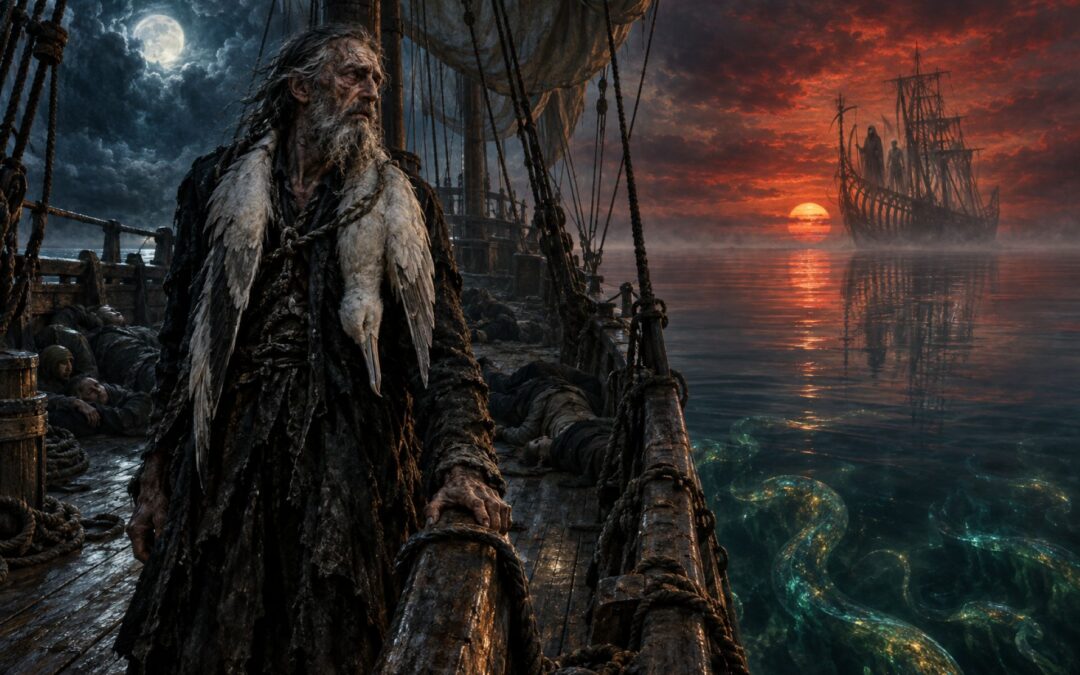
Samuel Taylor Coleridge’s The Rime of the Ancient Mariner looks, at first, like a simple supernatural ballad. An old sailor stops a man on his way to a wedding, tells him about a disastrous voyage, confesses that he killed an albatross, describes the terrible punishment that followed, and leaves his listener “a sadder and a wiser man.” Yet almost every part of that apparent moral tale becomes more difficult the closer it is examined. The Mariner never explains why he kills the bird, his punishment appears wildly disproportionate to the act, the supernatural forces governing the voyage do not form a completely coherent system, and even his apparent redemption leaves him condemned to recurring agony for the rest of his life.
The poem’s lasting power comes from that instability. It is simultaneously an adventure story, a Gothic nightmare, a Christian-inflected account of sin and penance, a meditation on humanity’s relation to other living creatures, a psychological story about guilt and survivorhood, and a poem about the need to turn unbearable experience into narrative. Coleridge revised it repeatedly after its first publication in 1798, and the final 1834 text preserved by the University of Toronto stands at the end of a long process in which the poem’s language, framing and supernatural explanations became increasingly elaborate.
Spoiler warning: this article explains the entire poem, including its ending.
The best way to understand The Rime of the Ancient Mariner is therefore not to begin by reducing the albatross to a symbol or the voyage to a lesson. The poem needs to be experienced first as a sequence of events in which one inexplicable act generates isolation, death, supernatural judgment, altered perception and an incomplete return to human community. Only after that complete narrative is in view does its deeper argument become visible.
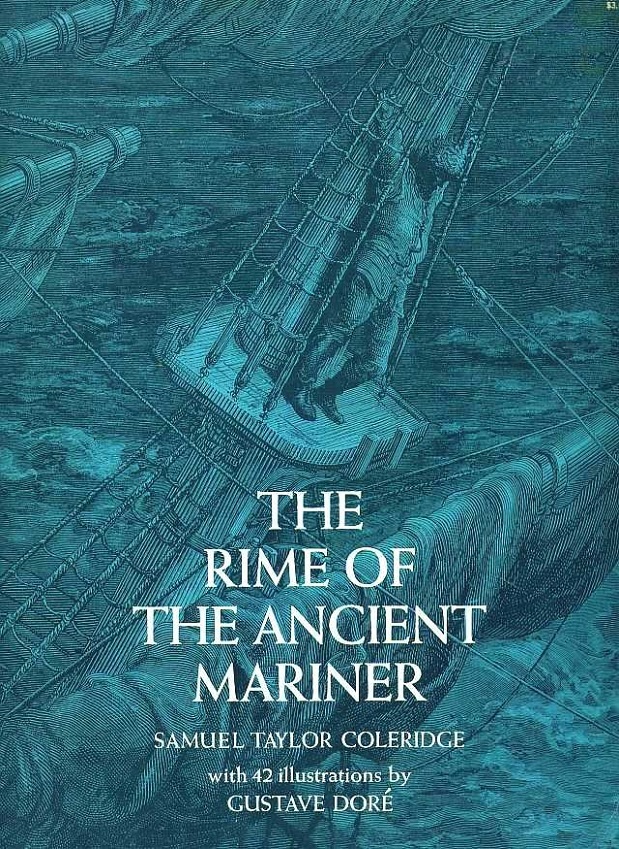
The Voyage and the Killing of the Albatross
The poem begins not at sea but at a wedding. An Ancient Mariner stops one of three men walking toward the Bridegroom’s house, where the celebration is already underway. The Wedding-Guest immediately resists him. He is related to the groom, the feast has begun, music is sounding from inside, and he has no obvious reason to listen to a stranger who physically grabs him and begins talking about a ship.
The Mariner releases the Wedding-Guest’s arm when ordered to do so, but physical restraint turns out not to be necessary. His “glittering eye” exerts a more mysterious form of control. The Wedding-Guest sits down and listens “like a three years’ child,” establishing from the first lines that the Mariner’s storytelling is not ordinary conversation. He possesses some strange authority that forces the right listener to remain until the tale is finished.
The Mariner begins with an apparently ordinary departure. His ship leaves the harbour amid cheers and sails past the church, hill and lighthouse. The sun rises and sets in a regular pattern, and the early voyage carries the reassuring sense of movement through a familiar natural world. The Wedding-Guest intermittently hears the wedding festivities nearby and becomes impatient, but each interruption only sharpens the contrast between the living social world he wants to enter and the increasingly uncanny story into which the Mariner is drawing him.
A violent storm abruptly changes the voyage. Coleridge personifies it as a tyrannical pursuer driving the ship southward, bending the masts and forcing the vessel before it. The sailors enter a region of mist, snow and immense ice, where ordinary signs of life disappear. Ice surrounds them in every direction, cracking, roaring and howling with a force that makes the natural landscape seem animate and hostile.
Into this frozen world comes an albatross. The bird appears through the fog, and the sailors welcome it “as if it had been a Christian soul,” feeding it and hailing it in God’s name. Its arrival coincides with deliverance: the ice breaks apart, the helmsman finds a route through, and a favourable south wind rises behind the ship.
The albatross continues following the vessel. It comes when the sailors call, accepts food, circles the ship, and perches on the mast or rigging evening after evening. Its presence creates a temporary harmony between the crew and the unfamiliar natural environment. The bird is neither merely decorative nor obviously allegorical at this point; before it becomes a symbol, Coleridge makes it a living creature with which the sailors establish a relationship.
The Wedding-Guest notices a change in the old man’s expression and asks what troubles him. The answer is the abrupt revelation on which the whole poem turns: the Mariner shot the albatross with his crossbow.
No motive is given. There is no quarrel, no practical need, no threat from the bird and no preceding psychological explanation. The poem does not describe the act as an accident either. The Mariner simply kills a harmless creature that the sailors had welcomed and that had accompanied them out of the ice.
That absence of motive matters because it prevents the crime from being absorbed into an ordinary moral psychology. If the Mariner killed from hunger, fear, superstition or anger, the story could explain punishment as the consequence of a recognisable vice. Instead the act appears almost radically gratuitous: a destructive exercise of human agency against a living thing whose presence had been benign.
At first, the crew condemns him. The sailors believe that the albatross caused the favourable wind, so killing it seems both cruel and dangerously foolish. They call the Mariner a wretch for destroying the bird that made the breeze blow.
Their judgment changes almost immediately when the weather changes. The sun rises brightly and the fog disappears, so the sailors decide that the albatross must actually have caused the mist. Killing it now appears correct. The same men who condemned the Mariner begin approving the act because its immediate consequences seem favourable.
This reversal makes the crew more than passive victims of another man’s crime. They do not fire the crossbow, but their moral judgment shifts according to circumstance. The later marginal gloss explicitly treats them as accomplices, and the verse supports the underlying point: they evaluate the killing not by what was done to the bird but by whether the weather seems advantageous to themselves.
For a time, their interpretation appears vindicated. The breeze continues, the ship moves freely, and the vessel enters a silent sea where it seems no other ship has travelled. Then the wind suddenly stops.
The sails hang uselessly. The ship becomes motionless beneath a hot, copper-coloured sky, with the sun fixed almost directly above the mast. One of Coleridge’s most famous comparisons captures the complete paralysis: the vessel is “as idle as a painted ship / Upon a painted ocean.” Movement has ceased not only physically but psychologically; the sailors have entered a landscape that feels removed from ordinary time.
Their greatest torment is water. It surrounds them everywhere, yet none of it can be drunk. The ship’s boards shrink in the heat, the sailors’ mouths dry out, and the ocean itself appears corrupted. Strange creatures crawl through the “slimy sea,” while unnatural lights burn across the water at night in green, blue and white.
Some of the sailors dream that a spirit has followed them from the polar region. The supernatural consequences of the albatross’s death are therefore no longer confined to weather. The ship appears to have entered a moral and metaphysical condition in which the natural world itself has become hostile or unreadable.
The crew can no longer speak because their tongues are dried by thirst. Their earlier verbal judgments are replaced by hostile looks directed at the Mariner. Finally, they hang the dead albatross around his neck “instead of the cross.”
The gesture transforms the bird. While alive, the albatross was a creature with whom the sailors interacted. In death, it becomes a visible burden attached to the man who killed it, an emblem of guilt placed where a Christian cross might normally signify faith, salvation or belonging. The poem does not yet tell us whether the Mariner can be forgiven; it first makes him physically carry the consequence of what he has done.
Death, Life-in-Death and the Turn Toward Blessing
The punishment now moves beyond thirst and immobility into explicit supernatural horror. Coleridge structures this part of the voyage as a movement from desperate hope to something worse than ordinary death, and the Mariner’s survival becomes more terrifying than the possibility of dying with his companions. The poem’s central question is no longer simply whether the ship will escape, but what kind of existence remains possible after the Mariner’s act.
After a long period in which every throat is parched and every eye exhausted, the Mariner notices something on the western horizon. At first it is only a speck, then a mist, then a recognisable shape. It appears to be another ship.
The discovery should mean rescue, but the sailors are too dehydrated even to shout. The Mariner bites his own arm and sucks his blood so that he can moisten his mouth enough to cry out that a sail is approaching. The moment links speech to bodily violence: after killing the albatross and entering a world of silence, he must wound himself merely to communicate hope.
The approaching vessel behaves impossibly. No wind or tide carries it, yet it continues toward them. As the sun descends behind it, the Mariner realises that what looked like sails may be something more like cobwebs and that the sun is shining through the vessel’s exposed ribs.
The ship is essentially a skeleton on the water. It has only two inhabitants: Death and a terrifying female figure called Life-in-Death. Her red lips, golden hair and deathly white skin combine beauty with corruption, and the poem presents her not simply as an alternative to Death but as a fate potentially worse than him.
The two supernatural figures throw dice for the sailors. Life-in-Death wins the Mariner and announces her victory; Death receives the crew.
Night falls with unnatural speed. Under the moon, one sailor after another turns toward the Mariner with an expression of agony and silent accusation. All two hundred men collapse dead without having time for a final cry.
The Mariner hears their souls passing him, and the sound recalls the whizz of the crossbow that killed the albatross. The association binds the deaths of the crew back to the original shot without making the causal system completely transparent. The bird’s death has somehow opened a chain of supernatural retribution, but the poem never provides a straightforward law explaining why these specific punishments must follow.
The Wedding-Guest interrupts because he now fears the storyteller himself. The Ancient Mariner looks so unnatural that the listener suspects he may be another corpse. The Mariner reassures him that he did not die with his shipmates, but that survival becomes the next stage of punishment.
He is left completely alone on the sea. Around him lie the bodies of men he describes as beautiful, while countless living creatures continue moving in the water. His reaction is initially one of disgust: the human sailors are dead, yet the “slimy things” remain alive, and so does he.
This is one of the cruelest aspects of Life-in-Death. The Mariner is not merely spared. He is forced to remain conscious in a world filled with death, unable to escape the accusing gaze of the corpses and unable to understand his own continued existence.
He looks toward heaven and tries to pray, but prayer will not come. Something he describes as a “wicked whisper” enters his heart before the prayer can emerge, leaving him spiritually dry in the same way that his body has been physically dried by thirst. The inability to pray matters because the poem’s later religious language will make prayer a sign of restored relation; at this stage, even that possibility is inaccessible.
The dead sailors do not decay normally. Their cold bodies remain on the deck, and the expression with which they cursed the Mariner remains fixed in their eyes. For seven days and seven nights he endures that gaze without dying.
The turning point arrives through perception rather than argument. Under the moonlight, the Mariner looks at water-snakes moving through the sea. Earlier he had regarded the ocean’s living creatures with disgust, but now he becomes absorbed by their movement and colour.
He notices shining tracks, glossy green, velvet black and flashes of golden light. What had appeared repulsive becomes beautiful. The transformation occurs not because someone explains a doctrine to him but because he suddenly sees life differently.
A feeling of love rises spontaneously from his heart, and he blesses the creatures “unaware.” The phrasing is crucial. He does not decide to perform a morally useful blessing in order to end the curse, nor does he intellectually derive a principle about respecting nature. His response happens before calculation.
At that same moment, he becomes capable of prayer again. The dead albatross falls from his neck and sinks into the sea.
This release can easily be mistaken for the completion of his redemption, but the poem later prevents that reading. The burden of the albatross disappears because something real has changed within the Mariner, yet the supernatural voices he will soon hear make clear that his penance is not finished. The water-snake episode is a threshold: the first restoration of relationship, not the end of consequence.
Penance, Return and the Endless Retelling
The Mariner’s spontaneous blessing changes the direction of the voyage, but Coleridge refuses to let the poem resolve immediately. Physical restoration, supernatural assistance and eventual homecoming all follow, yet each apparent form of deliverance remains incomplete. The Mariner can return to human society, but he cannot simply resume the life he had before the albatross was killed.
The first gift after the blessing is sleep. The Mariner praises sleep as something gentle and universal and attributes it to Mary, introducing a more explicit language of divine or saintly mercy. After a period of unbearable wakefulness among the dead, unconsciousness itself becomes an act of grace.
He dreams that the ship’s empty buckets are filled with dew. When he wakes, rain is falling. His lips become wet, his throat cools and his clothes are soaked, reversing the earlier world of drought.
The atmosphere also comes alive. Wind roars in the distance, lightning cuts through the sky, rain pours from a black cloud and the moon remains visible at its edge. Strangely, the strong wind never actually reaches the ship, yet the vessel begins to move.
Then the dead sailors groan.
Their bodies rise, return to their usual stations and begin operating the ropes. They do not speak or move their eyes, and the Mariner describes their limbs working like lifeless tools. The scene is grotesque precisely because ordinary shipboard labour resumes without ordinary life.
When the Wedding-Guest again reacts with fear, the Mariner clarifies that the original souls of the sailors have not returned. Instead, blessed spirits have entered or animated the bodies. At dawn those supernatural presences produce beautiful sounds that rise from the corpses and move through the air like birdsong, instruments and angelic music.
The contrast with the previous horrors is striking. Supernaturalism in the poem is not uniformly demonic or punitive. The same cosmos that contains Death, Life-in-Death and a pursuing spirit also contains benevolent agencies, prayer, rain and music.
Still, the ship’s movement remains uncanny. It travels without a normal wind because a spirit beneath the keel is driving it. This spirit has followed the vessel from the polar region and is connected with the place where the albatross was killed.
At noon, the ship suddenly stops and begins moving uneasily backward and forward. Then it leaps ahead with such force that blood rushes to the Mariner’s head and he loses consciousness.
While he lies in a trance, he hears two voices speaking in the air. One identifies him as the man who killed the harmless albatross and explains that the spirit associated with the polar region loved the bird. The other answers that the Mariner has already performed penance but must perform more.
That declaration governs the rest of the poem. The blessing of the water-snakes mattered, prayer has returned, the albatross has fallen away and supernatural forces are guiding him home, yet none of these events cancels the past. Grace and continuing punishment coexist.
The two voices discuss how the ship is moving at impossible speed without wind or wave. By the time the Mariner wakes, the vessel is again sailing through calm night under the moon. The dead sailors stand together on the deck, their fixed eyes still carrying the curse with which they died.
Eventually that spell breaks. The Mariner can again look away from the dead and toward the sea. A gentle breeze begins to touch him, although it does not visibly disturb the water. It lifts his hair and cools his face like a spring wind, feeling both eerie and welcoming.
Then he recognises home.
He sees the familiar lighthouse, hill and church that had appeared at the beginning of his voyage. The return to these landmarks creates a structural circle: the man who passed them while leaving ordinary society now sees them after entering and surviving a supernatural world.
His reaction is intensely emotional. He prays through sobs and cannot fully believe that the familiar harbour is real. Moonlight lies over the bay, the water seems smooth as glass and the church stands again above the shore.
Supernatural signs remain present even here. Crimson shapes rise from the water near the ship. When the Mariner looks back at the deck, he sees each dead sailor lying flat while a luminous seraphic figure stands above every corpse.
The seraphs silently gesture toward land like signals. Soon the Mariner hears oars and sees a boat carrying the Pilot, the Pilot’s Boy and a Hermit.
The Hermit matters because the Mariner immediately imagines him as the person who can provide conventional religious resolution. He hopes that this holy man will hear his confession, absolve him and wash away the blood of the albatross.
Before that can happen, the supernatural ship itself must disappear. The rescue boat approaches, and a deep sound begins beneath the water. It grows louder until it seems to strike sea and sky, and the Mariner’s vessel suddenly sinks “like lead.”
The Mariner does not drown with it. He finds himself floating and then, almost instantaneously, inside the Pilot’s boat. The rescuers react to him as though something uncanny has crossed into their world: the Pilot collapses when the Mariner speaks, the Hermit prays, and the Pilot’s Boy becomes hysterical.
At last the Mariner reaches solid land. He immediately asks the Hermit to hear his confession.
But the expected sacramental solution does not occur. The Hermit instead asks what kind of man he is, and the Mariner’s body is seized by terrible agony. The only thing that relieves the pain is telling the story of the voyage.
That experience becomes permanent. At unpredictable moments the same burning agony returns, and the Mariner must recount what happened before he can feel temporary release. He wanders from land to land possessing a “strange power of speech,” somehow recognising the particular person who must hear him.
The poem then fully returns to the wedding frame. The celebration is still underway, with singing and communal life continuing nearby, but the Mariner now tells the Wedding-Guest that he values another kind of gathering more deeply: walking with others to church and praying together.
His final stated lesson is that the person who loves human beings, birds and beasts prays well, and the person who loves all created things best prays best because God made and loves them all. This is the clearest moral statement in the poem, but it emerges from a story far more troubling than the statement itself.
The Mariner disappears. The Wedding-Guest does not continue into the wedding feast. Instead he turns away from the Bridegroom’s door, stunned by what he has heard, and rises the next morning “a sadder and a wiser man.”
The story has therefore altered both teller and listener, but in radically different ways. The Mariner remains condemned to retell it; the Wedding-Guest is changed by hearing it once.
The Poem’s Moral and Supernatural World
The sequence of crime, curse, blessing and return encourages readers to search for a stable moral system behind the supernatural events. Coleridge does provide patterns of wrongdoing, punishment, grace and penance, but he never makes them perfectly neat. The poem repeatedly offers explanations while preserving elements that resist those explanations, which is why its religious and moral meaning cannot be reduced to “do not kill animals.”
That ambiguity is central to the poem rather than an obstacle to interpretation. As the British Library’s discussion of The Rime of the Ancient Mariner emphasises, both the Mariner’s final moral and the later prose gloss can be read as interpretations of the strange events rather than as unquestionable keys that settle every problem.
Nature, the Albatross and the Ethics of Relation
Nature in The Rime of the Ancient Mariner is never simply benevolent. Before the Mariner commits any crime, the sailors are already driven south by a terrifying storm and surrounded by immense ice. The natural world can be sublime, destructive, beautiful, indifferent and apparently supernaturalised, often within the same passage.
The albatross nevertheless marks a temporary relationship of hospitality within that frightening environment. The sailors greet it, feed it and call it when it flies around the ship. Its arrival coincides with escape from the ice, but its moral importance does not depend on proving that it literally caused the favourable wind. The basic fact is that the sailors receive a living creature into their community and the Mariner kills it without explanation.
That is why the act feels less like the violation of a technical rule than a rupture in relation. The bird had become part of the sailors’ world, however briefly. By destroying it gratuitously, the Mariner asserts power over something whose existence had made no claim against him.
His subsequent punishment repeatedly distorts his relationship with the non-human world. The sea becomes rotten, its creatures seem disgusting, the sun becomes oppressive and the ship is trapped in a landscape where water exists everywhere but cannot sustain life. Nature is still present in abundance, yet the Mariner experiences it as alien and hostile.
The water-snakes reverse that perception. Nothing about the creatures themselves necessarily changes; what changes is the Mariner’s capacity to see them. Their colours, movements and brightness suddenly become beautiful, and affection rises in him before he has decided what the correct moral response should be.
This is one reason the poem is stronger than a simple command to respect nature. The crucial transformation is imaginative and emotional before it is doctrinal. The Mariner becomes capable of blessing other life because he has ceased viewing it only according to usefulness, danger or disgust.
Modern readers often find ecological meaning here, and the poem certainly lends itself to thinking about human violence toward other forms of life. Yet calling it a modern environmentalist manifesto would impose a later political and intellectual framework too directly onto a Romantic poem. Its concern is broader and stranger: whether human beings can recognise value in living things outside themselves, and what happens when that relation is violently broken.
The final moral about loving “man and bird and beast” grows naturally from this transformation. Even so, the poem does not demonstrate that every supernatural event is an exact punishment for violating ecological harmony. The scale of suffering remains too excessive, and the metaphysical machinery too uncertain, for the moral to function as a complete explanation.
Sin, Grace, Penance and the Problem of Punishment
Christian language permeates the poem. The albatross is welcomed “in God’s name,” the dead bird replaces the cross around the Mariner’s neck, he repeatedly attempts prayer, he invokes Mary, he seeks a Hermit for confession, blessed spirits animate the sailors’ bodies and the conclusion explicitly speaks of God as creator and lover of all things.
The narrative also resembles a pattern of sin and redemption. The Mariner commits an apparently wrongful act, suffers punishment, experiences a transformation of heart, regains the ability to pray, receives supernatural assistance and returns to human community. Seen at this level, the voyage can look like an elaborate spiritual conversion.
The difficulty is that conversion does not end punishment. The albatross falls from the Mariner’s neck, but the voices subsequently declare that more penance is required. He reaches home, but instead of being permanently absolved through confession he acquires a lifelong condition in which agony repeatedly forces him to tell the story.
The poem therefore distinguishes between grace and release. The Mariner receives grace when his capacity for love and prayer returns, and he is spared from death at sea. Yet the consequences of his act remain embodied in memory, storytelling and recurring pain.
This makes the language of penance more important than a simple idea of forgiveness. Penance is not merely a punishment imposed until a debt has been paid. In the poem, it becomes the continuing shape of the Mariner’s existence.
The proportionality of that punishment is troubling. One albatross is killed, yet two hundred sailors die, the Mariner suffers extreme thirst and supernatural terror, and his torment never completely ends. Even if the crew’s approval makes them morally implicated, the sheer scale of suffering resists a tidy equation between crime and consequence.
That disproportion may be part of what makes the poem feel genuinely uncanny. The supernatural order does not resemble a courtroom in which every action receives a precisely calculated sentence. It behaves more like a world in which moral violation has released forces far beyond the Mariner’s understanding.
The Christian imagery therefore provides a vocabulary for guilt, blessing, prayer, grace and penance without producing an entirely orthodox theological system. The poem contains religious patterns, but it does not offer a theological explanation detailed enough to resolve every contradiction. The reader is left with the certainty that the Mariner has violated something real and the uncertainty of why the universe responds in exactly this way.
Death, Life-in-Death and the Invisible Spirits
Death and Life-in-Death give the poem’s supernatural world its most terrifying personifications. Their dice game converts the fate of human beings into something both judicial and arbitrary. The Mariner’s survival is not presented as an obvious mercy; Life-in-Death wins him, making continued consciousness itself a punishment.
Death claims the crew quickly. Life-in-Death condemns the Mariner to the slower experience of isolation, memory and guilt. This distinction explains why the deaths of his shipmates do not make him the fortunate survivor. They escape the ship; he remains inside the consequences.
Other supernatural forces are less clearly personified. The Polar Spirit appears connected with the albatross and the region of ice, and the two disembodied voices discuss the Mariner’s crime and penance. Blessed spirits animate the corpses and later appear as seraphic lights above them.
The poem never gives these beings a completely systematic hierarchy. Their relationship to God, one another and the rules of punishment remains partly unexplained. The later marginal gloss supplies more causal connections than the verse itself, but even that apparatus does not turn the poem into a fantasy world governed by fully articulated metaphysical laws.
That lack of system is important. The supernatural forces are comprehensible enough to make the Mariner feel judged but mysterious enough to preserve dread. Coleridge offers just enough explanation to keep the voyage morally charged without allowing explanation to dissolve its strangeness.
Characters, Relationships and the Psychology of Guilt
The Rime of the Ancient Mariner is not built around realistic psychological characterisation in the manner of a novel. Most figures do not have detailed histories, social identities or complex personal motives, yet they possess strong narrative and symbolic functions. The Mariner himself is psychologically most interesting precisely where his motives remain inaccessible and where his identity gradually becomes inseparable from the story he is compelled to tell.
The poem’s relationships are similarly concentrated. A few basic bonds — Mariner and listener, Mariner and crew, Mariner and bird, individual and community, human being and created life — carry much of the emotional and philosophical weight.
The Ancient Mariner
The most important fact about the Ancient Mariner is also the fact the poem refuses to explain: he kills the albatross. Because no motive is supplied, readers cannot comfortably convert the act into the consequence of a familiar flaw such as greed, rage or fear. His most decisive action therefore reveals less about his personality than expected.
After the shooting, his agency steadily decreases. He cannot summon the wind, prevent the ship from being becalmed, save the crew, resist Life-in-Death or choose the form of his punishment. Much of the narrative consists of things happening to him.
His significant later actions are inward rather than controlling. He looks at the water-snakes differently, blesses them without calculation, attempts prayer and finally tells his story. The character develops not by mastering the supernatural world but by becoming able to perceive, love and speak within a situation he cannot master.
Guilt is conveyed less through explicit introspection than through sensory experience. The dead sailors stare at him, the albatross hangs around his neck, prayer fails, thirst dries his body, and the sound of departing souls recalls the crossbow. External images repeatedly embody what a psychological novel might describe internally.
His survival produces another layer of guilt. He remains alive among two hundred dead men and cannot escape their accusing eyes. That position resembles what would now be recognised more broadly as the psychological burden of survivorhood, although the poem should not be reduced to a modern clinical diagnosis that it does not itself supply.
The Mariner also changes from actor into witness. Early in the voyage, one arbitrary action alters everything. By the end, his defining activity is not doing but recounting: he becomes the person through whom an overwhelming event must repeatedly be transmitted.
Whether that makes him fully wise remains uncertain. He certainly possesses a moral interpretation of his suffering, and his final teaching about loving all created things has genuine force. Yet his compulsive condition raises the possibility that he is also permanently trapped inside the need to explain the voyage.
His authority is therefore powerful but not absolute. The Wedding-Guest cannot resist him, and the poem allows his story to transform another person. At the same time, the reader can accept the reality of his suffering without assuming that every interpretation he gives of that suffering is identical to the poem’s final meaning.
The Wedding-Guest and the Power of the Listener
The Wedding-Guest begins as an unwilling audience. He has a clear destination, social obligations and a celebration waiting for him. The Mariner’s interruption initially seems absurd and irritating because the old sailor appears to be pulling him away from life.
His resistance makes him important. If he eagerly wanted to hear a ghost story, the Mariner’s power would appear ordinary. Instead the Wedding-Guest repeatedly tries to return his attention to the wedding and discovers that he cannot.
He also interrupts the narrative at significant moments. Music from the celebration reminds him what he is missing; the Mariner’s horrifying appearance makes him fear that his storyteller is dead; the reanimated crew frightens him again. These interruptions keep the frame story alive and prevent the voyage from becoming a detached legend.
The Wedding-Guest functions partly as a surrogate reader because he must decide what kind of knowledge the story provides. He cannot change the events he hears, but hearing them changes his relation to the ordinary social world waiting nearby.
The ending makes that transformation visible without fully explaining it. He turns away from the wedding and rises the next morning “sadder and wiser,” but the poem does not specify a new doctrine he now believes. His wisdom may consist less in memorising the Mariner’s final moral than in having been forced to confront suffering, guilt and mystery that the festive world initially seemed able to exclude.
His relationship with the Mariner also demonstrates that storytelling requires a listener. The Mariner cannot relieve his agony merely by remembering privately. His burden becomes temporarily bearable only when experience is transmitted to another human being.
Crew, Albatross and Secondary Figures
The crew operates less as a collection of individual personalities than as a changing moral chorus. At first the sailors condemn the killing of the albatross, then approve it when the disappearance of fog appears useful, and finally blame the Mariner when disaster comes. Their judgments expose a morality governed by outcomes rather than stable principle.
This does not make their deaths easy to justify. Their complicity is real within the poem’s logic, but their punishment remains severe enough to preserve the problem of disproportion. They matter because the Mariner’s crime does not remain private; it draws an entire human community into a supernatural catastrophe.
The albatross has a similarly double existence as creature and symbol. Its symbolic importance is undeniable, especially once its corpse replaces the cross around the Mariner’s neck, but interpreting the bird only symbolically would repeat the kind of reduction the poem resists. Its moral significance begins with the fact that it is alive, harmless and welcomed.
Life-in-Death is more explicitly symbolic because she embodies a condition rather than an ordinary human personality. She turns survival into punishment, making the Mariner live through what the dead sailors escape. The figure’s power lies in giving a name and body to an existence in which one remains alive without being restored to ordinary life.
The Hermit represents another kind of possibility. The Mariner expects him to provide familiar religious absolution, but the poem denies that easy resolution. Instead of ending the story through confession, the encounter inaugurates the endless retelling.
The Pilot and Pilot’s Boy serve primarily as witnesses to the Mariner’s return from the supernatural world. Their terror confirms that he no longer enters ordinary society as an ordinary sailor. The voyage has marked him so deeply that other people experience his presence as something uncanny.
Eyes, Speech, Silence, Prayer and Other Recurring Motifs
Eyes recur so insistently that seeing becomes one of the poem’s central actions. The Mariner initially controls the Wedding-Guest through his glittering eye, the dying sailors curse him with their eyes, their fixed dead gaze continues tormenting him, and he later cannot look away from them. Vision can dominate, accuse, imprison and transform.
The water-snakes bring a different kind of looking. Here sight no longer traps the Mariner inside accusation; it opens him to beauty. The same capacity that earlier transmitted fear and curse becomes the means through which his relationship with life begins to change.
Speech follows a similar pattern. The Mariner initially tells his tale with strange authority, but within the remembered voyage thirst makes speech physically impossible. When he sees the spectral ship, he must bite his arm and use his own blood merely to announce its arrival.
Silence also surrounds the deaths of the crew. They cannot explain or forgive; they communicate through their final looks. Later, the blessed spirits produce beautiful sound without restoring ordinary human conversation, creating a world where music can return before social language does.
Prayer is the spiritual version of this problem. The Mariner wants to pray while alone among the dead but cannot make the words emerge. His heart has become as dry as the landscape around him.
The blessing of the water-snakes restores prayer because relation precedes language. He does not successfully pray himself into compassion; compassion arrives first, and prayer becomes possible afterward.
By the end, speech becomes his permanent condition. The man once unable to speak from thirst now possesses a “strange power of speech,” but this ability is not simple liberation. He must tell the story because silence becomes unbearable.
Water repeatedly participates in the same reversal. The sailors are surrounded by it and dying of thirst; the sea seems rotten and hostile; later rain restores the Mariner and the harbour becomes smooth and luminous. Water can imprison or sustain depending on the Mariner’s place within the poem’s shifting moral universe.
The sun and moon likewise acquire contrasting emotional associations. The sun dominates the becalmed ship with heat and exposure, while the moon presides over the water-snakes, the supernatural return and several moments of softened perception. The contrast is not a rigid symbolic code, but Coleridge repeatedly uses light to shape the Mariner’s changing experience of the world.
Form, Voice and the Marginal Gloss
The story of the albatross would lose much of its power if told as straightforward prose. Coleridge makes the poem feel at once ancient and immediate by drawing on the conventions of traditional ballads while constantly modifying them. Simple narrative movement, repetition and strong rhyme coexist with difficult theological questions, psychological terror and elaborate supernatural imagery.
The poem also contains more than one interpretive voice. The Mariner tells the voyage, an outer narrator presents the encounter with the Wedding-Guest, and later versions add a marginal glosser who repeatedly explains what events mean. Understanding how those voices interact is essential to understanding why the poem never settles into one entirely secure moral reading.
Ballad Form, Sound and Repetition
The poem imitates the speed and memorability of popular ballads. Much of its rhythm moves through alternating lines that tend toward four and three strong beats, supported by emphatic rhyme and repeated phrases. Coleridge frequently disrupts that basic pattern, however, expanding stanzas, adding internal rhymes and allowing rhythm to accelerate or stall according to the action.
Repetition is particularly important. Phrases recur with small changes, creating the impression of oral storytelling while intensifying psychological states. The becalmed ship is described through repeated days, repeated water and repeated stillness until physical paralysis becomes almost hypnotic.
Sound often does narrative work before interpretation begins. The ice cracks and roars, the storm drives the ship, souls pass with the sound of the crossbow, supernatural music flows from the dead sailors and the sinking vessel produces a catastrophic underwater noise. Coleridge makes hearing as important as seeing.
The ballad’s apparent simplicity also creates productive tension with the complexity of the events. A form associated with direct storytelling becomes the vehicle for metaphysical uncertainty. The reader can follow what happens even when the reason it happens remains obscure.
Archaic diction strengthens the impression that the tale belongs to an older oral world. Yet the poem is not actually an anonymous ancient ballad; it is a highly self-conscious literary reconstruction of one. Its antique surface allows Coleridge to combine folklore, Christian imagery, sea legend and Gothic supernaturalism without making the narrative feel like ordinary contemporary realism.
Pacing shifts dramatically. The opening voyage moves rapidly, the dead calm stretches time almost to immobility, the deaths of the crew happen with frightening speed, and the final supernatural return accelerates again. Form mirrors experience: the poem itself becomes fast or motionless as the ship does.
The Frame Narrative and Compulsion to Tell
The wedding frame gives the poem a social world outside the Mariner’s nightmare. Music, family, celebration and communal ritual continue while the old sailor tells his story, and the Wedding-Guest remains physically close to that world throughout. The voyage therefore unfolds against the constant possibility of ordinary human connection.
The Mariner’s intrusion initially seems antisocial. He isolates the Wedding-Guest from the group of three and prevents him from joining the feast. Yet his final lesson celebrates communal prayer and shared relation, making the storyteller both a figure of isolation and an agent who attempts to restore connection through narrative.
The frame also prevents the poem from ending when the ship reaches land. If the voyage alone were the whole story, rescue might provide sufficient closure. Instead the outer narrative reveals that survival creates another life: the life of compulsive retelling.
This changes the meaning of everything we have read. The tale is not merely a memory the Mariner chooses to share because it contains an interesting lesson. Telling it is itself part of the punishment.
The Wedding-Guest’s transformation demonstrates the other side of that process. Narrative transfers something from sufferer to listener. The Mariner gains temporary relief, while the listener acquires sadness and wisdom.
The poem therefore asks what stories of suffering do when they enter another person’s life. They can instruct, disturb, burden and transform. The Mariner’s “strange power of speech” is both a gift and a sentence because it allows him to make meaning from the voyage without allowing him to leave the voyage completely behind.
Revision, the 1817 Gloss and Competing Authorities
The Rime of the Ancient Mariner did not remain textually fixed after its first publication. The 1798 version appeared under the deliberately archaic title The Rime of the Ancyent Marinere, and Coleridge later reduced much of the antiquated spelling and diction. The poem continued evolving through subsequent editions until the form represented by the 1834 text.
The largest interpretive intervention came in 1817. When the poem appeared in Sibylline Leaves, Coleridge added a Latin epigraph and an extensive prose gloss running beside the verse. The 1817 version with its added glosses shows how dramatically the apparatus changes the reading experience.
The glosser frequently supplies causal explanations that the verse leaves uncertain. It identifies spiritual agencies, interprets the crew as sharing responsibility and comments on the Mariner’s progress through penance. Readers are therefore exposed to a voice that sounds learned and explanatory beside a poem whose events often remain mysterious.
It is tempting to treat this gloss as Coleridge simply telling us what the poem means. That is too easy. The gloss is part of the later work, but its confident explanations do not always eliminate the tensions within the verse.
Instead, the poem develops competing layers of authority. The Mariner believes he understands his experience well enough to teach a moral; the glosser provides another explanatory system; the outer narrative shows the Wedding-Guest changing without specifying that he has adopted either interpretation in full.
Coleridge’s revision process therefore deepens rather than erases ambiguity. The later apparatus makes the poem more explicitly moral and supernatural while simultaneously giving readers another voice whose assumptions can be examined. The result is not one final explanation imposed on a chaotic poem but a more elaborate debate inside the work about how strange experience becomes meaning.
What the Ending Means
The literal ending is clear enough. The Mariner returns home alive, his ship is destroyed, and he reaches land with the expectation that the Hermit will hear his confession. Instead, a violent internal agony compels him to narrate what happened, and the pain returns at unpredictable intervals for the rest of his life.
He therefore does not finish his penance when the albatross falls from his neck. He does not finish it when rain arrives, when the spirits guide him home, when the dead sailors’ curse finally loosens, when he sees the harbour or even when he reaches solid ground. Physical survival and spiritual release are not identical.
His punishment becomes a mode of existence. He wanders until he recognises a person who must hear the tale, speaks until the agony recedes and then continues onward. The poem does not tell us that this process will ever end.
That condition complicates any claim that the Mariner is simply redeemed. Something in him has unquestionably changed: he can love the sea creatures, pray again, value community and articulate an ethic of reverence for life. Yet redemption, if the term applies at all, does not erase memory or consequence.
His final moral is sincere. After living through a world in which he had destroyed one living creature and then experienced almost absolute isolation, he concludes that loving all created beings is inseparable from true prayer. The lesson directly reflects his transformation beside the water-snakes.
But the moral is not large enough to explain every part of the story. It does not tell us why the killing was motiveless, why the crew had to die, why Life-in-Death won the Mariner, why the supernatural punishment is so extreme or why his suffering must continue indefinitely.
The gap between story and moral is therefore productive. The Mariner has extracted a meaningful truth from his experience, but meaning is not the same thing as a complete causal explanation. His lesson helps him live with the voyage; it does not make the voyage entirely intelligible.
The Wedding-Guest’s ending reinforces that distinction. He does not repeat the Mariner’s doctrine or announce a new commitment to animals, prayer or Christianity. He simply turns away from the wedding and awakens the next morning transformed by sadness and wisdom.
The wedding itself has not become evil. Throughout the poem it represents music, marriage, fellowship and ordinary human life, precisely the forms of community the Mariner has lost and come to value. The Wedding-Guest’s decision to turn away from it should therefore not be read as a permanent rejection of social joy.
Instead, he can no longer enter the feast in the same state of consciousness with which he approached it. The story has interrupted ordinary pleasure by exposing him to mortality, guilt, loneliness and mystery. His sadness is part of his wisdom because the poem refuses to define wisdom as cheerful moral certainty.
The Mariner’s fate also gives storytelling a double meaning. His repeated narration may serve others by transmitting hard-earned knowledge, but it is also the mechanism through which his punishment continues. He is at once teacher and haunted survivor.
That tension is the final form of Life-in-Death. The supernatural figure disappears from the narrative long before the poem ends, yet the condition she wins for the Mariner persists. He lives, travels, speaks and influences others, but he does so as a man permanently marked by an experience from which complete escape is impossible.
Critical Review: Achievement, Limits and Lasting Value
The Rime of the Ancient Mariner succeeds first as an extraordinarily efficient narrative. Coleridge moves from a wedding to a polar wasteland, from natural danger to supernatural punishment, from mass death to luminous beauty and from rescue to permanent wandering without losing the story’s basic momentum. Even readers who resist its theology or symbolism can follow the emotional logic of transgression, isolation, altered perception and return.
Its imagery is among its greatest strengths. The painted ship on the painted ocean, the albatross around the Mariner’s neck, the skeletal vessel carrying Death and Life-in-Death, the dead sailors staring in moonlight and the brightly coloured water-snakes all convert abstract states into unforgettable visual experiences. Guilt, stasis, isolation and grace become things the reader can almost see and hear.
The sound of the poem is equally important. Repetition, rhyme, internal rhyme and shifting rhythm make passages memorable without requiring conceptual explanation. The poem often produces atmosphere through sound before the reader has decided what an image symbolises.
Its supernaturalism is also remarkably successful because Coleridge avoids explaining everything. The invisible world has enough structure to make the Mariner’s suffering feel morally charged, but not enough to become predictable. Spirits, voices, Death and Life-in-Death remain more disturbing because they are partially understood.
That balance connects directly to Coleridge’s larger poetic project. In discussing the origins of Lyrical Ballads, he famously described his task as giving supernatural incidents enough human truth to produce a temporary “poetic faith.” The Ancient Mariner achieves that not by making its ghosts and spirits realistic in an ordinary sense, but by making the Mariner’s fear, thirst, guilt, loneliness and relief psychologically convincing.
The poem’s moral complexity is another strength. Its final lesson sounds simple, yet the narrative refuses to become a mere illustration of that lesson. The result is a work that can sustain Christian, psychological, ecological, formal and sceptical readings without being exhausted by any one of them.
Its central transformation is especially convincing because it occurs through perception. The Mariner does not receive an abstract lecture on compassion. He looks at creatures he had previously experienced as part of a repulsive sea and suddenly sees beauty.
There are, however, real limitations. The characters other than the Mariner and Wedding-Guest are deliberately thin, and even the Mariner himself possesses little conventional biography or motive. Readers looking for psychologically detailed character development may find him closer to an archetypal sufferer than a fully individualised person.
William Wordsworth made related objections almost immediately. In his 1800 note on “The Ancient Mariner”, he criticised the Mariner for lacking enough distinct character and argued that the poem’s events did not sufficiently arise from one another through necessary causation. He also thought the density of imagery sometimes overwhelmed the narrative.
Those criticisms identify genuine features. The Mariner often undergoes events rather than actively shaping them, and the supernatural plot does not operate according to a strict chain of rational necessity. The shooting itself is deliberately unexplained, which means the entire catastrophe begins with an action whose motive cannot be integrated into a stable character psychology.
Yet the same qualities also generate the poem’s power. If the shooting had a clear motive and each supernatural punishment followed a transparent rule, the voyage would become morally easier and artistically narrower. Its nightmare quality depends partly on the Mariner’s inability to understand the forces his act has released.
The apparent disproportion of punishment remains more difficult to defend. Two hundred sailors die after one man kills a bird, and even their temporary approval of his action does not fully resolve the ethical imbalance. Readers who expect the supernatural order to represent divine justice may reasonably find that system troubling.
The later marginal gloss attempts to organise this chaos, but it creates another artistic problem. Its explanations can deepen the poem by adding a second interpretive voice, yet they can also feel like an effort to rationalise a narrative whose original force depended partly on mystery. The gloss is most interesting when read not as a set of final answers but as another attempt to make the voyage intelligible.
The final moral presents a similar tension. “He prayeth best, who loveth best” is memorable and emotionally earned, especially after the water-snake episode. At the same time, its neatness sits uneasily beside a story filled with arbitrary violence, supernatural gambling, collective death and unresolved punishment.
That tension ultimately strengthens rather than destroys the poem. The moral captures something the Mariner has genuinely learned, but the poem remains larger than his explanation of it. A weaker work would make every image and event neatly confirm the final lesson.
The poem has also aged well in its treatment of the non-human world. Readers do not need to impose a modern environmental ideology on Coleridge to recognise how radically the poem challenges a purely instrumental view of other living things. The Mariner’s decisive change comes when he perceives value where he previously saw only ugliness.
What has aged less comfortably is some of the poem’s inherited Christian and supernatural framework for readers who no longer share its vocabulary of sin, saints, spirits and penance. Yet even here the poem’s ambiguity protects it. It does not require the reader to accept a systematic theology in order to understand guilt, isolation, remorse or the need to restore connection.
Its emotional force also remains unusually direct. The most effective passages do not depend on knowledge of Romanticism, theology or literary theory. Being trapped without water, surrounded by dead companions and unable to pray is immediately comprehensible as horror.
The same is true of the ending. The image of a man condemned to keep telling the worst experience of his life because silence makes the pain return has psychological power beyond the specific religious framework of the poem. Storytelling becomes confession, survival mechanism, burden and vocation at once.
For readers who want carefully motivated realism, detailed character psychology or a supernatural world governed by explicit rules, The Rime of the Ancient Mariner may be frustrating. Its causal gaps are not minor accidents that can be explained away; they are part of its design.
For readers interested in narrative poetry, Gothic literature, Romanticism, supernatural fiction, symbolism or the relationship between guilt and storytelling, it remains exceptionally rewarding. Its short length disguises how much interpretive pressure Coleridge concentrates into a small number of scenes.
Its greatest achievement is therefore not that it presents a flawless moral philosophy. It is that image, rhythm, supernatural terror, spiritual longing and unresolved guilt become impossible to separate. The poem continues to disturb because its meaning never quite domesticates what happened.
The Mariner can tell us what he learned, but he cannot make his voyage fully reasonable. That is why the poem survives its own moral. The reader leaves with a clearer sense of the importance of relation, compassion and reverence for life, yet also with the unsettling recognition that suffering can exceed the explanations people construct around it.
The Rime of the Ancient Mariner remains worth reading because it does far more than deliver a lesson about an albatross. It takes a gratuitous act of violence and follows its consequences through nature, religion, guilt, perception, community and language until the act becomes the organising event of one man’s entire life.
Its best readers will be those willing to accept that a poem can be morally serious without being morally tidy. Coleridge gives the Mariner genuine transformation but not clean absolution, genuine wisdom but not complete understanding, and genuine return without allowing him to go back to who he was before the voyage.
That is also why the Wedding-Guest’s final condition is the right ending. He becomes wiser, but wisdom does not make him lighter. Like the reader, he has encountered a story that produces meaning without cancelling mystery, and the cost of understanding something more deeply is that he can no longer enter the ordinary world quite as innocently as before.
Last Updated on September 23, 2026 by Aseem Gupta