
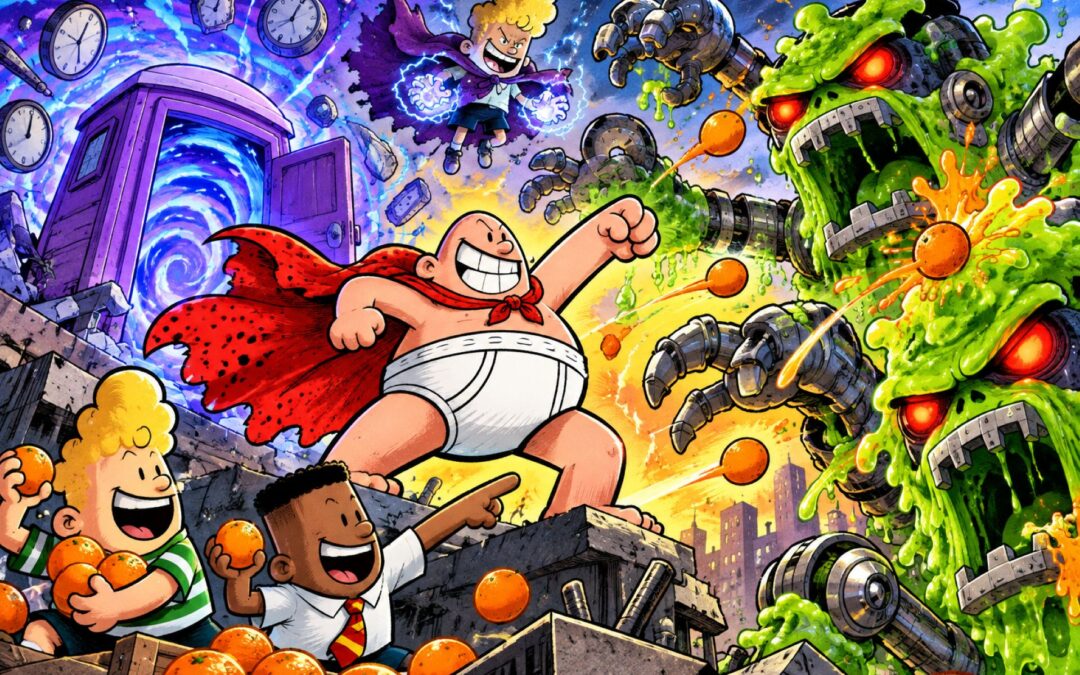
Captain Underpants and the Big, Bad Battle of the Bionic Booger Boy, Part 2: The Revenge of the Ridiculous Robo-Boogers is the seventh novel in Dav Pilkey’s wildly inventive children’s series. Originally published in 2003, it continues the adventure begun in the sixth book, combining a disastrous brain swap, a time-traveling portable toilet, stolen superpowers, and three monstrous robotic boogers into an increasingly ridiculous superhero story.
As the seventh Captain Underpants book, it assumes some familiarity with George Beard, Harold Hutchins, and their accidentally created superhero. However, its introductory recap makes the essential background accessible to newcomers. Beneath the gross-out humor and cartoon violence, the novel develops an entertaining contrast between possessing extraordinary abilities and having the courage to use them responsibly.
Spoiler warning: This article explains the complete plot, including the defeat of the Robo-Boogers, Melvin’s downfall, and the unresolved ending. It also examines the characters, themes, storytelling techniques, and strengths and weaknesses of the book.

What Happened Before: The Bionic Booger Boy and the Brain Swap
George Beard and Harold Hutchins are two mischievous fourth graders who create comic books about a fictional superhero called Captain Underpants. Their real-life adventures began when they hypnotized their unpleasant school principal, Mr. Krupp, into believing he was their superhero. Ever since, snapping fingers has transformed Mr. Krupp into Captain Underpants, while water has restored his ordinary personality.
Captain Underpants eventually acquired genuine superpowers after drinking alien Super Power Juice. Unfortunately, the powers did not make him much more intelligent, and George and Harold frequently have to protect their well-meaning but foolish hero from the consequences of his own decisions.
The previous book introduced Melvin Sneedly, an arrogant young inventor who created a machine called the Combine-O-Tron 2000. After successfully combining his hamster, Sulu, with a robot, Melvin attempted a similar experiment on himself. The experiment went disastrously wrong, transforming him into the enormous Bionic Booger Boy.
Melvin’s parents eventually reversed his transformation, but an improperly configured Combine-O-Tron accidentally switched Melvin’s brain with Mr. Krupp’s. Meanwhile, three monstrous robotic boogers named Carl, Trixie, and Frankenbooger came to life and destroyed the machine.
The seventh book begins immediately after these events, with the monsters still threatening George, Harold, and their companions.
The Robo-Boogers Escape and the Brain-Swap Crisis
The story opens by introducing George, Harold, Captain Underpants, Melvin, and Sulu the Bionic Hamster. Sulu possesses an absurd collection of mechanical enhancements, including powerful robotic jaws, hydraulic legs, and laser-equipped eyes. These inventions become important almost immediately when the three Robo-Boogers chase the group through the streets.
Carl, Trixie, and Frankenbooger corner everyone in a dead-end alley. Just as the monsters leap toward their intended victims, Sulu stretches open his enormous mechanical mouth and swallows all three. He then launches them into outer space with an incredibly powerful spit, apparently ending the threat before the adventure has properly begun.
George and Harold celebrate what seems to be their shortest adventure yet. Their relief proves premature because the destruction of the Combine-O-Tron has left a much more complicated problem unresolved.
As everyone returns to school, Mr. Krupp begins demanding ownership of Sulu, even though the hamster originally belonged to Melvin. Meanwhile, Melvin starts issuing disciplinary orders as though he were the principal. When Melvin’s parents arrive, they are understandably disturbed by the grown man who insists that he is their son.
The confusion becomes worse when Melvin, speaking with Mr. Krupp’s personality, insults the school secretary, Miss Anthrope. She retaliates by hanging the boy from a coat hook using his underwear. The incident demonstrates the absurd consequences of an adult authority figure finding himself trapped inside a child’s body.
George and Harold eventually establish what happened during the earlier accident. Melvin’s brain is inside Mr. Krupp’s adult body, while Mr. Krupp’s brain is inside Melvin’s smaller body. The narrator adopts temporary names to keep the arrangement understandable: Melvin inside Krupp becomes Mr. Melvin, while Krupp inside Melvin becomes Kruppy the Kid.
The characters desperately want to return to their original bodies, but the Combine-O-Tron has been destroyed. Melvin claims that constructing another machine would require six months. When he casually mentions that building a time machine would be easier, George suggests traveling into the past to recover the original Combine-O-Tron before its destruction.
Melvin immediately appropriates George’s suggestion and begins treating it as his own brilliant idea. His willingness to take credit for someone else’s ingenuity foreshadows the much more serious deception he attempts near the book’s conclusion.
Another complication arises when Melvin snaps his fingers during their conversation. Because Mr. Krupp’s brain occupies Melvin’s body, the transformation mechanism still works, creating a child-sized Captain Underpants who promptly flies away.
Melvin is astonished to discover that Captain Underpants possesses actual superpowers. George and Harold initially try to dismiss the phenomenon, but Melvin demands an explanation. Once he learns about the original hypnosis and the alien Super Power Juice, he realizes that restoring the brains could provide an opportunity to acquire powers for himself.
His objective therefore changes. Melvin no longer wants simply to become himself again; he wants to emerge from the experiment as an exceptionally powerful superhero.
He uses his temporary position as principal to intimidate George and Harold, threatening them with enormous amounts of homework unless they cooperate. He also demands that they create a flattering comic portraying him as a magnificent superhero.
The boys reluctantly agree, although their understanding of what constitutes a flattering portrayal differs considerably from Melvin’s.
The Purple Potty and the Race to Recover the Combine-O-Tron
Melvin chooses the school library as the location for his new invention because almost nobody uses it. The librarian, Miss Singerbrains, has banned nearly every book, leaving the shelves empty and the institution largely devoid of its intended purpose. Her hostility toward reading provides one of the novel’s sharpest jokes about adult authority.
Melvin needs a large enclosure for his time machine and discovers a purple portable toilet in the school basement. He manipulates Miss Singerbrains into carrying it upstairs and then dismisses her from her position. The resulting invention becomes known as the Purple Potty, a functional time machine housed inside one of the least dignified objects imaginable.
While Melvin works, the narrative shifts to outer space, where the Robo-Boogers are traveling toward Uranus. A group of astronauts belonging to the Piqua Order of Professional Space and Interplanetary Explorers, or POOPSIE, is investigating the planet.
The expedition is commanded by Major Buzz Tomski, who notices strange objects on the planet’s surface. The astronauts become distracted by what appear to be discarded robots and toilets, allowing Carl, Trixie, and Frankenbooger to approach their spacecraft.
The monsters collide with the shuttle and remain attached to it. When Ground Control orders the expedition to return to Earth, the astronauts unknowingly bring the dangerous creatures home with them.
Back at the school, George and Harold have completed the comic Melvin demanded. However, they have turned it into an elaborate insult rather than a celebration of his supposed greatness.
Their story, Captain Underpants and the War of the Wily Wonder Nerd, begins with radioactive waste contaminating a cotton field. The cotton eventually becomes underwear, and that underwear finds its way to Melvin. Its radioactive properties transform him into the gigantic Wily Wonder Nerd.
The transformed Melvin becomes a destructive menace, attacking the city and confronting military forces. Captain Underpants attempts to stop him and discovers that the villain’s powers depend on his unusual underwear. By using water to shrink the garment, Captain Underpants manages to defeat the enormous threat.
The comic delivers its superhero spectacle through childish drawings, deliberately bad spelling, exaggerated violence, and a ridiculous moral about pre-shrunk underwear. It is simultaneously an insult to Melvin and a demonstration of George and Harold’s ability to turn an unwanted assignment into entertainment.
Melvin is furious when he discovers what the boys have produced. They pretend to have misunderstood his instructions, but he refuses to be distracted from his latest invention.
He unveils the completed Purple Potty and instructs George and Harold to travel to the day before yesterday, when the Combine-O-Tron was still functioning. Their mission is to retrieve the original device and leave behind an identical substitute so that the events of the past can proceed without obvious changes.
Melvin supplies a second invention, the Forgetchamacallit 2000, which can erase short-term memories. If anyone sees the boys interfering with the past, they can activate the device and remove the witness’s recollection.
Before they leave, Melvin also delivers an important safety warning. The Purple Potty must not be used on consecutive days because it requires time to cool down. Otherwise, the machine could open a dangerous interdimensional rift and potentially destroy the planet.
Unfortunately, George and Harold are too busy rearranging letters on a nearby bulletin board into an inappropriate message to pay attention. They remember the basic instructions about recovering the Combine-O-Tron and erasing witnesses’ memories, but not the crucial warning.
They enter the portable toilet, set its controls, pull the chain, and disappear into the past.
Their first journey succeeds. George and Harold arrive during the earlier confrontation involving the Bionic Booger Boy and observe Melvin’s father operating the original Combine-O-Tron.
To obtain the machine, they construct an improvised adult disguise. Harold climbs onto George’s shoulders, and the pair conceal themselves beneath Miss Singerbrains’s coat and hat. They approach Mr. Sneedly and pretend to represent an organization presenting him with a scientific award.
Mr. Sneedly is delighted by the supposed recognition. While he is distracted, the boys exchange the real Combine-O-Tron for the duplicate. They then activate the Forgetchamacallit, erasing his memory of their intervention.
The substitution allows the past to continue approximately as expected. The Robo-Boogers destroy the fake machine, while George and Harold escape with the functional original.
Their success lasts only until they return to the library. Miss Singerbrains has discovered the Purple Potty and demands an explanation. She confiscates both the Combine-O-Tron and the Forgetchamacallit and drives away, intending to deliver the suspicious devices to the police.
George realizes that catching her car will require the ability to fly. Instead of abandoning the mission, he proposes another journey through time.
The boys return approximately 65 million years to the prehistoric world, bringing crackers from the library. There they encounter a friendly flying reptile, specifically a Quetzalcoatlus, which Harold attracts with the food.
Harold immediately develops an affection for the creature and names him Crackers. George objects to the name because he considers the animal a temporary means of transportation rather than a potential pet.
Using Crackers, the boys return to their recent past and fly above the city in pursuit of Miss Singerbrains. They eventually land on her car and convince her that the impossible events she is witnessing must be part of a dream.
After recovering the confiscated inventions, they return with her to the school library. George instructs Harold to take Crackers back to the prehistoric period while he deals with the librarian.
Harold reluctantly enters the Purple Potty with his new companion. When he returns, however, his awkward answers make George suspicious that something has gone wrong. Harold insists that he returned Crackers to his home, but he does not sound entirely convincing.
George erases Miss Singerbrains’s memory, and the boys finally travel back to their original present with the recovered Combine-O-Tron.
Their mission appears successful, although Harold’s secret decision will prove important later.
Melvin’s Stolen Superpowers and the Robo-Boogers’ Return
Melvin is delighted when the boys bring him his lost invention. He immediately begins preparing the machine to reverse the brain swap, but he must first locate Captain Underpants, who is still wandering around in Melvin’s body.
During his absence, the superhero has caused considerable trouble despite his good intentions. He has attempted to rescue a kitten from a tree but forgotten about the elderly women he was helping, leaving them stranded there. He has also mistaken an ordinary football for a potentially dangerous unidentified flying object, causing a football team to lose an important game.
In another incident, Captain Underpants confronts skateboarders who are ignoring a sign prohibiting their activity. He destroys their skateboards with his superhuman strength and angers them in the process.
These incidents are funny because Captain Underpants sincerely believes he is helping people, but his poor judgment creates new problems. They also establish a group of furious citizens who associate the trouble with Melvin’s physical appearance.
Eventually, Melvin has George and Harold summon Captain Underpants back to the library. He tells the superhero that he wants to take a photograph and persuades him to stand beside the Combine-O-Tron.
Captain Underpants agrees, even putting on ordinary clothes for the supposed photograph. Melvin activates his newly configured machine and rushes to stand beside him.
The Combine-O-Tron merges their bodies into a temporary mass before separating them again. When the transformation ends, everyone’s brain has returned to its original body.
Mr. Krupp’s adult body is once again occupied by the Captain Underpants personality, and Melvin is back inside his own childhood body. For a moment, the crisis seems resolved.
However, Melvin has secretly modified the process to transfer Captain Underpants’s superpowers into himself.
At almost the same moment, the POOPSIE space shuttle returns to Earth and makes a disastrous landing at Piqua International Airport. The Robo-Boogers have consumed much of the shuttle’s machinery, and they immediately begin eating the airport itself.
As the monsters devour the surrounding structures, they grow increasingly enormous. Their return creates a much more serious threat than the earlier chase because they are now endangering large numbers of innocent people.
Captain Underpants hears the commotion and instinctively jumps out a third-floor library window to help. Instead of flying, however, he crashes onto the ground.
Melvin then reveals that the superhero has lost his extraordinary abilities. He demonstrates his own newly acquired powers by floating above the others and proudly announces that he has become the world’s greatest superhero.
George and Harold desperately ask him to stop the Robo-Boogers. Melvin refuses unless they revise their comic to portray him as an impressive hero.
Even when the boys explain that people are in immediate danger, Melvin remains concerned only with his own reputation. He considers their earlier insult more important than the lives threatened by the monsters.
Captain Underpants, meanwhile, refuses to abandon the people who need him. Although he can no longer fly or rely on superhuman strength, he insists that his commitment to fighting evil remains unchanged.
He sets off toward the airport on foot, fully aware of his apparent disadvantage.
George and Harold face a difficult decision. They can obey Melvin, remain relatively safe, and allow the monsters to continue their destruction, or they can accompany their powerless friend into danger.
They choose to follow Captain Underpants.
This decision is central to the novel because the characters who lack extraordinary abilities demonstrate more genuine courage than the character who possesses them.
How Captain Underpants Defeats the Robo-Boogers
George and Harold catch up with Captain Underpants at the airport, where they witness the destruction caused by Carl, Trixie, and Frankenbooger. The monsters recognize the familiar heroes who opposed them earlier and immediately resume their pursuit.
The three protagonists flee through the city until they reach a shopping center. There, they become trapped with the enormous creatures approaching.
Desperate for a way to defend themselves, George, Harold, and Captain Underpants begin throwing merchandise at their pursuers. The monsters swallow several objects without difficulty, suggesting that ordinary attacks will be useless against them.
Then Carl consumes an orange.
To everyone’s surprise, the orange has a devastating effect. Carl’s slimy exterior begins drying out and crumbling away, eventually leaving his mechanical components exposed and defeated.
George decides that the vitamin C contained in the orange must be responsible for destroying the biological material surrounding the robot. The explanation is deliberately nonsensical, but it gives the heroes a practical method for fighting the remaining monsters.
They immediately gather more oranges and begin throwing them at Trixie and Frankenbooger.
Unfortunately, the surviving creatures have learned from Carl’s destruction. They recognize the oranges as dangerous and begin avoiding the projectiles. The heroes quickly exhaust their supply without landing a successful attack.
Trixie and Frankenbooger seize George and Harold, leaving the boys facing almost certain death.
Captain Underpants escapes with two crates of oranges and begins preparing a different strategy. Rather than attempting to force the remaining monsters to swallow the fruit, he decides to lure them into a trap.
He positions himself atop a giant novelty toilet at John’s House of Toilets and begins performing an irritating dance.
The dance is presented through one of the series’ famous Flip-E-Rama sequences, which allows readers to create a simple animation by flipping pages backward and forward. Its movements include the Wedgie Wiggle, Toilet-Top Tango, Waistband Watusi, and Big Butt Boogie.
The performance is intentionally absurd, but Captain Underpants has a practical reason for doing it. His increasingly ridiculous movements aggravate the monsters until they become determined to attack him.
Trixie and Frankenbooger climb toward the giant toilet, attempting to reach the superhero. To lift themselves onto it, they push down on the enormous toilet seat.
The seat crushes the crates of oranges concealed beneath it, releasing a large quantity of juice directly onto the monsters.
The result is catastrophic for the Robo-Boogers. Their slimy bodies begin drying, crumbling, and separating from their mechanical components until both collapse into heaps of wreckage.
All three monsters have now been defeated.
The final battle illustrates Pilkey’s particular approach to superhero adventure. A seemingly random shopping-center discovery becomes a solution, while a ridiculous dance serves as the mechanism of victory.
Captain Underpants succeeds not because he possesses impressive powers but because he is willing to confront danger, improvise, and use his opponents’ behavior against them.
Big Melvin, the Final Switch, and the Cliffhanger
With the Robo-Boogers destroyed, television reporter Ingrid Ashley arrives to interview the heroes. Before George, Harold, or Captain Underpants can receive recognition, Melvin swoops in and claims that he defeated the monsters himself.
Wearing an improvised cape made from old drapes, he announces himself as Big Melvin. He tells the television audience that his extraordinary powers and superior intelligence were responsible for saving the city.
George and Harold object because Melvin did nothing to help during the confrontation. Their protests fail to discourage him.
Melvin uses his laser vision to burn his initials into the ground beside the defeated monsters, imitating the dramatic signatures of more conventional superheroes. Unfortunately, the initials of Big Melvin form a familiar bathroom-related abbreviation, turning his attempt at glory into another joke at his expense.
Still dissatisfied, Melvin decides to humiliate Captain Underpants publicly. He grabs the powerless superhero and demands that he acknowledge Big Melvin’s superiority.
Captain Underpants refuses to surrender his identity or abandon his loyalty to underwear. Melvin responds by repeatedly striking him with his makeshift cape.
While Melvin is distracted by this performance, George and Harold recognize an opportunity. They rush back to the school library, where Melvin has carelessly left the Combine-O-Tron unattended.
The boys retrieve the invention and reconfigure it themselves. When they return, they aim it at Melvin and Captain Underpants.
The machine once again combines the two characters, but this time its settings transfer the superpowers back to their rightful owner before separating them.
The experiment succeeds almost immediately. Melvin falls to the ground, while Captain Underpants rises into the air, delighted to discover that he can fly again.
George then uses the Forgetchamacallit to erase the memories of the television crew and viewers who witnessed the confrontation. This prevents the extraordinary events from becoming a public spectacle.
Melvin is devastated by the loss of his powers. He complains that George and Harold have destroyed his chance to become a famous superhero.
George points out that Melvin should consider himself fortunate to have escaped without more serious consequences. However, the story has already prepared a particularly unpleasant surprise.
A crowd gathers around Melvin and begins recognizing him.
Miss Anthrope remembers the insulting behavior of Mr. Krupp’s personality while it occupied Melvin’s body. The elderly women recognize the young person who left them stranded in a tree, while the football players blame him for the loss of their game.
The skateboarders also recognize the same appearance as belonging to the person who destroyed their equipment.
None of these people understands the extraordinary identity exchanges that caused the incidents. They simply see the boy they believe was responsible.
Terrified, Melvin runs away as the angry crowd pursues him.
The conclusion supplies a delayed comic punishment for his earlier behavior. Although Melvin has repeatedly tried to claim credit for other people’s achievements, he now receives blame for actions he did not personally commit.
George and Harold then restore Captain Underpants to his ordinary Mr. Krupp personality with a squirt of water. With the superhero crisis finally over, they return to their tree house.
There, George discovers Harold’s secret.
Harold did not return Crackers permanently to the prehistoric world. Instead, he brought the friendly flying reptile home, where Crackers has become friends with Sulu.
George is frustrated because keeping a prehistoric animal would be expensive, impractical, and dangerous. However, Harold is deeply attached to the creature and persuades George to let Crackers stay one more night.
George reluctantly agrees on the condition that they return Crackers to his own time the following day.
The next day, George, Harold, Sulu, and Crackers secretly return to the school library. They enter the Purple Potty intending to take Crackers back to the Cretaceous period.
Harold suddenly remembers Melvin’s warning about operating the machine on consecutive days. George dismisses his concerns, admitting that he cannot remember precisely what Melvin said.
He activates the machine anyway.
Instead of its usual green flash, the Purple Potty produces an alarming orange light. It begins shaking violently, and the surrounding air fills with electrical disturbances.
As the boys realize that something has gone terribly wrong, the machine disappears into a violent whirlwind of energy.
The story ends without revealing where the travelers have gone or what consequences the malfunction will produce.
The central adventure has been resolved, but a new disaster has already begun.
Jerome Horwitz Elementary and the Rules of Pilkey’s World
Jerome Horwitz Elementary School is the central setting of the Captain Underpants series, but it functions very differently from a realistic educational institution. Its teachers, administrators, and other authority figures frequently behave in ways that are exaggerated, unreasonable, or openly hostile to children.
Mr. Krupp is an unpleasant principal who prefers discipline and control to understanding his students. Miss Anthrope responds to insults with humiliation, while Miss Singerbrains transforms the school library into an institution that actively discourages reading.
The library is especially revealing because its shelves have been emptied by excessive book banning. Rather than protecting children’s access to stories and information, the librarian has removed almost everything they might want to read.
Melvin’s ability to build a time machine inside this practically abandoned space creates an additional joke: the library becomes useful only after it stops functioning as a library.
Outside the school, Piqua is an equally flexible cartoon environment. Its airport, shopping centers, football fields, and public buildings provide recognizable locations for increasingly impossible events. The city can accommodate gigantic monsters, a superhero in underwear, bionic animals, and a time-traveling toilet without requiring a convincing explanation of how ordinary society continues to operate.
The technological rules are similarly elastic. The Combine-O-Tron can merge bodies, separate them, switch brains, and transfer superpowers. The Forgetchamacallit erases memories, while the Purple Potty enables journeys across millions of years.
These inventions follow the requirements of the comedy more closely than those of science. However, their basic functions remain consistent enough to support the narrative: the Combine-O-Tron creates and resolves identity problems, the memory eraser conceals extraordinary events, and the Purple Potty allows the characters to alter earlier situations while introducing new dangers.
The world therefore possesses a kind of comic consistency rather than scientific realism. Its institutions and technologies exist primarily to create conflicts that George and Harold can confront through friendship, deception, creativity, and occasionally spectacularly bad judgment.
Character Analysis: George, Harold, Melvin, and Captain Underpants
The characters in The Revenge of the Ridiculous Robo-Boogers are deliberately exaggerated rather than psychologically intricate. Their personalities are expressed through recurring habits, conflicts, and decisions, but the story still develops meaningful distinctions between intelligence, imagination, loyalty, courage, and selfishness.
The main characters are particularly effective because their roles overlap without becoming identical. George and Harold are partners with different temperaments, Melvin is both an inventor and an insecure antagonist, and Captain Underpants is simultaneously a ridiculous superhero and an unexpectedly dependable friend.
George and Harold: Friendship, Mischief, and Ingenuity
George Beard and Harold Hutchins provide the emotional center of the novel. Although they frequently disobey rules, mock adults, and cause trouble, their friendship is consistently portrayed as a source of loyalty and resourcefulness.
George tends to be the more assertive problem-solver. He proposes recovering the Combine-O-Tron through time travel, devises the disguise used to deceive Mr. Sneedly, and quickly recognizes practical solutions when their plans encounter obstacles.
He is also capable of sensible caution, as demonstrated by his refusal to allow Harold to keep Crackers permanently. George understands that a prehistoric flying reptile cannot simply become an ordinary household pet.
However, his competence has limits. He ignores Melvin’s warning about the Purple Potty, assumes that he understands enough to operate it safely, and dismisses Harold’s concerns at the end.
His carelessness demonstrates that the same confidence that makes him a successful improviser can also produce reckless decisions.
Harold is equally imaginative but often more openly affectionate and emotionally responsive. He helps create the boys’ comics, participates in their elaborate schemes, and quickly forms a bond with Crackers.
His decision to bring the creature home is irresponsible, but it is driven by genuine attachment rather than ambition or selfish cruelty. He sees Crackers as a friend rather than a temporary convenience.
Harold also becomes the more cautious character at the end, remembering the warning George has forgotten. This reversal complicates the idea that George is always the practical leader and Harold merely follows his instructions.
Together, the boys demonstrate the value of cooperation between different personalities. Their inventions, disguises, and jokes are possible because they trust one another and combine their talents.
Their greatest moment comes when they reject Melvin’s demands and accompany Captain Underpants into danger. Unlike many of their earlier pranks, this decision is not motivated by amusement or rebellion. It reflects genuine concern for someone else.
Melvin Sneedly and Mr. Krupp: Intelligence, Authority, and Identity
Melvin Sneedly is unquestionably the most intellectually accomplished child in the story. He constructs sophisticated machines, understands extraordinary technological processes, and possesses knowledge that George and Harold generally lack.
However, his intelligence is accompanied by arrogance, insecurity, and an obsessive desire for recognition.
When George suggests using time travel to recover the Combine-O-Tron, Melvin quickly assumes credit for the idea. When he gains Captain Underpants’s powers, he becomes more interested in being celebrated than in helping endangered people.
His refusal to confront the Robo-Boogers is the clearest demonstration of his priorities. Melvin has the ability to intervene, yet he allows innocent people to remain in danger because he is angry about George and Harold’s comic.
His subsequent appearance as Big Melvin reveals the same insecurity on a larger scale. He cannot tolerate others receiving recognition, so he publicly claims credit for a victory in which he played no part.
Mr. Krupp represents a different kind of authority. He is not particularly imaginative or intellectually adventurous, but he possesses institutional power as the school principal and habitually uses it to intimidate children.
The brain swap creates a reversal in which Melvin gains Krupp’s adult authority while Krupp is reduced to a child’s body. Their physical appearances no longer correspond to their personalities, exposing the gap between external status and actual character.
Melvin quickly exploits his temporary adult position to threaten George and Harold. Krupp, meanwhile, discovers that occupying a child’s body does not guarantee the respect or obedience he expects.
The reversal does not transform either character into a fundamentally better person. Instead, it reveals their existing flaws under extraordinary circumstances.
Melvin’s eventual punishment is particularly ironic because he spends much of the book trying to control how others perceive him. After losing his powers, he is pursued by people who mistake actions performed through his body for his own behavior.
The character who desperately wanted public recognition receives precisely the wrong kind.
Captain Underpants, Sulu, and Crackers: Unexpected Heroes
Captain Underpants is fundamentally absurd. He wears an underwear-based costume, makes foolish decisions, and misunderstands ordinary situations with remarkable consistency.
His supposed rescue of a football from an imaginary UFO and his destruction of skateboarders’ equipment demonstrate how easily his attempts at heroism can go wrong.
Yet his ridiculous behavior coexists with genuine courage. When Melvin steals his powers, Captain Underpants does not consider himself relieved of his obligation to help others.
He attempts to confront the Robo-Boogers even though he can no longer fly, withstand attacks, or rely on superhuman strength. His willingness to accept danger distinguishes him sharply from Melvin.
Sulu the Bionic Hamster provides another example of unexpected heroism. Despite being a small animal, he saves the protagonists by swallowing the Robo-Boogers and launching them into space. His mixture of animal innocence and absurd technological capabilities is one of the series’ most effective comic inventions.
Crackers plays a gentler role. His friendliness allows George and Harold to recover the stolen machines, while Harold’s affection for him creates the final complication.
Unlike Melvin’s inventions, which he uses to obtain power and recognition, Sulu and Crackers become important because of their relationships with George and Harold.
Together, these supporting characters reinforce the idea that usefulness, loyalty, and courage do not necessarily come from conventional appearances or impressive social status.
The Major Themes: Friendship, Power, Heroism, and Freedom
The novel’s strongest theme is the distinction between possessing power and acting heroically. Melvin acquires extraordinary abilities through scientific ingenuity, but he refuses to accept the responsibilities associated with them. Captain Underpants loses those abilities and nevertheless continues trying to protect others.
Their contrasting decisions make the theme concrete. When the Robo-Boogers attack, Melvin treats the emergency as an opportunity to negotiate for a more flattering comic, while Captain Underpants immediately attempts to intervene.
George and Harold’s decision to accompany their powerless friend extends the same principle to ordinary children. They cannot fly or destroy gigantic monsters through brute strength, but they possess the courage and loyalty necessary to confront danger.
Friendship is therefore more than a pleasant background feature. It becomes a practical form of strength, enabling the characters to cooperate, improvise, and survive situations that none could manage alone.
The book also repeatedly contrasts intelligence with imagination. Melvin possesses exceptional technical knowledge, while George and Harold rely on creativity, resourcefulness, and an ability to see unusual possibilities in ordinary objects.
George recognizes that a time machine could solve the problem of the destroyed Combine-O-Tron. The boys invent a ridiculous disguise to obtain the machine, turn a prehistoric animal into an unexpected means of transportation, and help develop solutions against the Robo-Boogers.
This contrast does not establish that scientific intelligence is worthless. Without Melvin’s machines, many of their adventures would be impossible. Instead, it suggests that intelligence becomes destructive when separated from humility, cooperation, and moral judgment.
Another important theme concerns the misuse of authority. Mr. Krupp and Miss Singerbrains occupy positions intended to support and educate children, yet their behavior is frequently hostile toward the very people they are supposed to serve.
The empty library extends this satire to reading itself. Miss Singerbrains has effectively prevented children from accessing the books they might enjoy, reducing an educational space to an absurdly useless institution.
The joke has a meaningful real-world context. The American Library Association’s account of challenges to the Captain Underpants series documents objections involving the books’ language, humor, and supposed encouragement of disrespect toward authority.
Pilkey’s fictional librarian should not be mistaken for a realistic portrayal of librarians generally. Instead, she represents an exaggerated attitude that treats children’s enjoyment and independence as threats requiring control.
The novel also complicates its celebration of rebellion by showing that George and Harold are not always responsible. Their tendency to ignore instructions creates problems, especially when George disregards Melvin’s warning about consecutive-day time travel.
Their resistance to unreasonable adults is often justified, but their dismissal of legitimate technical advice is not. The final disaster suggests that independence and ingenuity do not eliminate the need for caution.
Underwear, Boogers, and the Purple Potty: Symbols and Comic Motifs
Underwear is the series’ central comic symbol. Ordinary superhero costumes traditionally communicate strength, mystery, and grandeur, but Captain Underpants’s outfit makes conventional heroic dignity impossible.
The costume is ridiculous, yet the character wearing it repeatedly demonstrates genuine bravery. Its effect is to separate the appearance of heroism from its moral substance.
Melvin’s improvised costume produces the opposite effect. His cape, made from discarded curtains, is intended to announce his impressive new identity. Instead, it exposes his desperation to appear heroic without performing heroic actions.
The Robo-Boogers turn one of the most childish forms of bodily humor into a threatening physical presence. Mucus becomes monstrous, robotic, and capable of destroying buildings, allowing Pilkey to combine disgust with exaggerated superhero spectacle.
Their defeat through oranges transforms the same bodily joke into the mechanism of resolution. The supposedly terrifying villains are eventually undone by an absurd application of an ordinary nutritional concept.
The Purple Potty is another example of turning something mundane into an extraordinary object. A portable toilet, normally associated with physical necessity and embarrassment, becomes a device capable of crossing enormous distances in time.
Its appearance continually undercuts the grandeur of time-travel fiction. The characters do not enter a magnificent scientific laboratory or elegant futuristic vehicle; they step into a toilet and pull a chain.
The Combine-O-Tron introduces a related visual motif of physical transformation. By exchanging brains, combining bodies, and moving superpowers between people, it makes identity unstable and external appearances unreliable.
These motifs are not elaborate allegories requiring a single hidden interpretation. Their primary function is comic. However, they repeatedly support the book’s larger contrast between what something looks like and what it is capable of doing.
How Dav Pilkey Makes the Story Work: Comics, Flip-E-Rama, and Meta-Humor
Dav Pilkey’s storytelling combines prose, cartoons, embedded comics, visual diagrams, and direct conversations with the reader. The result is a novel that frequently calls attention to its own construction rather than pretending that the events belong to a realistic fictional world.
The narrator regularly interrupts the action to describe the characters, explain their ridiculous inventions, or comment on the story’s apparent direction. These interruptions create a distinctive relationship with readers, who are encouraged to participate in the joke rather than passively accept the adventure.
The opening provides a particularly clear example. Sulu defeats all three Robo-Boogers almost immediately, prompting George and Harold to believe that they have experienced their shortest adventure. The following chapters immediately undermine that expectation.
A similar joke appears near the conclusion, when an entire chapter consists of an extremely brief confirmation that George and Harold’s plan succeeded. After the elaborate buildup surrounding the Combine-O-Tron, the abrupt resolution becomes funny precisely because the reader expects something much longer.
Pilkey also uses intentionally exaggerated chapter titles, repeated jokes, and references to earlier narrative details. These devices establish continuity while reminding readers that the author is actively manipulating suspense and pacing.
The embedded Wonder Nerd comic is especially important because it allows George and Harold’s fictional creativity to become part of the larger novel. Their drawings do not merely illustrate events already described in prose. They produce an independent story that exposes their opinion of Melvin and directly influences his subsequent behavior.
The comic’s deliberately incorrect spelling and awkward drawings imitate the work of enthusiastic children rather than polished professional artists. Its imaginative appeal depends partly on the sense that George and Harold themselves could have created it.
This approach reflects Pilkey’s broader intentions as a writer for children. In a Scholastic interview about encouraging reluctant readers, he discusses the importance of accessible text, short chapters, funny illustrations, and interactive features in attracting children who might otherwise struggle to enjoy books.
The Flip-E-Rama sequence demonstrates how the physical experience of reading becomes part of the entertainment. Readers flip pages to animate Captain Underpants’s dance, producing movement through their own actions.
The technique also contributes directly to the plot. The dance distracts and irritates the Robo-Boogers, helping lure them into the orange-juice trap.
The humor frequently operates through incongruity. Serious-sounding scientific terminology describes absurd machines, superhero conventions are attached to embarrassing bodily functions, and enormous threats are defeated through objects that normally possess no dramatic significance.
Pilkey’s pacing is unusually fast, with brief chapters, frequent illustrations, and regular cliffhangers. These choices help prevent the novel’s increasingly complicated plot from becoming intimidating.
Nevertheless, the narrative demands more attention than its simple sentences might suggest. Readers must follow swapped identities, changes in supernatural abilities, movement between time periods, and the reappearance of apparently defeated antagonists.
The combination of simple presentation and elaborate comic plotting is one of the book’s distinctive achievements. Its readability does not depend on having an uncomplicated story, but on dividing complicated events into manageable and entertaining pieces.
The Ending Explained: What Goes Wrong With the Purple Potty?
The ending depends on a warning established much earlier in the novel. Before George and Harold first use the Purple Potty, Melvin explains that it must not be operated on consecutive days because it needs time to cool down.
He warns that ignoring this limitation could create a dangerous interdimensional rift with catastrophic consequences.
George and Harold hear the warning while distracted by their own jokes. They remember enough to operate the machine and recover the Combine-O-Tron, but they fail to retain its most important safety restriction.
The immediate reason for their final journey is Harold’s affection for Crackers. He secretly brings the prehistoric creature into the present, hoping to keep him as a pet.
George eventually discovers the deception and insists that Crackers be returned to his original time. Although this decision is sensible, George fails to consider the machine’s operating restrictions.
When Harold raises the issue, George dismisses his concern without remembering the details of Melvin’s instructions.
The Purple Potty then behaves differently from its earlier successful journeys. Instead of producing the expected green flash, it displays an orange warning light, shakes uncontrollably, and disappears amid a violent electrical disturbance.
The book does not reveal precisely where George, Harold, Sulu, and Crackers have been transported. Nor does it confirm that the catastrophic destruction Melvin warned about has occurred.
What the ending establishes is that the protagonists have disregarded a known technical danger and triggered an uncontrolled malfunction.
This cliffhanger transforms the apparent resolution into the beginning of another adventure. The brain swap has been corrected, the Robo-Boogers defeated, and Melvin stripped of his stolen powers, but George and Harold have created a new crisis through their own carelessness.
The ending also changes the significance of the earlier time-travel warning. What initially appeared to be a disposable joke about Melvin’s boring technical explanations turns out to be essential narrative foreshadowing.
Its final effect is consistent with the series’ tone: the heroes are clever and courageous enough to save the world, yet still perfectly capable of endangering it through ordinary childish inattentiveness.
Critical Review: Strengths, Weaknesses, and Lasting Appeal
The Revenge of the Ridiculous Robo-Boogers succeeds most clearly as a fast-moving illustrated adventure that transforms ridiculous ideas into functioning narrative mechanisms. Its inventions, jokes, and absurdities are not merely decorative; they repeatedly create problems and supply solutions.
The plot is more carefully constructed than its deliberately chaotic surface initially suggests. The brain swap produces Melvin’s ambition, which leads to the theft of Captain Underpants’s powers. The theft exposes the difference between genuine heroism and selfishness, while the return of the Robo-Boogers forces that difference into action.
Several apparently disposable jokes also become important later. Captain Underpants’s misadventures in Melvin’s body lead to the angry crowd at the conclusion, Harold’s affection for Crackers creates the final time-travel journey, and Melvin’s overlooked safety warning prepares the cliffhanger.
These delayed consequences give the novel a satisfying sense of structure despite its extremely silly premise.
The central contrast between Melvin and Captain Underpants is particularly effective. Melvin is not merely an antagonist who wants to destroy the world. He is a talented child whose jealousy and obsession with status prevent him from using his abilities constructively.
Captain Underpants, by comparison, is spectacularly foolish but fundamentally committed to helping people. His decision to confront the monsters without superpowers gives the story a genuine moral center without requiring a lengthy speech about responsibility.
George and Harold remain appealing protagonists because their intelligence is expressed through creativity rather than conventional academic accomplishment. Their disguises, comics, and improvised solutions offer a form of competence that readers may find more relatable than Melvin’s impossible technical genius.
Their friendship also provides consistency across the escalating chaos. Even when they disagree, particularly about Crackers, the relationship remains grounded in affection and mutual trust.
The book’s visual storytelling is another significant strength. Pilkey moves comfortably between prose and illustration, allowing jokes to operate through drawings, page arrangement, and interactive features rather than dialogue alone.
The embedded Wonder Nerd comic is an effective example because it develops the conflict with Melvin while reproducing the distinctive style of George and Harold’s amateur artwork. The Flip-E-Rama dance similarly turns a physical reading activity into an important plot event.
These techniques make the novel more engaging than a straightforward prose account of the same events would likely be. They encourage readers to pay attention to visual details and participate in the book’s humor.
The novel also achieves considerable momentum. Its chapters are short, its conflicts change frequently, and moments of apparent resolution are quickly followed by new complications. The opening defeat of the Robo-Boogers, for example, seems to end the adventure before the book redirects attention toward the brain-swap crisis.
The resulting pace suits the intended audience. There are few lengthy descriptions or extended conversations that interrupt the story’s progress.
However, the book’s greatest structural strength also creates one of its principal weaknesses: it depends heavily on knowledge of the preceding volume.
Although the opening recap explains the essential background, the main story begins with numerous extraordinary conditions already established. Readers are expected to accept the Combine-O-Tron, Sulu’s bionic abilities, Captain Underpants’s transformation rules, and the existence of the Robo-Boogers almost immediately.
The recap makes the adventure understandable, but it cannot fully reproduce the emotional and comic development that created those circumstances. Reading Part 1 first significantly improves the experience.
The plot also becomes relatively complicated for such an accessible book. Melvin’s brain inside Krupp’s body, Krupp’s brain inside Melvin’s body, Captain Underpants appearing in the wrong physical form, and the later transfer of superpowers require careful attention.
Pilkey compensates with illustrations, explanatory diagrams, and repeated clarifications, but the identity exchanges can still be confusing. The problem is especially noticeable because the book simultaneously introduces time travel and a separate outer-space subplot.
Another limitation is the convenience of its inventions. The Combine-O-Tron can be adjusted to perform exactly the transformation required by the current situation, while the Forgetchamacallit allows the characters to remove witnesses’ memories whenever public knowledge would become inconvenient.
These devices are appropriate to the series’ cartoon logic, but they reduce the sense of genuine difficulty surrounding some problems. The final restoration of Captain Underpants’s powers, for instance, occurs almost immediately once the boys retrieve and reconfigure the machine.
The solutions are often entertaining rather than logically demanding. Readers looking for intricate problem-solving or scientifically coherent speculative fiction may find them arbitrary.
The humor is equally dependent on personal taste. The novel makes extensive use of underwear, toilets, mucus, exaggerated bodily functions, and childish insults.
For readers who enjoy this kind of comedy, the repetition helps establish a recognizable comic identity. The absurdity becomes part of the pleasure, particularly when ordinary bathroom objects are turned into powerful inventions or enormous monsters.
For readers who find gross-out humor tiresome, however, the book offers relatively little escape from it. Nearly every major conflict eventually returns to the same collection of bodily jokes.
The character development is also limited. Melvin’s selfishness is central to the story, but he does not undergo a meaningful transformation or gain much self-understanding. His punishment is designed for comic satisfaction rather than psychological growth.
Similarly, Mr. Krupp remains largely an exaggerated authoritarian figure, and Captain Underpants’s foolishness rarely develops into a more complicated awareness of his own limitations.
These restrictions are understandable in a children’s comic adventure, but they prevent the novel from achieving the emotional complexity available in other forms of children’s fiction.
One of the more interesting tensions concerns the book’s treatment of responsibility. George and Harold repeatedly demonstrate courage, loyalty, and imagination, yet their final decision also shows considerable carelessness.
The story does not punish them within this volume for disregarding the warning about the Purple Potty. Instead, it ends at the moment their mistake becomes dangerous, postponing the consequences until the following adventure.
The cliffhanger creates suspense, but it also means the book does not offer a fully self-contained resolution. The central conflicts conclude satisfactorily, while the larger story immediately continues into another problem.
This is effective serialized storytelling, although readers who prefer complete closure may find it frustrating.
The novel’s satire of educational authority is appealing but deliberately one-sided. Miss Singerbrains’s hostility toward reading and Mr. Krupp’s unpleasant behavior make them easy targets for ridicule, while George and Harold’s creative freedom is generally presented sympathetically.
This exaggeration serves the comedy, but it leaves little room for depicting adults who exercise authority constructively. The book is more interested in allowing children to laugh at oppressive rules than in examining the complexity of educational institutions.
Its treatment of science is similarly comic rather than educational. Melvin’s inventions use impressive terminology without meaningful scientific foundations, and the Robo-Boogers’ vulnerability to vitamin C is an impossible biological mechanism. These are entertaining narrative inventions, not explanations that should be treated as factual.
Nevertheless, judging the novel primarily by scientific accuracy or psychological realism would misunderstand its intentions.
Pilkey is not attempting to create a plausible study of childhood behavior or a convincing account of advanced technology. His goal is to make reading energetic, funny, imaginative, and accessible.
Against that standard, the novel performs strongly.
It offers a complete central adventure, memorable comic situations, clear contrasts between important characters, and a storytelling style that encourages visual participation. It also gives young readers the pleasure of watching mischievous children succeed through their own ingenuity rather than simply obeying adult instructions.
Its greatest achievement is the integration of humor with narrative construction. The jokes frequently do more than produce laughter: they establish character, create unexpected complications, and eventually resolve the plot.
Its most significant limitation is that the same dependence on outrageous inventions, recurring gross-out humor, and established series continuity restricts its appeal beyond the intended audience.
For children who enjoy illustrated adventures, exaggerated comedy, and unconventional superheroes, the book remains an entertaining and inventive installment. It is particularly well suited to readers who appreciate comics, rapid pacing, and stories that do not require them to approach literature with excessive seriousness.
Readers seeking sophisticated characterization, realistic science fiction, or a completely independent narrative may find the experience less satisfying. The book is also best approached after reading the preceding installment, since so much of its opening situation follows directly from that story.
Ultimately, The Revenge of the Ridiculous Robo-Boogers illustrates why the Captain Underpants series has such a distinctive place in children’s fiction. It treats laughter, drawing, absurdity, and imaginative rebellion as legitimate parts of storytelling, while allowing a meaningful distinction between power and heroism to emerge naturally from its ridiculous adventure.
Melvin possesses extraordinary intelligence and temporarily acquires extraordinary powers, yet neither makes him a hero. Captain Underpants, George, and Harold succeed because they are willing to help others despite their limitations. Their victory is imperfect, and their next disaster is already beginning, but that combination of courage, creativity, and spectacular foolishness is precisely what makes the novel memorable.
Last Updated on October 15, 2026 by Aseem Gupta