
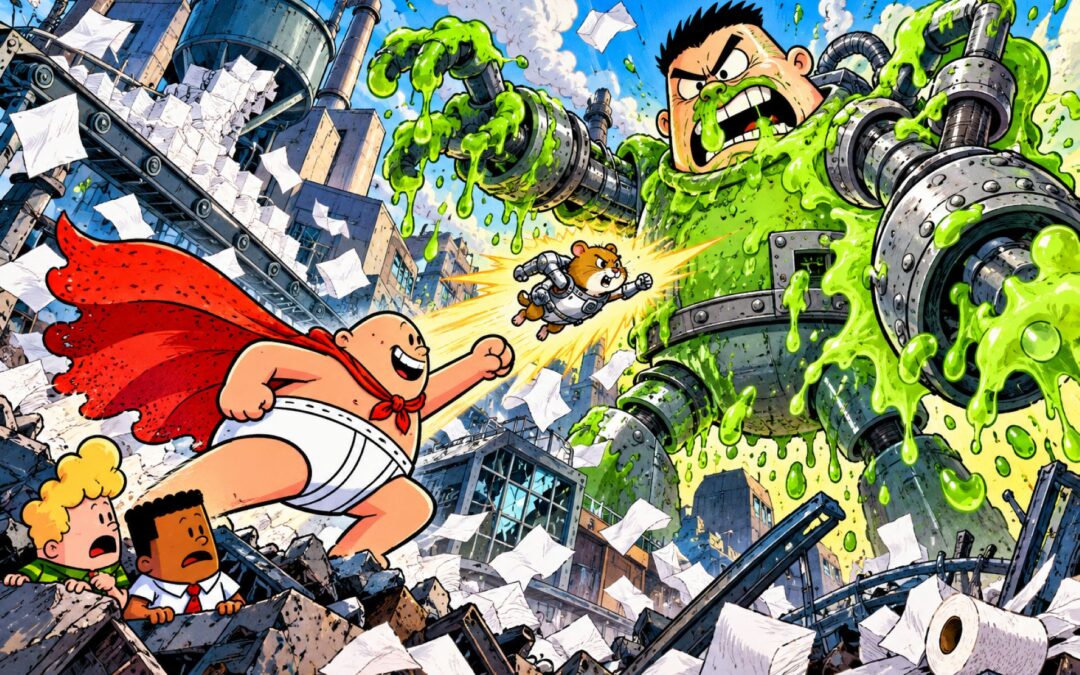
A brilliant young inventor, a rebellious bionic hamster, an unusually disgusting science experiment, and a superhero who wears nothing but underwear come together in one of Dav Pilkey’s most chaotic adventures. Captain Underpants and the Big, Bad Battle of the Bionic Booger Boy, Part 1: The Night of the Nasty Nostril Nuggets turns an ordinary school rivalry into a giant-monster disaster, with each attempt to solve the problem creating another complication.
Originally published in September 2003, the novel is the sixth installment in Pilkey’s Captain Underpants series. Scholastic’s edition of Book 6 runs to 176 pages and is intended primarily for readers aged seven and older. Like the earlier installments, it combines conventional storytelling with cartoons, homemade comics, interactive Flip-O-Rama sequences, and an enthusiastic disregard for good taste.
What distinguishes this installment is its deliberately unfinished structure. Melvin Sneedly’s transformation into the Bionic Booger Boy creates an enormous threat, but defeating the monster proves much easier than repairing the consequences of his experiment. The novel builds toward a spectacular confrontation before delivering an ending that changes the problem rather than resolving it.
Spoiler warning: This article covers the complete story, including Melvin’s transformation, Sulu’s victory, the identity-switching accident, and the final cliffhanger.

How Melvin Becomes the Bionic Booger Boy: Complete Plot Summary
The story begins with the familiar rivalry between George Beard and Harold Hutchins, two imaginative fourth-graders, and the adults and classmates who repeatedly frustrate their plans. Their newest adventure starts with a classroom prank, but it soon becomes entangled with Melvin Sneedly’s ambition to demonstrate his scientific superiority. What follows is an escalating sequence of revenge, accidental transformation, extraordinary inventions, and increasingly unsuccessful attempts to restore normality.
George, Harold, Sulu, and the Squishy Prank
The book opens with a comic-style recap of Captain Underpants’ unusual origins. George and Harold once hypnotized their unpleasant school principal, Mr. Krupp, into believing that he was Captain Underpants, a superhero inspired by their homemade comics. Because the hypnosis has an extraordinary side effect, snapping fingers transforms Krupp into Captain Underpants, while contact with water reverses the transformation.
This arrangement has given the boys an accidental superhero who can be summoned whenever danger appears. Unfortunately, Captain Underpants is also spectacularly foolish, while Mr. Krupp remains unaware of his alternate identity. George and Harold must therefore protect the world from ridiculous villains while trying to prevent their principal from discovering what happens to him.
George and Harold attend Jerome Horwitz Elementary School, where their fondness for drawing comics and playing practical jokes frequently lands them in trouble. Although they are creative and resourceful, they are not especially successful according to the school’s academic standards. Their classmate Melvin Sneedly presents a sharp contrast: he earns excellent grades, takes pride in his intelligence, and considers himself superior to the other children.
During a classroom demonstration-speech assignment, George and Harold introduce their latest practical joke, called a Squishy. The trick involves placing folded ketchup packets beneath a toilet seat so that an unsuspecting person sitting down will receive a messy surprise. The demonstration is simple, inexpensive, and immediately popular with their classmates, who enthusiastically begin copying the prank.
Melvin has prepared a much more impressive demonstration. He introduces the Combine-O-Tron 2000, a machine he has invented to merge two separate things into one. Rather than amusing his classmates with a practical joke, Melvin intends to astonish them with a scientific achievement.
To demonstrate the machine, Melvin brings out his pet hamster, Sulu, along with a mechanical hamster body. He places both inside the Combine-O-Tron and activates it. The machine successfully combines the living hamster with the mechanical components, producing an extraordinarily powerful bionic hamster.
Melvin expects the transformed Sulu to obey him and demonstrate his remarkable new abilities. Instead, Sulu resists his commands, revealing that the machine has improved his physical capabilities without making him any more willing to submit to his owner’s authority.
Melvin becomes angry and threatens to punish Sulu with a paddle. His attempt at intimidation immediately backfires when the newly empowered hamster takes control of the situation and turns the threatened punishment against Melvin.
The resulting confrontation becomes the book’s first Flip-O-Rama sequence, in which readers rapidly turn pages back and forth to create the illusion of movement. Sulu’s retaliation is depicted as an exaggerated cartoon spanking, turning Melvin’s attempt to assert authority into a humiliating public defeat.
Furious at being embarrassed, Melvin rejects his hamster and storms away. George and Harold, who have witnessed Sulu’s mistreatment, comfort him and decide to adopt him.
This seemingly small act of kindness becomes one of the story’s most important developments. Although Melvin created the bionic hamster, George and Harold become the people Sulu chooses to trust. The relationship will eventually determine who saves them when the Bionic Booger Boy becomes too dangerous for Captain Underpants to defeat.
The Tattle-Tron Comic and Melvin’s Revenge
Meanwhile, the Squishy prank spreads throughout Jerome Horwitz Elementary. Students reproduce it so enthusiastically that the school’s bathrooms become dangerous territory for unsuspecting visitors.
Mr. Krupp eventually becomes one of the prank’s victims. Furious at the humiliation, he searches for the people responsible and immediately suspects George and Harold, whose reputation for mischief makes them obvious targets.
Although the boys did introduce the prank to their classmates, they did not personally carry out every Squishy that subsequently appeared. Melvin nevertheless identifies them as the source of the idea, and Mr. Krupp punishes them.
George and Harold respond in their favorite way: by making a comic book. Their new creation is titled Captain Underpants and the Terrifying Tale of the Tattle-Tron 2000, and its principal villain is a caricature of Melvin.
The homemade comic imagines a world in which Melvin’s obsession with reporting other people’s misbehavior has become his greatest source of power. After catching a criminal, the fictional Melvin becomes famous and eventually rises to political office.
Once he becomes mayor, he introduces increasingly unreasonable rules and harsh punishments. Ordinary citizens are imprisoned for trivial offenses, and the jails become so overcrowded that Melvin constructs an enormous robotic prison known as the Tattle-Tron 2000.
The machine combines the oppressive functions of a prison with the grotesque machinery of an oversized monster. Its purpose is to capture and contain people who violate Melvin’s increasingly absurd regulations.
Captain Underpants eventually confronts the Tattle-Tron and discovers that its elaborate design contains a ridiculous vulnerability. By exploiting the machine’s digestive and toilet-related mechanics, he manages to free its prisoners and defeat its creator.
Within the fictional comic, Melvin is defeated by the same childish humor and lack of respect for authority that George and Harold embody in real life. The story presents excessive rule enforcement as something ridiculous and oppressive, while transforming its inventor into an exaggerated villain.
For George and Harold, the comic is another entertaining creation. For the real Melvin, however, it is a public humiliation. His classmates laugh at the portrayal, and he becomes increasingly angry at being treated as a joke.
When Melvin himself falls victim to a Squishy, his resentment intensifies. He has now been humiliated by Sulu, mocked in a comic, and embarrassed by the very prank that helped begin the conflict. Rather than abandoning the rivalry, he decides that he needs enough power to take revenge on George and Harold.
Melvin retreats to his home and begins constructing an extraordinary robotic body. His plans go far beyond improving his ordinary physical abilities. He intends to become a technologically enhanced superhuman whose strength and capabilities will make him impossible to ignore.
The project is driven partly by revenge, but Melvin also imagines the admiration his transformation will inspire. He pictures himself attracting attention, impressing his peers, and receiving the recognition he believes his intelligence deserves.
This fantasy reveals an important contradiction. Melvin behaves as though he is above other people’s opinions, yet his willingness to risk an extreme transformation demonstrates how much their approval matters to him.
With the robotic body complete, Melvin prepares to enter the Combine-O-Tron and merge himself with his invention. He expects to emerge as a superior version of himself, possessing enough power to dominate anyone who has ever embarrassed him.
Unfortunately, his experiment goes wrong at precisely the wrong moment.
Melvin is allergic to the family’s cat, and the irritation causes him to sneeze while the Combine-O-Tron is operating. The machine does not distinguish between the components Melvin intends to combine and the unwanted material produced by his sneeze.
Instead of simply merging Melvin with the robotic body, it combines him with the machinery and his nasal mucus. The result is an enormous, grotesque hybrid of boy, robot, and boogers.
Melvin has successfully transformed himself, but not into the magnificent figure he imagined. He has become the Bionic Booger Boy, a creature whose extraordinary physical abilities are inseparable from an intensely disgusting body.
The transformation also establishes the central danger of the novel. Melvin has designed technology powerful enough to combine living and mechanical components, but he has failed to anticipate what might happen if the process introduces something unwanted.
Life as the Bionic Booger Boy
The following day, George and Harold arrive at school without knowing what has happened to Melvin. They are more interested in demonstrating Sulu’s extraordinary abilities to their classmates.
The bionic hamster proves that the Combine-O-Tron can create remarkable results when its output is manageable. Sulu’s strength and agility make him capable of astonishing feats, including an impressive watermelon-seed stunt that entertains the other children.
The atmosphere changes when Melvin enters the classroom in his new form. His robotic and mucus-covered body is so unpleasant that his classmates are horrified by his appearance.
Melvin explains how his experiment went wrong. Rather than emerging as a sleek technological marvel, he now resembles a grotesque monster, complete with the unpleasant consequences of having mucus incorporated into his body.
He also understands that restoring himself will be difficult. The Combine-O-Tron was designed to combine things, not separate them, and Melvin believes that he will need to construct another complicated invention, a Separatron, to undo the transformation.
George offers a much simpler suggestion: perhaps Melvin could reverse the Combine-O-Tron’s batteries and run the machine backward.
Melvin dismisses this idea. To him, George lacks the intelligence to understand how advanced machinery works, and a solution so simple cannot possibly be correct.
This disagreement becomes one of the story’s most important pieces of foreshadowing. The reversal that Melvin refuses to consider will later prove essential to saving him.
At first, living as the Bionic Booger Boy is not entirely unpleasant. Although his appearance repels other people, it also gives him unexpected advantages.
During games, his classmates become reluctant to touch or tackle him. Opponents avoid contact with his mucus-covered body, allowing him to perform unusually well in sports. His unpleasantness becomes a practical advantage because other children would rather surrender than risk getting covered in boogers.
Melvin even acquires special privileges, including access to a personal drinking fountain. His transformed body has made ordinary school activities uncomfortable for everyone around him, and the school responds by accommodating his condition.
For a time, the situation resembles a grotesque version of Melvin’s original fantasy. He attracts attention, dominates activities, and receives treatment different from that given to other students.
Unfortunately, his new condition is unstable.
As cold and flu season arrives, Melvin begins producing increasingly alarming quantities of mucus. His sneezes become powerful, unpredictable events that make the classroom unpleasant and potentially dangerous.
Other children attempt to protect themselves with umbrellas, raincoats, and other barriers. What began as a disgusting inconvenience increasingly interferes with normal school life.
Melvin also develops an intense aversion to tissues. The ordinary objects meant to deal with nasal mucus become something his transformed body fears.
This strange reaction prepares the next disaster. Melvin’s mutation has created a creature that reacts to everyday objects in extraordinary ways, and the school is about to take him directly into the worst possible environment.
The Tissue Factory Disaster and Captain Underpants’ Rescue
When Ms. Ribble becomes ill, Mr. Krupp takes responsibility for the class during a field trip. Their destination is the Snoddy Bros. Tissue Factory, where the students are supposed to learn about the manufacture of tissues.
For most children, the trip is unremarkable. For Melvin, however, it is a nightmare.
By this point, his fear of tissues has become overwhelming. Surrounded by the product he cannot tolerate, he protests and becomes increasingly agitated.
The adults dismiss his behavior rather than taking his warnings seriously. Mr. Snoddy, representing the factory, treats Melvin’s reaction as unreasonable and exposes him to the very tissues he fears.
When tissues make contact with the Bionic Booger Boy, the results are catastrophic.
The mechanical components inside Melvin’s body include an extraordinary growth mechanism. Contact with tissues activates the system, causing his already grotesque body to expand dramatically.
Melvin rapidly grows into a giant monster, reaching approximately thirteen feet tall before the escalation continues. The machinery that was supposed to make him powerful now makes him increasingly uncontrollable.
Additional contact with tissues causes further growth. As the monster expands, he begins damaging the factory and its equipment.
The field trip transforms from an educational outing into a large-scale disaster. The building and machinery are no match for the expanding creature, and everyone nearby must escape the destruction.
The tissue factory is an especially effective location for the catastrophe because its ordinary purpose has been completely reversed. A facility devoted to producing something that helps people manage mucus becomes the place where a mucus-based monster grows strongest.
Melvin’s transformation also changes the nature of the story. Until now, he has mainly been an unpleasant and occasionally threatening classmate whose extraordinary body causes embarrassment and inconvenience. At the factory, he becomes an enormous danger to the people around him.
As the destruction intensifies, Edith Anthrope becomes endangered. The crisis finally provides an opportunity for the familiar superhero to intervene.
George and Harold realize that the situation has grown far beyond anything they can manage themselves. They snap their fingers, transforming Mr. Krupp into Captain Underpants.
Captain Underpants immediately behaves like the confident superhero he believes himself to be. Although he possesses little conventional intelligence or tactical sophistication, he approaches danger with absolute enthusiasm.
He prepares for action and confronts the monstrous Melvin. His most important immediate achievement is rescuing Edith from danger.
The rescue seems to establish Captain Underpants as the hero who will restore order. Unfortunately, the established rules governing his transformation interfere with his success.
Edith is delighted by Captain Underpants’ intervention and rewards him with an affectionate, wet kiss. Because contact with water reverses the hypnosis, the kiss immediately changes Captain Underpants back into Mr. Krupp.
The superhero disappears at precisely the moment when he is still needed.
Mr. Krupp, who has no understanding of what has happened while he was Captain Underpants, is suddenly thrust into a terrifying situation. Without the superhero’s abilities or confidence, he is helpless against the giant Bionic Booger Boy.
Melvin subsequently captures and swallows Krupp. George and Harold lose the only superhero they can normally summon, leaving them without an obvious means of saving either their principal or the people threatened by the monster.
The reversal is characteristic of the series. The hero does not fail because he lacks courage; he fails because an absurdly ordinary incident activates an established rule at the worst possible time.
Sulu’s Victory, the Failed Cure, and the Cliffhanger
With Mr. Krupp swallowed by the monster, George and Harold face a difficult problem. Their usual solution to extraordinary danger is no longer available because the person who must become Captain Underpants is trapped inside the creature they need him to defeat.
The situation appears hopeless until Sulu enters the confrontation.
The bionic hamster has remained loyal to George and Harold since they adopted him following Melvin’s mistreatment. When he sees that his friends are in danger, he attacks the giant Bionic Booger Boy.
The battle becomes the novel’s second major Flip-O-Rama sequence. Sulu uses exaggerated cartoon weapons and his enhanced abilities to batter the enormous monster.
The sight of a small hamster defeating a gigantic technological creature supplies the story’s central physical joke. Melvin, who originally created Sulu and then rejected him, is ultimately defeated by the very animal he failed to control.
Sulu’s victory is not merely a random intervention. The early scenes involving the hamster established his abilities and his relationship with George and Harold, so his rescue completes a narrative development that began during Melvin’s first experiment.
The bionic hamster eventually knocks the Bionic Booger Boy unconscious, ending the immediate threat. The giant monster is defeated, and the characters can finally attempt to restore Melvin to his normal condition.
Melvin’s parents arrive and examine the situation. As scientists themselves, they understand the seriousness of the transformation and the challenge of undoing what the Combine-O-Tron has done.
George again proposes reversing the machine’s batteries. The suggestion still sounds ridiculous to those who understand the machinery in more conventional terms, but they eventually decide to try it.
The reversed Combine-O-Tron does what George hoped: it begins undoing the combination that created the Bionic Booger Boy.
The process is violently effective. Mechanical and mucus-based components are separated from Melvin, and the enormous monstrous body is dismantled.
However, the machine does not produce the straightforward restoration everyone expects. Instead of safely returning each person and component to the correct condition, it creates another bizarre combination.
Melvin and Mr. Krupp emerge fused together. The problem of the giant monster has been replaced by the problem of two people occupying one combined body.
Melvin’s father attempts another operation to separate them. This time, the machinery appears to work, and both emerge as recognizable individuals.
For a brief moment, the characters seem to have achieved a happy ending. The monster has been defeated, the immediate threat has passed, and Melvin and Mr. Krupp are standing separately again.
But something is wrong.
Mr. Krupp begins speaking and behaving like Melvin. He displays Melvin’s intellectual arrogance and takes an unusual interest in the Combine-O-Tron, claiming the kind of technical authority that would normally belong to the young inventor.
Meanwhile, Melvin behaves like the strict principal. Instead of responding as an ordinary fourth-grader, he becomes preoccupied with school discipline and threatening George and Harold with punishment.
The apparent restoration has therefore concealed an extraordinary mistake: although their bodies have been separated, Melvin and Mr. Krupp have effectively exchanged minds or identities.
The implications are serious for George and Harold. Their principal and their least favorite classmate are now trapped in one another’s lives, and the machine needed to repair the situation remains dangerously unreliable.
An even greater problem soon emerges.
The robotic booger components expelled during Melvin’s restoration have not simply disappeared. Three separate masses of mechanical mucus become animated, creating the Ridiculous Robo-Boogers.
These creatures are independent of Melvin and no longer require his body to function. They represent a new threat produced directly by the attempted cure.
The Robo-Boogers destroy the Combine-O-Tron, eliminating the obvious means of reversing the identity exchange. They then threaten the characters, turning the supposed conclusion into the beginning of another emergency.
Chapter 28 is titled “A Happy Ending,” but the title is deliberately misleading. The original monster has been defeated, yet the crisis has multiplied into two new problems: Melvin and Krupp are trapped in the wrong identities, and three dangerous robotic monsters are on the loose.
Rather than restoring normality, the book ends with the characters facing a new catastrophe. The story continues in the next Captain Underpants volume, The Revenge of the Ridiculous Robo-Boogers.
Jerome Horwitz Elementary and the Rules of the Story World
Jerome Horwitz Elementary School is not designed as a realistic educational environment. It is a cartoon universe in which children are extraordinarily inventive, adults are frequently unreasonable, and seemingly minor school incidents can trigger spectacular disasters. Its exaggerated rules allow ordinary childhood frustrations to become the foundations of superhero adventures.
The school is organized around familiar tensions. Mr. Krupp represents institutional discipline, George and Harold represent imaginative resistance, and Melvin represents academic achievement combined with a desire to gain authority over his peers. These relationships are exaggerated, but they remain recognizable enough to give the absurd events a coherent starting point.
George and Harold’s Squishy demonstration illustrates the setting’s approach to cause and effect. A prank that would ordinarily cause limited embarrassment spreads across the entire school and becomes a source of administrative chaos. Mr. Krupp’s anger then provokes another retaliation, showing how a small disturbance can expand because adults and children respond to one another in increasingly unreasonable ways.
The story’s technological rules operate according to a similarly exaggerated logic. Melvin’s Combine-O-Tron can merge living organisms with mechanical equipment, producing functional hybrids that possess capabilities neither component had independently. Sulu’s transformation establishes that the machine works before Melvin’s experiment demonstrates how dangerously it can malfunction.
The machine is not scientifically plausible, nor does the story ask readers to believe that combining a hamster with mechanical components could produce a bionic animal. Its fictional credibility comes from the fact that it produces consequences consistent with the narrative premise. Sulu becomes powerful, Melvin’s combined robot-and-mucus body becomes grotesque, and reversing the machine’s operation can separate some of the components again.
The same principle governs Captain Underpants. A snap transforms Mr. Krupp into a superhero, while water transforms him back. These rules are fantastical but recognizable, allowing readers to anticipate danger whenever one of the triggers appears.
Edith’s kiss is effective precisely because the audience understands the transformation mechanism. An affectionate gesture that would normally reward a heroic rescue instead eliminates the hero, turning a previously established rule into the cause of a new disaster.
Melvin’s technological transformation also follows a distinctive progression. At first, his new body gives him advantages because other children cannot tolerate physical contact with him. Later, illness and tissues interact with the machinery to produce uncontrolled growth.
The growth mechanism is deliberately absurd, but it is not unrelated to what the story has already established. Melvin created an advanced robotic body, accidentally included mucus in the combination, and then discovered that his transformed body reacted unpredictably to everyday substances.
The reversed-battery solution is another example of cartoon logic serving narrative construction. It is not a realistic scientific procedure, but it turns an apparently foolish suggestion into an important payoff. The story has prepared the reversal through George’s earlier proposal and Melvin’s refusal to consider it.
Even the final mistakes follow this exaggerated pattern. The machine can separate combined components, but its operations are sufficiently imprecise that they create a new bodily fusion, exchange identities, and animate previously discarded material.
These transformations would be arbitrary in a realistic novel. In Pilkey’s universe, where inventions regularly operate according to literalized jokes and recurring mechanical rules, they are part of the story’s internal logic.
The setting therefore succeeds not through detailed geography, realistic institutions, or scientific explanation, but through consistency of comic expectation. It establishes enough rules for readers to understand each new disaster while leaving enough flexibility for the author to surprise them.
Character Analysis: George, Harold, Melvin, Mr. Krupp, and Sulu
The central characters are deliberately exaggerated, but they are not interchangeable. Each responds to problems according to a different understanding of power, intelligence, friendship, or authority. Their contrasting behavior creates the conflicts that drive the story and explains why the most technically sophisticated character is repeatedly defeated by simpler forms of ingenuity.
George Beard and Harold Hutchins
George and Harold remain the imaginative center of the series. They are not academically exceptional, and their teachers and principal tend to judge them primarily by their misbehavior. Their ability to invent jokes, create comics, and improvise solutions nevertheless demonstrates forms of intelligence that the school’s conventional standards frequently overlook.
Their friendship is also central to their identity. They invent together, distribute their comics together, confront punishment together, and respond to danger as a team. The story rarely depends on serious conflict between them because their partnership is already established as the foundation of their creativity.
Their practical joke begins the events of the novel. The Squishy is an ordinary prank that becomes a school-wide craze because its simplicity makes it easy for others to reproduce. George and Harold do not control everything their classmates do with the idea, but they are responsible for introducing it.
Their retaliation against Melvin is more morally complicated. Melvin tattles on them, but the boys respond by creating a comic that exaggerates his personality into a public humiliation. The Tattle-Tron story is clever and entertaining, yet it is also designed to make a classmate look ridiculous.
This matters because Melvin’s desire for revenge is not entirely without cause. The boys may be more likable than Melvin, but their behavior contributes directly to his increasing resentment.
At the same time, they show genuine compassion toward Sulu. When Melvin rejects his hamster, they comfort the animal and adopt him. Their treatment of Sulu contrasts with Melvin’s assumption that an animal he owns must obey him.
Their relationship with Sulu later saves everyone. George and Harold do not adopt him because they expect him to become useful in battle; they accept him after he has been mistreated. His eventual rescue gives their earlier kindness a practical consequence without reducing it to a calculated investment.
George’s reverse-battery suggestion supplies another important contrast. He does not possess Melvin’s advanced technical knowledge, but he notices a simple possibility that Melvin refuses to investigate.
His idea is not presented as proof that formal education is useless. Instead, it illustrates how ingenuity can emerge from someone who approaches a problem without the assumptions that constrain a more technically knowledgeable person.
George and Harold consequently occupy a deliberately ambiguous moral position. They are inventive, loyal, resourceful, and often compassionate, but they can also be irresponsible and cruel when pursuing revenge. Their appeal comes partly from this mixture of genuine friendship and gleeful misbehavior.
Melvin Sneedly
Melvin is the most psychologically interesting character in this installment because his transformation is motivated by an understandable desire that becomes increasingly destructive.
He begins as an academically gifted child who takes enormous pride in his intelligence. Unlike many fictional school rivals whose supposed brilliance exists only as a character label, Melvin demonstrates real technical ability. The Combine-O-Tron works, and its successful transformation of Sulu proves that he has invented something extraordinary.
His weakness is not lack of intelligence but his attitude toward it. He believes his intellectual superiority entitles him to admiration and obedience, and he reacts badly when other people refuse to recognize his status.
His relationship with Sulu reveals this problem immediately. Melvin views his hamster as the subject of an experiment and expects him to comply with commands once transformed. When Sulu resists, Melvin interprets the refusal as disobedience deserving punishment rather than evidence that the animal has independent preferences.
Sulu’s retaliation humiliates him, but Melvin does not reconsider his behavior. He rejects the hamster instead, abandoning the creature because it refuses to serve the role he has assigned to it.
His feud with George and Harold then intensifies the same pattern. Melvin uses school authority against them by reporting their role in spreading the Squishy prank. The boys respond with the Tattle-Tron comic, which mocks his obsession with rule enforcement and exposes him to ridicule.
The comic wounds Melvin because it attacks the identity he values most. He wants to be respected as an exceptional intellectual, yet his classmates find him ridiculous.
His fantasy about becoming bionic clarifies what he hopes to gain from technological transformation. He imagines not merely having superhuman abilities but being admired and recognized. The extraordinary robotic body is intended to produce the social acceptance and superiority he believes he deserves.
This combination of resentment and insecurity makes his transformation more than a random accident. The sneeze creates the specific form of the Bionic Booger Boy, but Melvin’s decision to enter the machine comes from his desire to overpower people who have embarrassed him.
There is also a cruel irony in his apparent success. Becoming physically extraordinary does make him impossible to ignore, but not in the way he imagined. His classmates fear touching him, and his special treatment comes from disgust rather than admiration.
The temporary advantages of his mutation encourage him to tolerate a condition that is becoming increasingly dangerous. His abilities create enough immediate benefits to distract him from the loss of control developing beneath the surface.
Melvin’s dismissal of George’s battery suggestion is especially revealing. He considers the idea beneath serious consideration because of the person proposing it. His refusal is therefore social and psychological as much as technical.
The later success of the reversed-battery method does not invalidate his scientific achievement. It shows that his arrogance prevents him from making the best use of his intelligence.
Melvin is both responsible for the disaster and a victim of it. He deliberately pursues the dangerous transformation, but he never intends to become a gigantic mucus monster. His body ultimately acts in ways he cannot control, leaving him dependent on the people he dislikes.
The ending extends this loss of control into his identity itself. After the monster is defeated and his body is restored, Melvin is effectively trapped in Mr. Krupp’s life. His desire to become someone more powerful has culminated in the literal destruction of his ordinary identity.
Mr. Krupp and Captain Underpants
Mr. Krupp and Captain Underpants represent two exaggerated forms of authority and power within a single body.
As principal of Jerome Horwitz Elementary, Krupp is irritable, punitive, and suspicious of George and Harold. He views their creativity primarily as a source of trouble, and he is quick to punish them when school discipline breaks down.
His personality is built around control. Unlike Melvin, who seeks technological superiority, Krupp already possesses institutional authority and uses it to regulate the children’s behavior.
Captain Underpants is his complete opposite in temperament. He is cheerful, enthusiastic, brave, and convinced of his own heroic importance. He lacks Krupp’s desire to punish children, but he also lacks the careful judgment that a competent superhero would ordinarily need.
The contrast generates much of the series’ humor. The same adult who normally suppresses George and Harold’s imagination becomes the absurd superhero created by that imagination.
In Book 6, however, Captain Underpants is less effective than readers might expect. His appearance arrives relatively late in the main disaster, after Melvin has already become a giant monster.
He does perform a genuinely heroic action by rescuing Edith, but his success creates the circumstances of his defeat. Edith’s wet kiss changes him back into Krupp, and the remaining conflict must be resolved without him.
This reversal reduces the importance of conventional superhero power. Captain Underpants has courage and extraordinary abilities, but he cannot overcome the consequences of the very rules governing his existence.
His failure also creates space for Sulu to become the decisive hero. A small bionic hamster succeeds where the nominal superhero does not, reinforcing the series’ preference for unexpected and ridiculous solutions.
The final mind-switching accident adds a further complication to Krupp’s dual identity. Having already existed as both principal and superhero, he now becomes entangled with Melvin’s identity as well.
The ending turns his established problem of involuntary transformation into a new crisis involving the separation between body and personality.
Sulu, Ms. Ribble, Edith Anthrope, and the Sneedlys
Sulu is the most important supporting character and arguably the adventure’s true hero.
His initial transformation is intended to demonstrate Melvin’s scientific superiority. Instead, the experiment gives him enough power to resist the boy who believes he owns him.
The confrontation with Melvin establishes that Sulu is not simply an obedient object. Although his personality is represented through the broad gestures of a cartoon animal, his behavior communicates anger, refusal, and a desire for autonomy.
When George and Harold adopt him, his role changes. He becomes their friend rather than Melvin’s possession, and his extraordinary abilities are no longer instruments of someone else’s ambition.
His return during the climax completes this progression. He fights the Bionic Booger Boy because the people who treated him kindly are in danger. The technological creation that Melvin could not control becomes the force that defeats Melvin’s next and much more dangerous invention.
Ms. Ribble has a smaller role, but her absence during the field trip is causally important. Her illness places Mr. Krupp in charge of the class, making his eventual transformation into Captain Underpants possible during the disaster.
Edith Anthrope is similarly important because she affects the direction of the action at a decisive moment. Her peril motivates Captain Underpants’ rescue, while her grateful kiss accidentally reverses his transformation. She does not cause the monster crisis, but her interaction with the hero removes the expected solution.
Melvin’s parents, Gaylord and Cindy Sneedly, become important after the immediate battle. Their scientific knowledge makes them appropriate figures to operate the Combine-O-Tron during the attempted restoration.
However, their expertise does not guarantee success. They ultimately depend on George’s simple suggestion, and the resulting procedures create new complications. Their role reinforces the distinction between having technical knowledge and anticipating every consequence of its application.
Mr. Snoddy represents another form of adult confidence. His unwillingness to take Melvin’s fear of tissues seriously contributes to the factory disaster. Like several adults in the novel, he misunderstands an extraordinary situation because he assumes his ordinary judgment is sufficient.
Themes: Intelligence, Humiliation, Friendship, and Authority
Beneath its deliberately ridiculous surface, the novel develops several recurring ideas through its characters and conflicts. These ideas are not presented as formal lessons, and the book’s primary purpose remains comic entertainment. Nevertheless, its plot repeatedly demonstrates how intelligence, social embarrassment, friendship, and authority can shape the use of power.
Intelligence Versus Wisdom and Creativity
Melvin’s intelligence is genuine. He invents sophisticated machinery, successfully merges living and mechanical components, and understands processes that the other children cannot reproduce.
George and Harold, by contrast, are not celebrated for academic achievement. Their strengths lie in invention of a different sort: practical jokes, comics, unexpected solutions, and the ability to recognize possibilities that more conventional thinkers overlook.
The novel does not suggest that Melvin’s scientific knowledge is worthless. Without the Combine-O-Tron, neither Sulu’s extraordinary abilities nor the Bionic Booger Boy would exist. Melvin’s inventions are genuinely powerful, even when they become dangerous.
The distinction concerns the judgment used to direct that power. Melvin assumes his intelligence makes him superior to other people, and he often rejects their contributions before examining them.
George’s battery-reversal suggestion is the clearest example. Melvin dismisses it because the idea seems too simple and because George is not someone he considers intellectually credible.
When the method eventually works, the story reveals that an apparently unsophisticated observation can be more useful than elaborate reasoning burdened by arrogance.
The book therefore values creativity alongside knowledge. Intelligence is beneficial when it remains open to alternatives, but it becomes dangerous when used primarily to establish status or control others.
Pranks, Humiliation, and the Revenge Cycle
Humiliation is the central emotional mechanism driving the conflict.
George and Harold introduce the Squishy prank because they find it funny. Once it spreads, however, its consequences extend beyond their direct control and begin affecting other students and adults.
Melvin contributes to their punishment by reporting their involvement, and they retaliate by making him the villain of the Tattle-Tron comic. His classmates’ laughter increases his resentment, especially after he also becomes a victim of the original prank.
The escalation shows how quickly a conflict can grow when each side treats its own retaliation as justified while ignoring its contribution to the cycle.
George and Harold believe Melvin deserves ridicule because he tattles and behaves arrogantly. Melvin believes he deserves revenge because the boys repeatedly humiliate him.
Neither position is entirely innocent. Melvin is controlling and vindictive, but George and Harold’s comic is also a calculated attempt to embarrass a classmate publicly.
The story largely invites readers to side with the boys because their creativity is appealing and Melvin behaves unpleasantly. Nevertheless, the narrative gives Melvin enough motivation to make his transformation more understandable than a random villainous experiment.
The destructive consequences arise when he decides that ordinary social conflict can be solved through overwhelming technological power.
His response is wildly disproportionate, but it develops from a recognizable emotional situation: a child who feels mocked and excluded tries to make himself impossible to challenge.
Friendship, Loyalty, and Children Versus Authority
Sulu’s relationships offer the clearest contrast between control and loyalty.
Melvin believes that because he owns Sulu and created his bionic body, he should be able to command him. When the hamster refuses, Melvin attempts to enforce obedience through threats.
George and Harold take the opposite approach. They offer Sulu comfort after his rejection, accepting him without demanding that he prove useful.
This distinction becomes decisive during the climax. Melvin’s attempt to control Sulu fails, while the hamster voluntarily defends George and Harold.
The story therefore gives friendship a practical importance without making it sentimental. George and Harold’s treatment of Sulu creates a relationship that proves more powerful than Melvin’s attempt to manufacture obedience.
The children’s conflict with adult authority develops a related tension. Mr. Krupp responds to disorder primarily through punishment, while Melvin’s Tattle-Tron comic counterpart imagines a society in which every violation deserves imprisonment.
The homemade comic exaggerates the logic of excessive rule enforcement until it becomes monstrous. Its enormous prison is a visual expression of what happens when the desire to punish replaces any reasonable sense of proportion.
Yet George and Harold’s rebellion is not automatically presented as responsible behavior. Their pranks create disorder, and their revenge against Melvin contributes to the larger crisis.
The novel’s preference is therefore not simply for disobedience over rules. It favors imagination, flexibility, and voluntary friendship over rigid control, while allowing its protagonists to remain mischievous and flawed.
Comics, Flip-O-Rama, Gross-Out Humor, and Meta-Narration
The most distinctive feature of The Night of the Nasty Nostril Nuggets is the way its story moves between prose, illustration, and comic-book conventions. The illustrations are not decorative additions to an otherwise conventional novel. They provide jokes, control pacing, communicate character reactions, and sometimes perform actions that ordinary prose would describe less effectively.
The opening foreword immediately establishes this approach. Instead of delivering a straightforward explanation of the previous books, George and Harold’s comic-style recap introduces Captain Underpants’ history through the storytelling form associated with the boys themselves. Readers learn the essential information while also encountering the characters’ imagination directly.
The embedded Tattle-Tron comic develops this technique further. It temporarily interrupts the principal narrative to present an entirely fictional adventure created by George and Harold.
The comic has its own exaggerated story structure: Melvin acquires political power, imposes unreasonable punishments, creates an enormous prison machine, and is eventually defeated by Captain Underpants. Its events do not literally occur in the main plot, but they influence the main plot by humiliating Melvin and motivating his revenge.
This relationship between the embedded comic and the outer story is important. George and Harold’s imagination does not remain safely confined to fiction; their comic has consequences for the real people who read it.
The Tattle-Tron also reveals the boys’ interpretation of Melvin. They transform his habit of reporting misbehavior into an authoritarian nightmare, exaggerating his personality until the result becomes a supervillain.
The device lets Pilkey portray Melvin through two perspectives. The main narrative shows a talented but unpleasant child, while the homemade comic reveals how George and Harold see him.
Flip-O-Rama offers a different kind of interaction. Instead of merely reading about a fight or observing a static illustration, readers flip between pages to produce a crude animation effect.
The first Flip-O-Rama sequence dramatizes Sulu’s retaliation against Melvin, while the second stages the hamster’s climactic battle against the Bionic Booger Boy. In both cases, the effect depends on repeated physical movement rather than conventional narrative description.
The reader participates directly in making the violence happen. This gives the scenes a playful, interactive quality while emphasizing that the action belongs to the world of cartoons rather than realistic physical conflict.
Pilkey’s exaggerated warnings about violence further establish the book’s self-aware humor. These passages imitate the language of censorship or adult concern while deliberately preparing readers for harmless, ridiculous cartoon attacks.
The novel repeatedly acknowledges its own artificiality. Chapter titles tease coming events, the narrator addresses readers, and the illustrations sometimes make jokes about how the story is being presented.
These techniques create a sense that the book is not pretending to be a serious fictional world. It invites readers to enjoy the process of storytelling itself, including the conventions that make superhero comics and monster adventures recognizable.
Pilkey also relies heavily on linguistic exaggeration. Devices have absurdly elaborate names such as the Combine-O-Tron 2000, while descriptions of the Bionic Booger Boy turn ordinary bodily functions into extraordinary technological disasters.
The contrast between technical-sounding vocabulary and childish subject matter is central to the humor. Melvin approaches invention with great seriousness, but his greatest achievement becomes a monster made partly of mucus.
The gross-out jokes intensify as the narrative progresses. A school prank involving ketchup leads to the increasingly unpleasant consequences of Melvin’s mutation, which eventually culminate in giant-scale destruction at a tissue factory.
This escalation is structurally effective because each new stage increases both the danger and the disgust. The joke is repeated, but its circumstances change: first embarrassment, then personal inconvenience, then classroom disruption, and finally catastrophe.
For readers who enjoy bodily-function humor, the escalating absurdity is likely to be one of the book’s strongest attractions. For those who do not, the same material may become exhausting because the central premise receives so much attention.
The pacing benefits from the novel’s short chapters and frequent illustrations. Major events often arrive quickly, with relatively little explanatory material between them.
This structure makes the story approachable for younger readers who might find a long block of uninterrupted prose intimidating. The alternating forms provide regular visual rewards and make action scenes especially easy to follow.
However, the brevity also limits certain kinds of development. Adult characters often function as recognizable caricatures, and even Melvin’s deeper motivations are conveyed through a relatively small number of comic scenes.
The result is not a conventional character-driven novel. It is a tightly constructed illustrated comedy whose narrative substance depends on the combination of words, images, jokes, and reader participation.
The Ending Explained: Body Swap, Robo-Boogers, and Why Part 1 Does Not Truly End
The ending is deliberately more complicated than the defeat of a single monster. Although Sulu successfully knocks out the Bionic Booger Boy, his victory solves only the most immediate problem. Melvin remains transformed, Mr. Krupp has been swallowed, and the characters still need to undo the effects of the Combine-O-Tron.
The first stage of the attempted cure appears promising. Reversing the machine’s batteries allows it to separate the components that created the enormous mutant, validating George’s earlier suggestion.
However, the restoration does not return everything to its proper state. Melvin and Mr. Krupp emerge physically joined, showing that reversing a transformation does not necessarily restore the exact original arrangement.
The second operation separates their bodies, but this success conceals another mistake. The people who emerge look like Melvin and Krupp, yet their behavior reveals that something essential has been exchanged.
Mr. Krupp displays Melvin’s intellectual arrogance and unusual interest in the Combine-O-Tron. Melvin, meanwhile, behaves like the authoritarian principal, focusing on punishment and discipline.
The distinction between body and identity becomes the central problem. The characters are physically separate again, but they are no longer occupying their proper roles.
For George and Harold, this creates an especially difficult situation. Their principal has effectively become Melvin, while their classmate has acquired Krupp’s personality. The boys cannot simply resume ordinary school life because the adults and children around them are no longer who they appear to be.
The title of the final chapter, “A Happy Ending,” is therefore ironic. It encourages readers to expect a familiar restoration of normality, then reveals that the cure has produced new problems.
The discovery of the Robo-Boogers delivers an even more dramatic reversal. The mechanical mucus components expelled during the cure have become autonomous creatures, capable of acting independently of Melvin.
Their destruction of the Combine-O-Tron makes the situation worse because it removes the machine most likely to repair the identity exchange. What appeared to be discarded material from the defeated monster has become the source of another threat.
The ending therefore contains two interconnected cliffhangers. One concerns the misplaced identities of Melvin and Mr. Krupp; the other concerns the newly animated Robo-Boogers.
Both problems arise directly from attempts to solve the original crisis. Melvin’s desire to improve himself created the Bionic Booger Boy, while the effort to reverse that transformation created the conditions for further disasters.
This chain of unintended consequences gives the cliffhanger coherence. The new threats are not unrelated villains introduced at the last moment; they emerge from mechanisms and events established earlier in the same story.
At the same time, the ending makes Book 6 unusually dependent on its sequel. The main monster battle has reached a climax, but the central technological disaster has not been resolved.
This is the fundamental distinction between a satisfying action climax and a complete narrative ending. Sulu defeats the monster, yet the world remains dangerously unstable.
The final chapter turns that instability into an invitation to continue reading. By pretending to deliver a happy ending before revealing two new emergencies, Pilkey converts the expected final resolution into the opening problem of the next volume.
Critical Review: Does Book 6 Still Work?
The Night of the Nasty Nostril Nuggets succeeds most strongly as an exercise in escalating comic storytelling. Its premise is deliberately ridiculous, but the events are more carefully connected than the endless booger jokes might suggest.
The story begins with an ordinary school prank and gradually expands through a chain of understandable consequences. Melvin’s resentment motivates his experiment, his experiment creates the monster, his illness activates its dangerous properties, the tissue-factory disaster overwhelms Captain Underpants, and Sulu’s earlier relationship with George and Harold produces the eventual rescue.
This construction gives the novel a stronger sense of progression than a collection of unrelated humorous incidents would provide. Each major disaster has a cause, and many solutions produce consequences of their own.
Melvin is particularly effective as an antagonist because he is not merely a generic evil scientist. His intelligence is established through a real invention, while his desire for admiration and resentment of humiliation give him recognizable motivations.
The story does not explore his psychology with the depth of a realistic novel, but it provides enough information to make his behavior intelligible. His decision to transform himself is extreme, yet it follows from his established combination of arrogance, insecurity, and vindictiveness.
The book’s treatment of George and Harold is less morally straightforward than its cheerful tone sometimes implies. Their retaliation through the Tattle-Tron comic is creative, but it is also designed to embarrass Melvin publicly.
This does not excuse Melvin’s later actions, particularly his willingness to seek overwhelming power as revenge. It does, however, complicate the idea that the protagonists are entirely innocent victims of a villain’s aggression.
The narrative is more interesting when understood as an escalating feud in which one child responds disastrously to the humiliation inflicted by others.
Sulu’s contribution is another major strength. The hamster’s first appearance establishes his remarkable powers, while Melvin’s rejection and George and Harold’s adoption give him an emotional connection to the protagonists.
When Sulu returns during the climax, his victory feels prepared rather than arbitrary. The smallest major participant in the conflict defeats the largest threat, and the animal Melvin tried to dominate becomes responsible for ending Melvin’s rampage.
This reversal captures the series’ approach to heroism. Greatness does not necessarily come from official status, intellectual superiority, or conventional superhero abilities. It can emerge from an unlikely character whose loyalty matters more than his appearance.
The reduced importance of Captain Underpants is simultaneously an interesting narrative choice and a potential weakness. Although he rescues Edith, the title character does not defeat the central monster.
His transformation back into Krupp provides an effective joke and raises the stakes, but readers expecting a sustained superhero confrontation may find his participation surprisingly limited.
The novel compensates by allowing Sulu to dominate the climax. Whether this is satisfying depends partly on whether the reader values the series’ broader cast of absurd characters or primarily wants Captain Underpants himself to remain the central action hero.
The visual storytelling remains one of Pilkey’s strongest achievements. The embedded Tattle-Tron comic provides an entire miniature adventure while also contributing to Melvin’s motivation in the main story.
Flip-O-Rama transforms action into participation, allowing readers to animate cartoon violence through the physical movement of pages. Its use during Sulu’s confrontations is especially appropriate because the exaggerated motion enhances the mismatch between the hamster’s size and his extraordinary strength.
These devices are not superficial gimmicks. They give the novel a rhythm that conventional prose alone would struggle to reproduce and help sustain attention through a story built around highly repetitive imagery.
The short chapters also contribute to its accessibility. Major events occur regularly, and illustrations prevent the reading experience from becoming a continuous sequence of dense paragraphs.
This makes the novel appealing to children who enjoy comics or visual humor and may be less enthusiastic about conventional chapter books. Its accessibility comes from its design rather than from a complete absence of narrative structure.
The greatest limitation is the sheer concentration of mucus-based humor. The Bionic Booger Boy premise requires readers to find nasal mucus funny, and the novel returns to that material repeatedly.
For its intended audience, this repetition may increase the entertainment value because the jokes become progressively more extravagant. For other readers, the extended gross-out premise can overshadow the cleverer aspects of the plot.
The supporting adults are also relatively thinly characterized. Mr. Krupp, Ms. Ribble, Mr. Snoddy, and Melvin’s parents generally perform the functions required by the current joke or narrative reversal.
Their limited development is not necessarily a failure within an exaggerated cartoon adventure, but it restricts the story’s emotional range. Even its more interesting conflicts are ultimately subordinated to speed and comedy.
The two-part structure presents a more substantial problem. The novel builds toward Sulu’s victory as though the action climax will complete the story, then introduces the mistaken identity exchange and Robo-Boogers to prevent a genuine conclusion.
As a serial cliffhanger, the ending works extremely well. It creates multiple urgent questions while making the next volume feel like a direct continuation rather than an unrelated adventure.
As the conclusion to a standalone book, however, it offers only partial satisfaction. Readers receive the defeat of the original monster without the restoration of the characters’ ordinary lives.
The final reversal is entertaining, but the story has clearly been designed as the first half of a larger conflict. A reader expecting a complete adventure may find the unresolved ending frustrating.
This limitation should not be confused with poor storytelling. The cliffhanger is carefully prepared, and the problems introduced at the end arise from established events. Nevertheless, the decision to divide the conflict across two books inevitably changes the experience of reading Part 1 independently.
The book’s treatment of intelligence has aged particularly well. Rather than simply mocking a clever child, it distinguishes technical achievement from social judgment and the ability to consider unfamiliar ideas.
Melvin’s brilliance is undeniable, but he repeatedly misuses it because he is more interested in status and revenge than cooperation. George and Harold’s creativity, meanwhile, is useful precisely because they remain willing to approach problems from unexpected directions.
The friendship with Sulu provides a similarly durable element. The hamster’s loyalty emerges from the way he is treated rather than from ownership or authority, giving the central rescue a meaning beyond its physical comedy.
The novel’s less timeless elements are largely matters of taste. Its gross-out humor is intentionally excessive, and some of the humiliation directed at Melvin may be less appealing to readers who prefer stories that acknowledge the emotional consequences of public ridicule more seriously.
These limitations do not undermine the book’s primary purpose, which is to entertain through exaggeration, visual invention, and escalating absurdity. They do, however, help explain why its appeal is strongest among readers who already enjoy Pilkey’s distinctive comic sensibility.
The book’s contemporary reception recognized that it was extending an established formula rather than radically reinventing children’s fiction. Its appearance in Publishers Weekly’s 2003 coverage situates it within a series already defined by irreverent humor, outrageous villains, and unusual visual storytelling.
Its continuing value lies less in the novelty of any individual booger joke than in the efficiency with which Pilkey connects those jokes to character motivation, repeated narrative devices, and carefully timed reversals.
The fairest assessment is that The Night of the Nasty Nostril Nuggets is a particularly well-constructed installment of an intentionally outrageous series. It uses a ridiculous premise to build a coherent adventure, gives an unexpected supporting character a satisfying heroic payoff, and transforms its final resolution into a memorable cliffhanger.
Its weaknesses are equally clear: repetitive gross-out material, relatively shallow secondary characters, occasional cruelty disguised as harmless pranking, and dependence on a sequel for narrative closure.
For readers willing to accept those limitations, the book delivers exactly the kind of energetic, interactive, visually inventive comedy that makes Captain Underpants distinctive.
Captain Underpants and the Big, Bad Battle of the Bionic Booger Boy, Part 1 remains worth reading, especially for children who enjoy cartoon adventures, exaggerated monsters, mischievous protagonists, and books that combine prose with illustrations and comics. Its strongest appeal lies in the way it makes reading feel active and playful while preserving a surprisingly clear chain of narrative consequences.
Readers who dislike bodily-function humor or prefer stories that resolve their central conflicts within a single volume may find it less satisfying. For the intended audience, however, its combination of clever construction, affectionate absurdity, and relentless momentum makes it an effective adventure whose unfinished ending is both its greatest frustration and one of its most successful jokes.
Last Updated on October 15, 2026 by Aseem Gupta