
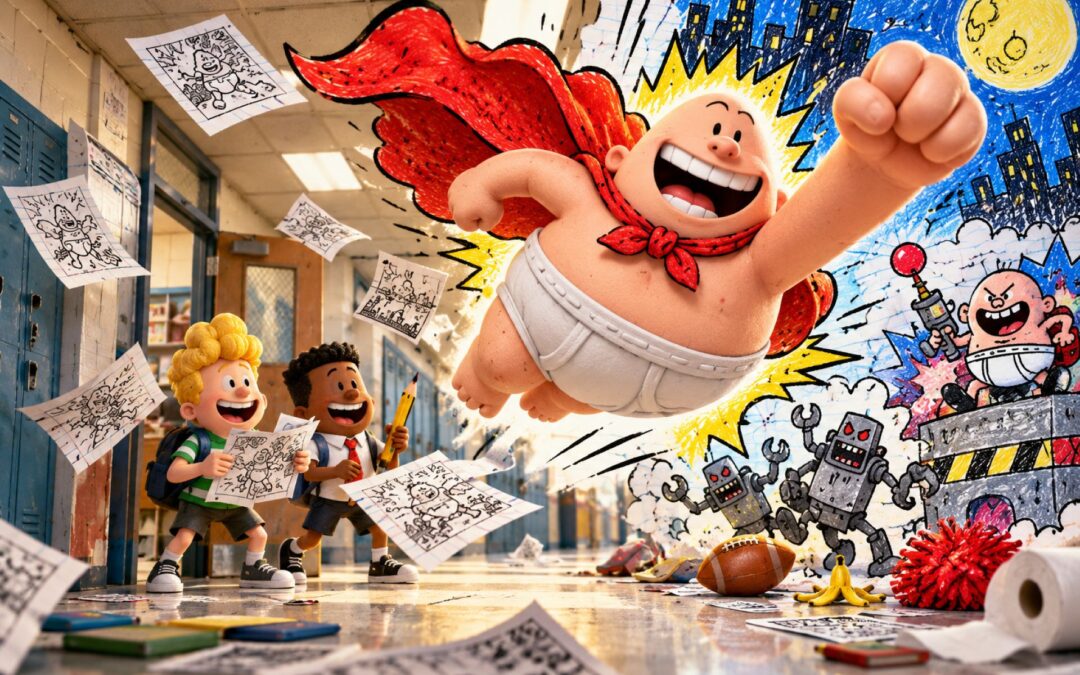
Dav Pilkey’s The Adventures of Captain Underpants, first published in 1997, begins with the kind of premise that sounds almost too ridiculous to sustain a novel: two fourth-graders hypnotize their unpleasant principal and convince him that he is Captain Underpants, the superhero they invented for their homemade comics. Yet the absurdity is precisely the point. Pilkey turns children’s jokes, drawings, pranks, cheap novelty toys, underwear humor, and even the physical act of flipping pages into the machinery of the story.
What makes the first Captain Underpants book work is not an intricate plot or psychologically complex villain. Its strength lies in how completely it adopts George and Harold’s creative worldview. Their comic-book imagination gradually spills into ordinary life until the superhero they drew for fun is running through town in his underwear, attempting to fight real criminals and save the world. Full spoilers follow, including the ending and the mechanism that permanently links Mr. Krupp to Captain Underpants.

The Adventures of Captain Underpants: Complete Plot Summary
The novel moves through several distinct phases while maintaining a clear causal chain. George and Harold’s creativity leads to their pranks, the pranks allow Mr. Krupp to blackmail them, the blackmail inspires their hypnosis scheme, and their misuse of hypnosis creates Captain Underpants. What begins as a school comedy therefore turns naturally—if absurdly—into a superhero adventure.
George and Harold vs. Mr. Krupp
George Beard and Harold Hutchins are fourth-grade best friends who live next door to each other and attend Jerome Horwitz Elementary School. The narrator quickly establishes the central contradiction in their personalities: they are good-hearted boys, but they are also responsible for an extraordinary amount of trouble. They love jokes, pranks, and anything that disrupts the seriousness of school, and their friendship is built as much around making things together as around misbehaving together.
Their most important creative outlet is Tree House Comix, Inc., the homemade comic-book operation they run from their tree house. George is primarily the storyteller, inventing plots and characters, while Harold is the artist who brings George’s ideas to life. They create a variety of ridiculous heroes and monsters, but their favorite character is Captain Underpants, based on George’s observation that superheroes already look as though they are running around in their underwear.
The novel does not merely tell readers that George and Harold make comics. It reproduces one of their Captain Underpants stories inside the book. In their comic, Captain Underpants confronts the Inedible Hunk, a monstrous creature made from cafeteria food. When direct fighting fails, Captain Underpants exhausts the creature, gives it water, and ultimately gets rid of it through a deliberately childish solution involving a toilet.
That embedded comic establishes several things at once. It shows how George and Harold think, introduces Captain Underpants before he exists within the main story, and creates a miniature version of the kind of plot the novel itself will soon become: an absurd villain, an apparently impossible crisis, and a ridiculous improvised solution.
The chief obstacle to George and Harold’s fun is Principal Benjamin Krupp. Krupp is presented as the boys’ natural opposite because he seems to dislike virtually everything they enjoy: laughter, jokes, comics, children having fun, and especially George and Harold themselves. He has repeatedly tried to catch them causing trouble, and he particularly hates the Captain Underpants comics they circulate around school.
The confrontation finally escalates during an important football game. George and Harold arrange an elaborate series of practical jokes that throws the entire event into chaos. Among other tricks, they put pepper in the cheerleaders’ pom-poms, bubble bath in the marching band’s instruments, and helium inside the football. The resulting disaster is funny from the boys’ perspective, but it also causes real disruption and humiliation for the school.
George and Harold think they have escaped without being identified. Their confidence disappears when Krupp summons them to his office and reveals that he secretly installed miniature video cameras around the school. The surveillance footage not only proves that they sabotaged the football game but also records numerous earlier pranks.
Krupp now possesses something he has never had before: undeniable evidence. He threatens to show the tape to their parents, school authorities, and, most frighteningly, the football players whose game the boys ruined. Rather than immediately exposing them, however, Krupp uses the evidence to control them.
George and Harold must obey an exhausting set of rules and chores. They wash Krupp’s car, perform work for him, behave perfectly at school, stop telling jokes, stop pulling pranks, and accept extra homework. Their punishment is comic precisely because it transforms two hyperactive creators into unnaturally obedient children.
The arrangement soon becomes unbearable. George finally reveals a possible solution: he has ordered a 3-D Hypno-Ring from a mail-order novelty company. If it actually works, they can hypnotize Krupp into giving them the videotape and forgetting what happened.
The Hypno-Ring Creates Captain Underpants
After several weeks of forced good behavior, the Hypno-Ring arrives. Harold is skeptical that a cheap novelty item ordered through the mail could have genuine hypnotic powers, but George is willing to try anything that might free them from Krupp’s control.
The boys deliberately provoke Krupp and then persuade him to stare into the ring. To their surprise, the hypnosis works. Krupp falls completely under their control, and George orders him to hand over the incriminating videotape.
Harold makes the plan safer by replacing the tape in Krupp’s filing cabinet with an old children’s sing-along video belonging to his sister. This matters later because Krupp will eventually believe that he still possesses the evidence against them even though the real recording has already been removed.
At this point, George and Harold have accomplished what they originally intended. They have escaped the blackmail. The sensible choice would be to wake Krupp up and leave.
Instead, they keep playing.
While searching Krupp’s office, they discover years’ worth of confiscated objects, including toys, slingshots, skateboards, fake dog waste, and their own Captain Underpants comics. The discovery encourages them to treat the hypnotized principal as another toy. They order him to behave like a chicken and then like a monkey, enjoying the reversal of power after weeks of being controlled by him.
Eventually they decide to give Krupp one more identity: the greatest superhero of all time, Captain Underpants.
Krupp immediately accepts the command as reality. He strips down to his underwear, transforms a curtain into a cape, declares himself Captain Underpants, and leaps enthusiastically into his new role. What began as a joke suddenly becomes dangerous when he escapes through the office window.
George and Harold initially find the spectacle hilarious, but the consequences become obvious almost immediately. Krupp does not merely pretend to be Captain Underpants. He genuinely believes he is a superhero, which means he is likely to confront criminals, leap into danger, or get himself killed while possessing no actual superhuman abilities.
The boys gather useful objects from Krupp’s collection of confiscated items, including their skateboards, slingshots, and fake dog waste, then race after him. Their attempt to escape punishment has now created a much more serious problem.
Captain Underpants Meets a Real Supervillain
Captain Underpants quickly finds an opportunity to prove himself when he encounters a bank robbery. He charges into the situation with complete confidence and attempts to use imaginary superhero techniques, including his supposed “Wedgie Power.”
He has no actual powers, but his appearance is so ridiculous that the bank robbers collapse into helpless laughter. They drop their loot, and Captain Underpants accidentally succeeds. The joke establishes an important rule for his character: he is ineffective according to ordinary superhero logic but can still produce heroic results because his absolute confidence collides with an equally absurd world.
The police are less impressed. They see an almost-naked man behaving wildly and move to arrest him along with the criminals. George and Harold intervene, grab Captain Underpants, and escape with him on their skateboards.
The boys are still searching for a way to restore Mr. Krupp when an explosion changes their priorities. They see robots stealing a rare crystal and escaping in a van. Captain Underpants immediately recognizes the situation as another heroic mission and rushes after them despite George and Harold’s attempts to stop him.
His cape becomes caught on the vehicle, and the chase carries all three of them to an abandoned warehouse. Inside they discover that the robbery is part of a much larger plan. The mastermind is Dr. Diaper, a tiny supervillain dressed like an infant and operating with the aid of robots.
Dr. Diaper has built the Laser-Matic 2000. He intends to use the stolen crystal to power the machine, fire a destructive beam at the Moon, and cause enormous lunar fragments to crash onto major cities. Once civilization has been devastated, he plans to take control of what remains.
The scheme is intentionally ridiculous even by comic-book standards. That is exactly what George and Harold’s universe has become: the kind of exaggerated superhero story they might have drawn themselves.
Captain Underpants is captured, leaving George and Harold to improvise. They use the fake dog waste they took from Krupp’s confiscated collection to embarrass and distract Dr. Diaper, but the deception does not solve the larger problem. The robots detect the boys and attack.
The confrontation becomes the book’s most distinctive action sequence because Pilkey stops presenting it through ordinary narrative panels and introduces Flip-E-Rama. Readers are instructed to hold particular pages and flip them rapidly back and forth, making two alternating illustrations appear to move.
Within the fight itself, George and Harold repeatedly help one another. Using wooden boards and quick improvisation rather than superhero abilities, they smash the robots until the machines are reduced to scrap. The sequence turns their friendship into physical action: the boys who create together also rescue each other when their imaginary kind of adventure becomes real.
After destroying the robots, they free Captain Underpants. George and Harold would prefer to escape, but Captain Underpants insists that saving themselves is not enough. The Laser-Matic 2000 still threatens the world.
While examining the machine, Harold discovers what appears to be a useful control and pulls it. Unfortunately, it is the self-destruct lever.
Dr. Diaper reappears armed and ready to stop them. Captain Underpants finally confronts him directly and defeats him using the most appropriate weapon imaginable: his own underwear. The solution is deliberately juvenile, but it also completes the novel’s parody of superhero seriousness. Captain Underpants approaches every situation with the confidence of Superman while resolving crises through jokes that could have been invented by fourth-graders.
The Laser-Matic explodes. Pilkey briefly builds the destruction into a cliffhanger, then undercuts the drama almost immediately. Chapter 18, “To Make a Long Story Short,” essentially exists to inform readers that the heroes escaped, converting what should have been a long action-movie aftermath into a punchline.
Back to School—and the Permanent Transformation Trigger
With Dr. Diaper defeated, George and Harold leave him tied up outside the police station along with a confession. Their larger problem remains Captain Underpants himself. They must return him to school and somehow restore Principal Krupp before anyone realizes what has happened.
They dress Captain Underpants back in Krupp’s clothes and attempt to reverse the hypnosis. Simply snapping their fingers does not restore him, however, and the boys begin to panic. George finally pours water over his head.
The water works. Captain Underpants disappears and an extremely confused Mr. Krupp returns, with no understanding of the superhero adventure that has occurred while he was hypnotized.
Krupp immediately resumes his old personality. Believing that he still has the incriminating football-game recording, he retrieves what he thinks is the evidence against George and Harold. Harold’s earlier tape swap now pays off: the recording is actually the children’s sing-along video.
Krupp’s attempt to punish the boys therefore collapses. The football players unexpectedly enjoy the substitute video, and the boys are freed from the threat that originally caused them to use the Hypno-Ring.
George later finds the Hypno-Ring instructions and throws them away without properly reading an important warning. The discarded instructions explain that pouring water on someone while that person is in a hypnotic trance can create a lasting side effect. From then on, the person may switch between ordinary consciousness and the hypnotized identity whenever someone snaps their fingers.
George and Harold assume life has returned to normal. They resume their comics, jokes, and pranks, though they remain wary of Krupp.
Then someone nearby snaps their fingers.
Mr. Krupp instantly becomes Captain Underpants again and races away to fight crime. The story’s apparent resolution is therefore revealed as the beginning of a permanent problem: George and Harold have not merely created a temporary superhero. They have accidentally built Captain Underpants into their principal.
George, Harold, Mr. Krupp, and Captain Underpants
The novel’s characters are deliberately broad rather than psychologically intricate, but their relationships are carefully constructed. George and Harold work as a pair built around collaboration, while Mr. Krupp and Captain Underpants work as a pair built around contradiction; much of the comedy comes from placing those two pairings in conflict.
George and Harold
George and Harold are pranksters, but defining them only through misbehavior misses what makes them compelling. Their most important characteristic is creativity. George makes up stories, Harold draws them, and together they turn imagination into a shared activity that produces comics, jokes, inventions, and elaborate schemes.
Their talents also complement each other narratively. George frequently generates plans while Harold notices practical details, as when he secretly replaces Krupp’s videotape. During the robot battle, that partnership becomes physical rather than artistic: each boy helps rescue the other, showing that their friendship is not merely based on finding the same things funny.
Pilkey has acknowledged the autobiographical element in the pair, explaining that George and Harold grew out of aspects of his own childhood personality and creativity. That connection helps explain why their comic-making is presented with such affection. The novel does not treat their drawings as childish nonsense waiting to be replaced by “real” achievement; making stories is already something valuable.
At the same time, the story never makes George and Harold completely innocent. Sabotaging a football game affects many people, and hypnotizing Krupp after they have already recovered the videotape is plainly irresponsible. Their greatest crisis exists because they cannot resist extending a successful prank beyond the point where it was necessary.
That moral messiness makes them more interesting than perfectly virtuous child heroes. They are generous toward one another and willing to risk themselves to fix the disaster they created, yet their imagination regularly outruns their judgment. The book’s distinction between being “good” and being conventionally well behaved allows both qualities to exist at once.
Mr. Krupp and Captain Underpants
Mr. Krupp functions as George and Harold’s authoritarian opposite. He dislikes noise, laughter, pranks, comics, and the boys’ constant disruption, and he derives real satisfaction from finally gaining control over them. Yet the conflict is not simply freedom against tyranny because Krupp also has a legitimate grievance: George and Harold genuinely cause chaos at his school.
Where Krupp crosses a line is in the way he uses his power. His hidden surveillance gives him proof of wrongdoing, but he turns that evidence into indefinite blackmail rather than straightforward discipline. George and Harold respond to his abuse of power with an abuse of their own, using hypnosis first to escape his control and then to humiliate him.
Captain Underpants is funny because he reverses nearly everything associated with Krupp. Krupp is bitter, controlling, suspicious, fully dressed, and obsessed with suppressing childish behavior. Captain Underpants is cheerful, impulsive, trusting, nearly naked, and completely devoted to helping other people.
The contrast becomes even sharper because the two identities share the same body. The least heroic adult in George and Harold’s immediate world becomes the embodiment of the hero they created. Captain Underpants therefore operates simultaneously as a superhero parody and as a comic liberation of everything Krupp normally represses.
He also has no conventional powers. His victories come from confidence, coincidence, other characters’ reactions, and George and Harold’s competence. The bank robbers defeat themselves by laughing at him, while George and Harold do most of the practical work against Dr. Diaper’s robots.
Dr. Diaper, by contrast, is not designed to support complicated character analysis. He is a purposefully ridiculous supervillain with an enormous doomsday scheme, robot henchmen, and almost no psychological depth. His simplicity is part of the parody because, once Captain Underpants enters the real world, the plot itself begins behaving like one of George and Harold’s homemade comics.
Themes and Motifs: Creativity, Authority, Friendship, and Transformation
Creativity is the book’s most persistent source of power. George and Harold may lack formal authority, but they constantly alter the world around them through stories, drawings, jokes, plans, and improvisation. Their Captain Underpants comics begin as an invented space where children control the narrative, then the hypnotized Mr. Krupp makes that imaginative world physically real.
This makes imagination both liberating and dangerous. The boys’ comics give them pleasure, status among classmates, and a way to express themselves, but the same instinct that makes them inventive also makes them reckless. They do not merely imagine Captain Underpants; they accidentally create someone who believes completely in the fiction.
Pilkey has described the series as a kind of empowerment fantasy for children, which fits the structure of the first book particularly well. George and Harold live in a world where adults normally control school schedules, homework, discipline, surveillance, and punishment. Through creativity, they repeatedly seize some of that control for themselves.
The book does not present authority as automatically wrong, however. George and Harold deserve consequences for many of their actions, and Krupp’s frustration is understandable even when his behavior becomes excessive. The comedy instead comes from escalating both sides until discipline becomes blackmail and resistance becomes hypnosis.
That conflict also produces the book’s distinction between goodness and obedience. George and Harold are terrible at following rules, but they show loyalty, courage, ingenuity, and a willingness to repair the disasters they cause. Captain Underpants himself is almost pure good intention despite behaving in ways any responsible adult would regard as dangerously irrational.
Friendship provides the moral center that prevents the story from becoming merely a celebration of disruption. George and Harold create together, get into trouble together, and repeatedly protect each other. When their prank puts Krupp in danger, they do not abandon him; they chase him across town and eventually risk themselves confronting Dr. Diaper.
Several recurring objects turn these themes into running jokes. Underwear strips the superhero image of dignity while preserving the fantasy of heroic action. Captain Underpants looks absurd according to adult standards but regards himself with complete seriousness, allowing the book to mock superhero conventions without rejecting heroism itself.
Comics perform a similar boundary-breaking function. George and Harold create Captain Underpants on paper, the novel reproduces their comic for the reader, and then their fictional creation seems to step into the main narrative through Krupp. The movement from drawing to “reality” makes the book’s own shifting forms part of its subject.
Finger snapping and water eventually become mechanical motifs of identity. A snap initially belongs to hypnosis, while water appears to solve the problem by restoring Krupp. The final warning reveals that the supposed cure actually locks both identities together, converting two ordinary actions into the engine of the series.
Comics, Illustrations, Narrator, and Flip-E-Rama
The first Captain Underpants novel cannot be understood completely by extracting its prose and treating the pictures as decoration. Pilkey constructs the book as a hybrid reading experience in which narration, drawings, comics, typography, page turns, and physical interaction all contribute to pacing and humor.
The narrator speaks directly to readers in an informal, conspiratorial style. Chapters are short, jokes arrive quickly, and visual information frequently performs work that a conventional chapter book would handle through description. This gives the story unusual speed even during its relatively long setup.
Pilkey has explained that this accessibility was intentional. In discussing children who struggle with conventional reading, he has said he wanted to create books with short chapters, funny pictures, comics, and Flip-O-Rama sequences that make finishing a book feel achievable and enjoyable. The form therefore serves both comedy and reading confidence.
The embedded Tree House Comix story is particularly important. Pilkey changes the apparent level of authorship, presenting pages supposedly created by George and Harold rather than by the adult author of the novel. The intentionally rough drawing, misspellings, exaggerated violence, and childish logic give the boys a creative voice distinct from the surrounding narration.
That move is also metafictional. Readers first encounter Captain Underpants as a fictional character inside fiction, then watch Krupp become that character in the novel’s main world. The distinction between “real” and invented events therefore becomes unstable even though the book never treats that instability solemnly.
Pilkey repeatedly jokes about storytelling conventions themselves. Cliffhangers are exaggerated, unbelievable events are cheerfully acknowledged as unbelievable, and heroic drama can be interrupted by a joke about how the chapter is constructed. Chapter 18 is the clearest example: after an enormous explosion creates the expectation of an elaborate escape, the narrative simply tells readers that everyone got away.
Flip-E-Rama takes that experimentation further by turning the reader’s hands into part of the storytelling mechanism. Two illustrations are designed to be flipped rapidly back and forth so that the action appears to move, producing an intentionally primitive form of animation. Pilkey has connected the technique to flip-action drawings he enjoyed making as a child, which explains why it feels so naturally connected to George and Harold’s own homemade creativity.
The robot battle is an ideal place for the device because it would otherwise be an ordinary action sequence. Instead, the reader must physically create the apparent movement by flipping the pages. The joke therefore does not exist solely in the story; it exists in the interaction between book and reader.
The sequence also reinforces character rather than functioning as a disconnected novelty. George and Harold repeatedly rescue one another while destroying the robots. The crude animation transforms their partnership into something the reader performs, moment by moment, with them.
This fusion of visual comedy and narrative economy is arguably the book’s most distinctive achievement. The plot itself is built from familiar ingredients—troublesome children, a hostile principal, hypnosis, bank robbers, a supervillain, robots, and a doomsday machine—but the presentation makes those ingredients feel unusually energetic. Pilkey’s major formal insight is that a children’s chapter book does not need to choose between prose and comics; the conflict between those forms can become part of the fun.
The Ending Explained: Why the Snap Matters
The ending resolves the immediate story while deliberately making the central problem permanent. George and Harold defeat Dr. Diaper, return Captain Underpants to school, and successfully neutralize Krupp’s blackmail because Harold has replaced the incriminating football-game recording with a harmless children’s sing-along tape.
Their remaining task is restoring Krupp’s normal identity. Snapping their fingers does not work, so George improvises by pouring water on Captain Underpants. Krupp returns immediately, leading the boys to assume that the hypnosis has finally been reversed.
The mistake is revealed in the Hypno-Ring instructions. Water has not erased the Captain Underpants identity. Because Krupp was doused while hypnotized, he can now switch between ordinary Krupp and Captain Underpants whenever someone snaps their fingers.
George and Harold never learn this in time because they throw the instructions away. The final snap therefore surprises both them and the reader when Krupp once again transforms, strips down, and rushes away as Captain Underpants.
This mechanism is what turns the novel’s premise from a temporary gag into a sustainable series. George and Harold cannot simply promise never to hypnotize Krupp again because the hypnosis is no longer under their control. Any accidental snap can release Captain Underpants, meaning that their principal has permanently become both the authority figure they fear and the superhero they created.
The ending also completes the book’s central irony. George and Harold wanted to escape Krupp’s control, but their solution binds them to him more closely than ever. From this point forward, they are partly responsible for managing the superhero hidden inside their own principal.
Critical Review: Does the First Captain Underpants Still Work?
The first Captain Underpants succeeds primarily because it knows exactly what kind of book it wants to be. It does not ask readers to admire intricate world-building, psychologically complex villains, or elegant prose. It aims to make reading feel fast, participatory, mischievous, and funny, and its strongest formal choices all serve that goal.
George and Harold are a major reason the book remains engaging. Their friendship feels more substantial than the deliberately thin superhero plot because they create things together, understand each other’s strengths, and remain loyal when their own mistakes become dangerous. The distinction between their behavior and their character also gives the comedy some moral texture: they can do irresponsible things without being presented as bad people.
Mr. Krupp’s transformation is equally effective because the premise is instantly understandable. The harshest authority figure in the boys’ world becomes a nearly naked superhero who exists entirely to help others. That contrast creates a comic engine strong enough to survive far beyond the original hypnosis scene.
The visual construction has aged especially well. The mixture of cartoons, embedded comics, short chapters, page-based punchlines, and Flip-E-Rama still feels more inventive than simply inserting occasional illustrations between blocks of prose. The reader is constantly being asked to switch modes, which makes the book feel closer to something being played with than something being passively consumed.
The limitations are equally clear. Dr. Diaper is barely more than a visual gag attached to a doomsday plot, and the second half follows a deliberately generic superhero structure once the characters leave school. Robots appear, the world is threatened, a machine must be stopped, and the villain is defeated through a joke.
For some readers, the humor will also be the main obstacle. Underwear, bodily embarrassment, silly names, fake dog waste, and childish exaggeration are not incidental elements that disappear after the opening chapters; they are the book’s comic vocabulary. Anyone fundamentally resistant to that style is unlikely to be converted by the sophistication of the themes beneath it.
Even contemporary professional reviews divided over this balance. A 1997 Publishers Weekly review criticized the amount of exposition before the central action and regarded much of the humor as deliberately lowbrow, while still acknowledging the appeal of the visual presentation and Flip-E-Rama. Kirkus Reviews responded more enthusiastically to the same mixture of irreverence, comic-book energy, and interactive design.
The early exposition does take longer than the title might lead a new reader to expect. Captain Underpants does not immediately dominate the story because Pilkey first needs to establish George and Harold, Tree House Comix, Krupp, the football disaster, the surveillance tape, the blackmail, and the Hypno-Ring. Yet much of that material pays off later, especially Harold’s tape swap and the contrast between the boys’ fictional superhero and their authoritarian principal.
The moral logic is cartoonish rather than carefully resolved. George and Harold sabotage people who have done nothing to them, Krupp secretly surveils children and blackmails them, the boys manipulate his mind, and the story mostly treats the escalating violations as comic material. That lack of moral seriousness would be a weakness in a realistic school novel, but Captain Underpants operates more like a child’s fantasy of reversed authority than a guide to appropriate behavior.
That tension later contributed to the series’ controversial reputation. The American Library Association recorded Captain Underpants among its most frequently challenged books and series, with objections over issues such as age suitability, offensive material, and violence. Those records concern the broader series rather than proving that this individual volume alone generated every objection, but they illustrate how strongly Pilkey’s deliberate irreverence could divide adults.
For the intended audience, however, much of what irritates skeptical adults is inseparable from what makes the book inviting. The authority figures can be ridiculous. The children’s homemade art matters. Misspellings can be funny rather than shameful. A reader can manipulate pages, encounter comics inside a novel, and finish chapters quickly without the book treating any of those features as lesser forms of reading.
The strongest contribution of The Adventures of Captain Underpants is therefore not the specific Dr. Diaper adventure. It is the model of children’s fiction the book embodies: text and image cooperating rather than competing, humor functioning as a reading incentive rather than a reward inserted between lessons, and young creators being allowed to shape the reality of the story.
Its greatest limitation is almost the reverse. Once the novelty of the form and the George-Harold-Krupp dynamic are removed, the underlying superhero adventure is extremely simple. Readers looking primarily for an elaborate plot or deep character development will find relatively little.
That limitation does not seriously damage the book’s central project because the conventional plot is a framework for the comedy and visual invention, not the reason the book exists. Pilkey’s real achievement is making the act of reading resemble the kind of unruly creative play that George and Harold themselves enjoy.
The Adventures of Captain Underpants remains most worth reading for children who enjoy visual humor, comics, absurdity, fast pacing, and stories about kids who do not behave like miniature adults. Readers who dislike toilet jokes or deliberately juvenile comedy will probably find its obsessions repetitive, but the book is much more carefully constructed than its title suggests.
Its lasting strength is the way Pilkey turns children’s creativity into both subject and form. George and Harold draw a ridiculous superhero because making comics is fun; through one reckless experiment, their invention escapes the page and begins reorganizing their world. The novel does something similar to the reader: prose becomes comics, comics become animation, page-flipping becomes action, and a joke about a man in his underwear becomes the foundation of an entire series.
Last Updated on October 14, 2026 by Aseem Gupta