
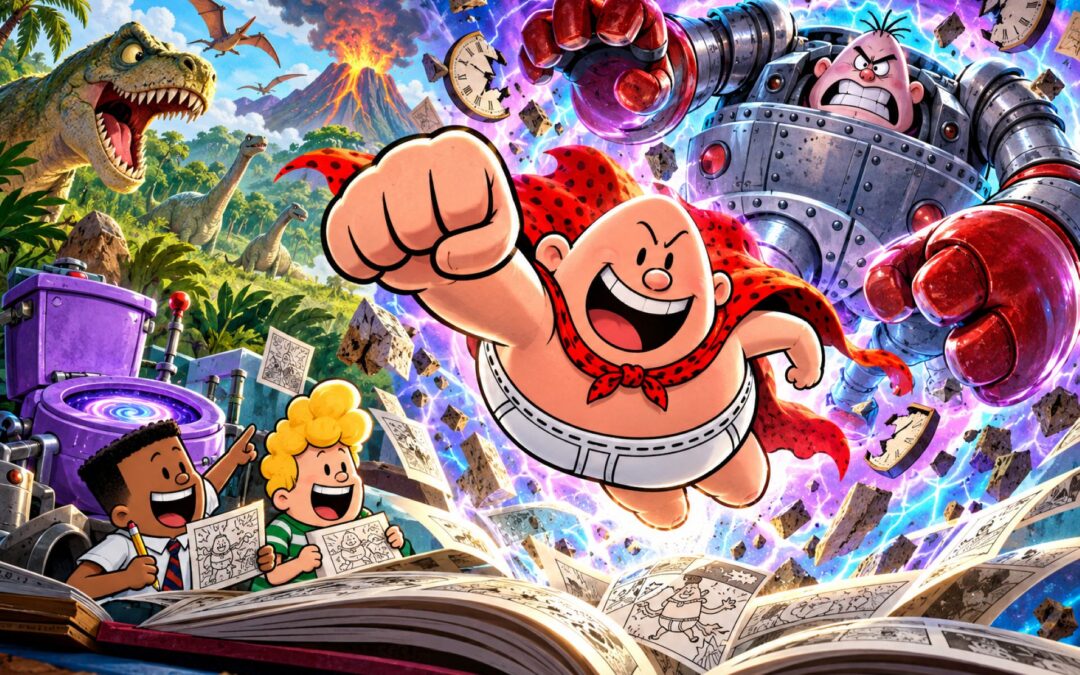
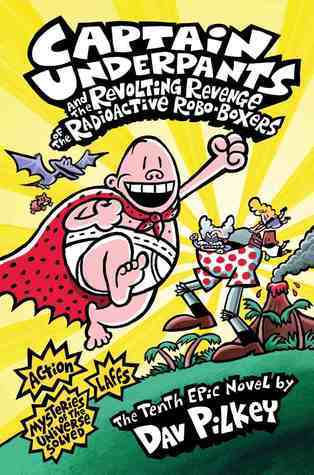
Captain Underpants and the Revolting Revenge of the Radioactive Robo-Boxers is the tenth novel in Dav Pilkey’s wildly popular children’s superhero series. Published by Scholastic in January 2013, the book takes George Beard, Harold Hutchins, and their underwear-clad superhero on an adventure involving time travel, prehistoric humans, robot-powered villains, alternative futures, and the accidental creation of the universe.
The story begins with a seemingly impossible problem. George and Harold have been transformed into giant zombie nerds, their world has been devastated, and Captain Underpants no longer exists because a time-travelling villain has changed the past. Restoring history proves to be only the beginning of their troubles. As Tippy Tinkletrousers pursues the boys through different periods, his inventions threaten to destroy entire eras, while George and Harold discover something frightening about the adults they might become.
As the tenth Captain Underpants novel, this installment builds heavily on earlier adventures, particularly the preceding book’s complicated time-travel plot. Its appeal lies not only in outrageous humour and chaotic action but also in its inventive combination of prose, comics, interactive illustrations, and an unexpectedly emotional ending.
Spoiler warning: This article covers the complete story, including its major revelations, the fate of important characters, and the final cliffhanger.
The Broken Timeline and Tippy’s Return
The novel opens by explaining a disaster that began in the previous installment, Captain Underpants and the Terrifying Return of Tippy Tinkletrousers. George and Harold are ordinarily two fourth-grade friends whose imagination and practical jokes repeatedly disrupt Jerome Horwitz Elementary School. Their greatest creation is Captain Underpants, a ridiculous comic-book superhero who becomes real whenever their unpleasant principal, Mr. Benjamin Krupp, hears someone snap their fingers.
Unfortunately, this familiar arrangement has been destroyed by time travel. Tippy Tinkletrousers, the former Professor Poopypants, interfered with events from George and Harold’s childhood, preventing them from following the path that originally led to Captain Underpants’ creation. Without the superhero, earlier threats were never defeated, history developed differently, and Earth was devastated. George and Harold themselves became enormous, monstrous zombie nerds.
A comic-strip foreword explains this extraordinary situation before the main story resumes. Pilkey uses the opening to remind returning readers of the series’ central characters and rules while immediately establishing that the present adventure depends on events which have already happened, been reversed, or ceased to exist.
At the beginning of the new story, the giant zombie nerds have apparently crushed Tippy beneath their feet. However, the villain survives through an absurd deception involving a large ketchup packet. What appeared to be his gruesome destruction was merely a trick that allowed him to avoid being killed.
Tippy’s survival is important because he possesses the technology needed to repair the history he previously damaged. His robotic trousers contain a time-travel mechanism, allowing him to revisit earlier events and change their outcome. Although he is interested primarily in protecting himself and pursuing revenge, his actions can restore the world that his previous interference destroyed.
Before the adventure continues, the narrator interrupts the story with a chapter about adults who dislike children laughing and having fun. Readers are invited to imagine what happens when grown-ups become so serious that they lose their ability to enjoy themselves. The narrator’s exaggerated warnings establish one of the novel’s important concerns: the possibility that adulthood can become an excuse for suppressing imagination.
Tippy then travels backward to a decisive moment in George and Harold’s childhood. Their earlier encounters with school bullies had changed because another version of Tippy intervened, producing the chain of events that eventually erased Captain Underpants.
Arriving at the school, Tippy freezes the bullies and confronts his younger self. He removes that earlier version from the situation, preventing the disruption that had altered the boys’ lives. With the original sequence of events restored, the timeline returns to the version in which George and Harold create Captain Underpants and repeatedly save the world.
The repair is successful, but Tippy has not become a better person. He still wants revenge against George, Harold, and their superhero. His decision to pursue them again transforms what might have been the conclusion of the previous adventure into a new and increasingly dangerous chase.
The Chase into the Age of Dinosaurs
Once the timeline has been repaired, Tippy travels forward to find George and Harold. The boys are already involved in another complicated situation arising from their earlier adventures, and they are accompanied by two unusual animals: Sulu, their genetically enhanced hamster, and Crackers, a pterodactyl they rescued from prehistoric times.
Tippy interrupts a confrontation involving the police and resumes his pursuit. His giant robotic trousers give him enormous physical power, while the machinery built into them allows him to move through time and employ a variety of destructive weapons.
George and Harold initially have little hope of defeating him directly. They escape through the town, hide from his attacks, and repeatedly rely on quick thinking to avoid being captured. Tippy uses his Freezy-Beam 4000 to immobilise opponents, turning his technological superiority into a constant threat.
The boys eventually become concerned about Crackers and Sulu. Their pets have been carried into a dangerous situation through no choice of their own, and George and Harold decide that protecting them must take priority over continuing to run.
They plan to return Crackers to the prehistoric world using the Purple Potty, a time machine disguised as an ordinary portable toilet. Sulu will accompany her so that she will not be abandoned without a friend.
George and Harold return to Jerome Horwitz Elementary School and locate the Purple Potty in the library. However, Mr. Krupp discovers their presence and rushes after them. The principal is furious that the children are at school when they should not be there, and his attempts to stop them lead him directly into their escape.
As the boys activate the time machine, Krupp accidentally becomes part of the journey. The device transports all five travellers into the distant past, approximately sixty-five million years before the present.
Meanwhile, Tippy has discovered that the children have disappeared through time. Because he does not initially know their destination, he sends a miniature younger version of himself backward to investigate.
This creates a particularly confusing situation. Several versions of Tippy now exist simultaneously, each possessing his intelligence, vanity, and appetite for revenge. Although they sometimes cooperate, their personalities make stable cooperation almost impossible.
The miniature Tippy investigates the school, observes the disappearance of the Purple Potty, and obtains the information needed to follow the boys. The time-travelling versions then pursue them into the dinosaur era.
George, Harold, and their companions arrive in a world populated by enormous prehistoric animals. Almost immediately, the adventure becomes dangerous. A confrontation involving Tippy and the surrounding dinosaurs results in the destruction of the Purple Potty, apparently removing the children’s most straightforward means of returning home.
Mr. Krupp is initially as frightened and confused as the others. However, George and Harold remember that their principal can become Captain Underpants through a simple finger snap.
With the transformation completed, Captain Underpants returns to action. The absurd superhero confronts Tippy’s enormous mechanical trousers, producing a battle between two physically powerful but very different figures.
Captain Underpants is impulsive, enthusiastic, and largely unconcerned with the consequences of his actions. Tippy, by contrast, possesses sophisticated technology and considerable scientific knowledge, but he is obsessed with establishing his superiority. Their confrontation repeatedly demonstrates that intelligence and sound judgment are not the same thing.
The younger versions of Tippy introduce another complication by plotting to obtain the Goosy-Grow 4000, a machine capable of enlarging objects or beings. While the larger Tippy remains occupied with the heroes, the smaller versions attempt to exploit the confusion for their own advantage.
Their plan involves travelling to an earlier moment, locating the powerful device, and using it to alter the balance of power. They briefly find themselves in an ordinary domestic setting rather than a prehistoric battlefield, creating a contrast between their ridiculous criminal ambition and the everyday world.
When they eventually obtain the enlargement technology, they create a much larger and more dangerous version of Tippy. The enormous figure becomes known as Supa Mega Tippy, adding another formidable opponent to an already complicated conflict.
At the same time, Captain Underpants continues fighting the original larger version. The battle takes place around prehistoric animals, bodies of water, and dangerous terrain. Water proves especially troublesome because it causes Captain Underpants to transform back into Mr. Krupp, leaving the boys temporarily without their superhero protector.
Tippy takes advantage of these transformations, but the conflict among his different selves prevents him from maintaining control. One version wants revenge against the children, another wants to demonstrate his superiority, and the others are willing to betray one another when the opportunity arises.
Eventually, the fighting escalates to the point where an enormous bomb enters the struggle. Its countdown threatens not merely the characters involved but the prehistoric environment surrounding them.
In a desperate attempt to escape the explosion, the giant Tippy figures attack one another. Supa Mega Tippy is violently kicked away along with the bomb, sending the explosive device flying across the prehistoric landscape.
The bomb finally explodes near the Gulf of Mexico.
Pilkey represents the resulting catastrophe through enormous illustrated explosions and dramatic descriptions of environmental destruction. The blast devastates the surrounding world, produces earthquakes and other disasters, and becomes the novel’s explanation for the extinction of the dinosaurs.
This account is deliberately absurd. The book is not claiming that prehistoric extinction was caused by time-travelling villains in mechanical trousers. Instead, it turns one of Earth’s most consequential natural events into the punchline of a superhero battle.
With the dinosaur era collapsing around them, the surviving characters must escape yet again. They use Tippy’s time-travel machinery to move forward to another prehistoric period, only to discover that they have entered a new conflict.
Cavepeople, Comics, and the Ice Age
George, Harold, Mr. Krupp, Crackers, and Sulu arrive approximately 206,784 years before the present. Their new surroundings contain forests, rocky landscapes, waterfalls, and communities of prehistoric humans.
The danger from Tippy has not disappeared. Supa Mega Tippy survives the earlier catastrophe and continues his pursuit, using his enormous robotic trousers and advanced weapons to terrorise the much smaller people around him.
The villain quickly captures the heroes. Although George and Harold have escaped several extraordinary situations, they remain vulnerable when confronted by a machine that can overwhelm them physically.
Sulu helps the group escape, but Mr. Krupp is left behind. Tippy positions the principal near a waterfall, making it especially difficult for Captain Underpants to remain in his superhero form. Any contact with water threatens to restore Krupp to his ordinary identity.
George and Harold now face two immediate problems. They must rescue their principal, and they must avoid a villain whose technological power appears overwhelming. With their usual resources unavailable, they search for assistance among the prehistoric inhabitants.
The boys discover a village of cavepeople and attempt to communicate. Unfortunately, the inhabitants cannot understand their language, and the children cannot explain the threat through ordinary conversation.
This difficulty becomes more urgent when Tippy attacks the settlement. The cavepeople witness his enormous mechanical trousers, destructive weapons, and ability to cause chaos. Although they understand that he is dangerous, they have no obvious way to defeat him.
George and Harold eventually realise that pictures might succeed where words have failed.
The boys begin drawing a comic on a large wall, using simple illustrations to communicate with the prehistoric audience. The drawings attract attention, and the cavepeople gather to watch the unfolding story.
What follows is one of the novel’s most unusual sequences: an extended wordless comic starring Ook and Gluk.
Instead of explaining the situation through conventional prose, Pilkey presents page after page of sequential pictures. The images depict prehistoric characters, exaggerated dangers, and increasingly ridiculous attempts to overcome an oversized enemy.
The story begins with relatively simple situations involving prehistoric creatures before developing into a chaotic series of confrontations with a figure resembling Tippy and his mechanical trousers. The characters improvise ways of surviving attacks and turning an apparently invincible opponent’s size against him.
Much of the comedy comes from the visual relationship between expectation and consequence. A threatening situation is established in one panel, followed by an unexpected reversal or physical joke in another. Actions such as falling, being struck, becoming trapped, or accidentally creating a worse problem are communicated without requiring spoken language.
Pilkey repeatedly includes the reactions of the watching cavepeople. They laugh, shout, become alarmed, and celebrate as the drawings unfold. Their responses demonstrate that they understand what is happening even though they cannot understand George and Harold’s speech.
This is more than a decorative interruption. The boys are using storytelling as a practical tool, showing the prehistoric community that a powerful enemy can be defeated through cooperation and imagination.
Once the comic ends, the cavepeople are ready to act.
George and Harold organise the villagers into groups and explain a plan using drawings and gestures. The prehistoric community gathers materials from its surroundings and prepares a series of traps for Tippy.
The next confrontation begins when the villain notices the heroes and charges toward them. George and Harold deliberately draw his attention while the cavepeople wait in prepared positions.
Tippy’s enormous size initially seems advantageous, but the defenders exploit it. Obstacles involving trees, ropes, slippery surfaces, and the surrounding landscape interrupt his movements.
At one point, he crashes into a tree trunk and encounters a carefully positioned series of banana peels, causing his mechanical trousers to lose their footing. His efforts to regain control send him into further hazards rather than allowing him to escape.
Another trap involves sticky material, while subsequent attacks use fire and heavy objects to damage the robotic equipment. Tippy becomes increasingly furious because every attempt to escape produces another humiliating defeat.
The prehistoric villagers have no advanced machinery, but their coordinated use of ordinary objects proves surprisingly effective. Their victory depends on understanding their environment and working together rather than possessing a superior weapon.
The confrontation develops into the first major Flip-E-Rama sequence of the novel. Readers are instructed to flip between adjoining pages to create the illusion of animated movement.
The repeated images show Tippy suffering a series of exaggerated physical attacks. His mechanical body is battered, struck, and damaged in ways that would be gruesome in a realistic story but become deliberately ridiculous through Pilkey’s cartoon style.
Although Tippy is badly injured and humiliated, he still possesses an extraordinarily dangerous weapon: the Freezy-Beam 4000.
He attempts to use the freezing device against the children and cavepeople. Unfortunately, the weapon’s emergency shutdown mechanism fails, leaving it firing uncontrollably.
The beam freezes the surrounding environment and creates a spreading mass of ice. Tippy initially treats this as another inconvenience, but the consequences rapidly expand beyond his control.
A younger version of Tippy becomes involved and uses the Goosy-Grow technology to enlarge the freezing effect. What began as a relatively local hazard grows into an immense environmental catastrophe.
The expanding ice destroys vegetation, freezes rivers, overwhelms landscapes, and threatens every living creature nearby. Pilkey presents this chain reaction as the cause of the Ice Age.
Again, the explanation is intentionally false and comical. The story treats a major period of prehistoric climate change as the result of a malfunctioning supervillain weapon made even more dangerous by another supervillain’s foolish intervention.
George and Harold realise that they must escape before the advancing ice reaches them. They gather Crackers and Sulu and attempt to reach Mr. Krupp, who remains trapped near the waterfall.
Their situation becomes desperate when the ice approaches from several directions. The children refuse to abandon their principal, even though he spends most of his ordinary life making their school experience miserable.
Crackers also appears increasingly unwell. George and Harold fear that the cold is affecting her, but they cannot stop to investigate while everyone remains in danger.
The characters are eventually rescued through another intervention by Tippy’s time-travelling counterparts. Their survival does not immediately end the danger, however, because the ice continues advancing and the group must still find a way to leave.
Captain Underpants finally regains the initiative. He uses the villain’s enormous robotic trousers to transport the cavepeople away from the threatened region.
The prehistoric humans are carried to a safer location in what will eventually become southern France. There, they can escape the most immediate effects of the freezing disaster.
The rescue temporarily resolves the conflict involving the cavepeople, but it leaves George and Harold with a larger problem. They have caused or witnessed a series of catastrophic events, and their attempts to save themselves have repeatedly changed history.
They must also find a way home. Because the Purple Potty has been destroyed, they remain dependent on Tippy’s time-travel equipment, even though the villain cannot be trusted.
George and Harold’s Terrifying Future
After surviving the prehistoric disasters, George and Harold begin thinking about the consequences of their behaviour. Their adventures have involved danger, destruction, frightened people, and repeated threats to their friends.
For the first time in this story, the boys begin to question whether their usual approach to life has become irresponsible.
George and Harold decide that they must change. They promise to stop making comic books, abandon childish pranks, take school more seriously, and become mature, respectable people.
The decision seems reasonable at first. They are not deliberately trying to become unpleasant adults; they are responding to their guilt and fear after witnessing the consequences of their adventures.
Unfortunately, their promise has a profound effect on their future.
When the group travels forward, it arrives thirty years ahead of the present rather than returning to the boys’ childhood. George and Harold find themselves in a familiar world that has changed in unsettling ways.
Jerome Horwitz Elementary School still exists, but the passage of time has transformed its surroundings. The children discover that an older version of Mr. Krupp is still associated with the school.
More disturbing is the revelation that George and Harold themselves have become teachers.
Their adult counterparts are not the imaginative, sympathetic grown-ups the boys might have hoped to become. They are bitter, authoritarian men who dislike laughter, punish childish behaviour, and treat their students with the same contempt that Mr. Krupp once directed toward them.
The future teachers enforce strict discipline and demand unquestioning obedience. They discourage fun, creativity, and harmless disorder, apparently convinced that their own seriousness represents maturity.
George and Harold are horrified when they recognise the men.
The adults have become precisely the kind of people the boys have spent their childhood resisting. Their vow to behave responsibly has not simply made them better students or more thoughtful people. It has developed into a complete rejection of the qualities that once defined their friendship.
The younger boys confront their future selves and begin questioning whether this outcome is inevitable.
They realise that becoming responsible does not require abandoning imagination. Their mistake was treating seriousness as the opposite of everything they enjoyed rather than recognising that a person can grow older without becoming cruel or joyless.
George and Harold therefore make a new promise: they will continue being themselves.
This decision changes the future. The unpleasant adult versions disappear because the children no longer intend to follow the path that created them.
The alteration also affects Mr. Krupp’s future. The boys encounter his older counterpart and discover that the familiar superhero transformation remains possible.
By snapping their fingers, they transform the older Krupp into another Captain Underpants.
The extraordinary result is that two versions of Captain Underpants can now exist together. The younger and older superheroes join forces against Tippy’s enormous robotic body.
The novel’s second Flip-E-Rama sequence presents their coordinated attack. The two heroes strike Tippy with a series of exaggerated blows, pulling at his nose hairs, attacking his face, and subjecting him to increasingly ridiculous punishment.
The enormous villain is badly defeated, but his technological equipment remains dangerous.
The fight leaves Tippy furious, humiliated, and determined to retaliate. His final attempt at revenge creates a threat greater than any of the disasters that have already occurred.
The Big Ka-Bloosh and the Final Cliffhanger
The last major confrontation begins when a younger version of Tippy finds himself unable to overcome the two Captain Underpants superheroes. His enormous body and advanced weapons have failed to secure the victory he wants.
Rather than accept defeat, he turns to an explosive device capable of destroying everything around him.
The bomb is far more dangerous than the weapon that previously devastated the dinosaur era. Its destructive power threatens the planet and extends to the surrounding galaxy.
George and Harold realise that their usual methods will not be enough. Neither a clever prank nor the physical strength of Captain Underpants can safely neutralise the device before its countdown reaches zero.
The situation leaves the heroes facing an apparently unavoidable catastrophe.
Crackers and Sulu, however, notice the danger and act independently.
The two animals reach the controls of Tippy’s time-travel machinery and begin operating the device. They move the bomb, its carrier, and themselves backward through time, removing the immediate threat from George, Harold, and the rest of the present world.
Their destination is approximately 13.7 billion years in the past, a point before the universe exists.
Pilkey describes an empty environment without Earth, the Sun, planets, or any familiar cosmic structures. The bomb continues counting down despite the absence of the world it was originally intended to destroy.
When the countdown ends, the device explodes.
The explosion becomes the book’s version of the Big Bang, which the narrator calls the Big Ka-Bloosh. Matter spreads outward, the universe begins expanding, and the process eventually produces galaxies, stars, planets, and life.
The absurdity is unmistakable. A weapon designed by a vindictive inventor accidentally becomes responsible for the existence of the universe, while two heroic animals are apparently sacrificed in the process.
The narrator follows the event with a deliberately misleading science lesson. Readers are reminded of the extraordinary explanations they have encountered for the extinction of the dinosaurs, the beginning of the Ice Age, and the origin of everything.
The book then makes it clear that these explanations should not be repeated as scientific facts. A joke involving a failed school science assignment reinforces the difference between Pilkey’s invented history and actual education.
The narrative returns to George and Harold thirty years in the future.
The boys have survived, but their victory feels incomplete. Crackers and Sulu have disappeared into a time before the universe existed, and the children believe they will never see their pets again.
Their grief introduces an unusually quiet emotional moment into a story otherwise dominated by physical comedy and spectacular destruction.
The situation changes when the boys discover three speckled eggs.
George and Harold realise that Crackers had laid them before the final catastrophe. Her strange behaviour and apparent illness had been connected to her impending motherhood rather than simply to the cold or the strain of their adventures.
The eggs reveal that Crackers was female and that part of her life continues through her offspring.
This discovery does not bring Crackers or Sulu back. Instead, it gives George and Harold something to protect and a reason to look toward the future.
They carefully collect the eggs and prepare to return to their own time, hoping to raise the young creatures themselves.
The adventure seems to have reached a conclusion. The villains have apparently been defeated, history has been changed repeatedly, and the surviving heroes have endured an experience that altered their understanding of responsibility.
However, the final chapter refuses to provide a peaceful ending.
Melvin Sneedly, another familiar figure from George and Harold’s school life, suddenly appears. He arrives in an enormous robotic squid equipped with mechanical tentacles and sophisticated technology.
Melvin captures George, Harold, Captain Underpants, and the eggs, revealing that he has plans of his own.
The book ends with the characters facing a new danger and the promise of another installment, Captain Underpants and the Tyrannical Retaliation of the Turbo Toilet 2000.
The supposedly final chapter is therefore another joke. Even after surviving prehistoric catastrophes and the creation of the universe, George and Harold cannot escape the endless consequences of their extraordinary lives.
How Time Travel and the World Work
The world of Captain Underpants and the Revolting Revenge of the Radioactive Robo-Boxers combines an ordinary elementary-school environment with superhero fantasy, impossible inventions, and a deliberately inconsistent version of history.
Jerome Horwitz Elementary School provides the story’s familiar foundation. Its classrooms, principal’s office, library, and strict rules represent the world of adult authority against which George and Harold regularly rebel.
The school is not merely a starting location. Its characters and conflicts remain important even when the adventure travels millions of years into the past. Mr. Krupp’s presence brings the school hierarchy into prehistoric settings, while the future version of the building shows what George and Harold might become if they surrender their individuality.
The prehistoric environments operate differently. The dinosaur era is a dangerous landscape populated by enormous creatures, while the later prehistoric settlement introduces humans who must survive through collective knowledge and practical cooperation.
These settings allow Pilkey to place modern technology into situations where it appears both astonishing and absurd. Tippy’s Robo-Pants can overwhelm prehistoric animals, yet their wearer remains vulnerable to everyday objects and simple physical traps.
The adult future serves another purpose. Instead of introducing a completely unfamiliar civilisation, it exaggerates the boys’ ordinary school environment. The familiar institution becomes frightening because George and Harold discover themselves occupying the positions of the adults they once disliked.
Time travel makes these contrasting environments part of the same narrative.
The Purple Potty initially provides a means of travelling between periods, but its destruction forces the heroes to depend on Tippy’s more sophisticated machinery. His time-travelling trousers allow different versions of himself to coexist, creating situations in which one Tippy can assist, betray, or physically attack another.
The story establishes a flexible principle that changing earlier events can change the future. Tippy’s interference erases Captain Underpants, while repairing that interference restores him. George and Harold’s decision about their future personalities similarly causes their unpleasant adult selves to disappear.
However, the novel does not apply its temporal rules with strict consistency. Characters remember events from erased histories, duplicate selves interact freely, and historical catastrophes arise through chains of events that exist primarily to produce jokes.
The extinction of dinosaurs, the Ice Age, and the creation of the universe are especially obvious examples. Their explanations are not attempts at plausible alternative science but comic reversals in which inventions associated with childish villainy somehow cause enormous natural phenomena.
This loose approach to causality allows Pilkey to move quickly between danger, surprise, and comedy. It also demands that readers accept the narrative on its own terms. The world is internally recognisable through its recurring characters and storytelling rules, but it is not designed to withstand close scientific scrutiny.
George, Harold, Captain Underpants, and Their Allies
Although the title focuses on Captain Underpants and his robotic enemies, the story is fundamentally driven by a small group whose members contribute different forms of intelligence, courage, and loyalty. George and Harold provide imagination, Captain Underpants supplies extraordinary physical power, and their animal companions repeatedly accomplish things the human characters cannot.
Their relationships create continuity amid the confusing movement between historical periods. Even when the environment changes completely, the characters’ established loyalties give readers a reason to care about the outcome.
George and Harold
George Beard and Harold Hutchins are the creative centre of the series. George is frequently the more verbally confident and energetic member of the partnership, while Harold’s drawing abilities help transform their ideas into comic-book adventures.
Their friendship depends on shared imagination. They collaborate in making comics, playing pranks, inventing stories, and confronting situations that ordinary adults cannot understand. Their creativity is occasionally irresponsible, but it is also their principal means of solving problems.
The prehistoric sequence demonstrates this particularly clearly. George and Harold cannot defeat Tippy through strength or advanced machinery, so they turn to an ability they already possess: making comics.
Their drawings allow them to communicate with people who do not speak their language. The resulting alliance demonstrates that the boys’ imagination is not simply a means of escaping responsibility. Under the right circumstances, it becomes a way of helping others.
Their most significant development occurs when they confront their adult counterparts.
George and Harold’s original vow to become serious is motivated by genuine guilt. They recognise that their adventures can produce consequences beyond their control and briefly conclude that abandoning childish behaviour is the only responsible response.
The future teachers reveal the danger of carrying that idea too far. Their older selves have become unimaginative authority figures who treat childhood enthusiasm as something that must be eliminated.
The boys’ rejection of this future marks an important adjustment in their understanding of maturity. They do not learn that consequences are irrelevant; they learn that responsibility should not require losing their identities.
Their treatment of Crackers’ eggs reinforces this distinction. At the end, they accept the responsibility of protecting vulnerable young creatures while retaining the friendship and imagination that define them.
Mr. Krupp and Captain Underpants
Mr. Benjamin Krupp is one of the series’ most important comic contradictions. In his ordinary identity, he is an authoritarian principal who dislikes George and Harold’s mischief and frequently attempts to punish them.
His transformation into Captain Underpants produces the opposite personality. The superhero is cheerful, fearless, enthusiastic, and almost completely indifferent to embarrassment.
The transformation also provides a reliable source of comedy. Captain Underpants possesses extraordinary strength and the ability to fly, but he behaves with the confidence of a conventional superhero while wearing only his underwear and cape.
His physical powers are useful against Tippy’s robotic machinery, yet they are not sufficient to resolve every problem. Water can transform him back into Krupp, and his eagerness to fight sometimes creates additional complications.
The prehistoric waterfall makes this weakness especially important. Tippy understands that Krupp’s superhero identity cannot be maintained under every condition, so he uses the environment to neutralise the defenders’ most powerful ally.
Despite the antagonism between Krupp and the children, George and Harold repeatedly attempt to save him. Their loyalty suggests that their rejection of his authority is not equivalent to indifference toward his life.
The arrival of an older Captain Underpants also demonstrates the comic possibilities of time travel. The two versions cooperate without becoming rivals, contrasting sharply with the competing Tippys.
Where Tippy’s different selves struggle for dominance, the Captain Underpants figures act together against a common enemy. The distinction is straightforward but effective: extraordinary power becomes more useful when its possessors are capable of cooperation.
Crackers, Sulu, and the Cavepeople
Crackers and Sulu initially appear to serve familiar roles as unusual animal companions. Crackers is a prehistoric pterodactyl, while Sulu is an enhanced hamster capable of extraordinary physical feats.
Their abilities repeatedly help the human characters escape danger. Sulu participates in rescues, and Crackers’ capacity for flight allows the group to move through environments that would otherwise be inaccessible.
Their importance grows as the story continues. George and Harold attempt to return Crackers to her original era because they recognise that their adventures have placed her in an unfair and dangerous situation.
The animals eventually reverse this relationship by protecting the children themselves. During the final confrontation, Crackers and Sulu act independently to remove the bomb from the present world.
Their sacrifice gives them genuine agency. They are not merely creatures the heroes must rescue; they become the characters whose decisions save everyone else.
Crackers’ eggs deepen this role by introducing the possibility of continuity after loss. Their discovery means the boys’ relationship with the pterodactyl has consequences extending beyond her apparent death.
The prehistoric humans provide a different example of collective action. Initially frightened and unable to understand George and Harold’s speech, they become effective allies after encountering the boys’ drawings.
Their response demonstrates the possibility of cooperation without shared language or advanced technology. Instead of remaining helpless victims of Tippy’s inventions, they participate directly in defeating him.
Together, these secondary characters broaden the story’s concept of heroism. The decisive achievements do not belong exclusively to Captain Underpants or to the technologically powerful figures.
Tippy Tinkletrousers and His Many Versions
Tippy Tinkletrousers is both the novel’s principal antagonist and the source of its most elaborate narrative complications. A brilliant but deeply vindictive inventor, he possesses technology capable of manipulating time, freezing opponents, enlarging objects, and producing destructive explosions.
His scientific intelligence is undeniable within the story’s fictional world. The machinery he creates enables actions that ordinary people cannot comprehend, and his time-travel equipment makes him capable of changing the conditions under which the other characters exist.
Nevertheless, Tippy is remarkably poor at handling frustration.
He repeatedly treats humiliation as a justification for extreme revenge. An insult or defeat does not encourage him to reconsider his behaviour; it makes him more determined to demonstrate his superiority.
The coexistence of multiple versions of Tippy turns this character flaw into a recurring structural device. The original larger Tippy, miniature younger versions, and the enlarged Supa Mega Tippy possess variations of the same personality.
They cooperate when doing so advances their immediate interests, but they also betray and compete with one another. Their shared identity does not generate solidarity because each version wants to dominate the others.
The Goosy-Grow 4000 makes this conflict especially ridiculous. Enlarging one version of Tippy does not make him wiser or more capable of solving problems. It simply increases the scale of the danger he creates.
The robotic trousers reinforce the same idea. They are impressive machines, capable of extraordinary actions, but their design exaggerates the ordinary human body into an absurd monument to their inventor’s vanity.
This combination of sophisticated machinery and childish motivation is what makes Tippy an effective Captain Underpants villain. His inventions create genuine narrative danger, while his personality continually turns that danger into slapstick comedy.
His limitations also distinguish him from a psychologically complex antagonist. Pilkey does not seriously investigate the origins of his resentment or offer him a substantial moral transformation.
Tippy remains obsessed with revenge because the story needs an inventive villain whose escalating schemes can generate ever more outrageous situations. His shallow emotional development is therefore a limitation of his characterisation but also part of his comic function.
Creativity, Authority, Friendship, and Growing Up
One of the novel’s clearest themes is the value of creativity in a world that frequently treats imagination as a distraction. George and Harold’s comics, drawings, and pranks are associated with childhood disorder, while the adults around them often demand discipline and conformity.
Pilkey repeatedly challenges the assumption that imaginative behaviour is inherently irresponsible. The boys’ drawings become essential to communicating with the cavepeople, allowing an entire community to organise against a technologically superior enemy.
This is an important distinction because the novel does not simply praise creativity in abstract terms. It shows creativity producing a practical result.
The cavepeople do not need to understand George and Harold’s language or possess sophisticated equipment. They need a way to recognise a shared problem and imagine a possible response.
The comic gives them that opportunity.
The future-school sequence develops the theme from another direction. When George and Harold decide to abandon their playful identities, they eventually become teachers who suppress the same qualities in their students.
Their transformation suggests that the danger is not adulthood itself but the belief that growing older requires rejecting curiosity, humour, and personal individuality.
At the same time, the book does not completely dismiss responsibility. George and Harold’s initial concern about the consequences of their adventures is legitimate, and their treatment of Crackers and Sulu shows that they are capable of considering others’ welfare.
The resolution therefore supports a more balanced interpretation than a simple claim that rules and maturity are bad. George and Harold need to preserve their creativity while developing an awareness of the consequences of their decisions.
Authority is another recurring concern. Mr. Krupp’s school represents a system in which adults frequently exercise power without earning affection or respect.
His superhero identity reverses this relationship. As Captain Underpants, he becomes helpful and courageous precisely because he no longer behaves like the rigid principal who attempts to control every aspect of the children’s lives.
The contrast is comic rather than a complete educational philosophy. Not every teacher is presented as cruel, and the story’s criticism is directed primarily at authority figures who confuse obedience with learning.
The book’s jokes about science reinforce this distinction. Pilkey offers deliberately ridiculous explanations of dinosaur extinction, climate change, and the universe’s origin, then explicitly reminds readers that such explanations should not be mistaken for scientific knowledge.
Humour and education are therefore not necessarily enemies. The novel’s own form suggests that playful storytelling can create curiosity even when its immediate purpose is entertainment.
Friendship provides the emotional foundation connecting these ideas. George and Harold survive through cooperation, while the different Tippys repeatedly sabotage one another because they cannot resist competing for dominance.
The contrast between the friends and the villain shows that shared intelligence becomes more effective when combined with trust. Tippy’s machines are powerful, but his refusal to cooperate prevents him from using them wisely.
Crackers and Sulu extend the theme beyond human friendship. Their decision to save the heroes demonstrates loyalty through action rather than speech or elaborate reasoning.
The ending also introduces sacrifice, which carries a more serious emotional implication than most of the book’s earlier comedy. The animals’ apparent deaths suggest that protecting others may require accepting consequences that cannot simply be undone.
Several recurring objects reinforce these themes.
Captain Underpants’ costume turns something embarrassing into a symbol of courage. Tippy’s mechanical trousers transform a similar article of clothing into an instrument of domination, suggesting that extraordinary power can serve radically different purposes depending on its possessor.
The Purple Potty represents the series’ ability to turn the most ordinary and ridiculous objects into sources of adventure. Its destruction removes the boys’ control over their journey, forcing them to rely on ingenuity and uncertain alliances.
The freezing weapon repeatedly threatens to immobilise individuals and environments. Although it is primarily a comic invention, its destructive consequences also reflect Tippy’s desire to control people rather than cooperate with them.
Crackers’ eggs provide the most emotionally meaningful symbol. Their discovery does not erase the animals’ sacrifice, but it offers continuity, responsibility, and hope after an apparently irreversible loss.
Together, these details create a thematic structure beneath the book’s deliberate absurdity. The story celebrates imagination without pretending that actions have no consequences, and it presents friendship as more valuable than power exercised for selfish reasons.
Humour, Comics, Flip-E-Rama, and Narrative Style
Dav Pilkey’s narrative style is central to the book’s appeal. The novel combines conventional prose with cartoons, exaggerated chapter titles, direct reader address, comic-strip sequences, and interactive illustrations.
The narrator frequently interrupts the action to explain something ridiculous, challenge the reader’s expectations, or mock the seriousness associated with conventional storytelling.
These interruptions establish a playful relationship between the book and its audience. Rather than pretending that the events are realistic, Pilkey openly invites readers to enjoy their impossibility.
The chapter about adults who dislike laughter is an early example. It temporarily pauses the plot to deliver a comic warning about excessive seriousness, establishing an attitude that later returns through George and Harold’s unpleasant future selves.
The narrative also plays with chronology. A chapter may revisit events that occurred several pages earlier, showing what another group of characters was doing during the same period.
This approach becomes particularly important when different versions of Tippy are operating independently. Readers must follow overlapping developments rather than a single uninterrupted sequence.
The technique can be confusing, but it also creates opportunities for surprise. An event that appears to be finished can acquire a new meaning when another timeline catches up with it.
The extensive prehistoric comic is the book’s most distinctive formal achievement.
For many pages, ordinary narration gives way to wordless sequential images. The comic’s characters experience exaggerated threats and devise increasingly ridiculous responses, while the prehistoric audience reacts visibly to each development.
Because the cavepeople do not understand English, this change in storytelling form has a clear narrative purpose. George and Harold cannot solve their problem through spoken explanation, so the novel demonstrates how pictures communicate actions, emotions, and possibilities.
The reader participates in the same process as the cavepeople, interpreting the story through visual information rather than dialogue.
The result is an unusually effective connection between form and meaning. The novel’s argument about the value of comics is demonstrated by a comic that succeeds where ordinary speech has failed.
Flip-E-Rama offers a different kind of participation.
The device asks readers to flip pages rapidly back and forth, producing the illusion that characters are moving. Its action sequences feature exaggerated blows, falls, and physical punishments.
The technique is deliberately simple, but its simplicity is part of its appeal. The reader physically controls the speed and repetition of the action, turning the reading experience into a small form of performance.
The two Flip-E-Rama battles also serve different purposes within the story. The first allows the cavepeople’s improvised traps to culminate in visual slapstick, while the second presents the combined assault of two Captain Underpants figures against Tippy.
Throughout the novel, Pilkey’s illustrations carry information that the prose does not always need to explain. Facial expressions, changes in scale, visual exaggerations, and the placement of characters make the increasingly chaotic events easier to follow.
The artwork is especially effective at conveying the absurd relationship between tiny humans and enormous robotic machinery. Tippy’s size makes him intimidating, but his exaggerated expressions and ridiculous costume prevent him from becoming genuinely terrifying.
The humour relies heavily on repetition, bathroom jokes, physical violence without lasting realistic consequences, and the constant escalation of impossible situations.
These techniques are unlikely to appeal equally to every reader. However, their persistence creates a recognisable comic world in which even catastrophic events can become occasions for laughter.
The novel’s most difficult tonal transition occurs near the ending. After hundreds of ridiculous reversals and exaggerated battles, the disappearance of Crackers and Sulu introduces genuine sadness.
Pilkey quickly returns to comedy through the cosmic explosion, the false science lesson, and Melvin’s sudden arrival. Yet the emotional moment is not entirely erased, because the discovery of the eggs acknowledges the boys’ grief while giving them something new to protect.
This combination of absurdity and sincerity is an important part of the series’ distinctive character.
The Ending Explained: Sacrifice, Hope, and Continuity
The ending resolves the novel’s central conflict through an action that the human heroes cannot accomplish themselves. Captain Underpants possesses extraordinary strength, and George and Harold have repeatedly demonstrated their ingenuity, but neither can prevent the final bomb from exploding.
Crackers and Sulu save them by transporting the explosive device into the distant past. Their decision changes the scale of heroism in the story.
Throughout most of the novel, survival depends on tricking enemies, escaping traps, or using superior strength. The final solution instead requires characters to place others’ safety above their own survival.
The apparent deaths of Crackers and Sulu therefore provide an emotional culmination to the friendship and loyalty developed throughout the adventure.
The cosmic explosion introduces an extraordinary contrast. An act of destruction becomes the beginning of creation, transforming Tippy’s final attempt at revenge into the fictional origin of the universe.
This conclusion is obviously not a scientific explanation. Its significance lies in the comic reversal of Tippy’s intentions and the enormous consequences of the animals’ sacrifice.
The discovery of Crackers’ eggs adds a more intimate meaning.
George and Harold cannot recover their companions, but they discover that Crackers has left behind new life. The eggs give them a responsibility that continues beyond the immediate adventure.
Their grief is therefore accompanied by the possibility of continuity rather than a miraculous restoration of everything they have lost.
This matters because it supports the book’s larger distinction between responsibility and oppressive seriousness. George and Harold can care for the eggs without surrendering their imagination or becoming the unpleasant adults they briefly feared they would be.
Melvin’s arrival prevents the ending from becoming entirely peaceful. His robotic squid introduces another conflict, reminding readers that the series is built around adventures which continually generate new consequences.
The cliffhanger also makes the final chapter title an ironic joke. The story promises an ending while simultaneously demonstrating that George, Harold, and Captain Underpants are not finished.
Critical Review: Strengths, Limitations, and Lasting Appeal
Captain Underpants and the Revolting Revenge of the Radioactive Robo-Boxers succeeds most clearly as a children’s comic adventure that refuses to separate reading from play. Its humour, illustrations, and changing narrative forms create an experience that is lively, unpredictable, and consistently aware of its young audience.
The book’s greatest strength is its willingness to use the physical possibilities of illustrated fiction rather than relying exclusively on conventional narration.
The prehistoric comic is particularly inventive because it performs a genuine narrative function. George and Harold need to communicate with people who cannot understand their language, and their solution depends on the same visual storytelling abilities that define their friendship.
Pilkey could have treated the comic as a brief illustration of this idea, but he gives it enough space to become a substantial event. Readers experience the communication process alongside the cavepeople, making the sequence more persuasive than a simple explanation would have been.
Flip-E-Rama offers a similarly memorable form of engagement. Although the technique is familiar within the series, its use during the major battles gives younger readers an opportunity to participate physically in the story’s action.
The illustrations also compensate for the increasingly complicated plot. Enormous robots, prehistoric animals, duplicate villains, and abrupt movements through time could become difficult to imagine through prose alone. Pilkey’s cartoon style makes these events visually immediate.
The novel is less successful when judged by the coherence of its time-travel plotting.
The different versions of Tippy create an elaborate sequence of cause and effect, but the distinctions among them are not always easy to follow. Younger readers may struggle to remember which version possesses which invention, which actions happened first, and how one character’s interference changes another’s situation.
The story sometimes seems more interested in inventing another spectacular reversal than in clarifying the consequences of the previous one.
This weakness is partly intentional. The novel belongs to a comic universe where strict logic is less important than surprise, speed, and absurdity. Nevertheless, the accumulation of competing Tippys and overlapping timelines occasionally makes the action feel more complicated than necessary.
The humour presents a similar mixture of strength and limitation.
Pilkey’s exaggerated names, ridiculous inventions, bodily comedy, and physical slapstick are well suited to readers who enjoy irreverent entertainment. The repeated jokes help establish a recognisable style in which the reader understands that almost nothing is too outrageous to happen.
However, the repetition can also become tiring. Tippy is humiliated, regains control, produces another invention, and suffers another spectacular defeat several times before the final confrontation.
For readers who have already encountered numerous Captain Underpants adventures, the pattern may feel familiar despite the novel’s inventive settings and visual techniques.
The book’s characterisation is deliberately simple. George and Harold remain recognisably good-hearted troublemakers, Mr. Krupp remains an unpleasant principal whose heroic alter ego is his opposite, and Tippy remains a vindictive inventor whose intelligence is undermined by immaturity.
These characters do not develop through subtle psychological conflicts. Their personalities are broad enough to support immediate comedy, and the plot generally relies on their established behaviour rather than surprising transformations.
Yet the adult-future sequence demonstrates that Pilkey can use these simple characters to produce a meaningful emotional reversal.
George and Harold’s discovery that they have become unpleasant teachers is effective because the result is both ridiculous and frightening from their perspective. Their future selves embody the exact values they have spent their childhood resisting.
The episode also gives the boys a genuine decision to make. Instead of merely escaping another villain, they must reconsider an apparently reasonable promise and recognise its unintended consequences.
This is one of the book’s strongest moments because it connects character development with the wider themes of childhood identity and imagination.
The ending is similarly effective, although its emotional treatment remains relatively brief.
Crackers and Sulu’s apparent sacrifice introduces stakes that cannot be resolved simply by another punch or technological trick. The animals demonstrate loyalty through an action whose consequences the human characters initially believe to be permanent.
The discovery of the eggs provides a satisfying continuation of that relationship without completely denying the loss. Although the book quickly returns to jokes and a new cliffhanger, the preceding sadness adds emotional variety to the adventure.
Its handling of authority is more limited. Mr. Krupp and the adult versions of George and Harold are exaggerated representatives of adults who discourage children’s creativity.
This makes the theme immediately accessible, but it also simplifies the relationship between discipline and education. The novel rarely explores situations in which adult rules might genuinely protect children or make learning easier.
Fortunately, its portrayal of George and Harold’s responsibility toward their pets prevents the message from becoming a complete rejection of maturity. The boys are encouraged to retain their individuality, not to ignore the consequences of everything they do.
The novel’s relationship to science also deserves a fair assessment.
Its explanations of the dinosaurs’ extinction, the Ice Age, and the Big Bang are intentionally ridiculous and should not be confused with scientific information. The closing joke about schoolwork makes this distinction explicit, suggesting that Pilkey understands the difference between imaginative speculation and factual education.
The book’s scientific references therefore function primarily as comic material. Their value lies in making enormous historical and cosmic events approachable through humour rather than teaching readers how those events actually occurred.
A more important limitation is the novel’s dependence on earlier installments.
The opening recap provides useful context, but readers unfamiliar with the series must still absorb an extraordinary amount of information. Captain Underpants’ origin, Mr. Krupp’s transformations, the Purple Potty, the earlier timeline changes, the zombie nerds, Crackers, Sulu, and Tippy’s history all influence the current story.
A newcomer can understand the immediate conflicts, but much of the humour and emotional significance depends on familiarity with the established characters.
The book is consequently more rewarding as the continuation of an ongoing series than as an independent entry point.
This was also apparent in its contemporary reception. Kirkus Reviews’ assessment acknowledged the book’s elaborate comic devices and relentless absurdity while suggesting that established series readers would be better equipped to appreciate its complicated continuation of the previous adventure.
That judgment captures an important tension. The novel’s unusual presentation and wild imagination make it accessible and entertaining, yet its increasingly elaborate continuity can make the story less welcoming to readers arriving without background knowledge.
For children who already enjoy Captain Underpants, these complications are unlikely to be decisive. The book provides familiar characters, enormous battles, ridiculous inventions, and several distinctive visual sequences.
It is especially suitable for readers who enjoy comics, action, interactive page features, and a fast-moving narrative with short chapters and frequent illustrations. Children who find uninterrupted prose intimidating may appreciate the way pictures continually support the storytelling.
Readers who prefer tightly constructed plots, realistic consequences, restrained humour, or detailed character psychology are less likely to find the same satisfaction.
The book’s lasting value lies in the confidence with which it treats imaginative play as a legitimate form of storytelling. Pilkey does not attempt to make his characters more respectable or his humour more sophisticated to justify the novel’s existence.
Instead, he uses the techniques of children’s comics to create an adventure that is funny, visually inventive, and occasionally more emotionally affecting than its title would suggest.
Its most significant weaknesses are the excessive complexity of the Tippy plot and the repetition of familiar comic patterns. These limitations sometimes interrupt the narrative’s momentum, but they do not undermine its central achievements.
Ultimately, Captain Underpants and the Revolting Revenge of the Radioactive Robo-Boxers is a successful installment that combines the series’ familiar outrageous humour with unusually ambitious visual storytelling and a memorable exploration of childhood identity.
The book is not a perfectly constructed adventure, nor does it need to be. Its most effective scenes demonstrate how imagination, friendship, and creative expression can overcome obstacles that physical strength and elaborate technology cannot solve. For established readers of the series, it remains an energetic, inventive, and surprisingly touching adventure that celebrates the possibility of growing up without surrendering the qualities that make childhood worth remembering.
Last Updated on October 15, 2026 by Aseem Gupta