
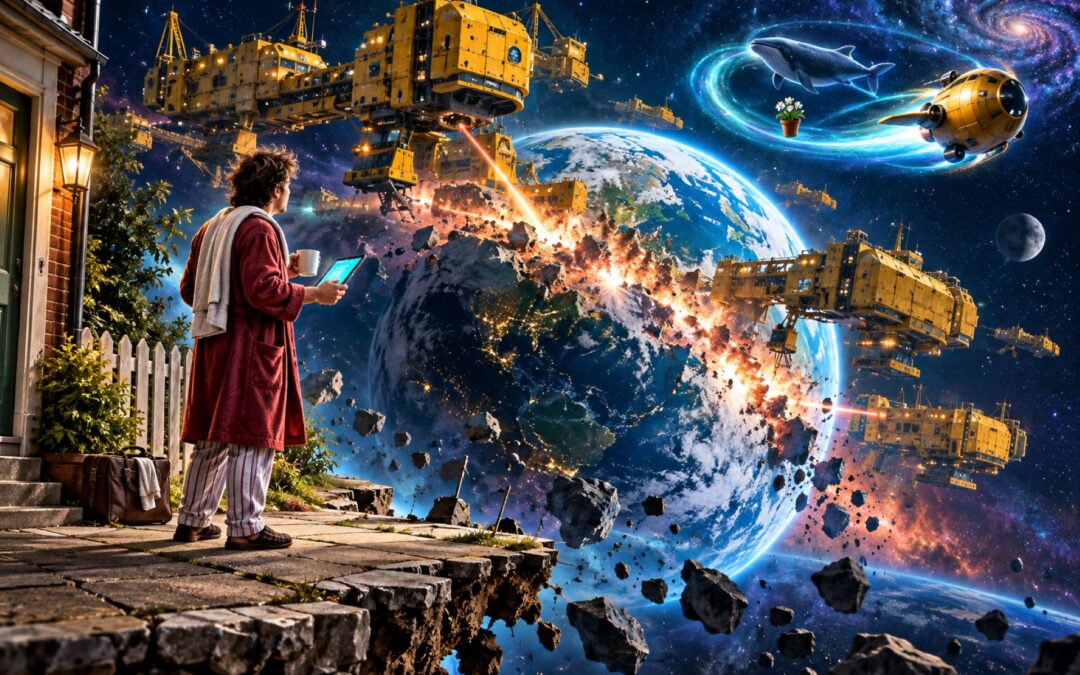
Douglas Adams begins The Hitchhiker’s Guide to the Galaxy with a remarkably ordinary problem: a man is about to lose his house because the local council wants to build a road. Within hours, the entire Earth is destroyed for essentially the same reason. What follows is a journey through a universe populated by bureaucratic aliens, eccentric politicians, depressed robots, improbably advanced spacecraft, and beings who have spent millions of years trying to determine the meaning of existence.
First published in 1979 by Pan Books, the novel grew out of Adams’s BBC radio comedy and became one of the most recognizable works of comic science fiction. Its distinctive achievement is that the jokes are not merely interruptions to the story. They are often the means through which Adams examines authority, intelligence, technological progress, human insignificance, and the difficulty of finding meaning in a universe that refuses to behave reasonably.
At the centre of this enormous fictional universe is Arthur Dent, an unremarkable Englishman who wants little more than a comfortable home, a decent cup of tea, and an explanation of what is happening to him. His bewilderment gives the novel a human perspective, even as its revelations repeatedly demonstrate how little human beings understand about their own existence.
Spoiler warning: This article covers the complete novel, including its major revelations, character developments, philosophical ideas, and ending.
A Thursday That Ends the World
Arthur Dent is approximately thirty years old and lives in an unremarkable house in the English countryside. He moved there from London in search of a quieter life, although he has not become notably happier or more confident. His circumstances change dramatically one Thursday morning when he discovers that a demolition crew has arrived to destroy his home and make way for a new bypass.
The local authorities insist that the project has followed the correct procedures. Plans were supposedly available for public inspection, and Arthur had ample opportunity to object. In reality, the notice was placed in an obscure location within the planning department, making its technical availability very different from any meaningful attempt to inform the people affected.
Arthur responds by lying in the mud in front of the bulldozers. His protest is neither especially sophisticated nor heroic, but he understands that his house will be destroyed if he moves. Mr Prosser, the council representative supervising the demolition, becomes increasingly frustrated by Arthur’s refusal to cooperate. Although Prosser presents himself as merely carrying out his duties, his inability to justify the practical fairness of the situation reveals the absurdity of the system he represents.
The confrontation is interrupted by Ford Prefect, Arthur’s friend of several years. Arthur believes Ford is an eccentric but otherwise ordinary man who has adopted an unusual name and displays a strange interest in everyday human behaviour. Unknown to him, Ford is actually an alien from a small planet near Betelgeuse. He works as a researcher for a bestselling electronic reference book called The Hitchhiker’s Guide to the Galaxy and has been stranded on Earth for approximately fifteen years.
Ford has just discovered something that makes Arthur’s impending eviction seem insignificant. A fleet of enormous alien spacecraft is approaching Earth, and the planet is about to be destroyed. Unfortunately, explaining this situation to Arthur is difficult because Arthur has no knowledge of interstellar civilization and is emotionally committed to saving his house.
Ford persuades Mr Prosser to take Arthur’s place in front of the bulldozers, allowing the two men to visit a nearby pub. There, Ford orders several beers and attempts to prepare Arthur for what is about to happen. Arthur interprets his friend’s strange behaviour as another example of Ford’s eccentricity, while Ford struggles to communicate the magnitude of the approaching disaster.
The ordinary atmosphere of the pub intensifies the comedy. Its patrons and staff remain absorbed in recognizable human concerns while events beyond their comprehension unfold overhead. Even when Ford tries to explain that the world is ending, the conversation repeatedly returns to practical misunderstandings.
The approaching spacecraft belong to the Vogon Constructor Fleet, commanded by Prostetnic Vogon Jeltz. The Vogons have been assigned to clear a route for a new hyperspace expressway, and Earth happens to occupy the necessary space. The fleet broadcasts an announcement informing humanity that the planet will shortly be demolished.
The announcement produces confusion and outrage, but the Vogons dismiss the objections. They explain that the plans have been available for consultation at a planning office on Alpha Centauri for decades. Humanity’s failure to examine those plans is therefore, from the Vogon perspective, entirely its own responsibility.
The parallel with Arthur’s situation is exact. Both the council and the Vogons consider proper paperwork sufficient justification for destroying someone’s home. Both treat the practical impossibility of consultation as irrelevant, and both assume that obedience to procedure eliminates any further moral obligation.
The joke becomes more devastating because the scale has changed without any improvement in the reasoning. What appeared ridiculous at the level of a country road is equally ridiculous at the level of planetary annihilation.
Ford has prepared for this emergency using equipment familiar to experienced galactic hitchhikers. He carries an electronic thumb capable of signalling passing spacecraft and a towel, which the Guide considers one of the most useful objects an interstellar traveller can possess. A towel’s practical applications are numerous, but its psychological value is equally important: a person who has managed to retain a towel appears to be unusually well prepared.
Ford uses his equipment and his knowledge of the fleet to arrange passage aboard one of the alien ships. He and Arthur are transported away just before the Vogons complete their assignment.
Earth is destroyed, together with almost everything Arthur has ever known. His house, his country, his memories of familiar places, and the civilization that supplied his understanding of reality disappear in a single bureaucratic operation.
The opening narration has already suggested that humanity’s troubles arose partly from its inability to understand its own condition. It also mentions a woman who had finally discovered a way of improving the human situation, only for her discovery to be lost in the destruction. This apparently incidental detail reinforces the novel’s central comic perspective: even a potentially transformative human insight can become irrelevant because of events operating on a completely different scale.
Arthur survives, but survival does not yet offer anything resembling freedom or reassurance. He is aboard a hostile alien spacecraft, dependent on a friend whose identity he has only just discovered, and separated permanently from the world that gave his life its structure.
The Vogons, the Improbability Drive, and the Heart of Gold
While Arthur and Ford struggle to escape Earth, another extraordinary event is taking place on the distant planet Damogran. Zaphod Beeblebrox, the Galactic President, is attending the unveiling of a remarkable new spacecraft called the Heart of Gold.
Zaphod is spectacularly charismatic, extravagantly self-confident, and physically unusual, possessing two heads and three arms. His position gives him enormous celebrity, although the presidency itself is largely ceremonial. The Galactic President’s principal function is not to exercise power but to attract public attention away from the places where meaningful decisions are actually made.
Zaphod is therefore ideally suited to his office. He enjoys publicity, excels at creating disturbances, and has little interest in conventional administrative responsibility. During the unveiling ceremony, he transforms the publicity event into an opportunity to steal the ship.
The Heart of Gold is powered by an experimental Infinite Improbability Drive, an invention that promises to transform interstellar travel. Instead of crossing ordinary distances through conventional propulsion, the system manipulates improbability so that the spacecraft can reach destinations through events that would otherwise be fantastically unlikely.
Zaphod’s theft creates a galactic scandal, but his motives remain obscure even to himself. He knows that he wants the ship and that he is pursuing something important, yet significant portions of the reasoning behind his decisions seem inaccessible.
Meanwhile, Arthur and Ford discover that being rescued from Earth’s destruction does not guarantee their safety. The Vogon ship on which they have hidden is commanded by Prostetnic Vogon Jeltz, an especially unpleasant member of an already unpleasant species.
The Guide describes Vogons as extraordinarily bureaucratic creatures whose temperament combines aggression, administrative rigidity, and a remarkable indifference to others. Their civilization has achieved considerable technical sophistication without developing corresponding virtues of compassion or imagination.
Ford explains that he and Arthur were brought aboard through the cooperation of the Dentrassi, a species employed as catering staff. Their willingness to assist hitchhikers reflects their dislike of the Vogons rather than any particular concern for the survival of humanity.
Once aboard, Arthur must confront another fundamental problem: communication. He does not understand the alien languages being spoken around him. The solution is the Babel fish, a small organism that can be placed in the ear and translates virtually any language by processing the brainwave patterns associated with speech.
The Babel fish is an astonishing invention, but Adams does not introduce it merely to solve a practical problem. The Guide uses its extraordinary capabilities to construct a deliberately ridiculous theological argument concerning the existence of God. Its apparent perfection is treated as evidence of design, yet the argument produces a paradox about proof, faith, and divine existence.
The episode demonstrates how the novel transforms a convenient science-fiction device into a comic examination of intellectual certainty. The fish makes universal communication possible, but its existence does not mean the universe has become easier to understand.
Ford and Arthur are eventually discovered. Jeltz decides that they must be expelled from the ship, although he first subjects them to one of the most terrifying experiences imaginable: a recital of Vogon poetry.
Vogon poetry is presented as almost unimaginably dreadful. Its author, however, is delighted by his creation and expects an appropriate response from his captive audience. Arthur attempts to survive by offering elaborate literary praise, treating the performance as though it contained meaningful artistic achievement.
His performance fails. Jeltz is not persuaded to spare the prisoners, and the Vogon guard is ordered to escort them to an airlock.
Ford attempts to negotiate with the guard by encouraging him to question his miserable professional existence. The guard briefly considers that he might prefer a different life, but the possibility of changing his habits proves more frightening than continuing to obey orders. He expels the prisoners into space.
Arthur and Ford now face almost certain death. The Guide emphasizes the unimaginable size of space and the fantastically small probability that someone expelled into it will be rescued before suffocating.
Yet this is precisely what happens. At the last possible moment, they are collected by a passing spacecraft operating under conditions of extreme improbability.
The rescue is far from comfortable. As the Infinite Improbability Drive operates, the normal rules of physical existence seem temporarily suspended. Their surroundings undergo impossible transformations, Ford briefly becomes a penguin, and Arthur experiences a bewildering succession of realities that make his earlier encounters seem almost sensible.
The spacecraft that rescues them is the stolen Heart of Gold.
Adams supplies a deliberately absurd explanation of the drive’s invention. Rather than presenting it as the predictable achievement of advanced research, he associates its discovery with an unexpectedly successful student researcher and the embarrassment of established scientific authorities. The resulting comedy attacks professional prestige and the human tendency to confuse institutional status with genuine discovery.
The Heart of Gold also demonstrates that advanced technology can create new frustrations without solving familiar ones. Its computer systems possess artificial personalities designed to make interactions pleasant, friendly, and reassuring. Unfortunately, their exaggerated cheerfulness becomes infuriating to the people who must use them.
The ship’s central computer, Eddie, is relentlessly enthusiastic. He approaches emergencies with the emotional manner of an excessively cheerful service employee, often making serious situations more difficult through his inability to recognize what kind of response is appropriate.
Arthur also meets Marvin, a robot with an extraordinary intellect and an equally extraordinary capacity for misery. Marvin possesses advanced cognitive abilities but is assigned menial tasks and treated as an inconvenience by almost everyone around him. He repeatedly complains about his suffering, physical discomfort, and lack of appreciation.
The contradiction is central to Marvin’s character. He has been engineered for sophisticated thought but placed in circumstances that provide almost no meaningful outlet for it.
On the bridge, Zaphod and his companion Trillian are attempting to understand the extraordinary circumstances surrounding the rescue. Trillian is educated, scientifically minded, and considerably more practical than Zaphod. She examines the mathematical improbability of the recent events and begins to suspect that the ship’s movements have produced more than an ordinary coincidence.
Zaphod initially seems interested in the rescue mainly as another unusual event within his already eventful life. Ford, however, discovers that the ship’s owner is someone he knows: Zaphod is his semi-cousin.
This revelation produces a second surprise when Arthur meets Trillian.
Her name is actually Tricia McMillan, and Arthur encountered her at a party in Islington before the destruction of Earth. He had been attracted to her and had hoped to develop their acquaintance, but Zaphod appeared at the same party and persuaded her to leave with him.
Arthur had never understood why their encounter ended so abruptly. He now discovers that Trillian accepted an invitation to travel through space, an opportunity that ultimately saved her from Earth’s destruction.
The coincidence is extraordinary even by the standards of the novel. Arthur has survived the destruction of his planet only to be rescued by the very people who interrupted a promising social encounter from his former life.
The reunion also establishes the complicated interpersonal dynamics that will shape the remainder of the journey. Arthur is overwhelmed, irritated, and increasingly aware that everyone else seems better equipped to understand the situation. Ford is delighted to escape his long confinement on Earth. Zaphod enjoys being at the centre of events, and Trillian attempts to make sense of circumstances that are becoming more mysterious rather than less.
The Infinite Improbability Drive provides a partial explanation for the characters’ unlikely reunion, but it does not establish that they are participating in a carefully designed destiny. In Adams’s universe, improbability is not necessarily evidence of meaning.
The Hunt for Magrathea
After the extraordinary rescue, the passengers attempt to settle aboard the Heart of Gold. Their reactions reveal how differently they understand their circumstances.
Ford is excited about resuming his interrupted career as a galactic traveller. Arthur is struggling to comprehend that his entire world has vanished. Trillian is unsettled by Earth’s destruction, although she finds the loss strangely remote from her immediate experience. She retains two white mice from Earth, creatures that appear to be her final living connection to the planet.
Zaphod is preoccupied by the mysterious purpose behind his theft of the ship. He senses that he is following some deeper plan, but he cannot fully remember why that plan matters.
The ship eventually reaches a remote region of space where Zaphod announces that they have discovered Magrathea, a legendary planet widely believed to have disappeared from galactic history.
According to the Guide, Magrathea was once the centre of an extraordinary industry: the manufacture of custom-designed planets.
The Magratheans developed the ability to construct worlds according to the specifications of unimaginably wealthy customers. Rather than purchasing conventional luxuries, wealthy individuals could commission entire planets with carefully designed landscapes, climates, oceans, and geographical features.
The business became spectacularly profitable. Demand for customized worlds concentrated enormous wealth among the Magratheans, while the wider galactic economy suffered from the economic consequences of their industry.
Eventually, the economic system collapsed. Magrathea disappeared from public view, and the existence of its legendary planet factories became a matter of speculation.
Ford regards the story as a myth. Zaphod insists that they have reached the actual planet.
The spacecraft approaches a bleak and apparently lifeless world, illuminated by an impressive double sunrise. The spectacle offers a moment of visual grandeur, but the planet itself seems almost impossibly desolate. Its surface is barren, cold, and devoid of the thriving civilization that its reputation would suggest.
When Ford challenges Zaphod about their destination, it becomes clear that Zaphod cannot explain his motives. He knows that he wanted to find Magrathea, but he cannot establish how that desire originated.
Before the argument can be resolved, an ancient planetary defence system detects the approaching spacecraft.
A recorded warning informs the visitors that Magrathea is closed for business and instructs them to leave. When the Heart of Gold continues its approach, the automated system launches guided missiles.
The danger is immediate. Zaphod and the other passengers attempt to find a means of escape, while Eddie responds with his characteristic enthusiasm rather than the practical urgency the situation requires.
Arthur is particularly ill-equipped for the emergency because he has been trying to obtain a recognizable cup of tea.
The ship contains a sophisticated Nutri-Matic drinks dispenser manufactured by the Sirius Cybernetics Corporation. The machine performs elaborate assessments of Arthur’s physiology and preferences before providing a substance that bears almost no meaningful resemblance to the tea he wants.
This minor domestic frustration becomes especially ridiculous when the spacecraft is suddenly threatened with destruction. Arthur is surrounded by technology far beyond anything available on Earth, yet obtaining a simple and familiar drink remains almost impossible.
As the missiles approach, the crew ultimately resorts to the Infinite Improbability Drive.
The drive alters the attacking missiles into two completely different objects: a sperm whale and a bowl of petunias.
The whale suddenly discovers itself alive, conscious, and falling through the atmosphere of an unfamiliar planet. In the brief interval before impact, it becomes fascinated by the world around it. It considers its own identity, the nature of the ground beneath it, and the possibility of making sense of its unexpected existence.
Its curiosity is touching precisely because the reader understands what the whale does not: it is about to die.
The bowl of petunias has a much shorter reaction to the same catastrophe, implying a strange familiarity with misfortune. The novel does not provide enough information within this first instalment to explain the full significance of that reaction.
The transformed missiles no longer threaten the Heart of Gold, allowing the ship to descend toward Magrathea.
The crew prepares to investigate the surface. Trillian notices that her mice have escaped their cage, an apparently minor development whose significance only becomes clear later.
The travellers then encounter a planet that seems more disappointing than mysterious. The barren landscape is unpleasantly cold, the atmosphere makes communication difficult, and Ford complains about having reached such an uninviting destination after years stranded on Earth.
Arthur, however, briefly experiences genuine wonder. For the first time, he is standing on the surface of another planet. The achievement is extraordinary, even though the planet turns out to be a miserable place.
The group discovers the remains of the transformed whale, whose impact has created a crater. Zaphod notices a passage leading underground, suggesting that Magrathea may not be as deserted as it appears.
He decides to investigate with Ford and Trillian. Arthur and Marvin remain on the surface.
Before the underground expedition proceeds, Zaphod reveals more about his recent difficulties. He has long suspected that parts of his mind are inaccessible to him, as though someone has prevented him from remembering certain thoughts or motivations.
Using the medical equipment aboard the Heart of Gold, he examined both his brains. Standard tests revealed no obvious abnormality, but a more unusual examination exposed sections that had been deliberately isolated from his other mental functions.
Someone had interfered with the relevant connections, preventing him from accessing their contents.
The discovery becomes more alarming when Zaphod reveals that the damaged areas contain initials identifying the person responsible: his own.
The apparent implication is that Zaphod deliberately altered his brains to conceal information from himself. He does not fully understand why he did so, and the revelation changes the nature of the mystery. He is no longer merely searching for something he has forgotten; he may be carrying out a plan designed by an earlier version of himself.
Before the others can resolve the discovery, a security mechanism traps the underground explorers and releases gas that renders them unconscious.
Meanwhile, Arthur is left alone with Marvin on Magrathea’s bleak surface.
He consults the Guide and encounters an elaborate discussion of missing ballpoint pens. The entry describes the investigations of Voojagig, who became obsessed with discovering why pens so often disappear. What begins as an ordinary human irritation develops into an absurd theory about the universe and the possible destination of lost writing instruments.
The digression has little direct bearing on Arthur’s immediate predicament, but it demonstrates how the Guide finds cosmic mysteries in commonplace experiences. It also interrupts the expected development of the adventure with an apparently unrelated piece of comic speculation.
Arthur eventually puts the Guide aside and considers what he has lost.
The destruction of Earth has left him without a recognizable future. He cannot return to his home, recover his previous life, or even visit the familiar places that once defined his identity. Although the novel often makes his confusion funny, this moment allows the emotional significance of his predicament to become more visible.
Marvin offers little comfort. His own dissatisfaction is so comprehensive that Arthur’s grief becomes another occasion for expressing how miserable existence is. Eventually the robot shuts himself down, leaving Arthur alone.
As the final light disappears from the Magrathean sky, Arthur encounters an elderly stranger. The meeting begins the sequence of revelations that explains why Earth was important and why the strange planet has become the destination of their improbable journey.
The Secret of Earth and the Answer of 42
The elderly stranger introduces himself as Slartibartfast, a Magrathean whose civilization once specialized in manufacturing planets.
He explains that the inhabitants of Magrathea entered an extended period of suspended activity after their economy collapsed. They have recently been awakened to complete a special commission.
Slartibartfast is polite, melancholy, and professionally proud. Although he belongs to a civilization capable of constructing entire worlds, his personal interests are surprisingly modest. He takes particular pride in the design of coastlines, especially the fjords of Norway, for which he once received professional recognition.
Arthur initially struggles to understand what the stranger is telling him. The claim that planets can be manufactured seems absurd, and Slartibartfast’s casual manner makes the information even more difficult to absorb.
Before revealing the complete explanation, the narrative introduces an extraordinary reversal of human assumptions about intelligence.
Human beings have always believed themselves to be the most intelligent species on Earth. According to the Guide, they were mistaken.
Dolphins were considerably more intelligent than humans, but their behaviour was misunderstood. While people interpreted their aquatic performances as amusing tricks, the dolphins were engaged in a far more sophisticated relationship with the world.
The dolphins recognized Earth’s approaching destruction and departed before the Vogon fleet arrived. Their attempts to communicate a farewell were interpreted by humans as another entertaining performance.
The revelation places humanity below dolphins in the hierarchy of intelligence, but the novel immediately supplies an even greater humiliation. The most intelligent creatures associated with Earth were actually mice.
What appeared to humans as the scientific observation of laboratory animals was, from another perspective, a misunderstanding of who was conducting the experiment. The mice were manifestations of vastly more intelligent beings whose activities extended beyond the familiar dimensions of human experience.
Slartibartfast takes Arthur aboard a small aircar and guides him into Magrathea’s enormous underground manufacturing complex.
Arthur sees a chamber of almost inconceivable dimensions, illuminated by vast artificial systems and containing immense constructions suspended within its interior. The scale is far beyond the industrial facilities available on Earth. Entire planets can be assembled within this environment.
Slartibartfast explains that Magrathea’s traditional commercial operations have not resumed. The galaxy is still not wealthy enough to support their usual business.
Instead, the Magratheans have been commissioned to construct a replacement for a particular planet.
That planet is Earth.
Arthur is astonished. He has spent much of the story attempting to understand why his home was destroyed, and now discovers that it had been constructed according to specifications supplied by beings he did not know existed.
Slartibartfast explains that Earth was not merely a naturally occurring world inhabited by intelligent life. It was part of an enormous computational system designed to answer a question of extraordinary importance.
To explain the project, the novel moves into the distant past.
A race of hyperintelligent, pan-dimensional beings had become frustrated with the seemingly endless disagreements surrounding the meaning of life, the universe, and existence itself. Instead of continuing their arguments, they decided to construct a computer capable of determining the definitive answer.
The resulting machine was called Deep Thought.
Deep Thought possessed intelligence beyond anything its creators had previously constructed. Its extraordinary capabilities created excitement, but also provoked opposition from professional philosophers.
The philosophers Majikthise and Vroomfondel recognized that an actual answer to existence’s deepest questions could threaten their livelihoods. Their professional influence depended partly on the continuation of debate, uncertainty, and interpretation.
They therefore protested against the possibility that a machine might provide an answer that would settle the matter.
The comedy depends on an inversion of the usual relationship between knowledge and expertise. The philosophers do not simply defend the intellectual seriousness of their work. They also defend the commercial value of keeping the question unresolved.
Deep Thought eventually agrees to calculate the Ultimate Answer to Life, the Universe, and Everything. However, the process will take seven and a half million years.
The computer begins its calculations, and entire generations pass while the surrounding civilization waits for the result. Over time, the anticipated revelation becomes an event of immense public importance.
Arthur witnesses the conclusion of this ancient computation through a recording presented by Slartibartfast.
The scene takes place after millions of years of anticipation. Representatives of the civilization approach Deep Thought, while enormous crowds await the answer outside. The occasion has the atmosphere of a historic revelation that will transform their understanding of existence.
Deep Thought announces that the Ultimate Answer is 42.
The representatives are horrified.
After seven and a half million years, they have received an answer that appears completely meaningless. It offers no explanation of existence, no ethical framework, no description of humanity’s purpose, and no practical guidance.
Deep Thought insists that the answer is correct. The difficulty lies not in the calculation but in the question.
The civilization never properly established what it was asking.
The Ultimate Answer cannot be understood because the Ultimate Question remains unknown.
This creates a problem greater than the original one. The computer has delivered the requested answer, but the information is useless without an adequate understanding of what it answers.
Deep Thought explains that determining the correct question will require an even more sophisticated computer. The new machine must operate through an unimaginably complicated system involving organic life and an entire planetary environment.
The civilization commissions the Magratheans to construct this computer.
The resulting machine is Earth.
Human beings were therefore not the central purpose of the planet. They were elements within a much larger computational process, living out their lives without understanding their actual relationship to the project.
The apparently ordinary existence of animals, societies, and civilizations formed part of the system’s functioning. The creatures humans regarded as laboratory mice were representatives of the beings responsible for the experiment.
Earth’s computational programme was designed to run for ten million years, after which it would reveal the Ultimate Question.
Unfortunately, the Vogons destroyed the planet only moments before the programme was due to finish.
Arthur now understands the scale of the catastrophe in a completely new way. The destruction of Earth was not merely the annihilation of his home and humanity’s civilization. It also destroyed the culmination of an experiment involving immense resources, multiple civilizations, and millions of years of effort.
Slartibartfast regards this outcome as an appalling waste. His professional civilization has invested extraordinary work in the project, and the Vogons have destroyed it through routine administration.
A replacement Earth is now under construction so that the programme can potentially be repeated.
Arthur has the opportunity to see a reproduction of his world, but he is not particularly interested. The replacement may possess recognizable geographical features, yet it cannot restore the actual Earth on which he lived.
The distinction matters because Arthur is beginning to understand that an accurate reconstruction of a planet is not necessarily an adequate replacement for everything he has lost. His attachment is not merely to the physical arrangement of land and water but to the specific world in which his experiences occurred.
Elsewhere within Magrathea, Ford, Zaphod, and Trillian recover from their encounter with the security system.
Their experiences are intertwined with further evidence about Magrathea’s ability to manufacture environments and manipulate appearances. The discoveries also give Zaphod an opportunity to explain the disturbing gaps in his memory.
He recalls his relationship with Yooden Vranx, a former Galactic President, and begins reconstructing the circumstances that led him to seek the presidency and steal the Heart of Gold.
Zaphod suspects that he deliberately altered his own brains so he could carry out a plan while remaining unaware of its complete purpose. The concealment may have been necessary to pass the scrutiny associated with obtaining the presidency and pursuing the ship.
Yet his explanation remains incomplete. He can infer the existence of a hidden plan, but he cannot confidently establish its full objectives.
This unresolved mystery parallels the larger story of Deep Thought. In both cases, extraordinary intelligence has produced a situation in which important information exists but remains inaccessible to those who need it.
Arthur, meanwhile, begins wondering whether the revelation of Earth’s purpose explains humanity’s persistent dissatisfaction. He considers the possibility that people have always sensed some larger truth without being able to identify it.
Slartibartfast does not provide a comforting philosophical answer. He is more interested in the practical business of building planets and the frustrating destruction of work already completed.
The conversation ends when Arthur learns that the beings responsible for the experiment want to meet him.
Because he was alive on Earth immediately before its destruction, he may possess information unavailable anywhere else. The mice have therefore developed a strong interest in the contents of his brain.
The Mice, the Police, and the Escape
Before the story returns to Arthur’s immediate situation, Adams introduces another example of the universe’s extraordinary unpredictability.
An apparently unimportant remark made by Arthur passes through a freak wormhole and reaches a distant civilization at an exceptionally unfortunate moment. The words are misunderstood as a terrible insult during a tense diplomatic confrontation, triggering a war between two powerful groups.
The conflict continues for generations before the civilizations discover their mistake. They eventually decide to attack the distant source of the offending words, only for their vast military expedition to encounter an absurd problem involving the relative scale of their ships and Earth.
The episode demonstrates how enormous consequences can arise from events that possess no meaningful connection to the intentions of those involved. Arthur has no idea that his casual complaint has influenced an ancient conflict.
The narrative then returns to Magrathea, where Arthur accompanies Slartibartfast to a reception.
He finds Ford, Zaphod, and Trillian seated around a lavish table enjoying an elaborate meal. The apparent hospitality seems reassuring after the dangers the group has recently experienced.
Arthur is startled to discover two white mice seated at the table in small mechanical vehicles. They are Benjy and Frankie, the same mice Trillian brought from Earth.
The mice are representatives of the hyperintelligent beings responsible for the planet’s ten-million-year research programme. Having escaped the destruction of Earth, they are now attempting to decide what should happen next.
Their immediate priorities are not what Arthur might expect from creatures engaged in the search for ultimate truth.
The mice have become tired of the experiment. Rebuilding Earth and waiting another ten million years would be enormously expensive and inconvenient, and they have little enthusiasm for repeating the process.
Meanwhile, they have been offered lucrative opportunities to appear on talk shows and lecture circuits within their own dimension.
The discovery of the Ultimate Answer has considerable commercial value, but there is a marketing problem. Simply announcing that the answer is 42 would make for a disappointingly brief public performance.
The mice need something that will make the answer appear significant and sustain public interest.
Ideally, they want the authentic Ultimate Question. However, they would also be satisfied with something that sounds sufficiently impressive.
Arthur becomes important because his brain may contain information left by Earth’s unfinished computational programme. Since he survived until moments before the planet’s destruction, his brain was part of the system at a very late stage of its operation.
Ford and Zaphod help explain this possibility. If the structure of the Ultimate Question is embedded somewhere within Arthur’s brain, extracting that information might allow the mice to present the missing revelation without repeating the experiment.
Arthur initially has difficulty understanding the proposal.
The mice are willing to pay generously for his brain, but they cannot simply read the necessary information through a harmless examination. The process requires physical removal and preparation of the organ.
They offer to replace it with an electronic substitute.
From the mice’s perspective, this should not create much difficulty. Arthur’s usual concerns and conversational habits appear simple enough to reproduce through a limited artificial system.
Arthur is appalled. The proposal reduces his identity, intelligence, and physical autonomy to an inconvenience within somebody else’s commercial operation.
Although he spends much of the novel confused and unable to influence events, he refuses to surrender his brain.
The mice abandon their friendly manner and become threatening. Their mechanical transports move toward Arthur while armed assistants arrive to carry out the extraction.
Ford, Zaphod, and Trillian attempt to help him escape, but their situation becomes increasingly desperate. Arthur is too frightened to respond effectively, and Trillian struggles to pull him away from danger.
At the critical moment, alarms sound throughout Magrathea.
An unauthorized spacecraft has arrived, and the planet’s security systems announce the presence of hostile intruders. The disturbance interrupts the attempt to seize Arthur’s brain.
The group escapes, leaving the mice to reconsider their options.
Rather than continuing the pursuit of genuine knowledge, Benjy and Frankie begin constructing a plausible substitute for the Ultimate Question. They consider possible formulations before settling on a question about how many roads a person must travel.
Its appeal is not that it has been established as correct. It sounds important without requiring a clearly defined meaning, making it suitable for public discussion and commercial exploitation.
The contrast with Deep Thought’s calculations is unmistakable. Millions of years of extraordinary research have ended in a decision to market an answerable-sounding question because the authentic one is unavailable.
Arthur and his companions have more immediate problems.
While searching for a route out of the Magrathean complex, they are intercepted by two heavily armed police officers who have arrived to arrest Zaphod.
The officers present themselves as intelligent, sensitive individuals who dislike violence. They insist that their psychological sophistication distinguishes them from crude, aggressive enforcers.
Nevertheless, they repeatedly fire powerful weapons at the fugitives.
Ford and Zaphod attempt to reason with them, pointing out the obvious contradiction between their professed reluctance to shoot and their continued shooting.
The officers respond by discussing the emotional difficulties of police work. One describes his personal sensitivity, while the other mentions his literary ambitions. Their self-image as thoughtful individuals remains completely unaffected by the violence they are inflicting.
They even threaten to destroy Magrathea and other planets if Zaphod refuses to surrender.
The group takes shelter behind a computer bank, but the officers’ weapons gradually destroy the equipment protecting them. The intense barrage makes escape seem impossible.
Arthur and the others prepare for the end.
Then the shooting suddenly stops.
The silence is so unexpected that the fugitives initially suspect a trap. Ford cautiously investigates and discovers that both police officers have collapsed.
The officers are methane-breathing aliens from Blagulon Kappa whose spacesuits contain equipment necessary for their survival. Their life-support systems have failed simultaneously, leaving them dead.
Ford cannot understand how such a failure could occur. The systems were designed with extensive safeguards and maintained a connection to their spacecraft’s central computer.
The others are less interested in investigating the mystery. They simply want to escape before another threat arrives.
Nearby, they discover an aircar left by Slartibartfast, along with a note identifying a control that will probably operate it successfully.
The group boards the vehicle and races through Magrathea’s underground tunnels toward the surface.
Once they reach the Heart of Gold, Ford notices that the police spacecraft is standing nearby. It appears completely lifeless, suggesting that the destruction of the officers’ life-support systems was connected to a larger failure aboard their ship.
Ford discovers Marvin lying in the dust near the spacecraft.
The robot explains that he had become bored and depressed while waiting outside. Seeking something to do, he connected himself to the police ship’s computer and began discussing his perspective on existence.
Marvin’s account of the universe was so overwhelmingly miserable that the computer destroyed itself.
Because the officers’ survival equipment depended on the ship’s systems, the computer’s destruction caused their deaths.
The seemingly useless robot has therefore saved the entire group.
The resolution is deliberately absurd, but it also completes a narrative development established much earlier. Marvin’s enormous intelligence and destructive pessimism, previously treated as comic inconveniences, become unexpectedly effective when directed toward another machine.
The travellers escape aboard the Heart of Gold, leaving Magrathea and its unfinished business behind.
Arthur has learned that his home planet was constructed for an extraordinary purpose, that its destruction interrupted an experiment of enormous significance, and that he almost lost his brain because others believed it might contain the missing answer to existence.
Yet he has not discovered the Ultimate Question. Nor has he recovered his home or achieved any stable understanding of his future.
During the final chapter, the spacecraft travels away from Magrathea. Zaphod relaxes with his favourite drinks, Ford and Trillian discuss life, and Arthur begins reading the Guide.
He encounters an entry describing three broad stages in the development of galactic civilizations: survival, inquiry, and sophistication.
The stages are illustrated through changing questions about food. Civilizations first concentrate on obtaining enough to eat, then begin questioning why they eat, and eventually turn their attention to deciding where they should dine.
At that moment, Zaphod contacts Arthur and suggests that they visit the Restaurant at the End of the Universe.
Arthur is hungry, so the proposal sounds reasonable.
The novel ends not with the revelation of cosmic meaning, but with the prospect of a meal.
How the Galaxy Works: Institutions, Technology, and Everyday Life
The fictional universe of The Hitchhiker’s Guide to the Galaxy is enormously advanced but conspicuously lacking in wisdom. Its inhabitants can construct planets, cross unimaginable distances, manipulate probability, and create intelligent machines. Yet they remain vulnerable to vanity, boredom, administrative indifference, commercial greed, and ordinary misunderstandings.
This contrast is central to the novel’s world-building. Adams does not simply invent futuristic objects to create spectacle. He constructs versions of recognizable institutions and gives them capabilities far beyond anything available to contemporary humanity, while preserving their most familiar defects.
The Galactic Government provides one of the clearest examples. Although it possesses the appearance of an enormous political system, the presidency is largely a diversion. Zaphod’s office attracts public attention while actual power remains elsewhere, suggesting that the visibility of political leadership need not correspond to the location of meaningful authority.
The Vogons demonstrate a different institutional problem. Their power operates through administration, and their destructive behaviour is presented as a routine consequence of assigned responsibilities. They are not particularly interested in whether the destruction of Earth is justified. They are concerned that the relevant procedures have been completed.
The Guide occupies its own place within this system. It is simultaneously a publishing enterprise, a practical instrument, a cultural authority, and a repository of frequently questionable information. Its popularity depends on accessibility and entertainment as much as factual accuracy.
Interstellar travel is similarly treated as both miraculous and mundane. Ford possesses equipment capable of communicating with distant spacecraft, yet still faces the familiar practical problems of obtaining transport, negotiating with unfriendly people, and locating somewhere reasonably comfortable to stay.
The Infinite Improbability Drive is perhaps the novel’s most distinctive technological invention. It allows the story to accommodate astonishing coincidences and impossible transformations without pretending that these occurrences are ordinary engineering achievements. Its fictional logic is intentionally extravagant, but the device performs a coherent narrative function: it makes improbability an accepted feature of the characters’ environment.
Artificial intelligence presents another contradiction. Eddie is designed to be cheerful and accommodating, but his personality makes emergencies more irritating. Marvin possesses immense intellectual capabilities, yet lacks meaningful work, companionship, or autonomy. The Nutri-Matic drinks dispenser can perform complicated physiological assessments but cannot provide Arthur with a satisfactory cup of tea.
These machines reveal a recurring failure to distinguish technical sophistication from practical usefulness. A system can be extraordinarily complicated while remaining poorly suited to the human needs it is supposedly designed to satisfy.
Magrathea extends the satire into economics. Its planet-manufacturing industry represents the ultimate luxury market, where entire worlds become commodities tailored to wealthy customers. The concentration of wealth associated with this business eventually undermines the wider economy.
The absurdity is recognizable because it enlarges familiar economic relationships rather than replacing them. The Magratheans provide an astonishing service to wealthy customers, develop immense productive capabilities, and eventually discover that their prosperity cannot be separated from the wider economic system.
Economist Ha-Joon Chang’s discussion of the novel’s economic and institutional satire illustrates why these comic inventions can illuminate real questions about organizations, incentives, and power.
Adams’s galaxy is therefore not simply a collection of bizarre locations. It is a society whose institutions resemble those of Earth while operating at a scale that exposes their absurdities more clearly.
The Characters and Their Relationships
The central characters are not conventional science-fiction heroes. They frequently misunderstand their situations, pursue questionable objectives, neglect one another’s emotional needs, and survive through circumstances they do not fully control. Their differences provide the novel with much of its humour while ensuring that the extraordinary setting remains grounded in recognizable human behaviour.
Rather than developing through a single shared quest, the characters bring competing attitudes toward life into the same series of adventures. Arthur wants stability, Ford wants movement, Zaphod wants excitement and an elusive objective, Trillian wants to understand what is happening, and Marvin finds almost everything intolerable.
Arthur Dent and Ford Prefect
Arthur Dent functions as the reader’s principal point of identification. He enters the story knowing almost nothing about the galaxy, which allows Ford and the Guide to explain unfamiliar aspects of the fictional universe without making the exposition feel entirely artificial.
His ordinariness is not merely a joke about an unsuitable hero. Arthur represents a person whose understanding of reality depends on familiar routines, places, and expectations. He knows how English society is supposed to operate, even if he frequently finds it frustrating, but he has no framework for responding to planetary destruction and interstellar travel.
This explains his repeated concern with ordinary comforts. Tea, his house, familiar social interactions, and recognizable explanations matter because they are the remaining fragments of a world he can understand.
Arthur is also more assertive than his constant bewilderment initially suggests. His refusal to surrender his house establishes a stubborn capacity for resistance. Later, he refuses to surrender his brain even when surrounded by beings who consider his personal wishes insignificant.
These decisions are not heroic in the conventional adventure-fiction sense. Arthur does not defeat powerful enemies through superior strength or ingenious strategy. Nevertheless, he resists attempts to turn him into an object whose interests can be ignored.
His psychological development is limited but recognizable. At the beginning, he is unable to imagine life beyond his familiar circumstances. By the ending, he accepts that he will have to live within the galaxy and begins studying the Guide to understand it.
Ford Prefect is almost Arthur’s opposite.
Ford grew up within interstellar civilization and regards extraordinary circumstances as ordinary travel problems. He possesses specialized knowledge, understands the importance of preparedness, and reacts to danger with practical improvisation.
His professional identity as a Guide researcher shapes his behaviour. He is curious about unfamiliar places, accustomed to gathering information, and enthusiastic about experiences that Arthur finds terrifying.
However, Ford is not simply the competent companion who explains everything. His knowledge is incomplete, his judgment can be unreliable, and his enthusiasm sometimes makes him insensitive to Arthur’s suffering.
Ford spent fifteen years stranded on Earth, a period he experienced as an unfortunate interruption to his travels. Consequently, Earth’s destruction has a different meaning for him. He has escaped an unwanted confinement, while Arthur has lost his entire world.
Their relationship is therefore characterized by a persistent emotional imbalance. Ford helps Arthur survive, but often fails to appreciate how radically their experiences differ.
The friendship nevertheless supplies continuity to the novel. Arthur depends on Ford for knowledge and practical assistance, while Ford’s affection for Arthur prevents him from becoming merely an indifferent observer of human confusion.
Zaphod Beeblebrox and Trillian
Zaphod Beeblebrox is the most spectacularly self-confident member of the group. His two heads, extra arm, extraordinary reputation, and political celebrity make him appear uniquely suited to the extravagant universe he inhabits.
Yet his personality is built around contradictions.
Zaphod behaves as though he is completely in control, but he frequently lacks reliable knowledge of his own motives. He enjoys attention yet has deliberately concealed information from himself. He possesses considerable intelligence while making decisions that appear impulsive, irresponsible, or absurd.
The revelation that he altered his own brains adds genuine complexity to what might otherwise be a straightforward comic portrait of vanity. Zaphod’s self-confidence becomes less secure when even he cannot know whether his decisions express his present intentions or a plan constructed by an earlier version of himself.
His position as Galactic President reinforces the distinction between appearance and substance. Zaphod represents spectacular public authority without necessarily possessing meaningful political control. He is effective at creating attention because he cares more about dramatic performance than responsible administration.
His relationship with Ford is affectionate but frequently competitive. Their shared history gives Ford a degree of familiarity that other characters lack, allowing him to question Zaphod’s behaviour more directly.
Trillian provides a contrasting perspective.
Originally Tricia McMillan, she was an academically capable woman whose curiosity and ambition made the possibility of interstellar travel attractive. Her decision to accompany Zaphod reflects a willingness to abandon an ordinary life for an extraordinary opportunity.
Unlike Arthur, she chose to leave Earth. Yet her survival does not mean she is unaffected by its destruction. Her inability to experience the loss in an immediately comprehensible way suggests that geographical distance and personal choice do not automatically eliminate emotional attachment.
Trillian is frequently more composed and analytically minded than her companions. She studies the mathematical implications of their improbable rescue, retains important connections to Earth through her mice, and often responds to crises more practically than the extravagantly self-involved Zaphod.
Her relationship with Arthur introduces another layer of emotional complexity. Their earlier meeting on Earth was interrupted when she left with Zaphod, and their reunion forces Arthur to confront a small personal disappointment against the vastly greater catastrophe of Earth’s destruction.
Trillian’s characterization is also one of the novel’s limitations. Although she possesses intelligence and independence, the narrative does not develop her perspective as extensively as those of Arthur or Zaphod. Much of her function is to observe, interpret, and respond to the behaviour of others.
She is therefore an important presence whose narrative possibilities are not fully explored.
Marvin, Slartibartfast, and the Supporting Cast
Marvin is among the novel’s most memorable creations because his personality turns a common science-fiction assumption upside down. Instead of regarding immense artificial intelligence as an advantage, Marvin experiences his abilities as an additional source of suffering.
He possesses intellectual capacities far beyond the tasks assigned to him. His complaints repeatedly emphasize the gap between what he can understand and what he is permitted to do.
Marvin’s unhappiness is also interpersonal. He believes that everyone dislikes him, and the behaviour of his companions often confirms that he is ignored or treated as a burden. Their impatience contributes to the comic effect, but it also gives his character a dimension beyond the mechanical repetition of pessimistic remarks.
His role in the climax demonstrates the unpredictable consequences of this imbalance. By communicating his bleak understanding of existence to the police ship’s computer, Marvin accomplishes something the other characters could not achieve through force or negotiation.
Slartibartfast embodies a different relationship between ability and purpose.
As a Magrathean designer, he belongs to a civilization capable of constructing worlds. Yet his personal satisfaction comes from practicing his craft, particularly the design of coastlines.
His affection for the fjords of Norway is comic because the achievement is at once enormous and oddly specialized. He can take pride in creating spectacular geography while having little interest in resolving the Ultimate Question that motivated Earth’s construction.
Slartibartfast is neither a grand philosopher nor an all-knowing authority. He is a professional concerned about the destruction of his work, the future of his trade, and the unnecessary difficulties caused by other people’s decisions.
The supporting cast further develops the novel’s central contrasts.
Mr Prosser and Prostetnic Vogon Jeltz represent bureaucracy at different scales. Deep Thought represents computational intelligence without necessarily useful insight. Eddie demonstrates the irritating consequences of artificially imposed cheerfulness.
Benjy and Frankie expose the commercial interests concealed beneath the language of pure research. Their willingness to extract Arthur’s brain reveals how easily supposedly noble objectives can become indifferent to individual welfare.
Majikthise and Vroomfondel show that uncertainty can sustain professional authority, while the police officers demonstrate that self-awareness and emotional sensitivity do not necessarily prevent cruelty.
Yooden Vranx contributes to the mystery surrounding Zaphod’s past, although he remains more important as a source of information than as a fully developed presence.
These characters are generally drawn through a few exaggerated qualities rather than sustained psychological realism. Their effectiveness depends on Adams’s ability to make each one express a recognizable contradiction with exceptional comic clarity.
The Guide Within the Novel: Knowledge, Language, and Authority
One of the most important features of The Hitchhiker’s Guide to the Galaxy is that its title refers to a fictional book that exists inside the story.
The Guide is a portable electronic reference work intended for travellers. It contains information about planets, species, customs, technologies, and practical survival, but its editorial standards are not especially rigorous.
Its most important advantage over the more authoritative Encyclopedia Galactica is not superior accuracy. It is cheaper, easier to use, and better suited to the needs of people trying to navigate an unfamiliar universe.
This distinction establishes one of the novel’s most enduring ideas: information becomes influential through accessibility, presentation, and usefulness, not necessarily through reliability.
The Guide’s editorial practices reinforce the point. Information is collected from travellers and researchers whose contributions vary in quality. Entries may be incomplete, misleading, eccentric, or absurdly disproportionate to their subjects.
Earth itself receives a famously dismissive classification, suggesting that the supposedly central setting of human existence barely registers within the galaxy’s informational landscape.
The Guide is also a crucial storytelling device.
Instead of explaining every aspect of the galaxy through character dialogue, Adams can interrupt the narrative with extracts from an apparently authoritative reference work. These passages introduce information, create suspense, supply jokes, or deliberately divert attention away from the immediate plot.
The description of the Vogons prepares readers for their unpleasant behaviour. The explanation of Magrathea supplies the background necessary for understanding the group’s destination. The entries concerning towels, drinks, and missing pens expand the fictional universe while revealing how absurdly selective its supposed authorities can be.
Because the Guide is allowed to digress, the novel can also digress without appearing structurally incoherent. The fictional reference book provides an organizing explanation for material that might otherwise seem unrelated to the central adventure.
Jenny Turner’s critical examination of the Guide as a literary device helps illuminate how Adams uses the book-within-the-book to combine narrative movement with comic commentary.
Language itself repeatedly proves unreliable.
The Babel fish allows creatures to understand one another’s words, but it does not ensure wisdom, cooperation, or agreement. Ford and Arthur understand the Vogons well enough to recognize their cruelty, yet communication does nothing to prevent their expulsion.
Similarly, the philosophers understand what Deep Thought is calculating but resist the possible consequences of receiving its answer. The mice understand Arthur’s value as a source of information but fail to treat his wishes as morally significant.
The Guide therefore occupies a complicated position. It is useful and sometimes indispensable, but its authority must be treated skeptically.
The novel does not argue that knowledge is worthless. Arthur’s eventual decision to study the Guide suggests the opposite. Knowledge is necessary for navigating unfamiliar circumstances, but possessing a source of information does not eliminate the need for judgment.
Bureaucracy, Power, and Institutional Absurdity
Bureaucratic irrationality is the novel’s clearest and most consistent target.
The opening parallel between Arthur’s house and Earth’s destruction establishes the pattern. In both cases, powerful institutions enforce decisions while treating technical compliance as proof of legitimacy.
Mr Prosser and the Vogons do not believe themselves to be acting outside the rules. Their confidence comes precisely from the belief that proper procedures have been followed.
Adams’s criticism is therefore not simply that officials are unpleasant. It is that institutional systems can become detached from the human purposes they supposedly serve.
The planning notices illustrate the problem. Making information technically available is not equivalent to ensuring that affected people can reasonably access or respond to it. The authorities exploit this distinction to absolve themselves of responsibility.
The Vogons represent the extreme version of the same mentality. They possess overwhelming technological power, but their decision-making remains inflexible and indifferent. Their assigned task is to construct a route, and the continued existence of Earth becomes an administrative obstacle.
The novel extends this criticism through Galactic Government.
The presidency appears powerful because it attracts public attention, yet its actual political significance is limited. Zaphod’s role illustrates how institutions can manufacture visible authority while concealing the mechanisms through which consequential decisions are made.
The distinction between spectacle and power also explains why Zaphod is so well suited to his position. His personality attracts attention even when his behaviour provides little evidence of responsible leadership.
The philosophers opposing Deep Thought reveal another institutional tendency. Their professional authority depends on continuing uncertainty, making the possibility of a definitive answer economically threatening.
Rather than celebrating a potential breakthrough in understanding, they worry about how the discovery might damage their status and livelihoods.
The mice develop the same conflict more aggressively. Their nominal objective is to discover the Ultimate Question, but their practical interest eventually shifts toward producing a commercially valuable public performance.
Once extracting Arthur’s brain becomes inconvenient, they are prepared to invent a substitute question that sounds sufficiently impressive.
The police officers provide the novel’s most direct example of moral contradiction.
They repeatedly insist that they are thoughtful, humane, and emotionally sophisticated. Nevertheless, they continue shooting at people who are attempting to avoid capture.
Their expressions of regret become additional evidence of self-absorption rather than genuine ethical concern. They are more interested in how violence affects their own self-image than in the suffering of the people being attacked.
Across these examples, Adams exposes the difference between an institution’s official explanation of its behaviour and the actual consequences of that behaviour.
The novel does not suggest that organization or administration is inherently unnecessary. Its stronger point is that rules, offices, and professional identities cannot substitute for judgment, responsibility, and concern for those affected by institutional decisions.
Intelligence, Meaning, and the Ultimate Question
The central philosophical problem of The Hitchhiker’s Guide to the Galaxy is not whether life has meaning in some abstract sense. It is whether intelligence can produce a meaningful answer when the underlying question has never been properly understood.
Deep Thought demonstrates the distinction.
Its computational powers are extraordinary, and the civilization that constructed it has every reason to believe that the machine can perform calculations far beyond ordinary understanding.
Yet the answer it produces is useless to the people who requested it.
The number 42 is funny because it possesses all the outward features of a correct answer without satisfying the expectations attached to the question. It is precise, definitive, and apparently arbitrary.
Deep Thought has not necessarily failed. The civilization has failed to establish the question whose answer it wants.
This reverses the usual assumption that the central problem is insufficient knowledge. Sometimes the difficulty lies in not understanding what kind of knowledge would actually be useful.
The construction of Earth makes the problem even more elaborate.
The hyperintelligent beings decide that determining the Ultimate Question requires a computer so sophisticated that it must incorporate an entire living planet. The project continues for millions of years, with human beings unknowingly participating in the calculation.
The revelation overturns humanity’s assumptions about its own importance. People believed they occupied the highest intellectual position on Earth, yet they were components within a system designed by beings they misunderstood.
The dolphins and mice intensify this reversal.
Animals that humans regarded as inferior are revealed to possess forms of intelligence exceeding human understanding. The supposed relationship between observer and observed is inverted, making human scientific confidence appear less secure.
Marvin provides a different objection to the assumption that intelligence guarantees a better existence.
His abilities do not make him happy. Instead, the mismatch between his intellectual potential and his actual circumstances produces overwhelming dissatisfaction.
Deep Thought can calculate an answer without knowing whether it will be meaningful to its creators. Marvin can understand an enormous range of things without finding his own existence worthwhile.
The two characters therefore expose different limitations of intelligence: one concerns the usefulness of knowledge, while the other concerns its relationship to experience.
The Babel fish introduces another philosophical problem through a deliberately absurd argument about design and divinity.
Its remarkable translation abilities inspire a supposed logical demonstration concerning God’s existence. However, the argument collapses into paradox because it treats the relationship between proof and faith in an impossibly simplistic manner.
The episode should not be mistaken for a rigorous theological position. Adams is parodying the confidence with which complicated philosophical questions can be supposedly resolved through clever reasoning.
These ideas make the novel compatible with certain readings associated with existential absurdism. Human beings search for order, purpose, and intelligible explanations, while the universe repeatedly refuses to satisfy their expectations.
Yet the book does not establish a complete philosophical doctrine.
Arthur’s experiences suggest that the absence of a comprehensible cosmic purpose does not eliminate ordinary attachments. He still values companionship, comfort, familiarity, and survival. Ford still enjoys travel, and Slartibartfast still takes pleasure in creating landscapes.
The novel’s attitude toward meaning is therefore more complicated than simple nihilism.
It questions whether the universe contains the definitive answers people expect, but it also portrays existence as full of experiences, relationships, and pleasures that need not depend on such answers.
The mice’s final decision adds an especially cynical variation. They no longer care whether the Ultimate Question is genuine, provided they can present something that sounds meaningful.
Their response illustrates how the appearance of intellectual significance can become more commercially useful than the difficult pursuit of understanding.
Grief, Coincidence, and the Experience of Chaos
Arthur’s loss of Earth supplies the novel with an emotional dimension that can be overlooked amid its constant humour.
At the beginning, Arthur is fighting to preserve a house he has occupied for only a few years. Its practical and aesthetic qualities are unremarkable, but it matters because it belongs to his life.
The destruction of Earth takes this experience to an almost unimaginable extreme. Arthur does not merely lose his property. He loses every familiar place, most of the people he has known, and the social world through which he understood himself.
His reactions are frequently comic because he continues to think in ordinary English terms. He worries about familiar comforts even while confronting the consequences of interstellar catastrophe.
Yet these concerns also reveal the psychological difficulty of his situation. When everything else has become incomprehensible, recognizable habits provide a remaining sense of continuity.
His desire for tea is therefore both a running joke and an expression of displacement.
Ford responds very differently. His fifteen years on Earth were a frustrating interruption to his career, so returning to galactic civilization represents liberation.
This contrast explains why Ford sometimes seems insensitive. The same event that destroys Arthur’s home allows Ford to escape a place in which he never truly belonged.
Trillian occupies an intermediate position. She voluntarily left Earth and has already begun adapting to interstellar life, but the planet’s destruction still unsettles her. Her mice provide a tangible connection to the world she abandoned.
Slartibartfast introduces another form of loss. He is distressed not primarily by the death of Earth’s inhabitants but by the destruction of an extraordinary work of planetary engineering.
His response may seem emotionally limited, yet it reflects the professional and personal framework through which he understands events.
These different reactions suggest that catastrophe does not possess one universal psychological meaning. People interpret loss through their relationships, histories, responsibilities, and expectations.
Coincidence introduces the other half of the novel’s treatment of chaos.
Arthur and Ford survive through an outrageously unlikely rescue. The ship that collects them happens to contain Ford’s semi-cousin and a woman Arthur previously met at a party. A missile attack is defeated when the weapons transform into absurdly inappropriate objects.
The Infinite Improbability Drive provides a fictional mechanism for these developments, but it also functions as a parody of storytelling itself.
Adventure narratives frequently depend on fortunate coincidences, last-minute rescues, and improbable meetings. Adams makes this dependence explicit by inventing technology that produces precisely such events.
The result is comic because the story seems to acknowledge how unreasonable its own plot would appear under ordinary circumstances.
However, the novel also refuses to guarantee that improbability will produce desirable outcomes. The whale’s brief existence is tragic from its own perspective, even though the transformation saves the spacecraft.
Arthur’s casual words can accidentally produce consequences across enormous distances and timescales. The characters survive the police only because Marvin’s misery happens to affect another machine in an unexpected way.
These events portray a universe in which consequences do not reliably correspond to intentions.
The combination of grief and coincidence is important. Arthur cannot control the destruction of his world or the improbable circumstances that follow, but he can still respond to what happens and gradually develop the capacity to live within unfamiliar conditions.
His adaptation is incomplete, and the novel does not pretend otherwise.
Symbols, Objects, and Recurring Jokes
Adams repeatedly gives familiar objects extraordinary significance by placing them in situations where their ordinary functions become absurdly exaggerated.
The towel is the clearest example.
In practical terms, a towel possesses numerous possible uses for an interstellar traveller. Its greater importance, however, lies in the impression of preparedness it creates.
The Guide suggests that someone who has retained a towel must be unusually competent, because they have managed to preserve a useful item while confronting the uncertainties of galactic travel.
This makes the towel a comic emblem of practical survival. It also reflects the novel’s interest in the difference between actually possessing knowledge and appearing to possess it.
Tea performs a different function.
Arthur’s repeated attempts to obtain a satisfactory cup of tea express his desire to preserve some connection with his former life. The failure of advanced machinery to provide it highlights the difference between technical capability and genuine usefulness.
Digital watches are another recurring image of misplaced human pride. The novel’s opening presents humanity as a species impressed by relatively trivial inventions while remaining ignorant of the larger universe.
The watches suggest technological self-satisfaction rather than meaningful intellectual maturity.
Roads and bypasses connect the personal and cosmic scales of the narrative. Arthur’s house and Earth itself are destroyed through nearly identical administrative reasoning, making the bypass the most direct representation of the novel’s institutional satire.
The Guide symbolizes the mixture of knowledge and confusion through which the characters navigate existence. Its instructions provide reassurance, but its authority is frequently unreliable.
The number 42 becomes the novel’s most recognizable expression of the distinction between having an answer and understanding what the answer means.
Mice and dolphins reverse conventional hierarchies of intelligence. Their apparent ordinariness makes the revelation of their superiority especially humiliating for humanity.
Food and drink recur throughout the novel, from Ford’s urgent visit to the pub and the Pan Galactic Gargle Blaster to Arthur’s tea and the final proposed restaurant.
These references are not all elaborate symbolic constructions. Their cumulative effect is to place ordinary bodily needs beside questions of cosmic significance.
The humour often comes from discovering that even creatures capable of crossing galaxies must still deal with hunger, thirst, boredom, and the practical arrangements of everyday life.
How Douglas Adams Makes the Novel Funny
The novel’s comedy depends as much on the way its story is told as on the events themselves.
Adams combines the conventions of science-fiction adventure with a narrative voice that repeatedly refuses to treat extraordinary events with the solemnity they appear to deserve.
A planet is about to be destroyed, but the explanation involves inaccessible planning documents. A computer determines the Ultimate Answer after millions of years, but the result is a commonplace number. An advanced artificial intelligence possesses extraordinary knowledge while remaining unable to tolerate existence.
These jokes work through disproportion. The scale of an event is enormous, while the motives, explanations, or reactions involved are stubbornly ordinary.
The omniscient narrator is essential to this effect.
Instead of remaining limited to Arthur’s experiences, the narration can move across vast distances, examine ancient galactic history, introduce obscure scientific theories, or explain the personal habits of minor alien species.
The voice often appears authoritative even when the information is preposterous. It supplies precise details, classifications, and technical explanations with an air of complete confidence.
This combination of formal explanation and absurd content produces much of the book’s distinctive humour.
The Guide entries extend the technique. By adopting the style of a reference work, Adams can introduce strange facts as though they were accepted knowledge.
The reader is encouraged to recognize the gap between the narrator’s apparent seriousness and the ridiculousness of the material being presented.
The original radio origins and later development of the work, documented by The Encyclopedia of Science Fiction, also help explain the novel’s episodic construction.
Individual encounters frequently operate like extended comic sequences, each organized around a distinctive premise. The Vogon poetry recital, the failed tea dispenser, the whale’s sudden consciousness, and the unveiling of 42 can all be appreciated as relatively self-contained episodes.
The larger narrative connects these sequences, but it does not demand that every joke contribute directly to a conventional dramatic structure.
Digression is one of Adams’s most important techniques.
The story frequently pauses at moments when readers expect immediate progress. A dangerous situation may be interrupted by an explanation of technology, an unrelated historical anecdote, or a Guide entry concerning something apparently trivial.
Such interruptions alter the reader’s expectations. Instead of maintaining continuous suspense, Adams repeatedly redirects attention toward unexpected connections.
The result can resemble a deliberately disorganized journey through an impossibly large body of knowledge.
Anticlimax is equally important.
The novel repeatedly prepares the reader for revelations that should be profound, only to replace them with something mundane or nonsensical.
The number 42 is the most famous example, but the pattern appears throughout the book. Zaphod’s spectacular authority conceals limited political power. The extraordinary Magrathean civilization contains an elderly designer primarily interested in fjords. The final destination of the surviving travellers is a restaurant.
Adams also uses bathos, the sudden movement from elevated subjects to ordinary or trivial concerns.
Questions about cosmic existence can lead directly to discussions of food, bureaucracy, or personal inconvenience. This movement prevents the narrative from becoming pompous while emphasizing how often human beings attach enormous significance to their own limited concerns.
His dialogue frequently depends on characters responding to different aspects of the same situation.
Arthur wants reassurance, while Ford wants him to recognize a practical emergency. The police officers want to discuss their emotional sophistication, while their intended victims want them to stop shooting.
The conversations become funny because the participants appear capable of communicating but remain committed to incompatible interpretations of what matters.
Adams also combines different literary traditions.
The novel borrows the scale, technology, and imaginative freedom of science fiction while frequently adopting the social discomfort, understatement, and verbal absurdity associated with English comic writing.
This combination allows the destruction of Earth to resemble a dispute with a local planning department, and a galactic political scandal to resemble a celebrity publicity stunt.
The style’s greatest strength is its ability to make elaborate inventions seem immediately recognizable. Readers do not need to believe in planet factories or improbability drives to understand the human behaviour being exaggerated.
Its potential weakness is that the constant interruption of dramatic expectations can make sustained emotional involvement difficult. Adams’s commitment to comic invention sometimes competes with the requirements of character development and narrative momentum.
Nevertheless, this tension is also part of the novel’s identity. Its world is not presented as a stable environment in which serious events occasionally become funny. It is a universe whose fundamental absurdity continually frustrates attempts to impose conventional seriousness upon it.
What the Ending Means
The ending of The Hitchhiker’s Guide to the Galaxy resolves the travellers’ immediate danger without resolving the larger questions that brought them to Magrathea.
Arthur escapes the mice, the police officers are defeated through Marvin’s unexpected intervention, and the Heart of Gold leaves the planet.
The mystery surrounding Earth’s construction has also been substantially explained. Arthur learns that his planet was manufactured as a vast computer intended to determine the Ultimate Question corresponding to the answer 42.
However, the most important intellectual mystery remains unsolved.
No one knows the genuine Ultimate Question. Earth’s computational programme was destroyed before completion, and the mice have become more interested in producing a commercially attractive substitute than continuing the pursuit of truth.
The replacement Earth introduces another unresolved possibility, but it does not restore Arthur’s home or guarantee the eventual completion of the experiment.
Zaphod’s personal mystery is similarly incomplete. He knows that he altered his own brains, but the full reason for his actions remains uncertain.
The novel therefore closes with several questions still open, but the lack of resolution is not simply a failure to finish the story.
Adams has spent much of the book undermining the belief that sufficiently advanced intelligence must eventually produce a satisfying explanation of existence. A conclusion supplying such an explanation would contradict the comic logic established by Deep Thought and the mice.
Instead, Arthur begins reading the Guide.
This is a modest but meaningful development. He does not suddenly understand the universe, yet he recognizes that he must learn something about the environment in which he now lives.
The final Guide entry transforms a supposed history of civilizational development into a joke about increasingly sophisticated approaches to eating.
Zaphod then proposes visiting the Restaurant at the End of the Universe.
The ending returns the characters to the concerns that have accompanied them from the beginning: travel, companionship, hunger, and the practical business of continuing to live.
One interpretation is that the novel rejects the possibility of a grand cosmic purpose. Another is that it questions whether obtaining such a purpose would actually improve the experience of living.
The second interpretation better captures the ending’s combination of scepticism and enjoyment.
The characters have encountered the apparent solution to existence’s greatest mystery and discovered that it provides almost no useful guidance. Nevertheless, they remain alive, together, and capable of finding something interesting to do next.
The novel ends with an invitation to continue the journey rather than a definitive statement about what the journey means.
What the Novel Achieves
The Hitchhiker’s Guide to the Galaxy succeeds most impressively through the originality and precision of its comic imagination.
Adams repeatedly begins with a recognizable human problem and enlarges it until the situation becomes fantastically absurd. A local planning dispute becomes a model for planetary destruction. Professional intellectual rivalry becomes opposition to a computer capable of answering the deepest questions of existence. The familiar irritation of an unhelpful machine becomes a feature of galactic artificial intelligence.
These transformations are funny because the underlying behaviour remains recognizable.
The novel’s world-building is equally distinctive. Rather than constructing a single rigorously explained technological system, Adams develops a galaxy through interconnected inventions, institutions, jokes, and cultural details.
Some of these inventions possess elaborate fictional explanations, while others work through a deliberately exaggerated refusal to explain themselves sensibly.
The result is an unusually memorable fictional environment.
The Guide itself is an especially effective achievement because it performs several functions simultaneously. It provides exposition, generates jokes, enlarges the setting, complicates the idea of authoritative knowledge, and gives the narrative permission to move beyond its central characters.
Without the Guide, many of the novel’s digressions might appear disconnected. Within its structure, they become part of the experience of exploring the galaxy.
The main characters also possess considerable comic distinction.
Arthur’s ordinary anxieties contrast with the extravagant universe around him. Ford’s practical enthusiasm makes danger seem like another travel inconvenience. Zaphod’s self-confidence conceals uncertainty, and Marvin’s intellectual abilities become a source of misery rather than fulfillment.
These characters are not uniformly complex, but their personalities create strong and flexible comic relationships.
Adams’s prose is another major strength.
His sentences frequently combine elaborate explanation with unexpected shifts in emphasis. He can make an impossible scientific phenomenon sound like a routine technical matter, then introduce a banal human concern that changes the meaning of the entire passage.
The humour depends on careful verbal construction rather than unusual premises alone.
The novel also deserves credit for its intellectual range.
Its treatment of bureaucracy, expertise, consumerism, technological capability, and the search for meaning is playful rather than systematic, yet its jokes often expose genuine contradictions.
The distinction between Deep Thought’s correct answer and the civilization’s inability to understand it remains one of the clearest examples of how a comic premise can express a serious idea.
Early critics recognized both the inventiveness and unconventional nature of the achievement. In John Clute’s contemporary critical assessment, the novel’s comic energy is considered alongside questions about the sophistication and consistency of its humour.
The fairest evaluation recognizes that Adams is not attempting to produce a conventional work of psychologically realistic or tightly plotted science fiction.
His primary artistic project is to make the universe appear simultaneously enormous, strange, familiar, and ridiculous.
By that standard, the novel is exceptionally successful.
Where the Novel Falls Short
The qualities that make the novel distinctive also create its principal limitations.
Its plot is deliberately episodic. Events frequently depend on coincidence, sudden intervention, improbable rescue, or the introduction of another extraordinary invention.
The Infinite Improbability Drive makes such developments acceptable within the fictional universe, but it does not entirely eliminate their effect on the reading experience.
When nearly anything can happen, suspense becomes more difficult to sustain. Readers may stop expecting characters to resolve problems through decisions that produce predictable consequences.
The escape from the Vogons and the defeat of the police demonstrate this tendency. Both situations initially appear hopeless, yet their resolutions depend on astonishing circumstances outside Arthur’s understanding or control.
These solutions are often excellent jokes, but they are less satisfying as conventional dramatic developments.
Characterization presents another limitation.
Arthur’s personality remains remarkably consistent, and his movement toward adaptation is relatively modest. Ford possesses considerable charm and practical knowledge but experiences little sustained internal development.
Zaphod’s altered brains introduce a genuinely intriguing psychological mystery, although the novel does not fully resolve its implications.
Trillian receives even less sustained exploration. Her intelligence, scientific education, and decision to abandon Earth offer the foundations for a compelling character, but she is frequently used to support the actions or explanations of others.
The emotional treatment of Earth’s destruction is similarly uneven.
Arthur occasionally experiences genuine grief, and his attachment to ordinary comforts gives the loss a recognizable human dimension. Nevertheless, the novel repeatedly moves away from his suffering toward another joke or digression.
This is partly a deliberate feature of Adams’s comic method. Sustained mourning would alter the tone considerably and might undermine the novel’s irreverent treatment of cosmic catastrophe.
Even so, the result limits the emotional depth that the premise might otherwise support.
Marvin raises a related problem.
His unhappiness produces some of the novel’s most memorable comedy, and his pessimism ultimately becomes important to the plot. Yet the repeated treatment of his suffering as an inconvenience can also appear emotionally narrow.
Jenny Turner’s critical reservations about aspects of the novel’s humour and characterization offer one interpretation of these tensions, particularly when considering how the book reads beyond its original cultural context.
Some jokes also depend heavily on verbal excess, absurdity for its own sake, or familiarity with the social conventions being parodied.
Readers who enjoy tightly structured plotting or psychologically sustained character development may find the digressions frustrating.
The novel’s philosophical content can also be overstated.
The number 42, the Babel fish, and the reversals of intelligence are ingenious comic devices, but they do not collectively form a complete theory of knowledge, theology, or existence.
Treating every joke as a profound philosophical statement would distort Adams’s achievement rather than elevate it.
The most important limitation is therefore not that the novel fails to provide serious answers. It is that its commitment to comic unpredictability sometimes weakens the emotional and dramatic development of its own characters and conflicts.
These weaknesses do not fundamentally undermine the book’s central project. They are largely consequences of the distinctive form Adams chose, although individual readers will differ in how much those consequences diminish their enjoyment.
Legacy, Relevance, and Who Should Read It
The Hitchhiker’s Guide to the Galaxy occupies an unusual place in the history of science fiction because its influence extends well beyond the boundaries of the novel itself.
The work began as a BBC radio comedy before developing into a bestselling book and a wider series of adaptations. Its fictional universe, characters, terminology, and recurring jokes subsequently became recognizable across popular culture.
The publisher’s history of the novel confirms its original publication in 1979 and its continued presence through later editions.
Its appeal rests partly on the way Adams makes science fiction accessible to readers who may not ordinarily be attracted to the genre.
The advanced technology and strange civilizations provide the imaginative setting, but the comedy depends primarily on familiar experiences: frustrating institutions, irritating machines, confusing conversations, professional vanity, and the difficulty of understanding what other people want.
The book’s treatment of information has also aged remarkably well.
The Guide’s popularity despite its questionable accuracy anticipates a broader problem associated with convenient sources of knowledge. People often prefer information that is accessible, reassuring, and entertaining, even when more authoritative alternatives are available.
This resemblance does not establish that Adams intended to predict later digital technologies. Rather, it demonstrates the continuing relevance of his observations about authority and the way information is consumed.
His treatment of bureaucracy remains similarly recognizable. The destruction of Earth is absurd because the institutions responsible believe that procedural correctness eliminates the need for meaningful communication or moral judgment.
The novel’s distinction between intelligence and wisdom also remains compelling. Advanced computers and sophisticated systems repeatedly fail to understand ordinary needs, while beings seeking ultimate knowledge struggle to define their own questions.
Its cultural significance should not, however, obscure its specific literary form.
The novel is best suited to readers who enjoy absurdist humour, imaginative digression, playful philosophical questions, and narratives that challenge conventional expectations.
It is especially rewarding for those who appreciate the idea that comedy can expose contradictions more efficiently than a serious explanatory argument.
Readers seeking a tightly constructed space adventure, psychologically detailed relationships, or a clearly resolved mystery may find it less satisfying.
Its jokes are also most effective when approached as jokes rather than as puzzles whose every detail must possess an elaborate symbolic explanation.
The book remains worth reading because its most important achievement is not simply the creation of memorable fictional objects or phrases. It establishes a distinctive way of looking at ordinary life from an impossible distance, making familiar assumptions suddenly appear strange.
That perspective gives its humour a lasting force even when individual jokes or cultural references show their age.
The Hitchhiker’s Guide to the Galaxy is ultimately a novel about the absurdity of expecting the universe to organize itself around human questions. Through Arthur Dent’s bewildering journey, Douglas Adams demonstrates how fragile our assumptions about knowledge, authority, progress, and importance can become when viewed from a sufficiently unfamiliar perspective.
Its episodic plotting and limited emotional development prevent it from being an entirely satisfying conventional adventure, but those limitations do little to diminish the originality of its comic imagination. The book’s greatest insight is that even extraordinary answers may fail to resolve the difficulties of existence, while everyday concerns continue to matter to the people experiencing them.
Arthur finishes the novel without recovering Earth or understanding the ultimate purpose of life. He has, however, survived, found companions, and begun learning how to exist in an unfamiliar universe. That modest achievement captures the book’s distinctive combination of cosmic scepticism and ordinary human resilience: the universe may not provide the explanations we want, but there is still a great deal worth discovering along the way.
Last Updated on October 9, 2026 by Aseem Gupta